

SIST EN 12255-9:2024
(Main)Wastewater treatment plants - Part 9: Odour control and ventilation
General Information
- Abstract
This document specifies design principles and performance requirements for odour control and associated ventilation for wastewater treatment plants serving more than 50PT.
- Status
- Published
- Public Enquiry End Date
- 24-Sep-2023
- Publication Date
- 11-Dec-2023
- Technical Committee
- IOVO - Water supply and waste water engineering
- Current Stage
- 6060 - National Implementation/Publication (Adopted Project)
- Start Date
- 07-Dec-2023
- Due Date
- 11-Feb-2024
- Completion Date
- 12-Dec-2023

Overview
EN 12255-9:2023 - Wastewater treatment plants: Odour control and ventilation is a CEN European Standard that specifies design principles and performance requirements for odour control and associated ventilation at wastewater treatment plants serving more than 50 PT (population equivalents). Approved in November 2023 and superseding the 2002 edition, the standard updates planning, measurement and technical requirements to reflect current best practice for mitigating odour emissions from municipal wastewater treatment works.
Key Topics
- Scope and applicability: Requirements apply to wastewater treatment plants for domestic and municipal wastewater with PT > 50.
- Design principles: Early-stage planning to minimise odour potential (site layout, process selection, septicity management).
- Odour sources and nature: Identification of point and diffuse sources (tanks, sludge surfaces, uncovered processes).
- Odour measurement & emission rate: Use of olfactometry and odour emission rate concepts; references EN 13725:2022 for dynamic olfactometry and Annex A for odour emission capacity and measurement.
- Planning and selection criteria: Preliminary and detailed planning steps, criteria for selecting abatement technologies based on impact and feasibility.
- Treatment of odorous air: Technical options include chemical or biological addition, advanced oxidation processes (AOP), adsorption, biofilters - design considerations such as empty bed residence time (EBRT) and UV/ozone dosing are addressed conceptually.
- Ventilation & covers: Design of covers, ventilation systems and odorous air collection to route emissions to abatement systems.
- Materials and process requirements: Guidance on materials selection resistant to odorous/ corrosive gases (e.g., H2S, VOCs) and on operational impacts (CAPEX/OPEX considerations).
- Normative references: Includes EN 13725, EN 16323, EN 16841-1/-2 and EN 12255-14 (disinfection).
Applications and Who Uses It
EN 12255-9:2023 is intended for:
- Environmental and wastewater engineers designing new or upgrading existing plants
- Consulting firms preparing odour assessments and abatement specifications
- Municipalities and plant owners setting performance requirements and procurement specs
- Operators implementing ventilation, odour monitoring and control strategies
- Regulators and planners assessing odour impact and compliance
Practical applications include selecting abatement technology, sizing ventilation and covers, measuring odour emissions for dispersion modelling, and balancing CAPEX/OPEX during system selection.
Related Standards
- EN 13725:2022 - Determination of odour concentration by dynamic olfactometry
- EN 16841-1 / EN 16841-2 - Field inspection methods for ambient odour (grid/plume)
- EN 16323 - Glossary of wastewater engineering terms
- EN 12255-14 - Disinfection (part of the EN 12255 series)
Keywords: EN 12255-9:2023, odour control, ventilation design, wastewater treatment plants, odour measurement, odour emission rate, odour abatement, EBRT, CAPEX, OPEX.
Relations
- Effective Date
- 01-Jan-2024
- Effective Date
- 28-Jan-2026
- Effective Date
- 28-Jan-2026
- Effective Date
- 28-Jan-2026
- Effective Date
- 28-Jan-2026
- Effective Date
- 28-Jan-2026
- Referred By
SIST EN 12255-8:2024 - Wastewater treatment plants - Part 8: Sludge treatment and storage - Effective Date
- 28-Jan-2026
- Referred By
SIST EN 12255-1:2025 - Wastewater treatment plants - Part 1: General construction principles - Effective Date
- 28-Jan-2026
- Referred By
SIST EN 12255-1:2002 - Wastewater treatment plants - Part 1: General construction principles - Effective Date
- 28-Jan-2026
Get Certified
Connect with accredited certification bodies for this standard

CIS Institut d.o.o.
Personal Protective Equipment (PPE) certification body. Notified Body NB-2890 for EU Regulation 2016/425 PPE.

Kiwa BDA Testing
Building and construction product certification.
Kmetijski inštitut Slovenije
Agricultural Institute of Slovenia. Soil testing, plant health, agricultural product analysis.
Sponsored listings
Frequently Asked Questions
SIST EN 12255-9:2024 is a standard published by the Slovenian Institute for Standardization (SIST). Its full title is "Wastewater treatment plants - Part 9: Odour control and ventilation". This standard covers: This document specifies design principles and performance requirements for odour control and associated ventilation for wastewater treatment plants serving more than 50PT.
This document specifies design principles and performance requirements for odour control and associated ventilation for wastewater treatment plants serving more than 50PT.
SIST EN 12255-9:2024 is classified under the following ICS (International Classification for Standards) categories: 13.060.30 - Sewage water. The ICS classification helps identify the subject area and facilitates finding related standards.
SIST EN 12255-9:2024 has the following relationships with other standards: It is inter standard links to SIST EN 12255-9:2002, SIST EN 16323:2014, SIST EN 16841-1:2017, SIST EN 16841-2:2017, SIST EN 12255-14:2023, SIST EN 13725:2022, SIST EN 12255-8:2024, SIST EN 12255-1:2025, SIST EN 12255-1:2002. Understanding these relationships helps ensure you are using the most current and applicable version of the standard.
SIST EN 12255-9:2024 is associated with the following European legislation: Standardization Mandates: M/BC/CEN/88/15. When a standard is cited in the Official Journal of the European Union, products manufactured in conformity with it benefit from a presumption of conformity with the essential requirements of the corresponding EU directive or regulation.
SIST EN 12255-9:2024 is available in PDF format for immediate download after purchase. The document can be added to your cart and obtained through the secure checkout process. Digital delivery ensures instant access to the complete standard document.
Standards Content (Sample)
SLOVENSKI STANDARD
01-januar-2024
Nadomešča:
SIST EN 12255-9:2002
Čistilne naprave za odpadno vodo – 9. del: Kontrola vonja in prezračevanje
Wastewater treatment plants - Part 9: Odour control and ventilation
Kläranlagen - Teil 9: Geruchsminderung und Belüftung
Stations d’épuration - Partie 9 : Maîtrise des odeurs et ventilation
Ta slovenski standard je istoveten z: EN 12255-9:2023
ICS:
13.060.30 Odpadna voda Sewage water
2003-01.Slovenski inštitut za standardizacijo. Razmnoževanje celote ali delov tega standarda ni dovoljeno.
EN 12255-9
EUROPEAN STANDARD
NORME EUROPÉENNE
November 2023
EUROPÄISCHE NORM
ICS 13.060.30 Supersedes EN 12255-9:2002
English Version
Wastewater treatment plants - Part 9: Odour control and
ventilation
Stations d'épuration - Partie 9 : Maîtrise des odeurs et Kläranlagen - Teil 9: Geruchsminderung und Belüftung
ventilation
This European Standard was approved by CEN on 29 October 2023.
CEN members are bound to comply with the CEN/CENELEC Internal Regulations which stipulate the conditions for giving this
European Standard the status of a national standard without any alteration. Up-to-date lists and bibliographical references
concerning such national standards may be obtained on application to the CEN-CENELEC Management Centre or to any CEN
member.
This European Standard exists in three official versions (English, French, German). A version in any other language made by
translation under the responsibility of a CEN member into its own language and notified to the CEN-CENELEC Management
Centre has the same status as the official versions.
CEN members are the national standards bodies of Austria, Belgium, Bulgaria, Croatia, Cyprus, Czech Republic, Denmark, Estonia,
Finland, France, Germany, Greece, Hungary, Iceland, Ireland, Italy, Latvia, Lithuania, Luxembourg, Malta, Netherlands, Norway,
Poland, Portugal, Republic of North Macedonia, Romania, Serbia, Slovakia, Slovenia, Spain, Sweden, Switzerland, Türkiye and
United Kingdom.
EUROPEAN COMMITTEE FOR STANDARDIZATION
COMITÉ EUROPÉEN DE NORMALISATION
EUROPÄISCHES KOMITEE FÜR NORMUNG
CEN-CENELEC Management Centre: Rue de la Science 23, B-1040 Brussels
© 2023 CEN All rights of exploitation in any form and by any means reserved Ref. No. EN 12255-9:2023 E
worldwide for CEN national Members.
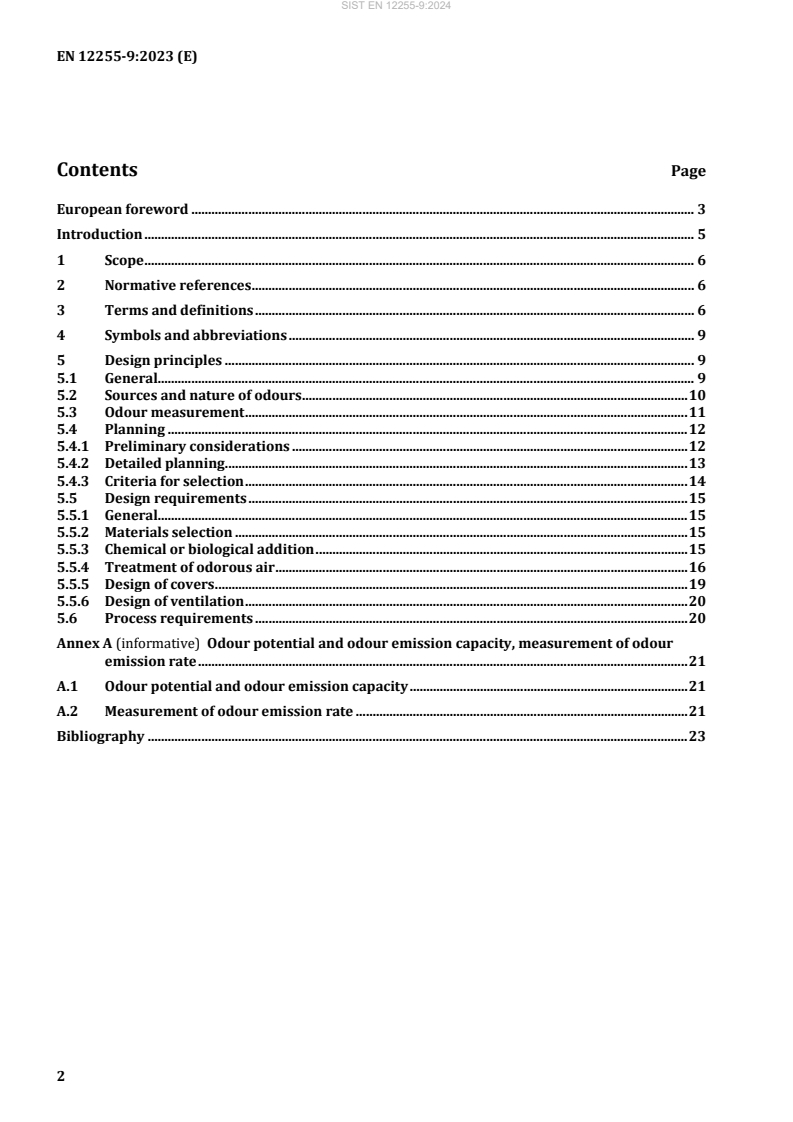
Contents Page
European foreword . 3
Introduction . 5
1 Scope . 6
2 Normative references . 6
3 Terms and definitions . 6
4 Symbols and abbreviations . 9
5 Design principles . 9
5.1 General. 9
5.2 Sources and nature of odours . 10
5.3 Odour measurement . 11
5.4 Planning . 12
5.4.1 Preliminary considerations . 12
5.4.2 Detailed planning . 13
5.4.3 Criteria for selection . 14
5.5 Design requirements . 15
5.5.1 General. 15
5.5.2 Materials selection . 15
5.5.3 Chemical or biological addition . 15
5.5.4 Treatment of odorous air . 16
5.5.5 Design of covers . 19
5.5.6 Design of ventilation . 20
5.6 Process requirements . 20
Annex A (informative) Odour potential and odour emission capacity, measurement of odour
emission rate . 21
A.1 Odour potential and odour emission capacity . 21
A.2 Measurement of odour emission rate . 21
Bibliography . 23
European foreword
This document (EN 12255-9:2023) has been prepared by Technical Committee CEN/TC 165 “Waste
water engineering” the secretariat of which is held by DIN.
This European Standard shall be given the status of a national standard, either by publication of an
identical text or by endorsement, at the latest by May 2024, and conflicting national standards shall be
withdrawn at the latest by May 2024.
Attention is drawn to the possibility that some of the elements of this document may be the subject of
patent rights. CEN shall not be held responsible for identifying any or all such patent rights.
This document supersedes EN 12255-9:2002.
The main changes compared to the previous edition EN 12255-9:2002 are listed below:
— comprehensive revision and additions in all sections;
— adaptation to the current state of the art;
— updating of the Normative references;
— updated bibliography;
— editorial revision.
It is the ninth part prepared by Working Group CEN/TC 165/WG 40 relating to the general
requirements and processes for treatment plants for a total number of inhabitants and population
equivalents (PT) over 50. The EN 12255 series with the generic title “Wastewater treatment plants”
consists of the following parts:
— Part 1: General construction principles
— Part 3: Preliminary treatment
— Part 4: Primary settlement
— Part 5: Lagooning processes
— Part 6: Activated sludge process
— Part 7: Biological fixed-film reactors
— Part 8: Sludge treatment and storage
— Part 9: Odour control and ventilation
— Part 10: Safety principles
— Part 11: General data required
— Part 12: Control and automation
— Part 13: Chemical treatment — Treatment of wastewater by precipitation/flocculation
— Part 14: Disinfection
— Part 15: Measurement of the oxygen transfer in clean water in aeration tanks of activated sludge
plants
— Part 16: Physical (mechanical) filtration
NOTE For requirements on pumping installations at wastewater treatment plants see EN 752, Drain and
sewer systems outside buildings — Sewer system management and EN 16932 (all parts), Drain and sewer systems
outside buildings — Pumping systems.
Any feedback and questions on this document should be directed to the users’ national standards body.
A complete listing of these bodies can be found on the CEN website.
According to the CEN-CENELEC Internal Regulations, the national standards organisations of the
following countries are bound to implement this European Standard: Austria, Belgium, Bulgaria,
Croatia, Cyprus, Czech Republic, Denmark, Estonia, Finland, France, Germany, Greece, Hungary, Iceland,
Ireland, Italy, Latvia, Lithuania, Luxembourg, Malta, Netherlands, Norway, Poland, Portugal, Republic of
North Macedonia, Romania, Serbia, Slovakia, Slovenia, Spain, Sweden, Switzerland, Türkiye and the
United Kingdom.
Introduction
Differences in wastewater treatment throughout Europe have led to a variety of systems being
developed. This document gives fundamental information about the systems; this document has not
attempted to specify all available systems. A generic arrangement of wastewater treatment plants is
illustrated in Figure 1:
Key
1 preliminary treatment C discharged effluent
2 primary treatment D screenings and grit
3 secondary treatment E primary sludge
4 tertiary treatment F secondary sludge
5 additional treatment (e.g. disinfection or G tertiary sludge
removal of micropollutants)
6 sludge treatment H digested sludge
7 lagoons (as an alternative) I digester gas
A raw wastewater J returned water from dewatering
B effluent for re-use (e.g. irrigation)
Figure 1 — Schematic diagram of wastewater treatment plants
Detailed information additional to that contained in this document can be obtained by referring to the
bibliography.
The primary application is for wastewater treatment plants designed for the treatment of domestic and
municipal wastewater.
1 Scope
This document specifies design principles and performance requirements for odour control and
associated ventilation for wastewater treatment plants serving more than 50PT.
2 Normative references
The following documents are referred to in the text in such a way that some or all of their content
constitutes requirements of this document. For dated references, only the edition cited applies. For
undated references, the latest edition of the referenced document (including any amendments) applies.
EN 12255-14, Wastewater treatment plants — Part 14: Disinfection
EN 13725:2022, Stationary source emissions — Determination of odour concentration by dynamic
olfactometry and odour emission rate
EN 16323:2014, Glossary of wastewater engineering terms
EN 16841-1, Ambient air — Determination of odour in ambient air by using field inspection — Part 1:
Grid method
EN 16841-2:2016, Ambient air — Determination of odour in ambient air by using field inspection — Part
2: Plume method
ISO 1629, Rubber and latices — Nomenclature
3 Terms and definitions
For the purposes of this document, the terms and definitions given in EN 16323 and the following apply.
ISO and IEC maintain terminology databases for use in standardization at the following addresses:
— ISO Online browsing platform: available at https://www.iso.org/obp
— IEC Electropedia: available at https://www.electropedia.org/
3.1
olfactometry
measurement of the response of assessors to olfactory stimuli
[SOURCE: EN 16323:2014, 2.1.3.2]
Note 1 to entry: See EN 13725 for details.
3.2
odour concentration
number of European odour units in a cubic metre of gas at standard conditions for olfactometry
[SOURCE: EN 13725:2022, 3.1.30 but with added example and notes]
EXAMPLE If a sample needs to be diluted by a factor of 300 to reach the detection threshold, the odour
concentration of the sample is cod = 300 ouE/m .
Note 1 to entry: The odour concentration has the symbol c and the unit ou /m .
od E
Note 2 to entry: The value of the odour concentration is the dilution factor that is necessary to reach the detection
threshold. At the detection threshold, the odour concentration of the mixture is 1 ouE/m by definition.
3.3
odour emission rate
odour flow rate
quantity of European odour units which crosses a given surface per unit of time
Note 1 to entry: For point sources, the surface is the sampling plane. The odour flow rate is calculated as the
product of the odour concentration cod, the outlet velocity v and the area of the sampling plane A or as the product
of the odour concentration cod and the pertinent volume flow rate V.
Note 2 to entry: The unit of odour flow rate is ou /s (or ou /min or ou /h).
E E E
Note 3 to entry: The odour flow rate, expressed in ou /s, is the quantity equivalent to the mass flow rate,
E
expressed in kg/s, as used in dispersion models for example.
Note 4 to entry: Diffuse sources such as unaerated wastewater or sludge surfaces, do not have a defined waste air
flow, although they can emit odorants. In these cases, a special sampling procedure is necessary which is
discussed in EN 13725 (see Annex A). Odorant flow rates can be used in an analogous fashion to mass flow rates
when modelling the impact from a source. All odour sources will have an odorant flow rate, even where no air
flow rate is easily identifiable.
[SOURCE: EN 13725:2022, 3.2.8 modified by the addition of Note 4]
3.4
volatile organic compound
VOC
organic compound with an initial boiling point less than or equal to 250 °C measured at a standard
pressure of 101,3 kPa
[SOURCE: EU Directive 2004/42/CE]
3.5
capital expenditure
CAPEX
money used to purchase and install and commission a capital asset
[SOURCE: ISO 15663-1:2000, 2.1.6]
3.6
operational expenditure
OPEX
recurrent expenditure required to provide a service or product
[SOURCE: ISO/TS 55010:2019, 3.9]
3.7
empty bed residence time
EBRT
total time air is retained in a considered unit in average conditions
3 3
Note 1 to entry: The EBRT is calculated as V/Q, where V (m ) is the total internal volume of the unit and Q (m /s)
is the air flow rate. The EBRT calculation assumes that the unit is empty, regardless the presence of packings or
other solid elements.
3.8
specific ozone demand
required ozone concentration in the odours air (g O /m or g O /l) to achieve a level of odour reduction
3 3
3.9
contact tank
tank for providing the required retention time for certain reactions to take place
[SOURCE: EN 16323:2014, term 2.3.9.4, modified – definition was modified to extend to use with gases]
3.10
advanced oxidation process
AOP
chemical process generating hydroxyl or oxygen radicals
3.11
UV efficiency
UV-C radiation conversion efficiency
ability of a UV-C lamp to convert electrical power into UV-C radiation
Note 1 to entry: The ratio is the UV-C radiation power accounting for the electrical power of the UV-C lamp. The
UV-C conversion efficiency of a low pressure UV-C lamp at 253,7 nm is between 25 % and 45 %. The UV-C
conversion efficiency should not be less than 30 % in an air disinfection field under all circumstances due to
energy consumption of the system.
[SOURCE: ISO 15727:2020, 3.6]
3.12
UV radiation demand
sum of the UV output (W) at 254 nm from all the lamps of an UV reactor, divided by the odorous air flow
/h) to achieve a certain level of disinfection
rate (m
Note 1 to entry: The UV output from a lamp is measured according to ISO 15727.
4 Symbols and abbreviations
For the purposes of this document, the following symbols and abbreviations apply.
AOX adsorbable organohalogens
AOP advanced oxidation process
CAPEX capital expenditure
C concentration (in ppm) resulting by the sum of all the measured odorants
OD
EBRT empty bed residence time
FFKM perfluoroelastomer
NOTE Defined in ASTM D1418 (equivalent to FFPMs defined in ISO 1629)
FKM fluorocarbon
NOTE Defined in ASTM D1418 (equivalent to FPM defined in ISO 1629)
FRP fibre-reinforced plastic (sometimes referred to as fiber-reinforced polymer, or fiber-
reinforced plastic)
H S hydrogen sulphide
NH ammonia
ou European odour units
E
OPEX operating expenditure
P the emitted UV output at 254 nm and P (W)
254 in
PE polyethylene
Pin the power input to the lamp (W)
PP polypropylene
PTFE polytetrafluoroethylene
UV ultraviolet, electromagnetic radiation with wavelength 100 nm to 400 nm
UV-C ultraviolet electromagnetic radiation with wavelength 100 nm to 280 nm
VOC volatile organic compounds
W Watts
5 Design principles
5.1 General
Given the nature of wastewater it is not possible to guarantee that a wastewater treatment plant will be
totally odour free. A well-designed plant minimizes the potential for odour problems.
The potential for odour generation shall be considered at the earliest stages in the design of wastewater
treatment works. The likelihood of odour emission, its impact and ease of treatment shall be considered
in all aspects of design, especially:
a) septicity of the raw wastewater – e.g. by considering the sewerage system;
b) process selection – e.g. if septic wastewater is anticipated, possibilities to minimize odour include:
1) minimizing the retention time of the sludge in the primary settlement tank;
2) having no primary settlement (thus avoiding a major source of odour) and applying extended
aeration;
3) selecting a covered process;
c) location of the major sources of odour – e.g. wherever possible, site these away from the most
sensitive locations surrounding the plant taking into account the direction and speed of winds local
to the installation;
NOTE Situations with light wind or no wind and stable atmospheric conditions are most unfavourable for the
dispersion of odours. Thus, if these situations happen very often, then the local wind direction during these
situations is relevant instead of the generally prevailing wind direction.
d) co-location of unit processes — e.g. it can be possible to use a single abatement process to treat
more than one source of odour or to use the odorous air from one process as process or
combustion air in an adjacent process. Any decision to treat odorous air will require a process to be
covered and ventilated with the vented air ducted to treatment. Covering, venting and treatment
shall be designed as an integrated package.
Where treatment plants are not covered or housed in buildings and the effect of odour is difficult to
quantify prior to commissioning designs should allow for covering and/or ventilation at a later date.
Further general design requirements are given in EN 12255-1.
When tanks or processes are covered careful consideration is required of:
e) explosion risk;
f) corrosion prevention;
g) health and safety of operators;
h) access for operation and maintenance;
i) ventilation and its potential consequences.
Details on construction principles and health and safety can be found in EN 12255-1 and EN 12255-10.
5.2 Sources and nature of odours
Odour is generated during the conveyance and treatment of wastewater primarily due to the
degradation of organic matter by microorganisms under anaerobic conditions. Industrial wastewater
can also contain characteristic odorous constituents. The onset of septicity can be accelerated by
elevated temperatures, high BOD concentration and presence of reducing chemicals. The range of
odorous constituents is very wide and includes:
— hydrogen sulphide;
— ammonia;
— organic sulphur compounds; thiols (e.g. mercaptans);
— organic compounds with nitrogen as amines; indole and skatole;
— volatile fatty acids;
— other Volatile Organic Compounds (VOC).
The features that typically cause odours to occur are:
— unfavourable conditions in the sewage systems (e.g. long retention times, poor maintenance,
industrial discharges);
— long pressure mains;
— some high rate treatment processes;
— anaerobic lagoons;
— sludge storage and treatment processes.
Odours can be present or form in the sewer system or in the treatment plant. Once formed, odours tend
to travel with the flow through the treatment process to be transferred to the atmosphere at points of
turbulence or where there is a large air-water interface. Levels of odour can be increased by the
recycling of liquors within a treatment process, particularly when recycling those produced by the
thickening or dewatering of sludge.
NOTE EN 752 and EN 16932 (all parts) give guidance on minimizing septicity in drain and sewer systems.
Particular problems can be found at:
a) inlet works: strong odours in the incoming flow lead to high levels of release at inlet works;
b) treatment of screenings and grit;
c) primary settlement tanks: if they receive a highly odorous flow or if excessive sludge is allowed to
accumulate in the tank, generating septicity;
d) secondary treatment: if it is highly loaded or receives a highly odorous feed;
e) sites for the transfer, storage and treatment of sludges, especially of non-stabilized sludges;
f) leaks or emissions of biogas from anaerobic digestion and the first point of discharge of digested
sludge.
5.3 Odour measurement
Quantitative measurements of odour shall be carried out when undertaking investigations into the
causes of odour, for identifying sites where odour is formed or emitted, for estimating the impact from
an odour source and for specifying the duty of odour abatement equipment.
Measurement and assessment of odorous compounds may include:
a) technical/automated measurements of the four main compounds H S, NH , mercaptanes and
2 3
amines (which are normally present), with detection tubes or with electronic devices;
b) measurement of specific odorous compounds arising from known or foreseeable industrial
effluents.
Quantitative measurements of odour include:
c) measurement based on olfactometry:
1) the odorant detection threshold concentration applicable to single compounds;
2) the odour concentration applicable to air samples of unknown composition;
3) the odour potential and odour emission capacity (see Annex A);
4) the odorant flow rate (see Annex A).
The levels of hydrogen sulphide, ammonia, mercaptans and amines are easy to measure and
provide valuable information for odour solution.
Reliance solely on hydrogen sulfide measurements can be misleading in cases where odorants
other than hydrogen sulfide are predominant e.g. ammonia and organic sulphides. Often this
can be the case where odours:
5) come predominantly from a specific industrial discharge;
6) come from secondary treatment;
7) come from the incineration or drying of sludge;
8) follow abatement measures aimed specifically at reducing H S.
Measurements shall be undertaken in accordance with EN 13725, EN 16841-1 and EN 16841-2.
5.4 Planning
5.4.1 Preliminary considerations
5.4.1.1 General
Discussions should be held with the appropriate authorities to ascertain what standards need to be met
by the proposed plant or proposed abatement measures at an existing plant. Most wastewater
treatment processes will require odour abatement in particularly sensitive locations.
An atmospheric dispersion model using a historical record of wind-speed and direction and
atmospheric stability class can be used to estimate the odour emission rate that will comply with such a
standard. This odour emission rate can be used as a target for design or as a specification for the
performance of abatement technology.
At existing sites with known odour emission rates, the results from a model of atmospheric dispersion
can be compared against the locations of received complaints to estimate a suitable quality standard.
New installations shall be designed where possible to minimize the problem of odour generation.
5.4.1.2 Sewer system
A sewer system designed according to the principles contained in EN 752 should minimize the
development of septicity [1].
5.4.1.3 Wastewater treatment plants
The following points shall be considered during the design:
a) control of the discharge of particularly odorous industrial wastewater;
b) location of the plant;
c) minimizing of the exposure of non-stabilized or pseudo-stabilized sludges during storage and
treatment;
d) avoiding the development of septicity in settlement tanks by minimizing the retention time of the
accumulating sludge layer;
e) choosing processes which minimize emissions where a highly odorous feed-stream is unavoidable
(see 5.1);
f) minimizing turbulence e.g. by minimizing the drop over weirs (unless used for stripping);
g) the addition of odorous return flows as close to aerobic secondary treatment processes as possible;
h) choosing compact designs where process covering is unavoidable;
i) locating the major sources of odour as far as possible from the most sensitive receptors in the
vicinity;
j) grouping the main odour sources to allow the use of common abatement measures;
k) use of odorous air from one process as the process or combustion air for another process. In this
case air quality shall be considered;
l) prevention of increased evaporation of odour compounds;
m) minimizing situations where pressure reduction can occur (e.g. when removing digested sludge
from a digester), to avoid releases of gases from solution;
n) enclosure of units or materials (e.g. screenings).
5.4.1.4 Remedial measures
When designing remedial measures to overcome an unacceptable odour impact in the vicinity,
thorough investigations should be undertaken to identify how odour is generated, where it is emitted
and, if possible, to estimate the odour emission rates of the major sources. Specific compound analysis
and the measurement of odour potentials in the liquid streams will show where odours are being
formed. Analysis for specific compounds in air samples can help to locate the significant points of odour
emission. Preparation of a map of hydrogen sulphide concentrations within and around a treatment
works can be very valuable. For techniques for measuring odour emission rates see Annex A.
5.4.2 Detailed planning
5.4.2.1 Odour abatement
Methods for odour abatement from a number of basic categories include:
a) process design and layout;
b) process operation;
c) industrial wastewater limits and controls;
d) chemical addition to prevent septicity, to ameliorate its effects or otherwise reduce odour;
e) cover odour sources, provide ventilation and treat the collected air.
Methods a), b) and c) are described in 5.4.1.1 and 5.4.1.3. When using chemicals, great care shall be
taken to ensure that no detrimental by-product is produced as a consequence.
5.4.2.2 Chemical additives
Chemical additives can be divided into:
a) strong oxidising agents (e.g. ozone, hydrogen peroxide and sodium hypochlorite) which will oxidize
many odorous compounds after they have been formed;
b) sources of oxygen (e.g. air, oxygen concentrators, liquid oxygen and nitrate salts) which act
primarily as sources of oxygen to prevent the development of septicity. In a secondary range some
treatment of pre-formed odours can occur;
c) metal salts, (typically of iron) which are used to fix sulphide as insoluble metal sulphides,
preventing any transfer to the atmosphere.
When using sodium hypochlorite the formation of adsorbable organohalogens (AOX) compounds shall
be investigated and minimized.
5.4.2.3 Treating odorous air
Methods of treating odorous air that may be considered include:
a) biofiltration;
b) ozonation;
c) advanced oxidation based on UV radiation combined with ozonation;
d) wet chemical, biological or ozone scrubbing;
e) regular bed adsorpt
...