

SIST EN 4526:2014
(Main)Aerospace series - Metallic materials - Test methods - Sharp edge-notch tensile testing for sheet and strip
- Abstract
This European Standard specifies the requirements for sharp edge-notch tensile testing for sheet and strip for aerospace applications.
It shall be applied when referred to in the EN Technical Specification or material standard unless otherwise specified on the drawing, order or inspection schedule.
- Status
- Published
- Publication Date
- 02-Jan-2014
- Technical Committee
- I13 - Imaginarni 13
- Current Stage
- 6060 - National Implementation/Publication (Adopted Project)
- Start Date
- 23-Dec-2013
- Due Date
- 27-Feb-2014
- Completion Date
- 03-Jan-2014

SIST EN 4526:2014 is the Slovenian adoption of EN 4526:2013, a European standard from CEN for sharp edge-notch tensile testing of sheet and strip for aerospace applications. It specifies how to carry out a notched tensile test on metallic sheet and strip and how to report the results when the method is called up in an EN Technical Specification or material standard.
What does SIST EN 4526:2014 specify?
SIST EN 4526:2014 specifies the requirements for sharp edge-notch tensile testing of sheet and strip used in aerospace applications. In practice, it is the method to use when a material specification, technical specification, drawing, order, or inspection schedule calls for this test.
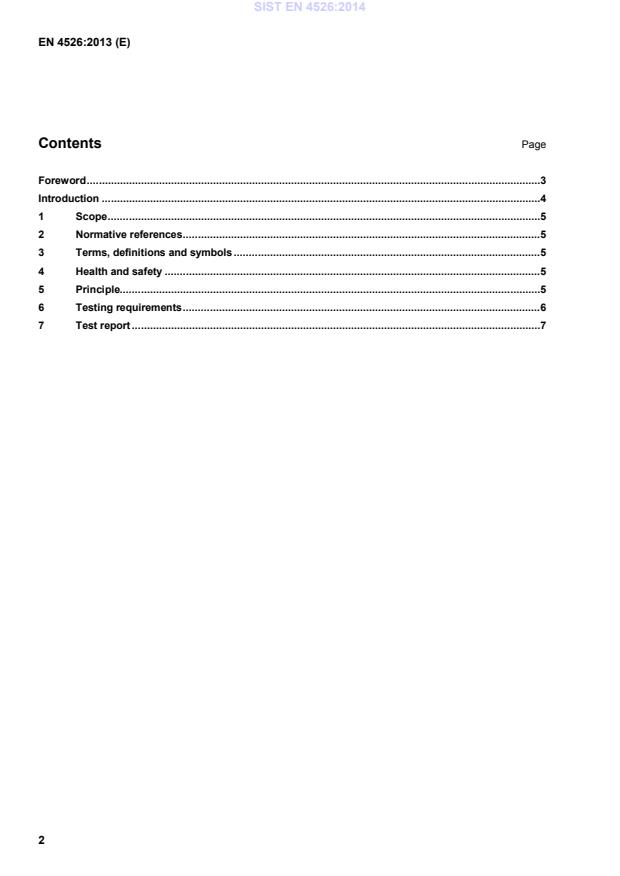
The document is organized into seven clauses:
- Scope
- Normative references
- Terms, definitions and symbols
- Health and safety
- Principle
- Testing requirements
- Test report
The method is aimed at metallic materials where a sharp machined notch can be made in the specimen, which matters because the test depends on notch-sensitive fracture behaviour.
What are the key requirements of SIST EN 4526:2014?
When the method applies
Clause 1 says the test is used for sheet and strip in aerospace applications when it is referenced by the relevant EN Technical Specification or material standard, unless another instruction is given on the drawing, order, or inspection schedule. That makes it a call-up method rather than a stand-alone mandatory test for every product.
Clause 5 defines the principle: a test piece with a sharp machined notch is pulled in tension until the maximum force, P, is reached. The ratio of sharp notch strength to 0,2 % proof stress is used as a comparative index of fracture toughness, so the result is mainly used to compare materials or product conditions.
Specimen, equipment and personnel
Clause 6.1 points users to EN 2002-001 for equipment and plant used in ambient-temperature tensile testing. It also allows practical support items such as degreasing fluids, recording paper, and electronic recording where appropriate.
Clause 6.1.3 requires the test to be carried out or supervised only by competent personnel with suitable education, training and experience. In practice, the laboratory needs trained staff, not only the right machine.
Test piece and procedure
Clause 6.2 requires a machined sharp edge-notch specimen in accordance with ASTM E338-91. Clause 6.3 says the general procedure follows ASTM E338-91 and EN 2002-001.
The test temperature is limited to 10 °C to 35 °C unless otherwise specified. In case of dispute, the test is performed at 23 °C ± 5 °C. This matters because temperature affects measured tensile behaviour and comparison between results.
Results and reporting
Clause 6.4 refers result expression back to ASTM E338-91. Clause 7 then sets out the written report content, including:
- reference to the standard
- relevant test conditions, equipment, procedure and verification
- identification and traceability of the semi-finished product
- identification and traceability of the test samples and test pieces
- the result expression, including individual or mean values and any unusual fracture features
- recorded plots or graphs when needed
- date of test, traceability of the person who performed it, incidents affecting results, and any deviation from the method
That level of traceability is important when results are used for product qualification, acceptance, or investigation.
What terms does SIST EN 4526:2014 define?
- Sharp edge-notch tensile testing - A tensile test on a specimen with a sharp machined notch, used to assess how the material behaves at a stress concentration.
- Maximum force, P - The highest force the specimen withstands during the test.
- Sharp notch strength - The strength measure obtained from the notched tensile test.
- 0,2 % proof stress - The reference stress used in the ratio that compares sharp notch strength with yielding behaviour.
- Fracture toughness - The resistance of a material to crack growth and fracture; here the standard uses a ratio as a comparative index.
- Test piece - The actual notched specimen that is pulled in tension.
- Test sample - The piece taken from the semi-finished product from which the test piece is prepared.
Who uses SIST EN 4526:2014?
SIST EN 4526:2014 is used by aerospace material suppliers, test laboratories, quality teams, and inspectors working with metallic sheet and strip. It is relevant when a technical specification, material standard, drawing, order, or inspection schedule requires sharp edge-notch tensile testing.
Buyers and specification writers also use it to define a consistent acceptance or qualification test for sheet and strip, especially for materials such as aluminium and magnesium alloys where the notch can be machined.
What changed in SIST EN 4526:2014 from the previous edition?
SIST EN 4526:2014 is the Slovenian standard identical to EN 4526:2013.
Which standards are used with SIST EN 4526:2014?
| Reference | What it contributes |
|---|---|
| EN 2002-001 | Ambient-temperature tensile testing requirements for equipment and general procedure. |
| EN 4258 | General organization of aerospace metallic material standards and their use. |
| EN 4259 | Terms, definitions and symbols used for aerospace metallic materials standards. |
| ASTM E338-91 | Specimen details, general procedure, and result expression for sharp notch tension testing. |
What does the SIST EN 4526:2014 document contain?
The document gives the test principle, the required specimen type, the temperature range for testing, and the competence requirement for personnel. It also links the method to ASTM E338-91 and EN 2002-001 so users know where to follow the detailed specimen and procedural rules.
Clause 7 is especially practical because it lists what the test report should capture for traceability and interpretation. That makes the standard useful not only for testing, but also for audits, qualification records, and disputes over results.
Relations
- Effective Date
- 28-Jan-2026
- Effective Date
- 28-Jan-2026
- Effective Date
- 28-Jan-2026
Get Certified
Connect with accredited certification bodies for this standard

BUREAU VERITAS Certification Germany
Bureau Veritas certification in Germany.

Element Materials Technology
Materials testing and product certification.

AQMS Ltd.
AQMS provides ISO certification to SMEs across the UK.
Sponsored listings
Frequently Asked Questions
SIST EN 4526:2014 is a standard published by the Slovenian Institute for Standardization (SIST). Its full title is "Aerospace series - Metallic materials - Test methods - Sharp edge-notch tensile testing for sheet and strip". This standard covers: This European Standard specifies the requirements for sharp edge-notch tensile testing for sheet and strip for aerospace applications. It shall be applied when referred to in the EN Technical Specification or material standard unless otherwise specified on the drawing, order or inspection schedule.
This European Standard specifies the requirements for sharp edge-notch tensile testing for sheet and strip for aerospace applications. It shall be applied when referred to in the EN Technical Specification or material standard unless otherwise specified on the drawing, order or inspection schedule.
SIST EN 4526:2014 is classified under the following ICS (International Classification for Standards) categories: 49.025.05 - Ferrous alloys in general; 49.025.15 - Non-ferrous alloys in general. The ICS classification helps identify the subject area and facilitates finding related standards.
SIST EN 4526:2014 has the following relationships with other standards: It is inter standard links to SIST EN 2002-001:2026, SIST EN 4258:2024, SIST EN 4400-2:2019. Understanding these relationships helps ensure you are using the most current and applicable version of the standard.
SIST EN 4526:2014 is available in PDF format for immediate download after purchase. The document can be added to your cart and obtained through the secure checkout process. Digital delivery ensures instant access to the complete standard document.
Standards Content (Sample)
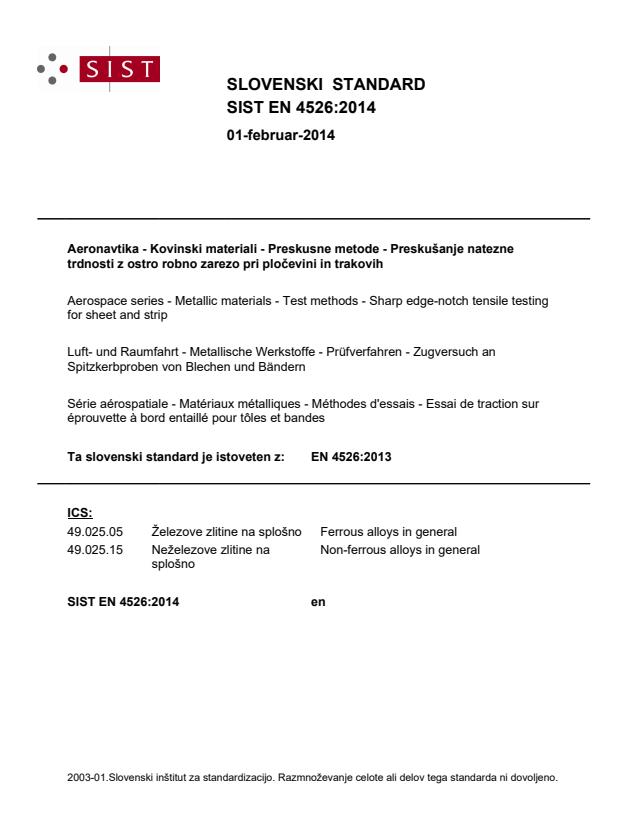
2003-01.Slovenski inštitut za standardizacijo. Razmnoževanje celote ali delov tega standarda ni dovoljeno.Luft- und Raumfahrt - Metallische Werkstoffe - Prüfverfahren - Zugversuch an Spitzkerbproben von Blechen und BändernSérie aérospatiale - Matériaux métalliques - Méthodes d'essais - Essai de traction sur éprouvette à bord entaillé pour tôles et bandesAerospace series - Metallic materials - Test methods - Sharp edge-notch tensile testing for sheet and strip49.025.15Neželezove zlitine na splošnoNon-ferrous alloys in general49.025.05Železove zlitine na splošnoFerrous alloys in generalICS:Ta slovenski standard je istoveten z:EN 4526:2013SIST EN 4526:2014en01-februar-2014SIST EN 4526:2014SLOVENSKI
STANDARD
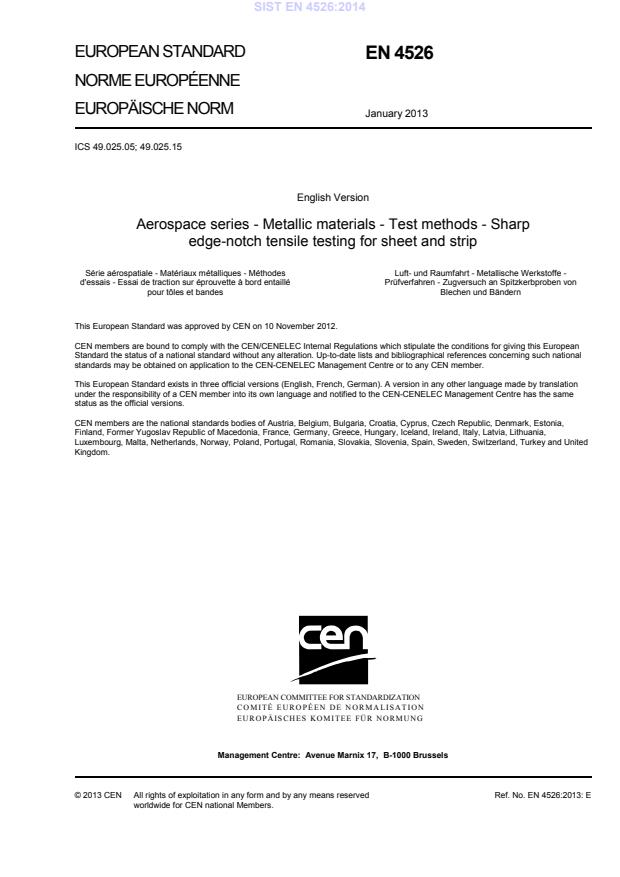
EUROPEAN STANDARD NORME EUROPÉENNE EUROPÄISCHE NORM
EN 4526
January 2013 ICS 49.025.05; 49.025.15 English Version
Aerospace series - Metallic materials - Test methods - Sharp edge-notch tensile testing for sheet and strip
Série aérospatiale - Matériaux métalliques - Méthodes d'essais - Essai de traction sur éprouvette à bord entaillé pour tôles et bandes
Luft- und Raumfahrt - Metallische Werkstoffe - Prüfverfahren - Zugversuch an Spitzkerbproben von Blechen und Bändern This European Standard was approved by CEN on 10 November 2012.
CEN members are bound to comply with the CEN/CENELEC Internal Regulations which stipulate the conditions for giving this European Standard the status of a national standard without any alteration. Up-to-date lists and bibliographical references concerning such national standards may be obtained on application to the CEN-CENELEC Management Centre or to any CEN member.
This European Standard exists in three official versions (English, French, German). A version in any other language made by translation under the responsibility of a CEN member into its own language and notified to the CEN-CENELEC Management Centre has the same status as the official versions.
CEN members are the national standards bodies of Austria, Belgium, Bulgaria, Croatia, Cyprus, Czech Republic, Denmark, Estonia, Finland, Former Yugoslav Republic of Macedonia, France, Germany, Greece, Hungary, Iceland, Ireland, Italy, Latvia, Lithuania, Luxembourg, Malta, Netherlands, Norway, Poland, Portugal, Romania, Slovakia, Slovenia, Spain, Sweden, Switzerland, Turkey and United Kingdom.
EUROPEAN COMMITTEE FOR STANDARDIZATION
COMITÉ EUROPÉEN DE NORMALISATION EUROPÄISCHES KOMITEE FÜR NORMUNG
Management Centre:
Avenue Marnix 17,
B-1000 Brussels © 2013 CEN All rights of exploitation in any form and by any means reserved worldwide for CEN national Members. Ref. No. EN 4526:2013: ESIST EN 4526:2014
...