

SIST EN IEC 60079-17:2024
(Main)Explosive atmospheres - Part 17: Electrical installations inspection and maintenance (IEC 60079-17:2023)
General Information
- Abstract
This part of the IEC 60079 series applies to users and covers only those factors directly related to the inspection and maintenance of electrical installations specifically designed for hazardous areas, where the hazard may be caused by explosive gas or explosive dust atmospheres.
It does not include:
- other fundamental installation and inspection requirements for electrical installations;
- the verification of electrical equipment;
- protection or ventilation of rooms;
- gas detection systems;
- the repair and overhaul of explosion protected equipment (see IEC 60079-19).
While this standard does not include inspection of safety devices such as used in ventilated rooms (see 60079-13), this standard does include the requirements for inspection and maintenance of individual items of equipment that will be part of such systems, for example motors or sensors.
This standard supplements the requirements for inspection and testing in non-hazardous areas in IEC 60364-6.
NOTE 1 Standards applied at the date of installation might not have been IEC standards.
This standard is intended to be applied where there can be a risk due to the presence of explosive gas or dust mixtures with air or combustible dust layers under normal atmospheric conditions. It does not apply to:
- underground mining areas,
- dusts of explosives,
- pyrophoric substances.
- Status
- Published
- Public Enquiry End Date
- 22-Apr-2021
- Publication Date
- 05-Mar-2024
- Technical Committee
- EXP - Product for explosive atmospheres
- Current Stage
- 6060 - National Implementation/Publication (Adopted Project)
- Start Date
- 16-Jan-2024
- Due Date
- 22-Mar-2024
- Completion Date
- 06-Mar-2024

Overview
EN IEC 60079-17:2024 - Explosive atmospheres - Part 17: Electrical installations inspection and maintenance - provides practical requirements for inspecting and maintaining electrical installations located in hazardous areas where explosive gas or combustible dust atmospheres may occur. It is the European adoption of IEC 60079-17:2023, superseding EN 60079-17:2014, and is intended to be used alongside general installation standards (for example IEC/EN 60079-14 and IEC 60364-6).
This standard focuses only on factors directly related to inspection and maintenance of explosion-protected electrical installations and equipment; it explicitly excludes equipment verification, repair/overhaul (see IEC 60079-19), room ventilation or protection systems, gas detection systems and underground mining or pyrophoric materials.
Key topics and technical requirements
- Documentation and records: required inspection schedules, certificates and maintenance records to demonstrate continuing compliance.
- Competence of personnel: roles and minimum knowledge/skills for Technical Persons with Executive Function, Skilled Personnel and inspectors (see Annex B).
- Inspection types and grades: definitions of periodic inspections, continuous supervision and various inspection grades and scopes.
- Inspection schedules and tables: itemized checks for cable glands, sealing, insulation resistance, fault loop impedance/earthing resistance, lamps/luminaires and protection devices.
- Protection types covered: requirements tailored to protection concepts such as "d" (flameproof), "e" (increased safety), "i" (intrinsic safety), "p" (pressurized), "n", "t" (enclosure) and encapsulation methods.
- Maintenance and remedial actions: permitted modifications, withdrawal from service, safe isolation procedures and guidance for live work on intrinsically safe circuits.
- External influences and specific conditions of use: assessment of environmental impacts and fitness-for-purpose (Annex C).
- Earthing and bonding: criteria for continuity and earthing to maintain intrinsic safety and fault protection.
Practical applications and users
EN IEC 60079-17:2024 is essential for:
- Plant and facility engineers responsible for electrical installations in petrochemical, chemical, pharmaceutical, food processing, grain handling and other industries with explosive atmospheres.
- Maintenance teams and contractors performing periodic inspections, testing and corrective maintenance.
- Safety managers, inspectors and auditors who assess compliance with hazardous-area installation requirements.
- Asset owners and operators documenting fitness-for-service and evidence for regulators or certification bodies.
Use this standard to develop inspection plans, define competent personnel requirements, conduct risk-based periodic inspections and maintain records required to demonstrate ongoing safety in hazardous areas.
Related standards
- IEC/EN 60079-0, 60079-10-1, 60079-10-2, 60079-14, 60079-19
- IEC 60364-6 (verification of low-voltage installations)
Keywords: EN IEC 60079-17:2024, explosive atmospheres, electrical installations inspection and maintenance, hazardous areas, inspection schedules, intrinsic safety, flameproof, increased safety.
Relations
- Effective Date
- 03-Feb-2026
- Effective Date
- 03-Feb-2026
- Effective Date
- 03-Feb-2026
- Effective Date
- 03-Feb-2026
- Effective Date
- 20-Feb-2026
- Effective Date
- 09-Feb-2026
- Effective Date
- 09-Feb-2026
- Effective Date
- 09-Feb-2026
- Effective Date
- 09-Feb-2026
- Effective Date
- 09-Feb-2026
- Effective Date
- 09-Feb-2026
- Effective Date
- 09-Feb-2026
- Effective Date
- 09-Feb-2026
- Effective Date
- 09-Feb-2026
- Effective Date
- 09-Feb-2026
Get Certified
Connect with accredited certification bodies for this standard

DIBt (Deutsches Institut für Bautechnik)
German Institute for Building Technology.
DIN CERTCO
DIN Group product certification.

IMQ S.p.A. (Certification)
Italian electrical product certification.
Sponsored listings
Frequently Asked Questions
SIST EN IEC 60079-17:2024 is a standard published by the Slovenian Institute for Standardization (SIST). Its full title is "Explosive atmospheres - Part 17: Electrical installations inspection and maintenance (IEC 60079-17:2023)". This standard covers: This part of the IEC 60079 series applies to users and covers only those factors directly related to the inspection and maintenance of electrical installations specifically designed for hazardous areas, where the hazard may be caused by explosive gas or explosive dust atmospheres. It does not include: - other fundamental installation and inspection requirements for electrical installations; - the verification of electrical equipment; - protection or ventilation of rooms; - gas detection systems; - the repair and overhaul of explosion protected equipment (see IEC 60079-19). While this standard does not include inspection of safety devices such as used in ventilated rooms (see 60079-13), this standard does include the requirements for inspection and maintenance of individual items of equipment that will be part of such systems, for example motors or sensors. This standard supplements the requirements for inspection and testing in non-hazardous areas in IEC 60364-6. NOTE 1 Standards applied at the date of installation might not have been IEC standards. This standard is intended to be applied where there can be a risk due to the presence of explosive gas or dust mixtures with air or combustible dust layers under normal atmospheric conditions. It does not apply to: - underground mining areas, - dusts of explosives, - pyrophoric substances.
This part of the IEC 60079 series applies to users and covers only those factors directly related to the inspection and maintenance of electrical installations specifically designed for hazardous areas, where the hazard may be caused by explosive gas or explosive dust atmospheres. It does not include: - other fundamental installation and inspection requirements for electrical installations; - the verification of electrical equipment; - protection or ventilation of rooms; - gas detection systems; - the repair and overhaul of explosion protected equipment (see IEC 60079-19). While this standard does not include inspection of safety devices such as used in ventilated rooms (see 60079-13), this standard does include the requirements for inspection and maintenance of individual items of equipment that will be part of such systems, for example motors or sensors. This standard supplements the requirements for inspection and testing in non-hazardous areas in IEC 60364-6. NOTE 1 Standards applied at the date of installation might not have been IEC standards. This standard is intended to be applied where there can be a risk due to the presence of explosive gas or dust mixtures with air or combustible dust layers under normal atmospheric conditions. It does not apply to: - underground mining areas, - dusts of explosives, - pyrophoric substances.
SIST EN IEC 60079-17:2024 is classified under the following ICS (International Classification for Standards) categories: 29.260.20 - Electrical apparatus for explosive atmospheres; 91.140.50 - Electricity supply systems. The ICS classification helps identify the subject area and facilitates finding related standards.
SIST EN IEC 60079-17:2024 has the following relationships with other standards: It is inter standard links to SIST EN IEC 60079-10-1:2021, SIST EN 60079-10-2:2015, SIST EN IEC 60079-15:2019, SIST EN IEC 60079-0:2018, oSIST prEN IEC 60335-2-24:2026, SIST EN 12981:2005+A1:2009, SIST EN 17673:2022, SIST EN 1776:2016, SIST EN 1473:2016, SIST EN 12405-2:2013, SIST EN 16314:2013, SIST EN 15001-2:2023, SIST EN 1776:2026, SIST EN 1755:2016, SIST EN 1804-3:2021. Understanding these relationships helps ensure you are using the most current and applicable version of the standard.
SIST EN IEC 60079-17:2024 is available in PDF format for immediate download after purchase. The document can be added to your cart and obtained through the secure checkout process. Digital delivery ensures instant access to the complete standard document.
Standards Content (Sample)
SLOVENSKI STANDARD
01-april-2024
Eksplozivne atmosfere - 17. del: Pregledovanje in vzdrževanje električnih inštalacij
(IEC 60079-17:2023)
Explosive atmospheres - Part 17: Electrical installations inspection and maintenance
(IEC 60079-17:2023)
Explosionsgefährdete Bereiche - Teil 17: Prüfung und Instandhaltung elektrischer
Anlagen (IEC 60079-17:2023)
Atmosphères explosives - Partie 17: Inspection et entretien des installations électriques
(IEC 60079-17:2023)
Ta slovenski standard je istoveten z: EN IEC 60079-17:2024
ICS:
29.260.20 Električni aparati za Electrical apparatus for
eksplozivna ozračja explosive atmospheres
91.140.50 Sistemi za oskrbo z elektriko Electricity supply systems
2003-01.Slovenski inštitut za standardizacijo. Razmnoževanje celote ali delov tega standarda ni dovoljeno.
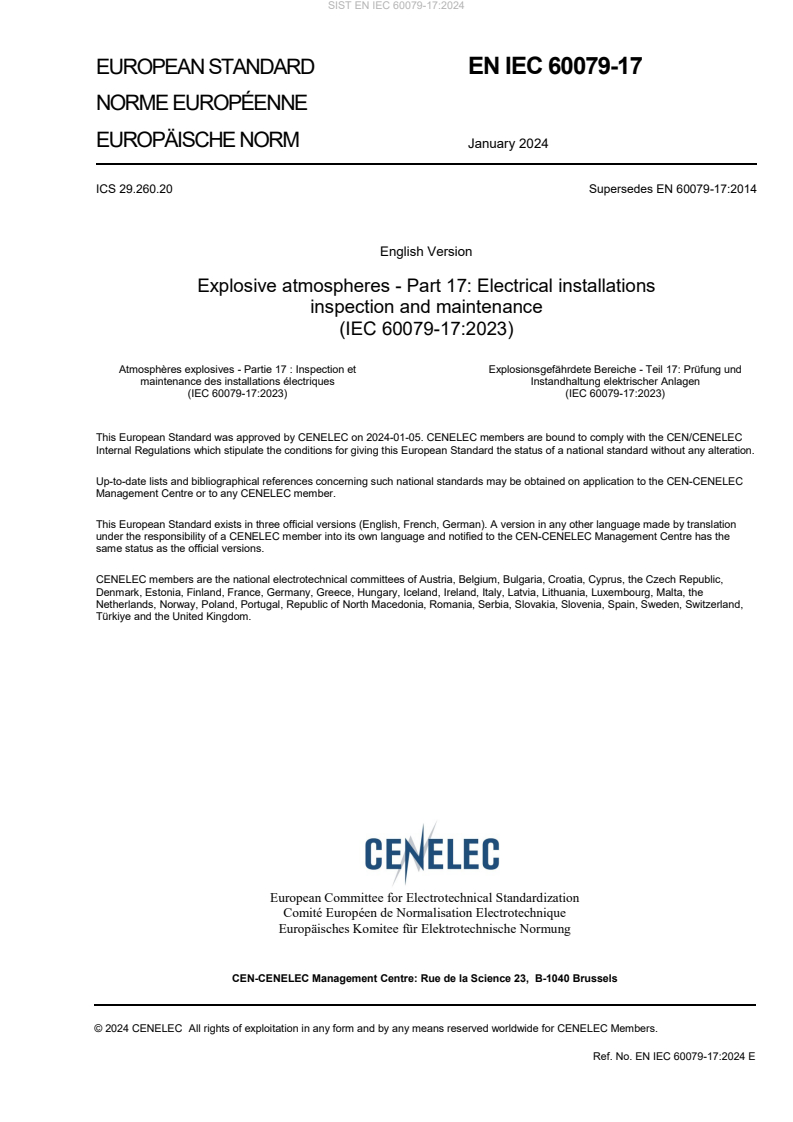
EUROPEAN STANDARD EN IEC 60079-17
NORME EUROPÉENNE
EUROPÄISCHE NORM January 2024
ICS 29.260.20 Supersedes EN 60079-17:2014
English Version
Explosive atmospheres - Part 17: Electrical installations
inspection and maintenance
(IEC 60079-17:2023)
Atmosphères explosives - Partie 17 : Inspection et Explosionsgefährdete Bereiche - Teil 17: Prüfung und
maintenance des installations électriques Instandhaltung elektrischer Anlagen
(IEC 60079-17:2023) (IEC 60079-17:2023)
This European Standard was approved by CENELEC on 2024-01-05. CENELEC members are bound to comply with the CEN/CENELEC
Internal Regulations which stipulate the conditions for giving this European Standard the status of a national standard without any alteration.
Up-to-date lists and bibliographical references concerning such national standards may be obtained on application to the CEN-CENELEC
Management Centre or to any CENELEC member.
This European Standard exists in three official versions (English, French, German). A version in any other language made by translation
under the responsibility of a CENELEC member into its own language and notified to the CEN-CENELEC Management Centre has the
same status as the official versions.
CENELEC members are the national electrotechnical committees of Austria, Belgium, Bulgaria, Croatia, Cyprus, the Czech Republic,
Denmark, Estonia, Finland, France, Germany, Greece, Hungary, Iceland, Ireland, Italy, Latvia, Lithuania, Luxembourg, Malta, the
Netherlands, Norway, Poland, Portugal, Republic of North Macedonia, Romania, Serbia, Slovakia, Slovenia, Spain, Sweden, Switzerland,
Türkiye and the United Kingdom.
European Committee for Electrotechnical Standardization
Comité Européen de Normalisation Electrotechnique
Europäisches Komitee für Elektrotechnische Normung
CEN-CENELEC Management Centre: Rue de la Science 23, B-1040 Brussels
© 2024 CENELEC All rights of exploitation in any form and by any means reserved worldwide for CENELEC Members.
Ref. No. EN IEC 60079-17:2024 E
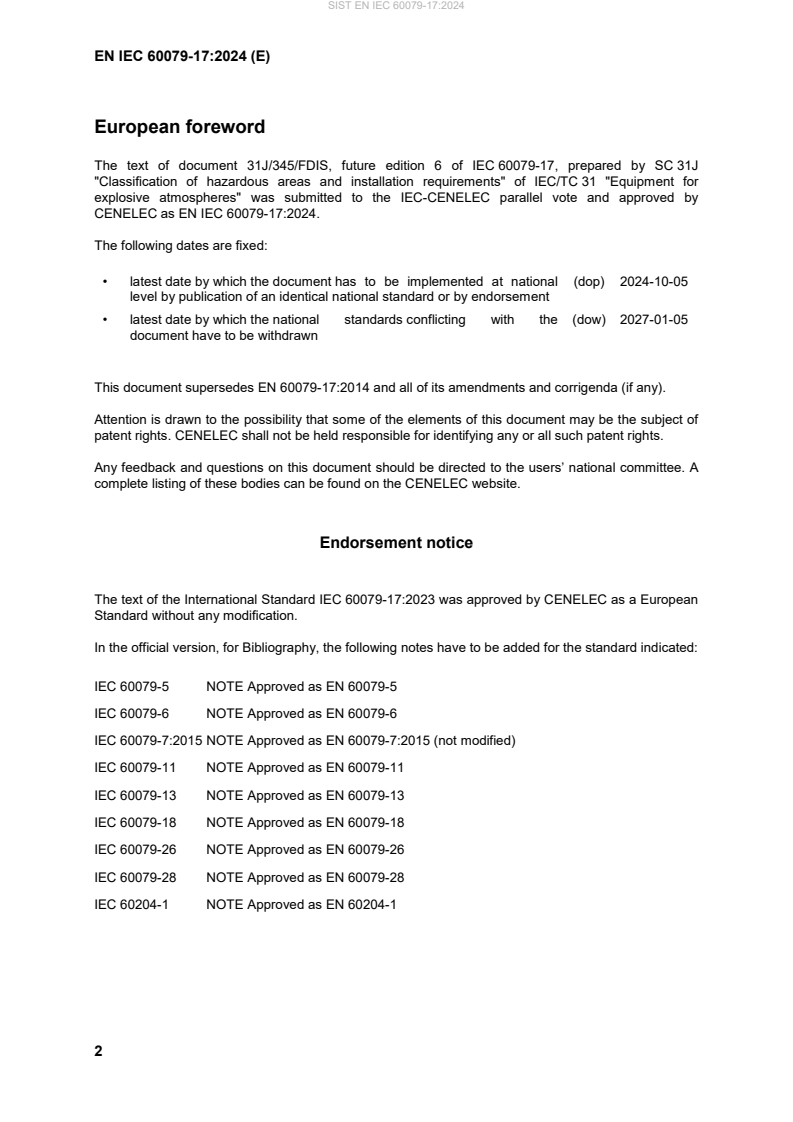
European foreword
The text of document 31J/345/FDIS, future edition 6 of IEC 60079-17, prepared by SC 31J
"Classification of hazardous areas and installation requirements" of IEC/TC 31 "Equipment for
explosive atmospheres" was submitted to the IEC-CENELEC parallel vote and approved by
CENELEC as EN IEC 60079-17:2024.
The following dates are fixed:
• latest date by which the document has to be implemented at national (dop) 2024-10-05
level by publication of an identical national standard or by endorsement
• latest date by which the national standards conflicting with the (dow) 2027-01-05
document have to be withdrawn
This document supersedes EN 60079-17:2014 and all of its amendments and corrigenda (if any).
Attention is drawn to the possibility that some of the elements of this document may be the subject of
patent rights. CENELEC shall not be held responsible for identifying any or all such patent rights.
Any feedback and questions on this document should be directed to the users’ national committee. A
complete listing of these bodies can be found on the CENELEC website.
Endorsement notice
The text of the International Standard IEC 60079-17:2023 was approved by CENELEC as a European
Standard without any modification.
In the official version, for Bibliography, the following notes have to be added for the standard indicated:
IEC 60079-5 NOTE Approved as EN 60079-5
IEC 60079-6 NOTE Approved as EN 60079-6
IEC 60079-7:2015 NOTE Approved as EN 60079-7:2015 (not modified)
IEC 60079-11 NOTE Approved as EN 60079-11
IEC 60079-13 NOTE Approved as EN 60079-13
IEC 60079-18 NOTE Approved as EN 60079-18
IEC 60079-26 NOTE Approved as EN 60079-26
IEC 60079-28 NOTE Approved as EN 60079-28
IEC 60204-1 NOTE Approved as EN 60204-1
Annex ZA
(normative)
Normative references to international publications
with their corresponding European publications
The following documents are referred to in the text in such a way that some or all of their content
constitutes requirements of this document. For dated references, only the edition cited applies. For
undated references, the latest edition of the referenced document (including any amendments)
applies.
NOTE 1 Where an International Publication has been modified by common modifications, indicated by (mod), the
relevant EN/HD applies.
NOTE 2 Up-to-date information on the latest versions of the European Standards listed in this annex is available
here: www.cencenelec.eu.
Publication Year Title EN/HD Year
IEC 60079-0 - Explosive atmospheres - Part 0: EN IEC 60079-0 -
Equipment - General requirements
IEC 60079-10-1 - Explosive atmospheres - Part 10-1: EN IEC 60079-10-1 -
Classification of areas - Explosive gas
atmospheres
IEC 60079-10-2 - Explosive atmospheres - Part 10-2: EN 60079-10-2 -
Classification of areas - Explosive dust
atmospheres
IEC 60079-14 - Explosive atmospheres - Part 14: Electrical EN 60079-14 -
installations design, selection and erection
IEC 60079-15 - Explosive atmospheres - Part 15: EN IEC 60079-15 -
Equipment protection by type of protection
"n"
IEC 60079-19 - Explosive atmospheres - Part 19: EN IEC 60079-19 -
Equipment repair, overhaul and
reclamation
IEC 60364-6 - Low voltage electrical installations - Part 6: HD 60364-6 -
Verification
IEC 60079-17 ®
Edition 6.0 2023-12
INTERNATIONAL
STANDARD
NORME
INTERNATIONALE
Explosive atmospheres –
Part 17: Electrical installations inspection and maintenance
Atmosphères explosives –
Partie 17 : Inspection et maintenance des installations électriques
INTERNATIONAL
ELECTROTECHNICAL
COMMISSION
COMMISSION
ELECTROTECHNIQUE
INTERNATIONALE
ICS 29.260.20 ISBN 978-2-8322-7759-1
– 2 – IEC 60079-17:2023 © IEC 2023
CONTENTS
FOREWORD . 5
INTRODUCTION . 9
1 Scope . 10
2 Normative references . 10
3 Terms and definitions . 11
4 General requirements . 12
4.1 Documentation . 12
4.2 Competence of personnel . 13
4.3 Integrated systems. 13
4.4 Inspections . 13
4.4.1 General . 13
4.4.2 Grades of inspection . 15
4.4.3 Types of inspection . 15
4.5 Periodic inspections . 16
4.5.1 Personnel . 16
4.5.2 Fixed installations . 16
4.5.3 Transportable, personal and portable equipment . 17
4.6 Continuous supervision by Skilled Personnel . 17
4.6.1 Concept . 17
4.6.2 Objectives . 17
4.6.3 Responsibilities . 18
4.6.4 Frequency of inspection . 18
4.6.5 Documents . 19
4.6.6 Training . 19
4.7 Maintenance requirements . 19
4.7.1 Remedial measures and modifications to equipment . 19
4.7.2 Maintenance of flexible cables . 20
4.7.3 Withdrawal from service . 20
4.7.4 Fastenings and tools . 20
4.8 External influences . 20
4.9 Isolation of equipment . 21
4.9.1 Installations other than intrinsically safe circuits . 21
4.9.2 Live maintenance on Intrinsically safe installations . 22
4.10 Earthing and equipotential bonding . 23
4.11 Specific Conditions of Use . 23
4.12 Movable equipment and its connections . 23
4.13 Inspection schedules . 23
4.13.1 General . 23
4.13.2 Equipment is appropriate to the EPL/Zone requirements of the location . 23
4.13.3 Equipment group . 24
4.13.4 Equipment maximum surface temperature . 24
4.13.5 Equipment circuit identification . 24
4.13.6 Ex Cable Glands . 24
4.13.7 Type of cable . 24
4.13.8 Sealing . 24
4.13.9 Test and measuring equipment . 24
4.13.10 Fault loop impedance or earthing resistance . 24
IEC 60079-17:2023 © IEC 2023 – 3 –
4.13.11 Insulation resistance . 25
4.13.12 Overload protection . 25
4.13.13 Lamps and luminaires . 25
5 Additional inspection schedule requirements . 25
5.1 Type of Protection "d" – Flameproof enclosure . 25
5.2 Type of Protection "e" – Increased safety . 26
5.2.1 Level of Protection "eb" . 26
5.2.2 Level of Protection "ec" . 26
5.3 Type of Protection "i" – Intrinsic safety . 26
5.3.1 General . 26
5.3.2 Documentation . 27
5.3.3 Labelling . 27
5.3.4 Unauthorized modifications . 27
5.3.5 Associated apparatus (safety interface) between intrinsically safe and
non-intrinsically safe circuits . 27
5.3.6 Cables . 27
5.3.7 Cable screens . 27
5.3.8 Point-to-point connections . 27
5.3.9 Earth continuity of non-galvanically isolated circuits . 28
5.3.10 Earth connections to maintain the integrity of the intrinsic safety . 28
5.3.11 Intrinsically safe circuit earthing or insulation . 28
5.3.12 Separation between intrinsically safe and non-intrinsically safe circuits . 28
5.4 Type of Protection "p" and "pD" – Pressurized enclosure . 28
5.5 Type of Protection "n" . 29
5.5.1 General . 29
5.5.2 Restricted breathing enclosures . 29
5.6 Type of Protection "t" and "tD" – Protection by enclosure . 29
5.7 Types of Protection "o" (liquid immersion) . 29
5.8 Types of Protection "m" and "mD" (encapsulation), "op" (optical radiation)
and "q" (powder-filling) . 29
6 Inspection tables . 29
Annex A (informative) Typical inspection procedure for periodic inspections . 36
Annex B (normative) Knowledge, skills and competencies of Technical Persons with
Executive Function and Skilled Personnel . 37
B.1 General . 37
B.2 Knowledge and skills . 37
B.2.1 Technical Persons with Executive Function . 37
B.2.2 Skilled Personnel (inspection and maintenance) . 37
B.3 Competencies . 38
B.3.1 General . 38
B.3.2 Technical Persons with Executive Function . 38
B.3.3 Skilled Personnel . 38
B.4 Assessment . 38
Annex C (informative) Fitness-for-purpose assessment . 39
C.1 Background. 39
C.2 Need for a fitness-for-purpose assessment . 39
C.3 Approach . 39
C.4 Ignition sources . 39
C.5 Contents of the fitness-for-purpose assessment . 39
– 4 – IEC 60079-17:2023 © IEC 2023
C.5.1 General . 39
C.5.2 Scope of the assessment report . 39
C.5.3 Equipment and its application . 40
C.5.4 Description . 40
C.5.5 Function of the product including the location . 40
C.5.6 Specification . 40
C.5.7 Standards compliance . 40
C.5.8 Documents . 41
C.5.9 Product sample . 41
C.5.10 Equipment label . 41
C.5.11 Training of personnel . 41
C.5.12 Elements of the report . 42
C.5.13 Assessor requirements . 42
C.5.14 Typical assessment and test report . 42
Annex D (informative) Example of motor checks . 44
Annex E (informative) Adverse service conditions . 45
Bibliography . 46
Figure A.1 – Typical inspection procedure for periodic inspections . 36
Table 1 – Inspection schedule for Ex "d", Ex "e", Ex "n" and Ex "t/tD" installations . 30
Table 2 – Inspection schedule for Ex "i" installations . 32
Table 3 – Inspection schedule for Ex "p" and "pD" installations . 33
Table 4 – Inspection schedule for Ex "o" installations . 34
Table C.1 – Title . 43
IEC 60079-17:2023 © IEC 2023 – 5 –
INTERNATIONAL ELECTROTECHNICAL COMMISSION
____________
EXPLOSIVE ATMOSPHERES –
Part 17: Electrical installations inspection and maintenance
FOREWORD
1) The International Electrotechnical Commission (IEC) is a worldwide organization for standardization comprising
all national electrotechnical committees (IEC National Committees). The object of IEC is to promote international
co-operation on all questions concerning standardization in the electrical and electronic fields. To this end and
in addition to other activities, IEC publishes International Standards, Technical Specifications, Technical Reports,
Publicly Available Specifications (PAS) and Guides (hereafter referred to as "IEC Publication(s)"). Their
preparation is entrusted to technical committees; any IEC National Committee interested in the subject dealt with
may participate in this preparatory work. International, governmental and non-governmental organizations liaising
with the IEC also participate in this preparation. IEC collaborates closely with the International Organization for
Standardization (ISO) in accordance with conditions determined by agreement between the two organizations.
2) The formal decisions or agreements of IEC on technical matters express, as nearly as possible, an international
consensus of opinion on the relevant subjects since each technical committee has representation from all
interested IEC National Committees.
3) IEC Publications have the form of recommendations for international use and are accepted by IEC National
Committees in that sense. While all reasonable efforts are made to ensure that the technical content of IEC
Publications is accurate, IEC cannot be held responsible for the way in which they are used or for any
misinterpretation by any end user.
4) In order to promote international uniformity, IEC National Committees undertake to apply IEC Publications
transparently to the maximum extent possible in their national and regional publications. Any divergence between
any IEC Publication and the corresponding national or regional publication shall be clearly indicated in the latter.
5) IEC itself does not provide any attestation of conformity. Independent certification bodies provide conformity
assessment services and, in some areas, access to IEC marks of conformity. IEC is not responsible for any
services carried out by independent certification bodies.
6) All users should ensure that they have the latest edition of this publication.
7) No liability shall attach to IEC or its directors, employees, servants or agents including individual experts and
members of its technical committees and IEC National Committees for any personal injury, property damage or
other damage of any nature whatsoever, whether direct or indirect, or for costs (including legal fees) and
expenses arising out of the publication, use of, or reliance upon, this IEC Publication or any other IEC
Publications.
8) Attention is drawn to the Normative references cited in this publication. Use of the referenced publications is
indispensable for the correct application of this publication.
9) IEC draws attention to the possibility that the implementation of this document may involve the use of (a)
patent(s). IEC takes no position concerning the evidence, validity or applicability of any claimed patent rights in
respect thereof. As of the date of publication of this document, IEC had not received notice of (a) patent(s), which
may be required to implement this document. However, implementers are cautioned that this may not represent
the latest information, which may be obtained from the patent database available at https://patents.iec.ch. IEC
shall not be held responsible for identifying any or all such patent rights.
IEC 60079-17 has been prepared by subcommittee 31J: Classification of hazardous areas and
installation requirements, of IEC technical committee 31: Equipment for explosive atmospheres.
It is an International Standard.
This sixth edition cancels and replaces the fifth edition published in 2013. This edition
constitutes a technical revision.
– 6 – IEC 60079-17:2023 © IEC 2023
This edition includes the following significant technical changes with respect to the previous
edition:
Type
Minor and Major
Changes Clause editorial Extension technical
changes changes
Simplifying description of explosive gas and dust 1 X
atmospheres in the Scope and uses of these terms
throughout document
Clarifies the exclusion of ventilated rooms in the 1 X
Scope
Aligns maintenance terms and definitions in 3.7 and
3 X
3.8 with IEV & 60079.
Introducing new clause 4.4.1.2. Manufacturer’s 4 X
documentation for cross referencing in text without
repetition
Further guidance added into Note 4 regarding 4.4.1.1. X
factors contributing to the deterioration of Ex
Equipment.
Clarifies the change in terminology from previously 4.11 X
used Special Condition of Safe Use to current
terminology Specific Conditions of Use.
Further requirements added regarding Type of 5.7 C1
Protection "o".
Clarification added regarding use of inspection 6 X
tables
Minor editorial changes and correction made to Tables 1 X
Tables 1 to 4 but with no change to item numbering to 4
or content
Modified reference in this standard to align all types
Annex B C2
of inspection with Continuous Supervision terms for
example; Skilled Personnel and Technical Persons
with Executive Function.
A typical assessment and test report is shown in Annex C X
C.5.14.
Introducing new items in the Bibliography Bibliography X
NOTE The technical changes referred to include the significance of technical changes in the revised IEC
Standard, but they do not form an exhaustive list of all modifications from the previous version.
Explanations:
A Definitions
Minor and editorial changes
– clarification
– decrease of technical requirements
– minor technical change
– editorial corrections
These are changes which modify requirements in an editorial or a minor technical way. They
include changes of the wording to clarify technical requirements without any technical change,
or a reduction in level of existing requirement.
IEC 60079-17:2023 © IEC 2023 – 7 –
Extension
– addition of technical options
These are changes which add new or modify existing technical requirements, in a way that new
options are given, but without increasing requirements from the previous standard.
Major technical changes
– addition of technical requirements
– increase of technical requirements
These are changes to technical requirements (addition, increase of the level or removal) made
in a way that an overhaul or repair of product to the preceding edition will not always be able to
fulfil the requirements given in the later edition. For these changes additional information is
provided in clause B) below.
NOTE These changes represent current technological knowledge. However, these changes do not normally have
an influence on equipment already placed on the market.
B Information about the background of 'major technical changes'
C1 Sub-clause 5.7 and Table 4 has been inserted based on text submitted by MT60079-6
Explosive atmospheres – Part 6: Equipment protection by liquid immersion "o".
C2 The previous reference to Responsible Person in Annex B usually reflects the roles and
the responsibilities of a person rather than the technical knowledge, skills and
competencies required to manage the activity of periodic inspection and maintenance of
Ex equipment. The term used within the Continuous Supervision clauses of Technical
Person With Executive Function provides clarity and harmonises the clauses within the
document.
The text of this International Standard is based on the following documents:
Draft Report on voting
31J/345/FDIS 31J/351/RVD
Full information on the voting for its approval can be found in the report on voting indicated in
the above table.
The language used for the development of this International Standard is English.
This document was drafted in accordance with ISO/IEC Directives, Part 2, and developed in
accordance with ISO/IEC Directives, Part 1 and ISO/IEC Directives, IEC Supplement, available
at www.iec.ch/members_experts/refdocs. The main document types developed by IEC are
described in greater detail at www.iec.ch/standardsdev/publications.
This International Standard is intended to be used in conjunction with IEC 60364-6.
A list of all parts of the IEC 60079 series, under the general title Explosive atmospheres, can
be found on the IEC website.
– 8 – IEC 60079-17:2023 © IEC 2023
The committee has decided that the contents of this document will remain unchanged until the
stability date indicated on the IEC website under webstore.iec.ch in the data related to the
specific document. At this date, the document will be
• reconfirmed,
• withdrawn, or
• revised.
IEC 60079-17:2023 © IEC 2023 – 9 –
INTRODUCTION
Electrical installations in hazardous areas possess features specially designed to render them
suitable for operations in such atmospheres. It is essential for reasons of safety in those areas
that, throughout the life of such installations, the integrity of those special features is preserved.
This document provides the details for initial inspection and on-going inspections as either:
a) regular periodic inspections thereafter, or,
b) continuous supervision
by Skilled Personnel.
Where necessary, maintenance might also be needed.
Correct functional operation of hazardous area installations does not mean, and is not to be
interpreted as meaning, that the integrity of the special features referred to above are preserved.
– 10 – IEC 60079-17:2023 © IEC 2023
EXPLOSIVE ATMOSPHERES –
Part 17: Electrical installations inspection and maintenance
1 Scope
This part of IEC 60079 applies to users and covers only those factors directly related to the
inspection and maintenance of electrical installations specifically designed for hazardous areas,
where the hazard is caused by explosive atmospheres.
It does not include:
• other fundamental installation and inspection requirements for electrical installations;
• the verification of electrical equipment;
• protection or ventilation of rooms;
• gas detection systems;
• the repair, overhaul and reclamation of explosion protected equipment (see IEC 60079-19).
While this document does not include inspection of safety devices such as used in ventilated
rooms (see IEC 60079-13), it does include the requirements for inspection and maintenance of
individual items of equipment that will be part of such systems, for example motors or sensors.
This document supplements the requirements for inspection and testing in non-hazardous areas
in IEC 60364-6. This document is intended to be applied where there is a risk due to the
potential presence of explosive gas or dust mixtures with air or combustible dust layers under
normal atmospheric conditions. It does not apply to:
• underground mining areas,
• dusts of explosives,
• pyrophoric substances.
2 Normative references
The following documents are referred to in the text in such a way that some or all of their content
constitutes requirements of this document. For dated references, only the edition cited applies.
For undated references, the latest edition of the referenced document (including any
amendments) applies.
IEC 60079-0, Explosive atmospheres – Part 0: Equipment – General requirements
IEC 60079-10-1, Explosive atmospheres – Part 10-1: Classification of areas – Explosive gas
atmospheres
IEC 60079-10-2, Explosive atmospheres – Part 10-2: Classification of areas – Explosive dust
atmospheres
IEC 60079-14, Explosive atmospheres – Part 14: Electrical installations design, selection and
erection
IEC 60079-15, Explosive atmospheres – Part 15: Equipment protection by type of protection "n"
IEC 60079-17:2023 © IEC 2023 – 11 –
IEC 60079-19, Explosive atmospheres – Part 19: Equipment repair, overhaul and reclamation
IEC 60364-6, Low voltage electrical installations – Part 6: Verification
3 Terms and definitions
For the purposes of this document, the terms and definitions given in IEC 60079-0 and the
following apply.
NOTE Additional definitions applicable to explosive atmospheres can be found in IEC 60050-426.
ISO and IEC maintain terminological databases for use in standardization at the following
addresses:
• IEC Electropedia: available at http://www.electropedia.org/
• ISO Online browsing platform: available at http://www.iso.org/obp
3.1
close inspection
inspection that encompasses those aspects covered by a visual inspection and, in addition,
identifies those defects, such as loose bolts, which will be apparent only by the use of access
equipment, for example steps (where necessary) and tools
Note 1 to entry: Close inspections do not normally require the enclosure to be opened, or the equipment to be de-
energized.
3.2
continuous supervision
frequent attendance, inspection, service, care and maintenance of the electrical installation by
Skilled Personnel who have experience in the specific installation and its environment in order
to maintain the explosion protection features of the installation in satisfactory condition
3.3
detailed inspection
inspection that encompasses those aspects covered by a close inspection and, in addition,
identifies those defects, such as loose terminations, which will only be apparent by opening the
enclosure, and/or using, where necessary, tools and test equipment
3.4
hazardous area
area in which an explosive atmosphere is present, or can be expected to be present, in
quantities such as to require special precautions for the construction, installation and use of
equipment
Note 1 to entry: IEC 60079-10-1, Explosive atmospheres – Part 10-1: Classification of areas – Explosive gas
atmospheres, gives a classification of hazardous areas containing explosive gas atmospheres (see IEC 60050-
426:2020, 426-03-03, 426-03-04 and 426-03-05).
Note 2 to entry: IEC 60079-10-2, Explosive atmospheres – Part 10-2: Classification of areas – Explosive dust
atmospheres, gives a classification of hazardous areas containing explosive dust atmospheres (see IEC 60050-
426:2020, 426-03-23, 426-03-24, and 426-03-25).
3.5
initial inspection
inspection of all electrical equipment, systems and installations before they are brought into
service
– 12 – IEC 60079-17:2023 © IEC 2023
3.6
inspection
action comprising careful scrutiny of an item carried out either
without dismantling, or with the addition of partial dismantling as required, supplemented by
means such as measurement, in order to arrive at a reliable conclusion as to the condition of
an item
3.7
live maintenance
maintenance activities carried out while the associated apparatus, intrinsically safe apparatus,
and circuits are energized
[SOURCE: IEC 60050-426: 2020, 426-11-51]
3.8
maintenance
combination of routine actions taken to preserve the fully
serviceable condition of the installed apparatus
3.9
non-hazardous area
area in which an explosive atmosphere is not expected to be present in quantities such as to
require special precautions for the construction, installation and use of equipment
3.10
periodic inspection
inspection of all electrical equipment, systems and installations carried out on a routine basis
3.11
sample inspection
inspection of a representative proportion of the electrical equipment, systems and installations
3.12
Skilled Personnel
people who meet specific requirements for the qualification of personnel
Note 1 to entry: The specific requirements for the qualification of personnel with respect to installation and
maintenance are specified in Annex B.
3.13
Technical Persons with Executive Function
persons providing technical management of the Skilled Personnel, having adequate knowledge
in the field of explosion protection, familiar with the local conditions, familiar with the installation
and who has overall responsibility and control of the inspection systems for the electrical
equipment within hazardous areas
3.14
visual inspection
inspection that identifies, without the use of access equipment or tools, those defects, such as
missing bolts, which will be apparent to the eye
4 General requirements
4.1 Documentation
For the purposes of inspection and maintenance, up-to-date documentation (verification dossier)
including any modification records, of the following items shall be available:
IEC 60079-17:2023 © IEC 2023 – 13 –
a) hazardous area classification and, if included, the Equipment Protection Level (EPL)
required for each location (see IEC 60079-10-1 and IEC 60079-10-2);
b) for gases: equipment group (IIA, IIB or IIC) and temperature class requirements;
c) for dusts: equipment group (IIIA, IIIB or IIIC) and maximum surface temperature
requirements;
d) equipment characteristics for example ambient temperature range, Type of Protection, IP
rating, corrosion resistance;
e) records sufficient to enable the Ex Equipment to be maintained in accordance with its Type
of Protection (see IEC 60079-14) (for example list and location of equipment, spares,
certificates, technical information); and
f) copies of previous inspection records, including initial inspection as detailed in
IEC 60079-14.
Requirements for other documentation that might be necessary are provided in IEC 60079-14
and IEC 60079-19.
4.2 Competence of personnel
The inspection and maintenance of installations covered by this document shall be carried out
only by skilled personnel. The knowledge, skills, and competencies of Technical Persons with
Executive Function and Skilled Personnel are given in Annex B.
Appropriate continuing education or training shall be undertaken by all personnel on a regular
basis with all evidence documented and available for regular review.
4.3 Integrated systems
Integrated systems which provide protection in relation to the hazardous area installation, for
example ventilation or pressurisation of rooms or gas detection systems, shall be inspected and
maintained to ensure correct functioning in accordance with the requirements of the relevant
standards.
NOTE The requirements for pressurised and ventilated rooms are given in IEC 60079-13.
4.4 Inspections
4.4.1 General
4.4.1.1 Basic principles
The inspection program should be sufficient to confirm ongoing suitability of the equipment for
use in hazardous areas.
Before a new installation of plant or equipment is commissioned, it shall be given an initial
inspection. Requirements for initial inspection are provided in IEC 60079-14, along with other
guidance for the plant commissioning and start up procedures.
To ensure that the installations are maintained in a satisfactory condition for continued use
within a hazardous area, and where necessary relevant maintenance is performed, they shall
be subject to either:
a) regular periodic inspections by personnel with competence according to 4.2 and Annex B;
or
b) continuous supervision by Skilled Personnel (see 4.6).
NOTE 1 In the case of dust hazardous area, housekeeping can influence the inspection and maintenance
requirements.
– 14 – IEC 60079-17:2023 © IEC 2023
Inspections on existing installations shall be carried out in accordance with this document.
However, for older installations the details for the equipment and installation requirements could
be referenced to the standards that applied at the date of the installation.
NOTE 2 Standards applied at the date of installation might not have been IEC standards.
In cases where Ex Equipment is located outside of a hazardous area, for example due to
changes on site, it should be maintained in accordance with its Type of Protection.
Following any adjustment, maintenance, repair, overhaul, modification or replacement, the
equipment or relevant parts of equipment concerned shall be given a detailed inspection.
The inspection activity shall be sufficiently independent of any immediate demands of
maintenance or other activities so as not to prejudice the reliability of any report findings from
the inspection.
NOTE 3 It is not a requirement of this document that inspection personnel are members of an external independent
organisation.
If at any time there is a change in the area classification or the Equipment Protection Level
requirements or if any equipment is moved from one location to another, a check shall be made
to ensure that the Type of Protection, group, maximum surface temperature for dusts, including
any consideration of dust layers, and temperature class for gases, where appropriate, are
suitable for the revised conditions.
If plant or equipment is dismantled during the course of an inspection, precautions shall be
taken during reassembly to ensure that the integrity of the Type of Protection is not impaired.
EXAMPLE 1 Removing any residual dust.
EXAMPLE 2 Correctly reinstating gaskets.
NOTE 4 Factors affecting the deterioration of Ex Equipment or installation can include accumulation of dust, water
ingress, excessive ambient temperature, exposure to chemicals, susceptibility to corrosion, undue vibration or
mechanical damage. Service factors affecting Ex Equipment or installation can include inappropriate maintenance,
lack of training, experience or competency of personnel and the resulting unauthorised modifications or adjustments
or inappropriate maintenance, for example that which is not in accordance with the manufacturer’s requirements.
4.4.1.2 Manufacturer’s documentation
Manufacturer’s information can have additional requirements or recommendations for
inspection and maintenance for example, types of grease that should be used, frequency of
inspection under specific climatic conditions or torque that should be applied by fasteners.
The manufacturer’s requirements or guidance take precedence over this document in the event
of conflict, for example for testing frequency.
4.4.1.3 Verification of unmarked equipment
Where the certification plate or markings on explosion protected equipment is m
...