

SIST EN 15088:2006
(Main)Aluminium and aluminium alloys - Structural products for construction works - Technical conditions for inspection and delivery
General Information
- Abstract
This European Standard specifies requirements for castings and for semi-finished products of aluminium and aluminium alloys for load-bearing structural construction works (Construction works covers building and civil engineering works).
It also specifies requirements for evaluation of conformity and the test methods to be used.
It does not apply to products after machining or joining operations (e.g. bolting, welding of elements), which can be found in other European Standards, e.g. prEN 1090-1.
- Status
- Published
- Publication Date
- 28-Feb-2006
- Technical Committee
- INEK - Nonferrous metals
- Current Stage
- 6060 - National Implementation/Publication (Adopted Project)
- Start Date
- 01-Mar-2006
- Due Date
- 01-Mar-2006
- Completion Date
- 01-Mar-2006
- Directive
- 305/2011 - Regulation (eu) No 305/2011 of the European Parliament and of the Council of 9 march 2011 laying down harmonised conditions for the marketing of construction products and repealing council directive 89/106/eecOJ Ref: C 259 OJ Date: 08-Aug-2014
89/106/EEC - Construction productsOJ Ref: C 304 OJ Date: 13-Dec-2006

Overview
EN 15088:2005 - "Aluminium and aluminium alloys - Structural products for construction works - Technical conditions for inspection and delivery" (CEN) defines the technical and regulatory requirements for castings and semi‑finished aluminium products intended for load‑bearing construction works (buildings and civil engineering). It specifies ordering information, material designation, product requirements, test methods and procedures for evaluation of conformity. EN 15088 is intended as an umbrella/harmonized standard that supports CE marking under the EU Construction Products Directive (CPD) and includes an informative Annex ZA on CPD provisions.
Key topics and technical requirements
- Scope and exclusions: Covers semi‑finished wrought products and castings used as structural materials. It explicitly does not apply to products after machining or joining (e.g., bolting, welding) - see related standards such as prEN 1090‑1 for execution/joining requirements.
- Ordering information: Defines required order details (product description, reference to EN 15088, alloy and temper designation).
- Alloy and temper selection: Requires designation in accordance with EN 573‑3 (chemical composition) and EN 515 (temper designations).
- Product requirements: Mechanical and dimensional characteristics follow relevant family standards (e.g., EN 485, EN 755, EN 754, EN 1559, EN 1706).
- Evaluation of conformity: Specifies testing regimes, sampling and factory production control (FPC) obligations to demonstrate compliance and enable CE marking.
- Testing and test methods: Includes reference to specific test procedures and normative annexes covering fatigue testing (Annex A) and bendability (Annex B).
- Marking, labelling and packaging: Requirements for traceability and delivery documentation (e.g., inspection certificates per EN 10204).
Practical applications and users
- Manufacturers and producers of aluminium semi‑finished products and castings who must demonstrate conformity for structural use and affix CE marking.
- Structural engineers, specifiers and architects selecting aluminium materials for load‑bearing elements who need to verify material properties and compliance.
- Procurement officers, quality managers and compliance teams responsible for assessment, inspection and supplier audits (FPC).
- Testing laboratories and notified bodies conducting material tests, fatigue assessments and issuing inspection documents.
Related standards (examples)
- EN 573‑3 (chemical composition), EN 515 (tempers)
- EN 485, EN 755, EN 754 (product family technical delivery conditions)
- EN 1559‑4, EN 1706 (castings)
- prEN 1999‑1‑1 / prEN 1999‑1‑3 (Eurocode 9: design rules and fatigue)
- EN 10204 (inspection documents), EN ISO 9001 (quality systems)
EN 15088:2005 is essential when specifying, manufacturing or certifying aluminium structural products for construction works - providing the technical framework for inspection, testing and conformity assessment of aluminium materials used in load‑bearing applications.
Relations
- Effective Date
- 25-Aug-2026
- Effective Date
- 25-Mar-2026
- Effective Date
- 28-Jan-2026
- Refers
SIST EN 1301-2:2008 - Aluminium and aluminium alloys - Drawn wire - Part 2: Mechanical properties - Effective Date
- 28-Jan-2026
- Refers
SIST EN ISO 1519:2012 - Paints and varnishes - Bend test (cylindrical mandrel) (ISO 1519:2011) - Effective Date
- 28-Jan-2026
- Effective Date
- 28-Jan-2026
- Effective Date
- 28-Jan-2026
- Effective Date
- 28-Jan-2026
- Refers
SIST EN 1301-3:2008 - Aluminium and aluminium alloys - Drawn wire - Part 3: Tolerances on dimensions - Effective Date
- 28-Jan-2026
- Effective Date
- 28-Jan-2026
- Effective Date
- 28-Jan-2026
- Effective Date
- 28-Jan-2026
- Effective Date
- 28-Jan-2026
- Effective Date
- 28-Jan-2026
- Effective Date
- 28-Jan-2026
Get Certified
Connect with accredited certification bodies for this standard

Element Materials Technology
Materials testing and product certification.

Inštitut za kovinske materiale in tehnologije
Institute of Metals and Technology. Materials testing, metallurgical analysis, NDT.
Sponsored listings
Frequently Asked Questions
SIST EN 15088:2006 is a standard published by the Slovenian Institute for Standardization (SIST). Its full title is "Aluminium and aluminium alloys - Structural products for construction works - Technical conditions for inspection and delivery". This standard covers: This European Standard specifies requirements for castings and for semi-finished products of aluminium and aluminium alloys for load-bearing structural construction works (Construction works covers building and civil engineering works). It also specifies requirements for evaluation of conformity and the test methods to be used. It does not apply to products after machining or joining operations (e.g. bolting, welding of elements), which can be found in other European Standards, e.g. prEN 1090-1.
This European Standard specifies requirements for castings and for semi-finished products of aluminium and aluminium alloys for load-bearing structural construction works (Construction works covers building and civil engineering works). It also specifies requirements for evaluation of conformity and the test methods to be used. It does not apply to products after machining or joining operations (e.g. bolting, welding of elements), which can be found in other European Standards, e.g. prEN 1090-1.
SIST EN 15088:2006 is classified under the following ICS (International Classification for Standards) categories: 77.150.10 - Aluminium products. The ICS classification helps identify the subject area and facilitates finding related standards.
SIST EN 15088:2006 has the following relationships with other standards: It is inter standard links to SIST ISO 8062:1995, SIST EN 573-3:2026, SIST EN ISO 9001:2000, SIST EN 1301-2:2008, SIST EN ISO 1519:2012, SIST EN 754-1:2016, SIST EN 1592-2:1998, SIST EN 485-4:1998, SIST EN 1301-3:2008, SIST EN 755-3:2008, SIST EN 485-2:2016+A1:2018, SIST EN 12020-2:2023, SIST EN 573-3:2019+A2:2024, SIST EN 755-9:2016, SIST EN 1301-1:2008. Understanding these relationships helps ensure you are using the most current and applicable version of the standard.
SIST EN 15088:2006 is associated with the following European legislation: EU Directives/Regulations: 305/2011, 89/106/EEC; Standardization Mandates: M/120. When a standard is cited in the Official Journal of the European Union, products manufactured in conformity with it benefit from a presumption of conformity with the essential requirements of the corresponding EU directive or regulation.
SIST EN 15088:2006 is available in PDF format for immediate download after purchase. The document can be added to your cart and obtained through the secure checkout process. Digital delivery ensures instant access to the complete standard document.
Standards Content (Sample)
2003-01.Slovenski inštitut za standardizacijo. Razmnoževanje celote ali delov tega standarda ni dovoljeno.Aluminium and aluminium alloys - Structural products for construction works - Technical conditions for inspection and deliveryAluminium et alliages d'aluminium - Produits pour applications de structure pour construction - Conditions techniques de contrôle et de livraisonAluminium und Aluminiumlegierungen - Erzeugnisse für Tragwerksanwendungen - Technische LieferbedingungenTa slovenski standard je istoveten z:EN 15088:2005SIST EN 15088:2006en77.150.10ICS:SLOVENSKI
STANDARDSIST EN 15088:200601-marec-2006
EUROPEAN STANDARDNORME EUROPÉENNEEUROPÄISCHE NORMEN 15088December 2005ICS 77.150.10 English VersionAluminium and aluminium alloys - Structural products forconstruction works - Technical conditions for inspection anddeliveryAluminium et alliages d'aluminium - Produits pourapplications de structure pour construction - Conditionstechniques de contrôle et de livraisonAluminium und Aluminiumlegierungen - Erzeugnisse fürTragwerksanwendungen - Technische LieferbedingungenThis European Standard was approved by CEN on 12 May 2005.CEN members are bound to comply with the CEN/CENELEC Internal Regulations which stipulate the conditions for giving this EuropeanStandard the status of a national standard without any alteration. Up-to-date lists and bibliographical references concerning such nationalstandards may be obtained on application to the Central Secretariat or to any CEN member.This European Standard exists in three official versions (English, French, German). A version in any other language made by translationunder the responsibility of a CEN member into its own language and notified to the Central Secretariat has the same status as the officialversions.CEN members are the national standards bodies of Austria, Belgium, Cyprus, Czech Republic, Denmark, Estonia, Finland, France,Germany, Greece, Hungary, Iceland, Ireland, Italy, Latvia, Lithuania, Luxembourg, Malta, Netherlands, Norway, Poland, Portugal, Slovakia,Slovenia, Spain, Sweden, Switzerland and United Kingdom.EUROPEAN COMMITTEE FOR STANDARDIZATIONCOMITÉ EUROPÉEN DE NORMALISATIONEUROPÄISCHES KOMITEE FÜR NORMUNGManagement Centre: rue de Stassart, 36
B-1050 Brussels© 2005 CENAll rights of exploitation in any form and by any means reservedworldwide for CEN national Members.Ref. No. EN 15088:2005: E
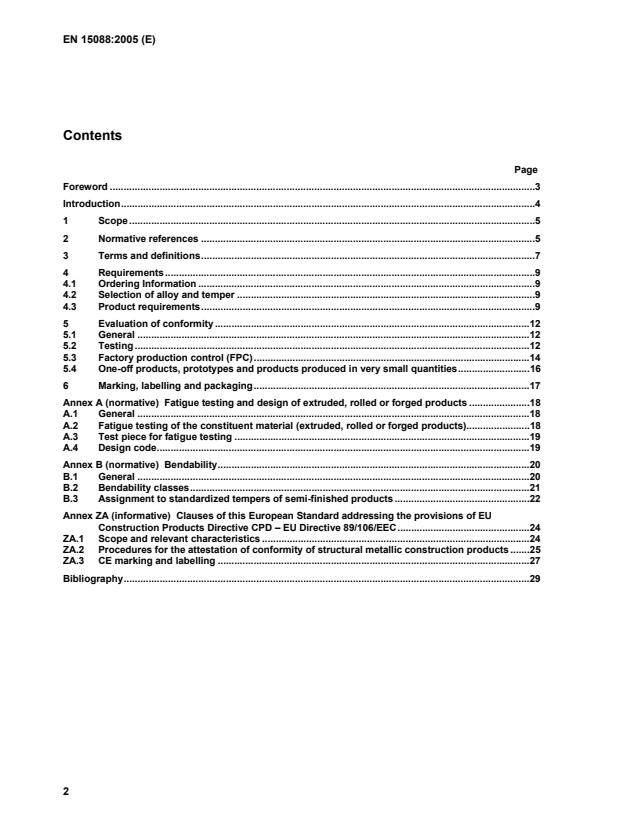
Fatigue testing and design of extruded, rolled or forged products.18 A.1 General.18 A.2 Fatigue testing of the constituent material (extruded, rolled or forged products).18 A.3 Test piece for fatigue testing.19 A.4 Design code.19 Annex B (normative)
Bendability.20 B.1 General.20 B.2 Bendability classes.21 B.3 Assignment to standardized tempers of semi-finished products.22 Annex ZA (informative)
Clauses of this European Standard addressing the provisions of EU Construction Products Directive CPD – EU Directive 89/106/EEC.24 ZA.1 Scope and relevant characteristics.24 ZA.2 Procedures for the attestation of conformity of structural metallic construction products.25 ZA.3 CE marking and labelling.27 Bibliography.29
Figure 1 — Relationship between standards
See introduction 3.7 structure load-bearing element construction, i.e. organized assembly of connected parts designed to provide mechanical resistance and stability to the works [Commission Guidance Paper L concerning the Construction Products Directive 89/106/EEC] 3.8 structural relating to a structure [Commission Guidance Paper L concerning the Construction Products Directive 89/106/EEC] 3.9 structural material/constituent material material or constituent product with properties which enter into structural calculations or otherwise relate to the mechanical resistance and stability of works and part thereof, and/or their fire resistance, including aspects of durability and serviceability, such as castings or semi-finished wrought products made of aluminium and aluminium alloys [Commission Guidance Paper L concerning the Construction Products Directive 89/106/EEC] 3.10 structural component components to be used as load-bearing part of works designed to provide mechanical resistance and stability to the works and/or fire resistance, including aspects of durability and serviceability; it can be used directly as delivered or for inclusion in a construction work [Commission Guidance Paper L concerning the Construction Products Directive 89/106/EEC] 3.11 structural kit kit consisting of structural components to be assembled and installed on site; the assembled system made from the structural kit is a “structure” [Commission Guidance Paper L concerning the Construction Products Directive 89/106/EEC] 3.12 technical specifications harmonized European Standard (hEN) and European Technical Approval (ETA) for construction products [Commission Guidance Paper L concerning the Construction Products Directive 89/106/EEC] 3.13 wrought product product obtained by hot and/ or cold working processes such as extruding, forging, hot rolling, cold rolling or drawing, either exclusively or in combination; examples for wrought products are rod/ bar, wire, tube, profile, sheet, strip and forging [EN 12258-1:1998]
4.3.2.1 General The requirements and test methods on structural material for construction works shall be as specified in the standards given in Table 1.
4.3.2.2 Mechanical properties 4.3.2.2.1 General The mechanical properties shall conform to those specified in the European Standards given in Table 1 and achieve the minimum values for: elongation; tensile strength; yield strength; fatigue strength (where required); bendability (where required). 4.3.2.2.2 Mechanical properties of products under cyclic loading/fatigue strength The material shall be classified on a case-by-case base in accordance with the intended use as follows: Class I The product is not subject to fatigue. Class II The product is subject to fatigue and fatigue properties are specified in prEN 1999-1-3. Class III The product is subject to fatigue, but fatigue properties are not specified in prEN 1999-1-3. For Class III, the fatigue testing shall be carried out according to: requirements on fatigue testing of extruded, rolled or forged products as specified in Annex A. If no Class is specified in the ordering information, the manufacturer shall obtain the requirements in accordance with this European Standard from the purchaser. 4.3.2.2.3 Bendability The structural material shall be classified as specified in Annex B. Bendability of new alloys may be established with the use of application rules or extended application rules developed for the purpose. 4.3.3 Weldability The weldability of aluminium and aluminium alloys shall be declared according to Table C.1 and Table C.2 of Annex C of prEN 1999-1-1. NOTE
A new or modified alloy could demonstrate weldability suitability by assessment leading to European Technical Approval until the Eurocode classification is extended to include the new or modified alloy. 4.3.4 Restrictions to avoid regulated substances The manufacturer shall ensure that there are no emissions of any substances hazardous to health or to the environment in excess of the legally permitted level in the member state of destination. Aluminium scrap shall be as in EN 13920-1.
Aluminium and aluminium alloys as specified in EN 573-3 and EN 1706 are environmentally friendly with reference to the release of cadmium, chromium (VI), mercury and the emission of radioactivity. 4.3.5 Durability Durability for a reasonable economic working lifetime is generally assured by the inherent corrosion resistance of aluminium and its alloys. Under exceptional atmospheric conditions or demanding use, the selection of the material shall take into account all relevant requirements. The durability of aluminium and aluminium alloys shall be declared according to prEN 1999-1-1 Table 3.1 a, Table 3.1 b or prEN 1999-1-4 Table 3.1. The organic coating of coated sheet and strip shall be tested in accordance with EN 1396. The durability of the coated sheet and strip shall not be adversely affected by bending. When the material is subject to bending, the flexibility of the organic coating shall be assessed by subjecting the material to an additional bend test in accordance with EN ISO 1519. The result shall be expressed as measured bend radius "T". NOTE
A new or modified alloy could demonstrate durability suitability by assessment leading to European Technical Approval until the Eurocode classification is extended to include the new or modified alloy. 5 Evaluation of conformity 5.1 General The conformity of the products to the requirements of this European Standard and with the stated values (including classes) shall be demonstrated by: Initial Type Testing (ITT) ; and Factory Production Control (FPC) by the manufacturer, including product assessment. For the purposes of testing, the products may be grouped into families, where it is considered that the selected property/properties is/are common to all the products within that family. 5.2 Testing 5.2.1 Initial type testing (ITT) 5.2.1.1 General An initial type test is the complete set of tests or other procedures, determining the performance of samples of products representative of the product type. Initial type testing shall be performed to show conformity with this European Standard on first use of this European Standard for products being put onto the market and: the beginning of the production with changes in new or modified product design, new raw material or supplier of the materials, if such a change is likely to alter the performance of the product; the beginning of a new or modified method of production. In case of tests previously performed on the same products in accordance with the provisions of this standard (same characteristic(s), test method, sampling procedure, system of attestation of conformity, etc.) may be taken into account (use of historical data).
5.2.1.3 "Deemed to satisfy" provisions and use of reference tabulated data In those cases where conformity with this European Standard is based on "deemed to satisfy" provisions or tabulated values, type testing shall be limited to the verification of whether the products meet the requirements to use those values, classes or levels, unless better values, classes or levels are being claimed. 5.2.1.4 Treatment of calculated values and design In some cases, the manufacturer will produce products in accordance with a design and/or calculations provided by a third party. In this case, verification will not be of the design or calculations themselves, but only of the fact that the products comply with the assumptions of the design and/or calculations. 5.2.1.5 Additional conformity procedure If required for special uses, the need for any additional requirements for conformity testing shall be specified at the time of order. If required by the order, conformity tests for additional characteristics as given in 4.1 g) shall be performed by the manufacturer. 5.2.2 Sampling, testing and conformity criteria 5.2.2.1 Sampling Initial type testing shall be performed on samples of products representative for the manufactured product type. The sampling shall be performed in accordance with the European Standards in Table 1. 5.2.2.2 Testing and conformity criteria The number of samples to be assessed shall be in accordance with Table 2.
...