

SIST EN 15450:2007
Heating systems in buildings - Design of heat pump heating systems
General Information
- Abstract
This standard specifies design criteria for heating systems in buildings using electrically driven heat pumps alone or in combination with other heat generators. Heat pump systems considered include (see Table 1):
- water - water;
- water - air;
- brine - water;
- refrigerant - water (direct expansion systems);
- refrigerant - refrigerant;
- air - air;
- air - water.
This standard takes into account the heating requirements of attached systems (e.g. domestic hot water) in the design of heat supply, but does not cover the design of these systems. This standard covers only the aspects dealing with the heat pump, the interface with the heat distribution system and heat emission system (e.g. buffering system), the control of the whole system and the aspects dealing with energy source of the system.
Systems designed primarily for cooling and systems which can operate simultaneously in cooling and heating mode are not within the scope of this standard.
- Status
- Published
- Publication Date
- 08-Nov-2007
- Technical Committee
- OGS - Heating for buildings
- Current Stage
- 6060 - National Implementation/Publication (Adopted Project)
- Start Date
- 09-Oct-2007
- Due Date
- 14-Dec-2007
- Completion Date
- 09-Nov-2007

Overview
EN 15450:2007 - Heating systems in buildings: Design of heat pump heating systems is a CEN European Standard that sets out design criteria for building heating systems using electrically driven heat pumps (alone or combined with other heat generators). It applies to a wide range of heat pump types (water‑water, water‑air, brine‑water, refrigerant‑water (direct expansion), refrigerant‑refrigerant, air‑air and air‑water) and focuses on the heat pump, its interface with the heat distribution and emission systems, controls, buffering and the energy source. Systems designed primarily for cooling or simultaneous cooling/heating are excluded.
Key topics and technical requirements
- Scope of design: Requirements for heat source selection, electrical supply, system strategy (monovalent, bivalent‑parallel, bivalent‑alternative), positioning and noise control.
- Heat supply & sizing: Guidance on heat pump capacity sizing, buffering/storage integration and provisions for backup heaters where the heat pump capacity is insufficient.
- Hydraulic integration: Standard hydraulic circuits and recommendations for connecting heat pumps to building distribution systems and emission devices.
- Control and operation: Functional requirements for system control, setpoints, capacity modulation and monitoring (temperature, power consumption). Annex F covers capacity control strategies.
- Domestic hot water (DHW): Design considerations for DHW demand and buffering, including sizing and specific control requirements; the standard accounts for DHW in heat supply design but does not replace dedicated DHW system design. Annex E provides average DHW tapping patterns.
- Commissioning & installation: Procedures for preparation, functional and operational tests, balancing and handing over.
- Performance metrics: Definitions and calculation guidance for COP and Seasonal Performance Factor (SPF), with Annex C addressing SPF calculation and target/minimum values.
- Supportive guidance: Informative annexes on design parameters for water and ground sources, noise in the vicinity, hydraulic circuits and more.
Applications and users
EN 15450:2007 is intended for:
- HVAC designers and building services engineers specifying heat pump heating systems
- System integrators and installers responsible for hydraulic and control integration
- Commissioning engineers and technical consultants performing functional and performance tests
- Energy assessors and specifiers assessing COP and SPF for compliance or procurement
- Facility managers planning monitoring, maintenance and backup arrangements
This standard is useful for projects where reliable design, integration and operation of heat pump heating systems are required, including low‑energy and retrofit buildings.
Related standards
EN 15450 references and complements other standards such as:
- EN 12831 (design heat load)
- EN 12828 (water‑based heating system design)
- EN 14511 (heat pump terms and performance)
- prEN 15316‑4‑2 (system energy calculations)
Keywords: EN 15450:2007, heat pump heating systems, heating systems in buildings, heat pump design, COP, SPF, hydraulic integration, commissioning, domestic hot water.
Relations
- Effective Date
- 28-Jan-2026
- Effective Date
- 28-Jan-2026
- Effective Date
- 28-Jan-2026
- Effective Date
- 28-Jan-2026
- Effective Date
- 28-Jan-2026
- Effective Date
- 28-Jan-2026
- Effective Date
- 21-Aug-2024
Get Certified
Connect with accredited certification bodies for this standard

DNV
DNV is an independent assurance and risk management provider.

Lloyd's Register
Lloyd's Register is a global professional services organisation specialising in engineering and technology.

DIBt (Deutsches Institut für Bautechnik)
German Institute for Building Technology.
Sponsored listings
Frequently Asked Questions
SIST EN 15450:2007 is a standard published by the Slovenian Institute for Standardization (SIST). Its full title is "Heating systems in buildings - Design of heat pump heating systems". This standard covers: This standard specifies design criteria for heating systems in buildings using electrically driven heat pumps alone or in combination with other heat generators. Heat pump systems considered include (see Table 1): - water - water; - water - air; - brine - water; - refrigerant - water (direct expansion systems); - refrigerant - refrigerant; - air - air; - air - water. This standard takes into account the heating requirements of attached systems (e.g. domestic hot water) in the design of heat supply, but does not cover the design of these systems. This standard covers only the aspects dealing with the heat pump, the interface with the heat distribution system and heat emission system (e.g. buffering system), the control of the whole system and the aspects dealing with energy source of the system. Systems designed primarily for cooling and systems which can operate simultaneously in cooling and heating mode are not within the scope of this standard.
This standard specifies design criteria for heating systems in buildings using electrically driven heat pumps alone or in combination with other heat generators. Heat pump systems considered include (see Table 1): - water - water; - water - air; - brine - water; - refrigerant - water (direct expansion systems); - refrigerant - refrigerant; - air - air; - air - water. This standard takes into account the heating requirements of attached systems (e.g. domestic hot water) in the design of heat supply, but does not cover the design of these systems. This standard covers only the aspects dealing with the heat pump, the interface with the heat distribution system and heat emission system (e.g. buffering system), the control of the whole system and the aspects dealing with energy source of the system. Systems designed primarily for cooling and systems which can operate simultaneously in cooling and heating mode are not within the scope of this standard.
SIST EN 15450:2007 is classified under the following ICS (International Classification for Standards) categories: 27.080 - Heat pumps; 91.140.10 - Central heating systems. The ICS classification helps identify the subject area and facilitates finding related standards.
SIST EN 15450:2007 has the following relationships with other standards: It is inter standard links to SIST EN 14336:2025, SIST EN 12828:2004, SIST EN 14511-1:2004, SIST EN 12831-1:2018, SIST EN 15316-4-2:2018, SIST EN 378-1:2017+A1:2021, oSIST prEN 15450:2026. Understanding these relationships helps ensure you are using the most current and applicable version of the standard.
SIST EN 15450:2007 is associated with the following European legislation: EU Directives/Regulations: TRRTP129. When a standard is cited in the Official Journal of the European Union, products manufactured in conformity with it benefit from a presumption of conformity with the essential requirements of the corresponding EU directive or regulation.
SIST EN 15450:2007 is available in PDF format for immediate download after purchase. The document can be added to your cart and obtained through the secure checkout process. Digital delivery ensures instant access to the complete standard document.
Standards Content (Sample)
2003-01.Slovenski inštitut za standardizacijo. Razmnoževanje celote ali delov tega standarda ni dovoljeno.Heating systems in buildings - Design of heat pump heating systemsSystemes de chauffage dans les bâtiments - Conception des systemes de pompes de chauffageHeizsysteme Gebäuden - Planung von Heizsystemen mit WärmepumpenTa slovenski standard je istoveten z:EN 15450:2007SIST EN 15450:2007en,de91.140.10Sistemi centralnega ogrevanjaCentral heating systems27.080Heat pumpsICS:SLOVENSKI
STANDARDSIST EN 15450:200701-december-2007
EUROPEAN STANDARDNORME EUROPÉENNEEUROPÄISCHE NORMEN 15450October 2007ICS 27.080 English VersionHeating systems in buildings - Design of heat pump heatingsystemsSystèmes de chauffage dans les bâtiments - Conceptiondes systèmes de chauffage par pompe à chaleurHeizungsanlagen in Gebäuden - Planung vonHeizungsanlagen mit WärmepumpenThis European Standard was approved by CEN on 26 August 2007.CEN members are bound to comply with the CEN/CENELEC Internal Regulations which stipulate the conditions for giving this EuropeanStandard the status of a national standard without any alteration. Up-to-date lists and bibliographical references concerning such nationalstandards may be obtained on application to the CEN Management Centre or to any CEN member.This European Standard exists in three official versions (English, French, German). A version in any other language made by translationunder the responsibility of a CEN member into its own language and notified to the CEN Management Centre has the same status as theofficial versions.CEN members are the national standards bodies of Austria, Belgium, Bulgaria, Cyprus, Czech Republic, Denmark, Estonia, Finland,France, Germany, Greece, Hungary, Iceland, Ireland, Italy, Latvia, Lithuania, Luxembourg, Malta, Netherlands, Norway, Poland, Portugal,Romania, Slovakia, Slovenia, Spain, Sweden, Switzerland and United Kingdom.EUROPEAN COMMITTEE FOR STANDARDIZATIONCOMITÉ EUROPÉEN DE NORMALISATIONEUROPÄISCHES KOMITEE FÜR NORMUNGManagement Centre: rue de Stassart, 36
B-1050 Brussels© 2007 CENAll rights of exploitation in any form and by any means reservedworldwide for CEN national Members.Ref. No. EN 15450:2007: E
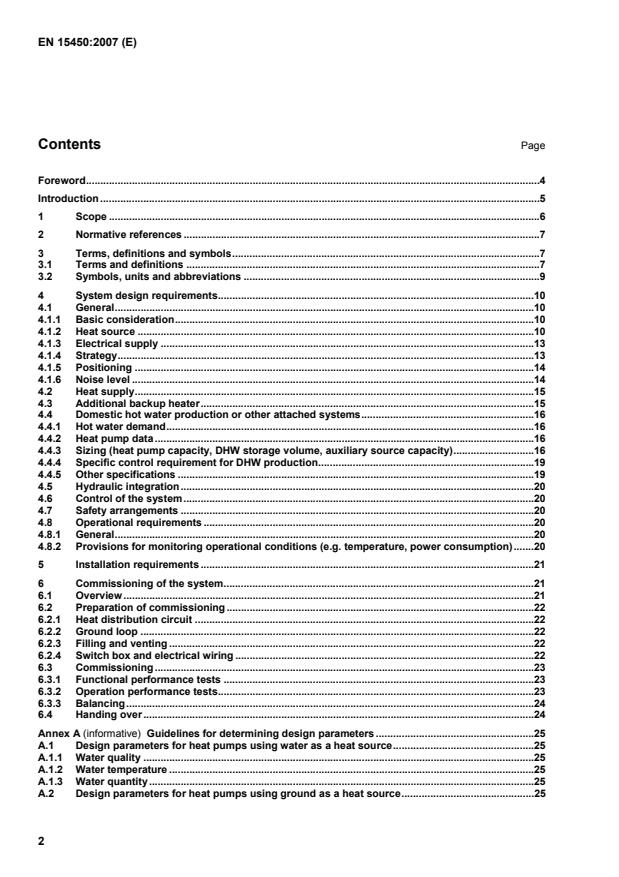
Guidelines for determining design parameters.25 A.1 Design parameters for heat pumps using water as a heat source.25 A.1.1 Water quality.25 A.1.2 Water temperature.25 A.1.3 Water quantity.25 A.2 Design parameters for heat pumps using ground as a heat source.25
Standard hydraulic circuits.30 Annex C (normative)
Calculation and requirements for Seasonal Performance Factors (SPF).36 C.1 Definitions.36 C.2 Calculations.36 C.3 Minimum and target SPF-values for heat pumps.37 Annex D (informative)
Noise levels in the vicinity.39 Annex E (informative)
Average daily tapping patterns for domestic hot water production.40 E.1 Average daily tapping patterns.40 E.2 Example calculation.44 Annex F (informative)
Capacity control.45 F.1 General control strategy.45 F.2 Capacity control of the heat pump.45 F.3 Enhanced Cycle Systems.46 Bibliography.47
Where possible, reference is made to other European or International Standards, a.o. product standards. However, use of products complying with relevant product standards is no guarantee of compliance with the system requirements. The requirements are mainly expressed as functional requirements, i.e. requirements dealing with the function of the system and not specifying shape, material, dimensions or the like.
The guidelines describe ways to meet the requirements, but other ways to fulfil the functional requirements might be used if fulfilment can be proved. Heating systems differ among the member countries due to climate, traditions and national regulations. In some cases requirements are given as classes so national or individual needs may be accommodated. In cases where the standards contradict with national regulations, the latter should be followed. According to the CEN/CENELEC Internal Regulations, the national standards organizations of the following countries are bound to implement this European Standard: Austria, Belgium, Bulgaria, Cyprus, Czech Republic, Denmark, Estonia, Finland, France, Germany, Greece, Hungary, Iceland, Ireland, Italy, Latvia, Lithuania, Luxembourg, Malta, Netherlands, Norway, Poland, Portugal, Romania, Slovakia, Slovenia, Spain, Sweden, Switzerland and United Kingdom.
source-system (energy extraction)
sink-system (energy rejection)
energy source a medium b medium energy sink c air indoor air exhaust air
outdoor air air water indoor air water water indoor air water surface water ground water
water air indoor air air indoor air brine (water) water indoor air water water indoor air water ground refrigerant refrigerant indoor air a Energy source is the location where the energy is extracted. b Medium is the fluid transported in the corresponding distribution system. c Energy sink is the location where the energy is used; this can be the heated space or water in case of domestic hot water production.
3 Terms, definitions and symbols 3.1 Terms and definitions For the purposes of this document, the terms and definitions given in EN 12828:2003 and the following apply. 3.1.1 coefficient of performance (COP) ratio of the heating capacity to the effective power input of the unit, expressed in Watt/Watt [EN 14511-1:2004] 3.1.2 seasonal performance factor (SPF) ratio of the total annual energy QHP delivered by the heat pump to the distribution subsystem for space heating and/or other attached systems (e.g. domestic hot water) to the total annual input of electrical energy consumed, including the total annual input of auxiliary energy NOTE See also Annex C. 3.1.3 balance point temperature lowest design external air temperature at which the heat pump output capacity and the building heating demand (heat load) are equal NOTE At lower external air temperatures, a second heat generator is employed to cover the entire or part of the building heating demand. 3.1.4 bivalent-alternative mode operational mode in which a second heat generator (e.g. gas boiler) completely accounts for the heat demand of the heating system if the external temperature falls below the balance point temperature
3.1.7 backup heater supplementary heating which is used to supply heat when the capacity of the heat pump is inadequate
Effective internal heating capacity of the building elements
Wh/m³K COPθset coefficient of performance of the heat pump for domestic hot water demand at the set buffer storage temperature θset – fAS
design factor for attached systems – fDHW
design factor for domestic hot water systems – fHL
design factor for the heat load – Φhp,el,θset electrical power of the heat pump for domestic hot water demand at θset kW Pel effective electrical power input kW Q energy kWh Qdaily total hot water energy demand per day kWh QS energy stored in the buffer storage kWh QDP energy demand during the defined period kWh Ql,s heat losses of the buffer storage in a defined time period kWh Qs,eff effective (useful) amount of energy in the buffer storage
kWh ql,s specific daily thermal losses of the buffer storage
kWh/(24hÜl) tDP duration of the defined period h tEnergy,HP duration of period when energy is available for the heat pump h VS volume of buffer storage l VDP60 volume delivered during the defined period at 60 °C l Vl,s volume amounting to the thermal losses of the buffer storage l Vset volume of hot water at θset that has the same enthalpy as QDP L AS heating capacity of attached systems kW DHW heating capacity of the heat pump for domestic hot water use kW HL heat load capacity kW hp,set heating capacity of the heat pump at θset kW hp heating capacity of the heat pump
kW SU heating capacity of the heat supply system
kW λ thermal conductivity W/(mK)
θCW inlet temperature (cold water)
°C θDPset set point for temperature in the buffer storage
°C θe design external air temperature °C θm,e local mean external air temperature °C θmin minimum value for domestic hot water draught off °C θset set temperature °C
Abbreviation Description COP coefficient of performance DHW domestic hot water GWP global warming potential
ODP ozone depletion potential SPF seasonal performance factor 4 System design requirements 4.1 General 4.1.1 Basic consideration The heating system shall be designed according to the requirements stated in 4.1 of EN 12828:2003. The following additional aspects shall be taken into account. 4.1.2 Heat source 4.1.2.1 General design aspects For each type of heat source, the following design aspects shall be taken into consideration: availability of the heat source; temperature level of the heat source; available heat extraction rate; quality of the heat source. 4.1.2.2 Air as heat source The minimum air flow declared by the manufacturer has to be taken into account when designing the system. The efficiency and the capacity of the heat pump increases with increasing external air temperature. For monovalent systems, the required capacity of the heat pump shall be determined by using the design external air temperature θe in the heat load calculation according to EN 12831. For bivalent systems, a suitable balance point temperature shall be set depending on the selected operational mode (bivalent-alternative or bivalent-parallel mode). The air entering the evaporator of the heat pump (outdoor air or exhaust air), shall be clean according to the manufacturer’s specifications. 4.1.2.3 Water as heat source (e.g. groundwater, seawater, lake, river)
The required water flow rate for the heat pump unit shall be made available, taking into account local regulations which may place limits on availability and flow rates. The average groundwater temperature can be obtained from local authorities, a test borehole or (in the case of dwellings) by qualified assumption (i.e. the annual mean external temperature at the location).
The water source shall enable a continuous extraction of the design flow rate of the attached heat pumps. The possible extraction flow rate is dependant on local geological factors and can be ascertained by continuously
The heat extraction system shall be designed and controlled so as to avoid the risk of freezing.
Key 1 living room, 2 bathroom, 3 cellar, 4 heat exchanger, 5 heat pump, 6 storage water heater, 7 buffer storage, 8 injection well, 9 extraction well, 10 ground water flow direction Figure 1 — Arrangement of a heat pump heating system with ground water flow 4.1.2.4 Ground as heat source The heat supply from the ground can be obtained by using either horizontal ground heat exchangers situated below the surface (horizontal loops) or vertical borehole heat exchangers (vertical loops). The minimum temperature of the ground at the appropriate depth shall be taken into account when designing the heat pump system. Information on typical temperature profiles is given in Annex A.
Local thermal properties of the ground, undisturbed ground temperature and system design have to be considered in the design of the heat exchanger. Information on neighbouring drillings, where available, shall be considered. Local regulations may limit the availability of ground as a heat source (e.g. drilling depths, presence of ground water). 4.1.3 Electrical supply Availability of a suitable electrical supply shall be ensured (power and amperage). National regulations may require that the local energy supplier shall be informed prior to installation. The operation time, the tariff and the cut-out time have to be taken into account. Maximum current drawn during start-up phase shall be considered. 4.1.4 Strategy The strategy for the design of a heat pump system shall consider the following aspects: The heat pump system shall be designed so as to achieve the highest seasonal performance factor (SPF) with respect to the selected heat source. The SPF increases with decreasing temperature difference between the source temperature and the sink temperature. High source temperatures and low sink temperatures are desirable (reducing the sink temperature by 1 K leads to an increase in the COP of about 2 %).
The heat pump system shall be designed so that its seasonal performance factor is equal to or higher than the minimum values given in an according national annex. In case no national annex has been published, default minimum values are given in Annex C. NOTE Additionally, target-values for the seasonal performance factor are given in an according national annex. In case no national annex has been published, default target-values are given in Annex C. The heat pump system shall be designed and controlled so as to avoid excessive start-up cycles (e.g. three start-up cycles per hour). The maximum number of start-up cycles per hour (or other time unit) shall comply with the regulations stated by the local utility and shall be in accordance with specifications by the manufacturer of the heat pump. The environmental impact due to heat pump operation shall be minimised. The selected refrigerant of the heat pump shall have an ozone depletion potential (ODP) of zero and a low global warming potential (GWP) (see also EN 378-1). Care shall be taken not to emit the refrigerant into the atmosphere due to leakages during operation as well as during maintenance. The heat pump system shall be designed so as to be user-friendly and require limited maintenance.
accessibility for installation and maintenance purposes. 4.1.6 Noise level
Noise immission (i.e. sound pressure) caused by the heat pump unit and its auxiliary components shall not exceed the maximum values required by national authorities. Recommended maximum noise-levels are given in Annex D. Heat pumps using air as a heat source are prone to cause noise problems resulting from sound conducted through solids and transmitted through air. Figure 2 shows critical sound transmission points of such heat pump installations. Care should be taken to acoustically insulate these points when designing and installing the heat pump system.
Key 1 sound conducted through solids; 2 channel for air intake or air extraction; 3 heating pipes; 4 air shaft; 5 grid cover; 6 sound conducted through air; 7 heat pump. Figure 2 — Critical sound transmission points in air-source heat pumps The room acoustics also have an important impact on the noise propagation and the noise level. This should be taken into consideration in the design phase.
NOTE The heating capacity of the heat pump can be kept low by avoiding the additional heat load caused by intermittent heating (e.g. avoiding night setback). The heat supply to serve the system shall be sized according to 4.2.2 of EN 12828:2003: SU = fHL Ü HL + fDHW Ü DHW + fAS Ü AS KW (1) where:
SU capacity of the heat supply system in kW; fHL
design factor for the heat load; HL
heat load capacity in kW; fDHW
design factor for domestic hot water systems; DHW
domestic hot water capacity in kW; fAS
design factor for attached systems;
AS
capacity of attached systems in kW; The domestic hot water capacity DHW is determined in 4.4. For heat pump systems, the design factors for Equation (1) are given in Table 4. Table 4 — Heat pump systems design factors Load Heat pump design factor Design criteria Values for design factors
low building mass (suspended ceilings and raised floors and light walls); Cih ≤ 20 Wh/m³K 1,00 medium building mass (concrete floors and ceilings, and light walls); 20 Wh/m³K < Cih < 40 Wh/m³K 0,95
heat load
fHL
high building mass (concrete floors and ceilings combined with brick or concrete walls); Cih ≥ 40 Wh/m³K 0,90 domestic hot water fDHW
standard class of sanitary equipment 1 attached systems
fAS
where:
Cih Effective internal heating capacity of the building elements in Wh/m³K;
4.3 Additional backup heater Heat pumps incorporating an additional backup heater shall be selected such that the energy supplied by the backup system is reduced to a minimum (e.g. less than 5 % of the total energy supplied by the heat pump if the energy source of the backup heater is not renewable). In order to secure sufficient domestic hot water production, the designer shall calculate and document the daily quantity of hot water which can be delivered by the backup system alone.
The hot water demand can differ considerably depending on the type of building, its usage and the region or country. The mandate M324 and SAVE report on domestic hot water demand provide data to identify the daily hot water demand for residential areas. National values on the daily hot water demand shall therefore preferably be used.
In the absence of national values, an average daily hot water demand of 1,45 kWh, corresponding to 25 l at 60 °C per person per day, can be considered as a default value for sizing domestic hot water systems. This corresponds to the average daily hot water consumption (Mandate M324 from the European Commission). Daily tapping patterns in residential buildings assume typically that the domestic hot water demand is required in the morning (35 %), at noon (20 %) and in the evening (45 %). 4.4.2 Heat pump data Data should be obtained from the manufacturer’s specifications, which shall be based on test data according to EN 255-3. 4.4.3 Sizing (heat pump capacity, DHW storage volume, auxiliary source capacity) 4.4.3.1 Identify the hot water demand for sizing the system
The designer shall identify the critical value QDP of the daily hot water energy demand during a defined period and the duration of this corresponding period tDP. Annex E provides information on domestic hot water demand for the residential sector. Different strategies are available depending on electrical tariff, space available and cost effectiveness of the design solutions. Solution 1 — Accumulation:
This solution results in a larger volume of the DHW storage, which is sized on the maximum daily demand. The selected thermal capacity of the heat pump allows the DHW storage to be heated up during low cost tariff.
Solution 2 — Semi accumulation:
This is the most general solution and requires that the heat pump is always available for hot water production. The designer shall check which period is the most critical for maintaining the DHW storage at hot conditions. The tables given in Annex E provide guidance to define the total hot water energy demand Qdaily, the critical value QDP and the duration of the corresponding period tDP. 4.4.3.2 Definition of the DHW storage volume VS The size of the DHW storage and the thermal capacity needed to heat up and maintain enough DHW to fulfil the demand are closely related.
The simplest way to design the DHW storage is to define a volume and subsequently check whether or not the thermal power of the heat pump is sufficient to meet the requirements for DHW demand alone as well as during the heating period. If the thermal power of the heat pump is not sufficient, the volume of the DHW storage shall be adapted.
volume of the DHW storage in l Vθset
volume of hot water at θset corresponding to QDP in l VDP60
volume of hot water at 60 °C corresponding to QDP in l θset
set temperature of the hot water in the DHW storage in °C θcw
temperature of the cold water in °C. 4.4.3.3 Energy balance of the DHW storage The energy stored in the DHW storage is expressed as follows: Qs = 0,00116 (θset – θcw ) Vs kWh (3) The extraction temperature in the DHW storage shall not fall below θmin = 40 °C during any draw off period. The effective amount of energy available in the storage is therefore: Qs,eff
= Qs
(θset – 40) /(θset – θcw ) kWh (4) The energy demand during the defined period is: QDP = 0,00116 ( 60 – θcw)
VDP60
kWh (as energy demand is expressed at 60 °C)
(5) 4.4.3.4 Calculation of the minimum thermal heating capacity needed to fulfil domestic hot water requirements Solution 1 — Accumulation systems The thermal heating capacity of the heat pump for DHW production is sized to heat up the storage when electrical energy is available.
energy stored in the DHW storage in kWh tEnergy,hp
time period where electrical energy is available for DHW production in h The corresponding electrical power is determined as
setsethp,setel,hp,θθθCOP-P= kW
(7) where setel,hp,θP
electrical power of the heat pump for domestic hot water use in kW sethp,θΦ
thermal heating capacity of the heat pump at θset in kW COPθset
coefficient of performance at θset (as obtained from the manufacturer’s specifications) Solution 2 — Semi- accumulation system
Considering the energy drawn off during the critical period QDP, the thermal capacity of the heat pump is determined so as to reload the DHW storage to the same status (θset) before the next draw off occurs. This signifies, that during the defined period (e.g. as presented in Annex E), the heat pump power is sufficient to maintain the DHW storage at a minimum value (40 °C as a minimum).
Equation (8) indicates the energy balance of the system. Energy input = Energy used – Useful energy stored
+ energy losses of DHW storage
Φhp,θset Ü
tDP
= QDP
-
QS Ü (θset – 40) / (θset – θcw)
+
Ql,s
(8) () )40(DPl,sDPcwsetsetSDPsethp,tQtQQ+−−⋅−=θθθΦθ
(9) where: tDP
duration of the defined period in h Ql,s
thermal losses of the DHW storage in the considered time period
kWh The corresponding electrical power can be determined according to Equation 7. An example calculation is given in Annex E. 4.4.3.5 Additional heating requirements and sizing of backup heater Equation (2) given in 4.4.3.2 provides the relationship between output capacity of the heat pump and volume of the DHW storage.
4.4.4 Specific control requirement for DHW production The system shall be sized and supplied with a control system so as to assure that a temperature of 60 °C may be reached once a day, if required. If the heat pump is not able to reach 60 °C on its own, the auxiliary system shall ensure that 60 °C may be reached.
In case of combined systems (space heating and domestic hot water), the control system should be designed to prioritize DHW production when simultaneous need of space heating and DHW occur. Care should be taken to ensure that the control of the backup heater is properly integrated with those of the heat pump. This should avoid both operating at the same time, where the return water temperature to the condenser could rise to such a level, that the high pressure cut-out shuts down the heat pump. 4.4.5 Other specifications Good thermal insulation of the DHW storage and the connection points is important for the performance of the system. Sl,sl,sVQq= kWh / (24hÜl) (10) The daily thermal losses of the DHW storage ql,s are expressed in kWh/(24hÜl) for a defined temperature difference of 45 K. Typical values for ql,s are between 0,005 and 0,015 kWh/(24hÜl). DHW storage vessels (domestic water heaters, hot water and DHW storage vessels) with a storage volume between 30 l and 2 000 l, which are equipped with manufacturer provided prefabricated insulation, underlie an energy related testing method. The energy loss shall not exceed the values given in Table 5. More stringent national regulations may apply. Table 5 — Proposed maximum energy losses of DHW storage vessels nominal volume
l max. heat loss
kWh/24h nominal volume
l max. heat loss
kWh/24h 30 0,75 600 3,8 50 0,90 700 4,1 80 1,1 800 4,3 100 1,3 900 4,5 120 1,4 1 000 4,7 150 1,6 1 100 4,8 200 2,1 1 200 4,9 300 2,6 1 300 5,0 400 3,1 1 500 5,1 500 3,5 2 000 5,2
Intermediate sizes are to be interpolated linearly; the actual volume may fall below the nominal volume by max. 5 %.
NOTE This can be achieved by setting a sufficient constant volume flow rate at the heat sink side of the heat pump. A higher inertia (capacity) can be achieved with a surface heating system or by installing a buffer storage (in parallel or series). A buffer storage connected in parallel with the heat pump serves additionally as a means of hydraulic decoupling. A guidance value for sizing the buffer storage volume is 12 to 35 l per kW maximum heat pump capacity. 4.6 Control of the system The output capacity of the heat pump shall be adapted to the building heat demand. It can be accomplished by different methods, which are given in Annex F.
4.7 Safety arrangements The safety requirements listed in 4.6 of EN 12828:2003 also apply to this standard (nominal heat output < 300 kW) if the medium on the heat sink side of a heat pump system is water.
All heat pump systems shall be equipped with appropriate controls that prevent a major leakage of refrigerant in case of accident. Refrigerant systems shall be in accordance with EN 378-1. NOTE Local regulations may require that heat pump systems using the ground as heat source shall be equipped with appropriate equipment to detect a leakage of brine or water.
4.8 Operational requirements 4.8.1 General Operational parameters shall be controlled during commissioning and be periodically monitored in the normal running phase of the heating system. In addition, measurement and recording of operational parameters can be used to calculate the energy performance of the heat pump in operation during a certain period of time. These respective parameters are the feed and return temperatures of the heat source and heat sink, the electrical power consumption and the volume flow rate (or heat meter readings). 4.8.2 Provisions for monitoring operational conditions (e.g. temperature, power consumption) 4.8.2.1 General requirements In order to facilitate monitoring and recording of operational and energy related parameters, provisions in the piping (water systems) or ducting (air systems) shall be made at operating locations, provided they have not already been integrated in the heat pump unit as supplied by the manufacturer. 4.8.2.2 Fluid systems
If the source side and/or the sink side of the heat pump system is served by water, brine or refrigerant as a medium, the following operational requirements in these types of circuits apply: provisions for directly measuring the feed and return temperatures of the circuit shall be provided;
If the source side and/or the sink side of the heat pump system is served by air as a medium, the following operational requirements in these types of circuits apply: - provisions for directly measuring the feed and return temperatures of the air in the circuit shall be provided; - provisions shall be taken to leave enough room around the supply or return air ducts in order to introduce an air velocity or an air flow-meter probe into the duct (external method). Alternatively, a refrigerant heat balance method may be used (internal method);
- electrical
...