

ISO 23551-2:2018
(Main)Safety and control devices for gas burners and gas-burning appliances — Particular requirements — Part 2: Pressure regulators
General Information
- Abstract
This document specifies safety, construction, performance and testing requirements for pressure regulators and pneumatic gas/air ratio pressure regulators intended for use with gas burners and gas-burning appliances. This document applies to pressure regulators and pneumatic gas/air ratio pressure regulators of nominal connection size up to and including DN 250 at inlet pressures up to and including 500 kPa, for use with natural gas, manufactured gas or liquefied petroleum gas (LPG). It is not applicable to corrosive and waste gases. This document is specifically applicable to: — positive, zero and negative pressure regulators which can use auxiliary energy to change the outlet pressure setting; — pneumatic gas/air ratio pressure regulators, which function by controlling a gas outlet pressure in response to an air signal pressure, air signal differential pressure, and/or to a combustion chamber pressure signal; — gas/air ratio pressure regulators, which function by controlling an air outlet pressure in response to a gas signal pressure or a gas signal differential pressure. This document does not cover: — pressure regulators connected directly to gas distribution network or to a container that maintains a standard distribution pressure; — pressure regulators intended to be installed in the open air and exposed to the environment; — mechanically linked gas/air ratio controls; — electronic pressure regulators and gas/air ratio regulators, which are contained in ISO 23552-1. This document covers type testing only. NOTE Annexes A to H reference the relevant annexes of ISO 23550, general requirements and are applicable where required.
- Status
- Published
- Publication Date
- 19-Sep-2018
- Technical Committee
- ISO/TC 161 - Controls and protective devices for gas and/or oil
- Drafting Committee
- ISO/TC 161/WG 4 - Multifunctional Controls
- Current Stage
- 9093 - International Standard confirmed
- Start Date
- 04-Dec-2023
- Completion Date
- 29-Aug-2026
Buy Documents

ISO 23551-2:2018 - Safety and control devices for gas burners and gas-burning appliances -- Particular requirements
ISO 23551-2:2018 - Safety and control devices for gas burners and gas-burning appliances — Particular requirements — Part 2: Pressure regulators/20/2018
Overview
ISO 23551-2:2018 - "Safety and control devices for gas burners and gas-burning appliances - Part 2: Pressure regulators" specifies safety, construction, performance and type testing requirements for pressure regulators and pneumatic gas/air ratio pressure regulators used with gas burners and gas-burning appliances. The standard applies to devices up to nominal connection size DN 250 and inlet pressures up to 500 kPa, for use with natural gas, manufactured gas or LPG. It excludes corrosive/waste gases, regulators installed in the open air, mechanically linked controls and electronic regulators (covered by ISO 23552-1).
Key topics and technical requirements
ISO 23551-2:2018 organizes requirements across construction, performance and testing. Major technical topics include:
Construction and materials
- Housing, springs, seals, surface protection and resistance to corrosion
- Connections (threads, flanges, compression fittings, GQC)
- Design features such as vent limiters, breather holes and pre-setting devices
Performance and type testing
- Leak-tightness (volumetric and pressure-loss methods - Annexes A & B)
- Rated flow rate, durability, endurance and functional tests
- Torsion and bending resistance, vibration testing and lock-up pressure tests
- Pneumatic gas/air ratio regulator performance (Annex L) and functional testing methods (Annexes J & K)
Electrical and EMC
- Requirements where electrical components exist in the gas path and electromagnetic compatibility provisions
Marking and documentation
- Required markings, installation and operating instructions, and warning notices
Regional requirements
- Normative annexes covering specific regional rules in Europe, North America and Japan (Annexes F–H)
Note: ISO 23551-2 covers type testing only; it references ISO 23550 for general requirements where applicable.
Practical applications
- Designing and selecting pressure regulators for industrial and commercial gas burners
- Specifying pneumatic gas/air ratio regulators for combustion control systems
- Preparing type-test evidence for product certification and conformity assessment
- Creating installation and maintenance documentation that meets regulatory expectations
Who should use this standard
- Manufacturer R&D and product compliance teams
- Test laboratories and certification bodies performing type testing
- System integrators and OEMs specifying gas-burning appliance components
- Safety and regulatory engineers responsible for gas appliance compliance
Related standards
- ISO 23552-1 (electronic pressure and ratio regulators)
- ISO 23550 (general requirements referenced by Annexes)
- Regional codes and standards referenced in Annexes F–H (Europe, North America, Japan)
Keywords: ISO 23551-2:2018, pressure regulators, pneumatic gas/air ratio regulator, gas burners, LPG, natural gas, type testing, leak-tightness, DN 250, 500 kPa.
Relations
- Effective Date
- 22-Apr-2026
- Effective Date
- 10-May-2014
Buy Documents
ISO 23551-2:2018 - Safety and control devices for gas burners and gas-burning appliances -- Particular requirements
ISO 23551-2:2018 - Safety and control devices for gas burners and gas-burning appliances — Particular requirements — Part 2: Pressure regulators/20/2018
Get Certified
Connect with accredited certification bodies for this standard

DNV
DNV is an independent assurance and risk management provider.

Lloyd's Register
Lloyd's Register is a global professional services organisation specialising in engineering and technology.
DNV Energy Systems
Energy and renewable energy certification.
Sponsored listings
Frequently Asked Questions
ISO 23551-2:2018 is a standard published by the International Organization for Standardization (ISO). Its full title is "Safety and control devices for gas burners and gas-burning appliances — Particular requirements — Part 2: Pressure regulators". This standard covers: This document specifies safety, construction, performance and testing requirements for pressure regulators and pneumatic gas/air ratio pressure regulators intended for use with gas burners and gas-burning appliances. This document applies to pressure regulators and pneumatic gas/air ratio pressure regulators of nominal connection size up to and including DN 250 at inlet pressures up to and including 500 kPa, for use with natural gas, manufactured gas or liquefied petroleum gas (LPG). It is not applicable to corrosive and waste gases. This document is specifically applicable to: — positive, zero and negative pressure regulators which can use auxiliary energy to change the outlet pressure setting; — pneumatic gas/air ratio pressure regulators, which function by controlling a gas outlet pressure in response to an air signal pressure, air signal differential pressure, and/or to a combustion chamber pressure signal; — gas/air ratio pressure regulators, which function by controlling an air outlet pressure in response to a gas signal pressure or a gas signal differential pressure. This document does not cover: — pressure regulators connected directly to gas distribution network or to a container that maintains a standard distribution pressure; — pressure regulators intended to be installed in the open air and exposed to the environment; — mechanically linked gas/air ratio controls; — electronic pressure regulators and gas/air ratio regulators, which are contained in ISO 23552-1. This document covers type testing only. NOTE Annexes A to H reference the relevant annexes of ISO 23550, general requirements and are applicable where required.
This document specifies safety, construction, performance and testing requirements for pressure regulators and pneumatic gas/air ratio pressure regulators intended for use with gas burners and gas-burning appliances. This document applies to pressure regulators and pneumatic gas/air ratio pressure regulators of nominal connection size up to and including DN 250 at inlet pressures up to and including 500 kPa, for use with natural gas, manufactured gas or liquefied petroleum gas (LPG). It is not applicable to corrosive and waste gases. This document is specifically applicable to: — positive, zero and negative pressure regulators which can use auxiliary energy to change the outlet pressure setting; — pneumatic gas/air ratio pressure regulators, which function by controlling a gas outlet pressure in response to an air signal pressure, air signal differential pressure, and/or to a combustion chamber pressure signal; — gas/air ratio pressure regulators, which function by controlling an air outlet pressure in response to a gas signal pressure or a gas signal differential pressure. This document does not cover: — pressure regulators connected directly to gas distribution network or to a container that maintains a standard distribution pressure; — pressure regulators intended to be installed in the open air and exposed to the environment; — mechanically linked gas/air ratio controls; — electronic pressure regulators and gas/air ratio regulators, which are contained in ISO 23552-1. This document covers type testing only. NOTE Annexes A to H reference the relevant annexes of ISO 23550, general requirements and are applicable where required.
ISO 23551-2:2018 is classified under the following ICS (International Classification for Standards) categories: 27.060.20 - Gas fuel burners. The ICS classification helps identify the subject area and facilitates finding related standards.
ISO 23551-2:2018 has the following relationships with other standards: It is inter standard links to EN ISO 13577-2:2023, ISO 23551-2:2006. Understanding these relationships helps ensure you are using the most current and applicable version of the standard.
ISO 23551-2:2018 is available in PDF format for immediate download after purchase. The document can be added to your cart and obtained through the secure checkout process. Digital delivery ensures instant access to the complete standard document.
Standards Content (Sample)
INTERNATIONAL ISO
STANDARD 23551-2
Second edition
2018-09
Safety and control devices for gas
burners and gas-burning appliances —
Particular requirements —
Part 2:
Pressure regulators
Dispositifs de commande et de sécurité pour brûleurs à gaz et
appareils à gaz — Exigences particulières —
Partie 2: Régulateurs de pression
Reference number
©
ISO 2018
© ISO 2018
All rights reserved. Unless otherwise specified, or required in the context of its implementation, no part of this publication may
be reproduced or utilized otherwise in any form or by any means, electronic or mechanical, including photocopying, or posting
on the internet or an intranet, without prior written permission. Permission can be requested from either ISO at the address
below or ISO’s member body in the country of the requester.
ISO copyright office
CP 401 • Ch. de Blandonnet 8
CH-1214 Vernier, Geneva
Phone: +41 22 749 01 11
Fax: +41 22 749 09 47
Email: copyright@iso.org
Website: www.iso.org
Published in Switzerland
ii © ISO 2018 – All rights reserved
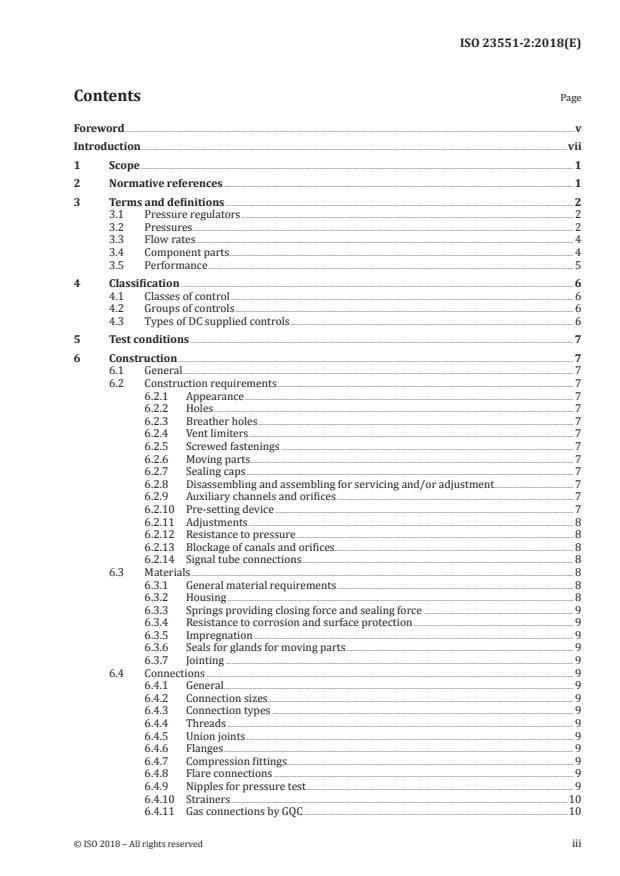
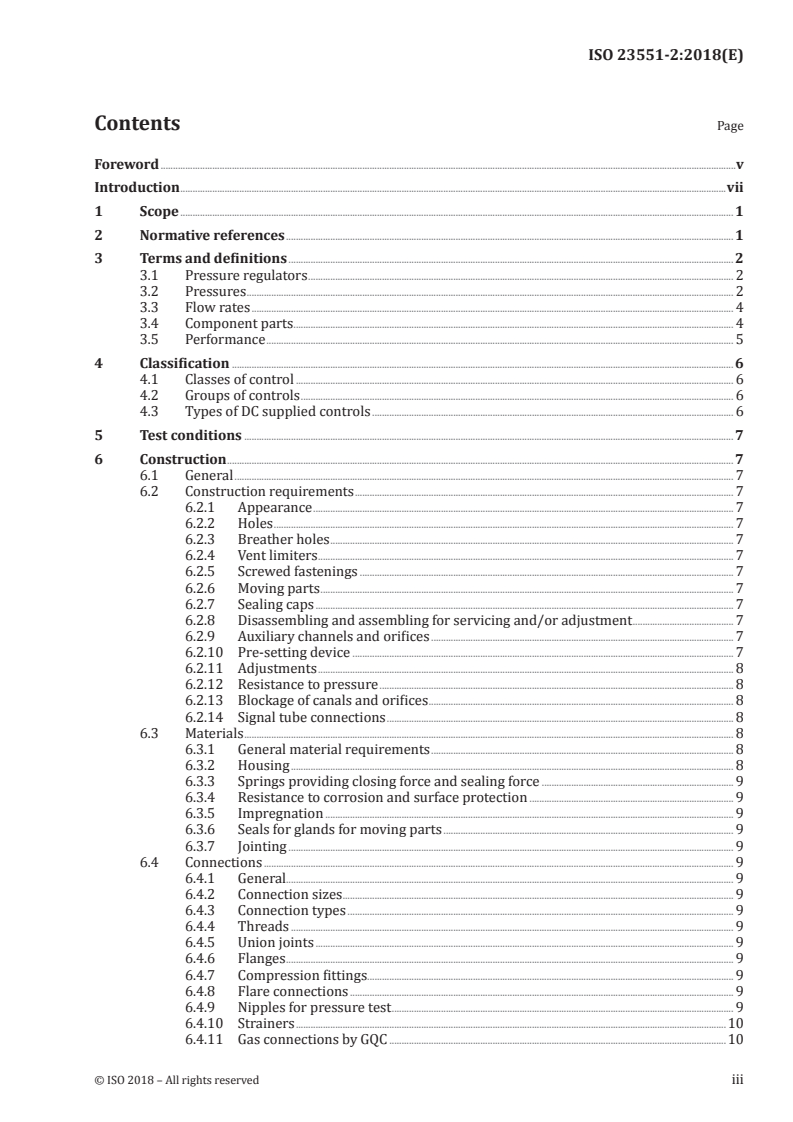
Contents Page
Foreword .v
Introduction .vii
1 Scope . 1
2 Normative references . 1
3 Terms and definitions . 2
3.1 Pressure regulators . 2
3.2 Pressures . 2
3.3 Flow rates . 4
3.4 Component parts . 4
3.5 Performance . 5
4 Classification . 6
4.1 Classes of control . 6
4.2 Groups of controls . 6
4.3 Types of DC supplied controls . 6
5 Test conditions . 7
6 Construction . 7
6.1 General . 7
6.2 Construction requirements . 7
6.2.1 Appearance . 7
6.2.2 Holes . 7
6.2.3 Breather holes . 7
6.2.4 Vent limiters . 7
6.2.5 Screwed fastenings . 7
6.2.6 Moving parts . 7
6.2.7 Sealing caps . 7
6.2.8 Disassembling and assembling for servicing and/or adjustment . 7
6.2.9 Auxiliary channels and orifices . 7
6.2.10 Pre-setting device . 7
6.2.11 Adjustments . 8
6.2.12 Resistance to pressure . 8
6.2.13 Blockage of canals and orifices . 8
6.2.14 Signal tube connections . 8
6.3 Materials . 8
6.3.1 General material requirements . 8
6.3.2 Housing . 8
6.3.3 Springs providing closing force and sealing force . 9
6.3.4 Resistance to corrosion and surface protection . 9
6.3.5 Impregnation . 9
6.3.6 Seals for glands for moving parts . 9
6.3.7 Jointing . 9
6.4 Connections . 9
6.4.1 General. 9
6.4.2 Connection sizes . 9
6.4.3 Connection types . 9
6.4.4 Threads . 9
6.4.5 Union joints . 9
6.4.6 Flanges . 9
6.4.7 Compression fittings . . . 9
6.4.8 Flare connections . 9
6.4.9 Nipples for pressure test . 9
6.4.10 Strainers .10
6.4.11 Gas connections by GQC .10
6.5 Gas controls employing electrical components in the gas way .10
7 Performance .10
7.1 General .10
7.2 Leak-tightness.10
7.2.1 General.10
7.2.2 Requirements .10
7.2.3 Test .10
7.3 Torsion and bending .11
7.4 Rated flow rate .11
7.4.1 General.11
7.4.2 Requirements .11
7.4.3 Test .11
7.5 Durability .11
7.6 Functional requirements .11
7.7 Endurance .11
7.8 Vibration test .12
7.9 Putting the regulator out of action.12
7.9.1 Requirement .12
7.9.2 Test putting the regulator out of action .12
7.10 Endurance .12
7.11 Lock-up pressure .12
7.11.1 Requirement .12
7.11.2 Lock-up pressure test .12
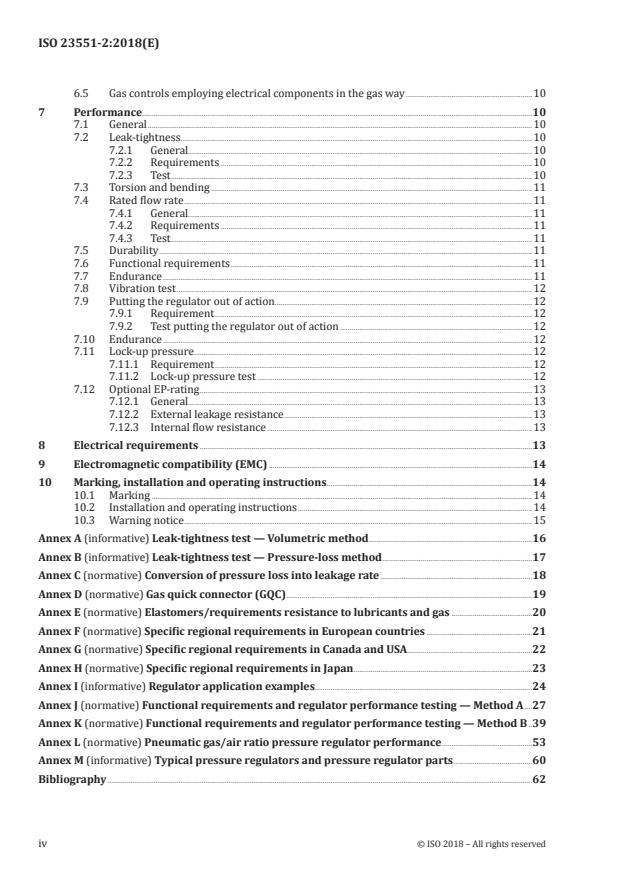
7.12 Optional EP-rating .13
7.12.1 General.13
7.12.2 External leakage resistance .13
7.12.3 Internal flow resistance .13
8 Electrical requirements .13
9 Electromagnetic compatibility (EMC) .14
10 Marking, installation and operating instructions .14
10.1 Marking .14
10.2 Installation and operating instructions .14
10.3 Warning notice .15
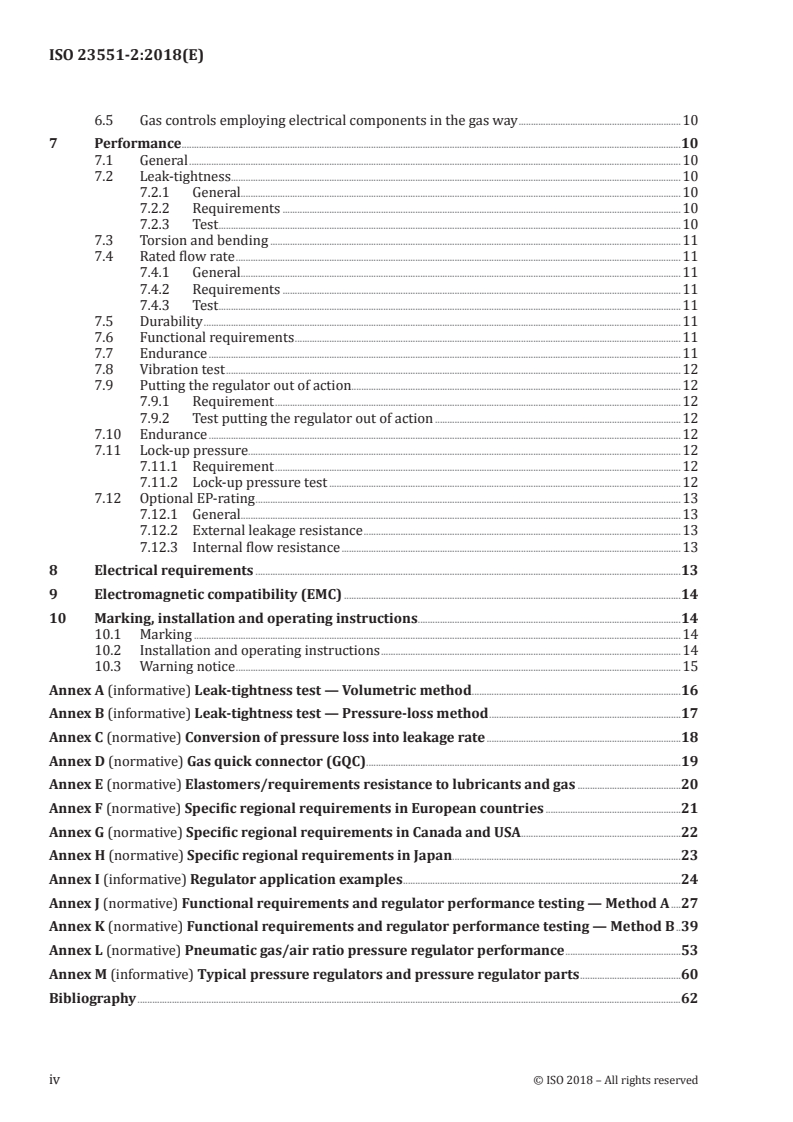
Annex A (informative) Leak-tightness test — Volumetric method .16
Annex B (informative) Leak-tightness test — Pressure-loss method .17
Annex C (normative) Conversion of pressure loss into leakage rate .18
Annex D (normative) Gas quick connector (GQC) .19
Annex E (normative) Elastomers/requirements resistance to lubricants and gas .20
Annex F (normative) Specific regional requirements in European countries .21
Annex G (normative) Specific regional requirements in Canada and USA .22
Annex H (normative) Specific regional requirements in Japan .23
Annex I (informative) Regulator application examples .24
Annex J (normative) Functional requirements and regulator performance testing — Method A .27
Annex K (normative) Functional requirements and regulator performance testing — Method B .39
Annex L (normative) Pneumatic gas/air ratio pressure regulator performance .53
Annex M (informative) Typical pressure regulators and pressure regulator parts .60
Bibliography .62
iv © ISO 2018 – All rights reserved
Foreword
ISO (the International Organization for Standardization) is a worldwide federation of national standards
bodies (ISO member bodies). The work of preparing International Standards is normally carried out
through ISO technical committees. Each member body interested in a subject for which a technical
committee has been established has the right to be represented on that committee. International
organizations, governmental and non-governmental, in liaison with ISO, also take part in the work.
ISO collaborates closely with the International Electrotechnical Commission (IEC) on all matters of
electrotechnical standardization.
The procedures used to develop this document and those intended for its further maintenance are
described in the ISO/IEC Directives, Part 1. In particular, the different approval criteria needed for the
different types of ISO documents should be noted. This document was drafted in accordance with the
editorial rules of the ISO/IEC Directives, Part 2 (see www .iso .org/directives).
Attention is drawn to the possibility that some of the elements of this document may be the subject of
patent rights. ISO shall not be held responsible for identifying any or all such patent rights. Details of
any patent rights identified during the development of the document will be in the Introduction and/or
on the ISO list of patent declarations received (see www .iso .org/patents).
Any trade name used in this document is information given for the convenience of users and does not
constitute an endorsement.
For an explanation of the voluntary nature of standards, the meaning of ISO specific terms and
expressions related to conformity assessment, as well as information about ISO's adherence to the
World Trade Organization (WTO) principles in the Technical Barriers to Trade (TBT) see www .iso
.org/iso/foreword .html.
This document was prepared by Technical Committee ISO/TC 161, Controls and protective devices for
gas and/or oil.
Any feedback or questions on this document should be directed to the user’s national standards body. A
complete listing of these bodies can be found at www .iso .org/members .html.
This second edition cancels and replaces the first edition (ISO 23551-2:2006), which has been technically
revised. The main changes compared to the previous edition are as follows:
a) this document has been aligned with the structure of ISO 23550:2018;
b) the following have been merged into one document:
— pressure regulators (ISO 23551-2),
— zero pressure regulators (new functions), and
— gas/air ratio controls, pneumatic types (ISO 23551-3);
c) the Introduction has been rewritten;
d) Clause 1 now extends to pressure regulators and pneumatic gas/air ratio pressure regulators at
inlet pressures up to and including 500 kPa; auxiliary energy may be used to change the set point;
e) Clause 2 has been updated;
f) Clause 3 has been updated and new definitions have been updated;
g) in Clause 4, new regulator class D has been added for supply situations with low fluctuations;
h) Clause 5 now refers to Annexes including the new Annex L for gas/air ratio pressure regulators;
i) requirements for breather holes have been moved from Clause 6 to ISO 23550:2018;
k) Clause 7 has been structured into “General”, “Requirements” and “Test”;
l) Clause 8 has been added without reflecting structure and requirements as in ISO 23550:2018;
m) Clause 9 has been renumbered;
n) Clause 10 has been renumbered and amended to cover the additional regulator types;
o) new Annex I has been added;
p) former Annex B has been updated and renumbered into Annex J;
q) former Annex C has been updated and renumbered into Annex K;
r) new Annex L has been added;
s) former Annex E has been updated and renumbered into Annex M;
t) new Annexes F, G and H have been added for regional requirements.
A list of all the parts in the ISO 23551 series can be found on the ISO website.
vi © ISO 2018 – All rights reserved
Introduction
This document is designed to be used in combination with ISO 23550. Together with ISO 23550, this
document establishes the full requirements as they apply to the product covered by this document.
Where needed, this document adapts ISO 23550 by stating in the corresponding clause:
— “with the following modification”;
— “with the following addition”;
— “is replaced by the following”; or
— “is not applicable”.
In order to identify specific requirements that are particular to this document, that are not already
covered by ISO 23550, this document may contain clauses or subclauses that are additional to the
structure of ISO 23550. These subclauses are indicated by the introductory sentence: “Subclause (or
Annex) specific to this document.”
To ensure global relevance of this document, the differing requirements resulting from practical
experience and installation practices in various regions of the world have been taken into account. The
variations in basic infrastructure associated with gas and/or oil controls and appliances have also been
recognized, some of which are addressed in Annexes F, G and H. This document intends to provide a
basic framework of requirements that recognize these differences.
INTERNATIONAL STANDARD ISO 23551-2:2018(E)
Safety and control devices for gas burners and gas-burning
appliances — Particular requirements —
Part 2:
Pressure regulators
1 Scope
This document specifies safety, construction, performance and testing requirements for pressure
regulators and pneumatic gas/air ratio pressure regulators intended for use with gas burners and gas-
burning appliances.
This document applies to pressure regulators and pneumatic gas/air ratio pressure regulators of
nominal connection size up to and including DN 250 at inlet pressures up to and including 500 kPa,
for use with natural gas, manufactured gas or liquefied petroleum gas (LPG). It is not applicable to
corrosive and waste gases.
This document is specifically applicable to:
— positive, zero and negative pressure regulators which can use auxiliary energy to change the outlet
pressure setting;
— pneumatic gas/air ratio pressure regulators, which function by controlling a gas outlet pressure in
response to an air signal pressure, air signal differential pressure, and/or to a combustion chamber
pressure signal;
— gas/air ratio pressure regulators, which function by controlling an air outlet pressure in response
to a gas signal pressure or a gas signal differential pressure.
This document does not cover:
— pressure regulators connected directly to gas distribution network or to a container that maintains
a standard distribution pressure;
— pressure regulators intended to be installed in the open air and exposed to the environment;
— mechanically linked gas/air ratio controls;
— electronic pressure regulators and gas/air ratio regulators, which are contained in ISO 23552-1.
This document covers type testing only.
NOTE Annexes A to H reference the relevant annexes of ISO 23550, general requirements and are applicable
where required.
2 Normative references
The following documents are referred to in the text in such a way that some or all of their content
constitutes requirements of this document. For dated references, only the edition cited applies. For
undated references, the latest edition of the referenced document (including any amendments) applies.
ISO 23550, Safety and control devices for gas burners and gas-burning appliances — General requirements
3 Terms and definitions
For the purposes of this document, the terms and definitions given in ISO 23550 and the following apply.
ISO and IEC maintain terminological databases for use in standardization at the following addresses:
— ISO Online browsing platform: available at https: //www .iso .org/obp
— IEC Electropedia: available at http: //www .electropedia .org/
3.1 Pressure regulators
3.1.1
pressure regulator
device that maintains the outlet pressure constant within given limits, independently of the variations
in inlet pressure and/or flow rate
Note 1 to entry: For examples refer to Annex I.
3.1.2
adjustable pressure regulator
pressure regulator (3.1.1) provided with means for changing the outlet pressure setting
3.1.3
pneumatic gas
air ratio pressure regulator
pressure regulator (3.1.1) which supplies gas at specified pressure at its outlet in response to control
pressure
3.1.4
zero pressure regulator
pressure regulator (3.1.1) which maintains the outlet pressure constant at or below atmospheric
pressure
3.2 Pressures
3.2.1
test pressure
pressure to be applied during a test
3.2.2
pressure drop
differential pressure with the control member open to its fullest extent
3.2.3
maximum inlet pressure
p
1max
highest inlet pressure at which tests have been conducted to determine that the regulator is able to
control the outlet pressure within acceptable limits as declared by the manufacturer
3.2.4
minimum inlet pressure
p
1min
lowest inlet pressure at which tests have been conducted to determine that the regulator is able to
control the outlet pressure within acceptable limits declared by the manufacturer
3.2.5
inlet pressure range
difference between the minimum and the maximum values of the inlet pressure
2 © ISO 2018 – All rights reserved
3.2.6
maximum outlet pressure
p
2max
highest outlet pressure at which tests have been conducted to determine that the regulator is able to
control the outlet pressure within acceptable limits declared by the manufacturer
3.2.7
minimum outlet pressure
p
2min
lowest outlet pressure at which tests have been conducted to determine that the regulator is able to
control the outlet pressure within acceptable limits declared by the manufacturer
3.2.8
outlet pressure range
difference between the minimum and the maximum values of the outlet pressure
3.2.9
setting point
inlet and outlet pressures declared by the manufacturer, at which the regulator is initially adjusted for
test purposes at a declared flow rate
Note 1 to entry: The respective pressures and flow rate are termed inlet setting pressure (3.2.10), outlet setting
pressure (3.2.11) and setting flow rate.
3.2.10
inlet setting pressure
p
1s
inlet pressure at which the pressure regulator (3.1.1) is set for test purposes
3.2.11
outlet setting pressure
p
2s
outlet pressure at which the pressure regulator (3.1.1) is set for test purposes
3.2.12
signal pressure
p
pressure, differential pressure or a combination of both applied to the regulator in order to provide the
specified outlet pressure
3.2.13
load determining pressure
p
negative pressure as a result of an air flow, e.g. produced by a sucking fan, through a restriction
3.2.14
combustion chamber pressure
p
sc
pressure of combustion gases from the combustion chamber connected to the pressure regulator (3.1.1)
3.2.15
gas/air ratio
slope of a straight line relationship between the outlet pressure, p , and signal pressure (3.2.12), p
2 3
3.2.16
withstand pressure
pressure that is withstood without degraded characteristic after returning to or below the maximum
inlet pressure (3.2.3)
3.2.17
excessive pressure
EP
optional rating for a regulator that is leak and flow resistant to abnormally high inlet pressures
Note 1 to entry: Regulators may be EP rated according to the tests herein.
3.3 Flow rates
3.3.1
maximum flow rate
q
max
maximum rate, as a function of inlet and outlet pressures, declared by the manufacturer and expressed
in m /h of air at standard conditions
Note 1 to entry: For a non-adjustable regulator, there is only one maximum flow rate.
3.3.2
minimum flow rate
q
min
minimum rate, as a function of inlet and outlet pressures, declared by the manufacturer and expressed
in m /h of air at standard conditions
Note 1 to entry: For a non-adjustable regulator, there is only one minimum flow rate.
3.3.3
flow rate range
range of flow rate between the maximum and minimum value
3.4 Component parts
3.4.1
breather hole
orifice that allows atmospheric pressure to be maintained in a compartment of variable volume
3.4.2
diaphragm
flexible member which, under the influence of the forces arising from loading and pressure, operates
the control member
3.4.3
diaphragm plate
stiffening plate fitted to the diaphragm (3.4.2)
3.4.4
valve
device which varies the gas flow directly
3.4.5
signal chamber
part of the regulator to which the air signal pressure (3.2.12), gas pressure, or combustion chamber
pressure (3.2.14) signal is connected
4 © ISO 2018 – All rights reserved
3.5 Performance
3.5.1
lock-up pressure
p
2f
outlet pressure at which a regulator closes when the outlet of the regulator is sealed
Note 1 to entry: The increase in outlet pressure is expressed either in kilopascals or as a percentage.
3.5.2
put out of action, verb
deactivate a regulator by putting the regulator to the full open position thereby ensuring that this
setting does not undergo any changes
3.5.3
offset
outlet pressure shift at pneumatic gas/air ratio pressure regulators (3.1.3) independent of signal or load
determining pressure(s) (3.2.13)
Note 1 to entry: Typically, this is achieved by means of a spring.
3.5.4
steady state value
outlet pressure measured after step response (control signal remains constant)
3.5.5
settling tolerance
maximum difference between the current outlet pressure and its steady state value (3.5.4)
3.5.6
settling time
time counted from start of the step change of the signal pressure (3.2.12) or load determining pressure
(3.2.13) until the outlet pressure remains in the settling tolerance (3.5.5)
Note 1 to entry: For further information refer to Figure 1.
Key
1 step change (y1) 4 state value
2 step response (y2) 5 settling time
3 settling tolerance t time
Figure 1 — Settling time after a step change
4 Classification
4.1 Classes of control
Shall be according to ISO 23550:2018, 4.1 with the following addition:
Pressure regulators are classified as class A, class B, class C or class D according to the appropriate inlet
pressure and flow rate limits, as given in Table 1.
Regulators may be classified as types for industrial use.
Regulators may be classified as circle "P" or triangle "P" when the range of regulation capacity
also includes pilot load (see Annex K). This classification does not apply to modulating regulators.
Regulators may be classified as EP when tested in accordance with 7.12.
Gas/air ratio pressure regulators are not classified.
NOTE In the USA, regulators are classified either for main burner load application or for main burner and
pilot load application.
Table 1 — Deviation of outlet pressure from outlet setting pressure
a
Maximum outlet pressure deviation
%
Class of regulators
Manufactured Natural gas Liquefied pe-
gas troleum gas
Class A: q to q and p to p
max min 1max 1min
standard use ±15 ±15 ±15
or ±0,1 kPa or ±0,1 kPa or ±0,1 kPa
industrial use ±20 ±20 ±20
or ±0,2 kPa or ±0,2 kPa or ±0,2 kPa
Class B: by variation of the inlet pressure for each of
+15 +10
the flow rates
±10
−20 −15
or ±0,1 kPa
or ±0,1 kPa or ±0,1 kPa
by variation of flow rates from q to q
max min
+40 +40 +40
(constant inlet pressure) for each of the
0 0 0
inlet pressures
Class C: at constant q (within the flow rate range)
+15 +10
±10
−20 −15
or ±0,1 kPa
or ±0,1 kPa or ±0,1 kPa
Class D: at constant q (within the flow rate range) ±15 ±15 ±15
and a fixed setting of p or ±0,1 kPa or ±0,1 kPa or ±0,1 kPa
2s
NOTE For the classification of fuel gases, see ISO 23550.
a
See ISO 23550.
4.2 Groups of controls
Shall be according to ISO 23550:2018, 4.2 with the following modification:
Replace “control” by “regulator”.
4.3 Types of DC supplied controls
Shall be according to ISO 23550:2018, 4.3.
6 © ISO 2018 – All rights reserved
5 Test conditions
Shall be according to ISO 23550:2018, Clause 5, with the following addition:
NOTE Specific requirements for testing are given in Annexes J, K and L.
6 Construction
6.1 General
Shall be according to ISO 23550:2018, 6.1, with the following addition:
NOTE For examples of typical pressure regulators and pressure regulator parts, refer to Annex M.
6.2 Construction requirements
6.2.1 Appearance
Shall be according to ISO 23550:2018; 6.2.1.
6.2.2 Holes
Shall be according to ISO 23550:2018; 6.2.2.
6.2.3 Breather holes
Shall be according to ISO 23550:2018, 6.2.3.
6.2.4 Vent limiters
Shall be according to ISO 23550:2018, 6.2.4.
6.2.5 Screwed fastenings
Shall be according to ISO 23550:2018, 6.2.5.
6.2.6 Moving parts
Shall be according to ISO 23550:2018, 6.2.6.
6.2.7 Sealing caps
Shall be according to ISO 23550:2018, 6.2.7.
6.2.8 Disassembling and assembling for servicing and/or adjustment
Shall be according to ISO 23550:2018, 6.2.8.
6.2.9 Auxiliary channels and orifices
Shall be according to ISO 23550:2018, 6.2.9.
6.2.10 Pre-setting device
Shall be according to ISO 23550:2018, 6.2.10.
6.2.11 Adjustments
Subclause specific to this document.
The adjustments (e.g. outlet pressure, offset and gas/air-ratio) shall be readily accessible to authorized
persons, but there shall be provision for sealing after adjustment. Means shall be provided to discourage
interference by unauthorized persons. If it is stated in the installation and operating instructions that
a pressure regulator can be put out of action, appropriate means shall be provided to put the pressure
regulator out of action.
6.2.12 Resistance to pressure
Subclause specific to this document.
Parts of the pressure regulator that are subjected to inlet pressure under normal operating conditions,
or can be subjected to inlet pressure in the event of a failure, shall resist a pressure equal to the
withstand pressure.
The withstand pressure shall be stated in the installation and operating instructions. If no withstand
pressure is stated, the withstand pressure is equal to the maximum inlet pressure.
6.2.13 Blockage of canals and orifices
Subclause specific to this document.
Blockage of auxiliary canals and orifices shall not lead to an unsafe situation. Otherwise, they shall be
protected against blockage by suitable means.
6.2.14 Signal tube connections
Subclause specific to this document.
Requirements on connections for gas pressure, air pressure or combustion chamber pressure signal
tubes shall be stated in the installation and operating instructions.
6.3 Materials
6.3.1 General material requirements
Shall be according to ISO 23550:2018, 6.3.1.
6.3.2 Housing
6.3.2.1 General
Shall be according to ISO 23550:2018, 6.3.2.1.
6.3.2.2 Requirements
Shall be according to ISO 23550:2018, 6.3.2.2 with the following modification:
The withstand pressure shall be used instead of maximum inlet pressure, if applicable.
6.3.2.3 Test
Shall be according to ISO 23550:2018, 6.3.2.3.
8 © ISO 2018 – All rights reserved
6.3.3 Springs providing closing force and sealing force
ISO 23550:2018, 6.3.3 is not applicable.
6.3.4 Resistance to corrosion and surface protection
Shall be according to ISO 23550:2018, 6.3.4.
6.3.5 Impregnation
Shall be according to ISO 23550:2018, 6.3.5.
6.3.6 Seals for glands for moving parts
Shall be according to ISO 23550:2018, 6.3.6.
6.3.7 Jointing
Shall be according to ISO 23550:2018, 6.3.7.
6.4 Connections
6.4.1 General
Shall be according to ISO 23550:2018, 6.4.1.
6.4.2 Connection sizes
Shall be according to ISO 23550:2018, 6.4.2.
6.4.3 Connection types
Shall be according to ISO 23550:2018, 6.4.3.
6.4.4 Threads
Shall be according to ISO 23550:2018, 6.4.4.
6.4.5 Union joints
Shall be according to ISO 23550:2018, 6.4.5.
6.4.6 Flanges
Shall be according to ISO 23550:2018, 6.4.6.
6.4.7 Compression fittings
Shall be according to ISO 23550:2018, 6.4.7.
6.4.8 Flare connections
Shall be according to ISO 23550:2018, 6.4.8.
6.4.9 Nipples for pressure test
Shall be according to ISO 23550:2018, 6.4.9.
6.4.10 Strainers
6.4.10.1 General
Shall be according to ISO 23550:2018, 6.4.10.1.
6.4.10.2 Requirements
Shall be according to ISO 23550:2018, 6.4.10.2 with the following addition:
Strainers intended to be serviceable shall be accessible for cleaning or replacement without the need to
remove the control body by dismantling threaded or welded pipe work.
6.4.10.3 Test
Shall be according to ISO 23550:2018, 6.4.10.3.
6.4.11 Gas connections by GQC
Shall be according to ISO 23550:2018, 6.4.11.
6.5 Gas controls employing electrical components in the gas way
Shall be according to ISO 23550:2018, 6.5.
7 Performance
7.1 General
Shall be according to ISO 23550:2018, 7.1.
7.2 Leak-tightness
7.2.1 General
Shall be according to ISO 23550:2018, 7.2.1.
7.2.2 Requirements
Shall be according to ISO 23550:2018, 7.2.2 with the following modification:
Requirements for internal leakage rates given in ISO 23550:2018, Table 2 shall not apply (see 7.2.3.3).
7.2.3 Test
7.2.3.1 General
Shall be according to ISO 23550:2018, 7.2.3.1.
7.2.3.2 Test for external leak-tightness
Shall be according to ISO 23550:2018, 7.2.3.2 with the following addition:
If the signal chamber is intended to be gas-tight, the following external leak test shall be used. Apply
a pressure of 1,5 times the maximum operating pressure to the signal chamber. The tests results shall
meet the requirements of 7.2.2.
10 © ISO 2018 – All rights reserved
If the signal chamber is pressurized by a non-combustible gas or air, the manufacturer shall specify
the allowable leak rate and the test method for the specific application. The leak rate shall meet this
specification before and after the endurance tests.
7.2.3.3 Test for internal leak-tightness of controls
ISO 23550:2018, 7.2.3.3 is not applicable.
7.3 Torsion and bending
Shall be according to ISO 23550:2018, 7.3.
7.4 Rated flow rate
7.4.1 General
Shall be according to ISO 23550:2018, 7.4.1.
7.4.2 Requirements
Shall be according to ISO 23550:2018, 7.4.2.
7.4.3 Test
7.4.3.1 Apparatus
Shall be according to ISO 23550:2018, 7.4.3.1.
7.4.3.2 Test procedure
Shall be according to ISO 23550:2018, 7.4.3.2 with the following addition:
If the rated flow rate for pressure regulators, as stated in the installation and operating instructions, is
specified for the control member in the fully open position, the test shall be performed with the control
member in that position.
7.4.3.3 Conversion of air flow rate
Shall be according to ISO 23550:2018, 7.4.3.3.
7.5 Durability
Shall be according to ISO 23550:2018, 7.5.
7.6 Functional requirements
Shall be according to ISO 23550:2018, 7.6 with the following addition:
Alternative methods for functional requirements and testing of pressure regulators are given in
Annexes J and K.
Annex L shall be used for functional requirements for gas/air ratio controls.
7.7 Endurance
Shall be according to ISO 23550:2018, 7.7.
7.8 Vibration test
Shall be according to ISO 23550:2018, 7.8.
7.9 Putting the regulator out of action
Subclause specific to this document.
7.9.1 Requirement
If it is stated in the installation and operating instructions that the pressure regulator can put out
of action, for example for Liquefied Petroleum Gas applications, the method shall be given in the
manufacturer’s installation and operating instructions and shall result in the control member being
fixed in the fully open position.
The control shall include or the manufacturer shall provide a means to comply with 6.2.3 when the
regulator is blocked in the open position.
When the regulator is put back into operation, it shall comply with the requirements of this document.
7.9.2 Test putting the regulator out of action
The regulator shall be deactivated in accordance with the procedure described in the manufacturer's
instructions. After visually checking that the valve is in its fully open position, the leak tightness is to
be determined in accordance with the method given in 7.2.3.2. When it is operative again, the regulator
is to be tested by the methods given in this document.
7.10 Endur
...
INTERNATIONAL ISO
STANDARD 23551-2
Second edition
2018-09
Safety and control devices for gas
burners and gas-burning appliances —
Particular requirements —
Part 2:
Pressure regulators
Dispositifs de commande et de sécurité pour brûleurs à gaz et
appareils à gaz — Exigences particulières —
Partie 2: Régulateurs de pression
Reference number
©
ISO 2018
© ISO 2018
All rights reserved. Unless otherwise specified, or required in the context of its implementation, no part of this publication may
be reproduced or utilized otherwise in any form or by any means, electronic or mechanical, including photocopying, or posting
on the internet or an intranet, without prior written permission. Permission can be requested from either ISO at the address
below or ISO’s member body in the country of the requester.
ISO copyright office
CP 401 • Ch. de Blandonnet 8
CH-1214 Vernier, Geneva
Phone: +41 22 749 01 11
Fax: +41 22 749 09 47
Email: copyright@iso.org
Website: www.iso.org
Published in Switzerland
ii © ISO 2018 – All rights reserved
Contents Page
Foreword .v
Introduction .vii
1 Scope . 1
2 Normative references . 1
3 Terms and definitions . 2
3.1 Pressure regulators . 2
3.2 Pressures . 2
3.3 Flow rates . 4
3.4 Component parts . 4
3.5 Performance . 5
4 Classification . 6
4.1 Classes of control . 6
4.2 Groups of controls . 6
4.3 Types of DC supplied controls . 6
5 Test conditions . 7
6 Construction . 7
6.1 General . 7
6.2 Construction requirements . 7
6.2.1 Appearance . 7
6.2.2 Holes . 7
6.2.3 Breather holes . 7
6.2.4 Vent limiters . 7
6.2.5 Screwed fastenings . 7
6.2.6 Moving parts . 7
6.2.7 Sealing caps . 7
6.2.8 Disassembling and assembling for servicing and/or adjustment . 7
6.2.9 Auxiliary channels and orifices . 7
6.2.10 Pre-setting device . 7
6.2.11 Adjustments . 8
6.2.12 Resistance to pressure . 8
6.2.13 Blockage of canals and orifices . 8
6.2.14 Signal tube connections . 8
6.3 Materials . 8
6.3.1 General material requirements . 8
6.3.2 Housing . 8
6.3.3 Springs providing closing force and sealing force . 9
6.3.4 Resistance to corrosion and surface protection . 9
6.3.5 Impregnation . 9
6.3.6 Seals for glands for moving parts . 9
6.3.7 Jointing . 9
6.4 Connections . 9
6.4.1 General. 9
6.4.2 Connection sizes . 9
6.4.3 Connection types . 9
6.4.4 Threads . 9
6.4.5 Union joints . 9
6.4.6 Flanges . 9
6.4.7 Compression fittings . . . 9
6.4.8 Flare connections . 9
6.4.9 Nipples for pressure test . 9
6.4.10 Strainers .10
6.4.11 Gas connections by GQC .10
6.5 Gas controls employing electrical components in the gas way .10
7 Performance .10
7.1 General .10
7.2 Leak-tightness.10
7.2.1 General.10
7.2.2 Requirements .10
7.2.3 Test .10
7.3 Torsion and bending .11
7.4 Rated flow rate .11
7.4.1 General.11
7.4.2 Requirements .11
7.4.3 Test .11
7.5 Durability .11
7.6 Functional requirements .11
7.7 Endurance .11
7.8 Vibration test .12
7.9 Putting the regulator out of action.12
7.9.1 Requirement .12
7.9.2 Test putting the regulator out of action .12
7.10 Endurance .12
7.11 Lock-up pressure .12
7.11.1 Requirement .12
7.11.2 Lock-up pressure test .12
7.12 Optional EP-rating .13
7.12.1 General.13
7.12.2 External leakage resistance .13
7.12.3 Internal flow resistance .13
8 Electrical requirements .13
9 Electromagnetic compatibility (EMC) .14
10 Marking, installation and operating instructions .14
10.1 Marking .14
10.2 Installation and operating instructions .14
10.3 Warning notice .15
Annex A (informative) Leak-tightness test — Volumetric method .16
Annex B (informative) Leak-tightness test — Pressure-loss method .17
Annex C (normative) Conversion of pressure loss into leakage rate .18
Annex D (normative) Gas quick connector (GQC) .19
Annex E (normative) Elastomers/requirements resistance to lubricants and gas .20
Annex F (normative) Specific regional requirements in European countries .21
Annex G (normative) Specific regional requirements in Canada and USA .22
Annex H (normative) Specific regional requirements in Japan .23
Annex I (informative) Regulator application examples .24
Annex J (normative) Functional requirements and regulator performance testing — Method A .27
Annex K (normative) Functional requirements and regulator performance testing — Method B .39
Annex L (normative) Pneumatic gas/air ratio pressure regulator performance .53
Annex M (informative) Typical pressure regulators and pressure regulator parts .60
Bibliography .62
iv © ISO 2018 – All rights reserved
Foreword
ISO (the International Organization for Standardization) is a worldwide federation of national standards
bodies (ISO member bodies). The work of preparing International Standards is normally carried out
through ISO technical committees. Each member body interested in a subject for which a technical
committee has been established has the right to be represented on that committee. International
organizations, governmental and non-governmental, in liaison with ISO, also take part in the work.
ISO collaborates closely with the International Electrotechnical Commission (IEC) on all matters of
electrotechnical standardization.
The procedures used to develop this document and those intended for its further maintenance are
described in the ISO/IEC Directives, Part 1. In particular, the different approval criteria needed for the
different types of ISO documents should be noted. This document was drafted in accordance with the
editorial rules of the ISO/IEC Directives, Part 2 (see www .iso .org/directives).
Attention is drawn to the possibility that some of the elements of this document may be the subject of
patent rights. ISO shall not be held responsible for identifying any or all such patent rights. Details of
any patent rights identified during the development of the document will be in the Introduction and/or
on the ISO list of patent declarations received (see www .iso .org/patents).
Any trade name used in this document is information given for the convenience of users and does not
constitute an endorsement.
For an explanation of the voluntary nature of standards, the meaning of ISO specific terms and
expressions related to conformity assessment, as well as information about ISO's adherence to the
World Trade Organization (WTO) principles in the Technical Barriers to Trade (TBT) see www .iso
.org/iso/foreword .html.
This document was prepared by Technical Committee ISO/TC 161, Controls and protective devices for
gas and/or oil.
Any feedback or questions on this document should be directed to the user’s national standards body. A
complete listing of these bodies can be found at www .iso .org/members .html.
This second edition cancels and replaces the first edition (ISO 23551-2:2006), which has been technically
revised. The main changes compared to the previous edition are as follows:
a) this document has been aligned with the structure of ISO 23550:2018;
b) the following have been merged into one document:
— pressure regulators (ISO 23551-2),
— zero pressure regulators (new functions), and
— gas/air ratio controls, pneumatic types (ISO 23551-3);
c) the Introduction has been rewritten;
d) Clause 1 now extends to pressure regulators and pneumatic gas/air ratio pressure regulators at
inlet pressures up to and including 500 kPa; auxiliary energy may be used to change the set point;
e) Clause 2 has been updated;
f) Clause 3 has been updated and new definitions have been updated;
g) in Clause 4, new regulator class D has been added for supply situations with low fluctuations;
h) Clause 5 now refers to Annexes including the new Annex L for gas/air ratio pressure regulators;
i) requirements for breather holes have been moved from Clause 6 to ISO 23550:2018;
k) Clause 7 has been structured into “General”, “Requirements” and “Test”;
l) Clause 8 has been added without reflecting structure and requirements as in ISO 23550:2018;
m) Clause 9 has been renumbered;
n) Clause 10 has been renumbered and amended to cover the additional regulator types;
o) new Annex I has been added;
p) former Annex B has been updated and renumbered into Annex J;
q) former Annex C has been updated and renumbered into Annex K;
r) new Annex L has been added;
s) former Annex E has been updated and renumbered into Annex M;
t) new Annexes F, G and H have been added for regional requirements.
A list of all the parts in the ISO 23551 series can be found on the ISO website.
vi © ISO 2018 – All rights reserved
Introduction
This document is designed to be used in combination with ISO 23550. Together with ISO 23550, this
document establishes the full requirements as they apply to the product covered by this document.
Where needed, this document adapts ISO 23550 by stating in the corresponding clause:
— “with the following modification”;
— “with the following addition”;
— “is replaced by the following”; or
— “is not applicable”.
In order to identify specific requirements that are particular to this document, that are not already
covered by ISO 23550, this document may contain clauses or subclauses that are additional to the
structure of ISO 23550. These subclauses are indicated by the introductory sentence: “Subclause (or
Annex) specific to this document.”
To ensure global relevance of this document, the differing requirements resulting from practical
experience and installation practices in various regions of the world have been taken into account. The
variations in basic infrastructure associated with gas and/or oil controls and appliances have also been
recognized, some of which are addressed in Annexes F, G and H. This document intends to provide a
basic framework of requirements that recognize these differences.
INTERNATIONAL STANDARD ISO 23551-2:2018(E)
Safety and control devices for gas burners and gas-burning
appliances — Particular requirements —
Part 2:
Pressure regulators
1 Scope
This document specifies safety, construction, performance and testing requirements for pressure
regulators and pneumatic gas/air ratio pressure regulators intended for use with gas burners and gas-
burning appliances.
This document applies to pressure regulators and pneumatic gas/air ratio pressure regulators of
nominal connection size up to and including DN 250 at inlet pressures up to and including 500 kPa,
for use with natural gas, manufactured gas or liquefied petroleum gas (LPG). It is not applicable to
corrosive and waste gases.
This document is specifically applicable to:
— positive, zero and negative pressure regulators which can use auxiliary energy to change the outlet
pressure setting;
— pneumatic gas/air ratio pressure regulators, which function by controlling a gas outlet pressure in
response to an air signal pressure, air signal differential pressure, and/or to a combustion chamber
pressure signal;
— gas/air ratio pressure regulators, which function by controlling an air outlet pressure in response
to a gas signal pressure or a gas signal differential pressure.
This document does not cover:
— pressure regulators connected directly to gas distribution network or to a container that maintains
a standard distribution pressure;
— pressure regulators intended to be installed in the open air and exposed to the environment;
— mechanically linked gas/air ratio controls;
— electronic pressure regulators and gas/air ratio regulators, which are contained in ISO 23552-1.
This document covers type testing only.
NOTE Annexes A to H reference the relevant annexes of ISO 23550, general requirements and are applicable
where required.
2 Normative references
The following documents are referred to in the text in such a way that some or all of their content
constitutes requirements of this document. For dated references, only the edition cited applies. For
undated references, the latest edition of the referenced document (including any amendments) applies.
ISO 23550, Safety and control devices for gas burners and gas-burning appliances — General requirements
3 Terms and definitions
For the purposes of this document, the terms and definitions given in ISO 23550 and the following apply.
ISO and IEC maintain terminological databases for use in standardization at the following addresses:
— ISO Online browsing platform: available at https: //www .iso .org/obp
— IEC Electropedia: available at http: //www .electropedia .org/
3.1 Pressure regulators
3.1.1
pressure regulator
device that maintains the outlet pressure constant within given limits, independently of the variations
in inlet pressure and/or flow rate
Note 1 to entry: For examples refer to Annex I.
3.1.2
adjustable pressure regulator
pressure regulator (3.1.1) provided with means for changing the outlet pressure setting
3.1.3
pneumatic gas
air ratio pressure regulator
pressure regulator (3.1.1) which supplies gas at specified pressure at its outlet in response to control
pressure
3.1.4
zero pressure regulator
pressure regulator (3.1.1) which maintains the outlet pressure constant at or below atmospheric
pressure
3.2 Pressures
3.2.1
test pressure
pressure to be applied during a test
3.2.2
pressure drop
differential pressure with the control member open to its fullest extent
3.2.3
maximum inlet pressure
p
1max
highest inlet pressure at which tests have been conducted to determine that the regulator is able to
control the outlet pressure within acceptable limits as declared by the manufacturer
3.2.4
minimum inlet pressure
p
1min
lowest inlet pressure at which tests have been conducted to determine that the regulator is able to
control the outlet pressure within acceptable limits declared by the manufacturer
3.2.5
inlet pressure range
difference between the minimum and the maximum values of the inlet pressure
2 © ISO 2018 – All rights reserved
3.2.6
maximum outlet pressure
p
2max
highest outlet pressure at which tests have been conducted to determine that the regulator is able to
control the outlet pressure within acceptable limits declared by the manufacturer
3.2.7
minimum outlet pressure
p
2min
lowest outlet pressure at which tests have been conducted to determine that the regulator is able to
control the outlet pressure within acceptable limits declared by the manufacturer
3.2.8
outlet pressure range
difference between the minimum and the maximum values of the outlet pressure
3.2.9
setting point
inlet and outlet pressures declared by the manufacturer, at which the regulator is initially adjusted for
test purposes at a declared flow rate
Note 1 to entry: The respective pressures and flow rate are termed inlet setting pressure (3.2.10), outlet setting
pressure (3.2.11) and setting flow rate.
3.2.10
inlet setting pressure
p
1s
inlet pressure at which the pressure regulator (3.1.1) is set for test purposes
3.2.11
outlet setting pressure
p
2s
outlet pressure at which the pressure regulator (3.1.1) is set for test purposes
3.2.12
signal pressure
p
pressure, differential pressure or a combination of both applied to the regulator in order to provide the
specified outlet pressure
3.2.13
load determining pressure
p
negative pressure as a result of an air flow, e.g. produced by a sucking fan, through a restriction
3.2.14
combustion chamber pressure
p
sc
pressure of combustion gases from the combustion chamber connected to the pressure regulator (3.1.1)
3.2.15
gas/air ratio
slope of a straight line relationship between the outlet pressure, p , and signal pressure (3.2.12), p
2 3
3.2.16
withstand pressure
pressure that is withstood without degraded characteristic after returning to or below the maximum
inlet pressure (3.2.3)
3.2.17
excessive pressure
EP
optional rating for a regulator that is leak and flow resistant to abnormally high inlet pressures
Note 1 to entry: Regulators may be EP rated according to the tests herein.
3.3 Flow rates
3.3.1
maximum flow rate
q
max
maximum rate, as a function of inlet and outlet pressures, declared by the manufacturer and expressed
in m /h of air at standard conditions
Note 1 to entry: For a non-adjustable regulator, there is only one maximum flow rate.
3.3.2
minimum flow rate
q
min
minimum rate, as a function of inlet and outlet pressures, declared by the manufacturer and expressed
in m /h of air at standard conditions
Note 1 to entry: For a non-adjustable regulator, there is only one minimum flow rate.
3.3.3
flow rate range
range of flow rate between the maximum and minimum value
3.4 Component parts
3.4.1
breather hole
orifice that allows atmospheric pressure to be maintained in a compartment of variable volume
3.4.2
diaphragm
flexible member which, under the influence of the forces arising from loading and pressure, operates
the control member
3.4.3
diaphragm plate
stiffening plate fitted to the diaphragm (3.4.2)
3.4.4
valve
device which varies the gas flow directly
3.4.5
signal chamber
part of the regulator to which the air signal pressure (3.2.12), gas pressure, or combustion chamber
pressure (3.2.14) signal is connected
4 © ISO 2018 – All rights reserved
3.5 Performance
3.5.1
lock-up pressure
p
2f
outlet pressure at which a regulator closes when the outlet of the regulator is sealed
Note 1 to entry: The increase in outlet pressure is expressed either in kilopascals or as a percentage.
3.5.2
put out of action, verb
deactivate a regulator by putting the regulator to the full open position thereby ensuring that this
setting does not undergo any changes
3.5.3
offset
outlet pressure shift at pneumatic gas/air ratio pressure regulators (3.1.3) independent of signal or load
determining pressure(s) (3.2.13)
Note 1 to entry: Typically, this is achieved by means of a spring.
3.5.4
steady state value
outlet pressure measured after step response (control signal remains constant)
3.5.5
settling tolerance
maximum difference between the current outlet pressure and its steady state value (3.5.4)
3.5.6
settling time
time counted from start of the step change of the signal pressure (3.2.12) or load determining pressure
(3.2.13) until the outlet pressure remains in the settling tolerance (3.5.5)
Note 1 to entry: For further information refer to Figure 1.
Key
1 step change (y1) 4 state value
2 step response (y2) 5 settling time
3 settling tolerance t time
Figure 1 — Settling time after a step change
4 Classification
4.1 Classes of control
Shall be according to ISO 23550:2018, 4.1 with the following addition:
Pressure regulators are classified as class A, class B, class C or class D according to the appropriate inlet
pressure and flow rate limits, as given in Table 1.
Regulators may be classified as types for industrial use.
Regulators may be classified as circle "P" or triangle "P" when the range of regulation capacity
also includes pilot load (see Annex K). This classification does not apply to modulating regulators.
Regulators may be classified as EP when tested in accordance with 7.12.
Gas/air ratio pressure regulators are not classified.
NOTE In the USA, regulators are classified either for main burner load application or for main burner and
pilot load application.
Table 1 — Deviation of outlet pressure from outlet setting pressure
a
Maximum outlet pressure deviation
%
Class of regulators
Manufactured Natural gas Liquefied pe-
gas troleum gas
Class A: q to q and p to p
max min 1max 1min
standard use ±15 ±15 ±15
or ±0,1 kPa or ±0,1 kPa or ±0,1 kPa
industrial use ±20 ±20 ±20
or ±0,2 kPa or ±0,2 kPa or ±0,2 kPa
Class B: by variation of the inlet pressure for each of
+15 +10
the flow rates
±10
−20 −15
or ±0,1 kPa
or ±0,1 kPa or ±0,1 kPa
by variation of flow rates from q to q
max min
+40 +40 +40
(constant inlet pressure) for each of the
0 0 0
inlet pressures
Class C: at constant q (within the flow rate range)
+15 +10
±10
−20 −15
or ±0,1 kPa
or ±0,1 kPa or ±0,1 kPa
Class D: at constant q (within the flow rate range) ±15 ±15 ±15
and a fixed setting of p or ±0,1 kPa or ±0,1 kPa or ±0,1 kPa
2s
NOTE For the classification of fuel gases, see ISO 23550.
a
See ISO 23550.
4.2 Groups of controls
Shall be according to ISO 23550:2018, 4.2 with the following modification:
Replace “control” by “regulator”.
4.3 Types of DC supplied controls
Shall be according to ISO 23550:2018, 4.3.
6 © ISO 2018 – All rights reserved
5 Test conditions
Shall be according to ISO 23550:2018, Clause 5, with the following addition:
NOTE Specific requirements for testing are given in Annexes J, K and L.
6 Construction
6.1 General
Shall be according to ISO 23550:2018, 6.1, with the following addition:
NOTE For examples of typical pressure regulators and pressure regulator parts, refer to Annex M.
6.2 Construction requirements
6.2.1 Appearance
Shall be according to ISO 23550:2018; 6.2.1.
6.2.2 Holes
Shall be according to ISO 23550:2018; 6.2.2.
6.2.3 Breather holes
Shall be according to ISO 23550:2018, 6.2.3.
6.2.4 Vent limiters
Shall be according to ISO 23550:2018, 6.2.4.
6.2.5 Screwed fastenings
Shall be according to ISO 23550:2018, 6.2.5.
6.2.6 Moving parts
Shall be according to ISO 23550:2018, 6.2.6.
6.2.7 Sealing caps
Shall be according to ISO 23550:2018, 6.2.7.
6.2.8 Disassembling and assembling for servicing and/or adjustment
Shall be according to ISO 23550:2018, 6.2.8.
6.2.9 Auxiliary channels and orifices
Shall be according to ISO 23550:2018, 6.2.9.
6.2.10 Pre-setting device
Shall be according to ISO 23550:2018, 6.2.10.
6.2.11 Adjustments
Subclause specific to this document.
The adjustments (e.g. outlet pressure, offset and gas/air-ratio) shall be readily accessible to authorized
persons, but there shall be provision for sealing after adjustment. Means shall be provided to discourage
interference by unauthorized persons. If it is stated in the installation and operating instructions that
a pressure regulator can be put out of action, appropriate means shall be provided to put the pressure
regulator out of action.
6.2.12 Resistance to pressure
Subclause specific to this document.
Parts of the pressure regulator that are subjected to inlet pressure under normal operating conditions,
or can be subjected to inlet pressure in the event of a failure, shall resist a pressure equal to the
withstand pressure.
The withstand pressure shall be stated in the installation and operating instructions. If no withstand
pressure is stated, the withstand pressure is equal to the maximum inlet pressure.
6.2.13 Blockage of canals and orifices
Subclause specific to this document.
Blockage of auxiliary canals and orifices shall not lead to an unsafe situation. Otherwise, they shall be
protected against blockage by suitable means.
6.2.14 Signal tube connections
Subclause specific to this document.
Requirements on connections for gas pressure, air pressure or combustion chamber pressure signal
tubes shall be stated in the installation and operating instructions.
6.3 Materials
6.3.1 General material requirements
Shall be according to ISO 23550:2018, 6.3.1.
6.3.2 Housing
6.3.2.1 General
Shall be according to ISO 23550:2018, 6.3.2.1.
6.3.2.2 Requirements
Shall be according to ISO 23550:2018, 6.3.2.2 with the following modification:
The withstand pressure shall be used instead of maximum inlet pressure, if applicable.
6.3.2.3 Test
Shall be according to ISO 23550:2018, 6.3.2.3.
8 © ISO 2018 – All rights reserved
6.3.3 Springs providing closing force and sealing force
ISO 23550:2018, 6.3.3 is not applicable.
6.3.4 Resistance to corrosion and surface protection
Shall be according to ISO 23550:2018, 6.3.4.
6.3.5 Impregnation
Shall be according to ISO 23550:2018, 6.3.5.
6.3.6 Seals for glands for moving parts
Shall be according to ISO 23550:2018, 6.3.6.
6.3.7 Jointing
Shall be according to ISO 23550:2018, 6.3.7.
6.4 Connections
6.4.1 General
Shall be according to ISO 23550:2018, 6.4.1.
6.4.2 Connection sizes
Shall be according to ISO 23550:2018, 6.4.2.
6.4.3 Connection types
Shall be according to ISO 23550:2018, 6.4.3.
6.4.4 Threads
Shall be according to ISO 23550:2018, 6.4.4.
6.4.5 Union joints
Shall be according to ISO 23550:2018, 6.4.5.
6.4.6 Flanges
Shall be according to ISO 23550:2018, 6.4.6.
6.4.7 Compression fittings
Shall be according to ISO 23550:2018, 6.4.7.
6.4.8 Flare connections
Shall be according to ISO 23550:2018, 6.4.8.
6.4.9 Nipples for pressure test
Shall be according to ISO 23550:2018, 6.4.9.
6.4.10 Strainers
6.4.10.1 General
Shall be according to ISO 23550:2018, 6.4.10.1.
6.4.10.2 Requirements
Shall be according to ISO 23550:2018, 6.4.10.2 with the following addition:
Strainers intended to be serviceable shall be accessible for cleaning or replacement without the need to
remove the control body by dismantling threaded or welded pipe work.
6.4.10.3 Test
Shall be according to ISO 23550:2018, 6.4.10.3.
6.4.11 Gas connections by GQC
Shall be according to ISO 23550:2018, 6.4.11.
6.5 Gas controls employing electrical components in the gas way
Shall be according to ISO 23550:2018, 6.5.
7 Performance
7.1 General
Shall be according to ISO 23550:2018, 7.1.
7.2 Leak-tightness
7.2.1 General
Shall be according to ISO 23550:2018, 7.2.1.
7.2.2 Requirements
Shall be according to ISO 23550:2018, 7.2.2 with the following modification:
Requirements for internal leakage rates given in ISO 23550:2018, Table 2 shall not apply (see 7.2.3.3).
7.2.3 Test
7.2.3.1 General
Shall be according to ISO 23550:2018, 7.2.3.1.
7.2.3.2 Test for external leak-tightness
Shall be according to ISO 23550:2018, 7.2.3.2 with the following addition:
If the signal chamber is intended to be gas-tight, the following external leak test shall be used. Apply
a pressure of 1,5 times the maximum operating pressure to the signal chamber. The tests results shall
meet the requirements of 7.2.2.
10 © ISO 2018 – All rights reserved
If the signal chamber is pressurized by a non-combustible gas or air, the manufacturer shall specify
the allowable leak rate and the test method for the specific application. The leak rate shall meet this
specification before and after the endurance tests.
7.2.3.3 Test for internal leak-tightness of controls
ISO 23550:2018, 7.2.3.3 is not applicable.
7.3 Torsion and bending
Shall be according to ISO 23550:2018, 7.3.
7.4 Rated flow rate
7.4.1 General
Shall be according to ISO 23550:2018, 7.4.1.
7.4.2 Requirements
Shall be according to ISO 23550:2018, 7.4.2.
7.4.3 Test
7.4.3.1 Apparatus
Shall be according to ISO 23550:2018, 7.4.3.1.
7.4.3.2 Test procedure
Shall be according to ISO 23550:2018, 7.4.3.2 with the following addition:
If the rated flow rate for pressure regulators, as stated in the installation and operating instructions, is
specified for the control member in the fully open position, the test shall be performed with the control
member in that position.
7.4.3.3 Conversion of air flow rate
Shall be according to ISO 23550:2018, 7.4.3.3.
7.5 Durability
Shall be according to ISO 23550:2018, 7.5.
7.6 Functional requirements
Shall be according to ISO 23550:2018, 7.6 with the following addition:
Alternative methods for functional requirements and testing of pressure regulators are given in
Annexes J and K.
Annex L shall be used for functional requirements for gas/air ratio controls.
7.7 Endurance
Shall be according to ISO 23550:2018, 7.7.
7.8 Vibration test
Shall be according to ISO 23550:2018, 7.8.
7.9 Putting the regulator out of action
Subclause specific to this document.
7.9.1 Requirement
If it is stated in the installation and operating instructions that the pressure regulator can put out
of action, for example for Liquefied Petroleum Gas applications, the method shall be given in the
manufacturer’s installation and operating instructions and shall result in the control member being
fixed in the fully open position.
The control shall include or the manufacturer shall provide a means to comply with 6.2.3 when the
regulator is blocked in the open position.
When the regulator is put back into operation, it shall comply with the requirements of this document.
7.9.2 Test putting the regulator out of action
The regulator shall be deactivated in accordance with the procedure described in the manufacturer's
instructions. After visually checking that the valve is in its fully open position, the leak tightness is to
be determined in accordance with the method given in 7.2.3.2. When it is operative again, the regulator
is to be tested by the methods given in this document.
7.10 Endur
...