

ISO 23551-10:2025
(Main)Safety and control devices for gas burners and gas-burning appliances — Particular requirements — Part 10: Vent valves
General Information
- Abstract
This document specifies safety, constructional, performance and testing requirements of normally open automatic vent valves, hereafter referred to as “valves”. This document applies to valves with a declared maximum operating pressure up to and including 500 kPa of nominal connection sizes up to and including DN 100 (4”), for use in gas control train of gas burners or in appliances using gaseous fuels such as natural, manufactured or liquefied petroleum gas (LPG). It is not applicable to corrosive and waste gases. This document applies to: — electrically operated valves and to valves actuated by fluids where the control valves for these fluids are actuated electrically, but not to any external devices for switching the control signal or actuating energy; — valves fitted with open position indicator switches. This document covers type testing only.
- Status
- Published
- Publication Date
- 07-May-2025
- Technical Committee
- ISO/TC 161 - Controls and protective devices for gas and/or oil
- Drafting Committee
- ISO/TC 161 - Controls and protective devices for gas and/or oil
- Current Stage
- 6060 - International Standard published
- Start Date
- 08-May-2025
- Due Date
- 22-Aug-2025
- Completion Date
- 08-May-2025
Overview
ISO 23551-10:2025 - Safety and control devices for gas burners and gas-burning appliances - Particular requirements - Part 10: Vent valves - specifies the safety, constructional, performance and testing requirements for normally open automatic vent valves used in gas control trains. The standard applies to valves up to DN 100 (4") and with declared maximum operating pressures up to 500 kPa, for use with gaseous fuels such as natural gas, manufactured gas and LPG. It covers electrically operated valves and fluid-actuated valves where the fluid control is electrically actuated, and includes valves fitted with open position indicator switches (OPS). ISO 23551-10:2025 covers type testing only and excludes corrosive and waste gases.
Key Topics and Requirements
The standard provides detailed, testable requirements across construction, performance and electrical aspects. Major technical topics include:
- Classification and definitions - scope, classes of control and types of DC-supplied controls.
- Construction requirements - housing, moving parts, breather holes, vent limiters, seals, materials and corrosion resistance.
- Connections and sizes - nominal connections up to DN 100, threads, flanges and fittings suitable for gas appliance integration.
- Performance tests - leak-tightness, rated flow rate, torsion and bending resistance, opening/closing forces and times, delay time, and endurance.
- Durability and endurance testing - cyclic operation and functional reliability over life expectancy.
- Hydrostatic withstand test - verification of pressure integrity.
- Electrical and EMC requirements - protection by enclosure, switch and connector requirements, immunity and surge tests for electrically actuated valves.
- Open position indicator switch (OPS) - functional and test requirements for position feedback.
- Type testing scope - procedures and tolerances for consistent verification.
(Key SEO terms: ISO 23551-10:2025, vent valves, gas burners, leak-tightness, rated flow rate, endurance test, EMC)
Applications and Who Uses This Standard
ISO 23551-10 is practical for organizations involved in the design, manufacture, testing and certification of gas appliance safety components:
- Valve and gas control manufacturers - design and validate automatic vent valves to comply with international safety requirements.
- Test laboratories and certification bodies - perform type testing and conformity assessment per the standard.
- Appliance OEMs and system integrators - select compliant vent valves for gas burners and gas-burning appliances.
- Regulatory authorities and safety engineers - reference for compliance, approvals and risk assessment.
- Procurement and quality teams - specify valves with verified performance for commercial and industrial gas applications.
Related Standards
ISO 23551-10:2025 is part of the broader ISO 23551 series on safety and control devices for gas burners and appliances. Manufacturers and test labs should also consult relevant national appliance standards and other ISO parts addressing complementary gas control devices and testing methods.
Relations
- Effective Date
- 27-Aug-2022
Get Certified
Connect with accredited certification bodies for this standard

DNV
DNV is an independent assurance and risk management provider.

Lloyd's Register
Lloyd's Register is a global professional services organisation specialising in engineering and technology.
DNV Energy Systems
Energy and renewable energy certification.
Sponsored listings
Frequently Asked Questions
ISO 23551-10:2025 is a standard published by the International Organization for Standardization (ISO). Its full title is "Safety and control devices for gas burners and gas-burning appliances — Particular requirements — Part 10: Vent valves". This standard covers: This document specifies safety, constructional, performance and testing requirements of normally open automatic vent valves, hereafter referred to as “valves”. This document applies to valves with a declared maximum operating pressure up to and including 500 kPa of nominal connection sizes up to and including DN 100 (4”), for use in gas control train of gas burners or in appliances using gaseous fuels such as natural, manufactured or liquefied petroleum gas (LPG). It is not applicable to corrosive and waste gases. This document applies to: — electrically operated valves and to valves actuated by fluids where the control valves for these fluids are actuated electrically, but not to any external devices for switching the control signal or actuating energy; — valves fitted with open position indicator switches. This document covers type testing only.
This document specifies safety, constructional, performance and testing requirements of normally open automatic vent valves, hereafter referred to as “valves”. This document applies to valves with a declared maximum operating pressure up to and including 500 kPa of nominal connection sizes up to and including DN 100 (4”), for use in gas control train of gas burners or in appliances using gaseous fuels such as natural, manufactured or liquefied petroleum gas (LPG). It is not applicable to corrosive and waste gases. This document applies to: — electrically operated valves and to valves actuated by fluids where the control valves for these fluids are actuated electrically, but not to any external devices for switching the control signal or actuating energy; — valves fitted with open position indicator switches. This document covers type testing only.
ISO 23551-10:2025 is classified under the following ICS (International Classification for Standards) categories: 27.060.20 - Gas fuel burners. The ICS classification helps identify the subject area and facilitates finding related standards.
ISO 23551-10:2025 has the following relationships with other standards: It is inter standard links to ISO 23551-10:2016. Understanding these relationships helps ensure you are using the most current and applicable version of the standard.
ISO 23551-10:2025 is available in PDF format for immediate download after purchase. The document can be added to your cart and obtained through the secure checkout process. Digital delivery ensures instant access to the complete standard document.
Standards Content (Sample)
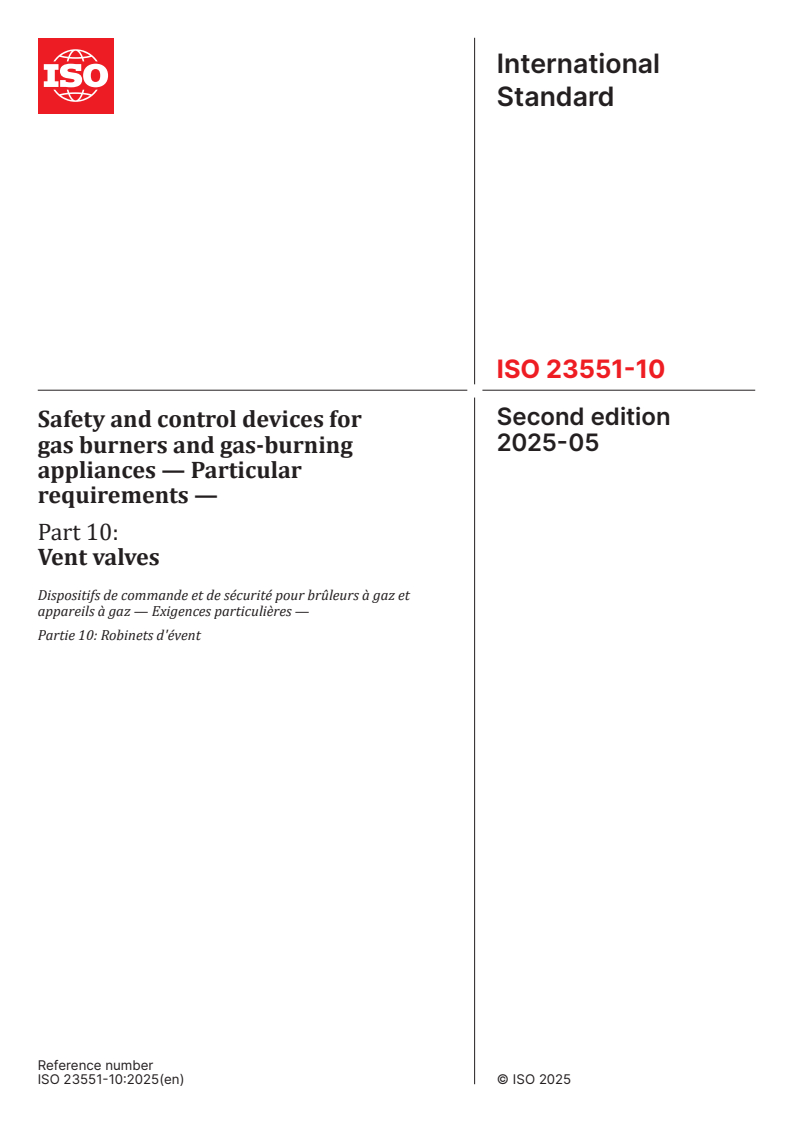
International
Standard
ISO 23551-10
Second edition
Safety and control devices for
2025-05
gas burners and gas-burning
appliances — Particular
requirements —
Part 10:
Vent valves
Dispositifs de commande et de sécurité pour brûleurs à gaz et
appareils à gaz — Exigences particulières —
Partie 10: Robinets d'évent
Reference number
© ISO 2025
All rights reserved. Unless otherwise specified, or required in the context of its implementation, no part of this publication may
be reproduced or utilized otherwise in any form or by any means, electronic or mechanical, including photocopying, or posting on
the internet or an intranet, without prior written permission. Permission can be requested from either ISO at the address below
or ISO’s member body in the country of the requester.
ISO copyright office
CP 401 • Ch. de Blandonnet 8
CH-1214 Vernier, Geneva
Phone: +41 22 749 01 11
Email: copyright@iso.org
Website: www.iso.org
Published in Switzerland
ii
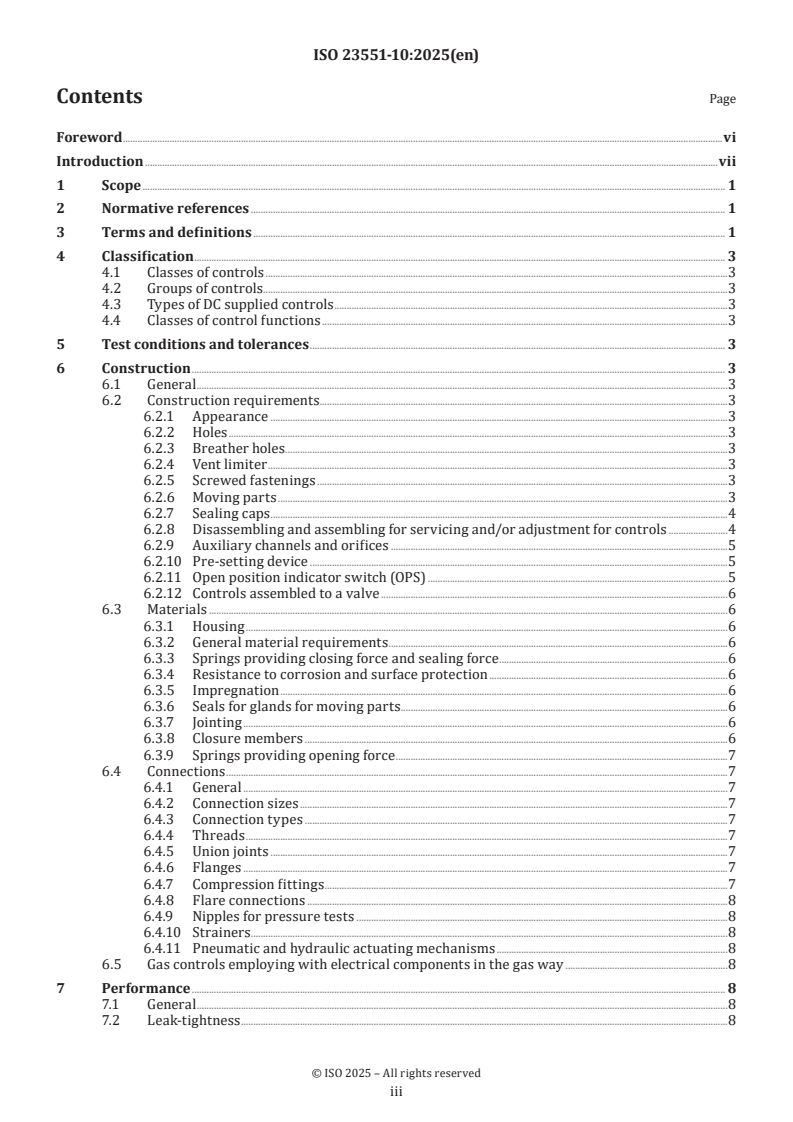
Contents Page
Foreword .vi
Introduction .vii
1 Scope . 1
2 Normative references . 1
3 Terms and definitions . 1
4 Classification . 3
4.1 Classes of controls .3
4.2 Groups of controls .3
4.3 Types of DC supplied controls .3
4.4 Classes of control functions .3
5 Test conditions and tolerances . 3
6 Construction . 3
6.1 General .3
6.2 Construction requirements.3
6.2.1 Appearance .3
6.2.2 Holes .3
6.2.3 Breather holes .3
6.2.4 Vent limiter .3
6.2.5 Screwed fastenings .3
6.2.6 Moving parts .3
6.2.7 Sealing caps .4
6.2.8 Disassembling and assembling for servicing and/or adjustment for controls .4
6.2.9 Auxiliary channels and orifices .5
6.2.10 Pre-setting device .5
6.2.11 Open position indicator switch (OPS) .5
6.2.12 Controls assembled to a valve .6
6.3 Materials .6
6.3.1 Housing .6
6.3.2 General material requirements .6
6.3.3 Springs providing closing force and sealing force .6
6.3.4 Resistance to corrosion and surface protection .6
6.3.5 Impregnation .6
6.3.6 Seals for glands for moving parts.6
6.3.7 Jointing .6
6.3.8 Closure members .6
6.3.9 Springs providing opening force .7
6.4 Connections .7
6.4.1 General .7
6.4.2 Connection sizes .7
6.4.3 Connection types .7
6.4.4 Threads .7
6.4.5 Union joints .7
6.4.6 Flanges .7
6.4.7 Compression fittings .7
6.4.8 Flare connections .8
6.4.9 Nipples for pressure tests .8
6.4.10 Strainers . . .8
6.4.11 Pneumatic and hydraulic actuating mechanisms .8
6.5 Gas controls employing with electrical components in the gas way .8
7 Performance . 8
7.1 General .8
7.2 Leak-tightness .8
iii
7.2.1 General .8
7.2.2 Requirements .8
7.2.3 Test . . .9
7.3 Torsion and bending .9
7.4 Rated flow rate .9
7.5 Durability .9
7.6 Functional requirements . .9
7.6.1 Opening function . .9
7.6.2 Opening force .10
7.6.3 Delay time and closing time .10
7.6.4 Opening time .11
7.7 Endurance .11
7.7.1 Requirements .11
7.7.2 Test . . . 12
7.8 Open position indicator switch . 12
7.8.1 Requirement . 12
7.8.2 Test of open position indicator switch . 12
7.9 Hydrostatic withstand pressure test . 12
7.9.1 General . 12
7.9.2 Requirement . 13
7.9.3 Test . . . 13
8 Electrical equipment .13
8.1 General . 13
8.2 Requirements . 13
8.3 Test .14
8.4 Protection by enclosure .14
8.5 Electrical components .14
8.5.1 Switches .14
8.5.2 Plug connector .14
8.5.3 Power saving circuit . 15
9 EMC/Electrical requirements .15
9.1 Protection against environmental influences . 15
9.1.1 General . 15
9.1.2 Requirements . 15
9.2 Harmonics and interharmonics including mains signalling at a. c. power port, low
frequency immunity . 15
9.3 Voltage dips, voltage interruptions and voltage variations in the power supply network . 15
9.4 Test of influence of voltage unbalance .16
9.5 Surge immunity test .16
9.6 Electrical fast transient/burst .16
9.7 Ring wave immunity .16
9.8 Electrostatic discharge .16
9.9 Radio-frequency electromagnetic field immunity .16
9.10 Influence of supply frequency variations .16
9.11 Power frequency magnetic field immunity .16
9.12 Evaluation of compliance .16
10 Marking, installation and operating instructions .16
10.1 Marking .16
10.2 Installation and operating instructions .17
10.3 Warning notice .17
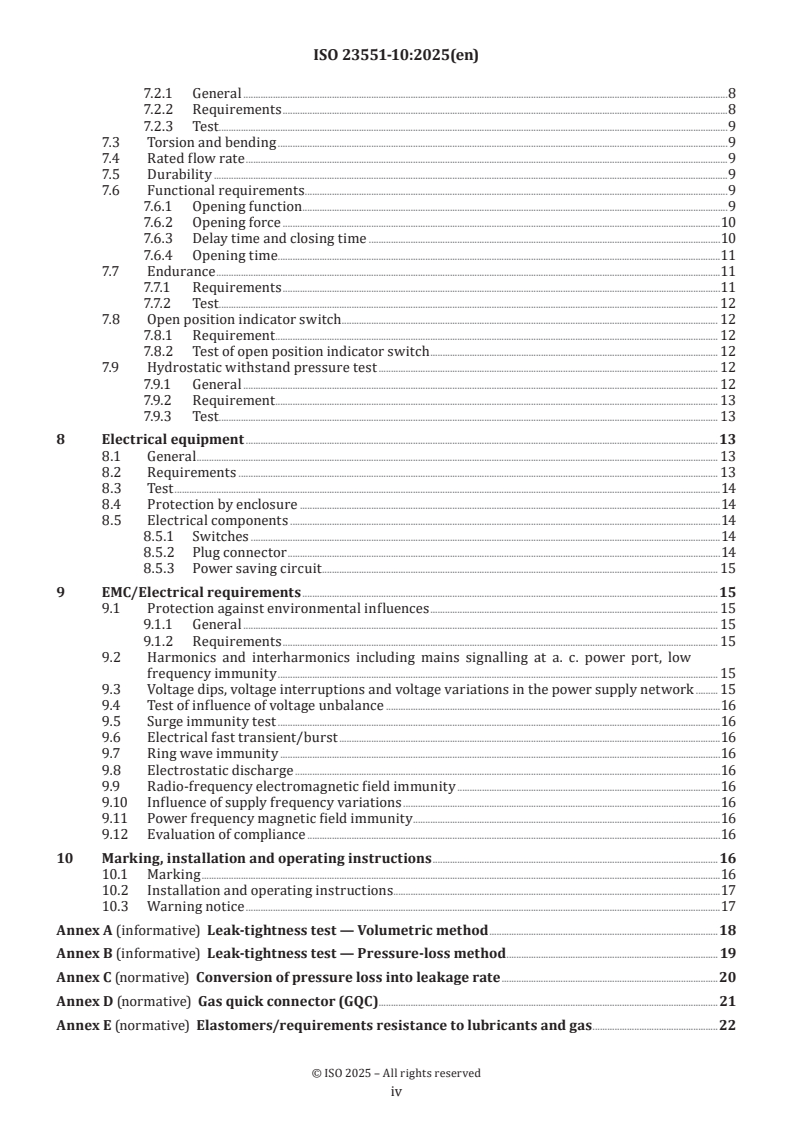
Annex A (informative) Leak-tightness test — Volumetric method .18
Annex B (informative) Leak-tightness test — Pressure-loss method . 19
Annex C (normative) Conversion of pressure loss into leakage rate .20
Annex D (normative) Gas quick connector (GQC).21
Annex E (normative) Elastomers/requirements resistance to lubricants and gas .22
iv
Annex F (normative) Specific regional requirements in European countries.23
Annex G (normative) Specific regional requirements in Canada and the USA .24
Annex H (normative) Specific regional requirements in Japan .25
Bibliography .26
v
Foreword
ISO (the International Organization for Standardization) is a worldwide federation of national standards
bodies (ISO member bodies). The work of preparing International Standards is normally carried out through
ISO technical committees. Each member body interested in a subject for which a technical committee
has been established has the right to be represented on that committee. International organizations,
governmental and non-governmental, in liaison with ISO, also take part in the work. ISO collaborates closely
with the International Electrotechnical Commission (IEC) on all matters of electrotechnical standardization.
The procedures used to develop this document and those intended for its further maintenance are described
in the ISO/IEC Directives, Part 1. In particular, the different approval criteria needed for the different types
of ISO document should be noted. This document was drafted in accordance with the editorial rules of the
ISO/IEC Directives, Part 2 (see www.iso.org/directives).
ISO draws attention to the possibility that the implementation of this document may involve the use of (a)
patent(s). ISO takes no position concerning the evidence, validity or applicability of any claimed patent
rights in respect thereof. As of the date of publication of this document, ISO had not received notice of (a)
patent(s) which may be required to implement this document. However, implementers are cautioned that
this may not represent the latest information, which may be obtained from the patent database available at
www.iso.org/patents. ISO shall not be held responsible for identifying any or all such patent rights.
Any trade name used in this document is information given for the convenience of users and does not
constitute an endorsement.
For an explanation of the voluntary nature of standards, the meaning of ISO specific terms and expressions
related to conformity assessment, as well as information about ISO's adherence to the World Trade
Organization (WTO) principles in the Technical Barriers to Trade (TBT), see www.iso.org/iso/foreword.html.
This document was prepared by Technical Committee ISO/TC 161, Control and protective devices for gaseous
and liquid fuels.
The second edition cancels and replaces the first edition (ISO 23551-10:2016), which has been technically
revised.
The main changes compared to the previous edition are as follows:
— the endurance test has been restructured and the test cycles changed;
— the hydrostatic withstand pressure test has been added;
— specific regional requirements that were previously contained in regional Annexes have been relocated
to the main body of the documents (and the annexes have been deleted);
— the document has been updated to align with IEC 60730-1:2022;
A list of all parts in the ISO 23551 series can be found on the ISO website.
Any feedback or questions on this document should be directed to the user’s national standards body. A
complete listing of these bodies can be found at www.iso.org/members.html.
vi
Introduction
This document is designed to be used in combination with ISO 23550. Together with ISO 23550, this
document establishes the full requirements as they apply to vent valves.
Where needed, this document adapts ISO 23550 by stating in the corresponding clause number and adding:
— “with the following modification”;
— “with the following addition”;
— “is replaced by the following”; or
— “is not applicable”.
In order to identify specific requirements that are particular to this document, that are not already covered
by ISO 23550, this document can contain clauses or subclauses that are additional to the structure of
ISO 23550. These subclauses are indicated by the introductory sentence: “Subclause (or Annex) specific to
this document.”
To ensure the global relevance of this document, the differing requirements resulting from practical
experience and installation practices in various regions of the world have been taken into account. The
variations in basic infrastructure associated with gas controls and appliances have also been recognized,
some of which are addressed in Annexes F, G and H. This document intends to provide a basic framework of
requirements that recognize these differences.
vii
International Standard ISO 23551-10:2025(en)
Safety and control devices for gas burners and gas-burning
appliances — Particular requirements —
Part 10:
Vent valves
1 Scope
This document specifies safety, constructional, performance and testing requirements of normally open
automatic vent valves, hereafter referred to as “valves”.
This document applies to valves with a declared maximum operating pressure up to and including 500 kPa
of nominal connection sizes up to and including DN 100 (4”), for use in gas control train of gas burners or
in appliances using gaseous fuels such as natural, manufactured or liquefied petroleum gas (LPG). It is not
applicable to corrosive and waste gases.
This document applies to:
— electrically operated valves and to valves actuated by fluids where the control valves for these fluids are
actuated electrically, but not to any external devices for switching the control signal or actuating energy;
— valves fitted with open position indicator switches.
This document covers type testing only.
2 Normative references
The following documents are referred to in the text in such a way that some or all of their content constitutes
requirements of this document. For dated references, only the edition cited applies. For undated references,
the latest edition of the referenced document (including any amendments) applies.
ISO 23550:2018, Safety and control devices for gas and/or oil burners and appliances — General requirements
IEC 60730-1:2022, Automatic electrical controls — Part 1: General requirements
IEC 60529:2018, Degrees of protection provided by enclosures (IP Code)
IEC 61058-1, Switches for appliances — Part 1: General requirements
3 Terms and definitions
For the purposes of this document, the terms and definitions given in ISO 23550 and the following apply.
ISO and IEC maintain terminological databases for use in standardization at the following addresses:
— IEC Electropedia: available at http:// www .electropedia .org/
— ISO Online browsing platform: available at http:// www .iso .org/ obp
3.1
automatic vent valve
device which closes when energized and opens automatically when de-energized
Note 1 to entry: These valves are typically used as bleed valves in a block and bleed application.
3.2
actuating mechanism
part of the valve which moves the closure member to the closed position
3.3
open position indicator switch
switch fitted to a valve which indicates when the closure member is in the open position
3.4
actuating energy
required energy for the actuating mechanism to move the closure member to the closed position
Note 1 to entry: The actuating energy may have an external source (electrical, hydraulic or pneumatic) and can be
transformed inside the valve.
3.5
opening force
force required to open the valve, independent of any force provided by fuel gas pressure
3.6
frictional force
largest force required to move the actuating mechanism and the closure member from the closed position to
the open position with the opener spring removed, independent of any force provided by fuel gas pressure
3.7
actuating pressure
hydraulic or pneumatic pressure supplied to the actuating mechanism of the valve
3.8
opening time
time interval between de-energizing the valve and the closure member attaining the open position
3.9
closing time
time interval between energizing the valve and the closure member attaining the closed position
3.10
delay time
time interval between energizing the valve and the start of the closure member moving to the closed position
3.11
control valve
valve which controls the hydraulic or pneumatic means supplied to the actuating mechanism
3.12
rated voltage
voltage as stated in the installation and operating instructions at which the valve may be operated
3.13
rated current
current as stated in the installation and operating instructions at which the valve may be operated
...