

ISO 23551-5:2023
(Main)Safety and control devices for gas burners and gas-burning appliances — Particular requirements — Part 5: Manual gas valves
General Information
- Abstract
This document specifies safety, constructional and performance requirements for manual gas valves intended for use with gas burners and gas-burning appliances, hereafter referred to as "valves", unless otherwise specified. This document applies to the following types of manual gas valves: — manual gas shut-off valves; — gas burner valves; — appliance connector valves; — delta C valves. This document applies to valves for gas burners and gas-burning appliances of nominal connection size up to and including DN 100 that can be used and tested independently of these appliances using fuel gases, as natural gas, manufactured gas or liquefied petroleum gas (LPG) at inlet pressures up to and including 500 kPa. This document is not applicable to corrosive and waste gases. This document covers type testing only.
- Status
- Published
- Publication Date
- 17-Oct-2023
- Technical Committee
- ISO/TC 161 - Controls and protective devices for gas and/or oil
- Drafting Committee
- ISO/TC 161/WG 4 - Multifunctional Controls
- Current Stage
- 6060 - International Standard published
- Start Date
- 18-Oct-2023
- Due Date
- 25-Dec-2022
- Completion Date
- 18-Oct-2023
Overview
ISO 23551-5:2023 - part of the ISO 23551 series on safety and control devices for gas burners and gas‑burning appliances - specifies safety, constructional and performance requirements for manual gas valves. It applies to manual gas shut‑off valves, gas burner valves, appliance connector valves and delta C valves up to nominal connection size DN 100, designed for use with fuel gases (natural gas, manufactured gas, LPG) at inlet pressures up to and including 500 kPa. The standard excludes corrosive and waste gases and covers type testing only.
Key topics and technical requirements
The standard addresses the full lifecycle of valve design and verification with emphasis on safety and reliable operation:
- Construction and materials: housing, seals, springs, closure members, corrosion resistance and component integrity.
- Performance requirements: leak‑tightness (volumetric and pressure‑loss methods), rated flow rate, seating adequacy and resistance to torsion/bending.
- Functional requirements: operating torque and force limits, safety locks, multi‑position “on” configurations and pre‑setting devices.
- Durability and endurance: elastomer compatibility, resistance to lubricants and gases, humidity, marking and abrasion.
- Testing: type tests for endurance, flow, leakage and mechanical stresses; normative annexes provide test methods (e.g., leak‑tightness volumetric and pressure‑loss methods).
- Marking and documentation: open/closed position markings, installation and operating instructions, and required warning notices.
- Electrical/EMC: requirements where electrical components are part of the gas way.
Relevant regional requirements are included in normative annexes for Europe, North America (Canada/USA) and Japan.
Practical applications
ISO 23551-5:2023 is used to ensure that manual gas valves installed on gas burners and appliances are safe, durable and perform predictably. Typical uses:
- Product design and development - guiding engineers on constructional and functional requirements.
- Type testing and certification - for compliance assessment by testing laboratories and certification bodies.
- Manufacturer quality assurance - defining acceptance criteria for new valve designs.
- Procurement and regulatory compliance - specifying performance expectations in tendering and approval processes.
- Installation/maintenance documentation - standardizes marking and instructions to improve safety in the field.
Who should use this standard
- Valve and appliance manufacturers
- Design and test engineers
- Certification and conformity assessment bodies
- Product safety and compliance teams
- Regulators and standards committees
Related standards
- Other parts of the ISO 23551 series covering safety and control devices for gas burners and appliances (see ISO catalogue for related parts).
Relations
- Effective Date
- 02-Jun-2018
Get Certified
Connect with accredited certification bodies for this standard

DNV
DNV is an independent assurance and risk management provider.

Lloyd's Register
Lloyd's Register is a global professional services organisation specialising in engineering and technology.
DNV Energy Systems
Energy and renewable energy certification.
Sponsored listings
Frequently Asked Questions
ISO 23551-5:2023 is a standard published by the International Organization for Standardization (ISO). Its full title is "Safety and control devices for gas burners and gas-burning appliances — Particular requirements — Part 5: Manual gas valves". This standard covers: This document specifies safety, constructional and performance requirements for manual gas valves intended for use with gas burners and gas-burning appliances, hereafter referred to as "valves", unless otherwise specified. This document applies to the following types of manual gas valves: — manual gas shut-off valves; — gas burner valves; — appliance connector valves; — delta C valves. This document applies to valves for gas burners and gas-burning appliances of nominal connection size up to and including DN 100 that can be used and tested independently of these appliances using fuel gases, as natural gas, manufactured gas or liquefied petroleum gas (LPG) at inlet pressures up to and including 500 kPa. This document is not applicable to corrosive and waste gases. This document covers type testing only.
This document specifies safety, constructional and performance requirements for manual gas valves intended for use with gas burners and gas-burning appliances, hereafter referred to as "valves", unless otherwise specified. This document applies to the following types of manual gas valves: — manual gas shut-off valves; — gas burner valves; — appliance connector valves; — delta C valves. This document applies to valves for gas burners and gas-burning appliances of nominal connection size up to and including DN 100 that can be used and tested independently of these appliances using fuel gases, as natural gas, manufactured gas or liquefied petroleum gas (LPG) at inlet pressures up to and including 500 kPa. This document is not applicable to corrosive and waste gases. This document covers type testing only.
ISO 23551-5:2023 is classified under the following ICS (International Classification for Standards) categories: 27.060.20 - Gas fuel burners. The ICS classification helps identify the subject area and facilitates finding related standards.
ISO 23551-5:2023 has the following relationships with other standards: It is inter standard links to ISO 23551-5:2014. Understanding these relationships helps ensure you are using the most current and applicable version of the standard.
ISO 23551-5:2023 is available in PDF format for immediate download after purchase. The document can be added to your cart and obtained through the secure checkout process. Digital delivery ensures instant access to the complete standard document.
Standards Content (Sample)
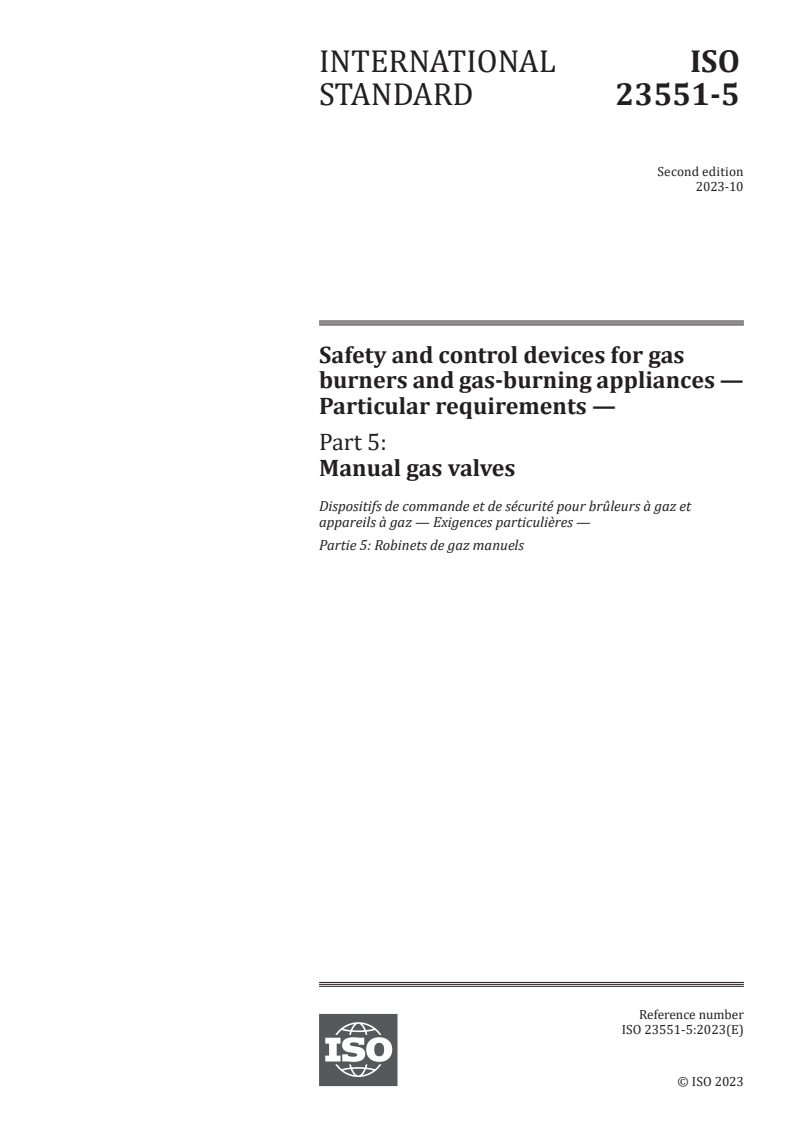
INTERNATIONAL ISO
STANDARD 23551-5
Second edition
2023-10
Safety and control devices for gas
burners and gas-burning appliances —
Particular requirements —
Part 5:
Manual gas valves
Dispositifs de commande et de sécurité pour brûleurs à gaz et
appareils à gaz — Exigences particulières —
Partie 5: Robinets de gaz manuels
Reference number
© ISO 2023
All rights reserved. Unless otherwise specified, or required in the context of its implementation, no part of this publication may
be reproduced or utilized otherwise in any form or by any means, electronic or mechanical, including photocopying, or posting on
the internet or an intranet, without prior written permission. Permission can be requested from either ISO at the address below
or ISO’s member body in the country of the requester.
ISO copyright office
CP 401 • Ch. de Blandonnet 8
CH-1214 Vernier, Geneva
Phone: +41 22 749 01 11
Email: copyright@iso.org
Website: www.iso.org
Published in Switzerland
ii
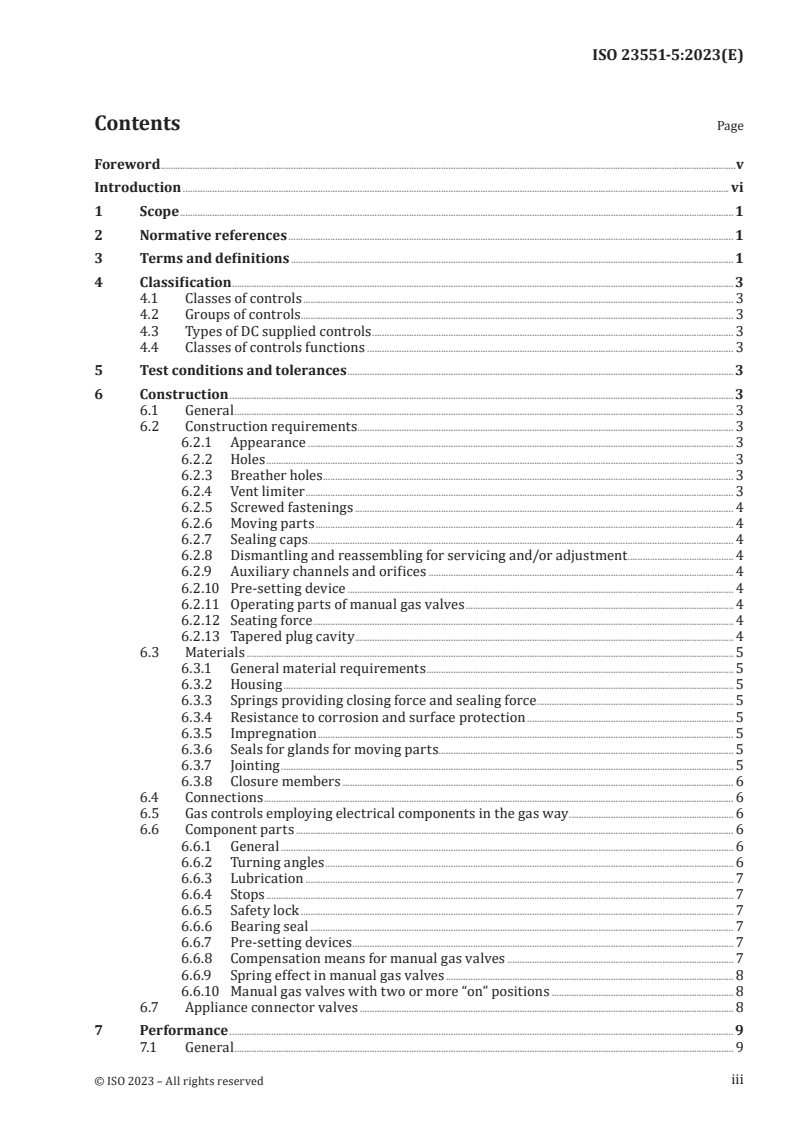
Contents Page
Foreword .v
Introduction . vi
1 Scope . 1
2 Normative references . 1
3 Terms and definitions . 1
4 Classification . 3
4.1 Classes of controls . 3
4.2 Groups of controls . 3
4.3 Types of DC supplied controls . 3
4.4 Classes of controls functions . 3
5 Test conditions and tolerances .3
6 Construction . 3
6.1 General . 3
6.2 Construction requirements. 3
6.2.1 Appearance . 3
6.2.2 Holes . 3
6.2.3 Breather holes . 3
6.2.4 Vent limiter . 3
6.2.5 Screwed fastenings . 4
6.2.6 Moving parts . 4
6.2.7 Sealing caps . 4
6.2.8 Dismantling and reassembling for servicing and/or adjustment . 4
6.2.9 Auxiliary channels and orifices . 4
6.2.10 Pre-setting device . 4
6.2.11 Operating parts of manual gas valves . 4
6.2.12 Seating force . 4
6.2.13 Tapered plug cavity . . 4
6.3 Materials . 5
6.3.1 General material requirements . 5
6.3.2 Housing . 5
6.3.3 Springs providing closing force and sealing force . 5
6.3.4 Resistance to corrosion and surface protection . 5
6.3.5 Impregnation . 5
6.3.6 Seals for glands for moving parts. 5
6.3.7 Jointing . 5
6.3.8 Closure members . 6
6.4 Connections . 6
6.5 Gas controls employing electrical components in the gas way . 6
6.6 Component parts . 6
6.6.1 General . 6
6.6.2 Turning angles . 6
6.6.3 Lubrication . 7
6.6.4 Stops . 7
6.6.5 Safety lock . 7
6.6.6 Bearing seal . 7
6.6.7 Pre-setting devices . 7
6.6.8 Compensation means for manual gas valves . 7
6.6.9 Spring effect in manual gas valves . 8
6.6.10 Manual gas valves with two or more “on” positions . 8
6.7 Appliance connector valves . 8
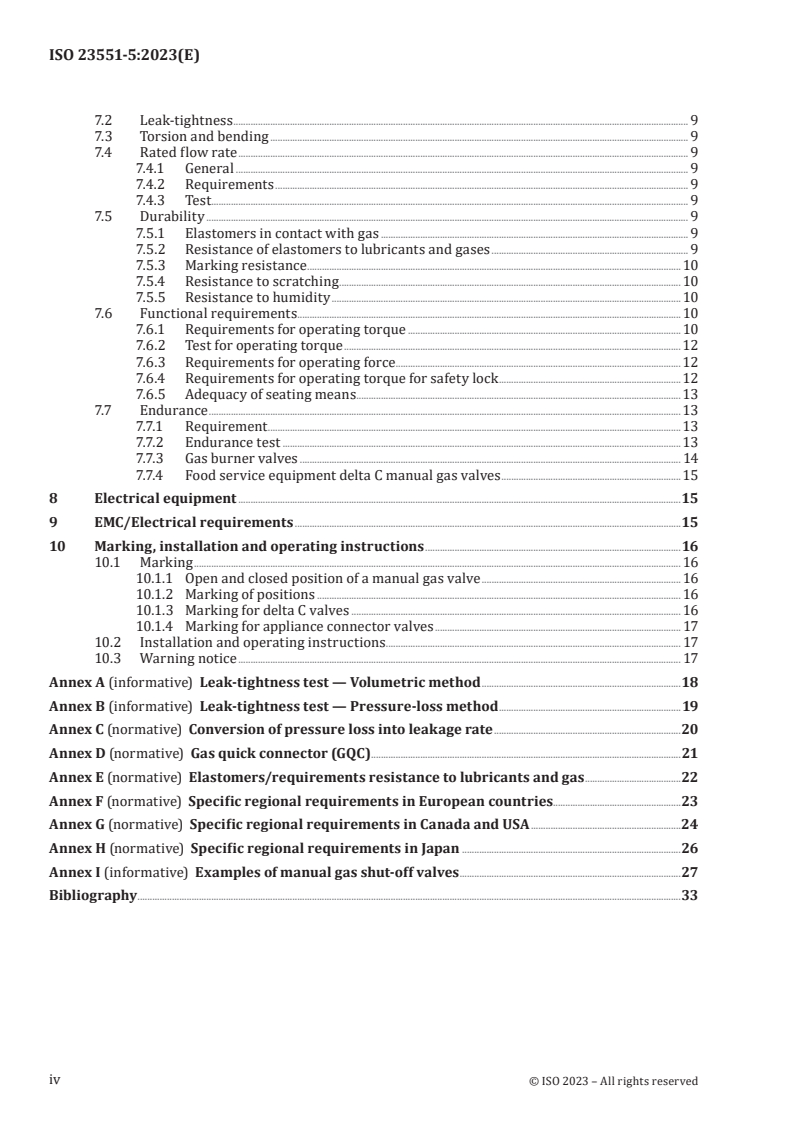
7 Performance . 9
7.1 General . 9
iii
7.2 Leak-tightness . 9
7.3 Torsion and bending . 9
7.4 Rated flow rate . 9
7.4.1 General . 9
7.4.2 Requirements . 9
7.4.3 Test . . . 9
7.5 Durability . 9
7.5.1 Elastomers in contact with gas . 9
7.5.2 Resistance of elastomers to lubricants and gases . 9
7.5.3 Marking resistance . 10
7.5.4 Resistance to scratching . 10
7.5.5 Resistance to humidity . 10
7.6 Functional requirements . . 10
7.6.1 Requirements for operating torque . 10
7.6.2 Test for operating torque .12
7.6.3 Requirements for operating force.12
7.6.4 Requirements for operating torque for safety lock .12
7.6.5 Adequacy of seating means . 13
7.7 Endurance . 13
7.7.1 Requirement .13
7.7.2 Endurance test .13
7.7.3 Gas burner valves . 14
7.7.4 Food service equipment delta C manual gas valves .15
8 Electrical equipment .15
9 EMC/Electrical requirements .15
10 Marking, installation and operating instructions .16
10.1 Marking . 16
10.1.1 Open and closed position of a manual gas valve . 16
10.1.2 Marking of positions . 16
10.1.3 Marking for delta C valves . 16
10.1.4 Marking for appliance connector valves . 17
10.2 Installation and operating instructions . 17
10.3 Warning notice . 17
Annex A (informative) Leak-tightness test — Volumetric method .18
Annex B (informative) Leak-tightness test — Pressure-loss method .19
Annex C (normative) Conversion of pressure loss into leakage rate .20
Annex D (normative) Gas quick connector (GQC).21
Annex E (normative) Elastomers/requirements resistance to lubricants and gas .22
Annex F (normative) Specific regional requirements in European countries.23
Annex G (normative) Specific regional requirements in Canada and USA .24
Annex H (normative) Specific regional requirements in Japan .26
Annex I (informative) Examples of manual gas shut-off valves .27
Bibliography .33
iv
Foreword
ISO (the International Organization for Standardization) is a worldwide federation of national standards
bodies (ISO member bodies). The work of preparing International Standards is normally carried out
through ISO technical committees. Each member body interested in a subject for which a technical
committee has been established has the right to be represented on that committee. International
organizations, governmental and non-governmental, in liaison with ISO, also take part in the work.
ISO collaborates closely with the International Electrotechnical Commission (IEC) on all matters of
electrotechnical standardization.
The procedures used to develop this document and those intended for its further maintenance are
described in the ISO/IEC Directives, Part 1. In particular, the different approval criteria needed for the
different types of ISO document should be noted. This document was drafted in accordance with the
editorial rules of the ISO/IEC Directives, Part 2 (see www.iso.org/directives).
ISO draws attention to the possibility that the implementation of this document may involve the use
of (a) patent(s). ISO takes no position concerning the evidence, validity or applicability of any claimed
patent rights in respect thereof. As of the date of publication of this document, ISO had not received
notice of (a) patent(s) which may be required to implement this document. However, implementers are
cautioned that this may not represent the latest information, which may be obtained from the patent
database available at www.iso.org/patents. ISO shall not be held responsible for identifying any or all
such patent rights.
Any trade name used in this document is information given for the convenience of users and does not
constitute an endorsement.
For an explanation of the voluntary nature of standards, the meaning of ISO specific terms and
expressions related to conformity assessment, as well as information about ISO's adherence to
the World Trade Organization (WTO) principles in the Technical Barriers to Trade (TBT), see
www.iso.org/iso/foreword.html.
This document was prepared by Technical Committee ISO/TC 161, Controls and protective devices for
gaseous and liquid fuels.
This second edition cancels and replaces the first edition (ISO 23551-5:2014), which has been technically
revised.
The main changes are as follows:
— the document has been updated to align technically and with the revised format of ISO 23550:2018;
— references to the current annex structure have been corrected.
A list of all parts in the ISO 23551 series can be found on the ISO website.
Any feedback or questions on this document should be directed to the user’s national standards body. A
complete listing of these bodies can be found at www.iso.org/members.html.
v
Introduction
This document is designed to be used in combination with ISO 23550. This document, together with
ISO 23550, establishes the full requirements as they apply to the product covered by this document.
Where needed, this document adapts ISO 23550 by stating in the corresponding clause:
— “with the following modification”;
— “with the following addition”;
— “is replaced by the following”; or
— “is not applicable”.
In order to identify specific requirements that are particular to this document, that are not already
covered by ISO 23550, this document contains certain clauses or subclauses that are additional to the
structure of ISO 23550. These subclauses are indicated by the introductory sentence: “Subclause (or
Annex) specific to this document”.
To ensure the global relevance of this document, the differing requirements resulting from practical
experience and installation practices in various regions of the world have been taken into account. The
variations in basic infrastructure associated with gas and/or oil controls and appliances have also been
recognized, some of which are addressed in Annexes F, G and H. This document intends to provide a
basic framework of requirements that recognize these differences.
vi
INTERNATIONAL STANDARD ISO 23551-5:2023(E)
Safety and control devices for gas burners and gas-burning
appliances — Particular requirements —
Part 5:
Manual gas valves
1 Scope
This document specifies safety, constructional and performance requirements for manual gas valves
intended for use with gas burners and gas-burning appliances, hereafter referred to as "valves", unless
otherwise specified.
This document applies to the following types of manual gas valves:
— manual gas shut-off valves;
— gas burner valves;
— appliance connector valves;
— delta C valves.
This document applies to valves for gas burners and gas-burning appliances of nominal connection size
up to and including DN 100 that can be used and tested independently of these appliances using fuel
gases, as natural gas, manufactured gas or liquefied petroleum gas (LPG) at inlet pressures up to and
including 500 kPa.
This document is not applicable to corrosive and waste gases.
This document covers type testing only.
2 Normative references
The following documents are referred to in the text in such a way that some or all of their content
constitutes requirements of this document. For dated references, only the edition cited applies. For
undated references, the latest edition of the referenced document (including any amendments) applies.
ISO 23550:2018, Safety and control devices for gas and/or oil burners and appliances — General
requirements
3 Terms and definitions
For the purposes of this document, the terms and definitions given in ISO 23550 and the following apply.
ISO and IEC maintain terminology databases for use in standardization at the following addresses:
— ISO Online browsing platform: available at https:// www .iso .org/ obp
— IEC Electropedia: available at https:// www .electropedia .org/
3.1
manual gas shut-off valve
manually-operated valve for the control of the gas flow from an “off” to an “on” position and vice versa
Note 1 to entry: Parts commonly used in manual gas shut-off valves are shown as examples in Figure I.1 to
Figure I.5.
3.2
delta C valve
manual gas valve suitable for use on food service equipment (commercial cooking equipment)
Note 1 to entry: These valves are identified by a marking.
3.3
gas burner valve
manual gas valve that requires user initiation of each usage cycle
Note 1 to entry: This type of manual gas valve is intended to be used between the gas supply piping and the gas
burner.
Note 2 to entry: The valve is turned on when the burner operating cycle is initiated and turned off when the
burner operating cycle is completed.
3.4
appliance connector valve
manual gas valve having a non-displaceable valve member (3.7), a minimum specified capacity (3.9) and
an internal taper pipe thread inlet and an outlet for flared tubing connection
Note 1 to entry: This type of manual gas valve is intended to be used between the gas supply piping and the
appliance connector attached to the appliance.
Note 2 to entry: For minimum capacity, see Table 2, and for inlet and outlet connection, see 6.7.
3.5
bearing seal
shortest distance between gas-carrying parts and the atmosphere measured along the length of the
sealing surfaces
3.6
plug
tapered valve member of a manual gas valve containing one or more gas flow openings
3.7
non-displaceable valve member
valve member that cannot be moved from its seat by a force applied to the handle, or force applied by a
plane surface to any exterior portion of the valve
3.8
safety lock
means in a manual valve that requires a separate action of the user before the valve can be opened
EXAMPLE Pushing on the valve handle to “unlatch” the valve before the valve handle can be rotated to turn
on the gas.
3.9
capacity
amount of a specified gas that flows through a control at a specified pressure drop in a fixed period of
time
4 Classification
4.1 Classes of controls
Shall be according to ISO 23550:2018, 4.1, with the following addition.
Manual gas valves are classified according to the number of operations:
— 1 000 operations (e.g. appliance connector valves);
— 5 000 operations (e.g. central heating);
— 10 000 operations (e.g. space heaters);
— 12 000 operations; and
— 40 000 operations (e.g. domestic cooking).
4.2 Groups of controls
Shall be according to ISO 23550:2018, 4.2.
4.3 Types of DC supplied controls
ISO 23550:2018, 4.3, is not applicable.
4.4 Classes of controls functions
ISO 23550:2018, 4.4, is not applicable.
5 Test conditions and tolerances
Shall be according to ISO 23550:2018, Clause 5.
6 Construction
6.1 General
Shall be according to ISO 23550:2018, 6.1.
6.2 Construction requirements
6.2.1 Appearance
Shall be according to ISO 23550: 2018, 6.2.1.
6.2.2 Holes
Shall be according to ISO 23550: 2018, 6.2.2.
6.2.3 Breather holes
ISO 23550:2018, 6.2.3, is not applicable.
6.2.4 Vent limiter
ISO 23550:2018, 6.2.4, is not applicable.
6.2.5 Screwed fastenings
Shall be according to ISO 23550:2018, 6.2.5.
6.2.6 Moving parts
Shall be according to ISO 23550:2018, 6.2.6.
6.2.7 Sealing caps
Shall be according to ISO 23550:2018, 6.2.7.
6.2.8 Dismantling and reassembling for servicing and/or adjustment
Shall be according to ISO 23550:2018, 6.2.8.
6.2.9 Auxiliary channels and orifices
Shall be according to ISO 23550:2018, 6.2.9.
6.2.10 Pre-setting device
Shall be according to ISO 23550:2018, 6.2.10.
6.2.11 Operating parts of manual gas valves
Subclause specific to this document.
Manual gas valves operated by rotation shall be opened by turning the operating device anticlockwise
and closed by turning it clockwise, except for valves, which provide more than one burner with gas.
Alternate construction is acceptable provided the rotation direction is clearly marked. Manual gas
valves with 90° rotation do not have to meet these requirements when the construction is such that the
lever or tee handle is 90° to the line of flow in the off position and parallel to the line of flow in the on
position.
A separable handle, removable without further disassembly of the valve, shall be attached by tamper-
resistant means unless removal of the handle does not affect the leak tightness of the valve or the
retention of the valve member.
Manual gas shut-off valves shall be operated without the use of tools.
It shall not be possible to exert direct axial pressure (other than spring pressure) on the closure member
when the operating spindle is depressed to clear any safety lock.
6.2.12 Seating force
Subclause specific to this document.
Manual gas valves shall be provided with a means, other than gravity, to maintain a continuous
seating force to compensate for manufacturing tolerances, operational variations, or displacement of
lubricant(s).
It shall not be possible in normal use to apply such forces to the closure member that it is lifted out of its
seat or is brought into a position which causes the leakage rates to exceed the values given in 7.2.
6.2.13 Tapered plug cavity
Subclause specific to this document.
For taper plug manual gas valves, the closure member included angle shall be at least 9° 25′. The taper
plug at the large diameter shall be recessed into the body, and the plug shall protrude beyond the taper
of the body at the small end. There shall be adequate clearance provided for this protrusion.
NOTE Regional specific requirements are given in Annex G.
6.3 Materials
6.3.1 General material requirements
Shall be according to ISO 23550:2018, 6.3.1.
6.3.2 Housing
6.3.2.1 General
Shall be according to ISO 23550:2018, 6.3.2.1.
6.3.2.2 Requirements
Shall be according to ISO 23550:2018, 6.3.2.2, with the following modification.
Item b) is not applicable. O-rings, gaskets and other seals are exempt.
6.3.2.3 Test
Shall be according to ISO 23550:2018, 6.3.2.3.
6.3.2.4 Manual gas valves with shaft seal
Subclause specific to this document.
For manual gas valves with shaft seals, the shaft seal is excluded from the requirement in 6.3.2.1, if the
following requirements are met:
The structure surrounding a shaft seal shall be such as to confine the seal properly and, with the seal
removed and the valve in any position, to allow, when tested at room temperature with air, not more
than 45,6 dm /h at a pressure of 1,74 kPa to leak past the shaft.
6.3.3 Springs providing closing force and sealing force
Shall be according to ISO 23550:2018, 6.3.3.
6.3.4 Resistance to corrosion and surface protection
Shall be according to ISO 23550:2018, 6.3.4.
6.3.5 Impregnation
Shall be according to ISO 23550:2018, 6.3.5.
6.3.6 Seals for glands for moving parts
Shall be according to ISO 23550:2018, 6.3.6.
6.3.7 Jointing
Shall be according to ISO 23550:2018. 6.3.7.
6.3.8 Closure members
Subclause specific to this document.
Gas-closing parts shall either have a metallic support to withstand the sealing force or shall be made of
metal. This requirement also applies to parts transmitting the closing force.
For guide elements (see Figure I.1 to Figure I.5), non-metallic materials are admissible.
6.4 Connections
Shall be according to ISO 23550:2018, 6.4.
6.5 Gas controls employing electrical components in the gas way
ISO 23550:2018, 6.5 is not applicable.
6.6 Component parts
Subclause specific to this document.
6.6.1 General
The off-position shall have a non-adjustable stop.
6.6.2 Turning angles
6.6.2.1 General
The reduced flow position, if any, shall be placed either after the fully open position or between the
open and the closed position.
The turning angle of the manual gas needle valve between the closed and the fully open position shall
be between 180° and 360° when used as a shut-off valve unless otherwise specified in the installation
and operating instructions.
6.6.2.2 Opening at maximum flow
If the reduced flow rate position is placed after the fully open position the following requirements shall
be met:
— in order to change from the closed position to the fully open position the turning angle shall be
(90 ± 5)° unless otherwise specified in the installation and operating instructions;
— the turning angle between the fully open position and the reduced flow rate position shall be greater
than 70° unless otherwise specified in the manufacturer’s installation and operating instructions;
this requirement is not applicable to multi-outlet valves;
— the movement of the manual gas valve closure member shall be limited by a fixed stop at the reduced
flow rate position.
6.6.2.3 Opening at minimum flow
If the reduced flow rate position is placed between the closed and fully open position the following
requirements shall be met:
— in order to change from the closed position to the fully open position the turning angle shall be
greater than 90° unless otherwise specified in the installation and operating instructions;
— in order to change from the reduced flow rate position to the fully open position the turning angle
shall be greater than 70° unless otherwise specified in the installation and operating instructions;
this requirement is not applicable for multi-outlet-valves;
— a reduced flow rate position shall be provided by means of a part which locates the valve closure
member in this position when the movement is in the direction of closing;
— the movement of the manual gas valve closure member shall be limited in the fully open position by
a stop.
6.6.2.4 Single outlet manual gas valves
If a single outlet manual gas valve does not have a reduced flow position, the turning angle to pass
from the closed position to the fully open position shall be (90 ± 5)° unless otherwise specified in the
installation and operating instructions.
6.6.3 Lubrication
A manual gas valve shall be designed so that lubrication, if used, does not cause blockage of any gas way.
6.6.4 Stops
The travel to and from the extreme positions of a manual gas valve shall be limited by stops.
When operating a manual gas needle valve, it shall not be possible to remove the needle completely
from the body by unscrewing. When closing the positive stop is obtained by contact of the needle on its
seat.
6.6.5 Safety lock
Single outlet manual gas valves may be provided with a safety lock that prevents any accidental opening
as it requires two separate actions to operate the valve. It shall permit ready operation with one hand.
Manual gas valves with two outlets for two separate burners shall be designed so that, in order to
change from one outlet to the other, it is necessary to pass through a locked closed position. It shall only
be possible for the user to change from one outlet to the other by a deliberate action. In particular, it
shall not be possible to change from one outlet to the other by keeping the handle constantly pressed in
or by a pure turning movement.
6.6.6 Bearing seal
The bearing seal for manual gas valves except needle valves shall be at least 3 mm (see Figure I.1,
Item 9), unless otherwise specified by the manufacturer based on tolerance calculation.
NOTE Regional specific requirements are given in Annex G.
6.6.7 Pre-setting devices
If present, pre-setting devices shall be easily accessible and not be able to fall into the gas way of the
manual gas valve.
The operation of pre-setting devices shall only be possible with a tool.
Pre-setting devices shall be fixed in their set positions.
6.6.8 Compensation means for manual gas valves
Manual gas valves shall be designed with compensating means to take up automatically any wear
between the closure member and the valve body.
6.6.9 Spring effect in manual gas valves
The tapered plug shall be held in position in the body by a spring. The construction shall be such that
any play between plug and valve body caused by wear which can be expected during normal life shall
be taken up automatically.
6.6.10 Manual gas valves with two or more “on” positions
A manual gas valve having an intermediate “off” position between two or more “on” positions shall be
so constructed that it will become latched in the “off” position.
6.7 Appliance connector valves
Subclause specific to this document.
NOTE Regional specific requirements are given in Annex F and H.
6.7.1 Appliance connector valves shall have inlet and outlet connections in accordance with Table 1.
Table 1 — Inlet and outlet connections of appliance connector valves
Inlet connection Outlet connection
[Female iron pipe size (I.P.S.)] (Fitting for flared tubing connection)
mm mm
9,5 9,5
12,7 12,7
19,1 19,1
6.7.2 An appliance connector valve shall have a non-displaceable valve member (see Figure 1). If the
small end of the plug is exposed, it shall be recessed in the body a minimum of 1,6 mm.
Key
1 flare tubing connection
2 spring and handle design such that plug cannot be displaced
3 taper pipe threads
4 gas way
a if small end of plug is exposed, the plug shall be recessed at least in 1,6 mm
Figure 1 — Appliance connector valve with non-displaceable valve member
7 Performance
7.1 General
Shall be according to ISO 23550:2018, 7.1.
7.2 Leak-tightness
Shall be according to ISO 23550:2018, 7.2.
NOTE Regional specific requirements are given in Annex G.
7.3 Torsion and bending
Shall be according to ISO 23550:2018, 7.3.
7.4 Rated flow rate
7.4.1 General
Shall be according to ISO 23550:2018, 7.4.1
7.4.2 Requirements
Shall be according to ISO 23550:2018, 7.4.2 with the following additions:
The flow rate shall be measured at the fully open position and if applicable at the reduced flow rate
position.
Appliance connector valves shall have a minimum capacity in accordance with that shown in Table 2, at
a pressure drop of 75 Pa (0,3" w.c.).
Table 2 — Minimum capacities for appliance connector valves
Outlet connection size Rating Minimum capacity
a 3 3
DN (inch) W (BTU/h) m /h (ft /h) Air at 75 Pa (0,3”w.c.)
pressure drop
10 (3/8”) 14 654 (50 000) 1,13 (40)
15 (1/2”) 29 307 (100 000) 2,26 (80)
18 (5/8”) 38 099 (130 000) 2,94 (104)
a 3 3
Based on a gas of 0,64 SpGr and a heating value of 37,3 MJ/m (1 000 BTU/ft ).
7.4.3 Test
Shall be according to ISO 23550:2018, 7.4.3.
7.5 Durability
7.5.1 Elastomers in contact with gas
Shall be according to ISO 23550:2018, 7.5.1.
7.5.2 Resistance of elastomers to lubricants and gases
Shall be according to ISO 23550:2018, 7.5.2.
7.5.3 Marking resistance
Shall be according to ISO 23550:2018, 7.5.3 with the following addition:
All metal marking materials shall be rustproof. All markings shall be suitable for the application and to
the surfaces they are applied on.
7.5.4 Resistance to scratching
Shall be according to ISO 23550:2018, 7.5.4.
7.5.5 Resistance to humidity
Shall be according to ISO 23550:2018, 7.5.5.
7.6 Functional requirements
Subclause specific to this document.
7.6.1 Requirements for operating torque
7.6.1.1 Ambient temperature operating torque
The operating torque shall not exceed the values given in Table 3 and Table 4, as applicable, when tested
in accordance with 7.6.2.
The operating torque of a manual gas valve knob shall not exceed 0,017 Nm per mm of the knob
diameter, unless otherwise specified by the manufacturer.
NOTE If an additional device is also operated, e.g. a piezo igniter, then the torque to operate this additional
device is excluded.
Table 3 — Maximum operating torque
Approach Operating torque
Inlet nominal
size
Nm
a b c
DN 2 000 3 000 4 000 5 000 6 000 8 000 10 000 12 000 40 000
DN ≤ 12 − − − 0,6 − − 0,4 − 0,2
I 12 < DN ≤ 25 − − − 0,6 − − 0,6 − 0,4
25 < DN ≤ 50 − − − 1,0 − − 0,6 − 0,4
6 − − − − − − 1,12 − −
8 − − − − − 1,69 − − −
10 − − − − 2,26 − − − −
II
15 − − 2,82 − − − − − −
20 − 3,95 − − − − − − −
25 5,08 − − − − − − − −
NOTE This document recognizes that different allowable maximum operating torque exist in various regions throughout
the world. For this purpose, countries can choose the appropriate torque values [i.e. approach I (Europe), II (USA and
Canada) or III (Japan)].
a
For example, central heating or water heating.
b
For example, space heaters.
c
For example, domestic cooking.
TTabablele 3 3 ((ccoonnttiinnueuedd))
Approach Operating torque
Inlet nominal
size
Nm
a b c
DN 2 000 3 000 4 000 5 000 6 000 8 000 10 000 12 000 40 000
DN ≤ 12 − − − − − − − 0,6 −
III 12 < DN ≤ 25 − − − − − − − 1,2 −
25 < DN ≤ 50 − − − − − − − 1,8 −
NOTE This document recognizes that different allowable maximum operating torque exist in various regions throughout
the world. For this purpose, countries can choose the appropriate torque values [i.e. approach I (Europe), II (USA and
Canada) or III (Japan)].
a
For example, central heating or water heating.
b
For example, space heaters.
c
For example, domestic cooking.
Table 4 — Maximum operating torque for appliance connector valves
Nominal size Operating torque
DN Nm
1 000 operations
6 1,12
8 1,69
a a
10 2,26
a a
15 2,82
a a
20 3,95
25 5,08
32 6,78
40 9,04
50 11,30
65 14,10
80 28,30
100 33,90
a
Corresponds to outlet tube size of appliance connector valves.
7.6.1.2 Low temperature operating torque
The manual gas valve shall conform to the following method of test at the minimum ambient
temperature specified by the manufacturer.
Conformance is checked by the following test.
Two new manual gas valves shall be subjected to this test. This test shall be conducted after or
concurrently with internal and external leakage in 7.2, as applicable.
The manual gas valves in the open position shall be placed in a chamber maintained at the
manufacturer’s specified minimum ambient temperature. After each manual gas valve has attained the
specified minimum ambient temperature, this temperature shall be maintained for at least 1 h.
Each manual gas valve shall be cycled from the full open position to the closed position 10 times. During
each closing cycle the torque needed to close the manual gas valve shall be measured and shall not
exceed that shown in Table 5.
Table 5 — Torque limits for low temperature test
Nominal size Nominal inlet tubing size Maximum torque
DN mm N·m
6 4,76 to 7,94 4,29
8 – 8,47
10 9,53 to 11,10 11,30
15 12,7 to 14,3 14,10
20 15,90 16,90
25 – 19,80
32 – 22,60
40 – 33,90
50 – 45,20
65 – 56,50
80 – 113,00
100 – 135,60
7.6.2 Test for operating torque
The operating torque is measured with a suitable torque-meter having accuracy within ±10 % of the
maximum value of operating torque specified in Table 3 and Table 4, as applicable, for the relevant size
of the manual gas valve to check for conformance to 7.6.1.1. The opening and closing movements are
carried out at a constant angular velocity of approximately 1,5 rad/s.
7.6.3 Requirements for operating force
For manual gas valves which are operated by a push-button, the force required for the manual operation
of the push-button shall not exceed the values given in Table 6 or the value of (0,5 N/mm × the sur
...