


ISO 13584-42:1998
(Main)Industrial automation systems and integration — Parts library — Part 42: Description methodology: Methodology for structuring part families
Industrial automation systems and integration — Parts library — Part 42: Description methodology: Methodology for structuring part families
Systèmes d'automatisation industrielle et intégration — Bibliothèque de composants — Partie 42: Méthodologie descriptive: Méthodologie appliquée à la structuration des familles de pièces
General Information
- Status
- Withdrawn
- Publication Date
- 15-Jul-1998
- Withdrawal Date
- 15-Jul-1998
- Technical Committee
- ISO/TC 184/SC 4 - Industrial data
- Drafting Committee
- ISO/TC 184/SC 4 - Industrial data
- Current Stage
- 9599 - Withdrawal of International Standard
- Start Date
- 09-Dec-2010
- Completion Date
- 14-Feb-2026
Relations
- Effective Date
- 10-Feb-2026
- Effective Date
- 10-Feb-2026
- Effective Date
- 10-Feb-2026
- Effective Date
- 10-Feb-2026
- Effective Date
- 10-Feb-2026
- Effective Date
- 15-Apr-2008
Get Certified
Connect with accredited certification bodies for this standard

National Aerospace and Defense Contractors Accreditation Program (NADCAP)
Global cooperative program for special process quality in aerospace.
CARES (UK Certification Authority for Reinforcing Steels)
UK certification for reinforcing steels and construction.
DVS-ZERT GmbH
German welding certification society.
Sponsored listings
Frequently Asked Questions
ISO 13584-42:1998 is a standard published by the International Organization for Standardization (ISO). Its full title is "Industrial automation systems and integration — Parts library — Part 42: Description methodology: Methodology for structuring part families". This standard covers: Industrial automation systems and integration — Parts library — Part 42: Description methodology: Methodology for structuring part families
Industrial automation systems and integration — Parts library — Part 42: Description methodology: Methodology for structuring part families
ISO 13584-42:1998 is classified under the following ICS (International Classification for Standards) categories: 25.040.40 - Industrial process measurement and control. The ICS classification helps identify the subject area and facilitates finding related standards.
ISO 13584-42:1998 has the following relationships with other standards: It is inter standard links to EN 61360-2:2002, EN 61360-1:2002, EN 61987-10:2009, EN 61360-1:2010, EN 61360-5:2004, ISO 13584-42:2010. Understanding these relationships helps ensure you are using the most current and applicable version of the standard.
ISO 13584-42:1998 is available in PDF format for immediate download after purchase. The document can be added to your cart and obtained through the secure checkout process. Digital delivery ensures instant access to the complete standard document.
Standards Content (Sample)
INTERNATIONAL ISO
STANDARD 13584-42
First edition
1998-07-01
Industrial automation systems and
integration — Parts library —
Part 42:
Description methodology: Methodology for
structuring part families
Systèmes d'automatisation industrielle et intégration — Bibliothèque de
composants —
Partie 42: Méthodologie descriptive: Méthodologie appliquée à la
structuration des familles de pièces
A
Reference number
Page
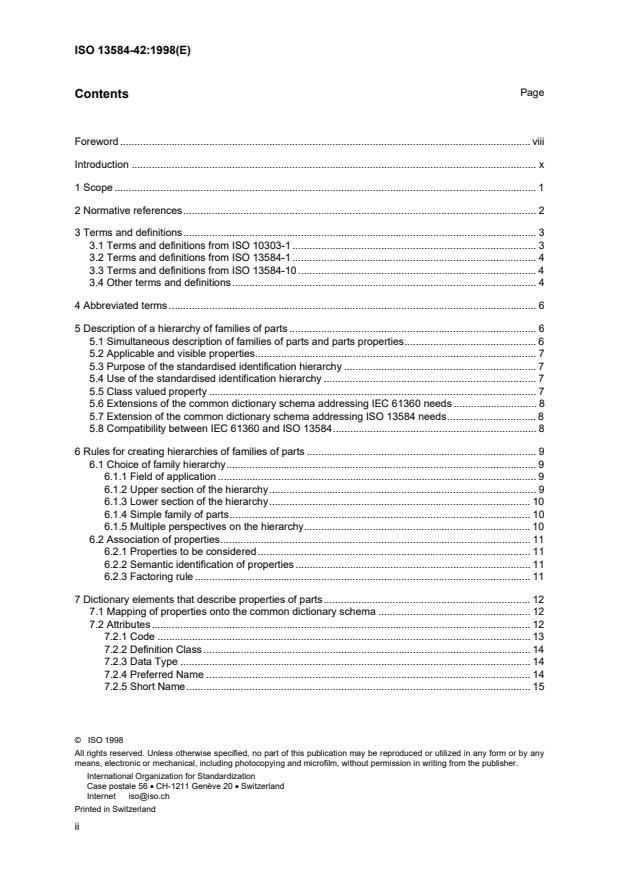
Contents
Foreword . viii
Introduction . x
1 Scope . 1
2 Normative references. 2
3 Terms and definitions. 3
3.1 Terms and definitions from ISO 10303-1 . 3
3.2 Terms and definitions from ISO 13584-1 . 4
3.3 Terms and definitions from ISO 13584-10 . 4
3.4 Other terms and definitions. 4
4 Abbreviated terms . 6
5 Description of a hierarchy of families of parts . 6
5.1 Simultaneous description of families of parts and parts properties. 6
5.2 Applicable and visible properties. 7
5.3 Purpose of the standardised identification hierarchy . 7
5.4 Use of the standardised identification hierarchy . 7
5.5 Class valued property . 7
5.6 Extensions of the common dictionary schema addressing IEC 61360 needs . 8
5.7 Extension of the common dictionary schema addressing ISO 13584 needs. 8
5.8 Compatibility between IEC 61360 and ISO 13584. 8
6 Rules for creating hierarchies of families of parts . 9
6.1 Choice of family hierarchy. 9
6.1.1 Field of application . 9
6.1.2 Upper section of the hierarchy. 9
6.1.3 Lower section of the hierarchy. 10
6.1.4 Simple family of parts. 10
6.1.5 Multiple perspectives on the hierarchy. 10
6.2 Association of properties. 11
6.2.1 Properties to be considered.11
6.2.2 Semantic identification of properties . 11
6.2.3 Factoring rule. 11
7 Dictionary elements that describe properties of parts. 12
7.1 Mapping of properties onto the common dictionary schema . 12
7.2 Attributes. 12
7.2.1 Code . 13
7.2.2 Definition Class . 14
7.2.3 Data Type . 14
7.2.4 Preferred Name . 14
7.2.5 Short Name. 15
© ISO 1998
All rights reserved. Unless otherwise specified, no part of this publication may be reproduced or utilized in any form or by any
means, electronic or mechanical, including photocopying and microfilm, without permission in writing from the publisher.
International Organization for Standardization
Case postale 56 • CH-1211 Genève 20 • Switzerland
Internet iso@iso.ch
Printed in Switzerland
ii
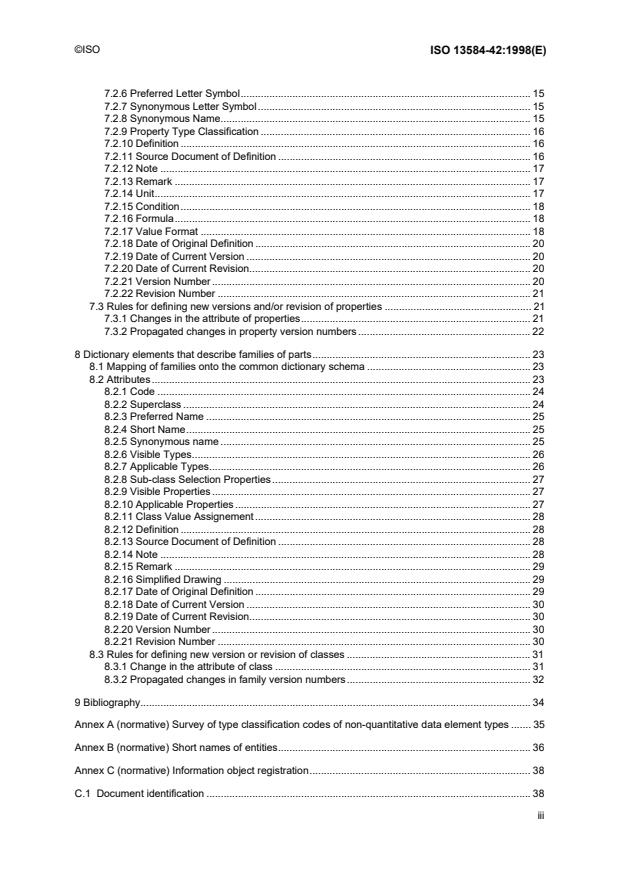
©ISO
7.2.6 Preferred Letter Symbol. 15
7.2.7 Synonymous Letter Symbol. 15
7.2.8 Synonymous Name. 15
7.2.9 Property Type Classification .16
7.2.10 Definition . 16
7.2.11 Source Document of Definition . 16
7.2.12 Note . 17
7.2.13 Remark . 17
7.2.14 Unit. 17
7.2.15 Condition. 18
7.2.16 Formula. 18
7.2.17 Value Format . 18
7.2.18 Date of Original Definition . 20
7.2.19 Date of Current Version . 20
7.2.20 Date of Current Revision. 20
7.2.21 Version Number. 20
7.2.22 Revision Number . 21
7.3 Rules for defining new versions and/or revision of properties . 21
7.3.1 Changes in the attribute of properties. 21
7.3.2 Propagated changes in property version numbers . 22
8 Dictionary elements that describe families of parts. 23
8.1 Mapping of families onto the common dictionary schema . 23
8.2 Attributes. 23
8.2.1 Code . 24
8.2.2 Superclass . 24
8.2.3 Preferred Name . 25
8.2.4 Short Name. 25
8.2.5 Synonymous name . 25
8.2.6 Visible Types. 26
8.2.7 Applicable Types. 26
8.2.8 Sub-class Selection Properties. 27
8.2.9 Visible Properties . 27
8.2.10 Applicable Properties . 27
8.2.11 Class Value Assignement. 28
8.2.12 Definition . 28
8.2.13 Source Document of Definition . 28
8.2.14 Note . 28
8.2.15 Remark . 29
8.2.16 Simplified Drawing . 29
8.2.17 Date of Original Definition . 29
8.2.18 Date of Current Version . 30
8.2.19 Date of Current Revision. 30
8.2.20 Version Number. 30
8.2.21 Revision Number . 30
8.3 Rules for defining new version or revision of classes . 31
8.3.1 Change in the attribute of class . 31
8.3.2 Propagated changes in family version numbers. 32
9 Bibliography. 34
Annex A (normative) Survey of type classification codes of non-quantitative data element types . 35
Annex B (normative) Short names of entities. 36
Annex C (normative) Information object registration.38
C.1 Document identification . 38
iii
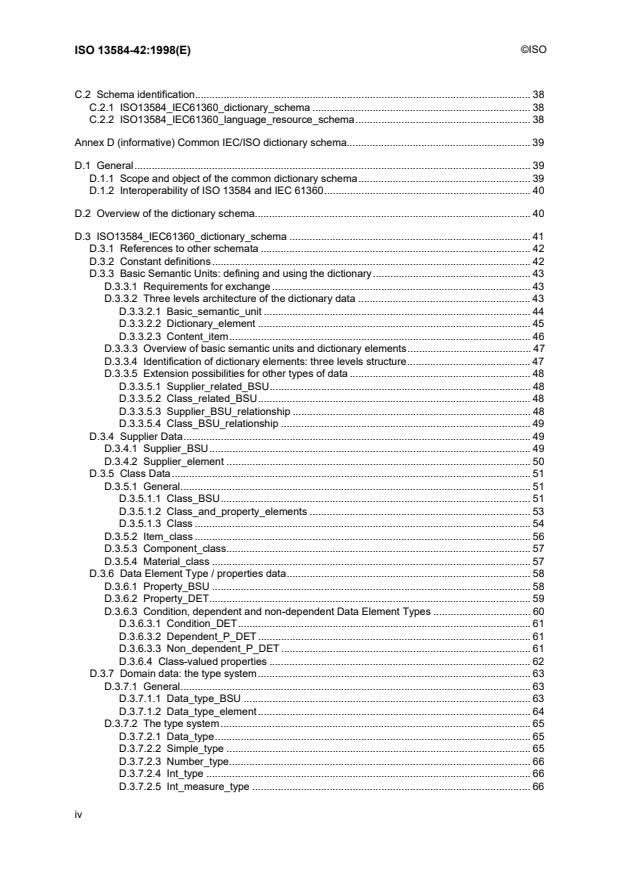
©ISO
C.2 Schema identification. 38
C.2.1 ISO13584_IEC61360_dictionary_schema . 38
C.2.2 ISO13584_IEC61360_language_resource_schema. 38
Annex D (informative) Common IEC/ISO dictionary schema. 39
D.1 General. 39
D.1.1 Scope and object of the common dictionary schema. 39
D.1.2 Interoperability of ISO 13584 and IEC 61360. 40
D.2 Overview of the dictionary schema. 40
D.3 ISO13584_IEC61360_dictionary_schema . 41
D.3.1 References to other schemata . 42
D.3.2 Constant definitions. 42
D.3.3 Basic Semantic Units: defining and using the dictionary. 43
D.3.3.1 Requirements for exchange . 43
D.3.3.2 Three levels architecture of the dictionary data . 43
D.3.3.2.1 Basic_semantic_unit . 44
D.3.3.2.2 Dictionary_element . 45
D.3.3.2.3 Content_item.46
D.3.3.3 Overview of basic semantic units and dictionary elements. 47
D.3.3.4 Identification of dictionary elements: three levels structure. 47
D.3.3.5 Extension possibilities for other types of data . 48
D.3.3.5.1 Supplier_related_BSU. 48
D.3.3.5.2 Class_related_BSU. 48
D.3.3.5.3 Supplier_BSU_relationship . 48
D.3.3.5.4 Class_BSU_relationship . 49
D.3.4 Supplier Data. 49
D.3.4.1 Supplier_BSU. 49
D.3.4.2 Supplier_element . 50
D.3.5 Class Data. 51
D.3.5.1 General. 51
D.3.5.1.1 Class_BSU.51
D.3.5.1.2 Class_and_property_elements . 53
D.3.5.1.3 Class . 54
D.3.5.2 Item_class . 56
D.3.5.3 Component_class. 57
D.3.5.4 Material_class . 57
D.3.6 Data Element Type / properties data. 58
D.3.6.1 Property_BSU . 58
D.3.6.2 Property_DET. 59
D.3.6.3 Condition, dependent and non-dependent Data Element Types . 60
D.3.6.3.1 Condition_DET. 61
D.3.6.3.2 Dependent_P_DET . 61
D.3.6.3.3 Non_dependent_P_DET . 61
D.3.6.4 Class-valued properties . 62
D.3.7 Domain data: the type system. 63
D.3.7.1 General. 63
D.3.7.1.1 Data_type_BSU . 63
D.3.7.1.2 Data_type_element . 64
D.3.7.2 The type system. 65
D.3.7.2.1 Data_type. 65
D.3.7.2.2 Simple_type .65
D.3.7.2.3 Number_type. 66
D.3.7.2.4 Int_type . 66
D.3.7.2.5 Int_measure_type . 66
iv
©ISO
D.3.7.2.6 Int_currency_type. 67
D.3.7.2.7 Non_quantitative_int_type. 67
D.3.7.2.8 Real_type . 67
D.3.7.2.9 Real_measure_type. 68
D.3.7.2.10 Real_currency_type . 68
D.3.7.2.11 Boolean_type . 68
D.3.7.2.12 String_type . 69
D.3.7.2.13 Non_quantitative_code_type. 69
D.3.7.2.14 Complex_type . 69
D.3.7.2.15 Level_type. 70
D.3.7.2.16 Level. 70
D.3.7.2.17 Class_instance_type. 71
D.3.7.2.18 Entity_instance_type. 71
D.3.7.2.19 Placement_type . 71
D.3.7.2.20 Axis1_placement_type. 72
D.3.7.2.21 Axis2_placement_2d_type. 72
D.3.7.2.22 Axis2_placement_3d_type. 73
D.3.7.2.23 Named_type. 73
D.3.7.3 Values . 73
D.3.7.3.1 Value_domain . 74
D.3.7.3.2 Value_type . 75
D.3.7.3.3 Dic_value . 75
D.3.7.4 Extension to ISO 10303-41 unit definitions . 75
D.3.7.4.1 Non_si_unit . 75
D.3.7.4.2 Assert_ONEOF rule . 76
D.3.7.4.3 Dic_unit . 76
D.3.8 Basic type and entity definitions . 77
D.3.8.1 Basic type definitions. 77
D.3.8.1.1 Class_code_type. 77
D.3.8.1.2 Code_type. 77
D.3.8.1.3 Currency_code. 78
D.3.8.1.4 Date_type. 78
D.3.8.1.5 Definition_type .79
D.3.8.1.6 DET_classification_type. 79
D.3.8.1.7 Data_type_code_type . 79
D.3.8.1.8 Note_type. 80
D.3.8.1.9 Pref_name_type. 80
D.3.8.1.10 Property_code_type. 80
D.3.8.1.11 Remark_type. 80
D.3.8.1.12 Revision_type. 81
D.3.8.1.13 Short_name_type. 81
D.3.8.1.14 Supplier_code_type . 81
D.3.8.1.15 Syn_name_type . 82
D.3.8.1.16 Value_code_type . 82
D.3.8.1.17 Value_format_type . 82
D.3.8.1.18 Version_type . 83
D.3.8.1.19 Source_doc_type . 83
D.3.8.2 Basic entity definitions. 83
D.3.8.2.1 Dates. 83
D.3.8.2.2 Document. 84
D.3.8.2.3 Graphics. 84
D.3.8.2.4 Identified_document. 84
D.3.8.2.5 Item_names . 85
D.3.8.2.6 Label_with_language . 86
D.3.8.2.7 Mathematical_string . 86
D.3.9 Function definitions. 87
D.3.9.1 Acyclic_superclass_relationship function. 87
v
©ISO
D.3.9.2 At_most_two_synonyms_per_language function. 87
D.3.9.3 Check_syn_length function . 88
D.3.9.4 Codes_are_unique function . 88
D.3.9.5 Definition_available_implies function. 89
D.3.9.6 Is_subclass function. 89
D.3.9.7 String_for_derived_unit function. 90
D.3.9.8 String_for_named_unit function . 91
D.3.9.9 String_for_SI_unit function .92
D.3.9.10 String_for_unit function . 93
D.3.9.11 All_class_descriptions_reachable function. 94
D.3.9.12 Compute_known_visible_properties function. 94
D.3.9.13 Compute_known_visible_data_types function . 95
D.3.9.14 Compute_known_applicable_properties function. 96
D.3.9.15 Compute_known_applicable_data_types function. 97
D.3.9.16 List_to_set. 97
D.4 ISO13584_IEC61360_language_resource_schema. 98
D.4.1 ISO13584_IEC61360_language_resource_schema type and entity definitions . 99
D.4.1.1 Language_code. 99
D.4.1.2 Global_language_assignment. 99
D.4.1.3 Present_translations. 99
D.4.1.4 Translatable_label . 100
D.4.1.5 Translated_label. 100
D.4.1.6 Translatable_text. 100
D.4.1.7 Translated_text. 101
D.4.2 ISO13584_IEC61360_language_resource_schema function definitions . 101
D.4.2.1 Check_label_length function . 101
D.4.2.2 Check_text_length function. 102
D.4.3 ISO13584_IEC61360_language_resource_schema rule definition . 102
D.5 Example Physical File . 103
D.5.1 Some example data. 103
D.5.1.1 Supplier data . 103
D.5.1.2 Root class data. 103
D.5.1.3 Material data. 104
D.5.1.4 Component data. 104
D.5.1.5 Electric / Electronic component data. 105
D.5.2 Templates derived from the EXPRESS code. 106
D.5.2.1 Templates for supplier data. 107
D.5.2.2 Templates for class data . 107
D.5.2.3 Templates for property_DET data. 108
D.5.2.4 Templates for data type data. 108
Annex E (informative) Survey of main classes and categories of properties. 110
Annex F (informative) Survey of type classification codes of quantitative data element types. 111
Annex G (informative) EXPRESS-G diagrams . 119
Annex H (informative) Definitions from ISO 13584-1. 127
Annex J (informative) Definitions from ISO 13584-10. 128
Index . 129
vi
©ISO
Figures
Figure D.1 — Overview of the dictionary schema. 41
Figure D.2 — Pieces of data with relationships . 43
Figure D.3 — Implementation of "inter-piece" relationships using basic semantic units. 44
Figure D.4 — Relationship between basic semantic unit and dictionary element. 46
Figure D.5 — Current BSUs and dictionary elements. 47
Figure D.6 — Overview of supplier data and relationships. 49
Figure D.7 — Overview of class data and relationships . 51
Figure D.8 — Overview of property data element type data and relationships. 60
Figure D.9 — Kinds of data element types . 60
Figure D.10 — Entity hierarchy for the type system . 63
Figure D.11 — Overview of non-quantitative data element Types. 74
Figure D.12 — ISO13584_IEC61360_language_resource_schema
and support_resource_schema .98
Tables
Table 1 — Overview of versioning in property updating operations. 22
Table 2 — Propagated changes in version numbers of properties. 23
Table 3 — Overview of versioning in class updating operations. 32
Table B.1 — Short names of entities . 36
vii
©ISO
Foreword
ISO (the International Organization for Standardization) is a worldwide federation of national standards
bodies (ISO member bodies). The work of preparing International Standards is normally carried out
through ISO technical committees. Each member body interested in a subject for which a technical
committee has been established has the right to be represented on that committee. International
organisations, governmental and non-governmental, in liaison with ISO, also take part in the work.
ISO collaborates closely with the International Electrotechnical Commission (IEC) on all matters of
electrotechnical standardisation.
Draft International Standards adopted by the technical committees are circulated to the member
bodies for voting. Publication as an International Standard requires approval by at least 75 % of the
member bodies casting a vote.
International Standard ISO 13584-42 was prepared by Technical Committee ISO/TC 184, Industrial
automation systems and integration, Subcommittee SC 4, Industrial data.
ISO 13584 consists of the following parts, under the general title Industrial automation systems and
integration — Parts library:
— Part 1: Overview and fundamental principles
— Part 10: Conceptual description: Conceptual model of parts library
— Part 20: Logical resource: Logical model of expressions
— Part 24, Logical resource: Logical model of supplier library
— Part 26: Logical resource: Supplier identification
— Part 31: Implementation resource: Geometric programming interface
— Part 42: Description methodology: Methodology for structuring part families
— Part 101: View exchange protocol: Geometric view exchange protocol by parametric program
— Part 102: View exchange protocol: View exchange protocol by ISO 10303 conforming
specification
The structure of ISO 13584 is described in ISO 13584-1. The numbering of the parts of ISO 13584
reflects its structure:
— Parts 10 to 19 specify the conceptual descriptions,
— Parts 20 to 29 specify the logical resources,
— Parts 30 to 39 specify the implementation resources,
— Parts 40 to 49 specify the description methodology,
— Parts 50 to 59 specify the conformance testing,
— Parts 100 to 199 specify the view exchange protocol,
viii
©ISO
— Parts 500 to 599 specify the standardised content.
Should further parts of ISO 13584 be published, they will follow the same numbering pattern.
Annexes A, B and C form an integral part of this part of ISO 13584. Annexes D, E, G and H are for
information only.
ix
©ISO
Introduction
ISO 13584 is an International Standard for the computer-interpretable representation and exchange of
part library data. The objective is to provide a neutral mechanism capable of transferring parts library
data, independent of any application that is using a parts library data system. The nature of this
description makes it suitable not only for the exchange of files containing parts, but also as a basis for
implementing and sharing databases of parts library data.
ISO 13854 is organised as a series of parts, each published separately. The parts of ISO 13854 fall
into one of the following series: conceptual descriptions, logical resources, implementation resources,
description methodology, conformance testing, view exchange protocol, and standardised content.
The series are described in ISO 13584-1. This part of ISO 13584 is a member of the description
methodology series.
This part of ISO 13584 provides rules and guidelines for library data suppliers to create hierarchies of
families of parts according to a common methodology intended to enable multi-supplier consistency.
These rules pertain to the following: the method for grouping parts into families of parts to form a
hierarchy; the dictionary elements that describe the families and properties of parts.
This part of ISO 13584 refers as a normative reference to the data model that specifies the exchange
of dictionary data. This EXPRESS specification was developed as a common model for ISO 13584
and IEC 61360. It is intended to be published as IEC 61360-2. For convenience this common model is
provided in this part of ISO 13584 as an informative annex that duplicates the normative content of
IEC 61360-2. This part of ISO 13584 also provides the mapping of the concepts described here onto
the common model.
x
INTERNATIONAL STANDARD ©ISO ISO 13584-42:1998(E)
Industrial automation systems and integration —
Parts library —
Part 42:
Description methodology: Methodology for structuring
part families
1 Scope
This part of ISO 13584 specifies the principles that shall be used for defining families of parts and
properties of parts to fully characterize parts and associated properties.
The rules and guidelines provided in this part of ISO 13584 are mandatory for the standardisation
committees responsible for creating standardised identification hierarchies.
The use of these rules by suppliers and users is recommended as a methodology for building their
own hierarchies.
The following are within the scope of this part of ISO 13584:
— the rule to group parts into generic families of parts and simple families of parts;
— the rules for the choice of the appropriate properties that shall be associated with the families of
parts;
— the attributes that shall be provided by library data suppliers to describe the families and
properties of parts.
— the specifications of those attributes in the EXPRESS information model that provide for the
exchange of such dictionary data.
NOTE 1 The EXPRESS information model for the exchange of dictionary data is defined in
IEC 61360-2.
NOTE 2 The content of this EXPRESS information model is in the informative Annex D of this part of ISO
13584 that duplicates the normative content of IEC 61360-3.
The following are outside the scope of this part of ISO 13584:
— libraries of assembled parts with aggregate structure (Level 3 libraries);
— the description of the parts themselves;
— the descriptions of the functional models that may refer to some family of parts;
— the description of tables, program libraries and documents that may refer to some family of
parts;
— the description of the systems intended to manage parts libraries; and
— the EXPRESS resource constructs for references between libraries.
NOTE The EXPRESS resource constructs for tables, programs libraries, documents and for references
between libraries are defined in ISO 13584-24.
©ISO
The structure of the information and the methodology defined in this part of ISO 13584 enable the
following:
— integration in the same data repository of different parts libraries originating from different library
data suppliers with an uniform access mechanism provided by a dictionary;
— integration in the same data repository of different definitions of materials originating from
different suppliers with an uniform access mechanism provided by a dictionary;
— referencing another supplier library assumed to be available on the receiving system;
— referencing a standardised identification hierarchy when such a hierarchy exists;
— definition by an end-user of a local classification or search hierarchy, and the mapping of these
hierarchies onto the supplier libraries available on its system.
2 Normative references
The following normative documents contain provisions which, through reference in this text, constitute
provisions of this part of ISO 13584. For dated references, subsequent amendments to, or revisions
of, any of these publications do not apply. However, parties to agreements based on this part of ISO
13584 are encouraged to investigate the possibility of applying the most recent editions of the
normative documents indicated below. For undated references the latest edition of the normative
document referred to applies. Members of IEC and ISO maintain registers of currently valid Inter-
national Standards.
ISO 31-0:1992, Quantities and units — Part 0: General principles.
ISO 4217, Codes for the representation of names of currencies and funds.
ISO 6093:1985, Information processing — Representation of numerical values in character strings for
information interchange.
ISO 8601:1988, Data elements and interchange formats — Information interchange —
Representations of dates and times.
ISO/IEC 8824-1:1995, Information technology — Abstract Syntax Notation One (ASN.1): Specification
of basic notation.
ISO 8879-1:1987, Information processing — 8-bit single-byte coded graphic character sets — Part 1:
Latin alphabet No. 1.
ISO 8879:1986, Information processing — Text and office systems — Standard Generalized Markup
Language (SGML).
ISO 9735:1988, Electronic data interchange for administration, commerce and transport (EDIFACT) —
Application level syntax rules.
ISO 10303-1:1994, Industrial automa
...
Questions, Comments and Discussion
Ask us and Technical Secretary will try to provide an answer. You can facilitate discussion about the standard in here.
Loading comments...