

ISO/TR 24464:2025
(Main)Visualization elements of digital twin — Visualization fidelity
General Information
- Abstract
The content of this document is divided into two parts. — This document analyses the overall configuration of an industrial digital twin system, and proposes a three-elements architecture, focusing on the twinning interface between the physical twin (PTw) and industrial digital twin (iDTw). — The characteristics, and the visualization elements and visualization fidelity of iDTw are analysed. This document: a) analyses the twinning interface between the PTw and iDTw; b) proposes a three-elements architecture; c) analyses the visualization element and its fidelity, which is a key component of the interface among the three-elements architecture; d) analyses the elements that constitute an iDTw system to understand the unique properties of iDTw; e) explores the differentiation from cyber physical systems (CPS) or augmented reality (AR), which are similar to existing concepts of iDTw. This document excludes: — applications of iDTw; — implementation of iDTw.
- Status
- Published
- Publication Date
- 06-Mar-2025
- Technical Committee
- ISO/TC 184/SC 4 - Industrial data
- Current Stage
- 6060 - International Standard published
- Start Date
- 07-Mar-2025
- Due Date
- 01-May-2025
- Completion Date
- 07-Mar-2025


Overview
ISO/TR 24464:2025 - "Visualization elements of digital twin - Visualization fidelity" is an ISO Technical Report that clarifies how visualization fits into an industrial digital twin (iDTw) system. The report proposes a three‑elements architecture focused on the twinning interface between the physical twin (PTw) and the iDTw, and it analyses the visualization elements and their visualization fidelity (how well the digital representation reproduces or conveys the physical state). This second edition updates the original 2020 report and emphasizes fidelity among visualization elements.
Key technical topics and requirements
- Three‑elements architecture: conceptual breakdown of an iDTw system highlighting the role of the twinning interface that mediates mutual augmentation between PTw and iDTw.
- Twinning interface: the mediator responsible for state synchronization and exchange between atom world (physical) and bit world (digital).
- Visualization elements: components that render shape, condition, and behavior of assets; the report analyses their characteristics without prescribing implementation.
- Visualization fidelity: definitions and analytic approaches for fidelity - including Level of Detail (LoD) for plant and equipment models and fidelity measures.
- Fidelity measures: spatial and temporal considerations such as spatial resolution (space measure) and time measure (latency and sampling rate) to assess how closely a visualization represents the PTw.
- iDTw system characteristics: life‑cycle considerations (separation of artificial model vs digital replica), mutual augmentation via twinning cycles, and inclusion relationships between iDTw and PTw.
- Differentiation: comparison and clarification of how iDTw differs from cyber‑physical systems (CPS) and augmented reality (AR).
- Scope limits: the report analyses architecture and fidelity but excludes application use cases and implementation details.
Practical applications and who would use this standard
ISO/TR 24464:2025 is useful for:
- System architects and solution designers creating industrial digital twin specifications or tender documents.
- Software and visualization vendors defining LoD, latency, and synchronization requirements.
- Asset owners and operators (manufacturing, energy, maritime, infrastructure) evaluating iDTw fidelity needs for monitoring, maintenance planning, or digital assurance.
- Researchers, standards developers, and integrators working at the intersection of IoT, digital twin, CPS, and XR environments who need clear terminology and fidelity metrics.
Practical uses include scoping visualization fidelity requirements, specifying twinning interface behavior, selecting appropriate LoD strategies, and benchmarking spatial/temporal resolution for digital twin visual systems.
Related standards
Relevant references and complementary standards cited or aligned with the report include:
- ISO 16781 (fidelity definitions)
- IEC 63278‑1 (asset administration shell)
- ISO/IEC TS 5147 (visualization terminology)
- ISO/IEC 18023‑1 (level of detail) These help integrate ISO/TR 24464:2025 into broader digital twin, PLM and industrial data ecosystems.
Keywords: ISO/TR 24464:2025, digital twin, industrial digital twin, iDTw, visualization fidelity, twinning interface, Level of Detail, spatial resolution, latency, CPS, augmented reality.
Relations
- Effective Date
- 04-Nov-2023
Get Certified
Connect with accredited certification bodies for this standard

BSI Group
BSI (British Standards Institution) is the business standards company that helps organizations make excellence a habit.

DVS-ZERT GmbH
German welding certification society.
CARES (UK Certification Authority for Reinforcing Steels)
UK certification for reinforcing steels and construction.
Sponsored listings
Frequently Asked Questions
ISO/TR 24464:2025 is a technical report published by the International Organization for Standardization (ISO). Its full title is "Visualization elements of digital twin — Visualization fidelity". This standard covers: The content of this document is divided into two parts. — This document analyses the overall configuration of an industrial digital twin system, and proposes a three-elements architecture, focusing on the twinning interface between the physical twin (PTw) and industrial digital twin (iDTw). — The characteristics, and the visualization elements and visualization fidelity of iDTw are analysed. This document: a) analyses the twinning interface between the PTw and iDTw; b) proposes a three-elements architecture; c) analyses the visualization element and its fidelity, which is a key component of the interface among the three-elements architecture; d) analyses the elements that constitute an iDTw system to understand the unique properties of iDTw; e) explores the differentiation from cyber physical systems (CPS) or augmented reality (AR), which are similar to existing concepts of iDTw. This document excludes: — applications of iDTw; — implementation of iDTw.
The content of this document is divided into two parts. — This document analyses the overall configuration of an industrial digital twin system, and proposes a three-elements architecture, focusing on the twinning interface between the physical twin (PTw) and industrial digital twin (iDTw). — The characteristics, and the visualization elements and visualization fidelity of iDTw are analysed. This document: a) analyses the twinning interface between the PTw and iDTw; b) proposes a three-elements architecture; c) analyses the visualization element and its fidelity, which is a key component of the interface among the three-elements architecture; d) analyses the elements that constitute an iDTw system to understand the unique properties of iDTw; e) explores the differentiation from cyber physical systems (CPS) or augmented reality (AR), which are similar to existing concepts of iDTw. This document excludes: — applications of iDTw; — implementation of iDTw.
ISO/TR 24464:2025 is classified under the following ICS (International Classification for Standards) categories: 25.040.40 - Industrial process measurement and control; 35.240.50 - IT applications in industry. The ICS classification helps identify the subject area and facilitates finding related standards.
ISO/TR 24464:2025 has the following relationships with other standards: It is inter standard links to ISO/TR 24464:2020. Understanding these relationships helps ensure you are using the most current and applicable version of the standard.
ISO/TR 24464:2025 is available in PDF format for immediate download after purchase. The document can be added to your cart and obtained through the secure checkout process. Digital delivery ensures instant access to the complete standard document.
Standards Content (Sample)
Technical
Report
ISO/TR 24464
Second edition
Visualization elements of digital
2025-03
twin — Visualization fidelity
Éléments de visualisation du jumeau numérique — Fidélité de la
visualisation
Reference number
© ISO 2025
All rights reserved. Unless otherwise specified, or required in the context of its implementation, no part of this publication may
be reproduced or utilized otherwise in any form or by any means, electronic or mechanical, including photocopying, or posting on
the internet or an intranet, without prior written permission. Permission can be requested from either ISO at the address below
or ISO’s member body in the country of the requester.
ISO copyright office
CP 401 • Ch. de Blandonnet 8
CH-1214 Vernier, Geneva
Phone: +41 22 749 01 11
Email: copyright@iso.org
Website: www.iso.org
Published in Switzerland
ii
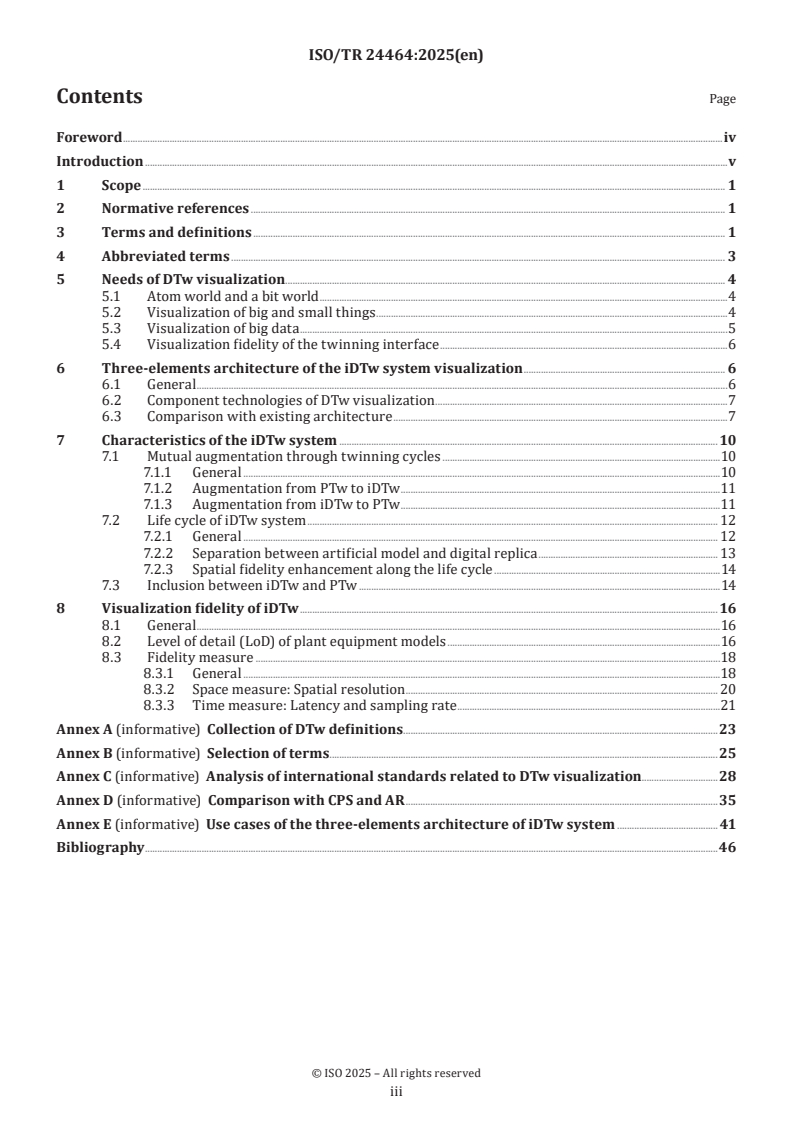
Contents Page
Foreword .iv
Introduction .v
1 Scope . 1
2 Normative references . 1
3 Terms and definitions . 1
4 Abbreviated terms . 3
5 Needs of DTw visualization . . 4
5.1 Atom world and a bit world .4
5.2 Visualization of big and small things .4
5.3 Visualization of big data .5
5.4 Visualization fidelity of the twinning interface .6
6 Three-elements architecture of the iDTw system visualization . 6
6.1 General .6
6.2 Component technologies of DTw visualization .7
6.3 Comparison with existing architecture .7
7 Characteristics of the iDTw system . 10
7.1 Mutual augmentation through twinning cycles .10
7.1.1 General .10
7.1.2 Augmentation from PTw to iDTw .11
7.1.3 Augmentation from iDTw to PTw .11
7.2 Life cycle of iDTw system . 12
7.2.1 General . 12
7.2.2 Separation between artificial model and digital replica . 13
7.2.3 Spatial fidelity enhancement along the life cycle .14
7.3 Inclusion between iDTw and PTw .14
8 Visualization fidelity of iDTw .16
8.1 General .16
8.2 Level of detail (LoD) of plant equipment models .16
8.3 Fidelity measure .18
8.3.1 General .18
8.3.2 Space measure: Spatial resolution . 20
8.3.3 Time measure: Latency and sampling rate .21
Annex A (informative) Collection of DTw definitions .23
Annex B (informative) Selection of terms .25
Annex C (informative) Analysis of international standards related to DTw visualization .28
Annex D (informative) Comparison with CPS and AR .35
Annex E (informative) Use cases of the three-elements architecture of iDTw system . 41
Bibliography .46
iii
Foreword
ISO (the International Organization for Standardization) is a worldwide federation of national standards
bodies (ISO member bodies). The work of preparing International Standards is normally carried out through
ISO technical committees. Each member body interested in a subject for which a technical committee
has been established has the right to be represented on that committee. International organizations,
governmental and non-governmental, in liaison with ISO, also take part in the work. ISO collaborates closely
with the International Electrotechnical Commission (IEC) on all matters of electrotechnical standardization.
The procedures used to develop this document and those intended for its further maintenance are described
in the ISO/IEC Directives, Part 1. In particular, the different approval criteria needed for the different types
of ISO documents should be noted. This document was drafted in accordance with the editorial rules of the
ISO/IEC Directives, Part 2 (see www.iso.org/directives).
ISO draws attention to the possibility that the implementation of this document may involve the use of (a)
patent(s). ISO takes no position concerning the evidence, validity, or applicability of any claimed patent
rights in respect thereof. As of the date of publication of this document, ISO had not received notice of (a)
patent(s) which may be required to implement this document. However, implementers are cautioned that
this may not represent the latest information, which may be obtained from the patent database available at
www.iso.org/patents. ISO shall not be held responsible for identifying any or all such patent rights.
Any trade name used in this document is information given for the convenience of users and does not
constitute an endorsement.
For an explanation of the voluntary nature of standards, the meaning of ISO specific terms and expressions
related to conformity assessment, as well as information about ISO's adherence to the World Trade
Organization (WTO) principles in the Technical Barriers to Trade (TBT), see www.iso.org/iso/foreword.html.
This document was prepared by Technical Committee ISO/TC 184, Automation systems and integration,
Subcommittee SC 4, Industrial data, in collaboration with Technical Committee ISO/IEC JTC 1 Information
Technology, Subcommittee SC 24, Computer graphics, image processing and environmental data representation
and Technical Committee ISO/TC 171, Document management applications, Subcommittee SC 2, Document file
formats, EDMS systems and authenticity of information.
This second edition cancels and replaces the first edition (ISO/TR 24464:2020), which has been technically
revised.
The main changes are as follows:
— the title is changed;
— a three-elements architecture is added;
— this document focuses more on fidelity among visualization elements.
Any feedback or questions on this document should be directed to the user’s national standards body. A
complete listing of these bodies can be found at www.iso.org/members.html.
iv
Introduction
This document analyses the visualization fidelity among the visualization elements of a digital twin system.
Since digital twin (DTw) is a new technology, various definitions are being proposed in the sector as a whole,
so they collide with each other, and cross-reference is underway at the same time. This document analyses
the element technologies and the properties that make up the DTw system, it also attempts to reveal the
nature of the DTw, and focuses on visualization elements. This is expected to further solidify the identity of
DTw, reduce confusion and consequently help further spread the use of DTw technology.
v
Technical Report ISO/TR 24464:2025(en)
Visualization elements of digital twin — Visualization fidelity
1 Scope
The content of this document is divided into two parts.
— This document analyses the overall configuration of an industrial digital twin system, and proposes a
three-elements architecture, focusing on the twinning interface between the physical twin (PTw) and
industrial digital twin (iDTw).
— The characteristics, and the visualization elements and visualization fidelity of iDTw are analysed.
This document:
a) analyses the twinning interface between the PTw and iDTw;
b) proposes a three-elements architecture;
c) analyses the visualization element and its fidelity, which is a key component of the interface among the
three-elements architecture;
d) analyses the elements that constitute an iDTw system to understand the unique properties of iDTw;
e) explores the differentiation from cyber physical systems (CPS) or augmented reality (AR), which are
similar to existing concepts of iDTw.
This document excludes:
— applications of iDTw;
— implementation of iDTw.
2 Normative references
There are no normative references in this document.
3 Terms and definitions
For the purposes of this document, the following terms and definitions apply.
ISO and IEC maintain a terminology database for use in standardization at:
— ISO Online browsing platform: available at https:// www .iso .org/ obp
— IEC Electropedia: available at https:// www .electropedia .org/
3.1
accuracy
closeness of agreement between a test result or measurement result and the true value
[SOURCE: ISO 3534-2:2006, 3.3.1, modified — Notes 1 to 3 to entry have been removed.]
3.2
asset
any item, thing or entity that has potential or actual value to an organization
[SOURCE: ISO/TS 15926-11:2023, 3.1.1]
3.3
asset administration shell
standardized digital representation of an asset (3.2)
[SOURCE: IEC 63278-1:2023, 3.1.2]
3.4
digital model
dataset to represent the shape (3.12) and any other desired characteristics for target synthetic model
[SOURCE: ISO 22926:2023, 3.1, modified — Term "digital anatomical bone model", Notes 1 to 2 to entry and
the example have been removed.]
3.5
federation
community of domains
[SOURCE: ISO 12967-1:2020, 3.4.2]
3.6
fidelity
degree to which a model or simulation reproduces the state and behaviour of a real-world object or the
perception of a real-world object, feature, condition, or chosen standard in a measurable or perceivable manner
[SOURCE: ISO 16781:2021, 3.1.4]
3.7
industrial digital twin
digital representation of a physical entity
Note 1 to entry: It represents the bit world rather than the atom world.
3.8
industrial digital twin system
compound model composed of a physical twin (3.10), an industrial digital twin (3.7), and a twinning interface
(3.15) which is used for state synchronization (3.13) between two twins
3.9
level of detail
alternate representations of an object at varying fidelities based on specific criteria
[SOURCE: ISO/IEC 18023-1:2006, 3.1.8]
3.10
physical twin
object which exists in the real world
3.11
real time
guarantee response within specified time constraints
Note 1 to entry: Often referred to as “deadlines”.
3.12
shape
form of an object or its external boundary, outline, or external surface, as opposed to other properties such
as colour, texture, or material type
3.13
synchronization
joining up or handshaking of multiple processes at a certain point, to reach an agreement or commit to a
certain sequence of action
3.14
twinning
pairing or union of two similar or identical objects
3.15
twinning interface
mediator which allows mutual augmentation between iDTw (3.7) and PTw (3.10)
3.16
visualization
rendering of an object, situation or set of information as a chart or image
[SOURCE: ISO/IEC TS 5147:2023, 3.1.15, modified — Note 1 to entry was removed.]
4 Abbreviated terms
AAS asset administration shell
AI artificial intelligence
AR augmented reality
AWI approved work item
CAD computer aided design
CAE computer aided engineering
CG computer graphics
CPS cyber physical system
DTw digital twin
fps frames per second
FPSO floating production storage offloading
HiFi high fidelity
HW hardware
iDTw industrial digital twin
IoT internet of things
JWG joint working group
LoD level of detail
LRC local RTI component
MAR mixed and augmented reality
MEMS micro electromechanical systems
MR mixed reality
NP new proposal
O&M operation and maintenance
P&ID piping and instrumentation diagram
PLM product life cycle management
PPI pixels per inch
PTw physical twin
RAMI4.0 reference architecture model industry 4.0
RPM revolution per minute
RTI run-time infrastructure
SMRM smart manufacturing reference model
SMRL STEP module and resource library
STEP standard for the exchange of product model data
SW software
TTR technology trend report
VR virtual reality
WiFi wireless fidelity
XR extended reality
5 Needs of DTw visualization
5.1 Atom world and a bit world
The concept of the digital twin (DTw) can be elucidated through the paradigms of the atom world and the
bit world. The atom, being the fundamental unit of matter, serves as the foundation for the real world. This
realm, governed by traditional economic principles, is often referred to as the physical world, characterized
by the tangible presence of materials. Within the atom world, the economy is predominantly influenced by
three factors: land, capital and labour.
Contrastingly, the bit world represents the online domain, where the economic paradigm shifts significantly
from that of the atom world. In this digital space, data are stored as bits which do not require physical space,
and the processing speeds surpass those encountered in the atom world.
5.2 Visualization of big and small things
As man-made products, including ocean platforms, satellites, factories, power plants, and urban
infrastructures, grow in size and complexity, the challenge of managing these entities escalates.
Consequently, there is an expanding demand for the utilization of DTws to manage these large and complex
products. Similarly, in the realm of micro-materials, such as DNA and micro-electro-mechanical systems
(MEMS), digital models replicating real-world objects are increasingly employed for planning, designing,
producing, operating, monitoring, and maintaining these materials. Nonetheless, digital models, whether for
macro or micro-scale applications, are often simplified or idealized versions of their physical counterparts,
leading to inherent limitations.
The absence of visualization technologies raises questions about the practical value of a constructed DTw.
This paradox underscores the critical importance of visualization capabilities. Visualization technologies,
including video, are becoming increasingly vital in accurately simulating real-world scenarios with DTws.
5.3 Visualization of big data
With advancements in the internet of things (IoT) and sensor network technologies, an increasing volume of
operational data are being digitized and stored through the internet and sensor devices, thus contributing
to the formation of substantial big data assets. Figure 1 illustrates the process in which operational data,
gathered via edge computing devices like smartphones, is archived and leveraged as big data within cloud
computing infrastructures.
[29]
Figure 1 — IoT produces big data
The sheer volume of this big data surpasses human analytical capabilities, heralding new horizons as artificial
intelligence (AI) is deployed for its analysis. With big data integrated into digital assets and constructed as
DTws, the fidelity in mirroring real-world scenarios surpasses that of traditional digital models.
The utilization of computer graphics (CG) for the visualization of big data has been established for quite some
time, notably in applications such as climate modelling with supercomputers, biological cell or chemical
modelling, and the interpretation of simulation outcomes via digital product models, including automobiles.
These scientific visualization techniques pivot on CG rather than mere numerical calculations (Figure 2).
The simulation outcomes, represented as numbers and compiled into big data, gain interpretative clarity
through the application of AI and/or visualization techniques.
[39]
Figure 2 — Scientific visualization
5.4 Visualization fidelity of the twinning interface
As depicted in Figure C.5 and Figure 3, the industrial digital twin (iDTw) system is composed of three core
elements: the physical twin (PTw), the iDTw, and the twinning interface (see also Clause 6). This document
primarily addresses the twinning interface that facilitates interaction between the PTw and iDTw, focusing on
the standardization of visualization fidelity that is either shared or integrated between the PTw and the iDTw.
6 Three-elements architecture of the iDTw system visualization
6.1 General
As the interest in DTw grows, the introduction of varied definitions and architectures for DTws has led to
confusion. To address this issue, formal concept analysis, as introduced in D.1, serves as a useful tool. It is
important that the definition of an entity-of-interest is grounded in its properties.
In numerous references, the term "digital twin" is often equated with a digital replica. However, this
document adopts the three-elements architecture based on the definition provided by Michael Grieves, who
is credited with the concept of the DTw. The selection of terminologies are further explained in Annex B.
The iDTw system is characterized by a three-elements model, as illustrated in Figure 3, encompassing
the PTw and the iDTw, both of which are integrated via the twinning interface. This model is collectively
referred to as the "iDTw system". Annex E outlines a series of use cases that are applicable to the three-
elements model.
Figure 3 — Three-elements architecture of the iDTw system
6.2 Component technologies of DTw visualization
Drawing from the model proposed by Dr. Michael Grieves and the associated three-element architecture,
the technologies integral to DTw visualization are delineated in Figure 4. Given the complex nature of DTws,
capturing all component technologies within this document proves challenging. Thus, the focus is narrowed
to the visualization aspects, which are systematically categorized. The various definitions of DTw are
grouped and presented in Table A.1.
Figure 4 — Component technologies of DTw visualization
A substantial portion of the over 600 SMRL (STEP module and resource library) data models or product
models (schemas) can be identified as components integral to DTws. The SMRL serves as the foundation for
the STEP standard (ISO 10303 series), which encompasses not just design models but also those pertinent to
production or manufacturing, including models dedicated to visualization purposes. For instance, the visual
presentation aspect is specifically addressed in ISO 10303-46:2022, C.7.
6.3 Comparison with existing architecture
To explain the characteristics of the three-elements architecture, a comparative analysis with pre-existing
architectures is conducted. Figure 5 illustrates the architecture outlined in the ISO 23247 series juxtaposed
with the three-elements architecture detailed in this document. Within the scope of the ISO 23247 series,
DTw applications, DTw, and certain aspects of the communication layer with physical devices are designated
as "DTw for manufacturing". Whereas the present document classifies observable elements under PTw, and
the communication layer is aligned with the twinning interface. It is noteworthy that "applications of DTw"
are excluded from the iDTw system architecture as defined in this document.
Figure 5 — Comparison with the ISO 23247 series
Figure 6 presents the reference architecture of the DTw as cited in Reference [16]. The components enclosed
within the red box are indicative of the "iDTw system" as conceptualized within the three-elements
architecture of this document. The real-world entity (RWE), which encompasses both a physical model
and conceptual models or software (SW), aligns with the PTw as defined in this document. The real-digital
gateway (RDG) is equivalent to the twinning interface outlined herein.
[16]
Figure 6 — Comparison with digital twin reference architecture
[13]
Figure 7 illustrates the DTw ecosystem, which is further elaborated in Figure C.1 . An overlaid black box
within this ecosystem delineates the scope of the iDTw system as defined in this document. Beyond the
boundaries of the black box, the broader DTw system encompasses both a library and API components. The
model encapsulated by the black box shares similarities with the iDTw system of this document, albeit with
minor differences in terminology. The integration of modelling and data within this context is synonymous
with the twinning interface of this document.
[13]
Figure 7 — Comparison with digital twin ecosystem architecture
7 Characteristics of the iDTw system
7.1 Mutual augmentation through twinning cycles
7.1.1 General
If the DTw is perceived as similar to concepts such as CPS or augmented reality (AR), it might be criticized
for lacking originality, potentially reducing DTw to just another industry buzzword. Identifying the unique
features of DTw is crucial.
Previously, physical assets (PTw) and digital assets (iDTw) were developed and used separately, without
significant integration or interaction between them. However, with the advent of high-speed internet
technologies like 5G, the IoT, and digital sensor networks, there is now a closer interface between the twins.
It is anticipated that the twins, which were used independently, will develop into a relationship that
complements each other, enhancing their overall effectiveness. The interface between the PTw and iDTw,
which is near-real time and high-resolution, will be crucial. The ability to analyse big data exchanged
between the twins, becomes important.
As illustrated in Figure 8 and Figure C.3, iDTw and PTw can support each other and improve the level of
fidelity. The iDTw system increases the fidelity level of digital models by utilizing big data from the operation
of physical products. The technology of monitoring and controlling physical products with computer
simulation models has been in use for several decades. With digital models enhanced by operational big
data, more accurate simulations and predictions are possible, enabling optimal control.
Figure 8 — Mutual twinning (IEEE 2888)
7.1.2 Augmentation from PTw to iDTw
Operational big data, gathered through digital sensors, is utilized to enhance the corresponding iDTw,
facilitating improvements in the operational processes of physical products.
The initial design model, conceptualized prior to the realization of the physical model, often represents
an idealized form, challenging to account for real-world environmental disturbances. While statistical
techniques, employing historical data, can partially accommodate external disturbances, acquiring
statistically significant environmental disturbance data in real time proves to be a complex task.
Enhancing the design model (iDTw) with operational big data, derived from real-world operations (PTw), is
feasible. The practice of refining the (computer aided design) CAD model with point-cloud data from laser
scans, as indicated in Table 1, is becoming an increasingly common practice among owner-operators of
engineering plants.
Motion texture, a term utilized within the context of graphics rendering, aligns with the concepts of texture
maps or depth maps. It specifically denotes data derived from motion capture processes. Motion texture
serves to address the limitations inherent in traditional motion dynamics-based animation, contributing to
an enhanced realism in the movements of digital characters of animation films.
Similarly, deficiencies in CAD models can be addressed through the integration of laser scanning models or
point clouds. The amalgamation of data from the iDTw, such as the motion of polygons or kinematics, with
big data from the PTw, including point clouds or motion textures, facilitates an elevation in the fidelity level
of the iDTw.
7.1.3 Augmentation from iDTw to PTw
The integration of digital models (iDTw) with physical assets (PTw) encompasses both short-term and long-
term augmentation strategies.
Short-term augmentation focuses on optimizing the operational parameters of the PTw by fine-tuning the
control parameters for the asset's operation. This approach aligns with techniques already employed in
automatic control systems.
Long-term augmentation, on the other hand, aims to enhance or upgrade the finished product by revising the
design itself, thereby altering the design version. Such improvements can be achieved through simulations
using digital models or by analysing operational big data. Occasionally, this process is undertaken internally
by manufacturers over a medium-term period, involving quality inspections, while more extended periods
of enhancement are driven by market feedback on the product.
The method of improving physical products through such augmentations is a well-established practice.
With the increasing fidelity of iDTws, augmented by operational big data, enhancements to physical
products can be executed with greater precision and comprehensiveness. This advancement also facilitates
quicker response times, allowing for immediate adaptation to market feedback or changes in the product's
operational conditions.
7.2 Life cycle of iDTw system
7.2.1 General
Throughout the product life cycle, the visualization elements and the necessary data exchange between
the two components of an iDTw system, the iDTw and the PTw, evolve. The product life cycle encompasses
stages such as planning, design, manufacturing, operation and maintenance (O&M), and disposal, with
visualization elements adapting accordingly.
At the inception of the product life cycle, a PTw does not exist; only an iDTw or a conceptual model is present.
Initially, the conceptual product envisioned by the designer is represented through hand sketches or as
digital assets (iDTw) within a computer system. These digital assets can undergo validation or simulation
within a virtual manufacturing environment. Subsequently, products materialize as physical assets (PTw)
via physical manufacturing processes. From this juncture, both twins coexist, enabling the control of the
PTw through actuators by leveraging real-time operational data from sensors and control parameters.
Figure 9 delineates the life cycle of the DTw, illustrating the transition of virtual products to real products
via the production processes, a concept encapsulated within traditional product life cycle management
(PLM) systems.
Throughout the operation phase of a real product, operational data are collected, verified and then utilized
as the foundation for continuous performance enhancements. This life cycle model incorporates the three-
elements architecture of an iDTw system, wherein the conceptual model or digital asset (iDTw) materializes
into a physical asset (PTw). Moreover, performance indicator data are reciprocated through the twinning
interface, facilitated by the IoT sensor network.
Figure 9 — Life cycle model of DTw
7.2.2 Separation between artificial model and digital replica
Within the life cycle of an iDTw system, a distinction is made between artificial (or conceptual) models and
mirror models. Artificial models, which exist solely in the virtual domain, are differentiated from digital
[40]
replicas of real objects that have physical world counterparts. The concept of mirror models has led to
discussions regarding its equivalence to the DTw concept. Mirror models serve as a distinguishing factor
between virtual reality (VR) and AR; VR is composed entirely of artificial models, whereas AR integrates the
mirror model of the PTw with the artificial model. Notable examples of mirror models include Google Earth,
Microsoft's Virtual Earth, and automotive navigation systems.
A century ago, conceptual designs were initially conceived in the designer's mind and subsequently depicted
on paper drawings. These drawings facilitated the transition of product concepts into physical products
through production processes. With the advent of computers in the 1950s, the creation of digital models
commenced. Today, various digital models and digital assets (iDTw) are employed, utilizing CAD software to
transcend traditional paper drawings and achieve significant advancements.
The evolution of the Internet has revolutionized the utilization of operational data by transforming sensor
data from analogue to digital format. Although analogue sensor data can indicate operational status,
accumulating performance data in analogue form presents challenges. Currently, operational big data are
collected via IoT and archived, interfacing with AI for diverse applications. Figure 10 encapsulates the
process of concept realization. Technologies such as the iDTw system, AR and CPS facilitate feedback from
physical assets (PTw) to digital assets (iDTw), enabling various enhancements through the analysis of
operational big data.
Figure 10 — Concept realization with iDTw system
7.2.3 Spatial fidelity enhancement along the life cycle
Figure 11 illustrates the development timeline of a product, referred to as the "valve", initiating from an
artificial or conceptual model, progressing towards increased tangibility, and culminating in the realization
as a physical product. Subsequently, a mirror model is derived from the physical product. This timeline
allows for observation of the evolution in spatial resolution and spatial fidelity throughout the process,
facilitating a distinction between the iDTw and the PTw (see also Table 1). Upon completion of the actual
product (PTw) and the commencement of its operation, IoT sensors start generating operational big data.
Figure 11 — Spatial fidelity along the life cycle of iDTw
7.3 Inclusion between iDTw and PTw
Within the context of smart cities' iDTw, an observed phenomenon is the challenge arising from the computer
system hardware (HW) utilized for the iDTw system often being physically located within the PTw of the
smart city itself. This scenario leads to a situation where the iDTw appears to be a component of the PTw,
complicating the distinction between these entities, especially when considered on a global scale, such as an
Earth-scale iDTw.
This document maintains a delineation between iDTw and PTw, even in instances where iDTw is situated
inside PTw. The two entities, iDTw and PTw, are collectively defined under the umbrella of the iDTw system,
which encompasses the twinning interface facilitating interaction between them. This approach mirrors
the conceptual separation of the human mental world from the physical body. Figure 12 provides a visual
representation of how the human mind operates.
[41]
Figure 12 — Mind-body problem
The semiotic triangle, a conceptual framework used to elucidate the relationship and operational principles
between the human mind and body, is applied to analyse the inclusion relationship between the iDTw and
the PTw. In Figure 13, the semiotic triangle's vertices represent a scenario where iDTw is positioned as an
alternative representation of an object, given that iDTw constitutes a digital data compilation of the physical
object. This arrangement suggests a bifurcation of the object into two distinct forms: a digital object (iDTw)
and a physical object (PTw).
Incorporating a construct termed "symbol" into Figure 10 evolves the diagram into a semiotic triangle that
encompasses iDTw. Within this framework, the concept is perceived as an entity residing in the human mind,
positioning iDTw as an alternate depiction of PTw (the object) and categorizing it alongside the symbol. This
perspective underscores iDTw's role as a digital manifestation of the physical object, aligning it conceptually
with symbols in the realm of semiotics.
Figure 13 — Semiotic triangle
8 Visualization fidelity of iDTw
8.1 General
Visualization of a product’s operational status is an established discipline within CG, commonly referred to
as scientific visualization. To leverage the advancements in the CG domain, incorporating CG technologies as
a visualization component within the iDTw system is advised.
Animation within this context extensively utilizes motion textures derived from data captured through
motion sensors. Beyond traditional polygon mesh animation, there is a need for further technological
advancements to adapt animation techniques to point cloud models. As an illustration, the concept of a 3D
video could be introduced. Analogous to a 2D video, which sequences images of two-dimensional pixels
along a time axis, a 3D video would sequence groups of point clouds, composed of three-dimensional voxels,
in a temporal continuum. Similar to holographic technology, a 3D video could present varying images based
on the observer's viewpoint.
Visualization fidelity serves as a metric to assess the equivalence between the iDTw and the PTw, taking into
account both spatial and temporal dimensions.
8.2 Level of detail (LoD) of plant equipment models
Visualization models are essential in the processes of 3D printing and 3D laser scanning. Originating
from traditional CAD models, 3D printing utilizes mesh models akin to those found in design or computer
simulation models. The intricate micro-structures encountered in additive manufacturing demand an
enhanced LoD for accurate depiction.
With the adoption of 3D laser scanning becoming more widespread, the introduction of point cloud models
has become prevalent. These models offer an alternative or complementary approach to the conventional
mesh models, highlighting the importance of examining the discrepancies or variations in detail levels
between the two methodologies. As illustrated in Table 1, various LoD can be discerned, reflecting the
[28]
fidelity level of the DTw .
[28]
Table 1 — Classification of plant equipment models based on LoD
No Type Description Example (Valve)
Symbol-level
model
Simple model (3-dimensionalized symbol from P&ID)
(basic design
Model in default libraries (known as catalogue model) pro-
stage,
vided by a PlantCAD system.
send to manufac-
turer)
Production
Model that a plant manufacturer re-models based on ven-
model
dor-package (collection of 2D drawings, simplified symbol
(production
model) of equipment.
design stage of
The product model which is suitable for plant manufacturer.
plant)
Handover model
Model that a plant owner or operating company requests.
(reconstruct-
ed model from Has different LOD depending on the requests.
scanned data)
A points cloud model from 3D scanning during or after manu-
Scanned model
facturing or construction of the plant
4 (during or after
It shows additional material such as insulation material sur-
construction)
rounding the equipment.
Detail model of vendor for producing the equipment
Detailed model Contains all (geometric/non-geometric) information about
5 from manufac- the product, e.g. internal geometric information as well as
turing (vendor) detailed surface information.
Due to security issues, only vendors have the model.
Table 1 showcases a valve utilized within an ocean engineering plant, illustrating that, despite being the
same valve, various computer model versions and levels of detail are employed at different stages of the
product life cycle, including design and production phases in shipyards.
The Level 1 model presented in Table 1, while a 3D model, possesses a LoD akin to a two-dimensional
symbol. In the plant industry, piping and instrumentation diagram (P&ID) drawings serve as foundational
and critical representations, depicting equipment and their interconnecting pipes through symbols and
lines, analogous to circuit diagrams in the electronics industry. Occasionally referred to as 3D P&ID, the
digital valve models are typically sourced from default libraries (catalogue models) provided by commercial
PlantCAD systems. Due to the simplistic 3D shape at Level 1, supplementary information such as attributes,
annotations, or local conventions are appended as digital data.
Level 2 delineates the equipment's size and location by modelling the physical apparatus rather than
employing 3D symbols, critical for assembling ocean plants like FPSOs or ships where three-dimensional
size and location are paramount. Nevertheless, the Level 2 model simplifies the physical equipment's outline,
avoiding detailed internal shape modelling to prevent the entire plant CAD model, potentially comprising 1
million pieces of equipment, from becoming unmanageably large. To circumvent this challenge, an “envelope”
technique, which omits internal parts or features, is frequently utilized.
The Level 3 model represents the detail of the CAD model that is transferred to the owner-operator upon
completion of the engineering plant. Historically, paper drawings were handed over to the owner-operator.
However, with a growing trend towards automation of engineering plant operations, an increasing number
of owner-operators are requesting more digital information, including detailed computer models that can
serve as DTws. It is a customary practice in shipyards to initiate with a production CAD model as depicted in
Level 2, subsequently refining and enhancing the Level 3 model by referencing the point cloud data acquired
in Level 4, which is then provided to the owner-operator.
Level 4 encompasses a point cloud model derived from laser scanning the completed engineering plant. In
large-scale constructions, such as engineering plants or high-rise buildings, minor discrepancies between
the design drawings and the final product are occasionally discovered. The adoption of scanned point cloud
data for quality inspections to identify these differences is gaining popularity.
The precision level required varies significantly across different product domains. For instance, dental
bolts or construction bolts are manufactured from distinct materials and necessitate varying degrees of
precision. Accordingly, iDTws with differing precision levels can be developed and utilized based on specific
use cases.
The characteristics of the point cloud mo
...