


ISO 11158:2009
(Main)Lubricants, industrial oils and related products (class L) — Family H (hydraulic systems) — Specifications for categories HH, HL, HM, HV and HG
Lubricants, industrial oils and related products (class L) — Family H (hydraulic systems) — Specifications for categories HH, HL, HM, HV and HG
ISO 11158:2009 specifies the minimum requirements for new mineral oil hydraulic fluids and is intended for hydraulic systems, particularly for hydrostatic hydraulic fluid power application. The purpose of ISO 11158:2009 is for the guidance of suppliers and end users of mineral oil hydraulic fluids and for the direction of equipment manufacturers of hydraulic systems. ISO 11158:2009 is written in a general form so that its application can accommodate various climatic conditions throughout the world. ISO 11158:2009 also stipulates the requirements for mineral-oil hydraulic fluids at the time of delivery. Classification of fluids used in hydraulic applications is defined in ISO 6743-4. Of the categories covered by ISO 6743-4, only five types of mineral oil based fluids are embraced in ISO 11158:2009. These categories are HH, HL, HM, HV and HG.
Lubrifiants, huiles industrielles et produits connexes (classe L) — Famille H (systèmes hydrauliques) — Spécifications des catégories HH, HL, HM, HV et HG
L'ISO 11158:2009 spécifie les exigences minimales relatives aux fluides hydrauliques neufs à base d'huiles minérales. Elle est applicable aux systèmes hydrauliques, et particulièrement aux applications hydrostatiques comportant une transmission de puissance par fluides hydrauliques. Elle donne des lignes directrices aux fournisseurs et aux utilisateurs finaux des fluides hydrauliques à base d'huile minérale, ainsi qu'aux fabricants d'équipements pour systèmes hydrauliques. L'ISO 11158:2009 est rédigée de manière générale afin d'être applicable quelles que soient les différentes conditions climatiques dans le monde. Elle spécifie également les exigences relatives aux fluides hydrauliques à base d'huile minérale au moment de leur livraison. La classification des fluides utilisée dans les applications hydrauliques est définie dans l'ISO 6743-4. Parmi les catégories couvertes par l'ISO 6743-4, seulement cinq types de fluides à base d'huile minérale sont traités dans l'ISO 11158:2009. Ces catégories sont: HH, HL, HM, HV et HG.
General Information
- Status
- Withdrawn
- Publication Date
- 30-Aug-2009
- Technical Committee
- ISO/TC 28/SC 4 - Classifications and specifications
- Drafting Committee
- ISO/TC 28/SC 4/WG 3 - Joint ISO/TC 28/SC 4 - ISO/TC 131 WG: Classification and specifications of hydraulic fluids
- Parallel Committee
- ISO/TC 131 - Fluid power systems
- Current Stage
- 9599 - Withdrawal of International Standard
- Start Date
- 13-Oct-2023
- Completion Date
- 14-Feb-2026
Relations
- Effective Date
- 06-Jun-2022
- Effective Date
- 15-Apr-2008
Buy Documents

ISO 11158:2009 - Lubricants, industrial oils and related products (class L) -- Family H (hydraulic systems) -- Specifications for categories HH, HL, HM, HV and HG
ISO 11158:2009 - Lubrifiants, huiles industrielles et produits connexes (classe L) -- Famille H (systèmes hydrauliques) -- Spécifications des catégories HH, HL, HM, HV et HG
Get Certified
Connect with accredited certification bodies for this standard

ABS Quality Evaluations Inc.
American Bureau of Shipping quality certification.

Element Materials Technology
Materials testing and product certification.

ABS Group Brazil
ABS Group certification services in Brazil.
Sponsored listings
Frequently Asked Questions
ISO 11158:2009 is a standard published by the International Organization for Standardization (ISO). Its full title is "Lubricants, industrial oils and related products (class L) — Family H (hydraulic systems) — Specifications for categories HH, HL, HM, HV and HG". This standard covers: ISO 11158:2009 specifies the minimum requirements for new mineral oil hydraulic fluids and is intended for hydraulic systems, particularly for hydrostatic hydraulic fluid power application. The purpose of ISO 11158:2009 is for the guidance of suppliers and end users of mineral oil hydraulic fluids and for the direction of equipment manufacturers of hydraulic systems. ISO 11158:2009 is written in a general form so that its application can accommodate various climatic conditions throughout the world. ISO 11158:2009 also stipulates the requirements for mineral-oil hydraulic fluids at the time of delivery. Classification of fluids used in hydraulic applications is defined in ISO 6743-4. Of the categories covered by ISO 6743-4, only five types of mineral oil based fluids are embraced in ISO 11158:2009. These categories are HH, HL, HM, HV and HG.
ISO 11158:2009 specifies the minimum requirements for new mineral oil hydraulic fluids and is intended for hydraulic systems, particularly for hydrostatic hydraulic fluid power application. The purpose of ISO 11158:2009 is for the guidance of suppliers and end users of mineral oil hydraulic fluids and for the direction of equipment manufacturers of hydraulic systems. ISO 11158:2009 is written in a general form so that its application can accommodate various climatic conditions throughout the world. ISO 11158:2009 also stipulates the requirements for mineral-oil hydraulic fluids at the time of delivery. Classification of fluids used in hydraulic applications is defined in ISO 6743-4. Of the categories covered by ISO 6743-4, only five types of mineral oil based fluids are embraced in ISO 11158:2009. These categories are HH, HL, HM, HV and HG.
ISO 11158:2009 is classified under the following ICS (International Classification for Standards) categories: 75.120 - Hydraulic fluids. The ICS classification helps identify the subject area and facilitates finding related standards.
ISO 11158:2009 has the following relationships with other standards: It is inter standard links to ISO 11158:2023, ISO 11158:1997. Understanding these relationships helps ensure you are using the most current and applicable version of the standard.
ISO 11158:2009 is available in PDF format for immediate download after purchase. The document can be added to your cart and obtained through the secure checkout process. Digital delivery ensures instant access to the complete standard document.
Standards Content (Sample)
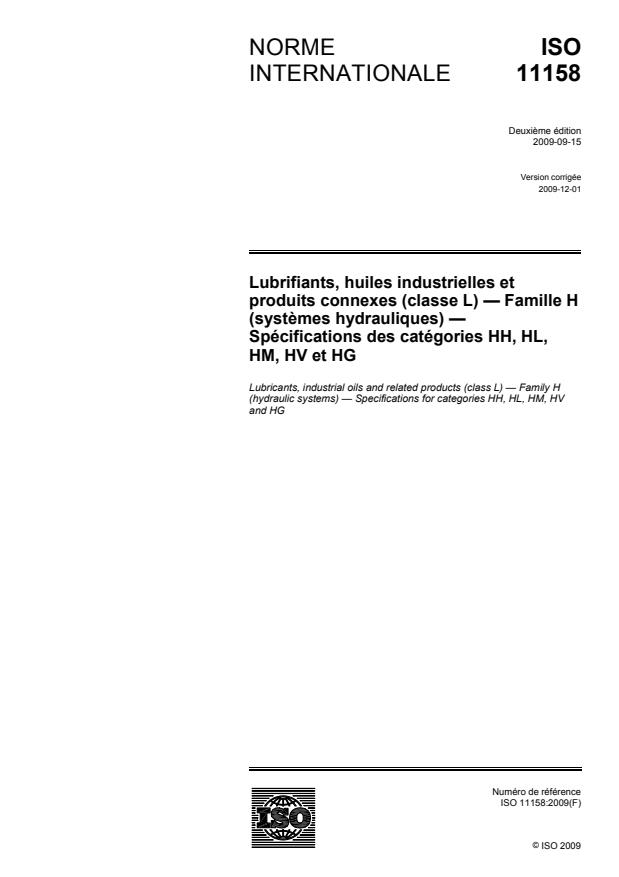
INTERNATIONAL ISO
STANDARD 11158
Second edition
2009-09-15
Corrected version
2009-12-01
Lubricants, industrial oils and related
products (class L) — Family H (hydraulic
systems) — Specifications for categories
HH, HL, HM, HV and HG
Lubrifiants, huiles industrielles et produits connexes (classe L) —
Famille H (systèmes hydrauliques) — Spécifications des catégories HH,
HL, HM, HV et HG
Reference number
©
ISO 2009
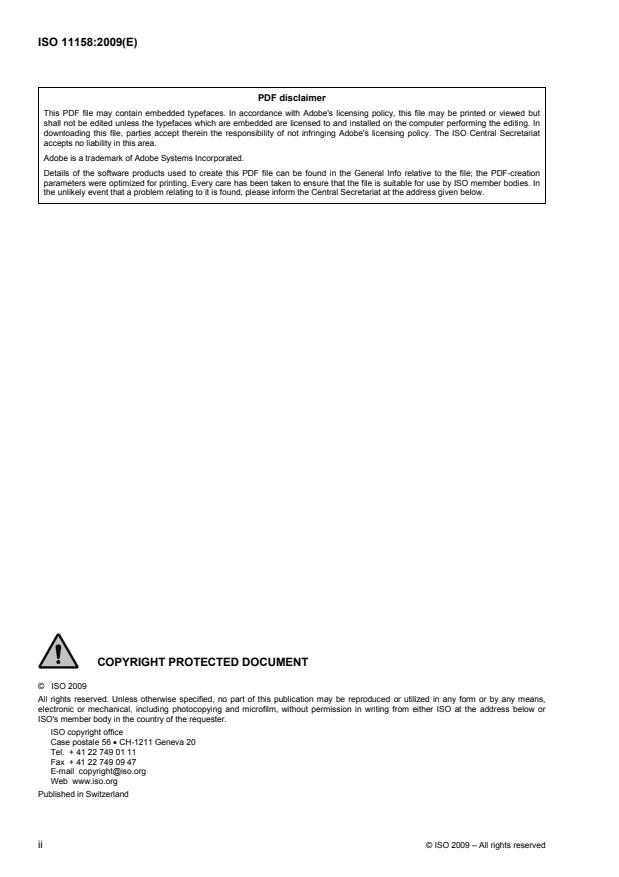
PDF disclaimer
This PDF file may contain embedded typefaces. In accordance with Adobe's licensing policy, this file may be printed or viewed but
shall not be edited unless the typefaces which are embedded are licensed to and installed on the computer performing the editing. In
downloading this file, parties accept therein the responsibility of not infringing Adobe's licensing policy. The ISO Central Secretariat
accepts no liability in this area.
Adobe is a trademark of Adobe Systems Incorporated.
Details of the software products used to create this PDF file can be found in the General Info relative to the file; the PDF-creation
parameters were optimized for printing. Every care has been taken to ensure that the file is suitable for use by ISO member bodies. In
the unlikely event that a problem relating to it is found, please inform the Central Secretariat at the address given below.
© ISO 2009
All rights reserved. Unless otherwise specified, no part of this publication may be reproduced or utilized in any form or by any means,
electronic or mechanical, including photocopying and microfilm, without permission in writing from either ISO at the address below or
ISO's member body in the country of the requester.
ISO copyright office
Case postale 56 • CH-1211 Geneva 20
Tel. + 41 22 749 01 11
Fax + 41 22 749 09 47
E-mail copyright@iso.org
Web www.iso.org
Published in Switzerland
ii © ISO 2009 – All rights reserved
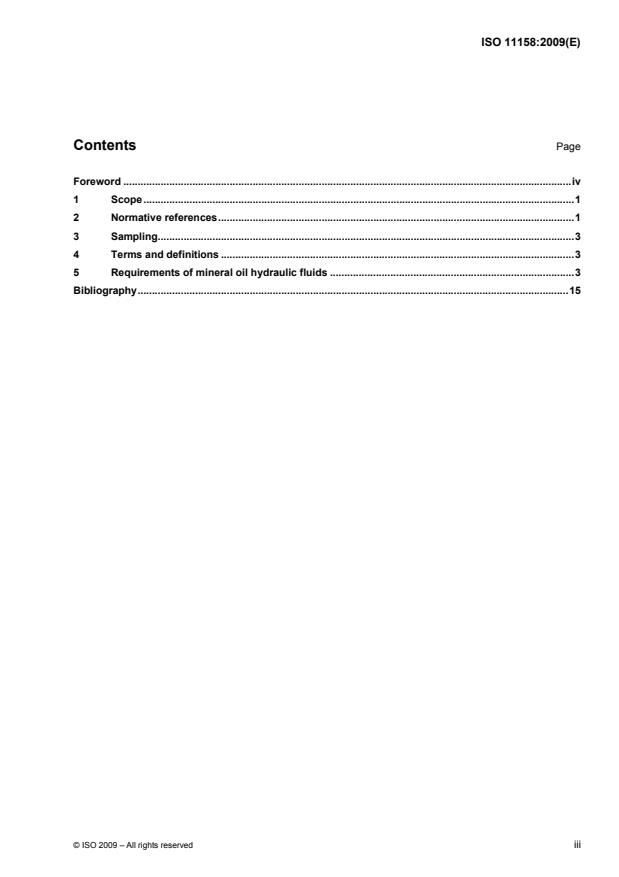
Contents Page
Foreword .iv
1 Scope.1
2 Normative references.1
3 Sampling.3
4 Terms and definitions .3
5 Requirements of mineral oil hydraulic fluids .3
Bibliography.15
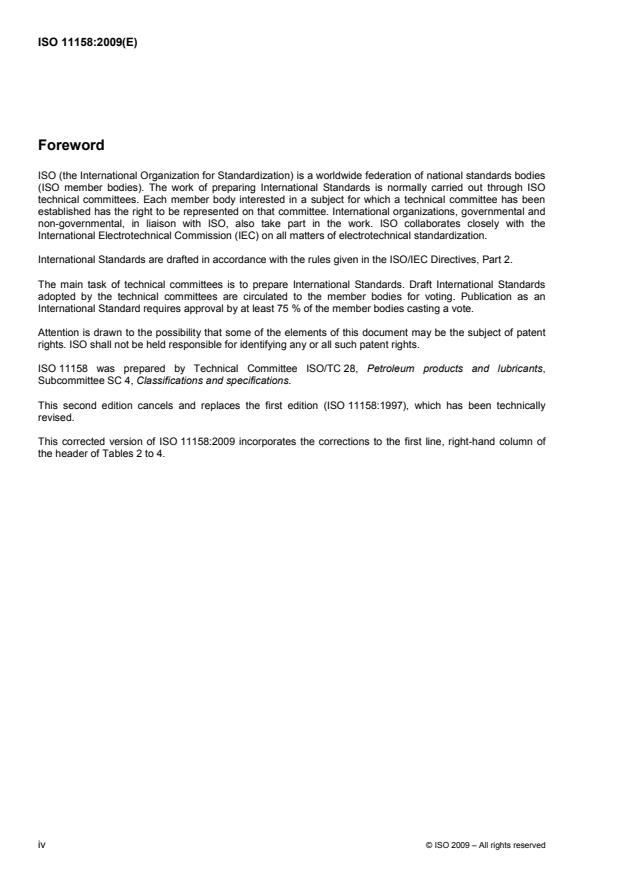
Foreword
ISO (the International Organization for Standardization) is a worldwide federation of national standards bodies
(ISO member bodies). The work of preparing International Standards is normally carried out through ISO
technical committees. Each member body interested in a subject for which a technical committee has been
established has the right to be represented on that committee. International organizations, governmental and
non-governmental, in liaison with ISO, also take part in the work. ISO collaborates closely with the
International Electrotechnical Commission (IEC) on all matters of electrotechnical standardization.
International Standards are drafted in accordance with the rules given in the ISO/IEC Directives, Part 2.
The main task of technical committees is to prepare International Standards. Draft International Standards
adopted by the technical committees are circulated to the member bodies for voting. Publication as an
International Standard requires approval by at least 75 % of the member bodies casting a vote.
Attention is drawn to the possibility that some of the elements of this document may be the subject of patent
rights. ISO shall not be held responsible for identifying any or all such patent rights.
ISO 11158 was prepared by Technical Committee ISO/TC 28, Petroleum products and lubricants,
Subcommittee SC 4, Classifications and specifications.
This second edition cancels and replaces the first edition (ISO 11158:1997), which has been technically
revised.
This corrected version of ISO 11158:2009 incorporates the corrections to the first line, right-hand column of
the header of Tables 2 to 4.
iv © ISO 2009 – All rights reserved
INTERNATIONAL STANDARD ISO 11158:2009(E)
Lubricants, industrial oils and related products (class L) —
Family H (hydraulic systems) — Specifications for categories
HH, HL, HM, HV and HG
WARNING — The handling and use of products as specified in this International Standard can be
hazardous if suitable precautions are not observed. This International Standard does not purport to
address all of the safety problems associated with its use. It is the responsibility of the user of this
International Standard to establish appropriate safety and health practices and to determine the
applicability of regulatory limitations prior to use.
1 Scope
This International Standard specifies the minimum requirements for new mineral oil hydraulic fluids and is
intended for hydraulic systems, particularly for hydrostatic hydraulic fluid power application. The purpose of
this International Standard is for the guidance of suppliers and end users of mineral oil hydraulic fluids and for
the direction of equipment manufacturers of hydraulic systems.
This International Standard is written in a general form so that its application can accommodate various
climatic conditions throughout the world. This International Standard also stipulates the requirements for
mineral-oil hydraulic fluids at the time of delivery.
Classification of fluids used in hydraulic applications is defined in ISO 6743-4. Of the categories covered by
ISO 6743-4, only five types of mineral oil based fluids are covered in this International Standard. These
categories are HH, HL, HM, HV and HG.
2 Normative references
The following referenced documents are indispensable for the application of this document. For dated
references, only the edition cited applies. For undated references, the latest edition of the referenced
document (including any amendments) applies.
ISO 2049:1996, Petroleum products — Determination of colour (ASTM scale)
ISO 2160:1998, Petroleum products — Corrosiveness to copper — Copper strip test
ISO 2592:2000, Determination of flash and fire points — Cleveland open cup method
ISO 2909:2002, Petroleum products — Calculation of viscosity index from kinematic viscosity
ISO 3016:1994, Petroleum products — Determination of pour point
ISO 3104:1994, Petroleum products — Transparent and opaque liquids — Determination of kinematic
viscosity and calculation of dynamic viscosity
ISO 3105:1994, Glass capillary kinematic viscometers — Specifications and operating instructions
ISO 3170:2004, Petroleum liquids — Manual sampling
ISO 3448:1992, Industrial liquid lubricants — ISO viscosity classification
ISO 3675:1998, Crude petroleum and liquid petroleum products — Laboratory determination of density —
Hydrometer method
ISO 4259:2006, Petroleum products — Determination and application of precision data in relation to methods
of test
ISO 4263-1:2003, Petroleum and related products — Determination of the ageing behaviour of inhibited oils
and fluids — TOST test — Part 1: Procedure for mineral oils
ISO 4406:1999, Hydraulic fluid power — Fluids — Method for coding the level of contamination by solid
particles
ISO 5598:2008, Fluid power systems and components — Vocabulary
ISO 6072:2002, Hydraulic fluid power — Compatibility between fluids and standard elastomeric materials
ISO 6247:1998, Petroleum products — Determination of foaming characteristics of lubricating oils
ISO 6296:2000, Petroleum products — Determination of water — Potentiometric Karl Fischer titration method
ISO 6614:1994, Petroleum products — Determination of water separability of petroleum oils and synthetic
fluids
ISO 6618:1997, Petroleum products and lubricants — Determination of acid or base number —
Colour-indicator titration method
ISO 6619:1988, Petroleum products and lubricants — Neutralization number — Potentiometric titration
method
ISO 6743-4:1999, Lubricants, industrial oils and related products (class L) — Classification — Part 4:
Family H (Hydraulic systems)
ISO 7120:1987, Petroleum products and lubricants — Petroleum oils and other fluids — Determination of
rust-preventing characteristics in the presence of water
ISO 9120:1997, Petroleum and related products — Determination of air-release properties of steam turbine
and other oils — Impinger method
ISO 12937:2000, Petroleum products — Determination of water — Coulometric Karl Fischer titration method
ISO 13357-1:2002, Petroleum products — Determination of the filterability of lubricating oils — Part 1:
Procedure for oils in the presence of water
ISO 13357-2:2005, Petroleum products — Determination of the filterability of lubricating oils — Part 2:
Procedure for dry oils
ISO 14635-1:2000, Gears — FZG test procedures — Part 1: FZG test method A/8,3/90 for relative scuffing
load-carrying capacity of oils
ISO 20763:2004, Petroleum and related products — Determination of anti-wear properties of hydraulic
fluids — Vane pump method
ISO 20764:2003, Petroleum and related products — Preparation of a test portion of high-boiling liquids for the
determination of water content — Nitrogen purge method
2 © ISO 2009 – All rights reserved
AFNOR XP T 60-183:1994, Lubrifiants, huiles industrielles et produits connexes pour glissières de machines-
outils — Pouvoir lubrifiant antisaccade (Lubricants, industrial oils and related products for machine tool
slideways — Anti-stick-slip lubricating ability)
1)
CEC L-45-A-99, Viscosity Shear Stability of Transmission Lubricants
3 Sampling
Sampling of hydraulic oils for the purpose of this International Standard shall be carried out in accordance with
the pertinent procedure described in ISO 3170. The sample shall be evaluated on a representative portion.
Any drum, barrel, tanker compartment or any type of container delivered to the end user may be sampled and
analysed at the discretion of the purchaser.
4 Terms and definitions
For the purposes of this document, the terms and definitions given in ISO 5598 apply.
5 Requirements of mineral oil hydraulic fluids
For the purpose of this International Standard, oils shall be refined petroleum oils. The classification of these
hydraulic oils shall be in accordance with ISO 6743-4.
Oils, when tested under prescribed methods, shall be in concurrence with limiting values set out in Table 1 to
Table 5, where applicable.
The appearance of the delivered oils shall be clear and bright and free of any visible particulate matter, under
normal visible light at ambient temperature.
The precision (repeatability and reproducibility) of the test methods for this International Standard and the
interpretation of the results shall be in accordance with ISO 4259 and shall be consulted in instances of
uncertainty or disputes.
Detailed specifications of each category mentioned in this International Standard are provided hereafter in
Tables 1 to 5 and as indicated below:
⎯ Table 1, category HH;
⎯ Table 2, category HL;
⎯ Table 3, category HM;
⎯ Table 4, category HV;
⎯ Table 5, category HG;
Composition, properties and typical applications of each category are reported at the head of each table.
These elements are taken from ISO 6743-4.
NOTE For the purposes of this International Standard, the term “% (m/m)” is used to represent the mass fraction of a
material.
1) This test method will become ISO 26422 Petroleum and related products — Determination of shear stability of
lubricating oils containing polymers — Method using a tapered roller bearing.
4 © ISO 2009 – All rights reserved
Table 1 — Specifications for category HH mineral oil hydraulics fluids
Non-inhibited mineral oils
Characteristics
Units Requirements Test method
Viscosity grade (ISO 3448) — VG 10 VG 15 VG 22 VG 32 VG 46 VG 68 VG 100 VG 150 —
a
Kinematic viscosity at 40 °C: mm /s 9,00 – 11,0 13,5 – 16,5 19,8 – 24,2 28,8 – 35,2 41,4 – 50,6 61,2 – 74,8 90,0 – 110 135 – 165 ISO 3104 and ISO 3105
minimum/maximum
b b b b b b b b
Viscosity index — ISO 2909
b b b b b b b b
Density at 15 °C kg/m ISO 3675
c b b b b b b b b
Colour — ISO 2049
d
Appearance at 25 °C — Cbr Clbr Clbr Clbr Clbr Clbr Clbr Clbr V sual
l i
e e e e e e e e
Cleanliness — —
Flash point:
— Cleveland open cup, minimum °C 125 140 165 175 185 195 205 215 ISO 2592
Pour point, maximum °C –15 –12 –9 –6 –6 –6 –6 –6 ISO 3016
Acid number, maximum mg KOH/g 0,1 0,1 0,1 0,1 0,1 0,1 0,1 0,1 ISO 6618 or ISO 6619
Water content, maximum % (m/m) 0,025 0,025 0,025 0,025 0,025 0,025 0,025 0,025 ISO 6296 or ISO 12937
or ISO 20764
Water separation: ISO 6614
b b b b b b
— time to 3 ml emulsion at 54 °C, maximum min — —
b b
— time to 3 ml emulsion at 82 °C, maximum min — — — — — —
f b b b b b b b b
Elastomer compatibility — ISO 6072
NBR 1, 100 °C, 168 h
a
Square millimetres per second (mm /s) is equivalent to centistokes (cSt).
b
Report.
c
For the purposes of identification, dye may be used by agreement between the supplier and the end-user.
d
Clear-bright is abbreviated as Clbr.
e
The requirements of the cleanliness of the hydraulic fluid is system-dependent. Cleanliness level expressed according to ISO 4406 may be established by agreement between the supplier and the end-user. It should
be noted that the fluid is exposed to various influences during transport and storage; the cleanliness level required for the system should be guaranteed by careful filtering of the hydraulic fluid when filling.
f
The definition of compatibility for types of elastomers other than NBR 1 (e.g. FPM, EPDM, AU) may be agreed between the supplier and the end users.
Table 2 — Specifications for category HL mineral oil hydraulics fluids
Oils of HH type with improved anti-rust and anti-oxidation properties
Characteristics
Units Requirements Test method
Viscosity grade (ISO 3448) — VG 10 VG 15 VG 22 VG 32 VG 46 VG 68 VG 100 VG 150 —
Kinematic viscosity at: ISO 3104 and ISO 3105
a
−20 °C max mum mm /s 600 — — — — — — —
i
a
0 °C maximum mm /s 90 150 300 420 780 1 400 2 560 4 500
2 a
40 °C minimum/maximum mm /s 9,00 – 11,0 13,5 – 16,5 19,8 – 24,2 28,8 – 35,2 41,4 – 50,6 61,2 – 74,8 90,0 – 110 135 – 165
a
100 °C m nimum mm /s 2,50 3,20 4,10 5,00 6,10 7,80 9,90 14,0
i
b b b b b b b b
Viscosity index — ISO 2909
b b b b b b b b
Density at 15 °C kg/m ISO 3675
c b b b b b b b b
Colour — ISO 2049
d
Appearance at 25 °C — Clbr Clbr Clbr Clbr Clbr Clbr Clbr Clbr Visual
e e e e e e e e
Cleanliness — —
Flash point: ISO 2592
— Cleveland open cup, minimum °C 125 140 165 175 185 195 205 215
Pour point, maximum °C –30 –27 –21 –18 –15 –12 –12 –12 ISO 3016
f b b b b b b b b
number, max m m mg O O 6618 or I O 6619
Acid i u K H/g IS S
Water content, maximum % (m/m) 0,025 0,025 0,025 0,025 0,025 0,025 0,025 0,025 ISO 6296 or ISO 12937
or ISO 20764
g
Water separation: ISO 6614
— time to 3 ml emulsion at 54 °C, maximum min 30 30 30 30 30 30 — —
— time to 3 ml emulsion at 82 °C, maximum min — — — — — — 30 30
2 2 2 2 2 2 2 2 ISO 2160
Copper corrosion, 100 °C, 3 h, maximum class
Rust prevention, 24 h: ISO 7120
Pass Pass Pass Pass Pass Pass Pass Pass
— Procedure A —
b b b
— Procedure B — Pass Pass Pass Pass Pass
6 © ISO 2009 – All rights reserved
Table 2 (continued)
Oils of HH type with improved anti-rust and anti-oxidation properties
Characteristics
Units Requirements Test method
Viscosity grade (ISO 3448) — VG 10 VG 15 VG 22 VG 32 VG 46 VG 68 VG 100 VG 150 —
ISO 6247
Foam:
150/0 150/0 150/0 150/0 150/0 150/0 150/0 150/0
— Sequence I, maximum ml
— Sequence I max mum m 80/0 80/0 80/0 80/0 80/0 80/0 80/0 80/0
I, i l
— Sequence III, maximum ml 150/0 150/0 150/0 150/0 150/0 150/0 150/0 150/0
Air release: ISO 9120
— at 50 °C, maximum min 5 5 5 5 10 10 — —
b b
— at 75 °C min — — — — — —
h
Elastomer compatibility ISO 6072
NBR 1, 100 °C, 168 h
— relative increase in volume % 0 to 18 0 to 15 0 to 15 0 to 12 0 to 12 0 to 10 0 to 10 0 to 10
— change in Shore A hardness — 0 to −10 0 to −8 0 to −8 0 to −7 0 to −7 0 to −6 0 to −6 0 to −6
ISO 4263-1
Oxidation stability:
2,0 2,0 2,0 2,0 2,0 2,0 2,0 2,0
— increase in acid number after 1 000 h, mg KOH/g
maximum
b b b b b b b b
— insoluble sludge mg
a
Square millimetres per second (mm /s) is equivalent to centistokes (cSt).
b
Report.
c
For the purposes of identification, dye may be used by agreement between the supplier and the end-user.
d
Clear-bright is abbreviated as Clbr.
e
The requirements of the cleanliness of the hydraulic fluid is system-dependent. Cleanliness level expressed according to ISO 4406 may be established by agreement between the supplier and the end-user. It should
be noted that the fluid is exposed to various influences during transport and storage; the cleanliness level required for the system should be guaranteed by careful filtering of the hydraulic fluid when filling.
f
Initial acid number is influenced by the presence of functional moieties in the additive package.
g
This method is not required for fluids with detergent properties.
h
The definition of compatibility for types of elastomers other than NBR 1 (e.g. FPM, EPDM, AU) may be agreed between the supplier and the end-users.
Table 3 — Specifications for category HM mineral oil hydraulics fluids
a
Oils of HL
...
NORME ISO
INTERNATIONALE 11158
Deuxième édition
2009-09-15
Version corrigée
2009-12-01
Lubrifiants, huiles industrielles et
produits connexes (classe L) — Famille H
(systèmes hydrauliques) —
Spécifications des catégories HH, HL,
HM, HV et HG
Lubricants, industrial oils and related products (class L) — Family H
(hydraulic systems) — Specifications for categories HH, HL, HM, HV
and HG
Numéro de référence
©
ISO 2009
PDF – Exonération de responsabilité
Le présent fichier PDF peut contenir des polices de caractères intégrées. Conformément aux conditions de licence d'Adobe, ce fichier
peut être imprimé ou visualisé, mais ne doit pas être modifié à moins que l'ordinateur employé à cet effet ne bénéficie d'une licence
autorisant l'utilisation de ces polices et que celles-ci y soient installées. Lors du téléchargement de ce fichier, les parties concernées
acceptent de fait la responsabilité de ne pas enfreindre les conditions de licence d'Adobe. Le Secrétariat central de l'ISO décline toute
responsabilité en la matière.
Adobe est une marque déposée d'Adobe Systems Incorporated.
Les détails relatifs aux produits logiciels utilisés pour la création du présent fichier PDF sont disponibles dans la rubrique General Info
du fichier; les paramètres de création PDF ont été optimisés pour l'impression. Toutes les mesures ont été prises pour garantir
l'exploitation de ce fichier par les comités membres de l'ISO. Dans le cas peu probable où surviendrait un problème d'utilisation,
veuillez en informer le Secrétariat central à l'adresse donnée ci-dessous.
DOCUMENT PROTÉGÉ PAR COPYRIGHT
© ISO 2009
Droits de reproduction réservés. Sauf prescription différente, aucune partie de cette publication ne peut être reproduite ni utilisée sous
quelque forme que ce soit et par aucun procédé, électronique ou mécanique, y compris la photocopie et les microfilms, sans l'accord écrit
de l'ISO à l'adresse ci-après ou du comité membre de l'ISO dans le pays du demandeur.
ISO copyright office
Case postale 56 • CH-1211 Geneva 20
Tel. + 41 22 749 01 11
Fax + 41 22 749 09 47
E-mail copyright@iso.org
Web www.iso.org
Publié en Suisse
ii © ISO 2009 – Tous droits réservés
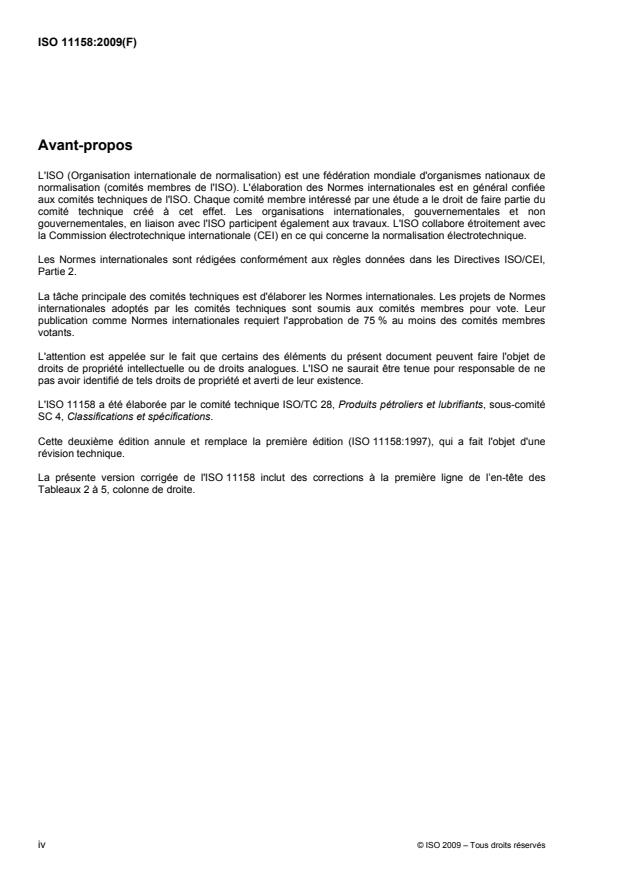
Sommaire Page
Avant-propos .iv
1 Domaine d'application .1
2 Références normatives.1
3 Échantillonnage.3
4 Termes et définitions .3
5 Exigences relatives aux fluides hydrauliques à base d'huile minérale.3
Bibliographie.15
Avant-propos
L'ISO (Organisation internationale de normalisation) est une fédération mondiale d'organismes nationaux de
normalisation (comités membres de l'ISO). L'élaboration des Normes internationales est en général confiée
aux comités techniques de l'ISO. Chaque comité membre intéressé par une étude a le droit de faire partie du
comité technique créé à cet effet. Les organisations internationales, gouvernementales et non
gouvernementales, en liaison avec l'ISO participent également aux travaux. L'ISO collabore étroitement avec
la Commission électrotechnique internationale (CEI) en ce qui concerne la normalisation électrotechnique.
Les Normes internationales sont rédigées conformément aux règles données dans les Directives ISO/CEI,
Partie 2.
La tâche principale des comités techniques est d'élaborer les Normes internationales. Les projets de Normes
internationales adoptés par les comités techniques sont soumis aux comités membres pour vote. Leur
publication comme Normes internationales requiert l'approbation de 75 % au moins des comités membres
votants.
L'attention est appelée sur le fait que certains des éléments du présent document peuvent faire l'objet de
droits de propriété intellectuelle ou de droits analogues. L'ISO ne saurait être tenue pour responsable de ne
pas avoir identifié de tels droits de propriété et averti de leur existence.
L'ISO 11158 a été élaborée par le comité technique ISO/TC 28, Produits pétroliers et lubrifiants, sous-comité
SC 4, Classifications et spécifications.
Cette deuxième édition annule et remplace la première édition (ISO 11158:1997), qui a fait l'objet d'une
révision technique.
La présente version corrigée de l'ISO 11158 inclut des corrections à la première ligne de l’en-tête des
Tableaux 2 à 5, colonne de droite.
iv © ISO 2009 – Tous droits réservés
NORME INTERNATIONALE ISO 11158:2009(F)
Lubrifiants, huiles industrielles et produits connexes
(classe L) — Famille H (systèmes hydrauliques) —
Spécifications des catégories HH, HL, HM, HV et HG
AVERTISSEMENT — La manipulation et l'utilisation de certains produits, comme spécifié dans la
présente Norme internationale, peuvent revêtir un caractère dangereux si des précautions
appropriées ne sont pas observées. La présente Norme internationale n'est pas censée aborder tous
les problèmes de sécurité concernés par son usage. Il est de la responsabilité de l'utilisateur de la
présente Norme internationale d'établir des règles de sécurité et d'hygiène appropriées et de
déterminer l'applicabilité des restrictions réglementaires avant utilisation.
1 Domaine d'application
La présente Norme internationale spécifie les exigences minimales relatives aux fluides hydrauliques neufs à
base d'huiles minérales. Elle est applicable aux systèmes hydrauliques, et particulièrement aux applications
hydrostatiques comportant une transmission de puissance par fluides hydrauliques. La présente Norme
internationale donne des lignes directrices aux fournisseurs et aux utilisateurs finaux des fluides hydrauliques
à base d'huile minérale, ainsi qu'aux fabricants d'équipements pour systèmes hydrauliques.
La présente Norme internationale est rédigée de manière générale afin d'être applicable quelles que soient
les différentes conditions climatiques dans le monde. La présente Norme internationale spécifie également les
exigences relatives aux fluides hydrauliques à base d'huile minérale au moment de leur livraison.
La classification des fluides utilisée dans les applications hydrauliques est définie dans l'ISO 6743-4. Parmi
les catégories couvertes par l'ISO 6743-4, seulement cinq types de fluides à base d'huile minérale sont traités
dans la présente Norme internationale. Ces catégories sont: HH, HL, HM, HV et HG.
2 Références normatives
Les documents de référence suivants sont indispensables pour l'application du présent document. Pour les
références datées, seule l'édition citée s'applique. Pour les références non datées, la dernière édition du
document de référence (y compris les éventuels amendements) s'applique.
ISO 2049:1996, Produits pétroliers — Détermination de la couleur (échelle ASTM)
ISO 2160:1998, Produits pétroliers – Action corrosive sur le cuivre – Essai à la lame de cuivre
ISO 2592:2000, Détermination des points d'éclair et de feu — Méthode Cleveland à vase ouvert
ISO 2909:2002, Produits pétroliers — Calcul de l'indice de viscosité à partir de la viscosité cinématique
ISO 3016:1994, Produits pétroliers — Détermination du point d'écoulement
ISO 3104:1994, Produits pétroliers — Liquides opaques et transparents — Détermination de la viscosité
cinématique et calcul de la viscosité dynamique
ISO 3105:1994, Viscosimètres à capillaires en verre pour viscosité cinématique — Spécifications et
instructions d'utilisation
ISO 3170:2004, Produits pétroliers liquides — Échantillonnage manuel
ISO 3448:1992, Lubrifiants liquides industriels — Classification ISO selon la viscosité
ISO 3675:1998, Pétrole brut et produits pétroliers liquides — Détermination en laboratoire de la masse
volumique — Méthode à l'aréomètre
ISO 4259:2006, Produits pétroliers — Détermination et application des valeurs de fidélité relatives aux
méthodes d'essai
ISO 4263-1:2003, Pétrole et produits connexes — Détermination du comportement au vieillissement des
fluides et huiles inhibées — Essai TOST — Partie 1: Méthode pour les huiles minérales
ISO 4406:1999, Transmissions hydrauliques — Fluides — Méthode de codification du niveau de pollution
particulaire solide
ISO 5598:2008, Transmissions hydrauliques et pneumatiques — Vocabulaire
ISO 6072:2002, Transmissions hydrauliques — Compatibilité des fluides avec les caoutchoucs normalisés
ISO 6247:1998, Produits pétroliers — Détermination des caractéristiques de moussage des huiles lubrifiantes
ISO 6296:2000, Produits Pétroliers — Dosage de l'eau — Méthode de titrage Karl Fischer par potentiométrie
ISO 6614:1994, Produits pétroliers — Détermination des caractéristiques de séparation d'eau des huiles de
pétrole et fluides synthétiques
ISO 6618:1997, Produits pétroliers et lubrifiants — Détermination de l'indice d'acide ou de l'indice de base —
Méthode par titrage en présence d'un indicateur coloré
ISO 6619:1988, Produits pétroliers et lubrifiants — Indice de neutralisation — Méthode par titrage
potentiométrique
ISO 6743-4:1999, Lubrifiants, huiles industrielles et produits connexes (classe L) — Classification — Partie 4:
Famille H (Systèmes hydrauliques)
ISO 7120:1987, Produits pétroliers et lubrifiants — Huiles de pétrole et autres fluides — Détermination des
caractéristiques anti-rouille en présence d'eau
ISO 9120:1997, Pétroles et produits connexes —Détermination de l'aptitude à la désaération des huiles pour
turbines à vapeur et autres huiles — Méthode Impinger
ISO 12937:2000, Produits pétroliers — Dosage de l'eau — Méthode de titrage Karl Fischer par coulométrie
ISO 13357-1:2002, Produits pétroliers — Détermination de la filtrabilité des huiles lubrifiantes — Partie 1:
Méthode pour les huiles en présence d'eau
ISO 13357-2:2005, Produits pétroliers — Détermination de la filtrabilité des huiles lubrifiantes — Partie 2:
Méthode pour les huiles non polluées par de l'eau
ISO 14635-1:2000, Engrenages — Méthodes d'essai FZG — Partie 1: méthode FZG A/8,3/90 pour évaluer la
capacité de charge au grippage des huiles
ISO 20763:2004, Pétrole et produits connexes — Détermination des propriétés anti-usure des fluides
hydrauliques — Méthode de la pompe à palettes
ISO 20764:2003, Pétrole et produits connexes — Préparation d'une prise d'essai de liquides à haut point
d'ébullition en vue du dosage de l'eau — Méthode par purge à l'azote
2 © ISO 2009 – Tous droits réservés
AFNOR XP T 60-183:1994, Lubrifiants, huiles industrielles et produits connexes pour glissières de machines-
outils — Pouvoir lubrifiant antisaccade
1)
CEC L-45-A-99, Viscosity Shear Stability of Transmission Lubricants
3 Échantillonnage
L'échantillonnage des huiles hydrauliques, pour les besoins de la présente Norme internationale, doit être
effectué conformément au mode opératoire adapté tel que décrit dans l'ISO 3170. L'échantillon doit être
évalué sur une partie représentative.
Tout fût, baril, citerne ou tout autre type de conteneur livré à l'utilisateur peut être échantillonné et analysé, à
la discrétion de l'acquéreur.
4 Termes et définitions
Pour les besoins du présent document, les termes et définitions donnés dans l'ISO 5598 s'appliquent.
5 Exigences relatives aux fluides hydrauliques à base d'huile minérale
Pour les besoins de la présente Norme internationale, les huiles doivent être des huiles minérales raffinées.
La classification de ces huiles hydrauliques doit être conforme à l'ISO 6743-4.
Les huiles, lorsqu'elles sont soumises à essai suivant les méthodes spécifiées, doivent, si applicable,
respecter les valeurs limites figurant dans les Tableaux 1 à 5.
L'aspect des huiles fournies doit être clair, limpide et exempt de particules visibles en suspension, sous une
lumière normale visible à température ambiante.
La fidélité (répétabilité et reproductibilité) des méthodes d'essai de la présente Norme internationale ainsi que
l'interprétation des résultats doivent être conformes à l'ISO 4259, à laquelle il faut se référer en cas de doute
ou de litige.
Des spécifications détaillées sur chaque catégorie mentionnée dans la présente Norme internationale sont
fournies dans les Tableaux 1 à 5 et comme indiqué ci-dessous:
⎯ Tableau 1, catégorie HH;
⎯ Tableau 2, catégorie HL;
⎯ Tableau 3, catégorie HM;
⎯ Tableau 4, catégorie HV;
⎯ Tableau 5, catégorie HG.
La composition, les propriétés et les applications usuelles pour chaque catégorie figurent en tête de chaque
tableau. Ces éléments proviennent de l'ISO 6743-4.
NOTE Pour les besoins de la présente Norme internationale, l'expression «% (m/m)» représente la fraction massique
d'un produit.
1) Cette méthode deviendra l'ISO 26422, Pétrole et produits connexes — Détermination de la stabilité au cisaillement
des huiles lubrifiantes contenant des polymères — Méthode avec roulement à rouleaux coniques.
4 © ISO 2009 – Tous droits réservés
Tableau 1 — Spécifications pour les fluides hydrauliques à base d'huile minérale de la catégorie HH
Huiles minérales non inhibées
Caractéristiques
Unités Exigences Méthode d'essai
Classe de viscosité (ISO 3448) — VG 10 VG 15 VG 22 VG 32 VG 46 VG 68 VG 100 VG 150
a
Viscosité cinématique à 40 °C: mm /s 9,00 – 11,0 13,5 – 16,5 19,8 – 24,2 28,8 – 35,2 41,4 – 50,6 61,2 – 74,8 90,0 – 110 135 – 165 ISO 3104 et ISO 3105
minimum/maximum
b b b b b b b b
Indice de viscosité — ISO 2909
b b b b b b b b
Masse volumique à 15 °C kg/m ISO 3675
c b b b b b b b b
Couleur — ISO 2049
d
Aspec à 25 °C — Clli Clli Clli Clli Clli Clli Clli Clli V suel e
t i l
e e e e e e e e
Propreté — —
Point d'éclair:
— Méthode Cleveland à vase ouvert, minimum °C 125 140 165 175 185 195 205 215 ISO 2592
Point d'écoulement, maximum °C –15 –12 –9 –6 –6 –6 –6 –6 ISO 3016
Indice d'acide, maximum mg KOH/g 0,1 0,1 0,1 0,1 0,1 0,1 0,1 0,1 ISO 6618 ou ISO 6619
Teneur en eau, maximum % (m/m) 0,025 0,025 0,025 0,025 0,025 0,025 0,025 0,025 ISO 6296 ou ISO 12937
ou ISO 20764
Séparation de l'eau: ISO 6614
b b b b b b
— temps pour 3 ml d'émulsion à 54 °C, max. min — —
b b
— temps pour 3 ml d'émulsion à 82 °C, max. min — — — — — —
f b b b b b b b b
Compatibilité avec les élastomères — ISO 6072
NBR 1, 100 °C, 168 h
a
Les millimètres carrés par seconde (mm /s) sont équivalents aux centistokes (cSt).
b
À reporter.
c
Pour des besoins d'identification, il est possible d'utiliser du colorant, après un accord entre le fournisseur et l'utilisateur final.
d
Clair et limpide est abrégé par Clli.
e
Les exigences de propreté du fluide hydraulique dépendent du système. Le niveau de propreté, exprimé selon l'ISO 4406, peut être défini par accord entre le fournisseur et l'utilisateur final. Il convient de noter que le
fluide est exposé à diverses influences pendant le transport et le stockage; il convient de garantir le niveau de propreté requis pour le système par une filtration minutieuse du fluide hydraulique lors du remplissage.
f
La définition de compatibilité avec les types d'élastomères autres que le NBR 1 (par exemple FPM, EPDM, AU) peut faire l'objet d'un accord entre le fournisseur et l'utilisateur final.
Tableau 2 — Spécifications pour les fluides hydrauliques à base d'huile minérale de la catégorie HL
Huiles de type HH avec des propriétés anti-rouille et anti-oxydation améliorées
Caractéristiques
Unités Exigences Méthode d'essai
Classe de viscosité (ISO 3448) — VG 10 VG 15 VG 22 VG 32 VG 46 VG 68 VG 100 VG 150 —
Viscosité cinématique à: ISO 3104 et ISO 3105
a
−20 °C max mum mm /s 600 — — — — — — —
i
a
0 °C maximum mm /s 90 150 300 420 780 1 400 2 560 4 500
2 a
40 °C minimum/maximum mm /s 9,00 – 11,0 13,5 – 16,5 19,8 – 24,2 28,8 – 35,2 41,4 – 50,6 61,2 – 74,8 90,0 – 110 135 – 165
a
100 °C m nimum mm /s 2,50 3,20 4,10 5,00 6,10 7,80 9,90 14,0
i
b b b b b b b b
Indice de viscosité — ISO 2909
b b b b b b b b
Masse volumique à 15 °C kg/m ISO 3675
c b b b b b b b b
Couleur — ISO 2049
d
Aspect à 25 °C — Clli Clli Clli Clli Clli Clli Clli Clli Visuelle
e e e e e e e e
Propreté — —
Point d'éclair: ISO 2592
— Méthode Cleveland à vase ouvert, minimum °C 125 140 165 175 185 195 205 215
Point d'écoulement, maximum °C –30 –27 –21 –18 –15 –12 –12 –12 ISO 3016
f b b b b b b b b
ndi d'acide, max m m mg O O 6618 ou O 6619
I ce i u K H/g IS IS
Teneur en eau, maximum % (m/m) 0,025 0,025 0,025 0,025 0,025 0,025 0,025 0,025 ISO 6296 ou ISO 12937
ou ISO 20764
g
Séparation de l'eau: ISO 6614
— temps pour 3 ml d'émulsion à 54 °C, max. min 30 30 30 30 30 30 — —
— temps pour 3 ml d'émulsion à 82 °C, max. min — — — — — — 30 30
2 2 2 2 2 2 2 2 ISO 2160
Corrosion du cuivre, 100 °C, 3 h, maximum classe
Anti-rouille, 24 h: ISO 7120
Passe Passe Passe Passe Passe Passe Passe Passe
— Mode opératoire A —
b b b
— Mode opérat — Passe Passe Passe Passe Passe
oire B
6 © ISO 2009 – Tous droits réservés
Tableau 2 (suite)
Huiles de type HH avec des propriétés anti-rouille et anti-oxydation améliorées
Caractéristiques
Unités Exigences Méthode d'essai
Classe de viscosité (ISO 3448) — VG 10 VG 15 VG 22 VG 32 VG 46 VG 68 VG 100 VG 150 —
ISO 6247
Moussage:
150/0 150/0 150/0 150/0 150/0 150/0 150/0 150/0
— Séquence I, maximum ml
— Séquence I max mum m 80/0 80/0 80/0 80/0 80/0 80/0 80/0 80/0
I, i l
— Séquence III, maximum ml 150/0 150/0 150/0 150/0 150/0 150/0 150/0 150/0
Désaération: ISO 9120
— à 50 °C, maximum min 5 5 5 5 10 10 — —
b b
— à 75 °C min — — — — — —
h
Compatibilité avec les élastomères ISO 6072
NBR 1, 100 °C, 168 h
— augmentation relative du volume % 0 à 18 0 à 15 0 à 15 0 à 12 0 à 12 0 à 10 0 à 10 0 à 10
— modification de la dureté Shore A — 0 à −10 0 à −8 0 à −8 0 à −7 0 à −7 0 à −6 0 à −6 0 à −6
ISO 4263-1
Stabilité à l'oxydation:
2,0 2,0 2,0 2,0 2,0 2,0 2,0 2,0
— augmentation de l'indice d'acide mg KOH/g
après 1 000 h, maximum
b b b b b b b b
— sédiments insolubles mg
a
Les millimètres carrés par seconde (mm /s) sont équivalents aux centistokes (cSt).
b
À reporter.
c
Pour des besoins d'identification, il est possible d'utiliser du colorant, après un accord entre le fournisseur et l'utilisateur final.
d
Clair et limpide est abrégé par Clli.
e
Les exigences de propreté du fluide hydraulique dépendent du système. Le niveau de propreté, exprimé selon l'ISO 4406, peut être défini par accord entre le fournisseur et l'utilisateur final. Il convient de noter que le
fluide est exposé à diverses influences pendant le transport et le stockage; il convient de garantir le niveau de propreté requis pour le système par une filtration minutieuse du fluide hydraulique lors du remplissage.
f
L'indice d'acide initial est influencé par la présence de groupe fonctionnées dans le paquet d'additifs.
g
Cette méthode ne s'applique pas aux fluides ayant des propriétés détergentes.
h
La définition de compatibilité avec les types d'élastomères autres que le NBR 1 (par exemple FPM, EPDM, AU) peut faire l'objet d'un accord entre le fournisseur et l'utilisateur final.
Tableau 3 — Spécifications pour les fluides hydrauliques à base d'huile minérale de la catégorie HM
a
Huiles de type HL avec des propriétés anti-usure et des propriétés de filtrabilité améliorées
Caractéristiques
Unités Exigences Méthod
...
Questions, Comments and Discussion
Ask us and Technical Secretary will try to provide an answer. You can facilitate discussion about the standard in here.
Loading comments...