


ISO/IEC 29138-1:2018
(Main)Information technology — User interface accessibility — Part 1: User accessibility needs
Information technology — User interface accessibility — Part 1: User accessibility needs
This document identifies a collection of user accessibility needs that diverse users have of ICT systems to make these systems accessible to them. Each user accessibility need might be required of a system by an individual. Different users can have different sets of user accessibility needs in different contexts. While this set of user accessibility needs was developed for the domain of ICT, many of the user accessibility needs in this set also apply in other domains. This document does not provide requirements or specific processes and methods for the application and evaluation of user accessibility needs. However, it could inform the development of such requirements (see 5.4). This document is not designed for certification purposes or regulatory or contractual use. The user accessibility needs in this document are intended to inform and encourage those responsible for accessibility to go beyond the minimum provisions of accessibility legislation and regulations.
Technologies de l'information — Accessibilité de l'interface utilisateur — Partie 1: Besoins d'accessibilité de l'usager
General Information
Relations
Standards Content (Sample)
INTERNATIONAL ISO/IEC
STANDARD 29138-1
First edition
2018-11
Information technology — User
interface accessibility —
Part 1:
User accessibility needs
Technologies de l'information — Accessibilité de l'interface
utilisateur —
Partie 1: Besoins d'accessibilité de l'usager
Reference number
©
ISO/IEC 2018
© ISO/IEC 2018
All rights reserved. Unless otherwise specified, or required in the context of its implementation, no part of this publication may
be reproduced or utilized otherwise in any form or by any means, electronic or mechanical, including photocopying, or posting
on the internet or an intranet, without prior written permission. Permission can be requested from either ISO at the address
below or ISO’s member body in the country of the requester.
ISO copyright office
CP 401 • Ch. de Blandonnet 8
CH-1214 Vernier, Geneva
Phone: +41 22 749 01 11
Fax: +41 22 749 09 47
Email: copyright@iso.org
Website: www.iso.org
Published in Switzerland
ii © ISO/IEC 2018 – All rights reserved
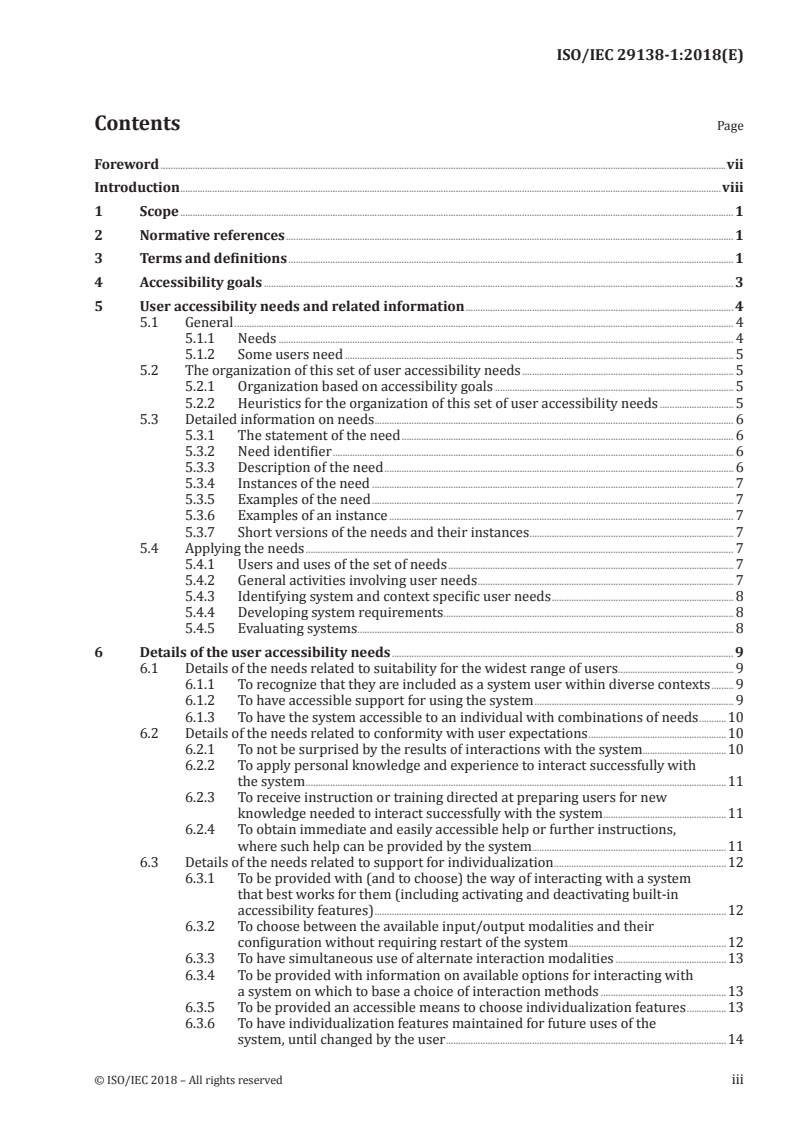
Contents Page
Foreword .vii
Introduction .viii
1 Scope . 1
2 Normative references . 1
3 Terms and definitions . 1
4 Accessibility goals . 3
5 User accessibility needs and related information . 4
5.1 General . 4
5.1.1 Needs . 4
5.1.2 Some users need . 5
5.2 The organization of this set of user accessibility needs . 5
5.2.1 Organization based on accessibility goals . 5
5.2.2 Heuristics for the organization of this set of user accessibility needs . 5
5.3 Detailed information on needs . 6
5.3.1 The statement of the need . 6
5.3.2 Need identifier . 6
5.3.3 Description of the need . 6
5.3.4 Instances of the need . 7
5.3.5 Examples of the need . 7
5.3.6 Examples of an instance . 7
5.3.7 Short versions of the needs and their instances . 7
5.4 Applying the needs . 7
5.4.1 Users and uses of the set of needs . 7
5.4.2 General activities involving user needs . 7
5.4.3 Identifying system and context specific user needs . 8
5.4.4 Developing system requirements . 8
5.4.5 Evaluating systems . . 8
6 Details of the user accessibility needs . 9
6.1 Details of the needs related to suitability for the widest range of users. 9
6.1.1 To recognize that they are included as a system user within diverse contexts . 9
6.1.2 To have accessible support for using the system . 9
6.1.3 To have the system accessible to an individual with combinations of needs .10
6.2 Details of the needs related to conformity with user expectations .10
6.2.1 To not be surprised by the results of interactions with the system.10
6.2.2 To apply personal knowledge and experience to interact successfully with
the system .11
6.2.3 To receive instruction or training directed at preparing users for new
knowledge needed to interact successfully with the system .11
6.2.4 To obtain immediate and easily accessible help or further instructions,
where such help can be provided by the system.11
6.3 Details of the needs related to support for individualization .12
6.3.1 To be provided with (and to choose) the way of interacting with a system
that best works for them (including activating and deactivating built-in
accessibility features) .12
6.3.2 To choose between the available input/output modalities and their
configuration without requiring restart of the system .12
6.3.3 To have simultaneous use of alternate interaction modalities .13
6.3.4 To be provided with information on available options for interacting with
a system on which to base a choice of interaction methods .13
6.3.5 To be provided an accessible means to choose individualization features .13
6.3.6 To have individualization features maintained for future uses of the
system, until changed by the user .14
© ISO/IEC 2018 – All rights reserved iii
6.3.7 To have the system use complete standardized sets of needs or
preferences from specific standards .14
6.3.8 To take or give up control of functions that could be performed by either
the user or the system .15
6.3.9 To have the option to use the system with a minimum of setup or
configuration .15
6.4 Details of the needs related to approachability .15
6.4.1 To have the system free from any physical barriers .15
6.4.2 To have the system free from any psychological barriers .16
6.4.3 To have the system maintain the user's attention .16
6.4.4 To have interaction options clearly presented .17
6.4.5 To have appropriate levels of privacy and security .17
6.4.6 To avoid patterns that cause psychological or physical discomfort or
disturbance .17
6.4.7 To use the system remotely as well as directly .18
6.4.8 To have the system free from environmental barriers .18
6.5 Details of the needs related to perceivability .19
6.5.1 To use a specific sensory modality (or a set of specific modalities) to
perceive information .19
6.5.2 To have information presented visually .19
6.5.3 To have visual information available in other modalities .19
6.5.4 To have information presented in auditory form .20
6.5.5 To have audio information available in other modalities .21
6.5.6 To have information in tactile form .21
6.5.7 To have tactile information available in other modalities .22
6.5.8 To experience information via multiple simultaneous modalities .22
6.5.9 To have presentation attributes of a modality that match an individual's needs .22
6.5.10 To have presentation attributes specific to the visual modality that match
an individual's needs .23
6.5.11 To have manageable textual material .24
6.5.12 To have sign language perceivable .24
6.5.13 To have 3-dimensional visual information presented using only two
dimensions .24
6.5.14 To have presentation attributes specific to the auditory modality that
match an individual's needs .25
6.5.15 To select/deselect different audio streams .25
6.5.16 To have presentation attributes specific to the tactile modality that match
an individual's needs .26
6.5.17 To have visual or tactile feedback occur at the same location as the control .26
6.5.18 To distinguish among the different components of information that are
being presented .26
6.5.19 To distinguish between different components without them interfering
with one another.26
6.5.20 To prevent actions which would decrease information perceivability .27
6.5.21 To locate and identify all actionable components without activating them .27
6.5.22 To be able to distinguish between actionable and non- actionable
components in any modality .27
6.5.23 To have sufficient landmarks and cues to quickly navigate to the
necessary locations, functionalities or controls to carry out a task .28
6.5.24 To have distinct recognisable signals for different alerts or other
messages that use signals .28
6.5.25 To perceive information regardless of environmental or other conditions
that might interfere .29
6.5.26 To perceive foreground information in the presence of background
information .29
6.5.27 To avoid distractions that prevent focusing on a task .29
6.5.28 To have accessibility features not interfere with perception of standard
information .30
iv © ISO/IEC 2018 – All rights reserved
6.5.29 To have only the content necessary for the current task presented .30
6.5.30 To have haptic input and output from devices not interfere with the
perception of information .30
6.5.31 To not have one's senses overloaded.31
6.5.32 To have attention drawn to critically important information in the
appropriate modality, form, and language .31
6.6 Details of the needs related to understandability .31
6.6.1 To obtain information on the system and its components and functionalities .31
6.6.2 To get an overview and to orient themselves to the system and its
functions/components (independent of actual use) .32
6.6.3 To obtain and use unique names for every user interface component .32
6.6.4 To receive training that supports an individual's cognitive needs .32
6.6.5 To receive help that supports an individual's cognitive needs .33
6.6.6 To receive recommendations that aid a user's understanding .33
6.6.7 To understand information presented by the system.33
6.6.8 To have presented information as easy to understand as possible .34
6.6.9 To have individual linguistic requirements supported by the system .34
6.6.10 To have individual cultural requirements supported by the system .34
6.6.11 To have text alternatives be provided for all non-textual information .35
6.6.12 To have information provided pictorially as well as via text .35
6.6.13 To customize abstract symbols with alternative representations .35
6.6.14 To have language presented in a particular modality and format .36
6.6.15 To have information that supports an individual's cognitive needs .36
6.6.16 To have information presented in a manner that supports an individual's
styles of reasoning .36
6.6.17 To avoid unnecessary high cognitive demands .37
6.6.18 To have navigation that supports an individual's thinking style .37
6.6.19 To have assistance with remembering and recalling information .37
6.6.20 To have the steps for completing tasks optimized to match an individual's
needs and clearly explained .38
6.6.21 To have cues to support the individual in completing tasks .38
6.6.22 To have feedback showing the results of actions .39
6.6.23 To have sufficient time to interact with the system .39
6.6.24 To have sufficient time to understand displayed or presented information .39
6.6.25 To have information necessary to plan actions available in advance .40
6.6.26 To plan a series of actions in advance .40
6.6.27 To access support when needed .40
6.7 Details of the needs related to controllability .40
6.7.1 To use a specific sensory modality (or a set of specific sensory modalities)
for inputs to the system .40
6.7.2 To have alternate modalities of input to the system .41
6.7.3 To use the tactile modality as a source of inputs to the system .41
6.7.4 To use sound as a source of inputs .41
6.7.5 To use visual recognition as a source of inputs .42
6.7.6 To control attributes of an input or interaction modality to match an
individual's needs .42
6.7.7 To have acceptable input or interaction attributes specific to the tactile
modality . . .42
6.7.8 To have acceptable input or interaction attributes specific to the auditory
modality . . .42
6.7.9 To have acceptable input or interaction attributes specific to the visual
modality . . .43
6.7.10 To position system components and devices in suitable locations for their use .43
6.7.11 To use a specific interaction method to provide inputs to the system .43
6.7.12 To perform the task using specific types of action .43
6.7.13 To have a means of shifting the input focus from one interface component
to another interface component .44
6.7.14 To perform the task using various parts of the body .44
© ISO/IEC 2018 – All rights reserved v
6.7.15 To have a method to fully operate the system that does not require
simultaneous actions .44
6.7.16 To interact with the system at one's own pace .45
6.7.17 To have a method to fully operate the system that does not require direct
body contact . .45
6.7.18 To perform supporting and maintenance tasks related to the use of the
system that other users are expected to undertake .46
6.7.19 To control the environment (to the extent possible) to prevent
interference with performing the task.46
6.7.20 To access the controls that allow them to turn on and adjust the built-in
accessibility features .47
6.7.21 To have a suitable level of autonomy .47
6.8 Details of the needs related to usability .47
6.8.1 To be provided a means to successfully accomplish tasks .47
6.8.2 To avoid making mistakes in completing tasks or in using the outcomes of
tasks .48
6.8.3 To complete tasks in an efficient manner relative to one's own abilities .48
6.8.4 To perform tasks with a minimum of physical exertion .48
6.8.5 To perform tasks with a minimum of cognitive exertion .48
6.8.6 To operate the system without becoming fatigued .49
6.8.7 To complete tasks within the available time .49
6.8.8 To be satisfied with the outcome of interacting with the system .49
6.8.9 To have comparable satisfaction that the system is worth using to that of
other users .50
6.9 Details of the needs related to error tolerance .50
6.9.1 To have confidence that using the system will be free from negative
consequences or unacceptable risks .50
6.9.2 to explore a system without unintentionally activating components or
their functionality .50
6.9.3 To accomplish tasks in spite of the occurrence of errors.51
6.9.4 To detect when errors have been made .51
6.9.5 To recover from errors made from interacting with the system (whenever
possible) .52
6.9.6 To reset a system to an earlier or original condition as a means of
responding to errors . .52
6.9.7 To avoid errors by having negative consequences be obvious, easy to
avoid, and difficult to trigger .52
6.10 Details of the needs related to equitable use .52
6.10.1 To use a system in a manner that is as similar as possible to other users .52
6.10.2 To use a system in a manner that is equivalent to that of other users, even
if the manner of use is different .53
6.10.3 To have available alternate ways of interacting with a system that match a
user’s needs .53
6.11 Details of the needs related to compatibility with other systems .54
6.11.1 to use their own assistive products or assistive technology to interact
with all the functionalities of the system .54
6.11.2 To have the interaction between the system and assistive technology be
without interference .54
6.11.3 To have specific accessibility functions available at all times, without
disruption .55
Annex A (informative) List of user accessibility needs .56
Annex B (informative) List of user needs and instances .61
Annex C (informative) Mapping of ISO/IEC TR 29138-1:2009 to this set of user needs .79
Annex D (informative) Applying needs to specific purposes.88
Bibliography .90
vi © ISO/IEC 2018 – All rights reserved
Foreword
ISO (the International Organization for Standardization) and IEC (the International Electrotechnical
Commission) form the specialized system for worldwide standardization. National bodies that are
members of ISO or IEC participate in the development of International Standards through technical
committees established by the respective organization to deal with particular fields of technical
activity. ISO and IEC technical committees collaborate in fields of mutual interest. Other international
organizations, governmental and non-governmental, in liaison with ISO and IEC, also take part in the
work. In the field of information technology, ISO and IEC have established a joint technical committee,
ISO/IEC JTC 1.
The procedures used to develop this document and those intended for its further maintenance are
described in the ISO/IEC Directives, Part 1. In particular, the different approval criteria needed for
the different types of document should be noted. This document was drafted in accordance with the
editorial rules of the ISO/IEC Directives, Part 2 (see www .iso .org/directives).
Attention is drawn to the possibility that some of the elements of this document may be the subject
of patent rights. ISO and IEC shall not be held responsible for identifying any or all such patent
rights. Details of any patent rights identified during the development of the document will be in the
Introduction and/or on the ISO list of patent declarations received (see www .iso .org/patents).
Any trade name used in this document is information given for the convenience of users and does not
constitute an endorsement.
For an explanation of the voluntary nature of standards, the meaning of ISO specific terms and
expressions related to conformity assessment, as well as information about ISO's adherence to the
World Trade Organization (WTO) principles in the Technical Barriers to Trade (TBT) see www .iso
.org/iso/foreword .html.
This document was prepared by Technical Committee ISO/IEC JTC 1, Information technology,
Subcommittee SC 35, User interfaces.
This first edition cancels and replaces the Technical Report ISO/IEC TR 29138-1:2009, which has been
technically revised.
Compared to the previous edition, all clauses in the document have been technically revised. Annex C
provides a full comparison of the content with the first edition.
A list of all parts in the ISO/IEC 29138 series can be found on the ISO website.
Any feedback or questions on this document should be directed to the user’s national standards body. A
complete listing of these bodies can be found at www .iso .org/members .html.
© ISO/IEC 2018 – All rights reserved vii
Introduction
It is important for the whole of society that all people, regardless of their age, size or ability, have access
to the broadest range of systems. Issues of accessibility to, and usability of, systems have become more
critical as recognition of the number of people (such as older persons, children, persons with reduced
abilities and persons with disabilities) with diverse user accessibility needs has increased, technology
has diversified and it has become increasingly necessary to use technology to participate fully in life.
The number of people using information and communications technology (ICT) products and services,
which combine hardware, software, and network technologies, is increasing, as is the variety of ICT
products and services. Our everyday lives are filled with such products and services. Currently available
ICT products and services, however, are not always accessible. Typically, the people most excluded by
poor accessibility of products and services are those with disabilities and those with limitations due to
age. However, they are not the only ones who experience difficulty in operating ICT products, such as
personal computers (PCs). It is essential to improve ICT accessibility, so that all people with whatever
user accessibility needs can have access to ICT products and services, leading to an inclusive e-society.
This document identifies a set of user accessibility needs that can be used to understand and improve
the accessibility of ICT and other systems for diverse users in diverse contexts of use. It recognizes
that different users will have different combinations of needs including different combinations of user
accessibility needs. By being as comprehensive as possible (at the time of publication), it aims to identify
a diverse set of user accessibility needs that, if met, can lead to accessibility for these diverse users. It
also recognizes that, as technologies evolve along with increases in our understanding of accessibility,
further user accessibility needs might be uncovered. However, this document will still provide the
major portion of the total set of all user accessibility needs.
This set of user accessibility needs has evolved from the Technical Report ISO/IEC TR 29138-1:2009
and from the accessibility goals and high-level user accessibility needs of ISO/IEC Guide 71:2014. ISO/
IEC TR 29138-1 was developed from the original user needs summary submitted to ISO/IEC JTC1/SWG-
Accessibility by the Trace R&D Center of the University of Wisconsin-Madison, developed under funding
from the National Institute on Disability Independent Living and Rehabilitation Research (NIDILRR),
under grant # H133E030012. This set of user accessibility needs also takes into account accessibility
guidance from a number of other ISO and ISO/IEC standards as well as from additional sources.
This document is intended for a wider audience than the previous Technical Report (which was only
addressed to standards developers). This expanded audience includes system and service developers
and other persons responsible for accessibility.
The set of user accessibility needs contained in this document can be especially useful in identifying
needs that might be missing in the requirements of existing accessibility regulations and standards.
Consideration of this set of user accessibility needs can lead to greater accessibility in the systems to
which they are applied in every domain.
viii © ISO/IEC 2018 – All rights reserved
INTERNATIONAL STANDARD ISO/IEC 29138-1:2018(E)
Information technology — User interface accessibility —
Part 1:
User accessibility needs
1 Scope
This document identifies a collection of user accessibility needs that diverse users have of ICT systems
to make these systems accessible to them. Each user accessibility need might be required of a system
by an individual. Different users can have different sets of user accessibility needs in different contexts.
While this set of user accessibility needs was developed for the domain of ICT, many of the user
accessibility needs in this set also apply in other domains.
This document does not provide requirements or specific processes and methods for the application and
evaluation of user accessibility needs. However, it could inform the development of such requirements
(see 5.4).
This document is not designed for certification purposes or regulatory or contractual use.
The user accessibility needs in this document are intended to inform and encourage those responsible
for accessibility to go beyond the minimum provisions of accessibility legislation and regulations.
2 Normative references
There are no normative references in this document.
3 Terms and definitions
For the purposes of this document, the following terms and definitions apply.
ISO and IEC maintain terminological databases for use in standardization at the following addresses:
— ISO Online browsing platform: available at https: //www .iso .org/obp
— IEC Electropedia: available at https: //www .electropedia .org/
3.1
accessibility
extent to which products, systems, services, environments and facilities can be used by people from a
population with the widest range of user needs, characteristics and capabilities to achieve identified
goals in identified contexts of use
Note 1 to entry: Context of use includes direct use or use supported by assistive technologies.
[SOURCE: ISO 9241-112:2017, 3.15]
3.2
assistive technology
hardware or software that is added to or incorporated within an ICT system that increases accessibility
for an individual
[SOURCE: ISO 9241-171:2008, 3.5 — modified to reference the ICT domain.]
© ISO/IEC 2018 – All rights reserved 1
3.3
information/communication technology
ICT
technology for gathering, storing, retrieving, processing, analysing and transmitting information
[SOURCE: ISO 9241-20:2008, 3.4]
3.4
system
product, service, or built environment or any combination of them with which the user interacts
[SOURCE: ISO/IEC Guide 71:2014, 2.1]
3.5
user
individual who accesses or interacts with a system
[SOURCE: ISO/IEC Guide 71:2014, 2.2]
3.6
diverse users
individuals with differing abilities and characteristics or accessibility needs
[SOURCE: ISO/IEC Guide 71:2014, 2.3]
3.7
context of use
physical and social environments in which a system is used, including users, tasks, equipment and
materials
[SOURCE: ISO/IEC Guide 71:2014, 2.7]
3.8
diverse contexts
differing contexts of use and differing economic, cultural and organizational conditions
[SOURCE: ISO/IEC Guide 71:2014, 2.8]
3.9
user need
prerequisite identified as necessary for a user, or a set of users, to achieve an intended outcome, implied
or stated within a specific context of use
EXAMPLE 1 A presenter (user) needs to know how much time is left (prerequisite) in order to complete the
presentation in time (intended outcome) during a presentation with a fixed time limit (context of use).
EXAMPLE 2 An account manager (user) needs to know the number of invoices received and their amounts
(prerequisite), in order to complete the daily accounting log (intended outcome) as part of monitoring the cash
flow (context of use).
Note 1 to entry: A user need is independent of any proposed solution for that need.
Note 2 to entry: User needs are identified based on various approaches including interviews with users,
observations, surveys, evaluations, expert analysis, etc.
Note 3 to entry: User needs often represent gaps (or discrepancies) between what should be and what is.
Note 4 to entry: User needs are transformed into user requirements considering the context of use, user priorities,
trade-offs with other system requirements and constraints.
[SOURCE: ISO/IEC 25064:2013, 4.19]
2 © ISO/IEC 2018 – All rights reserved
3.10
user accessibility need
user need related to features or attributes that are necessary for a system to be accessible
Note 1 to entry: User accessibility needs vary over time and across contexts of use.
[SOURCE: ISO/IEC Guide 71:2014, 2.4]
Note 2 to entry: User accessibility needs are transformed into user requirements considering the context of use,
user priorities, trade-offs with other system requirements and constraints.
3.11
user interface component
features or attributes of a system with which a user can interact
3.12
actionable user interface component
actionable component
user interface component that can receive input from a user
Note 1 to entry: All actionable components are intended to do something with the input that they receive, whether
it is to process it, pass it on to some other component of the system, and/or provide it back to the user.
3.13
non-actionable user interface component
non-actionable component
user interface component that only provides output to the user and that cannot receive input from
the user
3.14
multiple means of presentation
different ways of presenting information
Note 1 to entry: Presenting information in different ways can improve the accessibility of systems.
[SOURCE: ISO/IEC Guide 71:2014, 2.13]
3.15
perceive
recognize the existence of something
3.16
understand
recognize the meaning of something
4 Accessibility goals
ISO/IEC Guide 71 identifies the following accessibility goals:
1) suitability for the widest range of users: A system is suitable for the widest range of users if it
meets the needs of diverse users in diverse contexts;
2) conformity with user expectations: A system conforms to user expectations if it is predictable
based on the user’s past experience, the context of use, laws and standards, and/or commonly
accepted conventions;
3) support for individualization: A system supports individualization if its components, functions
or operations can be tailored to meet the needs of individual users;
4) approachability: A system is approachable if diverse users can overcome any physical or
psychological barriers and physically or remotely access it to accomplish the task;
© ISO/IEC 2018 – All rights reserved 3
5) perceivability: A system is perceivable if diverse users in diverse contexts can sense the
information and functionalities it presents;
6) understandability: A system is understandable if its information and functionalities are
interpretable by diverse users;
7) controllability: A system is controllable if the user is able to initiate and complete the interaction(s)
required to accomplish the task;
8) usability: A system is usable if it supports diverse users in their diverse contexts to accomplish
their tasks with effectiveness, efficiency and satisfaction;
9) error tolerance: A system has error tolerance if despite predictable errors, diverse users can
complete the intended task or activity with either no, or minimal, corrective action or negative
consequences;
10) equitable use: A system provides equitable use if it allows diverse users to accomplish tasks in an
identical manner whenever possible or in an equivale
...
Questions, Comments and Discussion
Ask us and Technical Secretary will try to provide an answer. You can facilitate discussion about the standard in here.
Loading comments...