

ISO 10291:1994
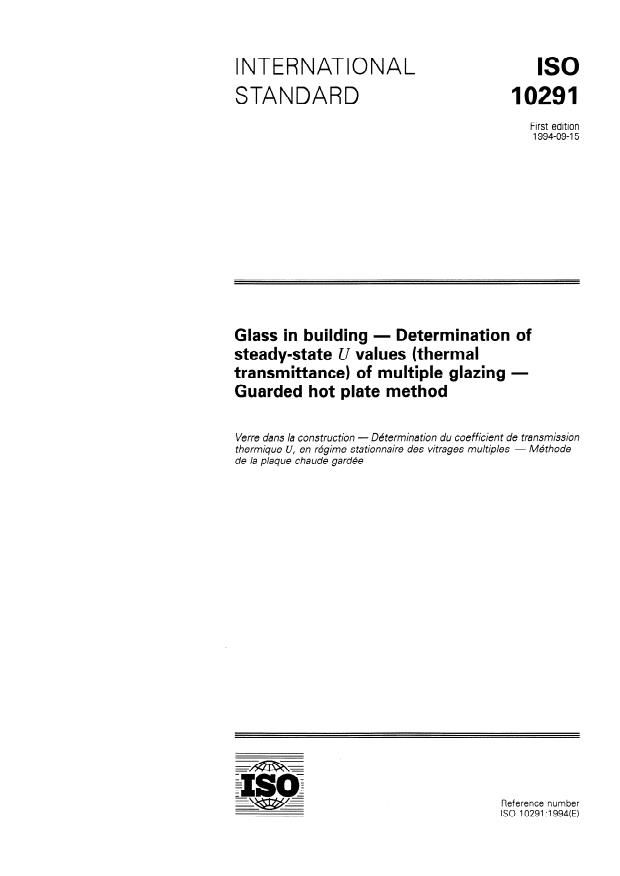
(Main)Glass in building — Determination of steady-state U values (thermal transmittance) of multiple glazing — Guarded hot plate method
General Information
- Abstract
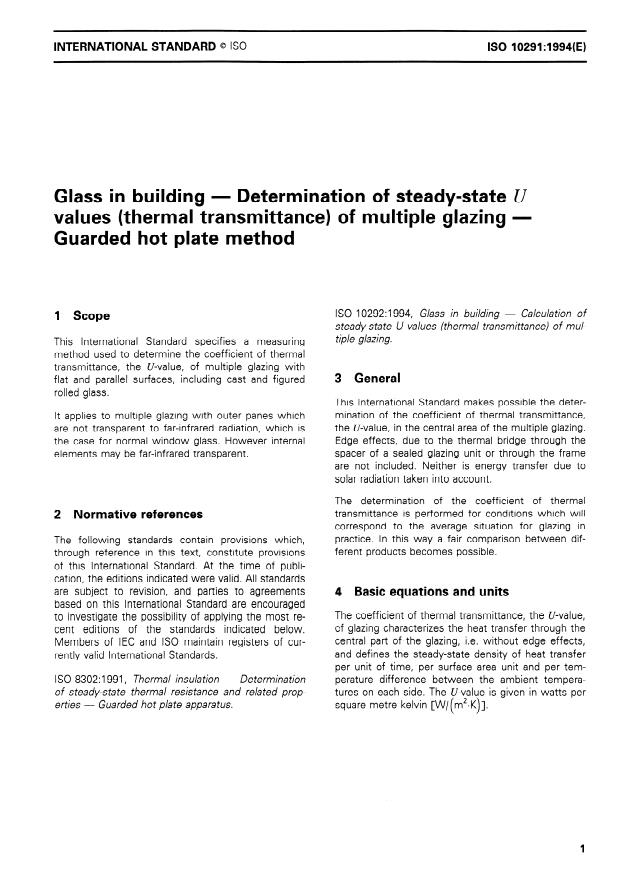
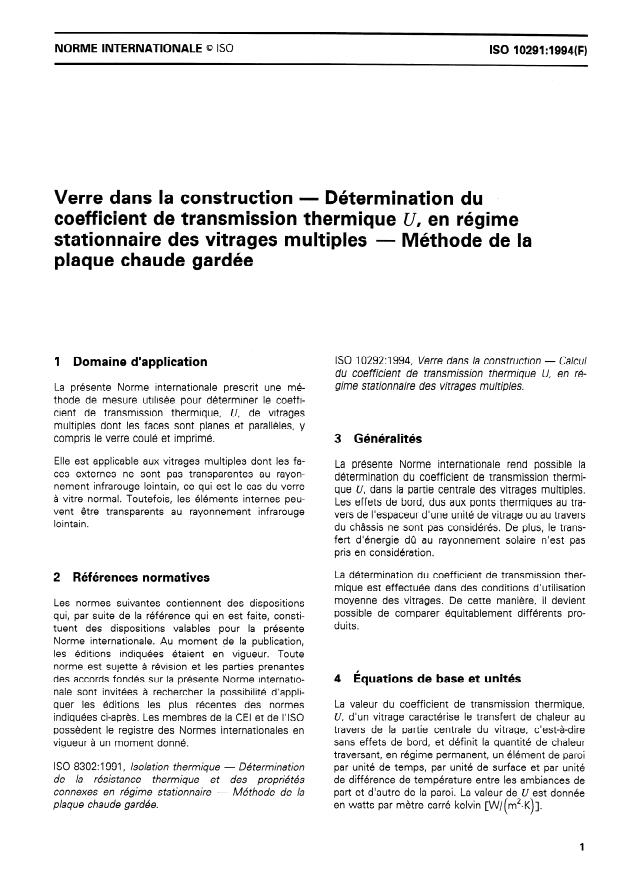
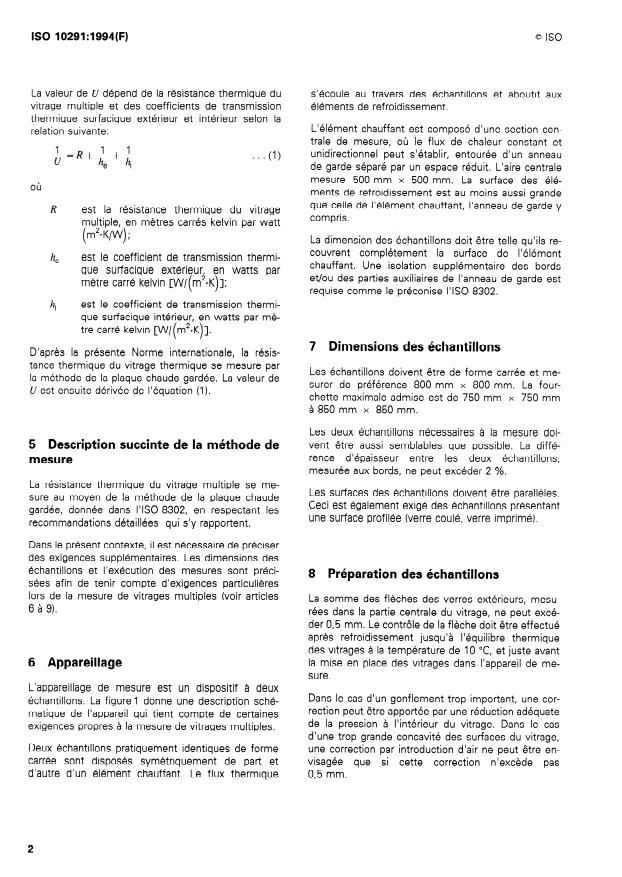
Specifies a measuring method used to determine the coefficient of thermal transmittance, the U-value, of multiple glazing with flat and parallel surfaces, including cast and figured rolled glass. Applies to multiple glazing with outer panes which are not transparent to far-infrared radiation, which is the case for normal window glass. Internal elements may be far-infrared transparent.
- Status
- Published
- Publication Date
- 14-Sep-1994
- Technical Committee
- ISO/TC 160/SC 2 - Use considerations
- Current Stage
- 9093 - International Standard confirmed
- Start Date
- 07-Mar-2024
- Completion Date
- 29-Aug-2026
Buy Documents
ISO 10291:1994 - Glass in building — Determination of steady-state U values (thermal transmittance) of multiple glazing — Guarded hot plate method Released:9/15/1994
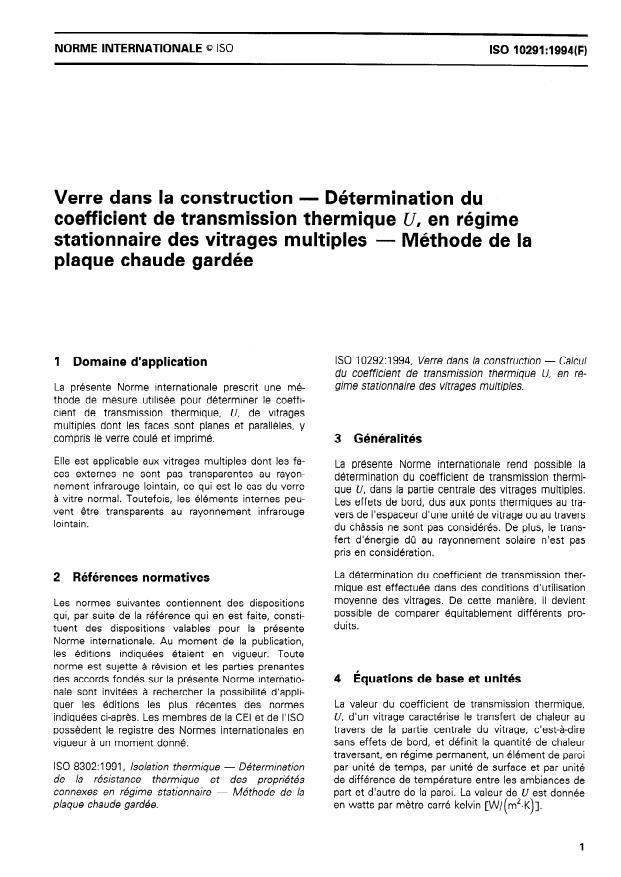
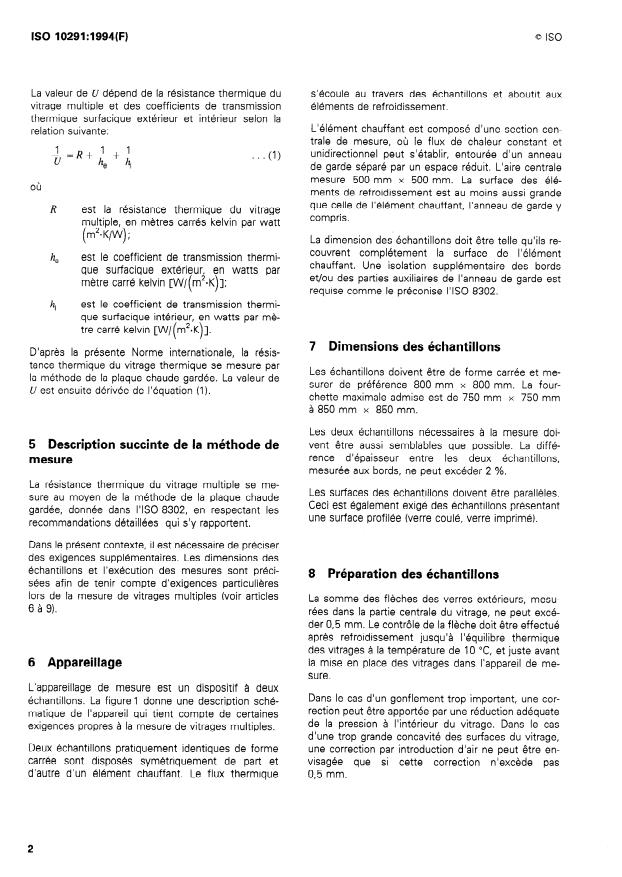
ISO 10291:1994 - Verre dans la construction — Détermination du coefficient de transmission thermique U, en régime stationnaire des vitrages multiples — Méthode de la plaque chaude gardée Released:9/15/1994
ISO 10291:1994 - Verre dans la construction — Détermination du coefficient de transmission thermique U, en régime stationnaire des vitrages multiples — Méthode de la plaque chaude gardée Released:9/15/1994
Overview
ISO 10291:1994 specifies a standardized method for determining the steady-state thermal transmittance (U-value) of multiple glazing used in building applications. This international standard applies to multiple glazing units with flat and parallel surfaces, including cast and figured rolled glass, commonly found in windows and facades. The method excludes edge effects and solar radiation influences, focusing on the core thermal performance of glazing systems.
The determination of U-values is performed using the guarded hot plate technique, which allows precise measurement of heat transfer through glazing materials. By establishing uniform testing conditions representative of typical building environments, ISO 10291:1994 ensures reliable and comparable thermal performance data for multiple glazing products.
Key Topics
Scope of Application
Applies to multiple glazing with outer panes non-transparent to far-infrared radiation (typical window glass), and internal elements which may be transparent to far-infrared.Guarded Hot Plate Method
Involves placing two similar specimens on either side of a heating unit; heat flow is measured to calculate thermal resistance and U-values.Specimen Requirements
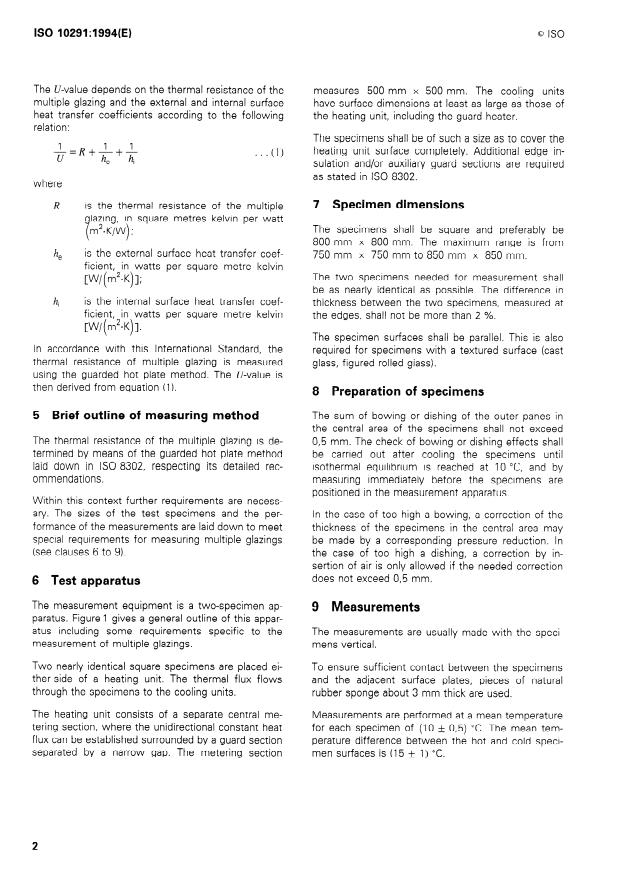
- Square specimens, preferably 800 mm x 800 mm, with size tolerance from 750 mm to 850 mm.
- Surface flatness and parallelism are critical; bowing or dishing must not exceed 0.5 mm.
- Thickness consistency between two specimens limited to 2%.
Measurement Conditions
- Mean specimen temperature: (10 ± 0.5) °C
- Temperature difference between hot and cold sides: (15 ± 1) °C
- Use of natural rubber sponges ensures optimal thermal contact.
Calculation of U-Value
U-value (W/m²K) is calculated from the measured thermal resistance (R) and standardized surface heat transfer coefficients (hi and he). Adjustments apply when low-emissivity (low-E) coatings are present.Test Report Requirements
Detailed reporting includes specimen dimensions, materials, layer details, temperature values, surface heat transfer coefficients, measured U-value and thermal resistance.
Applications
ISO 10291:1994 is essential for:
Building Design and Energy Efficiency
Enables architects and engineers to select glazing that meets energy codes by quantifying thermal insulation performance.Product Certification and Quality Control
Manufacturers use this standard method for product testing to provide accurate thermal transmittance data.Research and Development
Facilitates development of advanced glazing technologies-such as multi-pane, coated, or gas-filled units-by allowing precise thermal performance comparisons.Regulatory Compliance
Supports compliance with international and local building regulations requiring verified U-values for glazing products.Consulting and Retrofitting
Helps energy consultants assess and recommend glazing upgrades to improve building thermal performance.
Related Standards
ISO 8302:1991 – Thermal insulation – Determination of steady-state thermal resistance and related properties using the guarded hot plate apparatus. Provides detailed apparatus requirements referenced in ISO 10291.
ISO 10292:1994 – Glass in building – Calculation of steady-state U-values of multiple glazing. Complements ISO 10291 by specifying calculation methods based on measured data.
EN 673 – Glass in building – Determination of thermal transmittance (U value) – Heat flow meter method.
ASTM C1363 – Standard test method for thermal performance of building materials and envelope assemblies.
Keywords: ISO 10291, multiple glazing, thermal transmittance, U-value, guarded hot plate method, glass in building, thermal insulation, steady-state measurement, window glass, energy efficiency, building standards.
Relations
- Effective Date
- 09-Feb-2026
- Effective Date
- 09-Feb-2026
- Effective Date
- 09-Feb-2026
- Effective Date
- 09-Feb-2026
- Effective Date
- 09-Feb-2026
Buy Documents
ISO 10291:1994 - Glass in building — Determination of steady-state U values (thermal transmittance) of multiple glazing — Guarded hot plate method Released:9/15/1994
ISO 10291:1994 - Verre dans la construction — Détermination du coefficient de transmission thermique U, en régime stationnaire des vitrages multiples — Méthode de la plaque chaude gardée Released:9/15/1994
ISO 10291:1994 - Verre dans la construction — Détermination du coefficient de transmission thermique U, en régime stationnaire des vitrages multiples — Méthode de la plaque chaude gardée Released:9/15/1994
Frequently Asked Questions
ISO 10291:1994 is a standard published by the International Organization for Standardization (ISO). Its full title is "Glass in building — Determination of steady-state U values (thermal transmittance) of multiple glazing — Guarded hot plate method". This standard covers: Specifies a measuring method used to determine the coefficient of thermal transmittance, the U-value, of multiple glazing with flat and parallel surfaces, including cast and figured rolled glass. Applies to multiple glazing with outer panes which are not transparent to far-infrared radiation, which is the case for normal window glass. Internal elements may be far-infrared transparent.
Specifies a measuring method used to determine the coefficient of thermal transmittance, the U-value, of multiple glazing with flat and parallel surfaces, including cast and figured rolled glass. Applies to multiple glazing with outer panes which are not transparent to far-infrared radiation, which is the case for normal window glass. Internal elements may be far-infrared transparent.
ISO 10291:1994 is classified under the following ICS (International Classification for Standards) categories: 81.040.20 - Glass in building. The ICS classification helps identify the subject area and facilitates finding related standards.
ISO 10291:1994 has the following relationships with other standards: It is inter standard links to EN ISO 12631:2017, EN ISO 12631:2012, EN ISO 10077-1:2017, EN ISO 52018-1:2017, EN ISO 52022-1:2017. Understanding these relationships helps ensure you are using the most current and applicable version of the standard.
ISO 10291:1994 is available in PDF format for immediate download after purchase. The document can be added to your cart and obtained through the secure checkout process. Digital delivery ensures instant access to the complete standard document.
Standards Content (Sample)
INTERNATIONAL
ISO
STANDARD 10291
First edition
1994-09-15
Glass in building - Determination of
steady-state U values (thermal
transmittance) of multiple glazing -
Guarded hot plate method
Determination du coe fficien t de transmission
Verre dans Ia construction -
thermique U, en r6gime stationnaire des vitrages multiples - Methode
de Ia Plaque chaude gardbe
Reference number
Foreword
ISO (the International Organization for Standardization) is a worldwide
federation of national Standards bodies (ISO member bodies). The work
of preparing International Standards is normally carried out through ISO
technical committees. Esch member body interested in a subject for
which a technical committee has been established has the right to be
represented on that committee. International organizations, governmental
and non-governmental, in liaison with ISO, also take part in the work. ISO
collaborates closely with the International Electrotechnical Commission
(IEC) on all matters of electrotechnical standardization.
Draft International Standards adopted by the technical committees are
circulated to the member bodies for voting. Publication as an International
Standard requires approval by at least 75 % of the member bodies casting
a vote.
International Standard ISO 10291 was prepared by Technical Committee
lSO/TC 160, Glass in building, Subcommittee SC 2, Use considerations.
0 ISO 1994
All rights reserved. Unless otherwise specified, no part of this publication may be reproduced
or utilized in any form or by any means, electronie or mechanical, including photocopying and
microfilm, without Permission in writing from the publisher
International Organization for Standardization
Case Postale 56 l CH-1 211 Geneve 20 l Switzerland
Printed in Switzerland
INTERNATIONAL STANDARD 0 ISO ISO 10291:1994(E)
Glass in building - Determination of steady-state U
values (thermal transmittance) of multiple glazing -
Guarded hot plate method
ISO 10292:1994, Glass in building - Calculation of
1 Scope
steady-state U values (thermal transmittance) of mul-
tiple glazing.
This International Standard specifies a measuring
method used to determine the coefficient of thermal
transmittance, the U-value, of multiple glazing with
flat and parallel surfaces, including cast and figured 3 General
rolled glass.
This International Standard makes possible the deter-
mination of the coefficient of thermal transmittance,
lt applies to multiple glazing with outer panes which
the U-value, in the central area of the multiple glazing.
are not transparent to far-infrared radiation, which is
the case for normal window glass. However internal Edge effects, due to the thermal bridge through the
elements may be far-infrared transparent. spacer of a sealed glazing unit or through the frame
are not included. Neither is energy transfer due to
solar radiation taken into account.
The determination of the coefficient of thermal
transmittance is performed for conditions which will
2 Normative references
correspond to the average Situation for glazing in
practice. In this way a fair comparison between dif-
The following Standards contain provisions which,
ferent products becomes possible.
through reference in this text, constitute provisions
of this International Standard. At the time of publi-
cation, the editions indicated were valid. All Standards
are subject to revision, and Parties to agreements
4 Basic equations and units
based on this International Standard are encouraged
The coefficient of thermal transmittance, the U-value,
to investigate the possibility of applying the most re-
cf glazing characterizes the heat transfer through the
cent editions of the Standards indicated below.
central part of ,the glazing, i.e. without edge effects,
Members of IEC and ISO maintain registers of cur-
and defines the steady-state density of heat transfer
rently valid International Standards.
per unit of time, per surface area unit and per tem-
ISO 8302: 1991, Thermal insulation - Determination perature differente between the ambient tempera-
of steady-state thermal resistance and related prop-
tures on each side. The U-value is given in Watts per
erties - Guarded hot plate apparatus. Square metre kelvin [W/(m2mK)].
The U-value depends on the thermal resistance of the measures 500 mm x 500 mm. The cooling units
multiple glazing and the external and internal surface have surface dimensions at least as large as those of
heat transfer coefficients according to the following the heating unit, including the guard heater.
relation:
The specimens shall be of such a size as to cover the
UR++++
heating unit surface completely. Additional edge in-
. m .
(1)
U
e i
sulation and/or auxiliary guard sections are required
as stated in ISO 8302.
where
7 Specimen dimensions
R is the thermal resistance of the multiple
Square metres kelvin per Watt
The specimens shall be Square and preferably be
800 mm x 800 mm. The maximum range is from
is the external surface heat transfer coef-
750 mm x 750 mm to 850 mm x 850 mm.
he
ficient, in Watts per Square metre kelvin
The two specimens needed for measurement shall
[wi(m2J$;
be as nearly identical as possible. The differente in
is the internal surface heat transfer coef-
thickness between the two specimens, measured at
hi
ficient, in Watts per Square metre kelvin
the edges, shal! not be more than 2 %.
Cwi(m2mq1.
The specimen surfaces shall be parallel. This is also
In accordance with this International Standard, the
required for specimens with a textured surface (cast
thermal resistance of multiple glazing is measured glass, figured rolled giass).
using the guarded hot plate method. The U-value is
then derived from equation (1).
8 Preparation of specimens
The sum of bowing or dishing of
...
NORME
ISO
INTERNATIONALE
Première édition
1994-09-l 5
Verre dans la construction -
Détermination du coefficient de
transmission thermique U, en régime
stationnaire des vitrages multiples -
Méthode de la plaque chaude gardée
Glass in building -
Determination of steady-state U values (thermal
transmittance) of multiple glazing - Guarded hot plate method
Numéro de référence
ISO 10291 :1994(F)
Avant-propos
L’ISO (Organisation internationale de normalisation) est une fédération
mondiale d’organismes nationaux de normalisation (comités membres de
I’ISO). L’élaboration des Normes internationales est en général confiée aux
comités techniques de I’ISO. Chaque comité membre intéressé par une
étude a le droit de faire partie du comité technique créé à cet effet. Les
organisations internationales, gouvernementales et non gouvernemen-
tales, en liaison avec I’ISO participent également aux travaux. L’ISO colla-
bore étroitement avec la Commission électrotechnique internationale (CEI)
en ce qui concerne la normalisation électrotechnique.
Les projets de Normes internationales adoptés par les comités techniques
sont soumis aux comités membres pour vote. Leur publication comme
Normes internationales requiert l’approbation de 75 % au moins des co-
mités membres votants.
La Norme internationale ISO 10291 a été élaborée par le comité technique
lSO/TC 160, Verre dans la construction, sous-comité SC 2, Utilisation.
0 ISO 1994
Droits de reproduction réservés. Sauf prescription différente, aucune partie de cette publi-
cation ne peut être reproduite ni utilisée sous quelque forme que ce soit et par aucun pro-
cédé, électronique ou mécanique, y compris Sa photocopie et les microfilms, sans l’accord
écrit de l’éditeur.
Organisation internationale de normalisation
Case Postale 56 l CH-1 211 Genéve 20 l Suisse
Imprimé en Suisse
ii
~~
NORME INTERNATIONALE 0 ISO
Verre dans la construction - Détermination du .
coefficient de transmission thermique U, en régime
stationnaire des vitrages multiples - Méthode de la
plaque chaude gardée
ISO 10292:1994, Verre dans la construction - Calcul
1 Domaine d’application
du coefficient de transmission thermique U, en r&
gime stationnaire des vitrages multiples.
La présente Norme internationale prescrit une mé-
thode de mesure utilisée pour déterminer le coeffi-
cient de transmission thermique, U, de vitrages
multiples dont les faces sont planes et paralleles, y
compris le verre coulé et imprimé.
3 Généralités
Elle est applicable aux vitrages multiples dont les fa-
La présente Norme internationale rend possible la
ces externes ne sont pas transparentes au rayon-
détermination du coefficient de transmission thermi-
nement infrarouge lointain, ce qui est le cas du verre
que U, dans la partie centrale des vitrages multiples.
a vitre normal. Toutefois, les éléments internes peu-
Les effets de bord, dus aux ponts thermiques au tra-
vent être transparents au rayonnement infrarouge
vers de I’espaceur d’une unité de vitrage ou au travers
lointain.
du châssis ne sont pas considérés. De plus, le trans-
fert d’énergie dû au rayonnement solaire n’est pas
pris en considération.
La détermination du coefficient de transmission ther-
2 Références normatives
mique est effectuée dans des conditions d’utilisation
moyenne des. vitrages. De cette manière, il devient
Les normes suivantes contiennent des dispositions
possible de comparer équitablement différents pro-
qui, par suite de la référence qui en est faite, consti-
duits.
tuent des dispositions valables pour la présente
Norme internationale. Au moment de la publication,
les éditions indiquées étaient en vigueur. Toute
norme est sujette a révision et les parties prenantes
4 Équations de base et unités
des accords fondés sur la présente Norme internatio-
nale sont invitées a rechercher la possibilité d’appli-
La valeur du coefficient de transmission thermique,
quer les éditions les plus récentes des normes
U, d’un vitrage caractérise le transfert de chaleur au
indiquées ci-après. Les membres de la CEI et de I’ISO
travers de la partie centrale du vitrage, c’est-à-dire
possèdent le registre des Normes internationales en
sans effets de bord, et définit la quantité de chaleur
vigueur à un moment donné.
traversant, en régime permanent, un élément de paroi
ISO $302: 1991 p Isolation thermique - Détermination par unité de temps, par unité de surface et par unité
de la résistance thermique et des propri&és de différence de température entre les ambiances de
connexes en régime stationnaire - Méthode de la part et d’autre de la paroi. La valeur de U est donnée
plaque chaude gardée. en watts par métre carré kelvin [W/(mzDK)].
0 ISO
La valeur de U dépend de la résistance thermique du s’écoule au travers des échantillons et aboutit aux
vitrage multiple et des coefficients de transmission éléments de refroidissement.
thermique surfacique extérieur et intérieur selon la
L’élément chauffant est composé d’une section cen-
relation suivante:
trale de mesure, où le flux de chaleur constant et
unidirectionnel peut s’établir, entourée d’un anneau
(1)
de garde séparé par un espace réduit. L’aire centrale
mesure 500 mm x 500 mm. La surface des élé-
où
ments de refroidissement est au moins aussi grande
que celle de l’élément chauffant, l’anneau de garde y
R est la résistance thermique du vitrage
compris.
multiple, en mètres carrés kelvin par watt
(m*mK/W);
La dimension des échantillons doit être telle qu’ils re-
couvrent complétement la surface de l’élément
est le coefficient de transmission thermi-
he
chauffant. Une isolation supplémentaire des bords
que surfacique extérieur, en watts par
et/ou des parties auxiliaires de l’anneau de garde est
mètre carré kelvin [W/(m2mK)];
requise comme le préconise I’ISO 8302.
est le coefficient de transmission thermi-
hi
que surfacique intérieur, en watts par mè-
tre carré kelvin [W/(m2aK)].
7 Dimensions des échantillons
D’après la présente Norme internationale, la résis-
tance thermique du vitrage thermique se mesure par
Les échantillons doivent être de forme carrée et me-
la méthode de la plaque chaude gardée. La valeur de
surer de préférence 800 mm x 800 mm. La four-
U est ensuite dérivée de l’équation (1).
chette maximale admise est de 750 mm x 750 mm
à 850 mm x 850 mm.
Les deux échantillons nécessaires à la mesure doi-
vent être aussi sembla
...
NORME
ISO
INTERNATIONALE
Première édition
1994-09-l 5
Verre dans la construction -
Détermination du coefficient de
transmission thermique U, en régime
stationnaire des vitrages multiples -
Méthode de la plaque chaude gardée
Glass in building -
Determination of steady-state U values (thermal
transmittance) of multiple glazing - Guarded hot plate method
Numéro de référence
ISO 10291 :1994(F)
Avant-propos
L’ISO (Organisation internationale de normalisation) est une fédération
mondiale d’organismes nationaux de normalisation (comités membres de
I’ISO). L’élaboration des Normes internationales est en général confiée aux
comités techniques de I’ISO. Chaque comité membre intéressé par une
étude a le droit de faire partie du comité technique créé à cet effet. Les
organisations internationales, gouvernementales et non gouvernemen-
tales, en liaison avec I’ISO participent également aux travaux. L’ISO colla-
bore étroitement avec la Commission électrotechnique internationale (CEI)
en ce qui concerne la normalisation électrotechnique.
Les projets de Normes internationales adoptés par les comités techniques
sont soumis aux comités membres pour vote. Leur publication comme
Normes internationales requiert l’approbation de 75 % au moins des co-
mités membres votants.
La Norme internationale ISO 10291 a été élaborée par le comité technique
lSO/TC 160, Verre dans la construction, sous-comité SC 2, Utilisation.
0 ISO 1994
Droits de reproduction réservés. Sauf prescription différente, aucune partie de cette publi-
cation ne peut être reproduite ni utilisée sous quelque forme que ce soit et par aucun pro-
cédé, électronique ou mécanique, y compris Sa photocopie et les microfilms, sans l’accord
écrit de l’éditeur.
Organisation internationale de normalisation
Case Postale 56 l CH-1 211 Genéve 20 l Suisse
Imprimé en Suisse
ii
~~
NORME INTERNATIONALE 0 ISO
Verre dans la construction - Détermination du .
coefficient de transmission thermique U, en régime
stationnaire des vitrages multiples - Méthode de la
plaque chaude gardée
ISO 10292:1994, Verre dans la construction - Calcul
1 Domaine d’application
du coefficient de transmission thermique U, en r&
gime stationnaire des vitrages multiples.
La présente Norme internationale prescrit une mé-
thode de mesure utilisée pour déterminer le coeffi-
cient de transmission thermique, U, de vitrages
multiples dont les faces sont planes et paralleles, y
compris le verre coulé et imprimé.
3 Généralités
Elle est applicable aux vitrages multiples dont les fa-
La présente Norme internationale rend possible la
ces externes ne sont pas transparentes au rayon-
détermination du coefficient de transmission thermi-
nement infrarouge lointain, ce qui est le cas du verre
que U, dans la partie centrale des vitrages multiples.
a vitre normal. Toutefois, les éléments internes peu-
Les effets de bord, dus aux ponts thermiques au tra-
vent être transparents au rayonnement infrarouge
vers de I’espaceur d’une unité de vitrage ou au travers
lointain.
du châssis ne sont pas considérés. De plus, le trans-
fert d’énergie dû au rayonnement solaire n’est pas
pris en considération.
La détermination du coefficient de transmission ther-
2 Références normatives
mique est effectuée dans des conditions d’utilisation
moyenne des. vitrages. De cette manière, il devient
Les normes suivantes contiennent des dispositions
possible de comparer équitablement différents pro-
qui, par suite de la référence qui en est faite, consti-
duits.
tuent des dispositions valables pour la présente
Norme internationale. Au moment de la publication,
les éditions indiquées étaient en vigueur. Toute
norme est sujette a révision et les parties prenantes
4 Équations de base et unités
des accords fondés sur la présente Norme internatio-
nale sont invitées a rechercher la possibilité d’appli-
La valeur du coefficient de transmission thermique,
quer les éditions les plus récentes des normes
U, d’un vitrage caractérise le transfert de chaleur au
indiquées ci-après. Les membres de la CEI et de I’ISO
travers de la partie centrale du vitrage, c’est-à-dire
possèdent le registre des Normes internationales en
sans effets de bord, et définit la quantité de chaleur
vigueur à un moment donné.
traversant, en régime permanent, un élément de paroi
ISO $302: 1991 p Isolation thermique - Détermination par unité de temps, par unité de surface et par unité
de la résistance thermique et des propri&és de différence de température entre les ambiances de
connexes en régime stationnaire - Méthode de la part et d’autre de la paroi. La valeur de U est donnée
plaque chaude gardée. en watts par métre carré kelvin [W/(mzDK)].
0 ISO
La valeur de U dépend de la résistance thermique du s’écoule au travers des échantillons et aboutit aux
vitrage multiple et des coefficients de transmission éléments de refroidissement.
thermique surfacique extérieur et intérieur selon la
L’élément chauffant est composé d’une section cen-
relation suivante:
trale de mesure, où le flux de chaleur constant et
unidirectionnel peut s’établir, entourée d’un anneau
(1)
de garde séparé par un espace réduit. L’aire centrale
mesure 500 mm x 500 mm. La surface des élé-
où
ments de refroidissement est au moins aussi grande
que celle de l’élément chauffant, l’anneau de garde y
R est la résistance thermique du vitrage
compris.
multiple, en mètres carrés kelvin par watt
(m*mK/W);
La dimension des échantillons doit être telle qu’ils re-
couvrent complétement la surface de l’élément
est le coefficient de transmission thermi-
he
chauffant. Une isolation supplémentaire des bords
que surfacique extérieur, en watts par
et/ou des parties auxiliaires de l’anneau de garde est
mètre carré kelvin [W/(m2mK)];
requise comme le préconise I’ISO 8302.
est le coefficient de transmission thermi-
hi
que surfacique intérieur, en watts par mè-
tre carré kelvin [W/(m2aK)].
7 Dimensions des échantillons
D’après la présente Norme internationale, la résis-
tance thermique du vitrage thermique se mesure par
Les échantillons doivent être de forme carrée et me-
la méthode de la plaque chaude gardée. La valeur de
surer de préférence 800 mm x 800 mm. La four-
U est ensuite dérivée de l’équation (1).
chette maximale admise est de 750 mm x 750 mm
à 850 mm x 850 mm.
Les deux échantillons nécessaires à la mesure doi-
vent être aussi sembla
...