

ISO/ASTM 52945:2023
(Main)Additive manufacturing for automotive — Qualification principles — Generic machine evaluation and specification of key performance indicators for PBF-LB/M processes
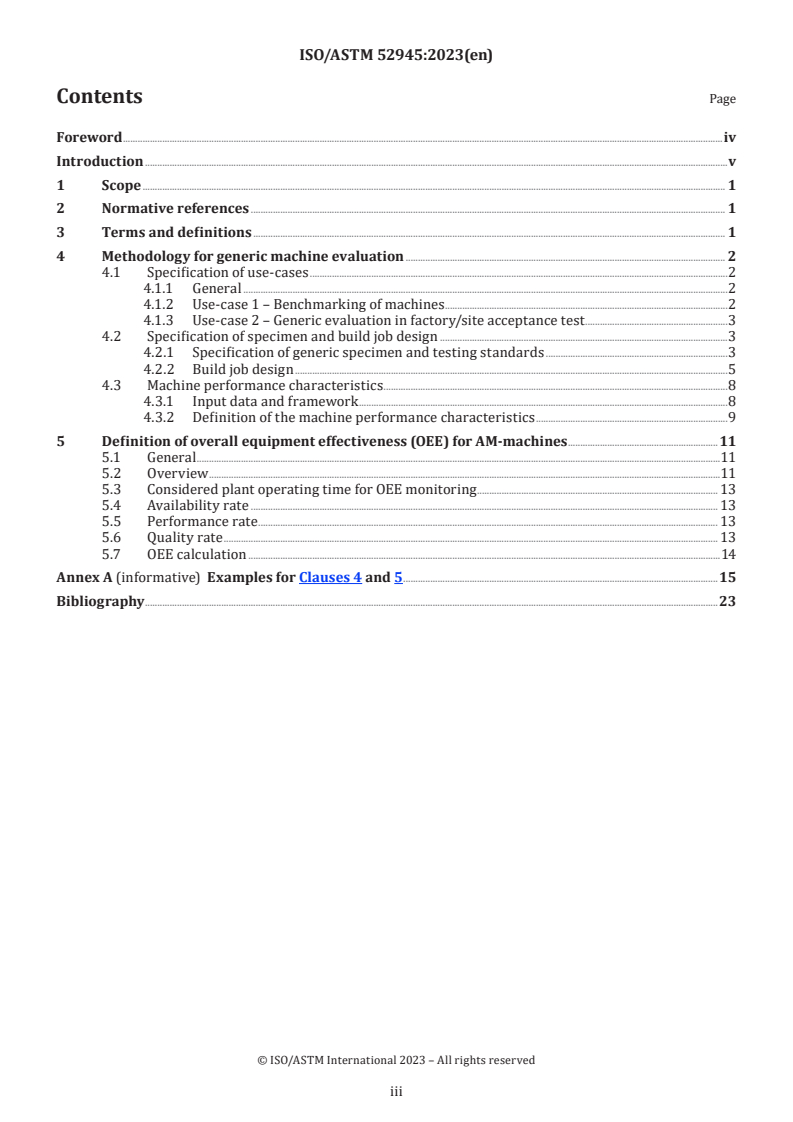
General Information
- Abstract
This document specifies the methodology for generic AM-machine evaluation in automotive environment using objective test criteria and provides the framework for an objective AM-machine evaluation and comparison. This document finds application in benchmarks, in the preparation of purchase decisions, but also in AM-machine evaluation within the machine procurement, acceptance, and qualification processes. This document is specific to automotive, as it is related to existing series part requirements of various original equipment manufacturers, but the content can be transferred to other industries if necessary. Furthermore, this document specifies machine KPIs in the context of machine procurement, production planning and production of PBF-LB/M components. It aims to reach a detailed understanding between machine supplier and machine user with respect to the acceptance criteria during the procurement process and evaluation of machine performance during running production. For using this document, all process parameters, such as scanning speed, laser power, etc., are fixed, since changing these parameters can affect the entire process performance and its stability. Therefore, variables are not changed any more during or after qualification. This document and the determination of the KPIs help in the evaluation of machine properties, but do not replace an application-specific approval process. This document is applicable to the additive manufacturing technology PBF-LB/M.
- Status
- Published
- Publication Date
- 19-Dec-2023
- Technical Committee
- ISO/TC 261 - Additive manufacturing
- Drafting Committee
- ISO/TC 261 - Additive manufacturing
- Current Stage
- 6060 - International Standard published
- Start Date
- 20-Dec-2023
- Due Date
- 01-Nov-2024
- Completion Date
- 20-Dec-2023
Buy Documents


ISO/ASTM 52945:2023 - Additive manufacturing for automotive — Qualification principles — Generic machine evaluation and specification of key performance indicators for PBF-LB/M processes Released:20. 12. 2023

ISO/ASTM 52945:2023 - Fabrication additive pour l'automobile — Principes de qualification — Évaluation générique de la machine et spécifications des indicateurs clefs de performance pour les procédés PBF-LB/M Released:20. 12. 2023
Overview
ISO/ASTM 52945:2023 - Additive manufacturing for automotive - Qualification principles - Generic machine evaluation and specification of key performance indicators for PBF-LB/M processes provides a standardized methodology to evaluate powder bed fusion - laser beam/melt (PBF‑LB/M) machines in the automotive context. The standard defines objective test criteria, specimen and build‑job frameworks, and machine key performance indicators (KPIs) to support benchmarking, procurement, factory/site acceptance, qualification and production planning. While targeted at automotive series‑part requirements, its methodology can be applied to other industries.
Key topics and requirements
- Generic machine evaluation methodology: A repeatable framework to generate neutral, documented evaluations of PBF‑LB/M machines for two main use‑cases - benchmarking and factory/site acceptance testing.
- Fixed process parameters: All process parameters (e.g., scanning speed, laser power) are to be fixed during and after qualification because changing them affects process stability and comparability.
- Specimen and build‑job design: Defines a specimen package and build‑job design for measuring surface roughness, relative density and quasi‑static mechanical properties. Surface measurement precedes porosity assessment.
- Machine performance characteristics: Measured characteristics are defined within a specified framework to enable objective machine comparison and capability assessment.
- Machine KPIs: KPIs are specified for procurement, production planning and running production to align expectations between machine supplier and user. KPIs include metrics relevant to availability, performance and quality.
- Overall Equipment Effectiveness (OEE) for AM: The document adapts OEE concepts for AM‑machines (availability, performance rate, quality rate) and provides guidance on monitoring and calculation in the AM production context.
- Use‑case guidance: Minimum test runs and options to extend testing for greater statistical significance; provisions for tailoring build jobs to future production scenarios through agreement between user and supplier.
- Limitation: The standard aids machine evaluation but does not replace application‑specific approval or qualification processes.
Practical applications
- Benchmarking PBF‑LB/M systems to compare machine suppliers
- Supporting purchase decisions and supplier selection for automotive AM production
- Defining acceptance criteria during factory acceptance test (FAT) and site acceptance test (SAT)
- Establishing production planning KPIs and machine performance monitoring for series manufacturing
- Creating a documented basis for contractual agreements between machine users and suppliers
Who should use this standard
- Automotive OEMs and tier suppliers evaluating AM systems
- AM machine manufacturers preparing acceptance test documentation
- Procurement teams, production planners and quality engineers working with PBF‑LB/M
- Test labs and integrators performing machine benchmarking
Related standards
Relevant references include ISO/ASTM 52900, ISO/ASTM 52902, ISO/ASTM 52928, ISO/ASTM TS 52930, ISO 6892‑1, ISO 3369, ISO 25178 and ASTM E8M. These support vocabulary, test artifacts, powder management and mechanical/texture testing referenced by ISO/ASTM 52945:2023.
Relations
- Effective Date
- 12-Feb-2026
- Effective Date
- 06-Jun-2022
Buy Documents
ISO/ASTM 52945:2023 - Additive manufacturing for automotive — Qualification principles — Generic machine evaluation and specification of key performance indicators for PBF-LB/M processes Released:20. 12. 2023
ISO/ASTM 52945:2023 - Fabrication additive pour l'automobile — Principes de qualification — Évaluation générique de la machine et spécifications des indicateurs clefs de performance pour les procédés PBF-LB/M Released:20. 12. 2023
Get Certified
Connect with accredited certification bodies for this standard

DVS-ZERT GmbH
German welding certification society.
CARES (UK Certification Authority for Reinforcing Steels)
UK certification for reinforcing steels and construction.
EWF/IIW (European/International Welding Federation)
International welding personnel certification.
Sponsored listings
Frequently Asked Questions
ISO/ASTM 52945:2023 is a standard published by the International Organization for Standardization (ISO). Its full title is "Additive manufacturing for automotive — Qualification principles — Generic machine evaluation and specification of key performance indicators for PBF-LB/M processes". This standard covers: This document specifies the methodology for generic AM-machine evaluation in automotive environment using objective test criteria and provides the framework for an objective AM-machine evaluation and comparison. This document finds application in benchmarks, in the preparation of purchase decisions, but also in AM-machine evaluation within the machine procurement, acceptance, and qualification processes. This document is specific to automotive, as it is related to existing series part requirements of various original equipment manufacturers, but the content can be transferred to other industries if necessary. Furthermore, this document specifies machine KPIs in the context of machine procurement, production planning and production of PBF-LB/M components. It aims to reach a detailed understanding between machine supplier and machine user with respect to the acceptance criteria during the procurement process and evaluation of machine performance during running production. For using this document, all process parameters, such as scanning speed, laser power, etc., are fixed, since changing these parameters can affect the entire process performance and its stability. Therefore, variables are not changed any more during or after qualification. This document and the determination of the KPIs help in the evaluation of machine properties, but do not replace an application-specific approval process. This document is applicable to the additive manufacturing technology PBF-LB/M.
This document specifies the methodology for generic AM-machine evaluation in automotive environment using objective test criteria and provides the framework for an objective AM-machine evaluation and comparison. This document finds application in benchmarks, in the preparation of purchase decisions, but also in AM-machine evaluation within the machine procurement, acceptance, and qualification processes. This document is specific to automotive, as it is related to existing series part requirements of various original equipment manufacturers, but the content can be transferred to other industries if necessary. Furthermore, this document specifies machine KPIs in the context of machine procurement, production planning and production of PBF-LB/M components. It aims to reach a detailed understanding between machine supplier and machine user with respect to the acceptance criteria during the procurement process and evaluation of machine performance during running production. For using this document, all process parameters, such as scanning speed, laser power, etc., are fixed, since changing these parameters can affect the entire process performance and its stability. Therefore, variables are not changed any more during or after qualification. This document and the determination of the KPIs help in the evaluation of machine properties, but do not replace an application-specific approval process. This document is applicable to the additive manufacturing technology PBF-LB/M.
ISO/ASTM 52945:2023 is classified under the following ICS (International Classification for Standards) categories: 25.030 - Additive manufacturing. The ICS classification helps identify the subject area and facilitates finding related standards.
ISO/ASTM 52945:2023 has the following relationships with other standards: It is inter standard links to EN ISO/ASTM 52945:2024, ISO 8102-2:2021. Understanding these relationships helps ensure you are using the most current and applicable version of the standard.
ISO/ASTM 52945:2023 is available in PDF format for immediate download after purchase. The document can be added to your cart and obtained through the secure checkout process. Digital delivery ensures instant access to the complete standard document.
Standards Content (Sample)
International
Standard
ISO/ASTM 52945
First edition
Additive manufacturing for
2023-12
automotive — Qualification
principles — Generic machine
evaluation and specification of key
performance indicators for PBF-
LB/M processes
Fabrication additive pour l'automobile — Principes de
qualification — Évaluation générique de la machine et
spécifications des indicateurs clefs de performance pour les
procédés PBF-LB/M
Reference number
© ISO/ASTM International 2023
All rights reserved. Unless otherwise specified, or required in the context of its implementation, no part of this publication may
be reproduced or utilized otherwise in any form or by any means, electronic or mechanical, including photocopying, or posting on
the internet or an intranet, without prior written permission. Permission can be requested from either ISO at the address below
or ISO’s member body in the country of the requester. In the United States, such requests should be sent to ASTM International.
ISO copyright office ASTM International
CP 401 • Ch. de Blandonnet 8 100 Barr Harbor Drive, PO Box C700
CH-1214 Vernier, Geneva West Conshohocken, PA 19428-2959, USA
Phone: +41 22 749 01 11 Phone: +610 832 9634
Fax: +610 832 9635
Email: copyright@iso.org Email: khooper@astm.org
Website: www.iso.org Website: www.astm.org
Published in Switzerland
© ISO/ASTM International 2023 – All rights reserved
ii
Contents Page
Foreword .iv
Introduction .v
1 Scope . 1
2 Normative references . 1
3 Terms and definitions . 1
4 Methodology for generic machine evaluation . 2
4.1 Specification of use-cases .2
4.1.1 General .2
4.1.2 Use-case 1 – Benchmarking of machines .2
4.1.3 Use-case 2 – Generic evaluation in factory/site acceptance test .3
4.2 Specification of specimen and build job design .3
4.2.1 Specification of generic specimen and testing standards .3
4.2.2 Build job design .5
4.3 Machine performance characteristics .8
4.3.1 Input data and framework .8
4.3.2 Definition of the machine performance characteristics .9
5 Definition of overall equipment effectiveness (OEE) for AM-machines .11
5.1 General .11
5.2 Overview .11
5.3 Considered plant operating time for OEE monitoring . 13
5.4 Availability rate . 13
5.5 Performance rate . 13
5.6 Quality rate . 13
5.7 OEE calculation .14
Annex A (informative) Examples for Clauses 4 and 5 .15
Bibliography .23
© ISO/ASTM International 2023 – All rights reserved
iii
Foreword
ISO (the International Organization for Standardization) is a worldwide federation of national standards
bodies (ISO member bodies). The work of preparing International Standards is normally carried out through
ISO technical committees. Each member body interested in a subject for which a technical committee
has been established has the right to be represented on that committee. International organizations,
governmental and non-governmental, in liaison with ISO, also take part in the work. ISO collaborates closely
with the International Electrotechnical Commission (IEC) on all matters of electrotechnical standardization.
The procedures used to develop this document and those intended for its further maintenance are described
in the ISO/IEC Directives, Part 1. In particular, the different approval criteria needed for the different types
of ISO document should be noted. This document was drafted in accordance with the editorial rules of the
ISO/IEC Directives, Part 2 (see www.iso.org/directives).
ISO draws attention to the possibility that the implementation of this document may involve the use of (a)
patent(s). ISO takes no position concerning the evidence, validity or applicability of any claimed patent
rights in respect thereof. As of the date of publication of this document, ISO had not received notice of (a)
patent(s) which may be required to implement this document. However, implementers are cautioned that
this may not represent the latest information, which may be obtained from the patent database available at
www.iso.org/patents. ISO shall not be held responsible for identifying any or all such patent rights.
Any trade name used in this document is information given for the convenience of users and does not
constitute an endorsement.
For an explanation of the voluntary nature of standards, the meaning of ISO specific terms and expressions
related to conformity assessment, as well as information about ISO's adherence to the World Trade
Organization (WTO) principles in the Technical Barriers to Trade (TBT), see www.iso.org/iso/foreword.html.
This document was prepared by Technical Committee ISO/TC 261, Additive manufacturing technologies, on
the basis of a partnership agreement between ISO and ASTM International with the aim to create a common
set of ISO/ASTM standards on additive manufacturing, in collaboration with the European Committee for
Standardization (CEN) Technical Committee CEN/TC 438, Additive manufacturing, in accordance with the
Agreement on technical cooperation between ISO and CEN (Vienna Agreement).
Any feedback or questions on this document should be directed to the user’s national standards body. A
complete listing of these bodies can be found at www.iso.org/members.html.
© ISO/ASTM International 2023 – All rights reserved
iv
Introduction
This document provides a methodology to evaluate PBF-LB/M AM-machines in the context of automotive on
an objective basis. The need to provide a document standardizing this topic exists because in high-volume
industrial production, the reproducibility of the produced component is crucial to meet production goals.
Therefore, reproducibility and capability of the machines used for manufacturing need to be evaluated
upfront. A methodology and performance characteristics are introduced to enable the evaluation on an
objective and quantitative basis. The documentation resulting from the AM-machine evaluation is used to
obtain a reliable orientation selection and evaluation of PBF-LB/M AM-machines.
Moreover, the document provides guidelines for machine production key performance indicators (KPIs)
which can be used in procurement, production planning and production to improve the understanding
between the machine manufacturer and user. The KPIs to be determined within the scope of this document
help to systematically evaluate the performance of PBF-LB/M machines. However, this does not necessarily
guarantee that the KPIs can always be used to select the most suitable machine for a specific application
scenario. Since a large number of very specific influencing factors affect the selection of an optimal machine,
situational, individual parameters must be included in the decision. However, the KPIs can form the basis for
this decision.
The requirements regarding quality and planning of build jobs are specific for the automotive industry. The
introduced generic approach can be expanded to other industries.
© ISO/ASTM International 2023 – All rights reserved
v
International Standard ISO/ASTM 52945:2023(en)
Additive manufacturing for automotive — Qualification
principles — Generic machine evaluation and specification of
key performance indicators for PBF-LB/M processes
1 Scope
This document specifies the methodology for generic AM-machine evaluation in automotive environment
using objective test criteria and provides the framework for an objective AM-machine evaluation and
comparison. This document finds application in benchmarks, in the preparation of purchase decisions, but
also in AM-machine evaluation within the machine procurement, acceptance, and qualification processes.
This document is specific to automotive, as it is related to existing series part requirements of various
original equipment manufacturers, but the content can be transferred to other industries if necessary.
Furthermore, this document specifies machine KPIs in the context of machine procurement, production
planning and production of PBF-LB/M components. It aims to reach a detailed understanding between
machine supplier and machine user with respect to the acceptance criteria during the procurement process
and evaluation of machine performance during running production. For using this document, all process
parameters, such as scanning speed, laser power, etc., are fixed, since changing these parameters can affect
the entire process performance and its stability. Therefore, variables are not changed any more during
or after qualification. This document and the determination of the KPIs help in the evaluation of machine
properties, but do not replace an application-specific approval process.
This document is applicable to the additive manufacturing technology PBF-LB/M.
2 Normative references
The following documents are referred to in the text in such a way that some or all of their content constitutes
requirements of this document. For dated references, only the edition cited applies. For undated references,
the latest edition of the referenced document (including any amendments) applies.
ISO 3369, Impermeable sintered metal materials and hardmetals — Determination of density
ISO 4499-4, Hardmetals — Metallographic determination of microstructure — Part 4: Characterisation of
porosity, carbon defects and eta-phase content
ISO 6892-1, Metallic materials — Tensile testing — Part 1: Method of test at room temperature
ISO 25178 (all parts), Geometrical product specifications (GPS) — Surface texture: Areal
ISO/ASTM 52900, Additive manufacturing — General principles — Fundamentals and vocabulary
ISO/ASTM 52902, Additive manufacturing — Test artifacts — Geometric capability assessment of additive
manufacturing systems
ISO/ASTM 52928, Additive manufacturing — Feedstock materials — Powder life cycle management
ASTM E8M, Standard test methods for tension testing of metallic materials
3 Terms and definitions
For the purposes of this document, the terms and definitions of ISO/ASTM 52900 and the following apply.
© ISO/ASTM International 2023 – All rights reserved
ISO and IEC maintain terminology databases for use in standardization at the following addresses:
— ISO Online browsing platform: available at https:// www .iso .org/ obp
— IEC Electropedia: available at https:// www .electropedia .org/
3.1
performance characteristics
defined characteristics which are measured in a defined framework (in this document based on generic
build jobs and produced specimens) and can be used to evaluate machines on an objective basis
3.2
machine KPIs
machine key performance indicators (KPIs) measure the relevant output of a production machine in a
defined framework, e.g. timeframe, defined production lots
Note 1 to entry: Throughout this document, various such KPIs are introduced and their meaning, as well as how to
measure them, is explained in detail.
EXAMPLE Overall equipment effectiveness.
3.3
quality level
defined ranges of values for a specified set of quality parameters such as relative density, surface roughness,
mechanical properties, etc.
3.4
specimen package
set of different specimens
Note 1 to entry: Examples of different specimens are shown in Table 1.
4 Methodology for generic machine evaluation
4.1 Specification of use-cases
4.1.1 General
This clause introduces the methodology of generic machine evaluation. The generic machine evaluation
shall be used to carry out an assessment to evaluate the performance of a PBF-LB/M machine on a defined
objective basis.
The methodology of generic machine evaluation introduced here is not intended to define and verify
compliance of target metrics but should instead be used to generate information and efficiency metrics to
enable machine assessment and comparison. Further details of the machine acceptance process are shown in
ISO/ASTM TS 52930. For this document it is mandatory that consistent handling sequences can be achieved
through a good operator’s expertise, since it is important on AM systems for a stable component quality (see
ISO/ASTM 52926 series).
The generic machine evaluation shall be used to generate a sufficient, neutral, and documented evaluation
basis for two different use-cases, which are described in 4.1.2 and 4.1.3.
4.1.2 Use-case 1 – Benchmarking of machines
The framework and methodology introduced in 4.3.1 shall be used in the context of benchmarking of
machines. Therefore, a minimum of 1 run of the described build jobs according to 4.2.2 shall be produced
and tested in the described way. To strengthen the statistical significance of the benchmark, production
and evaluation of additional build jobs shall be necessary. This is an option at the discretion of the machine
manufacturer or the user.
© ISO/ASTM International 2023 – All rights reserved
4.1.3 Use-case 2 – Generic evaluation in factory/site acceptance test
The framework and methodology introduced in 4.3.1 shall furthermore be used in the machinery
procurement process, more specific in the factory and site acceptance test. Before using the methodology,
the specific target values for the performance indicators shall be agreed on between user and machine
manufacturer. During factory and site acceptance test, at least one build job run is mandatory.
This methodology can also be used to evaluate build job-to-build job performance. For a better evaluation
of the machine, further evaluations of build jobs with specific relevant part designs can be taken into
consideration. The frame conditions for such specific build jobs can be derived from the framework of the
expected (future) build jobs or be pre-arranged by agreement between machine manufacturer and user.
4.2 Specification of specimen and build job design
4.2.1 Specification of generic specimen and testing standards
In the following, the test specimens used in the generic construction jobs and for the evaluation of these
construction jobs as well as the associated tests are defined. This clause gives an overview of the relevant use
cases for the generic machine evaluation and introduces the framework for the data generation (specimens
used, test methods, build job design and quality requirements).
Specimen geometries to be used throughout the generic build job are described in Table 1.
Part, as well as build job powder removal methods cannot be changed, in order to maintain consistent
mechanical and surface quality of the specimen. The surface measurement shall be performed prior to the
porosity measurement.
The introduced methodology is applied to quasi-static mechanical properties, relative density, and surface
characteristics. Further properties (e.g. dynamic, and cyclic properties) are excluded on purpose and can be
included in individually designed build jobs following this methodology or individual agreements between
user and machine manufacturer.
© ISO/ASTM International 2023 – All rights reserved
Table 1 — Specification of specimen for measurement of surface roughness, relative density, and
tensile strength
Test specimen Test standard, purpose and description Test procedure and criteria
Surface measurement: — Measurement (in
accordance with
— Test standard: ISO 25178 (all parts)
ISO/ASTM 52902) of S ,
z
S , S and S , on each of
— Test specimen:10 mm × 10 mm × 10 mm a sk ku
the 4 surfaces for 45°, 90°,
diamond surface/density specimen
135° angle against the
— Test purpose: build plate
Measurement of surface roughness on:
— Determination of mean
— 45° value and quantiles for
each cube
— 90° and
— Area of measurement
— 135° surfaces
shall be the complete area
that is available in each
— Test specimen surface:
direction
powder removed with pressured gas (no
surface modification)
— Typically used
measurement filters
in accordance with
ISO/ASTM 52902
Porosity measurement:
— Test standard:
— Cross section cut through
— Preparation: ISO 4499-4
the diamond specimen
— Porosity measurement: ISO 4499-4
— Preparation of the cross
section cut according to
— Test specimen:
the test standard
10 mm × 10 mm × 10 mm diamond sur-
face/density specimen
— Measurement of the
relative density according
— Test purpose:
to the test standard in
measurement relative density in cross
25 x magnification
section
— A testing with the Archimedes method in
accordance with ISO 3369 can be added
Tensile test (as-built surface): — Testing according
to test standard and
— Test standard: ISO 6892-1
measurement of R , R
m p0,2
and A
— Test specimen:
Near net shape tensile specimen (in ac-
cordance with ASTM E8M, the require-
ment regarding surface roughness may
be waived)
— Tensile testing near net shape with as-
built surface (no post processing)
— Enabling tensile strength trend analysis
over height
© ISO/ASTM International 2023 – All rights reserved
TTabablele 1 1 ((ccoonnttiinnueuedd))
Test specimen Test standard, purpose and description Test procedure and criteria
Tensile test (machined surface): — Machining of the cylinder
in accordance with
— Test standard: ISO 6892-1
ASTM E8M
— Test specimen:
— Testing according
Machined tensile/packing density spec-
to test standard and
imen (in accordance with ASTM E8M)
measurement of R , R
m p0,2
(optional)
and A
— Enabling density & surface trend analysis
over height in multiple layers
— Creation of packing density
Specimen package: — Test procedure according
to the description for the
— Test specimen:
individual components
combined diamond surface/density, near
of the specimen package
net shape tensile and machined tensile/
(see above)
packing density specimen
— This combination of specimen is named
specimen package and should be used
in the following for build job design
considerations
— The specimen package has a height of
112 mm
4.2.2 Build job design
In Figure 1, the representation of the generic build job for two different kinds of machines (in this example
400 mm cubic/cylindrical build envelope) is shown.
a) Isometric view: cubic build envelope b) Isometric view: cylindrical build envelope
c) Top view cubic build envelope d) Top view cylindrical build envelope
Figure 1 — Examples of build job design
© ISO/ASTM International 2023 – All rights reserved
The requirements for the generic build job are:
— The specimen packages shall be stacked in Z for the maximum Z-height possible within the present
machine design (e.g. for a 400 mm Z-height shall be 3 layers of specimen packages, 112 mm each);
— The specimen packages shall be distributed homogeneously and with equal distances;
— The build job shall contain a packing density of approximately 30 % containing specimen packages and
measured from the volume in the bounding box of the full build envelope in X-Y and the height of the
build job (Z);
— The machine manufacturer shall provide the exact packing density and spacing used for the assessment
as part of the documentation.
For further testing and evaluation of the specimen packages and single specimen from the specimen
packages, distinctive naming shall be assigned. The distinctive naming is described in Figure 2 and Figure 3.
Key
X X-axis
Y Y-axis
1 example specimen label A8
Figure 2 — Build job labelling X-Y-directions
© ISO/ASTM International 2023 – All rights reserved
Key
Z Z-axis 1 example A8_C
A A-level of density/surface specimen 2 example A8_2_m
B B-level of density/surface specimen 3 example A8_1_ap
a
A-level of tensile specimen as built.
b
B-level of tensile specimen as built.
Figure 3 — Build job labelling Z-direction and specimen differentiation
For the machine evaluation, a representative number of each specimen package layer shall be tested.
Due to the different ability of machines to realize full field laser exposure, the build envelope is divided
in 4 equal areas (quadrants, which are labelled 1, 2, 3, 4, see Figure 4). From these areas, a minimum of
21 specimens per layer (for cylindrical build envelopes), or a minimum of 25 specimens per layer (for cubic
build envelopes), shall be taken for evaluation. Upon agreement, a different number of specimens can be
considered. The specimens to be considered (21 specimens for cylindrical build envelopes, 25 specimens
for cubic build envelopes) should be evenly distributed on the build platform, see Figure 4, in dark grey. The
positions of the geometries are for the cubic arrangement: A1, A5, A9, A13, A18, B1, B5, B9, B13, B18 and so
on. For the cylindrical build, the arrangement is: A9, B5, B13, E2, E5, E9, E13, E17 and so on. The arrangement
is always such that the outer edges of the construction space are considered, and the interior of the building
space is scanned at regular intervals.
In case the build envelope is restricted due to screw holes the specimen package that need to be taken into
consideration, it shall be shifted accordingly. The numbers and letters on the sides of the building field
shown in Figure 4 from above determine the specific position through rows and columns of the respective
sample geometry. They serve a simple and quickly understandable specimen naming.
© ISO/ASTM International 2023 – All rights reserved
Figure 4 — Definition of specimen selection for cubic and cylindrical build envelopes
4.3 Machine performance characteristics
4.3.1 Input data and framework
To be able to calculate the machine performance characteristics following the generic build job production,
data input shall be provided and recorded. The data in
...
Norme
internationale
ISO/ASTM 52945
Première édition
Fabrication additive pour
2023-12
l'automobile — Principes de
qualification — Évaluation
générique de la machine et
spécifications des indicateurs clefs
de performance pour les procédés
PBF-LB/M
Additive manufacturing for automotive — Qualification
principles — Generic machine evaluation and specification of key
performance indicators for PBF-LB/M processes
Numéro de référence
DOCUMENT PROTÉGÉ PAR COPYRIGHT
© ISO/ASTM International 2023
Tous droits réservés. Sauf prescription différente ou nécessité dans le contexte de sa mise en œuvre, aucune partie de cette
publication ne peut être reproduite ni utilisée sous quelque forme que ce soit et par aucun procédé, électronique ou mécanique,
y compris la photocopie, ou la diffusion sur l’internet ou un intranet, sans autorisation écrite soit de l’ISO à l’adresse ci-après,
soit d’un organisme membre de l’ISO dans le pays du demandeur. Aux États-Unis, les demandes doivent être adressées à ASTM
International.
ISO copyright office ASTM International
Case postale 401 • Ch. de Blandonnet 8 100 Barr Harbor Drive, PO Box C700
CH-1214 Vernier, Genève West Conshohocken, PA 19428-2959, USA
Tél.: +41 22 749 01 11 Tél.: +610 832 9634
Fax: +610 832 9635
E-mail: copyright@iso.org E-mail: khooper@astm.org
Web: www.iso.org Web: www.astm.org
Publié en Suisse
© ISO/ASTM International 2023 – Tous droits réservés
ii
Sommaire Page
Avant-propos .iv
Introduction .v
1 Domaine d’application . 1
2 Références normatives . 1
3 Termes et définitions . 2
4 Méthodologie pour l’évaluation de la machine générique. 2
4.1 Spécification de cas d’utilisation .2
4.1.1 Généralités .2
4.1.2 Cas d’utilisation 1 – Benchmark des machines (référence d’évaluation
conformément à 4.2.5) .3
4.1.3 Cas d’utilisation 2 – Évaluation générique pour l’essai de réception en usine/sur
site .3
4.2 Spécification d’éprouvette et conception de tâche de fabrication .3
4.2.1 Spécification d’éprouvette générique et normes d’essai .3
4.2.2 Conception de tâche de fabrication .5
4.3 Caractéristiques de performance de la machine .8
4.3.1 Données d’entrée et cadre .8
4.3.2 Définition des caractéristiques de performance de la machine .9
5 Définition de l’Efficacité Générale de l'Equipement (EGE) pour les machines de FA .11
5.1 Généralités .11
5.2 Vue d’ensemble .11
5.3 Temps de fonctionnement de l’usine considéré pour la surveillance de l’EGE . 13
5.4 Taux de disponibilité . 13
5.5 Taux de performance .14
5.6 Taux de qualité.14
5.7 Calcul de l’EGE . 15
Annexe A (informative) Exemples pour les Articles 4 et 5 .16
Bibliographie .25
© ISO/ASTM International 2023 – Tous droits réservés
iii
Avant-propos
L'ISO (Organisation internationale de normalisation) est une fédération mondiale d'organismes nationaux
de normalisation (comités membres de l'ISO). L'élaboration des Normes internationales est en général
confiée aux comités techniques de l'ISO. Chaque comité membre intéressé par une étude a le droit de faire
partie du comité technique créé à cet effet. Les organisations internationales, gouvernementales et non
gouvernementales, en liaison avec l'ISO participent également aux travaux. L'ISO collabore étroitement avec
la Commission électrotechnique internationale (IEC) en ce qui concerne la normalisation électrotechnique.
Les procédures utilisées pour élaborer le présent document et celles destinées à sa mise à jour sont
décrites dans les Directives ISO/IEC, Partie 1. Il convient, en particulier de prendre note des différents
critères d'approbation requis pour les différents types de document ISO. Le présent document a été
rédigé conformément aux règles de rédaction données dans les Directives ISO/IEC, Partie 2 (voir
www.iso.org/directives).
L’ISO attire l’attention sur le fait que la mise en application du présent document peut entraîner l’utilisation
d’un ou de plusieurs brevets. L’ISO ne prend pas position quant à la preuve, à la validité et à l’applicabilité de
tout droit de brevet revendiqué à cet égard. À la date de publication du présent document, l’ISO n'avait pas
reçu notification qu’un ou plusieurs brevets pouvaient être nécessaires à sa mise en application. Toutefois,
il y a lieu d’avertir les responsables de la mise en application du présent document que des informations
plus récentes sont susceptibles de figurer dans la base de données de brevets, disponible à l'adresse
www.iso.org/brevets. L’ISO ne saurait être tenue pour responsable de ne pas avoir identifié tout ou partie de
tels droits de propriété.
Les appellations commerciales éventuellement mentionnées dans le présent document sont données pour
information, par souci de commodité, à l’intention des utilisateurs et ne sauraient constituer un engagement.
Pour une explication de la nature volontaire des normes, la signification des termes et expressions
spécifiques de l'ISO liés à l'évaluation de la conformité, ou pour toute information au sujet de l'adhésion de
l'ISO aux principes de l’Organisation mondiale du commerce (OMC) concernant les obstacles techniques au
commerce (OTC), voir le lien suivant: www.iso.org/iso/fr/avant-propos.
Le présent document a été élaboré par le Comité technique ISO/TC 261, Fabrication additive, dans le cadre
d'un accord de partenariat entre l'ISO et ASTM International dans le but de créer un ensemble de normes
ISO/ASTM sur la fabrication additive, et en collaboration avec le Comité technique CEN/TC 438 Fabrication
additive du Comité Européen de Normalisation (CEN), conformément à l'Accord de coopération technique
entre l'ISO et le CEN (Accord de Vienne).
Il convient que l’utilisateur adresse tout retour d’information ou toute question concernant le présent
document à l’organisme national de normalisation de son pays. Une liste exhaustive desdits organismes se
trouve à l’adresse www.iso.org/fr/members.html.
© ISO/ASTM International 2023 – Tous droits réservés
iv
Introduction
Le présent document fournit une méthodologie pour évaluer les machines de FA de PBF-LB/M dans le
contexte de l’automobile sur une base objective. Le besoin de fournir un document normalisant ce sujet
existe car dans la production industrielle à grand volume, la reproductibilité du composant produit est
cruciale pour atteindre les objectifs de production. Par conséquent, la reproductibilité et la capabilité des
machines utilisées pour la fabrication nécessitent d’être évaluées au préalable. Une méthodologie et des
caractéristiques de performance sont introduites pour permettre l’évaluation sur une base objective et
quantitative. La documentation résultant de l’évaluation de la machine de FA est utilisée pour obtenir un
choix d’orientation et une évaluation fiables des machines de FA de PBF-LB/M.
Par ailleurs, le document fournit des lignes directrices pour les indicateurs clefs de performance (KPI) de
la production de la machine qui peuvent être utilisés dans l’acquisition, la planification de la production et
la production pour améliorer la compréhension entre le fabricant et l’utilisateur de la machine. Les KPI à
déterminer dans le cadre du présent document permettent d'évaluer systématiquement les performances
des machines PBF-LB/M. Toutefois, cela ne garantit pas nécessairement que les KPI peuvent toujours être
utilisés pour sélectionner la machine la plus appropriée pour un scénario d'application défini. Étant donné
qu'un grand nombre de facteurs d'influence très spécifiques affectent le choix d'une machine optimale, des
paramètres individuels liés à la situation doivent être inclus dans la décision. Cependant, les KPI peuvent
constituer la base de cette décision.
Les exigences concernant la qualité et la planification des tâches de fabrication sont spécifiques à l’industrie
automobile. L'approche générique introduite peut être élargie à d’autres industries.
© ISO/ASTM International 2023 – Tous droits réservés
v
Norme internationale ISO/ASTM 52945:2023(fr)
Fabrication additive pour l'automobile — Principes de
qualification — Évaluation générique de la machine et
spécifications des indicateurs clefs de performance pour les
procédés PBF-LB/M
1 Domaine d’application
Le présent document spécifie la méthodologie pour l’évaluation générique de la machine de FA dans
le secteur automobile en utilisant des critères d’essai objectifs et fournit le cadre pour une évaluation et
une comparaison objectives de la machine de FA. Le présent document trouve son application dans les
benchmarks, dans la préparation des décisions d’achat, mais aussi dans l’évaluation de la machine de FA
dans le cadre des procédés d’acquisition, de réception et de qualification de la machine. Ce document est
spécifique à l'automobile, car il est lié aux exigences existantes en matière de pièces de série de divers
fabricants d'équipements d'origine, mais le contenu peut être transféré à d'autres industries si nécessaire.
Par ailleurs, le présent document spécifie les KPIs de la machine dans le contexte de l’acquisition de la
machine, de la planification de la production et de la production des composants de PBF-LB/M. Il a pour
objectif d’atteindre une compréhension détaillée entre le fournisseur de la machine et l'utilisateur de
la machine en ce qui concerne les critères de réception pendant le procédé d'acquisition et l'évaluation
des performances de la machine pendant la production. Pour l'utilisation du présent document, tous
les paramètres du processus, tels que la vitesse de balayage, la puissance du laser, etc., sont fixes, car la
modification de ces paramètres peut affecter l'ensemble des performances du processus et sa stabilité. Par
conséquent, les variables ne sont plus modifiées pendant ou après la qualification. Le présent document et la
détermination des KPIs aident à évaluer les propriétés de la machine, mais ne remplacent pas un processus
d'approbation spécifique à l'application.
Le présent document est applicable à la technologie de fabrication additive PBF-LB/M.
2 Références normatives
Les documents suivants cités dans le texte constituent, pour tout ou partie de leur contenu, des exigences du
présent document. Pour les références datées, seule l'édition citée s'applique. Pour les références non datées,
la dernière édition du document de référence s'applique (y compris les éventuels amendements).
ISO 3369, Matériaux en métal fritté imperméable et métaux-durs — Détermination de la masse volumique
ISO 4499-4, Métaux-durs — Détermination métallographique de la microstructure — Partie 4: Caractérisation
de la porosité, des défauts carbone et de la teneur en phase êta
ISO 6892-1, Matériaux métalliques — Essai de traction — Partie 1: Méthode d'essai à température ambiante
ISO 25178 (toutes les parties), Spécification géométrique des produits (GPS) — État de surface: surfacique
ISO/ASTM 52900, Fabrication additive — Principes généraux — Fondamentaux et vocabulaire
ISO/ASTM 52902, Fabrication additive — Pièces types d'essai — Évaluation de la capacité géométrique des
systèmes de fabrication additive
ISO/ASTM 52928, Fabrication additive — Matières premières — Gestion du cycle de vie de la poudre
ASTM E8M, Standard test methods for tension testing of metallic materials
© ISO/ASTM International 2023 – Tous droits réservés
3 Termes et définitions
Pour les besoins du présent document, les termes et définitions de l’ISO/ASTM 52900 ainsi que les suivants
s’appliquent.
L’ISO et l’IEC tiennent à jour des bases de données terminologiques destinées à être utilisées en normalisation,
consultables aux adresses suivantes:
— ISO Online browsing platform: disponible à l’adresse https:// www .iso .org/ obp
— IEC Electropedia: disponible à l’adresse https:// www .electropedia .org/
3.1
caractéristiques de performance
caractéristiques définies qui sont mesurées dans un cadre défini (dans le présent document, sur la base des
tâches de fabrication génériques et des éprouvettes produites) et peuvent être utilisées pour évaluer les
machines sur une base objective
3.2
KPIs de la machine
indicateurs clefs de performance (KPIs) de la machine mesurent le résultat pertinent d’une machine de
production dans un cadre défini (par exemple, plage de temps, lots définis de production, etc.)
Note 1 à l'article: Tout au long de ce document, divers KPIs de ce type sont présentés avec leur signification, et la façon
de les mesurer est expliquée en détail.
EXEMPLE Efficacité générale de l’équipement.
3.3
niveau de qualité
plages de valeurs définies pour un ensemble spécifié de paramètres de qualité tels que la masse volumique
relative, la rugosité de surface, les propriétés mécaniques, etc
3.4
ensemble d’éprouvettes
ensemble de différentes éprouvettes
Note 1 à l'article: Des exemples de différentes éprouvettes sont représentées dans le Tableau 1.
4 Méthodologie pour l’évaluation de la machine générique
4.1 Spécification de cas d’utilisation
4.1.1 Généralités
Le présent article introduit la méthodologie de l’évaluation de la machine générique. L'évaluation de la
machine générique doit être utilisée pour réaliser une évaluation pour évaluer la performance d’une machine
de PBF-LB/M sur une base objective définie.
La méthodologie d’évaluation de la machine générique introduite ici n’est pas destinée à définir et vérifier
la conformité des mesures cibles, mais il convient de l’utiliser pour générer des informations et des mesures
d’efficacité pour permettre l’évaluation et la comparaison de la machine. De plus amples détails du procédé de
réception de la machine sont fournis dans l’ISO/ASTM TS 52930. Pour ce présent document, il est obligatoire
que des séquences de manipulation cohérentes puissent être obtenues grâce à l'expertise convenable d'un
opérateur, car elle est importante sur les systèmes FA pour une qualité de composant stable (voir la série
ISO/ASTM 52926).
L'évaluation de la machine générique doit être utilisée pour générer une base d’évaluation suffisante, neutre
et documentée pour deux cas d’utilisation différents, qui sont décrits en 4.1.2 et 4.1.3.
© ISO/ASTM International 2023 – Tous droits réservés
4.1.2 Cas d’utilisation 1 – Benchmark des machines (référence d’évaluation conformément à 4.2.5)
Le cadre et la méthodologie introduits en 4.3.1 doivent être utilisés dans le contexte du benchmark des
machines. Par conséquent, un minimum de 1 cycle des tâches de fabrication décrites conformément à 4.2.2
doit être produit et soumis à essai selon la méthode décrite. Pour renforcer la signification statistique du
benchmark, la production et l’évaluation de tâches de fabrication supplémentaires doivent être nécessaires.
Cela est une option à la discrétion du fabricant ou de l’utilisateur de la machine.
4.1.3 Cas d’utilisation 2 – Évaluation générique pour l’essai de réception en usine/sur site
Le cadre et la méthodologie introduits en 4.3.1 doivent par ailleurs être utilisés dans le procédé d’acquisition
des machines, plus spécifiquement dans l’essai de réception en usine et sur site. Avant d’utiliser la
méthodologie, les valeurs cibles spécifiques pour la performance, les indicateurs doivent faire l’objet d’un
accord entre l’utilisateur et le fabricant de la machine. Lors de l’essai de réception en usine et sur site, au
moins un cycle de tâche de fabrication est obligatoire.
Cette méthodologie peut également être utilisée pour évaluer la performance d’une tâche de fabrication à
une tâche de fabrication. Pour une meilleure évaluation de la machine, des évaluations complémentaires
des tâches de fabrication avec des conceptions de pièces appropriées spécifiques peuvent être prises en
considération. Les conditions-cadres pour de telles tâches de fabrication spécifiques peuvent être dérivées
du cadre des tâches de fabrication (futures) prévues ou être prédéterminées par accord entre le fabricant et
l’utilisateur de la machine.
4.2 Spécification d’éprouvette et conception de tâche de fabrication
4.2.1 Spécification d’éprouvette générique et normes d’essai
Ci-après, les éprouvettes d’essai utilisées dans les tâches de fabrication génériques et pour l'évaluation
de ces tâches de fabrication ainsi que les essais associés sont définis. Le présent article donne une vue
d’ensemble des cas d’utilisation pertinents pour l'évaluation de la machine générique et introduit le cadre
pour la génération des données (éprouvettes utilisées, méthodes d’essai, conception de tâche de fabrication
et exigences de qualité).
Des géométries d’éprouvettes à utiliser pendant toute la tâche de fabrication générique sont décrites dans le
Tableau 1.
La pièce ainsi que les méthodes de retrait de la poudre de la tâche de fabrication ne peuvent pas être
changées, afin de maintenir une qualité mécanique et de surface constante de l’éprouvette. Le mesurage de
surface doit être réalisé avant le mesurage de la porosité.
La méthodologie introduite est appliquée aux propriétés mécaniques quasi-statiques, à la masse volumique
relative et aux caractéristiques de surface. Les autres propriétés (par exemple propriétés dynamiques et
cycliques) sont exclues volontairement et peuvent être incluses dans des tâches de fabrication conçues
individuellement selon cette méthodologie ou des accords individuels entre l’utilisateur et le fabricant de la
machine.
© ISO/ASTM International 2023 – Tous droits réservés
Tableau 1 — Spécification d’éprouvette pour le mesurage de la rugosité de surface, de la masse
volumique relative et de la résistance à la traction
Mode opératoire et critères
Éprouvette d'essai Norme, objectif et description d’essai
d'essai
Mesurage de surface: — Mesurage (conformément
à l’ISO/ASTM 52902)
— Norme d’essai: ISO 25178 (toutes les
de S , S , S et S , sur
z a sk ku
parties)
chacune des 4 surfaces à
un angle de 45°, 90°, 135°
— Éprouvette d’essai: éprouvette
par rapport à la plaque de
surface/masse volumique diamant de
fabrication
10 mm × 10 mm × 10 mm
— Détermination de la
— Objectif d’essai:
valeur moyenne et des
quantiles pour chaque
Mesurage de la rugosité de surface sur
cube
des surfaces à:
— 45°
— La surface de mesurage
doit être toute la surface
— 90° et
qui est disponible dans
chaque direction
— 135°
— Surface de l’éprouvette d'essai:
— Filtres de mesurage
généralement utilisés
poudre retirée avec du gaz sous pression
conformément à
(aucune modification de surface)
l’ISO/ASTM 52902
Mesurage de la porosité: — Coupe transversale de
l’éprouvette diamant
— Norme d’essai:
— Préparation: ISO 4499-4
— Préparation de la
section transversale
— Mesurage de la porosité:
conformément à la norme
ISO 4499-4
d’essai
— Éprouvette d’essai:
— Mesurage de la masse
volumique relative
éprouvette surface/masse volumique
conformément à la
diamant de 10 mm × 10 mm × 10 mm
norme d’essai avec un
— Objectif d’essai: grossissement de 25 x
mesurage de la masse volumique relative
dans la coupe transversale
— Un essai avec la méthode d’Archimède
conformément à l’ISO 3369 peut être
ajouté
© ISO/ASTM International 2023 – Tous droits réservés
TTabableleaauu 1 1 ((ssuuiitte)e)
Mode opératoire et critères
Éprouvette d'essai Norme, objectif et description d’essai
d'essai
Essai de traction (surface telle que — Essai conforme à la norme
fabriquée): d’essai et mesurage de R ,
m
R et A
p0,2
— Norme d’essai: ISO 6892-1
— Éprouvette d’essai:
éprouvette d’essai de traction de
forme quasi-définitive (conformément
à l’ASTM E8M, l’exigence relative à la
rugosité de surface peut être écartée)
— Essai de traction forme quasi-définitive
avec surface telle que fabriquée (aucun
post-traitement)
— Permettre l'analyse de la tendance de la
résistance à la traction en fonction de la
hauteur
Essai de traction (surface usinée): — Usinage du cylindre
conformément à
— Norme d’essai: ISO 6892-1
l’ASTM E8M
— Éprouvette d’essai:
— Essai conforme à la norme
d’essai et mesurage de R ,
éprouvette usinée d’essai de m
R et A
traction/compacité (conformément à p0,2
l’ASTM E8M) (facultative)
— Permettre l'analyse de la tendance de
la masse volumique et de la surface en
fonction de la hauteur dans des couches
multiples
— Création de la compacité
Ensemble d’éprouvettes: — Mode opératoire
d'essai conformément
— Éprouvette d’essai:
à la description
pour les composants
éprouvette combinée surface/masse
individuels de l’ensemble
volumique diamant, d’essai de traction
d’éprouvettes (voir ci-
de forme quasi-définitive, et usinée
dessus)
d’essai de traction/compacité
— Cette combinaison d’éprouvette est
appelée ensemble d’éprouvettes et il
convient de l’utiliser ci-après pour les
considérations de conception de tâche de
fabrication
— L’ensemble d’éprouvettes a une hauteur
de 112 mm
4.2.2 Conception de tâche de fabrication
À la Figure 1, la représentation de la tâche de fabrication générique pour deux types différents de machines
(dans cet exemple, enveloppe de fabrication cubique/cylindrique de 400 mm) est illustrée.
© ISO/ASTM International 2023 – Tous droits réservés
a) Vue isométrique: enveloppe b) Vue isométrique: enveloppe
de fabrication cubique de fabrication cylindrique
c) Enveloppe de fabrication cubique d) Enveloppe de fabrication cylindrique
vu de dessus vu de dessus
Figure 1 — Exemples de conception de tâche de fabrication
Les exigences pour la tâche de fabrication générique sont:
— les ensembles d’éprouvettes doivent être empilés en Z à la hauteur Z maximale possible dans la présente
conception de la machine (par exemple, pour une hauteur Z de 400 mm, il doit y avoir 3 couches
d’ensembles d’éprouvettes, 112 mm chacune);
— les ensembles d’éprouvettes doivent être distribués de manière homogène et à des distances égales;
— la tâche de fabrication doit contenir une compacité d’approximativement 30 % contenant des ensembles
d’éprouvettes et mesurée à partir du volume dans l’enveloppe de délimitation de l’enveloppe de fabrication
totale en X-Y et de la hauteur de la tâche de fabrication (Z);
— le fabricant de la machine doit fournir la compacité et l’espacement exacts utilisés pour l’évaluation
comme partie de la documentation.
Pour d’autres essais et évaluations des ensembles d’éprouvettes et des éprouvettes individuelles issues des
ensembles d’éprouvettes, une désignation distincte doit être assignée. La désignation distincte est décrite
aux Figure 2 et Figure 3.
© ISO/ASTM International 2023 – Tous droits réservés
Légende
X axe X
Y axe Y
1 exemple d’éprouvette, étiquette A8
Figure 2 — Direction X-Y d’étiquetage de la tâche de fabrication
Légende
Z axe Z 1 exemple A8_C
A niveau A de l’éprouvette masse volumique/surface 2 exemple A8_2_m
B niveau B de l’éprouvette masse volumique/surface 3 exemple A8_1_ap
a
Niveau A de l’éprouvette d’essai de traction telle que fabriquée.
b
Niveau B de l’éprouvette d’essai de traction telle que fabriquée.
Figure 3 — Direction Z d’étiquetage de la tâche de fabrication et différenciation des éprouvettes
© ISO/ASTM International 2023 – Tous droits réservés
Pour l'évaluation de la machine, un nombre représentatif de chaque couche d’ensemble d’éprouvettes doit
être soumis à essai. En raison de la capacité différente des machines à réaliser une exposition laser plein
champ, l’enveloppe de fabrication est divisée en 4 zones égales (quadrants, qui sont étiquetés 1, 2, 3, 4,
voir Figure 4). À partir de ces zones, un minimum de 21 éprouvettes par couche (pour les enveloppes de
fabrication cylindriques) ou un minimum de 25 éprouvettes par couche (pour les enveloppes de fabrication
cubiques) doivent être prises pour évaluation. Après accord, un nombre différent d’éprouvettes peut être
considéré. Il convient que les éprouvettes à considérer (21 éprouvettes pour les enveloppes de fabrication
cylindriques, 25 éprouvettes pour les enveloppes de fabrication cubiques) soient réparties uniformément
sur la plateforme de fabrication, voir Figure 4, en gris foncé. Les positions des géométries sont pour la
disposition cubique: A1, A5, A9, A13, A18, B1, B5, B9, B13, B18 et ainsi de suite. Pour la fabrication cylindrique,
la disposition est: A9, B5, B13, E2, E5, E9, E13, E17 et ainsi de suite. La disposition est toujours telle que les
bords extérieurs de l'espace de fabrication sont pris en compte, et l'intérieur de l'espace de fabrication est
balayé à intervalles réguliers.
Dans le cas où l’enveloppe de fabrication est limitée en raison de trous de vis dans l’ensemble d’éprouvettes
qu’il est nécessaire de prendre en considération, cela doit être décalé de manière appropriée. Les chiffres et
les lettres sur les côtés du champ de fabrication illustré à la Figure 4 déterminent la position spécifique à
travers les lignes et les colonnes de la géométrie d'échantillon respective.
Figure 4 — Définition de la sélection des éprouvettes pour des enveloppes de fabrication cubique et
cylindrique
4.3 Caractéristiques de performance de la machine
4.3.1 Données d’entrée et cadre
Pour pouvoir calculer les caractéristiques de performance de la machine selon la production de la tâche
de fabrication générique, des données d’entrée doivent être fournies et enregistrées. Les données d’entrée
doivent être divisées en trois domaines:
a) Données techniques de la fiche technique de la machine (voir Tableau 2)
© ISO/ASTM International 2023 – Tous droits réservés
Tableau 2 — Données d’entrée de la fiche technique de la machine
Caractéristique Unité
Puissance disponible du laser W
Nombre de lasers —
Diamètre du faisceau (réglable de . à .) µm
Mode de fonctionnement du laser (par exemple,
—
mode continu, mode pulsé)
Température de préchauffage (max.) °C
a
Espace
...