

ISO 16000-40:2019
(Main)Indoor air — Part 40: Indoor air quality management system
General Information
- Abstract
This document specifies requirements for an indoor air quality management system. It is applicable to any organization that wishes to: a) establish a system for the management of the quality of indoor air; b) implement, maintain and continually improve the indoor air quality management system; c) ensure conformity to the indoor air quality management system; d) demonstrate conformity to this document. It is applicable to the indoor environments of all kinds of facilities, installations and buildings, except those that are exclusively dedicated to industrial and/or agriculture activities. It is applicable to all types of indoor environments occupied by all kinds of persons, including regular users, clients, workers, etc.
- Status
- Published
- Publication Date
- 22-Jul-2019
- Technical Committee
- ISO/TC 146/SC 6 - Indoor air
- Drafting Committee
- ISO/TC 146/SC 6/WG 24 - Indoor Air Quality management system
- Current Stage
- 9093 - International Standard confirmed
- Start Date
- 03-Dec-2024
- Completion Date
- 29-Aug-2026
Buy Documents






ISO 16000-40:2019 - Indoor air — Part 40: Indoor air quality management system/23/2019



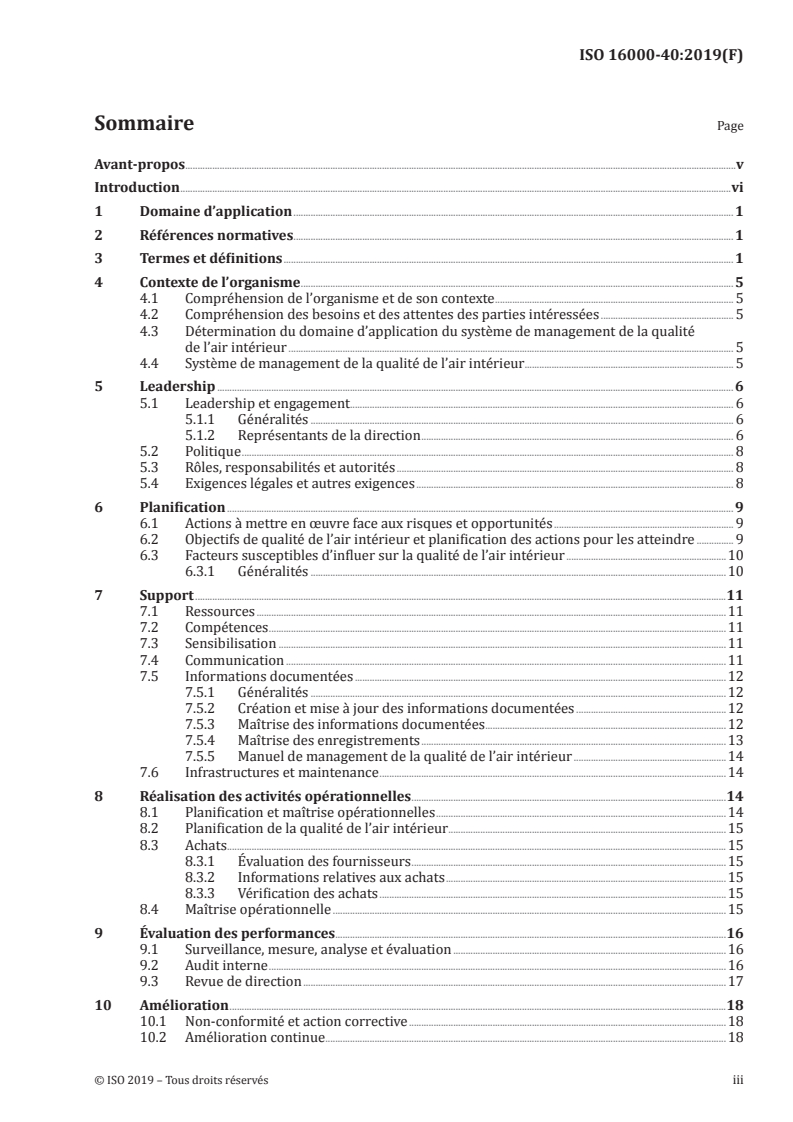
ISO 16000-40:2019 - Air intérieur — Partie 40: Système de management de la qualité de l'air intérieur/23/2019
Overview
ISO 16000-40:2019, Indoor Air - Part 40: Indoor Air Quality Management System, establishes requirements for implementing and maintaining a structured indoor air quality management system (IAQMS). Developed by the International Organization for Standardization (ISO), this standard provides a comprehensive framework for organizations seeking to control, improve, and demonstrate conformity in indoor air quality (IAQ) management across various types of buildings and facilities.
ISO 16000-40:2019 is applicable to any organization-public or private, large or small-that manages indoor environments, except those used exclusively for industrial or agricultural purposes. The standard is designed to protect the health, comfort, and wellbeing of regular occupants, such as employees, clients, and visitors, by encouraging a systematic approach to IAQ management and continual improvement.
Key Topics
ISO 16000-40:2019 covers essential components of an effective indoor air quality management system, including:
Context of the Organization
Identifying internal and external factors that can impact IAQ, and recognizing the requirements and expectations of all interested parties, such as occupants and stakeholders.Leadership and Commitment
Ensuring top management involvement, establishment of IAQ policy, assignment of clear roles and responsibilities, and allocation of necessary resources.Planning
Setting measurable IAQ objectives, identifying risks and opportunities, and establishing action plans to achieve consistent air quality improvements.Support
Determining resource requirements, ensuring staff competence through training, promoting awareness, managing internal and external communications, and maintaining documented information.Operation
Operational planning, routine assessments, procurement controls, and proactive building maintenance to prevent and address IAQ issues.Performance Evaluation
Monitoring and measuring IAQ, conducting internal audits, and reviewing management system effectiveness to drive continual improvement.Improvement
Implementing corrective actions in response to nonconformities and fostering a culture of continuous enhancement in IAQ performance.
Applications
Organizations implementing ISO 16000-40:2019 can expect practical benefits in diverse indoor environments, such as:
- Commercial Buildings: Offices, shopping centers, hotels, and other spaces where occupant health and comfort are priorities.
- Healthcare Facilities: Hospitals and clinics, where maintaining optimal indoor air directly impacts patient outcomes and helps prevent infections.
- Educational Institutions: Schools and universities, where clean air supports learning and reduces absenteeism.
- Public Buildings: Government offices, transportation hubs, and recreational centers, ensuring safe and pleasant environments for users and staff.
By adopting an IAQ management system aligned with this standard, organizations can:
- Demonstrate legal and regulatory compliance regarding indoor air quality.
- Enhance the wellbeing and productivity of building occupants.
- Reduce health risks associated with indoor air pollution.
- Respond effectively to occupant complaints or identified IAQ issues.
- Promote a proactive, systematic approach to facility maintenance and air quality improvement.
Related Standards
ISO 16000-40:2019 is part of a comprehensive series focusing on indoor air. Other relevant standards include:
- ISO 16000 series: Covering various aspects of indoor air quality assessment, including sampling strategies, analytical methods, and specific pollutants.
- ISO 16813: Building environment design-guidelines for energy efficiency and indoor air quality in buildings.
- ISO 9001: Quality management systems-providing guidance on general management system practices, useful when integrated with IAQMS.
Organizations may also reference relevant regional regulations and guidelines to ensure comprehensive compliance and effective IAQ management.
Keywords: ISO 16000-40:2019, indoor air quality management system, IAQMS, indoor air standard, air quality policy, building health, ISO indoor air, IAQ compliance, facilities management, IAQ continual improvement.
Relations
- Effective Date
- 18-Nov-2023
Buy Documents
ISO 16000-40:2019 - Indoor air — Part 40: Indoor air quality management system/23/2019
ISO 16000-40:2019 - Air intérieur — Partie 40: Système de management de la qualité de l'air intérieur/23/2019
Get Certified
Connect with accredited certification bodies for this standard

CIS Institut d.o.o.
Personal Protective Equipment (PPE) certification body. Notified Body NB-2890 for EU Regulation 2016/425 PPE.

Kiwa BDA Testing
Building and construction product certification.
Kmetijski inštitut Slovenije
Agricultural Institute of Slovenia. Soil testing, plant health, agricultural product analysis.
Sponsored listings
Frequently Asked Questions
ISO 16000-40:2019 is a standard published by the International Organization for Standardization (ISO). Its full title is "Indoor air — Part 40: Indoor air quality management system". This standard covers: This document specifies requirements for an indoor air quality management system. It is applicable to any organization that wishes to: a) establish a system for the management of the quality of indoor air; b) implement, maintain and continually improve the indoor air quality management system; c) ensure conformity to the indoor air quality management system; d) demonstrate conformity to this document. It is applicable to the indoor environments of all kinds of facilities, installations and buildings, except those that are exclusively dedicated to industrial and/or agriculture activities. It is applicable to all types of indoor environments occupied by all kinds of persons, including regular users, clients, workers, etc.
This document specifies requirements for an indoor air quality management system. It is applicable to any organization that wishes to: a) establish a system for the management of the quality of indoor air; b) implement, maintain and continually improve the indoor air quality management system; c) ensure conformity to the indoor air quality management system; d) demonstrate conformity to this document. It is applicable to the indoor environments of all kinds of facilities, installations and buildings, except those that are exclusively dedicated to industrial and/or agriculture activities. It is applicable to all types of indoor environments occupied by all kinds of persons, including regular users, clients, workers, etc.
ISO 16000-40:2019 is classified under the following ICS (International Classification for Standards) categories: 13.040.20 - Ambient atmospheres. The ICS classification helps identify the subject area and facilitates finding related standards.
ISO 16000-40:2019 has the following relationships with other standards: It is inter standard links to ISO 16000-40:2019/Amd 1:2024. Understanding these relationships helps ensure you are using the most current and applicable version of the standard.
ISO 16000-40:2019 is available in PDF format for immediate download after purchase. The document can be added to your cart and obtained through the secure checkout process. Digital delivery ensures instant access to the complete standard document.
Standards Content (Sample)
SLOVENSKI STANDARD
01-december-2019
Notranji zrak - 40. del: Sistem vodenja kakovosti notranjega zraka
Indoor air - Part 40: Indoor air quality management system
Air intérieur - Partie 40: Système de management de la qualité de l'air intérieur
Ta slovenski standard je istoveten z: ISO 16000-40:2019
ICS:
13.040.20 Kakovost okoljskega zraka Ambient atmospheres
2003-01.Slovenski inštitut za standardizacijo. Razmnoževanje celote ali delov tega standarda ni dovoljeno.
INTERNATIONAL ISO
STANDARD 16000-40
First edition
2019-07
Indoor air —
Part 40:
Indoor air quality management system
Air intérieur —
Partie 40: Système de management de la qualité de l'air intérieur
Reference number
©
ISO 2019
© ISO 2019
All rights reserved. Unless otherwise specified, or required in the context of its implementation, no part of this publication may
be reproduced or utilized otherwise in any form or by any means, electronic or mechanical, including photocopying, or posting
on the internet or an intranet, without prior written permission. Permission can be requested from either ISO at the address
below or ISO’s member body in the country of the requester.
ISO copyright office
CP 401 • Ch. de Blandonnet 8
CH-1214 Vernier, Geneva
Phone: +41 22 749 01 11
Fax: +41 22 749 09 47
Email: copyright@iso.org
Website: www.iso.org
Published in Switzerland
ii © ISO 2019 – All rights reserved
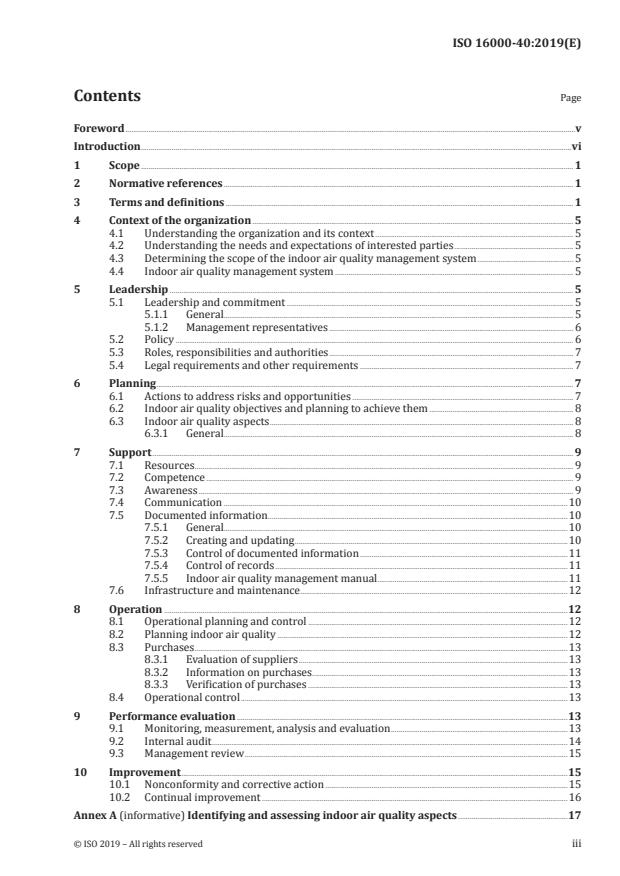
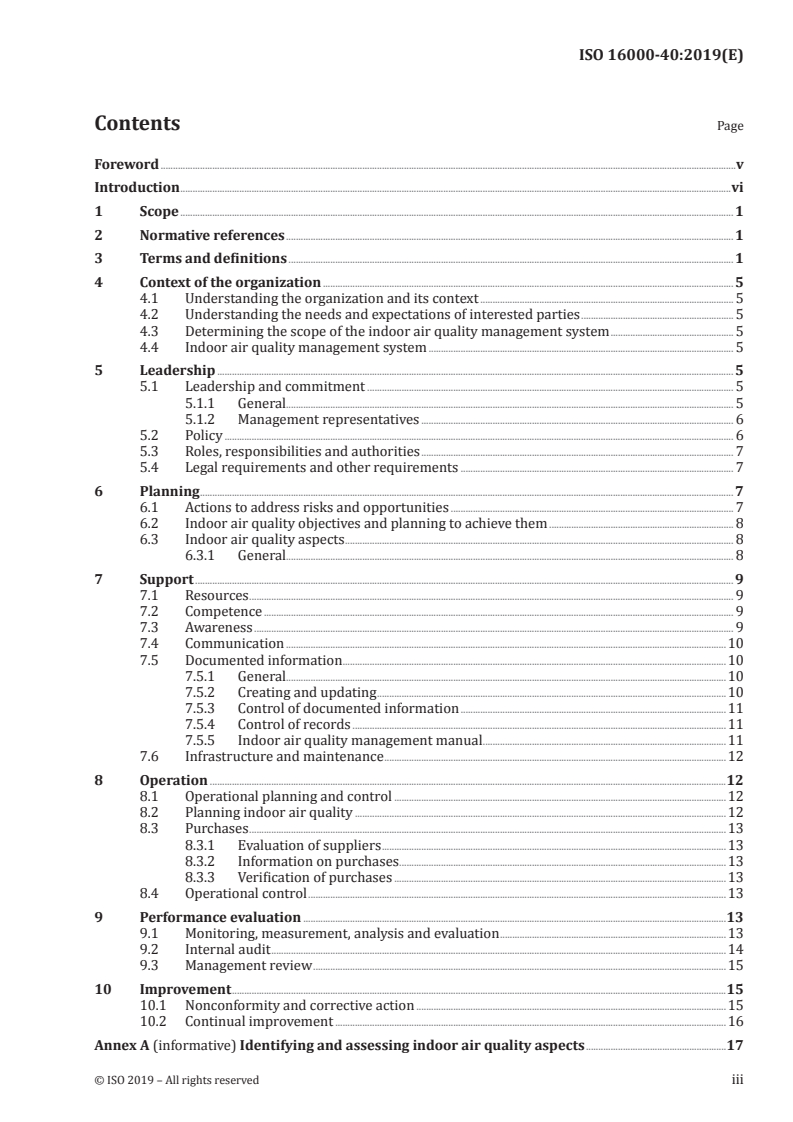
Contents Page
Foreword .v
Introduction .vi
1 Scope . 1
2 Normative references . 1
3 Terms and definitions . 1
4 Context of the organization . 5
4.1 Understanding the organization and its context . 5
4.2 Understanding the needs and expectations of interested parties . 5
4.3 Determining the scope of the indoor air quality management system . 5
4.4 Indoor air quality management system . 5
5 Leadership . 5
5.1 Leadership and commitment . 5
5.1.1 General. 5
5.1.2 Management representatives . 6
5.2 Policy . 6
5.3 Roles, responsibilities and authorities . 7
5.4 Legal requirements and other requirements . 7
6 Planning . 7
6.1 Actions to address risks and opportunities . 7
6.2 Indoor air quality objectives and planning to achieve them . 8
6.3 Indoor air quality aspects . 8
6.3.1 General. 8
7 Support . 9
7.1 Resources . 9
7.2 Competence . 9
7.3 Awareness . 9
7.4 Communication .10
7.5 Documented information .10
7.5.1 General.10
7.5.2 Creating and updating .10
7.5.3 Control of documented information .11
7.5.4 Control of records .11
7.5.5 Indoor air quality management manual .11
7.6 Infrastructure and maintenance .12
8 Operation .12
8.1 Operational planning and control .12
8.2 Planning indoor air quality .12
8.3 Purchases .13
8.3.1 Evaluation of suppliers .13
8.3.2 Information on purchases .13
8.3.3 Verification of purchases .13
8.4 Operational control .13
9 Performance evaluation .13
9.1 Monitoring, measurement, analysis and evaluation .13
9.2 Internal audit .14
9.3 Management review .15
10 Improvement .15
10.1 Nonconformity and corrective action .15
10.2 Continual improvement .16
Annex A (informative) Identifying and assessing indoor air quality aspects .17
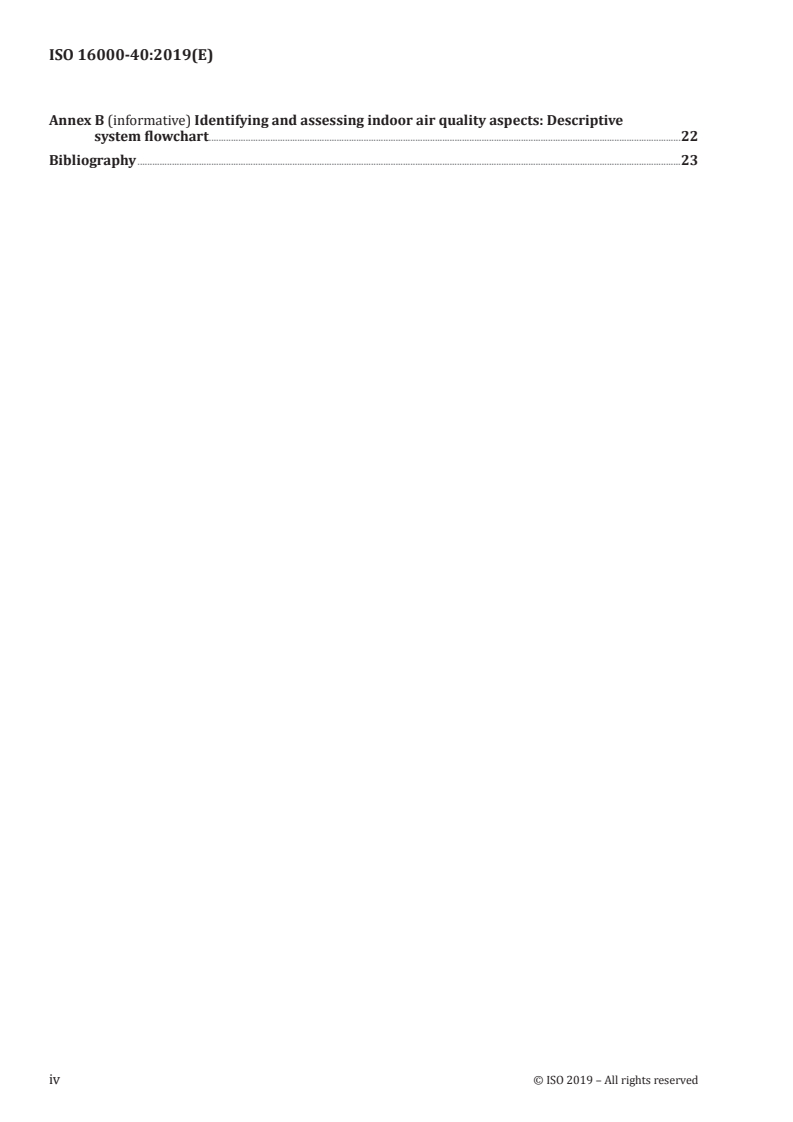
Annex B (informative) Identifying and assessing indoor air quality aspects: Descriptive
system flowchart .22
Bibliography .23
iv © ISO 2019 – All rights reserved
Foreword
ISO (the International Organization for Standardization) is a worldwide federation of national standards
bodies (ISO member bodies). The work of preparing International Standards is normally carried out
through ISO technical committees. Each member body interested in a subject for which a technical
committee has been established has the right to be represented on that committee. International
organizations, governmental and non-governmental, in liaison with ISO, also take part in the work.
ISO collaborates closely with the International Electrotechnical Commission (IEC) on all matters of
electrotechnical standardization.
The procedures used to develop this document and those intended for its further maintenance are
described in the ISO/IEC Directives, Part 1. In particular, the different approval criteria needed for the
different types of ISO documents should be noted. This document was drafted in accordance with the
editorial rules of the ISO/IEC Directives, Part 2 (see www .iso .org/directives).
Attention is drawn to the possibility that some of the elements of this document may be the subject of
patent rights. ISO shall not be held responsible for identifying any or all such patent rights. Details of
any patent rights identified during the development of the document will be in the Introduction and/or
on the ISO list of patent declarations received (see www .iso .org/patents).
Any trade name used in this document is information given for the convenience of users and does not
constitute an endorsement.
For an explanation of the voluntary nature of standards, the meaning of ISO specific terms and
expressions related to conformity assessment, as well as information about ISO’s adherence to the
World Trade Organization (WTO) principles in the Technical Barriers to Trade (TBT) see www .iso
.org/iso/foreword .html.
This document was prepared by Technical Committee ISO/TC 146, Air quality, Subcommittee SC 6,
Indoor air.
A list of all parts in the ISO 16000 series can be found on the ISO website.
Any feedback or questions on this document should be directed to the user’s national standards body. A
complete listing of these bodies can be found at www .iso .org/members .html.
Introduction
When not in the home urban populations spend most of the time indoors working in commercial
buildings, enjoy leisure time in hotels or shopping malls, or maybe using services in hospitals and
transportation centers among other types of facilities. There are many scientific studies showing that
special characteristics of indoor air pollution make enclosed spaces quite different from the outdoors
in terms of the quality of the air. There is a lot of knowledge about indoor air pollution, however, there
is a general lack of practical application of most of this information in the everyday life of the general
public, this document aims to help the managers of indoor built environments to apply protocols and
maintenance programs intended to enhance indoor air quality.
This document will help facility managers to apply protocols and maintenance processes designed to
enhance indoor air quality in their indoor spaces.
Controlling the quality of the indoor air can have enormous social benefits in terms of comfort and
health of the population, therefore enhancing productivity and minimizing absenteeism in commercial
premises as well as minimising nosocomial infections in hospital environments.
vi © ISO 2019 – All rights reserved
INTERNATIONAL STANDARD ISO 16000-40:2019(E)
Indoor air —
Part 40:
Indoor air quality management system
1 Scope
This document specifies requirements for an indoor air quality management system.
It is applicable to any organization that wishes to:
a) establish a system for the management of the quality of indoor air;
b) implement, maintain and continually improve the indoor air quality management system;
c) ensure conformity to the indoor air quality management system;
d) demonstrate conformity to this document.
It is applicable to the indoor environments of all kinds of facilities, installations and buildings, except
those that are exclusively dedicated to industrial and/or agriculture activities.
It is applicable to all types of indoor environments occupied by all kinds of persons, including regular
users, clients, workers, etc.
2 Normative references
There are no normative references in this document.
3 Terms and definitions
For the purposes of this document, the following terms and definitions apply.
ISO and IEC maintain terminological databases for use in standardization at the following addresses:
— ISO Online browsing platform: available at https: //www .iso .org/obp
— IEC Electropedia: available at http: //www .electropedia .org/
3.1
organization
person or group of people that has its own functions with responsibilities, authorities and relationships
to achieve its objectives (3.8)
Note 1 to entry: The concept of organization includes, but is not limited to sole-trader, company, corporation, firm,
enterprise, authority, partnership, charity or institution, or part or combination thereof, whether incorporated
or not, public or private.
Note 2 to entry: For organizations with more than one operating unit, a single operating unit may be defined as
an organization.
3.2
interested party
stakeholder
person or organization (3.1) that can affect, be affected by, or perceive itself to be affected by a decision
or activity
3.3
requirement
need or expectation that is stated, generally implied or obligatory
Note 1 to entry: “Generally implied” means that it is custom or common practice for the organization and
interested parties that the need or expectation under consideration is implied.
Note 2 to entry: A specified requirement is one that is stated, e.g. in documented information.
3.4
management system
set of interrelated or interacting elements of an organization (3.1) to establish policies (3.7) and
objectives (3.8) and processes (3.12) to achieve those objectives
Note 1 to entry: A management system can address a single discipline or several disciplines.
Note 2 to entry: The system elements include the organization’s structure, roles and responsibilities, planning
and operation.
Note 3 to entry: The scope of a management system can include the whole of the organization, specific and
identified functions of the organization, specific and identified sections of the organization, or one or more
functions across a group of organizations.
3.5
management
person or group of people who directs and controls an organization (3.1) at the highest level
Note 1 to entry: Management has the power to delegate authority and provide resources within the organization.
Note 2 to entry: If the scope of the management system (3.4) covers only part of an organization, then management
refers to those who direct and control that part of the organization.
3.6
effectiveness
extent to which planned activities are realized and planned results achieved
3.7
policy
intentions and direction of an organization (3.1), as formally expressed by its management (3.5)
3.8
objective
result to be achieved
Note 1 to entry: An objective can be strategic, tactical, or operational.
Note 2 to entry: Objectives can relate to different disciplines (such as financial, health and safety, and
environmental goals) and can apply at different levels [such as strategic, organization-wide, project, product and
process (3.12)].
Note 3 to entry: An objective can be expressed in other ways, e.g. as an intended outcome, a purpose, an
operational criterion, another objective, or by the use of other words with similar meaning (e.g. aim, goal, or
target).
Note 4 to entry: In the context of indoor air quality management system, indoor air quality objectives are set by
the organization, consistent with its policy, to achieve specific results.
2 © ISO 2019 – All rights reserved
3.9
risk
effect of uncertainty
Note 1 to entry: An effect is a deviation from the expected — positive or negative.
Note 2 to entry: Uncertainty is the state, even partial, of deficiency of information related to, understanding or
knowledge of, an event, its consequence, or likelihood.
Note 3 to entry: Risk is often characterized by reference to potential “events” (as defined in ISO Guide 73) and
“consequences” (as defined in ISO Guide 73), or a combination of these.
Note 4 to entry: Risk is often expressed in terms of a combination of the consequences of an event (including
changes in circumstances) and the associated “likelihood” (as defined in ISO Guide 73) of occurrence.
3.10
competence
ability to apply knowledge and skills to achieve intended results
3.11
documented information
information required to be controlled and maintained by an organization (3.1) and the medium on
which it is contained
Note 1 to entry: Documented information can be in any format and media, and from any source.
Note 2 to entry: Documented information can refer to:
— the management system (3.4), including related processes (3.12);
— information created in order for the organization to operate (documentation);
— evidence results achieved (records).
3.12
process
set of interrelated or interacting activities which transforms inputs into outputs
3.13
performance
measurable result
Note 1 to entry: Performance can relate either to quantitative or qualitative findings.
Note 2 to entry: Performance can relate to managing activities, processes (3.12), products (including services),
systems or organizations (3.1).
3.14
outsource
make an arrangement where an external organization (3.1) performs part of an organization’s function
or process (3.12)
Note 1 to entry: An external organization is outside the scope of the management system (3.4), although the
outsourced function or process is within the scope.
3.15
monitoring
determining the status of a system, a process (3.12) or an activity
Note 1 to entry: To determine the status, there can be a need to check, supervise or critically observe.
3.16
measurement
process (3.12) to determine a value
3.17
audit
systematic, independent and documented process (3.12) for obtaining audit evidence and evaluating it
objectively to determine the extent to which the audit criteria are fulfilled
Note 1 to entry: An audit can be an internal audit (first party) or an external audit (second party or third party),
and it can be a combined audit (combining two or more disciplines).
Note 2 to entry: An internal audit is conducted by the organization itself, or by an external party on its behalf.
Note 3 to entry: “Audit evidence” and “audit criteria” are defined in ISO 19011.
3.18
conformity
fulfilment of a requirement (3.3)
3.19
non conformity
non-fulfilment of a requirement (3.3)
3.20
corrective action
action to eliminate the cause(s) of a nonconformity (3.19) and to prevent recurrence
3.21
continual improvement
recurring activity to enhance performance (3.13)
3.22
indoor environment
environment delimited by the envelope of the enclosures for any use except those dedicated exclusively
to industrial and/or agricultural activities
[SOURCE: UNE 171330-1:2008]
3.23
indoor air quality aspect
elements of the site and its surroundings, activities and/or services of an organization that can interact
with indoor quality
[SOURCE: UNE 171330-1:2008]
3.24
indoor air quality
quality of air inside a building, described in terms of odour, physical parameters, chemical and biological
pollutants
Note 1 to entry: Indoor air quality is directly related to the ventilation rate, air distribution patterns and pollution
sources.
Note 2 to entry: Indoor air quality is important in ensuring human health, olfactory comfort and perceived
comfort.
Note 3 to entry: Adapted from ISO 16813:2006, 3.21. The definition has been simplified to refer to a building
in general, versus only non-industrial buildings, and the non-essential but relevant characteristics are now
referenced in notes.
4 © ISO 2019 – All rights reserved
4 Context of the organization
4.1 Understanding the organization and its context
The organization shall determine external and internal issues that are relevant to its purpose and that
affect its ability to achieve the intended outcome(s) of its indoor air quality management system.
4.2 Understanding the needs and expectations of interested parties
The organization shall determine:
a) the interested parties that are relevant to the indoor air quality management system;
b) the relevant requirements of these interested parties.
4.3 Determining the scope of the indoor air quality management system
The organization shall determine the boundaries and applicability of the indoor air quality management
system to establish its scope.
When determining this scope, the organization shall consider:
a) the external and internal issues referred to in 4.1;
b) the requirements referred to in 4.2.
The scope shall be available as documented information.
4.4 Indoor air quality management system
The organization shall establish, document, implement, maintain and continually improve an indoor air
quality management system, including the processes needed and their interactions, in accordance with
the requirements of this document. It shall determine how it will fulfil these requirements.
When an organization chooses to outsource any activity affecting conformity to these requirements,
the organization shall ensure control over such activities. The responsibilities and necessary controls
in such outsourced activities should be identified in the management system.
NOTE 1 An outsourced indoor air quality activity is one that the organization needs for its indoor air
management system and that it chooses to have performed by an external party.
NOTE 2 Ensuring control of outsourced activities does not absolve the organization of the responsibility to
conform to all requirements, including statutory and regulatory requirements.
5 Leadership
5.1 Leadership and commitment
5.1.1 General
Management shall demonstrate leadership and commitment with respect to the indoor air quality
management system by:
a) ensuring that the indoor air quality policies and indoor air quality objectives are established and
are compatible with the strategic direction of the organization;
b) ensuring the integration of the indoor air quality management system requirements into the
organization’s business processes;
c) ensuring that the resources needed for the indoor air quality management system are available;
d) communicating the importance of an effective indoor air quality management system and of
conforming to the indoor air quality management system requirements;
e) ensuring that the indoor air quality management system achieves its intended outcome(s);
f) directing and supporting persons to contribute to the effectiveness of the indoor air quality
management system;
g) promoting continual improvement;
h) supporting other relevant managerial roles to demonstrate their leadership as it applies to their
areas of responsibility;
i) carrying out management reviews.
NOTE Reference to “business” in this document can be interpreted broadly to mean those activities that are
core to the purposes of the organization’s existence.
5.1.2 Management representatives
5.1.2.1 The organization should define roles, responsibilities and authority. These should be
documented and communicated within the organization, to facilitate the effective management of indoor
air quality.
The organization shall establish the appropriate communication channels for:
a) internal communication between its various levels and functions;
b) receiving, documenting and responding to communications from external stakeholders (see 7.4).
It shall ensure that the effectiveness of the indoor air quality management system is communicated.
5.1.2.2 As part of measuring the performance of the indoor air quality management system, the
organization may periodically monitor the perception of users regarding the fulfilment of their indoor
air quality expectations, as well as the management of the organization’s related activities. If a decision
is taken to conduct periodic monitoring, the organization shall determine and document the methods for
obtaining and using this information.
5.1.2.3 Management shall appoint a member of the organization’s management who, irrespective of
other responsibilities, shall have the responsibility and authority to ensure:
a) the indoor air quality management system is established, implemented and maintained in
accordance with the requirements of this document;
b) reports are made to management on the performance of the management system review, including
recommendations for improvement;
c) ensure the promotion of awareness of management activities on indoor air quality at all levels of
the organization.
NOTE The responsibility of the management representative can include liaison with external parties on
matters relating to the indoor air quality management system.
5.2 Policy
5.2.1 Management shall establish an indoor air quality policy that:
a) is appropriate to the purpose of the organization;
6 © ISO 2019 – All rights reserved
b) provides a framework for setting indoor air quality objectives;
c) take into account applicable legal requirements and other requirements to which the organization
subscribes;
d) includes a commitment to continual improvement of the indoor air quality management system.
5.2.2 The policy of indoor air quality management shall:
a) be available as documented information;
b) be implemented, maintained and reviewed for continuing suitability;
c) be communicated within the organization;
d) be available to interested parties, as appropriate.
5.3 Roles, responsibilities and authorities
Management shall ensure that the responsibilities and authorities for relevant roles are assigned and
communicated within the organization.
Management shall assign the responsibility and authority for:
a) ensuring that the indoor air quality management system conforms to the requirements of this
document;
b) reporting on the performance of the indoor air quality management system to management.
5.4 Legal requirements and other requirements
Management shall ensure that there is a procedure established, implemented and maintained:
a) to identify and access the applicable legal requirements and other requirements to which the
organization subscribes related to indoor air quality;
b) to determine how these requirements apply to proceedings relating to indoor air quality and the
indoor air quality management system.
The organization shall keep this information updated. It shall communicate relevant information on
legal requirements and other requirements to its staff and stakeholders.
6 Planning
6.1 Actions to address risks and opportunities
6.1.1 When planning for the indoor air quality management system, the organization shall consider
the issues referred to in 4.1 and the requirements referred to in 4.2 and determine the risks and
opportunities that need to be addressed to:
a) give assurance that the indoor air quality management system can achieve its intended outcome(s);
b) prevent, or reduce, undesired effects;
c) achieve continual improvement.
6.1.2 The organization shall plan:
a) actions to address these risks and opportunities;
b) how to:
1) integrate and implement the actions into its indoor air quality management system processes;
2) evaluate the effectiveness of these actions.
6.2 Indoor air quality objectives and planning to achieve them
6.2.1 The organization shall establish indoor air quality objectives at relevant functions and levels.
The indoor air quality objectives shall:
a) be consistent with the indoor air quality policy;
b) be measurable (if practicable);
c) take into account applicable legal requirements and other requirements to which the organization
subscribes;
d) be monitored;
e) be communicated;
f) be updated as appropriate.
The organization shall also consider its technological, financial and operational requirements, and the
expectations of its users.
The organization shall retain documented information on the indoor air quality objectives.
6.2.2 When planning how to achieve its indoor air quality objectives, the organization shall determine:
a) what will be done, including establishing, documenting, implementing and maintaining processes;
b) what resources will be required;
c) who will be responsible, including the allocation of responsibility and authority for achieving
objectives at relevant functions and levels of the organization;
d) when it will be completed, including the means and timetable for achieving the objectives;
e) how the results will be evaluated, including reviewing them periodically to ensure that they remain
relevant to and consistent with the objectives of indoor air quality.
6.3 Indoor air quality aspects
6.3.1 General
The organization shall establish, implement and maintain a procedure to identify, determine the risk
level and, if neccessary, assess indoor air quality aspects.
The organization shall ensure that the results of these assessments are considered and, where
appropriate, provide input for:
a) the objectives for managing indoor air quality;
b) the management processes of indoor air quality;
c) determining the requirements for changes and remodelling of facilities;
d) identifying appropriate resources;
8 © ISO 2019 – All rights reserved
e) identifying training needs;
f) developing operational controls.
The organization shall document this information and keep it updated.
NOTE See Annex A and Annex B for guidance on identifying and assessing aspects.
Indoor air quality aspects to be considered may include, but are not limited to:
a) the location of the building;
b) the uses, activities and building layout;
c) construction materials;
d) building installations: air conditioning, water, sanitation, fuel tanks, vertical transportation and
communication between plants, electricity and telecommunications, parking areas and special
purpose rooms, etc;
e) building maintenance;
f) the renovation and remediation of the building.
Complaints from occupants and, if available, epidemiological data (for example, rate of abseenteism)
shall be recorded and addressed, as applicable.
7 Support
7.1 Resources
The organization shall determine and provide the resources needed for the establishment,
implementation, maintenance and continual improvement of the indoor air quality management system.
7.2 Competence
The organization shall:
a) determine the necessary competence of person(s) doing work under its control that affects its
indoor air quality performance;
b) ensure that these persons are competent on the basis of appropriate education, training, or
experience;
c) where applicable, take actions, such as training, to acquire the necessary competence, and evaluate
the effectiveness of the actions taken;
d) ensure that person(s) are aware of the importance of conformity to the policies, objectives and
processes of the indoor air quality management system;
e) retain appropriate documented information as evidence of competence, including records of
education, training, skills and experience.
NOTE Applicable actions can include, for example, the provision of training to, the mentoring of, or the re-
assignment of currently employed persons; or the hiring or contracting of competent persons.
7.3 Awareness
Persons doing work under the organization’s control shall be aware of:
a) the indoor air quality policy;
b) their contribution to the effectiveness of the indoor air quality management system, including the
benefits of improved indoor air quality performance;
c) the implications of not conforming with the indoor air quality management system requirements.
7.4 Communication
The organization shall determine the internal and external communications relevant to the indoor air
quality management system, including:
a) on what it will communicate;
b) when to communicate;
c) with whom to communicate;
d) how to communicate.
7.5 Documented information
7.5.1 General
The organization’s indoor air quality management system shall include:
a) documented information required by this document, including:
1) a manual of indoor air quality management (see 7.5.5);
2) the policy, objectives and processes for indoor air quality;
3) the procedure and records;
d) documented information, including records, determined by the organization as being necessary
for the effectiveness of the indoor air quality management system, i.e. that will ensure the effective
planning, operation and control of its activities in the field of indoor air quality.
NOTE 1 The extent of documented information for an indoor air quality management system can differ from
one organization to another due to:
— the size of organization and its type of activities, processes, products and services;
— the complexity of processes and their interactions;
— the competence of persons.
NOTE 2 Diagrams, drawings, technical memorandums, technical specifications of the facilities, etc., are
considered a key factor in ensuring indoor air quality, as such information can help to locate potential sources of
pollutants and to define appropriate sampling strategies.
7.5.2 Creating and updating
When creating and updating documented information the organization shall ensure appropriate:
a) identification and description (e.g. a title, date, author, or, reference number);
b) format (e.g. language, software version, graphics) and media (e.g. paper, electronic);
c) review and approval for suitability and adequacy.
10 © ISO 2019 – All rights reserved
7.5.3 Control of documented information
7.5.3.1 Documented information required by the indoor air quality management system and by this
document shall be controlled to ensure:
a) it is available and suitable for use, where and when it is needed;
b) it is adequately protected (e.g. from loss of confidentiality, improper use, or loss of integrity).
Records are a special type of document and shall be controlled in accordance with the requirements of
4.2 and 7.5.4.
7.5.3.2 For the control of documented information, the organization shall address the following
activities, as applicable:
a) establish, implement and maintain a procedure to define the control needed;
b) distribution, access, retrieval and use:
1) review and approve documents for adequacy prior to issue;
2) review, update and re-approve documents as necessary;
c) storage and preservation, including preservation of legibility:
1) ensure that documents remain legible and readily identifiable;
d) control of changes (e.g. version control):
1) ensure that changes are identified as well as the current revision status of documents;
2) ensure relevant versions on applicable documents are available at points of use;
e) retention and disposition:
1) prevent the unintended use of obsolete documents and apply suitable identification if they are
retained for any reason.
Documented information of external origin determined by the organization to be necessary for the
planning and operation of the indoor air quality management system shall be identified, as appropriate,
and controlled.
NOTE Access can imply a decision regarding the permission to view the documented information only, or
the permission and authority to view and change the documented information.
7.5.4 Control of records
The organization shall establish and maintain records necessary to demonstrate conformity to the
requirements of this document and the results achieved.
The organization shall establish, implement and maintain a procedure to define the controls needed for
the identification, storage, protection, retrieval, retention time and disposition of records.
Records shall remain legible, readily identifiable and retrievable. The documentation and records in
electronic and digital form should be tamper-proof. Regular backups should be performed.
7.5.5 Indoor air quality management manual
The organization shall establish, implement and maintain a manual for managing indoor air quality,
including:
a) the scope of the management system of the organization;
b) the facilities to which the management system is applicable;
c) a description of the actions and activities relating to indoor air quality that take place in the
organization applicable to the management system;
d) the procedures established for or referring to the management system;
e) processes of reviewing and improving.
7.6 Infrastructure and maintenance
The organization shall determine, provide and maintain the infrastructure needed to achieve conformity
to the requirements for indoor air quality. The infrastructure may include, but is not limited to:
a) air-conditioning and ventilation facilities;
b) water facilities;
c) sanitary facilities;
d) air leakage.
This infrastructure shall be properly maintained, including cleaning, disinfecting, sanitary treatments
and pest control, in such a way that indoor air quality is not compromised.
Records shall be retained to provide evidence of these activities.
8 Operation
8.1 Operational planning and control
The organization shall plan, implement and control the processes needed to meet requirements, and to
implement the actions determined in 6.1, by:
a) establishing criteria for the processes;
b) implementing control of the processes in accordance with the criteria;
c) keeping documented information to the extent necessary to have confidence that the processes
have been carried out as planned.
The organization shall control planned changes and review the consequences of unintended changes,
taking action to mitigate any adverse effects, as necessary.
The organization shall ensure that outsourced processes are controlled.
8.2 Planning indoor air quality
The organization shall plan and develop activities and processes necessary to control indoor air quality.
The planning shall consider, at least, the following:
a) processes for preventing indoor air quality problems during the renovation of facilities;
b) inspection and maintenance processes, including technical actions;
c) cleaning and disinfection processes;
d) processes of action against incidents that may affect indoor air quality (e.g. emergencies such as
flooding, fires);
e) sampling processes for parameters to control indoor air quality;
12 © ISO 2019 – All rights reserved
f) analytical and data control processes.
8.3 Purchases
8.3.1 Evaluation of suppliers
The organization shall ensure that outsourcing and/or products acquired that may affect indoor air
quality fulfil specified purchase requirements.
The organization shall evaluate and select suppliers based on their ability to supply products and/
or services according to the requirements of the organization. Criteria should be established for
the selection, evaluation and re-evaluation of suppliers. Records shall be retained of the results of
evaluations and any necessary actions arising from them.
8.3.2 Information on purchases
The purchasing information shall describe the work to be subcontracted or the product to be purchased,
including, where appropriate:
a) the requirements for approval of the purchase;
b) the req
...
INTERNATIONAL ISO
STANDARD 16000-40
First edition
2019-07
Indoor air —
Part 40:
Indoor air quality management system
Air intérieur —
Partie 40: Système de management de la qualité de l'air intérieur
Reference number
©
ISO 2019
© ISO 2019
All rights reserved. Unless otherwise specified, or required in the context of its implementation, no part of this publication may
be reproduced or utilized otherwise in any form or by any means, electronic or mechanical, including photocopying, or posting
on the internet or an intranet, without prior written permission. Permission can be requested from either ISO at the address
below or ISO’s member body in the country of the requester.
ISO copyright office
CP 401 • Ch. de Blandonnet 8
CH-1214 Vernier, Geneva
Phone: +41 22 749 01 11
Fax: +41 22 749 09 47
Email: copyright@iso.org
Website: www.iso.org
Published in Switzerland
ii © ISO 2019 – All rights reserved
Contents Page
Foreword .v
Introduction .vi
1 Scope . 1
2 Normative references . 1
3 Terms and definitions . 1
4 Context of the organization . 5
4.1 Understanding the organization and its context . 5
4.2 Understanding the needs and expectations of interested parties . 5
4.3 Determining the scope of the indoor air quality management system . 5
4.4 Indoor air quality management system . 5
5 Leadership . 5
5.1 Leadership and commitment . 5
5.1.1 General. 5
5.1.2 Management representatives . 6
5.2 Policy . 6
5.3 Roles, responsibilities and authorities . 7
5.4 Legal requirements and other requirements . 7
6 Planning . 7
6.1 Actions to address risks and opportunities . 7
6.2 Indoor air quality objectives and planning to achieve them . 8
6.3 Indoor air quality aspects . 8
6.3.1 General. 8
7 Support . 9
7.1 Resources . 9
7.2 Competence . 9
7.3 Awareness . 9
7.4 Communication .10
7.5 Documented information .10
7.5.1 General.10
7.5.2 Creating and updating .10
7.5.3 Control of documented information .11
7.5.4 Control of records .11
7.5.5 Indoor air quality management manual .11
7.6 Infrastructure and maintenance .12
8 Operation .12
8.1 Operational planning and control .12
8.2 Planning indoor air quality .12
8.3 Purchases .13
8.3.1 Evaluation of suppliers .13
8.3.2 Information on purchases .13
8.3.3 Verification of purchases .13
8.4 Operational control .13
9 Performance evaluation .13
9.1 Monitoring, measurement, analysis and evaluation .13
9.2 Internal audit .14
9.3 Management review .15
10 Improvement .15
10.1 Nonconformity and corrective action .15
10.2 Continual improvement .16
Annex A (informative) Identifying and assessing indoor air quality aspects .17
Annex B (informative) Identifying and assessing indoor air quality aspects: Descriptive
system flowchart .22
Bibliography .23
iv © ISO 2019 – All rights reserved
Foreword
ISO (the International Organization for Standardization) is a worldwide federation of national standards
bodies (ISO member bodies). The work of preparing International Standards is normally carried out
through ISO technical committees. Each member body interested in a subject for which a technical
committee has been established has the right to be represented on that committee. International
organizations, governmental and non-governmental, in liaison with ISO, also take part in the work.
ISO collaborates closely with the International Electrotechnical Commission (IEC) on all matters of
electrotechnical standardization.
The procedures used to develop this document and those intended for its further maintenance are
described in the ISO/IEC Directives, Part 1. In particular, the different approval criteria needed for the
different types of ISO documents should be noted. This document was drafted in accordance with the
editorial rules of the ISO/IEC Directives, Part 2 (see www .iso .org/directives).
Attention is drawn to the possibility that some of the elements of this document may be the subject of
patent rights. ISO shall not be held responsible for identifying any or all such patent rights. Details of
any patent rights identified during the development of the document will be in the Introduction and/or
on the ISO list of patent declarations received (see www .iso .org/patents).
Any trade name used in this document is information given for the convenience of users and does not
constitute an endorsement.
For an explanation of the voluntary nature of standards, the meaning of ISO specific terms and
expressions related to conformity assessment, as well as information about ISO’s adherence to the
World Trade Organization (WTO) principles in the Technical Barriers to Trade (TBT) see www .iso
.org/iso/foreword .html.
This document was prepared by Technical Committee ISO/TC 146, Air quality, Subcommittee SC 6,
Indoor air.
A list of all parts in the ISO 16000 series can be found on the ISO website.
Any feedback or questions on this document should be directed to the user’s national standards body. A
complete listing of these bodies can be found at www .iso .org/members .html.
Introduction
When not in the home urban populations spend most of the time indoors working in commercial
buildings, enjoy leisure time in hotels or shopping malls, or maybe using services in hospitals and
transportation centers among other types of facilities. There are many scientific studies showing that
special characteristics of indoor air pollution make enclosed spaces quite different from the outdoors
in terms of the quality of the air. There is a lot of knowledge about indoor air pollution, however, there
is a general lack of practical application of most of this information in the everyday life of the general
public, this document aims to help the managers of indoor built environments to apply protocols and
maintenance programs intended to enhance indoor air quality.
This document will help facility managers to apply protocols and maintenance processes designed to
enhance indoor air quality in their indoor spaces.
Controlling the quality of the indoor air can have enormous social benefits in terms of comfort and
health of the population, therefore enhancing productivity and minimizing absenteeism in commercial
premises as well as minimising nosocomial infections in hospital environments.
vi © ISO 2019 – All rights reserved
INTERNATIONAL STANDARD ISO 16000-40:2019(E)
Indoor air —
Part 40:
Indoor air quality management system
1 Scope
This document specifies requirements for an indoor air quality management system.
It is applicable to any organization that wishes to:
a) establish a system for the management of the quality of indoor air;
b) implement, maintain and continually improve the indoor air quality management system;
c) ensure conformity to the indoor air quality management system;
d) demonstrate conformity to this document.
It is applicable to the indoor environments of all kinds of facilities, installations and buildings, except
those that are exclusively dedicated to industrial and/or agriculture activities.
It is applicable to all types of indoor environments occupied by all kinds of persons, including regular
users, clients, workers, etc.
2 Normative references
There are no normative references in this document.
3 Terms and definitions
For the purposes of this document, the following terms and definitions apply.
ISO and IEC maintain terminological databases for use in standardization at the following addresses:
— ISO Online browsing platform: available at https: //www .iso .org/obp
— IEC Electropedia: available at http: //www .electropedia .org/
3.1
organization
person or group of people that has its own functions with responsibilities, authorities and relationships
to achieve its objectives (3.8)
Note 1 to entry: The concept of organization includes, but is not limited to sole-trader, company, corporation, firm,
enterprise, authority, partnership, charity or institution, or part or combination thereof, whether incorporated
or not, public or private.
Note 2 to entry: For organizations with more than one operating unit, a single operating unit may be defined as
an organization.
3.2
interested party
stakeholder
person or organization (3.1) that can affect, be affected by, or perceive itself to be affected by a decision
or activity
3.3
requirement
need or expectation that is stated, generally implied or obligatory
Note 1 to entry: “Generally implied” means that it is custom or common practice for the organization and
interested parties that the need or expectation under consideration is implied.
Note 2 to entry: A specified requirement is one that is stated, e.g. in documented information.
3.4
management system
set of interrelated or interacting elements of an organization (3.1) to establish policies (3.7) and
objectives (3.8) and processes (3.12) to achieve those objectives
Note 1 to entry: A management system can address a single discipline or several disciplines.
Note 2 to entry: The system elements include the organization’s structure, roles and responsibilities, planning
and operation.
Note 3 to entry: The scope of a management system can include the whole of the organization, specific and
identified functions of the organization, specific and identified sections of the organization, or one or more
functions across a group of organizations.
3.5
management
person or group of people who directs and controls an organization (3.1) at the highest level
Note 1 to entry: Management has the power to delegate authority and provide resources within the organization.
Note 2 to entry: If the scope of the management system (3.4) covers only part of an organization, then management
refers to those who direct and control that part of the organization.
3.6
effectiveness
extent to which planned activities are realized and planned results achieved
3.7
policy
intentions and direction of an organization (3.1), as formally expressed by its management (3.5)
3.8
objective
result to be achieved
Note 1 to entry: An objective can be strategic, tactical, or operational.
Note 2 to entry: Objectives can relate to different disciplines (such as financial, health and safety, and
environmental goals) and can apply at different levels [such as strategic, organization-wide, project, product and
process (3.12)].
Note 3 to entry: An objective can be expressed in other ways, e.g. as an intended outcome, a purpose, an
operational criterion, another objective, or by the use of other words with similar meaning (e.g. aim, goal, or
target).
Note 4 to entry: In the context of indoor air quality management system, indoor air quality objectives are set by
the organization, consistent with its policy, to achieve specific results.
2 © ISO 2019 – All rights reserved
3.9
risk
effect of uncertainty
Note 1 to entry: An effect is a deviation from the expected — positive or negative.
Note 2 to entry: Uncertainty is the state, even partial, of deficiency of information related to, understanding or
knowledge of, an event, its consequence, or likelihood.
Note 3 to entry: Risk is often characterized by reference to potential “events” (as defined in ISO Guide 73) and
“consequences” (as defined in ISO Guide 73), or a combination of these.
Note 4 to entry: Risk is often expressed in terms of a combination of the consequences of an event (including
changes in circumstances) and the associated “likelihood” (as defined in ISO Guide 73) of occurrence.
3.10
competence
ability to apply knowledge and skills to achieve intended results
3.11
documented information
information required to be controlled and maintained by an organization (3.1) and the medium on
which it is contained
Note 1 to entry: Documented information can be in any format and media, and from any source.
Note 2 to entry: Documented information can refer to:
— the management system (3.4), including related processes (3.12);
— information created in order for the organization to operate (documentation);
— evidence results achieved (records).
3.12
process
set of interrelated or interacting activities which transforms inputs into outputs
3.13
performance
measurable result
Note 1 to entry: Performance can relate either to quantitative or qualitative findings.
Note 2 to entry: Performance can relate to managing activities, processes (3.12), products (including services),
systems or organizations (3.1).
3.14
outsource
make an arrangement where an external organization (3.1) performs part of an organization’s function
or process (3.12)
Note 1 to entry: An external organization is outside the scope of the management system (3.4), although the
outsourced function or process is within the scope.
3.15
monitoring
determining the status of a system, a process (3.12) or an activity
Note 1 to entry: To determine the status, there can be a need to check, supervise or critically observe.
3.16
measurement
process (3.12) to determine a value
3.17
audit
systematic, independent and documented process (3.12) for obtaining audit evidence and evaluating it
objectively to determine the extent to which the audit criteria are fulfilled
Note 1 to entry: An audit can be an internal audit (first party) or an external audit (second party or third party),
and it can be a combined audit (combining two or more disciplines).
Note 2 to entry: An internal audit is conducted by the organization itself, or by an external party on its behalf.
Note 3 to entry: “Audit evidence” and “audit criteria” are defined in ISO 19011.
3.18
conformity
fulfilment of a requirement (3.3)
3.19
non conformity
non-fulfilment of a requirement (3.3)
3.20
corrective action
action to eliminate the cause(s) of a nonconformity (3.19) and to prevent recurrence
3.21
continual improvement
recurring activity to enhance performance (3.13)
3.22
indoor environment
environment delimited by the envelope of the enclosures for any use except those dedicated exclusively
to industrial and/or agricultural activities
[SOURCE: UNE 171330-1:2008]
3.23
indoor air quality aspect
elements of the site and its surroundings, activities and/or services of an organization that can interact
with indoor quality
[SOURCE: UNE 171330-1:2008]
3.24
indoor air quality
quality of air inside a building, described in terms of odour, physical parameters, chemical and biological
pollutants
Note 1 to entry: Indoor air quality is directly related to the ventilation rate, air distribution patterns and pollution
sources.
Note 2 to entry: Indoor air quality is important in ensuring human health, olfactory comfort and perceived
comfort.
Note 3 to entry: Adapted from ISO 16813:2006, 3.21. The definition has been simplified to refer to a building
in general, versus only non-industrial buildings, and the non-essential but relevant characteristics are now
referenced in notes.
4 © ISO 2019 – All rights reserved
4 Context of the organization
4.1 Understanding the organization and its context
The organization shall determine external and internal issues that are relevant to its purpose and that
affect its ability to achieve the intended outcome(s) of its indoor air quality management system.
4.2 Understanding the needs and expectations of interested parties
The organization shall determine:
a) the interested parties that are relevant to the indoor air quality management system;
b) the relevant requirements of these interested parties.
4.3 Determining the scope of the indoor air quality management system
The organization shall determine the boundaries and applicability of the indoor air quality management
system to establish its scope.
When determining this scope, the organization shall consider:
a) the external and internal issues referred to in 4.1;
b) the requirements referred to in 4.2.
The scope shall be available as documented information.
4.4 Indoor air quality management system
The organization shall establish, document, implement, maintain and continually improve an indoor air
quality management system, including the processes needed and their interactions, in accordance with
the requirements of this document. It shall determine how it will fulfil these requirements.
When an organization chooses to outsource any activity affecting conformity to these requirements,
the organization shall ensure control over such activities. The responsibilities and necessary controls
in such outsourced activities should be identified in the management system.
NOTE 1 An outsourced indoor air quality activity is one that the organization needs for its indoor air
management system and that it chooses to have performed by an external party.
NOTE 2 Ensuring control of outsourced activities does not absolve the organization of the responsibility to
conform to all requirements, including statutory and regulatory requirements.
5 Leadership
5.1 Leadership and commitment
5.1.1 General
Management shall demonstrate leadership and commitment with respect to the indoor air quality
management system by:
a) ensuring that the indoor air quality policies and indoor air quality objectives are established and
are compatible with the strategic direction of the organization;
b) ensuring the integration of the indoor air quality management system requirements into the
organization’s business processes;
c) ensuring that the resources needed for the indoor air quality management system are available;
d) communicating the importance of an effective indoor air quality management system and of
conforming to the indoor air quality management system requirements;
e) ensuring that the indoor air quality management system achieves its intended outcome(s);
f) directing and supporting persons to contribute to the effectiveness of the indoor air quality
management system;
g) promoting continual improvement;
h) supporting other relevant managerial roles to demonstrate their leadership as it applies to their
areas of responsibility;
i) carrying out management reviews.
NOTE Reference to “business” in this document can be interpreted broadly to mean those activities that are
core to the purposes of the organization’s existence.
5.1.2 Management representatives
5.1.2.1 The organization should define roles, responsibilities and authority. These should be
documented and communicated within the organization, to facilitate the effective management of indoor
air quality.
The organization shall establish the appropriate communication channels for:
a) internal communication between its various levels and functions;
b) receiving, documenting and responding to communications from external stakeholders (see 7.4).
It shall ensure that the effectiveness of the indoor air quality management system is communicated.
5.1.2.2 As part of measuring the performance of the indoor air quality management system, the
organization may periodically monitor the perception of users regarding the fulfilment of their indoor
air quality expectations, as well as the management of the organization’s related activities. If a decision
is taken to conduct periodic monitoring, the organization shall determine and document the methods for
obtaining and using this information.
5.1.2.3 Management shall appoint a member of the organization’s management who, irrespective of
other responsibilities, shall have the responsibility and authority to ensure:
a) the indoor air quality management system is established, implemented and maintained in
accordance with the requirements of this document;
b) reports are made to management on the performance of the management system review, including
recommendations for improvement;
c) ensure the promotion of awareness of management activities on indoor air quality at all levels of
the organization.
NOTE The responsibility of the management representative can include liaison with external parties on
matters relating to the indoor air quality management system.
5.2 Policy
5.2.1 Management shall establish an indoor air quality policy that:
a) is appropriate to the purpose of the organization;
6 © ISO 2019 – All rights reserved
b) provides a framework for setting indoor air quality objectives;
c) take into account applicable legal requirements and other requirements to which the organization
subscribes;
d) includes a commitment to continual improvement of the indoor air quality management system.
5.2.2 The policy of indoor air quality management shall:
a) be available as documented information;
b) be implemented, maintained and reviewed for continuing suitability;
c) be communicated within the organization;
d) be available to interested parties, as appropriate.
5.3 Roles, responsibilities and authorities
Management shall ensure that the responsibilities and authorities for relevant roles are assigned and
communicated within the organization.
Management shall assign the responsibility and authority for:
a) ensuring that the indoor air quality management system conforms to the requirements of this
document;
b) reporting on the performance of the indoor air quality management system to management.
5.4 Legal requirements and other requirements
Management shall ensure that there is a procedure established, implemented and maintained:
a) to identify and access the applicable legal requirements and other requirements to which the
organization subscribes related to indoor air quality;
b) to determine how these requirements apply to proceedings relating to indoor air quality and the
indoor air quality management system.
The organization shall keep this information updated. It shall communicate relevant information on
legal requirements and other requirements to its staff and stakeholders.
6 Planning
6.1 Actions to address risks and opportunities
6.1.1 When planning for the indoor air quality management system, the organization shall consider
the issues referred to in 4.1 and the requirements referred to in 4.2 and determine the risks and
opportunities that need to be addressed to:
a) give assurance that the indoor air quality management system can achieve its intended outcome(s);
b) prevent, or reduce, undesired effects;
c) achieve continual improvement.
6.1.2 The organization shall plan:
a) actions to address these risks and opportunities;
b) how to:
1) integrate and implement the actions into its indoor air quality management system processes;
2) evaluate the effectiveness of these actions.
6.2 Indoor air quality objectives and planning to achieve them
6.2.1 The organization shall establish indoor air quality objectives at relevant functions and levels.
The indoor air quality objectives shall:
a) be consistent with the indoor air quality policy;
b) be measurable (if practicable);
c) take into account applicable legal requirements and other requirements to which the organization
subscribes;
d) be monitored;
e) be communicated;
f) be updated as appropriate.
The organization shall also consider its technological, financial and operational requirements, and the
expectations of its users.
The organization shall retain documented information on the indoor air quality objectives.
6.2.2 When planning how to achieve its indoor air quality objectives, the organization shall determine:
a) what will be done, including establishing, documenting, implementing and maintaining processes;
b) what resources will be required;
c) who will be responsible, including the allocation of responsibility and authority for achieving
objectives at relevant functions and levels of the organization;
d) when it will be completed, including the means and timetable for achieving the objectives;
e) how the results will be evaluated, including reviewing them periodically to ensure that they remain
relevant to and consistent with the objectives of indoor air quality.
6.3 Indoor air quality aspects
6.3.1 General
The organization shall establish, implement and maintain a procedure to identi
...
INTERNATIONAL ISO
STANDARD 16000-40
First edition
2019-07
Indoor air —
Part 40:
Indoor air quality management system
Air intérieur —
Partie 40: Système de management de la qualité de l'air intérieur
Reference number
©
ISO 2019
© ISO 2019
All rights reserved. Unless otherwise specified, or required in the context of its implementation, no part of this publication may
be reproduced or utilized otherwise in any form or by any means, electronic or mechanical, including photocopying, or posting
on the internet or an intranet, without prior written permission. Permission can be requested from either ISO at the address
below or ISO’s member body in the country of the requester.
ISO copyright office
CP 401 • Ch. de Blandonnet 8
CH-1214 Vernier, Geneva
Phone: +41 22 749 01 11
Fax: +41 22 749 09 47
Email: copyright@iso.org
Website: www.iso.org
Published in Switzerland
ii © ISO 2019 – All rights reserved
Contents Page
Foreword .v
Introduction .vi
1 Scope . 1
2 Normative references . 1
3 Terms and definitions . 1
4 Context of the organization . 5
4.1 Understanding the organization and its context . 5
4.2 Understanding the needs and expectations of interested parties . 5
4.3 Determining the scope of the indoor air quality management system . 5
4.4 Indoor air quality management system . 5
5 Leadership . 5
5.1 Leadership and commitment . 5
5.1.1 General. 5
5.1.2 Management representatives . 6
5.2 Policy . 6
5.3 Roles, responsibilities and authorities . 7
5.4 Legal requirements and other requirements . 7
6 Planning . 7
6.1 Actions to address risks and opportunities . 7
6.2 Indoor air quality objectives and planning to achieve them . 8
6.3 Indoor air quality aspects . 8
6.3.1 General. 8
7 Support . 9
7.1 Resources . 9
7.2 Competence . 9
7.3 Awareness . 9
7.4 Communication .10
7.5 Documented information .10
7.5.1 General.10
7.5.2 Creating and updating .10
7.5.3 Control of documented information .11
7.5.4 Control of records .11
7.5.5 Indoor air quality management manual .11
7.6 Infrastructure and maintenance .12
8 Operation .12
8.1 Operational planning and control .12
8.2 Planning indoor air quality .12
8.3 Purchases .13
8.3.1 Evaluation of suppliers .13
8.3.2 Information on purchases .13
8.3.3 Verification of purchases .13
8.4 Operational control .13
9 Performance evaluation .13
9.1 Monitoring, measurement, analysis and evaluation .13
9.2 Internal audit .14
9.3 Management review .15
10 Improvement .15
10.1 Nonconformity and corrective action .15
10.2 Continual improvement .16
Annex A (informative) Identifying and assessing indoor air quality aspects .17
Annex B (informative) Identifying and assessing indoor air quality aspects: Descriptive
system flowchart .22
Bibliography .23
iv © ISO 2019 – All rights reserved
Foreword
ISO (the International Organization for Standardization) is a worldwide federation of national standards
bodies (ISO member bodies). The work of preparing International Standards is normally carried out
through ISO technical committees. Each member body interested in a subject for which a technical
committee has been established has the right to be represented on that committee. International
organizations, governmental and non-governmental, in liaison with ISO, also take part in the work.
ISO collaborates closely with the International Electrotechnical Commission (IEC) on all matters of
electrotechnical standardization.
The procedures used to develop this document and those intended for its further maintenance are
described in the ISO/IEC Directives, Part 1. In particular, the different approval criteria needed for the
different types of ISO documents should be noted. This document was drafted in accordance with the
editorial rules of the ISO/IEC Directives, Part 2 (see www .iso .org/directives).
Attention is drawn to the possibility that some of the elements of this document may be the subject of
patent rights. ISO shall not be held responsible for identifying any or all such patent rights. Details of
any patent rights identified during the development of the document will be in the Introduction and/or
on the ISO list of patent declarations received (see www .iso .org/patents).
Any trade name used in this document is information given for the convenience of users and does not
constitute an endorsement.
For an explanation of the voluntary nature of standards, the meaning of ISO specific terms and
expressions related to conformity assessment, as well as information about ISO’s adherence to the
World Trade Organization (WTO) principles in the Technical Barriers to Trade (TBT) see www .iso
.org/iso/foreword .html.
This document was prepared by Technical Committee ISO/TC 146, Air quality, Subcommittee SC 6,
Indoor air.
A list of all parts in the ISO 16000 series can be found on the ISO website.
Any feedback or questions on this document should be directed to the user’s national standards body. A
complete listing of these bodies can be found at www .iso .org/members .html.
Introduction
When not in the home urban populations spend most of the time indoors working in commercial
buildings, enjoy leisure time in hotels or shopping malls, or maybe using services in hospitals and
transportation centers among other types of facilities. There are many scientific studies showing that
special characteristics of indoor air pollution make enclosed spaces quite different from the outdoors
in terms of the quality of the air. There is a lot of knowledge about indoor air pollution, however, there
is a general lack of practical application of most of this information in the everyday life of the general
public, this document aims to help the managers of indoor built environments to apply protocols and
maintenance programs intended to enhance indoor air quality.
This document will help facility managers to apply protocols and maintenance processes designed to
enhance indoor air quality in their indoor spaces.
Controlling the quality of the indoor air can have enormous social benefits in terms of comfort and
health of the population, therefore enhancing productivity and minimizing absenteeism in commercial
premises as well as minimising nosocomial infections in hospital environments.
vi © ISO 2019 – All rights reserved
INTERNATIONAL STANDARD ISO 16000-40:2019(E)
Indoor air —
Part 40:
Indoor air quality management system
1 Scope
This document specifies requirements for an indoor air quality management system.
It is applicable to any organization that wishes to:
a) establish a system for the management of the quality of indoor air;
b) implement, maintain and continually improve the indoor air quality management system;
c) ensure conformity to the indoor air quality management system;
d) demonstrate conformity to this document.
It is applicable to the indoor environments of all kinds of facilities, installations and buildings, except
those that are exclusively dedicated to industrial and/or agriculture activities.
It is applicable to all types of indoor environments occupied by all kinds of persons, including regular
users, clients, workers, etc.
2 Normative references
There are no normative references in this document.
3 Terms and definitions
For the purposes of this document, the following terms and definitions apply.
ISO and IEC maintain terminological databases for use in standardization at the following addresses:
— ISO Online browsing platform: available at https: //www .iso .org/obp
— IEC Electropedia: available at http: //www .electropedia .org/
3.1
organization
person or group of people that has its own functions with responsibilities, authorities and relationships
to achieve its objectives (3.8)
Note 1 to entry: The concept of organization includes, but is not limited to sole-trader, company, corporation, firm,
enterprise, authority, partnership, charity or institution, or part or combination thereof, whether incorporated
or not, public or private.
Note 2 to entry: For organizations with more than one operating unit, a single operating unit may be defined as
an organization.
3.2
interested party
stakeholder
person or organization (3.1) that can affect, be affected by, or perceive itself to be affected by a decision
or activity
3.3
requirement
need or expectation that is stated, generally implied or obligatory
Note 1 to entry: “Generally implied” means that it is custom or common practice for the organization and
interested parties that the need or expectation under consideration is implied.
Note 2 to entry: A specified requirement is one that is stated, e.g. in documented information.
3.4
management system
set of interrelated or interacting elements of an organization (3.1) to establish policies (3.7) and
objectives (3.8) and processes (3.12) to achieve those objectives
Note 1 to entry: A management system can address a single discipline or several disciplines.
Note 2 to entry: The system elements include the organization’s structure, roles and responsibilities, planning
and operation.
Note 3 to entry: The scope of a management system can include the whole of the organization, specific and
identified functions of the organization, specific and identified sections of the organization, or one or more
functions across a group of organizations.
3.5
management
person or group of people who directs and controls an organization (3.1) at the highest level
Note 1 to entry: Management has the power to delegate authority and provide resources within the organization.
Note 2 to entry: If the scope of the management system (3.4) covers only part of an organization, then management
refers to those who direct and control that part of the organization.
3.6
effectiveness
extent to which planned activities are realized and planned results achieved
3.7
policy
intentions and direction of an organization (3.1), as formally expressed by its management (3.5)
3.8
objective
result to be achieved
Note 1 to entry: An objective can be strategic, tactical, or operational.
Note 2 to entry: Objectives can relate to different disciplines (such as financial, health and safety, and
environmental goals) and can apply at different levels [such as strategic, organization-wide, project, product and
process (3.12)].
Note 3 to entry: An objective can be expressed in other ways, e.g. as an intended outcome, a purpose, an
operational criterion, another objective, or by the use of other words with similar meaning (e.g. aim, goal, or
target).
Note 4 to entry: In the context of indoor air quality management system, indoor air quality objectives are set by
the organization, consistent with its policy, to achieve specific results.
2 © ISO 2019 – All rights reserved
3.9
risk
effect of uncertainty
Note 1 to entry: An effect is a deviation from the expected — positive or negative.
Note 2 to entry: Uncertainty is the state, even partial, of deficiency of information related to, understanding or
knowledge of, an event, its consequence, or likelihood.
Note 3 to entry: Risk is often characterized by reference to potential “events” (as defined in ISO Guide 73) and
“consequences” (as defined in ISO Guide 73), or a combination of these.
Note 4 to entry: Risk is often expressed in terms of a combination of the consequences of an event (including
changes in circumstances) and the associated “likelihood” (as defined in ISO Guide 73) of occurrence.
3.10
competence
ability to apply knowledge and skills to achieve intended results
3.11
documented information
information required to be controlled and maintained by an organization (3.1) and the medium on
which it is contained
Note 1 to entry: Documented information can be in any format and media, and from any source.
Note 2 to entry: Documented information can refer to:
— the management system (3.4), including related processes (3.12);
— information created in order for the organization to operate (documentation);
— evidence results achieved (records).
3.12
process
set of interrelated or interacting activities which transforms inputs into outputs
3.13
performance
measurable result
Note 1 to entry: Performance can relate either to quantitative or qualitative findings.
Note 2 to entry: Performance can relate to managing activities, processes (3.12), products (including services),
systems or organizations (3.1).
3.14
outsource
make an arrangement where an external organization (3.1) performs part of an organization’s function
or process (3.12)
Note 1 to entry: An external organization is outside the scope of the management system (3.4), although the
outsourced function or process is within the scope.
3.15
monitoring
determining the status of a system, a process (3.12) or an activity
Note 1 to entry: To determine the status, there can be a need to check, supervise or critically observe.
3.16
measurement
process (3.12) to determine a value
3.17
audit
systematic, independent and documented process (3.12) for obtaining audit evidence and evaluating it
objectively to determine the extent to which the audit criteria are fulfilled
Note 1 to entry: An audit can be an internal audit (first party) or an external audit (second party or third party),
and it can be a combined audit (combining two or more disciplines).
Note 2 to entry: An internal audit is conducted by the organization itself, or by an external party on its behalf.
Note 3 to entry: “Audit evidence” and “audit criteria” are defined in ISO 19011.
3.18
conformity
fulfilment of a requirement (3.3)
3.19
non conformity
non-fulfilment of a requirement (3.3)
3.20
corrective action
action to eliminate the cause(s) of a nonconformity (3.19) and to prevent recurrence
3.21
continual improvement
recurring activity to enhance performance (3.13)
3.22
indoor environment
environment delimited by the envelope of the enclosures for any use except those dedicated exclusively
to industrial and/or agricultural activities
[SOURCE: UNE 171330-1:2008]
3.23
indoor air quality aspect
elements of the site and its surroundings, activities and/or services of an organization that can interact
with indoor quality
[SOURCE: UNE 171330-1:2008]
3.24
indoor air quality
quality of air inside a building, described in terms of odour, physical parameters, chemical and biological
pollutants
Note 1 to entry: Indoor air quality is directly related to the ventilation rate, air distribution patterns and pollution
sources.
Note 2 to entry: Indoor air quality is important in ensuring human health, olfactory comfort and perceived
comfort.
Note 3 to entry: Adapted from ISO 16813:2006, 3.21. The definition has been simplified to refer to a building
in general, versus only non-industrial buildings, and the non-essential but relevant characteristics are now
referenced in notes.
4 © ISO 2019 – All rights reserved
4 Context of the organization
4.1 Understanding the organization and its context
The organization shall determine external and internal issues that are relevant to its purpose and that
affect its ability to achieve the intended outcome(s) of its indoor air quality management system.
4.2 Understanding the needs and expectations of interested parties
The organization shall determine:
a) the interested parties that are relevant to the indoor air quality management system;
b) the relevant requirements of these interested parties.
4.3 Determining the scope of the indoor air quality management system
The organization shall determine the boundaries and applicability of the indoor air quality management
system to establish its scope.
When determining this scope, the organization shall consider:
a) the external and internal issues referred to in 4.1;
b) the requirements referred to in 4.2.
The scope shall be available as documented information.
4.4 Indoor air quality management system
The organization shall establish, document, implement, maintain and continually improve an indoor air
quality management system, including the processes needed and their interactions, in accordance with
the requirements of this document. It shall determine how it will fulfil these requirements.
When an organization chooses to outsource any activity affecting conformity to these requirements,
the organization shall ensure control over such activities. The responsibilities and necessary controls
in such outsourced activities should be identified in the management system.
NOTE 1 An outsourced indoor air quality activity is one that the organization needs for its indoor air
management system and that it chooses to have performed by an external party.
NOTE 2 Ensuring control of outsourced activities does not absolve the organization of the responsibility to
conform to all requirements, including statutory and regulatory requirements.
5 Leadership
5.1 Leadership and commitment
5.1.1 General
Management shall demonstrate leadership and commitment with respect to the indoor air quality
management system by:
a) ensuring that the indoor air quality policies and indoor air quality objectives are established and
are compatible with the strategic direction of the organization;
b) ensuring the integration of the indoor air quality management system requirements into the
organization’s business processes;
c) ensuring that the resources needed for the indoor air quality management system are available;
d) communicating the importance of an effective indoor air quality management system and of
conforming to the indoor air quality management system requirements;
e) ensuring that the indoor air quality management system achieves its intended outcome(s);
f) directing and supporting persons to contribute to the effectiveness of the indoor air quality
management system;
g) promoting continual improvement;
h) supporting other relevant managerial roles to demonstrate their leadership as it applies to their
areas of responsibility;
i) carrying out management reviews.
NOTE Reference to “business” in this document can be interpreted broadly to mean those activities that are
core to the purposes of the organization’s existence.
5.1.2 Management representatives
5.1.2.1 The organization should define roles, responsibilities and authority. These should be
documented and communicated within the organization, to facilitate the effective management of indoor
air quality.
The organization shall establish the appropriate communication channels for:
a) internal communication between its various levels and functions;
b) receiving, documenting and responding to communications from external stakeholders (see 7.4).
It shall ensure that the effectiveness of the indoor air quality management system is communicated.
5.1.2.2 As part of measuring the performance of the indoor air quality management system, the
organization may periodically monitor the perception of users regarding the fulfilment of their indoor
air quality expectations, as well as the management of the organization’s related activities. If a decision
is taken to conduct periodic monitoring, the organization shall determine and document the methods for
obtaining and using this information.
5.1.2.3 Management shall appoint a member of the organization’s management who, irrespective of
other responsibilities, shall have the responsibility and authority to ensure:
a) the indoor air quality management system is established, implemented and maintained in
accordance with the requirements of this document;
b) reports are made to management on the performance of the management system review, including
recommendations for improvement;
c) ensure the promotion of awareness of management activities on indoor air quality at all levels of
the organization.
NOTE The responsibility of the management representative can include liaison with external parties on
matters relating to the indoor air quality management system.
5.2 Policy
5.2.1 Management shall establish an indoor air quality policy that:
a) is appropriate to the purpose of the organization;
6 © ISO 2019 – All rights reserved
b) provides a framework for setting indoor air quality objectives;
c) take into account applicable legal requirements and other requirements to which the organization
subscribes;
d) includes a commitment to continual improvement of the indoor air quality management system.
5.2.2 The policy of indoor air quality management shall:
a) be available as documented information;
b) be implemented, maintained and reviewed for continuing suitability;
c) be communicated within the organization;
d) be available to interested parties, as appropriate.
5.3 Roles, responsibilities and authorities
Management shall ensure that the responsibilities and authorities for relevant roles are assigned and
communicated within the organization.
Management shall assign the responsibility and authority for:
a) ensuring that the indoor air quality management system conforms to the requirements of this
document;
b) reporting on the performance of the indoor air quality management system to management.
5.4 Legal requirements and other requirements
Management shall ensure that there is a procedure established, implemented and maintained:
a) to identify and access the applicable legal requirements and other requirements to which the
organization subscribes related to indoor air quality;
b) to determine how these requirements apply to proceedings relating to indoor air quality and the
indoor air quality management system.
The organization shall keep this information updated. It shall communicate relevant information on
legal requirements and other requirements to its staff and stakeholders.
6 Planning
6.1 Actions to address risks and opportunities
6.1.1 When planning for the indoor air quality management system, the organization shall consider
the issues referred to in 4.1 and the requirements referred to in 4.2 and determine the risks and
opportunities that need to be addressed to:
a) give assurance that the indoor air quality management system can achieve its intended outcome(s);
b) prevent, or reduce, undesired effects;
c) achieve continual improvement.
6.1.2 The organization shall plan:
a) actions to address these risks and opportunities;
b) how to:
1) integrate and implement the actions into its indoor air quality management system processes;
2) evaluate the effectiveness of these actions.
6.2 Indoor air quality objectives and planning to achieve them
6.2.1 The organization shall establish indoor air quality objectives at relevant functions and levels.
The indoor air quality objectives shall:
a) be consistent with the indoor air quality policy;
b) be measurable (if practicable);
c) take into account applicable legal requirements and other requirements to which the organization
subscribes;
d) be monitored;
e) be communicated;
f) be updated as appropriate.
The organization shall also consider its technological, financial and operational requirements, and the
expectations of its users.
The organization shall retain documented information on the indoor air quality objectives.
6.2.2 When planning how to achieve its indoor air quality objectives, the organization shall determine:
a) what will be done, including establishing, documenting, implementing and maintaining processes;
b) what resources will be required;
c) who will be responsible, including the allocation of responsibility and authority for achieving
objectives at relevant functions and levels of the organization;
d) when it will be completed, including the means and timetable for achieving the objectives;
e) how the results will be evaluated, including reviewing them periodically to ensure that they remain
relevant to and consistent with the objectives of indoor air quality.
6.3 Indoor air quality aspects
6.3.1 General
The organization shall establish, implement and maintain a procedure to identi
...
NORME ISO
INTERNATIONALE 16000-40
Première édition
2019-07
Air intérieur —
Partie 40:
Système de management de la qualité
de l'air intérieur
Indoor air —
Part 40: Indoor air quality management system
Numéro de référence
©
ISO 2019
DOCUMENT PROTÉGÉ PAR COPYRIGHT
© ISO 2019
Tous droits réservés. Sauf prescription différente ou nécessité dans le contexte de sa mise en œuvre, aucune partie de cette
publication ne peut être reproduite ni utilisée sous quelque forme que ce soit et par aucun procédé, électronique ou mécanique,
y compris la photocopie, ou la diffusion sur l’internet ou sur un intranet, sans autorisation écrite préalable. Une autorisation peut
être demandée à l’ISO à l’adresse ci-après ou au comité membre de l’ISO dans le pays du demandeur.
ISO copyright office
Case postale 401 • Ch. de Blandonnet 8
CH-1214 Vernier, Genève
Tél.: +41 22 749 01 11
Fax: +41 22 749 09 47
E-mail: copyright@iso.org
Web: www.iso.org
Publié en Suisse
ii © ISO 2019 – Tous droits réservés
Sommaire Page
Avant-propos .v
Introduction .vi
1 Domaine d’application . 1
2 Références normatives . 1
3 Termes et définitions . 1
4 Contexte de l’organisme . 5
4.1 Compréhension de l’organisme et de son contexte . 5
4.2 Compréhension des besoins et des attentes des parties intéressées . 5
4.3 Détermination du domaine d’application du système de management de la qualité
de l’air intérieur . 5
4.4 Système de management de la qualité de l’air intérieur . 5
5 Leadership . 6
5.1 Leadership et engagement. 6
5.1.1 Généralités . 6
5.1.2 Représentants de la direction . 6
5.2 Politique . 8
5.3 Rôles, responsabilités et autorités . 8
5.4 Exigences légales et autres exigences . 8
6 Planification . 9
6.1 Actions à mettre en œuvre face aux risques et opportunités . 9
6.2 Objectifs de qualité de l’air intérieur et planification des actions pour les atteindre . 9
6.3 Facteurs susceptibles d’influer sur la qualité de l’air intérieur .10
6.3.1 Généralités .10
7 Support .11
7.1 Ressources .11
7.2 Compétences .11
7.3 Sensibilisation .11
7.4 Communication .11
7.5 Informations documentées .12
7.5.1 Généralités .12
7.5.2 Création et mise à jour des informations documentées .12
7.5.3 Maîtrise des informations documentées .12
7.5.4 Maîtrise des enregistrements .13
7.5.5 Manuel de management de la qualité de l’air intérieur .14
7.6 Infrastructures et maintenance .14
8 Réalisation des activités opérationnelles .14
8.1 Planification et maîtrise opérationnelles .14
8.2 Planification de la qualité de l’air intérieur .15
8.3 Achats .15
8.3.1 Évaluation des fournisseurs .15
8.3.2 Informations relatives aux achats .15
8.3.3 Vérification des achats .15
8.4 Maîtrise opérationnelle .15
9 Évaluation des performances .16
9.1 Surveillance, mesure, analyse et évaluation .16
9.2 Audit interne .16
9.3 Revue de direction .17
10 Amélioration .18
10.1 Non-conformité et action corrective .18
10.2 Amélioration continue .18
Annexe A (informative) Identification et évaluation des facteurs susceptibles d’influer sur
la qualité de l’air intérieur .19
Annexe B (informative) Identification et évaluation des facteurs susceptibles d’influer sur
la qualité de l’air intérieur: organigramme descriptif du système .25
Bibliographie .26
iv © ISO 2019 – Tous droits réservés
Avant-propos
L’ISO (Organisation internationale de normalisation) est une fédération mondiale d’organismes
nationaux de normalisation (comités membres de l’ISO). L’élaboration des Normes internationales est
en général confiée aux comités techniques de l’ISO. Chaque comité membre intéressé par une étude
a le droit de faire partie du comité technique créé à cet effet. Les organisations internationales,
gouvernementales et non gouvernementales, en liaison avec l’ISO participent également aux travaux.
L’ISO collabore étroitement avec la Commission électrotechnique internationale (IEC) en ce qui
concerne la normalisation électrotechnique.
Les procédures utilisées pour élaborer le présent document et celles destinées à sa mise à jour sont
décrites dans les Directives ISO/IEC, Partie 1. Il convient, en particulier de prendre note des différents
critères d’approbation requis pour les différents types de documents ISO. Le présent document a été
rédigé conformément aux règles de rédaction données dans les Directives ISO/IEC, Partie 2 (voir www
.iso .org/directives).
L’attention est attirée sur le fait que certains des éléments du présent document peuvent faire l’objet de
droits de propriété intellectuelle ou de droits analogues. L’ISO ne saurait être tenue pour responsable
de ne pas avoir identifié de tels droits de propriété et averti de leur existence. Les détails concernant
les références aux droits de propriété intellectuelle ou autres droits analogues identifiés lors de
l’élaboration du document sont indiqués dans l’Introduction et/ou dans la liste des déclarations de
brevets reçues par l’ISO (voir www .iso .org/brevets).
Les appellations commerciales éventuellement mentionnées dans le présent document sont données
pour information, par souci de commodité, à l’intention des utilisateurs et ne sauraient constituer un
engagement.
Pour une explication de la nature volontaire des normes, la signification des termes et expressions
spécifiques de l’ISO liés à l’évaluation de la conformité, ou pour toute information au sujet de l’adhésion
de l’ISO aux principes de l’Organisation mondiale du commerce (OMC) concernant les obstacles
techniques au commerce (OTC), voir le lien suivant: www .iso .org/iso/fr/avant -propos.
Le présent document a été élaboré par le comité technique ISO/TC 146, Qualité de l’air, sous-comité SC 6,
Air intérieur.
Une liste de toutes les parties de la série ISO 16000 se trouve sur le site web de l’ISO.
Il convient que l’utilisateur adresse tout retour d’information ou toute question concernant le présent
document à l’organisme national de normalisation de son pays. Une liste exhaustive desdits organismes
se trouve à l’adresse www .iso .org/fr/members .html.
Introduction
Lorsqu’elles ne sont pas à leur domicile, les populations urbaines passent la plupart du temps à
l’intérieur, à travailler dans des bâtiments commerciaux, à profiter de leur temps libre dans des hôtels
ou des centres commerciaux, ou éventuellement à utiliser les services des hôpitaux et des centres de
transport parmi d’autres types d’installations. De nombreuses études scientifiques montrent que des
caractéristiques particulières de la pollution de l’air intérieur rendent les espaces clos assez différents
de l’extérieur en termes de qualité de l’air. Bien que les connaissances sur la pollution de l’air intérieur
soient vastes, l’application pratique de la plupart de ces informations dans la vie quotidienne du grand
public fait généralement défaut. Le présent document vise à aider les gestionnaires des environnements
bâtis intérieurs à appliquer des protocoles et des programmes de maintenance destinés à améliorer la
qualité de l’air intérieur.
Le présent document aidera les gestionnaires des installations à appliquer des protocoles et des
processus de maintenance conçus pour améliorer la qualité de l’air intérieur dans leurs espaces
intérieurs.
Le contrôle de la qualité de l’air intérieur peut avoir d’énormes bénéfices sociaux en termes de confort
et de santé de la population, améliorant ainsi la productivité et réduisant l’absentéisme dans les locaux
commerciaux ainsi que les infections nosocomiales dans les environnements hospitaliers.
vi © ISO 2019 – Tous droits réservés
NORME INTERNATIONALE ISO 16000-40:2019(F)
Air intérieur —
Partie 40:
Système de management de la qualité de l'air intérieur
1 Domaine d’application
Le présent document spécifie les exigences relatives à un système de management de la qualité de l’air
intérieur.
Il s’applique à tout organisme souhaitant:
a) établir un système de management de la qualité de l’air intérieur;
b) mettre en œuvre, tenir à jour et améliorer en continu un système de management de la qualité de
l’air intérieur;
c) assurer la conformité au système de management de la qualité de l’air intérieur;
d) démontrer sa conformité au présent document.
Il s’applique aux environnements intérieurs de tous les types d’infrastructures, installations et
bâtiments, excepté ceux qui sont exclusivement dédiés à des activités industrielles et/ou agricoles.
Il s’applique à tous les types d’environnements intérieurs occupés par tous les types de personnes, y
compris les utilisateurs réguliers, les clients, les travailleurs, etc.
2 Références normatives
Le présent document ne contient aucune référence normative.
3 Termes et définitions
Pour les besoins du présent document, les termes et définitions suivants s’appliquent.
L’ISO et l’IEC tiennent à jour des bases de données terminologiques destinées à être utilisées en
normalisation, consultables aux adresses suivantes:
— ISO Online browsing platform: disponible à l’adresse https: //www .iso .org/obp;
— IEC Electropedia: disponible à l’adresse http: //www .electropedia .org/.
3.1
organisme
personne ou groupe de personnes ayant sa propre structure fonctionnelle avec des responsabilités,
autorités et relations en vue d’atteindre ses objectifs (3.8)
Note 1 à l'article: Le concept d’organisme comprend mais n’est pas limité à travailleur indépendant, compagnie,
société, firme, entreprise, autorité, partenariat, organisation caritative ou institution, ou une partie ou une
combinaison des entités précédentes, à responsabilité limitée ou d’un autre statut, de droit public ou privé.
Note 2 à l'article: Toute unité opérationnelle d’un organisme composé de plusieurs unités peut être définie comme
un organisme.
3.2
partie intéressée
partie prenante
personne ou organisme (3.1) qui peut soit influer sur une décision ou une activité, soit être influencé ou
s’estimer influencé par une décision ou une activité
3.3
exigence
besoin ou attente formulé, généralement implicite ou obligatoire
Note 1 à l'article: «Généralement implicite» signifie qu’il est habituel ou courant, pour l’organisme et les parties
intéressées, que le besoin ou l’attente en question soit implicite.
Note 2 à l'article: Une exigence spécifiée est une exigence formulée, par exemple une information documentée.
3.4
système de management
ensemble d’éléments corrélés ou en interaction d’un organisme (3.1), utilisés pour établir des politiques
(3.7), des objectifs (3.8) et des processus (3.12) de façon à atteindre lesdits objectifs
Note 1 à l'article: Un système de management peut traiter d’un seul ou de plusieurs domaines.
Note 2 à l'article: Les éléments du système de management comprennent la structure, les rôles et responsabilités,
la planification et le fonctionnement de l’organisme.
Note 3 à l'article: Le domaine d’application d’un système de management peut comprendre l’ensemble de
l’organisme, des fonctions ou des sections spécifiques et identifiées de l’organisme, ou une ou plusieurs fonctions
dans un groupe d’organismes.
3.5
direction
personne ou groupe de personnes qui oriente et dirige un organisme (3.1) au plus haut niveau
Note 1 à l'article: La direction a le pouvoir de déléguer son autorité et de fournir des ressources au sein de
l’organisme.
Note 2 à l'article: Si le domaine d’application du système de management (3.4) ne couvre qu’une partie de
l’organisme, alors la direction s’adresse à ceux qui orientent et dirigent cette partie de l’organisme.
3.6
efficacité
niveau de réalisation des activités planifiées et d’obtention des résultats escomptés
3.7
politique
intentions et orientations d’un organisme (3.1), telles qu’elles sont officiellement formulées par sa
direction (3.5)
3.8
objectif
résultat à atteindre
Note 1 à l'article: Un objectif peut être stratégique, tactique ou opérationnel.
Note 2 à l'article: Les objectifs peuvent se rapporter à différentes disciplines (telles que la finance, la santé et la
sécurité, et les buts environnementaux) et ils peuvent s’appliquer à divers niveaux [tels que stratégie, organisme
dans son ensemble, projet, produit et processus (3.12)].
Note 3 à l'article: Un objectif peut être exprimé de différentes manières, par exemple par un résultat escompté, un
besoin, un critère opérationnel, un autre objectif ou par l’utilisation d’autres termes ayant la même signification
(par exemple finalité, but ou cible).
2 © ISO 2019 – Tous droits réservés
Note 4 à l'article: Dans le contexte d’un système de management de la qualité de l’air intérieur, les objectifs de
qualité de l’air intérieur sont établis par l’organisme, en cohérence avec sa politique, en vue d’obtenir des résultats
spécifiques.
3.9
risque
effet de l’incertitude
Note 1 à l'article: Un effet est un écart, positif ou négatif, par rapport à une attente.
Note 2 à l'article: L’incertitude est l’état, même partiel, de manque d’information, de compréhension ou de
connaissance d’un événement, de ses conséquences ou de sa vraisemblance.
Note 3 à l'article: Un risque est souvent caractérisé par référence à des événements potentiels (tels que définis
dans le Guide ISO 73) et à des conséquences également potentielles (telles que définies dans le Guide ISO 73), ou
par référence à une combinaison des deux.
Note 4 à l'article: Un risque est souvent exprimé en termes de combinaison des conséquences d’un événement (y
compris des changements de circonstances) et de la vraisemblance de son occurrence (telle que définie dans le
Guide ISO 73).
3.10
compétence
aptitude à mettre en pratique des connaissances et des savoir-faire pour obtenir les résultats escomptés
3.11
information documentée
information devant être maîtrisée et tenue à jour par un organisme (3.1) ainsi que le support sur lequel
elle figure
Note 1 à l'article: Les informations documentées peuvent se présenter sous n’importe quel format et sur tous
supports et peuvent provenir de toute source.
Note 2 à l'article: Les informations documentées peuvent se rapporter:
— au système de management (3.4), y compris les processus (3.12) connexes;
— aux informations créées en vue du fonctionnement de l’organisme (documentation);
— aux preuves des résultats obtenus (enregistrements).
3.12
processus
ensemble d’activités corrélées ou en interaction qui transforme des éléments d’entrée en éléments
de sortie
3.13
performance
résultat mesurable
Note 1 à l'article: Les performances peuvent être liées à des résultats quantitatifs ou qualitatifs.
Note 2 à l'article: Les performances peuvent concerner le management d’activités, de processus (3.12), de produits
(y compris de services), de systèmes ou d’organismes (3.1).
3.14
externaliser
passer un accord selon lequel un organisme (3.1) externe assure une partie de la fonction ou met en
œuvre une partie du processus (3.12) d’un organisme
Note 1 à l'article: L’organisme externe n’est pas inclus dans le domaine d’application du système de management
(3.4), contrairement à la fonction ou au processus externalisé qui en font partie intégrante.
3.15
surveillance
détermination de l’état d’un système, d’un processus (3.12) ou d’une activité
Note 1 à l'article: Pour la détermination de cet état, il peut être nécessaire de vérifier, de superviser ou d’observer
d’un point de vue critique.
3.16
mesure
processus (3.12) visant à déterminer une valeur
3.17
audit
processus (3.12) méthodique, indépendant et documenté, permettant d’obtenir des preuves d’audit et de
les évaluer de manière objective pour déterminer dans quelle mesure les critères d’audit sont satisfaits
Note 1 à l'article: Un audit peut être interne (de première partie) ou externe (de seconde ou tierce partie), et il
peut être un audit combiné (s’il associe deux domaines ou plus).
Note 2 à l'article: Un audit interne est réalisé par l’organisme lui-même ou par une partie externe pour le compte
de celui-ci.
Note 3 à l'article: Les termes «preuves d’audit» et «critères d’audit» sont définis dans l’ISO 19011.
3.18
conformité
satisfaction d’une exigence (3.3)
3.19
non-conformité
non-satisfaction d’une exigence (3.3)
3.20
action corrective
action visant à éliminer la cause d’une non-conformité (3.19) et à éviter qu’elle ne réapparaisse
3.21
amélioration continue
activité récurrente menée pour améliorer les performances (3.13)
3.22
environnement intérieur
environnement délimité par l’enveloppe des enceintes pour tout usage autre que ceux dédiés
exclusivement aux activités industrielles et/ou agricoles
[SOURCE: UNE 171330-1:2008]
3.23
facteur susceptible d’influer sur la qualité de l’air intérieur
éléments du site et de son environnement, activités et/ou services d’un organisme qui peuvent interagir
avec la qualité intérieure
[SOURCE: UNE 171330-1:2008]
3.24
qualité d’air intérieur
qualité d’air à l’intérieur d’un bâtiment, décrite en termes d’odeur, de paramètres physiques, de
polluants chimiques et biologiques
Note 1 à l'article: La qualité d’air intérieur est directement liée au débit de renouvellement d’air, aux modes de
diffusion d’air et aux sources de pollution.
4 © ISO 2019 – Tous droits réservés
Note 2 à l'article: La qualité d’air intérieur est importante pour assurer la protection de la santé humaine, le
confort olfactif et la sensation de confort.
Note 3 à l'article: Adapté de l’ISO 16813:2006, 3.21. La définition a été simplifiée pour s’appliquer aux bâtiments
en général, et non uniquement aux bâtiments non industriels, et les caractéristiques non essentielles, mais
pertinentes, sont maintenant mentionnées dans des notes.
4 Contexte de l’organisme
4.1 Compréhension de l’organisme et de son contexte
L’organisme doit déterminer les enjeux externes et internes pertinents par rapport à sa finalité et qui
influent sur sa capacité à obtenir le ou les résultats attendus de son système de management de la
qualité de l’air intérieur.
4.2 Compréhension des besoins et des attentes des parties intéressées
L’organisme doit déterminer:
a) les parties intéressées qui sont pertinentes dans le cadre du système de management de la qualité
de l’air intérieur;
b) les exigences pertinentes de ces parties intéressées.
4.3 Détermination du domaine d’application du système de management de la qualité
de l’air intérieur
L’organisme doit déterminer les limites et l’applicabilité du système de management de la qualité de l’air
intérieur afin d’établir son domaine d’application.
Lorsque l’organisme établit ce domaine d’application, il doit prendre en compte:
a) les enjeux externes et internes auxquels il est fait référence en 4.1;
b) les exigences auxquelles il est fait référence en 4.2.
Le domaine d’application doit être disponible sous la forme d’une information documentée.
4.4 Système de management de la qualité de l’air intérieur
L’organisme doit établir, documenter, mettre en œuvre, tenir à jour et améliorer en continu un système
de management de la qualité de l’air intérieur, y compris les processus nécessaires et leurs interactions,
en accord avec les exigences du présent document. Il doit déterminer comment satisfaire à ces exigences.
Lorsqu’un organisme décide d’externaliser une activité ayant une incidence sur la conformité à
ces exigences, l’organisme doit en assurer la maîtrise. Il convient d’identifier, au sein du système de
management, les responsabilités et la maîtrise nécessaire de ces activités externalisées.
NOTE 1 Une activité externalisée liée à la qualité de l’air intérieur est une activité dont l’organisme a besoin
pour son système de management de l’air intérieur et qu’il décide de faire réaliser par une partie externe.
NOTE 2 L’assurance de la maîtrise des activités externalisées ne dégage pas l’organisme de sa responsabilité
de répondre à toutes les exigences, y compris les exigences légales et réglementaires.
5 Leadership
5.1 Leadership et engagement
5.1.1 Généralités
La direction doit démontrer son leadership et son engagement vis-à-vis du système de management de
la qualité de l’air intérieur en:
a) s’assurant que les politiques et les objectifs de qualité de l’air intérieur sont établis et compatibles
avec l’orientation stratégique de l’organisme;
b) s’assurant que les exigences liées au système de management de la qualité de l’air intérieur sont
intégrées aux processus métiers de l’organisme;
c) s’assurant que les ressources requises pour le système de management de la qualité de l’air intérieur
sont disponibles;
d) communiquant sur l’importance de disposer d’un système de management de la qualité de l’air
intérieur efficace et de se conformer aux exigences liées à ce système;
e) s’assurant que le système de management de la qualité de l’air intérieur atteigne le(s) résultat(s)
attendu(s);
f) orientant et soutenant les personnes pour qu’elles contribuent à l’efficacité du système de
management de la qualité de l’air intérieur;
g) promouvant l’amélioration continue;
h) soutenant les autres rôles pertinents de management afin de démontrer leurs responsabilités dans
leurs domaines respectifs;
i) menant des revues de direction.
NOTE Dans le présent document, il convient d’interpréter le terme «métier» au sens large, c’est-à-dire
comme se référant aux activités liées à la finalité de l’organisme.
5.1.2 Représentants de la direction
5.1.2.1 Il convient que l’organisme définisse les rôles, les responsabilités et l’autorité. Il convient
que ceux-ci soient documentés et communiqués au sein de l’organisme afin de faciliter le management
efficace de la qualité de l’air intérieur.
L’organisme doit établir les canaux de communication appropriés pour:
a) la communication interne entre ses différents niveaux et fonctions;
b) la réception, la documentation et la réponse aux communications provenant de parties prenantes
externes (voir 7.4).
Il doit s’assurer que l’efficacité du système de management de la qualité de l’air intérieur est
communiquée.
5.1.2.2 Dans le cadre de la mesure de la performance du système de management de la qualité de l’air
intérieur, l’organisme peut surveiller périodiquement la perception des utilisateurs concernant le niveau
de satisfaction de leurs attentes en matière de qualité de l’air intérieur, ainsi que le management des
activités connexes de l’organisme. S’il est décidé de réaliser une surveillance périodique, l’organisme doit
déterminer et documenter les méthodes permettant d’obtenir et d’utiliser ces informations.
6 © ISO 2019 – Tous droits réservés
5.1.2.3 La direction doit nommer un membre de l’encadrement de l’organisme qui, nonobstant d’autres
responsabilités, doit avoir la responsabilité et l’autorité pour s’assurer:
a) que le système de management de la qualité de l’air intérieur est établi, mis en œuvre et tenu à jour
conformément aux exigences du présent document;
b) que des rapports sur la performance du système de management sont transmis à la direction, y
compris des recommandations d’amélioration;
c) de la sensibilisation aux activités de management de la qualité de l’air intérieur à tous les niveaux
de l’organisme.
NOTE La responsabilité du représentant de la direction peut comprendre une liaison avec des parties
externes à l’organisme sur des sujets relatifs au système de management de la qualité de l’air intérieur.
5.2 Politique
5.2.1 La direction doit établir une politique de qualité de l’air intérieur qui:
a) est appropriée à la finalité de l’organisme;
b) fournit un cadre pour l’établissement d’objectifs de qualité de l’air intérieur;
c) tient compte des exigences légales applicables et des autres exigences auxquelles l’organisme a
souscrit;
d) inclut l’engagement pour l’amélioration continue du système de management de la qualité de l’air
intérieur.
5.2.2 La politique de management de la qualité de l’air intérieur doit:
a) être disponible sous la forme d’une information documentée;
b) être mise en œuvre, tenue à jour et revue afin de s’assurer qu’elle demeure appropriée;
c) être communiquée au sein de l’organisme;
d) être mise à la disposition des parties intéressées, le cas échéant.
5.3 Rôles, responsabilités et autorités
La direction doit s’assurer que les responsabilités et autorités relatives aux rôles pertinents sont
attribuées et communiquées au sein de l’organisme.
La direction doit attribuer la responsabilité et l’autorité pour:
a) s’assurer que le système de management de la qualité de l’air intérieur est conforme aux exigences
du présent document;
b) rendre compte à la direction de la performance du système de management de la qualité de l’air
intérieur.
5.4 Exigences légales et autres exigences
La direction doit s’assurer qu’il existe une procédure établie, mise en œuvre et tenue à jour:
a) pour identifier et accéder aux exigences légales applicables et aux autres exigences auxquelles
l’organisme a souscrit concernant la qualité de l’air intérieur;
b) pour déterminer comment ces exigences s’appliquent aux procédures relatives à la qualité de l’air
intérieur et au système de management de la qualité de l’air intérieur.
L’organisme doit tenir à jour ces informations. Il doit communiquer les informations pertinentes
concernant les exigences légales et autres exigences à son personnel et aux parties prenantes.
8 © ISO 2019 – Tous droits réservés
6 Planification
6.1 Actions à mettre en œuvre face aux risques et opportunités
6.1.1 Dans le cadre de la planification de son système de management de la qualité de l’air intérieur,
l’organisme doit tenir compte des enjeux mentionnés en 4.1 et des exigences mentionnées en 4.2 et
déterminer les risques et opportunités qu’il est nécessaire de prendre en compte pour:
a) donner l’assurance que le système de management de la qualité de l’air intérieur peut atteindre le
ou les résultats escomptés;
b) prévenir ou réduire les effets indésirables;
c) s’inscrire dans une dynamique d’amélioration continue.
6.1.2 L’organisme doit planifier:
a) les actions à mettre en œuvre face aux risques et opportunités;
b) comment:
1) intégrer et mettre en œuvre ces actions au sein des processus du système de management de la
qualité de l’air intérieur;
2) évaluer l’efficacité de ces actions.
6.2 Objectifs de qualité de l’air intérieur et planification des actions pour les atteindre
6.2.1 L’organisme doit établir des objectifs de qualité de l’air intérieur aux fonctions et niveaux
concernés.
Les objectifs de qualité de l’air intérieur doivent:
a) être en cohérence avec la politique de qualité de l’air intérieur;
b) être mesurables (si possible);
c) tenir compte des exigences légales applicables et des autres exigences auxquelles l’organisme a
souscrit;
d) être surveillés;
e) être communiqués;
f) être mis à jour en tant que de besoin.
L’organisme doit également tenir compte de ses exigences techniques, financières et opérationnelles et
des attentes des utilisateurs.
L’organisme doit conserver des informations documentées sur les objectifs de qualité de l’air intérieur.
6.2.2 Lorsque l’organisme planifie la façon dont ses objectifs de qualité de l’air intérieur seront atteints,
il doit déterminer:
a) ce qui sera fait, y compris l’établissement, la documentation, la mise en œuvre et la tenue à jour des
processus;
b) quelles ressources seront nécessaires;
c) qui sera responsable, y compris l’attribution de la responsabilité et de l’autorité pour atteindre les
objectifs aux fonctions et niveaux concernés de l’organisme;
d) les échéances, y compris les moyens et le calendrier pour atteindre les objectifs;
e) comment les résultats seront évalués, y compris une revue périodique de ceux-ci pour s’assurer
qu’ils demeurent pertinents et en cohérence avec les objectifs de qualité de l’air intérieur.
6.3 Facteurs susceptibles d’influer sur la qualité de l’air intérieur
6.3.1 Généralités
L’organisme doit établir, mettre en œuvre et tenir à jour une procédure pour identifier, déterminer
le niveau de risque et, si nécessaire, évaluer les facteurs susceptibles d’influer sur la qualité de l’air
intérieur.
L’organisme doit s’assurer que les résultats de ces évaluations sont pris en compte et, le cas échéant,
servent d’élément d’entrée pour:
a) les objectifs de management de la qualité de l’air intérieur;
b) les processus de management de la qualité de l’air intérieur;
c) la détermination des besoins de modifications et de rénovation des installations;
d) l’identification des ressources appropriées;
e) l’identification des besoins en formation;
f) le développement d’une maîtrise opérationnelle.
L’organisme doit documenter ces informations et les tenir à jour.
NOTE Voir l’Annexe A et l’Annexe B pour des recommandations concernant l’identification et l’évaluation des
facteurs d’influence.
Les facteurs susceptibles d’influer sur la qualité de l’air intérieur à prendre en compte peuvent
comprendre, sans toutefois s’y limiter:
a) l’emplacement du bâtiment;
b) les utilisations, les activités et l’implantation du bâtiment;
c) les matériaux de construction;
d) les installations du bâtiment: climatisation, eau, assainissement, réservoirs de combustibles,
transport vertical et communication entre installations, électricité et télécommunications, aires de
stationnement et locaux à usage particulier, etc.;
e) la maintenance du bâtiment;
f) la rénovation et la remise en état du bâtiment.
Les plaintes des occupants et, si elles sont disponibles, les données épidémiologiques (par exemple taux
d’absentéisme) doivent être enregistrées et traitées, le cas échéant.
10 © ISO 2019 – Tous droits réservés
7 Support
7.1 Ressources
L’organisme doit identifier et fournir les ressources nécessaires à l’établissement, la mise en œuvre, la
mise à jour et l’amélioration continue du système de management de la qualité de l’air intérieur.
7.2 Compétences
L’organisme doit:
a) déterminer les compétences nécessaires de la ou des personnes effectuant, sous son contrôle, un
travail qui a une incidence sur ses performances en matière de qualité de l’air intérieur;
b) s’assurer que ces personnes sont compétentes sur la base d’une formation initiale ou professionnelle,
ou d’une expérience appropriée;
c) le cas échéant, mener des actions, telles qu’une formation, pour acquérir les compétences
nécessaires et évaluer l’efficacité de ces actions;
d) s’assurer que la ou les personnes sont sensibilisées à l’importance de se conformer aux politiques,
aux objectifs et aux processus du système de management de la qualité de l’air intérieur;
e) conserver des informations documentées appropriées comme preuves desdites compétences, y
compris des enregistrements concernant la formation initiale et professionnelle, le savoir-faire et
l’expérience.
NOTE Les actions envisageables peuvent notamment inclure la formation, l’encadrement ou la réaffectation
du personnel actuellement en activité, ou le recrutement, direct ou en sous-traitance, de personnes compétentes.
7.3 Sensibilisation
Les personnes effectuant un travail sous le contrôle de l’organisme doivent être sensibilisées:
a) à la politique de qualité de l’air intérieur;
b) à l’importance de leur contribution à l’efficacité du système de management de la qualité de l’air
intérieur, y compris aux effets bénéfiques d’une amélioration des performances en matière de
qualité de l’air intérieur;
c) aux répercussions d’un non-respect des exigences du système de management de la qualité de l’air
intérieur.
7.4 Communication
L’organisme doit déterminer les besoins de communication interne et externe pertinents pour le
système de management de la qualité de l’air intérieur, y compris:
a) sur quels sujets communiquer;
b) à quels moments communiquer;
c) avec qui communiquer;
d) comment communiquer.
7.5 Informations documentées
7.5.1 Généralités
Le système de management de la qualité de l’air intérieur de l’organisme doit inclure:
a) les informations documentées exigées par le présent document, y compris:
1) un manuel de management de la qualité de l’air intérieur (voir 7.5.5);
2) la politique, les objectifs et les processus relatifs à la qualité de l’air intérieur;
3) les procédures et les enregistrements;
d) les informations documentées, incluant les enregistrements, que l’organisme juge nécessaires à
l’efficacité du système de management de la qualité de l’air intérieur, c’est-à-dire qui assureront
la planification, le fonctionnement et la maîtrise efficaces de ses activités dans le domaine de la
qualité de l’air intérieur.
NOTE 1 L’étendue des informations documentées dans le cadre d’un système de management de la qualité de
l’air intérieur peut différer selon l’organisme en fonction de:
— la taille de l’organisme, de ses domaines d’activité et de ses processus, produits et services;
— la complexité des processus et de leurs interactions;
— la compétence des personnes.
NOTE 2 Les schémas, les dessins, les mémorandums techniques, les spécifications techniques des installations,
etc. sont considérés comme un facteur essentiel pour assurer la qualité de l’air intérieur, car de telles informations
peuvent aider à localiser des sources potentielles de polluants et à définir des stratégies d’échantillonnage
appropriées.
7.5.2 Création et mise à jour des informations documentées
Lors de la création et de la mise à jour des informations documentées, l’organisme doit s’assurer que les
éléments suivants sont appropriés:
a) l’identification et la description des informations documentées (par exemple leur titre, date, auteur,
numéro de référence);
b) leur format (par exemple langue, version logicielle, graphiques) et support (par exemple
électronique, papier);
c) la revue effectuée (et leur approbation pour en déterminer la pertinence et l’adéquation).
7.5.3 Maîtrise des informations documentées
7.5.3.1 Les informations documentées exigées par le système de management de la qualité de l’air
intérieur et par le présent document doivent être maîtrisées pour assurer:
a) qu’elles sont disponibles et conviennent à l’utilisation, quand et là où elles sont nécessaires;
b) qu’elles sont convenablement protégées (par exemple de toute perte de confidentialité, utilisation
inappropriée ou perte d’intégrité).
Les enregistrements sont un type particulier de document et doivent être maîtrisés conformément aux
exigences de 4.2 et 7.5.4.
12 © ISO 2019 – Tous droits réservés
7.5.3.2 Pour maîtriser les informations documentées, l’organisme doit mettre en œuvre les activités
suivantes, quand elles sont applicables:
a) établir, mettre en œuvre et tenir à jour une procédure pour définir la maîtrise nécessaire;
b) distribution, accès, récupération et utilisation:
1) revoir et approuver les documents quant à leur adéquation avant diffusion;
2) revoir, mettre à jour et approuver à nouveau les documents, si nécessaire;
c) stockage et protection, y compris préservation de la lisibilité:
1) s’assurer que les documents restent lisibles et facilement identifiables;
d) maîtrise des modifications (par exemple contrôle des versions):
1) s’assurer que les modifications et le statut de la version en vigueur des documents sont
identifiés;
2) s’assurer que les versions pertinentes des documents applicables sont disponibles sur les lieux
d’utilisation;
e) conservation et élimination:
1) empêcher toute utilisation non intentionnelle de documents obsolètes et les identifier de
manière adéquate s’ils sont conservés pour une raison quelconque.
Les informations documentées d’origine externe que l’organisme juge nécessaires à la planification et
au fonctionnement du système de management de la qualité de l’air intérieur doivent être identifiées
comme il convient et maîtrisées.
NOTE L’accès peut impliquer une décision relative à l’autorisation de consulter les informations documentées
uniquement, ou l’autorisation et l’autorité de consulter et modif
...
NORME ISO
INTERNATIONALE 16000-40
Première édition
2019-07
Air intérieur —
Partie 40:
Système de management de la qualité
de l'air intérieur
Indoor air —
Part 40: Indoor air quality management system
Numéro de référence
©
ISO 2019
DOCUMENT PROTÉGÉ PAR COPYRIGHT
© ISO 2019
Tous droits réservés. Sauf prescription différente ou nécessité dans le contexte de sa mise en œuvre, aucune partie de cette
publication ne peut être reproduite ni utilisée sous quelque forme que ce soit et par aucun procédé, électronique ou mécanique,
y compris la photocopie, ou la diffusion sur l’internet ou sur un intranet, sans autorisation écrite préalable. Une autorisation peut
être demandée à l’ISO à l’adresse ci-après ou au comité membre de l’ISO dans le pays du demandeur.
ISO copyright office
Case postale 401 • Ch. de Blandonnet 8
CH-1214 Vernier, Genève
Tél.: +41 22 749 01 11
Fax: +41 22 749 09 47
E-mail: copyright@iso.org
Web: www.iso.org
Publié en Suisse
ii © ISO 2019 – Tous droits réservés
Sommaire Page
Avant-propos .v
Introduction .vi
1 Domaine d’application . 1
2 Références normatives . 1
3 Termes et définitions . 1
4 Contexte de l’organisme . 5
4.1 Compréhension de l’organisme et de son contexte . 5
4.2 Compréhension des besoins et des attentes des parties intéressées . 5
4.3 Détermination du domaine d’application du système de management de la qualité
de l’air intérieur . 5
4.4 Système de management de la qualité de l’air intérieur . 5
5 Leadership . 6
5.1 Leadership et engagement. 6
5.1.1 Généralités . 6
5.1.2 Représentants de la direction . 6
5.2 Politique . 8
5.3 Rôles, responsabilités et autorités . 8
5.4 Exigences légales et autres exigences . 8
6 Planification . 9
6.1 Actions à mettre en œuvre face aux risques et opportunités . 9
6.2 Objectifs de qualité de l’air intérieur et planification des actions pour les atteindre . 9
6.3 Facteurs susceptibles d’influer sur la qualité de l’air intérieur .10
6.3.1 Généralités .10
7 Support .11
7.1 Ressources .11
7.2 Compétences .11
7.3 Sensibilisation .11
7.4 Communication .11
7.5 Informations documentées .12
7.5.1 Généralités .12
7.5.2 Création et mise à jour des informations documentées .12
7.5.3 Maîtrise des informations documentées .12
7.5.4 Maîtrise des enregistrements .13
7.5.5 Manuel de management de la qualité de l’air intérieur .14
7.6 Infrastructures et maintenance .14
8 Réalisation des activités opérationnelles .14
8.1 Planification et maîtrise opérationnelles .14
8.2 Planification de la qualité de l’air intérieur .15
8.3 Achats .15
8.3.1 Évaluation des fournisseurs .15
8.3.2 Informations relatives aux achats .15
8.3.3 Vérification des achats .15
8.4 Maîtrise opérationnelle .15
9 Évaluation des performances .16
9.1 Surveillance, mesure, analyse et évaluation .16
9.2 Audit interne .16
9.3 Revue de direction .17
10 Amélioration .18
10.1 Non-conformité et action corrective .18
10.2 Amélioration continue .18
Annexe A (informative) Identification et évaluation des facteurs susceptibles d’influer sur
la qualité de l’air intérieur .19
Annexe B (informative) Identification et évaluation des facteurs susceptibles d’influer sur
la qualité de l’air intérieur: organigramme descriptif du système .25
Bibliographie .26
iv © ISO 2019 – Tous droits réservés
Avant-propos
L’ISO (Organisation internationale de normalisation) est une fédération mondiale d’organismes
nationaux de normalisation (comités membres de l’ISO). L’élaboration des Normes internationales est
en général confiée aux comités techniques de l’ISO. Chaque comité membre intéressé par une étude
a le droit de faire partie du comité technique créé à cet effet. Les organisations internationales,
gouvernementales et non gouvernementales, en liaison avec l’ISO participent également aux travaux.
L’ISO collabore étroitement avec la Commission électrotechnique internationale (IEC) en ce qui
concerne la normalisation électrotechnique.
Les procédures utilisées pour élaborer le présent document et celles destinées à sa mise à jour sont
décrites dans les Directives ISO/IEC, Partie 1. Il convient, en particulier de prendre note des différents
critères d’approbation requis pour les différents types de documents ISO. Le présent document a été
rédigé conformément aux règles de rédaction données dans les Directives ISO/IEC, Partie 2 (voir www
.iso .org/directives).
L’attention est attirée sur le fait que certains des éléments du présent document peuvent faire l’objet de
droits de propriété intellectuelle ou de droits analogues. L’ISO ne saurait être tenue pour responsable
de ne pas avoir identifié de tels droits de propriété et averti de leur existence. Les détails concernant
les références aux droits de propriété intellectuelle ou autres droits analogues identifiés lors de
l’élaboration du document sont indiqués dans l’Introduction et/ou dans la liste des déclarations de
brevets reçues par l’ISO (voir www .iso .org/brevets).
Les appellations commerciales éventuellement mentionnées dans le présent document sont données
pour information, par souci de commodité, à l’intention des utilisateurs et ne sauraient constituer un
engagement.
Pour une explication de la nature volontaire des normes, la signification des termes et expressions
spécifiques de l’ISO liés à l’évaluation de la conformité, ou pour toute information au sujet de l’adhésion
de l’ISO aux principes de l’Organisation mondiale du commerce (OMC) concernant les obstacles
techniques au commerce (OTC), voir le lien suivant: www .iso .org/iso/fr/avant -propos.
Le présent document a été élaboré par le comité technique ISO/TC 146, Qualité de l’air, sous-comité SC 6,
Air intérieur.
Une liste de toutes les parties de la série ISO 16000 se trouve sur le site web de l’ISO.
Il convient que l’utilisateur adresse tout retour d’information ou toute question concernant le présent
document à l’organisme national de normalisation de son pays. Une liste exhaustive desdits organismes
se trouve à l’adresse www .iso .org/fr/members .html.
Introduction
Lorsqu’elles ne sont pas à leur domicile, les populations urbaines passent la plupart du temps à
l’intérieur, à travailler dans des bâtiments commerciaux, à profiter de leur temps libre dans des hôtels
ou des centres commerciaux, ou éventuellement à utiliser les services des hôpitaux et des centres de
transport parmi d’autres types d’installations. De nombreuses études scientifiques montrent que des
caractéristiques particulières de la pollution de l’air intérieur rendent les espaces clos assez différents
de l’extérieur en termes de qualité de l’air. Bien que les connaissances sur la pollution de l’air intérieur
soient vastes, l’application pratique de la plupart de ces informations dans la vie quotidienne du grand
public fait généralement défaut. Le présent document vise à aider les gestionnaires des environnements
bâtis intérieurs à appliquer des protocoles et des programmes de maintenance destinés à améliorer la
qualité de l’air intérieur.
Le présent document aidera les gestionnaires des installations à appliquer des protocoles et des
processus de maintenance conçus pour améliorer la qualité de l’air intérieur dans leurs espaces
intérieurs.
Le contrôle de la qualité de l’air intérieur peut avoir d’énormes bénéfices sociaux en termes de confort
et de santé de la population, améliorant ainsi la productivité et réduisant l’absentéisme dans les locaux
commerciaux ainsi que les infections nosocomiales dans les environnements hospitaliers.
vi © ISO 2019 – Tous droits réservés
NORME INTERNATIONALE ISO 16000-40:2019(F)
Air intérieur —
Partie 40:
Système de management de la qualité de l'air intérieur
1 Domaine d’application
Le présent document spécifie les exigences relatives à un système de management de la qualité de l’air
intérieur.
Il s’applique à tout organisme souhaitant:
a) établir un système de management de la qualité de l’air intérieur;
b) mettre en œuvre, tenir à jour et améliorer en continu un système de management de la qualité de
l’air intérieur;
c) assurer la conformité au système de management de la qualité de l’air intérieur;
d) démontrer sa conformité au présent document.
Il s’applique aux environnements intérieurs de tous les types d’infrastructures, installations et
bâtiments, excepté ceux qui sont exclusivement dédiés à des activités industrielles et/ou agricoles.
Il s’applique à tous les types d’environnements intérieurs occupés par tous les types de personnes, y
compris les utilisateurs réguliers, les clients, les travailleurs, etc.
2 Références normatives
Le présent document ne contient aucune référence normative.
3 Termes et définitions
Pour les besoins du présent document, les termes et définitions suivants s’appliquent.
L’ISO et l’IEC tiennent à jour des bases de données terminologiques destinées à être utilisées en
normalisation, consultables aux adresses suivantes:
— ISO Online browsing platform: disponible à l’adresse https: //www .iso .org/obp;
— IEC Electropedia: disponible à l’adresse http: //www .electropedia .org/.
3.1
organisme
personne ou groupe de personnes ayant sa propre structure fonctionnelle avec des responsabilités,
autorités et relations en vue d’atteindre ses objectifs (3.8)
Note 1 à l'article: Le concept d’organisme comprend mais n’est pas limité à travailleur indépendant, compagnie,
société, firme, entreprise, autorité, partenariat, organisation caritative ou institution, ou une partie ou une
combinaison des entités précédentes, à responsabilité limitée ou d’un autre statut, de droit public ou privé.
Note 2 à l'article: Toute unité opérationnelle d’un organisme composé de plusieurs unités peut être définie comme
un organisme.
3.2
partie intéressée
partie prenante
personne ou organisme (3.1) qui peut soit influer sur une décision ou une activité, soit être influencé ou
s’estimer influencé par une décision ou une activité
3.3
exigence
besoin ou attente formulé, généralement implicite ou obligatoire
Note 1 à l'article: «Généralement implicite» signifie qu’il est habituel ou courant, pour l’organisme et les parties
intéressées, que le besoin ou l’attente en question soit implicite.
Note 2 à l'article: Une exigence spécifiée est une exigence formulée, par exemple une information documentée.
3.4
système de management
ensemble d’éléments corrélés ou en interaction d’un organisme (3.1), utilisés pour établir des politiques
(3.7), des objectifs (3.8) et des processus (3.12) de façon à atteindre lesdits objectifs
Note 1 à l'article: Un système de management peut traiter d’un seul ou de plusieurs domaines.
Note 2 à l'article: Les éléments du système de management comprennent la structure, les rôles et responsabilités,
la planification et le fonctionnement de l’organisme.
Note 3 à l'article: Le domaine d’application d’un système de management peut comprendre l’ensemble de
l’organisme, des fonctions ou des sections spécifiques et identifiées de l’organisme, ou une ou plusieurs fonctions
dans un groupe d’organismes.
3.5
direction
personne ou groupe de personnes qui oriente et dirige un organisme (3.1) au plus haut niveau
Note 1 à l'article: La direction a le pouvoir de déléguer son autorité et de fournir des ressources au sein de
l’organisme.
Note 2 à l'article: Si le domaine d’application du système de management (3.4) ne couvre qu’une partie de
l’organisme, alors la direction s’adresse à ceux qui orientent et dirigent cette partie de l’organisme.
3.6
efficacité
niveau de réalisation des activités planifiées et d’obtention des résultats escomptés
3.7
politique
intentions et orientations d’un organisme (3.1), telles qu’elles sont officiellement formulées par sa
direction (3.5)
3.8
objectif
résultat à atteindre
Note 1 à l'article: Un objectif peut être stratégique, tactique ou opérationnel.
Note 2 à l'article: Les objectifs peuvent se rapporter à différentes disciplines (telles que la finance, la santé et la
sécurité, et les buts environnementaux) et ils peuvent s’appliquer à divers niveaux [tels que stratégie, organisme
dans son ensemble, projet, produit et processus (3.12)].
Note 3 à l'article: Un objectif peut être exprimé de différentes manières, par exemple par un résultat escompté, un
besoin, un critère opérationnel, un autre objectif ou par l’utilisation d’autres termes ayant la même signification
(par exemple finalité, but ou cible).
2 © ISO 2019 – Tous droits réservés
Note 4 à l'article: Dans le contexte d’un système de management de la qualité de l’air intérieur, les objectifs de
qualité de l’air intérieur sont établis par l’organisme, en cohérence avec sa politique, en vue d’obtenir des résultats
spécifiques.
3.9
risque
effet de l’incertitude
Note 1 à l'article: Un effet est un écart, positif ou négatif, par rapport à une attente.
Note 2 à l'article: L’incertitude est l’état, même partiel, de manque d’information, de compréhension ou de
connaissance d’un événement, de ses conséquences ou de sa vraisemblance.
Note 3 à l'article: Un risque est souvent caractérisé par référence à des événements potentiels (tels que définis
dans le Guide ISO 73) et à des conséquences également potentielles (telles que définies dans le Guide ISO 73), ou
par référence à une combinaison des deux.
Note 4 à l'article: Un risque est souvent exprimé en termes de combinaison des conséquences d’un événement (y
compris des changements de circonstances) et de la vraisemblance de son occurrence (telle que définie dans le
Guide ISO 73).
3.10
compétence
aptitude à mettre en pratique des connaissances et des savoir-faire pour obtenir les résultats escomptés
3.11
information documentée
information devant être maîtrisée et tenue à jour par un organisme (3.1) ainsi que le support sur lequel
elle figure
Note 1 à l'article: Les informations documentées peuvent se présenter sous n’importe quel format et sur tous
supports et peuvent provenir de toute source.
Note 2 à l'article: Les informations documentées peuvent se rapporter:
— au système de management (3.4), y compris les processus (3.12) connexes;
— aux informations créées en vue du fonctionnement de l’organisme (documentation);
— aux preuves des résultats obtenus (enregistrements).
3.12
processus
ensemble d’activités corrélées ou en interaction qui transforme des éléments d’entrée en éléments
de sortie
3.13
performance
résultat mesurable
Note 1 à l'article: Les performances peuvent être liées à des résultats quantitatifs ou qualitatifs.
Note 2 à l'article: Les performances peuvent concerner le management d’activités, de processus (3.12), de produits
(y compris de services), de systèmes ou d’organismes (3.1).
3.14
externaliser
passer un accord selon lequel un organisme (3.1) externe assure une partie de la fonction ou met en
œuvre une partie du processus (3.12) d’un organisme
Note 1 à l'article: L’organisme externe n’est pas inclus dans le domaine d’application du système de management
(3.4), contrairement à la fonction ou au processus externalisé qui en font partie intégrante.
3.15
surveillance
détermination de l’état d’un système, d’un processus (3.12) ou d’une activité
Note 1 à l'article: Pour la détermination de cet état, il peut être nécessaire de vérifier, de superviser ou d’observer
d’un point de vue critique.
3.16
mesure
processus (3.12) visant à déterminer une valeur
3.17
audit
processus (3.12) méthodique, indépendant et documenté, permettant d’obtenir des preuves d’audit et de
les évaluer de manière objective pour déterminer dans quelle mesure les critères d’audit sont satisfaits
Note 1 à l'article: Un audit peut être interne (de première partie) ou externe (de seconde ou tierce partie), et il
peut être un audit combiné (s’il associe deux domaines ou plus).
Note 2 à l'article: Un audit interne est réalisé par l’organisme lui-même ou par une partie externe pour le compte
de celui-ci.
Note 3 à l'article: Les termes «preuves d’audit» et «critères d’audit» sont définis dans l’ISO 19011.
3.18
conformité
satisfaction d’une exigence (3.3)
3.19
non-conformité
non-satisfaction d’une exigence (3.3)
3.20
action corrective
action visant à éliminer la cause d’une non-conformité (3.19) et à éviter qu’elle ne réapparaisse
3.21
amélioration continue
activité récurrente menée pour améliorer les performances (3.13)
3.22
environnement intérieur
environnement délimité par l’enveloppe des enceintes pour tout usage autre que ceux dédiés
exclusivement aux activités industrielles et/ou agricoles
[SOURCE: UNE 171330-1:2008]
3.23
facteur susceptible d’influer sur la qualité de l’air intérieur
éléments du site et de son environnement, activités et/ou services d’un organisme qui peuvent interagir
avec la qualité intérieure
[SOURCE: UNE 171330-1:2008]
3.24
qualité d’air intérieur
qualité d’air à l’intérieur d’un bâtiment, décrite en termes d’odeur, de paramètres physiques, de
polluants chimiques et biologiques
Note 1 à l'article: La qualité d’air intérieur est directement liée au débit de renouvellement d’air, aux modes de
diffusion d’air et aux sources de pollution.
4 © ISO 2019 – Tous droits réservés
Note 2 à l'article: La qualité d’air intérieur est importante pour assurer la protection de la santé humaine, le
confort olfactif et la sensation de confort.
Note 3 à l'article: Adapté de l’ISO 16813:2006, 3.21. La définition a été simplifiée pour s’appliquer aux bâtiments
en général, et non uniquement aux bâtiments non industriels, et les caractéristiques non essentielles, mais
pertinentes, sont maintenant mentionnées dans des notes.
4 Contexte de l’organisme
4.1 Compréhension de l’organisme et de son contexte
L’organisme doit déterminer les enjeux externes et internes pertinents par rapport à sa finalité et qui
influent sur sa capacité à obtenir le ou les résultats attendus de son système de management de la
qualité de l’air intérieur.
4.2 Compréhension des besoins et des attentes des parties intéressées
L’organisme doit déterminer:
a) les parties intéressées qui sont pertinentes dans le cadre du système de management de la qualité
de l’air intérieur;
b) les exigences pertinentes de ces parties intéressées.
4.3 Détermination du domaine d’application du système de management de la qualité
de l’air intérieur
L’organisme doit déterminer les limites et l’applicabilité du système de management de la qualité de l’air
intérieur afin d’établir son domaine d’application.
Lorsque l’organisme établit ce domaine d’application, il doit prendre en compte:
a) les enjeux externes et internes auxquels il est fait référence en 4.1;
b) les exigences auxquelles il est fait référence en 4.2.
Le domaine d’application doit être disponible sous la forme d’une information documentée.
4.4 Système de management de la qualité de l’air intérieur
L’organisme doit établir, documenter, mettre en œuvre, tenir à jour et améliorer en continu un système
de management de la qualité de l’air intérieur, y compris les processus nécessaires et leurs interactions,
en accord avec les exigences du présent document. Il doit déterminer comment satisfaire à ces exigences.
Lorsqu’un organisme décide d’externaliser une activité ayant une incidence sur la conformité à
ces exigences, l’organisme doit en assurer la maîtrise. Il convient d’identifier, au sein du système de
management, les responsabilités et la maîtrise nécessaire de ces activités externalisées.
NOTE 1 Une activité externalisée liée à la qualité de l’air intérieur est une activité dont l’organisme a besoin
pour son système de management de l’air intérieur et qu’il décide de faire réaliser par une partie externe.
NOTE 2 L’assurance de la maîtrise des activités externalisées ne dégage pas l’organisme de sa responsabilité
de répondre à toutes les exigences, y compris les exigences légales et réglementaires.
5 Leadership
5.1 Leadership et engagement
5.1.1 Généralités
La direction doit démontrer son leadership et son engagement vis-à-vis du système de management de
la qualité de l’air intérieur en:
a) s’assurant que les politiques et les objectifs de qualité de l’air intérieur sont établis et compatibles
avec l’orientation stratégique de l’organisme;
b) s’assurant que les exigences liées au système de management de la qualité de l’air intérieur sont
intégrées aux processus métiers de l’organisme;
c) s’assurant que les ressources requises pour le système de management de la qualité de l’air intérieur
sont disponibles;
d) communiquant sur l’importance de disposer d’un système de management de la qualité de l’air
intérieur efficace et de se conformer aux exigences liées à ce système;
e) s’assurant que le système de management de la qualité de l’air intérieur atteigne le(s) résultat(s)
attendu(s);
f) orientant et soutenant les personnes pour qu’elles contribuent à l’efficacité du système de
management de la qualité de l’air intérieur;
g) promouvant l’amélioration continue;
h) soutenant les autres rôles pertinents de management afin de démontrer leurs responsabilités dans
leurs domaines respectifs;
i) menant des revues de direction.
NOTE Dans le présent document, il convient d’interpréter le terme «métier» au sens large, c’est-à-dire
comme se référant aux activités liées à la finalité de l’organisme.
5.1.2 Représentants de la direction
5.1.2.1 Il convient que l’organisme définisse les rôles, les responsabilités et l’autorité. Il convient
que ceux-ci soient documentés et communiqués au sein de l’organisme afin de faciliter le management
efficace de la qualité de l’air intérieur.
L’organisme doit établir les canaux de communication appropriés pour:
a) la communication interne entre ses différents niveaux et fonctions;
b) la réception, la documentation et la réponse aux communications provenant de parties prenantes
externes (voir 7.4).
Il doit s’assurer que l’efficacité du système de management de la qualité de l’air intérieur est
communiquée.
5.1.2.2 Dans le cadre de la mesure de la performance du système de management de la qualité de l’air
intérieur, l’organisme peut surveiller périodiquement la perception des utilisateurs concernant le niveau
de satisfaction de leurs attentes en matière de qualité de l’air intérieur, ainsi que le management des
activités connexes de l’organisme. S’il est décidé de réaliser une surveillance périodique, l’organisme doit
déterminer et documenter les méthodes permettant d’obtenir et d’utiliser ces informations.
6 © ISO 2019 – Tous droits réservés
5.1.2.3 La direction doit nommer un membre de l’encadrement de l’organisme qui, nonobstant d’autres
responsabilités, doit avoir la responsabilité et l’autorité pour s’assurer:
a) que le système de management de la qualité de l’air intérieur est établi, mis en œuvre et tenu à jour
conformément aux exigences du présent document;
b) que des rapports sur la performance du système de management sont transmis à la direction, y
compris des recommandations d’amélioration;
c) de la sensibilisation aux activités de management de la qualité de l’air intérieur à tous les niveaux
de l’organisme.
NOTE La responsabilité du représentant de la direction peut comprendre une liaison avec des parties
externes à l’organisme sur des sujets relatifs au système de management de la qualité de l’air intérieur.
5.2 Politique
5.2.1 La direction doit établir une politique de qualité de l’air intérieur qui:
a) est appropriée à la finalité de l’organisme;
b) fournit un cadre pour l’établissement d’objectifs de qualité de l’air intérieur;
c) tient compte des exigences légales applicables et des autres exigences auxquelles l’organisme a
souscrit;
d) inclut l’engagement pour l’amélioration continue du système de management de la qualité de l’air
intérieur.
5.2.2 La politique de management de la qualité de l’air intérieur doit:
a) être disponible sous la forme d’une information documentée;
b) être mise en œuvre, tenue à jour et revue afin de s’assurer qu’elle demeure appropriée;
c) être communiquée au sein de l’organisme;
d) être mise à la disposition des parties intéressées, le cas échéant.
5.3 Rôles, responsabilités et autorités
La direction doit s’assurer que les responsabilités et autorités relatives aux rôles pertinents sont
attribuées et communiquées au sein de l’organisme.
La direction doit attribuer la responsabilité et l’autorité pour:
a) s’assurer que le système de management de la qualité de l’air intérieur est conforme aux exigences
du présent document;
b) rendre compte à la direction de la performance du système de management de la qualité de l’air
intérieur.
5.4 Exigences légales et autres exigences
La direction doit s’assurer qu’il existe une procédure établie, mise en œuvre et tenue à jour:
a) pour identifier et accéder aux exigences légales applicables et aux autres exigences auxquelles
l’organisme a souscrit concernant la qualité de l’air intérieur;
b) pour déterminer comment ces exigences s’appliquent aux procédures relatives à la qualité de l’air
intérieur et au système de management de la qualité de l’air intérieur.
L’organisme doit tenir à jour ces informations. Il doit communiquer les informations pertinentes
concernant les exigences légales et autres exigences à son personnel et aux parties prenantes.
8 © ISO 2019 – Tous droits réservés
6 Planification
6.1 Actions à mettre en œuvre face aux risques et opportunités
6.1.1 Dans le cadre de la planification de son système de management de la qualité de l’air intérieur,
l’organisme doit tenir compte des enjeux mentionnés en 4.1 et des exigences mentionnées en 4.2 et
déterminer les risques et opportunités qu’il est nécessaire de prendre en compte pour:
a) donner l’assurance que le système de management de la qualité de l’air intérieur peut atteindre le
ou les résultats escomptés;
b) prévenir ou réduire les effets indésirables;
c) s’inscrire dans une dynamique d’amélioration continue.
6.1.2 L’organisme doit planifier:
a) les actions à mettre en œuvre face aux risques et opportunités;
b) comment:
1) intégrer et mettre en œuvre ces actions au sein des processus du système de management de la
qualité de l’air intérieur;
2) évaluer l’efficacité de ces actions.
6.2 Objectifs de qualité de l’air intérieur et planification des actions pour les atteindre
6.2.1 L’organisme doit établir des objectifs de qualité de l’air intérieur aux fonctions et niveaux
concernés.
Les objectifs de qualité de l’air intérieur doivent:
a) être en cohérence avec la politique de qualité de l’air intérieur;
b) être mesurables (si possible);
c) tenir compte des exigences légales applicables et des autres exigences auxquelles l’organisme a
souscrit;
d) être surveillés;
e) être communiqués;
f) être mis à jour en tant que de besoin.
L’organisme doit également tenir compte de ses exigences techniques, financières et opérationnelles et
des attentes des utilisateurs.
L’organisme doit conserver des informations documentées sur les objectifs de qualité de l’air intérieur.
6.2.2 Lorsque l’organisme planifie la façon dont ses objectifs de qualité de l’air intérieur seront atteints,
il doit déterminer:
a) ce qui sera fait, y compris l’établissement, la documentation, la mise en œuvre et la tenue à jour des
processus;
b) quelles ressources seront nécessaires;
c) qui sera responsable, y compris l’attribution de la responsabilité et de l’autorité pour atteindre les
objectifs aux fonctions et niveaux concernés de l’organisme;
d) les échéances, y compris les moyens et le calendrier pour atteindre les objectifs;
e) comment les résultats seront évalués, y compris une revue périodique de ceux-ci pour s’assurer
qu’ils demeurent pertinents et en cohérence avec les objectifs de qualité de l’air intérieur.
6.3 Facteurs susceptibles d’influer sur la qualité de l’air intérieur
6.3.1 Généralités
L’organisme doit établir, mettre en œuvre et tenir à jour une procédure pour identifier, déterminer
le niveau de risque et, si nécessaire, évaluer les facteurs susceptibles d’influer sur la qualité de l’air
intérieur.
L’organisme doit s’assurer que les résultats de ces évaluations sont pris en compte et, le cas échéant,
servent d’élément d’entrée pour:
a) les objectifs de management de la qualité de l’air intérieur;
b) les processus de management de la qualité de l’air intérieur;
c) la détermination des besoins de modifications et de rénovation des installations;
d) l’identification des ressources appropriées;
e) l’identification des besoins en formation;
f) le développement d’une maîtrise opérationnelle.
L’organisme doit documenter ces informations et les tenir à jour.
NOTE Voir l’Annexe A et l’Annexe B pour des recommandations concernant l’identification et l’évaluation des
facteurs d’influence.
Les facteurs susceptibles d’influer sur la qualité de l’air intérieur à prendre en compte peuvent
comprendre, sans toutefois s’y limiter:
a) l’emplacement du bâtiment;
b) les utilisations, les activités et l’implantation du bâtiment;
c) les matériaux de construction;
d) les installations du bâtiment: climatisation, eau, assainissement, réservoirs de combustibles,
transport vertical et communication entre installations, électricité et télécommunications, aires de
stationnement et locaux à usage particulier, etc.;
e) la maintenance du bâtiment;
f) la rénovation et la remise en état du bâtiment.
Les plaintes des occupants et, si elles sont disponibles, les données épidémiologiques (par exemple taux
d’absentéisme) doivent être enregistrées et traitées, le cas échéant.
10 © ISO 2019 – Tous droits réservés
7 Support
7.1 Ressources
L’organisme doit identifier et fournir les ressources nécessaires à l’établissement, la mise en œuvre, la
mise à jour et l’amélioration continue du système de management de la qualité de l’air intérieur.
7.2 Compétences
L’organisme doit:
a) déterminer les compétences nécessaires de la ou des personnes effectuant, sous son contrôle, un
travail qui a une incidence sur ses performances en matière de qualité de l’air intérieur;
b) s’assurer que ces personnes sont compétentes sur la base d’une formation initiale ou professionnelle,
ou d’une expérience appropriée;
c) le cas échéant, mener des actions, telles qu’une formation, pour acquérir les compétences
nécessaires et évaluer l’efficacité de ces actions;
d) s’assurer que la ou les personnes sont sensibilisées à l’importance de se conformer aux politiques,
aux objectifs et aux processus du système de management de la qualité de l’air intérieur;
e) conserver des informations documentées appropriées comme preuves desdites compétences, y
compris des enregistrements concernant la formation initiale et professionnelle, le savoir-faire et
l’expérience.
NOTE Les actions envisageables peuvent notamment inclure la formation, l’encadrement ou la réaffectation
du personnel actuellement en activité, ou le recrutement, direct ou en sous-traitance, de personnes compétentes.
7.3 Sensibilisation
Les personnes effectuant un travail sous le contrôle de l’organisme doivent être sensibilisées:
a) à la politique de qualité de l’air intérieur;
b) à l’importance de leur contribution à l’efficacité du système de management de la qualité de l’air
intérieur, y compris aux effets bénéfiques d’une amélioration des performances en matière de
qualité de l’air intérieur;
c) aux répercussions d’un non-respect des exigences du système de management de la qualité de l’air
intérieur.
7.4 Communication
L’organisme doit déterminer les besoins de communication interne et externe pertinents pour le
système de management de la qualité de l’air intérieur, y compris:
a) sur quels sujets communiquer;
b) à quels moments communiquer;
c) avec qui communiquer;
d) comment communiquer.
7.5 Informations documentées
7.5.1 Généralités
Le système de management de la qualité de l’air intérieur de l’organisme doit inclure:
a) les informations documentées exigées par le présent document, y compris:
1) un manuel de management de la qualité de l’air intérieur (voir 7.5.5);
2) la politique, les objectifs et les processus relatifs à la qualité de l’air intérieur;
3) les procédures et les enregistrements;
d) les informations documentées, incluant les enregistrements, que l’organisme juge nécessaires à
l’efficacité du système de management de la qualité de l’air intérieur, c’est-à-dire qui assureront
la planification, le fonctionnement et la maîtrise efficaces de ses activités dans le domaine de la
qualité de l’air intérieur.
NOTE 1 L’étendue des informations documentées dans le cadre d’un système de management de la qualité de
l’air intérieur peut différer selon l’organisme en fonction de:
— la taille de l’organisme, de ses domaines d’activité et de ses processus, produits et services;
— la complexité des processus et de leurs interactions;
— la compétence des personnes.
NOTE 2 Les schémas, les dessins, les mémorandums techniques, les spécifications techniques des installations,
etc. sont considérés comme un facteur essentiel pour assurer la qualité de l’air intérieur, car de telles informations
peuvent aider à localiser des sources potentielles de polluants et à définir des stratégies d’échantillonnage
appropriées.
7.5.2 Création et mise à jour des informations documentées
Lors de la création et de la mise à jour des informations documentées, l’organisme doit s’assurer que les
éléments suivants sont appropriés:
a) l’identification et la description des informations documentées (par exemple leur titre, date, auteur,
numéro de référence);
b) leur format (par exemple langue, version logicielle, graphiques) et support (par exemple
électronique, papier);
c) la revue effectuée (et leur approbation pour en déterminer la pertinence et l’adéquation).
7.5.3 Maîtrise des informations documentées
7.5.3.1 Les informations documentées exigées par le système de management de la qualité de l’air
intérieur et par le présent document doivent être maîtrisées pour assurer:
a) qu’elles sont disponibles et conviennent à l’utilisation, quand et là où elles sont nécessaires;
b) qu’elles sont convenablement protégées (par exemple de toute perte de confidentialité, utilisation
inappropriée ou perte d’intégrité).
Les enregistrements sont un type particulier de document et doivent être maîtrisés conformément aux
exigences de 4.2 et 7.5.4.
12 © ISO 2019 – Tous droits réservés
7.5.3.2 Pour maîtriser les informations documentées, l’organisme doit mettre en œuvre les activités
suivantes, quand elles sont applicables:
a) établir, mettre en œuvre et tenir à jour une procédure pour définir la maîtrise nécessaire;
b) distribution, accès, récupération et utilisation:
1) revoir et approuver les documents quant à leur adéquation avant diffusion;
2) revoir, mettre à jour et approuver à nouveau les documents, si nécessaire;
c) stockage et protection, y compris préservation de la lisibilité:
1) s’assurer que les documents restent lisibles et facilement identifiables;
d) maîtrise des modifications (par exemple contrôle des versions):
1) s’assurer que les modifications et le statut de la version en vigueur des documents sont
identifiés;
2) s’assurer que les versions pertinentes des documents applicables sont disponibles sur les lieux
d’utilisation;
e) conservation et élimination:
1) empêcher toute utilisation non intentionnelle de documents obsolètes et les identifier de
manière adéquate s’ils sont conservés pour une raison quelconque.
Les informations documentées d’origine externe que l’organisme juge nécessaires à la planification et
au fonctionnement du système de management de la qualité de l’air intérieur doivent être identifiées
comme il convient et maîtrisées.
NOTE L’accès peut impliquer une décision relative à l’autorisation de consulter les informations documentées
uniquement, ou l’autorisation et l’autorité de consulter et modif
...