

ISO 12219-11:2025
(Main)Interior air of road vehicles — Part 11: Thermal desorption analysis of organic emissions for the characterization on non-metallic materials for vehicles
General Information
- Abstract
This document describes an analytical method to determine the emissions from non-metallic materials used for moulded parts in motor vehicles, such as textiles, carpets, adhesives, sealing compounds, forms, leather, plastic parts, films and sheets, paints or material combinations. The materials are characterized in terms of the type and quantity of organic substances that can be outgassed from them. For this purpose, two semiquantitative sum values are determined, which allow an estimation of the emissions of volatile organic compounds (VOC value) and the proportion of condensable substances [low volatile “fogging” compound (FOG) value]. Furthermore, individual substances of the emission are determined. During the analysis, the samples are thermally extracted, the emissions are separated by gas chromatography and detected by mass spectrometry. The test method presented in this document provides values that are valid only for conditions described in this document. The results which can be achieved using this method are not appropriate for making further estimations of any kind of the health effects of emitted substances nor should they be used might that can be found in the interior of a complete vehicle in stationary condition, while driving or in conditions similar to driving.
- Status
- Published
- Publication Date
- 18-May-2025
- Technical Committee
- ISO/TC 146/SC 6 - Indoor air
- Drafting Committee
- ISO/TC 146/SC 6 - Indoor air
- Current Stage
- 9092 - International Standard to be revised
- Start Date
- 29-May-2026
- Completion Date
- 29-Aug-2026
Overview
ISO 12219-11:2025 - Interior air of road vehicles, Part 11 - specifies a laboratory thermal desorption analysis method for characterizing organic emissions from non‑metallic materials used in motor vehicle interiors (textiles, carpets, adhesives, leather, plastics, films, paints, etc.). The method thermally extracts emissions from representative specimens, separates compounds by gas chromatography (GC) and identifies/detects them by mass spectrometry (MS) to provide semiquantitative sum values for volatile organic compounds (VOC value) and low‑volatile “fogging” compounds (FOG value), plus identification of individual substances.
Key SEO keywords: ISO 12219-11:2025, thermal desorption, interior air, VOC, FOG, gas chromatography, mass spectrometry, Tenax TA.
Key topics and technical requirements
- Scope and limitations
- Evaluates outgassing from moulded non‑metallic parts under the specific test conditions in the document.
- Results are not appropriate for estimating health effects or predicting in‑vehicle concentrations during driving or stationary conditions.
- Analytical approach
- Thermal extraction of samples (VOC measurement example: heating at 90 °C for 30 min), TD → GC separation → MS detection.
- Two semiquantitative sum values: VOC (toluene equivalent; detects up to n‑Pentacosane C25) and FOG (hexadecane equivalent; n‑alkanes C14–C32).
- Equipment and consumables
- Directly coupled thermal desorption / GC system with a focusing device (cryofocusing/cold trap), MSD, inert desorption tubes (4–5 mm ID; Tenax TA recommended), fused‑silica capillary GC column (5% phenyl‑methyl‑siloxane, 30–60 m, 0.25–0.32 mm ID, phase 0.25–0.52 µm).
- Performance criteria
- Check standard recoveries: 60–140% for single substances (VOC conditions); toluene recovery 80–120%.
- Detection limits examples (95% CI): VOC run toluene < 0.04 µg, icosane (C20) < 0.06 µg; FOG run C32 < 0.2 µg.
- Quality control
- System checks, calibration (calibration solutions and factors), chromatographic integration rules and reporting protocols are specified.
Practical applications and users
- Who uses it:
- Automotive OEMs, material suppliers, independent test laboratories, quality engineers, and regulatory bodies concerned with vehicle interior air quality and fogging behavior.
- Use cases:
- Material screening and selection, suppliers’ product qualification, comparative emission profiling of interior components, and pre‑compliance testing to reduce interior odour and condensation (“fogging”) risks.
- Benefits:
- Provides reproducible, standardized TD‑GC‑MS data (VOC/FOG values and substance IDs) to inform design decisions and quality control.
Related standards
- ISO 12219 series (other parts for sampling, chamber tests, etc.)
- Normative reference: ISO 16000‑6 (determination of organic compounds in indoor/test chamber air)
- Sampling/storage: see ISO 12219‑8:2018 (clauses referenced for sampling and storage).
For implementation, consult the full ISO 12219-11:2025 text for exact procedures, annex examples, and reporting templates.
Get Certified
Connect with accredited certification bodies for this standard

TÜV Rheinland
TÜV Rheinland is a leading international provider of technical services.

TÜV SÜD
TÜV SÜD is a trusted partner of choice for safety, security and sustainability solutions.

BSI Group
BSI (British Standards Institution) is the business standards company that helps organizations make excellence a habit.
Sponsored listings
Frequently Asked Questions
ISO 12219-11:2025 is a standard published by the International Organization for Standardization (ISO). Its full title is "Interior air of road vehicles — Part 11: Thermal desorption analysis of organic emissions for the characterization on non-metallic materials for vehicles". This standard covers: This document describes an analytical method to determine the emissions from non-metallic materials used for moulded parts in motor vehicles, such as textiles, carpets, adhesives, sealing compounds, forms, leather, plastic parts, films and sheets, paints or material combinations. The materials are characterized in terms of the type and quantity of organic substances that can be outgassed from them. For this purpose, two semiquantitative sum values are determined, which allow an estimation of the emissions of volatile organic compounds (VOC value) and the proportion of condensable substances [low volatile “fogging” compound (FOG) value]. Furthermore, individual substances of the emission are determined. During the analysis, the samples are thermally extracted, the emissions are separated by gas chromatography and detected by mass spectrometry. The test method presented in this document provides values that are valid only for conditions described in this document. The results which can be achieved using this method are not appropriate for making further estimations of any kind of the health effects of emitted substances nor should they be used might that can be found in the interior of a complete vehicle in stationary condition, while driving or in conditions similar to driving.
This document describes an analytical method to determine the emissions from non-metallic materials used for moulded parts in motor vehicles, such as textiles, carpets, adhesives, sealing compounds, forms, leather, plastic parts, films and sheets, paints or material combinations. The materials are characterized in terms of the type and quantity of organic substances that can be outgassed from them. For this purpose, two semiquantitative sum values are determined, which allow an estimation of the emissions of volatile organic compounds (VOC value) and the proportion of condensable substances [low volatile “fogging” compound (FOG) value]. Furthermore, individual substances of the emission are determined. During the analysis, the samples are thermally extracted, the emissions are separated by gas chromatography and detected by mass spectrometry. The test method presented in this document provides values that are valid only for conditions described in this document. The results which can be achieved using this method are not appropriate for making further estimations of any kind of the health effects of emitted substances nor should they be used might that can be found in the interior of a complete vehicle in stationary condition, while driving or in conditions similar to driving.
ISO 12219-11:2025 is classified under the following ICS (International Classification for Standards) categories: 13.040.20 - Ambient atmospheres; 43.020 - Road vehicles in general. The ICS classification helps identify the subject area and facilitates finding related standards.
ISO 12219-11:2025 is available in PDF format for immediate download after purchase. The document can be added to your cart and obtained through the secure checkout process. Digital delivery ensures instant access to the complete standard document.
Standards Content (Sample)
International
Standard
ISO 12219-11
First edition
Interior air of road vehicles —
2025-05
Part 11:
Thermal desorption analysis
of organic emissions for the
characterization on non-metallic
materials for vehicles
Air intérieur des véhicules routiers —
Partie 11: Analyse par désorption thermique des émissions
organiques pour la caractérisation des matériaux non
métalliques
Reference number
© ISO 2025
All rights reserved. Unless otherwise specified, or required in the context of its implementation, no part of this publication may
be reproduced or utilized otherwise in any form or by any means, electronic or mechanical, including photocopying, or posting on
the internet or an intranet, without prior written permission. Permission can be requested from either ISO at the address below
or ISO’s member body in the country of the requester.
ISO copyright office
CP 401 • Ch. de Blandonnet 8
CH-1214 Vernier, Geneva
Phone: +41 22 749 01 11
Email: copyright@iso.org
Website: www.iso.org
Published in Switzerland
ii
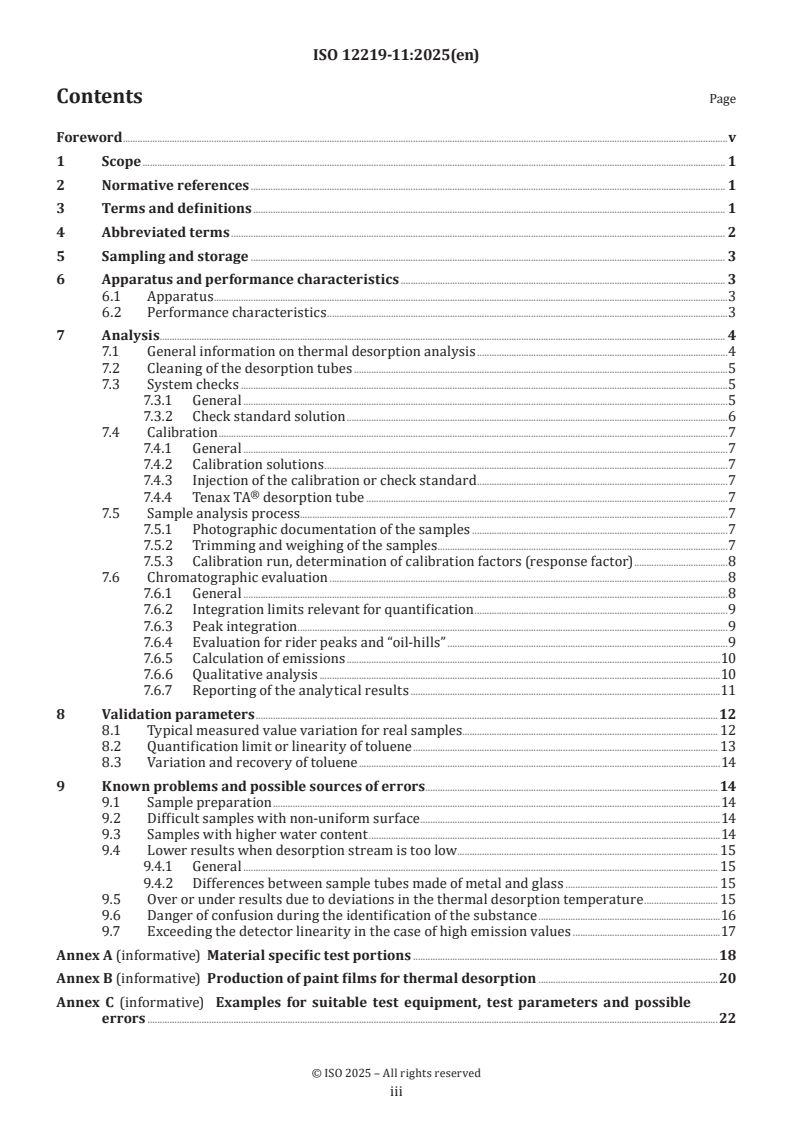
Contents Page
Foreword .v
1 Scope . 1
2 Normative references . 1
3 Terms and definitions . 1
4 Abbreviated terms . 2
5 Sampling and storage . 3
6 Apparatus and performance characteristics . 3
6.1 Apparatus .3
6.2 Performance characteristics .3
7 Analysis . . 4
7.1 General information on thermal desorption analysis .4
7.2 Cleaning of the desorption tubes .5
7.3 System checks .5
7.3.1 General .5
7.3.2 Check standard solution .6
7.4 Calibration .7
7.4.1 General .7
7.4.2 Calibration solutions .7
7.4.3 Injection of the calibration or check standard .7 ®
7.4.4 Tenax TA desorption tube .7
7.5 Sample analysis process.7
7.5.1 Photographic documentation of the samples .7
7.5.2 Trimming and weighing of the samples .7
7.5.3 Calibration run, determination of calibration factors (response factor) .8
7.6 Chromatographic evaluation .8
7.6.1 General .8
7.6.2 Integration limits relevant for quantification .9
7.6.3 Peak integration . .9
7.6.4 Evaluation for rider peaks and “oil-hills” .9
7.6.5 Calculation of emissions .10
7.6.6 Qualitative analysis .10
7.6.7 Reporting of the analytical results .11
8 Validation parameters .12
8.1 Typical measured value variation for real samples. 12
8.2 Quantification limit or linearity of toluene . 13
8.3 Variation and recovery of toluene .14
9 Known problems and possible sources of errors . 14
9.1 Sample preparation .14
9.2 Difficult samples with non-uniform surface .14
9.3 Samples with higher water content .14
9.4 Lower results when desorption stream is too low . 15
9.4.1 General . 15
9.4.2 Differences between sample tubes made of metal and glass . 15
9.5 Over or under results due to deviations in the thermal desorption temperature . 15
9.6 Danger of confusion during the identification of the substance .16
9.7 Exceeding the detector linearity in the case of high emission values .17
Annex A (informative) Material specific test portions .18
Annex B (informative) Production of paint films for thermal desorption .20
Annex C (informative) Examples for suitable test equipment, test parameters and possible
errors .22
iii
Annex D (informative) Preparation of standard solutions .32
Bibliography .33
iv
Foreword
ISO (the International Organization for Standardization) is a worldwide federation of national standards
bodies (ISO member bodies). The work of preparing International Standards is normally carried out through
ISO technical committees. Each member body interested in a subject for which a technical committee
has been established has the right to be represented on that committee. International organizations,
governmental and non-governmental, in liaison with ISO, also take part in the work. ISO collaborates closely
with the International Electrotechnical Commission (IEC) on all matters of electrotechnical standardization.
The procedures used to develop this document and those intended for its further maintenance are described
in the ISO/IEC Directives, Part 1. In particular, the different approval criteria needed for the different types
of ISO document should be noted. This document was drafted in accordance with the editorial rules of the
ISO/IEC Directives, Part 2 (see www.iso.org/directives).
ISO draws attention to the possibility that the implementation of this document may involve the use of (a)
patent(s). ISO takes no position concerning the evidence, validity or applicability of any claimed patent
rights in respect thereof. As of the date of publication of this document, ISO had not received notice of (a)
patent(s) which may be required to implement this document. However, implementers are cautioned that
this may not represent the latest information, which may be obtained from the patent database available at
www.iso.org/patents. ISO shall not be held responsible for identifying any or all such patent rights.
Any trade name used in this document is information given for the convenience of users and does not
constitute an endorsement.
For an explanation of the voluntary nature of standards, the meaning of ISO specific terms and expressions
related to conformity assessment, as well as information about ISO's adherence to the World Trade
Organization (WTO) principles in the Technical Barriers to Trade (TBT), see www.iso.org/iso/foreword.html.
This document was prepared by Technical Committee ISO/TC 146, Air quality, Subcommittee SC 6, Indoor air.
A list of all parts in the ISO 12219 series can be found on the ISO website.
Any feedback or questions on this document should be directed to the user’s national standards body. A
complete listing of these bodies can be found at www.iso.org/members.html.
v
International Standard ISO 12219-11:2025(en)
Interior air of road vehicles —
Part 11:
Thermal desorption analysis of organic emissions for the
characterization on non-metallic materials for vehicles
1 Scope
This document describes an analytical method to determine the emissions from non-metallic materials used
for moulded parts in motor vehicles, such as textiles, carpets, adhesives, sealing compounds, forms, leather,
plastic parts, films and sheets, paints or material combinations.
The materials are characterized in terms of the type and quantity of organic substances that can be outgassed
from them. For this purpose, two semiquantitative sum values are determined, which allow an estimation
of the emissions of volatile organic compounds (VOC value) and the proportion of condensable substances
[low volatile “fogging” compound (FOG) value]. Furthermore, individual substances of the emission are
determined. During the analysis, the samples are thermally extracted, the emissions are separated by gas
chromatography and detected by mass spectrometry. The test method presented in this document provides
values that are valid only for conditions described in this document.
The results which can be achieved using this method are not appropriate for making further estimations of
any kind of the health effects of emitted substances nor should they be used might that can be found in the
interior of a complete vehicle in stationary condition, while driving or in conditions similar to driving.
2 Normative references
The following documents are referred to in the text in such a way that some or all of their content constitutes
requirements of this document. For dated references, only the edition cited applies. For undated references,
the latest edition of the referenced document (including any amendments) applies.
ISO 16000-6, Indoor air — Part 6: Determination of organic compounds (VVOC, VOC, SVOC) in indoor and test
chamber air by active sampling on sorbent tubes, thermal desorption and gas chromatography using MS or MS FID
3 Terms and definitions
For the purposes of this document, the following terms and definitions apply.
ISO and IEC maintain terminology databases for use in standardization at the following addresses:
— ISO Online browsing platform: available at https:// www .iso .org/ obp
— IEC Electropedia: available at https:// www .electropedia .org/
3.1
volatile organic compound value
VOC value
total volatile organic compound value
total of the readily volatile to medium volatile substances
Note 1 to entry: The VOC value is calculated as a toluene equivalent. The method described in this document allows
substances in the boiling/elution range from the beginning of the chromatogram up to n-Pentacosane (C25) to be
determined and analysed.
Note 2 to entry: It is known that the retention area between C1 and C6 cannot be completely quantified.
Note 3 to entry: It can be assumed that these substances can be detected when analysing the air of the vehicle interior.
For the analysis, the sample (3.4) is heated at 90 °C for 30 min. The VOC value is determined by two measurements. The
higher value of the measurements is indicated as the result.
3.2
low volatile “fogging” compound value
FOG value
total of substances with low volatility which elute from the retention time of n-tetradecane (inclusive)
Note 1 to entry: It is calculated as hexadecane equivalent. Substances in the boiling range of n-alkanes C14 to C32 are
determined and analysed.
3.3
retention index
index calculated with a series of n-alkanes
[SOURCE: Reference [6]]
3.4
sample
part or piece of a product that is representative of the production
[SOURCE: ISO 12219-4:2013, 3.15]
3.5
specimen
article prepared from a sample (3.4)
[SOURCE: ISO 15906:2007, 3.2]
4 Abbreviated terms
CI confidence interval
EI electron impact
FID flame ionization detector
1)
FOG low volatile “fogging” compounds
GC gas chromatograph
MSD mass-selective detector
PES polyester film
TD thermal desorption
TIC total ion chromatogram
TPO thermoplastic polyolefin foil
VOC volatile organic compound
1) Semi-volatile organic compounds prone to condensation on vehicle interior surfaces causing ‘fogging’ of the
windscreen and other windows.’
5 Sampling and storage
For sampling and storage of the samples, the conditions of ISO 12219-8:2018, Clauses 8 and 10 should be met.
6 Apparatus and performance characteristics
6.1 Apparatus
The following laboratory equipment is needed:
— directly coupled thermal desorption / gas chromatography system;
— GC (electronic control of pneumatics is recommended; suitable instruments are listed in Annex C);
— a focusing device comprising a cryofocusing or cold-trapping mechanism, which can be heated sufficiently
quickly to release compounds of interest and inject them into the capillary GC column without dispersion;
— MSD;
— empty desorption tubes with inert surface, internal diameter 4 mm to 5 mm;
— a fused silica GC capillary column of 5% phenyl-methyl-siloxane is selected; bonded columns of 30 m to
60 m, internal diameter 0,25 mm to 0,32 mm and phase thickness 0,25 µm to 0,52 µm are examples of
columns proven to be suitable for VOC and FOG analyses;
— software for equipment control;
— software for analysis of chromatograms.
6.2 Performance characteristics
The following recommendations regarding the performance shall be considered:
— The recovery rates of the single substances (calculated as toluene equivalent) of the check standard
solution describe in 7.3.1 should be between 60 % and 140 % under VOC conditions, whereby the recovery
of the toluene should be at least 80 % and no more than 120 %.
— It should be possible to fall below the following detection limits (see DIN 32645, 95 % confidence interval):
— In the VOC run toluene < 0,04 µg, and icosane (C20) < 0,06 µg.
— In the FOG run n-alkane C32 < 0,2 µg.
® 2)
— Tenax TA desorption tubes:
— With regard to the density and amount on the packing, refer to the recommendation of
the equipment manufacturers. In particular, care should be taken to ensure that the Tenax ®
TA packing fills the tube so that it can be covered completely by the heated zone of the TD
instrument’s tube heater. ®
— The tubes should be filled with a sufficient amount of Tenax TA so that no substance
breakthrough can occur during sample feed. Further manufacturer-specific information is
described informatively in the Clause C.3.
— This document only uses sorbent tubes for introducing standards to the analytical system.
— For the determination of the detection limits, different amounts of the test substances dissolved
in methanol (for VOC run) and n-pentane (for FOG) should be injected into desorption tubes
2) Tenax TA® is the trade name of a product supplied by Buchem. This information is given for the convenience of users
of this document and does not constitute an endorsement by ISO of the product named. Equivalent products may be used
if they can be shown to lead to the same results.
®
filled with Tenax TA and desorbed at 280 °C. The split characteristics and GC conditions should
conform to the VOC/FOG method parameters.
— Parameters for gas chromatography for calibration and control analysis (examples are given in Table C.1):
— For toluene calibration and the analysis of the control mix, the same parameters should be set as for
the VOC sample run (for retention times of the control mix, see Table B.1). The only difference is a
later start of the data logging to mask out the methanol peak.
— Hexadecane calibration is carried out under the GC conditions of the FOG analysis. The only difference
is a later start of the data logging to mask out the pentane peak.
— Compared to the sample runs, the GC runs can be shortened by abandoning the oven temperature
program after elution of the calibration substances.
7 Analysis
7.1 General information on thermal desorption analysis
In a TD analysis, small amounts of the material are heated in an empty thermal desorption tube in a defined
process. The volatile substances emitted during this process are carried by means of a GC carrier gas to the
focusing trap with programmable temperature. A scheme of the process is given in Figure 1.
Following the heating phase, the focusing trap is heated up quickly to 280 °C. The focused substances are
desorbed during this process. They are split during transfer to the gas-chromatographic separation column
and are detected by mass spectrometry.
Calibration with reference substances allows for a semiquantitative estimation to be carried out, expressed
as µg/g.
Toluene for the VOC analysis and n-hexadecane for the FOG value are used as quantitative reference
substances. Using mass spectra and retention indices, the substances can be identified.
a
VOC: 30 min at 90 °C.
b
FOG: 60 min at 120 °C.
Figure 1 — Principle of thermal desorption
7.2 Cleaning of the desorption tubes
All desorption tubes used should be completely free of contamination. New tubes should also be cleaned
carefully before initial use by means of an appropriate method. The following procedure is recommended
for glass tubes.
— Clean the glass tubes by storing them in an alkaline cleaning solution for several hours, preferably
overnight. Then, rinse thoroughly, first under running hot water for at least one minute and subsequently
with deionized water.
— Dry the tubes in a drying oven for approximately 45 min at 105 °C and store in a manner that is free from
contamination (e.g. wrapped airtight in aluminium foil) until used.
7.3 System checks
7.3.1 General
The performance of the equipment system should be checked during the sample series by analysing a
performance check standard solution (see 7.3.1).
The check standard solution should contain non-polar, polar alkaline and acidic components which would
demonstrate a noticeable peak tailing in the event of undesired adsorption effects. Peaks in close succession
such as o-xylene and n-nonane are used for checking the separation performance of the chromatography
column. Under the chromatographic conditions chosen, these two substance peaks shall be almost baseline
separated. Check standards are also useful to monitor the drift in the instrument response over time. All
substances contained in this check standard should be uniquely identified during the search in the mass
spectral database.
The performance of the mass-selective detector is to be ensured by mass and sensitivity tuning, during
which the manufacturer's specifications should be achieved. In addition, an air/water check should be
performed to check the overall system for leakages.
The TDGC system should also be checked for memory effects by at least carrying out a blank run with an
empty desorption tube before each sample series. If negative effects (such as strong peak tailing, interfering
blank run peaks or significant loss of analytes) occur, the system should be cleaned. If appropriate, the GC
column, glass line, transfer line or seals, for example, should be replaced.
The documentation of the results of the control runs for each sample series within the framework of quality
control is recommended (control chart). The following parameters are examples of expedient control
variables:
— peak area characteristics of the check standard substances;
— calculation of concentrations of check standard substances as toluene equivalents;
— retention times.
7.3.2 Check standard solution
The substances listed in Table 1, dissolved in methanol have proved suitable for checking the system (listed
in elution sequence under VOC condition).
Table 1 — Check standard — Control mixture
a
Retention index Component Retention index Component
670 benzene 1100 n-undecane
700 n-heptane 1110 2,6-dimethylphenol
766 toluene 1200 n-dodecane
800 n-octane 1300 n-tridecane
870 p-xylene 1400 n-tetradecane
895 o-xylene 1435 dicyclohexylamine
900 n-nonane 1500 n-pentadecane
1000 n-decane 1600 n-hexadecane
1030 2-ethylhexanol-1 2390 di-(2-ethylhexl)-adipate
a
The retention indices listed in this column are referenced to n-alkanes and represent approximate
values.
It is possible to use a commercially available certified substance mixture with comparable volatility, polarity
and concentration for system check. ®
For the control run, inject a volume of this solution into a desorption tube filled with Tenax TA , so that
approximately 0,45 µg ± 0,1 µg absolute of each component are present in the desorption tube.
Otherwise, it is possible to prepare a solution following the procedure described in Clause D.1.
Based on the retention times of the n-alkanes present in these mixtures, the retention index of the unknown
substance peaks can be determined. They can be used to further verify the MSD identification during the
sample runs.
If stored properly (chilled at a maximum of 8 °C), the check standard solution has a shelf life of at least
three months.
7.4 Calibration
7.4.1 General
Calibration should be carried out using the external standard method. For this purpose, apply a calibration ®
solution to a desorption tube filled with Tenax TA .
7.4.2 Calibration solutions
Two calibration solutions are required.
a) For VOC analysis, approximately 2,0 µg/µl toluene pro analysis (p.a.) in methanol (p.a.).
b) For FOG analysis, approximately 2,0 µg/µl n-Hexadecane (p.a.) in n-pentane (p.a.).
It is possible to use a commercially available certified substance solution with comparable concentration.
Otherwise, it is possible to prepare a solution following the procedure described in Clause D.2.
When stored chilled, the calibration solutions have a shelf life of at least three months. Assurance of the
correctness of the concentration should form part of the quality control processes of the laboratory.
7.4.3 Injection of the calibration or check standard
Inject precise aliquots (e.g. 1 µl of the prepared liquid standards) onto the sampling end of conditioned
sorbent tubes as described in ISO 16000-6. ®
7.4.4 Tenax TA desorption tube
With regard to the density and amount on the packing, refer to the recommendation of the equipment ®
manufacturers. In particular, care should be taken to ensure that the Tenax TA packing fills the tube so
that it can be covered completely by the heated zone of the TD instrument’s tube heater. ®
The tubes should be filled with a sufficient amount of Tenax TA so that no substance breakthrough can
occur during sample feed. Further manufacturer-specific information is described informatively in the
Clause C.3.
7.5 Sample analysis process
7.5.1 Photographic documentation of the samples
A photo should be taken for documentation purposes in which the sample filled into the desorption glass
tube and its laboratory ID number as well as the sampling location are visible. If metal tubes are used, a
photo of the prepared test specimen and the tube with its laboratory ID number shall be taken. The photo
shall be part of the laboratory test report.
7.5.2 Trimming and weighing of the samples
7.5.2.1 General
Prepare two clean, empty desorption tubes with weighed specimens of the sample material. These are
analysed as follows:
— tube A: initial VOC analysis run;
— tube B: second VOC analysis run and a subsequent FOG run.
The weight of the samples depends on the type of material to be analysed (see Table A.1).
The required accuracy is ±0,1 mg.
7.5.2.2 Sample weight
Due to the large variety of possible materials, no generally applicable specifications for the dimensioning
of the samples can be given. When trimming the sample, the aim should be to achieve the largest possible
contiguous area. The following procedure can be used for general orientation:
— The inner diameter (4 mm to 5 mm) of the desorption tube cannot be fully utilized. The temperature-
controlled zone of the tube – and therefor the maximum sample length – is approximately 4 cm.
— In order to be able to introduce as large an area as possible, the diameter of the sample injection tube should
be used first when trimming the sample. This is usually possible up to a sample width of approximately
3 mm to 4 mm. The length and thickness of the sample are variable, whereby the specified weight (see
Annex A) is the most important factor. In this process, the sample should preferably be trimmed long and
the thickness reduced accordingly.
— The sample dimensions shall be reported in the test report (e.g. L × W × H ≈ 15 × 2,8 × 0,7 mm), if requested.
For paints and adhesives, a special procedure applies, i.e. by working with dried films applied to aluminium
foil (see Annex B).
7.5.3 Calibration run, determination of calibration factors (response factor) ®
For each sample series, at least two Tenax TA desorption tubes each should be injected with toluene /
hexadecane calibration solution (see 7.4.2), and the area values of the calibration peaks should be determined
from the calibration runs. The response factor results from the quotient of the absolute mass (in µg) of
toluene / hexadecane injected into the tube and the resulting peak areas. If a FID is used in parallel with a
MS, the FID areas can also be used for calibration.
m
T/C16
R =×1000 (1)
f
A
where
R is the response factor in 1/ng;
f
m is the absolute mass of toluene respectively C16 on tube in µg;
T/C16
A is the peak area in counts.
To check the system linearity regularly a multi-level calibration should be done (see 8.2).
It is recommended to run standard tubes within and at the end of sequence of samples to check standard
and system stability during a sequence.
7.6 Chromatographic evaluation
7.6.1 General
The total concentration of the VOC run calculated as toluene equivalent represents the VOC value. The total
concentration of the FOG run calculated as hexadecane equivalent represents the FOG value. Both VOC values
should be indicated in the test report. For evaluation purposes, the analysis with the highest value is used.
Substances in the boiling range of n-alkanes C14 to C32 condense easily at room temperature and contribute
to the fogging of the windscreen.
To determine the FOG value, the second sample is retained in the desorption tube after the VOC analysis and
reheated to 120 °C for 60 min.
If two VOC values significantly (more than 50 %) differ for each other, a repeat analysis with new samples is
required (two VOC runs and a FOG run).
7.6.2 Integration limits relevant for quantification
The following integration ranges should be met:
a) for VOC run: start of the chromatogram up to n-alkane C25 (inclusive);
b) for FOG run: from n-alkane C14 (inclusive) to n-alkane C32 (inclusive).
The elution times of the n-alkanes mentioned should be determined by reference measurements.
7.6.3 Peak integration
To determine the cumulative parameters (VOC and FOG value), the total area of all substance peaks from the
sample lying above the baseline should be determined. The shape of the baseline must be known from blank
value analysis. All measuring signals should be determined which contribute to the total emissions. In case
of complex samples, the addition of individual peaks alone is not recommended; instead the total area above
the baseline should be integrated and evaluated.
The results report should list separately at least all substances whose concentrations are ≥1 µg/g i.e. the
chromatographic integration conditions should always be selected for the determination of single substances
such that 1 µg/g peaks are reliable determined.
7.6.4 Evaluation for rider peaks and “oil-hills”
If the chromatogram contains humps of unresolved components, e.g. accumulated isomeric compounds of
continuous, chemically similar isomeric mixtures, these should be accumulated and integrated by placing
the baseline from the start to the end for the compound (see Figure 2). If the baseline shape becomes
complex, it can become necessary to integrate each section separately.
If clearly delimitable peaks of other substance classes appear within this area, these peaks should be
integrated separately and listed. Such peaks are quantified as rider peaks, i.e. they are not integrated down
to the ground baseline, but only to the point where they protrude from the compound.
Key
1 isomeric compound
2 rider
3 oil hill
4 baseline
t time
Figure 2 — Integration of rider on “oil-hill” — Peaks
7.6.5 Calculation of emissions
For semiquantitative calculation of the concentrations, the peak areas (MS or FID) are multiplied with the
response factor (see 7.5.3) of toluene for the VOC analysis and of hexadecane for the FOG analysis and divided
through the sample test portion:
A
F = (2)
Rf *m
tolueneorC16
where
F is the emission in μg/g;
R
is the response factor in 1/ng;
f
A is the peak area in counts;
m is the test portion sample in µg.
7.6.6 Qualitative analysis
The peaks (>1 µg/g) are assigned on the basis of their mass spectra and – if available – their retention
indices. The MS search result should be checked for plausibility before it is entered into the results table. If a
substance cannot be unambiguously identified, it may also be indicated as an assumption by marking it with
a question mark or a reference of a substance class may be given provided that appropriate clues (e.g. typical
mass fragments) allow such conclusion to be drawn.
To show the different levels of certainty of the substance assignment, the conventions summarized in Table 2
should be observed.
Table 2 — Conventions to show the different levels of certainty of the substance assignment
Designation example Explanation
Toluene, methylbenzene Mass spectrum and retention of reference substance coincide (regarded as
identified with high level of certainty)
? 1,1-bis(p-tolyl)ethane: 210 195 Prefixed question mark:
179 104
Based on mass spectra / retention no unique assignment is possible: this
substance is, however, considered possible (very similar); Significant mass
fragments are also indicated
? Alcohol; 31 57 85 Question mark + class of substances:
Typical fragments or known fragment patterns proved indications of a class of
substances
? 54 76 99 109 No conclusions can be drawn with regard to compound; distinctive masses are
indicated.
Isomeric paraffin fractions, boiling In the case of accumulated isomeric compounds, the class of substances and
range C16-C26 the approximate boiling range, referenced to n-alkanes, should be indicated as
substance designation. In the “retention time” column, the tie of the accumu-
lated compound maximum should be entered.
Cyclohexanone + ? An identified peak is superimposed by one or several unknown substances
Artefact Peak which cannot originate from the sample or has been created in the sys-
tem.
7.6.7 Reporting of the analytical results
The report of the analytical results should be entered in a spreadsheet which contains at least the following
information about the analysed sample:
— general information:
— precise designation of the analysed material;
— component designation;
— name of the manufacturer or supplier;
— date of the production of the material;
— date of analysis;
— weight of the sample (mg);
— part number;
— photo documentation;
— analytical results:
— retention time;
— substance name;
3)
— CAS Registry Number® ;
— percentage of peak;
— concentration (µg/g);
— remark on peak;
— VOC (FOG) value;
— VOC second value;
— remarks on analysis.
The MS database often offer different notations for a substance which can then be adopted directly. The
substance name field should not be overloaded with too many, often redundant designations. It is sufficient
to add a maximum of 1 to 3 “common” designations apart from the CAS designation.
Additional information which may be provided if requested are:
— the material batch;
— the approximate dimensions of sample (mm × mm × mm);
— when the results are transferred to the spreadsheet format, it is imperative that conventions are
observed to allow electronic data exchange, therefore, certain contents are required to be entered in
defined spreadsheet cells. The spreadsheet printout in Annex C can be used as a template.
— The contracted laboratory should create a written report of the results containing VOC values and the
FOG value as well as the list (spreadsheet) of the quantified substances.
3) CAS Registry Number® is a trademark of the American Chemical Society (ACS). This information is given for the
convenience of users of this document and does not constitute an endorsement by ISO of the product named. Equivalent
products may be used if they can be shown to lead to the same results.
— The report may contain the following data, if requested:
— 2 chromatogram raw data files of the VOC determination;
— 1 chromatogram raw data file of the FOG determination;
— chromatogram raw data files of the blank runs;
— chromatogram raw data files of the calibration and control runs;
— spreadsheet with individual results of the VOC/FOG analysis.
The data format of the chromatogram files should be agreed upon with the buyer to ensure compatibility.
8 Validation parameters
8.1 Typical measured value variation for real samples
The repeatability depends on, among other factors, the characteristic of the sample matrix, its composition,
the polarity and the volatility of the emitted compounds.
The result also largely depends on whether reproducible sample surfaces can be produced during the
preparation. This may be much more difficult, for example, for a porous foam than for a compact plastic
sample. Experiences with numerous measurements of very different materials have shown that an internal
measured value deviation of <15 % is normally achieved within the laboratory.
However, no generally valid precision value for thermal desorption analysis according to this document can
be given. In case of doubt, it should be determined separately for each matrix analysed.
Twenty-six laboratories with different equipment took part in an interlaboratory test in 2017 to determine
the analytical limits of the method. In the test series, the accuracy of the method for the VOC value, the FOG
value, single components from the two analysis runs with a polyester film (PES) and a film produced from
thermoplastic polyolefin foil (TPO) were determined. The results are shown in Table 3.
[7]
Table 3 — Result of interlaboratory test 2017
Standard deviation of reproducibility
Parameter Robust mean
(robust)
VOC-mean value in in μg/g mean of value 1 and 2 249,64 82,29
1-Ethyl-2-pyrrolidinone in μg/g 10,1 4,31
Benzene, m-di-tert-butyl- in μg/g 32,6 9,12
2,4,7,9-Tetramethyl-5-decyne-4,7-diol in μg/g 4,41 1,5
Phenol, 2,4-di-tert-butyl- in μg/g VOC 64,5 19,26
Fog value in μg/g 245,8 57,70
Phenol, 2,4-di-tert-butyl- in μg/g FOG 22,8 10,76
In comparison to the results of the 2010 VDA proficiency test in 2017 65 % of the participants achieved the
class 1 whereas in 2010 around 52 % got into class 1. It is important to mentioned that the performance
criteria in the 2017 proficiency was relevantly stricter in comparison to 2010; this shows that the overall
performance of this method has increased.
NOTE Class 1 is achieved when the measured value is close to the mean value within a window plus minus half
the standard deviation.
8.2 Quantification limit or linearity of toluene
The performance of the total system which is independent of samples is shown below using the example of ®
the linearity of toluene. For this purpose, defined amounts of toluene on Tenax TA were analysed according
to 7.5.3 and the statistical characteristics were determined from the resulting peak areas.
Figure 3 a) shows a linear shape of the toluene response up to a high concentration range (5 µg would
correspond to approximately 150 µg/g for a 30 mg sample). Figure 3 b) shows the linear shape of the three
lower measuring points.
a) Linearity of toluene across the whole measuring range
b) Linearity of toluene in the lower measuring range
Key
X time
Y counts
Figure 3 — Linearity of toluene
YX=+aa
where
1 1
a is the slope, a = 6 761 000 ± 48 000;
0 0
a is the y-axis intercept, a : 10 300 ± 98 000.
The correlation coefficient is: r = 0,999 98.
For the lower working range [confidence interval (CI) of 95 %], the following values results from the above
measurement: ®
— detection limit: 0,005 µg (toluene on Tenax TA ); ®
— quantification limit: 0,02 µg (toluene on Tenax TA ).
The characteristic values were calculated according to DIN 32645.
The quantification and detection limits determined here do not unconditionally reflect the relationships
during a real sample measurement. Instead, they are intended to help understand the minimum performance
requirements for the analysis system. For assessment of the suitability of the system, the minimum
requirements given in 6.2 apply.
8.3 Variation and recovery of toluene ®
From the analyses of the check standard applied on Tenax TA , the toluene content was calculated and
resulted in the following measuring values.
Number of measuring values N = 20
Number of measuring series 6
Standard deviation 5,4 %
Mean value of recovery (actual value divided by target value, then multiplied by 100) 102 %
Highest recovery 117 %
Lowest recovery 85 %
The measuring series was performed over a period of some six weeks.
9 Known problems and possible sources of errors
9.1 Sample preparation
During preparation, care should be taken to prevent contamination or unnecessary heating of the samples.
The samples should not be touched with fingers or processed using cutting technologies generating heat
(such as high-speed rotary saws). The use of a scalpel (with
...