

ISO 12219-10:2021
(Main)Interior air of road vehicles — Part 10: Whole vehicle test chamber — Specification and methods for the determination of volatile organic compounds in cabin interiors — Trucks and buses
General Information
- Abstract
This document describes and specifies the whole vehicle test chamber, the vapour sampling assembly and the operating conditions for the determination of volatile organic compounds (VOCs; for more information see Annex E), and carbonyl compounds in vehicle cabin air. There are three measurements performed: one (for VOCs and carbonyl compounds) during the simulation of ambient conditions (ambient mode) at standard conditions of 23 °C with no air exchange; a second only for the measurement of formaldehyde at elevated temperatures (parking mode); and a third for VOCs and carbonyl compounds simulating driving after the vehicle has been parked in the sun starting at elevated temperatures (driving mode). For the simulation of the mean sun irradiation, fixed irradiation in the whole vehicle test chamber is employed. The VOC method is valid for measurement of non-polar and slightly polar VOCs in a concentration range of sub-micrograms per cubic metre up to several milligrams per cubic metre. Using the principles described in this method, some semi-volatile organic compounds (SVOC) can also be analysed. Compatible compounds are those which can be trapped and released from the Tenax TA®1) sorbent tubes described in ISO 16000‑6, which includes VOCs ranging in volatility from n-C6 to n-C16. The sampling and analysis procedure for formaldehyde and other carbonyl compounds is performed by collecting air on to cartridges coated with 2,4-dinitrophenylhydrazine (DNPH) and subsequent analysis by high performance liquid chromatography (HPLC) with detection by ultraviolet absorption. Formaldehyde and other carbonyl compounds can be determined in the approximate concentration range 1 μg/m3 to 1 mg/m3. This method applicable to trucks and buses, as defined in ISO 3833:1977 3.1.1 to 3.1.6. This document describes: a) Transport and storage of the test vehicle until the start of the test. b) Conditioning of the surroundings of the test vehicle and the test vehicle itself as well as the whole vehicle test chamber. c) Conditioning of the test vehicle prior to measurements. d) Simulation of ambient air conditions (ambient mode). e) Formaldehyde sampling at elevated temperatures (parking mode). f) Simulation of driving after the test vehicle has been parked in the sun (driving mode). 1)Tenax TA® is the trade name of a product supplied by Buchem. This information is given for the convenience of users of this document and does not constitute an endorsement by ISO of the product named. Equivalent products may be used if they can be shown to lead to the same results.
- Status
- Published
- Publication Date
- 07-Jun-2021
- Technical Committee
- ISO/TC 146/SC 6 - Indoor air
- Drafting Committee
- ISO/TC 146/SC 6/WG 13 - Joint ISO/TC 146/SC 6 - ISO/TC 22 WG: Determination of volatile organic compounds in car interiors
- Parallel Committee
- ISO/TC 22 - Road vehicles
- Current Stage
- 9093 - International Standard confirmed
- Start Date
- 11-Sep-2026
- Completion Date
- 19-Sep-2026
Buy Documents



ISO 12219-10:2021 - Interior air of road vehicles
ISO 12219-10:2021 - Interior air of road vehicles — Part 10: Whole vehicle test chamber — Specification and methods for the determination of volatile organic compounds in cabin interiors — Trucks and buses/8/2021
Overview
ISO 12219-10:2021 - "Interior air of road vehicles - Part 10" specifies a whole vehicle test chamber and standardized methods for measuring volatile organic compounds (VOCs) and carbonyl compounds in the cabin air of trucks and buses. The standard defines chamber design, sampling assemblies, conditioning and test procedures to reproduce three realistic exposure scenarios: ambient mode (standard indoor conditions), parking mode (elevated temperatures to measure formaldehyde), and driving mode (simulated driving after sun exposure).
Key measurable ranges and methods:
- VOCs (non‑polar and slightly polar, n‑C6 to n‑C16 volatility): from sub-µg/m3 up to several mg/m3 using Tenax TA® sorbent tubes, thermal desorption and GC (MS or FID).
- Carbonyls (including formaldehyde): approx. 1 µg/m3 to 1 mg/m3 using DNPH‑coated cartridges and HPLC‑UV.
Key technical topics and requirements
- Whole vehicle test chamber: sized to house the vehicle, with air‑conditioning to maintain standardized conditions (23 °C ±2 °C, 50% RH ±10% RH) and an integrated solar radiator system to simulate sun irradiation.
- Heating/radiator specifications: fixed roof irradiation (infrared/halogen or equivalent) to reach target cabin temperatures (e.g., ~40 °C for trucks, ~35 °C for buses).
- Sampling trains: parallel sampling lines for repeatability - two for VOCs (Tenax TA) and two for carbonyls (DNPH).
- Analytical methods: thermal desorption + GC‑MS/FID for VOCs; DNPH derivatization and HPLC‑UV for carbonyls (formaldehyde).
- Test procedures covered: transport/storage, chamber & vehicle preconditioning, ambient sampling (engine off), parking sampling (formaldehyde at elevated T), and driving simulation (engine, HVAC on; trucks: 30 min sampling; buses: 120 min).
- Quality controls: field blanks, background concentration assessment, and protocols for calculation, uncertainty and reporting.
Practical applications and users
This standard is intended for:
- Vehicle manufacturers evaluating interior material emissions during design and validation.
- Automotive suppliers (interior trim, adhesives, foams) assessing product off‑gassing.
- Test laboratories performing standardized cabin air quality tests.
- Regulators and certification bodies defining exposure limits and compliance.
- Academic and industrial researchers studying cabin air chemistry, VOC emission kinetics, and exposure scenarios.
Using ISO 12219-10:2021 ensures repeatable, comparable measurements of cabin VOCs and carbonyls under realistic simulated conditions, supporting material selection, product improvements, and occupant health assessments.
Related standards
- ISO 12219-1 (whole vehicle test chamber general specification)
- ISO 16000-3 (formaldehyde and carbonyls sampling)
- ISO 16000-6 (VOC sampling on Tenax TA, thermal desorption, GC‑MS/FID)
- ISO 3833:1977 (vehicle classification - trucks and buses)
Keywords: ISO 12219-10:2021, VOCs, cabin air, whole vehicle test chamber, Tenax TA, DNPH, HPLC, formaldehyde, trucks and buses, driving mode, parking mode.
Buy Documents
ISO 12219-10:2021 - Interior air of road vehicles
ISO 12219-10:2021 - Interior air of road vehicles — Part 10: Whole vehicle test chamber — Specification and methods for the determination of volatile organic compounds in cabin interiors — Trucks and buses/8/2021
Get Certified
Connect with accredited certification bodies for this standard

TÜV Rheinland
TÜV Rheinland is a leading international provider of technical services.

TÜV SÜD
TÜV SÜD is a trusted partner of choice for safety, security and sustainability solutions.

BSI Group
BSI (British Standards Institution) is the business standards company that helps organizations make excellence a habit.
Sponsored listings
Frequently Asked Questions
ISO 12219-10:2021 is a standard published by the International Organization for Standardization (ISO). Its full title is "Interior air of road vehicles — Part 10: Whole vehicle test chamber — Specification and methods for the determination of volatile organic compounds in cabin interiors — Trucks and buses". This standard covers: This document describes and specifies the whole vehicle test chamber, the vapour sampling assembly and the operating conditions for the determination of volatile organic compounds (VOCs; for more information see Annex E), and carbonyl compounds in vehicle cabin air. There are three measurements performed: one (for VOCs and carbonyl compounds) during the simulation of ambient conditions (ambient mode) at standard conditions of 23 °C with no air exchange; a second only for the measurement of formaldehyde at elevated temperatures (parking mode); and a third for VOCs and carbonyl compounds simulating driving after the vehicle has been parked in the sun starting at elevated temperatures (driving mode). For the simulation of the mean sun irradiation, fixed irradiation in the whole vehicle test chamber is employed. The VOC method is valid for measurement of non-polar and slightly polar VOCs in a concentration range of sub-micrograms per cubic metre up to several milligrams per cubic metre. Using the principles described in this method, some semi-volatile organic compounds (SVOC) can also be analysed. Compatible compounds are those which can be trapped and released from the Tenax TA®1) sorbent tubes described in ISO 16000‑6, which includes VOCs ranging in volatility from n-C6 to n-C16. The sampling and analysis procedure for formaldehyde and other carbonyl compounds is performed by collecting air on to cartridges coated with 2,4-dinitrophenylhydrazine (DNPH) and subsequent analysis by high performance liquid chromatography (HPLC) with detection by ultraviolet absorption. Formaldehyde and other carbonyl compounds can be determined in the approximate concentration range 1 μg/m3 to 1 mg/m3. This method applicable to trucks and buses, as defined in ISO 3833:1977 3.1.1 to 3.1.6. This document describes: a) Transport and storage of the test vehicle until the start of the test. b) Conditioning of the surroundings of the test vehicle and the test vehicle itself as well as the whole vehicle test chamber. c) Conditioning of the test vehicle prior to measurements. d) Simulation of ambient air conditions (ambient mode). e) Formaldehyde sampling at elevated temperatures (parking mode). f) Simulation of driving after the test vehicle has been parked in the sun (driving mode). 1)Tenax TA® is the trade name of a product supplied by Buchem. This information is given for the convenience of users of this document and does not constitute an endorsement by ISO of the product named. Equivalent products may be used if they can be shown to lead to the same results.
This document describes and specifies the whole vehicle test chamber, the vapour sampling assembly and the operating conditions for the determination of volatile organic compounds (VOCs; for more information see Annex E), and carbonyl compounds in vehicle cabin air. There are three measurements performed: one (for VOCs and carbonyl compounds) during the simulation of ambient conditions (ambient mode) at standard conditions of 23 °C with no air exchange; a second only for the measurement of formaldehyde at elevated temperatures (parking mode); and a third for VOCs and carbonyl compounds simulating driving after the vehicle has been parked in the sun starting at elevated temperatures (driving mode). For the simulation of the mean sun irradiation, fixed irradiation in the whole vehicle test chamber is employed. The VOC method is valid for measurement of non-polar and slightly polar VOCs in a concentration range of sub-micrograms per cubic metre up to several milligrams per cubic metre. Using the principles described in this method, some semi-volatile organic compounds (SVOC) can also be analysed. Compatible compounds are those which can be trapped and released from the Tenax TA®1) sorbent tubes described in ISO 16000‑6, which includes VOCs ranging in volatility from n-C6 to n-C16. The sampling and analysis procedure for formaldehyde and other carbonyl compounds is performed by collecting air on to cartridges coated with 2,4-dinitrophenylhydrazine (DNPH) and subsequent analysis by high performance liquid chromatography (HPLC) with detection by ultraviolet absorption. Formaldehyde and other carbonyl compounds can be determined in the approximate concentration range 1 μg/m3 to 1 mg/m3. This method applicable to trucks and buses, as defined in ISO 3833:1977 3.1.1 to 3.1.6. This document describes: a) Transport and storage of the test vehicle until the start of the test. b) Conditioning of the surroundings of the test vehicle and the test vehicle itself as well as the whole vehicle test chamber. c) Conditioning of the test vehicle prior to measurements. d) Simulation of ambient air conditions (ambient mode). e) Formaldehyde sampling at elevated temperatures (parking mode). f) Simulation of driving after the test vehicle has been parked in the sun (driving mode). 1)Tenax TA® is the trade name of a product supplied by Buchem. This information is given for the convenience of users of this document and does not constitute an endorsement by ISO of the product named. Equivalent products may be used if they can be shown to lead to the same results.
ISO 12219-10:2021 is classified under the following ICS (International Classification for Standards) categories: 13.040.20 - Ambient atmospheres; 43.020 - Road vehicles in general. The ICS classification helps identify the subject area and facilitates finding related standards.
ISO 12219-10:2021 is available in PDF format for immediate download after purchase. The document can be added to your cart and obtained through the secure checkout process. Digital delivery ensures instant access to the complete standard document.
Standards Content (Sample)
SLOVENSKI STANDARD
01-september-2021
Notranji zrak v cestnih vozilih - 10. del: Preskusna komora za celotno vozilo -
Specifikacija in metode za določevanje hlapnih organskih spojin v notranjosti
kabine - Tovornjaki in avtobusi
Interior air of road vehicles - Part 10: Whole vehicle test chamber - Specification and
methods for the determination of volatile organic compounds in cabin interiors - Trucks
and buses
Ta slovenski standard je istoveten z: ISO 12219-10:2021
ICS:
13.040.20 Kakovost okoljskega zraka Ambient atmospheres
43.020 Cestna vozila na splošno Road vehicles in general
2003-01.Slovenski inštitut za standardizacijo. Razmnoževanje celote ali delov tega standarda ni dovoljeno.
INTERNATIONAL ISO
STANDARD 12219-10
First edition
2021-06
Interior air of road vehicles —
Part 10:
Whole vehicle test chamber —
Specification and methods for the
determination of volatile organic
compounds in cabin interiors —
Trucks and buses
Reference number
©
ISO 2021
© ISO 2021
All rights reserved. Unless otherwise specified, or required in the context of its implementation, no part of this publication may
be reproduced or utilized otherwise in any form or by any means, electronic or mechanical, including photocopying, or posting
on the internet or an intranet, without prior written permission. Permission can be requested from either ISO at the address
below or ISO’s member body in the country of the requester.
ISO copyright office
CP 401 • Ch. de Blandonnet 8
CH-1214 Vernier, Geneva
Phone: +41 22 749 01 11
Email: copyright@iso.org
Website: www.iso.org
Published in Switzerland
ii © ISO 2021 – All rights reserved
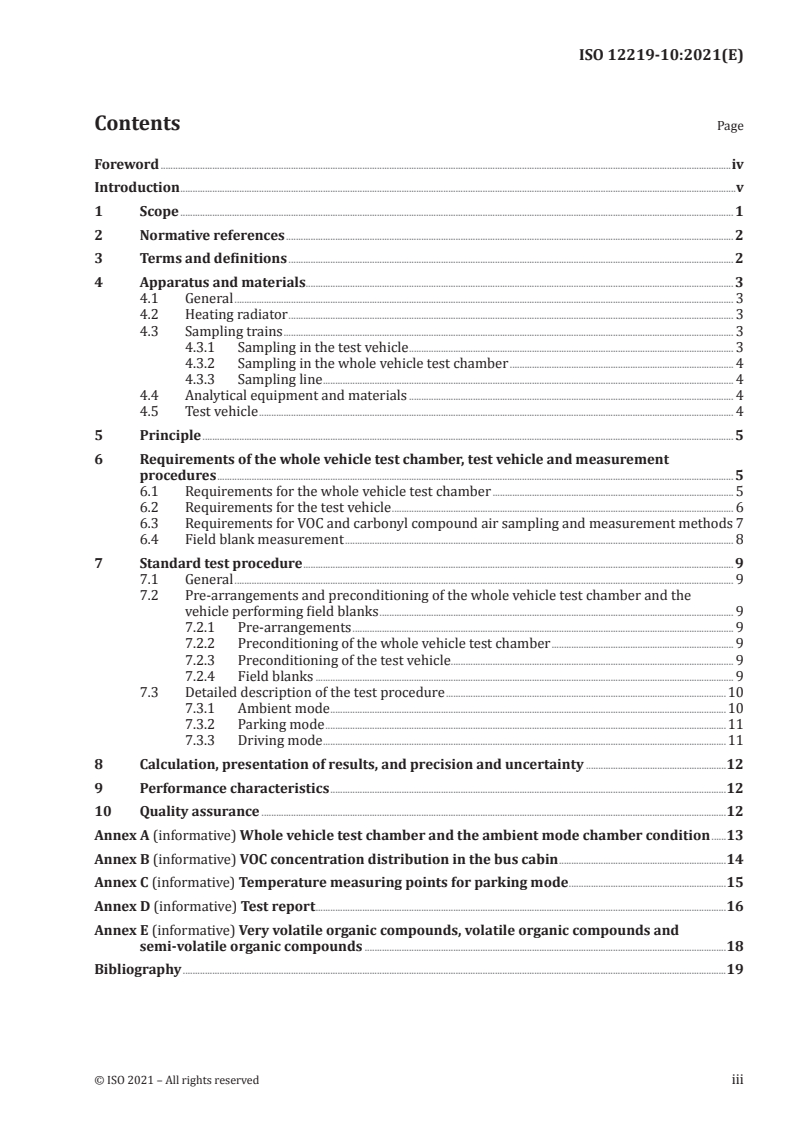
Contents Page
Foreword .iv
Introduction .v
1 Scope . 1
2 Normative references . 2
3 Terms and definitions . 2
4 Apparatus and materials. 3
4.1 General . 3
4.2 Heating radiator . 3
4.3 Sampling trains . 3
4.3.1 Sampling in the test vehicle . 3
4.3.2 Sampling in the whole vehicle test chamber . 4
4.3.3 Sampling line . 4
4.4 Analytical equipment and materials . 4
4.5 Test vehicle . 4
5 Principle . 5
6 Requirements of the whole vehicle test chamber, test vehicle and measurement
procedures . 5
6.1 Requirements for the whole vehicle test chamber . 5
6.2 Requirements for the test vehicle . 6
6.3 Requirements for VOC and carbonyl compound air sampling and measurement methods 7
6.4 Field blank measurement . 8
7 Standard test procedure . 9
7.1 General . 9
7.2 Pre-arrangements and preconditioning of the whole vehicle test chamber and the
vehicle performing field blanks . 9
7.2.1 Pre-arrangements . 9
7.2.2 Preconditioning of the whole vehicle test chamber . 9
7.2.3 Preconditioning of the test vehicle . 9
7.2.4 Field blanks . 9
7.3 Detailed description of the test procedure .10
7.3.1 Ambient mode .10
7.3.2 Parking mode .11
7.3.3 Driving mode .11
8 Calculation, presentation of results, and precision and uncertainty .12
9 Performance characteristics .12
10 Quality assurance .12
Annex A (informative) Whole vehicle test chamber and the ambient mode chamber condition .13
Annex B (informative) VOC concentration distribution in the bus cabin .14
Annex C (informative) Temperature measuring points for parking mode .15
Annex D (informative) Test report .16
Annex E (informative) Very volatile organic compounds, volatile organic compounds and
semi-volatile organic compounds .18
Bibliography .19
Foreword
ISO (the International Organization for Standardization) is a worldwide federation of national standards
bodies (ISO member bodies). The work of preparing International Standards is normally carried out
through ISO technical committees. Each member body interested in a subject for which a technical
committee has been established has the right to be represented on that committee. International
organizations, governmental and non-governmental, in liaison with ISO, also take part in the work.
ISO collaborates closely with the International Electrotechnical Commission (IEC) on all matters of
electrotechnical standardization.
The procedures used to develop this document and those intended for its further maintenance are
described in the ISO/IEC Directives, Part 1. In particular, the different approval criteria needed for the
different types of ISO documents should be noted. This document was drafted in accordance with the
editorial rules of the ISO/IEC Directives, Part 2 (see www .iso .org/ directives).
Attention is drawn to the possibility that some of the elements of this document may be the subject of
patent rights. ISO shall not be held responsible for identifying any or all such patent rights. Details of
any patent rights identified during the development of the document will be in the Introduction and/or
on the ISO list of patent declarations received (see www .iso .org/ patents).
Any trade name used in this document is information given for the convenience of users and does not
constitute an endorsement.
For an explanation of the voluntary nature of standards, the meaning of ISO specific terms and
expressions related to conformity assessment, as well as information about ISO's adherence to the
World Trade Organization (WTO) principles in the Technical Barriers to Trade (TBT), see www .iso .org/
iso/ foreword .html.
This document was prepared by Technical Committee ISO/TC 146, Air quality, Subcommittee SC 6,
Indoor air.
A list of all parts in the ISO 12219 series can be found on the ISO website.
Any feedback or questions on this document should be directed to the user’s national standards body. A
complete listing of these bodies can be found at www .iso .org/ members .html.
iv © ISO 2021 – All rights reserved
Introduction
Volatile organic compounds (VOCs) are widely used in industry and can be emitted by many every-day
products and materials. They have attracted much attention in recent years because of their impact
on cabin air quality. After homes and workplaces, people spend a lot of time in their vehicles. It is
important to determine the material emissions of interior parts and to reduce them to an acceptable
level. Therefore, it is important to get comprehensive and reliable information about the types of
organic compounds in the interior air of vehicles and also their concentrations.
This document outlines a method of measuring the types and levels of VOCs in vehicle cabin air under
controlled conditions. It describes requirements for a whole vehicle test chamber and a test protocol.
INTERNATIONAL STANDARD ISO 12219-10:2021(E)
Interior air of road vehicles —
Part 10:
Whole vehicle test chamber — Specification and methods
for the determination of volatile organic compounds in
cabin interiors — Trucks and buses
1 Scope
This document describes and specifies the whole vehicle test chamber, the vapour sampling
assembly and the operating conditions for the determination of volatile organic compounds (VOCs;
for more information see Annex E), and carbonyl compounds in vehicle cabin air. There are three
measurements performed: one (for VOCs and carbonyl compounds) during the simulation of ambient
conditions (ambient mode) at standard conditions of 23 °C with no air exchange; a second only for
the measurement of formaldehyde at elevated temperatures (parking mode); and a third for VOCs
and carbonyl compounds simulating driving after the vehicle has been parked in the sun starting at
elevated temperatures (driving mode). For the simulation of the mean sun irradiation, fixed irradiation
in the whole vehicle test chamber is employed.
The VOC method is valid for measurement of non-polar and slightly polar VOCs in a concentration range
of sub-micrograms per cubic metre up to several milligrams per cubic metre. Using the principles
described in this method, some semi-volatile organic compounds (SVOC) can also be analysed.
®1)
Compatible compounds are those which can be trapped and released from the Tenax TA sorbent
tubes described in ISO 16000-6, which includes VOCs ranging in volatility from n-C6 to n-C16.
The sampling and analysis procedure for formaldehyde and other carbonyl compounds is performed
by collecting air on to cartridges coated with 2,4-dinitrophenylhydrazine (DNPH) and subsequent
analysis by high performance liquid chromatography (HPLC) with detection by ultraviolet absorption.
Formaldehyde and other carbonyl compounds can be determined in the approximate concentration
3 3
range 1 μg/m to 1 mg/m .
This method applicable to trucks and buses, as defined in ISO 3833:1977 3.1.1 to 3.1.6.
This document describes:
a) Transport and storage of the test vehicle until the start of the test.
b) Conditioning of the surroundings of the test vehicle and the test vehicle itself as well as the whole
vehicle test chamber.
c) Conditioning of the test vehicle prior to measurements.
d) Simulation of ambient air conditions (ambient mode).
e) Formaldehyde sampling at elevated temperatures (parking mode).
f) Simulation of driving after the test vehicle has been parked in the sun (driving mode). ®
1) Tenax TA is the trade name of a product supplied by Buchem. This information is given for the convenience of
users of this document and does not constitute an endorsement by ISO of the product named. Equivalent products
may be used if they can be shown to lead to the same results.
2 Normative references
The following documents are referred to in the text in such a way that some or all of their content
constitutes requirements of this document. For dated references, only the edition cited applies. For
undated references, the latest edition of the referenced document (including any amendments) applies.
ISO 12219-1, Interior air of road vehicles — Part 1: Whole vehicle test chamber — Specification and method
for the determination of volatile organic compounds
ISO 16000-3, Indoor air — Part 3: Determination of formaldehyde and other carbonyl compounds in indoor
air and test chamber air — Active sampling method
ISO 16000-6, Indoor Air — Part 6: Determination of volatile organic compounds in indoor and test chamber ®
air by active sampling on Tenax TA sorbent, thermal desorption and gas chromatography using MS or MS-
FID
3 Terms and definitions
For the purposes of this document, the following terms and definitions apply.
ISO and IEC maintain terminological databases for use in standardization at the following addresses:
— ISO Online browsing platform: available at https:// www .iso .org/ obp
— IEC Electropedia: available at http:// www .electropedia .org/
3.1
background concentration
analyte concentration in the whole vehicle test chamber, when the vehicle is inside
3.2
test vehicle
new vehicle to be tested
Note 1 to entry: The test vehicle used can be of any type specified in ISO 3833:1977, 3.1.2 to 3.1.6.
Note 2 to entry: See also 3.5
3.3
total volatile organic compounds (TVOC) ®
sum of volatile organic compounds sampled on Tenax TA and eluting between and including n-hexane
and n-hexadecane, detected with a flame ionization detector (TVOC ) or mass spectrometric detector
FID
(TVOC ) and quantified converting the total area of the chromatogram in that analytical window to
MS
toluene equivalents
3.4
carbonyl compound
compound containing the functional group -C(=O)- determined according to ISO 16000-3
3.5
ambient mode
mode in which sampling of VOCs and carbonyl compounds in the cabin of a test vehicle under
standardized ambient temperature conditions is performed, defined as 23 °C
Note 1 to entry: Engine off, radiators off, trucks and buses sampling time 30 min.
2 © ISO 2021 – All rights reserved
3.6
parking mode
mode in which sampling of formaldehyde in the cabin of a test vehicle under standardized elevated
temperature conditions is performed
Note 1 to entry: Engine off, radiators on, trucks and buses sampling time 30 min.
3.7
driving mode
mode in which sampling of VOCs and carbonyl compounds in the cabin of a test vehicle (3.2) under
standardized conditions starting at elevated temperatures is performed, simulating a vehicle driven
after being parked in the sun
Note 1 to entry: Engine on, radiators on, air conditioning on, trucks sampling time 30 min, buses sampling time
120 min.
3.8
sampling train
apparatus to collect the sample gas inside the test vehicle (3.2) cabin (indoor) and the whole vehicle test
chamber, trapping the VOCs and carbonyl compounds on sorbent tubes under standardized conditions
Note 1 to entry: See ISO 16000-3 for formaldehyde and ISO 16000-6 the VOCs.
3.9
field blank
air quality sample taken in an identical manner as the real sample, but without sucking air through the
sampling apparatus
[SOURCE: ISO 16000-16; 3.7, modified — Note to entry has been deleted since it does not apply to this
document.]
4 Apparatus and materials
4.1 General
The whole vehicle test chamber is big enough to house the test vehicle completely. An air conditioning
system is installed to allow standardized air conditions for a temperature of 23 °C ± 2 °C, humidity
of 50 % RH ± 10 % RH. A solar radiator system is installed to heat the test vehicle cabin to a defined
temperature (see also Figure 1).
4.2 Heating radiator
Infrared radiator, halogen radiator or other radiators (simulating sunlight). The heating radiators used
shall be powered to maintain a temperature of 40°C ± 2 °C for trucks and 35°C ± 2 °C for buses.
Position the heating radiators on the roof. There shall be no heating radiators shining from the side.
Take care not to have too short a distance between radiator and surface in order to avoid hot spots.
4.3 Sampling trains
4.3.1 Sampling in the test vehicle
Four sampling trains are employed: two for the VOC measurements in parallel and two for the carbonyl
compound measurements in parallel in the test vehicle (to check the repeatability) (see ISO 16000-3 for
carbonyl compounds and ISO 16000-6 or ISO 16017-1 for VOCs).
There is one sampling line with a manifold for the division of the sampling flow outside the test vehicle
(see 4.3.3). It consists of the probe, the sampling line (heated, if necessary), the sorbent tube for VOC or
the DNPH cartridge for carbonyl compound sampling respectively, the gas meters and the pumps.
All sampling trains shall be checked for leaks and shall have a maximum vacuum decay rate of 30 kPa
for an average time of 10 s. For the leak check, the nozzle shall be plugged. Other equivalent leak checks
can be employed.
4.3.2 Sampling in the whole vehicle test chamber
Four sampling trains are used to determine the background concentration in the whole vehicle test
chamber. The sampling trains are identical to those of 4.3.1, apart from the sampling line, which is much
shorter and not heated.
All sampling trains shall have a maximum vacuum decay rate of 30 kPa for an average of 10 s. The
nozzle is plugged for the leak check. Other equivalent leak checks can be employed.
4.3.3 Sampling line
Tubing, between the sampling point (probe) inside the test vehicle, via the manifold outside the test
vehicle to the VOC sorbent tubes or DNPH cartridges respectively (see Figure 1).
The sampling line shall be constructed so as described in ISO 12219-1.
The tubing should be inserted between the door and the door frame or between the door frame and the
glazing and should be sufficiently non-compressible to ensure an unimpeded flow of air.
The second sampling line [tubing, between the sampling point (probe) in the whole vehicle test chamber
in the vicinity of the test vehicle (see 6.1 b)) and the manifold and to the VOC sorbent tubes or DNPH
cartridges, respectively is identical to that described in the preceding, but no heating is necessary. This
second sampling line is needed to monitor the background analyte concentration of the whole vehicle
test chamber.
4.4 Analytical equipment and materials
The analytical equipment used for the determination of VOCs and carbonyl compounds or formaldehyde
alone shall be in accordance with ISO 16000-6 (VOCs) or ISO 16000-3 (carbonyl compounds),
respectively.
It shall be proven for the VOC sorbent tubes and the DNPH cartridges that there is no breakthrough.
This can be identified by a back-up sorbent tube which is analysed separately (see ISO 16017-1).
4.5 Test vehicle
A new vehicle (i.e. minimum mileage after vehicle manufacture and within 28 d ± 5 d after the
completion of manufacture) to be tested shall have been manufactured by the normal production
process. The preferred colour of the test vehicles for the determination of the official VOC and carbonyl
compound emissions is black or a dark colour.
All manual glazing shades shall remain open.
The test vehicle shall be stored and transported under conditions preventing direct solar heating,
otherwise the vehicle shall be conditioned after arrival overnight with open doors and windows before
it is transferred into the whole vehicle test chamber. No transport waxes for protection should be used.
All transport foils or transit lacquers shall be removed carefully before the test. The test vehicle shall
not be cleaned (inside) for at least 24 h before starting the measurements.
The method specified in this document can also be employed for used vehicles. In this case, it is possible
that the measurement results are not identical to those obtained on a new test vehicle due to different
usage.
4 © ISO 2021 – All rights reserved
5 Principle
A whole vehicle test chamber (see Annex A) reserved for this purpose is assembled. The air in the test
vehicle cabin is measured according to a uniform standardized programme (see Figure 1). Sampling of
VOCs and carbonyl compounds is performed for the ambient mode at 23 °C. Subsequently, formaldehyde
is determined alone under elevated temperature conditions in the parking mode (see Figure 3).
Sunshine is simulated by the use of heating radiators providing fixed irradiation for 3,5 h, after which
a third sample is taken in the driving mode. The humidity and temperature of the air inside the whole
vehicle test chamber are measured.
The VOC and carbonyl compound vapour samples are taken in the driver breathing zone and collected
on VOC sorbent tubes and DNPH cartridges. Later the samples shall be analysed in the laboratory
according to ISO 16000-6 or ISO 16000-3, respectively.
Furthermore, VOC and carbonyl compound vapour samples are taken in the whole vehicle test chamber
to determine background concentrations. Altogether, a total of eight VOC and 12 carbonyl compound
samples are required: two duplicate room temperature samplings (ambient mode) and two duplicate
elevated temperature samplings (driving mode), and the same duplicate background samples in the
whole test chamber in each of the modes as well as the two formaldehyde measurements under the
elevated temperature conditions (parking mode).
The analytical part of the overall measurement procedure is based on the use
...
INTERNATIONAL ISO
STANDARD 12219-10
First edition
2021-06
Interior air of road vehicles —
Part 10:
Whole vehicle test chamber —
Specification and methods for the
determination of volatile organic
compounds in cabin interiors —
Trucks and buses
Reference number
©
ISO 2021
© ISO 2021
All rights reserved. Unless otherwise specified, or required in the context of its implementation, no part of this publication may
be reproduced or utilized otherwise in any form or by any means, electronic or mechanical, including photocopying, or posting
on the internet or an intranet, without prior written permission. Permission can be requested from either ISO at the address
below or ISO’s member body in the country of the requester.
ISO copyright office
CP 401 • Ch. de Blandonnet 8
CH-1214 Vernier, Geneva
Phone: +41 22 749 01 11
Email: copyright@iso.org
Website: www.iso.org
Published in Switzerland
ii © ISO 2021 – All rights reserved
Contents Page
Foreword .iv
Introduction .v
1 Scope . 1
2 Normative references . 2
3 Terms and definitions . 2
4 Apparatus and materials. 3
4.1 General . 3
4.2 Heating radiator . 3
4.3 Sampling trains . 3
4.3.1 Sampling in the test vehicle . 3
4.3.2 Sampling in the whole vehicle test chamber . 4
4.3.3 Sampling line . 4
4.4 Analytical equipment and materials . 4
4.5 Test vehicle . 4
5 Principle . 5
6 Requirements of the whole vehicle test chamber, test vehicle and measurement
procedures . 5
6.1 Requirements for the whole vehicle test chamber . 5
6.2 Requirements for the test vehicle . 6
6.3 Requirements for VOC and carbonyl compound air sampling and measurement methods 7
6.4 Field blank measurement . 8
7 Standard test procedure . 9
7.1 General . 9
7.2 Pre-arrangements and preconditioning of the whole vehicle test chamber and the
vehicle performing field blanks . 9
7.2.1 Pre-arrangements . 9
7.2.2 Preconditioning of the whole vehicle test chamber . 9
7.2.3 Preconditioning of the test vehicle . 9
7.2.4 Field blanks . 9
7.3 Detailed description of the test procedure .10
7.3.1 Ambient mode .10
7.3.2 Parking mode .11
7.3.3 Driving mode .11
8 Calculation, presentation of results, and precision and uncertainty .12
9 Performance characteristics .12
10 Quality assurance .12
Annex A (informative) Whole vehicle test chamber and the ambient mode chamber condition .13
Annex B (informative) VOC concentration distribution in the bus cabin .14
Annex C (informative) Temperature measuring points for parking mode .15
Annex D (informative) Test report .16
Annex E (informative) Very volatile organic compounds, volatile organic compounds and
semi-volatile organic compounds .18
Bibliography .19
Foreword
ISO (the International Organization for Standardization) is a worldwide federation of national standards
bodies (ISO member bodies). The work of preparing International Standards is normally carried out
through ISO technical committees. Each member body interested in a subject for which a technical
committee has been established has the right to be represented on that committee. International
organizations, governmental and non-governmental, in liaison with ISO, also take part in the work.
ISO collaborates closely with the International Electrotechnical Commission (IEC) on all matters of
electrotechnical standardization.
The procedures used to develop this document and those intended for its further maintenance are
described in the ISO/IEC Directives, Part 1. In particular, the different approval criteria needed for the
different types of ISO documents should be noted. This document was drafted in accordance with the
editorial rules of the ISO/IEC Directives, Part 2 (see www .iso .org/ directives).
Attention is drawn to the possibility that some of the elements of this document may be the subject of
patent rights. ISO shall not be held responsible for identifying any or all such patent rights. Details of
any patent rights identified during the development of the document will be in the Introduction and/or
on the ISO list of patent declarations received (see www .iso .org/ patents).
Any trade name used in this document is information given for the convenience of users and does not
constitute an endorsement.
For an explanation of the voluntary nature of standards, the meaning of ISO specific terms and
expressions related to conformity assessment, as well as information about ISO's adherence to the
World Trade Organization (WTO) principles in the Technical Barriers to Trade (TBT), see www .iso .org/
iso/ foreword .html.
This document was prepared by Technical Committee ISO/TC 146, Air quality, Subcommittee SC 6,
Indoor air.
A list of all parts in the ISO 12219 series can be found on the ISO website.
Any feedback or questions on this document should be directed to the user’s national standards body. A
complete listing of these bodies can be found at www .iso .org/ members .html.
iv © ISO 2021 – All rights reserved
Introduction
Volatile organic compounds (VOCs) are widely used in industry and can be emitted by many every-day
products and materials. They have attracted much attention in recent years because of their impact
on cabin air quality. After homes and workplaces, people spend a lot of time in their vehicles. It is
important to determine the material emissions of interior parts and to reduce them to an acceptable
level. Therefore, it is important to get comprehensive and reliable information about the types of
organic compounds in the interior air of vehicles and also their concentrations.
This document outlines a method of measuring the types and levels of VOCs in vehicle cabin air under
controlled conditions. It describes requirements for a whole vehicle test chamber and a test protocol.
INTERNATIONAL STANDARD ISO 12219-10:2021(E)
Interior air of road vehicles —
Part 10:
Whole vehicle test chamber — Specification and methods
for the determination of volatile organic compounds in
cabin interiors — Trucks and buses
1 Scope
This document describes and specifies the whole vehicle test chamber, the vapour sampling
assembly and the operating conditions for the determination of volatile organic compounds (VOCs;
for more information see Annex E), and carbonyl compounds in vehicle cabin air. There are three
measurements performed: one (for VOCs and carbonyl compounds) during the simulation of ambient
conditions (ambient mode) at standard conditions of 23 °C with no air exchange; a second only for
the measurement of formaldehyde at elevated temperatures (parking mode); and a third for VOCs
and carbonyl compounds simulating driving after the vehicle has been parked in the sun starting at
elevated temperatures (driving mode). For the simulation of the mean sun irradiation, fixed irradiation
in the whole vehicle test chamber is employed.
The VOC method is valid for measurement of non-polar and slightly polar VOCs in a concentration range
of sub-micrograms per cubic metre up to several milligrams per cubic metre. Using the principles
described in this method, some semi-volatile organic compounds (SVOC) can also be analysed.
®1)
Compatible compounds are those which can be trapped and released from the Tenax TA sorbent
tubes described in ISO 16000-6, which includes VOCs ranging in volatility from n-C6 to n-C16.
The sampling and analysis procedure for formaldehyde and other carbonyl compounds is performed
by collecting air on to cartridges coated with 2,4-dinitrophenylhydrazine (DNPH) and subsequent
analysis by high performance liquid chromatography (HPLC) with detection by ultraviolet absorption.
Formaldehyde and other carbonyl compounds can be determined in the approximate concentration
3 3
range 1 μg/m to 1 mg/m .
This method applicable to trucks and buses, as defined in ISO 3833:1977 3.1.1 to 3.1.6.
This document describes:
a) Transport and storage of the test vehicle until the start of the test.
b) Conditioning of the surroundings of the test vehicle and the test vehicle itself as well as the whole
vehicle test chamber.
c) Conditioning of the test vehicle prior to measurements.
d) Simulation of ambient air conditions (ambient mode).
e) Formaldehyde sampling at elevated temperatures (parking mode).
f) Simulation of driving after the test vehicle has been parked in the sun (driving mode). ®
1) Tenax TA is the trade name of a product supplied by Buchem. This information is given for the convenience of
users of this document and does not constitute an endorsement by ISO of the product named. Equivalent products
may be used if they can be shown to lead to the same results.
2 Normative references
The following documents are referred to in the text in such a way that some or all of their content
constitutes requirements of this document. For dated references, only the edition cited applies. For
undated references, the latest edition of the referenced document (including any amendments) applies.
ISO 12219-1, Interior air of road vehicles — Part 1: Whole vehicle test chamber — Specification and method
for the determination of volatile organic compounds
ISO 16000-3, Indoor air — Part 3: Determination of formaldehyde and other carbonyl compounds in indoor
air and test chamber air — Active sampling method
ISO 16000-6, Indoor Air — Part 6: Determination of volatile organic compounds in indoor and test chamber ®
air by active sampling on Tenax TA sorbent, thermal desorption and gas chromatography using MS or MS-
FID
3 Terms and definitions
For the purposes of this document, the following terms and definitions apply.
ISO and IEC maintain terminological databases for use in standardization at the following addresses:
— ISO Online browsing platform: available at https:// www .iso .org/ obp
— IEC Electropedia: available at http:// www .electropedia .org/
3.1
background concentration
analyte concentration in the whole vehicle test chamber, when the vehicle is inside
3.2
test vehicle
new vehicle to be tested
Note 1 to entry: The test vehicle used can be of any type specified in ISO 3833:1977, 3.1.2 to 3.1.6.
Note 2 to entry: See also 3.5
3.3
total volatile organic compounds (TVOC) ®
sum of volatile organic compounds sampled on Tenax TA and eluting between and including n-hexane
and n-hexadecane, detected with a flame ionization detector (TVOC ) or mass spectrometric detector
FID
(TVOC ) and quantified converting the total area of the chromatogram in that analytical window to
MS
toluene equivalents
3.4
carbonyl compound
compound containing the functional group -C(=O)- determined according to ISO 16000-3
3.5
ambient mode
mode in which sampling of VOCs and carbonyl compounds in the cabin of a test vehicle under
standardized ambient temperature conditions is performed, defined as 23 °C
Note 1 to entry: Engine off, radiators off, trucks and buses sampling time 30 min.
2 © ISO 2021 – All rights reserved
3.6
parking mode
mode in which sampling of formaldehyde in the cabin of a test vehicle under standardized elevated
temperature conditions is performed
Note 1 to entry: Engine off, radiators on, trucks and buses sampling time 30 min.
3.7
driving mode
mode in which sampling of VOCs and carbonyl compounds in the cabin of a test vehicle (3.2) under
standardized conditions starting at elevated temperatures is performed, simulating a vehicle driven
after being parked in the sun
Note 1 to entry: Engine on, radiators on, air conditioning on, trucks sampling time 30 min, buses sampling time
120 min.
3.8
sampling train
apparatus to collect the sample gas inside the test vehicle (3.2) cabin (indoor) and the whole vehicle test
chamber, trapping the VOCs and carbonyl compounds on sorbent tubes under standardized conditions
Note 1 to entry: See ISO 16000-3 for formaldehyde and ISO 16000-6 the VOCs.
3.9
field blank
air quality sample taken in an identical manner as the real sample, but without sucking air through the
sampling apparatus
[SOURCE: ISO 16000-16; 3.7, modified — Note to entry has been deleted since it does not apply to this
document.]
4 Apparatus and materials
4.1 General
The whole vehicle test chamber is big enough to house the test vehicle completely. An air conditioning
system is installed to allow standardized air conditions for a temperature of 23 °C ± 2 °C, humidity
of 50 % RH ± 10 % RH. A solar radiator system is installed to heat the test vehicle cabin to a defined
temperature (see also Figure 1).
4.2 Heating radiator
Infrared radiator, halogen radiator or other radiators (simulating sunlight). The heating radiators used
shall be powered to maintain a temperature of 40°C ± 2 °C for trucks and 35°C ± 2 °C for buses.
Position the heating radiators on the roof. There shall be no heating radiators shining from the side.
Take care not to have too short a distance between radiator and surface in order to avoid hot spots.
4.3 Sampling trains
4.3.1 Sampling in the test vehicle
Four sampling trains are employed: two for the VOC measurements in parallel and two for the carbonyl
compound measurements in parallel in the test vehicle (to check the repeatability) (see ISO 16000-3 for
carbonyl compounds and ISO 16000-6 or ISO 16017-1 for VOCs).
There is one sampling line with a manifold for the division of the sampling flow outside the test vehicle
(see 4.3.3). It consists of the probe, the sampling line (heated, if necessary), the sorbent tube for VOC or
the DNPH cartridge for carbonyl compound sampling respectively, the gas meters and the pumps.
All sampling trains shall be checked for leaks and shall have a maximum vacuum decay rate of 30 kPa
for an average time of 10 s. For the leak check, the nozzle shall be plugged. Other equivalent leak checks
can be employed.
4.3.2 Sampling in the whole vehicle test chamber
Four sampling trains are used to determine the background concentration in the whole vehicle test
chamber. The sampling trains are identical to those of 4.3.1, apart from the sampling line, which is much
shorter and not heated.
All sampling trains shall have a maximum vacuum decay rate of 30 kPa for an average of 10 s. The
nozzle is plugged for the leak check. Other equivalent leak checks can be employed.
4.3.3 Sampling line
Tubing, between the sampling point (probe) inside the test vehicle, via the manifold outside the test
vehicle to the VOC sorbent tubes or DNPH cartridges respectively (see Figure 1).
The sampling line shall be constructed so as described in ISO 12219-1.
The tubing should be inserted between the door and the door frame or between the door frame and the
glazing and should be sufficiently non-compressible to ensure an unimpeded flow of air.
The second sampling line [tubing, between the sampling point (probe) in the whole vehicle test chamber
in the vicinity of the test vehicle (see 6.1 b)) and the manifold and to the VOC sorbent tubes or DNPH
cartridges, respectively is identical to that described in the preceding, but no heating is necessary. This
second sampling line is needed to monitor the background analyte concentration of the whole vehicle
test chamber.
4.4 Analytical equipment and materials
The analytical equipment used for the determination of VOCs and carbonyl compounds or formaldehyde
alone shall be in accordance with ISO 16000-6 (VOCs) or ISO 16000-3 (carbonyl compounds),
respectively.
It shall be proven for the VOC sorbent tubes and the DNPH cartridges that there is no breakthrough.
This can be identified by a back-up sorbent tube which is analysed separately (see ISO 16017-1).
4.5 Test vehicle
A new vehicle (i.e. minimum mileage after vehicle manufacture and within 28 d ± 5 d after the
completion of manufacture) to be tested shall have been manufactured by the normal production
process. The preferred colour of the test vehicles for the determination of the official VOC and carbonyl
compound emissions is black or a dark colour.
All manual glazing shades shall remain open.
The test vehicle shall be stored and transported under conditions preventing direct solar heating,
otherwise the vehicle shall be conditioned after arrival overnight with open doors and windows before
it is transferred into the whole vehicle test chamber. No transport waxes for protection should be used.
All transport foils or transit lacquers shall be removed carefully before the test. The test vehicle shall
not be cleaned (inside) for at least 24 h before starting the measurements.
The method specified in this document can also be employed for used vehicles. In this case, it is possible
that the measurement results are not identical to those obtained on a new test vehicle due to different
usage.
4 © ISO 2021 – All rights reserved
5 Principle
A whole vehicle test chamber (see Annex A) reserved for this purpose is assembled. The air in the test
vehicle cabin is measured according to a uniform standardized programme (see Figure 1). Sampling of
VOCs and carbonyl compounds is performed for the ambient mode at 23 °C. Subsequently, formaldehyde
is determined alone under elevated temperature conditions in the parking mode (see Figure 3).
Sunshine is simulated by the use of heating radiators providing fixed irradiation for 3,5 h, after which
a third sample is taken in the driving mode. The humidity and temperature of the air inside the whole
vehicle test chamber are measured.
The VOC and carbonyl compound vapour samples are taken in the driver breathing zone and collected
on VOC sorbent tubes and DNPH cartridges. Later the samples shall be analysed in the laboratory
according to ISO 16000-6 or ISO 16000-3, respectively.
Furthermore, VOC and carbonyl compound vapour samples are taken in the whole vehicle test chamber
to determine background concentrations. Altogether, a total of eight VOC and 12 carbonyl compound
samples are required: two duplicate room temperature samplings (ambient mode) and two duplicate
elevated temperature samplings (driving mode), and the same duplicate background samples in the
whole test chamber in each of the modes as well as the two formaldehyde measurements under the
elevated temperature conditions (parking mode).
The analytical part of the overall measurement procedure is based on the use of sorbent tubes with
subsequent thermal desorption and gas chromatographic analysis for VOCs (according to ISO 16000-6)
and the use of 2,4-dinitrophenylhydrazine (DNPH) cartridges for the determination of carbonyl
compounds (according to ISO 16000-3).
6 Requirements of the whole vehicle test chamber, test vehicle and
measurement procedures
6.1 Requirements for the whole vehicle test chamber
The whole vehicle test chamber with the following requirements is assembled as shown in Figure 1.
The following requireme
...
INTERNATIONAL ISO
STANDARD 12219-10
First edition
2021-06
Interior air of road vehicles —
Part 10:
Whole vehicle test chamber —
Specification and methods for the
determination of volatile organic
compounds in cabin interiors —
Trucks and buses
Reference number
©
ISO 2021
© ISO 2021
All rights reserved. Unless otherwise specified, or required in the context of its implementation, no part of this publication may
be reproduced or utilized otherwise in any form or by any means, electronic or mechanical, including photocopying, or posting
on the internet or an intranet, without prior written permission. Permission can be requested from either ISO at the address
below or ISO’s member body in the country of the requester.
ISO copyright office
CP 401 • Ch. de Blandonnet 8
CH-1214 Vernier, Geneva
Phone: +41 22 749 01 11
Email: copyright@iso.org
Website: www.iso.org
Published in Switzerland
ii © ISO 2021 – All rights reserved
Contents Page
Foreword .iv
Introduction .v
1 Scope . 1
2 Normative references . 2
3 Terms and definitions . 2
4 Apparatus and materials. 3
4.1 General . 3
4.2 Heating radiator . 3
4.3 Sampling trains . 3
4.3.1 Sampling in the test vehicle . 3
4.3.2 Sampling in the whole vehicle test chamber . 4
4.3.3 Sampling line . 4
4.4 Analytical equipment and materials . 4
4.5 Test vehicle . 4
5 Principle . 5
6 Requirements of the whole vehicle test chamber, test vehicle and measurement
procedures . 5
6.1 Requirements for the whole vehicle test chamber . 5
6.2 Requirements for the test vehicle . 6
6.3 Requirements for VOC and carbonyl compound air sampling and measurement methods 7
6.4 Field blank measurement . 8
7 Standard test procedure . 9
7.1 General . 9
7.2 Pre-arrangements and preconditioning of the whole vehicle test chamber and the
vehicle performing field blanks . 9
7.2.1 Pre-arrangements . 9
7.2.2 Preconditioning of the whole vehicle test chamber . 9
7.2.3 Preconditioning of the test vehicle . 9
7.2.4 Field blanks . 9
7.3 Detailed description of the test procedure .10
7.3.1 Ambient mode .10
7.3.2 Parking mode .11
7.3.3 Driving mode .11
8 Calculation, presentation of results, and precision and uncertainty .12
9 Performance characteristics .12
10 Quality assurance .12
Annex A (informative) Whole vehicle test chamber and the ambient mode chamber condition .13
Annex B (informative) VOC concentration distribution in the bus cabin .14
Annex C (informative) Temperature measuring points for parking mode .15
Annex D (informative) Test report .16
Annex E (informative) Very volatile organic compounds, volatile organic compounds and
semi-volatile organic compounds .18
Bibliography .19
Foreword
ISO (the International Organization for Standardization) is a worldwide federation of national standards
bodies (ISO member bodies). The work of preparing International Standards is normally carried out
through ISO technical committees. Each member body interested in a subject for which a technical
committee has been established has the right to be represented on that committee. International
organizations, governmental and non-governmental, in liaison with ISO, also take part in the work.
ISO collaborates closely with the International Electrotechnical Commission (IEC) on all matters of
electrotechnical standardization.
The procedures used to develop this document and those intended for its further maintenance are
described in the ISO/IEC Directives, Part 1. In particular, the different approval criteria needed for the
different types of ISO documents should be noted. This document was drafted in accordance with the
editorial rules of the ISO/IEC Directives, Part 2 (see www .iso .org/ directives).
Attention is drawn to the possibility that some of the elements of this document may be the subject of
patent rights. ISO shall not be held responsible for identifying any or all such patent rights. Details of
any patent rights identified during the development of the document will be in the Introduction and/or
on the ISO list of patent declarations received (see www .iso .org/ patents).
Any trade name used in this document is information given for the convenience of users and does not
constitute an endorsement.
For an explanation of the voluntary nature of standards, the meaning of ISO specific terms and
expressions related to conformity assessment, as well as information about ISO's adherence to the
World Trade Organization (WTO) principles in the Technical Barriers to Trade (TBT), see www .iso .org/
iso/ foreword .html.
This document was prepared by Technical Committee ISO/TC 146, Air quality, Subcommittee SC 6,
Indoor air.
A list of all parts in the ISO 12219 series can be found on the ISO website.
Any feedback or questions on this document should be directed to the user’s national standards body. A
complete listing of these bodies can be found at www .iso .org/ members .html.
iv © ISO 2021 – All rights reserved
Introduction
Volatile organic compounds (VOCs) are widely used in industry and can be emitted by many every-day
products and materials. They have attracted much attention in recent years because of their impact
on cabin air quality. After homes and workplaces, people spend a lot of time in their vehicles. It is
important to determine the material emissions of interior parts and to reduce them to an acceptable
level. Therefore, it is important to get comprehensive and reliable information about the types of
organic compounds in the interior air of vehicles and also their concentrations.
This document outlines a method of measuring the types and levels of VOCs in vehicle cabin air under
controlled conditions. It describes requirements for a whole vehicle test chamber and a test protocol.
INTERNATIONAL STANDARD ISO 12219-10:2021(E)
Interior air of road vehicles —
Part 10:
Whole vehicle test chamber — Specification and methods
for the determination of volatile organic compounds in
cabin interiors — Trucks and buses
1 Scope
This document describes and specifies the whole vehicle test chamber, the vapour sampling
assembly and the operating conditions for the determination of volatile organic compounds (VOCs;
for more information see Annex E), and carbonyl compounds in vehicle cabin air. There are three
measurements performed: one (for VOCs and carbonyl compounds) during the simulation of ambient
conditions (ambient mode) at standard conditions of 23 °C with no air exchange; a second only for
the measurement of formaldehyde at elevated temperatures (parking mode); and a third for VOCs
and carbonyl compounds simulating driving after the vehicle has been parked in the sun starting at
elevated temperatures (driving mode). For the simulation of the mean sun irradiation, fixed irradiation
in the whole vehicle test chamber is employed.
The VOC method is valid for measurement of non-polar and slightly polar VOCs in a concentration range
of sub-micrograms per cubic metre up to several milligrams per cubic metre. Using the principles
described in this method, some semi-volatile organic compounds (SVOC) can also be analysed.
®1)
Compatible compounds are those which can be trapped and released from the Tenax TA sorbent
tubes described in ISO 16000-6, which includes VOCs ranging in volatility from n-C6 to n-C16.
The sampling and analysis procedure for formaldehyde and other carbonyl compounds is performed
by collecting air on to cartridges coated with 2,4-dinitrophenylhydrazine (DNPH) and subsequent
analysis by high performance liquid chromatography (HPLC) with detection by ultraviolet absorption.
Formaldehyde and other carbonyl compounds can be determined in the approximate concentration
3 3
range 1 μg/m to 1 mg/m .
This method applicable to trucks and buses, as defined in ISO 3833:1977 3.1.1 to 3.1.6.
This document describes:
a) Transport and storage of the test vehicle until the start of the test.
b) Conditioning of the surroundings of the test vehicle and the test vehicle itself as well as the whole
vehicle test chamber.
c) Conditioning of the test vehicle prior to measurements.
d) Simulation of ambient air conditions (ambient mode).
e) Formaldehyde sampling at elevated temperatures (parking mode).
f) Simulation of driving after the test vehicle has been parked in the sun (driving mode). ®
1) Tenax TA is the trade name of a product supplied by Buchem. This information is given for the convenience of
users of this document and does not constitute an endorsement by ISO of the product named. Equivalent products
may be used if they can be shown to lead to the same results.
2 Normative references
The following documents are referred to in the text in such a way that some or all of their content
constitutes requirements of this document. For dated references, only the edition cited applies. For
undated references, the latest edition of the referenced document (including any amendments) applies.
ISO 12219-1, Interior air of road vehicles — Part 1: Whole vehicle test chamber — Specification and method
for the determination of volatile organic compounds
ISO 16000-3, Indoor air — Part 3: Determination of formaldehyde and other carbonyl compounds in indoor
air and test chamber air — Active sampling method
ISO 16000-6, Indoor Air — Part 6: Determination of volatile organic compounds in indoor and test chamber ®
air by active sampling on Tenax TA sorbent, thermal desorption and gas chromatography using MS or MS-
FID
3 Terms and definitions
For the purposes of this document, the following terms and definitions apply.
ISO and IEC maintain terminological databases for use in standardization at the following addresses:
— ISO Online browsing platform: available at https:// www .iso .org/ obp
— IEC Electropedia: available at http:// www .electropedia .org/
3.1
background concentration
analyte concentration in the whole vehicle test chamber, when the vehicle is inside
3.2
test vehicle
new vehicle to be tested
Note 1 to entry: The test vehicle used can be of any type specified in ISO 3833:1977, 3.1.2 to 3.1.6.
Note 2 to entry: See also 3.5
3.3
total volatile organic compounds (TVOC) ®
sum of volatile organic compounds sampled on Tenax TA and eluting between and including n-hexane
and n-hexadecane, detected with a flame ionization detector (TVOC ) or mass spectrometric detector
FID
(TVOC ) and quantified converting the total area of the chromatogram in that analytical window to
MS
toluene equivalents
3.4
carbonyl compound
compound containing the functional group -C(=O)- determined according to ISO 16000-3
3.5
ambient mode
mode in which sampling of VOCs and carbonyl compounds in the cabin of a test vehicle under
standardized ambient temperature conditions is performed, defined as 23 °C
Note 1 to entry: Engine off, radiators off, trucks and buses sampling time 30 min.
2 © ISO 2021 – All rights reserved
3.6
parking mode
mode in which sampling of formaldehyde in the cabin of a test vehicle under standardized elevated
temperature conditions is performed
Note 1 to entry: Engine off, radiators on, trucks and buses sampling time 30 min.
3.7
driving mode
mode in which sampling of VOCs and carbonyl compounds in the cabin of a test vehicle (3.2) under
standardized conditions starting at elevated temperatures is performed, simulating a vehicle driven
after being parked in the sun
Note 1 to entry: Engine on, radiators on, air conditioning on, trucks sampling time 30 min, buses sampling time
120 min.
3.8
sampling train
apparatus to collect the sample gas inside the test vehicle (3.2) cabin (indoor) and the whole vehicle test
chamber, trapping the VOCs and carbonyl compounds on sorbent tubes under standardized conditions
Note 1 to entry: See ISO 16000-3 for formaldehyde and ISO 16000-6 the VOCs.
3.9
field blank
air quality sample taken in an identical manner as the real sample, but without sucking air through the
sampling apparatus
[SOURCE: ISO 16000-16; 3.7, modified — Note to entry has been deleted since it does not apply to this
document.]
4 Apparatus and materials
4.1 General
The whole vehicle test chamber is big enough to house the test vehicle completely. An air conditioning
system is installed to allow standardized air conditions for a temperature of 23 °C ± 2 °C, humidity
of 50 % RH ± 10 % RH. A solar radiator system is installed to heat the test vehicle cabin to a defined
temperature (see also Figure 1).
4.2 Heating radiator
Infrared radiator, halogen radiator or other radiators (simulating sunlight). The heating radiators used
shall be powered to maintain a temperature of 40°C ± 2 °C for trucks and 35°C ± 2 °C for buses.
Position the heating radiators on the roof. There shall be no heating radiators shining from the side.
Take care not to have too short a distance between radiator and surface in order to avoid hot spots.
4.3 Sampling trains
4.3.1 Sampling in the test vehicle
Four sampling trains are employed: two for the VOC measurements in parallel and two for the carbonyl
compound measurements in parallel in the test vehicle (to check the repeatability) (see ISO 16000-3 for
carbonyl compounds and ISO 16000-6 or ISO 16017-1 for VOCs).
There is one sampling line with a manifold for the division of the sampling flow outside the test vehicle
(see 4.3.3). It consists of the probe, the sampling line (heated, if necessary), the sorbent tube for VOC or
the DNPH cartridge for carbonyl compound sampling respectively, the gas meters and the pumps.
All sampling trains shall be checked for leaks and shall have a maximum vacuum decay rate of 30 kPa
for an average time of 10 s. For the leak check, the nozzle shall be plugged. Other equivalent leak checks
can be employed.
4.3.2 Sampling in the whole vehicle test chamber
Four sampling trains are used to determine the background concentration in the whole vehicle test
chamber. The sampling trains are identical to those of 4.3.1, apart from the sampling line, which is much
shorter and not heated.
All sampling trains shall have a maximum vacuum decay rate of 30 kPa for an average of 10 s. The
nozzle is plugged for the leak check. Other equivalent leak checks can be employed.
4.3.3 Sampling line
Tubing, between the sampling point (probe) inside the test vehicle, via the manifold outside the test
vehicle to the VOC sorbent tubes or DNPH cartridges respectively (see Figure 1).
The sampling line shall be constructed so as described in ISO 12219-1.
The tubing should be inserted between the door and the door frame or between the door frame and the
glazing and should be sufficiently non-compressible to ensure an unimpeded flow of air.
The second sampling line [tubing, between the sampling point (probe) in the whole vehicle test chamber
in the vicinity of the test vehicle (see 6.1 b)) and the manifold and to the VOC sorbent tubes or DNPH
cartridges, respectively is identical to that described in the preceding, but no heating is necessary. This
second sampling line is needed to monitor the background analyte concentration of the whole vehicle
test chamber.
4.4 Analytical equipment and materials
The analytical equipment used for the determination of VOCs and carbonyl compounds or formaldehyde
alone shall be in accordance with ISO 16000-6 (VOCs) or ISO 16000-3 (carbonyl compounds),
respectively.
It shall be proven for the VOC sorbent tubes and the DNPH cartridges that there is no breakthrough.
This can be identified by a back-up sorbent tube which is analysed separately (see ISO 16017-1).
4.5 Test vehicle
A new vehicle (i.e. minimum mileage after vehicle manufacture and within 28 d ± 5 d after the
completion of manufacture) to be tested shall have been manufactured by the normal production
process. The preferred colour of the test vehicles for the determination of the official VOC and carbonyl
compound emissions is black or a dark colour.
All manual glazing shades shall remain open.
The test vehicle shall be stored and transported under conditions preventing direct solar heating,
otherwise the vehicle shall be conditioned after arrival overnight with open doors and windows before
it is transferred into the whole vehicle test chamber. No transport waxes for protection should be used.
All transport foils or transit lacquers shall be removed carefully before the test. The test vehicle shall
not be cleaned (inside) for at least 24 h before starting the measurements.
The method specified in this document can also be employed for used vehicles. In this case, it is possible
that the measurement results are not identical to those obtained on a new test vehicle due to different
usage.
4 © ISO 2021 – All rights reserved
5 Principle
A whole vehicle test chamber (see Annex A) reserved for this purpose is assembled. The air in the test
vehicle cabin is measured according to a uniform standardized programme (see Figure 1). Sampling of
VOCs and carbonyl compounds is performed for the ambient mode at 23 °C. Subsequently, formaldehyde
is determined alone under elevated temperature conditions in the parking mode (see Figure 3).
Sunshine is simulated by the use of heating radiators providing fixed irradiation for 3,5 h, after which
a third sample is taken in the driving mode. The humidity and temperature of the air inside the whole
vehicle test chamber are measured.
The VOC and carbonyl compound vapour samples are taken in the driver breathing zone and collected
on VOC sorbent tubes and DNPH cartridges. Later the samples shall be analysed in the laboratory
according to ISO 16000-6 or ISO 16000-3, respectively.
Furthermore, VOC and carbonyl compound vapour samples are taken in the whole vehicle test chamber
to determine background concentrations. Altogether, a total of eight VOC and 12 carbonyl compound
samples are required: two duplicate room temperature samplings (ambient mode) and two duplicate
elevated temperature samplings (driving mode), and the same duplicate background samples in the
whole test chamber in each of the modes as well as the two formaldehyde measurements under the
elevated temperature conditions (parking mode).
The analytical part of the overall measurement procedure is based on the use of sorbent tubes with
subsequent thermal desorption and gas chromatographic analysis for VOCs (according to ISO 16000-6)
and the use of 2,4-dinitrophenylhydrazine (DNPH) cartridges for the determination of carbonyl
compounds (according to ISO 16000-3).
6 Requirements of the whole vehicle test chamber, test vehicle and
measurement procedures
6.1 Requirements for the whole vehicle test chamber
The whole vehicle test chamber with the following requirements is assembled as shown in Figure 1.
The following requireme
...