

ISO 16000-33:2024
(Main)Indoor air — Part 33: Determination of phthalates with gas chromatography/mass spectrometry (GC/MS)
General Information
- Abstract
This document specifies the sampling and analysis of phthalates in indoor air and describes the sampling and analysis of phthalates in house dust and in solvent wipe samples of surfaces by means of gas chromatography-mass spectrometry (GC-MS). Two alternative sampling, sample preparation and sample introduction methods, whose comparability has been proven in an interlaboratory test, are specified for indoor air[1]: — sorbent tubes sampling with subsequent thermal desorption GC-MS, and — sampling by adsorption and subsequent solvent extraction and injection to GC-MS. Additional adsorbents that can be used are described in Annex B. Depending on the sampling method, the compounds dimethyl phthalate to diisoundecylphthalate can be analysed in house dust as described in Annex D. The investigation of house dust samples is only appropriate as a screening method. This investigation only results in indicative values and is not acceptable for a final assessment of a potential need for action. Dimethyl phthalate to diisoundecylphthalate can be analysed in solvent wipe samples as described in Annex C. Solvent wipe samples are suitable for non-quantitative source identification. NOTE In principle, the method is also suitable for the analysis of other phthalates, adipates and cyclohexane dicarboxylic acid esters, but this is confirmed by determination of the performance characteristics in each case. General information on phthalates are given in Annex A.
- Status
- Published
- Publication Date
- 01-Jul-2024
- Technical Committee
- ISO/TC 146/SC 6 - Indoor air
- Drafting Committee
- ISO/TC 146/SC 6 - Indoor air
- Current Stage
- 6060 - International Standard published
- Start Date
- 02-Jul-2024
- Due Date
- 14-Jan-2024
- Completion Date
- 02-Jul-2024


Overview
ISO 16000-33:2024 - "Indoor air - Part 33: Determination of phthalates with gas chromatography/mass spectrometry (GC/MS)" specifies validated sampling and GC‑MS analytical procedures for measuring phthalates in indoor environments. The second edition (2024) defines two comparable methods for indoor air sampling (proven by interlaboratory testing), and describes procedures for analyzing phthalates in house dust and surface solvent‑wipe samples. The standard supports reliable indoor air quality (IAQ) assessments targeting phthalates and related semi-volatile organic compounds (SVOCs).
Key technical topics and requirements
Target analytes and scope
- Phthalates from dimethyl phthalate to diisoundecylphthalate are covered; the method can be extended to other phthalates, adipates and related esters after performance verification.
- Applicable sample types: indoor air, house dust (screening only) and solvent wipe samples (non‑quantitative source ID).
Two validated indoor air sampling workflows
- Sorbent tubes with thermal desorption GC‑MS (active sampling on tubes followed by thermal desorption and GC‑MS).
- Adsorption with solvent extraction followed by GC‑MS injection (adsorbent sampling, solvent extraction, GC‑MS).
- Annex B describes additional adsorbents (e.g., ODS disk or SDB cartridges) that can be used.
Sampling and sample preparation
- Procedures for preparation of thermal desorption tubes and adsorbent conditioning.
- Guidance for solvent wipe collection (Annex C) and house dust screening (Annex D).
- Notes on when house dust results are indicative only and not suitable for definitive action.
Analytical performance and QA
- Requirements for calibration, identification and quantification by MS (SIM or full scan), establishment of calibration curves and mass calculation.
- Performance characteristics: limits of detection/quantification, repeatability/reproducibility, blank value management and minimization.
- Practical calibration and GC examples in Annexes E–H, and troubleshooting for blank issues (Annex I).
Practical applications and users
- Used by indoor air quality laboratories, environmental consultancies, regulatory agencies, manufacturers and product safety teams to:
- Quantify phthalate concentrations in indoor air for exposure assessment.
- Screen house dust for presence of phthalates (indicative values).
- Identify likely phthalate sources on surfaces using solvent wipe tests (non‑quantitative source identification).
- Supports compliance testing, exposure studies, product stewardship and remediation decision‑making.
Related standards
- ISO 16000 series (general indoor air measurement methods), specifically referenced: ISO 16000-6 (active sampling on sorbent tubes, thermal desorption GC with MS/FID).
- Consult ISO 16000-1 for indoor environment definitions and general IAQ requirements.
Keywords: ISO 16000-33, indoor air, phthalates, GC‑MS, gas chromatography-mass spectrometry, sorbent tubes, thermal desorption, solvent extraction, house dust, solvent wipe, indoor air quality.
Relations
- Effective Date
- 06-Jun-2022
Get Certified
Connect with accredited certification bodies for this standard

CIS Institut d.o.o.
Personal Protective Equipment (PPE) certification body. Notified Body NB-2890 for EU Regulation 2016/425 PPE.

Kiwa BDA Testing
Building and construction product certification.
Kmetijski inštitut Slovenije
Agricultural Institute of Slovenia. Soil testing, plant health, agricultural product analysis.
Sponsored listings
Frequently Asked Questions
ISO 16000-33:2024 is a standard published by the International Organization for Standardization (ISO). Its full title is "Indoor air — Part 33: Determination of phthalates with gas chromatography/mass spectrometry (GC/MS)". This standard covers: This document specifies the sampling and analysis of phthalates in indoor air and describes the sampling and analysis of phthalates in house dust and in solvent wipe samples of surfaces by means of gas chromatography-mass spectrometry (GC-MS). Two alternative sampling, sample preparation and sample introduction methods, whose comparability has been proven in an interlaboratory test, are specified for indoor air[1]: — sorbent tubes sampling with subsequent thermal desorption GC-MS, and — sampling by adsorption and subsequent solvent extraction and injection to GC-MS. Additional adsorbents that can be used are described in Annex B. Depending on the sampling method, the compounds dimethyl phthalate to diisoundecylphthalate can be analysed in house dust as described in Annex D. The investigation of house dust samples is only appropriate as a screening method. This investigation only results in indicative values and is not acceptable for a final assessment of a potential need for action. Dimethyl phthalate to diisoundecylphthalate can be analysed in solvent wipe samples as described in Annex C. Solvent wipe samples are suitable for non-quantitative source identification. NOTE In principle, the method is also suitable for the analysis of other phthalates, adipates and cyclohexane dicarboxylic acid esters, but this is confirmed by determination of the performance characteristics in each case. General information on phthalates are given in Annex A.
This document specifies the sampling and analysis of phthalates in indoor air and describes the sampling and analysis of phthalates in house dust and in solvent wipe samples of surfaces by means of gas chromatography-mass spectrometry (GC-MS). Two alternative sampling, sample preparation and sample introduction methods, whose comparability has been proven in an interlaboratory test, are specified for indoor air[1]: — sorbent tubes sampling with subsequent thermal desorption GC-MS, and — sampling by adsorption and subsequent solvent extraction and injection to GC-MS. Additional adsorbents that can be used are described in Annex B. Depending on the sampling method, the compounds dimethyl phthalate to diisoundecylphthalate can be analysed in house dust as described in Annex D. The investigation of house dust samples is only appropriate as a screening method. This investigation only results in indicative values and is not acceptable for a final assessment of a potential need for action. Dimethyl phthalate to diisoundecylphthalate can be analysed in solvent wipe samples as described in Annex C. Solvent wipe samples are suitable for non-quantitative source identification. NOTE In principle, the method is also suitable for the analysis of other phthalates, adipates and cyclohexane dicarboxylic acid esters, but this is confirmed by determination of the performance characteristics in each case. General information on phthalates are given in Annex A.
ISO 16000-33:2024 is classified under the following ICS (International Classification for Standards) categories: 13.040.20 - Ambient atmospheres. The ICS classification helps identify the subject area and facilitates finding related standards.
ISO 16000-33:2024 has the following relationships with other standards: It is inter standard links to ISO 16000-33:2017. Understanding these relationships helps ensure you are using the most current and applicable version of the standard.
ISO 16000-33:2024 is available in PDF format for immediate download after purchase. The document can be added to your cart and obtained through the secure checkout process. Digital delivery ensures instant access to the complete standard document.
Standards Content (Sample)
SLOVENSKI STANDARD
01-april-2025
Nadomešča:
SIST ISO 16000-33:2019
Notranji zrak - 33. del: Določanje ftalatov s plinsko kromatografijo z masno
spektrometrijo (GC/MS)
Indoor air - Part 33: Determination of phthalates with gas chromatography/mass
spectrometry (GC/MS)
Air intérieur - Partie 33: Détermination des phthalates par chromatographie en phase
gazeuse/spectrométrie de masse (CPG/SM)
Ta slovenski standard je istoveten z: ISO 16000-33:2024
ICS:
13.040.20 Kakovost okoljskega zraka Ambient atmospheres
71.040.50 Fizikalnokemijske analitske Physicochemical methods of
metode analysis
2003-01.Slovenski inštitut za standardizacijo. Razmnoževanje celote ali delov tega standarda ni dovoljeno.
International
Standard
ISO 16000-33
Second edition
Indoor air —
2024-07
Part 33:
Determination of phthalates
with gas chromatography/mass
spectrometry (GC/MS)
Air intérieur —
Partie 33: Détermination des phthalates par chromatographie en
phase gazeuse/spectrométrie de masse (CPG/SM)
Reference number
© ISO 2024
All rights reserved. Unless otherwise specified, or required in the context of its implementation, no part of this publication may
be reproduced or utilized otherwise in any form or by any means, electronic or mechanical, including photocopying, or posting on
the internet or an intranet, without prior written permission. Permission can be requested from either ISO at the address below
or ISO’s member body in the country of the requester.
ISO copyright office
CP 401 • Ch. de Blandonnet 8
CH-1214 Vernier, Geneva
Phone: +41 22 749 01 11
Email: copyright@iso.org
Website: www.iso.org
Published in Switzerland
ii
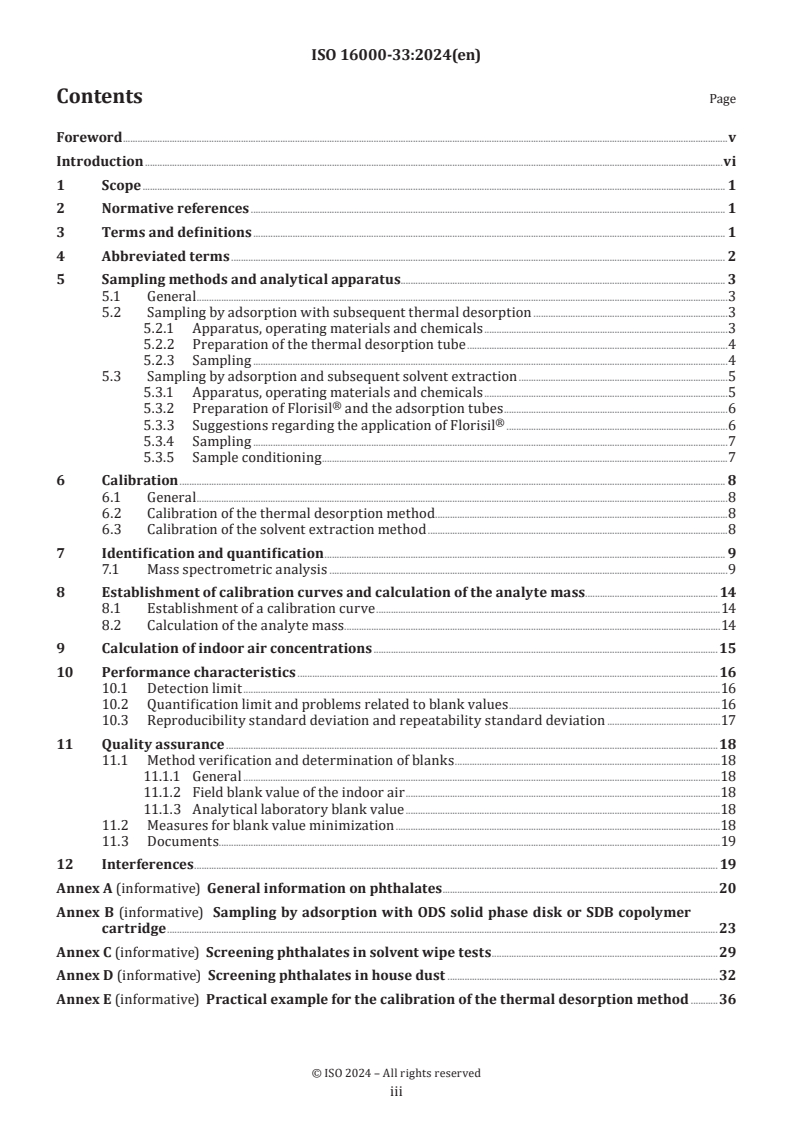
Contents Page
Foreword .v
Introduction .vi
1 Scope . 1
2 Normative references . 1
3 Terms and definitions . 1
4 Abbreviated terms . 2
5 Sampling methods and analytical apparatus. 3
5.1 General .3
5.2 Sampling by adsorption with subsequent thermal desorption .3
5.2.1 Apparatus, operating materials and chemicals .3
5.2.2 Preparation of the thermal desorption tube .4
5.2.3 Sampling .4
5.3 Sampling by adsorption and subsequent solvent extraction .5
5.3.1 Apparatus, operating materials and chemicals .5 ®
5.3.2 Preparation of Florisil and the adsorption tubes .6 ®
5.3.3 Suggestions regarding the application of Florisil .6
5.3.4 Sampling .7
5.3.5 Sample conditioning .7
6 Calibration . 8
6.1 General .8
6.2 Calibration of the thermal desorption method .8
6.3 Calibration of the solvent extraction method .8
7 Identification and quantification . 9
7.1 Mass spectrometric analysis .9
8 Establishment of calibration curves and calculation of the analyte mass. 14
8.1 Establishment of a calibration curve .14
8.2 Calculation of the analyte mass . .14
9 Calculation of indoor air concentrations .15
10 Performance characteristics . 16
10.1 Detection limit .16
10.2 Quantification limit and problems related to blank values .16
10.3 Reproducibility standard deviation and repeatability standard deviation .17
11 Quality assurance .18
11.1 Method verification and determination of blanks .18
11.1.1 General .18
11.1.2 Field blank value of the indoor air .18
11.1.3 Analytical laboratory blank value .18
11.2 Measures for blank value minimization .18
11.3 Documents.19
12 Interferences . 19
Annex A (informative) General information on phthalates .20
Annex B (informative) Sampling by adsorption with ODS solid phase disk or SDB copolymer
cartridge .23
Annex C (informative) Screening phthalates in solvent wipe tests .29
Annex D (informative) Screening phthalates in house dust .32
Annex E (informative) Practical example for the calibration of the thermal desorption method .36
iii
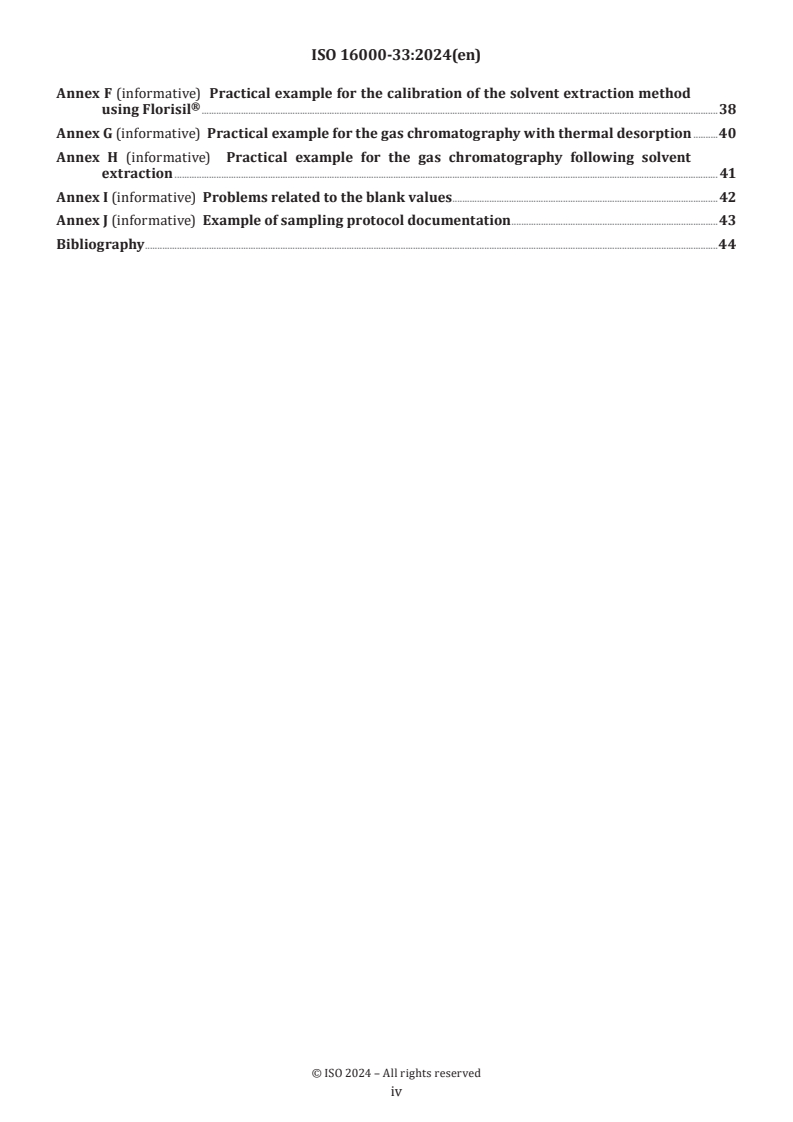
Annex F (informative) Practical example for the calibration of the solvent extraction method ®
using Florisil .38
Annex G (informative) Practical example for the gas chromatography with thermal desorption .40
Annex H (informative) Practical example for the gas chromatography following solvent
extraction . 41
Annex I (informative) Problems related to the blank values .42
Annex J (informative) Example of sampling protocol documentation .43
Bibliography .44
iv
Foreword
ISO (the International Organization for Standardization) is a worldwide federation of national standards
bodies (ISO member bodies). The work of preparing International Standards is normally carried out through
ISO technical committees. Each member body interested in a subject for which a technical committee
has been established has the right to be represented on that committee. International organizations,
governmental and non-governmental, in liaison with ISO, also take part in the work. ISO collaborates closely
with the International Electrotechnical Commission (IEC) on all matters of electrotechnical standardization.
The procedures used to develop this document and those intended for its further maintenance are described
in the ISO/IEC Directives, Part 1. In particular, the different approval criteria needed for the different types
of ISO document should be noted. This document was drafted in accordance with the editorial rules of the
ISO/IEC Directives, Part 2 (see www.iso.org/directives).
ISO draws attention to the possibility that the implementation of this document may involve the use of (a)
patent(s). ISO takes no position concerning the evidence, validity or applicability of any claimed patent
rights in respect thereof. As of the date of publication of this document, ISO had not received notice of (a)
patent(s) which may be required to implement this document. However, implementers are cautioned that
this may not represent the latest information, which may be obtained from the patent database available at
www.iso.org/patents. ISO shall not be held responsible for identifying any or all such patent rights.
Any trade name used in this document is information given for the convenience of users and does not
constitute an endorsement.
For an explanation of the voluntary nature of standards, the meaning of ISO specific terms and expressions
related to conformity assessment, as well as information about ISO's adherence to the World Trade
Organization (WTO) principles in the Technical Barriers to Trade (TBT), see www.iso.org/iso/foreword.html.
This document was prepared by Technical Committee ISO/TC 146, Air quality, Subcommittee SC 6, Indoor air.
This second edition cancels and replaces the first edition (ISO 16000-33:2017), which has been technically
revised.
The main change is as follows: a description of an adsorbent which can alternatively be used has been added.
A list of all parts in the ISO 16000 series can be found on the ISO website.
Any feedback or questions on this document should be directed to the user’s national standards body. A
complete listing of these bodies can be found at www.iso.org/members.html.
v
Introduction
Different parts of the ISO 16000 series describe the general requirements relating to the measurement of
indoor air pollutants and the important conditions to be observed before or during the sampling of individual
pollutants or groups of pollutants, as well as the measurement procedures themselves.
The definition of indoor environment is given by ISO 16000-1. Dwellings [living rooms, bedrooms, do-it-
yourself (DIY) rooms, sports rooms and cellars, kitchens and bathrooms], workrooms or workplaces in
buildings which are not subject to health and safety inspections with respect to air pollutants (e.g. offices,
salesrooms), public buildings (e.g. restaurants, theatres, cinemas and other meeting rooms) and passenger
cabins of motor vehicles and public transport are among the most important types of indoor environment.
Phthalates, the diesters of the ortho-phthalic acid (1,2-benzene dicarboxylic acid), are emitted into the
indoor air primarily from articles of daily use made of soft polyvinyl chloride (PVC). Typically, phthalates
are used as plasticizers in soft PVC. Four most frequently used phthalates are diisodecylphthalate (DiDP),
diisononylphthalate (DiNP), di-2-ethylhexyl terephthalate (DOTP) and di-isononyl cyclohexane dicarboxylate
(DINCH) but other families of esters are available. Di(2-ethylhexyl)-phthalate (DEHP), di-n-butyl-phthalate
(DBP) and benzyl-n-butyl-phthalate (BBP) were used in Europe until more recent regulatory developments
placed restrictions on their use in the manufacture of new articles. However, these can still be present in
articles currently in use and are subject to assessment. An overview of the most important phthalates, their
acronyms and several relevant substance properties can be found in Table A.1. These phthalates can be
determined in indoor environments by means of the analytical methods incorporating gas chromatography-
mass spectrometry specified in this document.
vi
International Standard ISO 16000-33:2024(en)
Indoor air —
Part 33:
Determination of phthalates with gas chromatography/mass
spectrometry (GC/MS)
1 Scope
This document specifies the sampling and analysis of phthalates in indoor air and describes the sampling
and analysis of phthalates in house dust and in solvent wipe samples of surfaces by means of gas
chromatography-mass spectrometry (GC-MS).
Two alternative sampling, sample preparation and sample introduction methods, whose comparability has
[1]
been proven in an interlaboratory test, are specified for indoor air :
— sorbent tubes sampling with subsequent thermal desorption GC-MS, and
— sampling by adsorption and subsequent solvent extraction and injection to GC-MS.
Additional adsorbents that can be used are described in Annex B.
Depending on the sampling method, the compounds dimethyl phthalate to diisoundecylphthalate can
[2]
be analysed in house dust as described in Annex D . The investigation of house dust samples is only
appropriate as a screening method. This investigation only results in indicative values and is not acceptable
for a final assessment of a potential need for action.
Dimethyl phthalate to diisoundecylphthalate can be analysed in solvent wipe samples as described in
Annex C. Solvent wipe samples are suitable for non-quantitative source identification.
NOTE In principle, the method is also suitable for the analysis of other phthalates, adipates and cyclohexane
dicarboxylic acid esters, but this is confirmed by determination of the performance characteristics in each case.
General information on phthalates are given in Annex A.
2 Normative references
The following documents are referred to in the text in such a way that some or all of their content constitutes
requirements of this document. For dated references, only the edition cited applies. For undated references,
the latest edition of the referenced document (including any amendments) applies.
ISO 16000-6, Indoor air — Part 6: Determination of organic compounds (VVOC, VOC, SVOC) in indoor and test
chamber air by active sampling on sorbent tubes, thermal desorption and gas chromatography using MS or MS FID
3 Terms and definitions
No terms and definitions are listed in this document.
ISO and IEC maintain terminology databases for use in standardization at the following addresses:
— ISO Online browsing platform: available at https:// www .iso .org/ obp
— IEC Electropedia: available at https:// www .electropedia .org/
4 Abbreviated terms
For the purpose of this document, the following abbreviated terms apply.
BBP benzyl-n-butyl phthalate
DAIP diallyl phthalate
DBP di-n-butyl phthalate
DCHP dicyclohexyl phthalate
DEHP di(2-ethyl hexyl) phthalate
DEP diethyl phthalate
DiBP diisobutyl phthalate
DiDP diisodecylphthalate
DiNP diisononylphthalate
DiUP diisoundecyl phthalate
DMP dimethyl phthalate
DOP di(n-octyl) phthalate
DPhP diphenyl phthalate
DPP di-n-propyl phthalate
D -BBP D -benzyl-n-butyl phthalate
4 4
D -DBP D -di-n-butyl phthalate
4 4
D -DEP D -diethyl phthalate
4 4
D -DEHP D -di(2-ethyl hexyl) phthalate
4 4
D -DMP D -dimethyl phthalate
4 4
D -DOP D -di(n-octyl) phthalate
4 4
GC gas chromatographic
IS internal standard
LOD limit of detection
LOQ limit of quantification
MS mass spectrometry
ODS octadecyl silica
PE polyethylene
PP polypropylene
PTFE polytetrafluoroethylene
SDB styrene-divinylbenzene
SIM selected ion monitoring
SVOC semi-volatile organic compounds
TBME tertiary butyl methyl ether
TDS thermal desorption system
4-NP 4-nonylphenol
5 Sampling methods and analytical apparatus
5.1 General
Sampling of indoor air takes place either by adsorption on a thermal desorption tube filled with quartz wool
1) 2)
and Tenax® TA or on adsorbents such as Florisil® octadecyl silica (ODS) and styrene–divinylbenzene
[1],[3],[22]
(SDB) copolymer with subsequent solvent extraction. The quantity of solvent used for solvent
extraction procedures should be minimized in order to minimize blank values. All apparatus and reagents
used should be clean, i.e. without detectable quantities of the compounds of interest.
The experiences from the interlaboratory test have indicated that significant blank value differences
can also be introduced by the solvent. Each new bottle of solvent shall therefore be tested for phthalate
[1]
contamination before use .
NOTE The experiences from the interlaboratory test have indicated that rinsing with clean solvent (no detectable
phthalates) is sufficient to remove contamination from the apparatus and that a sterilization by heating with
subsequent deactivation of the heated glass apparatus is not mandatory.
The ubiquitous distribution of phthalates shall be considered during sampling of indoor air in order to
avoid contamination of the sample. The measures to be considered for blank value minimization, as well
as the advantages and disadvantages of the individual methods, are described in detail in 5.3.3, Clause B.2,
Clause D.6 and Annex I. Further hints to quality assurance and problems related to blank values that shall be
considered are listed in Clause 11.
5.2 Sampling by adsorption with subsequent thermal desorption
5.2.1 Apparatus, operating materials and chemicals
Use the apparatus, reagents and materials described in ISO 16000-6 with the following specific requirements.
5.2.1.1 Thermal desorption tube, stainless steel, inert-coated steel or glass tube filled with a 1 cm loosely
packed plug of non-friable quartz wool backed up by a minimum of 50 mg of Tenax® TA (see ISO 16000-6).
5.2.1.2 Sampling system, in accordance with Figure 1.
5.2.1.3 Pump, suitable for a volume flow in the range 50 ml/min to 200 ml/min under sampling conditions;
recommended sampling volume of approximately 20 l to approximately 70 l.
5.2.1.4 Gas volume meter, the maximal measurement inaccuracy shall not exceed 5 %.
1) Tenax® TA is the trade name of a product supplied by Buchem. This information is given for the convenience of the
users of this document and does not constitute an endorsement by ISO of the product named. Equivalent products may
be used if they can be shown to lead to the same results.
2) Florisil® is the trade name of product supplied by US Silica. This information is given for the convenience of the users
of this document and does not constitute an endorsement by ISO of the product named. Equivalent products may be used
if they can be shown to lead to the same results.
5.2.1.5 Laboratory sampling facilities, hygrometer, thermometer, barometer.
5.2.1.6 Internal standards, required as quality control measure of the whole analytical process including
sampling. Suitable examples include the ring-deuterated compounds D -DMP, D -DEP, D -DBP, D -BBP, D -
4 4 4 4 4
DEHP, D -DOP as well as the non-deuterated DAIP, see Clause 6 and Table 3. Standards shall be prepared
in phthalate-free methanol, as described in ISO 16000-6, at a level such that a maximum 1 μl injection
introduces approximately the same mass of analyte onto the sampling end of the tubes as is expected to be
collected during sampling.
5.2.1.7 Thermal desorption system, coupled to GC-MS for two-stage thermal desorption of the sorbent
tubes. Transfer of desorbed vapours via a carrier gas flow into a GC system, fitted with a MS detector.
NOTE Deactivated (silanised) glass wool or quartz wool can also be used as adsorbent after an appropriate
method validation.
5.2.2 Preparation of the thermal desorption tube
The use of a tube packed with quartz wool and Tenax® TA assumes knowledge of ISO 16000-6. Prepacked
and preconditioned sorbent tubes are available commercially or can be prepared in the laboratory as follows.
A plug of non-friable quartz wool, usually supported by a stainless steel mesh, is inserted at the sampling
end of the tube. The required mass of sorbent is poured into the tube behind the quartz wool plug. The far
end of the sorbent bed is typically supported by a second plug of quartz wool or a stainless steel mesh.
A minimum of 50 mg of Tenax® TA shall be used per tube in order to guarantee the sorption capacity.
NOTE Determination of the breakthrough volume is described in ISO 16017-1:2000, Annex B. The breakthrough
volumes are proportional to the dimensions and masses of the sorbents. The rule of the thumb is that the guaranteed
sample volume doubles itself when the sorbent bed length is doubled (while retaining the tube diameter).
After filling of the thermal desorption tubes (e.g. with Tenax® TA), the tubes are conditioned for
approximately 8 h at 280 °C followed by approximately 30 min at 300 °C in an inert gas flow (100 ml/min).
The purified sorption tubes are closed and stored at room temperature and in the dark in a container that
prevents sample contamination.
Analyse a representative number of conditioned tubes for blank value, using routine analytical parameters,
to ensure that thermal desorption blank is sufficiently small (see ISO 16000-6:2021, Clause 9).
Sampling should take place as soon as possible after conditioning. If sampling is not possible within
approximately 14 d after conditioning, then the tube shall be reconditioned for 15 min at approximately
300 °C before sampling. Cotton gloves can be used to minimize the risk of contamination of the sorbent
tubes. In addition, labelling shall be omitted.
The thermal desorption device should ensure that any contamination from external tube surfaces is
excluded from the analytical sample flow path.
Tubes should be individually identifiable via etched barcodes. No adhesive labels or writing on the tube is
allowed.
5.2.3 Sampling
Prior to sampling, the conditioned tubes are spiked with a maximum of 1 μl of internal standard solution in
methanol (e.g. 20 ng/μl for a sampling volume of 50 l; the absolute mass of the additionally spiked standard
depends on the sampling volume and the operating range of the method). The standard solution is usually
applied on the sampling end of the sorbent tube.
The sampling equipment is assembled according to Figure 1. The sampling equipment shall be free of leaks.
The pump is connected to the non-sampling end of the sorbent tube by means of polyethylene or PTFE
connectors and is switched on. If the breakthrough volume of the analysed phthalates is unknown, then two
sorption tubes shall be connected in series. The tubes shall be connected with a phthalate-free coupling.
The volume flow, as well as the temperature, the absolute air pressure and the relative air humidity, shall
be recorded. The suitable sampling volume flows are within the range of 50 ml/min to 200 ml/min. This
corresponds to a recommended sampling volume of approximately 20 l to 70 l for a sampling duration of
approximately 2 h to 24 h. After sampling, the sorption tube is removed from the sampling equipment; both
ends of the sorption tube shall be closed.
A duplicate sampling of the indoor air is recommended.
Sampled tubes shall be transported to the laboratory and analysed as soon as possible.
5.3 Sampling by adsorption and subsequent solvent extraction
5.3.1 Apparatus, operating materials and chemicals
5.3.1.1 Sampling system, in accordance with Figure 1.
5.3.1.2 Pump, suitable for a volume of approximately 2 l/min under the conditions of the sampling,
3 3
recommended sampling volume of approximately 1 m to 3 m in 8 h to 24 h.
5.3.1.3 Gas volume meter, the maximal measurement inaccuracy shall not exceed 5 %.
5.3.1.4 Muffle furnace. ®
5.3.1.5 Flat, heat resistant evaporating dish, for heating Florisil . ®
5.3.1.6 Florisil , 60 to 100 mesh.
Key
1 sampling tube 4 anti-abrasion filter
2 membrane vacuum pump 5 volume measuring device or mass flow controller
3 timer switch (optional) 6 protective housing
Figure 1 — Schematic diagram of the sampling equipment
5.3.1.7 Glass wool, silanized.
5.3.1.8 Glass flask, with screw-cap and PTFE sealing, 50 ml.
5.3.1.9 Adsorption tubes, glass tube, approximately 200 ml long, internal diameter approximately
10 mm to 12 mm.
5.3.1.10 Laboratory sampling facilities, hygrometer, thermometer, barometer.
5.3.1.11 Solvent, e.g. TBME or toluene, free of blank values (the solvent shall be tested for the absence of
phthalate blank values).
5.3.1.12 Internal standards. Suitable examples include the ring-deuterated compounds D -DMP, D -DEP,
4 4
D -DBP, D -BBP, D -DEHP, D -DOP as well as the non-deuterated DAIP; see Clause 6 and Table 3.
4 4 4 4
5.3.1.13 GC-MS, gas chromatographic system fitted with a mass spectrometric detector. ®
5.3.2 Preparation of Florisil and the adsorption tubes ®
Florisil is brought out in a thin layer (approximately 3 cm to 4 cm) on an evaporation dish and heated at
800 °C for 6 h. After cooling down in the desiccator it is deactivated with bi-distilled water (3 % proportion ®
by mass). To this end, 5 g of Florisil and 150 μl of water are added to a 50 ml glass flask with a screw- ®
cap and PTFE sealing. After closing the flask, Florisil shall be mixed for approximately 45 min until a ®
uniformly flowing powder has formed again. The deactivated Florisil is then filled into an adsorption tube ®
(see Figure 2). The filling height should be approximately 10 cm to 13 cm. The ends of the Florisil filling
are closed with silanised glass wool. The filled tubes are stored in the desiccator over silica gel until air
sampling.
NOTE The geometry of the tube is based on the method described in Reference [4].
Key ®
1 Florisil
2 glass wool
Figure 2 — Filling of the glass tube ®
5.3.3 Suggestions regarding the application of Florisil ®
Each batch of Florisil newly heated and deactivated in accordance with 5.3.2 shall be examined for blank
values. Batches where high phthalate blank values are still measured after such treatment shall be heated
and deactivated anew.
As long as the prepared tubes are stored in the desiccator, they are suitable for storage and use within six
months. After expiration of this period, unused tubes shall be emptied and the Florisil® shall be treated
again in accordance with 5.3.2.
3) ®
Other adsorbents such as Chromosorb 106 or comparable carrier materials can be utilized as adsorption
agents. Absorbent preparation and sampling shall then be modified accordingly, and the suitability shall be
proven by a determination of the performance characteristics. ®
3) Chromosorb 106 is the trade name of a product supplied by SKC Ltd. This information is given for the convenience
of users of this document and does not constitute an endorsement by ISO of the product named. Equivalent products may
be used if they can be shown to lead to the same results.
5.3.4 Sampling
A known volume (e.g. 10 μl) of the internal standard solution (e.g. 100 mg/l which corresponds to an absolute
mass of the internal standard of 1 μg) shall be added prior to sampling. The preparation of the solutions of
the internal standards is described in Annex E for thermal desorption method and in Annex F for solvent ®
extraction method using Florisil .
The internal standard is added, for example, by means of a microlitre syringe. The standard solution is
usually placed on the adsorbent on the side oriented towards the flow. The amount to be added for the
3 3
anticipated operating ranges from 0,05 μg/m to 10 μg/m is listed in Table 1. The compounds listed in
Clause 6 are suitable as internal standards.
The sampling equipment is assembled according to Figure 1 and a leak test is performed. The volume flow, as
well as the temperature, the absolute air pressure and the relative air humidity, shall be recorded. Sampling
3 3
takes place by means of a pump, and the sampling volume amounts to 1 m to 3 m . For a volume flow of 2 l/
min to 3 l/min, the sampling duration shall be approximately 8 h to 24 h depending on the sampling strategy.
The loaded tubes shall be transported to the laboratory promptly, and processing of the tubes shall take
place as soon as possible after sampling.
3 3
Table 1 — Operating range to determine the phthalates with contents from 0,05 µg/m to 10 µg/m
in an air sample
Concentration of the reduced sampling solution Corresponds to a concentration in the air
mg/l µg/m
0,05 0,05
0,1 0,1
0,5 0,5
1,0 1,0
2,5 2,5
5,0 5,0
10,0 10,0
The data concerning the calculated concentrations in the air are tentative. The actual detection and quantification limits of the
method shall be determined by the test laboratory based on the calibration under consideration of the blank value.
NOTE The data given in Table 1 are valid for an air volume of 1 m and sample processing as described in 5.3.5.
5.3.5 Sample conditioning ®
The Florisil and the glass wool from the adsorption tube are transferred completely to a 50 ml glass flask
with screw and mixed with 25 ml solvent. The flask is closed by a screw-cap with a PTFE-coated seal,
effectually shacked up for thorough wetting and placed for 15 min in the ultrasonic bath.
TBME and toluene have been proven successful as solvents. The use of another slightly polar solvent is
possible. Non-polar solvents (e.g. hexane) are not suitable. However, it shall be guaranteed that the same
solvent is used for calibration and gas chromatographic determination of the sampling solution.
Five millilitres of the supernatant are then extracted by a pipette and reduced to 0,2 ml by evaporation.
Reduction to dryness leads to considerable substance loss, especially of the volatile phthalates. A 100 μl
of this concentrated extract is transferred to the auto sampler vials and used for the GC-MS analysis (see
Clause 7). Under application of the specifications described in 5.3.4, the concentration of the internal
standard in the concentrated extract amounts to 1 mg/l.
6 Calibration
6.1 General
Phthalates present in indoor environments tend to undergo gas-particle-partitioning which is mainly
characterized by the vapour pressure of the individual compound. Phthalates exhibiting high vapour
pressures are most likely found in the gas phase whereas phthalates with low pressures tend to condense
and are predominantly found in the particle phase. Therefore, some phthalates like DPhP, DiNP, DiDP and
DiUP are not normally present at detectable concentrations in indoor air. Those compounds will be found
in solvent wipe samples and house dust samples. Methods for screening phthalates in solvent wipe tests
and house dust are described in Annex C and Annex D, respectively. Table 2 gives an overview for a range of
phthalates and their occurrence in air samples or house dust as well as in wipe samples.
Table 2 — Ascertainable phthalates in various media
Compound Air sample House dust Wipe sample
DMP X X X
DEP X X X
DPP X X X
DiBP X X X
DBP X X X
BBP X X X
DCHP X X X
DEHP X X X
DOP X X X
DPhP X X
DiNP X X
DiDP X X
DiUP X X
A calibration shall be performed in order to specify the concentration and working range to be determined,
respectively. A multiple calibration (at least a five-point calibration) is required for the establishment of the
basic calibration. It shall be repeated regularly, at the latest after substantial changes of the measurement
system. A multiple calibration (at least a three-point calibration) shall be performed for the validation of the
calibration function. The ring-deuterated compounds listed in 5.2.2 as well as the non-deuterated DAIP are
suitable as internal standards (see ISO 18856).
6.2 Calibration of the thermal desorption method
A minimum five-point thermal desorption GC-MS calibration shall be performed by desorbing a blank tube
and preparing standard tubes at four or more different levels covering the work range. Methanol is used as
solvent. A detailed example for a calibration procedure is given in Annex E.
6.3 Calibration of the solvent extraction method
A minimum five-point solvent extraction GC-MS calibration shall be performed by desorbing a blank tube
and preparing standard tubes at four or more different levels covering the work range. More calibration
points can be added if an extended calibration range is required. Either toluene or TBME is used as solvent. A
detailed example for a calibration procedure is given in Annex F.
7 Identification and quantification
7.1 Mass spectrometric analysis
During phthalate breakup through electron ionization, the anhydride fragment with a mass to charge ratio
(m/z) of 149 forms the base peak. The masses usually used in SIM mode are listed in Table 3.
Specific problems arise during quantification of the isomer mixtures, e.g. nonyl, decyl and undecyl phthalates.
Since isomeric phthalates fragment stronger than their n-compounds, the determination of phthalates using
the ion m/z = 149 and the response factor of the corresponding n-compound leads to a result that lies lower
than the actual value. Thus, for example, DEHP and DiBP show an approximately 20 % lower detection
sensitivity towards their n-compounds upon quantification by means of m/z = 149. The lower results for
components with longer chains can amount to 50 %.
Table 3 — Mass traces (SIM masses)
Compound Quantification mass Qualification mass
DMP 163 194
DEP 149 177
DPP 149 191,209
DiBP 149 167,223
DBP 149 205,223
BBP 149 91,206
DCHP 149 167,249
DEHP 149 167,279
DOP 149 167,279
DPhP 225 77,226
DiNP 293 149,167
DiDP 307 149
DiUP 321 149
a
D -DMP 167 198
a
D -DEP 153 181
a
D -DBP 153 209,227
a
D -BBP 153 95,212 0
a
D -DEHP 153 171,283
a
D -DOP 153 171,283
b
DAIP 149 104,189
a
These compounds are ring-deuterated phthalate internal standards.
b
This compound is an internal standard.
When DAIP is used as an internal standard, it is necessary to confirm that the retention times of DAIP and
4-NP are not identical.
In addition, numerous peaks in the chromatogram are obtained in the case of the isomeric nonyl, decyl and
[5],[6],[7]
undecyl phthalates (especially in house dust samples or solvent wipe samples) (see Figure 3). Thus,
for the same concentration, the height and the area of the individual peaks within a peak pattern of this type
are smaller than for the phthalates consisting of only one isomer, e.g. DEHP. Smaller concentrations of the
isomeric nonyl and decyl phthalates can present difficulties with conforming identities compared with the
same concentrations of phthalates consisting of a single isomer. Hence, the achievable quantification limits
for isomer mixtures are higher than for the common phthalates.
If several different isomer mixtures are present in a single sample (e.g. nonyl and decyl phthalates), then an
[5]
exact quantification of the single isomer mixture is no longer possible . Two different approaches can be
attempted to identify the mixtures and to quantify them by approximation.
— The identification and quantification takes place using the specific masses m/z = 293; 307; 321 according
to Table 3. This is, however, related to a sensitivity loss. Furthermore, the specific masses of the isomer
mixtures cannot be clearly allocated (see Figure 3).
— The identification and determination of the integration times takes place using the specific masses
m/z = 293; 307; 321 according to Table 3.
Quantification takes place using the mass m/z = 149. The integration limits are determined within the
overlapping range of both peaks (see Figure 3). This inaccurate determination of the integration window
can lead to substantial uncertainties.
a) Superimposed GC-MS chromatogram of a DiNP standard
b) Superimposed GC-MS chromatogram of a DiDP standard
Key
X retention time
Y strength of the signal
SOURCE: Reference [27]. Reproduced with the permission of the authors.
Figure 3 — Superimposed GC-MS chromatograms
The selected quantification method shall be recorded in the test report. A known problem is that
commercially used semi-volatile phthalates are not widely available as analytical standards. Furthermore,
the available analytical standards can have a substantially different composition as shown in Figure 4. It
shows the substantial mass trace m/z = 149 of two different commercially available DiNP mixtures. Both
DiNP mixtures show different peak patterns with a different retention range. Also, standards with the same
CAS number can reveal different compositions.
a) GC-MS chromatogram (m/z = 149) for DiNP standard producer A
b) GC-MS chromatogram (m/z = 149) for DiNP standard producer B
Key
X retention time
Y strength of the signal
SOURCE: Reference [27]. Reproduced with the permission of the authors.
Figure 4 — GC-MS chromatograms (m/z = 149) of two different DiNP standards
Figure 5 shows example chromatograms of an air sample, blank and calibration typical to Florisil® sampling
and analysis.
a) Chromatogram of a laboratory blank value from a Florisil® tube spiked with the IS and the
a
concentrate
b
b) Chromatogram of a calibration standard of 1 mg/l
c
c) Chromatogram of a processed air sample
Key
X retention time
Y strength of the signal
a
IS (DAlP): 17,02 min, DiBP: 19,22 min, DBP: 20,85 min, DEHP: 29,65 min.
b
DMP: 11,20 min, DEP: 14,04 min, IS (DAlP): 17,02 min, DiBP: 19,22 min, DBP: 20,85 min, BBP: 26,93 min, DEHP:
29,63 min, DOP: 31,99 min.
c
IS (DAlP): 17,04 min, DiBP: 19,22 min, DBP: 20,85 min, BBP: 26,95 min, DEHP: 29,66 min.
Figure 5 — Typical chromatograms of an air sample
8 Establishment of calibration curves and calculation of the analyte mass
8.1 Establishment of a calibration curve
A calibration curve is established by using calibration solutions. The calibration procedure is described in
Annex E for the thermal desorption method and in Annex F for the solvent extraction method. To establish
the calibration function, the ratio of the peak area of the fragment ion trace of the analyte to the peak area of
the fragment ion trace of the internal standard is calculated. The calibration function is given by Formula (1):
ν =+bm a (1)
PA
where
v is the peak area
...
International
Standard
ISO 16000-33
Second edition
Indoor air —
2024-07
Part 33:
Determination of phthalates
with gas chromatography/mass
spectrometry (GC/MS)
Air intérieur —
Partie 33: Détermination des phthalates par chromatographie en
phase gazeuse/spectrométrie de masse (CPG/SM)
Reference number
© ISO 2024
All rights reserved. Unless otherwise specified, or required in the context of its implementation, no part of this publication may
be reproduced or utilized otherwise in any form or by any means, electronic or mechanical, including photocopying, or posting on
the internet or an intranet, without prior written permission. Permission can be requested from either ISO at the address below
or ISO’s member body in the country of the requester.
ISO copyright office
CP 401 • Ch. de Blandonnet 8
CH-1214 Vernier, Geneva
Phone: +41 22 749 01 11
Email: copyright@iso.org
Website: www.iso.org
Published in Switzerland
ii
Contents Page
Foreword .v
Introduction .vi
1 Scope . 1
2 Normative references . 1
3 Terms and definitions . 1
4 Abbreviated terms . 2
5 Sampling methods and analytical apparatus. 3
5.1 General .3
5.2 Sampling by adsorption with subsequent thermal desorption .3
5.2.1 Apparatus, operating materials and chemicals .3
5.2.2 Preparation of the thermal desorption tube .4
5.2.3 Sampling .4
5.3 Sampling by adsorption and subsequent solvent extraction .5
5.3.1 Apparatus, operating materials and chemicals .5 ®
5.3.2 Preparation of Florisil and the adsorption tubes .6 ®
5.3.3 Suggestions regarding the application of Florisil .6
5.3.4 Sampling .7
5.3.5 Sample conditioning .7
6 Calibration . 8
6.1 General .8
6.2 Calibration of the thermal desorption method .8
6.3 Calibration of the solvent extraction method .8
7 Identification and quantification . 9
7.1 Mass spectrometric analysis .9
8 Establishment of calibration curves and calculation of the analyte mass. 14
8.1 Establishment of a calibration curve .14
8.2 Calculation of the analyte mass . .14
9 Calculation of indoor air concentrations .15
10 Performance characteristics . 16
10.1 Detection limit .16
10.2 Quantification limit and problems related to blank values .16
10.3 Reproducibility standard deviation and repeatability standard deviation .17
11 Quality assurance .18
11.1 Method verification and determination of blanks .18
11.1.1 General .18
11.1.2 Field blank value of the indoor air .18
11.1.3 Analytical laboratory blank value .18
11.2 Measures for blank value minimization .18
11.3 Documents.19
12 Interferences . 19
Annex A (informative) General information on phthalates .20
Annex B (informative) Sampling by adsorption with ODS solid phase disk or SDB copolymer
cartridge .23
Annex C (informative) Screening phthalates in solvent wipe tests .29
Annex D (informative) Screening phthalates in house dust .32
Annex E (informative) Practical example for the calibration of the thermal desorption method .36
iii
Annex F (informative) Practical example for the calibration of the solvent extraction method ®
using Florisil .38
Annex G (informative) Practical example for the gas chromatography with thermal desorption .40
Annex H (informative) Practical example for the gas chromatography following solvent
extraction . 41
Annex I (informative) Problems related to the blank values .42
Annex J (informative) Example of sampling protocol documentation .43
Bibliography .44
iv
Foreword
ISO (the International Organization for Standardization) is a worldwide federation of national standards
bodies (ISO member bodies). The work of preparing International Standards is normally carried out through
ISO technical committees. Each member body interested in a subject for which a technical committee
has been established has the right to be represented on that committee. International organizations,
governmental and non-governmental, in liaison with ISO, also take part in the work. ISO collaborates closely
with the International Electrotechnical Commission (IEC) on all matters of electrotechnical standardization.
The procedures used to develop this document and those intended for its further maintenance are described
in the ISO/IEC Directives, Part 1. In particular, the different approval criteria needed for the different types
of ISO document should be noted. This document was drafted in accordance with the editorial rules of the
ISO/IEC Directives, Part 2 (see www.iso.org/directives).
ISO draws attention to the possibility that the implementation of this document may involve the use of (a)
patent(s). ISO takes no position concerning the evidence, validity or applicability of any claimed patent
rights in respect thereof. As of the date of publication of this document, ISO had not received notice of (a)
patent(s) which may be required to implement this document. However, implementers are cautioned that
this may not represent the latest information, which may be obtained from the patent database available at
www.iso.org/patents. ISO shall not be held responsible for identifying any or all such patent rights.
Any trade name used in this document is information given for the convenience of users and does not
constitute an endorsement.
For an explanation of the voluntary nature of standards, the meaning of ISO specific terms and expressions
related to conformity assessment, as well as information about ISO's adherence to the World Trade
Organization (WTO) principles in the Technical Barriers to Trade (TBT), see www.iso.org/iso/foreword.html.
This document was prepared by Technical Committee ISO/TC 146, Air quality, Subcommittee SC 6, Indoor air.
This second edition cancels and replaces the first edition (ISO 16000-33:2017), which has been technically
revised.
The main change is as follows: a description of an adsorbent which can alternatively be used has been added.
A list of all parts in the ISO 16000 series can be found on the ISO website.
Any feedback or questions on this document should be directed to the user’s national standards body. A
complete listing of these bodies can be found at www.iso.org/members.html.
v
Introduction
Different parts of the ISO 16000 series describe the general requirements relating to the measurement of
indoor air pollutants and the important conditions to be observed before or during the sampling of individual
pollutants or groups of pollutants, as well as the measurement procedures themselves.
The definition of indoor environment is given by ISO 16000-1. Dwellings [living rooms, bedrooms, do-it-
yourself (DIY) rooms, sports rooms and cellars, kitchens and bathrooms], workrooms or workplaces in
buildings which are not subject to health and safety inspections with respect to air pollutants (e.g. offices,
salesrooms), public buildings (e.g. restaurants, theatres, cinemas and other meeting rooms) and passenger
cabins of motor vehicles and public transport are among the most important types of indoor environment.
Phthalates, the diesters of the ortho-phthalic acid (1,2-benzene dicarboxylic acid), are emitted into the
indoor air primarily from articles of daily use made of soft polyvinyl chloride (PVC). Typically, phthalates
are used as plasticizers in soft PVC. Four most frequently used phthalates are diisodecylphthalate (DiDP),
diisononylphthalate (DiNP), di-2-ethylhexyl terephthalate (DOTP) and di-isononyl cyclohexane dicarboxylate
(DINCH) but other families of esters are available. Di(2-ethylhexyl)-phthalate (DEHP), di-n-butyl-phthalate
(DBP) and benzyl-n-butyl-phthalate (BBP) were used in Europe until more recent regulatory developments
placed restrictions on their use in the manufacture of new articles. However, these can still be present in
articles currently in use and are subject to assessment. An overview of the most important phthalates, their
acronyms and several relevant substance properties can be found in Table A.1. These phthalates can be
determined in indoor environments by means of the analytical methods incorporating gas chromatography-
mass spectrometry specified in this document.
vi
International Standard ISO 16000-33:2024(en)
Indoor air —
Part 33:
Determination of phthalates with gas chromatography/mass
spectrometry (GC/MS)
1 Scope
This document specifies the sampling and analysis of phthalates in indoor air and describes the sampling
and analysis of phthalates in house dust and in solvent wipe samples of surfaces by means of gas
chromatography-mass spectrometry (GC-MS).
Two alternative sampling, sample preparation and sample introduction methods, whose comparability has
[1]
been proven in an interlaboratory test, are specified for indoor air :
— sorbent tubes sampling with subsequent thermal desorption GC-MS, and
— sampling by adsorption and subsequent solvent extraction and injection to GC-MS.
Additional adsorbents that can be used are described in Annex B.
Depending on the sampling method, the compounds dimethyl phthalate to diisoundecylphthalate can
[2]
be analysed in house dust as described in Annex D . The investigation of house dust samples is only
appropriate as a screening method. This investigation only results in indicative values and is not acceptable
for a final assessment of a potential need for action.
Dimethyl phthalate to diisoundecylphthalate can be analysed in solvent wipe samples as described in
Annex C. Solvent wipe samples are suitable for non-quantitative source identification.
NOTE In principle, the method is also suitable for the analysis of other phthalates, adipates and cyclohexane
dicarboxylic acid esters, but this is confirmed by determination of the performance characteristics in each case.
General information on phthalates are given in Annex A.
2 Normative references
The following documents are referred to in the text in such a way that some or all of their content constitutes
requirements of this document. For dated references, only the edition cited applies. For undated references,
the latest edition of the referenced document (including any amendments) applies.
ISO 16000-6, Indoor air — Part 6: Determination of organic compounds (VVOC, VOC, SVOC) in indoor and test
chamber air by active sampling on sorbent tubes, thermal desorption and gas chromatography using MS or MS FID
3 Terms and definitions
No terms and definitions are listed in this document.
ISO and IEC maintain terminology databases for use in standardization at the following addresses:
— ISO Online browsing platform: available at https:// www .iso .org/ obp
— IEC Electropedia: available at https:// www .electropedia .org/
4 Abbreviated terms
For the purpose of this document, the following abbreviated terms apply.
BBP benzyl-n-butyl phthalate
DAIP diallyl phthalate
DBP di-n-butyl phthalate
DCHP dicyclohexyl phthalate
DEHP di(2-ethyl hexyl) phthalate
DEP diethyl phthalate
DiBP diisobutyl phthalate
DiDP diisodecylphthalate
DiNP diisononylphthalate
DiUP diisoundecyl phthalate
DMP dimethyl phthalate
DOP di(n-octyl) phthalate
DPhP diphenyl phthalate
DPP di-n-propyl phthalate
D -BBP D -benzyl-n-butyl phthalate
4 4
D -DBP D -di-n-butyl phthalate
4 4
D -DEP D -diethyl phthalate
4 4
D -DEHP D -di(2-ethyl hexyl) phthalate
4 4
D -DMP D -dimethyl phthalate
4 4
D -DOP D -di(n-octyl) phthalate
4 4
GC gas chromatographic
IS internal standard
LOD limit of detection
LOQ limit of quantification
MS mass spectrometry
ODS octadecyl silica
PE polyethylene
PP polypropylene
PTFE polytetrafluoroethylene
SDB styrene-divinylbenzene
SIM selected ion monitoring
SVOC semi-volatile organic compounds
TBME tertiary butyl methyl ether
TDS thermal desorption system
4-NP 4-nonylphenol
5 Sampling methods and analytical apparatus
5.1 General
Sampling of indoor air takes place either by adsorption on a thermal desorption tube filled with quartz wool
1) 2)
and Tenax® TA or on adsorbents such as Florisil® octadecyl silica (ODS) and styrene–divinylbenzene
[1],[3],[22]
(SDB) copolymer with subsequent solvent extraction. The quantity of solvent used for solvent
extraction procedures should be minimized in order to minimize blank values. All apparatus and reagents
used should be clean, i.e. without detectable quantities of the compounds of interest.
The experiences from the interlaboratory test have indicated that significant blank value differences
can also be introduced by the solvent. Each new bottle of solvent shall therefore be tested for phthalate
[1]
contamination before use .
NOTE The experiences from the interlaboratory test have indicated that rinsing with clean solvent (no detectable
phthalates) is sufficient to remove contamination from the apparatus and that a sterilization by heating with
subsequent deactivation of the heated glass apparatus is not mandatory.
The ubiquitous distribution of phthalates shall be considered during sampling of indoor air in order to
avoid contamination of the sample. The measures to be considered for blank value minimization, as well
as the advantages and disadvantages of the individual methods, are described in detail in 5.3.3, Clause B.2,
Clause D.6 and Annex I. Further hints to quality assurance and problems related to blank values that shall be
considered are listed in Clause 11.
5.2 Sampling by adsorption with subsequent thermal desorption
5.2.1 Apparatus, operating materials and chemicals
Use the apparatus, reagents and materials described in ISO 16000-6 with the following specific requirements.
5.2.1.1 Thermal desorption tube, stainless steel, inert-coated steel or glass tube filled with a 1 cm loosely
packed plug of non-friable quartz wool backed up by a minimum of 50 mg of Tenax® TA (see ISO 16000-6).
5.2.1.2 Sampling system, in accordance with Figure 1.
5.2.1.3 Pump, suitable for a volume flow in the range 50 ml/min to 200 ml/min under sampling conditions;
recommended sampling volume of approximately 20 l to approximately 70 l.
5.2.1.4 Gas volume meter, the maximal measurement inaccuracy shall not exceed 5 %.
1) Tenax® TA is the trade name of a product supplied by Buchem. This information is given for the convenience of the
users of this document and does not constitute an endorsement by ISO of the product named. Equivalent products may
be used if they can be shown to lead to the same results.
2) Florisil® is the trade name of product supplied by US Silica. This information is given for the convenience of the users
of this document and does not constitute an endorsement by ISO of the product named. Equivalent products may be used
if they can be shown to lead to the same results.
5.2.1.5 Laboratory sampling facilities, hygrometer, thermometer, barometer.
5.2.1.6 Internal standards, required as quality control measure of the whole analytical process including
sampling. Suitable examples include the ring-deuterated compounds D -DMP, D -DEP, D -DBP, D -BBP, D -
4 4 4 4 4
DEHP, D -DOP as well as the non-deuterated DAIP, see Clause 6 and Table 3. Standards shall be prepared
in phthalate-free methanol, as described in ISO 16000-6, at a level such that a maximum 1 μl injection
introduces approximately the same mass of analyte onto the sampling end of the tubes as is expected to be
collected during sampling.
5.2.1.7 Thermal desorption system, coupled to GC-MS for two-stage thermal desorption of the sorbent
tubes. Transfer of desorbed vapours via a carrier gas flow into a GC system, fitted with a MS detector.
NOTE Deactivated (silanised) glass wool or quartz wool can also be used as adsorbent after an appropriate
method validation.
5.2.2 Preparation of the thermal desorption tube
The use of a tube packed with quartz wool and Tenax® TA assumes knowledge of ISO 16000-6. Prepacked
and preconditioned sorbent tubes are available commercially or can be prepared in the laboratory as follows.
A plug of non-friable quartz wool, usually supported by a stainless steel mesh, is inserted at the sampling
end of the tube. The required mass of sorbent is poured into the tube behind the quartz wool plug. The far
end of the sorbent bed is typically supported by a second plug of quartz wool or a stainless steel mesh.
A minimum of 50 mg of Tenax® TA shall be used per tube in order to guarantee the sorption capacity.
NOTE Determination of the breakthrough volume is described in ISO 16017-1:2000, Annex B. The breakthrough
volumes are proportional to the dimensions and masses of the sorbents. The rule of the thumb is that the guaranteed
sample volume doubles itself when the sorbent bed length is doubled (while retaining the tube diameter).
After filling of the thermal desorption tubes (e.g. with Tenax® TA), the tubes are conditioned for
approximately 8 h at 280 °C followed by approximately 30 min at 300 °C in an inert gas flow (100 ml/min).
The purified sorption tubes are closed and stored at room temperature and in the dark in a container that
prevents sample contamination.
Analyse a representative number of conditioned tubes for blank value, using routine analytical parameters,
to ensure that thermal desorption blank is sufficiently small (see ISO 16000-6:2021, Clause 9).
Sampling should take place as soon as possible after conditioning. If sampling is not possible within
approximately 14 d after conditioning, then the tube shall be reconditioned for 15 min at approximately
300 °C before sampling. Cotton gloves can be used to minimize the risk of contamination of the sorbent
tubes. In addition, labelling shall be omitted.
The thermal desorption device should ensure that any contamination from external tube surfaces is
excluded from the analytical sample flow path.
Tubes should be individually identifiable via etched barcodes. No adhesive labels or writing on the tube is
allowed.
5.2.3 Sampling
Prior to sampling, the conditioned tubes are spiked with a maximum of 1 μl of internal standard solution in
methanol (e.g. 20 ng/μl for a sampling volume of 50 l; the absolute mass of the additionally spiked standard
depends on the sampling volume and the operating range of the method). The standard solution is usually
applied on the sampling end of the sorbent tube.
The sampling equipment is assembled according to Figure 1. The sampling equipment shall be free of leaks.
The pump is connected to the non-sampling end of the sorbent tube by means of polyethylene or PTFE
connectors and is switched on. If the breakthrough volume of the analysed phthalates is unknown, then two
sorption tubes shall be connected in series. The tubes shall be connected with a phthalate-free coupling.
The volume flow, as well as the temperature, the absolute air pressure and the relative air humidity, shall
be recorded. The suitable sampling volume flows are within the range of 50 ml/min to 200 ml/min. This
corresponds to a recommended sampling volume of approximately 20 l to 70 l for a sampling duration of
approximately 2 h to 24 h. After sampling, the sorption tube is removed from the sampling equipment; both
ends of the sorption tube shall be closed.
A duplicate sampling of the indoor air is recommended.
Sampled tubes shall be transported to the laboratory and analysed as soon as possible.
5.3 Sampling by adsorption and subsequent solvent extraction
5.3.1 Apparatus, operating materials and chemicals
5.3.1.1 Sampling system, in accordance with Figure 1.
5.3.1.2 Pump, suitable for a volume of approximately 2 l/min under the conditions of the sampling,
3 3
recommended sampling volume of approximately 1 m to 3 m in 8 h to 24 h.
5.3.1.3 Gas volume meter, the maximal measurement inaccuracy shall not exceed 5 %.
5.3.1.4 Muffle furnace. ®
5.3.1.5 Flat, heat resistant evaporating dish, for heating Florisil . ®
5.3.1.6 Florisil , 60 to 100 mesh.
Key
1 sampling tube 4 anti-abrasion filter
2 membrane vacuum pump 5 volume measuring device or mass flow controller
3 timer switch (optional) 6 protective housing
Figure 1 — Schematic diagram of the sampling equipment
5.3.1.7 Glass wool, silanized.
5.3.1.8 Glass flask, with screw-cap and PTFE sealing, 50 ml.
5.3.1.9 Adsorption tubes, glass tube, approximately 200 ml long, internal diameter approximately
10 mm to 12 mm.
5.3.1.10 Laboratory sampling facilities, hygrometer, thermometer, barometer.
5.3.1.11 Solvent, e.g. TBME or toluene, free of blank values (the solvent shall be tested for the absence of
phthalate blank values).
5.3.1.12 Internal standards. Suitable examples include the ring-deuterated compounds D -DMP, D -DEP,
4 4
D -DBP, D -BBP, D -DEHP, D -DOP as well as the non-deuterated DAIP; see Clause 6 and Table 3.
4 4 4 4
5.3.1.13 GC-MS, gas chromatographic system fitted with a mass spectrometric detector. ®
5.3.2 Preparation of Florisil and the adsorption tubes ®
Florisil is brought out in a thin layer (approximately 3 cm to 4 cm) on an evaporation dish and heated at
800 °C for 6 h. After cooling down in the desiccator it is deactivated with bi-distilled water (3 % proportion ®
by mass). To this end, 5 g of Florisil and 150 μl of water are added to a 50 ml glass flask with a screw- ®
cap and PTFE sealing. After closing the flask, Florisil shall be mixed for approximately 45 min until a ®
uniformly flowing powder has formed again. The deactivated Florisil is then filled into an adsorption tube ®
(see Figure 2). The filling height should be approximately 10 cm to 13 cm. The ends of the Florisil filling
are closed with silanised glass wool. The filled tubes are stored in the desiccator over silica gel until air
sampling.
NOTE The geometry of the tube is based on the method described in Reference [4].
Key ®
1 Florisil
2 glass wool
Figure 2 — Filling of the glass tube ®
5.3.3 Suggestions regarding the application of Florisil ®
Each batch of Florisil newly heated and deactivated in accordance with 5.3.2 shall be examined for blank
values. Batches where high phthalate blank values are still measured after such treatment shall be heated
and deactivated anew.
As long as the prepared tubes are stored in the desiccator, they are suitable for storage and use within six
months. After expiration of this period, unused tubes shall be emptied and the Florisil® shall be treated
again in accordance with 5.3.2.
3) ®
Other adsorbents such as Chromosorb 106 or comparable carrier materials can be utilized as adsorption
agents. Absorbent preparation and sampling shall then be modified accordingly, and the suitability shall be
proven by a determination of the performance characteristics. ®
3) Chromosorb 106 is the trade name of a product supplied by SKC Ltd. This information is given for the convenience
of users of this document and does not constitute an endorsement by ISO of the product named. Equivalent products may
be used if they can be shown to lead to the same results.
5.3.4 Sampling
A known volume (e.g. 10 μl) of the internal standard solution (e.g. 100 mg/l which corresponds to an absolute
mass of the internal standard of 1 μg) shall be added prior to sampling. The preparation of the solutions of
the internal standards is described in Annex E for thermal desorption method and in Annex F for solvent ®
extraction method using Florisil .
The internal standard is added, for example, by means of a microlitre syringe. The standard solution is
usually placed on the adsorbent on the side oriented towards the flow. The amount to be added for the
3 3
anticipated operating ranges from 0,05 μg/m to 10 μg/m is listed in Table 1. The compounds listed in
Clause 6 are suitable as internal standards.
The sampling equipment is assembled according to Figure 1 and a leak test is performed. The volume flow, as
well as the temperature, the absolute air pressure and the relative air humidity, shall be recorded. Sampling
3 3
takes place by means of a pump, and the sampling volume amounts to 1 m to 3 m . For a volume flow of 2 l/
min to 3 l/min, the sampling duration shall be approximately 8 h to 24 h depending on the sampling strategy.
The loaded tubes shall be transported to the laboratory promptly, and processing of the tubes shall take
place as soon as possible after sampling.
3 3
Table 1 — Operating range to determine the phthalates with contents from 0,05 µg/m to 10 µg/m
in an air sample
Concentration of the reduced sampling solution Corresponds to a concentration in the air
mg/l µg/m
0,05 0,05
0,1 0,1
0,5 0,5
1,0 1,0
2,5 2,5
5,0 5,0
10,0 10,0
The data concerning the calculated concentrations in the air are tentative. The actual detection and quantification limits of the
method shall be determined by the test laboratory based on the calibration under consideration of the blank value.
NOTE The data given in Table 1 are valid for an air volume of 1 m and sample processing as described in 5.3.5.
5.3.5 Sample conditioning ®
The Florisil and the glass wool from the adsorption tube are transferred completely to a 50 ml glass flask
with screw and mixed with 25 ml solvent. The flask is closed by a screw-cap with a PTFE-coated seal,
effectually shacked up for thorough wetting and placed for 15 min in the ultrasonic bath.
TBME and toluene have been proven successful as solvents. The use of another slightly polar solvent is
possible. Non-polar solvents (e.g. hexane) are not suitable. However, it shall be guaranteed that the same
solvent is used for calibration and gas chromatographic determination of the sampling solution.
Five millilitres of the supernatant are then extracted by a pipette and reduced to 0,2 ml by evaporation.
Reduction to dryness leads to considerable substance loss, especially of the volatile phthalates. A 100 μl
of this concentrated extract is transferred to the auto sampler vials and used for the GC-MS analysis (see
Clause 7). Under application of the specifications described in 5.3.4, the concentration of the internal
standard in the concentrated extract amounts to 1 mg/l.
6 Calibration
6.1 General
Phthalates present in indoor environments tend to undergo gas-particle-partitioning which is mainly
characterized by the vapour pressure of the individual compound. Phthalates exhibiting high vapour
pressures are most likely found in the gas phase whereas phthalates with low pressures tend to condense
and are predominantly found in the particle phase. Therefore, some phthalates like DPhP, DiNP, DiDP and
DiUP are not normally present at detectable concentrations in indoor air. Those compounds will be found
in solvent wipe samples and house dust samples. Methods for screening phthalates in solvent wipe tests
and house dust are described in Annex C and Annex D, respectively. Table 2 gives an overview for a range of
phthalates and their occurrence in air samples or house dust as well as in wipe samples.
Table 2 — Ascertainable phthalates in various media
Compound Air sample House dust Wipe sample
DMP X X X
DEP X X X
DPP X X X
DiBP X X X
DBP X X X
BBP X X X
DCHP X X X
DEHP X X X
DOP X X X
DPhP X X
DiNP X X
DiDP X X
DiUP X X
A calibration shall be performed in order to specify the concentration and working range to be determined,
respectively. A multiple calibration (at least a five-point calibration) is required for the establishment of the
basic calibration. It shall be repeated regularly, at the latest after substantial changes of the measurement
system. A multiple calibration (at least a three-point calibration) shall be performed for the validation of the
calibration function. The ring-deuterated compounds listed in 5.2.2 as well as the non-deuterated DAIP are
suitable as internal standards (see ISO 18856).
6.2 Calibration of the thermal desorption method
A minimum five-point thermal desorption GC-MS calibration shall be performed by desorbing a blank tube
and preparing standard tubes at four or more different levels covering the work range. Methanol is used as
solvent. A detailed example for a calibration procedure is given in Annex E.
6.3 Calibration of the solvent extraction method
A minimum five-point solvent extraction GC-MS calibration shall be performed by desorbing a blank tube
and preparing standard tubes at four or more different levels covering the work range. More calibration
points can be added if an extended calibration range is required. Either toluene or TBME is used as solvent. A
detailed example for a calibration procedure is given in Annex F.
7 Identification and quantification
7.1 Mass spectrometric analysis
During phthalate breakup through electron ionization, the anhydride fragment with a mass to charge ratio
(m/z) of 149 forms the base peak. The masses usually used in SIM mode are listed in Table 3.
Specific problems arise during quantification of the isomer mixtures, e.g. nonyl, decyl and undecyl phthalates.
Since isomeric phthalates fragment stronger than their n-compounds, the determination of phthalates using
the ion m/z = 149 and the response factor of the corresponding n-compound leads to a result that lies lower
than the actual value. Thus, for example, DEHP and DiBP show an approximately 20 % lower detection
sensitivity towards their n-compounds upon quantification by means of m/z = 149. The lower results for
components with longer chains can amount to 50 %.
Table 3 — Mass traces (SIM masses)
Compound Quantification mass Qualification mass
DMP 163 194
DEP 149 177
DPP 149 191,209
DiBP 149 167,223
DBP 149 205,223
BBP 149 91,206
DCHP 149 167,249
DEHP 149 167,279
DOP 149 167,279
DPhP 225 77,226
DiNP 293 149,167
DiDP 307 149
DiUP 321 149
a
D -DMP 167 198
a
D -DEP 153 181
a
D -DBP 153 209,227
a
D -BBP 153 95,212 0
a
D -DEHP 153 171,283
a
D -DOP 153 171,283
b
DAIP 149 104,189
a
These compounds are ring-deuterated phthalate internal standards.
b
This compound is an internal standard.
When DAIP is used as an internal standard, it is necessary to confirm that the retention times of DAIP and
4-NP are not identical.
In addition, numerous peaks in the chromatogram are obtained in the case of the isomeric nonyl, decyl and
[5],[6],[7]
undecyl phthalates (especially in house dust samples or solvent wipe samples) (see Figure 3). Thus,
for the same concentration, the height and the area of the individual peaks within a peak pattern of this type
are smaller than for the phthalates consisting of only one isomer, e.g. DEHP. Smaller concentrations of the
isomeric nonyl and decyl phthalates can present difficulties with conforming identities compared with the
same concentrations of phthalates consisting of a single isomer. Hence, the achievable quantification limits
for isomer mixtures are higher than for the common phthalates.
If several different isomer mixtures are present in a single sample (e.g. nonyl and decyl phthalates), then an
[5]
exact quantification of the single isomer mixture is no longer possible . Two different approaches can be
attempted to identify the mixtures and to quantify them by approximation.
— The identification and quantification takes place using the specific masses m/z = 293; 307; 321 according
to Table 3. This is, however, related to a sensitivity loss. Furthermore, the specific masses of the isomer
mixtures cannot be clearly allocated (see Figure 3).
— The identification and determination of the integration times takes place using the specific masses
m/z = 293; 307; 321 according to Table 3.
Quantification takes place using the mass m/z = 149. The integration limits are determined within the
overlapping range of both peaks (see Figure 3). This inaccurate determination of the integration window
can lead to substantial uncertainties.
a) Superimposed GC-MS chromatogram of a DiNP standard
b) Superimposed GC-MS chromatogram of a DiDP standard
Key
X retention time
Y strength of the signal
SOURCE: Reference [27]. Reproduced with the permission of the authors.
Figure 3 — Superimposed GC-MS chromatograms
The selected quantification method shall be recorded in the test report. A known problem is that
commercially used semi-volatile phthalates are not widely available as analytical standards. Furthermore,
the available analytical standards can have a substantially different composition as shown in Figure 4. It
shows the substantial mass trace m/z = 149 of two different commercially available DiNP mixtures. Both
DiNP mixtures show different peak patterns with a different retention range. Also, standards with the same
CAS number can reveal different compositions.
a) GC-MS chromatogram (m/z = 149) for DiNP standard producer A
b) GC-MS chromatogram (m/z = 149) for DiNP standard producer B
Key
X retention time
Y strength of the signal
SOURCE: Reference [27]. Reproduced with the permission of the authors.
Figure 4 — GC-MS chromatograms (m/z = 149) of two different DiNP standards
Figure 5 shows example chromatograms of an air sample, blank and calibration typical to Florisil® sampling
and analysis.
a) Chromatogram of a laboratory blank value from a Florisil® tube spiked with the IS and the
a
concentrate
b
b) Chromatogram of a calibration standard of 1 mg/l
c
c) Chromatogram of a processed air sample
Key
X retention time
Y strength of the signal
a
IS (DAlP): 17,02 min, DiBP: 19,22 min, DBP: 20,85 min, DEHP: 29,65 min.
b
DMP: 11,20 min, DEP: 14,04 min, IS (DAlP): 17,02 min, DiBP: 19,22 min, DBP: 20,85 min, BBP: 26,93 min, DEHP:
29,63 min, DOP: 31,99 min.
c
IS (DAlP): 17,04 min, DiBP: 19,22 min, DBP: 20,85 min, BBP: 26,95 min, DEHP: 29,66 min.
Figure 5 — Typical chromatograms of an air sample
8 Establishment of calibration curves and calculation of the analyte mass
8.1 Establishment of a calibration curve
A calibration curve is established by using calibration solutions. The calibration procedure is described in
Annex E for the thermal desorption method and in Annex F for the solvent extraction method. To establish
the calibration function, the ratio of the peak area of the fragment ion trace of the analyte to the peak area of
the fragment ion trace of the internal standard is calculated. The calibration function is given by Formula (1):
ν =+bm a (1)
PA
where
v is the peak area ratio (ratio of the peak area of the analyte to the peak area of the internal stand-
PA
ard);
a is the intercept;
−1
b is the slope in μg ;
m is the analyte mass in μg.
A linear regression analysis using the known analyte masses, m, and the corresponding peak area ratios,
v , is performed. In addition to the intercept, a, and the slope, b, mentioned above, the regression analysis
PA
also gives the following parameters: the standard deviation of the intercept, s , the standard deviation of
a
the slope, s , the linear correlation coefficient, r, and the standard deviation of the regression (standard
b
deviation of the estimate), s , and the number of measurement points, n.
y,x
8.2 Calculation of the analyte mass
First of all, the ratio of the peak area of the analyte to the peak area of the internal standard is established,
v . The analyte mass, m, in μg is calculated using the peak area ratio and the regression coefficients (slope
PA
and intercept). Assuming m = m , i.e. the analyte mass refers to the mass of analyte in the measurement
sol
solution, in μg, the rearrangement of Formula (2) gives:
ma=−()ν /b (2)
solPA
Assuming m = m , i.e. the analyte mass refers to the mass of analyte in the thermal desorption tube, in μg,
tube
the rearrangement of Formula (1) gives Formula (3):
ma=−()ν /b (3)
tube PA
If the value for intercept
...