

ISO/TR 52127-2:2021
(Main)Energy performance of buildings — Building automation, controls and building management — Part 2: Explanation and justification of ISO 52127-1
General Information
- Abstract
This document contains information to support the correct understanding, use and adoption of ISO 52127-1.
- Status
- Published
- Publication Date
- 01-Feb-2021
- Technical Committee
- ISO/TC 205 - Building environment design
- Drafting Committee
- ISO/TC 205/WG 3 - Building Automation and Control System (BACS) Design
- Current Stage
- 6060 - International Standard published
- Start Date
- 02-Feb-2021
- Completion Date
- 02-Feb-2021
Buy Documents

ISO/TR 52127-2:2021 - Energy performance of buildings — Building automation, controls and building management — Part 2: Explanation and justification of ISO 52127-1 Released:2/2/2021

ISO/TR 52127-2:2021 - Energy performance of buildings — Building automation, controls and building management — Part 2: Explanation and justification of ISO 52127-1/2/2021
Overview
ISO/TR 52127-2:2021 is a Technical Report that explains and justifies ISO 52127-1 (the EPB module for Building management systems). It consolidates informative material to support correct understanding, national adoption and practical application of the ISO 52127 series on energy performance of buildings, with a focus on building automation, controls and building management (BAC/TBM). As an informative companion to the normative standard, this TR collects rationale, method descriptions and implementation guidance without adding new normative requirements.
Key topics and technical content
- Purpose: Clarifies how to apply the methods in ISO 52127-1 for detailed energy performance analysis when information about automation, control and management functions is available.
- Normative references: Links explicitly to ISO 52127-1, ISO 52000-1 (EPB framework) and ISO 7345 (terms/quantities).
- Method description:
- Role of Building Automation and Control (BAC) and Technical Building Management (TBM) in balancing occupant comfort and minimizing energy use.
- Three control characteristics: control accuracy, control function, control strategy.
- Emphasis on demand‑oriented control (orchestration from emission → distribution → storage → generation).
- Functions covered (BMS functions):
- Setpoint management
- Runtime management
- Sequencing of multiple generators (including mixed technologies and renewables)
- Local energy production and renewable energies
- Heat recovery and heat shifting
- Smart grid interactions and peak shaving
- Time-step compatibility: Method supports yearly, monthly, hourly and BIN statistical approaches; normally designed for monthly or hourly inputs.
- Rationale and application scope: Intended for holistic EPB calculations when detailed BAC/TBM data are known; assumes availability of a compatible EPB calculation method.
- Supporting material: Information on an accompanying spreadsheet and guidance on data input and simplified inputs.
Practical applications and intended users
This Technical Report is useful for:
- Energy modelers and building simulation engineers who need to quantify BAC/TBM effects on energy performance.
- BMS integrators and controls engineers implementing demand‑oriented strategies, sequencing and smart‑grid interactions.
- Building designers and HVAC consultants specifying control strategies (optimum start/stop, interlock, timers).
- Certification bodies, policy makers and standards developers adopting ISO 52127-1 into national EPB frameworks.
- Facility managers and technical building managers aiming to optimize comfort vs. energy use through automation.
Related standards
- ISO 52127-1 - Module M10‑12 (normative companion)
- ISO 52000-1 - EPB overarching framework and procedures
- ISO 7345 - Thermal insulation definitions
- EN standards referenced for control functions (e.g., optimum start/stop, timer)
Keywords: ISO/TR 52127-2:2021, ISO 52127-1, building automation, building management system, BAC, TBM, energy performance of buildings, demand-oriented control, sequencing multiple generators, smart grid, peak shaving.
Relations
- Effective Date
- 12-Feb-2026
- Effective Date
- 06-Jun-2022
Buy Documents
ISO/TR 52127-2:2021 - Energy performance of buildings — Building automation, controls and building management — Part 2: Explanation and justification of ISO 52127-1 Released:2/2/2021
ISO/TR 52127-2:2021 - Energy performance of buildings — Building automation, controls and building management — Part 2: Explanation and justification of ISO 52127-1/2/2021
Get Certified
Connect with accredited certification bodies for this standard

DIBt (Deutsches Institut für Bautechnik)
German Institute for Building Technology.
DIN CERTCO
DIN Group product certification.

Aboma Certification B.V.
Specialized in construction, metal, and transport sectors.
Sponsored listings
Frequently Asked Questions
ISO/TR 52127-2:2021 is a technical report published by the International Organization for Standardization (ISO). Its full title is "Energy performance of buildings — Building automation, controls and building management — Part 2: Explanation and justification of ISO 52127-1". This standard covers: This document contains information to support the correct understanding, use and adoption of ISO 52127-1.
This document contains information to support the correct understanding, use and adoption of ISO 52127-1.
ISO/TR 52127-2:2021 is classified under the following ICS (International Classification for Standards) categories: 91.120.10 - Thermal insulation of buildings. The ICS classification helps identify the subject area and facilitates finding related standards.
ISO/TR 52127-2:2021 has the following relationships with other standards: It is inter standard links to CEN ISO/TR 52127-2:2021, ISO/IEC 26300-3:2015. Understanding these relationships helps ensure you are using the most current and applicable version of the standard.
ISO/TR 52127-2:2021 is available in PDF format for immediate download after purchase. The document can be added to your cart and obtained through the secure checkout process. Digital delivery ensures instant access to the complete standard document.
Standards Content (Sample)
TECHNICAL ISO/TR
REPORT 52127-2
First edition
2021-02
Energy performance of buildings —
Building automation, controls and
building management —
Part 2:
Explanation and justification of ISO
52127-1
Performance énergétique des bâtiments — Automatisation,
régulation et gestion technique du bâtiment —
Partie 2: Explication et justification de l'ISO 52127-1
Reference number
©
ISO 2021
© ISO 2021
All rights reserved. Unless otherwise specified, or required in the context of its implementation, no part of this publication may
be reproduced or utilized otherwise in any form or by any means, electronic or mechanical, including photocopying, or posting
on the internet or an intranet, without prior written permission. Permission can be requested from either ISO at the address
below or ISO’s member body in the country of the requester.
ISO copyright office
CP 401 • Ch. de Blandonnet 8
CH-1214 Vernier, Geneva
Phone: +41 22 749 01 11
Email: copyright@iso.org
Website: www.iso.org
Published in Switzerland
ii © ISO 2021 – All rights reserved
Contents Page
Foreword .iv
Introduction .v
1 Scope . 1
2 Normative references . 1
3 Terms and definitions . 1
4 Symbols . 1
5 Method description . 1
5.1 Effect of building automation and control (BAC) and technical building
management (TBM) . 1
5.2 Control strategy . 2
5.3 Rationale. 3
5.4 Time steps . 3
5.4.1 General. 3
5.4.2 Assumption . 3
5.4.3 Data input — Item 1. 3
5.4.4 Simplified input . 4
5.4.5 Calculation information . 4
5.5 List of functions covered by the method. 4
5.5.1 Setpoint management (BMS function 1) . 4
5.5.2 Runtime management (BMS function 2). 5
5.5.3 Sequencing of multiple generators (BMS function 3) . 6
5.5.4 Local energy production and renewable energies (BMS function 4) . 7
5.5.5 Heat recovery and heat shifting (BMS function 5) . 7
5.5.6 Smart grid interactions and peak shaving (BMS function 6) . 8
6 Method selection . 8
7 Information on the accompanying spreadsheet . 8
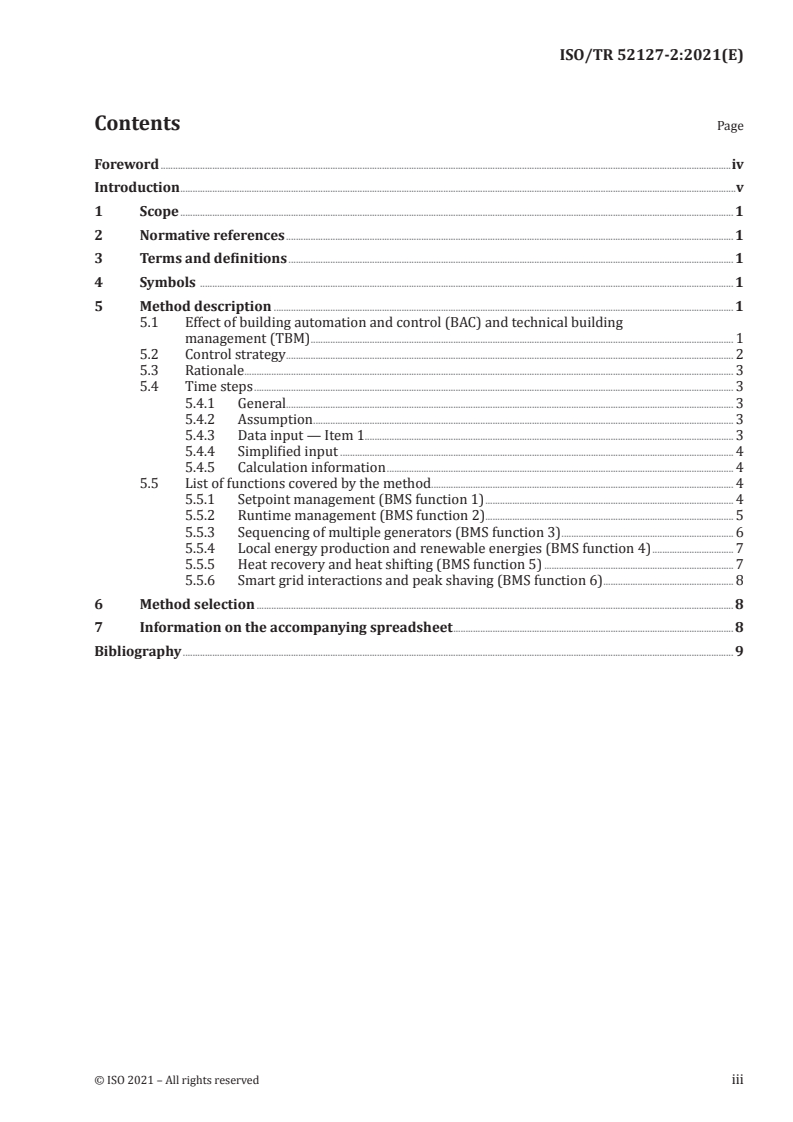
Bibliography . 9
Foreword
ISO (the International Organization for Standardization) is a worldwide federation of national standards
bodies (ISO member bodies). The work of preparing International Standards is normally carried out
through ISO technical committees. Each member body interested in a subject for which a technical
committee has been established has the right to be represented on that committee. International
organizations, governmental and non-governmental, in liaison with ISO, also take part in the work.
ISO collaborates closely with the International Electrotechnical Commission (IEC) on all matters of
electrotechnical standardization.
The procedures used to develop this document and those intended for its further maintenance are
described in the ISO/IEC Directives, Part 1. In particular, the different approval criteria needed for the
different types of ISO documents should be noted. This document was drafted in accordance with the
editorial rules of the ISO/IEC Directives, Part 2 (see www .iso .org/ directives).
Attention is drawn to the possibility that some of the elements of this document may be the subject of
patent rights. ISO shall not be held responsible for identifying any or all such patent rights. Details of
any patent rights identified during the development of the document will be in the Introduction and/or
on the ISO list of patent declarations received (see www .iso .org/ patents).
Any trade name used in this document is information given for the convenience of users and does not
constitute an endorsement.
For an explanation of the voluntary nature of standards, the meaning of ISO specific terms and
expressions related to conformity assessment, as well as information about ISO's adherence to the
World Trade Organization (WTO) principles in the Technical Barriers to Trade (TBT), see www .iso .org/
iso/ foreword .html.
This document was prepared by Technical Committee ISO/TC 205, Building environment design, in
collaboration with the European Committee for Standardization (CEN) Technical Committee CEN/
TC 247, Building Automation, Controls and Building Management, in accordance with the Agreement on
technical cooperation between ISO and CEN (Vienna Agreement).
A list of all parts in the ISO 52127 series can be found on the ISO website.
Any feedback or questions on this document should be directed to the user’s national standards body. A
complete listing of these bodies can be found at www .iso .org/ members .html.
iv © ISO 2021 – All rights reserved
Introduction
This document consolidates information that is considered important for users to properly understand,
apply and nationally adopt the EPB standards.
The detailed technical rules in CEN/TS 16629 ask for a clear separation between normative and
informative contents:
— to avoid flooding and confusing the actual normative part with informative content;
— to reduce the page count of the actual standard;
— to facilitate understanding of the package.
Therefore, each EPB standard should be accompanied by an informative Technical Report, like this
document, where all informative contents are collected.
Table 1 shows the relative position of this document within the EPB set of standards.
vi © ISO 2021 – All rights reserved
Table 1 — Position of this document within the EPB set of standards
Over- Building Technical building system
arching (as such)
Building au-
Sub Ventila- Humidifi- Dehumidi- Domestic PV,
Descriptions Descriptions Descriptions Heating Cooling Lighting tomation and
module tion cation fication hot waters wind…
control
sub1 M1 M2 M3 M4 M5 M6 M7 M8 M9 M10 M11
1 General General General
Common
terms and
definitions; Building en-
2 Needs
symbols, ergy needs
units and
subscripts
(Free)
Maximum
Indoor con-
3 Application load and
ditions with-
power
out systems
Ways to ex- Ways to ex- Ways to ex-
4 press energy press energy press energy
performance performance performance
Building
Heat transfer
functions Emission
5 by transmis-
and building and control
sion
boundaries
Building oc- Heat transfer
cupancy and by infiltra- Distribution
operating tion and and control
conditions ventilation
Aggregation
of energy
Internal heat Storage and
7 services
gains control
and energy
carriers
Building par- Solar heat Generation
titioning gains and control
NOTE The shaded modules are not applicable.
Table 1 (continued)
Over- Building Technical building system
arching (as such)
Building au-
Sub Ventila- Humidifi- Dehumidi- Domestic PV,
Descriptions Descriptions Descriptions Heating Cooling Lighting tomation and
module tion cation fication hot waters wind…
control
sub1 M1 M2 M3 M4 M5 M6 M7 M8 M9 M10 M11
Load dis-
Calculated Building dy-
patching and
9 energy per- namics (ther-
operating
formance mal mass)
conditions
Measured Measured Measured
10 energy per- energy per- energy per-
formance formance formance
11 Inspection Inspection Inspection
Ways to ex-
12 press indoor BMS x
comfort
External
13 environment
conditions
Economic
calculation
NOTE The shaded modules are not applicable.
TECHNICAL REPORT ISO/TR 52127-2:2021(E)
Energy performance of buildings — Building automation,
controls and building management —
Part 2:
Explanation and justification of ISO 52127-1
1 Scope
This document contains information to support the correct understanding, use and adoption of
ISO 52127-1.
2 Normative references
The following documents are referred to in the text in such a way that some or all of their content
constitutes requirements of this document. For dated references, only the edition cited applies. For
undated references, the latest edition of the referenced document (including any amendments) applies.
ISO 52127-1, Energy performance of buildings — Building management system — Part 1: Module M10-12
ISO 7345, Thermal insulation of buildings and building components — Physical quantities and definitions
ISO 52000-1, Energy performance of buildings — Overarching EPB assessment — Part 1: General
framework and procedures
3 Terms and definitions
For the purposes of this document, the terms and definitions given in ISO 7345, ISO 52000-1 and
ISO 52127-1 apply.
ISO and IEC maintain terminological databases for use in standardization at the following addresses:
— ISO Online browsing platform: available at https:// www .iso .org/ obp
— IEC Electropedia: available at http:// www .electropedia .org/
4 Symbols
For the purposes of this document, the symbols given in ISO 52000-1 and ISO 52127-1 apply.
5 Method description
5.1 Effect of building automation and control (BAC) and technical building
management (TBM)
The key-role of building automation and control and TBM is to ensure the balance between the desired
human comfort - which should be maximal, and energy used to obtain this goal - which should be
minimal.
The scope of BAC and TBM covers in accordance with their role from one side all technical building
systems (where the effect of the BAC is used in the calculation procedures) and from another side the
global optimization of the energy performance of a building.
Several categories of controls could be identified.
— Technical building systems specific controls: these controllers are dedicated to the physical chain of
transformation of the energy, from generation, to storage, distribution and emission. We find them
in the matrix starting with the modules M3-5 to M9-5 and finishing with M3-8 till M9-8. We could
consider that one controller exists by module, but sometimes one controller does the control among
several modules. More often, these controllers are communicating between them via a standardized
open bus, such as BACnet, KNX or LON.
— BAC used for all or several technical building systems that do multidiscipline (heating, cooling,
ventilation, DHW, lighting) optimization and complex control functions. For example, one of them is
INTERLOCK, a control function that avoids heating and cooling at the same time.
— If all technical building system are used in the building, we have (depending of the size of the
building) a technical building management system. Specific global functions are implemented here
and are necessary to reach the key-role mentioned above. Usually, in this case, an interrelation with
the building as such (module M2) will occur, mainly to take in consideration the building needs;
for example, due to outside temperature, taking into account the inertia of the building when the
control will reach the set point in a room.
In a control system dedicated to a building, in this case BAC and TBM, we can distinguish three main
characteristics:
— control accuracy,
— control function,
— control strategy.
Technical building management systems are implemented to realize an overall building operation
strategy by interdisciplinary orchestration of building energy systems (heating, cooling, ventilation,
lighting) whereas systems are controlled by BAC functions. Further information about control accuracy
and control functions can be found in ISO/TR 52120-2. ISO 52120-1 describes two approaches, how
to evaluate the contribution of building automation and how to control the energy performance of
buildings. This document is dedicated to control strategy and technical building management issues
covered by ISO 52127-1.
5.2 Control strategy
The control strategy is applied to achieve a given level of control to reach a goal. Optimal control
strategies deliver a desired level of control at a minimum cost. A control strategy could consist of a
control function or a group of control functions. An example of a control strategy implemented by a
control function is optimum start, optimum stop or night set back described in EN 12098-1 and
EN 12098-3. The timer function is described in EN 12098-5.
An example of a control strategy that is carried out by a group of control functions is the control strategy
used by intermittence. This function uses several control functions, operation modes, optimum start-
stop and timer at the same time. All elements together are called either building profile or user pattern.
Usually, to implement such building profile, a TBM is a prerequisite.
The most important control strategy described and implemented in ISO 52120-1 is demand-oriented
control. Usually these strategies implement the sense of the energy flow (from generation to emission)
with flow of calculation (from building needs to delivered energy). Usually for this complex control
strategy, a TBM is necessary with a distributed specific control for each technical building system that
communicates in system architecture via a communication standardized bus such as BACnet, KNX or LON.
Explained in more detail, this demand oriented control works as follows: when the comfort is reached
in the emission area, the controller from the emission sends the message to the controller in charge of
distribution to stop to distribute energy, then the controller in charge of distribution sends the message
to the controller in charge of storage to either store the energy or if the storage cannot store more
2 © ISO 2021 – All rights reserved
energy, then to send the message to the controller in charge of the generation to stop to generating
more energy.
Another important control strategy is the control strategy for multi generators either from the same
type (e.g. several boilers) or differe
...
TECHNICAL ISO/TR
REPORT 52127-2
First edition
2021-02
Energy performance of buildings —
Building automation, controls and
building management —
Part 2:
Explanation and justification of ISO
52127-1
Performance énergétique des bâtiments — Automatisation,
régulation et gestion technique du bâtiment —
Partie 2: Explication et justification de l'ISO 52127-1
Reference number
©
ISO 2021
© ISO 2021
All rights reserved. Unless otherwise specified, or required in the context of its implementation, no part of this publication may
be reproduced or utilized otherwise in any form or by any means, electronic or mechanical, including photocopying, or posting
on the internet or an intranet, without prior written permission. Permission can be requested from either ISO at the address
below or ISO’s member body in the country of the requester.
ISO copyright office
CP 401 • Ch. de Blandonnet 8
CH-1214 Vernier, Geneva
Phone: +41 22 749 01 11
Email: copyright@iso.org
Website: www.iso.org
Published in Switzerland
ii © ISO 2021 – All rights reserved
Contents Page
Foreword .iv
Introduction .v
1 Scope . 1
2 Normative references . 1
3 Terms and definitions . 1
4 Symbols . 1
5 Method description . 1
5.1 Effect of building automation and control (BAC) and technical building
management (TBM) . 1
5.2 Control strategy . 2
5.3 Rationale. 3
5.4 Time steps . 3
5.4.1 General. 3
5.4.2 Assumption . 3
5.4.3 Data input — Item 1. 3
5.4.4 Simplified input . 4
5.4.5 Calculation information . 4
5.5 List of functions covered by the method. 4
5.5.1 Setpoint management (BMS function 1) . 4
5.5.2 Runtime management (BMS function 2). 5
5.5.3 Sequencing of multiple generators (BMS function 3) . 6
5.5.4 Local energy production and renewable energies (BMS function 4) . 7
5.5.5 Heat recovery and heat shifting (BMS function 5) . 7
5.5.6 Smart grid interactions and peak shaving (BMS function 6) . 8
6 Method selection . 8
7 Information on the accompanying spreadsheet . 8
Bibliography . 9
Foreword
ISO (the International Organization for Standardization) is a worldwide federation of national standards
bodies (ISO member bodies). The work of preparing International Standards is normally carried out
through ISO technical committees. Each member body interested in a subject for which a technical
committee has been established has the right to be represented on that committee. International
organizations, governmental and non-governmental, in liaison with ISO, also take part in the work.
ISO collaborates closely with the International Electrotechnical Commission (IEC) on all matters of
electrotechnical standardization.
The procedures used to develop this document and those intended for its further maintenance are
described in the ISO/IEC Directives, Part 1. In particular, the different approval criteria needed for the
different types of ISO documents should be noted. This document was drafted in accordance with the
editorial rules of the ISO/IEC Directives, Part 2 (see www .iso .org/ directives).
Attention is drawn to the possibility that some of the elements of this document may be the subject of
patent rights. ISO shall not be held responsible for identifying any or all such patent rights. Details of
any patent rights identified during the development of the document will be in the Introduction and/or
on the ISO list of patent declarations received (see www .iso .org/ patents).
Any trade name used in this document is information given for the convenience of users and does not
constitute an endorsement.
For an explanation of the voluntary nature of standards, the meaning of ISO specific terms and
expressions related to conformity assessment, as well as information about ISO's adherence to the
World Trade Organization (WTO) principles in the Technical Barriers to Trade (TBT), see www .iso .org/
iso/ foreword .html.
This document was prepared by Technical Committee ISO/TC 205, Building environment design, in
collaboration with the European Committee for Standardization (CEN) Technical Committee CEN/
TC 247, Building Automation, Controls and Building Management, in accordance with the Agreement on
technical cooperation between ISO and CEN (Vienna Agreement).
A list of all parts in the ISO 52127 series can be found on the ISO website.
Any feedback or questions on this document should be directed to the user’s national standards body. A
complete listing of these bodies can be found at www .iso .org/ members .html.
iv © ISO 2021 – All rights reserved
Introduction
This document consolidates information that is considered important for users to properly understand,
apply and nationally adopt the EPB standards.
The detailed technical rules in CEN/TS 16629 ask for a clear separation between normative and
informative contents:
— to avoid flooding and confusing the actual normative part with informative content;
— to reduce the page count of the actual standard;
— to facilitate understanding of the package.
Therefore, each EPB standard should be accompanied by an informative Technical Report, like this
document, where all informative contents are collected.
Table 1 shows the relative position of this document within the EPB set of standards.
vi © ISO 2021 – All rights reserved
Table 1 — Position of this document within the EPB set of standards
Over- Building Technical building system
arching (as such)
Building au-
Sub Ventila- Humidifi- Dehumidi- Domestic PV,
Descriptions Descriptions Descriptions Heating Cooling Lighting tomation and
module tion cation fication hot waters wind…
control
sub1 M1 M2 M3 M4 M5 M6 M7 M8 M9 M10 M11
1 General General General
Common
terms and
definitions; Building en-
2 Needs
symbols, ergy needs
units and
subscripts
(Free)
Maximum
Indoor con-
3 Application load and
ditions with-
power
out systems
Ways to ex- Ways to ex- Ways to ex-
4 press energy press energy press energy
performance performance performance
Building
Heat transfer
functions Emission
5 by transmis-
and building and control
sion
boundaries
Building oc- Heat transfer
cupancy and by infiltra- Distribution
operating tion and and control
conditions ventilation
Aggregation
of energy
Internal heat Storage and
7 services
gains control
and energy
carriers
Building par- Solar heat Generation
titioning gains and control
NOTE The shaded modules are not applicable.
Table 1 (continued)
Over- Building Technical building system
arching (as such)
Building au-
Sub Ventila- Humidifi- Dehumidi- Domestic PV,
Descriptions Descriptions Descriptions Heating Cooling Lighting tomation and
module tion cation fication hot waters wind…
control
sub1 M1 M2 M3 M4 M5 M6 M7 M8 M9 M10 M11
Load dis-
Calculated Building dy-
patching and
9 energy per- namics (ther-
operating
formance mal mass)
conditions
Measured Measured Measured
10 energy per- energy per- energy per-
formance formance formance
11 Inspection Inspection Inspection
Ways to ex-
12 press indoor BMS x
comfort
External
13 environment
conditions
Economic
calculation
NOTE The shaded modules are not applicable.
TECHNICAL REPORT ISO/TR 52127-2:2021(E)
Energy performance of buildings — Building automation,
controls and building management —
Part 2:
Explanation and justification of ISO 52127-1
1 Scope
This document contains information to support the correct understanding, use and adoption of
ISO 52127-1.
2 Normative references
The following documents are referred to in the text in such a way that some or all of their content
constitutes requirements of this document. For dated references, only the edition cited applies. For
undated references, the latest edition of the referenced document (including any amendments) applies.
ISO 52127-1, Energy performance of buildings — Building management system — Part 1: Module M10-12
ISO 7345, Thermal insulation of buildings and building components — Physical quantities and definitions
ISO 52000-1, Energy performance of buildings — Overarching EPB assessment — Part 1: General
framework and procedures
3 Terms and definitions
For the purposes of this document, the terms and definitions given in ISO 7345, ISO 52000-1 and
ISO 52127-1 apply.
ISO and IEC maintain terminological databases for use in standardization at the following addresses:
— ISO Online browsing platform: available at https:// www .iso .org/ obp
— IEC Electropedia: available at http:// www .electropedia .org/
4 Symbols
For the purposes of this document, the symbols given in ISO 52000-1 and ISO 52127-1 apply.
5 Method description
5.1 Effect of building automation and control (BAC) and technical building
management (TBM)
The key-role of building automation and control and TBM is to ensure the balance between the desired
human comfort - which should be maximal, and energy used to obtain this goal - which should be
minimal.
The scope of BAC and TBM covers in accordance with their role from one side all technical building
systems (where the effect of the BAC is used in the calculation procedures) and from another side the
global optimization of the energy performance of a building.
Several categories of controls could be identified.
— Technical building systems specific controls: these controllers are dedicated to the physical chain of
transformation of the energy, from generation, to storage, distribution and emission. We find them
in the matrix starting with the modules M3-5 to M9-5 and finishing with M3-8 till M9-8. We could
consider that one controller exists by module, but sometimes one controller does the control among
several modules. More often, these controllers are communicating between them via a standardized
open bus, such as BACnet, KNX or LON.
— BAC used for all or several technical building systems that do multidiscipline (heating, cooling,
ventilation, DHW, lighting) optimization and complex control functions. For example, one of them is
INTERLOCK, a control function that avoids heating and cooling at the same time.
— If all technical building system are used in the building, we have (depending of the size of the
building) a technical building management system. Specific global functions are implemented here
and are necessary to reach the key-role mentioned above. Usually, in this case, an interrelation with
the building as such (module M2) will occur, mainly to take in consideration the building needs;
for example, due to outside temperature, taking into account the inertia of the building when the
control will reach the set point in a room.
In a control system dedicated to a building, in this case BAC and TBM, we can distinguish three main
characteristics:
— control accuracy,
— control function,
— control strategy.
Technical building management systems are implemented to realize an overall building operation
strategy by interdisciplinary orchestration of building energy systems (heating, cooling, ventilation,
lighting) whereas systems are controlled by BAC functions. Further information about control accuracy
and control functions can be found in ISO/TR 52120-2. ISO 52120-1 describes two approaches, how
to evaluate the contribution of building automation and how to control the energy performance of
buildings. This document is dedicated to control strategy and technical building management issues
covered by ISO 52127-1.
5.2 Control strategy
The control strategy is applied to achieve a given level of control to reach a goal. Optimal control
strategies deliver a desired level of control at a minimum cost. A control strategy could consist of a
control function or a group of control functions. An example of a control strategy implemented by a
control function is optimum start, optimum stop or night set back described in EN 12098-1 and
EN 12098-3. The timer function is described in EN 12098-5.
An example of a control strategy that is carried out by a group of control functions is the control strategy
used by intermittence. This function uses several control functions, operation modes, optimum start-
stop and timer at the same time. All elements together are called either building profile or user pattern.
Usually, to implement such building profile, a TBM is a prerequisite.
The most important control strategy described and implemented in ISO 52120-1 is demand-oriented
control. Usually these strategies implement the sense of the energy flow (from generation to emission)
with flow of calculation (from building needs to delivered energy). Usually for this complex control
strategy, a TBM is necessary with a distributed specific control for each technical building system that
communicates in system architecture via a communication standardized bus such as BACnet, KNX or LON.
Explained in more detail, this demand oriented control works as follows: when the comfort is reached
in the emission area, the controller from the emission sends the message to the controller in charge of
distribution to stop to distribute energy, then the controller in charge of distribution sends the message
to the controller in charge of storage to either store the energy or if the storage cannot store more
2 © ISO 2021 – All rights reserved
energy, then to send the message to the controller in charge of the generation to stop to generating
more energy.
Another important control strategy is the control strategy for multi generators either from the same
type (e.g. several boilers) or differe
...