

ISO 52032-1:2022
(Main)Energy performance of buildings — Energy requirements and efficiencies of heating, cooling and domestic hot water (DHW) distribution systems — Part 1: Calculation procedures
General Information
- Abstract
This document specifies the energy performance calculation of water-based distribution systems for space heating, space cooling and domestic hot water (DHW). This document is applicable to the heat flux from the distributed water to the space and the auxiliary energy of the related pumps. The heat flux and the auxiliary energy for pumps can be calculated for any time interval (hour, month and year). The input and output data are mean values of the time interval. Instead of calculating the energy performance of water-based distribution systems, it is also possible to use measurements as long as they follow the time intervals of the whole performance calculation or can be divided into those time intervals.
- Status
- Published
- Publication Date
- 27-Mar-2022
- Technical Committee
- ISO/TC 205 - Building environment design
- Drafting Committee
- ISO/TC 205/WG 9 - Heating and cooling systems
- Current Stage
- 6060 - International Standard published
- Start Date
- 28-Mar-2022
- Due Date
- 25-Oct-2021
- Completion Date
- 28-Mar-2022


Overview
ISO 52032-1:2022 - "Energy performance of buildings - Energy requirements and efficiencies of heating, cooling and domestic hot water (DHW) distribution systems - Part 1: Calculation procedures" - defines a standardized method to calculate the energy performance of water-based distribution systems for space heating, space cooling and domestic hot water (DHW). The standard covers calculation of the heat flux from distributed water to the space and the auxiliary energy of related pumps, using mean input/output values over defined time intervals (hour, month, year). Measurements may be used instead of calculations if they match the calculation time intervals.
Key topics and technical requirements
- Scope of calculation: thermal loss of distribution systems, recoverable thermal loss, auxiliary (pump) energy demand and recoverable auxiliary energy, for heating, cooling and DHW.
- Time intervals: calculations can be performed for any time interval (hour, month, year). Input/output data are mean values for the chosen interval.
- Input-data categories: product technical data, system configuration and design, operating/boundary conditions, constants/physical data, and Annex A inputs (with default choices in Annex B).
- Calculation procedure (Clause 6.4): includes choosing applicable time interval, determining operating conditions, calculating heat losses, recoverable energy, auxiliary energy (including pump control modes like setback/boost), ribbon heater auxiliary energy, and pipe length considerations.
- Templates and defaults: Annex A provides an input/method selection template; Annex B supplies default choices to ensure consistency and transparency.
- Quality and conformance: procedures for quality control and conformance checks are specified to validate calculation results.
- Terminology & symbols: aligned with ISO 52000-1 and ISO 7345, including standardized symbols, subscripts and definitions for EPB (energy performance of buildings) assessments.
Practical applications and users
ISO 52032-1:2022 is practical for:
- Architects, HVAC and building services engineers performing energy performance assessments
- Energy auditors and consultants preparing regulatory compliance reports
- Building designers and system specifiers sizing and selecting distribution components (pipes, pumps)
- Regulators and certification bodies developing or verifying EPB calculations
- Researchers and software developers implementing calculation modules in building simulation and energy assessment tools
Use cases include estimating distribution system losses for building energy certification, comparing system design options, and validating measured distribution performance against standardized calculation procedures.
Related standards
- ISO 52000-1:2017 - Overarching EPB framework and procedures
- ISO 52031 - Calculation method for space emission systems (heating and cooling)
- ISO 7345 - Thermal performance terminology and definitions
- ISO/TR 52032-2 and relevant CEN technical reports for additional guidance and context
Keywords: ISO 52032-1:2022, energy performance of buildings, distribution systems, water-based distribution, heating cooling DHW, pump auxiliary energy, heat loss calculation, EPB standards.
Get Certified
Connect with accredited certification bodies for this standard

DIBt (Deutsches Institut für Bautechnik)
German Institute for Building Technology.
DIN CERTCO
DIN Group product certification.

Aboma Certification B.V.
Specialized in construction, metal, and transport sectors.
Sponsored listings
Frequently Asked Questions
ISO 52032-1:2022 is a standard published by the International Organization for Standardization (ISO). Its full title is "Energy performance of buildings — Energy requirements and efficiencies of heating, cooling and domestic hot water (DHW) distribution systems — Part 1: Calculation procedures". This standard covers: This document specifies the energy performance calculation of water-based distribution systems for space heating, space cooling and domestic hot water (DHW). This document is applicable to the heat flux from the distributed water to the space and the auxiliary energy of the related pumps. The heat flux and the auxiliary energy for pumps can be calculated for any time interval (hour, month and year). The input and output data are mean values of the time interval. Instead of calculating the energy performance of water-based distribution systems, it is also possible to use measurements as long as they follow the time intervals of the whole performance calculation or can be divided into those time intervals.
This document specifies the energy performance calculation of water-based distribution systems for space heating, space cooling and domestic hot water (DHW). This document is applicable to the heat flux from the distributed water to the space and the auxiliary energy of the related pumps. The heat flux and the auxiliary energy for pumps can be calculated for any time interval (hour, month and year). The input and output data are mean values of the time interval. Instead of calculating the energy performance of water-based distribution systems, it is also possible to use measurements as long as they follow the time intervals of the whole performance calculation or can be divided into those time intervals.
ISO 52032-1:2022 is classified under the following ICS (International Classification for Standards) categories: 91.120.10 - Thermal insulation of buildings. The ICS classification helps identify the subject area and facilitates finding related standards.
ISO 52032-1:2022 is available in PDF format for immediate download after purchase. The document can be added to your cart and obtained through the secure checkout process. Digital delivery ensures instant access to the complete standard document.
Standards Content (Sample)
INTERNATIONAL ISO
STANDARD 52032-1
First edition
2022-03
Energy performance of buildings —
Energy requirements and efficiencies
of heating, cooling and domestic hot
water (DHW) distribution systems —
Part 1:
Calculation procedures
Performance énergétique des bâtiments — Besoins énergétiques
et rendements des systèmes de distribution d'eau chaude sanitaire,
chauffage et refroidissement —
Partie 1: Modes opératoires de calcul
Reference number
© ISO 2022
All rights reserved. Unless otherwise specified, or required in the context of its implementation, no part of this publication may
be reproduced or utilized otherwise in any form or by any means, electronic or mechanical, including photocopying, or posting on
the internet or an intranet, without prior written permission. Permission can be requested from either ISO at the address below
or ISO’s member body in the country of the requester.
ISO copyright office
CP 401 • Ch. de Blandonnet 8
CH-1214 Vernier, Geneva
Phone: +41 22 749 01 11
Email: copyright@iso.org
Website: www.iso.org
Published in Switzerland
ii
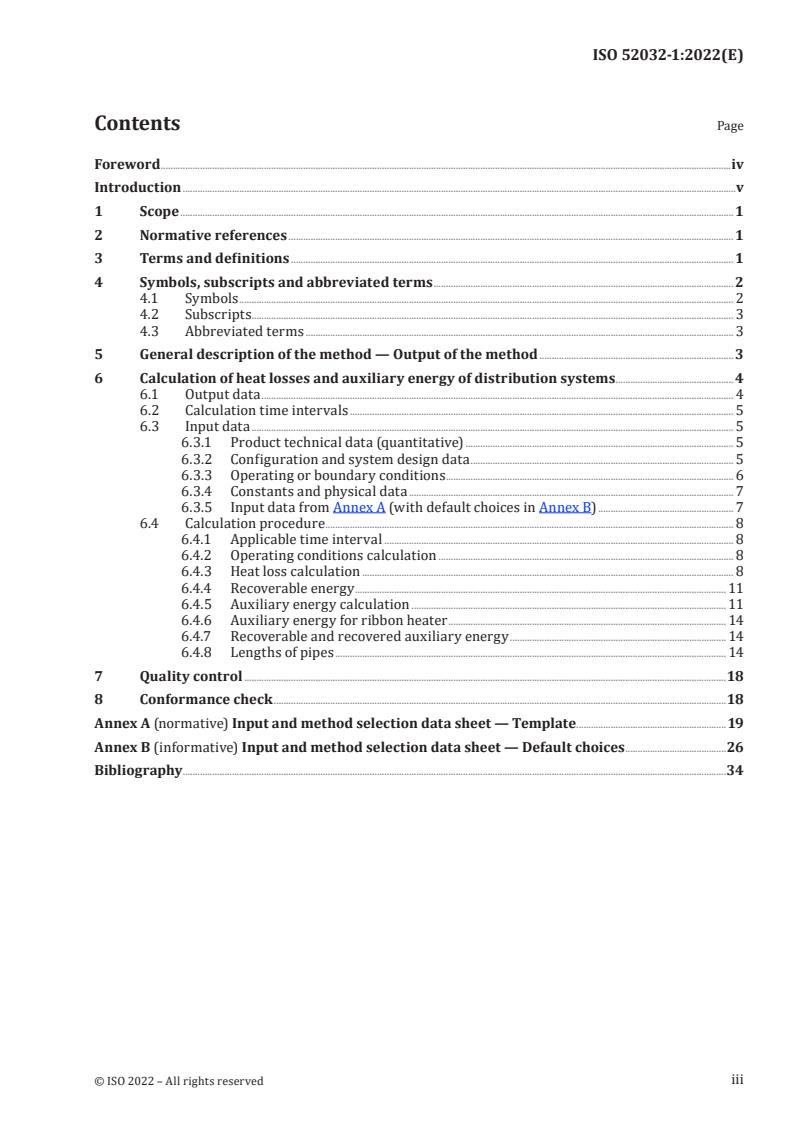
Contents Page
Foreword .iv
Introduction .v
1 Scope . 1
2 Normative references . 1
3 Terms and definitions . 1
4 Symbols, subscripts and abbreviated terms . 2
4.1 Symbols . 2
4.2 Subscripts . . 3
4.3 Abbreviated terms . 3
5 General description of the method — Output of the method . 3
6 Calculation of heat losses and auxiliary energy of distribution systems .4
6.1 Output data . 4
6.2 Calculation time intervals . 5
6.3 Input data . 5
6.3.1 Product technical data (quantitative) . 5
6.3.2 Configuration and system design data . 5
6.3.3 Operating or boundary conditions . 6
6.3.4 Constants and physical data . 7
6.3.5 Input data from Annex A (with default choices in Annex B) . 7
6.4 Calculation procedure . . 8
6.4.1 Applicable time interval . 8
6.4.2 Operating conditions calculation . 8
6.4.3 Heat loss calculation . 8
6.4.4 Recoverable energy . 11
6.4.5 Auxiliary energy calculation . 11
6.4.6 Auxiliary energy for ribbon heater . 14
6.4.7 Recoverable and recovered auxiliary energy . 14
6.4.8 Lengths of pipes . 14
7 Quality control .18
8 Conformance check .18
Annex A (normative) Input and method selection data sheet — Template .19
Annex B (informative) Input and method selection data sheet — Default choices .26
Bibliography .34
iii
Foreword
ISO (the International Organization for Standardization) is a worldwide federation of national standards
bodies (ISO member bodies). The work of preparing International Standards is normally carried out
through ISO technical committees. Each member body interested in a subject for which a technical
committee has been established has the right to be represented on that committee. International
organizations, governmental and non-governmental, in liaison with ISO, also take part in the work.
ISO collaborates closely with the International Electrotechnical Commission (IEC) on all matters of
electrotechnical standardization.
The procedures used to develop this document and those intended for its further maintenance are
described in the ISO/IEC Directives, Part 1. In particular, the different approval criteria needed for the
different types of ISO documents should be noted. This document was drafted in accordance with the
editorial rules of the ISO/IEC Directives, Part 2 (see www.iso.org/directives).
Attention is drawn to the possibility that some of the elements of this document may be the subject of
patent rights. ISO shall not be held responsible for identifying any or all such patent rights. Details of
any patent rights identified during the development of the document will be in the Introduction and/or
on the ISO list of patent declarations received (see www.iso.org/patents).
Any trade name used in this document is information given for the convenience of users and does not
constitute an endorsement.
For an explanation of the voluntary nature of standards, the meaning of ISO specific terms and
expressions related to conformity assessment, as well as information about ISO's adherence to
the World Trade Organization (WTO) principles in the Technical Barriers to Trade (TBT), see
www.iso.org/iso/foreword.html.
This document was prepared by Technical Committee ISO/TC 205, Building environment design.
A list of all parts in the ISO 52032 series can be found on the ISO website.
Any feedback or questions on this document should be directed to the user’s national standards body. A
complete listing of these bodies can be found at www.iso.org/members.html.
iv
Introduction
This document belongs to the family of International Standards aimed at the international
harmonization of the methodology for assessing the energy performance of buildings. Throughout, this
group of standards is referred to as a “set of EPB standards”.
All EPB standards follow specific rules to ensure overall consistency, unambiguity and transparency.
All EPB standards provide a certain flexibility with regard to the methods, the required input data and
references to other EPB standards. For the correct use of this document a template is given in Annex A
to specify these choices. Default choices are provided in Annex B.
The main target groups of this document are all the users of the set of EPB set of standards (e.g.
architects, engineers, regulators).
Further target groups are parties wanting to motivate their assumptions by classifying the building
energy performance for a dedicated building stock.
[12]1) [4]
More information is provided in ISO/TR 52032-2 and in CEN/TR 15316-6-3 .
Table 1 shows the relative position of this document within the set of EPB standards in the context of
the modular structure as set out in ISO 52000-1.
NOTE 1 In ISO/TR 52000-2 the same table can be found, with, for each module, the numbers of the relevant
EPB standards and accompanying technical reports that are published or in preparation.
NOTE 2 The modules represent EPB standards, although one EPB standard can cover more than one module
and one module can be covered by more than one EPB standard, e.g. a simplified and a detailed method
respectively. See also Clause 2 and Tables A.1 and B.1.
1) Under preparation. Stage at the time of publication: ISO/AWI TR 52032-2.
v
vi
Table 1 — Position of this document within the modular structure of the set of EPB standards
Building (as
Overarching Technical building systems
such)
Domes- Building
Electric-
Descrip- Descrip- Descrip- Ventila- Humidifica- Dehumidifica- tic hot Light- automa-
Heating Cooling ity pro-
tions tions tions tion tion tion water ing tion and
duction
(DHW) control
sub1 M1 sub1 M2 sub1 M3 M4 M5 M6 M7 M8 M9 M10 M11
1 General 1 General 1 General
Common
terms and
Building
definitions;
2 2 energy 2 Needs
symbols,
needs
units and
subscripts
(Free)
Indoor Maximum
Applica-
3 3 conditions 3 load and
tions
without power
systems
Ways to Ways to Ways to
express express express
4 4 4
energy per- energy per- energy per-
formance formance formance
Building
Heat
functions
transfer by Emission
5 and build- 5 5
transmis- and control
ing bounda-
sion
ries
Building
Heat trans- ISO ISO ISO
occupan- Distribu-
fer by infil- 52032-1 52032-1 52032-1
6 cy and 6 6 tion and
tration and (this doc- (this doc- (this doc-
operating control
ventilation ument) ument) ument)
conditions
Aggre-
gation of
energy Internal Storage and
7 7 7
services heat gains control
and energy
carriers
vii
Table 1 (continued)
Building (as
Overarching Technical building systems
such)
Domes- Building
Electric-
Descrip- Descrip- Descrip- Ventila- Humidifica- Dehumidifica- tic hot Light- automa-
Heating Cooling ity pro-
tions tions tions tion tion tion water ing tion and
duction
(DHW) control
sub1 M1 sub1 M2 sub1 M3 M4 M5 M6 M7 M8 M9 M10 M11
Building
Solar heat
8 partition- 8 8 Generation
gains
ing
Combus-
8–1
tion boilers
8–2 Heat pumps
Thermal
solar
8–3
photovol-
taics
On-site co-
8–4
generation
District
8–5 heating and
cooling
Direct
8–6 electrical
heater
Wind tur-
8–7
bines
Radiant
8–8 heating,
stoves
Load
Building
Calculated dispatch-
dynamics
9 energy per- 9 9 ing and
(thermal
formance operating
mass)
conditions
Measured Measured Measured
10 energy per- 10 energy per- 10 energy per-
formance formance formance
11 Inspection 11 Inspection 11 Inspection
viii
Table 1 (continued)
Building (as
Overarching Technical building systems
such)
Domes- Building
Electric-
Descrip- Descrip- Descrip- Ventila- Humidifica- Dehumidifica- tic hot Light- automa-
Heating Cooling ity pro-
tions tions tions tion tion tion water ing tion and
duction
(DHW) control
sub1 M1 sub1 M2 sub1 M3 M4 M5 M6 M7 M8 M9 M10 M11
Ways to
express
12 12 – 12 BMS
indoor
comfort
External
environ-
ment condi-
tions
Economic 15459–
calculation 1
NOTE The shaded modules are not applicable
INTERNATIONAL STANDARD ISO 52032-1:2022(E)
Energy performance of buildings — Energy requirements
and efficiencies of heating, cooling and domestic hot water
(DHW) distribution systems —
Part 1:
Calculation procedures
1 Scope
This document specifies the energy performance calculation of water-based distribution systems for
space heating, space cooling and domestic hot water (DHW).
This document is applicable to the heat flux from the distributed water to the space and the auxiliary
energy of the related pumps.
The heat flux and the auxiliary energy for pumps can be calculated for any time interval (hour, month
and year). The input and output data are mean values of the time interval.
Instead of calculating the energy performance of water-based distribution systems, it is also possible to
use measurements as long as they follow the time intervals of the whole performance calculation or can
be divided into those time intervals.
2 Normative references
The following documents are referred to in the text in such a way that some or all of their content
constitutes requirements of this document. For dated references, only the edition cited applies. For
undated references, the latest edition of the referenced document (including any amendments) applies.
ISO 7345, Thermal performance of buildings and building components — Physical quantities and definitions
ISO 52000-1:2017, Energy performance of buildings — Overarching EPB assessment — Part 1: General
framework and procedures
ISO 52031, Energy performance of buildings — Method for calculation of system energy requirements and
system efficiencies — Space emission systems (heating and cooling)
3 Terms and definitions
For the purposes of this document, the terms and definitions given in ISO 7345, ISO 52000-1 and the
following apply.
ISO and IEC maintain terminology databases for use in standardization at the following addresses:
— ISO Online browsing platform: available at https:// www .iso .org/ obp
— IEC Electropedia: available at https:// www .electropedia .org/
3.1
tapping profile
domestic hot water (DHW) drawn off over time
3.2
setback mode
operation mode for pumps at the end of scheduled usage time
3.3
boost mode
operation mode for pumps before the beginning of scheduled usage time
3.4
EPB standard
[5]
standard that complies with the requirements given in ISO 52000-1, CEN/TS 16628 and CEN/
[6]
TS 16629
Note 1 to entry: These three basic EPB documents were developed under a mandate given to CEN by the European
Commission and the European Free Trade Association (Mandate M/480), and support essential requirements of
EU Directive 2010/31/EC on the energy performance of buildings (EPBD). Several EPB standards and related
documents are developed or revised under the same mandate.
[SOURCE: ISO 52000-1:2017, 3.5.14.]
4 Symbols, subscripts and abbreviated terms
4.1 Symbols
For the purposes of this document, the symbols given in ISO 52000-1 and the following apply.
Symbol Description Unit
b factor for pump design selection -
B width m
c specific heat Wh/(kg∙K)
C constant -
d diameter m
f resistance ratio -
F force N
h total surface coefficient of heat transfer W/(m∙K)
H height m
L length m
m mass kg
n number -
p differential pressure kPa
P power N
q heat flowrate W/K
Q heat flow kWh
R pressure loss per m kPa/m
t time h
v flowrate m /h
V volume m
W energy demand kWh
z depth m
β mean part load in a time interval -
ε expenditure energy factor -
θ temperature C°
Symbol Description Unit
λ thermal conductivity W/(m∙K)
ρ density kg/m
Ψ linear thermal transmittance W/(m∙K)
V tapping profile 24 [1/h] – per day
Tap
4.2 Subscripts
For the purposes of this document, the subscripts given in ISO 52000-1 and the following apply.
a outer add additional ah ambient heating
amb ambient an regular mode aux auxiliary
avg average atap after tapping boost boost heating
C cooling ci calculation interval
comp components corr correction cs conditioned space
D insulation des design dis distribution
e efficiency el existing em embedded
equi equivalent fl floor H heating
HB hydraulic balance HC heating/cooling HCW heating/cooling/domes-
tic hot water (DHW)
hydr hydraulic i variable
in input ir inner
j zone index ls loss mean mean
nom nominal heat loss non non-insulated op operation
out output p pipe pmp pump
P1 pump control system #1 P2 pump control system #2 rbl recoverable
ref reference rib ribbon rvd recovered
setb setback mode stub open circuited stubs w water
W DHW
4.3 Abbreviated terms
DHW domestic hot water (system)
5 General description of the method — Output of the method
This method covers the calculation of:
— thermal loss of the distribution system for space heating, space cooling and domestic hot water
(DHW) in the zone;
— recoverable thermal loss for space heating, space cooling and DHW in the zone;
— auxiliary energy demand of distribution systems;
— recoverable auxiliary energy in the zone for space heating, space cooling and DHW in the zone;
— recovered auxiliary energy in the fluid in the zone for space heating, space cooling and DHW in the
zone.
The time interval of the output can be according to the time interval of the input values:
— hourly;
— monthly;
— yearly.
All input and output values are mean values in the corresponding time interval. Because of summarized
time intervals with the same boundary conditions and no dynamic effect being taken into account, the
bin-method is also valid.
6 Calculation of heat losses and auxiliary energy of distribution systems
6.1 Output data
The output data of this method are listed in Table 2.
Table 2 — Output data of this method
Intended
Validity
b
Description Symbol Unit destination Varying
a
interval
module
Thermal loss of the distribution system Yes
Q kWh 0 to ∞ M3–1
H,dis,ls
for heating in the zone
Thermal loss of the distribution system Yes
Q kWh 0 to ∞ M4–1
C,dis,ls
for cooling in the zone
Thermal loss of the distribution system Yes
Q kWh 0 to ∞ M3–1
W,dis,ls
for DHW in the zone
Recoverable thermal loss of the distri- Yes
Q kWh 0 to ∞ M3–1
H,dis,rbl
bution system for heating in the zone
Recoverable thermal loss of the distri- Yes
Q kWh 0 to ∞ M4–1
C,dis,rbl
bution system for cooling in the zone
Recoverable thermal loss of the dis- Yes
Q kWh 0 to ∞ M3–1
W,dis,rbl
tribution system for DHW in the zone
Auxiliary energy for distribution system Yes
W kWh 0 to ∞ M3–1
H,dis
heating in the zone
Auxiliary energy for distribution system Yes
W kWh 0 to ∞ M4–1
C,dis
cooling in the zone
Auxiliary energy for distribution system Yes
W kWh 0 to ∞ M3–1
W,dis
DHW in the zone
Recoverable auxiliary energy for dis- Yes
Q kWh 0 to ∞ M3–1
H,dis,rbl
tribution system heating in the zone
Recoverable auxiliary energy for dis- Yes
Q kWh 0 to ∞ M4–1
C,dis,rbl
tribution system cooling in the zone
Recoverable auxiliary energy for dis- Yes
Q kWh 0 to ∞ M3–1
W,dis,rbl
tribution system DHW in the zone
Recovered auxiliary energy for dis- Yes
Q kWh 0 to ∞ M3–1
H,dis,rvd
tribution system heating in the zone
Recovered auxiliary energy for dis- Yes
Q kWh 0 to ∞ M4–1
C,dis,rvd
tribution system cooling in the zone
a
Practical range, informative.
b
"Varying": value can vary over time; different values per time interval, e.g. hourly values or monthly values (not
constant values over the year).
Table 2 (continued)
Intended
Validity
b
Description Symbol Unit destination Varying
a
interval
module
Recovered auxiliary energy for distri- Yes
Q kWh 0 to ∞ M3–1
W,dis,rvd
bution system DHW in the zone
a
Practical range, informative.
b
"Varying": value can vary over time; different values per time interval, e.g. hourly values or monthly values (not
constant values over the year).
6.2 Calculation time intervals
The methods described in Clause 6 are suitable for the following calculation time intervals:
— hourly;
— monthly;
— yearly.
For this method, the output time interval is the same as the input time-interval. This method does not
take into account any dynamic effect.
6.3 Input data
6.3.1 Product technical data (quantitative)
Table 3 — Product technical input data list
Catalogue Computed Validity
b
Characteristics Symbol Ref. Varying
a
unit unit interval
Energy efficiency index EEI - 0 to 1 YES
a
Practical range, informative.
b
"Varying": value can vary over time; different values per time interval, e.g. hourly values or monthly values (not
constant values over the year).
6.3.2 Configuration and system design data
6.3.2.1 Process design
The input data of the process design are listed in Table 4.
Table 4 — Process design input data list
Process design
tapping profile V 24 ∙ [l/h]
tap
temperature difference between hot water tapping temperature to the return
∆ϑW °C
temperature in a circulation loop system (design value)
number of operations of circulation pump n 1/d
nom
average hot water temperature in circulation system without operation ϑ °C
W,avg
resistance ratio of components in the piping system f —
comp
pressure loss per length R kPa/m
HCW,max
pressure losses of additional resistances ∆R kPa
HCW,add
length of pipes L m
Table 4 (continued)
Process design
equivalent length of pipes (e.g. valves, hangers) L m
equi
6.3.2.2 Controls
This identifier (see Table 5) indicates how the pump is controlled.
Table 5 — Identifiers for pump control
Identifier Code Meaning
HEAT_DISTR_CTRL_PMP 0 Uncontrolled
HEAT_DISTR_CTRL_PMP 1 On-off mode
HEAT_DISTR_CTRL_PMP 2 Multi-stage-control
HEAT_DISTR_CTRL_PMP 3 Variable speed control based on ∆p -constant
HEAT_DISTR_CTRL_PMP 4 Variable speed control based on ∆p -variable
In this document a distinction is only made between codes 0, 3 and 4 because codes 1 and 2 relate to the
energy demand and not to the type of operation.
This identifier (see Table 6) indicates how the pump is operating in intermittent control of emission
and/or distribution.
Table 6 — Identifiers for pump control (intermittent)
Identifier Code Meaning
HEAT_DISTR_CTRL 0 No automatic control
HEAT_DISTR_CTRL 1 Fixed time program
HEAT_DISTR_CTRL 2 control with optimum start/stop
HEAT_DISTR_CTRL 3 Control with demand evaluation
In this document a distinction is only made between codes 0, 2 and 3. Code 1 relates to the energy
demand.
The values correspond to those in ISO 52031.
The identifier for pump selection in the design process (see Table 7) takes into account whether the
pump is selected with its working point at the design point or not. Different from design point is also
used for existing pumps.
Table 7 — Identifiers for pump selection
Identifier Code Meaning
PUMP_DISTR_SEL 1 When selection is at design point
PUMP_DISTR_SEL When selection is different from design
point
6.3.3 Operating or boundary conditions
Required operating condition data for this calculation procedure are listed in Table 8.
Table 8 — Operating condition data list
a b
Name Symbol Unit Range Origin module Varying
Operating conditions
Input temperature of the heating circuit ϑ °C 0 to 110 M3–5 Yes
H,in
Output temperature of the heating circuit ϑ °C 0 to 110 M3–5 Yes
H,out
Flowrate in the heating circuit v m /h 0 to ∞ Yes
H
Mean part load of heating circuit β — 0 to 1 Yes
H,dis
Input temperature of the cooling circuit ϑ °C 0 to 110 M4–5 Yes
C,in
Output temperature of the cooling circuit ϑ °C 0 to 110 M4–5 Yes
C,out
Flowrate in the cooling circuit v m /h 0 to ∞ Yes
C
Mean part load of cooling circuit β — 0 to 1 Yes
C,dis
Temperature of DHW ϑ °C 30 to 70 M8–1 Yes
W
Temperature difference between hot
water tapping temperature to the return Δϑ °C 1 to 20 Yes
W
temperature in a circulation loop system
.
Flowrate in the DHW circulation system m /h 0 to ∞ Yes
v
W
Calculation interval t h 1 to 8 760 M1–9 Yes
ci
Total time operation t h 0 to 8 760 M1–6 Yes
op
Surrounding zone temperature in the
ϑ °C −40 to +40 M2–2 Yes
ah,H
calculation interval at heating period
Surrounding zone temperature in the
ϑ °C −40 to +40 M2–2 Yes
ah,C
calculation interval at cooling period
Surrounding zone temperature in the
ϑ °C −40 to +40 M2–2 Yes
amb,W
calculation interval at DHW period
Operation time of the distribution system t h 0 to 8 760 M2–2 Yes
HCW,op
a
Practical range, informative.
b
"Varying": value can vary over time; different values per time interval, e.g. hourly values or monthly values (not
constant values over the year).
6.3.4 Constants and physical data
Table 9 indicates constants and physical data.
Table 9 — Constants and physical data
Name Symbol Unit Value
(specific heat ∙ density) of water c ∙ρ kWh/(m ·K) 1,15
w w
−3
Specific heat of water c kWh/(kg∙K) 1,163⋅10
w
Density of water ρ kg/m 990
w
6.3.5 Input data from Annex A (with default choices in Annex B)
The user shall follow the templates for choices in references, methods and input given in Annex A.
NOTE Informative default choices are given in Annex B, respecting the template of Annex A.
6.4 Calculation procedure
6.4.1 Applicable time interval
The procedure can be used with the following time intervals:
— hourly;
— monthly;
— yearly.
The bin-method can also be used because in this method only identical time intervals are summarized.
No dynamic effects are taken into account because there are no significant time constants.
This procedure is not suitable for dynamic simulations.
6.4.2 Operating conditions calculation
6.4.3 Heat loss calculation
6.4.3.1 General
The heat loss calculation of a distribution system is based on the mean water supply temperature, the
surrounding temperature in a space, the thermal transmittance of the pipes, the length of the pipes and
the operation time.
6.4.3.2 Mean water temperature for space heating and space cooling with circulation
The mean water temperature in the distribution systems ϑ for space heating and space cooling
HC;mean
is given by:
ϑϑ+
HC;inHC;out
ϑ = °[]C (1)
HC;mean
where
ϑ is the mean water temperature in the distribution system at the time interval, in C°;
HC;mean
ϑ is the input water temperature in the emission system, at the time interval, as determined
HC;in
in the relevant standard under EPB module M3-5, in C°;
ϑ is the output water temperature in the emission system at the time interval, as determined
HC;out
in the relevant standard under EPB module M3-5, in C°.
6.4.3.3 Mean water temperature for DHW with circulation
The mean water temperature in the distribution system θ for DHW with circulation is given by:
W,mean
Δϑ
W
ϑϑ=− (2)
W;mean W
where
ϑ is the hot water temperature at the time interval, as determined in the relevant standard under
W
EPB module M8-2, in C°;
∆ϑ is the temperature difference between hot water tapping temperature to the return tempera-
W
ture in a circulation loop system. It is a design value declared as an input in the process design
input data list in C°.
The mean water temperature during operation (tapping) is in case of stubs: ϑϑ=
W;mean W
6.4.3.4 Linear thermal transmittance
The linear thermal transmittance Ψ for insulated pipes in air with a total heat transfer coefficient
including convection and radiation at the outside is given by:
π
Ψ = (3)
d
1 1
a
⋅+ln
2⋅λ dh ⋅d
D ir aa
where
d is the inner diameter (without insulation) of the pipe, in m;
ir
d is the outer diameter (with insulation) of the pipe, in m
a
h is the outer total surface coefficient of heat transfer (convection and radiation), as obtained
a
from Table A.8 (normative template, with informative choice in Table B.8), in W/(m K);
λ is the thermal conductivity of insulation, in W/mK.
D
For embedded pipes the linear thermal transmittance Ψ is given by:
em
π
Ψ = (4)
em
d
1 11 4⋅z
a
⋅+ln ⋅ln
2 λλd d
D ir em a
where
z is the depth of pipe from surface, in m;
λ is the thermal conductivity of embedded material, in W/mK.
em
For non-insulated pipes the linear thermal transmittance Ψ is given by:
non
π
Ψ = (5)
non
d
1 p,a 1
⋅+ln
2⋅λ dh ⋅d
p p,ir ap,a
where
d is the inner diameter of the pipe, in m;
p,ir
d is the outer diameter of the pipe, in m;
p,a
λ is the thermal conductivity of the pipe material, in W/mK.
p
As an approximation the linear thermal transmittance Ψ is given by:
non
Ψ =⋅hdπ⋅ (6)
non ap,a
In absence of detailed information, typical values for the linear thermal transmittance Ψ can be
obtained from Table A.7 (template, with informative default values in Table B.7).
6.4.3.5 Thermal loss
The thermal losses are divided into two types of operation:
— during operation;
— without operation.
The tapping profile (see Table 4) includes the DHW-flow by each hour. If the DHW-flow per hour > 0 all
pipes in the sections S, V, and A (equal to stubs) are in operation. The DHW-flow is distributed to all
stubs. This simplified assumption is made because generally the tapping profile do not allow the DHW-
flow to be divided per stub. When within the tapping profile there is no tapping but the circulation loop
is in operation, then pipes in sections S and V are in operation and the stubs (pipe sections A) are not in
operation. During no tapping and no operation of the circulation loop, all pipe sections (S, V, A) are not
in operation.
Depending on the mode combination the following formulae are used. The calculations apply for the
circulation loops and the open stubs. Note that the length of the pipes in each zone shall be used divided
and added for each pipe section (S, V, A as determined in 6.4.8).
6.4.3.6 Thermal loss during operation (space heating, space cooling, DHW)
The thermal loss for a distribution system Q for space heating, space cooling and DHW
HCW;dis;ls
(including the circulation loop and the open stubs – during tapping per pipes S, V and A as determined
in 6.4.8 are in operation) in a zone during operation time is given by:
t
HCW;op
Qj=⋅Ψ ϑϑ− ⋅+LL ⋅t (7)
() ()
HCW;dis;ls ∑ ∑ HCW;mean HCW;amb;j eqquici
j
0 j
where
j is the index for zone (unconditioned or conditioned);
ϑ is the surrounding temperature in the zone at the time interval, in C°;
HCW;amb;j
L is the length of the pipe in the zone (unconditioned or conditioned), according to section
S, V or A as determined in 6.4.8, in m;
L is the equivalent length of pipe in the zone (unconditioned or conditioned) for, e.g. valves,
equi
hangers, in m;
t is the length of the calculation time interval, in h;
ci
t is the total operation time for space heating, space cooling and circulation loop of DHW,
HCW;op
in h.
6.4.3.7 Thermal loss without operation
The thermal loss in circulation systems without operation Q is calculated according to
w,dis,non
Formula (8), where the mean water temperature at operation time is substituted by the average hot
water temperature ϑ in the circulation system without operation and stubs during no tapping at
W;avg
the time interval:
t
W;op
[]
Qj=⋅Ψϑ −ϑ ⋅+LL ⋅t kWh (8)
() ()
W,dis,nonW∑ ∑ ;avg W;amb,j equi cci
j
j
where ϑ is the average hot water temperature in circulation system without operation at the time
W;avg
interval, in C°.
The average hot water temperature after a tapping during a time without operation ϑ is given
W;avg;j;t
by:
Ψ ⋅L ϑ −ϑ
()
jJ W;avg;ttW−1 ;;amb j
− ⋅−t 1
cV⋅⋅ρ
ww w ;j
ϑϑ=+ ϑϑ− ⋅e []°C (9)
()
W;avg;j;tW,amb,Wjj,avg,j;t-1 W,amb,
where
V is the volume of water in pipes in zone j in section S, V or A as determined in 6.4.8, in m ;
w;j
c is the specific heat of water, as specified in Table 9, in kWh/(kg∙K);
w
Ψ is the linear thermal transmittance zone j in section S, V or A as determined in 6.4.8, in W/(m∙K);
j
ρ
is the specific density of water, as specified in Table 9, in kg/m ;
w
t is the calculation interval after a tapping before the next tapping (see tapping profile as deter-
mined in the relevant standard under EPB module M3-5), t=0 starts at the end of last tapping
before a non-operation period and ends as the next tapping starts. t starts again with t=0;
L is the length of pipes in zone j according to section S, V or A as determined in 6.4.8, in m.
j
A simplified method to calculate the mean temperature ϑ without detailed information about the
W;avg;j
tapping profile for use in Formula (8) is given by:
−02,
ϑ =25.Ψ (10)
W;avg;j j
6.4.3.8 Total distribution system thermal loss with operation and without operation
The total thermal loss in a DHW distribution system is given by:
QQ=+ Q (11)
HCW;dis;ls;total HCW:dis;ls HCW;dis;non
6.4.4 Recoverable energy
The recoverable thermal loss of distribution systems for space heating, space cooling and DHW
Q in the zone is given by Formulae (7 and 8) under the boundary condition that the pipes with
HCW;dis;rbl
length L are located in conditioned spaces. Therefore the recoverable thermal loss as a part f
j HCW,dis,rbl
of the total losses is given as:
Q
HCW;dis;ls;cs
f = (12)
HCW;dis;rbl
Q
HCW;dis;ls,;total
Qf=⋅Q (13)
HW;dis;rbl HCW;dis;rblHW;dis;ls;total
Qf=− ⋅Q (14)
C;dis;rbl HCW;dis;rbl C;dis;ls;total
6.4.5 Auxiliary energy calculation
The auxiliary energy demand of distribution systems is based on the hydraulic design power of the
circulation pump, the differential pressure of the pipe system in a zone at design point, the flow at
design point, the expenditure energy factor of the circulation pump at operation point and the operation
time.
The hydraulic design power of a circulation pump P is given by:
HCW;hydr;des
ΔpV⋅
HCW;desHCW;des
P = (15)
HCW;hydr;des
where
∆p is the differential pressure (delivery height) in a circuit (piping system) at design point,
HCW;des
in kPa;
is the flow at design point, in m /h.
V
HCW;des
The differential pressure of a pipe system ∆ p in a circuit (piping system) is given by:
HCW;des
ΔΔpf=+1 ⋅⋅RL + R (16)
()
HCW;descompHCW;max max HCW;add
where
f is the resistance ratio of components in the piping system, as obtained from Table A.13
comp
(template, with informative value in Table B.13);
R is the pressure loss per length, as obtained from Table A.12 (template, with informative
HCW;max
values in Table B.12), in kPa/m;
L is the maximum length of the circuit, as obtained from 6.4.8, in m;
max
∆R is the pressure losses of additional resistances, as obtained from Table A.14 (template,
HCW;add
with informative values in Table B.14), in kPa.
The hydraulic energy demand W is given by:
HCW;dis;hydr;an
WP=⋅β ⋅⋅tf (17)
HCW;dis;hydr;anHCW;hydr;desHCW;dis HCW;op;anHCW;corrr
where
ß is the part load of the distribution system;
HCW;dis
t is the operation time of the distribution system, in h;
HCW;op;an
f is the correction factor for special design conditions of the distribution system, as ob-
HCW;corr
tained from Table A.15 (template, with informative values in Table B.15).
The auxiliary energy demand W is given by:
HCW;dis;an
WW=⋅ε (18)
HCW;dis;an HCW;dis;hydr;anHCW;dis
where ε is the expenditure energy factor of the distribution pump.
HCW;dis
The expenditure energy factor of distribution pumps ε is given by:
HCW;dis
EEI
−1
εβ=⋅fC +⋅C ⋅ (19)
()
HCW;disHCW;e P1 P2 HCW;dis
02, 5
where
f is the factor for efficiency, determined as described below;
HCW;e
C is the constant depending on control system of the pump, as obtained from Tables A.9 to A.11
P1
(templates, with informative values in Tables B.9 to B.11);
C is the constant depending on control system of the pump, as obtained from Tables A.9 to A.11
P2
(templates, with informative values in Tables B.9 to B.11);
EEI is the energy efficiency index, determined as described below.
The factor for efficiency f in general is given by:
HCW;e
P
HCW;ref
f = (20)
HCW;e
P
HCW;hydr;des
where P is the reference power of the pump.
HCW;ref
For circulation pumps (wet rotor pump) with hydraulic power 0,001 < P < 2,5 kW, the reference
HC;hydr;des
power is given by:
−⋅03, P
HC;hydr;des
PP=⋅17, +⋅17 1−e (21)
HC,ref ( HC;hydr;des ( ))
The EEI-value for circulation pumps (wet rotor pump) is determined by a measurement procedure as
described in Table A.17 (template, with informative choice in Table B.17). If the EEI of a real pump is
known it can be taken into account.
For all other pumps, EEI in Formula (24) shall be set to EEI = 0,25 and the factor for efficiency f is
HCW;e
then given by:
05,
02.
f =+12, 5 ⋅b (22)
HCW;e
P
HCW;hydr;des
where b is the factor for pump design selection (see identifier PUMP_DISTR_SEL in Table 9).
For existing installations, it is approximately correct to use the power rating given on the label at the
pump for P ; in case of non-controlled pumps with more than one speed level, P shall be taken
el;pmp el;pmp
from the speed level at which the pump is operated. Then the factor for efficiency is given by:
P
el;pmp
f = (23)
HCW;e
P
HCW;hydr;des
where P is the power rating on the label at existing pump (at speed level of pump operation), in kW.
el;pmp
For intermittent operation of circulation pumps in space heating or space cooling systems there are
three different phases and the total is the sum of these parts:
— regular mode W
HCW;dis;hydr;an
— setback mode W
HCW;dis;setb
— boost mode W
HCW;dis;boost
For the setback operation, the pump is operated at minimum speed. When the real efficiency in the
setback operation is not known, the power is assumed to be constant 30 % of the electrical power at
design point and then the auxiliary energy demand W taking into account a mean pump
HCW;dis;setb
efficiency of 30 %, is given by:
WP=⋅t (24)
HCW;dis;setb HCW;hydr;des ci
For boost mode operation the power of the pump is the electrical power at design point. The auxiliary
energy demand W also taking a mean pump efficiency into account, is given by:
HCW;dis;boost
WP=⋅33, ⋅t (25)
HCW;dis;boostHCW;hydr;desci
When the real power of the circulation pump in the different modes is available the calculation should
use this data.
6.4.6 Auxiliary energy for ribbon heater
The auxiliary energy demand for a ribbon heater in DHW distribution systems W is given by:
W;dis;rib
WQ= (26)
W;dis;ribW;dis;ls
where Q is calculated according to Formula (7), in kWh, taking into account only the length of the
W;dis;ls
hot water pipes.
6.4.7 Recoverable and recovered auxiliary energy
The recoverable auxiliary energy for distribution systems for space heating and DHW Q as
HCW;dis;rbl
heat flux to the zone which is the heat flux from the pump to the surrounding zone is given by:
Qf=⋅W (27)
HW;dis;rbl rbl;disHW;dis
where f is the factor for recoverable auxiliary energy in distribution systems, f , as obtained
rbl;dis aux;rbl
from Table A.16 (template, with informative values in Table B.16).
In case of distribution systems for space cooling, the heat flux to the zone is given by using the same
factor for recoverable energy but becomes negative, so that the energy demand in the conditioned space
is increased:
Qf=− ⋅W (28)
C;dis;rbl rbl;dis C;dis
The recovered auxiliary energy for distribution systems for space heating and DHW Q in the
HW,dis,rvd
zone as heat flux direct to the fluid (in case of wet rotor pump) is given by:
Qf=−1 ⋅W (29)
()
HW;dis;rvd rbl;disHW;dis;aux
In case of distribution systems for space cooling, the heat flux to fluid in the zone is given by using the
same factor for recoverable energy but becomes negative, so that the energy demand for cooling the
fluid increased:
Qf=− 1− ⋅W (30)
()
C;dis;rvd rbl;dis C;dis
6.4.8 Lengths of pipes
6.4.8.1 General
In all basic formulae for thermal distribution losses, the lengths of pipes in the individual sections I are
required.
If these lengths are not known during the design process or from measurement in existing buildings,
approximations may be applied:
— for space heating and space cooling distribution networks see 6.4.8.2;
— for DHW distribution networks see 6.4.8.3.
Losses of distribution subsystems are calculated by summing the losses of each homogeneous section
according to the specific formulae.
6.4.8.2 Space heating and space cooling systems
The correlations to get the input data of the length of pipes are given in A.3.1 (template, with informative
default values in B.3.1), per section of the distribution network.
Losses of distribution subsystems are calculated summing the losses of each homogeneous section
according to the specific formulae.
Typically, a network for space heating and cooling systems is divided in the following sections, as shown
in Figure 1:
— A: connection of radiators to vertical shafts;
— S: vertical shafts;
— V: base distributor/collector.
Key
1 section A
2 section S
3 section V
Figure 1 — Typical network of space heating and space cooling systems
For the correlations in A.3.1 and B.3.1, the following input data apply (see
...