

ISO 7615-1:2024
(Main)Energy performance of building systems — Underfloor air distribution systems — Part 1: General overview
General Information
- Abstract
This document provides a general overview, including terms and definitions and technical specifications for an underfloor air distribution (UFAD) system. A UFAD system includes a raised floor, a zone air handling unit (AHU), an underfloor plenum and underfloor air diffusers. This document is applicable to all types of systems which utilize underfloor plenum to supply conditioned air into the occupied space.
- Status
- Published
- Publication Date
- 19-Sep-2024
- Technical Committee
- ISO/TC 163/SC 1 - Test and measurement methods
- Drafting Committee
- ISO/TC 163/SC 1 - Test and measurement methods
- Current Stage
- 6060 - International Standard published
- Start Date
- 20-Sep-2024
- Due Date
- 26-Jul-2024
- Completion Date
- 20-Sep-2024

Overview
ISO 7615-1:2024 - Energy performance of building systems - Underfloor air distribution systems - Part 1: General overview provides a structured, normative introduction to underfloor air distribution (UFAD) systems. The standard defines terminology, symbols and subscripts, technical specifications and key performance considerations for UFAD installations that use an underfloor plenum to supply conditioned air into the occupied space. It is a Part 1 general overview and is applicable to all UFAD configurations (raised floor, zone AHU, underfloor plenum, underfloor air diffusers). It does not apply to ceiling-based diffusers, AHUs alone, or displacement ventilation systems.
Key topics and technical requirements
The document organizes essential UFAD knowledge into clear elements:
- Terms and definitions - canonical definitions for UFAD, raised floor, underfloor plenum, diffusers, thermal plume, space air stratification, thermal decay, pressurized/neutral/ducted plenum, stratification height, occupied zones, and underfloor terminal units.
- Symbols and subscripts - standardized notation for airflow (Q), temperature (T), stratification parameters, buoyancy flux and other quantities used in UFAD performance assessment.
- Technical specifications - descriptions of major plenum design approaches and typical parameters:
- Plenum approaches: pressurized, neutral, combined (pressurized + neutral), and ducted plenum.
- Typical plenum heights: commonly 0.15 m to 0.45 m (from structural slab to raised floor).
- Diffuser types: passive swirl, displacement ventilation diffusers, variable-area (VAV) passive diffusers, linear bar grilles, fan-powered VAV diffusers, and air-permeable carpet tile systems.
- Performance considerations: space air stratification, thermal decay of supply air through the plenum, underfloor plenum air leakage, acoustic performance, occupant comfort, and maintenance of conformity.
- Informative annexes: Annex A–D provide detailed descriptions of plenum approaches, diffusers, perimeter terminal units, and UFAD design examples.
Normative references include ISO 7730 (thermal comfort), ISO 13731 (vocabulary), and ISO 16818 (HVAC test procedures).
Practical applications and users
ISO 7615-1:2024 is valuable for:
- HVAC engineers and system designers specifying UFAD systems and selecting plenum/diffuser strategies.
- Building energy modelers assessing energy performance impacts of stratification and thermal decay.
- Architects and façade engineers coordinating raised-floor geometry with building envelopes and perimeter zones.
- Facility managers and commissioning teams using the standard to inform maintenance and conformity checks.
- Manufacturers and suppliers of raised-floor systems, diffusers and underfloor terminal units.
Keywords: ISO 7615-1:2024, underfloor air distribution, UFAD, underfloor plenum, raised floor, diffusers, energy performance, HVAC design.
Related standards
- ISO 7730 - Ergonomics of the thermal environment (PMV/PPD)
- ISO 13731 - Thermal environment vocabulary and symbols
- ISO 16818 - Building environment design - HVAC test procedures
For implementation details and design examples consult the informative annexes and the wider ISO 7615 series.
Get Certified
Connect with accredited certification bodies for this standard

DIBt (Deutsches Institut für Bautechnik)
German Institute for Building Technology.
DIN CERTCO
DIN Group product certification.

Aboma Certification B.V.
Specialized in construction, metal, and transport sectors.
Sponsored listings
Frequently Asked Questions
ISO 7615-1:2024 is a standard published by the International Organization for Standardization (ISO). Its full title is "Energy performance of building systems — Underfloor air distribution systems — Part 1: General overview". This standard covers: This document provides a general overview, including terms and definitions and technical specifications for an underfloor air distribution (UFAD) system. A UFAD system includes a raised floor, a zone air handling unit (AHU), an underfloor plenum and underfloor air diffusers. This document is applicable to all types of systems which utilize underfloor plenum to supply conditioned air into the occupied space.
This document provides a general overview, including terms and definitions and technical specifications for an underfloor air distribution (UFAD) system. A UFAD system includes a raised floor, a zone air handling unit (AHU), an underfloor plenum and underfloor air diffusers. This document is applicable to all types of systems which utilize underfloor plenum to supply conditioned air into the occupied space.
ISO 7615-1:2024 is classified under the following ICS (International Classification for Standards) categories: 91.120.10 - Thermal insulation of buildings. The ICS classification helps identify the subject area and facilitates finding related standards.
ISO 7615-1:2024 is available in PDF format for immediate download after purchase. The document can be added to your cart and obtained through the secure checkout process. Digital delivery ensures instant access to the complete standard document.
Standards Content (Sample)
International
Standard
ISO 7615-1
First edition
Energy performance of building
2024-09
systems — Underfloor air
distribution systems —
Part 1:
General overview
Reference number
© ISO 2024
All rights reserved. Unless otherwise specified, or required in the context of its implementation, no part of this publication may
be reproduced or utilized otherwise in any form or by any means, electronic or mechanical, including photocopying, or posting on
the internet or an intranet, without prior written permission. Permission can be requested from either ISO at the address below
or ISO’s member body in the country of the requester.
ISO copyright office
CP 401 • Ch. de Blandonnet 8
CH-1214 Vernier, Geneva
Phone: +41 22 749 01 11
Email: copyright@iso.org
Website: www.iso.org
Published in Switzerland
ii
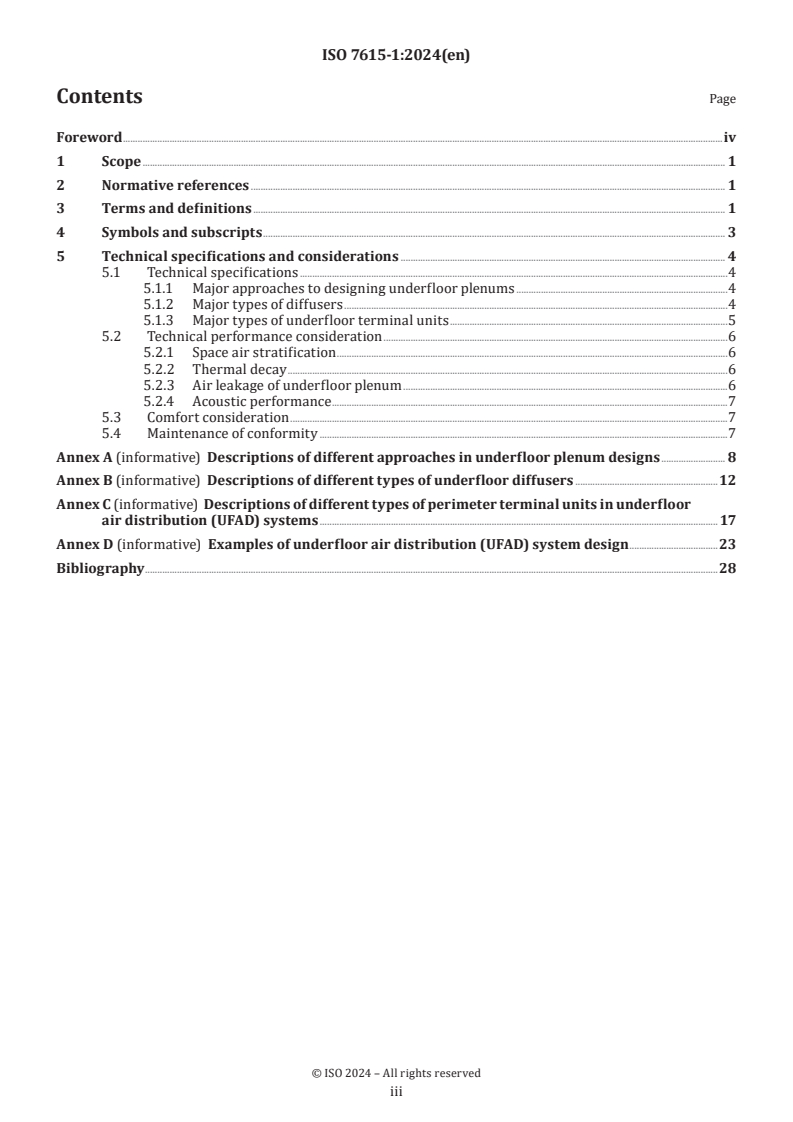
Contents Page
Foreword .iv
1 Scope . 1
2 Normative references . 1
3 Terms and definitions . 1
4 Symbols and subscripts . 3
5 Technical specifications and considerations . 4
5.1 Technical specifications .4
5.1.1 Major approaches to designing underfloor plenums .4
5.1.2 Major types of diffusers .4
5.1.3 Major types of underfloor terminal units .5
5.2 Technical performance consideration .6
5.2.1 Space air stratification .6
5.2.2 Thermal decay .6
5.2.3 Air leakage of underfloor plenum .6
5.2.4 Acoustic performance .7
5.3 Comfort consideration .7
5.4 Maintenance of conformity .7
Annex A (informative) Descriptions of different approaches in underfloor plenum designs . 8
Annex B (informative) Descriptions of different types of underfloor diffusers .12
Annex C (informative) Descriptions of different types of perimeter terminal units in underfloor
air distribution (UFAD) systems . 17
Annex D (informative) Examples of underfloor air distribution (UFAD) system design .23
Bibliography .28
iii
Foreword
ISO (the International Organization for Standardization) is a worldwide federation of national standards
bodies (ISO member bodies). The work of preparing International Standards is normally carried out through
ISO technical committees. Each member body interested in a subject for which a technical committee
has been established has the right to be represented on that committee. International organizations,
governmental and non-governmental, in liaison with ISO, also take part in the work. ISO collaborates closely
with the International Electrotechnical Commission (IEC) on all matters of electrotechnical standardization.
The procedures used to develop this document and those intended for its further maintenance are described
in the ISO/IEC Directives, Part 1. In particular, the different approval criteria needed for the different types
of ISO document should be noted. This document was drafted in accordance with the editorial rules of the
ISO/IEC Directives, Part 2 (see www.iso.org/directives).
ISO draws attention to the possibility that the implementation of this document may involve the use of (a)
patent(s). ISO takes no position concerning the evidence, validity or applicability of any claimed patent
rights in respect thereof. As of the date of publication of this document, ISO had not received notice of (a)
patent(s) which may be required to implement this document. However, implementers are cautioned that
this may not represent the latest information, which may be obtained from the patent database available at
www.iso.org/patents. ISO shall not be held responsible for identifying any or all such patent rights.
Any trade name used in this document is information given for the convenience of users and does not
constitute an endorsement.
For an explanation of the voluntary nature of standards, the meaning of ISO specific terms and expressions
related to conformity assessment, as well as information about ISO's adherence to the World Trade
Organization (WTO) principles in the Technical Barriers to Trade (TBT), see www.iso.org/iso/foreword.html.
This document was prepared by Technical Committee ISO/TC 163, Thermal performance and energy use in
the built environment, Subcommittee SC 1, Test and measurement methods.
A list of all parts in the ISO 7615 series can be found on the ISO website.
Any feedback or questions on this document should be directed to the user’s national standards body. A
complete listing of these bodies can be found at www.iso.org/members.html.
iv
International Standard ISO 7615-1:2024(en)
Energy performance of building systems — Underfloor air
distribution systems —
Part 1:
General overview
1 Scope
This document provides a general overview, including terms and definitions and technical specifications
for an underfloor air distribution (UFAD) system. A UFAD system includes a raised floor, a zone air handling
unit (AHU), an underfloor plenum and underfloor air diffusers. This document is applicable to all types of
systems which utilize underfloor plenum to supply conditioned air into the occupied space.
This document is not applicable to AHUs, ceiling-based air diffusers or displacement ventilation systems.
2 Normative references
This document referred to in the text in such a way that some or all of their content constitutes requirements
of the following document. For dated references, only the edition cited applies. For undated references, the
latest edition of the referenced document (including any amendments) applies.
ISO 7730, Ergonomics of the thermal environment — Analytical determination and interpretation of thermal
comfort using calculation of the PMV and PPD indices and local thermal comfort criteria
ISO 13731, Ergonomics of the thermal environment — Vocabulary and symbols
ISO 16818, Building environment design — List of test procedures for heating, ventilating, air-conditioning and
domestic hot water equipment related to energy efficiency
3 Terms and definitions
For the purposes of this document, the terms and definitions given in ISO 7730, ISO 13731 and ISO 16818
and the following apply.
ISO and IEC maintain terminology databases for use in standardization at the following addresses:
— ISO Online browsing platform: available at https:// www .iso .org/ obp
— IEC Electropedia: available at https:// www .electropedia .org/
3.1
underfloor air distribution system
UFAD system
forced air delivery system which takes advantage of the underfloor plenum to supply the conditioned air
produced from the air handling unit into the occupied space through underfloor air diffusers mounted on
the raised floor
3.2
raised floor
elevated interior floor composed of modular panels above the structural slab to form the underfloor plenum
for the passage of conditioned air supplied from the air handling unit
3.3
underfloor plenum
void space between raised floor and the slab, where technical services are placed, and the conditioned air is
supplied from the air handling unit before being supplied into the occupied space
3.4
underfloor air diffuser
air supply outlet mounted on the raised floor through which the conditioned air produced from the air
handling unit is supplied into the occupied space
3.5
thermal plume
movement of the occupied space air in the upward direction caused by the buoyancy effect above the internal
heat gain components
Note 1 to entry: Internal heat gain usually includes occupants, lighting and electric equipment.
3.6
space air stratification
formation of a stratified environment in the air in the occupied space, having an elevated temperature with
height caused by the thermal buoyancy
3.7
personal thermal comfort system
device, under the control of the occupant, to either heat or cool, or both, the immediate thermal environment
of an individual occupant, without affecting the thermal environment of the other occupants
3.8
thermal decay
increase or decrease in temperature of the conditioned air supplied from the air handling unit as it travels
through the underfloor plenum, mainly caused by the convective heat transfer from/into the upper surface
of the slab and lower surface of the raised floor
3.9
pressurized plenum
underfloor plenum configuration where the conditioned air is blown from the air handling unit into the
underfloor plenum to maintain positive pressure in the underfloor plenum relative to the occupied space
3.10
neutral plenum
underfloor plenum configuration where the conditioned air is blown from the air handling unit into the
underfloor plenum to maintain almost the same pressure as the occupied space
3.11
ducted plenum
underfloor plenum configuration where the conditioned air is blown from the air handling unit into air
ducts in the underfloor plenum
Note 1 to entry: Underfloor air diffusers are connected to ductwork, similar to conventional ceiling based air
distribution systems.
3.12
stratification height
height of the virtual horizontal surface separating two zones with different air temperature profiles
3.13
occupied space
volume of the conditioned space vertically between the floor and the ceiling, which can be divided into the
lower occupied zone and the upper mixed zone
3.14
lower occupied zone
volume of the occupied space below the stratification height
3.15
upper mixed zone
volume of the occupied space above the stratification height
3.16
interior zone
volume of the occupied space usually farther than 5 m from the exterior envelope, whose thermal loads are
not typically affected by the exterior conditions, such as outdoor air temperature and solar radiation
3.17
perimeter zone
volume of the occupied space adjacent to the exterior envelope, usually within 5 m, whose thermal loads are
highly affected by the exterior conditions (e.g. outdoor air temperature and solar radiation)
3.18
underfloor terminal unit
unit installed under the raised floor at the end of an air distribution system intended to control air flow rate,
pressure or temperature, or to mix air flows
4 Symbols and subscripts
Symbol Quantity Unit
A area m
4 3
B buoyancy flux m /s
H height m
m number of plumes –
n number of diffusers –
Q airflow m /s
T temperature °C
W room convective heat extraction (also known as cooling load) W
θ discharge angle from vertical °
dimensionless number representing the stratification in the occupied
Φ –
[3]
space
dimensionless number representing the ratio of momentum to buoy-
Γ –
[3]
ancy forces
Subscripts Significance
DA diffuser discharge air
diff diffuser
eff effective
os occupied space
oz lower occupied zone
RA return air
5 Technical specifications and considerations
5.1 Technical specifications
5.1.1 Major approaches to designing underfloor plenums
UFAD systems can take advantage of the underfloor plenum by blowing conditioned air into the occupied
space through the underfloor plenum, which allows UFAD systems to operate as the personal thermal
comfort system. Typical plenum heights integrated with UFAD systems are 0,15 m to 0,45 m from the
structure slab. According to the pressure condition of the underfloor plenum, four different approaches
commonly used in designing underfloor plenum in UFAD systems are described in Table 1:
— pressurized plenum;
— neutral plenum;
— a combined feature of pressurized and neutral plenums;
— ducted plenum.
Table 1 — Different design approaches for underfloor plenums
Approach Description
In the pressurized plenum approach, passive diffusers
are placed in the occupied spaces and no local fans in the
underfloor air diffusers are needed. Due to the maintained
Pressurized plenum pressure difference between the underfloor plenum and
the occupied space, conditioned air can be provided into
the occupied space from the underfloor plenum without
the operation of local fans in the underfloor air diffusers.
Local fans are embedded inside the underfloor air diffusers
Neutral plenum to provide enough of the conditioned air into the occupied
space.
This approach is the combined feature of pressurized and
neutral plenum designs. The zone AHU or central AHU blows
the conditioned air into the underfloor plenum to maintain
positive pressure in the underfloor plenum relative to the
Combined (pressurized + neutral) plenum occupied space. Passive diffusers serve in interior zones
having a relatively stable thermal load profile, while under-
floor air diffusers integrated with local fans are placed in
the perimeter zones where thermal load fluctuates rapidly
due to the building envelope.
The zone AHU or central AHU supplies the conditioned air
into the underfloor plenum through ductwork, similar to
conventional ceiling-based air distribution systems. Under-
Ducted plenum
floor air diffusers on the raised floor are connected to the
underfloor ductwork to provide the conditioned air from
the underfloor plenum into the occupied space.
Details of different approaches in designing underfloor plenums are provided in Annex A. Examples of the
two commonly used UFAD system designs in practice are provided in Annex D.
5.1.2 Major types of diffusers
Different types of underfloor air diffusers commonly used in UFAD systems are provided in Table 2.
Table 2 — Major types of underfloor air diffusers
Type Description
The passive diffuser has small openings to supply the conditioned air
into the occupied zone with a swirling conditioned air. It allows the zone
air and the conditioned air to be mixed from the underfloor plenum. It is
Passive swirl diffuser
usually a round shape diffuser, but a square or rectangular diffuser can be
applied with the shape of air openings. Generally, it is preferable to place
it in the interior zone instead of perimeter zones.
In the displacement ventilation diffuser, the air is supplied into the zone
Displacement ventilation diffuser with its main velocity component parallel to the floor, which tends to
create high stratification.
It has internal air regulators like an air damper in the diffuser to control
the flow rate of the supply air with automatic or manual control. To control
Variable-area variable air volume (VAV)
air flow rate or flow velocity of the supply air by motor drive, it commonly
diffuser
requires a motor drive and thermostats of the zone. It is a type of the passive
diffuser which does not require fan but still controls supply air volume.
Bar grilles have narrow and long openings which can supply the conditioned
air with a targeted direction. When controlling the air flow direction, it
Linear bar grilles
is usually placed in the perimeter zones near the exterior windows and
walls where the thermal load changes by time.
The underfloor fan powered VAV diffuser is composed of an inlet, an outlet
and control dampers, integrated with the fan operation. The operation of
Fan powered VAV diffuser
the control dampers and fan is governed by different modes, i.e. heating,
cooling and recirculation.
The air permeable carpet tile is laid over the perforated and fully accessible
floor system. The system supplies fresh cool air or fresh heated air at a
very low velocity up through the double floor, a space that also accommo-
Air permeable carpet tile integrated with
dates wiring and cabling. The rising air carries with it impurities and heat
perforated access floor
generated by people, appliances, and other sources, continuing upward all
the way to air-release slots in the ceiling. This purifying process prevents
the recirculation of airborne contaminants in the indoor environment.
Details of different types of underfloor air diffusers are provided in Annex B.
5.1.3 Major types of underfloor terminal units
The thermal environment of perimeter zones is typically more dynamic than interior zones. These spaces
have time-variant thermal loads and often require additional heating. Underfloor terminal units in the
perimeter zones generally supply a larger volume of conditioned air to control the envelope load than those
of the interior zone. Different types of underfloor terminal units commonly used in UFAD systems are
provided in Table 3.
Table 3 — Major types of underfloor terminal units
Type Description
Variable-area VAV diffusers with constant speed heating fan coils are
composed of a set of two diffusers and constant-speed fans which allows
the underfloor plenum air to be supplied into the occupied space by the
pressure difference between the upstream and downstream of the fan.
Variable-area VAV diffusers with constant During the cooling operation, the fan is switched off and the volume of the
speed heating fan coils air is modulated by the internal damper depending on the cooling load.
During the heating operation, the constant-speed fan is switched on so
that return air can be pulled through one diffuser from the occupied space
and can be supplied back into the occupied space after heated up by the
internal heating coil as illustrated in Figure D.3.
A fan coil unit (FCU), or vertical fan-coil unit (VFCU), is a device that has
either a heating or cooling coil, or both, and a fan to either heat or cool, or
both, the occupied space without ductwork. Air moves over the coil and the
Variable speed fan coil unit (FCU)
coil heats or cools the air before returning it into the room. The supply air
flow rate can adjust in the case of variable speed FCUs. A variable frequency
driver (VFD) is a popular equipment to control the speed of the fan motor.
A VAV unit can change the operational mode either between recirculating
the space air or suppling plenum air to the space, or both. It has control
Fan powered VAV with reheat dampers to switch the air flow. This allows the conditioned air to be re-
heated if it is necessary. The flow rate can be adjustable depending on the
space thermal environment.
Floor convectors are based on the principle of natural air convection. They
Natural convection floor convector
are designed for secondary room heating.
Floor convectors use the fan for obtaining forced air convection, achiev-
Floor convector with fan (underfloor fan-
ing higher capacities than natural convection floor convectors. They use
coil unit)
secondary (e.g. room, recirculating) air and can also be used for cooling.
Underfloor induction units provide centrally conditioned primary air
(fresh air) to the room. The secondary (room) air is induced, and passed
Underfloor induction unit
across the heat exchanger used for either additional cooling or heating,
or both. The mix of primary and secondary air is supplied to the room.
Decentralised ventilation units are supply and extract units with second-
Decentralised ventilation unit ary (room) air addition used for room ventilation and either heating or
cooling, or both, of the room.
Details of different types of perimeter terminal units in UFAD systems are described in Annex C.
5.2 Technical performance consideration
5.2.1 Space air stratification
The rated space air stratification of diffusers in different operating conditions (characteristic curve) should
be evaluated experimentally. Space air stratification is influenced by discharge angle and effective area of
diffusers, supply airflow, number of plumes, number of diffusers and thermal load of the occupied space.
5.2.2 Thermal decay
The rated thermal decay of the underfloor plenum in different operating conditions (characteristic curve)
should be evaluated experimentally. Thermal decay of the underfloor plenum is influenced by the supply
airflow, insulation of slab and raised floor, airflow pattern within the underfloor plenum, thermal load of the
occupied space and air leakage of the underfloor plenum.
5.2.3 Air leakage of underfloor plenum
The rated air leakage of the underfloor plenum in different operating conditions (characteristic curve) should
be evaluated experimentally. Air leakage of the underfloor plenum is largely influenced by the construction
of the raised floor, especially the locations where columns and diffusers are jointed with the raised floor.
5.2.4 Acoustic performance
Noise can occur when too much airflow is supplied inside the fan-powered diffusers or FCUs. Domestic
acoustic regulations can be considered to limit the corresponding noise level.
5.3 Comfort consideration
Occupants are affected by velocity of the air, the vertical air temperature distribution caused by the space
air stratification and the discharge temperature coming out of the diffusers. Although ISO 7730 and
[1]
ASHRAE Standard 55 prescribe 3 °C as the limit for the vertical air temperature difference between head
and ankle levels, acceptable stratification can be up to 7 °C depending on the operative temperature of the
[2]
occupied space. Vertical temperature distribution for thermal comfort shall be considered. Discharge air
temperature from the diffusers below 16 °C can cause a cold draft for the occupants and thus the discharge
air temperature shall be maintained so that it does not go below 16 °C.
5.4 Maintenance of conformity
Operation and maintenance of the UFAD system shall be performed to meet conformity with conventional
HVAC systems. The maintenance check for joints and insulation of a raised floor, space air stratification,
thermal decay, air leakage of the underfloor plenum, space air temperature distribution and acoustic
performance shall be conducted on a regular basis to ensure that the products maintain conformity with
the requirements in Table 4. The initial attestation of conformity shall be valid until any change is made
to the design of the model or any change is made to the manufacturing process having an influence on the
thermal output.
Table 4 — Maintenance checklist
Category Contents Checklist
— System specification
— Check the joints with column or diffusers
a) Raised floor panel
System specification and
— Measure thermal resistance of raised floor
installation
b) Underfloor diffusers — Check the dust on the diffusers
c) Dimensional tolerances — Measure dimensions of the underfloor plenum
— Space air stratification — Measure rated space air stratification
— Thermal decay — Measure rated thermal decay
Technical performance
— Air leakage of underfloor plenum — Measure rated air leakage of underfloor plenum
— Acoustic performance — Measure noise level
Annex A
(informative)
Descriptions of different approaches in underfloor plenum designs
A.1 General
This annex describes the following different approaches in designing underfloor plenums:
— pressurized plenum;
— neutral plenum;
— ducted plenum;
— combined feature of pressurized and neutral plenums.
A.2 Pressurized plenum
In pressurized plenums illustrated in Figure A.1, the zone AHU or central AHU blows conditioned air into the
underfloor plenum to maintain positive pressure in the underfloor plenum relative to the occupied space.
In this approach, passive diffusers are placed in the occupied spaces and no local fans in the underfloor
air diffusers are needed. Due to the maintained pressure in the underfloor plenum, conditioned air can be
provided into the occupied space from the underfloor plenum without the operation of local fans in the
underfloor air diffusers. However, unintentional air leakage in the underfloor plenum can negatively affect
the airflow pattern and the thermal performance of the entire system. An additional issue can be that the
pressure causing the airflow into the occupied space through underfloor air diffusers may not be sufficient
to handle the thermal load in the perimeter zones where the thermal load fluctuates dynamically.
Key
1 air handling unit (AHU) 6 raised floor
2 return air 7 passive diffusers
3 return air plenum 8 underfloor plenum
4 lighting fixtures 9 supply air
5 occupied space
Figure A.1 — Pressurized plenum type
A.3 Neutral plenum
In the neutral plenums illustrated in Figure A.2, the zone AHU or central AHU blows conditioned air at low
velocity into the underfloor plenum to maintain almost the same pressure as the occupied space. Local fans
are embedded inside the underfloor air diffusers to provide enough supply air into the occupied space. As
opposed to the pressurized plenum, neutral plenums do not suffer from the unintentional air leakage in the
underfloor plenum due to the same pressure being maintained as the occupied space. Since the local fans
are installed inside the underfloor air diffusers, enough supply airflows are provided in the perimeter zones
having a dynamic thermal load profile.
Key
1 air handling unit (AHU) 6 raised floor
2 return air 7 fan powered
...