

ISO 6781-1:2023
(Main)Performance of buildings — Detection of heat, air and moisture irregularities in buildings by infrared methods — Part 1: General procedures
General Information
- Abstract
This document specifies requirements and methodologies for infrared thermographic services for detection of heat, air and moisture irregularities in buildings that help users to specify and understand a) the extent of thermographic services required, b) the type and condition of equipment available for use, c) the qualifications of equipment operators, image analysts, and report authors and those making recommendations, and d) the reporting of results. It provides guidance to understanding and utilizing the final results stemming from provision of the thermographic services. This document is applicable to the general procedures for infrared thermographic methods as can be applied to residential, commercial, and institutional and special use buildings.
- Status
- Published
- Publication Date
- 03-Aug-2023
- Technical Committee
- ISO/TC 163/SC 1 - Test and measurement methods
- Current Stage
- 6060 - International Standard published
- Start Date
- 04-Aug-2023
- Due Date
- 31-Oct-2022
- Completion Date
- 04-Aug-2023
Buy Documents

ISO 6781-1:2023 - Performance of buildings — Detection of heat, air and moisture irregularities in buildings by infrared methods — Part 1: General procedures Released:4. 08. 2023

ISO 6781-1:2023 - Performance des bâtiments — Détection d'irrégularités de chaleur, air et humidité dans les bâtiments par des méthodes infrarouges — Partie 1: Modes opératoires généraux Released:4. 08. 2023
Overview
ISO 6781-1:2023 - Performance of buildings - Detection of heat, air and moisture irregularities in buildings by infrared methods - Part 1: General procedures - defines general requirements and methodologies for building infrared thermography (thermal imaging) services. It helps users specify the scope of thermographic services, understand equipment condition and calibration, set personnel qualifications, and standardize reporting and interpretation of results. The standard applies to residential, commercial, institutional and special-use buildings and is the first part of the ISO 6781 series addressing general procedures.
Key topics and technical requirements
ISO 6781-1 covers practical and technical elements needed for repeatable, reliable thermographic inspections:
- Thermography techniques: comparative qualitative and quantitative thermography, limitations and best practices.
- Equipment requirements: camera capabilities, calibration, spot radiometry (non-contact infrared radiometry), and field measurement of emissivity and reflected apparent temperature.
- Personnel qualification: roles and minimum qualification guidance for operators, image analysts and report authors for different building types.
- Moisture and air leakage detection: thermographic indicators for moisture and air movement plus guidance on combined methods.
- Supporting diagnostic methods: use of fan pressurization, tracer gas, heat-flow meters, moisture meters and RH sensors to validate thermographic findings.
- Data collection & baseline monitoring: systematic collection, condition monitoring and survey intervals for repeat surveys.
- Safety and reporting: pro-forma safety guidance, structured test-report content, diagnosis/prognosis and severity criteria for anomalies.
- Annexes: normative safety rules and emissivity measurement procedures; informative examples of detected faults and anomalies.
Practical applications
ISO 6781-1 is designed to standardize and improve the practical use of thermal imaging for:
- Locating thermal insulation defects and thermal bridges
- Identifying moisture intrusion, dampness and condensation risks
- Detecting air leakage paths and poor air sealing
- Building commissioning, quality-control inspections and periodic condition monitoring
- Prioritizing repairs and validating remediation effectiveness
Using thermography per this standard supports energy audits, building performance assessments, forensic investigations and preventative maintenance programs.
Who should use this standard?
- Building energy auditors and thermography contractors
- Facility managers and building owners
- Commissioning agents and construction quality-control teams
- Building surveyors, consultants and forensic engineers
- Standards developers and regulatory bodies
Related standards
- ISO 6781 series (other parts address practitioner-specific and building-type technical requirements)
- Standards and guidelines for fan pressurization, moisture metering and thermal performance testing (referenced within ISO 6781-1)
Keywords: ISO 6781-1, infrared thermography, building thermography, thermal imaging, moisture detection, air leakage, building performance, thermographic services, thermal inspection, emissivity.
Relations
- Effective Date
- 12-Feb-2026
- Effective Date
- 06-Jun-2022
- Effective Date
- 23-Apr-2020
Buy Documents
ISO 6781-1:2023 - Performance of buildings — Detection of heat, air and moisture irregularities in buildings by infrared methods — Part 1: General procedures Released:4. 08. 2023
ISO 6781-1:2023 - Performance des bâtiments — Détection d'irrégularités de chaleur, air et humidité dans les bâtiments par des méthodes infrarouges — Partie 1: Modes opératoires généraux Released:4. 08. 2023
Get Certified
Connect with accredited certification bodies for this standard

DIBt (Deutsches Institut für Bautechnik)
German Institute for Building Technology.
DIN CERTCO
DIN Group product certification.

Aboma Certification B.V.
Specialized in construction, metal, and transport sectors.
Sponsored listings
Frequently Asked Questions
ISO 6781-1:2023 is a standard published by the International Organization for Standardization (ISO). Its full title is "Performance of buildings — Detection of heat, air and moisture irregularities in buildings by infrared methods — Part 1: General procedures". This standard covers: This document specifies requirements and methodologies for infrared thermographic services for detection of heat, air and moisture irregularities in buildings that help users to specify and understand a) the extent of thermographic services required, b) the type and condition of equipment available for use, c) the qualifications of equipment operators, image analysts, and report authors and those making recommendations, and d) the reporting of results. It provides guidance to understanding and utilizing the final results stemming from provision of the thermographic services. This document is applicable to the general procedures for infrared thermographic methods as can be applied to residential, commercial, and institutional and special use buildings.
This document specifies requirements and methodologies for infrared thermographic services for detection of heat, air and moisture irregularities in buildings that help users to specify and understand a) the extent of thermographic services required, b) the type and condition of equipment available for use, c) the qualifications of equipment operators, image analysts, and report authors and those making recommendations, and d) the reporting of results. It provides guidance to understanding and utilizing the final results stemming from provision of the thermographic services. This document is applicable to the general procedures for infrared thermographic methods as can be applied to residential, commercial, and institutional and special use buildings.
ISO 6781-1:2023 is classified under the following ICS (International Classification for Standards) categories: 91.120.10 - Thermal insulation of buildings. The ICS classification helps identify the subject area and facilitates finding related standards.
ISO 6781-1:2023 has the following relationships with other standards: It is inter standard links to EN ISO 6781-1:2023, ISO 12609-1:2021, ISO 6781:1983. Understanding these relationships helps ensure you are using the most current and applicable version of the standard.
ISO 6781-1:2023 is available in PDF format for immediate download after purchase. The document can be added to your cart and obtained through the secure checkout process. Digital delivery ensures instant access to the complete standard document.
Standards Content (Sample)
INTERNATIONAL ISO
STANDARD 6781-1
First edition
2023-08
Performance of buildings — Detection
of heat, air and moisture irregularities
in buildings by infrared methods —
Part 1:
General procedures
Performance des bâtiments — Détection d'irrégularités de chaleur,
air et humidité dans les bâtiments par des méthodes infrarouges —
Partie 1: Modes opératoires généraux
Reference number
© ISO 2023
All rights reserved. Unless otherwise specified, or required in the context of its implementation, no part of this publication may
be reproduced or utilized otherwise in any form or by any means, electronic or mechanical, including photocopying, or posting on
the internet or an intranet, without prior written permission. Permission can be requested from either ISO at the address below
or ISO’s member body in the country of the requester.
ISO copyright office
CP 401 • Ch. de Blandonnet 8
CH-1214 Vernier, Geneva
Phone: +41 22 749 01 11
Email: copyright@iso.org
Website: www.iso.org
Published in Switzerland
ii
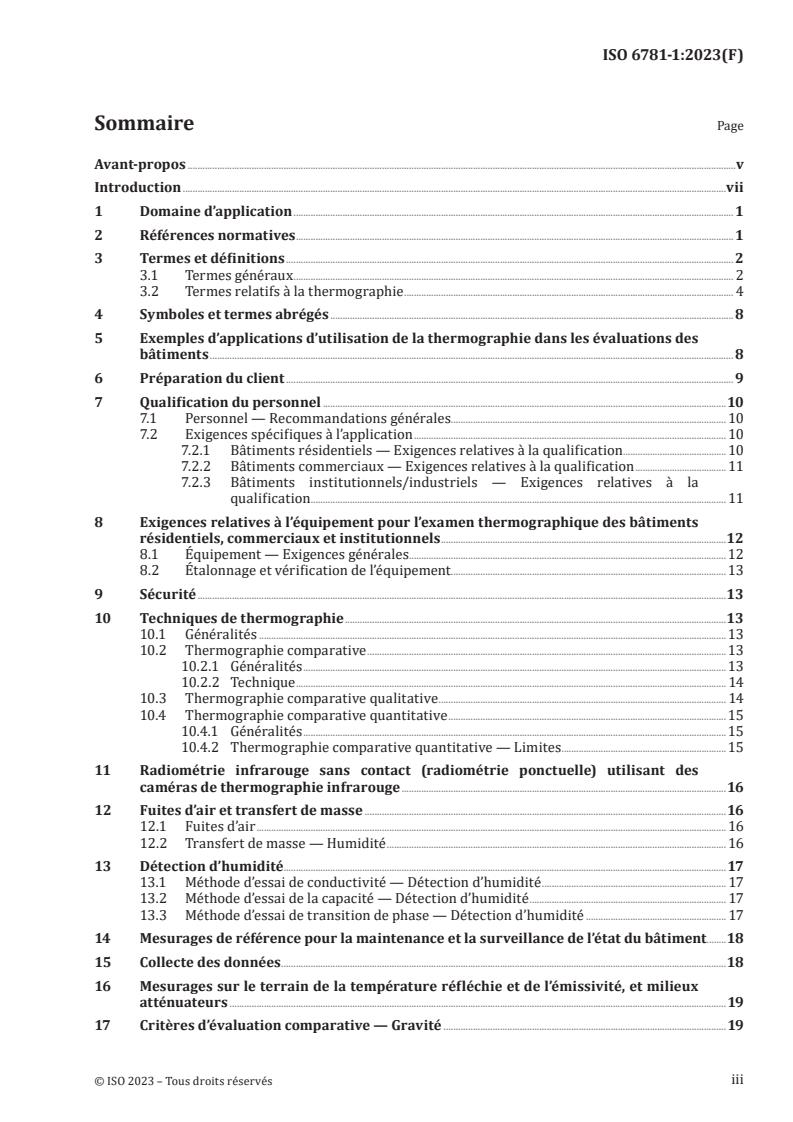
Contents Page
Foreword .v
Introduction .vii
1 Scope . 1
2 Normative references . 1
3 Terms and definitions . 1
3.1 General terms . 2
3.2 Thermography terms . 4
4 Symbols and abbreviated terms.7
5 Example applications of use of thermography in building assessments .8
6 Customer preparation . 8
7 Qualification of personnel .9
7.1 Personnel — General guidance . 9
7.2 Application specific requirements . 10
7.2.1 Residential buildings — Qualification requirements . 10
7.2.2 Commercial buildings — Qualification requirements . 10
7.2.3 Institutional / Industrial buildings — Qualification requirements . 10
8 Equipment requirements for thermographic examination of residential,
commercial and institutional buildings .11
8.1 Equipment — General requirements . 11
8.2 Calibration and checking of equipment .12
9 Safety .12
10 Thermography techniques .12
10.1 General .12
10.2 Comparative thermography .12
10.2.1 General .12
10.2.2 Technique .13
10.3 Comparative qualitative thermography . 13
10.4 Comparative quantitative thermography . 14
10.4.1 General . 14
10.4.2 Comparative quantitative thermography — Limitations . 14
11 Non-contact infrared radiometry (spot radiometry) using infrared thermography
cameras .15
12 Air leakage and mass transfer .15
12.1 Air leakage . . 15
12.2 Mass transfer — Moisture . 15
13 Moisture detection .16
13.1 Conductivity test method — Moisture detection . 16
13.2 Capacitance test method — Moisture detection . 16
13.3 Phase change test method — Moisture detection . 16
14 Baseline measurements for building maintenance and condition monitoring .17
15 Data collection . .17
16 Field measurements of reflected temperature and emissivity, and attenuating
media .18
17 Comparative assessment criteria — Severity .18
18 Diagnosis and prognosis.18
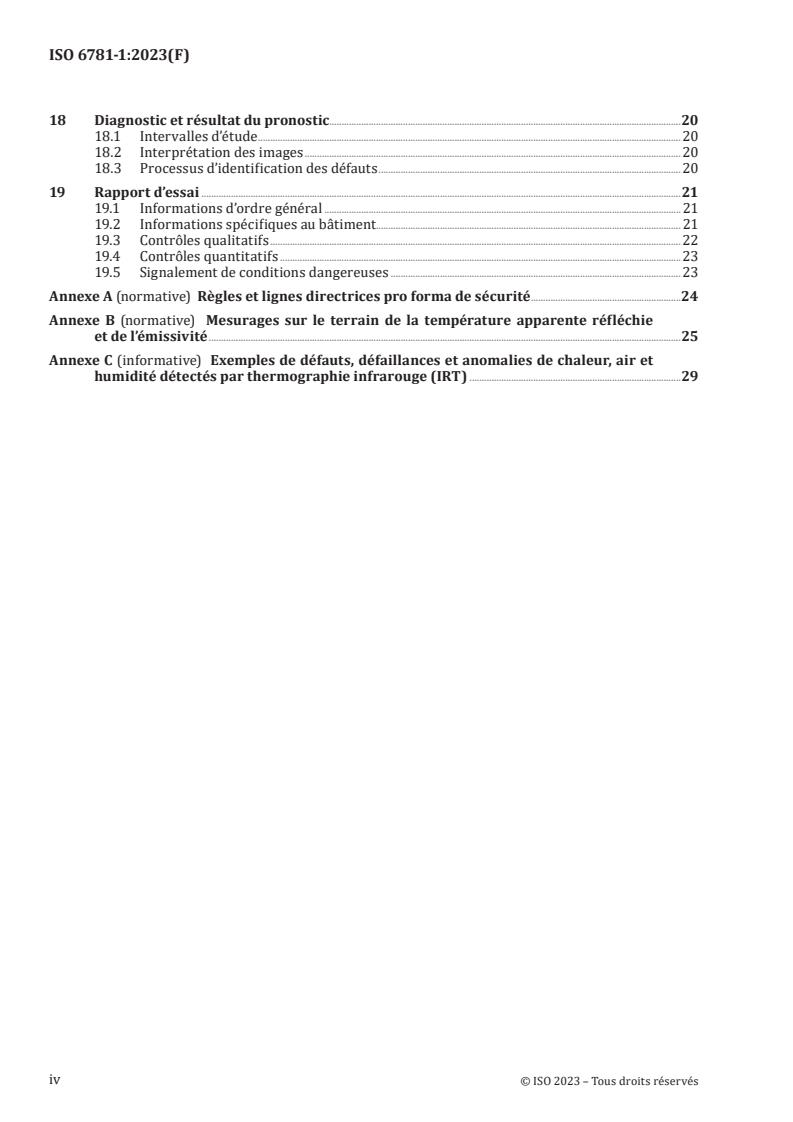
18.1 Survey intervals . 18
iii
18.2 Image interpretation . 18
18.3 Fault identification process . 19
19 Test report .19
19.1 General information. 19
19.2 Building-specific information . 20
19.3 Qualitative inspections . 21
19.4 Quantitative inspections . 21
19.5 Reporting of unsafe conditions . 22
Annex A (normative) Pro-forma safety rules and guidelines .23
Annex B (normative) Field measurements of reflected apparent temperature and
emissivity .24
Annex C (informative) Examples of buildings heat, air and moisture faults, failures and
anomalies detected by infrared thermography (IRT) .28
iv
Foreword
ISO (the International Organization for Standardization) is a worldwide federation of national standards
bodies (ISO member bodies). The work of preparing International Standards is normally carried out
through ISO technical committees. Each member body interested in a subject for whom a technical
committee has been established has the right to be represented on that committee. International
organizations, governmental and non-governmental, in liaison with ISO, also take part in the work.
ISO collaborates closely with the International Electrotechnical Commission (IEC) on all matters of
electrotechnical standardization.
The procedures used to develop this document and those intended for its further maintenance are
described in the ISO/IEC Directives, Part 1. In particular, the different approval criteria needed for the
different types of ISO documents should be noted. This document was drafted in accordance with the
editorial rules of the ISO/IEC Directives, Part 2 (see www.iso.org/directives).
ISO draws attention to the possibility that the implementation of this document may involve the use
of (a) patent(s). ISO takes no position concerning the evidence, validity or applicability of any claimed
patent rights in respect thereof. As of the date of publication of this document, ISO had not received
notice of (a) patent(s) which may be required to implement this document. However, implementers are
cautioned that this may not represent the latest information, which may be obtained from the patent
database available at www.iso.org/patents. ISO shall not be held responsible for identifying any or all
such patent rights.
Any trade name used in this document is information given for the convenience of users and does not
constitute an endorsement.
For an explanation of the voluntary nature of standards, the meaning of ISO specific terms and
expressions related to conformity assessment, as well as information about ISO's adherence to
the World Trade Organization (WTO) principles in the Technical Barriers to Trade (TBT), see
www.iso.org/iso/foreword.html.
This document was prepared by Technical Committee ISO/TC 163, Thermal performance and energy use
in the built environment, Subcommittee SC1, Test and measurement methods, in collaboration with the
European Committee for Standardization (CEN) Technical Committee CEN/TC 89, Thermal performance
of buildings and building components, in accordance with the Agreement on technical cooperation
between ISO and CEN (Vienna Agreement).
This first edition cancels and replaces ISO 6781:1983, which has been technically revised.
The main changes are as follows:
— now comprises the first part of the ISO 6781 series, which addresses the general user of thermography
and provides general requirements pertinent to thermography;
NOTE Further parts of the ISO 6781 series provide specific thermographic requirements pertinent to
thermographic practitioners, and the technical requirement for thermography of specific types of buildings.
— covers general requirements concerning detection of air leakage and moisture anomalies, using
thermographic methods, in addition to thermal anomalies;
— thoroughly updates the thermographic requirements resulting from the vast technological upgrades
in thermography since ISO 6781:1983 was published;
— provides general information and specific constraints concerning qualitative thermography and
quantitative thermography;
— provides general information and requirements regarding the qualification of thermographic
operators and report writers.
A list of all parts in the ISO 6781 series can be found on the ISO website.
v
Any feedback or questions on this document should be directed to the user’s national standards body. A
complete listing of these bodies can be found at www.iso.org/members.html.
vi
Introduction
Infrared building thermography provides a tool to qualitatively identify the presence of energy-
wasting defects and anomalies within building structures. These defects and anomalies can include,
for example, thermal insulation defects, moisture content, and / or unwanted air movement or leakage
within the building enclosure.
Building thermography is carried out by means of an infrared thermography camera, which produces
an image based on the apparent radiance temperature of the target surface area. The thermal radiation
(infrared radiation density) from the target area is converted by the infrared thermography camera to
produce a thermal image (thermogram). This image (thermogram) represents the relative intensity of
thermal radiation from different parts of the surface. The radiation intensity indicated by the image is
related directly to
a) the surface temperature distribution,
b) the characteristics of the surface,
c) the ambient conditions, and
d) the sensor itself.
As a result, surface temperature distribution can be a key parameter for monitoring the performance of
building components, building enclosure and the diagnostics of problems. In use, via analysis of surface
temperature distributions, irregularities in the heat and moisture properties of building enclosures and
components, and air movement within the building enclosure, can be indicated. These irregularities
can be due to, for example, thermal insulation defects, moisture content, air leakage within components
or through assemblies, or incorrect installation of components which comprise the construction of the
building.
To realize its full utility as an initial qualitative screening technique, or an in-depth diagnostic
technique, thermography must often be supported and/or validated by other methods. These methods
include, but are not limited to, infrared photosensitive tracer gas methods, fan pressurization of the
building enclosure, heat-flow metres, smoke diffusion, anemometry, moisture metres and relative
humidity (RH) sensors.
Infrared building thermography inspection methodologies can be used for either new-construction
quality control applications or in existing buildings as ongoing condition monitoring for periodic or
specific building-condition reporting. The latter applications may be accompanied with visual fault
symptoms, while the former may not necessarily present symptoms via visual faults.
vii
INTERNATIONAL STANDARD ISO 6781-1:2023(E)
Performance of buildings — Detection of heat, air and
moisture irregularities in buildings by infrared methods —
Part 1:
General procedures
1 Scope
This document specifies requirements and methodologies for infrared thermographic services for
detection of heat, air and moisture irregularities in buildings that help users to specify and understand
a) the extent of thermographic services required,
b) the type and condition of equipment available for use,
c) the qualifications of equipment operators, image analysts, and report authors and those making
recommendations, and
d) the reporting of results.
It provides guidance to understanding and utilizing the final results stemming from provision of the
thermographic services.
This document is applicable to the general procedures for infrared thermographic methods as can be
applied to residential, commercial, and institutional and special use buildings.
2 Normative references
The following documents are referred to in the text in such a way that some or all of their content
constitutes requirements of this document. For dated references, only the edition cited applies. For
undated references, the latest edition of the referenced document (including any amendments) applies.
ISO 6781-3, Performance of buildings — Detection of heat, air and moisture irregularities in buildings by
infrared methods — Part 3: Qualifications of equipment operators, data analysts and report writers
ISO 7345, Thermal performance of buildings and building components — Physical quantities and definitions
ISO 9288, Thermal insulation — Heat transfer by radiation — Vocabulary
ISO 9869-1, Thermal insulation — Building elements — In-situ measurement of thermal resistance and
thermal transmittance — Part 1: Heat flow meter method
ISO 9972, Thermal performance of buildings — Determination of air permeability of buildings — Fan
pressurization method
ISO 10878, Non-destructive testing — Infrared thermography — Vocabulary
3 Terms and definitions
For the purposes of this document, the terms and definitions given in ISO 7345, ISO 9288, ISO 10878
and the following apply.
ISO and IEC maintain terminology databases for use in standardization at the following addresses:
— ISO Online browsing platform: available at https:// www .iso .org/ obp
— IEC Electropedia: available at https:// www .electropedia .org/
3.1 General terms
3.1.1
system
regularly interacting or interdependent group of associated entities (e.g. components, factors, members,
parts) forming an integrated whole and delineated by its spatial and temporal boundaries
Note 1 to entry: One or more of the associated entities define the boundary of the system.
3.1.2
analysis
careful scrutiny of constituent parts of a system (3.1.1) in order to thoroughly understand the whole
3.1.3
function
functional purpose of the building, building component or building system (3.1.1)
Note 1 to entry: The function is the activity assigned to, required of, or expected of the system.
3.1.4
residential building
building meeting the parameters defined in local building codes as small/residential building and as
agreed with the customer receiving thermographic services
3.1.5
parameter
numerical or other measurable factor forming one of a set that sets the conditions for measurement, or
defines the system and its operation
3.1.6
performance
behaviour, characteristics and efficiency of a building, building component or building system (3.1.1)
3.1.7
sign
characteristic parameter of a signal, which shows information about a state
3.1.8
symptom
perception, made by means of human observations and measurements (descriptors), which may
indicate the presence of one or more faults (3.1.12) with a certain probability
3.1.9
syndrome
group of signs (3.1.7) or symptoms (3.1.8) that collectively indicate or characterize an abnormal
condition
3.1.10
anomaly
something that deviates from what is standard, normal or expected, and an irregularity (3.1.12) or
abnormality (3.1.11) in a system (3.1.1)
3.1.11
abnormality
deviation from a standard condition
3.1.12
irregularity
condition which significantly departs from the operational norm
3.1.13
fault
condition that occurs when a building or one of its components or assemblies degrades or exhibits
abnormal behaviour, which may lead to the failure (3.1.14) to perform in accordance with its design
intent
Note 1 to entry: A fault can be the result of a failure, but can exist without a failure.
Note 2 to entry: Planned actions or lack of external resources are not a fault.
3.1.14
fault propogation
characterization of the change in severity of a fault (3.1.12) over time
3.1.15
failure
termination of the ability of an item to perform a required function (3.1.4)
Note 1 to entry: Failure is an event as distinguished from fault (3.1.12), which is a state.
3.1.16
failure mode
effect by which a failure (3.1.14) is observed
3.1.17
diagnostics
examination of symptoms (3.1.8) and syndromes (3.1.9) to determine the nature of faults (3.1.12) or
failures (3.1.14) (i.e. kind, situation, extent)
3.1.18
root cause
either a set of conditions or actions, or both, that occur at the beginning of a sequence of events and
result in the initiation of a failure mode (3.1.15)
3.1.19
root cause failure analysis
RCFA
after a failure, the logical systematic examination of an item, its construction, application and
documentation in order to identify the failure mode (3.1.15) and determine the failure mechanism and
its basic cause
Note 1 to entry: Root cause failure analysis is often used to provide a solution to chronic problems.
3.1.20
prognostics
analysis of the symptoms of faults (3.1.12) to predict a future condition and remaining useful life
3.1.21
prognosis
result of the prognostics process
3.1.22
qualitative
relating to measuring, or measured by the quality of something, rather than its quantity
3.1.23
quantitative
relating to measuring, or measured by the quantity of something, rather than its general qualities
3.2 Thermography terms
3.2.1
infrared
IR
portion of the electromagnetic spectrum extending from the red visible wavelength, 0,75 μm to 1 mm
Note 1 to entry: Because of instrument design and infrared transmission characteristics of the atmosphere, most
infrared measurements are made between 0,75 μm and 15 μm wavelengths.
3.2.2
thermography
representation of the temperature distribution of a surface, in a thermal image
3.2.3
thermographic analysis
interpretation and determination of the casual mechanisms producing variations and irregularities in
the thermal image
3.2.4
quantitative thermographic examination
examination of whole buildings, structures or components using thermographic methods with the
objective of providing quantitative (3.1.22) output
Note 1 to entry: Reporting requirements for both qualitative and quantitative examinations are specified in
Clause 19.
3.2.5
infrared thermography camera
IRT camera
instrument that collects the infrared radiant energy from a target surface and produces a monochrome
(black and white) or colour image, where the grey shades (monochrome) or colour hues are related to
the target surface apparent temperature
3.2.6
thermal image
image which is produced by an infrared thermography camera and which represents the apparent
radiance temperature distribution over the target surfaces
Note 1 to entry: Such images are sometimes called "infrared thermograms".
3.2.7
temperature isotherm
enhancement feature applied to an image, which marks an interval of equal apparent temperature
3.2.8
radiation density isotherm
region on an infrared (IR) (3.2.1) display consisting of points, lines or areas having the same infrared
radiation density
3.2.9
isotherm image
output from an infrared thermography camera showing temperature isotherms (3.2.7) and radiation
density isotherms (3.2.8)
3.2.10
ironbow palette image
image comprising a colour palette running from black through blue, magenta, orange, yellow to white
that creates best contrast, in particular regarding edges and shapes
3.2.11
image interpretation
processing and comparing apparent surface temperatures and thermal patterns against those
representative of the ideal design, construction, installation and maintenance criteria
Note 1 to entry: In the case of a thermal image or thermogram this can include temperature scaling, spot
temperature measurements, thermal profiles, image manipulation, subtraction and storage.
3.2.12
apparent temperature
uncompensated reading from an infrared thermography camera containing all radiation incidents on
the detector, regardless of its source
3.2.13
attenuating media
windows, filters, atmospheres, external optics, materials or other media that attenuate the infrared
radiation emitted from a source
3.2.14
black body
ideal perfect emitter and absorber of thermal radiation at all wavelengths
Note 1 to entry: The emissivity (3.2.15) of a black body is 1… ε = 1.
Note 2 to entry: This is described by Planck's law.
3.2.15
emissivity
ε
ratio of a target surface’s radiance to that of a black body (3.2.14) at the same temperature and over the
same spectral interval
3.2.16
total radiance
radiant heat flow rate divided by the solid angle around the direction ∆ and the projected area normal
to this direction
Note 1 to entry: Radiance includes emitted radiation from a surface as well as reflected and transmitted radiation.
3.2.17
apparent radiance temperature
temperature determined from the measured total radiance
Note 1 to entry: This temperature is the equivalent black body (3.2.14) temperature which would produce the
same total radiance.
3.2.18
reflectivity
ρ
ratio of the total reflected energy from a surface to total incident energy on that surface
Note 1 to entry: ρ = 1 – ε - τ ; for a mirror, reflectivity approaches 1,0; for a black body, ρ = 0.
Note 2 to entry: Technically, reflectivity is the ratio of the intensity of the reflected radiation to the total radiation;
reflectance is the ratio of the reflected flux to the incident flux. In infrared thermography (IRT), the two terms
are often used interchangeably.
3.2.19
reflected apparent temperature
T
refl
apparent temperature of other objects that are reflected by the target into the thermography camera
3.2.20
repeatability
capability of an instrument to repeat exactly a reading on a fixed target over a short- or long-term
interval
Note 1 to entry: Repeatability is expressed in ± degrees or a percentage of full scale.
3.2.21
spatial measurement resolution
measurement-spot size in terms of working distance
EXAMPLE In an infrared radiation thermometer, this is expressed in milliradians or as a ratio of the target-
spot size (containing 95 % of the radiant energy, according to common usage) to the working distance. In
scanners, cameras and imagers it is most often expressed in milliradian.
3.2.22
instantaneous field of view
IFOV
measurement of a sensor's intrinsic field of view, as distinct from what the sensor can perceive when a
scanning motion is incorporated into the imaging system
Note 1 to entry: The instantaneous field of view corresponds to the solid angle that admits light to a sensor at any
given instant.
3.2.23
target
object surface to be measured
3.2.24
working distance
distance from the target to the instrument, usually to the primary optic
3.2.25
diffuse surface
surface from which light or other electromagnetic radiation is scattered, rather than reflected
3.2.26
specular surface
surface from which light or other electromagnetic radiation is strongly reflected, rather than randomly
scattered
3.2.27
transmissivity / transmittance
τ
proportion of infrared radiant energy impinging on an object surface, for any given spectral interval,
that is transmitted through the object
Note 1 to entry: Transmissivity: τ = 1 − ε − ρ
where
τ is transmissivity;
ε is emissivity;
ρ is reflectivity.
Note 2 to entry: For a black body, τ = 0. Transmissivity is that fraction of incident radiation transmitted by matter.
3.2.28
thermal index
TI
ratio of temperature drop across the building enclosure, to the total temperature drop between inside
and outside environmental temperatures
Note 1 to entry: Thermal index is calculated as follows: TI= [(T −T ) / (T −T )] × 100 %
surface outside inside outside
where
T is the surface temperature of a part of the building enclosure;
surface
T is the localized outside air temperature measured by the user;
outside
T is the air temperature inside the structure measured by the user.
inside
Note 2 to entry: Example: T = 60 °C; T = 70 °C; T = 30 °C.
surface inside outside
Therefore TI = [(60 − 30) / (70 − 30)] × 100 = 75 %.
4 Symbols and abbreviated terms
L Radiance
e
ε(λ) Spectral emissivity
ρ(λ) Spectral reflectivity
τ(λ) Spectral transmissivity
α(λ) Spectral absorptivity
ΔT Differential temperature
FOV Field of view
Hz Hertz
IFOV Instantaneous field of view for detection (3.2.22)
IRT Infrared Thermography
MDT Minimum detectable temperature
MRTD Minimum resolvable temperature difference
NETD Noise equivalent temperature difference
NUC Non-uniformity correction
MIFOV Instantaneous field of view for measurement
mrad milliradian
TI Thermal index
5 Example applications of use of thermography in building assessments
The following list gives examples of where thermography may be applied as an initial or screening tool
in the context of building examinations. These examinations can be conducted from inside or outside of
the building. The list given below is not exhaustive:
a) surface temperature variations;
b) uniformity of building component installation;
c) thermal anomalies, e.g. thermal bridges, thermal insulation deficiencies, variances, or misfits;
d) location(s) of air movement;
e) extent of air movement through (i) a wall (ii) single component (iii) inter-component (iv) interstitial
space, and determination of volumes of air movement when pressure differentials are known;
f) moisture transport due to temperature or pressure differentials;
g) moisture ingress and egress;
h) the extent and phase of moisture present during inspection;
i) thermal comfort;
j) delaminating of coatings or renderings;
k) as a standard for training personnel;
l) provide a basis / set a performance standard / level of qualification for certifying thermographers;
m) energy efficient renovation of buildings;
n) location of under-floor heating;
o) building condition assessments of existing structures;
p) quality control assessments of renovations to existing buildings;
q) quality control assessments of new construction, part of building enclosure commissioning;
r) quality control assessment of repairs to new construction;
s) re-commissioning of building enclosure;
t) detection of structural components within masonry wall assemblies;
u) detection of structural reinforcing in poured concrete assemblies;
v) location of roof leaks, severity of leak and path of drainage through structural components;
w) moulds and fungus.
NOTE The presence of moisture in materials can lead to formation of surface or interstitial mould and
fungus.
6 Customer preparation
The customer of an infrared thermography (IRT) service shall, as applicable:
a) provide access to the building / facility to be inspected;
b) provide the thermographer with details of any potential safety hazards related to the building /
facility use;
c) disclose the history of any prior problems;
d) provide or help develop an inventory of building enclosure, architectural & structural assemblies,
building components, etc., to be inspected, in a logical and efficient route with "line of sight"
viewing;
e) make available any building, architectural and structural shop drawings;
f) make available any building equipment operating manuals and building "as built" drawings;
g) identify fire zones;
h) provide qualified guide(s) knowledgeable in the operation and maintenance history of the building
/ facility to be inspected. This person(s) shall accompany the infrared thermographer during the
examination and shall be qualified and authorized to:
— gain access to the inner and outer parts of the buildings to be inspected and to notify the building
owner, occupants, operating and maintenance personnel, etc. of the IRT examination activities;
— open and make accessible any requested areas immediately before examination by the infrared
thermographer;
— either close or secure these areas, or both, immediately after examination by the infrared
thermographer;
— operate, as possible, any building architectural, structural, mechanical and/or electrical
equipment;
— assure that building systems are operating normally, or placed in a state as requested by the
infrared thermographer and allow sufficient time for stable thermal patterns to be attained
— take full responsibility for consequences resulting from actions taken, or not taken, as a result
of information provided by an infrared examination;
— provide information on the results of follow up examination and repair activities.
7 Qualification of personnel
7.1 Personnel — General guidance
The requirements for operator competence and qualifications vary with the type of structure being
investigated and methodologies employed. The building thermographer's qualification classification
shall be agreed upon by the customer and service provider. The thermographer shall provide evidence
of qualification to that classification prior to the commencement of any work. Building thermographers
shall possess knowledge, skills and abilities assessed in accordance with the classification requirements
of ISO 6781-3.
The following provides an outline summary of classification levels:
Class I: Conversant and capable in knowledge, skills and abilities regarding camera operation, heat
transfer basics, infrared basics, applications basics, baseline imaging, thermal signatures, problem
identification, recognition of special (atypical) problems, fundamental analysis and reporting, safety
considerations, and the ability to think and conceptualize ‘thermally’.
Class II: All Class I requirements plus knowledge, skills, abilities, baseline experience in building
physics and technology, building materials and construction methods, thermographic methodologies,
building thermographic procedures, infrared radiometrics, diagnostic imaging, thermographic infrared
measurement, and basic Infrared thermography program management.
Class III: All Class II requirements plus knowledge, skills, abilities, experience and advanced
knowledge in building physics, building technology, materials and construction methods plus advanced
thermographic methodologies in thermographic program management, cost / benefit accounting,
specialized diagnostics, advanced radiometry, technology planning, and training and certification.
7.2 Application specific requirements
7.2.1 Residential buildings — Qualification requirements
7.2.1.1 Thermographic inspections
Personnel operating equipment performing thermographic inspections / investigations on residential
buildings, where standard construction is employed, shall be qualified to building-thermography
qualification Class I or higher in accordance with ISO 6781-3.
7.2.1.2 Report author / Data analyst
Personnel analysing thermographic data / results or writing reports of thermographic inspections /
investigations on residential buildings, where standard construction is employed, shall be qualified to
building-thermography qualification Class I or higher in accordance with ISO 6781-3.
7.2.2 Commercial buildings — Qualification requirements
7.2.2.1 Inspections — Wall assemblies
Personnel supervising or operating equipment performing thermographic inspections / investigations
of wall assemblies, of conventional construction, on commercial buildings, shall be:
a) qualified to building-thermography qualification Class II (or higher) in accordance with ISO 6781-3.
b) Alternatively, a Class I thermographer may be the field investigator, but shall either be under
the direct supervision of a Class II thermographer, or follow a written procedural methodology
prepared by a Class II thermographer. The procedural methodology for the field investigation
developed by the Class II thermographer shall be for the specific structure being investigated.
7.2.2.2 Inspections — Roof assemblies
Personnel operating equipment performing thermographic inspections / investigations of low-slope
roof assemblies, of conventional construction, on commercial buildings, shall be qualified to building-
thermography qualification Class I (or higher) in accordance with ISO 6781-3.
7.2.2.3 Report author / Data analyst — Wall assemblies
Personnel analysing thermographic data / results or writing reports of thermographic inspections
/ investigations on wall assemblies, of conventional construction of commercial buildings, shall be
qualified to building-thermography qualification Class II (or higher) in accordance with ISO 6781-3.
7.2.2.4 Report author / Data analyst — Roof assemblies
Personnel analysing thermographic data / results or writing reports of thermographic inspections
/ investigations on roof assemblies, of conventional construction, of commercial buildings, shall be
qualified to building-thermography qualification Class I (or higher) in accordance with ISO 6781-3.
7.2.3 Institutional / Industrial buildings — Qualification requirements
7.2.3.1 Inspections — Wall assemblies
Personnel supervising or operating equipment performing thermographic inspections / investigations
of wall assemblies, of conventional construction, on institutional / industrial buildings, shall be
qualified to building-thermography qualification Class II (or higher) in accordance with Clause 7 of this
document.
A Class I thermographer may be the field investigator in this case, but shall either be under the direct
supervision of a Class II thermographer, or follow a written procedural methodology. The procedural
methodology for the field investigation shall be developed by a Class II thermographer for the specific
structure being investigated.
7.2.3.2 Inspections — Roof assemblies
Personnel operating equipment performing thermographic inspections / investigations of low-slope
roof assemblies, of conventional construction, on institutional / industrial buildings, shall be qualified
to building-thermography qualification Class I (or higher) in accordance with Clause 7 of this document.
7.2.3.3 Report author / Data analyst — Wall assemblies
Personnel analysing thermographic data / results or writing reports of thermographic inspections
/ investigations on wall assemblies, of conventional construction, of on institutional / industrial
buildings, shall be qualified to building-thermography qualification Class II (or higher) in accordance
with Clause 7 of this document.
7.2.3.4 Report author / Data analyst — Roof assemblies
Personnel analysing thermographic data / results or writing reports of thermographic inspections
/ investigations on roof assemblies, of conventional construction, of on institutional / industrial
buildings, shall be qualified to building-thermography qualification Class I (or higher) in accordance
with Clause 7 of this document.
8 Equipment requirements for thermographic examination of residential,
commercial and institutional buildings
8.1 Equipment — General requirements
Infrared cameras vary widely. Performance factors to be considered shall include variance in thermal
performance, spatial detection capabilities, measurement capabilities, and field of view (FOV).
For basic interior thermographic investigations related to heat and air-leakage detection, a camera with
minimum specifications of 3 mrad, 20 ° minimum fixed lens FOV and 0,08 °C sensitivity at 30°C can be
suitable given appropriate environmental conditions. For detection of moisture in the same situation, a
higher sensitivity such as 0,05 °C sensitivity at 30 °C can be required.
For thermographic investigators examining a broad range of residential, commercial and institutional
applications for detection of heat, air and moisture irregularities, the following shall be the minimum
equipment requirements:
— thermal sensitivity of 0,05 °C at 30 °C object temperature;
— interchangeable or optical zoom lens with IFOV capability ranging from approximately 10 ° FOV to
45 ° FOV;
— corresponding IFOV spatial detection capabilities as great as 0,5 mrad;
— resolvable thermal, air and / or moisture anomaly size of 10 mm × 10 mm with a minimum resolution
of 300 pixels × 300 pixels;
— for visible resolution in building enclosure examinations: the minimum digital image size for visible
spatial resolution of defects due to air leakage or thermal or structural irregularities shall be a
minimum of 1 pixel per 150 mm of wall or surface area;
— for visible moisture in roof examinations: the minimum digital image size for visible spatial
resolution of defects due to moisture shall be a minimum of 1 pixel per 645 mm of roof area.
For outdoor investigation of building enclosures of large commercial buildings at cold temperatures,
the spatial a
...
NORME ISO
INTERNATIONALE 6781-1
Première édition
2023-08
Performance des bâtiments —
Détection d'irrégularités de chaleur,
air et humidité dans les bâtiments par
des méthodes infrarouges —
Partie 1:
Modes opératoires généraux
Performance of buildings — Detection of heat, air and moisture
irregularities in buildings by infrared methods —
Part 1: General procedures
Numéro de référence
DOCUMENT PROTÉGÉ PAR COPYRIGHT
© ISO 2023
Tous droits réservés. Sauf prescription différente ou nécessité dans le contexte de sa mise en œuvre, aucune partie de cette
publication ne peut être reproduite ni utilisée sous quelque forme que ce soit et par aucun procédé, électronique ou mécanique,
y compris la photocopie, ou la diffusion sur l’internet ou sur un intranet, sans autorisation écrite préalable. Une autorisation peut
être demandée à l’ISO à l’adresse ci-après ou au comité membre de l’ISO dans le pays du demandeur.
ISO copyright office
Case postale 401 • Ch. de Blandonnet 8
CH-1214 Vernier, Genève
Tél.: +41 22 749 01 11
E-mail: copyright@iso.org
Web: www.iso.org
Publié en Suisse
ii
Sommaire Page
Avant-propos .v
Introduction .vii
1 Domaine d’application . 1
2 Références normatives .1
3 Termes et définitions . 2
3.1 Termes généraux . 2
3.2 Termes relatifs à la thermographie . 4
4 Symboles et termes abrégés .8
5 Exemples d’applications d’utilisation de la thermographie dans les évaluations des
bâtiments . 8
6 Préparation du client . 9
7 Qualification du personnel .10
7.1 Personnel — Recommandations générales. 10
7.2 Exigences spécifiques à l’application . 10
7.2.1 Bâtiments résidentiels — Exigences relatives à la qualification . 10
7.2.2 Bâtiments commerciaux — Exigences relatives à la qualification . 11
7.2.3 Bâtiments institutionnels/industriels — Exigences relatives à la
qualification . 11
8 Exigences relatives à l’équipement pour l’examen thermographique des bâtiments
résidentiels, commerciaux et institutionnels .12
8.1 Équipement — Exigences générales .12
8.2 Étalonnage et vérification de l’équipement . 13
9 Sécurité .13
10 Techniques de thermographie .13
10.1 Généralités .13
10.2 Thermographie comparative .13
10.2.1 Généralités .13
10.2.2 Technique . 14
10.3 Thermographie comparative qualitative . 14
10.4 Thermographie comparative quantitative . 15
10.4.1 Généralités .15
10.4.2 Thermographie comparative quantitative — Limites .15
11 Radiométrie infrarouge sans contact (radiométrie ponctuelle) utilisant des
caméras de thermographie infrarouge .16
12 Fuites d’air et transfert de masse .16
12.1 Fuites d’air . 16
12.2 Transfert de masse — Humidité . 16
13 Détection d’humidité.17
13.1 Méthode d’essai de conductivité — Détection d’humidité . 17
13.2 Méthode d’essai de la capacité — Détection d’humidité . 17
13.3 Méthode d’essai de transition de phase — Détection d’humidité . 17
14 Mesurages de référence pour la maintenance et la surveillance de l’état du bâtiment.18
15 Collecte des données .18
16 Mesurages sur le terrain de la température réfléchie et de l’émissivité, et milieux
atténuateurs .19
17 Critères d’évaluation comparative — Gravité .19
iii
18 Diagnostic et résultat du pronostic.20
18.1 Intervalles d’étude . 20
18.2 Interprétation des images . 20
18.3 Processus d’identification des défauts . 20
19 Rapport d’essai .21
19.1 Informations d’ordre général . 21
19.2 Informations spécifiques au bâtiment . . 21
19.3 Contrôles qualitatifs . 22
19.4 Contrôles quantitatifs .23
19.5 Signalement de conditions dangereuses . 23
Annexe A (normative) Règles et lignes directrices pro forma de sécurité .24
Annexe B (normative) Mesurages sur le terrain de la température apparente réfléchie
et de l’émissivité .25
Annexe C (informative) Exemples de défauts, défaillances et anomalies de chaleur, air et
humidité détectés par thermographie infrarouge (IRT) .29
iv
Avant-propos
L’ISO (Organisation internationale de normalisation) est une fédération mondiale d’organismes
nationaux de normalisation (comités membres de l’ISO). L’élaboration des Normes internationales est
en général confiée aux comités techniques de l’ISO. Chaque comité membre intéressé par une étude
a le droit de faire partie du comité technique créé à cet effet. Les organisations internationales,
gouvernementales et non gouvernementales, en liaison avec l’ISO participent également aux travaux.
L’ISO collabore étroitement avec la Commission électrotechnique internationale (IEC) en ce qui
concerne la normalisation électrotechnique.
Les procédures utilisées pour élaborer le présent document et celles destinées à sa mise à jour sont
décrites dans les Directives ISO/IEC, Partie 1. Il convient, en particulier, de prendre note des différents
critères d’approbation nécessaires pour les différents types de documents ISO. Le présent document
a été rédigé conformément aux règles de rédaction données dans les Directives ISO/IEC, Partie 2
(voir www.iso.org/directives).
L’ISO attire l’attention sur le fait que la mise en application du présent document peut entraîner
l’utilisation d’un ou de plusieurs brevets. L’ISO ne prend pas position quant à la preuve, à la validité
et à l’applicabilité de tout droit de brevet revendiqué à cet égard. À la date de publication du présent
document, l’ISO n'avait pas reçu notification qu’un ou plusieurs brevets pouvaient être nécessaires à sa
mise en application. Toutefois, il y a lieu d’avertir les responsables de la mise en application du présent
document que des informations plus récentes sont susceptibles de figurer dans la base de données de
brevets, disponible à l'adresse www.iso.org/brevets. L’ISO ne saurait être tenue pour responsable de ne
pas avoir identifié tout ou partie de tels droits de propriété.
Les appellations commerciales éventuellement mentionnées dans le présent document sont données
pour information, par souci de commodité, à l’intention des utilisateurs et ne sauraient constituer un
engagement.
Pour une explication de la nature volontaire des normes, la signification des termes et expressions
spécifiques de l’ISO liés à l’évaluation de la conformité, ou pour toute information au sujet de l’adhésion
de l’ISO aux principes de l’Organisation mondiale du commerce (OMC) concernant les obstacles
techniques au commerce (OTC), voir le lien suivant: www.iso.org/iso/fr/avant-propos.
Le présent document a été élaboré par le comité technique ISO/TC 163, Performance thermique et
utilisation de l’énergie en environnement bâti, sous-comité SC 1, Méthodes d’essais et de mesurage,
en collaboration avec le comité technique CEN/TC 89, Performance thermique des bâtiments et des
composants du bâtiment, du Comité européen de normalisation (CEN) conformément à l’Accord de
coopération technique entre l’ISO et le CEN (Accord de Vienne).
Cette première édition annule et remplace l’ISO 6781:1983, qui a fait l’objet d’une révision technique.
Les principales modifications sont les suivantes:
— la présente édition comprend désormais la première partie de la série ISO 6781, qui s’adresse
aux utilisateurs habituels de la thermographie et fournit des exigences générales relatives à la
thermographie;
NOTE D’autres parties de la série ISO 6781 fournissent des exigences spécifiques à la thermographie pour
les praticiens de la thermographie, ainsi que les exigences techniques relatives à la thermographie de certains
types de bâtiments.
— en plus des anomalies thermiques, elle couvre également les exigences générales concernant la
détection des fuites d’air et des anomalies d’humidité, en utilisant des méthodes de contrôle par
thermographie;
— elle met à jour de manière approfondie les exigences thermographiques résultant des progrès
technologiques considérables réalisés dans le domaine de la thermographie depuis la publication de
l’ISO 6781:1983;
v
— elle fournit des informations générales et des contraintes spécifiques concernant la thermographie
qualitative et la thermographie quantitative;
— elle fournit des informations générales et des exigences concernant la qualification des opérateurs
thermographiques et des rédacteurs de rapports.
Une liste de toutes les parties de la série de normes ISO 6781 est disponible sur le site Internet de l’ISO.
Il convient que l’utilisateur adresse tout retour d’information ou toute question concernant le présent
document à l’organisme national de normalisation de son pays. Une liste exhaustive desdits organismes
se trouve à l’adresse www.iso.org/fr/members.html.
vi
Introduction
La thermographie infrarouge appliquée aux bâtiments constitue un outil permettant d’identifier
qualitativement la présence de défauts et d’anomalies dans les structures de bâtiments à l’origine d’une
déperdition d’énergie. Ces défauts et anomalies peuvent inclure, par exemple, les défauts d’isolation
thermique, la teneur en humidité et/ou une circulation d’air ou des fuites indésirables dans l’enveloppe
du bâtiment.
La thermographie appliquée aux bâtiments est réalisée au moyen d’une caméra de thermographie
infrarouge qui produit une image basée sur la température radiante apparente de la surface cible.
Le rayonnement thermique (densité du rayonnement infrarouge) émis par la surface cible est converti
par la caméra de thermographie infrarouge pour produire une image thermique (thermogramme).
Cette image (thermogramme) représente l’intensité relative du rayonnement thermique émis par les
différentes parties de la surface. L’intensité du rayonnement indiquée par l’image est directement liée:
a) à la distribution de la température de surface;
b) aux caractéristiques de la surface;
c) aux conditions ambiantes; et
d) au capteur lui-même.
De ce fait, la distribution de la température de surface peut être un paramètre clé pour la surveillance
de la performance des éléments du bâtiment, des enveloppes de bâtiment et le diagnostic des problèmes.
Dans la pratique, elle permet d’indiquer, par le biais d’une analyse des distributions de température de
surface, toute irrégularité dans les caractéristiques de chaleur et d’humidité des enveloppes et éléments
du bâtiment, ainsi que dans la circulation d’air à l’intérieur de l’enveloppe du bâtiment. Ces irrégularités
peuvent être dues, par exemple à des défauts d’isolation thermique, à la teneur en humidité, à des fuites
d’air dans les éléments ou à travers les assemblages, ou à une installation incorrecte des éléments qui
constituent le bâtiment.
Pour tirer pleinement profit de la thermographie en tant que technique de contrôle qualitatif initial
ou de technique de diagnostic approfondi, elle doit souvent être complétée et/ou validée par d’autres
méthodes. Ces méthodes comprennent, sans toutefois s’y limiter, des méthodes utilisant un gaz de
dépistage photosensible à l’infrarouge, une pressurisation par ventilateur de l’enveloppe du bâtiment,
des fluxmètres thermiques, une diffusion de fumée, l’anémométrie, des appareils de mesure de
l’humidité et des capteurs d’humidité relative (HR).
Les méthodologies de contrôle par thermographie infrarouge appliquée aux bâtiments peuvent être
utilisées pour des applications de contrôle qualité de constructions neuves ou dans des bâtiments
existants, en tant que surveillance permanente de l’état, pour la consignation périodique ou spécifique
de l’état du bâtiment. Ces dernières applications peuvent s’accompagner de symptômes visuels de
défauts, alors que les premières ne présentent pas nécessairement de symptômes par le biais de défauts
visuels.
vii
NORME INTERNATIONALE ISO 6781-1:2023(F)
Performance des bâtiments — Détection d'irrégularités
de chaleur, air et humidité dans les bâtiments par des
méthodes infrarouges —
Partie 1:
Modes opératoires généraux
1 Domaine d’application
Le présent document spécifie les exigences et les méthodologies relatives aux services de thermographie
infrarouge pour la détection d’irrégularités de chaleur, air et humidité dans les bâtiments, afin d’aider
les utilisateurs à spécifier et à comprendre:
a) l’étendue des services de thermographie exigés;
b) le type et l’état de l’équipement pouvant être utilisé;
c) les qualifications des opérateurs de l’équipement, des analystes de données, des auteurs de rapports
et des personnes qui émettent des recommandations; et
d) la présentation des résultats.
Il fournit des recommandations concernant la compréhension et l’utilisation des résultats finals
découlant des prestations de services de thermographie.
Le présent document s’applique aux modes opératoires généraux des méthodes de contrôle par
thermographie infrarouge qui peuvent être appliquées aux bâtiments résidentiels, commerciaux,
institutionnels et à usage spécial.
2 Références normatives
Les documents suivants sont cités dans le texte de sorte qu’ils constituent, pour tout ou partie de leur
contenu, des exigences du présent document. Pour les références datées, seule l’édition citée s’applique.
Pour les références non datées, la dernière édition du document de référence s’applique (y compris les
éventuels amendements).
ISO 6781-3, Performance des bâtiments — Détection d'irrégularités de chaleur, air et humidité dans les
bâtiments par des méthodes infrarouges — Partie 3: Qualification des opérateurs de l'équipement, des
analystes de données et des rédacteurs de rapports
ISO 7345, Performance thermique des bâtiments et des matériaux pour le bâtiment — Grandeurs physiques
et définitions
ISO 9288, Isolation thermique — Transfert de chaleur par rayonnement — Vocabulaire
ISO 9869-1, Isolation thermique — Éléments de construction — Mesurage in situ de la résistance thermique
et du coefficient de transmission thermique — Partie 1: Méthode du fluxmètre
ISO 9972, Performance thermique des bâtiments — Détermination de la perméabilité à l'air des bâtiments
— Méthode de pressurisation par ventilateur
ISO 10878, Essais non destructifs — Thermographie infrarouge — Vocabulaire
3 Termes et définitions
Pour les besoins du présent document, les termes et définitions de l’ISO 7345, l’ISO 9288 et l’ISO 10878,
ainsi que les suivants, s’appliquent.
L’ISO et l’IEC tiennent à jour des bases de données terminologiques destinées à être utilisées en
normalisation, consultables aux adresses suivantes:
— ISO Online browsing platform: disponible à l’adresse https:// www .iso .org/ obp;
— IEC Electropedia: disponible à l’adresse https:// www .electropedia .org/ .
3.1 Termes généraux
3.1.1
système
groupe d’entités associées (par exemple composants, facteurs, membres, parties) en interaction
régulière ou interdépendantes, formant un ensemble intégré et délimité par ses limites spatiales et
temporelles
Note 1 à l'article: Une ou plusieurs entités associées définissent les limites du système.
3.1.2
analyse
examen minutieux des parties constitutives d’un système (3.1.1) afin d’avoir une connaissance
approfondie de l’ensemble
3.1.3
fonction
objectif fonctionnel du bâtiment, de l’élément du bâtiment ou du système du bâtiment (3.1.1)
Note 1 à l'article: La fonction est l’activité assignée, exigée ou attendue du système.
3.1.4
bâtiment résidentiel
bâtiment satisfaisant aux paramètres définis dans les codes de construction locaux en tant que
petit bâtiment ou bâtiment résidentiel et comme convenu avec le client bénéficiaire des services de
thermographie
3.1.5
paramètre
facteur numérique ou autre facteur mesurable faisant partie d’un ensemble qui établit les conditions de
mesurage ou définit le système et son fonctionnement
3.1.6
performance
comportement, caractéristiques et efficacité d’un bâtiment, d’un élément du bâtiment ou d’un système
(3.1.1) du bâtiment
3.1.7
signe
paramètre caractéristique d’un signal, qui fournit des informations sur un état
3.1.8
symptôme
perception, basée sur des observations et des mesurages humains (descripteurs), qui peut indiquer la
présence d’un ou de plusieurs défauts (3.1.12) avec une certaine probabilité
3.1.9
syndrome
groupe de signes (3.1.7) ou de symptômes (3.1.8) qui, combinés, indiquent ou caractérisent un état
anormal
3.1.10
anomalie
chose qui s’écarte de ce qui est normalisé, normal ou attendu, et irrégularité (3.1.12) ou état anormal
(3.1.11) d’un système (3.1.1)
3.1.11
état anormal
écart par rapport à un état normal
3.1.12
irrégularité
état qui s’écarte de manière significative de l’état normal de fonctionnement
3.1.13
défaut
état en cas de dégradation ou de comportement anormal d’un bâtiment ou de l’un de ses éléments ou
assemblages, pouvant entraîner une défaillance (3.1.14) de son fonctionnement conformément à son
usage prévu
Note 1 à l'article: Un défaut peut être le résultat d’une défaillance, mais il peut exister en l’absence de défaillance.
Note 2 à l'article: Des actions planifiées ou le manque de ressources externes ne sont pas des défauts.
3.1.14
propagation du défaut
caractérisation de la modification de la gravité d’un défaut (3.1.12) dans le temps
3.1.15
défaillance
cessation de l’aptitude d’un élément à effectuer la fonction (3.1.4) exigée
Note 1 à l'article: Une défaillance est un événement, à la différence d’un défaut (3.1.12), qui est un état.
3.1.16
mode de défaillance
effet par lequel une défaillance (3.1.14) est observée
3.1.17
diagnostic
examen des symptômes (3.1.8) et des syndromes (3.1.9) afin de déterminer la nature d’un défaut (3.1.12)
ou d’une défaillance (3.1.14) (à savoir type, situation et ampleur)
3.1.18
cause originelle
ensemble de conditions ou d’actions qui se produisent au début d’une série d’événements qui ont pour
conséquence le déclenchement d’un mode de défaillance (3.1.15)
3.1.19
analyse de la cause originelle de la défaillance
RCFA
examen logique systématique, à la suite d’une défaillance, d’un élément, de sa construction, de son
application et de sa documentation en vue d’identifier le mode de défaillance (3.1.15) et de déterminer le
mécanisme de défaillance et sa cause première
Note 1 à l'article: L’analyse de la cause originelle de la défaillance est souvent utilisée pour résoudre les problèmes
chroniques.
3.1.20
pronostic
analyse des symptômes des défauts (3.1.12) dans l’intention de prédire l’état futur et la durée de vie
utile restante
3.1.21
résultat du pronostic
résultats du processus de pronostic
3.1.22
qualitatif
relatif au mesurage ou mesuré en fonction de la qualité de quelque chose plutôt que de sa quantité
3.1.23
quantitatif
relatif au mesurage ou mesuré en fonction de la quantité de quelque chose plutôt que de ses qualités
générales
3.2 Termes relatifs à la thermographie
3.2.1
infrarouge
IR
domaine du spectre électromagnétique qui s’étend au-delà de la longueur d’onde de la lumière rouge
visible, soit de 0,75 μm à 1 mm
Note 1 à l'article: La plupart des mesurages en infrarouge se font toutefois à des longueurs d’onde comprises entre
0,75 µm et 15 µm en raison de la conception des instruments et des caractéristiques de transmission infrarouge
de l’atmosphère.
3.2.2
thermographie
représentation de la distribution de la température d’une surface par une image thermique
3.2.3
analyse thermographique
interprétation et identification des mécanismes accidentels qui produisent des variations et des
irrégularités dans l’image thermique
3.2.4
examen thermographique quantitatif
examen de bâtiments, de structures ou d’éléments entiers à l’aide de méthodes de contrôle par
thermographie dans le but de fournir un résultat quantitatif (3.1.22)
Note 1 à l'article: Les exigences concernant les rapports pour les examens qualitatifs et quantitatifs sont
spécifiées à l’Article 19.
3.2.5
caméra de thermographie infrarouge
caméra IRT
appareil qui recueille l’énergie rayonnante infrarouge d’une surface cible et produit une image
monochrome (en noir et blanc) ou en couleurs, les nuances de gris (monochrome) ou les palettes de
couleurs dépendant de la distribution des températures apparentes sur la surface considérée
3.2.6
image thermique
image produite par une caméra de thermographie infrarouge et qui représente la distribution de
température radiante apparente sur les surfaces cibles
Note 1 à l'article: Ces images sont parfois appelées «thermogrammes infrarouges».
3.2.7
isotherme de température
caractéristique de rehaussement de contraste appliquée à une image, qui marque un intervalle de
températures apparentes égales
3.2.8
isotherme de densité du rayonnement
région sur une image infrarouge (IR) (3.2.1) constituée de points, de lignes ou de zones ayant la même
densité de rayonnement infrarouge
3.2.9
image isothermique
sortie d’une caméra de thermographie infrarouge affichant des isothermes de température (3.2.7) et des
isothermes de densité de rayonnement (3.2.8)
3.2.10
image avec palette de couleurs
image comprenant une palette de couleurs allant du noir au blanc en passant par le bleu, le magenta,
l’orange et le jaune, qui crée le meilleur contraste, en particulier en ce qui concerne les bords et les
formes
3.2.11
interprétation des images
traitement et comparaison des températures de surface apparentes et profils thermiques par rapport
aux valeurs représentatives des critères idéaux de conception, de construction, d’installation et de
maintenance
Note 1 à l'article: Dans le cas d’une image thermique ou d’un thermogramme, cette opération peut éventuellement
inclure une mise à l’échelle de la température, des mesurages ponctuels de la température, des profils thermiques,
ainsi que la manipulation, la soustraction et la sauvegarde de l’image.
3.2.12
température apparente
relevé non compensé d’une caméra de thermographie infrarouge contenant tous les rayonnements
incidents sur le détecteur, indépendamment de leur source
3.2.13
milieu atténuateur
hublots, filtres, atmosphères, optiques externes, matériaux ou autres supports qui atténuent le
rayonnement infrarouge émis par une source
3.2.14
corps noir
corps parfait théorique qui émet et absorbe intégralement les rayonnements thermiques à toutes les
longueurs d’onde
Note 1 à l'article: L’émissivité (3.2.15) d’un corps noir est égale à un (ε = 1).
Note 2 à l'article: Le corps noir est décrit par la loi de Planck.
3.2.15
émissivité
ε
rapport de la luminance énergétique (radiance) d’une surface cible à la luminance énergétique (radiance)
d’un corps noir (3.2.14) à la même température et sur le même intervalle spectral
3.2.16
luminance totale
luminance énergétique totale
quotient du flux thermique de rayonnement par l’angle solide entourant la direction ∆ et l’aire projetée
sur un plan perpendiculaire à cette direction
Note 1 à l'article: La luminance énergétique comprend l’énergie émise par la surface ainsi que l’énergie réfléchie
par ou transmise à travers cette surface.
3.2.17
température radiante apparente
température définie à partir du mesurage de la luminance totale
Note 1 à l'article: Il s’agit de la température équivalente d’un corps noir (3.2.14) ayant la même luminance totale.
3.2.18
réflectivité
ρ
rapport entre le flux total d’énergie réfléchi par une surface et le flux total incident reçu par cette même
surface
Note 1 à l'article: ρ = 1 – ε – τ; pour un miroir, cette valeur est proche de 1,0; pour un corps noir, ρ = 0.
Note 2 à l'article: Techniquement parlant, la réflectivité est le rapport de l’intensité du rayonnement réfléchi
au rayonnement total, tandis que le coefficient de réflexion est le rapport du flux réfléchi au flux incident.
En thermographie infrarouge (IRT), les deux termes sont souvent utilisés indifféremment.
3.2.19
température apparente réfléchie
T
refl
température apparente d’autres objets réfléchis par la cible sur la caméra de thermographie infrarouge
3.2.20
répétabilité
capacité d’un instrument à répéter avec exactitude un relevé effectué sur une cible fixe sur un intervalle
de courte ou de longue durée
Note 1 à l'article: La répétabilité est exprimée en degrés avec une tolérance en plus et en moins ou sous forme de
pourcentage de l’échelle.
3.2.21
résolution spatiale du mesurage
dimension du point de mesurage, ramenée à la distance de travail
EXEMPLE Dans le cas d’un thermomètre à rayonnement infrarouge, la résolution est exprimée en
milliradians ou sous forme de rapport entre la dimension du point cible (contenant 95 % de l’énergie rayonnante,
selon l’usage courant) et la distance de travail. Dans le cas des analyseurs-lignes, des caméras et des imageurs,
la résolution est le plus souvent exprimée en milliradians.
3.2.22
champ de visée instantané
IFOV
mesurage du champ de visée intrinsèque d’un capteur, par opposition à ce que le capteur peut percevoir
lorsqu’un mouvement de balayage est incorporé dans le système d’imagerie
Note 1 à l'article: Le champ de visée instantané correspond à l’angle solide auquel la lumière atteint un capteur à
un moment donné.
3.2.23
cible
surface de l’objet à mesurer
3.2.24
distance de travail
distance entre la cible et l’instrument, généralement par rapport à l’optique primaire
3.2.25
surface à réflexion diffuse
surface à partir de laquelle la lumière ou d’autres rayonnements électromagnétiques sont diffusés
plutôt que réfléchis
3.2.26
surface à réflexion spéculaire
surface à partir de laquelle la lumière ou d’autres rayonnements électromagnétiques sont fortement
réfléchis, plutôt que dispersés de manière aléatoire
3.2.27
transmissivité
coefficient de transmission
τ
proportion d’énergie rayonnante infrarouge reçue par la surface d’un objet dans un intervalle spectral
donné et transmise par cet objet
Note 1 à l'article: Transmissivité: τ = 1 − ε − ρ
où
τ est la transmissivité;
ε est l’émissivité;
ρ est la réflectivité.
Note 2 à l'article: Pour un corps noir, τ = 0. La transmissivité est la quantité fractionnée d’un rayonnement
incident transmis par le matériau.
3.2.28
indice thermique
TI
rapport entre la chute de température de part et d’autre de l’enveloppe du bâtiment et la chute de
température totale entre les températures des environnements intérieur et extérieur
Note 1 à l'article: L’indice thermique est calculé de la manière suivante:
TI = [(T − T ) / (T −T )] × 100 %
surface ext int ext
Note 2 à l'article: où
T est la température de surface d’une partie de l’enveloppe du bâtiment;
surface
T est la température extérieure localisée mesurée par l’utilisateur;
ext
T est la température de l’air à l’intérieur de la structure mesurée par l’utilisateur.
int
Note 3 à l'article: Exemple: T = 60 °C; T = 70 °C; T = 30 °C.
surface int ext
Note 4 à l'article: Par conséquent, TI = [(60 − 30)/(70 − 30)] × 100 = 75 %.
4 Symboles et termes abrégés
L Luminance énergétique
e
ε(λ) Émissivité spectrale
ρ(λ) Réflectivité spectrale
τ(λ) Transmissivité spectrale
α(λ) Absorptivité spectrale
ΔT Différence de température
FOV Champ de visée
Hz Hertz
IFOV Champ de visée instantané pour la détection (3.2.22)
IRT Thermographie infrarouge
MDT Température minimale détectable
MRTD Différence de température minimale résolvable
NETD Équivalent en bruit de la différence de température
NUC Correction de non-uniformité
MIFOV Champ de visée instantané pour le mesurage
mrad milliradian
TI Indice de thermique
5 Exemples d’applications d’utilisation de la thermographie dans les évaluations
des bâtiments
La liste suivante énumère des exemples de cas où la thermographie peut être utilisée comme outil
initial ou de contrôle dans le cadre d’examens de bâtiments. Ces examens peuvent être effectués depuis
l’intérieur ou l’extérieur du bâtiment. Les exemples ci-dessous ne sont pas exhaustifs:
a) variations de température de surface;
b) uniformité de l’installation d’éléments du bâtiment;
c) anomalies thermiques, par exemple ponts thermiques, déficiences, variances ou incompatibilités
de l’isolation thermique;
d) emplacements de la circulation d’air;
e) importance de la circulation d’air à travers (i) un mur; (ii) un élément unique; (iii) entre éléments;
(iv) dans un vide de construction et détermination des volumes de circulation d’air lorsque les
différences de pressions sont connues;
f) transport de l’humidité dû aux différences de températures ou de pressions;
g) infiltration et dégagement d’humidité;
h) importance et phase de l’humidité présente lors du contrôle;
i) confort thermique;
j) décollement de revêtements ou d’enduits;
k) constitution d’une norme pour la formation du personnel;
l) fourniture d’une base/établissement d’une norme de performance ou d’un niveau de qualification
pour la certification des thermographistes;
m) rénovation pour une plus grande efficacité énergétique des bâtiments;
n) localisation du chauffage par le sol;
o) évaluations de l’état de bâtiment de structures existantes;
p) évaluations du contrôle de la qualité de rénovations de bâtiments existants;
q) évaluations du contrôle de la qualité d’une construction neuve, partie de la mise en service de
l’enveloppe du bâtiment;
r) évaluation du contrôle de la qualité de réparations d’une construction neuve;
s) remise en service d’une enveloppe de bâtiment;
t) détection d’éléments de structure dans les murs en maçonnerie;
u) détection de l’armature structurelle dans les assemblages en béton coulé;
v) localisation de fuites sur le toit, gravité des fuites et voie d’infiltration à travers les éléments de
structure;
w) moisissures et champignons.
NOTE La présence d’humidité dans les matériaux peut entraîner la formation de moisissures et de
champignons en surface ou dans les vides de construction.
6 Préparation du client
Le client d’un service de thermographie infrarouge (IRT) doit, suivant le cas:
a) permettre l’accès au bâtiment/installation à inspecter;
b) fournir au thermographiste la description détaillée de tout danger potentiel relatif à la sécurité lié
à l’utilisation du bâtiment/de l’installation;
c) divulguer l’historique de tout problème antérieur;
d) fournir ou aider à dresser un inventaire de l’enveloppe du bâtiment, des assemblages architecturaux
et structurels, des éléments de construction, etc., à inspecter, en suivant un itinéraire logique et
efficace, avec une vision directe;
e) mettre à disposition tous les dessins d’atelier du bâtiment, architecturaux et structuraux;
f) mettre à disposition les notices d’utilisation de l’équipement du bâtiment et les plans de récolement
du bâtiment;
g) identifier les zones d’incendie;
h) fournir un ou plusieurs guides qualifiés qui connaissent bien l’historique de fonctionnement et de
maintenance du bâtiment ou de l’installation à inspecter. Cette ou ces personnes doivent assister
le thermographiste infrarouge au cours du contrôle et disposer des qualifications et autorisations
nécessaires pour:
— accéder aux parties extérieures et intérieures des bâtiments à contrôler et notifier les activités
de contrôle IRT au propriétaire, aux occupants, au personnel d’exploitation et de maintenance,
etc. du bâtiment;
— ouvrir et rendre accessibles toutes les zones demandées, immédiatement avant l’examen par le
thermographiste infrarouge;
— fermer ou sécuriser ces zones, ou les deux à la fois, immédiatement après l’examen par le
thermographiste infrarouge;
— mettre en fonctionnement, dans la mesure du possible, tout équipement architectural,
structurel, mécanique et/ou électrique du bâtiment;
— s’assurer que les systèmes du bâtiment fonctionnent normalement ou sont maintenus dans
l’état tel demandé par le thermographiste infrarouge en leur accordant un temps suffisant pour
atteindre des profils thermiques stables;
— assumer l’entière responsabilité des conséquences des actions entreprises ou non entreprises,
à la suite des informations fournies par un contrôle infrarouge;
— fournir des informations sur les résultats des activités d’examen et de réparation.
7 Qualification du personnel
7.1 Personnel — Recommandations générales
Les exigences relatives aux compétences et aux qualifications des opérateurs varient en fonction
du type de structure étudiée et des méthodologies employées. La classification de qualification du
thermographiste du bâtiment doit faire l’objet d’un accord entre le client et le prestataire de services.
Le thermographiste doit fournir la preuve de la qualification de cette classification préalablement à
toute tâche. Les thermographistes du bâtiment doivent posséder des connaissances, un savoir-faire et
des aptitudes évalués conformément aux exigences de classification de l’ISO 6781-3.
Ce qui suit est un résumé des niveaux de classification:
Classe I: maîtrise des connaissances, du savoir-faire et des aptitudes relatives au fonctionnement
des caméras, aux bases du transfert de chaleur, aux bases de l’infrarouge, aux bases des applications,
à l’imagerie de base, aux signatures thermiques, à l’identification des problèmes, à la reconnaissance
des problèmes spéciaux (atypiques), à l’analyse fondamentale et à l’établissement de rapports,
aux considérations de sécurité, ainsi qu’à la capacité de penser et de conceptualiser «thermiquement».
Classe II: toutes les exigences de la Classe I, ainsi que des connaissances, un savoir-faire, des aptitudes et
de l’expérience de base en physique et technologie du bâtiment, matériaux de construction et méthodes
de construction, méthodologies thermographiques, modes opératoires thermographiques appliqués
aux bâtiments, radiométrie infrarouge, imagerie diagnostique, mesurage thermographique infrarouge
et gestion de programme de thermographie infrarouge de base.
Classe III: toutes les exigences de la Classe II, ainsi que des connaissances, un savoir-faire, des aptitudes,
de l’expérience et des connaissances approfondies en physique du bâtiment, technologie du bâtiment,
matériaux et méthodes de construction et des méthodologies avancées de gestion de programmes
de thermographie, analyse coûts-avantages, diagnostic spécialisé, radiométrie avancée, planification
technologique, formation et certification.
7.2 Exigences spécifiques à l’application
7.2.1 Bâtiments résidentiels — Exigences relatives à la qualification
7.2.1.1 Contrôles thermographiques
Le personnel qui utilise des équipements effectuant des contrôles et des études thermographiques sur
des bâtiments résidentiels, de construction conventionnelle, doit disposer d’une qualification de Classe I
(ou supérieure) en thermographie appliquée aux bâtiments, conformément à l’ISO 6781-3.
7.2.1.2 Auteur des rapports/analyste des données
Le personnel qui analyse des données/résultats thermographiques ou qui rédige des rapports de
contrôles/études thermographiques de bâtiments résidentiels, de construction conventionnelle,
doit disposer d’une qualification de Classe I (ou supérieure) en thermographie appliquée aux bâtiments,
conformément à l’ISO 6781-3.
7.2.2 Bâtiments commerciaux — Exigences relatives à la qualification
7.2.2.1 Contrôles — Murs
Le personnel qui supervise ou utilise des équipements effectuant des contrôles/études
thermographiques de murs, de construction conventionnelle, de bâtiments commerciaux, doit:
a) disposer d’une qualification de Classe II (ou supérieure) en thermographie appliquée aux bâtiments,
conformément à l’ISO 6781-3;
b) en variante, un thermographiste classé en Classe I peut être l’investigateur de terrain, mais il
doit être placé sous la surveillance directe d’un thermographiste classé en Classe II, ou suivre
une méthodologie de modes opératoires écrite élaborée par un thermographiste classé en
Classe II. La méthodologie de modes opératoires de l’investigation sur le terrain, développée par le
thermographiste classé en Classe II, doit correspondre à la structure spécifique étudiée.
7.2.2.2 Contrôles — Toiture
Le p
...