

ISO 19467-2:2021
(Main)Thermal Performance of windows and doors — Determination of solar heat gain coefficient using solar simulator — Part 2: Centre of glazing
General Information
- Abstract
This document specifies a method to measure the solar heat gain coefficient for the centre of glazing in fenestration systems (e.g. complete windows, doors or curtain walls with or without shading devices) for normal and off-normal irradiation on the surface. This document applies to the centre of glazing in fenestration systems which might consist of: a) various types of glazing (e.g. glass or plastic; single or multiple glazing; with or without low emissivity coatings, and with spaces filled with air or other gases; opaque or transparent glazing); b) various types of shading devices (e.g. blind, screen, film or any attachment with shading effects); c) various types of active solar fenestration systems [e.g. building-integrated PV systems (BIPV) or building-integrated solar thermal collectors (BIST)]. This document does not include: a) shading effects of building elements (e.g. eaves, sleeve wall, etc.); b) shading effects of fenestration attachments with overhang structures (e.g., awning, etc.) or similar; c) shading effects of non-glazing elements in fenestration systems (e.g. window frame, etc.); d) heat transfer caused by air leakage between indoors and outdoors; e) ventilation of air spaces in double and coupled windows; f) thermal bridge effects at the joint between the glazing and the rest of the fenestration parts (e.g. window frame, etc.).
- Status
- Published
- Publication Date
- 01-Nov-2021
- Technical Committee
- ISO/TC 163/SC 1 - Test and measurement methods
- Drafting Committee
- ISO/TC 163/SC 1/WG 17 - Solar heat gain coefficient of windows and doors
- Current Stage
- 6060 - International Standard published
- Start Date
- 02-Nov-2021
- Due Date
- 10-Aug-2021
- Completion Date
- 02-Nov-2021
Buy Documents



ISO 19467-2:2021 - Thermal Performance of windows and doors -- Determination of solar heat gain coefficient using solar simulator


ISO 19467-2:2021 - Thermal Performance of windows and doors — Determination of solar heat gain coefficient using solar simulator — Part 2: Centre of glazing/2/2021
Overview
ISO 19467-2:2021 specifies a standardized laboratory method to determine the solar heat gain coefficient (SHGC) for the centre of glazing in fenestration systems using a solar simulator. The method applies to the central glazing area of complete windows, doors or curtain walls (with or without shading devices) and covers normal and off‑normal irradiance. It focuses on centre‑of‑glazing measurements to avoid edge and frame effects and to enable directional (angle‑dependent) SHGC assessment.
Key measurement principle: g_cog = (q_in − q_in(I=0)) / I_net where I_net is the net incident irradiance and q terms are net heat flux densities with and without irradiance.
Key topics and requirements
- Scope and applicability: Applies to various glazing types (glass, plastics, single/multiple, low‑e coatings, gas fills), shading attachments, and active systems (e.g., BIPV, BIST).
- Exclusions: Does not account for building element shading (eaves, overhangs), non‑glazing elements (frames), air leakage, ventilated cavities, or thermal bridge effects at glazing‑frame joints.
- Measurement methods: Describes procedures to measure irradiance and heat flow rates using hot box and cooled plate methods; includes calibration, metering and correction of reflected radiation.
- Test apparatus: Defines required equipment - solar simulator, climatic chamber, metering box, surround and calibration panels, and specified metering locations.
- Off‑normal irradiation: Procedures to measure SHGC at varying incident angles (altitude/azimuth) to capture directional behavior.
- Reporting and uncertainty: Specifies test report contents and guidance for estimating measurement uncertainty.
Practical applications
- Product testing and certification of windows, doors and curtain walls for energy performance and compliance with building codes.
- Performance evaluation of glazing with shading attachments, films, screens or active solar fenestration (BIPV/BIST).
- Input data for thermal/energy modelling (HVAC sizing, building energy simulation) requiring accurate SHGC values for centre glazing.
- Research and development for glazing manufacturers and façade engineers to optimize solar control and daylighting trade‑offs.
- Independent test laboratories implementing standardized SHGC measurements using solar simulators.
Who should use this standard
- Glazing and window manufacturers
- Independent testing laboratories and certification bodies
- Façade engineers, architects and energy modelers
- Regulatory agencies and code officials assessing energy performance
Related standards
- ISO 19467 (general SHGC measurement)
- ISO 9050 (glazing optical properties)
- ISO 12567‑1 (hot‑box thermal transmittance)
- ISO 15099 (detailed thermal calculations)
- IEC 60904‑9 (solar simulator performance)
Keywords: ISO 19467-2:2021, solar heat gain coefficient, SHGC, centre of glazing, solar simulator, fenestration testing, glazing performance, BIPV, BIST, hot box, cooled plate, irradiance.
Buy Documents
ISO 19467-2:2021 - Thermal Performance of windows and doors -- Determination of solar heat gain coefficient using solar simulator
ISO 19467-2:2021 - Thermal Performance of windows and doors — Determination of solar heat gain coefficient using solar simulator — Part 2: Centre of glazing/2/2021
Get Certified
Connect with accredited certification bodies for this standard

DIBt (Deutsches Institut für Bautechnik)
German Institute for Building Technology.
DIN CERTCO
DIN Group product certification.

Aboma Certification B.V.
Specialized in construction, metal, and transport sectors.
Sponsored listings
Frequently Asked Questions
ISO 19467-2:2021 is a standard published by the International Organization for Standardization (ISO). Its full title is "Thermal Performance of windows and doors — Determination of solar heat gain coefficient using solar simulator — Part 2: Centre of glazing". This standard covers: This document specifies a method to measure the solar heat gain coefficient for the centre of glazing in fenestration systems (e.g. complete windows, doors or curtain walls with or without shading devices) for normal and off-normal irradiation on the surface. This document applies to the centre of glazing in fenestration systems which might consist of: a) various types of glazing (e.g. glass or plastic; single or multiple glazing; with or without low emissivity coatings, and with spaces filled with air or other gases; opaque or transparent glazing); b) various types of shading devices (e.g. blind, screen, film or any attachment with shading effects); c) various types of active solar fenestration systems [e.g. building-integrated PV systems (BIPV) or building-integrated solar thermal collectors (BIST)]. This document does not include: a) shading effects of building elements (e.g. eaves, sleeve wall, etc.); b) shading effects of fenestration attachments with overhang structures (e.g., awning, etc.) or similar; c) shading effects of non-glazing elements in fenestration systems (e.g. window frame, etc.); d) heat transfer caused by air leakage between indoors and outdoors; e) ventilation of air spaces in double and coupled windows; f) thermal bridge effects at the joint between the glazing and the rest of the fenestration parts (e.g. window frame, etc.).
This document specifies a method to measure the solar heat gain coefficient for the centre of glazing in fenestration systems (e.g. complete windows, doors or curtain walls with or without shading devices) for normal and off-normal irradiation on the surface. This document applies to the centre of glazing in fenestration systems which might consist of: a) various types of glazing (e.g. glass or plastic; single or multiple glazing; with or without low emissivity coatings, and with spaces filled with air or other gases; opaque or transparent glazing); b) various types of shading devices (e.g. blind, screen, film or any attachment with shading effects); c) various types of active solar fenestration systems [e.g. building-integrated PV systems (BIPV) or building-integrated solar thermal collectors (BIST)]. This document does not include: a) shading effects of building elements (e.g. eaves, sleeve wall, etc.); b) shading effects of fenestration attachments with overhang structures (e.g., awning, etc.) or similar; c) shading effects of non-glazing elements in fenestration systems (e.g. window frame, etc.); d) heat transfer caused by air leakage between indoors and outdoors; e) ventilation of air spaces in double and coupled windows; f) thermal bridge effects at the joint between the glazing and the rest of the fenestration parts (e.g. window frame, etc.).
ISO 19467-2:2021 is classified under the following ICS (International Classification for Standards) categories: 91.060.50 - Doors and windows; 91.120.10 - Thermal insulation of buildings. The ICS classification helps identify the subject area and facilitates finding related standards.
ISO 19467-2:2021 is available in PDF format for immediate download after purchase. The document can be added to your cart and obtained through the secure checkout process. Digital delivery ensures instant access to the complete standard document.
Standards Content (Sample)
INTERNATIONAL ISO
STANDARD 19467-2
First edition
2021-11
Thermal Performance of windows
and doors — Determination of solar
heat gain coefficient using solar
simulator —
Part 2:
Centre of glazing
Performance thermique des fenêtres et portes — Détermination
du coefficient de gain thermique solaire au moyen d'un simulateur
solaire —
Partie 2: Centre du vitrage
Reference number
© ISO 2021
All rights reserved. Unless otherwise specified, or required in the context of its implementation, no part of this publication may
be reproduced or utilized otherwise in any form or by any means, electronic or mechanical, including photocopying, or posting on
the internet or an intranet, without prior written permission. Permission can be requested from either ISO at the address below
or ISO’s member body in the country of the requester.
ISO copyright office
CP 401 • Ch. de Blandonnet 8
CH-1214 Vernier, Geneva
Phone: +41 22 749 01 11
Email: copyright@iso.org
Website: www.iso.org
Published in Switzerland
ii
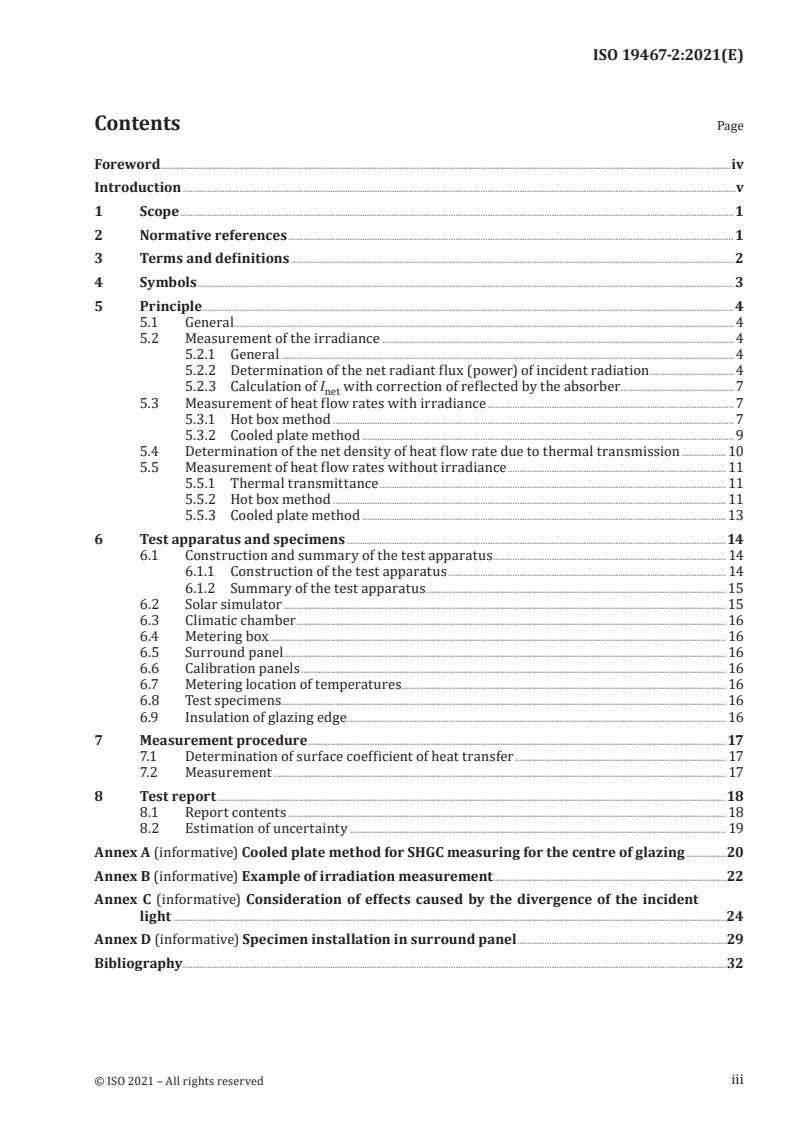
Contents Page
Foreword .iv
Introduction .v
1 Scope . 1
2 Normative references . 1
3 Terms and definitions . 2
4 Symbols . 3
5 Principle . 4
5.1 General . 4
5.2 Measurement of the irradiance . 4
5.2.1 General . 4
5.2.2 Determination of the net radiant flux (power) of incident radiation . 4
5.2.3 Calculation of I with correction of reflected by the absorber . 7
net
5.3 Measurement of heat flow rates with irradiance . 7
5.3.1 Hot box method . 7
5.3.2 Cooled plate method . 9
5.4 Determination of the net density of heat flow rate due to thermal transmission . 10
5.5 Measurement of heat flow rates without irradiance . 11
5.5.1 Thermal transmittance . 11
5.5.2 Hot box method . 11
5.5.3 Cooled plate method .13
6 Test apparatus and specimens .14
6.1 Construction and summary of the test apparatus. 14
6.1.1 Construction of the test apparatus . 14
6.1.2 Summary of the test apparatus . 15
6.2 Solar simulator . 15
6.3 Climatic chamber . . 16
6.4 Metering box . 16
6.5 Surround panel . 16
6.6 Calibration panels . 16
6.7 Metering location of temperatures. 16
6.8 Test specimens. 16
6.9 Insulation of glazing edge . 16
7 Measurement procedure .17
7.1 Determination of surface coefficient of heat transfer . 17
7.2 Measurement . 17
8 Test report .18
8.1 Report contents . 18
8.2 Estimation of uncertainty . 19
Annex A (informative) Cooled plate method for SHGC measuring for the centre of glazing .20
Annex B (informative) Example of irradiation measurement.22
Annex C (informative) Consideration of effects caused by the divergence of the incident
light .24
Annex D (informative) Specimen installation in surround panel .29
Bibliography .32
iii
Foreword
ISO (the International Organization for Standardization) is a worldwide federation of national standards
bodies (ISO member bodies). The work of preparing International Standards is normally carried out
through ISO technical committees. Each member body interested in a subject for which a technical
committee has been established has the right to be represented on that committee. International
organizations, governmental and non-governmental, in liaison with ISO, also take part in the work.
ISO collaborates closely with the International Electrotechnical Commission (IEC) on all matters of
electrotechnical standardization.
The procedures used to develop this document and those intended for its further maintenance are
described in the ISO/IEC Directives, Part 1. In particular, the different approval criteria needed for the
different types of ISO documents should be noted. This document was drafted in accordance with the
editorial rules of the ISO/IEC Directives, Part 2 (see www.iso.org/directives).
Attention is drawn to the possibility that some of the elements of this document may be the subject of
patent rights. ISO shall not be held responsible for identifying any or all such patent rights. Details of
any patent rights identified during the development of the document will be in the Introduction and/or
on the ISO list of patent declarations received (see www.iso.org/patents).
Any trade name used in this document is information given for the convenience of users and does not
constitute an endorsement.
For an explanation of the voluntary nature of standards, the meaning of ISO specific terms and
expressions related to conformity assessment, as well as information about ISO's adherence to
the World Trade Organization (WTO) principles in the Technical Barriers to Trade (TBT), see
www.iso.org/iso/foreword.html.
This document was prepared by Technical Committee ISO/TC 163, Thermal performance and energy use
in the built environment, Subcommittee SC 1, Test and measurement methods.
A list of all parts in the ISO 19467 series can be found on the ISO website.
Any feedback or questions on this document should be directed to the user’s national standards body. A
complete listing of these bodies can be found at www.iso.org/members.html.
iv
Introduction
This document is designed to provide solar heat gain coefficient values of the centre of glazing in
fenestration systems by standardized measurement method. The terms solar heat gain coefficient
(SHGC), total solar energy transmittance (TSET), solar factor and g-value are all used to describe the
same quantity. Small differences might be caused by different reference conditions (e.g. differences in
the reference solar spectrum). In this document, solar heat gain coefficient is used.
The solar heat gain coefficient of a complex fenestration system can depend on the direction of the
incident radiation. It also might be influenced by other factors, e.g. window frame. In order to avoid
the complexity and to enable the measurement of off-normal irradiation, this document focuses on the
centre of glazing in fenestration systems.
This document specifies standardized apparatus and criteria. The solar heat gain coefficient measuring
apparatus applied in this document includes solar simulator, climatic chamber, and metering box. In
some cases, solar heat gain coefficient of the centre of glazing can be determined most accurately by a
combination of calculations and measurements.
v
INTERNATIONAL STANDARD ISO 19467-2:2021(E)
Thermal Performance of windows and doors —
Determination of solar heat gain coefficient using solar
simulator —
Part 2:
Centre of glazing
1 Scope
This document specifies a method to measure the solar heat gain coefficient for the centre of glazing in
fenestration systems (e.g. complete windows, doors or curtain walls with or without shading devices)
for normal and off-normal irradiation on the surface.
This document applies to the centre of glazing in fenestration systems which might consist of:
a) various types of glazing (e.g. glass or plastic; single or multiple glazing; with or without low
emissivity coatings, and with spaces filled with air or other gases; opaque or transparent glazing);
b) various types of shading devices (e.g. blind, screen, film or any attachment with shading effects);
c) various types of active solar fenestration systems [e.g. building-integrated PV systems (BIPV) or
building-integrated solar thermal collectors (BIST)].
This document does not include:
a) shading effects of building elements (e.g. eaves, sleeve wall, etc.);
b) shading effects of fenestration attachments with overhang structures (e.g., awning, etc.) or similar;
c) shading effects of non-glazing elements in fenestration systems (e.g. window frame, etc.);
d) heat transfer caused by air leakage between indoors and outdoors;
e) ventilation of air spaces in double and coupled windows;
f) thermal bridge effects at the joint between the glazing and the rest of the fenestration parts (e.g.
window frame, etc.).
2 Normative references
The following documents are referred to in the text in such a way that some or all of their content
constitutes requirements of this document. For dated references, only the edition cited applies. For
undated references, the latest edition of the referenced document (including any amendments) applies.
ISO 7345, Thermal performance of buildings and building components — Physical quantities and definitions
ISO 9050, Glass in building — Determination of light transmittance, solar direct transmittance, total solar
energy transmittance, ultraviolet transmittance and related glazing factors
ISO 9288, Thermal insulation — Heat transfer by radiation — Physical quantities and definitions
ISO 12567-1, Thermal performance of windows and doors — Determination of thermal transmittance by
the hot-box method — Part 1: Complete windows and doors
ISO 15099, Thermal performance of windows, doors and shading devices — Detailed calculations
ISO 19467:2017, Thermal performance of windows and doors — Determination of solar heat gain coefficient
using solar simulator
ISO 52016-1, Energy performance of buildings — Energy needs for heating and cooling, internal
temperatures and sensible and latent heat loads — Part 1: Calculation procedures
IEC 60904-9, Photovoltaic devices — Part 9: Solar simulator performance requirements
3 Terms and definitions
For the purposes of this document, the terms and definitions given in ISO 7345, ISO 9050, ISO 9288,
ISO 12567-1, ISO 15099, ISO 19467, ISO 52016-1 and IEC 60904-9 and the following apply.
ISO and IEC maintain terminology databases for use in standardization at the following addresses:
— ISO Online browsing platform: available at https:// www .iso .org/ obp
— IEC Electropedia: available at https:// www .electropedia .org/
3.1
centre of glazing
central area of the glazing, undisturbed by edge and frame effects
3.2
off-normal irradiance
irradiation with altitude and/or azimuth angle not equal to 0°
3.3
projected area
area of the projection of the surface of the element on to a plane parallel to the transparent or translucent
part of the element
Note 1 to entry: In the case of non-parallel condition, refer to Annex D.
3.4
simple fenestration system
fenestration products having non-ventilated glazing units made from glass and/or polymers and
homogeneous specular and transparent properties in optical and thermal.
Note 1 to entry: In the case of non-parallel condition, refer to Annex D.
3.5
complex fenestration system
optically and/or thermally complex fenestration products that are not described as simple fenestration
systems (3.4)
EXAMPLE optically scattering glazing and/or shading devices and/or ventilated cavities and/or PV cells
and/or solar collectors.
3.6
solar wavelength range
range of wavelengths for the incident radiation used for solar properties
Note 1 to entry: The range of wavelengths for the incident shall be as specified in ISO 9050.
4 Symbols
Symbol Quantity Unit
A Area m
f Ratio of irradiation difference to distance difference -
Solar heat gain coefficient (also known as total solar energy trans-
g —
mittance, solar factor or g-value)
h Surface coefficient of heat transfer W/(m ·K)
H Height m
Density of heat flow rate (energy per unit area per unit time resulting
q W/m
from radiative and/or convective and/or conductive heat transfer)
Irradiance, radiant flux (power) of incident radiation (energy per
I W/m
unit area per unit time resulting from incident radiation)
U Thermal transmittance W/(m ·K)
W Width m
x Distance or position m
θ Celsius temperature °C
Heat flow rate (energy per unit time resulting from radiative and/
Φ W
or convective and/or conductive heat transfer)
τ Transmittance -
Subscript Meaning
B Planes of peripheral wall of the metering box
C Cooling device
cog Centre of glazing
ex External
F Internal fan
H Heating device
i Number (Index)
in Internal
INS Insulation
N Without irradiance
net Net (Resulting quantity)
ne Environmental external
ni Environmental internal
P Surround panel
r Reflection
ref Reference
scan Scan
si Internal surface
se External surface
5 Principle
5.1 General
The solar heat gain coefficient for the centre of glazing in fenestration systems, g , can be determined
cog
according to the same principle described in ISO 19467. Therefore, it shall be calculated using
Formula (1) with or without shading devices.
qq− I =0
()
in in net
g = (1)
cog
I
net
where
I is the net radiant flux (power) of incident radiation, in W/m2;
net
q is the net density of heat flow rate through the test specimen in the centre of glazing
in
with irradiance, in W/m ;
q (I = 0) is the net density of heat flow rate through the test specimen in the centre of glazing due
in net
to thermal transmission without irradiance when the temperature difference between
internal side and external side is (θ – θ ), in W/m .
ne ni
Main differences between ISO 19467 and this document are as follows:
— this measurement deals with not the complete fenestration systems but the centre of glazing in
fenestration systems;
— irradiance can be emitted also from off-normal incidence (see 5.2);
— not only “hot-box method” but also “cooled plate method” are adopted (see 5.3, 5.4, and 5.5).
5.2 Measurement of the irradiance
5.2.1 General
The determination of the net radiant flux (power) of incident radiation of the centre of glazing in
fenestration systems involves three stages. The first stage is to scan the irradiation. The second stage is
to take the irradiation divergence by distance between test specimen and lamp into account. The third
stage is to calculate the net radiant flux (power) of the incident radiation in the solar wavelength range.
5.2.2 Determination of the net radiant flux (power) of incident radiation
Since the solar simulator cannot provide ideally parallel incident radiation to the test specimen, the
irradiance depends on the distance between the solar simulator and each part of the test specimen and
is not ideally homogeneous on the surface of the test specimen as shown in Figure 1. In order to take
into account the inhomogeneity of the irradiance, net radiant flux (power) of incident radiation, I ,
net
shall be calculated using Formula (2), which is the area-weighted average irradiance at the external
surface of the test specimen on which sensing position should be equally distributed.
n
IA⋅
∑
netc,,iiog
i=1
I = (2)
net
A
cog
where
I is the corresponding net radiation flux (power) of incident radiation for each measurement
net,i
point, i, along a vertical line in the plane of the test specimen, in W/m ;
A is the corresponding projected area for each measurement point, i, in the centre of glazing
cog,i
along a vertical line in the plane of the test specimen, in m ;
A is the projected area of the centre of glazing in the test specimen, in m .
cog
The projected area of the centre of glazing in the test specimen, A , shall be identical to the sum of the
cog
projected area for each measurement point, A , as shown in Formula (3).
cog,i
n
AA= (3)
cogc∑ og,i
i=1
Sensors shall be in the centre of each divided area. More information is given in Annex B. The projected
area of the centre of glazing in the test specimen, A , for both the cooled plate method and the hot box
cog
method can be determined according to Annex A and Annex D, respectively.
Key
X x-axis 3 test specimen
1 solar simulator (normal and off-normal) 4 cooling device or absorber
2 metering box or insulation box 5 lighting generated by solar simulator
Figure 1 — Influence of beam divergence of the incident irradiation
Solar simulators do not provide ideally parallel radiation, therefore the irradiance depends on the
distance from the solar simulator. The individual layers of the test specimen and the absorber in the
case of cooled plate method are thus irradiated with slightly different irradiance values as shown in
Figure 2.
The irradiance may also be determined in a different plane in front of the test specimen. In this case,
I shall be calculated using Formula (4). The influence of divergent irradiation on the position of X
net,i ref
should be taken into account according to Annex C for the cooled plate method.
II=+1 fx −x (4)
()()
net,iiscan,scanref
where
I is the corresponding net radiant flux (power) of incident radiation for each measurement point,
scan,i
i, at the position x , in W/m ;
scan
-1
f is the variation ratio of the irradiance, in m ;
x is the distance between the solar simulator and the scanning radiometer, in m;
scan
x is the distance between the solar simulator and reference plane for the irradiance measure-
ref
ment, in m.
NOTE Directions of x and x are normal to the test specimen.
scan ref
Key
X x-axis 4 cooling device or absorber
1 solar simulator (normal and off-normal) 5 lighting projected by solar simulator
2 metering box or insulation box 6 measuring plane of irradiance scan (x )
scan
3 test specimen 7 plane of reference irradiance (x )
ref
Figure 2 — Determination of reference irradiance when the sensor cannot be put in the plane of
reference irradiance
In order to take into evaluate the variation of the irradiance level from the distance of the absorber, the
criterion f might be used according to Formula (5).
I
scan,1
−1
I
scan,2
f = (5)
xx−
scan,2 scan,1
where
x is the measuring plane1 of irradiance scan in m (key 7 in Figure 3);
scan,1
x is the measuring plane 2 of irradiance scan in m (key 8 in Figure 3);
scan,2
I is the irradiance on the measuring plane 1, in W/m (key 7 in Figure 3);
scan,1
I is the irradiance on the measuring plane2, in W/m (key 8 in Figure 3).
scan,2
If the irradiance sensor cannot be put in the reference plane and f is greater than 0,07 %/mm, f should
be taken into account to analyse the additional uncertainty of the irradiance level due to divergence
effects as shown in Figure 3 and the correction of the reference plane as described in Annex C as already
mentioned before Formula (4). This additional systematic (non-statistical) error should be taken into
account in the determination of the uncertainty of the g-value measurement.
Key
X x-axis 4 cooling device or absorber
1 solar simulator (normal and off-normal) 5 lighting generated by solar simulator
2 metering box or insulation box 6 measuring plane 1 of irradiance scan (x )
scan,1
3 test specimen 7 measuring plane 2 of irradiance scan (x )
scan,2
Figure 3 — Determination of irradiance in different planes in front of the test specimen
5.2.3 Calculation of I with correction of reflected by the absorber
net
The net density of the heat flow rate of the incident radiation, I , shall be calculated using Formula (6).
net,i
II=−I (6)
net,iiscan, r
where I is the density of heat flow rate of the incident radiation that is transmitted to the external side
r
of the metering box/plate after being reflected the internal side of the metering box/plate, in W/m .
If I is proved to be negligible (I approximately 0), the net radiant flux (power) of incident radiation, I ,
r r net
shall be calculated using Formula (7), which results in the second term on the right side of Formula (6)
to become 0.
II= (7)
net,iiscan,
Whether I is negligible or not shall be evaluated based on the criteria stated in ISO 19467.
r
5.3 Measurement of heat flow rates with irradiance
5.3.1 Hot box method
The heat flow rates with irradiance for the hot box method are shown in Figure 4.
Key
1 external side baffle(optional) Φ heat flow rate through the planes of peripheral wall
B
of the metering box with irradiance
2 internal side baffle (optional) Φ heat flow rate removed by the cooling device with
C
irradiance
3 cooling device Φ heat flow rate supplied by the one or more internal
F
fans with irradiance (optional)
4 heat flow measuring device Φ heat flow rate supplied by the heating device with
H
irradiance (optional)
5 internal fan(optional) Φ net heat flow rate through the test specimen with
in
irradiance
6 heating device(optional) Φ (I = 0) net heat flow rate through the test specimen due to
in net
thermal transmission without irradiance when the
temperature difference between internal side and
external side is (θ – θ )
ne ni
7 test specimen Φ heat flow rate through the surround panel with
P
irradiance
8 insulation of glazing edge Φ net radiant flux (power) of incident radiation
net
Φ heat flow rate through the insulation of the glazing
INS
edge with irradiance
This figure shows the case of a condition when the environmental external temperature is higher than the
environmental internal temperature. In the case of a reverse condition, the directions of the heat flow through the
test specimen and the surround panel due to thermal transmission will be reversed. If the internal baffle is not
present, the difference between air temperature and radiative temperature should be minimized.
Figure 4 — Heat flow rates with irradiance for the hot box method
The net density of heat flow rate through the test specimen with irradiance, q , for the hot box method
in
shall be calculated using Formula (8). In the formula, Φ should be estimated by the two-dimensional
INS
calculation.
ΦΦ−−ΦΦ−−ΦΦ−
CB FH PINS
q = (8)
in
A
cog
where
Φ is the heat flow rate removed by the cooling device with irradiance, in watts;
C
Φ is the heat flow rate through the planes of peripheral wall of the metering box with irradi-
B
ance, in watts;
Φ is the heat flow rate supplied by the one or more internal fans with irradiance (optional), in
F
watts;
Φ is the heat flow rate supplied by the heating device with irradiance (optional), in watts;
H
Φ is the heat flow rate through the surround panel with irradiance, in watts;
P
Φ is the heat flow rate through the insulation of the glazing edge with irradiance, in watts.
INS
A is the projected area of the centre of glazing in the test specimen, in m .
cog
5.3.2 Cooled plate method
The heat flow rates with irradiance for the cooled plate method are shown in Figure 5.
Key
1 test specimen Φ heat flow rate removed by the cooled plate for the
C,cog
centre of glazing with irradiance, in watts
2 cooling device Φ net heat flow rate through the test specimen with
in
irradiance
3 heat flow measuring device Φ (I = 0) net heat flow rate through the test specimen due to
in net
thermal transmission without irradiance when the
temperature difference between internal side and
external side is (θ – θ )
ne ni
4 insulation Φ net radiant flux (power) of incident radiation
net
5 insulation of the glazing edge
Figure 5 — Heat flow rates with irradiance for the cooled plate method
The test specimen is mounted in front of a cooled flat plate absorber with an air gap between the internal
surface of the test specimen and the cooled plate. The convective-radiative heat transfer coefficient
between this air gap is set by choosing the width of the gap. The evaluation of the measurement is
based on a local energy balance at the centre of the test specimen, directly resulting in the centre of
glazing value. Edge effects can be analysed with the heat flows of edge of glazing. Therefore, the net
density of heat flow rate through the test specimen with irradiance, q , for the cooled plate method
in
shall be calculated using Formula (9).
Φ
C, cog
q = (9)
in
A
cog
where Φ is the heat flow rate removed by the cooled plate for the centre of glazing with irradiance,
C,cog
in watts.
More information is presented in Annex A.
5.4 Determination of the net density of heat flow rate due to thermal transmission
The net density of heat flow rate through the area of the centre of glazing due to thermal transmission
without irradiance, q (I =0), shall be calculated using Formula (10) in the case of both hot box method
in net
and cooled plate method.
qI =0 =⋅U θθ− (10)
() ()
in netnN eni
where
U is the thermal transmittance of the test specimen without irradiance, in W/(m ·K);
N
θ is the environmental external temperature with irradiance, in °C;
ne
θ is the environmental internal temperature with irradiance, in °C.
ni
5.5 Measurement of heat flow rates without irradiance
5.5.1 Thermal transmittance
The thermal transmittance of the test specimen without irradiance, U , shall be calculated using
N
Formula (11).
'
qI =0
()
in net
U = (11)
N
''
θθ−
()
ne ni
where
q' (I =0) is the net density of heat flow rate of the test specimen due to thermal transmission
in net
without irradiance when the temperature difference between internal side and external
side is (θ’ – θ’ ), in W/m ;
ne ni
θ' is the environmental external temperature without irradiance, in °C;
ne
θ' is the environmental internal temperature without irradiance, in °C.
ni
5.5.2 Hot box method
The heat flow rates without irradiance for hot box method are shown in Figure 6.
Key
1 external side baffle(optional) Φ’ heat flow rate through the planes of peripheral wall of
B
the metering box without irradiance
2 internal side baffle (optional) Φ’ heat flow rate removed by the cooling device without
C
irradiance
3 cooling device Φ’ heat flow rate supplied by the one or more internal
F
fans without irradiance (optional)
4 heat flow measuring device Φ’ heat flow rate supplied by the heating device without
H
irradiance (optional)
5 internal fan (optional) Φ’ (I = 0) net heat flow rate through the test specimen due to
in net
thermal transmission without irradiance when the
temperature difference between internal side and
external side is (θ’ – θ’ )
ne ni
6 heating device (optional) Φ’ heat flow rate through the surround panel without
P
irradiance
7 test specimen Φ’ heat flow rate through the insulation of the glazing
INS
edge without irradiance
8 insulation of the glazing edge
This figure shows the case of a condition when the environmental external temperature is higher than the
environmental internal temperature. In the case of a reverse condition, the directions of the heat flow through the
test specimen and the surround panel due to thermal transmission will be reversed. If the internal baffle is not
present, the difference between air temperature and radiative temperature should be minimized.
Figure 6 — Heat flow rates without irradiance for hot box method
The net density of heat flow rate through the test specimen due to thermal transmission without
irradiance, q’ (I =0), shall be calculated using Formula (12).
in net
'' '' ''
ΦΦ−−ΦΦ−−ΦΦ−
CB FH PINS
'
qI =0 = (12)
()
in net
A
cog
where
Φ' is the heat flow rate removed by the cooling device without irradiance, in watts;
C
Φ' is the heat flow rate through the planes of peripheral wall of the metering box without irra-
B
diance, in watts;
Φ' is the heat flow rate supplied by the one or more internal fans without irradiance (optional),
F
in watts;
Φ' is the heat flow rate supplied by the heating device without irradiance (optional), in watts;
H
Φ' is the heat flow rate through the surround panel without irradiance, in watts.
P
Φ' is the heat flow rate through the insulation of the glazing edge without irradiance, in watts.
INS
5.5.3 Cooled plate method
The heat flow rates without irradiance for cooled plate method are shown in Figure 7.
Key
1 test specimen Φ’ heat flow rate removed by the cooling device without
C,cog
irradiance
2 cooling device Φ’ (I = 0) net heat flow rate through the test specimen due to
in net
thermal transmission without irradiance when the
temperature difference between internal side and
external side is (θ’ – θ’ )
ne ni
3 heat flow measuring device
4 insulation
5 insulation of the glazing edge
Figure 7 — Heat flow rates without irradiance for cooled plate method
The net density of heat flow rate through the test specimen without irradiance, q’ (I =0) for the
in net
cooled plate method shall be calculated using Formula (13).
Φ'
C, cog
′
qI =0 = (13)
()
in net
A
cog
where Φ’ is the heat flow rate removed by the cooled plate for the centre of glazing without
C,cog
irradiance, in watts.
6 Test apparatus and specimens
6.1 Construction and summary of the test apparatus
6.1.1 Construction of the test apparatus
The overall constructions of the measuring apparatus for hot box method and for cooled plate method
are shown in Figure 8 and Figure 9, respectively.
Key
1a solar simulator in the case of normal irradiance 8 test specimen
1b solar simulator in the case of off-normal irradiance
2 climatic chamber 9 internal side baffle (optional)
3 metering box 10 one or more internal fans (optional)
4 transparent aperture 11 heating device (optional)
5 external side baffle (optional) 12 heat flow measuring device
6 external airflow generator 13 cooling device
7 surround panel 14 peripheral wall of the metering box
Figure 8 — Construction of the test apparatus for hot box method
Key
1 solar simulator in case of normal irradiance 7 solar simulator in case of off-normal irradiance
2 climatic chamber 8 air temperature sensors
3 metering box 9 radiometer for monitoring the stability of the solar
simulator
a
4 test specimen 10 radiometer in front of test specimen
5 cooling device 11 data acquisition and control system
a
6 air conditioner The Radiometer in front of test specimen should be
removed before the actual measurement.
Figure 9 — Construction of the test apparatus for cooled plate method
6.1.2 Summary of the test apparatus
The details of measuring apparatus are described in ISO 19467:2017 and the subsequent sections.
6.2 Solar simulator
A steady-state solar simulator whose quality of the irradiance for normal condition meets the
requirement of ISO 19467:2017, 6.2 shall be used. For off-normal condition, it should allow off-normal
irradiation by tilting light source or by rotating test specimen around a vertical axis, i.e., varying the
azimuth. But it should have separate requirements for quality of irradiation. In addition to the list of
requirements for normal condition, the requirement should also include requirements on unpolarization
of incident irradiation. For off-normal irradiance, altitude angle and azimuth angle shall be specified.
6.3 Climatic chamber
The climatic chamber is basically same as specified in ISO 19467:2017, 6.3 except for following
specifications:
a) Transparent aperture: The transparent aperture should be devised to transmit off-normal
irradiation from solar simulator as much as possible. Angle of incidence on the transparent aperture
of the climatic chamber shall not exceed 35°;
b) Rotatable device (optional): Rotatable device that is able to change azimuth angle of the test
specimen to the solar simulator can be installed in the climatic chamber.
6.4 Metering box
The metering box is same as specified in ISO 19467:2017, 6.4. More information is presented in Annex A
for cooled plate method and ISO 19467:2017, Annex D for hot box method.
6.5 Surround panel
The surround panel is same as specified in ISO 19467:2017, 6.5.
6.6 Calibration panels
The calibration panel is same as specified in ISO 19467:2017, 6.6.
6.7 Metering location of temperatures
Metering location of temperatures is same as specified in ISO 19467:2017 except for ISO 19467:2017,
6.7, d).
6.8 Test specimens
The projected area of the test specimen shall be equal to or greater than 0,8 m in width and 0,8 m
in height to minimize the influence of edge effects. Furthermore, the area should be larger than the
inhomogeneities of complex fenestration systems. The maximum size of the test specimen might depend
on the distance between the solar simulator and the test specimen and should be considered for each
test facility condition. Therefore, this document does not set the maximum size of the test specimen
that can be applied to all the test facilities due to the fact that it depends on many factors and set-up
condition of each test facility.
The test specimen shall fill the surround panel aperture using additional insulation of glazing edge
according to 6.9. The clearance between the surround panel and the test specimen with the additional
insulation of glazing edge shall be 5 mm or less, and the perimeter joints between the surround panel
and the test specimen with additional insulation of glazing edge shall be sealed with tape, caulking or
mastic material.
NOTE If applicable, the position of the coating, can be checked before the measurement.
6.9 Insulation of glazing edge
The additional insulation of glazing edge shall be used on both internal side and external side of the
edge of the test specimen to hold the test specimen and to avoid disturbing heat transfer by shadow and
reflectance by the joint edge between the frame and test specimen. More information is presented in
Annex D.
In order to keep the absorption and the additional heat flux through the edge zone low and to reflect
radiation onto the absorber surface, the surfaces of the insulation of glazing edge should be coated with
a highly reflective material.
NOTE When the surfaces of the insulation of glazing edge are coated with a highly reflective material, it
helps to keep the absorption and the additional heat flux through the edge zone low. The inclination and the gloss
level of the surfaces of the edge insulation material determines the fraction of incident radiation that is reflected
onto the absorber surface for a certain direction of the incident radiation.
7 Measurement procedure
7.1 Determination of surface coefficient of heat transfer
The surface coefficient of heat transfer shall be determined as specified in ISO 19467:2017, Annex A.
The settings for the value of the surface coefficient of heat transfer shall be evaluated through the
method of using environmental temperature.
NOTE As described in ISO 19467:2017, Annex A, the real surface coefficient of heat transfer can be higher in
case of samples with rough or structured surfaces.
7.2 Measurement
Measurements shall be performed in each case with and without irradiance. Recommended
environmental conditions are shown in Table 1.
The environmental conditions are decided according to local standards, national standards or
regulations. Alternate environmental conditions shall be reported in 8.1 d).
Table 1 — Recommended environmental conditions
Conditions based on Conditions based on
ISO 15099 ISO 52022-3
Element
Summer Winter Summer Reference
Internal temperature, θ °C 25 20 25 20
in
External temperature, θ °C 30 0 25 5
ex
Internal surface coefficient of heat transfer, h W/(m ·K) 8 8 8 8
si
External surface coefficient of heat transfer, h W/(m ·K) 14 24 14 23
se
Net radiation flux (power) of incident radiation
W/m 500 300 500 300
a
for the case of normal incidence , I
net
a
If the solar simulator cannot meet the density of heat flow rate of the incident radiation, I , under summer conditions,
net
the value may be 400 W/m or higher.
NOTE 1 The performance requirements of fenestration systems are the solar shading in summer and the solar heat gain in
winter. Therefore, this document specifies each of the environmental conditions.
NOTE 2 Whether the heat flow rate due to thermal transmission is negligible is determined according to ISO 19467:2017,
Annex B.
NOTE 3 The relative humidity in the climatic chamber and metering box is kept at low enough levels to avoid condensation.
NOTE 4 Off-normal condition is specified according to national standards.
NOTE 5 There are different International Standards with different reference conditions (e.g. ISO 9050, ISO 15099 and
ISO 52022-3).
The tolerance for the air temperature or environmental temperature difference between internal
side and external side during measurements shall be ±2 °C or ±5 °C, respectively, of the set value. The
difference between the environmental temperatures and the reference temperatures shall be less than
5 K.
The metering location of the metering box side shall be used the same layout of the air temperatures
grid in the case when the surface temperatures of the test specimen and baffle are measured.
The measurement set-up shall reach thermally stable conditions before valid measurements with
or without irradiation can be performed. The required time to reach stability for steady-state tests
depends upon such factors as irradiance, thermal resistance and thermal capacity of the specimen,
s
...
INTERNATIONAL ISO
STANDARD 19467-2
First edition
2021-11
Thermal Performance of windows
and doors — Determination of solar
heat gain coefficient using solar
simulator —
Part 2:
Centre of glazing
Performance thermique des fenêtres et portes — Détermination
du coefficient de gain thermique solaire au moyen d'un simulateur
solaire —
Partie 2: Centre du vitrage
Reference number
© ISO 2021
All rights reserved. Unless otherwise specified, or required in the context of its implementation, no part of this publication may
be reproduced or utilized otherwise in any form or by any means, electronic or mechanical, including photocopying, or posting on
the internet or an intranet, without prior written permission. Permission can be requested from either ISO at the address below
or ISO’s member body in the country of the requester.
ISO copyright office
CP 401 • Ch. de Blandonnet 8
CH-1214 Vernier, Geneva
Phone: +41 22 749 01 11
Email: copyright@iso.org
Website: www.iso.org
Published in Switzerland
ii
Contents Page
Foreword .iv
Introduction .v
1 Scope . 1
2 Normative references . 1
3 Terms and definitions . 2
4 Symbols . 3
5 Principle . 4
5.1 General . 4
5.2 Measurement of the irradiance . 4
5.2.1 General . 4
5.2.2 Determination of the net radiant flux (power) of incident radiation . 4
5.2.3 Calculation of I with correction of reflected by the absorber . 7
net
5.3 Measurement of heat flow rates with irradiance . 7
5.3.1 Hot box method . 7
5.3.2 Cooled plate method . 9
5.4 Determination of the net density of heat flow rate due to thermal transmission . 10
5.5 Measurement of heat flow rates without irradiance . 11
5.5.1 Thermal transmittance . 11
5.5.2 Hot box method . 11
5.5.3 Cooled plate method .13
6 Test apparatus and specimens .14
6.1 Construction and summary of the test apparatus. 14
6.1.1 Construction of the test apparatus . 14
6.1.2 Summary of the test apparatus . 15
6.2 Solar simulator . 15
6.3 Climatic chamber . . 16
6.4 Metering box . 16
6.5 Surround panel . 16
6.6 Calibration panels . 16
6.7 Metering location of temperatures. 16
6.8 Test specimens. 16
6.9 Insulation of glazing edge . 16
7 Measurement procedure .17
7.1 Determination of surface coefficient of heat transfer . 17
7.2 Measurement . 17
8 Test report .18
8.1 Report contents . 18
8.2 Estimation of uncertainty . 19
Annex A (informative) Cooled plate method for SHGC measuring for the centre of glazing .20
Annex B (informative) Example of irradiation measurement.22
Annex C (informative) Consideration of effects caused by the divergence of the incident
light .24
Annex D (informative) Specimen installation in surround panel .29
Bibliography .32
iii
Foreword
ISO (the International Organization for Standardization) is a worldwide federation of national standards
bodies (ISO member bodies). The work of preparing International Standards is normally carried out
through ISO technical committees. Each member body interested in a subject for which a technical
committee has been established has the right to be represented on that committee. International
organizations, governmental and non-governmental, in liaison with ISO, also take part in the work.
ISO collaborates closely with the International Electrotechnical Commission (IEC) on all matters of
electrotechnical standardization.
The procedures used to develop this document and those intended for its further maintenance are
described in the ISO/IEC Directives, Part 1. In particular, the different approval criteria needed for the
different types of ISO documents should be noted. This document was drafted in accordance with the
editorial rules of the ISO/IEC Directives, Part 2 (see www.iso.org/directives).
Attention is drawn to the possibility that some of the elements of this document may be the subject of
patent rights. ISO shall not be held responsible for identifying any or all such patent rights. Details of
any patent rights identified during the development of the document will be in the Introduction and/or
on the ISO list of patent declarations received (see www.iso.org/patents).
Any trade name used in this document is information given for the convenience of users and does not
constitute an endorsement.
For an explanation of the voluntary nature of standards, the meaning of ISO specific terms and
expressions related to conformity assessment, as well as information about ISO's adherence to
the World Trade Organization (WTO) principles in the Technical Barriers to Trade (TBT), see
www.iso.org/iso/foreword.html.
This document was prepared by Technical Committee ISO/TC 163, Thermal performance and energy use
in the built environment, Subcommittee SC 1, Test and measurement methods.
A list of all parts in the ISO 19467 series can be found on the ISO website.
Any feedback or questions on this document should be directed to the user’s national standards body. A
complete listing of these bodies can be found at www.iso.org/members.html.
iv
Introduction
This document is designed to provide solar heat gain coefficient values of the centre of glazing in
fenestration systems by standardized measurement method. The terms solar heat gain coefficient
(SHGC), total solar energy transmittance (TSET), solar factor and g-value are all used to describe the
same quantity. Small differences might be caused by different reference conditions (e.g. differences in
the reference solar spectrum). In this document, solar heat gain coefficient is used.
The solar heat gain coefficient of a complex fenestration system can depend on the direction of the
incident radiation. It also might be influenced by other factors, e.g. window frame. In order to avoid
the complexity and to enable the measurement of off-normal irradiation, this document focuses on the
centre of glazing in fenestration systems.
This document specifies standardized apparatus and criteria. The solar heat gain coefficient measuring
apparatus applied in this document includes solar simulator, climatic chamber, and metering box. In
some cases, solar heat gain coefficient of the centre of glazing can be determined most accurately by a
combination of calculations and measurements.
v
INTERNATIONAL STANDARD ISO 19467-2:2021(E)
Thermal Performance of windows and doors —
Determination of solar heat gain coefficient using solar
simulator —
Part 2:
Centre of glazing
1 Scope
This document specifies a method to measure the solar heat gain coefficient for the centre of glazing in
fenestration systems (e.g. complete windows, doors or curtain walls with or without shading devices)
for normal and off-normal irradiation on the surface.
This document applies to the centre of glazing in fenestration systems which might consist of:
a) various types of glazing (e.g. glass or plastic; single or multiple glazing; with or without low
emissivity coatings, and with spaces filled with air or other gases; opaque or transparent glazing);
b) various types of shading devices (e.g. blind, screen, film or any attachment with shading effects);
c) various types of active solar fenestration systems [e.g. building-integrated PV systems (BIPV) or
building-integrated solar thermal collectors (BIST)].
This document does not include:
a) shading effects of building elements (e.g. eaves, sleeve wall, etc.);
b) shading effects of fenestration attachments with overhang structures (e.g., awning, etc.) or similar;
c) shading effects of non-glazing elements in fenestration systems (e.g. window frame, etc.);
d) heat transfer caused by air leakage between indoors and outdoors;
e) ventilation of air spaces in double and coupled windows;
f) thermal bridge effects at the joint between the glazing and the rest of the fenestration parts (e.g.
window frame, etc.).
2 Normative references
The following documents are referred to in the text in such a way that some or all of their content
constitutes requirements of this document. For dated references, only the edition cited applies. For
undated references, the latest edition of the referenced document (including any amendments) applies.
ISO 7345, Thermal performance of buildings and building components — Physical quantities and definitions
ISO 9050, Glass in building — Determination of light transmittance, solar direct transmittance, total solar
energy transmittance, ultraviolet transmittance and related glazing factors
ISO 9288, Thermal insulation — Heat transfer by radiation — Physical quantities and definitions
ISO 12567-1, Thermal performance of windows and doors — Determination of thermal transmittance by
the hot-box method — Part 1: Complete windows and doors
ISO 15099, Thermal performance of windows, doors and shading devices — Detailed calculations
ISO 19467:2017, Thermal performance of windows and doors — Determination of solar heat gain coefficient
using solar simulator
ISO 52016-1, Energy performance of buildings — Energy needs for heating and cooling, internal
temperatures and sensible and latent heat loads — Part 1: Calculation procedures
IEC 60904-9, Photovoltaic devices — Part 9: Solar simulator performance requirements
3 Terms and definitions
For the purposes of this document, the terms and definitions given in ISO 7345, ISO 9050, ISO 9288,
ISO 12567-1, ISO 15099, ISO 19467, ISO 52016-1 and IEC 60904-9 and the following apply.
ISO and IEC maintain terminology databases for use in standardization at the following addresses:
— ISO Online browsing platform: available at https:// www .iso .org/ obp
— IEC Electropedia: available at https:// www .electropedia .org/
3.1
centre of glazing
central area of the glazing, undisturbed by edge and frame effects
3.2
off-normal irradiance
irradiation with altitude and/or azimuth angle not equal to 0°
3.3
projected area
area of the projection of the surface of the element on to a plane parallel to the transparent or translucent
part of the element
Note 1 to entry: In the case of non-parallel condition, refer to Annex D.
3.4
simple fenestration system
fenestration products having non-ventilated glazing units made from glass and/or polymers and
homogeneous specular and transparent properties in optical and thermal.
Note 1 to entry: In the case of non-parallel condition, refer to Annex D.
3.5
complex fenestration system
optically and/or thermally complex fenestration products that are not described as simple fenestration
systems (3.4)
EXAMPLE optically scattering glazing and/or shading devices and/or ventilated cavities and/or PV cells
and/or solar collectors.
3.6
solar wavelength range
range of wavelengths for the incident radiation used for solar properties
Note 1 to entry: The range of wavelengths for the incident shall be as specified in ISO 9050.
4 Symbols
Symbol Quantity Unit
A Area m
f Ratio of irradiation difference to distance difference -
Solar heat gain coefficient (also known as total solar energy trans-
g —
mittance, solar factor or g-value)
h Surface coefficient of heat transfer W/(m ·K)
H Height m
Density of heat flow rate (energy per unit area per unit time resulting
q W/m
from radiative and/or convective and/or conductive heat transfer)
Irradiance, radiant flux (power) of incident radiation (energy per
I W/m
unit area per unit time resulting from incident radiation)
U Thermal transmittance W/(m ·K)
W Width m
x Distance or position m
θ Celsius temperature °C
Heat flow rate (energy per unit time resulting from radiative and/
Φ W
or convective and/or conductive heat transfer)
τ Transmittance -
Subscript Meaning
B Planes of peripheral wall of the metering box
C Cooling device
cog Centre of glazing
ex External
F Internal fan
H Heating device
i Number (Index)
in Internal
INS Insulation
N Without irradiance
net Net (Resulting quantity)
ne Environmental external
ni Environmental internal
P Surround panel
r Reflection
ref Reference
scan Scan
si Internal surface
se External surface
5 Principle
5.1 General
The solar heat gain coefficient for the centre of glazing in fenestration systems, g , can be determined
cog
according to the same principle described in ISO 19467. Therefore, it shall be calculated using
Formula (1) with or without shading devices.
qq− I =0
()
in in net
g = (1)
cog
I
net
where
I is the net radiant flux (power) of incident radiation, in W/m2;
net
q is the net density of heat flow rate through the test specimen in the centre of glazing
in
with irradiance, in W/m ;
q (I = 0) is the net density of heat flow rate through the test specimen in the centre of glazing due
in net
to thermal transmission without irradiance when the temperature difference between
internal side and external side is (θ – θ ), in W/m .
ne ni
Main differences between ISO 19467 and this document are as follows:
— this measurement deals with not the complete fenestration systems but the centre of glazing in
fenestration systems;
— irradiance can be emitted also from off-normal incidence (see 5.2);
— not only “hot-box method” but also “cooled plate method” are adopted (see 5.3, 5.4, and 5.5).
5.2 Measurement of the irradiance
5.2.1 General
The determination of the net radiant flux (power) of incident radiation of the centre of glazing in
fenestration systems involves three stages. The first stage is to scan the irradiation. The second stage is
to take the irradiation divergence by distance between test specimen and lamp into account. The third
stage is to calculate the net radiant flux (power) of the incident radiation in the solar wavelength range.
5.2.2 Determination of the net radiant flux (power) of incident radiation
Since the solar simulator cannot provide ideally parallel incident radiation to the test specimen, the
irradiance depends on the distance between the solar simulator and each part of the test specimen and
is not ideally homogeneous on the surface of the test specimen as shown in Figure 1. In order to take
into account the inhomogeneity of the irradiance, net radiant flux (power) of incident radiation, I ,
net
shall be calculated using Formula (2), which is the area-weighted average irradiance at the external
surface of the test specimen on which sensing position should be equally distributed.
n
IA⋅
∑
netc,,iiog
i=1
I = (2)
net
A
cog
where
I is the corresponding net radiation flux (power) of incident radiation for each measurement
net,i
point, i, along a vertical line in the plane of the test specimen, in W/m ;
A is the corresponding projected area for each measurement point, i, in the centre of glazing
cog,i
along a vertical line in the plane of the test specimen, in m ;
A is the projected area of the centre of glazing in the test specimen, in m .
cog
The projected area of the centre of glazing in the test specimen, A , shall be identical to the sum of the
cog
projected area for each measurement point, A , as shown in Formula (3).
cog,i
n
AA= (3)
cogc∑ og,i
i=1
Sensors shall be in the centre of each divided area. More information is given in Annex B. The projected
area of the centre of glazing in the test specimen, A , for both the cooled plate method and the hot box
cog
method can be determined according to Annex A and Annex D, respectively.
Key
X x-axis 3 test specimen
1 solar simulator (normal and off-normal) 4 cooling device or absorber
2 metering box or insulation box 5 lighting generated by solar simulator
Figure 1 — Influence of beam divergence of the incident irradiation
Solar simulators do not provide ideally parallel radiation, therefore the irradiance depends on the
distance from the solar simulator. The individual layers of the test specimen and the absorber in the
case of cooled plate method are thus irradiated with slightly different irradiance values as shown in
Figure 2.
The irradiance may also be determined in a different plane in front of the test specimen. In this case,
I shall be calculated using Formula (4). The influence of divergent irradiation on the position of X
net,i ref
should be taken into account according to Annex C for the cooled plate method.
II=+1 fx −x (4)
()()
net,iiscan,scanref
where
I is the corresponding net radiant flux (power) of incident radiation for each measurement point,
scan,i
i, at the position x , in W/m ;
scan
-1
f is the variation ratio of the irradiance, in m ;
x is the distance between the solar simulator and the scanning radiometer, in m;
scan
x is the distance between the solar simulator and reference plane for the irradiance measure-
ref
ment, in m.
NOTE Directions of x and x are normal to the test specimen.
scan ref
Key
X x-axis 4 cooling device or absorber
1 solar simulator (normal and off-normal) 5 lighting projected by solar simulator
2 metering box or insulation box 6 measuring plane of irradiance scan (x )
scan
3 test specimen 7 plane of reference irradiance (x )
ref
Figure 2 — Determination of reference irradiance when the sensor cannot be put in the plane of
reference irradiance
In order to take into evaluate the variation of the irradiance level from the distance of the absorber, the
criterion f might be used according to Formula (5).
I
scan,1
−1
I
scan,2
f = (5)
xx−
scan,2 scan,1
where
x is the measuring plane1 of irradiance scan in m (key 7 in Figure 3);
scan,1
x is the measuring plane 2 of irradiance scan in m (key 8 in Figure 3);
scan,2
I is the irradiance on the measuring plane 1, in W/m (key 7 in Figure 3);
scan,1
I is the irradiance on the measuring plane2, in W/m (key 8 in Figure 3).
scan,2
If the irradiance sensor cannot be put in the reference plane and f is greater than 0,07 %/mm, f should
be taken into account to analyse the additional uncertainty of the irradiance level due to divergence
effects as shown in Figure 3 and the correction of the reference plane as described in Annex C as already
mentioned before Formula (4). This additional systematic (non-statistical) error should be taken into
account in the determination of the uncertainty of the g-value measurement.
Key
X x-axis 4 cooling device or absorber
1 solar simulator (normal and off-normal) 5 lighting generated by solar simulator
2 metering box or insulation box 6 measuring plane 1 of irradiance scan (x )
scan,1
3 test specimen 7 measuring plane 2 of irradiance scan (x )
scan,2
Figure 3 — Determination of irradiance in different planes in front of the test specimen
5.2.3 Calculation of I with correction of reflected by the absorber
net
The net density of the heat flow rate of the incident radiation, I , shall be calculated using Formula (6).
net,i
II=−I (6)
net,iiscan, r
where I is the density of heat flow rate of the incident radiation that is transmitted to the external side
r
of the metering box/plate after being reflected the internal side of the metering box/plate, in W/m .
If I is proved to be negligible (I approximately 0), the net radiant flux (power) of incident radiation, I ,
r r net
shall be calculated using Formula (7), which results in the second term on the right side of Formula (6)
to become 0.
II= (7)
net,iiscan,
Whether I is negligible or not shall be evaluated based on the criteria stated in ISO 19467.
r
5.3 Measurement of heat flow rates with irradiance
5.3.1 Hot box method
The heat flow rates with irradiance for the hot box method are shown in Figure 4.
Key
1 external side baffle(optional) Φ heat flow rate through the planes of peripheral wall
B
of the metering box with irradiance
2 internal side baffle (optional) Φ heat flow rate removed by the cooling device with
C
irradiance
3 cooling device Φ heat flow rate supplied by the one or more internal
F
fans with irradiance (optional)
4 heat flow measuring device Φ heat flow rate supplied by the heating device with
H
irradiance (optional)
5 internal fan(optional) Φ net heat flow rate through the test specimen with
in
irradiance
6 heating device(optional) Φ (I = 0) net heat flow rate through the test specimen due to
in net
thermal transmission without irradiance when the
temperature difference between internal side and
external side is (θ – θ )
ne ni
7 test specimen Φ heat flow rate through the surround panel with
P
irradiance
8 insulation of glazing edge Φ net radiant flux (power) of incident radiation
net
Φ heat flow rate through the insulation of the glazing
INS
edge with irradiance
This figure shows the case of a condition when the environmental external temperature is higher than the
environmental internal temperature. In the case of a reverse condition, the directions of the heat flow through the
test specimen and the surround panel due to thermal transmission will be reversed. If the internal baffle is not
present, the difference between air temperature and radiative temperature should be minimized.
Figure 4 — Heat flow rates with irradiance for the hot box method
The net density of heat flow rate through the test specimen with irradiance, q , for the hot box method
in
shall be calculated using Formula (8). In the formula, Φ should be estimated by the two-dimensional
INS
calculation.
ΦΦ−−ΦΦ−−ΦΦ−
CB FH PINS
q = (8)
in
A
cog
where
Φ is the heat flow rate removed by the cooling device with irradiance, in watts;
C
Φ is the heat flow rate through the planes of peripheral wall of the metering box with irradi-
B
ance, in watts;
Φ is the heat flow rate supplied by the one or more internal fans with irradiance (optional), in
F
watts;
Φ is the heat flow rate supplied by the heating device with irradiance (optional), in watts;
H
Φ is the heat flow rate through the surround panel with irradiance, in watts;
P
Φ is the heat flow rate through the insulation of the glazing edge with irradiance, in watts.
INS
A is the projected area of the centre of glazing in the test specimen, in m .
cog
5.3.2 Cooled plate method
The heat flow rates with irradiance for the cooled plate method are shown in Figure 5.
Key
1 test specimen Φ heat flow rate removed by the cooled plate for the
C,cog
centre of glazing with irradiance, in watts
2 cooling device Φ net heat flow rate through the test specimen with
in
irradiance
3 heat flow measuring device Φ (I = 0) net heat flow rate through the test specimen due to
in net
thermal transmission without irradiance when the
temperature difference between internal side and
external side is (θ – θ )
ne ni
4 insulation Φ net radiant flux (power) of incident radiation
net
5 insulation of the glazing edge
Figure 5 — Heat flow rates with irradiance for the cooled plate method
The test specimen is mounted in front of a cooled flat plate absorber with an air gap between the internal
surface of the test specimen and the cooled plate. The convective-radiative heat transfer coefficient
between this air gap is set by choosing the width of the gap. The evaluation of the measurement is
based on a local energy balance at the centre of the test specimen, directly resulting in the centre of
glazing value. Edge effects can be analysed with the heat flows of edge of glazing. Therefore, the net
density of heat flow rate through the test specimen with irradiance, q , for the cooled plate method
in
shall be calculated using Formula (9).
Φ
C, cog
q = (9)
in
A
cog
where Φ is the heat flow rate removed by the cooled plate for the centre of glazing with irradiance,
C,cog
in watts.
More information is presented in Annex A.
5.4 Determination of the net density of heat flow rate due to thermal transmission
The net density of heat flow rate through the area of the centre of glazing due to thermal transmission
without irradiance, q (I =0), shall be calculated using Formula (10) in the case of both hot box method
in net
and cooled plate method.
qI =0 =⋅U θθ− (10)
() ()
in netnN eni
where
U is the thermal transmittance of the test specimen without irradiance, in W/(m ·K);
N
θ is the environmental external temperature with irradiance, in °C;
ne
θ is the environmental internal temperature with irradiance, in °C.
ni
5.5 Measurement of heat flow rates without irradiance
5.5.1 Thermal transmittance
The thermal transmittance of the test specimen without irradiance, U , shall be calculated using
N
Formula (11).
'
qI =0
()
in net
U = (11)
N
''
θθ−
()
ne ni
where
q' (I =0) is the net density of heat flow rate of the test specimen due to thermal transmission
in net
without irradiance when the temperature difference between internal side and external
side is (θ’ – θ’ ), in W/m ;
ne ni
θ' is the environmental external temperature without irradiance, in °C;
ne
θ' is the environmental internal temperature without irradiance, in °C.
ni
5.5.2 Hot box method
The heat flow rates without irradiance for hot box method are shown in Figure 6.
Key
1 external side baffle(optional) Φ’ heat flow rate through the planes of peripheral wall of
B
the metering box without irradiance
2 internal side baffle (optional) Φ’ heat flow rate removed by the cooling device without
C
irradiance
3 cooling device Φ’ heat flow rate supplied by the one or more internal
F
fans without irradiance (optional)
4 heat flow measuring device Φ’ heat flow rate supplied by the heating device without
H
irradiance (optional)
5 internal fan (optional) Φ’ (I = 0) net heat flow rate through the test specimen due to
in net
thermal transmission without irradiance when the
temperature difference between internal side and
external side is (θ’ – θ’ )
ne ni
6 heating device (optional) Φ’ heat flow rate through the surround panel without
P
irradiance
7 test specimen Φ’ heat flow rate through the insulation of the glazing
INS
edge without irradiance
8 insulation of the glazing edge
This figure shows the case of a condition when the environmental external temperature is higher than the
environmental internal temperature. In the case of a reverse condition, the directions of the heat flow through the
test specimen and the surround panel due to thermal transmission will be reversed. If the internal baffle is not
present, the difference between air temperature and radiative temperature should be minimized.
Figure 6 — Heat flow rates without irradiance for hot box method
The net density of heat flow rate through the test specimen due to thermal transmission without
irradiance, q’ (I =0), shall be calculated using Formula (12).
in net
'' '' ''
ΦΦ−−ΦΦ−−ΦΦ−
CB FH PINS
'
qI =0 = (12)
()
in net
A
cog
where
Φ' is the heat flow rate removed by the cooling device without irradiance, in watts;
C
Φ' is the heat flow rate through the planes of peripheral wall of the metering box without irra-
B
diance, in watts;
Φ' is the heat flow rate supplied by the one or more internal fans without irradiance (optional),
F
in watts;
Φ' is the heat flow rate supplied by the heating device without irradiance (optional), in watts;
H
Φ' is the heat flow rate through the surround panel without irradiance, in watts.
P
Φ' is the heat flow rate through the insulation of the glazing edge without irradiance, in watts.
INS
5.5.3 Cooled plate method
The heat flow rates without irradiance for cooled plate method are shown in Figure 7.
Key
1 test specimen Φ’ heat flow rate removed by the cooling device without
C,cog
irradiance
2 cooling device Φ’ (I = 0) net heat flow rate through the test specimen due to
in net
thermal transmission without irradiance when the
temperature difference between internal side and
external side is (θ’ – θ’ )
ne ni
3 heat flow measuring device
4 insulation
5 insulation of the glazing edge
Figure 7 — Heat flow rates without irradiance for cooled plate method
The net density of heat flow rate through the test specimen without irradiance, q’ (I =0) for the
in net
cooled plate method shall be calculated using Formula (13).
Φ'
C, cog
′
qI =0 = (13)
()
in net
A
cog
where Φ’ is the heat flow rate removed by the cooled plate for the centre of glazing without
C,cog
irradiance, in watts.
6 Test apparatus and specimens
6.1 Construction and summary of the test apparatus
6.1.1 Construction of the test apparatus
The overall constructions of the measuring apparatus for hot box method and for cooled plate method
are shown in Figure 8 and Figure 9, respectively.
Key
1a solar simulator in the case of normal irradiance 8 test specimen
1b solar simulator in the case of off-normal irradiance
2 climatic chamber 9 internal side baffle (optional)
3 metering box 10 one or more internal fans (optional)
4 transparent aperture 11 heating device (optional)
5 external side baffle (optional) 12 heat flow measuring device
6 external airflow generator 13 cooling device
7 surround panel 14 peripheral wall of the metering box
Figure 8 — Construction of the test apparatus for hot box method
Key
1 solar simulator in case of normal irradiance 7 solar simulator in case of off-normal irradiance
2 climatic chamber 8 air temperature sensors
3 metering box 9 radiometer for monitoring the stability of the solar
simulator
a
4 test specimen 10 radiometer in front of test specimen
5 cooling device 11 data acquisition and control system
a
6 air conditioner The Radiometer in front of test specimen should be
removed before the actual measurement.
Figure 9 — Construction of the test apparatus for cooled plate method
6.1.2 Summary of the test apparatus
The details of measuring apparatus are described in ISO 19467:2017 and the subsequent sections.
6.2 Solar simulator
A steady-state solar simulator whose quality of the irradiance for normal condition meets the
requirement of ISO 19467:2017, 6.2 shall be used. For off-normal condition, it should allow off-normal
irradiation by tilting light source or by rotating test specimen around a vertical axis, i.e., varying the
azimuth. But it should have separate requirements for quality of irradiation. In addition to the list of
requirements for normal condition, the requirement should also include requirements on unpolarization
of incident irradiation. For off-normal irradiance, altitude angle and azimuth angle shall be specified.
6.3 Climatic chamber
The climatic chamber is basically same as specified in ISO 19467:2017, 6.3 except for following
specifications:
a) Transparent aperture: The transparent aperture should be devised to transmit off-normal
irradiation from solar simulator as much as possible. Angle of incidence on the transparent aperture
of the climatic chamber shall not exceed 35°;
b) Rotatable device (optional): Rotatable device that is able to change azimuth angle of the test
specimen to the solar simulator can be installed in the climatic chamber.
6.4 Metering box
The metering box is same as specified in ISO 19467:2017, 6.4. More information is presented in Annex A
for cooled plate method and ISO 19467:2017, Annex D for hot box method.
6.5 Surround panel
The surround panel is same as specified in ISO 19467:2017, 6.5.
6.6 Calibration panels
The calibration panel is same as specified in ISO 19467:2017, 6.6.
6.7 Metering location of temperatures
Metering location of temperatures is same as specified in ISO 19467:2017 except for ISO 19467:2017,
6.7, d).
6.8 Test specimens
The projected area of the test specimen shall be equal to or greater than 0,8 m in width and 0,8 m
in height to minimize the influence of edge effects. Furthermore, the area should be larger than the
inhomogeneities of complex fenestration systems. The maximum size of the test specimen might depend
on the distance between the solar simulator and the test specimen and should be considered for each
test facility condition. Therefore, this document does not set the maximum size of the test specimen
that can be applied to all the test facilities due to the fact that it depends on many factors and set-up
condition of each test facility.
The test specimen shall fill the surround panel aperture using additional insulation of glazing edge
according to 6.9. The clearance between the surround panel and the test specimen with the additional
insulation of glazing edge shall be 5 mm or less, and the perimeter joints between the surround panel
and the test specimen with additional insulation of glazing edge shall be sealed with tape, caulking or
mastic material.
NOTE If applicable, the position of the coating, can be checked before the measurement.
6.9 Insulation of glazing edge
The additional insulation of glazing edge shall be used on both internal side and external side of the
edge of the test specimen to hold the test specimen and to avoid disturbing heat transfer by shadow and
reflectance by the joint edge between the frame and test specimen. More information is presented in
Annex D.
In order to keep the absorption and the additional heat flux through the edge zone low and to reflect
radiation onto the absorber surface, the surfaces of the insulation of glazing edge should be coated with
a highly reflective material.
NOTE When the surfaces of the insulation of glazing edge are coated with a highly reflective material, it
helps to keep the absorption and the additional heat flux through the edge zone low. The inclination and the gloss
level of the surfaces of the edge insulation material determines the fraction of incident radiation that is reflected
onto the absorber surface for a certain direction of the incident radiation.
7 Measurement procedure
7.1 Determination of surface coefficient of heat transfer
The surface coefficient of heat transfer shall be determined as specified in ISO 19467:2017, Annex A.
The settings for the value of the surface coefficient of heat transfer shall be evaluated through the
method of using environmental temperature.
NOTE As described in ISO 19467:2017, Annex A, the real surface coefficient of heat transfer can be higher in
case of samples with rough or structured surfaces.
7.2 Measurement
Measurements shall be performed in each case with and without irradiance. Recommended
environmental conditions are shown in Table 1.
The environmental conditions are decided according to local standards, national standards or
regulations. Alternate environmental conditions shall be reported in 8.1 d).
Table 1 — Recommended environmental conditions
Conditions based on Conditions based on
ISO 15099 ISO 52022-3
Element
Summer Winter Summer Reference
Internal temperature, θ °C 25 20 25 20
in
External temperature, θ °C 30 0 25 5
ex
Internal surface coefficient of heat transfer, h W/(m ·K) 8 8 8 8
si
External surface coefficient of heat transfer, h W/(m ·K) 14 24 14 23
se
Net radiation flux (power) of incident radiation
W/m 500 300 500 300
a
for the case of normal incidence , I
net
a
If the solar simulator cannot meet the density of heat flow rate of the incident radiation, I , under summer conditions,
net
the value may be 400 W/m or higher.
NOTE 1 The performance requirements of fenestration systems are the solar shading in summer and the solar heat gain in
winter. Therefore, this document specifies each of the environmental conditions.
NOTE 2 Whether the heat flow rate due to thermal transmission is negligible is determined according to ISO 19467:2017,
Annex B.
NOTE 3 The relative humidity in the climatic chamber and metering box is kept at low enough levels to avoid condensation.
NOTE 4 Off-normal condition is specified according to national standards.
NOTE 5 There are different International Standards with different reference conditions (e.g. ISO 9050, ISO 15099 and
ISO 52022-3).
The tolerance for the air temperature or environmental temperature difference between internal
side and external side during measurements shall be ±2 °C or ±5 °C, respectively, of the set value. The
difference between the environmental temperatures and the reference temperatures shall be less than
5 K.
The metering location of the metering box side shall be used the same layout of the air temperatures
grid in the case when the surface temperatures of the test specimen and baffle are measured.
The measurement set-up shall reach thermally stable conditions before valid measurements with
or without irradiation can be performed. The required time to reach stability for steady-state tests
depends upon such factors as irradiance, thermal resistance and thermal capacity of the specimen,
s
...