

ISO 10077-1:2017
(Main)Thermal performance of windows, doors and shutters — Calculation of thermal transmittance — Part 1: General
General Information
- Abstract
ISO 10077-1:2017 specifies methods for the calculation of the thermal transmittance of windows and pedestrian doors consisting of glazed and/or opaque panels fitted in a frame, with and without shutters.
- Status
- Published
- Publication Date
- 20-Jun-2017
- Technical Committee
- ISO/TC 163/SC 2 - Calculation methods
- Drafting Committee
- ISO/TC 163/SC 2 - Calculation methods
- Current Stage
- 9093 - International Standard confirmed
- Start Date
- 08-Dec-2022
- Completion Date
- 29-Aug-2026
Buy Documents


ISO 10077-1:2017 - Thermal performance of windows, doors and shutters -- Calculation of thermal transmittance

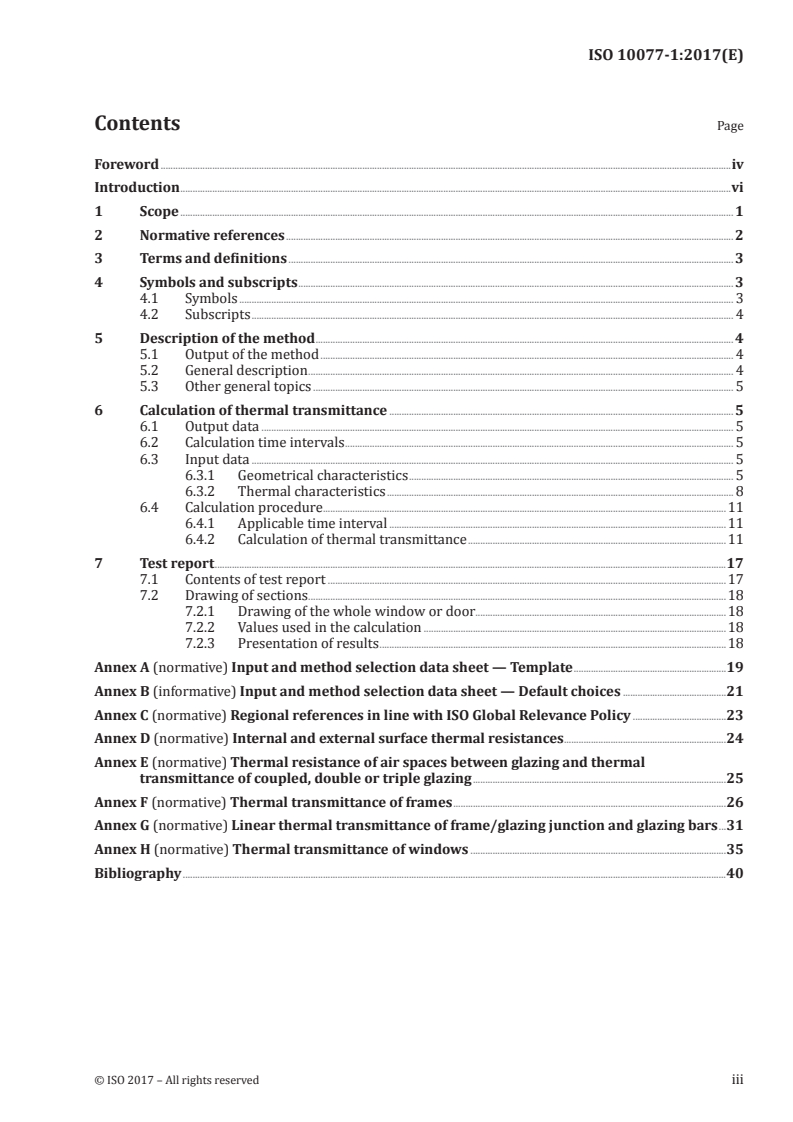

ISO 10077-1:2017 - Thermal performance of windows, doors and shutters — Calculation of thermal transmittance — Part 1: General/24/2020


ISO 10077-1:2017 - Performance thermique des fenetres, portes et fermetures -- Calcul du coefficient de transmission thermique


ISO 10077-1:2017 - Performance thermique des fenêtres, portes et fermetures — Calcul du coefficient de transmission thermique — Partie 1: Généralités/24/2020
Overview - ISO 10077-1:2017 (Thermal performance of windows, doors and shutters)
ISO 10077-1:2017 defines the general method for calculating the thermal transmittance (U-value) of windows, pedestrian doors and shutters. Part 1 sets out scope, definitions, input data, calculation procedures, reporting requirements and templates used across the ISO/CEN EPB (energy performance of buildings) set of standards. The standard applies to assemblies composed of glazed and/or opaque panels fitted in frames, with or without shutters, and supports consistent evaluation of window thermal performance for design, certification and regulatory compliance.
Key topics and technical requirements
- Scope and output: Specifies the calculation output (overall U-value and related data) and applicable time intervals for dynamic calculations.
- Input data: Requires geometric and thermal characteristics for glazing, opaque panels, frames and junctions (e.g., dimensions, material conductivities, air space properties).
- Component approach: Thermal transmittance is evaluated from component parts:
- glazing thermal transmittance (EN 673; measurement EN 674/675),
- opaque panel transmittance (ISO 6946, ISO 10211; measurement ISO 8301/8302),
- frame transmittance (ISO 10077-2 or EN 12412-2; Annex F),
- linear thermal transmittance of frame–glazing junctions (Ψ, ISO 10077-2 or Annex G).
- Annexes and templates: Includes normative templates (Annex A) and default choices (Annex B) to ensure unambiguous application and national/regional adaptation. Normative annexes cover surface resistances, air space resistances, frame data and tabulated values for junctions.
- Reporting: Defines required contents of a test/calculation report and drawing conventions for reproducible results.
Practical applications and who uses it
ISO 10077-1 is used to:
- Evaluate and compare thermal performance (U-value) of window, door and shutter products.
- Support product development and optimization for thermal efficiency.
- Provide inputs for building energy simulations and compliance with energy codes.
- Produce standardized calculation reports for certification, tendering and regulatory approval.
Primary users:
- Window and door manufacturers and R&D teams
- Façade and building-envelope engineers
- Energy assessors and consultants
- Regulatory bodies and certification schemes
- Test laboratories performing or validating thermal calculations and measurements
Related standards (selection)
- ISO 10077-2 (frame and junction calculation details)
- ISO 12567-1 / ISO 12567-2 (whole-window testing)
- EN 673, EN 674, EN 675 (glazing U-value methods)
- ISO 6946, ISO 10211, ISO 8301 / ISO 8302 (opaque elements and heat transfer)
- EN 12412-2 (frame measurement)
- ISO/TR 52022-2 (technical report supporting EPB harmonization)
ISO 10077-1:2017 is essential for anyone needing consistent, traceable calculation of window and door thermal transmittance for energy-efficient design, product certification and regulatory compliance.
Relations
- Effective Date
- 25-Aug-2026
- Effective Date
- 25-Aug-2026
- Effective Date
- 25-Aug-2026
- Effective Date
- 25-Aug-2026
- Effective Date
- 12-Feb-2026
- Effective Date
- 02-Aug-2014
Buy Documents
ISO 10077-1:2017 - Thermal performance of windows, doors and shutters -- Calculation of thermal transmittance
ISO 10077-1:2017 - Thermal performance of windows, doors and shutters — Calculation of thermal transmittance — Part 1: General/24/2020
ISO 10077-1:2017 - Performance thermique des fenetres, portes et fermetures -- Calcul du coefficient de transmission thermique
ISO 10077-1:2017 - Performance thermique des fenêtres, portes et fermetures — Calcul du coefficient de transmission thermique — Partie 1: Généralités/24/2020
Get Certified
Connect with accredited certification bodies for this standard

DIBt (Deutsches Institut für Bautechnik)
German Institute for Building Technology.
DIN CERTCO
DIN Group product certification.

Aboma Certification B.V.
Specialized in construction, metal, and transport sectors.
Sponsored listings
Frequently Asked Questions
ISO 10077-1:2017 is a standard published by the International Organization for Standardization (ISO). Its full title is "Thermal performance of windows, doors and shutters — Calculation of thermal transmittance — Part 1: General". This standard covers: ISO 10077-1:2017 specifies methods for the calculation of the thermal transmittance of windows and pedestrian doors consisting of glazed and/or opaque panels fitted in a frame, with and without shutters.
ISO 10077-1:2017 specifies methods for the calculation of the thermal transmittance of windows and pedestrian doors consisting of glazed and/or opaque panels fitted in a frame, with and without shutters.
ISO 10077-1:2017 is classified under the following ICS (International Classification for Standards) categories: 91.060.50 - Doors and windows; 91.120.10 - Thermal insulation of buildings. The ICS classification helps identify the subject area and facilitates finding related standards.
ISO 10077-1:2017 has the following relationships with other standards: It is inter standard links to EN ISO 12631:2017, EN ISO 52016-1:2017, EN ISO 13789:2017, CEN ISO/TR 52022-2:2017, EN ISO 10077-1:2017, ISO 10077-1:2006. Understanding these relationships helps ensure you are using the most current and applicable version of the standard.
ISO 10077-1:2017 is available in PDF format for immediate download after purchase. The document can be added to your cart and obtained through the secure checkout process. Digital delivery ensures instant access to the complete standard document.
Standards Content (Sample)
INTERNATIONAL ISO
STANDARD 10077-1
Third edition
2017-06
Corrected version
2020-02
Thermal performance of windows,
doors and shutters — Calculation of
thermal transmittance —
Part 1:
General
Performance thermique des fenêtres, portes et fermetures — Calcul
du coefficient de transmission thermique —
Partie 1: Généralités
Reference number
©
ISO 2017
© ISO 2017
All rights reserved. Unless otherwise specified, or required in the context of its implementation, no part of this publication may
be reproduced or utilized otherwise in any form or by any means, electronic or mechanical, including photocopying, or posting
on the internet or an intranet, without prior written permission. Permission can be requested from either ISO at the address
below or ISO’s member body in the country of the requester.
ISO copyright office
CP 401 • Ch. de Blandonnet 8
CH-1214 Vernier, Geneva
Phone: +41 22 749 01 11
Fax: +41 22 749 09 47
Email: copyright@iso.org
Website: www.iso.org
Published in Switzerland
ii © ISO 2017 – All rights reserved
Contents Page
Foreword .iv
Introduction .vi
1 Scope . 1
2 Normative references . 2
3 Terms and definitions . 3
4 Symbols and subscripts . 3
4.1 Symbols . 3
4.2 Subscripts . 4
5 Description of the method . 4
5.1 Output of the method . 4
5.2 General description . 4
5.3 Other general topics . 5
6 Calculation of thermal transmittance . 5
6.1 Output data . 5
6.2 Calculation time intervals . 5
6.3 Input data . 5
6.3.1 Geometrical characteristics . 5
6.3.2 Thermal characteristics . 8
6.4 Calculation procedure .11
6.4.1 Applicable time interval .11
6.4.2 Calculation of thermal transmittance .11
7 Test report .17
7.1 Contents of test report .17
7.2 Drawing of sections .18
7.2.1 Drawing of the whole window or door.18
7.2.2 Values used in the calculation .18
7.2.3 Presentation of results .18
Annex A (normative) Input and method selection data sheet — Template .19
Annex B (informative) Input and method selection data sheet — Default choices .21
Annex C (normative) Regional references in line with ISO Global Relevance Policy .23
Annex D (normative) Internal and external surface thermal resistances.24
Annex E (normative) Thermal resistance of air spaces between glazing and thermal
transmittance of coupled, double or triple glazing .25
Annex F (normative) Thermal transmittance of frames .26
Annex G (normative) Linear thermal transmittance of frame/glazing junction and glazing bars .31
Annex H (normative) Thermal transmittance of windows .35
Bibliography .40
Foreword
ISO (the International Organization for Standardization) is a worldwide federation of national standards
bodies (ISO member bodies). The work of preparing International Standards is normally carried out
through ISO technical committees. Each member body interested in a subject for which a technical
committee has been established has the right to be represented on that committee. International
organizations, governmental and non-governmental, in liaison with ISO, also take part in the work.
ISO collaborates closely with the International Electrotechnical Commission (IEC) on all matters of
electrotechnical standardization.
The procedures used to develop this document and those intended for its further maintenance are
described in the ISO/IEC Directives, Part 1. In particular the different approval criteria needed for the
different types of ISO documents should be noted. This document was drafted in accordance with the
editorial rules of the ISO/IEC Directives, Part 2 (see www .iso .org/ directives).
Attention is drawn to the possibility that some of the elements of this document may be the subject of
patent rights. ISO shall not be held responsible for identifying any or all such patent rights. Details of
any patent rights identified during the development of the document will be in the Introduction and/or
on the ISO list of patent declarations received (see www .iso .org/ patents).
Any trade name used in this document is information given for the convenience of users and does not
constitute an endorsement.
For an explanation on the voluntary nature of standards, the meaning of ISO specific terms and
expressions related to conformity assessment, as well as information about ISO's adherence to the
World Trade Organization (WTO) principles in the Technical Barriers to Trade (TBT) see the following
URL: www .iso .org/ iso/ foreword .html.
ISO 10077-1 was prepared by the European Committee for Standardization (CEN) Technical
Committee CEN/TC 89, Thermal performance of buildings and building components, in collaboration
with ISO Technical Committee TC 163, Thermal performance and energy use in the built environment,
Subcommittee SC 2, Calculation methods, in accordance with the Agreement on technical cooperation
between ISO and CEN (Vienna Agreement).
This third edition cancels and replaces the second edition (ISO 10077-1:2006), of which it constitutes a
minor revision. The necessary editorial revisions were made to comply with the requirements for the
EPB set of standards.
In addition, the following clauses and subclauses of the previous version have been revised.
— In Clause 6 (previous edition), the boundary condition “determined with the glazing replaced with
a material of thermal conductivity not exceeding 0,04 W/(m ·K)” was deleted, because the rules are
defined in EN 12412-2.
— In Clause 6 (previous edition), the measurement according to EN 12412-2 for the determination of
Ψ and/or Ψ was deleted. It is not within the scope of EN 12412-2 to determine Ψ values.
g p
— In Clause 6 (previous edition), the second paragraph was deleted. It is not necessary to give further
possibilities. Determination of the input data in unambiguous is defined.
1)
— In 5.2.2 (previous edition), the formula was deleted. Determination of U is according to ISO 10292.
g
— Formulae (1) and (2) were extended for the consideration of glazing bars.
— Tabulated values were added for the linear thermal transmittance of glazing bars.
— Status of Annex C (previous edition) was changed to normative; some values were revised to give
the values to two significant figures.
1) See Table C.1 for alternative regional references in line with ISO Global Relevance Policy.
iv © ISO 2017 – All rights reserved
— Table C.2 (previous edition) was moved to ISO/TR 52022-2:2017.
— Annex E (previous edition) was moved to the main body of the document.
— Annex G and Annex H (previous edition) were moved to ISO/TR 52022-2:2017.
It also incorporates the Technical Corrigendum ISO 10077-1:2006/Cor. 1:2009.
A list of all parts in the ISO 10077 series can be found on the ISO website.
This corrected version of ISO 10077-1:2017 incorporates the following corrections:
— In the Introduction, the reference to Annex D was changed to Annex F;
— In the Introduction, the reference to Annex E was changed to Annex G;
— In 6.3.2.2, the reference to Annex G was changed to Annex H;
— In 6.3.2.3.2, Ug was changed to U ;
g
— In the Note in 6.4.2.1.2, the reference to Annex F was changed to Annex E;
— In the header of Tables H.2, H.3 and H.4, the value was changed from 0,8 to 0,80;
— In Table H.3, in the thirteenth column and first row after the header, the value was changed from
51 to 5,1;
— In Table H.3, in the third column and twenty-ninth row after the header, the value was changed
from 0,18 to 0,81.
Introduction
This document is part of a series of standards aiming at international harmonization of the methodology
for the assessment of the energy performance of buildings, called “set of EPB standards.”
All EPB standards follow specific rules to ensure overall consistency, unambiguity and transparency.
All EPB standards provide a certain flexibility with regard to the methods, the required input data and
references to other EPB standards, by the introduction of a normative template in Annex A and Annex B
with informative default choices.
For the correct use of this document, a normative template is given in Annex A to specify these choices.
Informative default choices are provided in Annex B.
The main target groups of this document are manufacturers of windows.
Use by or for regulators: In case the document is used in the context of national or regional legal
requirements, mandatory choices may be given at national or regional level for such specific
applications. These choices (either the informative default choices from Annex B or choices adapted to
national/regional needs, but in any case, following the template in Annex A) can be made available as
national annex or as separate (e.g. legal) document (national data sheet).
NOTE 1 So in this case:
— the regulators will specify the choices;
— the individual user will apply the standard to assess the energy performance of a building, and thereby use
the choices made by the regulators.
Topics addressed in this document can be subject to public regulation. Public regulation on the same
topics can override the default values in Annex B. Public regulation on the same topics can even, for
certain applications, override the use of this document. Legal requirements and choices are in general
not published in standards but in legal documents. In order to avoid double publications and difficult
updating of double documents, a national annex may refer to the legal texts where national choices
have been made by public authorities. Different national annexes or national data sheets are possible,
for different applications.
It is expected, if the default values, choices and references to other EPB standards in Annex B are not
followed due to national regulations, policy or traditions, that
— national or regional authorities prepare data sheets containing the choices and national or regional
values, according to the model in Annex A. In this case, a national annex (e.g. NA) is recommended,
containing a reference to these data sheets;
— or, by default, the national standards body will consider the possibility to add or include a national
annex in agreement with the template in Annex A, in accordance to the legal documents that give
national or regional values and choices.
Further target groups are parties wanting to motivate their assumptions by classifying the building
energy performance for a dedicated building stock.
More information is provided in the Technical Report accompanying this document (ISO/TR 52022-2).
The calculation method described in this document is used to evaluate the thermal transmittance of
windows and doors, or as part of the determination of the energy use of a building.
An alternative to calculation is testing of the complete window or door according to ISO 12567-1 or, for
roof windows, according to ISO 12567-2.
vi © ISO 2017 – All rights reserved
The calculation is based on four component parts of the overall thermal transmittance:
— for elements containing glazing, the thermal transmittance of the glazing, calculated using EN 673
or measured according to EN 674 or EN 675;
— for elements containing opaque panels, the thermal transmittance of the opaque panels, calculated
according to ISO 6946 and/or ISO 10211 (all parts) or measured according to ISO 8301 or ISO 8302;
— thermal transmittance of the frame, calculated using ISO 10077-2, measured according to EN 12412-
2, or taken from Annex F;
— linear thermal transmittance of the frame/glazing junction, calculated according to ISO 10077-2 or
taken from Annex G.
The thermal transmittance of curtain walling can be calculated using ISO 12631.
EN 13241-1 gives procedures applicable to doors intended to provide access for goods and vehicles.
Table 1 shows the relative position of this document within the set of EPB standards in the context of
the modular structure as set out in ISO 52000-1.
NOTE 2 In ISO/TR 52000-2, the same table can be found, with, for each module, the numbers of the relevant
EPB standards and accompanying technical reports that are published or in preparation.
NOTE 3 The modules represent EPB standards, although one EPB standard could cover more than one module
and one module could be covered by more than one EPB standard, for instance, a simplified and a detailed method
respectively.
Table 1 — Position of this document (in case M2–5) within the modular structure of the set of
EPB standards
Building
Overarching Technical Building Systems
(as such)
Do- Building
Sub- Ven- Dehu- PV,
Descrip- Descrip- Descrip- Heat- Cool- Humidi- mestic automa-
mod- tila- midifi- Lighting wind,
tions tions tions ing ing fication hot tion and
ule tion cation .
water control
sub1 M1 M2 M3 M4 M5 M6 M7 M8 M9 M10 M11
1 General General General
Common
terms and
Building
definitions;
a
2 energy Needs
symbols,
needs
units and
subscripts
(Free)
Maxi-
indoor
mum
3 Applications conditions
load and
without
power
systems
Ways to Ways to
Ways to ex- express express
4 press energy energy energy
performance perfor- perfor-
mance mance
Building Heat
Emission
categories transfer by ISO 10077-
5 and
and building transmis- 1
control
boundaries sion
Heat
Building oc-
transfer by Distribu-
cupancy and
6 infiltration tion and
operating
and venti- control
conditions
lation
a
The shaded modules are not applicable.
Table 1 (continued)
Building
Overarching Technical Building Systems
(as such)
Do- Building
Sub- Ven- Dehu- PV,
Descrip- Descrip- Descrip- Heat- Cool- Humidi- mestic automa-
mod- tila- midifi- Lighting wind,
tions tions tions ing ing fication hot tion and
ule tion cation .
water control
sub1 M1 M2 M3 M4 M5 M6 M7 M8 M9 M10 M11
Aggregation
of energy Storage
Internal
7 services and
heat gains
and energy control
carriers
Genera-
Building Solar heat
8 tion and
zoning gains
control
Load dis-
Building patching
Calculated
dynamics and op-
9 energy per-
(thermal erating
formance
mass) condi-
tions
Meas-
Measured
Measured ured
energy
10 energy per- Energy
perfor-
formance Perfor-
mance
mance
Inspec-
11 Inspection Inspection
tion
Ways to ex-
12 press indoor BMS
comfort
External
13 environment
conditions
Economic
calculation
a
The shaded modules are not applicable.
viii © ISO 2017 – All rights reserved
INTERNATIONAL STANDARD ISO 10077-1:2017(E)
Thermal performance of windows, doors and shutters —
Calculation of thermal transmittance —
Part 1:
General
1 Scope
This document specifies methods for the calculation of the thermal transmittance of windows and
pedestrian doors consisting of glazed and/or opaque panels fitted in a frame, with and without shutters.
This document allows for
— different types of glazing (glass or plastic; single or multiple glazing; with or without low emissivity
coatings, and with spaces filled with air or other gases),
— opaque panels within the window or door,
— various types of frames (wood, plastic, metallic with and without thermal barrier, metallic with
pinpoint metallic connections or any combination of materials), and
— where appropriate, the additional thermal resistance introduced by different types of closed shutter
or external blind, depending on their air permeability.
The thermal transmittance of roof windows and other projecting windows can be calculated according
to this document, provided that the thermal transmittance of their frame sections is determined by
measurement or by numerical calculation.
Default values for glazing, frames and shutters are given in the annexes. Thermal bridge effects at the
rebate or joint between the window or door frame and the rest of the building envelope are excluded
from the calculation.
The calculation does not include
— effects of solar radiation (see standards under M2-8),
— heat transfer caused by air leakage (see standards under M2-6),
— calculation of condensation,
— ventilation of air spaces in double and coupled windows, and
— surrounding parts of an oriel window.
The document is not applicable to
— curtain walls and other structural glazing (see other standards under M2-5), and
— industrial, commercial and garage doors.
NOTE Table 1 in the Introduction shows the relative position of this document within the set of EPB
standards in the context of the modular structure as set out in ISO 52000-1.
2 Normative references
The following documents are referred to in the text in such a way that some or all of their content
constitutes requirements of this document. For dated references, only the edition cited applies. For
undated references, the latest edition of the referenced document (including any amendments) applies.
ISO 6946, Building components and building elements — Thermal resistance and thermal transmittance —
Calculation method
ISO 7345, Thermal insulation — Physical quantities and definitions
ISO 8301, Thermal insulation — Determination of steady-state thermal resistance and related properties —
Heat flow meter apparatus
ISO 8302, Thermal insulation — Determination of steady-state thermal resistance and related properties —
Guarded hot plate apparatus
ISO 10077-2, Thermal performance of windows, doors and shutters — Calculation of thermal
transmittance — Part 2: Numerical method for frames
ISO 10211, Thermal bridges in building construction — Heat flows and surface temperatures — Detailed
calculations
ISO 10291, Glass in building — Determination of steady-state U values (thermal transmittance) of multiple
glazing — Guarded hot plate method
ISO 10292, Glass in building — Calculation of steady-state U values (thermal transmittance) of multiple
glazing
ISO 10293, Glass in building — Determination of steady-state U values (thermal transmittance) of multiple
glazing — Heat flow meter method
ISO 10456, Building materials and products — Hygrothermal properties — Tabulated design values and
procedures for determining declared and design thermal values
ISO 12567-2, Thermal performance of windows and doors — Determination of thermal transmittance by
hot box method — Part 2: Roof windows and other projecting windows
ISO 52000-1:2017, Energy performance of buildings — Overarching EPB assessment —– Part 1: General
framework and procedures
EN 673, Glass in building — Determination of thermal transmittance (U value) — Calculation method
EN 674, Glass in building — Determination of thermal transmittance (U value) — Guarded hot plate method
EN 675, Glass in building — Determination of thermal transmittance (U value) — Heat flow meter method
EN 12412-2, Thermal performance of windows, doors and shutters — Determination of thermal
transmittance by hot box method — Frames
EN 12664, Thermal performance of building materials and products — Determination of thermal resistance
by means of guarded hot plate and heat flow meter methods — Dry and moist products of medium and low
thermal resistance
EN 12667, Thermal performance of building materials and products — Determination of thermal resistance
by means of guarded hot plate and heat flow meter methods — Products of high and medium thermal
resistance
EN 13125, Shutters and blinds — Additional thermal resistance — Allocation of a class of air permeability
to a product
EN 13561, External blinds and awnings — Performance requirements including safety
2 © ISO 2017 – All rights reserved
EN 13659, Shutters and external venetian blinds — Performance requirements including safety
NOTE Default references to EPB standards other than ISO 52000-1 are identified by the EPB module code
number and given in Annex A (normative template in Table A.1) and Annex B (informative default choice in
Table B.1).
EXAMPLE EPB module code number: M5–5, or M5–5.1 (if module M5–5 is subdivided), or M5–5/1 (if
reference to a specific clause of the standard covering M5–5).
3 Terms and definitions
For the purposes of this document, the terms and definitions given in ISO 10292, ISO 7345, ISO 52000-1
and the following apply.
ISO and IEC maintain terminological databases for use in standardization at the following addresses:
— IEC Electropedia: available at http:// www .electropedia .org/
— ISO Online browsing platform: available at http:// www .iso .org/ obp
NOTE In Clause 6, descriptions are given of a number of geometrical characteristics of glazing and frame.
3.1
EPB standard
[3]
standard that complies with the requirements given in ISO 52000-1, CEN/TS 16628 and CEN/
[4]
TS 16629
Note 1 to entry: These three basic EPB documents were developed under a mandate given to CEN by the European
Commission and the European Free Trade Association (Mandate M/480), and support essential requirements of
EU Directive 2010/31/EU on the energy performance of buildings (EPBD). Several EPB standards and related
documents are developed or revised under the same mandate.
[SOURCE: ISO 52000-1:2017, definition 3.5.14]
4 Symbols and subscripts
4.1 Symbols
For the purposes of this document, the symbols given in ISO 52000-1 and the following apply.
Symbol Name of quantity Unit
A area m
R thermal resistance m ⋅K/W
U thermal transmittance W/(m ⋅K)
b width m
d distance, thickness m
l length m
q density of heat flow rate W/m
Ψ linear thermal transmittance W/(m⋅K)
λ thermal conductivity W/(m⋅K)
4.2 Subscripts
For the purposes of this document, the subscripts given in ISO 52000-1 and the following apply.
Subscript Description
D door
W window
WS window with closed shutter or blind
d developed
e external
f frame
g glazing
gb glazing bar
i internal
j summation index
p panel (opaque)
s space (air or gas space)
se external surface
sh shutter or blind
si internal surface
5 Description of the method
5.1 Output of the method
The output of this document is the thermal transmittance of windows and pedestrian doors consisting
of glazed and/or opaque panels fitted in a frame, with and without shutters:
Depending on the type of product or assembly, it is one of the following:
— the thermal transmittance of a single window, U ;
W
— the thermal transmittance, U , of a system consisting of two separate windows;
W
— the thermal transmittance, U , of a system consisting of one frame and two separate sashes or
W
casements;
— the thermal transmittance of a window with closed shutters or external blinds, U ;
WS
— the thermal transmittance, U , of a door set of which the door leaf is fully glazed, or if the door
D
consists of frame, glazing and opaque panels, or if the door has no glazing.
5.2 General description
In general, the thermal transmittance or U-value of the window or door product or assembly is calculated
as a function of the thermal transmittance of the components and their geometrical characteristics,
plus the thermal interactions between the components.
— The calculation procedures depend on the composition of the product or assembly.
— Components may include (where appropriate): glazings, opaque panels, frames, and closed shutters
or external blinds.
— Thermal interactions are lateral heat flow (linear thermal bridge effect) between adjacent
components and surface and cavity thermal resistances (thermal radiation and convection).
4 © ISO 2017 – All rights reserved
— The geometrical characteristics concern the sizes and positions of the components and the tilt angle
of the window or door.
5.3 Other general topics
Results obtained for the purposes of comparison of products (declared values) shall be calculated or
measured for horizontal heat flow.
If design values are taking into account the actual inclination of the window, they shall be determined
for the actual inclination and boundary conditions, by including the effect of the inclination of the
window in the determination of U . However, U and Ψ and/or Ψ as determined for the window in the
g f g p
vertical position are used for all inclinations of the window. The design value is to be calculated only if
it is needed for the calculation of the energy demand of the building.
Throughout this document, where indicated in the text, Table C.1 shall be used to identify alternative
regional references in line with ISO Global Relevance Policy.
6 Calculation of thermal transmittance
6.1 Output data
The outputs of this document are transmission heat transfer coefficients as shown in Table 2.
Table 2 — Output data
Description Symbol Unit Destination Validity Varying
module interval
Thermal transmit- U W/(m ·K) M2-2, M2-3, 0 to ∞ No
W
tance of window M2-4
Thermal transmit- U W/(m ·K) M2-2, M2-3, 0 to ∞ No
D
tance of door M2-4
Thermal transmit- U W/(m ·K) M2-2, M2-3, 0 to ∞ No
WS
tance of window M2-4
with closed shutter
or external blind
6.2 Calculation time intervals
The input, the method and the output data are for steady state conditions and assumed to be independent
of actual conditions, such as indoor and outdoor temperature or effect of wind or solar radiation.
6.3 Input data
6.3.1 Geometrical characteristics
6.3.1.1 General
Table 3 shows the necessary geometrical characteristics.
Table 3 — Identifiers for geometric characteristics
Origin
Name Symbol Unit Range Varying
a
module
Geometrical data
Window or door
Window area A m 0 to ∞ No
W
product or assembly
Window or door
Door area A m 0 to ∞ No
D
product or assembly
Window or door
Glazed area A m 0 to ∞ No
g
product or assembly
Window or door
Frame area A m 0 to ∞ No
f
product or assembly
Window or door
Opaque panel area A m 0 to ∞ No
p
product or assembly
Window or door
Total perimeter of the glazing l m 0 to ∞ No
g
product or assembly
Window or door
Total perimeter of the panel l m 0 to ∞ No
p
product or assembly
Window or door
Total length of the glazing bar l m 0 to ∞ No
gb
product or assembly
a
According to specifications given in 6.3.1.2 to 6.3.1.5.
6.3.1.2 Glazed area, opaque panel area
The glazed area, A , or the opaque panel area, A , of a window or door is the smaller of the visible areas
g p
seen from both sides; see Figure 2. Any overlapping of gaskets is ignored.
6.3.1.3 Total visible perimeter of the glazing
The total perimeter of the glazing, l , (or the opaque panel, l ) is the sum of the visible perimeter of the
g p
glass panes (or opaque panels) in the window or door. If the perimeters are different on either side of
the pane or panel, then the larger of the two shall be used; see Figure 1.
Key
1 glass
Figure 1 — Illustration of glazed area and perimeter
6.3.1.4 Frame areas
For the definition of the areas, see also Figure 2.
6 © ISO 2017 – All rights reserved
A Internal projected frame area:
f,i
The internal projected frame area is the area of the projection of the internal frame, in-
cluding sashes if present, on a plane parallel to the glazing panel.
A External projected frame area:
f,e
The external projected frame area is the area of the projection of the external frame, in-
cluding sashes if present, on a plane parallel to the glazing panel.
A Frame area:
f
The frame area is the larger of the two projected areas seen from both sides.
A Internal developed frame area:
f,di
The internal developed frame area is the area of the frame, including sashes if present, in
contact with the internal air (see Figure 2).
A External developed frame area:
f,de
The external developed frame area is the area of the frame, including sashes if present, in
contact with the external air (see Figure 2).
Key
1 frame
2 glazing
a
Internal.
b
External.
Figure 2 — Internal and external developed area
6.3.1.5 Window area and door area
The window area, A , or the door area, A ; A is the sum of the frame area, A , and the glazing area, A , (or
w D f g
the panel area, A ).
p
The frame area and the glazed area are defined by the edge of the frame, i.e. sealing gaskets are ignored
for the purposes of determination of the areas.
Window or door dimensions (height, width, frame width and frame thickness) shall be determined to
the nearest millimetre.
Key
1 sash (moveable) A = max (A ; A )
f f,i f,e
2 frame (fixed) A = A + A
w f g
a
Internal A = A + A + A + A .
f,di 1 2 3 4
b
External A = A + A + A + A .
f,de 5 6 7 8
NOTE 1 The frame area, A , includes the area of the fixed frame together with that of any moveable sash or
f
casement.
NOTE 2 Drip trays and similar protuberances are not considered part of the developed area.
Figure 3 — Illustration of the various areas
6.3.2 Thermal characteristics
6.3.2.1 General
Table 4 identifies the thermal characteristics of the window/door components necessary for the
calculation of the thermal transmittance of the window or door.
8 © ISO 2017 – All rights reserved
Table 4 — Identifiers for thermal characteristics of the window/door component
Name Symbol Unit Range Origin Varying
ISO 10077-2 or
Thermal transmittance of frame U W/(m ·K) 0 to ∞ EN 12412-2 or No
f
Annex F
ISO 10291 for measured value
(GHP), ISO 10292 for calcu-
Thermal transmittance of glazing U W/(m ·K) 0 to ∞ lated value or ISO 10293 for No
g
measured value (HFM) (or see
Subject 1, 2 or 3 in Table C.1)
Linear thermal transmittance due to
Annex G or
combined effect of glazing, spacer and Ψ W/(m·K) 0 to ∞ No
g
ISO 10077-2
frame
ISO 6946 or
Thermal transmittance of opaque panel U W/(m ·K) 0 to ∞ ISO 10211 or No
p
EN 12664/EN 12667
Linear thermal transmittance due to
Ψ W/(m·K) 0 to ∞ ISO 10077-2 No
p
combined effect of panel, spacer and frame
Annex G or
Linear thermal transmittance due to
Ψ W/(m·K) 0 to ∞ No
gb
combined effect of glazing bar and glazing
ISO 10077-2
6.3.2.2 Frame
The thermal transmittance of the frame, U , shall be by hot box measurement in accordance with
f
EN 12412-2 or numerical calculation in accordance with ISO 10077-2.
U for roof windows shall be either
f
— calculated in accordance with ISO 10077-2, or
— measured in accordance with EN 12412-2 with specimens mounted within the aperture in the
surround panel flush with the cold side, in accordance with in ISO 12567-2.
For other windows, U shall be
f
— calculated in accordance with ISO 10077-2,
— measured in accordance with EN 12412-2, or
— obtained from Annex H.
6.3.2.3 Glazing
6.3.2.3.1 Single glazing
The thermal transmittance of a single or a single laminated glazing, U , shall be calculated using
g
Formula (1):
U = (1)
g
d
j
R ++R
∑
se si
j
λ
j
where
R is the external surface resistance;
se
λ is the thermal conductivity of glass or material layer j;
j
d is the thickness of the glass pane or material layer j;
j
R is the internal surface resistance.
si
In the absence of specific information for the glass concerned, the value λ = 1,0 W/(m⋅K) shall be used.
6.3.2.3.2 Multiple glazing
The thermal transmittance of multiple glazing, U , shall be determined in accordance with ISO 10291
g
for measured value (GHP), ISO 10292 for calculated value or ISO 10293 for measured value (HFM) (or
see Subject 1, 2 or 3 in Table C.1).
6.3.2.4 Panel/door leaves
The thermal transmittance of panels or opaque door leaves excluding the frame and without
inhomogeneities (having different layers only perpendicular to the heat flow direction) can be
measured in the heat-flow meter apparatus in accordance with ISO 8301 or in the guarded hot-plate
apparatus, in accordance with ISO 8302. Alternatively, EN 12664 or EN 12667 may be used. Formula (8)
is used to calculate the thermal transmittance of the door set, with A = 0.
g
Alternatively, the thermal transmittance of door leaves can be calculated in accordance with ISO 6946
provided that the ratio of the thermal conductivities of any two different materials in the door does not
exceed 1:5 (screws, nails and so on are excluded); this method includes the calculation of the maximum
relative error which should be less than 10 %.
If the maximum relative error is higher than 10 % or the ratio of the thermal conductivities of the
different materials is greater than 1:5, a numerical calculation in accordance with ISO 10077-2 and/or
ISO 10211 shall be carried out.
6.3.2.5 Linear thermal transmittance
Both U and U thus exclude the thermal interaction between the frame and the glazing (or opaque
f g
panel), which is taken into account by the linear thermal transmittance, Ψ and/or Ψ , either tabulated
g p
in this document or obtained by numerical calculations in accordance with ISO 10077-2.
U excludes the linear thermal transmittance, Ψ due to the combined effect of the glazing and a glazing
g gb
bar (see 6.4.2).
In the case of single glazing, the linear thermal transmittance of the glazing, Ψ , shall be taken as zero
g
(no spacer effect) because any correction is negligible.
Ψ may be taken as zero if
p
— the internal and external facings of the panel are of material with thermal conductivity less than
0,5 W/(m⋅K), and
— the thermal conductivity of any bridging material at the edges of the panel is less than 0,5 W/(m⋅K).
In other cases, Ψ shall be calculated in accordance with ISO 10077-2.
p
6.3.2.6 Other topics
If measured or calculated data are not available, the values in Annexes D to H may be used.
10 © ISO 2017 – All rights reserved
If the results are to be used for comparison of the performance of different windows, the sources of
the numerical values of each parameter shall be identical for each door or window included in the
comparison.
6.4 Calculation procedure
6.4.1 Applicable time interval
The thermal transmittance of a windows or door determined according to this document is a steady
state property which can also be used as input for dynamic (e.g. hourly) building calculations, because
the time constant of these types of building elements is negligible compared to many opaque elements.
However, depending on the type of product or assembly, some properties and consequently the
calculated thermal transmittance may be affected by the boundary conditions. The procedure whether
and how this has to be taken into account is given in the standards that use the output from this
document as input.
Also, some products or assemblies may be used in different modes of operation: parts that are opened,
moved or removed as function of time or conditions. The output may be different per mode of operation.
NOTE ISO 52016-1 contains procedures for the handling of building elements with different modes of
operation (dynamic transparent building elements) in the calculation of the energy needs for heating and cooling
and the internal temperature in a building.
6.4.2 Calculation of thermal transmittance
6.4.2.1 Windows
6.4.2.1.1 Single windows
An illustration of a single window is given in Figure 4.
Key
1 frame (fixed)
2 sash (moveable)
3 glazing (single or multiple)
Figure 4 — Illustration of single window
The thermal transmittance of a single window, U , shall be calculated using Formula (2):
W
∑+AU ∑+AU ∑+llΨΨ∑
gg ff gg gb gb
U = (2)
W
AA+
fg
where
U is the thermal transmittance of the glazing, obtained in accordance with ISO 10291 for meas-
g
ured value (GHP), ISO 10292 for calculated value or ISO 10293 for measured value (HFM) (or
see Subject 1, 2 or 3 in Table C.1);
U is the thermal transmittance of the frame, obtained in accordance with 6.3.2;
f
Ψ is the linear thermal transmittance due to the combined thermal effects of glazing, spacer
g
and frame, obtained in accordance with 6.3.2;
Ψ is the linear thermal transmittance due to the combined thermal effects of glazing and glaz-
gb
ing bar, obtained in accordance with 6.3.2;
and the other symbols are defined in 6.3. The summations included in Formula (2) are used to allow for
different parts of the glazing or frame, e.g. several values of A are needed when different values of U
f f
apply to the sill, head, jambs and dividers.
When there are both opaque panels and glazed panes, U , is calculated using Formula (3):
W
∑+AU ∑+AU ∑+AU ∑+llΨΨ∑+∑l Ψ
gg ff pp gg pp gb gb
U = (3)
W
AA++ A
fg p
where
U is the thermal transmittance of the glazing, obtained in accordance with ISO 10291 for meas-
g
ured value (GHP), ISO 10292 for calculated value or ISO 10293 for measured value (HFM) (or
see Subject 1, 2 or 3 in Table C.1);
U is the thermal transmittance of the frame, obtained in accordance with 6.3.2;
f
U is the thermal transmittance of the panel, obtained in accordance with 6.3.2;
p
Ψ is the linear thermal transmittance due to the combined thermal effects of glazing, spacer
g
and frame, obtained in accordance with 6.3.2;
Ψ is the linear thermal transmittance due to the combined thermal effects of panel, spacer and
p
frame, obtained in accordance with 6.3.2;
Ψ is the linear thermal transmittance due to the combined thermal effects of glazing and glaz-
gb
ing bar, obtained in accordance with 6.3.2.
12 © ISO 2017 – All rights reserved
6.4.2.1.2 Double windows
Dimensions in millimetres
Key
1 frame (fixed)
2 sash (moveable)
3 glazing (single or multiple)
a
Internal.
b
External.
Figure 5 — Illustration of double window
The thermal transmittance, U , of a system consisting of two separate windows shall be calculated
W
using Formula (4):
U = (4)
W
11//UR−+RR−+ U
Ws1 is se W2
where
U , U are the thermal transmittances of the external and internal window, respectively, cal-
W1 W2
culated according to Formula (2);
R is the internal surface resistance of the external window when used alone;
si
R is the external surface resistance of the internal window when used alone;
se
R is the thermal resistance of the space between the glazing in the two windows.
s
NOTE Typical values of R and R are given in Annex D and of R in Annex E.
si se s
If either of the gaps shown in Figure 5 exceeds 3 mm and measures have not been taken to prevent
excessive air exchange with external air, the method does not apply.
6.4.2.1.3 Coupled windows
Dimensions in millimetres
Key
1 glazing (single or multiple)
a
Internal.
b
External.
Figure 6 — Illustration of coupled window
The thermal transmittance, U , of a system consisting of on
...
INTERNATIONAL ISO
STANDARD 10077-1
Third edition
2017-06
Corrected version
2020-02
Thermal performance of windows,
doors and shutters — Calculation of
thermal transmittance —
Part 1:
General
Performance thermique des fenêtres, portes et fermetures — Calcul
du coefficient de transmission thermique —
Partie 1: Généralités
Reference number
©
ISO 2017
© ISO 2017
All rights reserved. Unless otherwise specified, or required in the context of its implementation, no part of this publication may
be reproduced or utilized otherwise in any form or by any means, electronic or mechanical, including photocopying, or posting
on the internet or an intranet, without prior written permission. Permission can be requested from either ISO at the address
below or ISO’s member body in the country of the requester.
ISO copyright office
CP 401 • Ch. de Blandonnet 8
CH-1214 Vernier, Geneva
Phone: +41 22 749 01 11
Fax: +41 22 749 09 47
Email: copyright@iso.org
Website: www.iso.org
Published in Switzerland
ii © ISO 2017 – All rights reserved
Contents Page
Foreword .iv
Introduction .vi
1 Scope . 1
2 Normative references . 2
3 Terms and definitions . 3
4 Symbols and subscripts . 3
4.1 Symbols . 3
4.2 Subscripts . 4
5 Description of the method . 4
5.1 Output of the method . 4
5.2 General description . 4
5.3 Other general topics . 5
6 Calculation of thermal transmittance . 5
6.1 Output data . 5
6.2 Calculation time intervals . 5
6.3 Input data . 5
6.3.1 Geometrical characteristics . 5
6.3.2 Thermal characteristics . 8
6.4 Calculation procedure .11
6.4.1 Applicable time interval .11
6.4.2 Calculation of thermal transmittance .11
7 Test report .17
7.1 Contents of test report .17
7.2 Drawing of sections .18
7.2.1 Drawing of the whole window or door.18
7.2.2 Values used in the calculation .18
7.2.3 Presentation of results .18
Annex A (normative) Input and method selection data sheet — Template .19
Annex B (informative) Input and method selection data sheet — Default choices .21
Annex C (normative) Regional references in line with ISO Global Relevance Policy .23
Annex D (normative) Internal and external surface thermal resistances.24
Annex E (normative) Thermal resistance of air spaces between glazing and thermal
transmittance of coupled, double or triple glazing .25
Annex F (normative) Thermal transmittance of frames .26
Annex G (normative) Linear thermal transmittance of frame/glazing junction and glazing bars .31
Annex H (normative) Thermal transmittance of windows .35
Bibliography .40
Foreword
ISO (the International Organization for Standardization) is a worldwide federation of national standards
bodies (ISO member bodies). The work of preparing International Standards is normally carried out
through ISO technical committees. Each member body interested in a subject for which a technical
committee has been established has the right to be represented on that committee. International
organizations, governmental and non-governmental, in liaison with ISO, also take part in the work.
ISO collaborates closely with the International Electrotechnical Commission (IEC) on all matters of
electrotechnical standardization.
The procedures used to develop this document and those intended for its further maintenance are
described in the ISO/IEC Directives, Part 1. In particular the different approval criteria needed for the
different types of ISO documents should be noted. This document was drafted in accordance with the
editorial rules of the ISO/IEC Directives, Part 2 (see www .iso .org/ directives).
Attention is drawn to the possibility that some of the elements of this document may be the subject of
patent rights. ISO shall not be held responsible for identifying any or all such patent rights. Details of
any patent rights identified during the development of the document will be in the Introduction and/or
on the ISO list of patent declarations received (see www .iso .org/ patents).
Any trade name used in this document is information given for the convenience of users and does not
constitute an endorsement.
For an explanation on the voluntary nature of standards, the meaning of ISO specific terms and
expressions related to conformity assessment, as well as information about ISO's adherence to the
World Trade Organization (WTO) principles in the Technical Barriers to Trade (TBT) see the following
URL: www .iso .org/ iso/ foreword .html.
ISO 10077-1 was prepared by the European Committee for Standardization (CEN) Technical
Committee CEN/TC 89, Thermal performance of buildings and building components, in collaboration
with ISO Technical Committee TC 163, Thermal performance and energy use in the built environment,
Subcommittee SC 2, Calculation methods, in accordance with the Agreement on technical cooperation
between ISO and CEN (Vienna Agreement).
This third edition cancels and replaces the second edition (ISO 10077-1:2006), of which it constitutes a
minor revision. The necessary editorial revisions were made to comply with the requirements for the
EPB set of standards.
In addition, the following clauses and subclauses of the previous version have been revised.
— In Clause 6 (previous edition), the boundary condition “determined with the glazing replaced with
a material of thermal conductivity not exceeding 0,04 W/(m ·K)” was deleted, because the rules are
defined in EN 12412-2.
— In Clause 6 (previous edition), the measurement according to EN 12412-2 for the determination of
Ψ and/or Ψ was deleted. It is not within the scope of EN 12412-2 to determine Ψ values.
g p
— In Clause 6 (previous edition), the second paragraph was deleted. It is not necessary to give further
possibilities. Determination of the input data in unambiguous is defined.
1)
— In 5.2.2 (previous edition), the formula was deleted. Determination of U is according to ISO 10292.
g
— Formulae (1) and (2) were extended for the consideration of glazing bars.
— Tabulated values were added for the linear thermal transmittance of glazing bars.
— Status of Annex C (previous edition) was changed to normative; some values were revised to give
the values to two significant figures.
1) See Table C.1 for alternative regional references in line with ISO Global Relevance Policy.
iv © ISO 2017 – All rights reserved
— Table C.2 (previous edition) was moved to ISO/TR 52022-2:2017.
— Annex E (previous edition) was moved to the main body of the document.
— Annex G and Annex H (previous edition) were moved to ISO/TR 52022-2:2017.
It also incorporates the Technical Corrigendum ISO 10077-1:2006/Cor. 1:2009.
A list of all parts in the ISO 10077 series can be found on the ISO website.
This corrected version of ISO 10077-1:2017 incorporates the following corrections:
— In the Introduction, the reference to Annex D was changed to Annex F;
— In the Introduction, the reference to Annex E was changed to Annex G;
— In 6.3.2.2, the reference to Annex G was changed to Annex H;
— In 6.3.2.3.2, Ug was changed to U ;
g
— In the Note in 6.4.2.1.2, the reference to Annex F was changed to Annex E;
— In the header of Tables H.2, H.3 and H.4, the value was changed from 0,8 to 0,80;
— In Table H.3, in the thirteenth column and first row after the header, the value was changed from
51 to 5,1;
— In Table H.3, in the third column and twenty-ninth row after the header, the value was changed
from 0,18 to 0,81.
Introduction
This document is part of a series of standards aiming at international harmonization of the methodology
for the assessment of the energy performance of buildings, called “set of EPB standards.”
All EPB standards follow specific rules to ensure overall consistency, unambiguity and transparency.
All EPB standards provide a certain flexibility with regard to the methods, the required input data and
references to other EPB standards, by the introduction of a normative template in Annex A and Annex B
with informative default choices.
For the correct use of this document, a normative template is given in Annex A to specify these choices.
Informative default choices are provided in Annex B.
The main target groups of this document are manufacturers of windows.
Use by or for regulators: In case the document is used in the context of national or regional legal
requirements, mandatory choices may be given at national or regional level for such specific
applications. These choices (either the informative default choices from Annex B or choices adapted to
national/regional needs, but in any case, following the template in Annex A) can be made available as
national annex or as separate (e.g. legal) document (national data sheet).
NOTE 1 So in this case:
— the regulators will specify the choices;
— the individual user will apply the standard to assess the energy performance of a building, and thereby use
the choices made by the regulators.
Topics addressed in this document can be subject to public regulation. Public regulation on the same
topics can override the default values in Annex B. Public regulation on the same topics can even, for
certain applications, override the use of this document. Legal requirements and choices are in general
not published in standards but in legal documents. In order to avoid double publications and difficult
updating of double documents, a national annex may refer to the legal texts where national choices
have been made by public authorities. Different national annexes or national data sheets are possible,
for different applications.
It is expected, if the default values, choices and references to other EPB standards in Annex B are not
followed due to national regulations, policy or traditions, that
— national or regional authorities prepare data sheets containing the choices and national or regional
values, according to the model in Annex A. In this case, a national annex (e.g. NA) is recommended,
containing a reference to these data sheets;
— or, by default, the national standards body will consider the possibility to add or include a national
annex in agreement with the template in Annex A, in accordance to the legal documents that give
national or regional values and choices.
Further target groups are parties wanting to motivate their assumptions by classifying the building
energy performance for a dedicated building stock.
More information is provided in the Technical Report accompanying this document (ISO/TR 52022-2).
The calculation method described in this document is used to evaluate the thermal transmittance of
windows and doors, or as part of the determination of the energy use of a building.
An alternative to calculation is testing of the complete window or door according to ISO 12567-1 or, for
roof windows, according to ISO 12567-2.
vi © ISO 2017 – All rights reserved
The calculation is based on four component parts of the overall thermal transmittance:
— for elements containing glazing, the thermal transmittance of the glazing, calculated using EN 673
or measured according to EN 674 or EN 675;
— for elements containing opaque panels, the thermal transmittance of the opaque panels, calculated
according to ISO 6946 and/or ISO 10211 (all parts) or measured according to ISO 8301 or ISO 8302;
— thermal transmittance of the frame, calculated using ISO 10077-2, measured according to EN 12412-
2, or taken from Annex F;
— linear thermal transmittance of the frame/glazing junction, calculated according to ISO 10077-2 or
taken from Annex G.
The thermal transmittance of curtain walling can be calculated using ISO 12631.
EN 13241-1 gives procedures applicable to doors intended to provide access for goods and vehicles.
Table 1 shows the relative position of this document within the set of EPB standards in the context of
the modular structure as set out in ISO 52000-1.
NOTE 2 In ISO/TR 52000-2, the same table can be found, with, for each module, the numbers of the relevant
EPB standards and accompanying technical reports that are published or in preparation.
NOTE 3 The modules represent EPB standards, although one EPB standard could cover more than one module
and one module could be covered by more than one EPB standard, for instance, a simplified and a detailed method
respectively.
Table 1 — Position of this document (in case M2–5) within the modular structure of the set of
EPB standards
Building
Overarching Technical Building Systems
(as such)
Do- Building
Sub- Ven- Dehu- PV,
Descrip- Descrip- Descrip- Heat- Cool- Humidi- mestic automa-
mod- tila- midifi- Lighting wind,
tions tions tions ing ing fication hot tion and
ule tion cation .
water control
sub1 M1 M2 M3 M4 M5 M6 M7 M8 M9 M10 M11
1 General General General
Common
terms and
Building
definitions;
a
2 energy Needs
symbols,
needs
units and
subscripts
(Free)
Maxi-
indoor
mum
3 Applications conditions
load and
without
power
systems
Ways to Ways to
Ways to ex- express express
4 press energy energy energy
performance perfor- perfor-
mance mance
Building Heat
Emission
categories transfer by ISO 10077-
5 and
and building transmis- 1
control
boundaries sion
Heat
Building oc-
transfer by Distribu-
cupancy and
6 infiltration tion and
operating
and venti- control
conditions
lation
a
The shaded modules are not applicable.
Table 1 (continued)
Building
Overarching Technical Building Systems
(as such)
Do- Building
Sub- Ven- Dehu- PV,
Descrip- Descrip- Descrip- Heat- Cool- Humidi- mestic automa-
mod- tila- midifi- Lighting wind,
tions tions tions ing ing fication hot tion and
ule tion cation .
water control
sub1 M1 M2 M3 M4 M5 M6 M7 M8 M9 M10 M11
Aggregation
of energy Storage
Internal
7 services and
heat gains
and energy control
carriers
Genera-
Building Solar heat
8 tion and
zoning gains
control
Load dis-
Building patching
Calculated
dynamics and op-
9 energy per-
(thermal erating
formance
mass) condi-
tions
Meas-
Measured
Measured ured
energy
10 energy per- Energy
perfor-
formance Perfor-
mance
mance
Inspec-
11 Inspection Inspection
tion
Ways to ex-
12 press indoor BMS
comfort
External
13 environment
conditions
Economic
calculation
a
The shaded modules are not applicable.
viii © ISO 2017 – All rights reserved
INTERNATIONAL STANDARD ISO 10077-1:2017(E)
Thermal performance of windows, doors and shutters —
Calculation of thermal transmittance —
Part 1:
General
1 Scope
This document specifies methods for the calculation of the thermal transmittance of windows and
pedestrian doors consisting of glazed and/or opaque panels fitted in a frame, with and without shutters.
This document allows for
— different types of glazing (glass or plastic; single or multiple glazing; with or without low emissivity
coatings, and with spaces filled with air or other gases),
— opaque panels within the window or door,
— various types of frames (wood, plastic, metallic with and without thermal barrier, metallic with
pinpoint metallic connections or any combination of materials), and
— where appropriate, the additional thermal resistance introduced by different types of closed shutter
or external blind, depending on their air permeability.
The thermal transmittance of roof windows and other projecting windows can be calculated according
to this document, provided that the thermal transmittance of their frame sections is determined by
measurement or by numerical calculation.
Default values for glazing, frames and shutters are given in the annexes. Thermal bridge effects at the
rebate or joint between the window or door frame and the rest of the building envelope are excluded
from the calculation.
The calculation does not include
— effects of solar radiation (see standards under M2-8),
— heat transfer caused by air leakage (see standards under M2-6),
— calculation of condensation,
— ventilation of air spaces in double and coupled windows, and
— surrounding parts of an oriel window.
The document is not applicable to
— curtain walls and other structural glazing (see other standards under M2-5), and
— industrial, commercial and garage doors.
NOTE Table 1 in the Introduction shows the relative position of this document within the set of EPB
standards in the context of the modular structure as set out in ISO 52000-1.
2 Normative references
The following documents are referred to in the text in such a way that some or all of their content
constitutes requirements of this document. For dated references, only the edition cited applies. For
undated references, the latest edition of the referenced document (including any amendments) applies.
ISO 6946, Building components and building elements — Thermal resistance and thermal transmittance —
Calculation method
ISO 7345, Thermal insulation — Physical quantities and definitions
ISO 8301, Thermal insulation — Determination of steady-state thermal resistance and related properties —
Heat flow meter apparatus
ISO 8302, Thermal insulation — Determination of steady-state thermal resistance and related properties —
Guarded hot plate apparatus
ISO 10077-2, Thermal performance of windows, doors and shutters — Calculation of thermal
transmittance — Part 2: Numerical method for frames
ISO 10211, Thermal bridges in building construction — Heat flows and surface temperatures — Detailed
calculations
ISO 10291, Glass in building — Determination of steady-state U values (thermal transmittance) of multiple
glazing — Guarded hot plate method
ISO 10292, Glass in building — Calculation of steady-state U values (thermal transmittance) of multiple
glazing
ISO 10293, Glass in building — Determination of steady-state U values (thermal transmittance) of multiple
glazing — Heat flow meter method
ISO 10456, Building materials and products — Hygrothermal properties — Tabulated design values and
procedures for determining declared and design thermal values
ISO 12567-2, Thermal performance of windows and doors — Determination of thermal transmittance by
hot box method — Part 2: Roof windows and other projecting windows
ISO 52000-1:2017, Energy performance of buildings — Overarching EPB assessment —– Part 1: General
framework and procedures
EN 673, Glass in building — Determination of thermal transmittance (U value) — Calculation method
EN 674, Glass in building — Determination of thermal transmittance (U value) — Guarded hot plate method
EN 675, Glass in building — Determination of thermal transmittance (U value) — Heat flow meter method
EN 12412-2, Thermal performance of windows, doors and shutters — Determination of thermal
transmittance by hot box method — Frames
EN 12664, Thermal performance of building materials and products — Determination of thermal resistance
by means of guarded hot plate and heat flow meter methods — Dry and moist products of medium and low
thermal resistance
EN 12667, Thermal performance of building materials and products — Determination of thermal resistance
by means of guarded hot plate and heat flow meter methods — Products of high and medium thermal
resistance
EN 13125, Shutters and blinds — Additional thermal resistance — Allocation of a class of air permeability
to a product
EN 13561, External blinds and awnings — Performance requirements including safety
2 © ISO 2017 – All rights reserved
EN 13659, Shutters and external venetian blinds — Performance requirements including safety
NOTE Default references to EPB standards other than ISO 52000-1 are identified by the EPB module code
number and given in Annex A (normative template in Table A.1) and Annex B (informative default choice in
Table B.1).
EXAMPLE EPB module code number: M5–5, or M5–5.1 (if module M5–5 is subdivided), or M5–5/1 (if
reference to a specific clause of the standard covering M5–5).
3 Terms and definitions
For the purposes of this document, the terms and definitions given in ISO 10292, ISO 7345, ISO 52000-1
and the following apply.
ISO and IEC maintain terminological databases for use in standardization at the following addresses:
— IEC Electropedia: available at http:// www .electropedia .org/
— ISO Online browsing platform: available at http:// www .iso .org/ obp
NOTE In Clause 6, descriptions are given of a number of geometrical characteristics of glazing and frame.
3.1
EPB standard
[3]
standard that complies with the requirements given in ISO 52000-1, CEN/TS 16628 and CEN/
[4]
TS 16629
Note 1 to entry: These three basic EPB documents were developed under a mandate given to CEN by the European
Commission and the European Free Trade Association (Mandate M/480), and support essential requirements of
EU Directive 2010/31/EU on the energy performance of buildings (EPBD). Several EPB standards and related
documents are developed or revised under the same mandate.
[SOURCE: ISO 52000-1:2017, definition 3.5.14]
4 Symbols and subscripts
4.1 Symbols
For the purposes of this document, the symbols given in ISO 52000-1 and the following apply.
Symbol Name of quantity Unit
A area m
R thermal resistance m ⋅K/W
U thermal transmittance W/(m ⋅K)
b width m
d distance, thickness m
l length m
q density of heat flow rate W/m
Ψ linear thermal transmittance W/(m⋅K)
λ thermal conductivity W/(m⋅K)
4.2 Subscripts
For the purposes of this document, the subscripts given in ISO 52000-1 and the following apply.
Subscript Description
D door
W window
WS window with closed shutter or blind
d developed
e external
f frame
g glazing
gb glazing bar
i internal
j summation index
p panel (opaque)
s space (air or gas space)
se external surface
sh shutter or blind
si internal surface
5 Description of the method
5.1 Output of the method
The output of this document is the thermal transmittance of windows and pedestrian doors consisting
of glazed and/or opaque panels fitted in a frame, with and without shutters:
Depending on the type of product or assembly, it is one of the following:
— the thermal transmittance of a single window, U ;
W
— the thermal transmittance, U , of a system consisting of two separate windows;
W
— the thermal transmittance, U , of a system consisting of one frame and two separate sashes or
W
casements;
— the thermal transmittance of a window with closed shutters or external blinds, U ;
WS
— the thermal transmittance, U , of a door set of which the door leaf is fully glazed, or if the door
D
consists of frame, glazing and opaque panels, or if the door has no glazing.
5.2 General description
In general, the thermal transmittance or U-value of the window or door product or assembly is calculated
as a function of the thermal transmittance of the components and their geometrical characteristics,
plus the thermal interactions between the components.
— The calculation procedures depend on the composition of the product or assembly.
— Components may include (where appropriate): glazings, opaque panels, frames, and closed shutters
or external blinds.
— Thermal interactions are lateral heat flow (linear thermal bridge effect) between adjacent
components and surface and cavity thermal resistances (thermal radiation and convection).
4 © ISO 2017 – All rights reserved
— The geometrical characteristics concern the sizes and positions of the components and the tilt angle
of the window or door.
5.3 Other general topics
Results obtained for the purposes of comparison of products (declared values) shall be calculated or
measured for horizontal heat flow.
If design values are taking into account the actual inclination of the window, they shall be determined
for the actual inclination and boundary conditions, by including the effect of the inclination of the
window in the determination of U . However, U and Ψ and/or Ψ as determined for the window in the
g f g p
vertical position are used for all inclinations of the window. The design value is to be calculated only if
it is needed for the calculation of the energy demand of the building.
Throughout this document, where indicated in the text, Table C.1 shall be used to identify alternative
regional references in line with ISO Global Relevance Policy.
6 Calculation of thermal transmittance
6.1 Output data
The outputs of this document are transmission heat transfer coefficients as shown in Table 2.
Table 2 — Output data
Description Symbol Unit Destination Validity Varying
module interval
Thermal transmit- U W/(m ·K) M2-2, M2-3, 0 to ∞ No
W
tance of window M2-4
Thermal transmit- U W/(m ·K) M2-2, M2-3, 0 to ∞ No
D
tance of door M2-4
Thermal transmit- U W/(m ·K) M2-2, M2-3, 0 to ∞ No
WS
tance of window M2-4
with closed shutter
or external blind
6.2 Calculation time intervals
The input, the method and the output data are for steady state conditions and assumed to be independent
of actual conditions, such as indoor and outdoor temperature or effect of wind or solar radiation.
6.3 Input data
6.3.1 Geometrical characteristics
6.3.1.1 General
Table 3 shows the necessary geometrical characteristics.
Table 3 — Identifiers for geometric characteristics
Origin
Name Symbol Unit Range Varying
a
module
Geometrical data
Window or door
Window area A m 0 to ∞ No
W
product or assembly
Window or door
Door area A m 0 to ∞ No
D
product or assembly
Window or door
Glazed area A m 0 to ∞ No
g
product or assembly
Window or door
Frame area A m 0 to ∞ No
f
product or assembly
Window or door
Opaque panel area A m 0 to ∞ No
p
product or assembly
Window or door
Total perimeter of the glazing l m 0 to ∞ No
g
product or assembly
Window or door
Total perimeter of the panel l m 0 to ∞ No
p
product or assembly
Window or door
Total length of the glazing bar l m 0 to ∞ No
gb
product or assembly
a
According to specifications given in 6.3.1.2 to 6.3.1.5.
6.3.1.2 Glazed area, opaque panel area
The glazed area, A , or the opaque panel area, A , of a window or door is the smaller of the visible areas
g p
seen from both sides; see Figure 2. Any overlapping of gaskets is ignored.
6.3.1.3 Total visible perimeter of the glazing
The total perimeter of the glazing, l , (or the opaque panel, l ) is the sum of the visible perimeter of the
g p
glass panes (or opaque panels) in the window or door. If the perimeters are different on either side of
the pane or panel, then the larger of the two shall be used; see Figure 1.
Key
1 glass
Figure 1 — Illustration of glazed area and perimeter
6.3.1.4 Frame areas
For the definition of the areas, see also Figure 2.
6 © ISO 2017 – All rights reserved
A Internal projected frame area:
f,i
The internal projected frame area is the area of the projection of the internal frame, in-
cluding sashes if present, on a plane parallel to the glazing panel.
A External projected frame area:
f,e
The external projected frame area is the area of the projection of the external frame, in-
cluding sashes if present, on a plane parallel to the glazing panel.
A Frame area:
f
The frame area is the larger of the two projected areas seen from both sides.
A Internal developed frame area:
f,di
The internal developed frame area is the area of the frame, including sashes if present, in
contact with the internal air (see Figure 2).
A External developed frame area:
f,de
The external developed frame area is the area of the frame, including sashes if present, in
contact with the external air (see Figure 2).
Key
1 frame
2 glazing
a
Internal.
b
External.
Figure 2 — Internal and external developed area
6.3.1.5 Window area and door area
The window area, A , or the door area, A ; A is the sum of the frame area, A , and the glazing area, A , (or
w D f g
the panel area, A ).
p
The frame area and the glazed area are defined by the edge of the frame, i.e. sealing gaskets are ignored
for the purposes of determination of the areas.
Window or door dimensions (height, width, frame width and frame thickness) shall be determined to
the nearest millimetre.
Key
1 sash (moveable) A = max (A ; A )
f f,i f,e
2 frame (fixed) A = A + A
w f g
a
Internal A = A + A + A + A .
f,di 1 2 3 4
b
External A = A + A + A + A .
f,de 5 6 7 8
NOTE 1 The frame area, A , includes the area of the fixed frame together with that of any moveable sash or
f
casement.
NOTE 2 Drip trays and similar protuberances are not considered part of the developed area.
Figure 3 — Illustration of the various areas
6.3.2 Thermal characteristics
6.3.2.1 General
Table 4 identifies the thermal characteristics of the window/door components necessary for the
calculation of the thermal transmittance of the window or door.
8 © ISO 2017 – All rights reserved
Table 4 — Identifiers for thermal characteristics of the window/door component
Name Symbol Unit Range Origin Varying
ISO 10077-2 or
Thermal transmittance of frame U W/(m ·K) 0 to ∞ EN 12412-2 or No
f
Annex F
ISO 10291 for measured value
(GHP), ISO 10292 for calcu-
Thermal transmittance of glazing U W/(m ·K) 0 to ∞ lated value or ISO 10293 for No
g
measured value (HFM) (or see
Subject 1, 2 or 3 in Table C.1)
Linear thermal transmittance due to
Annex G or
combined effect of glazing, spacer and Ψ W/(m·K) 0 to ∞ No
g
ISO 10077-2
frame
ISO 6946 or
Thermal transmittance of opaque panel U W/(m ·K) 0 to ∞ ISO 10211 or No
p
EN 12664/EN 12667
Linear thermal transmittance due to
Ψ W/(m·K) 0 to ∞ ISO 10077-2 No
p
combined effect of panel, spacer and frame
Annex G or
Linear thermal transmittance due to
Ψ W/(m·K) 0 to ∞ No
gb
combined effect of glazing bar and glazing
ISO 10077-2
6.3.2.2 Frame
The thermal transmittance of the frame, U , shall be by hot box measurement in accordance with
f
EN 12412-2 or numerical calculation in accordance with ISO 10077-2.
U for roof windows shall be either
f
— calculated in accordance with ISO 10077-2, or
— measured in accordance with EN 12412-2 with specimens mounted within the aperture in the
surround panel flush with the cold side, in accordance with in ISO 12567-2.
For other windows, U shall be
f
— calculated in accordance with ISO 10077-2,
— measured in accordance with EN 12412-2, or
— obtained from Annex H.
6.3.2.3 Glazing
6.3.2.3.1 Single glazing
The thermal transmittance of a single or a single laminated glazing, U , shall be calculated using
g
Formula (1):
U = (1)
g
d
j
R ++R
∑
se si
j
λ
j
where
R is the external surface resistance;
se
λ is the thermal conductivity of glass or material layer j;
j
d is the thickness of the glass pane or material layer j;
j
R is the internal surface resistance.
si
In the absence of specific information for the glass concerned, the value λ = 1,0 W/(m⋅K) shall be used.
6.3.2.3.2 Multiple glazing
The thermal transmittance of multiple glazing, U , shall be determined in accordance with ISO 10291
g
for measured value (GHP), ISO 10292 for calculated value or ISO 10293 for measured value (HFM) (or
see Subject 1, 2 or 3 in Table C.1).
6.3.2.4 Panel/door leaves
The thermal transmittance of panels or opaque door leaves excluding the frame and without
inhomogeneities (having different layers only perpendicular to the heat flow direction) can be
measured in the heat-flow meter apparatus in accordance with ISO 8301 or in the guarded hot-plate
apparatus, in accordance with ISO 8302. Alternatively, EN 12664 or EN 12667 may be used. Formula (8)
is used to calculate the thermal transmittance of the door set, with A = 0.
g
Alternatively, the thermal transmittance of door leaves can be calculated in accordance with ISO 6946
provided that the ratio of the thermal conductivities of any two different materials in the door does not
exceed 1:5 (screws, nails and so on are excluded); this method includes the calculation of the maximum
relative error which should be less than 10 %.
If the maximum relative error is higher than 10 % or the ratio of the thermal conductivities of the
different materials is greater than 1:5, a numerical calculation in accordance with ISO 10077-2 and/or
ISO 10211 shall be carried out.
6.3.2.5 Linear thermal transmittance
Both U and U thus exclude the thermal interaction between the frame and the glazing (or opaque
f g
panel), which is taken into account by the linear thermal transmittance, Ψ and/or Ψ , either tabulated
g p
in this document or obtained by numerical calculations in accordance with ISO 10077-2.
U excludes the linear thermal transmittance, Ψ due to the combined effect of the glazing and a glazing
g gb
bar (see 6.4.2).
In the case of single glazing, the linear thermal transmittance of the glazing, Ψ , shall be taken as zero
g
(no spacer effect) because any correction is negligible.
Ψ may be taken as zero if
p
— the internal and external facings of the panel are of material with thermal conductivity less than
0,5 W/(m⋅K), and
— the thermal conductivity of any bridging material at the edges of the panel is less than 0,5 W/(m⋅K).
In other cases, Ψ shall be calculated in accordance with ISO 10077-2.
p
6.3.2.6 Other topics
If measured or calculated data are not available, the values in Annexes D to H may be used.
10 © ISO 2017 – All rights reserved
If the results are to be used for comparison of the performance of different windows, the sources of
the numerical values of each parameter shall be identical for each door or window included in the
comparison.
6.4 Calculation procedure
6.4.1 Applicable time interval
The thermal transmittance of a windows or door determined according to this document is a steady
state property which can also be used as input for dynamic (e.g. hourly) building calculations, because
the time constant of these types of building elements is negligible compared to many opaque elements.
However, depending on the type of product or assembly, some properties and consequently the
calculated thermal transmittance may be affected by the boundary conditions. The procedure whether
and how this has to be taken into account is given in the standards that use the output from this
document as input.
Also, some products or assemblies may be used in different modes of operation: parts that are opened,
moved or removed as function of time or conditions. The output may be different per mode of operation.
NOTE ISO 52016-1 contains procedures for the handling of building elements with different modes of
operation (dynamic transparent building elements) in the calculation of the energy needs for heating and cooling
and the internal temperature in a building.
6.4.2 Calculation of thermal transmittance
6.4.2.1 Windows
6.4.2.1.1 Single windows
An illustration of a single window is given in Figure 4.
Key
1 frame (fixed)
2 sash (moveable)
3 glazing (single or multiple)
Figure 4 — Illustration of single window
The thermal transmittance of a single window, U , shall be calculated using Formula (2):
W
∑+AU ∑+AU ∑+llΨΨ∑
gg ff gg gb gb
U = (2)
W
AA+
fg
where
U is the thermal transmittance of the glazing, obtained in accordance with ISO 10291 for meas-
g
ured value (GHP), ISO 10292 for calculated value or ISO 10293 for measured value (HFM) (or
see Subject 1, 2 or 3 in Table C.1);
U is the thermal transmittance of the frame, obtained in accordance with 6.3.2;
f
Ψ is the linear thermal transmittance due to the combined thermal effects of glazing, spacer
g
and frame, obtained in accordance with 6.3.2;
Ψ is the linear thermal transmittance due to the combined thermal effects of glazing and glaz-
gb
ing bar, obtained in accordance with 6.3.2;
and the other symbols are defined in 6.3. The summations included in Formula (2) are used to allow for
different parts of the glazing or frame, e.g. several values of A are needed when different values of U
f f
apply to the sill, head, jambs and dividers.
When there are both opaque panels and glazed panes, U , is calculated using Formula (3):
W
∑+AU ∑+AU ∑+AU ∑+llΨΨ∑+∑l Ψ
gg ff pp gg pp gb gb
U = (3)
W
AA++ A
fg p
where
U is the thermal transmittance of the glazing, obtained in accordance with ISO 10291 for meas-
g
ured value (GHP), ISO 10292 for calculated value or ISO 10293 for measured value (HFM) (or
see Subject 1, 2 or 3 in Table C.1);
U is the thermal transmittance of the frame, obtained in accordance with 6.3.2;
f
U is the thermal transmittance of the panel, obtained in accordance with 6.3.2;
p
Ψ is the linear thermal transmittance due to the combined thermal effects of glazing, spacer
g
and frame, obtained in accordance with 6.3.2;
Ψ is the linear thermal transmittance due to the combined thermal effects of panel, spacer and
p
frame, obtained in accordance with 6.3.2;
Ψ is the linear thermal transmittance due to the combined thermal effects of glazing and glaz-
gb
ing bar, obtained in accordance with 6.3.2.
12 © ISO 2017 – All rights reserved
6.4.2.1.2 Double windows
Dimensions in millimetres
Key
1 frame (fixed)
2 sash (moveable)
3 glazing (single or multiple)
a
Internal.
b
External.
Figure 5 — Illustration of double window
The thermal transmittance, U , of a system consisting of two separate windows shall be calculated
W
using Formula (4):
U = (4)
W
11//UR−+RR−+ U
Ws1 is se W2
where
U , U are the thermal transmittances of the external and internal window, respectively, cal-
W1 W2
culated according to Formula (2);
R is the internal surface resistance of the external window when used alone;
si
R is the external surface resistance of the internal window when used alone;
se
R is the thermal resistance of the space between the glazing in the two windows.
s
NOTE Typical values of R and R are given in Annex D and of R in Annex E.
si se s
If either of the gaps shown in Figure 5 exceeds 3 mm and measures have not been taken to prevent
excessive air exchange with external air, the method does not apply.
6.4.2.1.3 Coupled windows
Dimensions in millimetres
Key
1 glazing (single or multiple)
a
Internal.
b
External.
Figure 6 — Illustration of coupled window
The thermal transmittance, U , of a system consisting of on
...
NORME ISO
INTERNATIONALE 10077-1
Troisième édition
2017-06
Version corrigée
2020-02
Performance thermique des fenêtres,
portes et fermetures — Calcul
du coefficient de transmission
thermique —
Partie 1:
Généralités
Thermal performance of windows, doors and shutters — Calculation
of thermal transmittance —
Part 1: General
Numéro de référence
©
ISO 2017
DOCUMENT PROTÉGÉ PAR COPYRIGHT
© ISO 2017
Tous droits réservés. Sauf prescription différente ou nécessité dans le contexte de sa mise en œuvre, aucune partie de cette
publication ne peut être reproduite ni utilisée sous quelque forme que ce soit et par aucun procédé, électronique ou mécanique,
y compris la photocopie, ou la diffusion sur l’internet ou sur un intranet, sans autorisation écrite préalable. Une autorisation peut
être demandée à l’ISO à l’adresse ci-après ou au comité membre de l’ISO dans le pays du demandeur.
ISO copyright office
Case postale 401 • Ch. de Blandonnet 8
CH-1214 Vernier, Genève
Tél.: +41 22 749 01 11
Fax: +41 22 749 09 47
E-mail: copyright@iso.org
Web: www.iso.org
Publié en Suisse
ii © ISO 2017 – Tous droits réservés
Sommaire Page
Avant-propos .iv
Introduction .vi
1 Domaine d'application . 1
2 Références normatives . 2
3 Termes et définitions . 3
4 Symboles et indices. 3
4.1 Symboles . 3
4.2 Indices . 4
5 Description de la méthode . 4
5.1 Résultat de la méthode . . 4
5.2 Description générale . 4
5.3 Autres sujets généraux . 5
6 Calcul du coefficient de transmission thermique . 5
6.1 Données de sortie . 5
6.2 Intervalles de temps du calcul . 5
6.3 Données d’entrée . 5
6.3.1 Caractéristiques géométriques . 5
6.3.2 Caractéristiques thermiques . 8
6.4 Mode opératoire de calcul .11
6.4.1 Intervalle de temps applicable .11
6.4.2 Calcul du coefficient de transmission thermique .11
7 Rapport d’essai .17
7.1 Contenu du rapport .17
7.2 Dessins des coupes .18
7.2.1 Dessin d’ensemble de la fenêtre ou de la porte .18
7.2.2 Valeurs utilisées dans les calculs .18
7.2.3 Présentation des résultats .19
Annexe A (normative) Données d’entrée et fiche technique pour la sélection de la
méthode — Modèle .20
Annexe B (informative) Données d’entrée et fiche technique pour la sélection de la
méthode — Choix par défaut .22
Annexe C (normative) Références régionales en ligne avec la politique de pertinence
globale de l’ISO .24
Annexe D (normative) Résistances thermiques superficielles intérieure et extérieure .25
Annexe E (normative) Résistance thermique des lames d’air entre vitrages et coefficient de
transmission thermique des vitrages couplés, doubles ou triples .26
Annexe F (normative) Coefficient de transmission thermique des encadrements .27
Annexe G (normative) Coefficient de transmission thermique linéique de la liaison vitrage/
encadrement et des intercalaires .33
Annexe H (normative) Coefficient de transmission thermique des fenêtres .37
Bibliographie .42
Avant-propos
L'ISO (Organisation internationale de normalisation) est une fédération mondiale d'organismes
nationaux de normalisation (comités membres de l'ISO). L'élaboration des Normes internationales est
en général confiée aux comités techniques de l'ISO. Chaque comité membre intéressé par une étude
a le droit de faire partie du comité technique créé à cet effet. Les organisations internationales,
gouvernementales et non gouvernementales, en liaison avec l'ISO participent également aux travaux.
L'ISO collabore étroitement avec la Commission électrotechnique internationale (IEC) en ce qui
concerne la normalisation électrotechnique.
Les procédures utilisées pour élaborer le présent document et celles destinées à sa mise à jour sont
décrites dans les Directives ISO/IEC, Partie 1. Il convient, en particulier de prendre note des différents
critères d'approbation requis pour les différents types de documents ISO. Le présent document a été
rédigé conformément aux règles de rédaction données dans les Directives ISO/IEC, Partie 2 (voir www
.iso .org/ directives).
L'attention est appelée sur le fait que certains des éléments du présent document peuvent faire l'objet de
droits de propriété intellectuelle ou de droits analogues. L'ISO ne saurait être tenue pour responsable
de ne pas avoir identifié de tels droits de propriété et averti de leur existence. Les détails concernant
les références aux droits de propriété intellectuelle ou autres droits analogues identifiés lors de
l'élaboration du document sont indiqués dans l'Introduction et/ou dans la liste des déclarations de
brevets reçues par l'ISO (voir www .iso .org/ brevets).
Les appellations commerciales éventuellement mentionnées dans le présent document sont données
pour information, par souci de commodité, à l’intention des utilisateurs et ne sauraient constituer un
engagement.
Pour une explication de la nature volontaire des normes, la signification des termes et expressions
spécifiques de l'ISO liés à l'évaluation de la conformité, ou pour toute information au sujet de l'adhésion
de l'ISO aux principes de l’Organisation mondiale du commerce (OMC) concernant les obstacles
techniques au commerce (OTC), voir le lien suivant: www .iso .org/ iso/ fr/ avant -propos .html
L'ISO 10077-1 a été élaborée par le Comité technique CEN/TC 89, Performance thermique des bâtiments
et des composants du bâtiment, du Comité européen de normalisation (CEN), en collaboration avec
le Comité technique ISO/TC 163, Performance thermique et utilisation de l'énergie en environnement
bâti, sous-comité SC 2, Méthodes de calcul, de l’Organisation internationale de normalisation (ISO),
conformément à l’Accord de coopération technique entre l’ISO et le CEN (Accord de Vienne).
Cette troisième édition annule et remplace la deuxième édition (ISO 10077-1:2006), dont elle constitue
une révision mineure. Les révisions éditoriales requises ont été effectuées de manière à rendre le
présent document conforme aux exigences applicables à l’ensemble de normes PEB.
De plus, les articles et paragraphes suivants de la version précédente ont fait l’objet d’une révision:
— À l’Article 6 (édition antérieure), la condition aux limites «en remplaçant le vitrage par un matériau
dont la conductivité thermique n’excède pas 0,04 W/(m ·K)» a été supprimée, car les règles sont
définies dans l’EN 12412‑2.
— À l’Article 6 (édition antérieure), le mesurage conformément à l’EN 12412-2 pour la détermination
de Ψ et/ou Ψ a été supprimé, car la détermination des valeurs Ψ n’entre pas dans le domaine
g p
d’application de l’EN 12412-2.
— À l’Article 6 (édition antérieure), le second paragraphe a été supprimé, car il n’est pas nécessaire
d’énoncer d’autres possibilités. La détermination des données d’entrée sans ambigüité est définie.
— En 5.2.2 (édition antérieure), la formule a été supprimée. U est déterminé conformément à
g
1)
l’ISO 10292 .
1) Voir le Tableau C.1 pour des références régionales optionnelles en ligne avec la politique de pertinence
globale de l’ISO.
iv © ISO 2017 – Tous droits réservés
— Les Formules (1) et (2) ont été étendues afin de tenir compte des intercalaires.
— Des valeurs tabulées ont été ajoutées pour le coefficient de transmission thermique linéique des
intercalaires.
— Le statut de l’Annexe C (édition antérieure), est passé à normatif et certaines valeurs ont été révisées
pour fournir deux chiffres significatifs.
— Le Tableau C.2 (édition antérieure), a été transféré dans l’ISO/TR 52022-2:2017.
— L’Annexe E (édition antérieure), a été intégrée dans le corps principal du document.
— Les Annexes G et H (édition antérieure), ont été transférées dans l’ISO/TR 52022-2:2017.
Le présent document intègre également le Rectificatif technique ISO 10077‑1:2006/AC 1:2009.
Une liste de toutes les parties de la série ISO 10077, se trouve sur le site Web de l’ISO.
La présente version corrigée de l'ISO 10077-1:2017 inclut les corrections suivantes :
— Dans l'Introduction, la référence à l'Annexe D a été remplacée par l' Annexe F ;
— Dans l'Introduction, la référence à l'Annexe E a été remplacée par l'Annexe G ;
— En 6.3.2.2, la référence à l'Annexe G a été remplacée par l'Annexe H ;
— Dans la Note en 6.4.2.1.2, la référence à l'Annexe F a été remplacée par l'Annexe E ;
— Dans la têtière des Tableaux H.2, H.3 et H.4, la valeur a été modifiée de 0,8 à 0,80 ;
— Dans le Tableau H.3, dans la treizième colonne, première ligne après la têtière, la valeur a été
modifiée de 51 à 5,1 ;
— Dans le Tableau H.3, dans la troisième colonne, vingt-neuvième ligne après la têtière, la valeur a été
modifiée de 0,18 à 0,81.
Introduction
Le présent document fait partie d’une série de normes visant à l’harmonisation internationale de
la méthodologie d’évaluation de la performance énergétique des bâtiments, appelée «ensemble de
normes PEB».
Toutes les normes PEB respectent des règles spécifiques afin de garantir la cohérence, l’absence
d’ambigüité et la transparence de l’ensemble.
Toutes les normes PEB offrent une certaine souplesse quant aux méthodes, aux données d’entrée
exigées et aux références à d’autres normes PEB en introduisant un modèle normatif à l’Annexe A et à
l’Annexe B avec des choix par défaut donnés à titre informatif.
Pour permettre l’utilisation correcte du présent document, un modèle normatif est donné à l’Annexe A
pour préciser ces choix. Des choix par défaut, indiqués à titre informatif, figurent à l’Annexe B.
Le principal groupe cible du présent document englobe tous les fabricants de fenêtres.
Utilisation par ou pour les autorités de réglementation: si le document est utilisé dans le contexte d’une
législation nationale ou régionale, des choix obligatoires peuvent être spécifiés au niveau national ou
régional pour des applications spécifiques de cette nature. Ces choix (qu’il s’agisse des choix par défaut
donnés à titre informatif dans l’Annexe B ou des choix adaptés aux besoins nationaux/régionaux, mais
respectant dans tous les cas le modèle de l’Annexe A) peuvent être mis à disposition sous forme d’une
annexe nationale ou d’un document (juridique par exemple) distinct (fiche technique nationale).
NOTE 1 Par conséquent dans ce cas:
— les autorités de réglementation spécifieront les choix;
— l’utilisateur individuel appliquera la norme pour évaluer la performance énergétique d’un bâtiment et
utilisera par conséquent les choix définis par les autorités de réglementation.
Les sujets abordés dans le présent document peuvent être soumis à une réglementation publique.
La réglementation publique portant sur les mêmes sujets peut remplacer les valeurs par défaut de
l’Annexe B. La réglementation publique portant sur les mêmes sujets peut même, pour certaines
applications, remplacer l’utilisation du présent document. Les exigences légales et les choix ne sont
généralement pas publiés sous forme de normes, mais plutôt sous forme de documents juridiques.
Afin d’éviter des doubles publications et une mise à jour difficile des documents en double, l’annexe
nationale peut se référer aux textes juridiques lorsque des choix nationaux ont été faits par les autorités
publiques. Plusieurs types d’annexes nationales ou de fiches techniques nationales sont possibles, pour
des applications différentes.
Il est prévu, si les valeurs par défaut, les choix et les références à d’autres normes PEB à l’Annexe B ne
sont pas respectés en raison de réglementations, de politiques ou de traditions nationales, que:
— les autorités nationales ou régionales préparent des fiches de données contenant les choix et les
valeurs nationales ou régionales, selon le modèle de l’Annexe A. Dans ce cas, une annexe nationale
(par exemple NA) est recommandée, contenant une référence à ces feuilles de données;
— ou, par défaut, l’organisme national de normalisation examinera la possibilité d’ajouter ou d’inclure
une annexe nationale en accord avec le modèle de l’Annexe A, conformément aux documents
juridiques qui donnent des valeurs et des choix nationaux ou régionaux.
D’autres groupes cibles correspondent aux parties souhaitant motiver leurs hypothèses en classant la
performance énergétique des bâtiments d’un parc immobilier dédié.
Plus d’informations sont disponibles dans le Rapport technique accompagnant le présent document
(ISO/TR 52022-2).
vi © ISO 2017 – Tous droits réservés
La méthode de calcul décrite dans le présent document est utilisée pour évaluer le coefficient de
transmission thermique des fenêtres et des portes, ou pour contribuer à la détermination des besoins
énergétiques d’un bâtiment.
Une alternative au calcul est l’essai de la fenêtre ou de la porte complète selon l’ISO 12567-1 ou, pour les
fenêtres de toit, selon l’ISO 12567-2.
Le calcul se fonde sur les quatre composantes du coefficient de transmission thermique global:
— pour les éléments comportant un vitrage, le coefficient de transmission thermique du vitrage,
calculé selon l’EN 673 ou mesuré selon l’EN 674 ou l’EN 675;
— pour les éléments comportant des panneaux opaques, le coefficient de transmission thermique des
panneaux opaques, calculé selon l’ISO 6946 et/ou l’ISO 10211 (toutes les parties) ou mesuré selon
l’ISO 8301 ou l’ISO 8302;
— le coefficient de transmission thermique de l’encadrement, calculé selon l’ISO 10077‑2, mesuré selon
l’EN 12412-2 ou tiré de l’Annexe F;
— le coefficient de transmission thermique linéique de la jonction encadrement/vitrage, calculé selon
l’ISO 10077-2 ou tiré de l’Annexe G.
Le coefficient de transmission thermique des façades légères peut être calculé selon l’ISO 12631.
L’EN 13241-1 indique des modes opératoires s’appliquant aux portes d’accès pour marchandises et
véhicules.
Le Tableau 1 indique la position relative du présent document dans l’ensemble de normes PEB dans le
cadre de la structure modulaire décrite dans l’ISO 52000-1.
NOTE 2 L’ISO/TR 52000-2 fournit le même tableau avec, pour chaque module, le numéro des normes PEB
pertinentes et les rapports techniques associés qui sont publiés ou en cours d’élaboration.
NOTE 3 Les modules représentent des normes PEB, bien qu’une norme PEB puisse couvrir plusieurs modules
et qu’un module puisse être couvert par plusieurs normes PEB, par exemple une méthode simplifiée et une
méthode détaillée respectivement. Voir également les Tableaux A.1 et B.1.
Tableau 1 — Position du présent document (dans ce cas, M2–5) dans la structure modulaire
de l’ensemble de normes PEB
Bâtiment
Cadre Système technique du bâtiment
(en tant que tel)
Auto-
mati-
Pro-
sation
Re- Eau duc-
Sous- Humi- Déshu- et
Descrip- Descrip- Descrip- Chauf- froi- Venti- chaude Éclai- tion
mo- difica midifi régu-
tions tions tions fage disse- lation sani- rage d’élec-
dule tion cation lation
ment taire tri-
du
cité
bâti-
ment
Sous1 M1 M2 M3 M4 M5 M6 M7 M8 M9 M10 M11
Généra- Généra- Généra-
lités lités lités
Termes et
définitions, Besoins
symboles, énergé-
a
2 Besoins
unités et tiques du
indices bâtiment
communs
Bâtiment
Cadre Système technique du bâtiment
(en tant que tel)
Auto-
mati-
Pro-
sation
Re- Eau duc-
Sous- Humi- Déshu- et
Descrip- Descrip- Descrip- Chauf- froi- Venti- chaude Éclai- tion
mo- difica midifi régu-
tions tions tions fage disse- lation sani- rage d’élec-
dule tion cation lation
ment taire tri-
du
cité
bâti-
ment
Sous1 M1 M2 M3 M4 M5 M6 M7 M8 M9 M10 M11
Condi-
tions Charge
inté- et puis-
Applica-
3 rieures sance
tions
(libres) maxi-
sans sys- males
tèmes
Manières Manières
Manières
d’expri- d’expri-
d’exprimer
mer la mer la
la perfor-
4 perfor- perfor-
mance
mance mance
énergé-
énergé- énergé-
tique
tique tique
Trans-
Fonctions
fert ther-
du bâti- Émission
mique
5 ment et ISO 10077-1 et régu-
par
limites du lation
trans-
bâtiment
mission
Trans-
Occupa-
fert ther-
tion du
mique Distri-
bâtiment
par bution et
6 et condi-
infiltra‑ régula-
tions de
tion et tion
fonction-
ventila-
nement
tion
Agrégation
de services
Apports
énergé- Stockage
de
7 tiques et et régu-
chaleur
vecteurs lation
internes
énergé-
tiques
Généra-
Zonage du Apports tion et
bâtiment solaires régula-
tion
Réparti-
Dyna-
Perfor- tion de la
mique du
mance charge et
bâtiment
9 éner- condi-
(masse
gétique tions de
ther-
calculée fonction-
mique)
nement
Perfor- Perfor- Perfor-
mance mance mance
10 éner- éner- éner-
gétique gétique gétique
mesurée mesurée mesurée
Inspec- Inspec-
11 Inspection
tion tion
Sys-
tèmes de
Manières
gestion
d’exprimer
12 tech-
le confort
nique du
intérieur
bâtiment
(GTB)
viii © ISO 2017 – Tous droits réservés
TTabableleaauu 1 1 ((ssuuiitte)e)
Bâtiment
Cadre Système technique du bâtiment
(en tant que tel)
Auto-
mati-
Pro-
sation
Re- Eau duc-
Sous- Humi- Déshu- et
Descrip- Descrip- Descrip- Chauf- froi- Venti- chaude Éclai- tion
mo- difica midifi régu-
tions tions tions fage disse- lation sani- rage d’élec-
dule tion cation lation
ment taire tri-
du
cité
bâti-
ment
Sous1 M1 M2 M3 M4 M5 M6 M7 M8 M9 M10 M11
Conditions
de l’envi-
ronnement
extérieur
Calculs
14 écono-
miques
a
Les modules grisés ne sont pas applicables.
NORME INTERNATIONALE ISO 10077-1:2017(F)
Performance thermique des fenêtres, portes et
fermetures — Calcul du coefficient de transmission
thermique —
Partie 1:
Généralités
1 Domaine d'application
Le présent document spécifie des méthodes de calcul du coefficient de transmission thermique des
fenêtres et des portes pour piétons constituées de panneaux vitrés et/ou opaques montés dans un
cadre, avec ou sans fermetures.
Le présent document prend en compte:
— les différents types de vitrage (en verre ou en plastique; simples ou multiples; avec ou sans
revêtements de basse émissivité; avec espaces intercalaires remplis d’air ou d’autres gaz);
— les panneaux opaques à l’intérieur de la fenêtre ou de la porte;
— les différents types d’encadrements (en bois, en plastique, en métal avec ou sans coupure thermique,
en métal avec jonctions métalliques ponctuelles ou toute combinaison de matériaux); et
— le cas échéant, la résistance thermique supplémentaire introduite par différents types de fermetures
ou stores extérieurs, en fonction de leur perméabilité à l’air.
Le coefficient de transmission thermique des fenêtres de toit et des autres fenêtres en saillie peut être
calculé selon le présent document, à condition que le coefficient de transmission thermique de leurs
encadrements soit déterminé par mesurage ou par calcul numérique.
Des valeurs par défaut pour les vitrages, encadrements et fermetures sont données dans les annexes.
Les effets de pont thermique à la contrefeuillure ou au joint entre l’encadrement de fenêtre ou de porte
et le reste de l’enveloppe du bâtiment sont exclus du calcul.
Le calcul n’inclut pas:
— les effets du rayonnement solaire (voir les normes relevant de M2-8);
— les transferts de chaleur dus aux infiltrations d’air (voir les normes relevant de M2‑6);
— le calcul des condensations;
— la ventilation des lames d’air dans les fenêtres doubles et à vantaux dédoublés; et
— les parties environnantes d’un oriel.
Le présent document ne s’applique pas aux:
— façades légères et aux autres vitrages structurels (voir les autres normes relevant de M2-5); et
— portes industrielles, commerciales et portes de garage.
NOTE Le Tableau 1 de l’Introduction indique la position relative du présent document dans la série de
normes PEB dans le contexte de la structure modulaire définie dans l’ISO 52000‑1.
2 Références normatives
Les documents suivants cités dans le texte constituent, pour tout ou partie de leur contenu, des
exigences du présent document. Pour les références datées, seule l’édition citée s’applique. Pour les
références non datées, la dernière édition du document de référence s'applique (y compris les éventuels
amendements).
ISO 6946, Composants et parois de bâtiments — Résistance thermique et coefficient de transmission
thermique — Méthode de calcul
ISO 7345, Isolation thermique — Grandeurs physiques et définitions
ISO 8301, Isolation thermique — Détermination de la résistance thermique et des propriétés connexes en
régime stationnaire — Méthode fluxmétrique
ISO 8302, Isolation thermique — Détermination de la résistance thermique et des propriétés connexes en
régime stationnaire — Méthode de la plaque chaude gardée
ISO 10077-2, Performance thermique des fenêtres, portes et fermetures — Calcul du coefficient de
transmission thermique — Partie 2: Méthode numérique pour les encadrements
ISO 10211, Ponts thermiques dans les bâtiments — Flux thermiques et températures superficielles —
Calculs détaillés
ISO 10291, Verre dans la construction — Détermination du coefficient de transmission thermique U, en
régime stationnaire des vitrages multiples — Méthode de la plaque chaude gardée
ISO 10292, Verre dans la construction — Calcul du coefficient de transmission thermique U, en régime
stationnaire des vitrages multiples
ISO 10293, Verre dans la construction — Détermination du coefficient de transmission thermique, U, en
régime stationnaire des vitrages multiples — Méthode du fluxmètre
ISO 10456, Matériaux et produits pour le bâtiment — Propriétés hygrothermiques — Valeurs utiles tabulées
et procédures pour la détermination des valeurs thermiques déclarées et utiles
ISO 12567-2, Isolation thermique des fenêtres et portes — Détermination de la transmission thermique par
la méthode à la boîte chaude — Partie 2: Fenêtres de toit et autres fenêtres en saillie
ISO 52000-1:2017, Performance énergétique des bâtiments — Évaluation cadre PEB — Partie 1: Cadre
général et modes opératoires
EN 673, Verre dans la construction — Détermination du coefficient de transmission thermique, U —
Méthode de calcul
EN 674, Verre dans la construction — Détermination du coefficient de transmission thermique, U —
Méthode de l’anneau de garde
EN 675, Verre dans la construction — Détermination du coefficient de transmission thermique, U —
Méthode du fluxmètre
EN 12412-2, Performance thermique des fenêtres, portes et fermetures — Détermination du coefficient de
transmission thermique par la méthode de la boîte chaude — Encadrements
EN 12664, Performance thermique des matériaux et produits pour le bâtiment — Détermination de la
résistance thermique par la méthode de la plaque chaude gardée et la méthode fluxmétrique — Produits
secs et humides de moyenne et basse résistance thermique
EN 12667, Performance thermique des matériaux et produits pour le bâtiment — Détermination de la
résistance thermique par la méthode de la plaque chaude gardée et la méthode fluxmétrique — Produits de
haute et moyenne résistance thermique
2 © ISO 2017 – Tous droits réservés
EN 13125, Fermetures pour baies équipées de fenêtres, stores intérieurs et extérieurs — Résistance
thermique additionnelle — Attribution d’une classe de perméabilité à l’air à un produit
EN 13561, Stores extérieurs — Exigences de performance, y compris la sécurité
EN 13659, Fermetures et stores vénitiens extérieurs — Exigences de performance y compris la sécurité
NOTE Les références par défaut à des normes PEB différentes de l’ISO 52000‑1 sont identifiées par le numéro
de code du module PEB et données à l’Annexe A (modèle normatif dans le Tableau A.1) et l’Annexe B (choix par
défaut indiqué à titre informatif dans le Tableau B.1).
EXEMPLE Numéro de code de module PEB: M5-5 ou M5-5.1 (si le module M5-5 est subdivisé) ou M5-5/1 (s’il
est fait référence à un article spécifique des documents traitant de M5‑5).
3 Termes et définitions
Pour les besoins du présent document, les termes et définitions de l'ISO 10292, l’ISO 7345, ISO 52000‑1,
ainsi que les suivants s’appliquent.
L’ISO et l’IEC tiennent à jour des bases de données terminologiques destinées à être utilisées en
normalisation, consultables aux adresses suivantes:
— IEC Electropedia: disponible à l'adresse http:// www .electropedia .org/ .
— ISO Online browsing platform: disponible à l'adresse http:// www .iso .org/ obp.
NOTE À l’Article 6 sont décrites diverses caractéristiques géométriques de vitrages et d’encadrements.
3.1
norme PEB
[3]
norme satisfaisant aux exigences spécifiées dans l’ISO 52000‑1, la CEN/TS 16628 et la CEN/
[4]
TS 16629
Note 1 à l'article: Ces trois documents PEB de base ont été élaborés dans le cadre d’un mandat donné au CEN par
la Commission Européenne et l’Association Européenne de Libre Échange (Mandat M/480) et viennent à l’appui
des exigences essentielles de la Directive UE 2010/31/CE sur la performance énergétique des bâtiments (DPEB).
Plusieurs normes PEB et des documents connexes sont développés ou révisés dans le cadre du même mandat.
[SOURCE: ISO 52000-1:2017, 3.5.14]
4 Symboles et indices
4.1 Symboles
Pour les besoins du présent document, les symboles donnés dans l’ISO 52000-1 ainsi que les suivants
s’appliquent.
Symbole Grandeur Unité
A aire m
R résistance thermique m ⋅K/W
U coefficient de transmission thermique W/(m ⋅K)
b largeur m
d distance/épaisseur m
l longueur m
q densité de flux thermique W/m
Ψ coefficient de transmission thermique linéique W/(m⋅K)
λ conductivité thermique W/(m⋅K)
4.2 Indices
Pour les besoins du présent document, les indices donnés dans l’ISO 52000-1 ainsi que les suivants
s’appliquent.
Indice Description
D porte
W fenêtre
WS fenêtre avec fermeture ou store extérieur
d développé(e)
e extérieur(e)
f encadrement
g vitrage
gb intercalaire
i intérieur(e)
j indice de sommation
p panneau (opaque)
s lame (d’air ou de gaz)
se superficiel(le) extérieur(e)
sh fermeture ou store
si superficiel(e) intérieur(e)
5 Description de la méthode
5.1 Résultat de la méthode
Le présent document permet de déterminer le coefficient de transmission thermique des fenêtres et
des portes pour piétons constituées de panneaux vitrés et/ou opaques montés dans un cadre, avec ou
sans fermetures.
Selon le type de produit ou d’ensemble, ce coefficient peut être:
— le coefficient de transmission thermique d’une fenêtre simple, U ;
W
— le coefficient de transmission thermique, U , d’un système constitué de deux fenêtres séparées;
W
— le coefficient de transmission thermique, U , d’un système constitué d’un dormant et de deux
W
vantaux ou châssis séparés;
— le coefficient de transmission thermique d’une fenêtre avec fermetures ou stores extérieurs, U ;
WS
— le coefficient de transmission thermique, U , d’une porte dont le vantail est intégralement vitré,
D
ou si la porte est constituée d’un encadrement et de panneaux vitrés et opaques, ou si la porte ne
possède pas de vitrage.
5.2 Description générale
En général, le coefficient de transmission thermique, U, du produit (fenêtre ou porte) ou de l’ensemble
(bloc‑fenêtre ou bloc‑porte) est calculé en fonction du coefficient de transmission thermique des
composants et de leurs caractéristiques géométriques, ainsi que des interactions thermiques entre les
composants.
— Les modes opératoires de calcul dépendent de la composition du produit ou de l’ensemble.
4 © ISO 2017 – Tous droits réservés
— Les composants peuvent comprendre, le cas échéant, les vitrages, les panneaux opaques, les
encadrements et les fermetures ou stores extérieurs.
— Les interactions thermiques sont le flux thermique latéral (effet de pont thermique linéaire) entre
composants adjacents et les résistances thermiques des surfaces et cavités (rayonnement thermique
et convection).
— Les caractéristiques géométriques concernent les tailles et positions des composants et l’angle
d’inclinaison de la fenêtre ou porte.
5.3 Autres sujets généraux
Les résultats obtenus en vue de la comparaison de produits (valeurs déclarées) doivent être calculés ou
mesurés pour un flux thermique horizontal.
Si les valeurs utiles tiennent compte de l’inclinaison réelle de la fenêtre, elles doivent être déterminées
pour l’inclinaison réelle et les conditions aux limites, en incluant l’effet de l’inclinaison de la fenêtre dans
la détermination de U . Néanmoins, U et Ψ et/ou Ψ , déterminés pour la fenêtre en position verticale,
g f g p
sont utilisés pour toutes les inclinaisons de fenêtre. La valeur utile ne doit être calculée que si elle est
nécessaire pour le calcul de la demande énergétique du bâtiment.
Tout au long du document, où indiqué dans le texte, le Tableau C.1 doit être utilisé pour identifier des
références régionales optionnelles en ligne avec la politique de pertinence globale de l’ISO.
6 Calcul du coefficient de transmission thermique
6.1 Données de sortie
Les données de sortie du présent document sont les coefficients de transfert thermique par transmission
présentés dans le Tableau 2.
Tableau 2 — Données de sortie
Description Symbole Unité Module de Intervalle Variable
destination de validité
Coefficient de transmission U W/(m ·K) M2-2, M2-3, 0 à ∞ Non
W
thermique d’une fenêtre M2-4
Coefficient de transmission U W/(m ·K) M2-2, M2-3, 0 à ∞ Non
D
thermique d’une porte M2-4
Coefficient de transmission U W/(m ·K) M2-2, M2-3, 0 à ∞ Non
WS
thermique d’une fenêtre avec M2-4
fermeture ou store extérieur
6.2 Intervalles de temps du calcul
La méthode et les données d’entrée et de sortie sont applicables en conditions de régime stationnaire et
supposées indépendantes des conditions réelles, telles que les températures intérieure et extérieure ou
l’effet du vent ou du rayonnement solaire.
6.3 Données d’entrée
6.3.1 Caractéristiques géométriques
6.3.1.1 Généralités
Le Tableau 3 présente les caractéristiques géométriques nécessaires au calcul.
Tableau 3 — Liste des caractéristiques géométriques requises
a
Désignation Symbole Unité Plage Module d’origine Variable
Données géométriques
Fenêtre ou porte, ou
Aire d’une fenêtre A m 0 à ∞ Non
W
bloc-fenêtre ou bloc-porte
Fenêtre ou porte, ou
Aire d’une porte A m 0 à ∞ Non
D
bloc-fenêtre ou bloc-porte
Fenêtre ou porte, ou
Aire d’un vitrage A m 0 à ∞ Non
g
bloc-fenêtre ou bloc-porte
Fenêtre ou porte, ou
Aire d’un encadrement A m 0 à ∞ Non
f
bloc-fenêtre ou bloc-porte
Fenêtre ou porte, ou
Aire d’un panneau opaque A m 0 à ∞ Non
p
bloc-fenêtre ou bloc-porte
Fenêtre ou porte, ou
Périmètre total d’un vitrage l m 0 à ∞ Non
g
bloc-fenêtre ou bloc-porte
Fenêtre ou porte, ou
Périmètre total d’un panneau l m 0 à ∞ Non
p
bloc-fenêtre ou bloc-porte
Fenêtre ou porte, ou
Longueur totale des intercalaires l m 0 à ∞ Non
gb
bloc-fenêtre ou bloc-porte
a
D’après les spécifications indiquées en 6.3.1.2 à 6.3.1.5.
6.3.1.2 Aires d’un vitrage et d’un panneau opaque
L’aire du vitrage, A , ou du panneau opaque, A , d’une fenêtre ou d’une porte est la plus petite des aires
g p
visibles vues des deux côtés (voir Figure 2). Les débordements de joints ne sont pas pris en compte.
6.3.1.3 Périmètre total visible du vitrage
Le périmètre total du vitrage, l (ou du panneau opaque, l ) est la somme des périmètres visibles des
g p
panneaux vitrés (ou des panneaux opaques) de la fenêtre ou de la porte. Si les périmètres diffèrent d’un
côté à l’autre du vitrage ou du panneau, le plus grand des deux doit alors être retenu (voir Figure 1).
Légende
1 vitrage
Figure 1 — Illustration de l’aire et du périmètre d’un vitrage
6.3.1.4 Aires d’un encadrement
Pour la définition des aires, voir aussi la Figure 2.
6 © ISO 2017 – Tous droits réservés
A Aire intérieure projetée de l’encadrement
f,i
L’aire intérieure projetée de l’encadrement est l’aire de la projection des cadres fixe et mobile,
côté intérieur, y compris les vantaux s’il y en a, sur un plan parallèle au vitrage.
A Aire extérieure projetée de l’encadrement
f,e
L’aire extérieure projetée de l’encadrement est l’aire de la projection des cadres fixe et mobile,
côté extérieur, y compris les vantaux s’il y en a, sur un plan parallèle au vitrage.
A Aire de l’encadrement
f
L’aire de l’encadrement est la plus grande des deux aires projetées vues des deux côtés.
A Aire intérieure développée de l’encadrement
f,di
L’aire intérieure développée de l’encadrement est l’aire des parties des cadres fixe et mobile, y
compris les vantaux s’il y en a, en contact avec l’air intérieur (voir Figure 2).
A Aire extérieure développée de l’encadrement
f,de
L’aire extérieure développée de l’encadrement est l’aire des parties des cadres fixe et mobile, y
compris les vantaux s’il y en a, en contact avec l’air extérieur (voir Figure 2).
Légende
1 encadrement
2 vitrage
a
Intérieur.
b
Extérieur.
Figure 2 — Aires développées intérieure et extérieure
6.3.1.5 Aires d’une fenêtre et d’une porte
L’aire d’une fenêtre, A , ou d’une porte, A est la somme de l’aire de l’encadrement, A , et de l’aire du
w D f
vitrage, A (ou de l’aire du panneau, A ).
g p
Les aires de l’encadrement et du vitrage sont délimitées par le bord de l’encadrement, c’est-à-dire que
les joints d’étanchéité ne sont pas pris en compte dans la détermination des aires.
Les dimensions de la fenêtre ou de la porte (hauteur, largeur, largeur et profondeur de l’encadrement)
doivent être déterminées au millimètre près.
Légende
1 vantail (amovible) A = max (A ; A )
f f,i f,e
2 encadrement (fixe) A = A + A
w f g
a
Intérieur. A = A + A + A + A
f,di 1 2 3 4
b
Extérieur. A = A + A + A + A
f,de 5 6 7 8
NOTE 1 L’aire de l’encadrement, A , comprend l’aire du cadre fixe et de tout vantail ou châssis amovible.
f
NOTE 2 Les gouttières et les autres protubérances ne sont pas considérées comme faisant partie de l’aire
développée.
Figure 3 — Illustration des différentes aires
6.3.2 Caractéristiques thermiques
6.3.2.1 Généralités
Le Tableau 4 identifie les caractéristiques thermiques des composants d’une fenêtre/porte nécessaires
pour le calcul du coefficient de transmission thermique de la fenêtre ou porte concernée.
8 © ISO 2017 – Tous droits réservés
Tableau 4 — Liste des caractéristiques thermiques des composants d’une fenêtre/porte
Désignation Symbole Unité Plage Origine Variable
ISO 10077-2 ou
Coefficient de transmission
U W/(m ·K) 0 à ∞ EN 12412-2 ou Non
f
thermique d’un encadrement
Annexe F
ISO 10291 pour la
valeur mesurée (GHP),
ISO 10292 pour la valeur
Coefficient de transmission
U W/(m ·K) 0 à ∞ calculée ou ISO 10293 Non
g
thermique d’un vitrage
pour la valeur mesurée
(HFM) (ou voir Sujet 1, 2
ou 3 dans le Tableau C.1)
Coefficient de transmission
Annexe G ou
thermique linéique dû aux
Ψ W/(m·K) 0 à ∞ Non
g
effets combinés du vitrage, de
ISO 10077-2
l’intercalaire et de l’encadrement
ISO 6946 ou
Coefficient de transmission
U W/(m ·K) 0 à ∞ Non
p
thermique d’un panneau opaque
EN 12664/EN 12667
Coefficient de transmission
thermique linéique dû aux
Ψ W/(m·K) 0 à ∞ ISO 10077-2 Non
p
effets combinés du panneau, de
l’intercalaire et de l’encadrement
Coefficient de transmission
Annexe G ou
thermique linéique dû aux effets
Ψ W/(m·K) 0 à ∞ Non
gb
combinés des intercalaires et du
ISO 10077-2
vitrage
6.3.2.2 Encadrement
Le coefficient de transmission thermique de l’encadrement, U , doit être mesuré à la boîte chaude
f
conformément à l’EN 12412-2 ou calculé numériquement conformément à l’ISO 10077-2.
Pour les fenêtres de toit, U doit être:
f
— soit calculé selon l’ISO 10077-2;
— soit mesuré selon l’EN 12412-2, les éprouvettes étant montées dans l’ouverture du panneau support
en affleurant le côté froid, suivant les indications de l’ISO 12567‑2.
Pour les autres fenêtres, U doit être:
f
— soit calculé selon l’ISO 10077-2;
— soit mesuré selon l’EN 12412-2;
— soit obtenu à partir de l’Annexe H.
6.3.2.3 Vitrages
6.3.2.3.1 Vitrages simples
Le coefficient de transmission thermique, U , d’un vitrage simple ou d’un vitrage simple feuilleté doit
g
être calculé en utilisant la Formule (1):
U = (1)
g
d
j
R ++R
∑
se si
j
λ
j
où
R est la résistance superficielle extérieure;
se
λ est la conductivité thermique du verre ou de la couche de matériau j;
j
d est l’épaisseur de la vitre ou de la couche de matériau j;
j
R est la résistance superficielle intérieure.
si
En l’absence d’informations particulières sur le verre considéré, la valeur λ = 1,0 W/(m⋅K) doit être
utilisée.
6.3.2.3.2 Vitrages multiples
Le coefficient de transmission thermique, U , d’un vitrage multiple doit être déterminé conformément
g
à l’ISO 10291 pour la valeur mesurée (GHP), l’ISO 10292 pour la valeur calculée ou l’ISO 10293 pour la
valeur mesurée (HFM) (ou voir Sujet 1, 2 ou 3 dans le Tableau C.1).
6.3.2.4 Panneaux/vantaux de portes
Le coefficient de transmission thermique des panneaux ou des vantaux de portes opaques en excluant
l’encadrement et sans hétérogénéités (uniquement constitués de différentes couches perpendiculaires
au sens du flux thermique) peut être mesuré dans le débitmètre thermique conformément à l’ISO 8301,
ou dans l’appareil à plaque chaude gardée, conformément à l’ISO 8302. À titre d’alternative, l’EN 12664
ou l’EN 12667 peuvent être utilisées. La Formule (8) est utilisée pour calculer le coefficient de
transmission thermique du bloc-porte, avec A = 0.
g
À titre d’alternative, le coefficient de transmission thermique des vantaux de portes peut être calculé
selon l’ISO 6946, à condition que le rapport des conductivités thermiques de deux matériaux différents
quelconques de la porte ne dépasse pas 1:5 (à l’exclusion des vis, clous, etc.); cette méthode inclut le
calcul de l’erreur relative maximale, dont il convient qu’elle soit inférieure à 10 %.
Si l’erreur relative maximale est supérieure à 10 % ou si le rapport des conductivités thermiques
des différents matériaux est supérieur à 1:5, un calcul numérique doit être effectué conformément à
l’ISO 10077-2 et/ou l’ISO 10211.
6.3.2.5 Coefficient de transmission thermique linéique
U et U excluent tous deux l’interaction thermique de l’encadrement et du vitrage (ou panneau opaque),
f g
qui est prise en compte par le coefficient de transmission thermique linéique, Ψ et/ou Ψ , lequel est
g p
soit tabulé dans le présent document, soit déterminé par calcul numérique selon l’ISO 10077-2.
U exclut transmission thermique linéique, Ψ , due à l’effet combiné du vitrage et des intercalaires
g gb
(voir 6.4.2).
10 © ISO 2017 – Tous dr
...
NORME ISO
INTERNATIONALE 10077-1
Troisième édition
2017-06
Version corrigée
2020-02
Performance thermique des fenêtres,
portes et fermetures — Calcul
du coefficient de transmission
thermique —
Partie 1:
Généralités
Thermal performance of windows, doors and shutters — Calculation
of thermal transmittance —
Part 1: General
Numéro de référence
©
ISO 2017
DOCUMENT PROTÉGÉ PAR COPYRIGHT
© ISO 2017
Tous droits réservés. Sauf prescription différente ou nécessité dans le contexte de sa mise en œuvre, aucune partie de cette
publication ne peut être reproduite ni utilisée sous quelque forme que ce soit et par aucun procédé, électronique ou mécanique,
y compris la photocopie, ou la diffusion sur l’internet ou sur un intranet, sans autorisation écrite préalable. Une autorisation peut
être demandée à l’ISO à l’adresse ci-après ou au comité membre de l’ISO dans le pays du demandeur.
ISO copyright office
Case postale 401 • Ch. de Blandonnet 8
CH-1214 Vernier, Genève
Tél.: +41 22 749 01 11
Fax: +41 22 749 09 47
E-mail: copyright@iso.org
Web: www.iso.org
Publié en Suisse
ii © ISO 2017 – Tous droits réservés
Sommaire Page
Avant-propos .iv
Introduction .vi
1 Domaine d'application . 1
2 Références normatives . 2
3 Termes et définitions . 3
4 Symboles et indices. 3
4.1 Symboles . 3
4.2 Indices . 4
5 Description de la méthode . 4
5.1 Résultat de la méthode . . 4
5.2 Description générale . 4
5.3 Autres sujets généraux . 5
6 Calcul du coefficient de transmission thermique . 5
6.1 Données de sortie . 5
6.2 Intervalles de temps du calcul . 5
6.3 Données d’entrée . 5
6.3.1 Caractéristiques géométriques . 5
6.3.2 Caractéristiques thermiques . 8
6.4 Mode opératoire de calcul .11
6.4.1 Intervalle de temps applicable .11
6.4.2 Calcul du coefficient de transmission thermique .11
7 Rapport d’essai .17
7.1 Contenu du rapport .17
7.2 Dessins des coupes .18
7.2.1 Dessin d’ensemble de la fenêtre ou de la porte .18
7.2.2 Valeurs utilisées dans les calculs .18
7.2.3 Présentation des résultats .19
Annexe A (normative) Données d’entrée et fiche technique pour la sélection de la
méthode — Modèle .20
Annexe B (informative) Données d’entrée et fiche technique pour la sélection de la
méthode — Choix par défaut .22
Annexe C (normative) Références régionales en ligne avec la politique de pertinence
globale de l’ISO .24
Annexe D (normative) Résistances thermiques superficielles intérieure et extérieure .25
Annexe E (normative) Résistance thermique des lames d’air entre vitrages et coefficient de
transmission thermique des vitrages couplés, doubles ou triples .26
Annexe F (normative) Coefficient de transmission thermique des encadrements .27
Annexe G (normative) Coefficient de transmission thermique linéique de la liaison vitrage/
encadrement et des intercalaires .33
Annexe H (normative) Coefficient de transmission thermique des fenêtres .37
Bibliographie .42
Avant-propos
L'ISO (Organisation internationale de normalisation) est une fédération mondiale d'organismes
nationaux de normalisation (comités membres de l'ISO). L'élaboration des Normes internationales est
en général confiée aux comités techniques de l'ISO. Chaque comité membre intéressé par une étude
a le droit de faire partie du comité technique créé à cet effet. Les organisations internationales,
gouvernementales et non gouvernementales, en liaison avec l'ISO participent également aux travaux.
L'ISO collabore étroitement avec la Commission électrotechnique internationale (IEC) en ce qui
concerne la normalisation électrotechnique.
Les procédures utilisées pour élaborer le présent document et celles destinées à sa mise à jour sont
décrites dans les Directives ISO/IEC, Partie 1. Il convient, en particulier de prendre note des différents
critères d'approbation requis pour les différents types de documents ISO. Le présent document a été
rédigé conformément aux règles de rédaction données dans les Directives ISO/IEC, Partie 2 (voir www
.iso .org/ directives).
L'attention est appelée sur le fait que certains des éléments du présent document peuvent faire l'objet de
droits de propriété intellectuelle ou de droits analogues. L'ISO ne saurait être tenue pour responsable
de ne pas avoir identifié de tels droits de propriété et averti de leur existence. Les détails concernant
les références aux droits de propriété intellectuelle ou autres droits analogues identifiés lors de
l'élaboration du document sont indiqués dans l'Introduction et/ou dans la liste des déclarations de
brevets reçues par l'ISO (voir www .iso .org/ brevets).
Les appellations commerciales éventuellement mentionnées dans le présent document sont données
pour information, par souci de commodité, à l’intention des utilisateurs et ne sauraient constituer un
engagement.
Pour une explication de la nature volontaire des normes, la signification des termes et expressions
spécifiques de l'ISO liés à l'évaluation de la conformité, ou pour toute information au sujet de l'adhésion
de l'ISO aux principes de l’Organisation mondiale du commerce (OMC) concernant les obstacles
techniques au commerce (OTC), voir le lien suivant: www .iso .org/ iso/ fr/ avant -propos .html
L'ISO 10077-1 a été élaborée par le Comité technique CEN/TC 89, Performance thermique des bâtiments
et des composants du bâtiment, du Comité européen de normalisation (CEN), en collaboration avec
le Comité technique ISO/TC 163, Performance thermique et utilisation de l'énergie en environnement
bâti, sous-comité SC 2, Méthodes de calcul, de l’Organisation internationale de normalisation (ISO),
conformément à l’Accord de coopération technique entre l’ISO et le CEN (Accord de Vienne).
Cette troisième édition annule et remplace la deuxième édition (ISO 10077-1:2006), dont elle constitue
une révision mineure. Les révisions éditoriales requises ont été effectuées de manière à rendre le
présent document conforme aux exigences applicables à l’ensemble de normes PEB.
De plus, les articles et paragraphes suivants de la version précédente ont fait l’objet d’une révision:
— À l’Article 6 (édition antérieure), la condition aux limites «en remplaçant le vitrage par un matériau
dont la conductivité thermique n’excède pas 0,04 W/(m ·K)» a été supprimée, car les règles sont
définies dans l’EN 12412‑2.
— À l’Article 6 (édition antérieure), le mesurage conformément à l’EN 12412-2 pour la détermination
de Ψ et/ou Ψ a été supprimé, car la détermination des valeurs Ψ n’entre pas dans le domaine
g p
d’application de l’EN 12412-2.
— À l’Article 6 (édition antérieure), le second paragraphe a été supprimé, car il n’est pas nécessaire
d’énoncer d’autres possibilités. La détermination des données d’entrée sans ambigüité est définie.
— En 5.2.2 (édition antérieure), la formule a été supprimée. U est déterminé conformément à
g
1)
l’ISO 10292 .
1) Voir le Tableau C.1 pour des références régionales optionnelles en ligne avec la politique de pertinence
globale de l’ISO.
iv © ISO 2017 – Tous droits réservés
— Les Formules (1) et (2) ont été étendues afin de tenir compte des intercalaires.
— Des valeurs tabulées ont été ajoutées pour le coefficient de transmission thermique linéique des
intercalaires.
— Le statut de l’Annexe C (édition antérieure), est passé à normatif et certaines valeurs ont été révisées
pour fournir deux chiffres significatifs.
— Le Tableau C.2 (édition antérieure), a été transféré dans l’ISO/TR 52022-2:2017.
— L’Annexe E (édition antérieure), a été intégrée dans le corps principal du document.
— Les Annexes G et H (édition antérieure), ont été transférées dans l’ISO/TR 52022-2:2017.
Le présent document intègre également le Rectificatif technique ISO 10077‑1:2006/AC 1:2009.
Une liste de toutes les parties de la série ISO 10077, se trouve sur le site Web de l’ISO.
La présente version corrigée de l'ISO 10077-1:2017 inclut les corrections suivantes :
— Dans l'Introduction, la référence à l'Annexe D a été remplacée par l' Annexe F ;
— Dans l'Introduction, la référence à l'Annexe E a été remplacée par l'Annexe G ;
— En 6.3.2.2, la référence à l'Annexe G a été remplacée par l'Annexe H ;
— Dans la Note en 6.4.2.1.2, la référence à l'Annexe F a été remplacée par l'Annexe E ;
— Dans la têtière des Tableaux H.2, H.3 et H.4, la valeur a été modifiée de 0,8 à 0,80 ;
— Dans le Tableau H.3, dans la treizième colonne, première ligne après la têtière, la valeur a été
modifiée de 51 à 5,1 ;
— Dans le Tableau H.3, dans la troisième colonne, vingt-neuvième ligne après la têtière, la valeur a été
modifiée de 0,18 à 0,81.
Introduction
Le présent document fait partie d’une série de normes visant à l’harmonisation internationale de
la méthodologie d’évaluation de la performance énergétique des bâtiments, appelée «ensemble de
normes PEB».
Toutes les normes PEB respectent des règles spécifiques afin de garantir la cohérence, l’absence
d’ambigüité et la transparence de l’ensemble.
Toutes les normes PEB offrent une certaine souplesse quant aux méthodes, aux données d’entrée
exigées et aux références à d’autres normes PEB en introduisant un modèle normatif à l’Annexe A et à
l’Annexe B avec des choix par défaut donnés à titre informatif.
Pour permettre l’utilisation correcte du présent document, un modèle normatif est donné à l’Annexe A
pour préciser ces choix. Des choix par défaut, indiqués à titre informatif, figurent à l’Annexe B.
Le principal groupe cible du présent document englobe tous les fabricants de fenêtres.
Utilisation par ou pour les autorités de réglementation: si le document est utilisé dans le contexte d’une
législation nationale ou régionale, des choix obligatoires peuvent être spécifiés au niveau national ou
régional pour des applications spécifiques de cette nature. Ces choix (qu’il s’agisse des choix par défaut
donnés à titre informatif dans l’Annexe B ou des choix adaptés aux besoins nationaux/régionaux, mais
respectant dans tous les cas le modèle de l’Annexe A) peuvent être mis à disposition sous forme d’une
annexe nationale ou d’un document (juridique par exemple) distinct (fiche technique nationale).
NOTE 1 Par conséquent dans ce cas:
— les autorités de réglementation spécifieront les choix;
— l’utilisateur individuel appliquera la norme pour évaluer la performance énergétique d’un bâtiment et
utilisera par conséquent les choix définis par les autorités de réglementation.
Les sujets abordés dans le présent document peuvent être soumis à une réglementation publique.
La réglementation publique portant sur les mêmes sujets peut remplacer les valeurs par défaut de
l’Annexe B. La réglementation publique portant sur les mêmes sujets peut même, pour certaines
applications, remplacer l’utilisation du présent document. Les exigences légales et les choix ne sont
généralement pas publiés sous forme de normes, mais plutôt sous forme de documents juridiques.
Afin d’éviter des doubles publications et une mise à jour difficile des documents en double, l’annexe
nationale peut se référer aux textes juridiques lorsque des choix nationaux ont été faits par les autorités
publiques. Plusieurs types d’annexes nationales ou de fiches techniques nationales sont possibles, pour
des applications différentes.
Il est prévu, si les valeurs par défaut, les choix et les références à d’autres normes PEB à l’Annexe B ne
sont pas respectés en raison de réglementations, de politiques ou de traditions nationales, que:
— les autorités nationales ou régionales préparent des fiches de données contenant les choix et les
valeurs nationales ou régionales, selon le modèle de l’Annexe A. Dans ce cas, une annexe nationale
(par exemple NA) est recommandée, contenant une référence à ces feuilles de données;
— ou, par défaut, l’organisme national de normalisation examinera la possibilité d’ajouter ou d’inclure
une annexe nationale en accord avec le modèle de l’Annexe A, conformément aux documents
juridiques qui donnent des valeurs et des choix nationaux ou régionaux.
D’autres groupes cibles correspondent aux parties souhaitant motiver leurs hypothèses en classant la
performance énergétique des bâtiments d’un parc immobilier dédié.
Plus d’informations sont disponibles dans le Rapport technique accompagnant le présent document
(ISO/TR 52022-2).
vi © ISO 2017 – Tous droits réservés
La méthode de calcul décrite dans le présent document est utilisée pour évaluer le coefficient de
transmission thermique des fenêtres et des portes, ou pour contribuer à la détermination des besoins
énergétiques d’un bâtiment.
Une alternative au calcul est l’essai de la fenêtre ou de la porte complète selon l’ISO 12567-1 ou, pour les
fenêtres de toit, selon l’ISO 12567-2.
Le calcul se fonde sur les quatre composantes du coefficient de transmission thermique global:
— pour les éléments comportant un vitrage, le coefficient de transmission thermique du vitrage,
calculé selon l’EN 673 ou mesuré selon l’EN 674 ou l’EN 675;
— pour les éléments comportant des panneaux opaques, le coefficient de transmission thermique des
panneaux opaques, calculé selon l’ISO 6946 et/ou l’ISO 10211 (toutes les parties) ou mesuré selon
l’ISO 8301 ou l’ISO 8302;
— le coefficient de transmission thermique de l’encadrement, calculé selon l’ISO 10077‑2, mesuré selon
l’EN 12412-2 ou tiré de l’Annexe F;
— le coefficient de transmission thermique linéique de la jonction encadrement/vitrage, calculé selon
l’ISO 10077-2 ou tiré de l’Annexe G.
Le coefficient de transmission thermique des façades légères peut être calculé selon l’ISO 12631.
L’EN 13241-1 indique des modes opératoires s’appliquant aux portes d’accès pour marchandises et
véhicules.
Le Tableau 1 indique la position relative du présent document dans l’ensemble de normes PEB dans le
cadre de la structure modulaire décrite dans l’ISO 52000-1.
NOTE 2 L’ISO/TR 52000-2 fournit le même tableau avec, pour chaque module, le numéro des normes PEB
pertinentes et les rapports techniques associés qui sont publiés ou en cours d’élaboration.
NOTE 3 Les modules représentent des normes PEB, bien qu’une norme PEB puisse couvrir plusieurs modules
et qu’un module puisse être couvert par plusieurs normes PEB, par exemple une méthode simplifiée et une
méthode détaillée respectivement. Voir également les Tableaux A.1 et B.1.
Tableau 1 — Position du présent document (dans ce cas, M2–5) dans la structure modulaire
de l’ensemble de normes PEB
Bâtiment
Cadre Système technique du bâtiment
(en tant que tel)
Auto-
mati-
Pro-
sation
Re- Eau duc-
Sous- Humi- Déshu- et
Descrip- Descrip- Descrip- Chauf- froi- Venti- chaude Éclai- tion
mo- difica midifi régu-
tions tions tions fage disse- lation sani- rage d’élec-
dule tion cation lation
ment taire tri-
du
cité
bâti-
ment
Sous1 M1 M2 M3 M4 M5 M6 M7 M8 M9 M10 M11
Généra- Généra- Généra-
lités lités lités
Termes et
définitions, Besoins
symboles, énergé-
a
2 Besoins
unités et tiques du
indices bâtiment
communs
Bâtiment
Cadre Système technique du bâtiment
(en tant que tel)
Auto-
mati-
Pro-
sation
Re- Eau duc-
Sous- Humi- Déshu- et
Descrip- Descrip- Descrip- Chauf- froi- Venti- chaude Éclai- tion
mo- difica midifi régu-
tions tions tions fage disse- lation sani- rage d’élec-
dule tion cation lation
ment taire tri-
du
cité
bâti-
ment
Sous1 M1 M2 M3 M4 M5 M6 M7 M8 M9 M10 M11
Condi-
tions Charge
inté- et puis-
Applica-
3 rieures sance
tions
(libres) maxi-
sans sys- males
tèmes
Manières Manières
Manières
d’expri- d’expri-
d’exprimer
mer la mer la
la perfor-
4 perfor- perfor-
mance
mance mance
énergé-
énergé- énergé-
tique
tique tique
Trans-
Fonctions
fert ther-
du bâti- Émission
mique
5 ment et ISO 10077-1 et régu-
par
limites du lation
trans-
bâtiment
mission
Trans-
Occupa-
fert ther-
tion du
mique Distri-
bâtiment
par bution et
6 et condi-
infiltra‑ régula-
tions de
tion et tion
fonction-
ventila-
nement
tion
Agrégation
de services
Apports
énergé- Stockage
de
7 tiques et et régu-
chaleur
vecteurs lation
internes
énergé-
tiques
Généra-
Zonage du Apports tion et
bâtiment solaires régula-
tion
Réparti-
Dyna-
Perfor- tion de la
mique du
mance charge et
bâtiment
9 éner- condi-
(masse
gétique tions de
ther-
calculée fonction-
mique)
nement
Perfor- Perfor- Perfor-
mance mance mance
10 éner- éner- éner-
gétique gétique gétique
mesurée mesurée mesurée
Inspec- Inspec-
11 Inspection
tion tion
Sys-
tèmes de
Manières
gestion
d’exprimer
12 tech-
le confort
nique du
intérieur
bâtiment
(GTB)
viii © ISO 2017 – Tous droits réservés
TTabableleaauu 1 1 ((ssuuiitte)e)
Bâtiment
Cadre Système technique du bâtiment
(en tant que tel)
Auto-
mati-
Pro-
sation
Re- Eau duc-
Sous- Humi- Déshu- et
Descrip- Descrip- Descrip- Chauf- froi- Venti- chaude Éclai- tion
mo- difica midifi régu-
tions tions tions fage disse- lation sani- rage d’élec-
dule tion cation lation
ment taire tri-
du
cité
bâti-
ment
Sous1 M1 M2 M3 M4 M5 M6 M7 M8 M9 M10 M11
Conditions
de l’envi-
ronnement
extérieur
Calculs
14 écono-
miques
a
Les modules grisés ne sont pas applicables.
NORME INTERNATIONALE ISO 10077-1:2017(F)
Performance thermique des fenêtres, portes et
fermetures — Calcul du coefficient de transmission
thermique —
Partie 1:
Généralités
1 Domaine d'application
Le présent document spécifie des méthodes de calcul du coefficient de transmission thermique des
fenêtres et des portes pour piétons constituées de panneaux vitrés et/ou opaques montés dans un
cadre, avec ou sans fermetures.
Le présent document prend en compte:
— les différents types de vitrage (en verre ou en plastique; simples ou multiples; avec ou sans
revêtements de basse émissivité; avec espaces intercalaires remplis d’air ou d’autres gaz);
— les panneaux opaques à l’intérieur de la fenêtre ou de la porte;
— les différents types d’encadrements (en bois, en plastique, en métal avec ou sans coupure thermique,
en métal avec jonctions métalliques ponctuelles ou toute combinaison de matériaux); et
— le cas échéant, la résistance thermique supplémentaire introduite par différents types de fermetures
ou stores extérieurs, en fonction de leur perméabilité à l’air.
Le coefficient de transmission thermique des fenêtres de toit et des autres fenêtres en saillie peut être
calculé selon le présent document, à condition que le coefficient de transmission thermique de leurs
encadrements soit déterminé par mesurage ou par calcul numérique.
Des valeurs par défaut pour les vitrages, encadrements et fermetures sont données dans les annexes.
Les effets de pont thermique à la contrefeuillure ou au joint entre l’encadrement de fenêtre ou de porte
et le reste de l’enveloppe du bâtiment sont exclus du calcul.
Le calcul n’inclut pas:
— les effets du rayonnement solaire (voir les normes relevant de M2-8);
— les transferts de chaleur dus aux infiltrations d’air (voir les normes relevant de M2‑6);
— le calcul des condensations;
— la ventilation des lames d’air dans les fenêtres doubles et à vantaux dédoublés; et
— les parties environnantes d’un oriel.
Le présent document ne s’applique pas aux:
— façades légères et aux autres vitrages structurels (voir les autres normes relevant de M2-5); et
— portes industrielles, commerciales et portes de garage.
NOTE Le Tableau 1 de l’Introduction indique la position relative du présent document dans la série de
normes PEB dans le contexte de la structure modulaire définie dans l’ISO 52000‑1.
2 Références normatives
Les documents suivants cités dans le texte constituent, pour tout ou partie de leur contenu, des
exigences du présent document. Pour les références datées, seule l’édition citée s’applique. Pour les
références non datées, la dernière édition du document de référence s'applique (y compris les éventuels
amendements).
ISO 6946, Composants et parois de bâtiments — Résistance thermique et coefficient de transmission
thermique — Méthode de calcul
ISO 7345, Isolation thermique — Grandeurs physiques et définitions
ISO 8301, Isolation thermique — Détermination de la résistance thermique et des propriétés connexes en
régime stationnaire — Méthode fluxmétrique
ISO 8302, Isolation thermique — Détermination de la résistance thermique et des propriétés connexes en
régime stationnaire — Méthode de la plaque chaude gardée
ISO 10077-2, Performance thermique des fenêtres, portes et fermetures — Calcul du coefficient de
transmission thermique — Partie 2: Méthode numérique pour les encadrements
ISO 10211, Ponts thermiques dans les bâtiments — Flux thermiques et températures superficielles —
Calculs détaillés
ISO 10291, Verre dans la construction — Détermination du coefficient de transmission thermique U, en
régime stationnaire des vitrages multiples — Méthode de la plaque chaude gardée
ISO 10292, Verre dans la construction — Calcul du coefficient de transmission thermique U, en régime
stationnaire des vitrages multiples
ISO 10293, Verre dans la construction — Détermination du coefficient de transmission thermique, U, en
régime stationnaire des vitrages multiples — Méthode du fluxmètre
ISO 10456, Matériaux et produits pour le bâtiment — Propriétés hygrothermiques — Valeurs utiles tabulées
et procédures pour la détermination des valeurs thermiques déclarées et utiles
ISO 12567-2, Isolation thermique des fenêtres et portes — Détermination de la transmission thermique par
la méthode à la boîte chaude — Partie 2: Fenêtres de toit et autres fenêtres en saillie
ISO 52000-1:2017, Performance énergétique des bâtiments — Évaluation cadre PEB — Partie 1: Cadre
général et modes opératoires
EN 673, Verre dans la construction — Détermination du coefficient de transmission thermique, U —
Méthode de calcul
EN 674, Verre dans la construction — Détermination du coefficient de transmission thermique, U —
Méthode de l’anneau de garde
EN 675, Verre dans la construction — Détermination du coefficient de transmission thermique, U —
Méthode du fluxmètre
EN 12412-2, Performance thermique des fenêtres, portes et fermetures — Détermination du coefficient de
transmission thermique par la méthode de la boîte chaude — Encadrements
EN 12664, Performance thermique des matériaux et produits pour le bâtiment — Détermination de la
résistance thermique par la méthode de la plaque chaude gardée et la méthode fluxmétrique — Produits
secs et humides de moyenne et basse résistance thermique
EN 12667, Performance thermique des matériaux et produits pour le bâtiment — Détermination de la
résistance thermique par la méthode de la plaque chaude gardée et la méthode fluxmétrique — Produits de
haute et moyenne résistance thermique
2 © ISO 2017 – Tous droits réservés
EN 13125, Fermetures pour baies équipées de fenêtres, stores intérieurs et extérieurs — Résistance
thermique additionnelle — Attribution d’une classe de perméabilité à l’air à un produit
EN 13561, Stores extérieurs — Exigences de performance, y compris la sécurité
EN 13659, Fermetures et stores vénitiens extérieurs — Exigences de performance y compris la sécurité
NOTE Les références par défaut à des normes PEB différentes de l’ISO 52000‑1 sont identifiées par le numéro
de code du module PEB et données à l’Annexe A (modèle normatif dans le Tableau A.1) et l’Annexe B (choix par
défaut indiqué à titre informatif dans le Tableau B.1).
EXEMPLE Numéro de code de module PEB: M5-5 ou M5-5.1 (si le module M5-5 est subdivisé) ou M5-5/1 (s’il
est fait référence à un article spécifique des documents traitant de M5‑5).
3 Termes et définitions
Pour les besoins du présent document, les termes et définitions de l'ISO 10292, l’ISO 7345, ISO 52000‑1,
ainsi que les suivants s’appliquent.
L’ISO et l’IEC tiennent à jour des bases de données terminologiques destinées à être utilisées en
normalisation, consultables aux adresses suivantes:
— IEC Electropedia: disponible à l'adresse http:// www .electropedia .org/ .
— ISO Online browsing platform: disponible à l'adresse http:// www .iso .org/ obp.
NOTE À l’Article 6 sont décrites diverses caractéristiques géométriques de vitrages et d’encadrements.
3.1
norme PEB
[3]
norme satisfaisant aux exigences spécifiées dans l’ISO 52000‑1, la CEN/TS 16628 et la CEN/
[4]
TS 16629
Note 1 à l'article: Ces trois documents PEB de base ont été élaborés dans le cadre d’un mandat donné au CEN par
la Commission Européenne et l’Association Européenne de Libre Échange (Mandat M/480) et viennent à l’appui
des exigences essentielles de la Directive UE 2010/31/CE sur la performance énergétique des bâtiments (DPEB).
Plusieurs normes PEB et des documents connexes sont développés ou révisés dans le cadre du même mandat.
[SOURCE: ISO 52000-1:2017, 3.5.14]
4 Symboles et indices
4.1 Symboles
Pour les besoins du présent document, les symboles donnés dans l’ISO 52000-1 ainsi que les suivants
s’appliquent.
Symbole Grandeur Unité
A aire m
R résistance thermique m ⋅K/W
U coefficient de transmission thermique W/(m ⋅K)
b largeur m
d distance/épaisseur m
l longueur m
q densité de flux thermique W/m
Ψ coefficient de transmission thermique linéique W/(m⋅K)
λ conductivité thermique W/(m⋅K)
4.2 Indices
Pour les besoins du présent document, les indices donnés dans l’ISO 52000-1 ainsi que les suivants
s’appliquent.
Indice Description
D porte
W fenêtre
WS fenêtre avec fermeture ou store extérieur
d développé(e)
e extérieur(e)
f encadrement
g vitrage
gb intercalaire
i intérieur(e)
j indice de sommation
p panneau (opaque)
s lame (d’air ou de gaz)
se superficiel(le) extérieur(e)
sh fermeture ou store
si superficiel(e) intérieur(e)
5 Description de la méthode
5.1 Résultat de la méthode
Le présent document permet de déterminer le coefficient de transmission thermique des fenêtres et
des portes pour piétons constituées de panneaux vitrés et/ou opaques montés dans un cadre, avec ou
sans fermetures.
Selon le type de produit ou d’ensemble, ce coefficient peut être:
— le coefficient de transmission thermique d’une fenêtre simple, U ;
W
— le coefficient de transmission thermique, U , d’un système constitué de deux fenêtres séparées;
W
— le coefficient de transmission thermique, U , d’un système constitué d’un dormant et de deux
W
vantaux ou châssis séparés;
— le coefficient de transmission thermique d’une fenêtre avec fermetures ou stores extérieurs, U ;
WS
— le coefficient de transmission thermique, U , d’une porte dont le vantail est intégralement vitré,
D
ou si la porte est constituée d’un encadrement et de panneaux vitrés et opaques, ou si la porte ne
possède pas de vitrage.
5.2 Description générale
En général, le coefficient de transmission thermique, U, du produit (fenêtre ou porte) ou de l’ensemble
(bloc‑fenêtre ou bloc‑porte) est calculé en fonction du coefficient de transmission thermique des
composants et de leurs caractéristiques géométriques, ainsi que des interactions thermiques entre les
composants.
— Les modes opératoires de calcul dépendent de la composition du produit ou de l’ensemble.
4 © ISO 2017 – Tous droits réservés
— Les composants peuvent comprendre, le cas échéant, les vitrages, les panneaux opaques, les
encadrements et les fermetures ou stores extérieurs.
— Les interactions thermiques sont le flux thermique latéral (effet de pont thermique linéaire) entre
composants adjacents et les résistances thermiques des surfaces et cavités (rayonnement thermique
et convection).
— Les caractéristiques géométriques concernent les tailles et positions des composants et l’angle
d’inclinaison de la fenêtre ou porte.
5.3 Autres sujets généraux
Les résultats obtenus en vue de la comparaison de produits (valeurs déclarées) doivent être calculés ou
mesurés pour un flux thermique horizontal.
Si les valeurs utiles tiennent compte de l’inclinaison réelle de la fenêtre, elles doivent être déterminées
pour l’inclinaison réelle et les conditions aux limites, en incluant l’effet de l’inclinaison de la fenêtre dans
la détermination de U . Néanmoins, U et Ψ et/ou Ψ , déterminés pour la fenêtre en position verticale,
g f g p
sont utilisés pour toutes les inclinaisons de fenêtre. La valeur utile ne doit être calculée que si elle est
nécessaire pour le calcul de la demande énergétique du bâtiment.
Tout au long du document, où indiqué dans le texte, le Tableau C.1 doit être utilisé pour identifier des
références régionales optionnelles en ligne avec la politique de pertinence globale de l’ISO.
6 Calcul du coefficient de transmission thermique
6.1 Données de sortie
Les données de sortie du présent document sont les coefficients de transfert thermique par transmission
présentés dans le Tableau 2.
Tableau 2 — Données de sortie
Description Symbole Unité Module de Intervalle Variable
destination de validité
Coefficient de transmission U W/(m ·K) M2-2, M2-3, 0 à ∞ Non
W
thermique d’une fenêtre M2-4
Coefficient de transmission U W/(m ·K) M2-2, M2-3, 0 à ∞ Non
D
thermique d’une porte M2-4
Coefficient de transmission U W/(m ·K) M2-2, M2-3, 0 à ∞ Non
WS
thermique d’une fenêtre avec M2-4
fermeture ou store extérieur
6.2 Intervalles de temps du calcul
La méthode et les données d’entrée et de sortie sont applicables en conditions de régime stationnaire et
supposées indépendantes des conditions réelles, telles que les températures intérieure et extérieure ou
l’effet du vent ou du rayonnement solaire.
6.3 Données d’entrée
6.3.1 Caractéristiques géométriques
6.3.1.1 Généralités
Le Tableau 3 présente les caractéristiques géométriques nécessaires au calcul.
Tableau 3 — Liste des caractéristiques géométriques requises
a
Désignation Symbole Unité Plage Module d’origine Variable
Données géométriques
Fenêtre ou porte, ou
Aire d’une fenêtre A m 0 à ∞ Non
W
bloc-fenêtre ou bloc-porte
Fenêtre ou porte, ou
Aire d’une porte A m 0 à ∞ Non
D
bloc-fenêtre ou bloc-porte
Fenêtre ou porte, ou
Aire d’un vitrage A m 0 à ∞ Non
g
bloc-fenêtre ou bloc-porte
Fenêtre ou porte, ou
Aire d’un encadrement A m 0 à ∞ Non
f
bloc-fenêtre ou bloc-porte
Fenêtre ou porte, ou
Aire d’un panneau opaque A m 0 à ∞ Non
p
bloc-fenêtre ou bloc-porte
Fenêtre ou porte, ou
Périmètre total d’un vitrage l m 0 à ∞ Non
g
bloc-fenêtre ou bloc-porte
Fenêtre ou porte, ou
Périmètre total d’un panneau l m 0 à ∞ Non
p
bloc-fenêtre ou bloc-porte
Fenêtre ou porte, ou
Longueur totale des intercalaires l m 0 à ∞ Non
gb
bloc-fenêtre ou bloc-porte
a
D’après les spécifications indiquées en 6.3.1.2 à 6.3.1.5.
6.3.1.2 Aires d’un vitrage et d’un panneau opaque
L’aire du vitrage, A , ou du panneau opaque, A , d’une fenêtre ou d’une porte est la plus petite des aires
g p
visibles vues des deux côtés (voir Figure 2). Les débordements de joints ne sont pas pris en compte.
6.3.1.3 Périmètre total visible du vitrage
Le périmètre total du vitrage, l (ou du panneau opaque, l ) est la somme des périmètres visibles des
g p
panneaux vitrés (ou des panneaux opaques) de la fenêtre ou de la porte. Si les périmètres diffèrent d’un
côté à l’autre du vitrage ou du panneau, le plus grand des deux doit alors être retenu (voir Figure 1).
Légende
1 vitrage
Figure 1 — Illustration de l’aire et du périmètre d’un vitrage
6.3.1.4 Aires d’un encadrement
Pour la définition des aires, voir aussi la Figure 2.
6 © ISO 2017 – Tous droits réservés
A Aire intérieure projetée de l’encadrement
f,i
L’aire intérieure projetée de l’encadrement est l’aire de la projection des cadres fixe et mobile,
côté intérieur, y compris les vantaux s’il y en a, sur un plan parallèle au vitrage.
A Aire extérieure projetée de l’encadrement
f,e
L’aire extérieure projetée de l’encadrement est l’aire de la projection des cadres fixe et mobile,
côté extérieur, y compris les vantaux s’il y en a, sur un plan parallèle au vitrage.
A Aire de l’encadrement
f
L’aire de l’encadrement est la plus grande des deux aires projetées vues des deux côtés.
A Aire intérieure développée de l’encadrement
f,di
L’aire intérieure développée de l’encadrement est l’aire des parties des cadres fixe et mobile, y
compris les vantaux s’il y en a, en contact avec l’air intérieur (voir Figure 2).
A Aire extérieure développée de l’encadrement
f,de
L’aire extérieure développée de l’encadrement est l’aire des parties des cadres fixe et mobile, y
compris les vantaux s’il y en a, en contact avec l’air extérieur (voir Figure 2).
Légende
1 encadrement
2 vitrage
a
Intérieur.
b
Extérieur.
Figure 2 — Aires développées intérieure et extérieure
6.3.1.5 Aires d’une fenêtre et d’une porte
L’aire d’une fenêtre, A , ou d’une porte, A est la somme de l’aire de l’encadrement, A , et de l’aire du
w D f
vitrage, A (ou de l’aire du panneau, A ).
g p
Les aires de l’encadrement et du vitrage sont délimitées par le bord de l’encadrement, c’est-à-dire que
les joints d’étanchéité ne sont pas pris en compte dans la détermination des aires.
Les dimensions de la fenêtre ou de la porte (hauteur, largeur, largeur et profondeur de l’encadrement)
doivent être déterminées au millimètre près.
Légende
1 vantail (amovible) A = max (A ; A )
f f,i f,e
2 encadrement (fixe) A = A + A
w f g
a
Intérieur. A = A + A + A + A
f,di 1 2 3 4
b
Extérieur. A = A + A + A + A
f,de 5 6 7 8
NOTE 1 L’aire de l’encadrement, A , comprend l’aire du cadre fixe et de tout vantail ou châssis amovible.
f
NOTE 2 Les gouttières et les autres protubérances ne sont pas considérées comme faisant partie de l’aire
développée.
Figure 3 — Illustration des différentes aires
6.3.2 Caractéristiques thermiques
6.3.2.1 Généralités
Le Tableau 4 identifie les caractéristiques thermiques des composants d’une fenêtre/porte nécessaires
pour le calcul du coefficient de transmission thermique de la fenêtre ou porte concernée.
8 © ISO 2017 – Tous droits réservés
Tableau 4 — Liste des caractéristiques thermiques des composants d’une fenêtre/porte
Désignation Symbole Unité Plage Origine Variable
ISO 10077-2 ou
Coefficient de transmission
U W/(m ·K) 0 à ∞ EN 12412-2 ou Non
f
thermique d’un encadrement
Annexe F
ISO 10291 pour la
valeur mesurée (GHP),
ISO 10292 pour la valeur
Coefficient de transmission
U W/(m ·K) 0 à ∞ calculée ou ISO 10293 Non
g
thermique d’un vitrage
pour la valeur mesurée
(HFM) (ou voir Sujet 1, 2
ou 3 dans le Tableau C.1)
Coefficient de transmission
Annexe G ou
thermique linéique dû aux
Ψ W/(m·K) 0 à ∞ Non
g
effets combinés du vitrage, de
ISO 10077-2
l’intercalaire et de l’encadrement
ISO 6946 ou
Coefficient de transmission
U W/(m ·K) 0 à ∞ Non
p
thermique d’un panneau opaque
EN 12664/EN 12667
Coefficient de transmission
thermique linéique dû aux
Ψ W/(m·K) 0 à ∞ ISO 10077-2 Non
p
effets combinés du panneau, de
l’intercalaire et de l’encadrement
Coefficient de transmission
Annexe G ou
thermique linéique dû aux effets
Ψ W/(m·K) 0 à ∞ Non
gb
combinés des intercalaires et du
ISO 10077-2
vitrage
6.3.2.2 Encadrement
Le coefficient de transmission thermique de l’encadrement, U , doit être mesuré à la boîte chaude
f
conformément à l’EN 12412-2 ou calculé numériquement conformément à l’ISO 10077-2.
Pour les fenêtres de toit, U doit être:
f
— soit calculé selon l’ISO 10077-2;
— soit mesuré selon l’EN 12412-2, les éprouvettes étant montées dans l’ouverture du panneau support
en affleurant le côté froid, suivant les indications de l’ISO 12567‑2.
Pour les autres fenêtres, U doit être:
f
— soit calculé selon l’ISO 10077-2;
— soit mesuré selon l’EN 12412-2;
— soit obtenu à partir de l’Annexe H.
6.3.2.3 Vitrages
6.3.2.3.1 Vitrages simples
Le coefficient de transmission thermique, U , d’un vitrage simple ou d’un vitrage simple feuilleté doit
g
être calculé en utilisant la Formule (1):
U = (1)
g
d
j
R ++R
∑
se si
j
λ
j
où
R est la résistance superficielle extérieure;
se
λ est la conductivité thermique du verre ou de la couche de matériau j;
j
d est l’épaisseur de la vitre ou de la couche de matériau j;
j
R est la résistance superficielle intérieure.
si
En l’absence d’informations particulières sur le verre considéré, la valeur λ = 1,0 W/(m⋅K) doit être
utilisée.
6.3.2.3.2 Vitrages multiples
Le coefficient de transmission thermique, U , d’un vitrage multiple doit être déterminé conformément
g
à l’ISO 10291 pour la valeur mesurée (GHP), l’ISO 10292 pour la valeur calculée ou l’ISO 10293 pour la
valeur mesurée (HFM) (ou voir Sujet 1, 2 ou 3 dans le Tableau C.1).
6.3.2.4 Panneaux/vantaux de portes
Le coefficient de transmission thermique des panneaux ou des vantaux de portes opaques en excluant
l’encadrement et sans hétérogénéités (uniquement constitués de différentes couches perpendiculaires
au sens du flux thermique) peut être mesuré dans le débitmètre thermique conformément à l’ISO 8301,
ou dans l’appareil à plaque chaude gardée, conformément à l’ISO 8302. À titre d’alternative, l’EN 12664
ou l’EN 12667 peuvent être utilisées. La Formule (8) est utilisée pour calculer le coefficient de
transmission thermique du bloc-porte, avec A = 0.
g
À titre d’alternative, le coefficient de transmission thermique des vantaux de portes peut être calculé
selon l’ISO 6946, à condition que le rapport des conductivités thermiques de deux matériaux différents
quelconques de la porte ne dépasse pas 1:5 (à l’exclusion des vis, clous, etc.); cette méthode inclut le
calcul de l’erreur relative maximale, dont il convient qu’elle soit inférieure à 10 %.
Si l’erreur relative maximale est supérieure à 10 % ou si le rapport des conductivités thermiques
des différents matériaux est supérieur à 1:5, un calcul numérique doit être effectué conformément à
l’ISO 10077-2 et/ou l’ISO 10211.
6.3.2.5 Coefficient de transmission thermique linéique
U et U excluent tous deux l’interaction thermique de l’encadrement et du vitrage (ou panneau opaque),
f g
qui est prise en compte par le coefficient de transmission thermique linéique, Ψ et/ou Ψ , lequel est
g p
soit tabulé dans le présent document, soit déterminé par calcul numérique selon l’ISO 10077-2.
U exclut transmission thermique linéique, Ψ , due à l’effet combiné du vitrage et des intercalaires
g gb
(voir 6.4.2).
10 © ISO 2017 – Tous dr
...