

ISO 52127-1:2021
(Main)Energy performance of buildings — Building management system — Part 1: Module M10-12
General Information
- Abstract
This document specifies operational activities, overall alarming, fault detection and diagnostics, reporting, monitoring, energy management functions, functional interlocks and optimizations to set and maintain energy performance of buildings.
- Status
- Published
- Publication Date
- 01-Feb-2021
- Technical Committee
- ISO/TC 205 - Building environment design
- Drafting Committee
- ISO/TC 205/WG 3 - Building Automation and Control System (BACS) Design
- Current Stage
- 9092 - International Standard to be revised
- Start Date
- 21-Aug-2026
- Completion Date
- 12-Sep-2026
Buy Documents


ISO 52127-1:2021 - Energy performance of buildings -- Building management system

ISO 52127-1:2021 - Energy performance of buildings — Building management system — Part 1: Module M10-12/2/2021

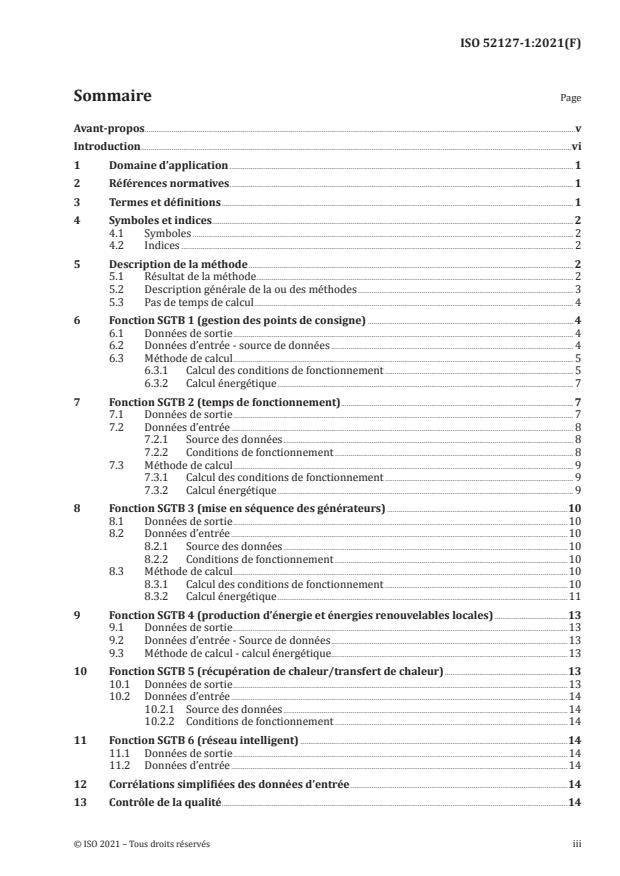

ISO 52127-1:2021 - Performance énergétique des bâtiments -- Système de gestion technique des bâtiments

ISO 52127-1:2021 - Performance énergétique des bâtiments — Système de gestion technique des bâtiments — Partie 1: Module M10-12/25/2021
Overview
ISO 52127-1:2021 - "Energy performance of buildings - Building management system - Part 1: Module M10-12" defines the operational framework and functional requirements for Building Management Systems (BMS) that influence building energy performance. The standard specifies operational activities, alarming, fault detection and diagnostics (FDD), reporting, monitoring, energy management functions, functional interlocks and optimizations required to set and maintain energy performance of buildings. It is part of the EPB (energy performance of buildings) set of standards and supports international harmonization of BMS contributions to energy assessments.
Key topics and technical requirements
ISO 52127-1 organizes BMS functionality into discrete modules and specifies inputs, outputs and calculation procedures rather than prescriptive device-level controls. Major technical topics covered include:
- BMS function definitions such as management of setpoints, runtime management, sequencing of generators, local energy production and renewable integration, heat recovery/heat shifting, and smart grid interaction.
- Data requirements: required input and output data, data sources and operating conditions for each BMS function.
- Calculation procedures: operating-conditions calculation steps and energy calculation methods described at the module level (sections on calculation time steps are included).
- Alarming and FDD: specifications for overall alarming, fault detection and diagnostics to support timely corrective actions.
- Reporting & monitoring: templates and requirements for performance reporting and continuous monitoring to track energy performance.
- Quality control and compliance checks: guidance on quality assurance, verification and conformity assessment for BMS-related energy impacts.
Note: ISO 52127-1 interfaces with the EPB modular structure (M1–M9 for system calculations); it avoids duplicating energy calculations already defined in those modules and instead provides identifiers and interaction methods.
Practical applications and who uses it
ISO 52127-1 is intended for professionals and organizations involved in building energy performance and automation, including:
- BMS designers and integrators implementing energy-management functions, FDD and smart-grid interaction.
- Energy managers and facility managers using standardized monitoring, reporting and alarm data to optimize operations.
- Building engineers and consultants documenting BMS contribution to energy performance assessments.
- Regulators and certifiers applying EPB standards and assessing compliance with directives such as the EU EPBD (supported by the EPB set).
Practical benefits include improved fault detection, systematic reporting for energy optimization, better integration of renewables and storage, and consistent inputs for building energy performance calculations.
Related standards
- ISO 52000-1:2017 - Overarching EPB assessment framework
- ISO 52120-1 - Contribution of building automation and controls (related module definitions)
- ISO 7345:2018 - Thermal performance - physical quantities and definitions
- ISO/TR 52127-2 - Technical report accompanying ISO 52127 series
Keywords: ISO 52127-1, building management system, BMS, energy performance of buildings, fault detection and diagnostics, energy management, EPB standards, M10-12.
Relations
- Effective Date
- 25-Aug-2026
- Effective Date
- 12-Feb-2026
Buy Documents
ISO 52127-1:2021 - Energy performance of buildings -- Building management system
ISO 52127-1:2021 - Energy performance of buildings — Building management system — Part 1: Module M10-12/2/2021
ISO 52127-1:2021 - Performance énergétique des bâtiments -- Système de gestion technique des bâtiments
ISO 52127-1:2021 - Performance énergétique des bâtiments — Système de gestion technique des bâtiments — Partie 1: Module M10-12/25/2021
Get Certified
Connect with accredited certification bodies for this standard

DIBt (Deutsches Institut für Bautechnik)
German Institute for Building Technology.
DIN CERTCO
DIN Group product certification.

Aboma Certification B.V.
Specialized in construction, metal, and transport sectors.
Sponsored listings
Frequently Asked Questions
ISO 52127-1:2021 is a standard published by the International Organization for Standardization (ISO). Its full title is "Energy performance of buildings — Building management system — Part 1: Module M10-12". This standard covers: This document specifies operational activities, overall alarming, fault detection and diagnostics, reporting, monitoring, energy management functions, functional interlocks and optimizations to set and maintain energy performance of buildings.
This document specifies operational activities, overall alarming, fault detection and diagnostics, reporting, monitoring, energy management functions, functional interlocks and optimizations to set and maintain energy performance of buildings.
ISO 52127-1:2021 is classified under the following ICS (International Classification for Standards) categories: 91.120.10 - Thermal insulation of buildings. The ICS classification helps identify the subject area and facilitates finding related standards.
ISO 52127-1:2021 has the following relationships with other standards: It is inter standard links to CEN ISO/TR 52127-2:2021, EN ISO 52127-1:2021. Understanding these relationships helps ensure you are using the most current and applicable version of the standard.
ISO 52127-1:2021 is available in PDF format for immediate download after purchase. The document can be added to your cart and obtained through the secure checkout process. Digital delivery ensures instant access to the complete standard document.
Standards Content (Sample)
INTERNATIONAL ISO
STANDARD 52127-1
First edition
2021-02
Energy performance of buildings —
Building management system —
Part 1:
Module M10-12
Performance énergétique des bâtiments — Système de gestion
technique des bâtiments —
Partie 1: Module M10-12
Reference number
©
ISO 2021
© ISO 2021
All rights reserved. Unless otherwise specified, or required in the context of its implementation, no part of this publication may
be reproduced or utilized otherwise in any form or by any means, electronic or mechanical, including photocopying, or posting
on the internet or an intranet, without prior written permission. Permission can be requested from either ISO at the address
below or ISO’s member body in the country of the requester.
ISO copyright office
CP 401 • Ch. de Blandonnet 8
CH-1214 Vernier, Geneva
Phone: +41 22 749 01 11
Email: copyright@iso.org
Website: www.iso.org
Published in Switzerland
ii © ISO 2021 – All rights reserved
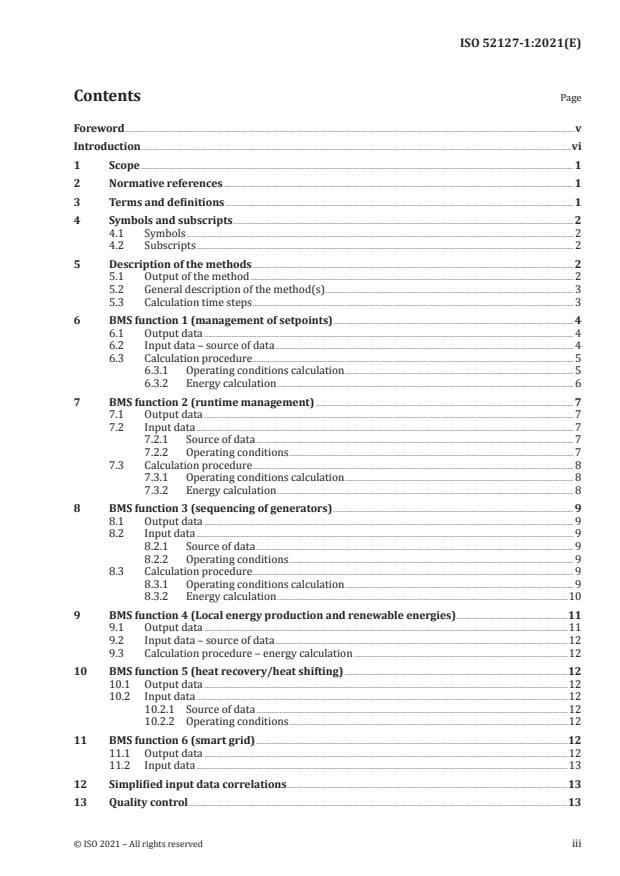
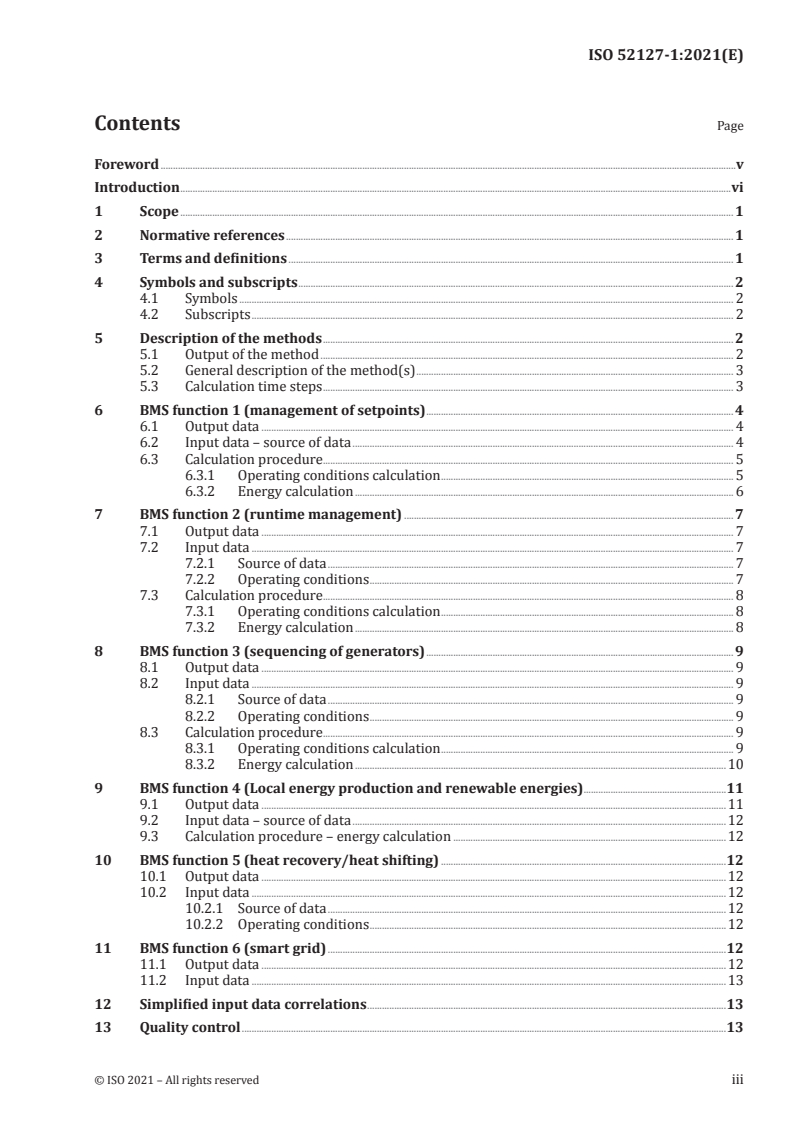
Contents Page
Foreword .v
Introduction .vi
1 Scope . 1
2 Normative references . 1
3 Terms and definitions . 1
4 Symbols and subscripts . 2
4.1 Symbols . 2
4.2 Subscripts . 2
5 Description of the methods . 2
5.1 Output of the method . 2
5.2 General description of the method(s) . 3
5.3 Calculation time steps . 3
6 BMS function 1 (management of setpoints) . 4
6.1 Output data . 4
6.2 Input data – source of data . 4
6.3 Calculation procedure . 5
6.3.1 Operating conditions calculation . 5
6.3.2 Energy calculation . 6
7 BMS function 2 (runtime management) . 7
7.1 Output data . 7
7.2 Input data . 7
7.2.1 Source of data . 7
7.2.2 Operating conditions . 7
7.3 Calculation procedure . 8
7.3.1 Operating conditions calculation . 8
7.3.2 Energy calculation . 8
8 BMS function 3 (sequencing of generators) . 9
8.1 Output data . 9
8.2 Input data . 9
8.2.1 Source of data . 9
8.2.2 Operating conditions . 9
8.3 Calculation procedure . 9
8.3.1 Operating conditions calculation . 9
8.3.2 Energy calculation .10
9 BMS function 4 (Local energy production and renewable energies) .11
9.1 Output data .11
9.2 Input data – source of data .12
9.3 Calculation procedure – energy calculation .12
10 BMS function 5 (heat recovery/heat shifting) .12
10.1 Output data .12
10.2 Input data .12
10.2.1 Source of data .12
10.2.2 Operating conditions .12
11 BMS function 6 (smart grid) .12
11.1 Output data .12
11.2 Input data .13
12 Simplified input data correlations .13
13 Quality control .13
14 Compliance check .13
Annex A (informative) Short description of BMS main functions .14
Bibliography .15
iv © ISO 2021 – All rights reserved
Foreword
ISO (the International Organization for Standardization) is a worldwide federation of national standards
bodies (ISO member bodies). The work of preparing International Standards is normally carried out
through ISO technical committees. Each member body interested in a subject for which a technical
committee has been established has the right to be represented on that committee. International
organizations, governmental and non-governmental, in liaison with ISO, also take part in the work.
ISO collaborates closely with the International Electrotechnical Commission (IEC) on all matters of
electrotechnical standardization.
The procedures used to develop this document and those intended for its further maintenance are
described in the ISO/IEC Directives, Part 1. In particular, the different approval criteria needed for the
different types of ISO documents should be noted. This document was drafted in accordance with the
editorial rules of the ISO/IEC Directives, Part 2 (see www .iso .org/ directives).
Attention is drawn to the possibility that some of the elements of this document may be the subject of
patent rights. ISO shall not be held responsible for identifying any or all such patent rights. Details of
any patent rights identified during the development of the document will be in the Introduction and/or
on the ISO list of patent declarations received (see www .iso .org/ patents).
Any trade name used in this document is information given for the convenience of users and does not
constitute an endorsement.
For an explanation of the voluntary nature of standards, the meaning of ISO specific terms and
expressions related to conformity assessment, as well as information about ISO's adherence to the
World Trade Organization (WTO) principles in the Technical Barriers to Trade (TBT) see www .iso .org/
iso/ foreword .html.
This document was prepared by Technical Committee ISO/TC 205, Building environment design, in
collaboration with the European Committee for Standardization (CEN) Technical Committee CEN/
TC 247, Building Automation, Controls and Building Management, in accordance with the Agreement on
technical cooperation between ISO and CEN (Vienna Agreement).
A list of all parts in the ISO 52127 series can be found on the ISO website.
Any feedback or questions on this document should be directed to the user’s national standards body. A
complete listing of these bodies can be found at www .iso .org/ members .html.
Introduction
This document is part of a series of standards aiming at international harmonization of the methodology
for the assessment of the energy performance of buildings called “EPB set of standards”.
As part of the “EPB set of standards”, it complies with the requirements for the set of basic EPB
documents ISO 52000-1 (see Normative references), CEN/TS 16628 and CEN/TS 16629 (see References
[4] and [5]) developed under a mandate given to CEN by the European Commission and the European
Free Trade Association (Mandate M/480), and supports essential requirements of EU Directive
2010/31/EU on the energy performance of buildings (EPBD).
This document is clearly identified in the modular structure developed to ensure a transparent and
coherent EPB standard set in ISO 52000-1. BAC (building automation and control) is identified in the
modular structure as technical building system M10. However, other standards issued by ISO TC 205
deal with control accuracy, control functions and control strategies using standards communications
protocol (these last standards do not belong to the EPB standards set).
To avoid a duplication of calculation due to the BAC (avoid double impact), no calculations are done in
BAC EPB standard set, but in each underlying standard of EPB set of standards (from M1 to M9 in the
modular structure), an identifier, developed and presented in the M10 covered by ISO 52120-1, is used
where appropriate. The way of interaction is described in detail in ISO/TR 52000-2 accompanying the
over-arching standard. As a consequence, the Annex A and Annex B concept as Excel sheets with the
calculation formulas used in the EPB standards are not applicable for this document.
The main target groups of this document are all the users of the set of EPB standards (e.g. architects,
engineers, regulators).
Further target groups are parties wanting to motivate their assumptions by classifying the building
energy performance for a dedicated building stock.
[3]
More information is provided in ISO/TR 52127-2 , the Technical Report accompanying this document.
Table 1 shows the relative position of this document within the set of EPB standards in the context of
the modular structure as set out in ISO 52000-1.
NOTE 1 In ISO/TR 52000-2 the same table can be found, with, for each module, the numbers of the relevant
EPB standards and accompanying Technical Reports that are published or in preparation.
NOTE 2 The modules represent EPB standards, although one EPB standard can cover more than one module
and one module can be covered by more than one EPB standard, for instance a simplified and a detailed method
respectively.
vi © ISO 2021 – All rights reserved
Table 1 — Position of this document (in casu M10–12), within the modular structure of the set of EPB standards
Over-arch- Building Technical building system
ing (as such)
Building au-
Sub Ventila- Humidifi- Dehumidi- Domestic PV,
Descriptions Descriptions Descriptions Heating Cooling Lighting tomation and
module tion cation fication hot waters wind…
control
sub1 M1 M2 M3 M4 M5 M6 M7 M8 M9 M10 M11
1 General General General
Common
terms and
definitions; Building en-
2 Needs
symbols, ergy needs
units and
subscripts
(Free)
Maximum
Indoor con-
3 Application load and
ditions with-
power
out systems
Ways to ex- Ways to ex- Ways to ex-
4 press energy press energy press energy
performance performance performance
Building
Heat transfer
functions Emission
5 by transmis-
and building and control
sion
boundaries
Building oc- Heat transfer
cupancy and by infiltra- Distribution
operating tion and and control
conditions ventilation
Aggregation
of energy
Internal heat Storage and
7 services
gains control
and energy
carriers
Building par- Solar heat Generation
titioning gains and control
NOTE The shaded modules are not applicable.
viii © ISO 2021 – All rights reserved
Table 1 (continued)
Over-arch- Building Technical building system
ing (as such)
Building au-
Sub Ventila- Humidifi- Dehumidi- Domestic PV,
Descriptions Descriptions Descriptions Heating Cooling Lighting tomation and
module tion cation fication hot waters wind…
control
sub1 M1 M2 M3 M4 M5 M6 M7 M8 M9 M10 M11
Load dis-
Calculated Building dy-
patching and
9 energy per- namics (ther-
operating
formance mal mass)
conditions
Measured Measured Measured
10 energy per- energy per- energy per-
formance formance formance
11 Inspection Inspection Inspection
Ways to ex-
12 press indoor BMS x
comfort
External
13 environment
conditions
Economic
a
calculation
NOTE The shaded modules are not applicable.
INTERNATIONAL STANDARD ISO 52127-1:2021(E)
Energy performance of buildings — Building management
system —
Part 1:
Module M10-12
1 Scope
This document specifies operational activities, overall alarming, fault detection and diagnostics,
reporting, monitoring, energy management functions, functional interlocks and optimizations to set
and maintain energy performance of buildings.
2 Normative references
The following documents are referred to in the text in such a way that some or all of their content
constitutes requirements of this document. For dated references, only the edition cited applies. For
undated references, the latest edition of the referenced document (including any amendments) applies.
ISO 52000-1:2017, Energy performance of buildings — Overarching EPB assessment — Part 1: General
framework and procedures
ISO 7345:2018, Thermal performance of buildings and building components — Physical quantities and
definitions
1)
ISO 52120-1:— , Energy performance of buildings — Contribution of building automation and controls
and building management — Part 1: Modules M10-4,5,6,7,8,9,10
3 Terms and definitions
For the purposes of this document, the terms and definitions given in ISO 7345 and ISO 52000-1 and the
following apply.
ISO and IEC maintain terminological databases for use in standardization at the following addresses:
— ISO Online browsing platform: available at https:// www .iso .org/ obp
— IEC Electropedia: available at http:// www .electropedia .org/
3.1
building management system
BMS
products, software, and engineering services for automatic controls (including interlocks), monitoring
and optimization, human intervention, and management to achieve energy-efficient, economical, and
safe operation of building services equipment
Note 1 to entry: Building services is divided in technical, infrastructural and financial building services and
energy management is part of technical building management (3.2).
Note 2 to entry: Building energy management system is part of a BMS.
1) Under preparation. Stage at the time of publication ISO/DIS 52120-1:2021.
Note 3 to entry: Building energy management system comprises data collection, logging, alarming, reporting, and
analysis of energy usage, etc. The system is designed to reduce the energy consumption, improve the utilisation,
increase the reliability and predict the performance of the technical building systems, as well as optimize energy
usage and reducing its cost.
3.2
technical building management
process(es) and services related to operation and management of buildings and technical building
system through the interrelationships between the different disciplines and trades
Note 1 to entry: The disciplines and trades comprise all technical building services for the purpose of optimized
maintenance and energy consumption.
EXAMPLE Optimization of buildings through interrelationships ranging from heating, ventilation and air
conditioning (HVAC), to lighting and day lighting, to life safety and security, to electric power systems and energy
monitoring and metering, to services, including communications and maintenance and to management.
4 Symbols and subscripts
4.1 Symbols
For the purposes of this document, the symbols given in ISO 52000-1:2017, Clause 4, Annex C and the
specific symbols listed in Table 2 apply.
Table 2 — Symbols and units
Symbol Quantity Unit
β Load factor -
4.2 Subscripts
For the purposes of this document, the subscript given in ISO 52000-1:2017, Clause 4, Annex C and the
specific subscripts listed in Table 3 apply.
Table 3 — Subscripts
Subscript Term
BMS building management system
boil boiler
cgn cogeneration
cmb combustion
5 Description of the methods
5.1 Output of the method
This method covers the calculation of the building operation data that could be influenced and
optimized by a building management system. Those data are mainly related to:
— setpoint including set back,
— operation times of heating, ventilation, cooling and lighting systems including start-stop
optimisation,
— sequencing of multiple generators,
2 © ISO 2021 – All rights reserved
— building energy management and load management with regard to the utilisation of local renewable
energy and local energy production,
— heat recovery and heat shifting,
— smart grid interactions, demand side management, and peak shaving.
Calculation is, in general, independent from the time step chosen but is according to the time step of
the input.
It is important to be aware that the technical building management (TBM) functions not fully automated
will have an impact on energy performance of the building only if they are not only installed but actively
used, i.e. that actions are taken if monitoring results ask for it.
5.2 General description of the method(s)
This document covers several functions of the application of the building management system. These
functions shall be taken from ISO 52120-1. Each function is represented by at least one calculation method.
2)
This document covers six of the functions described in ISO 52120-1:— , Table 4. This list of capabilities
of controls and BMS functions is not exhaustive. Energy efficiency performance of building depends
on
...
INTERNATIONAL ISO
STANDARD 52127-1
First edition
2021-02
Energy performance of buildings —
Building management system —
Part 1:
Module M10-12
Performance énergétique des bâtiments — Système de gestion
technique des bâtiments —
Partie 1: Module M10-12
Reference number
©
ISO 2021
© ISO 2021
All rights reserved. Unless otherwise specified, or required in the context of its implementation, no part of this publication may
be reproduced or utilized otherwise in any form or by any means, electronic or mechanical, including photocopying, or posting
on the internet or an intranet, without prior written permission. Permission can be requested from either ISO at the address
below or ISO’s member body in the country of the requester.
ISO copyright office
CP 401 • Ch. de Blandonnet 8
CH-1214 Vernier, Geneva
Phone: +41 22 749 01 11
Email: copyright@iso.org
Website: www.iso.org
Published in Switzerland
ii © ISO 2021 – All rights reserved
Contents Page
Foreword .v
Introduction .vi
1 Scope . 1
2 Normative references . 1
3 Terms and definitions . 1
4 Symbols and subscripts . 2
4.1 Symbols . 2
4.2 Subscripts . 2
5 Description of the methods . 2
5.1 Output of the method . 2
5.2 General description of the method(s) . 3
5.3 Calculation time steps . 3
6 BMS function 1 (management of setpoints) . 4
6.1 Output data . 4
6.2 Input data – source of data . 4
6.3 Calculation procedure . 5
6.3.1 Operating conditions calculation . 5
6.3.2 Energy calculation . 6
7 BMS function 2 (runtime management) . 7
7.1 Output data . 7
7.2 Input data . 7
7.2.1 Source of data . 7
7.2.2 Operating conditions . 7
7.3 Calculation procedure . 8
7.3.1 Operating conditions calculation . 8
7.3.2 Energy calculation . 8
8 BMS function 3 (sequencing of generators) . 9
8.1 Output data . 9
8.2 Input data . 9
8.2.1 Source of data . 9
8.2.2 Operating conditions . 9
8.3 Calculation procedure . 9
8.3.1 Operating conditions calculation . 9
8.3.2 Energy calculation .10
9 BMS function 4 (Local energy production and renewable energies) .11
9.1 Output data .11
9.2 Input data – source of data .12
9.3 Calculation procedure – energy calculation .12
10 BMS function 5 (heat recovery/heat shifting) .12
10.1 Output data .12
10.2 Input data .12
10.2.1 Source of data .12
10.2.2 Operating conditions .12
11 BMS function 6 (smart grid) .12
11.1 Output data .12
11.2 Input data .13
12 Simplified input data correlations .13
13 Quality control .13
14 Compliance check .13
Annex A (informative) Short description of BMS main functions .14
Bibliography .15
iv © ISO 2021 – All rights reserved
Foreword
ISO (the International Organization for Standardization) is a worldwide federation of national standards
bodies (ISO member bodies). The work of preparing International Standards is normally carried out
through ISO technical committees. Each member body interested in a subject for which a technical
committee has been established has the right to be represented on that committee. International
organizations, governmental and non-governmental, in liaison with ISO, also take part in the work.
ISO collaborates closely with the International Electrotechnical Commission (IEC) on all matters of
electrotechnical standardization.
The procedures used to develop this document and those intended for its further maintenance are
described in the ISO/IEC Directives, Part 1. In particular, the different approval criteria needed for the
different types of ISO documents should be noted. This document was drafted in accordance with the
editorial rules of the ISO/IEC Directives, Part 2 (see www .iso .org/ directives).
Attention is drawn to the possibility that some of the elements of this document may be the subject of
patent rights. ISO shall not be held responsible for identifying any or all such patent rights. Details of
any patent rights identified during the development of the document will be in the Introduction and/or
on the ISO list of patent declarations received (see www .iso .org/ patents).
Any trade name used in this document is information given for the convenience of users and does not
constitute an endorsement.
For an explanation of the voluntary nature of standards, the meaning of ISO specific terms and
expressions related to conformity assessment, as well as information about ISO's adherence to the
World Trade Organization (WTO) principles in the Technical Barriers to Trade (TBT) see www .iso .org/
iso/ foreword .html.
This document was prepared by Technical Committee ISO/TC 205, Building environment design, in
collaboration with the European Committee for Standardization (CEN) Technical Committee CEN/
TC 247, Building Automation, Controls and Building Management, in accordance with the Agreement on
technical cooperation between ISO and CEN (Vienna Agreement).
A list of all parts in the ISO 52127 series can be found on the ISO website.
Any feedback or questions on this document should be directed to the user’s national standards body. A
complete listing of these bodies can be found at www .iso .org/ members .html.
Introduction
This document is part of a series of standards aiming at international harmonization of the methodology
for the assessment of the energy performance of buildings called “EPB set of standards”.
As part of the “EPB set of standards”, it complies with the requirements for the set of basic EPB
documents ISO 52000-1 (see Normative references), CEN/TS 16628 and CEN/TS 16629 (see References
[4] and [5]) developed under a mandate given to CEN by the European Commission and the European
Free Trade Association (Mandate M/480), and supports essential requirements of EU Directive
2010/31/EU on the energy performance of buildings (EPBD).
This document is clearly identified in the modular structure developed to ensure a transparent and
coherent EPB standard set in ISO 52000-1. BAC (building automation and control) is identified in the
modular structure as technical building system M10. However, other standards issued by ISO TC 205
deal with control accuracy, control functions and control strategies using standards communications
protocol (these last standards do not belong to the EPB standards set).
To avoid a duplication of calculation due to the BAC (avoid double impact), no calculations are done in
BAC EPB standard set, but in each underlying standard of EPB set of standards (from M1 to M9 in the
modular structure), an identifier, developed and presented in the M10 covered by ISO 52120-1, is used
where appropriate. The way of interaction is described in detail in ISO/TR 52000-2 accompanying the
over-arching standard. As a consequence, the Annex A and Annex B concept as Excel sheets with the
calculation formulas used in the EPB standards are not applicable for this document.
The main target groups of this document are all the users of the set of EPB standards (e.g. architects,
engineers, regulators).
Further target groups are parties wanting to motivate their assumptions by classifying the building
energy performance for a dedicated building stock.
[3]
More information is provided in ISO/TR 52127-2 , the Technical Report accompanying this document.
Table 1 shows the relative position of this document within the set of EPB standards in the context of
the modular structure as set out in ISO 52000-1.
NOTE 1 In ISO/TR 52000-2 the same table can be found, with, for each module, the numbers of the relevant
EPB standards and accompanying Technical Reports that are published or in preparation.
NOTE 2 The modules represent EPB standards, although one EPB standard can cover more than one module
and one module can be covered by more than one EPB standard, for instance a simplified and a detailed method
respectively.
vi © ISO 2021 – All rights reserved
Table 1 — Position of this document (in casu M10–12), within the modular structure of the set of EPB standards
Over-arch- Building Technical building system
ing (as such)
Building au-
Sub Ventila- Humidifi- Dehumidi- Domestic PV,
Descriptions Descriptions Descriptions Heating Cooling Lighting tomation and
module tion cation fication hot waters wind…
control
sub1 M1 M2 M3 M4 M5 M6 M7 M8 M9 M10 M11
1 General General General
Common
terms and
definitions; Building en-
2 Needs
symbols, ergy needs
units and
subscripts
(Free)
Maximum
Indoor con-
3 Application load and
ditions with-
power
out systems
Ways to ex- Ways to ex- Ways to ex-
4 press energy press energy press energy
performance performance performance
Building
Heat transfer
functions Emission
5 by transmis-
and building and control
sion
boundaries
Building oc- Heat transfer
cupancy and by infiltra- Distribution
operating tion and and control
conditions ventilation
Aggregation
of energy
Internal heat Storage and
7 services
gains control
and energy
carriers
Building par- Solar heat Generation
titioning gains and control
NOTE The shaded modules are not applicable.
viii © ISO 2021 – All rights reserved
Table 1 (continued)
Over-arch- Building Technical building system
ing (as such)
Building au-
Sub Ventila- Humidifi- Dehumidi- Domestic PV,
Descriptions Descriptions Descriptions Heating Cooling Lighting tomation and
module tion cation fication hot waters wind…
control
sub1 M1 M2 M3 M4 M5 M6 M7 M8 M9 M10 M11
Load dis-
Calculated Building dy-
patching and
9 energy per- namics (ther-
operating
formance mal mass)
conditions
Measured Measured Measured
10 energy per- energy per- energy per-
formance formance formance
11 Inspection Inspection Inspection
Ways to ex-
12 press indoor BMS x
comfort
External
13 environment
conditions
Economic
a
calculation
NOTE The shaded modules are not applicable.
INTERNATIONAL STANDARD ISO 52127-1:2021(E)
Energy performance of buildings — Building management
system —
Part 1:
Module M10-12
1 Scope
This document specifies operational activities, overall alarming, fault detection and diagnostics,
reporting, monitoring, energy management functions, functional interlocks and optimizations to set
and maintain energy performance of buildings.
2 Normative references
The following documents are referred to in the text in such a way that some or all of their content
constitutes requirements of this document. For dated references, only the edition cited applies. For
undated references, the latest edition of the referenced document (including any amendments) applies.
ISO 52000-1:2017, Energy performance of buildings — Overarching EPB assessment — Part 1: General
framework and procedures
ISO 7345:2018, Thermal performance of buildings and building components — Physical quantities and
definitions
1)
ISO 52120-1:— , Energy performance of buildings — Contribution of building automation and controls
and building management — Part 1: Modules M10-4,5,6,7,8,9,10
3 Terms and definitions
For the purposes of this document, the terms and definitions given in ISO 7345 and ISO 52000-1 and the
following apply.
ISO and IEC maintain terminological databases for use in standardization at the following addresses:
— ISO Online browsing platform: available at https:// www .iso .org/ obp
— IEC Electropedia: available at http:// www .electropedia .org/
3.1
building management system
BMS
products, software, and engineering services for automatic controls (including interlocks), monitoring
and optimization, human intervention, and management to achieve energy-efficient, economical, and
safe operation of building services equipment
Note 1 to entry: Building services is divided in technical, infrastructural and financial building services and
energy management is part of technical building management (3.2).
Note 2 to entry: Building energy management system is part of a BMS.
1) Under preparation. Stage at the time of publication ISO/DIS 52120-1:2021.
Note 3 to entry: Building energy management system comprises data collection, logging, alarming, reporting, and
analysis of energy usage, etc. The system is designed to reduce the energy consumption, improve the utilisation,
increase the reliability and predict the performance of the technical building systems, as well as optimize energy
usage and reducing its cost.
3.2
technical building management
process(es) and services related to operation and management of buildings and technical building
system through the interrelationships between the different disciplines and trades
Note 1 to entry: The disciplines and trades comprise all technical building services for the purpose of optimized
maintenance and energy consumption.
EXAMPLE Optimization of buildings through interrelationships ranging from heating, ventilation and air
conditioning (HVAC), to lighting and day lighting, to life safety and security, to electric power systems and energy
monitoring and metering, to services, including communications and maintenance and to management.
4 Symbols and subscripts
4.1 Symbols
For the purposes of this document, the symbols given in ISO 52000-1:2017, Clause 4, Annex C and the
specific symbols listed in Table 2 apply.
Table 2 — Symbols and units
Symbol Quantity Unit
β Load factor -
4.2 Subscripts
For the purposes of this document, the subscript given in ISO 52000-1:2017, Clause 4, Annex C and the
specific subscripts listed in Table 3 apply.
Table 3 — Subscripts
Subscript Term
BMS building management system
boil boiler
cgn cogeneration
cmb combustion
5 Description of the methods
5.1 Output of the method
This method covers the calculation of the building operation data that could be influenced and
optimized by a building management system. Those data are mainly related to:
— setpoint including set back,
— operation times of heating, ventilation, cooling and lighting systems including start-stop
optimisation,
— sequencing of multiple generators,
2 © ISO 2021 – All rights reserved
— building energy management and load management with regard to the utilisation of local renewable
energy and local energy production,
— heat recovery and heat shifting,
— smart grid interactions, demand side management, and peak shaving.
Calculation is, in general, independent from the time step chosen but is according to the time step of
the input.
It is important to be aware that the technical building management (TBM) functions not fully automated
will have an impact on energy performance of the building only if they are not only installed but actively
used, i.e. that actions are taken if monitoring results ask for it.
5.2 General description of the method(s)
This document covers several functions of the application of the building management system. These
functions shall be taken from ISO 52120-1. Each function is represented by at least one calculation method.
2)
This document covers six of the functions described in ISO 52120-1:— , Table 4. This list of capabilities
of controls and BMS functions is not exhaustive. Energy efficiency performance of building depends
on
...
NORME ISO
INTERNATIONALE 52127-1
Première édition
2021-02
Performance énergétique des
bâtiments — Système de gestion
technique des bâtiments —
Partie 1:
Module M10-12
Energy performance of buildings — Building management system —
Part 1: Module M10-12
Numéro de référence
©
ISO 2021
DOCUMENT PROTÉGÉ PAR COPYRIGHT
© ISO 2021
Tous droits réservés. Sauf prescription différente ou nécessité dans le contexte de sa mise en œuvre, aucune partie de cette
publication ne peut être reproduite ni utilisée sous quelque forme que ce soit et par aucun procédé, électronique ou mécanique,
y compris la photocopie, ou la diffusion sur l’internet ou sur un intranet, sans autorisation écrite préalable. Une autorisation peut
être demandée à l’ISO à l’adresse ci-après ou au comité membre de l’ISO dans le pays du demandeur.
ISO copyright office
Case postale 401 • Ch. de Blandonnet 8
CH-1214 Vernier, Genève
Tél.: +41 22 749 01 11
E-mail: copyright@iso.org
Web: www.iso.org
Publié en Suisse
ii © ISO 2021 – Tous droits réservés
Sommaire Page
Avant-propos .v
Introduction .vi
1 Domaine d’application . 1
2 Références normatives . 1
3 Termes et définitions . 1
4 Symboles et indices. 2
4.1 Symboles . 2
4.2 Indices . 2
5 Description de la méthode . 2
5.1 Résultat de la méthode . . 2
5.2 Description générale de la ou des méthodes . 3
5.3 Pas de temps de calcul . 4
6 Fonction SGTB 1 (gestion des points de consigne) . 4
6.1 Données de sortie . 4
6.2 Données d’entrée - source de données . 4
6.3 Méthode de calcul . 5
6.3.1 Calcul des conditions de fonctionnement . 5
6.3.2 Calcul énergétique . 7
7 Fonction SGTB 2 (temps de fonctionnement) . 7
7.1 Données de sortie . 7
7.2 Données d’entrée . 8
7.2.1 Source des données . 8
7.2.2 Conditions de fonctionnement . 8
7.3 Méthode de calcul . 9
7.3.1 Calcul des conditions de fonctionnement . 9
7.3.2 Calcul énergétique . 9
8 Fonction SGTB 3 (mise en séquence des générateurs) .10
8.1 Données de sortie .10
8.2 Données d’entrée .10
8.2.1 Source des données .10
8.2.2 Conditions de fonctionnement .10
8.3 Méthode de calcul .10
8.3.1 Calcul des conditions de fonctionnement .10
8.3.2 Calcul énergétique .11
9 Fonction SGTB 4 (production d’énergie et énergies renouvelables locales) .13
9.1 Données de sortie .13
9.2 Données d’entrée - Source de données .13
9.3 Méthode de calcul - calcul énergétique . .13
10 Fonction SGTB 5 (récupération de chaleur/transfert de chaleur) .13
10.1 Données de sortie .13
10.2 Données d’entrée .14
10.2.1 Source des données .14
10.2.2 Conditions de fonctionnement .14
11 Fonction SGTB 6 (réseau intelligent) .14
11.1 Données de sortie .14
11.2 Données d’entrée .14
12 Corrélations simplifiées des données d’entrée .14
13 Contrôle de la qualité .14
14 Contrôle de la conformité .14
Annexe A (informative) Description succincte des principales fonctions SGTB .15
Bibliographie .16
iv © ISO 2021 – Tous droits réservés
Avant-propos
L'ISO (Organisation internationale de normalisation) est une fédération mondiale d'organismes
nationaux de normalisation (comités membres de l'ISO). L'élaboration des Normes internationales est
en général confiée aux comités techniques de l'ISO. Chaque comité membre intéressé par une étude
a le droit de faire partie du comité technique créé à cet effet. Les organisations internationales,
gouvernementales et non gouvernementales, en liaison avec l'ISO participent également aux travaux.
L'ISO collabore étroitement avec la Commission électrotechnique internationale (IEC) en ce qui
concerne la normalisation électrotechnique.
Les procédures utilisées pour élaborer le présent document et celles destinées à sa mise à jour sont
décrites dans les Directives ISO/IEC, Partie 1. Il convient, en particulier, de prendre note des différents
critères d'approbation requis pour les différents types de documents ISO. Le présent document a été
rédigé conformément aux règles de rédaction données dans les Directives ISO/IEC, Partie 2 (voir www
.iso .org/ directives).
L'attention est attirée sur le fait que certains des éléments du présent document peuvent faire l'objet de
droits de propriété intellectuelle ou de droits analogues. L'ISO ne saurait être tenue pour responsable
de ne pas avoir identifié de tels droits de propriété et averti de leur existence. Les détails concernant
les références aux droits de propriété intellectuelle ou autres droits analogues identifiés lors de
l'élaboration du document sont indiqués dans l'Introduction et/ou dans la liste des déclarations de
brevets reçues par l'ISO (voir www .iso .org/ brevets).
Les appellations commerciales éventuellement mentionnées dans le présent document sont données
pour information, par souci de commodité, à l’intention des utilisateurs et ne sauraient constituer un
engagement.
Pour une explication de la nature volontaire des normes, la signification des termes et expressions
spécifiques de l'ISO liés à l'évaluation de la conformité, ou pour toute information au sujet de l'adhésion
de l'ISO aux principes de l’Organisation mondiale du commerce (OMC) concernant les obstacles
techniques au commerce (OTC), voir www .iso .org/ avant -propos.
Le présent document a été élaboré par le comité technique ISO/TC 205 Conception de l’environnement
intérieur des bâtiments, en collaboration avec le comité technique CEN/TC 247, Automatisation,
régulation et gestion technique du bâtiment, du Comité européen de normalisation (CEN) conformément
à l’Accord de coopération technique entre l’ISO et le CEN (Accord de Vienne).
Une liste de toutes les parties de la série ISO 52127 se trouve sur le site web de l’ISO.
Il convient que l’utilisateur adresse tout retour d’information ou toute question concernant le présent
document à l’organisme national de normalisation de son pays. Une liste exhaustive desdits organismes
se trouve à l’adresse www .iso .org/ fr/ members .html.
Introduction
Le présent document fait partie d’une série de normes visant à l’harmonisation internationale de la
méthodologie pour l’évaluation de la performance énergétique des bâtiments (PEB), désignée «série de
normes PEB».
Dans le cadre de la «série de normes PEB», elle se conforme aux exigences de l’ensemble des
documents PEB de base ISO 52000-1 (voir Références normatives), CEN/TS 16628 et CEN/TS 16629
(voir Bibliographie, références [4] et [5]) élaborés dans le cadre d’un mandat donné au CEN par la
Commission Européenne et l’Association Européenne de Libre Échange (Mandat M/480) et vient à
l’appui des exigences essentielles de la Directive UE 2010/31/CE sur la performance énergétique des
bâtiments (DPEB).
Le présent document est clairement identifié dans la structure modulaire élaborée afin de garantir
la transparence et la cohérence de la série de normes PEB dans l’ISO 52000-1. L’automatisation et
la régulation des bâtiments (BAC) sont identifiées dans la structure modulaire en tant que système
technique de bâtiment M10. Toutefois, d’autres normes publiées par l'ISO/TC 205 traitent de la précision
de la régulation ainsi que des fonctions et des stratégies de régulation qui emploient des protocoles de
communication normalisés (les normes qui régissent ces protocoles n’appartiennent pas à la série de
normes PEB).
Pour éviter que la BAC entraîne des calculs inutiles (double impact), aucun calcul n’est effectué dans la
série de normes PEB BAC. En revanche, dans chacune des normes sous-jacentes de la série de normes
PEB (de M1 à M9 dans la structure modulaire), un identifiant, développé et présent dans le M10 couvert
par l’ISO 52120-1 est utilisé le cas échéant. Cette méthode d’interaction est décrite de manière détaillée
dans le Rapport technique (ISO/TR 52000-2) qui accompagne la norme-cadre. En conséquence, les
Annexes A et B sous forme de feuille EXCEL avec les formules de calcul utilisées dans les normes PEB ne
sont pas applicables au présent document.
Les principaux groupes cibles du présent document sont tous les utilisateurs de l’ensemble des normes
PEB (par exemple architectes, ingénieurs, législateurs).
D’autres groupes cibles sont les acteurs qui désirent justifier leurs propositions en caractérisant la
performance énergétique d’un ensemble de bâtiments spécifiques.
Plus d’informations sont données dans le Rapport technique (TR) qui accompagne le présent document
[1]
(ISO/TR 52127-1 ).
Le Tableau 1 montre la position relative de ce document dans la série de normes PEB dans le contexte
de la structure modulaire telle que définie dans l'ISO 52000‐1.
NOTE 1 Dans l'ISO/TR 52000-2, le même tableau peut être trouvé, avec, pour chaque module, les numéros de
la série de norme EPB et les rapports techniques d'accompagnement qui sont publiés ou en préparation.
NOTE 2 Les modules représentent les normes de la série EPB, bien qu'une norme EPB puisse couvrir plus d'un
module et un module peut être couvert par plus d'une norme de la série EPB, par exemple une méthode simplifiée
et une méthode détaillée respectivement.
vi © ISO 2021 – Tous droits réservés
Tableau 1 — Position du présent document (en l’occurrence M10-12) dans la structure modulaire de l’ensemble de normes PEB
Bâtiment
Cadre Système technique du bâtiment
(en tant que tel)
Automati- Énergie
Eau
Sous- Refroidis- Ventila- Humidifica- Déshumidi- sation et photo-
Descriptions Descriptions Descriptions Chauffage chaude Éclairage
module sement tion tion fication régulation voltaïque,
sanitaire
du bâtiment éolienne.
sous1 M1 M2 M3 M4 M5 M6 M7 M8 M9 M10 M11
1 Généralités Généralités Généralités
Termes et définitions,
Besoins énergé-
2 symboles, unités et Besoins
tiques du bâtiment
indices communs
Conditions inté-
Charge et puissance
3 Application rieures (libres) sans
maximales
systèmes
Manières d’exprimer Manières d’exprimer Manières d’exprimer
4 la performance éner- la performance la performance
gétique énergétique énergétique
Fonctions du bâtiment Transfert thermique Émission et régu-
et limites du bâtiment par transmission lation
Occupation du bâti- Transfert thermique
Distribution et
6 ment et conditions de par infiltration et
régulation
fonctionnement ventilation
Agrégation de services
Apports de chaleur Stockage et régu-
7 énergétiques et vec-
internes lation
teurs énergétiques
Génération et régu-
8 Zonage du bâtiment Apports solaires
lation
Dynamique du Répartition de la
Performance énergé-
9 bâtiment (masse charge et conditions
tique calculée
thermique) de fonctionnement
Performance énergé- Performance énergé- Performance énergé-
tique mesurée tique mesurée tique mesurée
11 Inspection Inspection Inspection
Manières d’exprimer le
12 SGTB x
confort intérieur
Conditions de l’envi-
ronnement extérieur
a
14 Calculs économiques
a
Les modules grisés ne sont pas applicables.
NORME INTERNATIONALE ISO 52127-1:2021(F)
Performance énergétique des bâtiments — Système de
gestion technique des bâtiments —
Partie 1:
Module M10-12
1 Domaine d’application
Le présent document précise les activités opérationnelles, les conditions générales d’activation
d’alarmes, la détection et le diagnostic des défaillances, la génération de rapports, la surveillance,
les fonctions de gestion énergétique, les asservissements fonctionnels et les optimisations pour le
paramétrage afin de mettre en œuvre la performance énergétique des bâtiments.
2 Références normatives
Les documents suivants sont cités dans le texte de sorte qu’ils constituent, pour tout ou partie de leur
contenu, des exigences du présent document. Pour les références datées, seule l’édition citée s’applique.
Pour les références non datées, la dernière édition du document de référence s'applique (y compris les
éventuels amendements).
ISO 52000-1:2017, Performance énergétique des bâtiments — Évaluation cadre PEB — Partie 1: Cadre
général et modes opératoires
ISO 7345:2018, Performance thermique des bâtiments et des matériaux pour le bâtiment — Grandeurs
physiques et définitions
1)
ISO 52120-1:— , Performance énergétique des bâtiments — Contribution de l’automatisation, de la
régulation et de la gestion technique — Partie 1: Cadre général et procédures
3 Termes et définitions
Pour les besoins du présent document, les termes et les définitions de l’ISO 7345 et l’ISO 52000‐1 ainsi
que les suivants s’appliquent.
L’ISO et l’IEC tiennent à jour des bases de données terminologiques destinées à être utilisées en
normalisation, consultables aux adresses suivantes:
— ISO Online browsing platform: disponible à l’adresse https:// www .iso .org/ obp
— IEC Electropedia: disponible à l’adresse http:// www .electropedia .org/
3.1
système de gestion du bâtiment
SGTB
produits, logiciels et services d’ingénierie nécessaires à la régulation automatique (asservissements
compris), à la supervision et à l’optimisation, à l’intervention et à la gestion humaine en vue de
l’exploitation économique et sûre des équipements techniques du bâtiment, pour obtenir une efficacité
énergétique optimale
Note 1 à l'article: Les services du bâtiment sont divisés en services techniques, de gestion des infrastructures et
de gestion financière du bâtiment; la gestion de l’énergie fait partie de la gestion technique du bâtiment (3.2).
1) En préparation. Stade au moment de la publication ISO/DIS 52120-1:2021.
Note 2 à l'article: Le système de maîtrise de l’énergie du bâtiment fait partie d’un système de gestion du bâtiment.
Note 3 à l'article: Le système de maîtrise de l’énergie du bâtiment comprend la collecte des données, l’encodage,
l’activation d’alarmes, le suivi, l’analyse de l’utilisation d’énergie, etc. Le système est conçu de manière à réduire
la consommation d’énergie, à améliorer son utilisation, à augmenter la fiabilité et à prévoir la performance des
systèmes techniques du bâtiment, ainsi qu’à optimiser l’utilisation d’énergie et à réduire son coût.
3.2
gestion technique du bâtiment
processus et services liés à l’exploitation et à la gestion des bâtiments et au système technique du
bâtiment grâce aux relations réciproques entre les différentes disciplines et les différents secteurs
Note 1 à l'article: Les disciplines et les secteurs incluent l’ensemble des services techniques du bâtiment ayant
pour but d’optimiser la maintenance et la consommation d’énergie.
EXEMPLE Optimisation des bâtiments grâce à des relations réciproques entre les systèmes de chauffage, de
ventilation et de climatisation (CVC), d’éclairage artificiel et naturel, de protection des personnes, de sécurité de
distribution d’électricité, de surveillance et de comptage d’énergie, et leurs services y compris les communications
et la maintenance, et leur gestion.
4 Symboles et indices
4.1 Symboles
Pour les besoins du présent document, les symboles fournis dans de l’ISO 52000-1:2017, Article 4 et
Annexe C, ainsi que les symboles spécifiques listés dans le Tableau 2 s’appliquent.
Tableau 2 — Symboles et unités
Symbole Grandeur Unité
β Facteur de charge —
4.2 Indices
Pour les besoins du présent document, les indices fournis dans l’ISO 52000-1:2017, Article 4 et Annexe C,
ainsi que les indices spécifiques listés dans le Tableau 3 s’appliquent.
Tableau 3 — Indices
Indice Terme
SGTB système de gestion du bâtiment
boil chaudière
cgn cogénération
cmb combustion
5 Description de la méthode
5.1 Résultat de la méthode
La présente méthode couvre le calcul des données d’exploitation du bâtiment susceptibles d’être
influencées et optimisées par un système de gestion technique du bâtiment. Les données en question
concernent essentiellement:
— les points de consigne et notamment de réduction;
— les temps de fonctionnement des systèmes de chauffage, de ventilation, de refroidissement et
d’éclairage, y compris l’optimisation d’intermittence;
2 © ISO 2021 – Tous droits réservés
— l’ordre de priorité de multiples générateurs;
— la gestion énergétique du bâtiment et la gestion de charge en relation avec l’utilisation d’énergie
renouvelable locale et la production locale d’énergie;
— la récupération de chaleur et le transfert de chaleur;
— les interactions de réseau intelligent (smart grid), la gestion côté demande et l’effacement.
De manière générale, les calculs sont indépendants du pas de temps choisi mais sont fonction du pas de
temps de l’entrée.
Il est important de porter attention au fait que les fonctions de la gestion technique du bâtilent (GTB)
qui ne sont pas entièrement automatisées n’auront un impact sur la performance énergétique que si
elles sont attentivement utilisées, il ne suffit pas qu’elles soient mises en place.
5.2 Description générale de la ou des méthodes
Le présent document couvre plusieurs fonctions de l’application du système de GTB. Chaque fonction
est représentée par au moins une méthode de calcul. Celles-ci les fonctions doivent être tirées de
l'ISO 52120-1. Chaque fonction est représentée par au moins un calcul méthode.
2)
Le présent document couvre 6 des fonctions décrites dans l’ISO 52120-1:— , Tableau 4. Cette liste
des fonctionnalités qui peuvent être apportées par la régulation et la gestion technique (SGTB) n’est
pas exhaustive. La performance énergétique du bâtiment dépend du choix du contrôle et des fonctions
SGTB associées à la performance attendue (selon la méthodologie décrite dans l’ISO 52000-1), leur
implémentation, leur mise en service et leur exploitation. Les fonctions sont les suivantes:
— la «fonction 1 – points de consigne» est prévue pour la définition de points de consigne et de
réduction. Cette fonction fait référence à la fonction 7.1 de l’ISO 52120‐1:—, Tableau 4;
— la «fonction 2 – temps de fonctionnement» est prévue pour l’estimation des temps de fonctionnement.
Cette fonction fait référence à la fonction 7.2 de l’ISO 52120‐1:—, Tableau 4;
— la «fonction 3 – mise en séquence des générateurs» est prévue pour estimer l’organisation séquentielle
de différents générateurs; Cette fonction fait référence à la fonction 1.9 de l’ISO 52120‐1:—, Tableau 4;
— la «fonction 4 – production énergétique et énergies renouvelables locales» est destinée à la gestion
des sources locales d’énergies renouvelables et aux autres productions locales d’énergie comme la
cogénération (CHP, combined heat and power plant). Cette fonction fait référence à la fonction 7.5 de
l’ISO 52120‐1:—, Tableau 4;
— la «fonction 5 – récupération et transfert de chaleur» est prévue pour le transfert d’énergie thermique
à l’intérieur du bâtiment. Cette fonction fait référence à la fonction 7.6 de l’ISO 52120‐1:—, Tableau 4;
— la «fonction 6 – réseau intelligent» (smart grid) est destinée aux interactions entre le bâtiment et le
réseau intelligent. Cette fonction fait référence à la fonction 7.7 de l’ISO 52120-1:—, Tableau 4.
Toutes les méthodes applicables aux calculs des fonctions précédemment énumérées sont décrites
en détail dans les Articles 6 à 11 qui suivent. En général, les fonctions peuvent être utilisées
indépendamment les unes des autres suivant les éléments du SGTB instal
...
NORME ISO
INTERNATIONALE 52127-1
Première édition
2021-02
Performance énergétique des
bâtiments — Système de gestion
technique des bâtiments —
Partie 1:
Module M10-12
Energy performance of buildings — Building management system —
Part 1: Module M10-12
Numéro de référence
©
ISO 2021
DOCUMENT PROTÉGÉ PAR COPYRIGHT
© ISO 2021
Tous droits réservés. Sauf prescription différente ou nécessité dans le contexte de sa mise en œuvre, aucune partie de cette
publication ne peut être reproduite ni utilisée sous quelque forme que ce soit et par aucun procédé, électronique ou mécanique,
y compris la photocopie, ou la diffusion sur l’internet ou sur un intranet, sans autorisation écrite préalable. Une autorisation peut
être demandée à l’ISO à l’adresse ci-après ou au comité membre de l’ISO dans le pays du demandeur.
ISO copyright office
Case postale 401 • Ch. de Blandonnet 8
CH-1214 Vernier, Genève
Tél.: +41 22 749 01 11
E-mail: copyright@iso.org
Web: www.iso.org
Publié en Suisse
ii © ISO 2021 – Tous droits réservés
Sommaire Page
Avant-propos .v
Introduction .vi
1 Domaine d’application . 1
2 Références normatives . 1
3 Termes et définitions . 1
4 Symboles et indices. 2
4.1 Symboles . 2
4.2 Indices . 2
5 Description de la méthode . 2
5.1 Résultat de la méthode . . 2
5.2 Description générale de la ou des méthodes . 3
5.3 Pas de temps de calcul . 4
6 Fonction SGTB 1 (gestion des points de consigne) . 4
6.1 Données de sortie . 4
6.2 Données d’entrée - source de données . 4
6.3 Méthode de calcul . 5
6.3.1 Calcul des conditions de fonctionnement . 5
6.3.2 Calcul énergétique . 7
7 Fonction SGTB 2 (temps de fonctionnement) . 7
7.1 Données de sortie . 7
7.2 Données d’entrée . 8
7.2.1 Source des données . 8
7.2.2 Conditions de fonctionnement . 8
7.3 Méthode de calcul . 9
7.3.1 Calcul des conditions de fonctionnement . 9
7.3.2 Calcul énergétique . 9
8 Fonction SGTB 3 (mise en séquence des générateurs) .10
8.1 Données de sortie .10
8.2 Données d’entrée .10
8.2.1 Source des données .10
8.2.2 Conditions de fonctionnement .10
8.3 Méthode de calcul .10
8.3.1 Calcul des conditions de fonctionnement .10
8.3.2 Calcul énergétique .11
9 Fonction SGTB 4 (production d’énergie et énergies renouvelables locales) .13
9.1 Données de sortie .13
9.2 Données d’entrée - Source de données .13
9.3 Méthode de calcul - calcul énergétique . .13
10 Fonction SGTB 5 (récupération de chaleur/transfert de chaleur) .13
10.1 Données de sortie .13
10.2 Données d’entrée .14
10.2.1 Source des données .14
10.2.2 Conditions de fonctionnement .14
11 Fonction SGTB 6 (réseau intelligent) .14
11.1 Données de sortie .14
11.2 Données d’entrée .14
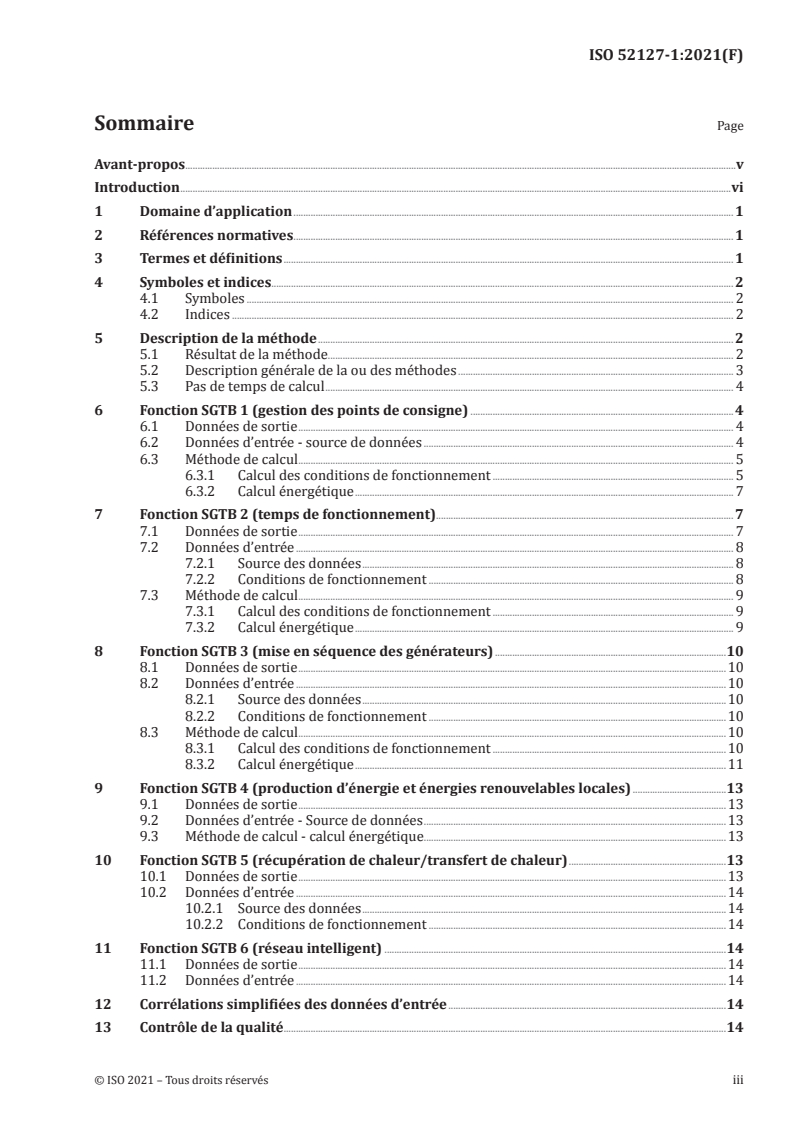
12 Corrélations simplifiées des données d’entrée .14
13 Contrôle de la qualité .14
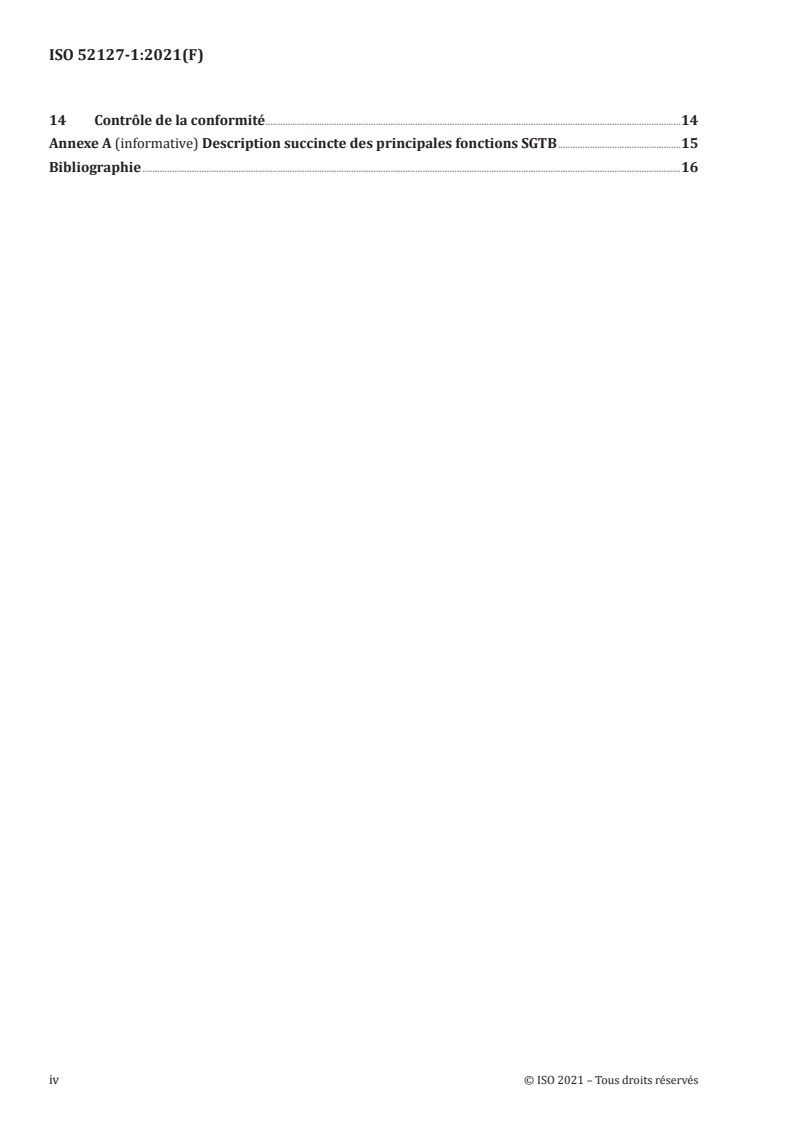
14 Contrôle de la conformité .14
Annexe A (informative) Description succincte des principales fonctions SGTB .15
Bibliographie .16
iv © ISO 2021 – Tous droits réservés
Avant-propos
L'ISO (Organisation internationale de normalisation) est une fédération mondiale d'organismes
nationaux de normalisation (comités membres de l'ISO). L'élaboration des Normes internationales est
en général confiée aux comités techniques de l'ISO. Chaque comité membre intéressé par une étude
a le droit de faire partie du comité technique créé à cet effet. Les organisations internationales,
gouvernementales et non gouvernementales, en liaison avec l'ISO participent également aux travaux.
L'ISO collabore étroitement avec la Commission électrotechnique internationale (IEC) en ce qui
concerne la normalisation électrotechnique.
Les procédures utilisées pour élaborer le présent document et celles destinées à sa mise à jour sont
décrites dans les Directives ISO/IEC, Partie 1. Il convient, en particulier, de prendre note des différents
critères d'approbation requis pour les différents types de documents ISO. Le présent document a été
rédigé conformément aux règles de rédaction données dans les Directives ISO/IEC, Partie 2 (voir www
.iso .org/ directives).
L'attention est attirée sur le fait que certains des éléments du présent document peuvent faire l'objet de
droits de propriété intellectuelle ou de droits analogues. L'ISO ne saurait être tenue pour responsable
de ne pas avoir identifié de tels droits de propriété et averti de leur existence. Les détails concernant
les références aux droits de propriété intellectuelle ou autres droits analogues identifiés lors de
l'élaboration du document sont indiqués dans l'Introduction et/ou dans la liste des déclarations de
brevets reçues par l'ISO (voir www .iso .org/ brevets).
Les appellations commerciales éventuellement mentionnées dans le présent document sont données
pour information, par souci de commodité, à l’intention des utilisateurs et ne sauraient constituer un
engagement.
Pour une explication de la nature volontaire des normes, la signification des termes et expressions
spécifiques de l'ISO liés à l'évaluation de la conformité, ou pour toute information au sujet de l'adhésion
de l'ISO aux principes de l’Organisation mondiale du commerce (OMC) concernant les obstacles
techniques au commerce (OTC), voir www .iso .org/ avant -propos.
Le présent document a été élaboré par le comité technique ISO/TC 205 Conception de l’environnement
intérieur des bâtiments, en collaboration avec le comité technique CEN/TC 247, Automatisation,
régulation et gestion technique du bâtiment, du Comité européen de normalisation (CEN) conformément
à l’Accord de coopération technique entre l’ISO et le CEN (Accord de Vienne).
Une liste de toutes les parties de la série ISO 52127 se trouve sur le site web de l’ISO.
Il convient que l’utilisateur adresse tout retour d’information ou toute question concernant le présent
document à l’organisme national de normalisation de son pays. Une liste exhaustive desdits organismes
se trouve à l’adresse www .iso .org/ fr/ members .html.
Introduction
Le présent document fait partie d’une série de normes visant à l’harmonisation internationale de la
méthodologie pour l’évaluation de la performance énergétique des bâtiments (PEB), désignée «série de
normes PEB».
Dans le cadre de la «série de normes PEB», elle se conforme aux exigences de l’ensemble des
documents PEB de base ISO 52000-1 (voir Références normatives), CEN/TS 16628 et CEN/TS 16629
(voir Bibliographie, références [4] et [5]) élaborés dans le cadre d’un mandat donné au CEN par la
Commission Européenne et l’Association Européenne de Libre Échange (Mandat M/480) et vient à
l’appui des exigences essentielles de la Directive UE 2010/31/CE sur la performance énergétique des
bâtiments (DPEB).
Le présent document est clairement identifié dans la structure modulaire élaborée afin de garantir
la transparence et la cohérence de la série de normes PEB dans l’ISO 52000-1. L’automatisation et
la régulation des bâtiments (BAC) sont identifiées dans la structure modulaire en tant que système
technique de bâtiment M10. Toutefois, d’autres normes publiées par l'ISO/TC 205 traitent de la précision
de la régulation ainsi que des fonctions et des stratégies de régulation qui emploient des protocoles de
communication normalisés (les normes qui régissent ces protocoles n’appartiennent pas à la série de
normes PEB).
Pour éviter que la BAC entraîne des calculs inutiles (double impact), aucun calcul n’est effectué dans la
série de normes PEB BAC. En revanche, dans chacune des normes sous-jacentes de la série de normes
PEB (de M1 à M9 dans la structure modulaire), un identifiant, développé et présent dans le M10 couvert
par l’ISO 52120-1 est utilisé le cas échéant. Cette méthode d’interaction est décrite de manière détaillée
dans le Rapport technique (ISO/TR 52000-2) qui accompagne la norme-cadre. En conséquence, les
Annexes A et B sous forme de feuille EXCEL avec les formules de calcul utilisées dans les normes PEB ne
sont pas applicables au présent document.
Les principaux groupes cibles du présent document sont tous les utilisateurs de l’ensemble des normes
PEB (par exemple architectes, ingénieurs, législateurs).
D’autres groupes cibles sont les acteurs qui désirent justifier leurs propositions en caractérisant la
performance énergétique d’un ensemble de bâtiments spécifiques.
Plus d’informations sont données dans le Rapport technique (TR) qui accompagne le présent document
[1]
(ISO/TR 52127-1 ).
Le Tableau 1 montre la position relative de ce document dans la série de normes PEB dans le contexte
de la structure modulaire telle que définie dans l'ISO 52000‐1.
NOTE 1 Dans l'ISO/TR 52000-2, le même tableau peut être trouvé, avec, pour chaque module, les numéros de
la série de norme EPB et les rapports techniques d'accompagnement qui sont publiés ou en préparation.
NOTE 2 Les modules représentent les normes de la série EPB, bien qu'une norme EPB puisse couvrir plus d'un
module et un module peut être couvert par plus d'une norme de la série EPB, par exemple une méthode simplifiée
et une méthode détaillée respectivement.
vi © ISO 2021 – Tous droits réservés
Tableau 1 — Position du présent document (en l’occurrence M10-12) dans la structure modulaire de l’ensemble de normes PEB
Bâtiment
Cadre Système technique du bâtiment
(en tant que tel)
Automati- Énergie
Eau
Sous- Refroidis- Ventila- Humidifica- Déshumidi- sation et photo-
Descriptions Descriptions Descriptions Chauffage chaude Éclairage
module sement tion tion fication régulation voltaïque,
sanitaire
du bâtiment éolienne.
sous1 M1 M2 M3 M4 M5 M6 M7 M8 M9 M10 M11
1 Généralités Généralités Généralités
Termes et définitions,
Besoins énergé-
2 symboles, unités et Besoins
tiques du bâtiment
indices communs
Conditions inté-
Charge et puissance
3 Application rieures (libres) sans
maximales
systèmes
Manières d’exprimer Manières d’exprimer Manières d’exprimer
4 la performance éner- la performance la performance
gétique énergétique énergétique
Fonctions du bâtiment Transfert thermique Émission et régu-
et limites du bâtiment par transmission lation
Occupation du bâti- Transfert thermique
Distribution et
6 ment et conditions de par infiltration et
régulation
fonctionnement ventilation
Agrégation de services
Apports de chaleur Stockage et régu-
7 énergétiques et vec-
internes lation
teurs énergétiques
Génération et régu-
8 Zonage du bâtiment Apports solaires
lation
Dynamique du Répartition de la
Performance énergé-
9 bâtiment (masse charge et conditions
tique calculée
thermique) de fonctionnement
Performance énergé- Performance énergé- Performance énergé-
tique mesurée tique mesurée tique mesurée
11 Inspection Inspection Inspection
Manières d’exprimer le
12 SGTB x
confort intérieur
Conditions de l’envi-
ronnement extérieur
a
14 Calculs économiques
a
Les modules grisés ne sont pas applicables.
NORME INTERNATIONALE ISO 52127-1:2021(F)
Performance énergétique des bâtiments — Système de
gestion technique des bâtiments —
Partie 1:
Module M10-12
1 Domaine d’application
Le présent document précise les activités opérationnelles, les conditions générales d’activation
d’alarmes, la détection et le diagnostic des défaillances, la génération de rapports, la surveillance,
les fonctions de gestion énergétique, les asservissements fonctionnels et les optimisations pour le
paramétrage afin de mettre en œuvre la performance énergétique des bâtiments.
2 Références normatives
Les documents suivants sont cités dans le texte de sorte qu’ils constituent, pour tout ou partie de leur
contenu, des exigences du présent document. Pour les références datées, seule l’édition citée s’applique.
Pour les références non datées, la dernière édition du document de référence s'applique (y compris les
éventuels amendements).
ISO 52000-1:2017, Performance énergétique des bâtiments — Évaluation cadre PEB — Partie 1: Cadre
général et modes opératoires
ISO 7345:2018, Performance thermique des bâtiments et des matériaux pour le bâtiment — Grandeurs
physiques et définitions
1)
ISO 52120-1:— , Performance énergétique des bâtiments — Contribution de l’automatisation, de la
régulation et de la gestion technique — Partie 1: Cadre général et procédures
3 Termes et définitions
Pour les besoins du présent document, les termes et les définitions de l’ISO 7345 et l’ISO 52000‐1 ainsi
que les suivants s’appliquent.
L’ISO et l’IEC tiennent à jour des bases de données terminologiques destinées à être utilisées en
normalisation, consultables aux adresses suivantes:
— ISO Online browsing platform: disponible à l’adresse https:// www .iso .org/ obp
— IEC Electropedia: disponible à l’adresse http:// www .electropedia .org/
3.1
système de gestion du bâtiment
SGTB
produits, logiciels et services d’ingénierie nécessaires à la régulation automatique (asservissements
compris), à la supervision et à l’optimisation, à l’intervention et à la gestion humaine en vue de
l’exploitation économique et sûre des équipements techniques du bâtiment, pour obtenir une efficacité
énergétique optimale
Note 1 à l'article: Les services du bâtiment sont divisés en services techniques, de gestion des infrastructures et
de gestion financière du bâtiment; la gestion de l’énergie fait partie de la gestion technique du bâtiment (3.2).
1) En préparation. Stade au moment de la publication ISO/DIS 52120-1:2021.
Note 2 à l'article: Le système de maîtrise de l’énergie du bâtiment fait partie d’un système de gestion du bâtiment.
Note 3 à l'article: Le système de maîtrise de l’énergie du bâtiment comprend la collecte des données, l’encodage,
l’activation d’alarmes, le suivi, l’analyse de l’utilisation d’énergie, etc. Le système est conçu de manière à réduire
la consommation d’énergie, à améliorer son utilisation, à augmenter la fiabilité et à prévoir la performance des
systèmes techniques du bâtiment, ainsi qu’à optimiser l’utilisation d’énergie et à réduire son coût.
3.2
gestion technique du bâtiment
processus et services liés à l’exploitation et à la gestion des bâtiments et au système technique du
bâtiment grâce aux relations réciproques entre les différentes disciplines et les différents secteurs
Note 1 à l'article: Les disciplines et les secteurs incluent l’ensemble des services techniques du bâtiment ayant
pour but d’optimiser la maintenance et la consommation d’énergie.
EXEMPLE Optimisation des bâtiments grâce à des relations réciproques entre les systèmes de chauffage, de
ventilation et de climatisation (CVC), d’éclairage artificiel et naturel, de protection des personnes, de sécurité de
distribution d’électricité, de surveillance et de comptage d’énergie, et leurs services y compris les communications
et la maintenance, et leur gestion.
4 Symboles et indices
4.1 Symboles
Pour les besoins du présent document, les symboles fournis dans de l’ISO 52000-1:2017, Article 4 et
Annexe C, ainsi que les symboles spécifiques listés dans le Tableau 2 s’appliquent.
Tableau 2 — Symboles et unités
Symbole Grandeur Unité
β Facteur de charge —
4.2 Indices
Pour les besoins du présent document, les indices fournis dans l’ISO 52000-1:2017, Article 4 et Annexe C,
ainsi que les indices spécifiques listés dans le Tableau 3 s’appliquent.
Tableau 3 — Indices
Indice Terme
SGTB système de gestion du bâtiment
boil chaudière
cgn cogénération
cmb combustion
5 Description de la méthode
5.1 Résultat de la méthode
La présente méthode couvre le calcul des données d’exploitation du bâtiment susceptibles d’être
influencées et optimisées par un système de gestion technique du bâtiment. Les données en question
concernent essentiellement:
— les points de consigne et notamment de réduction;
— les temps de fonctionnement des systèmes de chauffage, de ventilation, de refroidissement et
d’éclairage, y compris l’optimisation d’intermittence;
2 © ISO 2021 – Tous droits réservés
— l’ordre de priorité de multiples générateurs;
— la gestion énergétique du bâtiment et la gestion de charge en relation avec l’utilisation d’énergie
renouvelable locale et la production locale d’énergie;
— la récupération de chaleur et le transfert de chaleur;
— les interactions de réseau intelligent (smart grid), la gestion côté demande et l’effacement.
De manière générale, les calculs sont indépendants du pas de temps choisi mais sont fonction du pas de
temps de l’entrée.
Il est important de porter attention au fait que les fonctions de la gestion technique du bâtilent (GTB)
qui ne sont pas entièrement automatisées n’auront un impact sur la performance énergétique que si
elles sont attentivement utilisées, il ne suffit pas qu’elles soient mises en place.
5.2 Description générale de la ou des méthodes
Le présent document couvre plusieurs fonctions de l’application du système de GTB. Chaque fonction
est représentée par au moins une méthode de calcul. Celles-ci les fonctions doivent être tirées de
l'ISO 52120-1. Chaque fonction est représentée par au moins un calcul méthode.
2)
Le présent document couvre 6 des fonctions décrites dans l’ISO 52120-1:— , Tableau 4. Cette liste
des fonctionnalités qui peuvent être apportées par la régulation et la gestion technique (SGTB) n’est
pas exhaustive. La performance énergétique du bâtiment dépend du choix du contrôle et des fonctions
SGTB associées à la performance attendue (selon la méthodologie décrite dans l’ISO 52000-1), leur
implémentation, leur mise en service et leur exploitation. Les fonctions sont les suivantes:
— la «fonction 1 – points de consigne» est prévue pour la définition de points de consigne et de
réduction. Cette fonction fait référence à la fonction 7.1 de l’ISO 52120‐1:—, Tableau 4;
— la «fonction 2 – temps de fonctionnement» est prévue pour l’estimation des temps de fonctionnement.
Cette fonction fait référence à la fonction 7.2 de l’ISO 52120‐1:—, Tableau 4;
— la «fonction 3 – mise en séquence des générateurs» est prévue pour estimer l’organisation séquentielle
de différents générateurs; Cette fonction fait référence à la fonction 1.9 de l’ISO 52120‐1:—, Tableau 4;
— la «fonction 4 – production énergétique et énergies renouvelables locales» est destinée à la gestion
des sources locales d’énergies renouvelables et aux autres productions locales d’énergie comme la
cogénération (CHP, combined heat and power plant). Cette fonction fait référence à la fonction 7.5 de
l’ISO 52120‐1:—, Tableau 4;
— la «fonction 5 – récupération et transfert de chaleur» est prévue pour le transfert d’énergie thermique
à l’intérieur du bâtiment. Cette fonction fait référence à la fonction 7.6 de l’ISO 52120‐1:—, Tableau 4;
— la «fonction 6 – réseau intelligent» (smart grid) est destinée aux interactions entre le bâtiment et le
réseau intelligent. Cette fonction fait référence à la fonction 7.7 de l’ISO 52120-1:—, Tableau 4.
Toutes les méthodes applicables aux calculs des fonctions précédemment énumérées sont décrites
en détail dans les Articles 6 à 11 qui suivent. En général, les fonctions peuvent être utilisées
indépendamment les unes des autres suivant les éléments du SGTB instal
...