


ISO 185:2020
(Main)Grey cast irons - Classification
Grey cast irons - Classification
1 Scope This document specifies the properties of unalloyed and low-alloyed grey cast irons used for castings that have been manufactured in sand moulds or in moulds with comparable thermal behaviour. This document specifies the characterizing properties of grey cast irons by any of the following: a) the tensile strength of cast samples; b) if agreed by the manufacturer and the purchaser, the tensile strength of samples cut from a casting; c) if agreed between the manufacturer and the purchaser, the hardness of the material determined on castings or on a cast-on knob. If agreed by the manufacturer and the purchaser, the combination of tensile strength from option a) or option b) and plus hardness from option c) can be specified. Information on specifying a combination of tensile strength and hardness is given in Annex B. This document specifies eight grades of grey cast iron according to tensile strength (see Table 1) and six grades of grey cast iron according to Brinell hardness (see Table 2). This document does not apply to grey cast irons used for pipes and pipe fittings and continuous cast products. This document does not cover technical delivery conditions for grey iron castings. NOTE General information on the engineering properties of grey cast irons is provided in ISO/TR 10809-1.
Fontes à graphite lamellaire — Classification
General Information
- Status
- Published
- Publication Date
- 28-May-2020
- Technical Committee
- ISO/TC 25 - Cast irons and pig irons
- Drafting Committee
- ISO/TC 25 - Cast irons and pig irons
- Current Stage
- 9093 - International Standard confirmed
- Start Date
- 17-Oct-2025
- Completion Date
- 13-Dec-2025
Relations
- Effective Date
- 23-Apr-2020
Overview
ISO 185:2020 - Grey cast irons - Classification provides an international classification system for unalloyed and low-alloy grey cast irons used for castings produced in sand moulds or moulds with comparable thermal behaviour. The standard defines how grey cast irons can be characterized by tensile strength, Brinell hardness, or an agreed combination of both, and specifies grade groupings (eight grades by tensile strength; six grades by Brinell hardness). It excludes grey irons for pipes, pipe fittings and continuously cast products, and it does not itself set technical delivery conditions.
Key technical topics and requirements
- Characterizing properties: Material can be specified by
- tensile strength of standardized cast samples;
- tensile strength of samples cut from a casting (if agreed);
- Brinell hardness measured on castings or a cast-on knob (if agreed);
- or an agreed combination of tensile and hardness measures (see Annex B).
- Grade classification: Eight tensile-strength grades and six Brinell-hardness grades (specified for relevant wall-thickness ranges).
- Wall-thickness dependence: Tensile properties depend on relevant wall thickness and mould thermal behaviour; standardized 30 mm test bars are commonly used for quality control.
- Sampling and test methods: Sampling types (separately cast, side-by-side, cast-on, samples cut from casting) and testing requirements are defined; referenced test methods include ISO 6892-1 (tensile testing) and ISO 6506-1 (Brinell hardness).
- Manufacturer/purchaser agreements: Order must specify the designation and any special agreements (test method, sample location, relevant wall thickness). Manufacturing method and chemical composition are generally at the manufacturer’s discretion unless otherwise agreed.
- Informative annexes: Annex A (additional mechanical/physical properties), Annex B (hardness–tensile relationship), Annex C (tensile/hardness vs wall thickness) and Annex D (cross‑references to other standards).
Practical applications and users
ISO 185:2020 is used by:
- Foundries and materials engineers to classify and verify grey iron grades during production and QA.
- Design engineers and casting designers specifying material properties for components such as engine blocks, brake discs, machine beds and exhaust manifolds (properties like damping, thermal capacity and fatigue are relevant).
- Quality control and metallurgical laboratories conducting tensile and Brinell hardness tests and interpreting results against grade requirements.
- Procurement and specification writers who must define unambiguous order information (designation, relevant wall thickness, test options).
Related standards (referenced)
- ISO 945-1 - Microstructure of cast irons (graphite classification)
- ISO 6892-1 - Tensile testing at room temperature
- ISO 6506-1 - Brinell hardness test
- ISO/TR 10809-1 - General engineering properties of grey cast irons
Keywords: ISO 185:2020, grey cast iron classification, tensile strength, Brinell hardness, grey iron castings, sand moulds, graphite structure, casting standards.
Frequently Asked Questions
ISO 185:2020 is a standard published by the International Organization for Standardization (ISO). Its full title is "Grey cast irons - Classification". This standard covers: 1 Scope This document specifies the properties of unalloyed and low-alloyed grey cast irons used for castings that have been manufactured in sand moulds or in moulds with comparable thermal behaviour. This document specifies the characterizing properties of grey cast irons by any of the following: a) the tensile strength of cast samples; b) if agreed by the manufacturer and the purchaser, the tensile strength of samples cut from a casting; c) if agreed between the manufacturer and the purchaser, the hardness of the material determined on castings or on a cast-on knob. If agreed by the manufacturer and the purchaser, the combination of tensile strength from option a) or option b) and plus hardness from option c) can be specified. Information on specifying a combination of tensile strength and hardness is given in Annex B. This document specifies eight grades of grey cast iron according to tensile strength (see Table 1) and six grades of grey cast iron according to Brinell hardness (see Table 2). This document does not apply to grey cast irons used for pipes and pipe fittings and continuous cast products. This document does not cover technical delivery conditions for grey iron castings. NOTE General information on the engineering properties of grey cast irons is provided in ISO/TR 10809-1.
1 Scope This document specifies the properties of unalloyed and low-alloyed grey cast irons used for castings that have been manufactured in sand moulds or in moulds with comparable thermal behaviour. This document specifies the characterizing properties of grey cast irons by any of the following: a) the tensile strength of cast samples; b) if agreed by the manufacturer and the purchaser, the tensile strength of samples cut from a casting; c) if agreed between the manufacturer and the purchaser, the hardness of the material determined on castings or on a cast-on knob. If agreed by the manufacturer and the purchaser, the combination of tensile strength from option a) or option b) and plus hardness from option c) can be specified. Information on specifying a combination of tensile strength and hardness is given in Annex B. This document specifies eight grades of grey cast iron according to tensile strength (see Table 1) and six grades of grey cast iron according to Brinell hardness (see Table 2). This document does not apply to grey cast irons used for pipes and pipe fittings and continuous cast products. This document does not cover technical delivery conditions for grey iron castings. NOTE General information on the engineering properties of grey cast irons is provided in ISO/TR 10809-1.
ISO 185:2020 is classified under the following ICS (International Classification for Standards) categories: 77.080.10 - Irons. The ICS classification helps identify the subject area and facilitates finding related standards.
ISO 185:2020 has the following relationships with other standards: It is inter standard links to ISO 185:2019. Understanding these relationships helps ensure you are using the most current and applicable version of the standard.
You can purchase ISO 185:2020 directly from iTeh Standards. The document is available in PDF format and is delivered instantly after payment. Add the standard to your cart and complete the secure checkout process. iTeh Standards is an authorized distributor of ISO standards.
Standards Content (Sample)
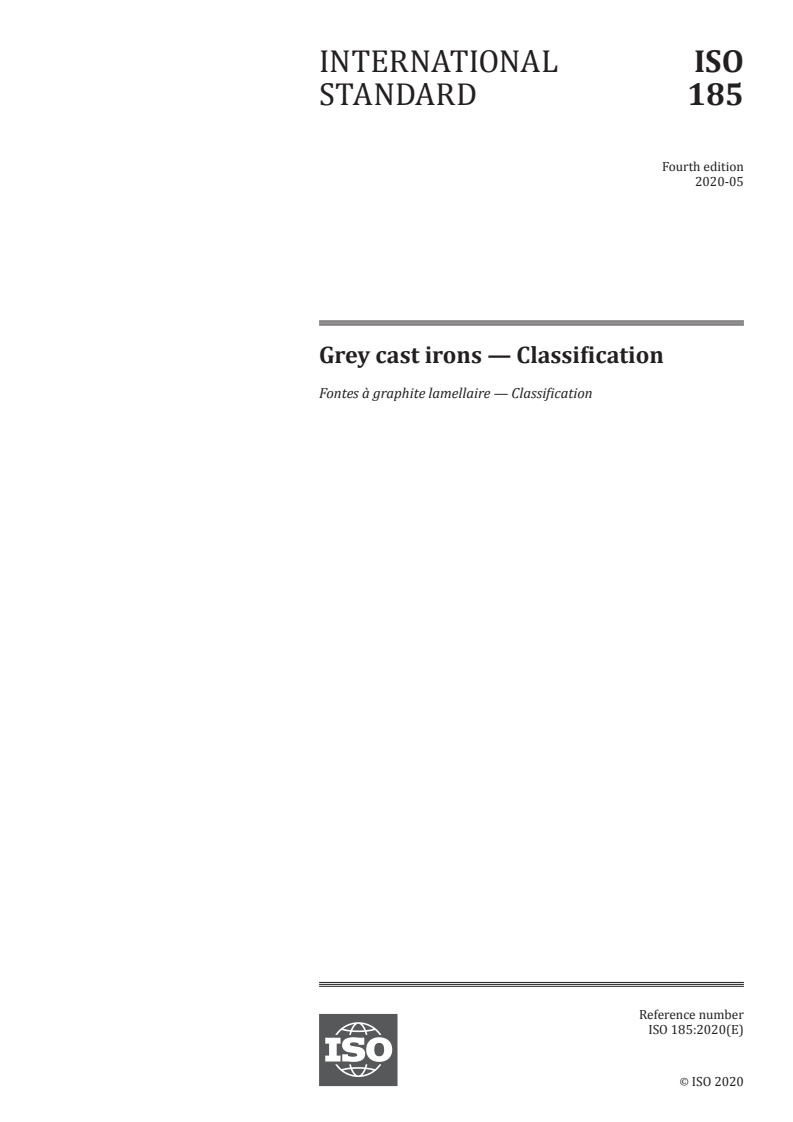
INTERNATIONAL ISO
STANDARD 185
Fourth edition
2020-05
Grey cast irons — Classification
Fontes à graphite lamellaire — Classification
Reference number
©
ISO 2020
© ISO 2020
All rights reserved. Unless otherwise specified, or required in the context of its implementation, no part of this publication may
be reproduced or utilized otherwise in any form or by any means, electronic or mechanical, including photocopying, or posting
on the internet or an intranet, without prior written permission. Permission can be requested from either ISO at the address
below or ISO’s member body in the country of the requester.
ISO copyright office
CP 401 • Ch. de Blandonnet 8
CH-1214 Vernier, Geneva
Phone: +41 22 749 01 11
Fax: +41 22 749 09 47
Email: copyright@iso.org
Website: www.iso.org
Published in Switzerland
ii © ISO 2020 – All rights reserved
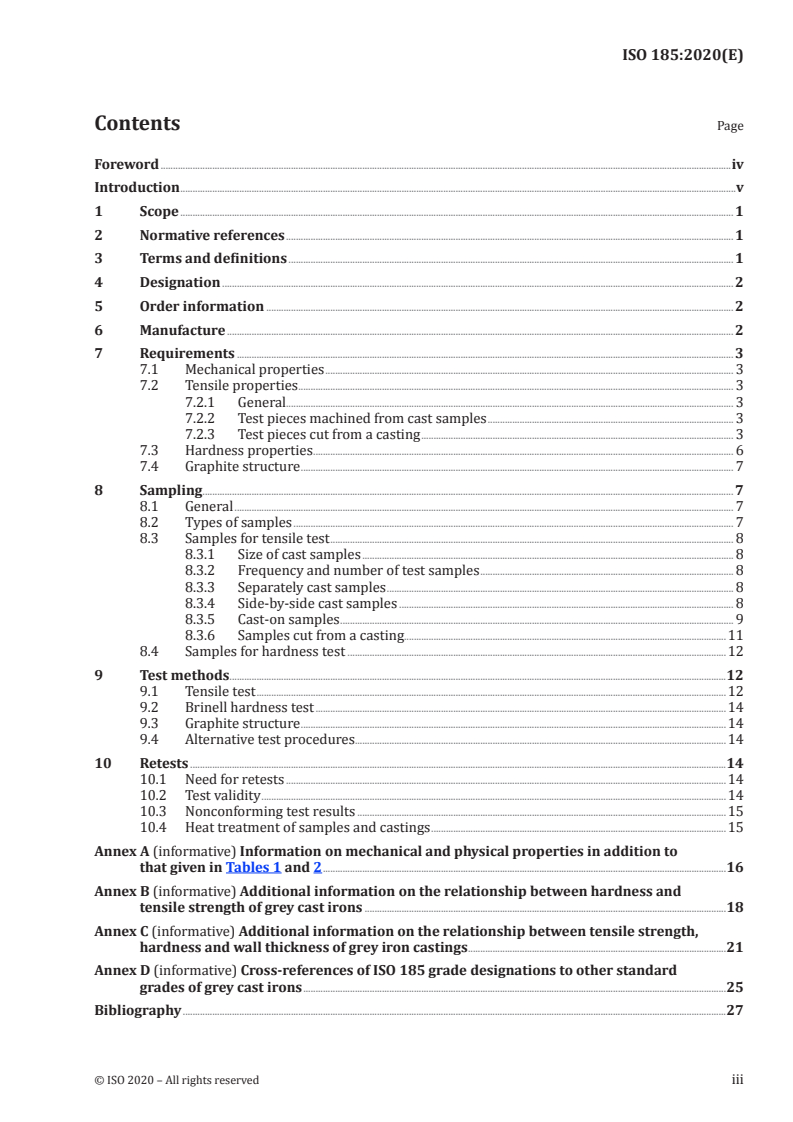
Contents Page
Foreword .iv
Introduction .v
1 Scope . 1
2 Normative references . 1
3 Terms and definitions . 1
4 Designation . 2
5 Order information . 2
6 Manufacture . 2
7 Requirements . 3
7.1 Mechanical properties . 3
7.2 Tensile properties . 3
7.2.1 General. 3
7.2.2 Test pieces machined from cast samples . 3
7.2.3 Test pieces cut from a casting . 3
7.3 Hardness properties . 6
7.4 Graphite structure . 7
8 Sampling . 7
8.1 General . 7
8.2 Types of samples . 7
8.3 Samples for tensile test . 8
8.3.1 Size of cast samples . 8
8.3.2 Frequency and number of test samples . 8
8.3.3 Separately cast samples . 8
8.3.4 Side-by-side cast samples . 8
8.3.5 Cast-on samples . 9
8.3.6 Samples cut from a casting.11
8.4 Samples for hardness test .12
9 Test methods .12
9.1 Tensile test .12
9.2 Brinell hardness test .14
9.3 Graphite structure .14
9.4 Alternative test procedures.14
10 Retests .14
10.1 Need for retests .14
10.2 Test validity .14
10.3 Nonconforming test results .15
10.4 Heat treatment of samples and castings .15
Annex A (informative) Information on mechanical and physical properties in addition to
that given in Tables 1 and 2 .16
Annex B (informative) Additional information on the relationship between hardness and
tensile strength of grey cast irons .18
Annex C (informative) Additional information on the relationship between tensile strength,
hardness and wall thickness of grey iron castings .21
Annex D (informative) Cross-references of ISO 185 grade designations to other standard
grades of grey cast irons .25
Bibliography .27
Foreword
ISO (the International Organization for Standardization) is a worldwide federation of national standards
bodies (ISO member bodies). The work of preparing International Standards is normally carried out
through ISO technical committees. Each member body interested in a subject for which a technical
committee has been established has the right to be represented on that committee. International
organizations, governmental and non-governmental, in liaison with ISO, also take part in the work.
ISO collaborates closely with the International Electrotechnical Commission (IEC) on all matters of
electrotechnical standardization.
The procedures used to develop this document and those intended for its further maintenance are
described in the ISO/IEC Directives, Part 1. In particular, the different approval criteria needed for the
different types of ISO documents should be noted. This document was drafted in accordance with the
editorial rules of the ISO/IEC Directives, Part 2 (see www .iso .org/ directives).
Attention is drawn to the possibility that some of the elements of this document may be the subject of
patent rights. ISO shall not be held responsible for identifying any or all such patent rights. Details of
any patent rights identified during the development of the document will be in the Introduction and/or
on the ISO list of patent declarations received (see www .iso .org/ patents).
Any trade name used in this document is information given for the convenience of users and does not
constitute an endorsement.
For an explanation of the voluntary nature of standards, the meaning of ISO specific terms and
expressions related to conformity assessment, as well as information about ISO's adherence to the
World Trade Organization (WTO) principles in the Technical Barriers to Trade (TBT), see www .iso .org/
iso/ foreword .html.
This document was prepared by Technical Committee ISO/TC 25, Cast irons and pig irons.
This fourth edition cancels and replaces the third edition (ISO 185:2019), of which it constitutes a minor
revision. The changes to the previous edition are as follows:
— Correction to typographical error for relevant wall thickness of ISO 185/JL/HBW235 in Table 2;
corrected from “4” to “40”. As a result of this change, the year of publication of ISO 185 in Annex D,
Table D.1, column 1, updated from 2019 to 2020 to conform with this new edition.
— Symbols for Brinell hardness and relative hardness updated to H and H , respectively, in B.2 and
B R
Figure B.1.
Any feedback or questions on this document should be directed to the user’s national standards body. A
complete listing of these bodies can be found at www .iso .org/ members .html.
iv © ISO 2020 – All rights reserved
Introduction
This document deals with the classification of grey cast irons, subdivided into two groups:
— materials specified by their tensile strength;
— materials specified by their hardness.
It is also possible to specify grey cast irons by a combination of tensile strength and hardness.
NOTE This document does not cover technical delivery conditions for grey iron castings.
The properties of grey cast iron depend on the form and distribution of the graphite and on the
structure of the matrix.
For many applications, tensile strength and hardness are not the only properties of interest to casting
designers. Other mechanical or physical properties can be decisive for the use of grey iron. For example:
— the thermal capacity and the thermal diffusivity for disc brakes;
— the damping capacity for engine blocks or machine beds;
— the thermocycle fatigue for exhaust manifolds or ingot moulds.
Therefore, Annex A provides additional information of interest to casting designers.
Furthermore:
— Annex B contains additional information on the relationship between hardness and tensile strength;
— Annex C contains additional information on the relationship between tensile strength, hardness
and wall thickness of grey iron castings;
— Annex D provides cross-references of ISO 185 grade designations to other standard grades of grey
cast irons.
INTERNATIONAL STANDARD ISO 185:2020(E)
Grey cast irons — Classification
1 Scope
This document specifies the properties of unalloyed and low-alloyed grey cast irons used for castings
that have been manufactured in sand moulds or in moulds with comparable thermal behaviour.
This document specifies the characterizing properties of grey cast irons by any of the following:
a) the tensile strength of cast samples;
b) if agreed by the manufacturer and the purchaser, the tensile strength of samples cut from a casting;
c) if agreed between the manufacturer and the purchaser, the hardness of the material determined on
castings or on a cast-on knob.
If agreed by the manufacturer and the purchaser, the combination of tensile strength from option a) or
option b) and plus hardness from option c) can be specified. Information on specifying a combination of
tensile strength and hardness is given in Annex B.
This document specifies eight grades of grey cast iron according to tensile strength (see Table 1) and six
grades of grey cast iron according to Brinell hardness (see Table 2).
This document does not apply to grey cast irons used for pipes and pipe fittings and continuous cast
products.
This document does not cover technical delivery conditions for grey iron castings.
NOTE General information on the engineering properties of grey cast irons is provided in ISO/TR 10809-1.
2 Normative references
The following documents are referred to in the text in such a way that some or all of their content
constitutes requirements of this document. For dated references, only the edition cited applies. For
undated references, the latest edition of the referenced document (including any amendments) applies.
ISO 945-1, Microstructure of cast irons — Part 1: Graphite classification by visual analysis
ISO 6506-1, Metallic materials — Brinell hardness test — Part 1: Test method
ISO 6892-1, Metallic materials — Tensile testing — Part 1: Method of test at room temperature
3 Terms and definitions
For the purposes of this document, the following terms and definitions apply.
ISO and IEC maintain terminological databases for use in standardization at the following addresses:
— ISO Online browsing platform: available at https:// www .iso .org/ obp
— IEC Electropedia: available at http:// www .electropedia .org/
3.1
grey cast iron
cast material, iron and carbon based, carbon being present mainly in the form of flake (lamellar)
graphite particles
Note 1 to entry: Grey cast iron is also known as “flake graphite cast iron” and, less commonly, as “lamellar
graphite cast iron”.
Note 2 to entry: Graphite form, distribution and size are specified in ISO 945-1.
3.2
relevant wall thickness
section of the casting, agreed between the manufacturer and the purchaser, to which the determined
mechanical properties apply
3.3
separately cast sample
sample cast in a separate sand mould under representative manufacturing conditions and material
3.4
side-by-side cast sample
sample cast in the mould alongside the casting, with a connected but separate running system
3.5
cast-on sample
sample attached directly to the casting
4 Designation
The material shall be designated as given in either Table 1 or Table 2. The designation system is given
in ISO/TR 15931.
The number in position 3 of the designation in Table 1 is the minimum tensile strength of the grade
as determined by test pieces machined from standardized 30 mm test bars or from cast samples of
corresponding relevant wall thickness.
The number in position 3 of the designation in Table 2 is the maximum Brinell hardness value of the
grade for relevant wall thickness > 40 mm to ≤ 80 mm.
5 Order information
The following information shall be supplied by the purchaser:
a) the complete designation of the material;
b) any special requirements that have to be agreed between the manufacturer and the purchaser.
All agreements between the manufacturer and the purchaser shall be made by the time of acceptance
of the order.
6 Manufacture
Unless otherwise specified by the purchaser, the method of manufacture of grey cast irons, including
their chemical composition, to obtain the specified mechanical properties shall be left to the discretion
of the manufacturer.
The manufacturer shall ensure that the requirements of this document are met for the material grade
specified in the order.
2 © ISO 2020 – All rights reserved
For grey cast irons to be used in special applications, the chemical composition and heat treatment may
be the subject of an agreement between the manufacturer and the purchaser.
7 Requirements
7.1 Mechanical properties
The order shall specify, in an unambiguous manner, whether the characterizing property is tensile
strength determined on cast samples or Brinell hardness determined on the casting, or both tensile
strength and Brinell hardness.
If the order does not specify the characterizing property, then the manufacturer shall characterize the
material according to tensile strength.
7.2 Tensile properties
7.2.1 General
The property values apply to grey cast irons cast in sand moulds or in moulds of comparable thermal
behaviour. Subject to amendments to be agreed upon in the order, the property values may be applied
to castings obtained by alternative methods.
Tensile properties are dependent upon wall thickness as shown in Table 1. For process quality assurance
purposes, standardized 30 mm test bars are commonly used.
NOTE Tensile testing requires sound test pieces in order to guarantee pure uniaxial stress during the test.
7.2.2 Test pieces machined from cast samples
The tensile properties of the eight grades of grey cast iron specified by tensile strength, when
determined in accordance with 9.1 using test pieces machined from cast samples, shall conform to the
requirements specified in Table 1.
7.2.3 Test pieces cut from a casting
If test pieces are to be machined from samples cut from a casting, the manufacturer and the purchaser
shall agree on:
— the locations on a casting where the samples shall be taken;
— the minimum value or the allowable range of values for the tensile properties, when determined in
accordance with 9.1.
NOTE 1 The properties and the structure of castings are not uniform and depend on the complexity of the
castings and their variation in section thickness.
NOTE 2 Tensile properties for test pieces machined from samples cut from a casting are affected not only
by material properties (subject of this document) but also by the local casting soundness (not subject of this
document).
Table 1 — Tensile strength of grey cast irons determined on test pieces machined from cast
samples
Tensile strength
R
Relevant wall
m
thickness
in separately cast samples
t
or side-by-side cast in cast-on samples
Material designation
samples
mm MPa MPa
≥ ≤ ≥ ≤ ≥
ISO 185/JL/100 5 40 100 200 —
2,5 5 —
5 10 —
10 20 —
ISO 185/JL/150 20 40 150 250 125
40 80 110
80 150 100
150 300 90
2,5 5 —
5 10 —
10 20 —
ISO 185/JL/200 20 40 200 300 170
40 80 155
80 150 140
150 300 130
5 10 —
10 20 —
20 40 190
ISO 185/JL/225 225 325
40 80 170
80 150 155
150 300 145
For each grade, the figure in bold indicates the minimum tensile strength to which the material designation of the grade
relates, based on separately cast or side-by-side cast 30 mm test samples.
Minimum and maximum tensile strength values are mandatory for separately cast samples and for side-by-side cast
samples.
Tensile strength values are mandatory for cast-on samples representing the relevant wall thickness, which shall be agreed
by the manufacturer and the purchaser.
For relevant wall thicknesses greater than 300 mm, the manufacturer and the purchaser shall agree on the type and size of
the cast sample and on the minimum required tensile strength value.
If a particular type of sample is to be specified, a “/” is added to the designation, followed by a letter indicating the type
of sample:
/S = separately cast sample or side-by-side cast sample;
/U = cast-on sample;
/C = sample cut from casting.
If tensile strength is specified as a characterizing property, the type of the sample should be stated in the order. If not
stated in the order, the type of sample is left to the discretion of the manufacturer.
For high damping capacity and thermal conductivity, ISO 185/JL/100 is the most suitable material.
For each grade, Brinell hardness decreases with increasing wall thickness.
4 © ISO 2020 – All rights reserved
Table 1 (continued)
Tensile strength
R
Relevant wall
m
thickness
in separately cast samples
t
or side-by-side cast in cast-on samples
Material designation
samples
mm MPa MPa
≥ ≤ ≥ ≤ ≥
5 10 —
10 20 —
20 40 210
ISO 185/JL/250 250 350
40 80 190
80 150 170
150 300 160
10 20 —
20 40 230
ISO 185/JL/275 40 80 275 375 210
80 150 190
150 300 180
10 20 —
20 40 250
ISO 185/JL/300 40 80 300 400 225
80 150 210
150 300 190
10 20 —
20 40 290
ISO 185/JL/350 40 80 350 450 260
80 150 240
150 300 220
For each grade, the figure in bold indicates the minimum tensile strength to which the material designation of the grade
relates, based on separately cast or side-by-side cast 30 mm test samples.
Minimum and maximum tensile strength values are mandatory for separately cast samples and for side-by-side cast
samples.
Tensile strength values are mandatory for cast-on samples representing the relevant wall thickness, which shall be agreed
by the manufacturer and the purchaser.
For relevant wall thicknesses greater than 300 mm, the manufacturer and the purchaser shall agree on the type and size of
the cast sample and on the minimum required tensile strength value.
If a particular type of sample is to be specified, a “/” is added to the designation, followed by a letter indicating the type
of sample:
/S = separately cast sample or side-by-side cast sample;
/U = cast-on sample;
/C = sample cut from casting.
If tensile strength is specified as a characterizing property, the type of the sample should be stated in the order. If not
stated in the order, the type of sample is left to the discretion of the manufacturer.
For high damping capacity and thermal conductivity, ISO 185/JL/100 is the most suitable material.
For each grade, Brinell hardness decreases with increasing wall thickness.
7.3 Hardness properties
Classification of grey iron castings by hardness is applicable principally where machinability or wear
resistance are of importance.
The Brinell hardness values of the six grades of grey cast iron specified by hardness, when determined
in accordance with 9.2, shall conform to the requirements specified in Table 2.
NOTE 1 Brinell hardness stated in HBW means under test conditions of 10/3 000 unless different test
conditions have been specified.
Minimum and maximum Brinell hardness values for the relevant wall thickness specified by the
purchaser shall be mandatory for the castings covered by the order.
If a casting is ordered on the basis of hardness, the relevant wall thickness and the position of the test
shall be agreed.
NOTE 2 For a relevant wall thickness t > 80 mm, grades are not classified by hardness.
If it is not possible to use the Brinell test method in accordance with ISO 6506-1, alternative test
methods may be used, which shall have correlated values with Brinell hardness.
Table 2 — Brinell hardness of castings of grey cast iron
Relevant wall thickness Brinell hardness
t
Material designation
mm HBW
> ≤ ≥ ≤
40 80 — 155
20 40 160
ISO 185/JL/HBW155 10 20 170
5 10 185
2,5 5 210
40 80 100 175
20 40 110 185
ISO 185/JL/HBW175 10 20 125 205
5 10 140 225
2,5 5 170 260
40 80 120 195
20 40 135 210
ISO 185/JL/HBW195
10 20 150 230
5 10 170 260
40 80 145 215
20 40 160 235
ISO 185/JL/HBW215
10 2
...
ISO 185:2020は、砂型または比較的似た熱特性を持つ型で製造された鉄鋳造品に使用される非合金および低合金の灰色鋳鉄の特性を規定しています。この文書では、灰色鋳鉄の特性を次のいずれかで定義しています: a) 鋳造試験片の引張強さ; b) 製造業者と購入者の間で合意された場合、鋳造品から切り出した試験片の引張強さ; c) 製造業者と購入者の間で合意された場合、鋳造品または打ち抜き試験片の硬さ。製造業者と購入者の間で合意された場合、a)またはb)の選択肢の引張強さとc)の選択肢の硬さの組み合わせが指定されることがあります。引張強さと硬さの組み合わせを指定する方法については、付録Bに記載されています。この文書では、引張強さに基づいて8つの灰色鋳鉄の等級(表1参照)およびBrinell硬さに基づいて6つの灰色鋳鉄の等級(表2参照)が定義されています。この文書は、パイプやパイプ継手、連続鋳造製品には適用されません。また、灰色鋳鉄鋳造品の技術的な納品条件については対象としていません。灰色鋳鉄の工学的特性に関する一般的な情報については、ISO/TR 10809-1を参照できます。
ISO 185:2020은 모래 주형이나 유사한 열 행동을 가진 주형에서 생산된 주형주철에 대한 사양을 제공하는 문서입니다. 이 문서는 주형주철의 특성을 다음 중 하나로 정의합니다. a) 주조 샘플의 인장강도; b) 제조자와 구매자 사이에 합의된 경우, 주조로부터 샘플로 절단된 것의 인장강도; c) 제조자와 구매자 사이에 합의된 경우, 주조물이나 주조된 갑구의 경도. 제조자와 구매자가 합의한 경우, a) 또는 b) 옵션의 인장강도와 c) 옵션의 경도의 조합을 지정할 수 있습니다. 인장강도와 경도의 조합을 지정하는 방법에 대한 정보는 부록 B에 제공됩니다. 이 문서는 인장강도에 따라 여덟 개의 주형주철 등급(표 1 참조)과 Brinell 경도에 따라 여섯 개의 주형주철 등급(표 2 참조)을 제시합니다. 이 문서는 파이프, 파이프 부속품, 연속 주조 제품에 사용되는 주형주철에는 적용되지 않습니다. 또한, 이 문서는 주형주철의 기술 납품 조건을 다루지 않습니다. 일반적인 주형주철의 공학적 특성에 대한 일반적인 정보는 ISO/TR 10809-1에 제공됩니다.
記事のタイトル:ISO 185:2020 - グレーキャスト鉄- 分類 記事の内容:1節 本文書では、砂型または同様の熱特性を持つ型で製造された鋳造品に使用される合金化されていないおよび低合金のグレーキャスト鉄の特性を定めています。本文書では、グレーキャスト鉄の特性を次のいずれかで特定します:a)鋳造試料の引張強度、b)製造業者と購入者の合意による、鋳造品から切り抜かれたサンプルの引張強度、c)製造業者と購入者の合意による、鋳造物または鋳造ノブ上で測定された材料の硬度。製造業者と購入者の合意により、a)またはb)からの引張強度とc)からの硬度の組み合わせを指定することもできます。引張強度と硬度の組み合わせを指定する方法についての情報は付録Bに記載されています。本文書では、引張強度に基づいて8つのグレードのグレーキャスト鉄と、ブリネル硬度に基づいて6つのグレードのグレーキャスト鉄を定めています(表1および表2を参照)。本文書は、パイプやパイプ継手、連続鋳造製品に使用されるグレーキャスト鉄には適用されません。また、本文書は、グレーアイアン鋳造品の技術的な納入条件には適用されません。ISO/TR 10809-1には、グレーキャスト鉄のエンジニアリング特性の一般的な情報が提供されています。
ISO 185:2020 is a document that provides specifications for unalloyed and low-alloyed grey cast irons used in sand molds or molds with similar thermal behavior. The document outlines the properties of grey cast irons in terms of tensile strength and hardness. It offers three options for determining the characterizing properties: using the tensile strength of cast samples, the tensile strength of samples taken from a casting if agreed upon by the manufacturer and purchaser, or the hardness of the material determined on castings or a cast-on knob if agreed upon by both parties. The document also includes a method for specifying a combination of tensile strength and hardness. It defines eight grades of grey cast iron based on tensile strength and six grades based on Brinell hardness. The document does not cover grey cast irons used for pipes, pipe fittings, or continuous cast products, and it does not include technical delivery conditions. For general information on the engineering properties of grey cast irons, ISO/TR 10809-1 can be consulted.
기사 제목: ISO 185:2020 - 회색 주철 - 분류 기사 내용: 1 범위 이 문서는 모래 성형 또는 유사한 열 특성을 가진 성형형에서 제조된 주조물에 사용되는 비합금 및 저합금 회색 주철의 특성을 정의한다. 이 문서는 회색 주철의 특성을 다음 중 하나로 정의한다: a) 주조 샘플의 인장 강도; b) 제조업체와 구매자의 합의에 따라 주조물에서 잘라낸 샘플의 인장 강도; c) 제조업체와 구매자의 합의에 따라 주조물이나 주조용 단추의 경도. 제조업체와 구매자의 합의에 따라 a) 또는 b)로부터의 인장 강도와 c)로부터의 경도의 결합을 지정할 수 있다. 인장 강도와 경도의 결합을 지정하는 방법에 대한 정보는 부록 B에 제공된다. 이 문서는 인장 강도에 따라 8개 등급의 회색 주철과 Brinell 경도에 따라 6개 등급의 회색 주철을 정의한다. 이 문서는 파이프와 파이프 부속품 및 연속 주조 제품에 사용되는 회색 주철에는 적용되지 않는다. 또한, 이 문서는 회색 주철 주조물에 대한 기술적 납품 조건을 다루지 않는다. ISO/TR 10809-1에는 회색 주철의 기술 속성에 대한 일반적인 정보가 제공된다.
ISO 185:2020 is a document that outlines the classification of unalloyed and low-alloyed grey cast irons used for castings made in sand moulds or similar thermal behavior moulds. The document specifies the properties of grey cast irons based on their tensile strength, hardness, or a combination of both. It defines eight grades of grey cast iron based on tensile strength and six grades based on Brinell hardness. The document does not apply to grey cast irons used for pipes, pipe fittings, and continuous cast products, nor does it cover technical delivery conditions for grey iron castings. ISO/TR 10809-1 provides additional general information on the engineering properties of grey cast irons.
Questions, Comments and Discussion
Ask us and Technical Secretary will try to provide an answer. You can facilitate discussion about the standard in here.
Loading comments...