

ISO/TR 10809-1:2023
(Main)Cast irons — Part 1: Materials and properties for design
General Information
- Abstract
This document provides information about cast iron materials so that users and designers are in a better position to understand cast iron as a design material in its own right and to correctly specify cast iron for suitable applications. This document suggests what can be achieved, and what is not achievable when cast irons are specified as well as the reasons why. It is not designed to be a textbook of cast iron metallurgy. It is intended to help people to choose the correct material for the right reasons and to also help to obviate the specification or expectation of unrealistic additional requirements, which are unlikely to be met and which can be detrimental to the intended application.
- Status
- Published
- Publication Date
- 22-Feb-2023
- Technical Committee
- ISO/TC 25 - Cast irons and pig irons
- Drafting Committee
- ISO/TC 25/WG 16 - Materials and properties for design
- Current Stage
- 6060 - International Standard published
- Start Date
- 23-Feb-2023
- Completion Date
- 23-Feb-2023

Overview
ISO/TR 10809-1:2023 - Cast irons - Part 1: Materials and properties for design is a technical report that provides practical guidance on using cast irons as engineering materials. It is intended for designers, specifiers and engineers who need to understand what cast irons can and cannot deliver in service, how to choose appropriate grades, and how material selection interacts with section thickness, processing and heat treatment. The report is guidance rather than a metallurgical textbook and emphasizes realistic specification to avoid unnecessary or unachievable requirements.
Key topics and technical coverage
The report summarizes material types, properties and design-relevant behaviour of cast irons, including:
- Cast iron families: grey cast iron, spheroidal (ductile) graphite iron, ausferritic spheroidal graphite (ADI), malleable iron, compacted/vermicular graphite iron, austenitic cast iron and abrasion‑resistant cast irons.
- Microstructure and graphite morphology: how graphite form, distribution and size influence mechanical and physical properties.
- Mechanical properties: tensile, yield, hardness and impact considerations for different microstructures and grades.
- Section sensitivity: effects of wall thickness on achievable microstructure and properties.
- Composition and carbon equivalent: role of alloying elements and carbon equivalent in property control.
- Heat treatment and welding: guidance on heat treatments (including ADI processing), hardness control and welding implications.
- Special performance topics: abrasion resistance, strain-rate and temperature effects, machinability, and impact‑resistant grades.
- Selection guidance: practical criteria for choosing appropriate grades and avoiding unrealistic specifications.
Practical applications and who uses this standard
ISO/TR 10809-1 is useful for:
- Mechanical and design engineers selecting cast iron for components (gears, housings, brake drums, pipes, wear parts).
- Materials and foundry engineers specifying grades, heat treatments and section designs.
- Purchasing/specification teams preparing realistic material requirements for procurement.
- Failure analysts and maintenance engineers evaluating material suitability and causes of problems. Practical benefits include improved material selection, optimized component performance, fewer specification disputes and reduced production problems caused by unrealistic requirements.
Related standards
This Technical Report complements product and grade standards, for example:
- ISO 185 (Grey cast irons)
- ISO 1083 (Spheroidal/ductile irons)
- ISO 17804 (Ausferritic spheroidal graphite - ADI)
- ISO 5922 (Malleable cast irons)
- ISO 16112 (Compacted/vermicular graphite irons)
- ISO 2892 (Austenitic cast irons)
- ISO 21988 (Abrasion‑resistant cast irons)
Use ISO/TR 10809-1:2023 as design‑focused guidance to match cast‑iron material selection with application requirements and realistic manufacturing constraints.
Relations
- Effective Date
- 17-Jul-2021
Get Certified
Connect with accredited certification bodies for this standard

Element Materials Technology
Materials testing and product certification.

Inštitut za kovinske materiale in tehnologije
Institute of Metals and Technology. Materials testing, metallurgical analysis, NDT.
Sponsored listings
Frequently Asked Questions
ISO/TR 10809-1:2023 is a technical report published by the International Organization for Standardization (ISO). Its full title is "Cast irons — Part 1: Materials and properties for design". This standard covers: This document provides information about cast iron materials so that users and designers are in a better position to understand cast iron as a design material in its own right and to correctly specify cast iron for suitable applications. This document suggests what can be achieved, and what is not achievable when cast irons are specified as well as the reasons why. It is not designed to be a textbook of cast iron metallurgy. It is intended to help people to choose the correct material for the right reasons and to also help to obviate the specification or expectation of unrealistic additional requirements, which are unlikely to be met and which can be detrimental to the intended application.
This document provides information about cast iron materials so that users and designers are in a better position to understand cast iron as a design material in its own right and to correctly specify cast iron for suitable applications. This document suggests what can be achieved, and what is not achievable when cast irons are specified as well as the reasons why. It is not designed to be a textbook of cast iron metallurgy. It is intended to help people to choose the correct material for the right reasons and to also help to obviate the specification or expectation of unrealistic additional requirements, which are unlikely to be met and which can be detrimental to the intended application.
ISO/TR 10809-1:2023 is classified under the following ICS (International Classification for Standards) categories: 77.080.10 - Irons. The ICS classification helps identify the subject area and facilitates finding related standards.
ISO/TR 10809-1:2023 has the following relationships with other standards: It is inter standard links to ISO/TR 10809-1:2009. Understanding these relationships helps ensure you are using the most current and applicable version of the standard.
ISO/TR 10809-1:2023 is available in PDF format for immediate download after purchase. The document can be added to your cart and obtained through the secure checkout process. Digital delivery ensures instant access to the complete standard document.
Standards Content (Sample)
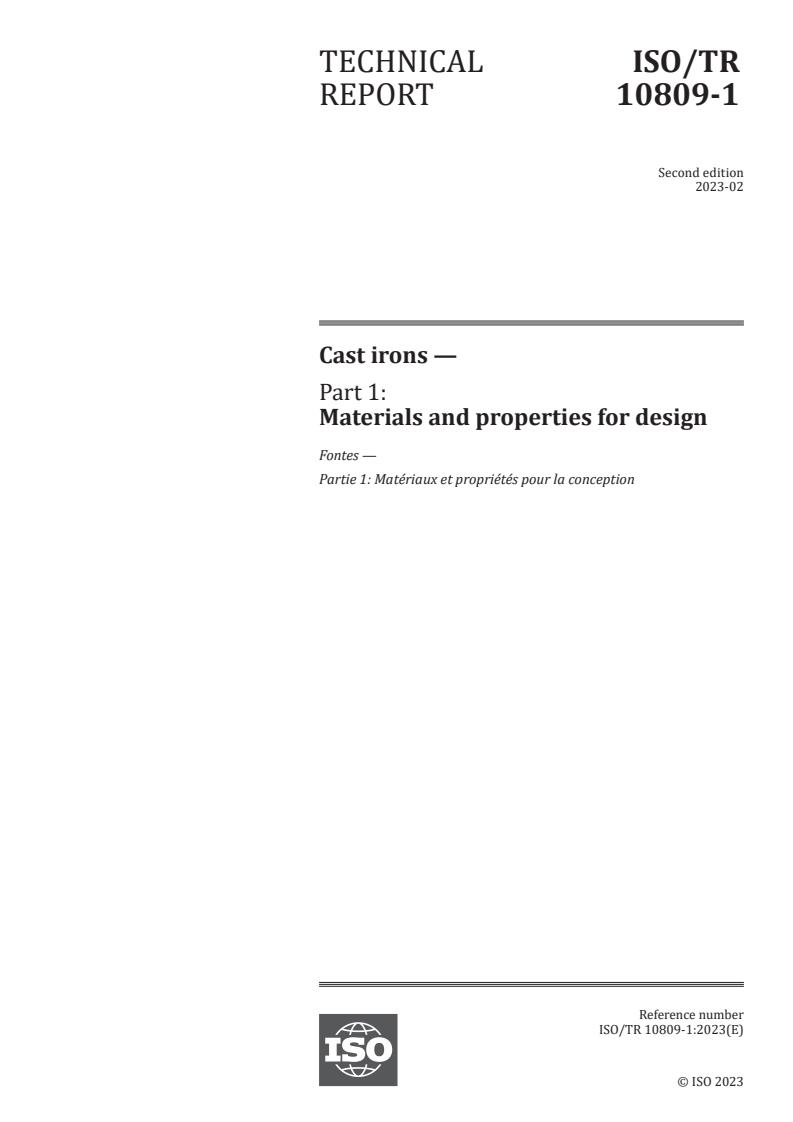
TECHNICAL ISO/TR
REPORT 10809-1
Second edition
2023-02
Cast irons —
Part 1:
Materials and properties for design
Fontes —
Partie 1: Matériaux et propriétés pour la conception
Reference number
© ISO 2023
All rights reserved. Unless otherwise specified, or required in the context of its implementation, no part of this publication may
be reproduced or utilized otherwise in any form or by any means, electronic or mechanical, including photocopying, or posting on
the internet or an intranet, without prior written permission. Permission can be requested from either ISO at the address below
or ISO’s member body in the country of the requester.
ISO copyright office
CP 401 • Ch. de Blandonnet 8
CH-1214 Vernier, Geneva
Phone: +41 22 749 01 11
Email: copyright@iso.org
Website: www.iso.org
Published in Switzerland
ii
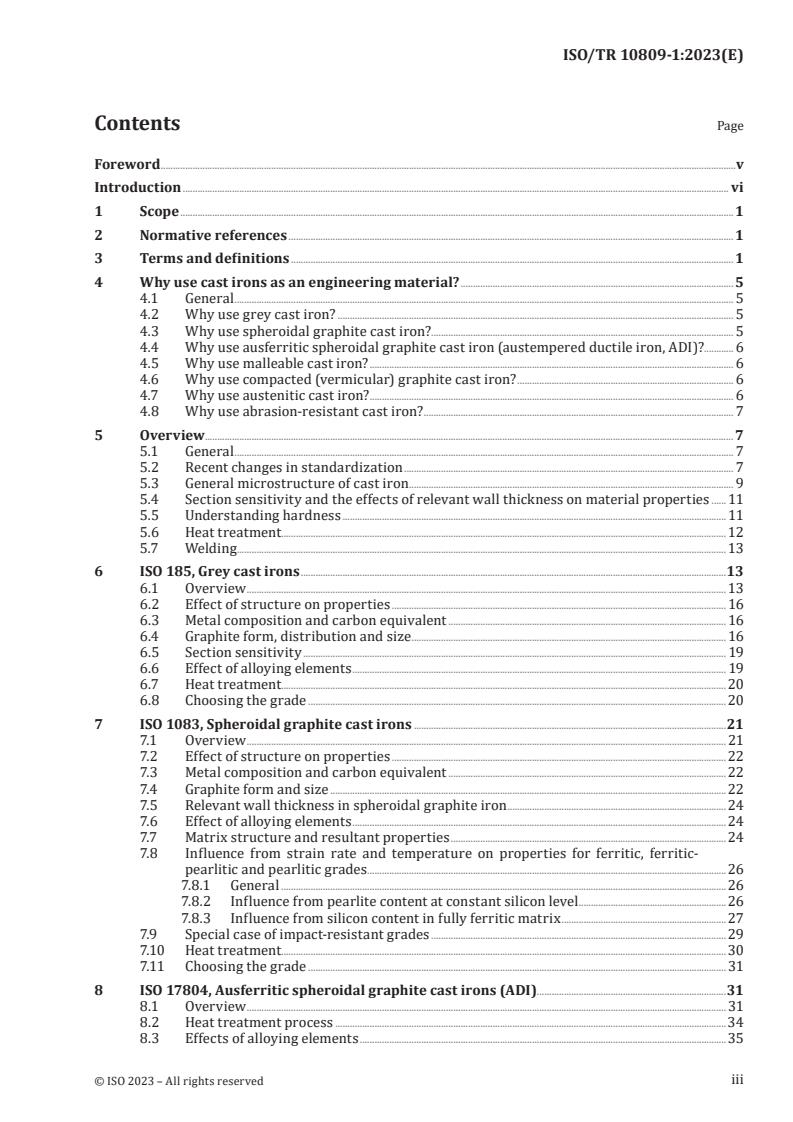
Contents Page
Foreword .v
Introduction . vi
1 Scope . 1
2 Normative references . 1
3 Terms and definitions . 1
4 Why use cast irons as an engineering material? . 5
4.1 General . 5
4.2 Why use grey cast iron? . 5
4.3 Why use spheroidal graphite cast iron? . 5
4.4 Why use ausferritic spheroidal graphite cast iron (austempered ductile iron, ADI)?. 6
4.5 Why use malleable cast iron? . 6
4.6 Why use compacted (vermicular) graphite cast iron? . 6
4.7 Why use austenitic cast iron? . 6
4.8 Why use abrasion-resistant cast iron? . 7
5 Overview . 7
5.1 General . 7
5.2 Recent changes in standardization . 7
5.3 General microstructure of cast iron . 9
5.4 Section sensitivity and the effects of relevant wall thickness on material properties . 11
5.5 Understanding hardness . 11
5.6 Heat treatment.12
5.7 Welding . . 13
6 ISO 185, Grey cast irons .13
6.1 Overview . 13
6.2 Effect of structure on properties . 16
6.3 Metal composition and carbon equivalent . 16
6.4 Graphite form, distribution and size . 16
6.5 Section sensitivity . 19
6.6 Effect of alloying elements . 19
6.7 Heat treatment. 20
6.8 Choosing the grade . 20
7 ISO 1083, Spheroidal graphite cast irons .21
7.1 Overview . 21
7.2 Effect of structure on properties . 22
7.3 Metal composition and carbon equivalent . 22
7.4 Graphite form and size .22
7.5 Relevant wall thickness in spheroidal graphite iron . 24
7.6 Effect of alloying elements . 24
7.7 Matrix structure and resultant properties . 24
7.8 Influence from strain rate and temperature on properties for ferritic, ferritic-
pearlitic and pearlitic grades . .26
7.8.1 General . 26
7.8.2 Influence from pearlite content at constant silicon level .26
7.8.3 Influence from silicon content in fully ferritic matrix . 27
7.9 Special case of impact-resistant grades .29
7.10 Heat treatment.30
7.11 Choosing the grade . 31
8 ISO 17804, Ausferritic spheroidal graphite cast irons (ADI).31
8.1 Overview . 31
8.2 Heat treatment process .34
8.3 Effects of alloying elements . 35
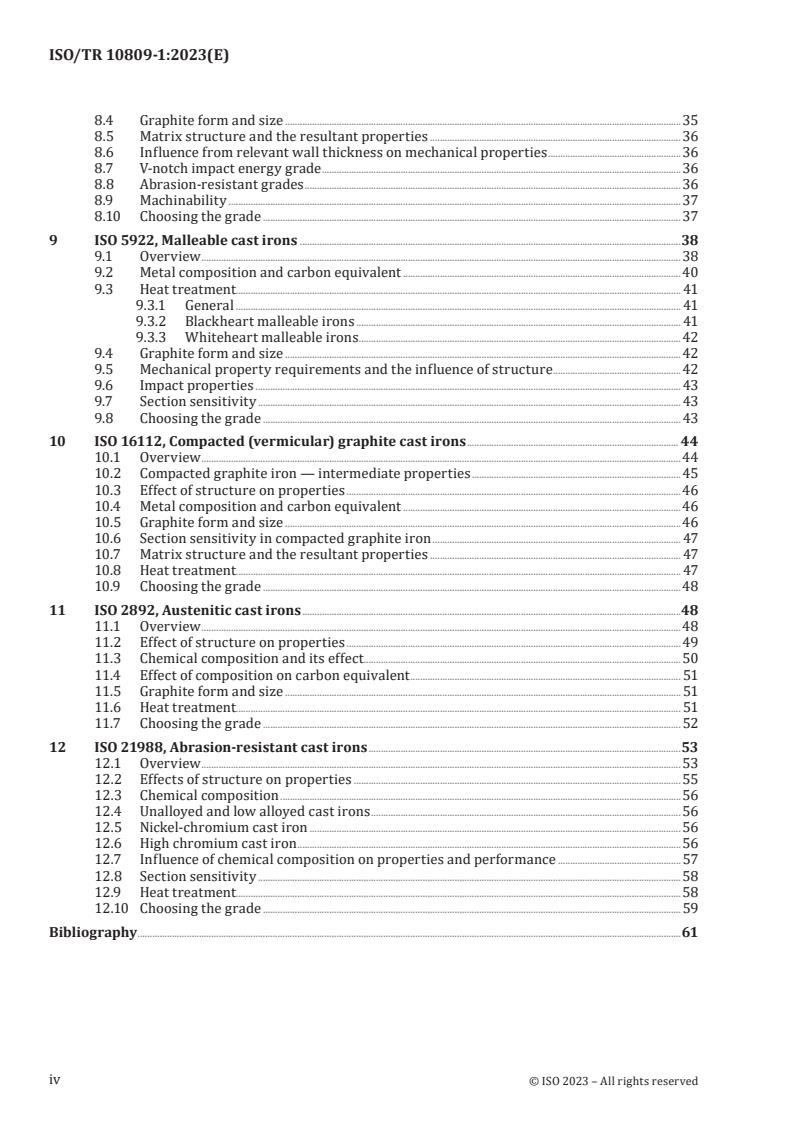
iii
8.4 Graphite form and size . 35
8.5 Matrix structure and the resultant properties .36
8.6 Influence from relevant wall thickness on mechanical properties .36
8.7 V-notch impact energy grade .36
8.8 Abrasion-resistant grades . 36
8.9 Machinability . 37
8.10 Choosing the grade . 37
9 ISO 5922, Malleable cast irons .38
9.1 Overview .38
9.2 Metal composition and carbon equivalent .40
9.3 Heat treatment. 41
9.3.1 General . 41
9.3.2 Blackheart malleable irons . 41
9.3.3 Whiteheart malleable irons . 42
9.4 Graphite form and size . 42
9.5 Mechanical property requirements and the influence of structure . 42
9.6 Impact properties . 43
9.7 Section sensitivity . 43
9.8 Choosing the grade . 43
10 ISO 16112, Compacted (vermicular) graphite cast irons . 44
10.1 Overview .44
10.2 Compacted graphite iron — intermediate properties . 45
10.3 Effect of structure on properties .46
10.4 Metal composition and carbon equivalent .46
10.5 Graphite form and size .46
10.6 Section sensitivity in compacted graphite iron . 47
10.7 Matrix structure and the resultant properties . 47
10.8 Heat treatment. 47
10.9 Choosing the grade .48
11 ISO 2892, Austenitic cast irons .48
11.1 Overview .48
11.2 Effect of structure on properties .49
11.3 Chemical composition and its effect.50
11.4 Effect of composition on carbon equivalent . 51
11.5 Graphite form and size . 51
11.6 Heat treatment. 51
11.7 Choosing the grade . 52
12 ISO 21988, Abrasion-resistant cast irons .53
12.1 Overview . 53
12.2 Effects of structure on properties . 55
12.3 Chemical composition .56
12.4 Unalloyed and low alloyed cast irons .56
12.5 Nickel-chromium cast iron .56
12.6 High chromium cast iron .56
12.7 Influence of chemical composition on properties and performance . 57
12.8 Section sensitivity .58
12.9 Heat treatment.58
12.10 Choosing the grade . 59
Bibliography .61
iv
Foreword
ISO (the International Organization for Standardization) is a worldwide federation of national standards
bodies (ISO member bodies). The work of preparing International Standards is normally carried out
through ISO technical committees. Each member body interested in a subject for which a technical
committee has been established has the right to be represented on that committee. International
organizations, governmental and non-governmental, in liaison with ISO, also take part in the work.
ISO collaborates closely with the International Electrotechnical Commission (IEC) on all matters of
electrotechnical standardization.
The procedures used to develop this document and those intended for its further maintenance are
described in the ISO/IEC Directives, Part 1. In particular, the different approval criteria needed for the
different types of ISO documents should be noted. This document was drafted in accordance with the
editorial rules of the ISO/IEC Directives, Part 2 (see www.iso.org/directives).
Attention is drawn to the possibility that some of the elements of this document may be the subject of
patent rights. ISO shall not be held responsible for identifying any or all such patent rights. Details of
any patent rights identified during the development of the document will be in the Introduction and/or
on the ISO list of patent declarations received (see www.iso.org/patents).
Any trade name used in this document is information given for the convenience of users and does not
constitute an endorsement.
For an explanation of the voluntary nature of standards, the meaning of ISO specific terms and
expressions related to conformity assessment, as well as information about ISO’s adherence to
the World Trade Organization (WTO) principles in the Technical Barriers to Trade (TBT), see
www.iso.org/iso/foreword.html.
This document was prepared by Technical Committee ISO/TC 25, Cast irons and pig irons.
This second edition cancels and replaces the first edition (ISO/TR 10809-1:2009), which has been
technically revised.
The main changes are as follows:
— Clauses 4 to 10 have been reordered in line with microstructural similarities between cast iron
types;
— the Bibliography has been updated.
A list of all parts in the ISO 10809 series can be found on the ISO website.
Any feedback or questions on this document should be directed to the user’s national standards body. A
complete listing of these bodies can be found at www.iso.org/members.html.
v
Introduction
[13]
Worldwide cast-iron production is in excess of 74 million metric tonnes per annum. It is manufactured
in a wide range of alloys and has applications in all sectors of world production and manufacture. Its
use spans many industries, including automotive, oil, mining, etc.
The purpose of this document is to assist the designer and engineer in understanding the family of cast
iron materials and to be able to utilize them with a more complete knowledge of their potential, among
the wide range of other engineering materials and fabrication methods now available. A considerable
amount of the data provided are metallurgical, but it is usually the metallurgical aspects of the cast
irons that create misunderstandings when these materials are specified. Metallurgy is not one of the
scientific disciplines commonly taught to engineering students, so the material properties of cast
irons are not often well understood. Thus, such students often have a lack of knowledge regarding the
fundamentals underpinning the material properties of cast irons.
vi
TECHNICAL REPORT ISO/TR 10809-1:2023(E)
Cast irons —
Part 1:
Materials and properties for design
1 Scope
This document provides information about cast iron materials so that users and designers are in a
better position to understand cast iron as a design material in its own right and to correctly specify
cast iron for suitable applications.
This document suggests what can be achieved, and what is not achievable when cast irons are specified
as well as the reasons why. It is not designed to be a textbook of cast iron metallurgy. It is intended
to help people to choose the correct material for the right reasons and to also help to obviate the
specification or expectation of unrealistic additional requirements, which are unlikely to be met and
which can be detrimental to the intended application.
2 Normative references
There are no normative references in this document.
3 Terms and definitions
For the purposes of this document, the following terms and definitions apply.
ISO and IEC maintain terminology databases for use in standardization at the following addresses:
— ISO Online browsing platform: available at https:// www .iso .org/ obp
— IEC Electropedia: available at https:// www .electropedia .org/
3.1
alloying
addition of elements such as copper, nickel and molybdenum to enhance hardenability
3.2
annealing
heat treatment (3.17) that breaks down iron carbide (3.21) and pearlite (3.26) to produce ferrite (3.12)
3.3
ausferrite
cast iron matrix microstructure, produced by a controlled thermal process, which consists of
predominantly acicular ferrite (3.12) and high carbon austenite (3.5)
3.4
austempering
heat treatment (3.17), consisting of heating the castings to a
temperature at which austenite (3.5) starts to form during heating and holding a sufficient time for
carbon diffusion into the austenite, followed by cooling at a rate sufficient to avoid the formation of
pearlite (3.26), and transforming the matrix structure for a time and temperature (above the martensite
(3.23) start temperature) sufficient to produce the desired properties
Note 1 to entry: This process produces a microstructure that consists predominantly of acicular ferrite (3.12)
and high carbon austenite. This microstructure is called ausferrite (3.3). Examples of ausferritic microstructures
are given in ISO/TR 945-3.
[SOURCE: ISO 17804:2020, 3.3]
3.5
austenite
cast iron matrix microstructure, formed in cast irons immediately upon solidification that at lower
temperatures transforms into ferrite (3.12), pearlite (3.26), ausferrite (3.3) and/or martensite (3.23),
unless the austenite is stabilized at lower temperatures by either sufficient alloying (3.1) with nickel in
austenitic cast irons, or by carbon enrichment in the austenite phase during the austempering (3.4) of
ausferritic cast irons containing sufficient silicon to prevent formation of bainite (3.6)
3.6
bainite
cast iron matrix microstructure that can form if a white iron with low silicon content is austempered
(3.4)
Note 1 to entry: Ausferritic cast irons contain sufficient silicon to prevent the formation of bainite.
3.7
carbon equivalent
formula based on the carbon and silicon contents of molten cast iron by thermal analysis
3.8
compacted
stubby form of graphite flakes providing material properties in between those of the grey and
spheroidal graphite irons
3.9
ductility
elongation measured on the tensile test piece following testing
Note 1 to entry: It is expressed as a percentage.
3.10
eutectic
point at which elements are present at a level where the lowest solidification temperature is reached
3.11
eutectic cell
solidification mechanism in grey cast iron where cells form, each with its individual internal graphite
structure
Note 1 to entry: These ultimately coalesce to form a uniform material.
3.12
ferrite
cast iron matrix microstructure formed during slow cooling of austenite (3.5), provided that pearlite
(3.26) is not rapidly forming to consume the austenite
Note 1 to entry: The formation of ferrite is promoted by both slower cooling and higher silicon content. The
latter results in considerable substitutional solution strengthening of the ferrite. A new kind of ferrite, also
interstitially solution strengthened by medium carbon contents, is formed during austempering (3.4) into
ausferritic microstructures.
3.13
graphite flake
two-dimensional appearance of the graphite form (3.14) in grey cast iron, when looking at the material
structure through a microscope
3.14
graphite form
descriptor of graphite shape, which can define material properties
Note 1 to entry: It is shown in ISO 945-1.
3.15
graphite size
size of the free graphite, whether in the form of flakes, nodules, temper nodules or vermicular graphite
Note 1 to entry: It can be quantified using the relevant cast iron type standard, and will have an effect on the
mechanical properties of the final product.
Note 2 to entry: It is classified in accordance with ISO 945-1.
Note 3 to entry: Fine graphite normally provides better properties than coarse graphite.
3.16
hardening
heat treatment (3.17) that generally produces martensite (3.23) in the matrix (3.24)
3.17
heat treatment
thermal process that removes internal stress or enhances properties
3.18
hypoeutectic
composition below the eutectic (3.10)
3.19
hypereutectic
composition above the eutectic (3.10)
3.20
inoculation
technique of adding inoculant to molten iron to enhance the graphite growth
3.21
iron carbide
iron and carbon in a combined form
EXAMPLE Fe3C.
3.22
iron-chromium carbide
complex carbide principally found in abrasion-resisting irons
3.23
martensite
cast iron matrix microstructure formed from cooling any austenite (3.5) not previously transformed at
higher temperatures into ferrite (3.12), pearlite (3.26), bainite (3.6) and/or ausferrite (3.3)
Note 1 to entry: In contrast to these transformations relying on the diffusion of carbon and thus depending on
both temperature and time, the formation of martensite is diffusionless and is dependent only on temperature.
3.24
matrix
structural phases surrounding the graphite in graphitic cast irons and carbide in abrasion-resisting
irons
EXAMPLE Ferrite (3.12), pearlite (3.26), ausferrite (3.3), austenite (3.5) and martensite (3.23).
3.25
nodularity
assessment of the proportion of spheroidal graphite particles in a cast iron sample
Note 1 to entry: Nodularity is generally expressed as a percentage.
[SOURCE: ISO 945-4:2019, 3.5]
3.26
pearlite
cast iron two-phased lamellar matrix microstructure composed of alternating layers of ferrite (3.12)
and cementite (Fe3C), formed by a eutectoid reaction during slow cooling of austenite (3.5) not
previously transformed into ferrite
Note 1 to entry: The formation of pearlite is promoted by both faster cooling and lower silicon content.
3.27
quenching
rapid cooling of previously austenitized castings to prevent formation of ferrite (3.12) and pearlite
(3.26), cooled either in a salt bath for subsequent austempering (3.4) into ausferrite (3.3) or in oil to
form martensite (3.23)
3.28
relevant wall thickness
section thickness of the casting, agreed between the manufacturer and the purchaser, to which the
determined mechanical properties apply
[SOURCE: ISO 185:2020, 3.2, modified — “thickness” added before “section”.]
3.29
section sensitivity
change in material properties that occurs due to variations in the solidification and cooling rates of cast
iron poured into different wall section thicknesses
3.30
spheroidal graphite
graphite in spheroidal graphite iron that is present as spheroids as opposed to flakes
3.31
stress relieving
low-temperature heat treatment (3.17) that removes stress without affecting structure
3.32
tempering
heat treatment (3.17) that enhances properties or relieves stress after hardening (3.16)
3.33
temper carbon
graphite form (3.14) found in malleable iron with the appearance of “ragged” spheroids, also known as
“temper carbon nodules”
3.34
trace elements
elements that are present in small amounts
EXAMPLE Copper, nickel, molybdenum, vanadium, titanium.
Note 1 to entry: Such elements can also be added for alloying (3.1) purposes.
4 Why use cast irons as an engineering material?
4.1 General
The first questions that the designer and engineer will probably ask are:
— Can I use a cast iron?
— Should I use a cast iron?
— Which type and grade are applicable?
— What are the advantages?
General information on the cast iron types currently standardized in International Standards is given
in 4.2 to 4.8.
4.2 Why use grey cast iron?
Grey cast iron is sometimes called “flake graphite cast iron” or “lamellar graphite cast iron”. It provides
the largest worldwide tonnage of all cast irons produced, mainly because of its wide range of uses
within general engineering, its ease of casting and machining, and its cost advantage. The material has
the highest thermal conductivity and vibration damping capacity among the range of cast irons, which
is why it is used in applications where these properties are important. Typical examples are automotive
parts such as brake drums, discs, clutch plates, and cylinder blocks and heads. Grey iron lacks ductility,
but for parts where requirements for ductility and impact resistance are low or unimportant, a huge
range of applications can be found. These include, for example, the manufacture of machine tools such
as lathe beds, where slideways can easily be surface hardened and the self-lubricating properties of the
material are advantageous. This highly versatile material can be considered for a potential application
unless there are ductility requirements, or the design requires ultimate strengths in excess of 350 MPa.
4.3 Why use spheroidal graphite cast iron?
Spheroidal graphite cast iron, also known as “ductile iron” or “nodular graphite iron”, has the benefit
of ductility as well as strength, which is why it is often considered to be a material superior to grey
iron. Its main disadvantage in this respect is that it does not have as high thermal conductivity as grey
iron and is not normally used where this property is important. A large number of spheroidal graphite
iron grades are available to the designer, based on the fact that as tensile strength increases, ductility
decreases. Thus, the designer has the opportunity to utilize different combinations of tensile/ductility
properties, depending upon the application. The lower-strength grades with high ductility also have
good impact properties at low temperatures and, for this reason, spheroidal graphite iron is increasingly
being used to produce cast parts to replace steel fabrications. Large tonnages of spheroidal graphite
iron are used to produce centrifugally cast pipe for water and sometimes gas transportation, but the
majority is used in general engineering applications where its considerably higher tensile properties,
compared with grey iron, are of advantage.
4.4 Why use ausferritic spheroidal graphite cast iron (austempered ductile iron, ADI)?
The austempering heat treatment carried out on a conventional spheroidal graphite cast iron enhances
its properties to produce a range of grades with exceptionally high tensile strengths. The highest tensile
strength grade, with a high hardness, allows it to be used in abrasion-resisting applications. As with
all spheroidal graphite iron materials, increases in tensile strength and hardness are accompanied by
decreases in ductility. This allows for a wide range of properties that can be exploited. Tensile strengths
up to 1 600 MPa, hardnesses greater than 400 HBW, and tensile elongations up to 10 % are possible
(although not all three simultaneously in the same grade of material). These mechanical properties
also result in a high fatigue strength that is useful in gears and other components for use in rotating/
bending applications. Certain ausferritic grades exhibit good toughness and impact properties, even at
sub-zero temperatures and/or high strain rates.
Additional variations of ausferritic spheroidal graphite iron include carbidic austempered ductile
iron (CADI), interrupted quench ausferritic spheroidal graphite iron and intercritical ausferritic
spheroidal graphite iron (also known as “intercritical austempered ductile iron (IADI)” or referred
to as “dual phase ausferritic spheroidal graphite iron”). Both CADI and interrupted quench variations
are produced to further improve the abrasion resistance of standard grades of ausferritic spheroidal
graphite iron by either austempering spheroidal graphite iron with a controlled volume of carbides
or using a shortened quench time, respectively. Applications include agricultural components such as
plough points and tillage tine where abrasion resistance combined with some toughness is needed.
Intercritical ausferritic spheroidal graphite iron is produced by modifying the austempering process to
produce a final microstructure that contains a controlled volume of proeutectoid ferrite. This is done to
improve post-heat-treatment machinability.
Although International Standards exist only for ausferritic spheroidal graphite iron, grey iron and
compacted graphite iron can both be austempered. This is done to improve tensile strength and wear
properties, as well as vibration and noise damping properties of as-cast grades.
4.5 Why use malleable cast iron?
There are two different types of malleable cast iron, blackheart and whiteheart (see 9.1). The
blackheart grades have properties similar to the ferritic spheroidal graphite irons and the materials
have traditionally been considered interchangeable in most general engineering applications. The
whiteheart malleable grades are still used to produce traditional thin section castings, particularly
fittings such as hinges and locks. Its usage is more typically confined to the production of thin section
castings where the heat treatment process can be adjusted to completely decarburize the material,
allowing for welding to steels.
4.6 Why use compacted (vermicular) graphite cast iron?
Compacted graphite cast iron, also known as “vermicular graphite iron”, has applications for
components which require additional strength, stiffness and ductility over and above that offered by
grey iron. Typical applications include cylinder blocks and heads, brake drums and brake discs, pump
housings, hydraulic components, and cylinder liners. The benefits of the material are that it provides
higher tensile strengths and some ductility compared to grey iron. The thermal conductivity and
vibration damping properties are between those of grey iron and spheroidal graphite iron. These are
also influenced by the compacted graphite morphology and the metal matrix microstructure.
4.7 Why use austenitic cast iron?
The austenitic cast iron, also known as “Ni-hard” or “Ni-resist”, is a family of materials that provide
corrosion resistance, heat resistance or a combination of both. Austenitic irons are often compared with
stainless steels when a design is being considered. One specific application for which the austenitic iron
grades are considered is where the component to be produced needs to be non-magnetizable and other
properties are of secondary importance. Both grey and spheroidal graphite iron grades are produced;
the spheroidal graphite iron grades exhibit superior tensile properties to the grey iron grades. These
materials vary widely in their metal composition to meet a broad range of applications; in general, the
most arduous applications are met by those grades containing the highest nickel content.
4.8 Why use abrasion-resistant cast iron?
The abrasion-resisting cast irons are a range of hard materials that compete with other alloys such
as manganese steel, mainly in wear-resistant applications including in mining and extraction
industries, such as slurry pumps, and in more generalized applications such as in the operation of shot-
cleaning plants. Thus, they are rightly considered to be a consumable item where the rate of wear or
operational life is important in the decision-making process regarding the choice of material. Generally
speaking, they tend to be less expensive and easier to manufacture than the abrasion-resisting steels
with which they are usually compared. They perform well in a variety of applications and cannot be
casually dismissed as the material of choice in any application that requires abrasion resistance. The
effectiveness of any abrasion-resisting material is highly dependent upon the materials it is in contact
with and the circumstances under which it is required to perform. For example, slight changes in
the composition of an ore in an extraction application, and even its water content, can significantly
influence the wear rate.
5 Overview
5.1 General
Cast irons have specific properties that make them useful materials in many applications.
5.2 Recent changes in standardization
ISO/TC 25 is the International Technical Committee responsible for the development of the following
International Standards for cast irons:
[1]
— ISO 185:2020 ;
[2]
— ISO 945-1:2019 ;
[3]
— ISO/TR 945-2:2011 ;
[4]
— ISO/TR 945-3:2016 ;
[5]
— ISO 945-4:2019 .
[6]
— ISO 1083:2018 ;
[7]
— ISO 2892:2007 ;
[8]
— ISO 5922:2005 ;
[10]
— ISO 16112:2017 ;
[11]
— ISO 17804:2020 ;
[12]
— ISO 21988:2006 ;
A majority of these standards have been revised or created since the first edition of this document
in 2009. These International Standards include annexes of additional information about material
properties, which are not requirements of the standards, but which provide helpful technical and
application information to designers and engineers.
The seven International Standards for cast iron materials encompass a huge international tonnage. In
1999, reported world production reached 49,3 million tonnes/annum, and this figure had increased to
[13]
74 million tonnes/annum in 2020 . The trend is continuing for cast irons utilized in the manufacture
of a wide variety of different components ranging in mass from a few grams to more than 100 tonnes.
The International Standards for cast irons detail the properties of seven individual types of cast iron
material in order to enable selection of the most appropriate material for the application. Table 1
provides an approximate ranking of properties to lead the user to the relevant International Standard.
It also compares one cast iron material type with another but does not compare the cast irons with
other materials. For example, if a cast iron with high strength and ductility were required, then an
examination of ISO 1083 or ISO 17804 would be beneficial. The individual grades within these two
International Standards can then be consulted to find the most appropriate one and to determine
whether the other, unspecified properties in the annexes are beneficial or detrimental to the application.
Table 1 — General property rankings for cast irons
ISO 16112 ISO 2892 ISO 21988
ISO 185 ISO 1083 ISO 17804 ISO 5922
Property Compact- Auste- Abrasion-
Grey Spheroidal Ausferritic Malleable
ed nitic resistant
Tensile strength √√ √√√√ √√√√√ √√√√ √√√ √√√ N/A
Yield strength √ √√√√ √√√√√ √√√ √√ √√√ N/A
Elongation √ √√√√√ √√√√ √√√ √√ √√√√ N/A
Impact resistance √ √√√ √√√√√ √√√ √ √√√ √√
Low temperature
mechanical √√ √√√√ √√√√√ √√√ √√ √√√ √
properties < 0 °C
High temperature
mechanical √ √√√ N/A N/A √√ √√√√√ N/A
properties > 450 °C
High strain rate N/A √√√ √√√√√ N/A N/A N/A N/A
Thermal
√√√√√ √√√ √√√ √√√ √√√√ √√√ √
conductivity
Thermal expansion √√ √√ √√ √√ √√ √√√√√ √
Abrasion resistance √√ √√ √√√√ √ √√ √√ √√√√√
Corrosion
√ √√ √√ √√ √√ √√√√√ √√√√√
resistance
Castability √√√√√ √√√√ √√√√ √√ √√√√ √√ √√
Machinability √√√√√ √√√ √√ √√√ √√√√ √√ √
Weldability √ √√ √ √√√ √√ √√ N/A
Key
√ Low
√√ Average
√√√ High
√√√√ Very high
√√√√√ Highest
N/A Not applicable
NOTE 1 Rankings are based on choosing the grade with optimum properties within each standard, see Clauses 6 to 12.
NOTE 2 Weldabilty of grades in ISO 5922: JMB grade: = √√√, JMW grade: = √√√√, JMW-S grade: = √√√√√.
Table 2 provides data on typical applications (the list is not exhaustive). Table 2 can also help the
designer and engineer to select the most appropriate International Standard, and ultimately the choice
of the grade within it.
Table 2 — Typical mechanical property ranges and example applications for cast irons
Standard Description
Minimum tensile strength range 100 MPa to 350 MPa, elongation < 1 %.
ISO 185
Wide ra
...