

ISO 13610:2025
(Main)Sludge recovery, recycling, treatment and disposal — Determination of calorific value of sludge
General Information
- Abstract
This document specifies a method for the determination of the gross calorific value of sludge at constant volume and at the reference temperature 25 °C in a bomb calorimeter calibrated by combustion of certified benzoic acid. The result obtained is the gross calorific value of the sample at constant volume with both the water of the combustion products and the moisture of the sludge as liquid water. In practice, sludge is burned at constant (atmospheric) pressure and the water is not condensed but is removed as vapour with the flue gases. Under these conditions, the operative heat of combustion to be used is the net calorific value of the fuel at constant pressure. The net calorific value at constant volume can also be used, equations for the calculation are given only as this requires less additional determinations. This method is applicable to all kinds of sludge.
- Status
- Published
- Publication Date
- 01-Jul-2025
- Technical Committee
- ISO/TC 275 - Sludge recovery, recycling, treatment and disposal
- Drafting Committee
- ISO/TC 275 - Sludge recovery, recycling, treatment and disposal
- Current Stage
- 6060 - International Standard published
- Start Date
- 02-Jul-2025
- Due Date
- 23-Jul-2025
- Completion Date
- 02-Jul-2025


Overview
ISO 13610:2025 - Sludge recovery, recycling, treatment and disposal - Determination of calorific value of sludge - specifies a laboratory method to determine the gross calorific value of sludge using a bomb calorimeter at constant volume and a reference temperature of 25 °C. The calorimeter is calibrated by combustion of certified benzoic acid. Results represent the gross calorific value with both the sludge moisture and the water from combustion considered as liquid water. The standard also explains how to derive net calorific value (operative heat typically used for thermal treatment at atmospheric pressure) and provides calculation options that reduce extra determinations.
Key technical topics and requirements
- Measurement principle: Combustion in a bomb calorimeter under oxygen at constant volume, with corrected temperature rise used to compute energy release.
- Reference conditions: 25 °C reference temperature; calibration by certified benzoic acid.
- Result definitions: Distinguishes gross calorific value (water as liquid) and net calorific value (water as vapour), and provides equations to convert between them.
- Apparatus and reagents: Includes requirements for calorimeter (isoperibol/adiabatic types), thermostat, crucibles (silica, nickel‑chromium, platinum or similar non‑reactive materials), ignition wire, pressure equipment, balances and pellet press.
- Procedure steps: Sample preparation, bomb preparation, assembling the calorimeter, combustion and temperature measurement, disassembly.
- Corrections & calibration: Corrections for heat exchange, ignition wire combustion, and reference temperature; calibration procedures and use of certified standards.
- Quality and reporting: Precision information (repeatability/reproducibility), calculation methods, and required test report content.
- Applicability: Method is explicitly applicable to all kinds of sludge.
Practical applications
- Assessing thermal energy potential of sewage sludge, industrial sludges and sludge-derived products.
- Supporting design and optimization of waste‑to‑energy, incineration, co‑combustion, pyrolysis and other thermal treatment processes.
- Characterizing fuel quality for sludge valorisation and recycling strategies.
- Providing laboratory data for lifecycle assessments, regulatory compliance, tender specifications, and feasibility studies.
- Assisting R&D and interlaboratory comparisons in sludge treatment technologies.
Who should use ISO 13610:2025
- Environmental and analytical laboratories performing calorimetry.
- Wastewater treatment plant operators and sludge managers evaluating energy recovery options.
- Engineers and consultants designing thermal sludge treatment facilities.
- Equipment manufacturers (calorimeters, combustion systems) and certification bodies.
- Researchers and policy makers involved in sludge valorisation and circular economy initiatives.
ISO 13610:2025 is a practical, standardized method for reliable calorific value measurement of sludge - essential information for energy recovery decisions and thermal process design.
Relations
- Effective Date
- 12-Feb-2026
Get Certified
Connect with accredited certification bodies for this standard

CIS Institut d.o.o.
Personal Protective Equipment (PPE) certification body. Notified Body NB-2890 for EU Regulation 2016/425 PPE.

Kiwa BDA Testing
Building and construction product certification.
Kmetijski inštitut Slovenije
Agricultural Institute of Slovenia. Soil testing, plant health, agricultural product analysis.
Sponsored listings
Frequently Asked Questions
ISO 13610:2025 is a standard published by the International Organization for Standardization (ISO). Its full title is "Sludge recovery, recycling, treatment and disposal — Determination of calorific value of sludge". This standard covers: This document specifies a method for the determination of the gross calorific value of sludge at constant volume and at the reference temperature 25 °C in a bomb calorimeter calibrated by combustion of certified benzoic acid. The result obtained is the gross calorific value of the sample at constant volume with both the water of the combustion products and the moisture of the sludge as liquid water. In practice, sludge is burned at constant (atmospheric) pressure and the water is not condensed but is removed as vapour with the flue gases. Under these conditions, the operative heat of combustion to be used is the net calorific value of the fuel at constant pressure. The net calorific value at constant volume can also be used, equations for the calculation are given only as this requires less additional determinations. This method is applicable to all kinds of sludge.
This document specifies a method for the determination of the gross calorific value of sludge at constant volume and at the reference temperature 25 °C in a bomb calorimeter calibrated by combustion of certified benzoic acid. The result obtained is the gross calorific value of the sample at constant volume with both the water of the combustion products and the moisture of the sludge as liquid water. In practice, sludge is burned at constant (atmospheric) pressure and the water is not condensed but is removed as vapour with the flue gases. Under these conditions, the operative heat of combustion to be used is the net calorific value of the fuel at constant pressure. The net calorific value at constant volume can also be used, equations for the calculation are given only as this requires less additional determinations. This method is applicable to all kinds of sludge.
ISO 13610:2025 is classified under the following ICS (International Classification for Standards) categories: 13.030.20 - Liquid wastes. Sludge. The ICS classification helps identify the subject area and facilitates finding related standards.
ISO 13610:2025 has the following relationships with other standards: It is inter standard links to EN 15170:2008. Understanding these relationships helps ensure you are using the most current and applicable version of the standard.
ISO 13610:2025 is available in PDF format for immediate download after purchase. The document can be added to your cart and obtained through the secure checkout process. Digital delivery ensures instant access to the complete standard document.
Standards Content (Sample)
International
Standard
ISO 13610
First edition
Sludge recovery, recycling, treatment
2025-07
and disposal — Determination of
calorific value of sludge
Valorisation, recyclage, traitement et élimination des boues —
Détermination du pouvoir calorifique des boues
Reference number
© ISO 2025
All rights reserved. Unless otherwise specified, or required in the context of its implementation, no part of this publication may
be reproduced or utilized otherwise in any form or by any means, electronic or mechanical, including photocopying, or posting on
the internet or an intranet, without prior written permission. Permission can be requested from either ISO at the address below
or ISO’s member body in the country of the requester.
ISO copyright office
CP 401 • Ch. de Blandonnet 8
CH-1214 Vernier, Geneva
Phone: +41 22 749 01 11
Email: copyright@iso.org
Website: www.iso.org
Published in Switzerland
ii
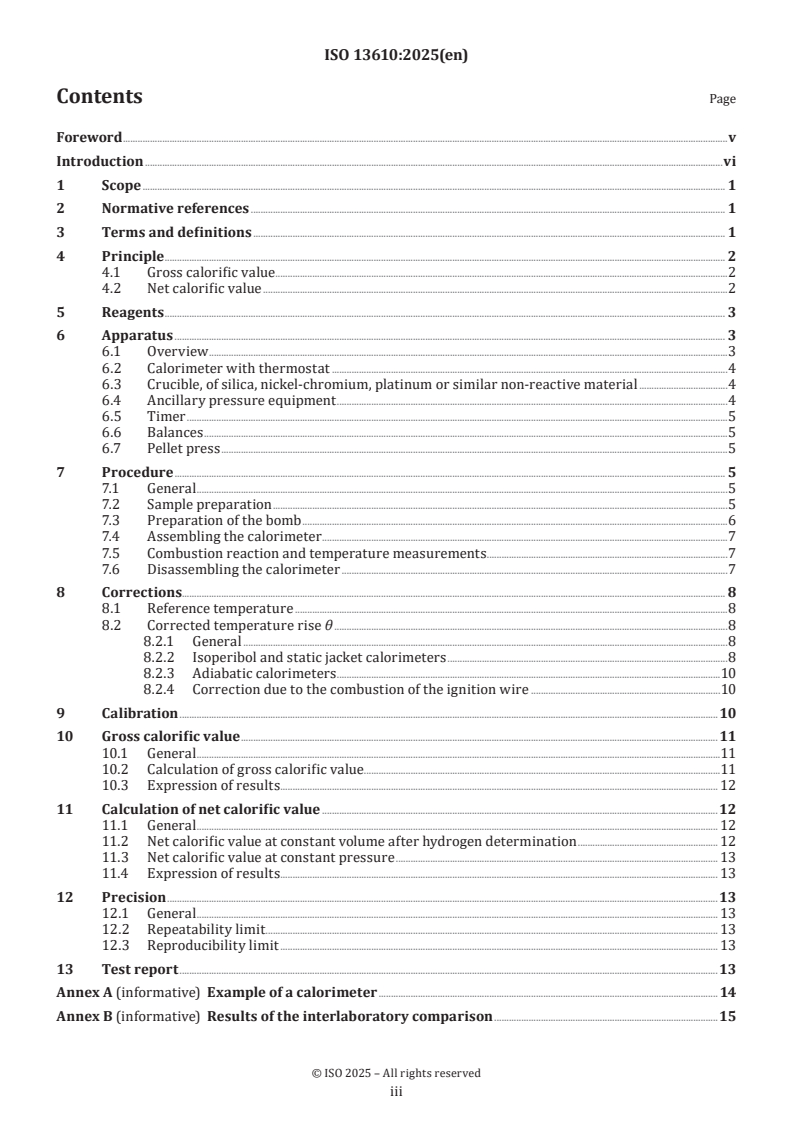
Contents Page
Foreword .v
Introduction .vi
1 Scope . 1
2 Normative references . 1
3 Terms and definitions . 1
4 Principle . 2
4.1 Gross calorific value .2
4.2 Net calorific value .2
5 Reagents . 3
6 Apparatus . 3
6.1 Overview .3
6.2 Calorimeter with thermostat .4
6.3 Crucible, of silica, nickel-chromium, platinum or similar non-reactive material .4
6.4 Ancillary pressure equipment .4
6.5 Timer .5
6.6 Balances .5
6.7 Pellet press .5
7 Procedure . 5
7.1 General .5
7.2 Sample preparation .5
7.3 Preparation of the bomb .6
7.4 Assembling the calorimeter .7
7.5 Combustion reaction and temperature measurements .7
7.6 Disassembling the calorimeter .7
8 Corrections. 8
8.1 Reference temperature .8
8.2 Corrected temperature rise θ .8
8.2.1 General .8
8.2.2 Isoperibol and static jacket calorimeters .8
8.2.3 Adiabatic calorimeters .10
8.2.4 Correction due to the combustion of the ignition wire .10
9 Calibration .10
10 Gross calorific value .11
10.1 General .11
10.2 Calculation of gross calorific value.11
10.3 Expression of results . . 12
11 Calculation of net calorific value .12
11.1 General . 12
11.2 Net calorific value at constant volume after hydrogen determination . 12
11.3 Net calorific value at constant pressure . 13
11.4 Expression of results . 13
12 Precision .13
12.1 General . 13
12.2 Repeatability limit . 13
12.3 Reproducibility limit . 13
13 Test report .13
Annex A (informative) Example of a calorimeter . 14
Annex B (informative) Results of the interlaboratory comparison .15
iii
Bibliography .16
iv
Foreword
ISO (the International Organization for Standardization) is a worldwide federation of national standards
bodies (ISO member bodies). The work of preparing International Standards is normally carried out through
ISO technical committees. Each member body interested in a subject for which a technical committee
has been established has the right to be represented on that committee. International organizations,
governmental and non-governmental, in liaison with ISO, also take part in the work. ISO collaborates closely
with the International Electrotechnical Commission (IEC) on all matters of electrotechnical standardization.
The procedures used to develop this document and those intended for its further maintenance are described
in the ISO/IEC Directives, Part 1. In particular the different approval criteria needed for the different types
of ISO documents should be noted. This document was drafted in accordance with the editorial rules of the
ISO/IEC Directives, Part 2 (see www.iso.org/directives).
ISO draws attention to the possibility that the implementation of this document may involve the use of (a)
patent(s). ISO takes no position concerning the evidence, validity or applicability of any claimed patent
rights in respect thereof. As of the date of publication of this document, ISO had not received notice of (a)
patent(s) which may be required to implement this document. However, implementers are cautioned that
this may not represent the latest information, which may be obtained from the patent database available at
www.iso.org/patents. ISO shall not be held responsible for identifying any or all such patent rights.
Any trade name used in this document is information given for the convenience of users and does not
constitute an endorsement.
For an explanation on the voluntary nature of standards, the meaning of ISO specific terms and
expressions related to conformity assessment, as well as information about ISO’s adherence to the World
Trade Organization (WTO) principles in the Technical Barriers to Trade (TBT) see the following URL:
www.iso.org/iso/foreword.html.
This document was prepared by the European Committee for Standardization as EN 15170:2008 and was
adopted, without modification other than those given below, by Technical Committee ISO/TC 275, Sludge
recovery, recycling, treatment and disposal.
— mercury-in-glass thermometers are replaced by resistance thermometers;
— subclause 7.7 was renumbered as Clause 8, and subsequent Clauses and subclauses were renumbered
accordingly;
— the calculation of the net calorific value at constant volume after determination of water amount in the
test (subclause 10.3 in EN 15170:2008) was removed;
— Annex B was removed, and Figure 1 was added in 8.2.2 instead;
— Annex C in EN 15170:2008 is Annex B in this document.
Any feedback or questions on this document should be directed to the user’s national standards body. A
complete listing of these bodies can be found at www.iso.org/members.html.
v
Introduction
The method specified in this document is a simple way to evaluate the amenability of sludge and sludge
products to be treated by thermal processes. In this document, some thermo-chemical corrections are not
considered. For detailed descriptions of analytical procedures and theoretical background see ISO 1928.
The result obtained is the gross calorific value of the sample at constant volume with both the water of the
combustion products and the moisture of the sludge as liquid water. The net calorific value can be derived
from the gross calorific value. For this the hydrogen content of the sludge is determined.
Sludge usually contains much water and (un-burnable) solids. Therefore, the calorific value – especially on
the “as received” basis – is quite low. For many purposes it can be sufficient to determine the gross calorific
value only, and not the net calorific value for which additional determinations are necessary. The calculation
of the net calorific value at constant volume only is described here; for calculation at constant pressure refer
to ISO 1928.
vi
International Standard ISO 13610:2025(en)
Sludge recovery, recycling, treatment and disposal —
Determination of calorific value of sludge
1 Scope
This document specifies a method for the determination of the gross calorific value of sludge at constant
volume and at the reference temperature 25 °C in a bomb calorimeter calibrated by combustion of certified
benzoic acid.
The result obtained is the gross calorific value of the sample at constant volume with both the water of the
combustion products and the moisture of the sludge as liquid water. In practice, sludge is burned at constant
(atmospheric) pressure and the water is not condensed but is removed as vapour with the flue gases. Under
these conditions, the operative heat of combustion to be used is the net calorific value of the fuel at constant
pressure. The net calorific value at constant volume can also be used, equations for the calculation are given
only as this requires less additional determinations.
This method is applicable to all kinds of sludge.
2 Normative references
The following documents are referred to in the text in such a way that some or all of their content constitutes
requirements of this document. For dated references, only the edition cited applies. For undated references,
the latest edition of the referenced document (including any amendments) applies.
ISO 11465, Sludge and solid environmental matrices — Determination of dry residue or water content and
1)
calculation of the dry matter fraction on a mass basis
ISO 16720, Soil quality — Pretreatment of samples by freeze-drying for subsequent analysis
ISO 29541, Coal and coke — Determination of total carbon, hydrogen and nitrogen — Instrumental method
3 Terms and definitions
For the purposes of this document, the following terms and definitions apply.
ISO and IEC maintain terminology databases for use in standardization at the following addresses:
— ISO Online browsing platform: available at https:// www .iso .org/ obp
— IEC Electropedia: available at https:// www .electropedia .org/
3.1
gross calorific value at constant volume
absolute value of the specific energy of combustion, in Joules, for unit mass of a solid sludge burned in oxygen
in a calorimetric bomb under the conditions specified
Note 1 to entry: The products of combustion are assumed to consist of gaseous oxygen, nitrogen, carbon dioxide and
sulfur dioxide, of liquid water (in equilibrium with its vapour) saturated with carbon dioxide under the conditions of
the bomb reaction, and of solid ash, all at the reference temperature.
1) Under preparation. Stage at the time of publication: ISO/FDIS 11465.
3.2
net calorific value at constant volume
absolute value of the specific energy of combustion, in Joules, for unit mass of a solid sludge burned in oxygen
under conditions of constant volume and such that all the water of the reaction products remains as water
vapour (in a hypothetical state at 0,1 MPa)
Note 1 to entry: The other products are in the same state as for the gross calorific value, all at the reference
temperature.
3.3
net calorific value at constant pressure
absolute value of the specific energy of combustion, in Joules, for unit mass of a solid sludge burned in oxygen
at constant pressure under such conditions that all the water of the reaction products remains as water
vapour (in a hypothetical state at 0,1 MPa)
Note 1 to entry: The other products are in the same state as for the gross calorific value, all at the reference
temperature.
3.4
corrected temperature rise
θ
change in calorimeter temperature caused solely by the processes taking place within the combustion bomb
Note 1 to entry: This is the total observed temperature rise corrected for heat exchange, stirring power, etc.
4 Principle
4.1 Gross calorific value
A weighed portion of the analysis sample of the solid sludge is burned in high-pressure oxygen in a bomb
calorimeter under specified conditions. The effective heat capacity of the calorimeter is determined in
calibration experiments by combustion of certified benzoic acid under similar conditions, accounted for
in the certificate. The corrected temperature rise is established from observations of temperature before,
during and after the combustion reaction takes place. The duration and frequency of the temperature
observations depend on the type of calorimeter used. Water is added to the bomb initially to give a saturated
vapour phase prior to combustion, thereby allowing all the water formed, from the hydrogen and moisture
in the sample, to be regarded as liquid water.
The gross calorific value is calculated from the corrected temperature rise and the effective heat capacity
of the calorimeter, with allowances made for contributions from ignition energy, combustion of the
fuse(s) and for thermal effects from side reactions such as the formation of nitric acid. Furthermore, a
correction is applied to account for the difference in energy between the aqueous sulfuric acid formed in
the bomb reaction and gaseous sulfur dioxide, i.e. the required reaction product of sulfur in the sludge. The
corresponding energy effect between aqueous and gaseous hydrochloric acid can be neglected due to the
usually low chlorine content of most sludge.
4.2 Net calorific value
The net calorific value at constant volume of the sludge is obtained by calculation from the gross calorific
value at constant volume determined on the analysis sample. The calculation of the net calorific value at
constant volume requires information about the moisture and hydrogen contents of the analysis sample. In
principle, the calculation of the net calorific value at constant pressure also requires information about the
oxygen and nitrogen contents of the sample.
NOTE The main difference between the gross and net calorific values is related to the physical state of water in
the reaction products.
5 Reagents
5.1 Oxygen, at a pressure high enough to fill the bomb to 3 MPa, pure with an assay of at least 99,5 %
volume fraction and free from combustible matter.
5.2 Fuse.
5.2.1 Ignition wire, of nickel-chromium 0,16 mm to 0,20 mm in diameter, platinum 0,05 mm to 0,10 mm
in diameter, or another suitable conducting wire with well-characterized thermal behaviour during
combustion.
5.2.2 Cotton fuse, of white cellulose cotton, or equivalent, if required.
If a fuse is used, it shall have the same length and sections both in the calibration step and in the
measurements.
5.3 Combustion aids of known gross calorific value, composition and purity. For example, benzoic acid,
n-dodecane, paraffin oil, combustion bags or capsules can be used.
® 2)
5.4 Benzoic acid, C H O , CAS RN 65-85-0 , of calorimetric-standard quality, certified by (or with
7 6 2
certification unambiguously traceable to) a recognized standardizing authority.
The benzoic acid is burned in the form of pellets. It is normally used without drying or any treatment
other than pelletizing; consult the CRM certificate. The benzoic acid does not absorb moisture from the
atmosphere at a relative humidity below 90 %, but it should be stored in a moisture-free environment (e.g. a
desiccator) until use.
Benzoic acid is the sole substance recommended for calibration of an oxygen-bomb calorimeter. For
the purpose of checking the overall reliability of the calorimetric measurements, test substances, e.g.
n-dodecane, are used. Test substances are mainly used to prove that certain characteristics of a sample, e.g.,
burning rate or chemical composition, do not introduce bias in the results. A test substance should have a
certified purity and a well-established energy of combustion.
6 Apparatus
6.1 Overview
The calorimeter (see a typical example in Annex A, Figure A.1), consists of the assembled combustion bomb,
the calorimeter can (with or without a lid), the calorimeter stirrer, water, temperature sensor, and leads
with connectors inside the calorimeter can required for ignition of the sample or as part of temperature
measurement or control circuits. During measurements the calorimeter is enclosed in a thermostat. The
way the thermostat temperature is controlled defines the working principle of the instrument and hence the
strategy for evaluation of the corrected temperature rise.
In combustion calorimetric instruments with a high degree of automation, especially in the evaluation of
the results, the calorimeter is in a few cases not as well-defined as the traditional, classical-type calorimeter.
Using such an automated calorimeter is, however, within the scope of this document as long as the basic
requirements are met with respect to calibration conditions, comparability between calibration and fuel
experiments, ratio of sample mass to bomb volume, oxygen pressure, bomb liquid, reference temperature of
the measurements and repeatability of the results.
Equipment, adequate for determinations of calorific value in accordance with this document, is specified below.
2) Chemical Abstracts Service (CAS) Registry Number® is a trademark of the American Chemical Society (ACS). This
information is given for the convenience of users of this document and does not constitute an endorsement by ISO of the
product named. Equivalent products may be used if they can be shown to lead to the same result.
6.2 Calorimeter with thermostat
6.2.1 Combustion bomb, capable of withstanding safely the pressures developed during combustion.
The design shall permit complete recovery of all liquid products. The material of construction shall resist
corrosion by the acids produced in the combustion of sludge. A suitable internal volume of the bomb is from
250 ml to 350 ml.
WARNING — Combustion vessel parts shall be inspected regularly for wear and corrosion; particular
attention shall be paid to the condition of the threads of the main closure. The user shall follow
manufacturer’s instructions and shall be aware of any local regulations regarding the safe handling
and use of the combustion vessel. When more than one combustion vessel of the same design is
used, each combustion bomb (body and screw lid) shall be used as a complete unit. Colour coding is
recommended. Swapping of parts can lead to a serious accident.
6.2.2 Calorimeter can, made of metal, highly polished on the outside and capable of holding an amount of
water sufficient to completely cover the flat upper surface of the bomb while the water is being stirred.
6.2.3 Stirrer, working at constant speed. The stirrer shaft should have a low-heat conduction and/or a low-
mass section below the cover of the surrounding thermostat to minimize transmission of heat to or from the
system; this is of particular importance when the stirrer shaft is in direct contact with the stirrer motor.
6.2.4 Thermostat (water jacket), completely surrounding the calorimeter, with an air gap of approximately
10 mm separating calorimeter and thermostat.
The mass of water of a thermostat intended for isothermal operation shall be sufficiently large to outbalance
thermal disturbances from the outside. The temperature should be controlled to within ±0,1 K or better
throughout the experiment.
6.2.5 Resistance thermometer, capable of indicating temperature with a resolution of at least 0,001 K so
that temperature intervals of 2 K to 3 K can be determined with a resolution of 0,002 K or better.
It should be noted that resistance thermometers have a non-linear characteristic. The calibration range
sh
...