

ISO/PRF 22785-7
(Main)Paints and varnishes — Coatings on plastics and composites — Part 7: Adhesion
- Abstract
This document provides guidance for testing the adhesion of coatings on plastics, plastics composites and similar substrates. An overview of common test methods is provided.
- Status
- Not Published
- Technical Committee
- ISO/TC 35/SC 9 - General test methods for paints and varnishes
- Drafting Committee
- ISO/TC 35/SC 9/WG 31 - Properties after application
- Current Stage
- 5020 - FDIS ballot initiated: 2 months. Proof sent to secretariat
- Start Date
- 01-Oct-2026
- Completion Date
- 10-Oct-2026
Buy Documents
ISO/PRF 22785-7 - Paints and varnishes — Coatings on plastics and composites — Part 7: Adhesion

REDLINE ISO/PRF 22785-7 - Paints and varnishes — Coatings on plastics and composites — Part 7: Adhesion
ISO/PRF 22785-7 is an ISO document in the Paints and varnishes - Coatings on plastics and composites series. It specifies testing of the adhesion of coatings on plastics, plastics composites and similar substrates, and it gives an overview of common test methods. It is aimed at people who need to choose, run, or interpret adhesion tests on coated plastic or composite parts.
What does ISO/PRF 22785-7 specify?
ISO/PRF 22785-7 covers adhesion testing for coatings on plastics, plastics composites and similar substrates. It also explains why results on plastics can differ from results on metals, so users can select a method and test condition that fits the substrate.
The document is organized into seven clauses:
| Clause | What it covers |
|---|---|
| 1 Scope | What the document applies to |
| 2 Normative references | The referenced standards used with it |
| 3 Terms and definitions | The terms taken from ISO 4618 and ISO 22785-1 |
| 4 Test specimen characteristics and preparation | Specimens, geometry, conditioning and film thickness |
| 5 Influence of the plastics substrate on the adhesion test | How plastics and composites affect results |
| 6 Test methods | The adhesion test methods and their result formats |
| 7 Assessment | How to judge the test surface and compare damage |
The emphasis is on practical testing. That matters because the same coating can behave differently on a flexible plastic part, a hard composite panel, or a rigid component.
What are the key requirements of ISO/PRF 22785-7?
ISO/PRF 22785-7 does not set one single adhesion test. Instead, it tells the user how to prepare specimens, how substrate properties influence the test, and which established methods can be used for different situations.
Test specimens and conditioning
Clause 4 states that both test panels specified in ISO 1514 and coated components can be tested. The substrate should be free from flaws or damage that could affect appearance or performance, and the coating system, substrate, pretreatment and coating method should be selected together so that a homogeneous coating is obtained.
The film thickness is documented according to the technical requirements for appearance and/or coating. In practice, this means the coating build has to be known before the result is judged, because thickness often changes adhesion behaviour.
Unless otherwise specified, test specimens are conditioned for 16 h under the standard climatic conditions of ISO 3270. The document notes that plastics often need longer conditioning than metals because humidity affects them more strongly.
How the substrate affects the result
Clause 5 explains that plastics and composites behave very differently from metallic substrates. Their hardness and flexibility can change with temperature, and those changes can influence results, especially in stone-chip resistance type testing.
The document states that results from flexible plastics substrates and hard plastics substrates are not comparable. For cutting methods, care has to be taken not to damage the substrate itself, and reduced cutting forces may be needed. In practice, this means the test should break the coating, not cut into the plastic below it.
Main adhesion test methods
Clause 6 brings together several established methods and shows how they are used on plastics and composites.
- Pull-off test - ISO 4624 methods A, B and C are named. For flexible plastics, the specimen must not deflect during the test, so a firm support or a sandwich arrangement is used. The result is the minimum tensile stress needed to cause failure, and the failure mode may be adhesion, cohesion, or mixed failure.
- Floating roller method - The method from EN 1464 records peel force over at least 115 mm, with the first 25 mm ignored. The average, maximum and minimum force are reported in N/mm. This is useful when peel resistance is needed rather than a single pass/fail answer.
- Cross-cut test - ISO 2409 is used with different cut spacing for hard and soft substrates and for different film thickness ranges. It is not suitable for coatings over 250 µm or for textured coatings. The result is a six-stage visual classification, so the user gets a graded adhesion assessment rather than a numerical force value.
- X-cut tests - X-cut test 1 follows ISO 16276-2 and uses two cuts at 30° to 45° with a 40 mm length. X-cut test 2 uses two cuts at 20° to 30° with a length of about 80 mm, tape is removed, and the damage is classified in four stages. X-cut test 2 is preferably used on automotive coatings.
- Scratch and pressure water jet methods - The scratch tests and the pressure water jet test use visual classification of damage after the coating has been stressed. The pressure water jet test uses hot water and fixed settings for temperature, angle, distance, flow rate and time, and is preferably used on automotive coatings.
- T-bend, pistol and impact tests - The T-bend test, pistol test and falling-weight tests check how the coating behaves under bending or impact. Some give a yes/no result, while others determine the lowest impact energy at which damage becomes visible. That is important when a buyer or lab needs to know not just whether damage occurs, but how much deformation or impact the coating can withstand.
What terms does ISO/PRF 22785-7 define?
ISO/PRF 22785-7 uses terms and definitions from ISO 4618 and ISO 22785-1. These are key terms and abbreviations used in the document:
- Adhesion - the ability of the coating to remain attached to the substrate or underlying layer during the test.
- Cohesion failure - failure within the coating or test assembly rather than at the interface, which shows the coating itself has become the weak point.
- Mixed failure - a result where adhesion failure and cohesion failure occur together.
- Conditioning - holding the test specimen under specified climate conditions before testing so results are more repeatable.
- Classification test - a test that places the result into a class or determines the lowest impact energy where damage appears.
- Yes/no test - a binary result showing whether damage or delamination occurred.
- GRP - glass-fibre reinforced plastic, named as a hard substrate type in the cross-cut discussion.
- CRP - carbon-fiber-reinforced plastic, also named as a hard substrate type in the cross-cut discussion.
Who uses ISO/PRF 22785-7?
ISO/PRF 22785-7 is used by people who need to test or specify coatings on plastics, plastics composites and similar substrates. Typical users include coating laboratories, test engineers, quality managers, and technical staff in coating or component supply chains.
It is especially relevant when a team must choose between pull-off, peel, cut, scratch, water jet or impact methods, or when comparing hard and flexible plastic substrates. It is also useful in automotive coating work, because several of the methods are stated as preferred there.
Which standards are used with ISO/PRF 22785-7?
ISO/PRF 22785-7 relies on several referenced and companion standards:
| Standard | What it contributes |
|---|---|
| ISO 4618 | Vocabulary for paints and varnishes |
| ISO 22785-1 | General introduction to the coatings on plastics and composites series |
| ISO 1514 | Standard panels for testing |
| ISO 3270 | Standard climatic conditions for conditioning and testing |
| ISO 2409 | Cross-cut test |
| ISO 4624 | Pull-off test for adhesion |
| ISO 16276-2 | Cross-cut and X-cut testing and acceptance criteria |
| ISO 17132 | T-bend test |
| ISO/TR 19402 | Adhesion of coatings, used here for the scratch test method |
| ISO 16925 | Resistance of coatings to pressure water-jetting |
| ISO 22557 | Scratch test using a spring-loaded pen |
| ISO 6272-1 | Falling-weight test with large-area indenter |
| ISO 6272-2 | Falling-weight test with small-area indenter |
| ISO 4532 | Pistol test |
| EN 1464 | Floating roller method for peel resistance |
These references provide the detailed test procedures that ISO/PRF 22785-7 brings together for plastics and composite substrates.
What does the ISO/PRF 22785-7 document contain?
ISO/PRF 22785-7 contains method descriptions, specimen preparation guidance, substrate-effect notes and assessment instructions. Clause 6 includes the detailed procedures for pull-off, floating roller, cross-cut, X-cut, T-bend, scratch, pressure water jet, pistol and falling-weight tests.
The document also includes schematic figures showing test device layouts, cutting tools and impact arrangements. Those figures support repeatable setup, which matters when a lab has to compare results across materials or across repeated tests.
Clause 7 explains how to assess the surfaces, including the effect of colour and transparency on visual inspection. It also notes that contrast on plastics is often lower than on metals, so wetting the specimen with water may help when judging damage.
Buy Documents
ISO/PRF 22785-7 - Paints and varnishes — Coatings on plastics and composites — Part 7: Adhesion
REDLINE ISO/PRF 22785-7 - Paints and varnishes — Coatings on plastics and composites — Part 7: Adhesion
Get Certified
Connect with accredited certification bodies for this standard

DIN CERTCO
DIN Group product certification.

Smithers Quality Assessments
US management systems and product certification.
Sponsored listings
Frequently Asked Questions
ISO/PRF 22785-7 is a draft published by the International Organization for Standardization (ISO). Its full title is "Paints and varnishes — Coatings on plastics and composites — Part 7: Adhesion". This standard covers: This document provides guidance for testing the adhesion of coatings on plastics, plastics composites and similar substrates. An overview of common test methods is provided.
This document provides guidance for testing the adhesion of coatings on plastics, plastics composites and similar substrates. An overview of common test methods is provided.
ISO/PRF 22785-7 is classified under the following ICS (International Classification for Standards) categories: 83.080.01 - Plastics in general; 83.120 - Reinforced plastics; 87.040 - Paints and varnishes. The ICS classification helps identify the subject area and facilitates finding related standards.
ISO/PRF 22785-7 is available in PDF format for immediate download after purchase. The document can be added to your cart and obtained through the secure checkout process. Digital delivery ensures instant access to the complete standard document.
Standards Content (Sample)
International
Standard
ISO 22785-7
First edition
Paints and varnishes — Coatings on
plastics and composites —
Part 7:
Adhesion
PROOF/ÉPREUVE
Reference number
ISO 22785-7:2026(en) © ISO 2026
ISO 22785-7:2026(en)
© ISO 2026
All rights reserved.
This ISO publication is protected by copyright and is owned by ISO and/or its licensors.
The content of this ISO publication is provided under licence, not sold. Use is subject to the applicable licence terms issued by ISO,
an ISO member body, or an authorized third-party distributor.
Except as required for implementation or expressly permitted by a separate licence, no part of this ISO publication may be
reproduced, distributed, modified, used, or made available in any form or by any means – electronic or mechanical, including
photocopying, scanning, recording, or posting on internal or external digital platforms.
Any use beyond the scope of the granted rights is prohibited and may result in legal action.
ISO copyright office
CP 401 • CH-1214 Vernier, Geneva
Phone: +41 22 749 01 11
Email: copyright@iso.org
Website: www.iso.org
Published in Switzerland
PROOF/ÉPREUVE
ii
ISO 22785-7:2026(en)
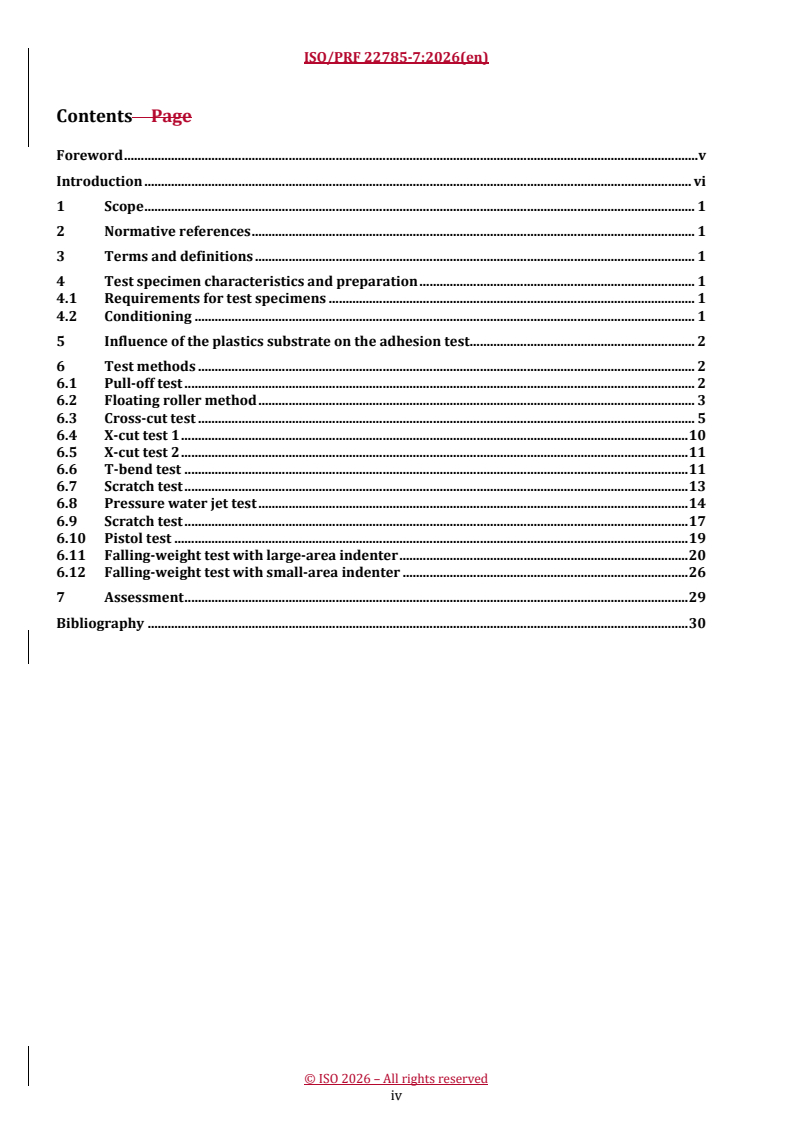
Contents Page
Foreword .iv
Introduction .v
1 Scope . 1
2 Normative references . 1
3 Terms and definitions . 1
4 Test specimen characteristics and preparation . 1
4.1 Requirements for test specimens .1
4.2 Conditioning.1
5 Influence of the plastics substrate on the adhesion test . 2
6 Test methods . 2
6.1 Pull-off test .2
6.2 Floating roller method .3
6.3 Cross-cut test .4
6.4 X-cut test 1 .7
6.5 X-cut test 2 .7
6.6 T-bend test .8
6.7 Scratch test .8
6.8 Pressure water jet test .9
6.9 Scratch test .11
6.10 Pistol test . 12
6.11 Falling-weight test with large-area indenter . 13
6.12 Falling-weight test with small-area indenter .16
7 Assessment . .18
Bibliography . 19
PROOF/ÉPREUVE
iii
ISO 22785-7:2026(en)
Foreword
ISO (the International Organization for Standardization) is a worldwide federation of national standards
bodies (ISO member bodies). The work of preparing International Standards is normally carried out through
ISO technical committees. Each member body interested in a subject for which a technical committee
has been established has the right to be represented on that committee. International organizations,
governmental and non-governmental, in liaison with ISO, also take part in the work. ISO collaborates closely
with the International Electrotechnical Commission (IEC) on all matters of electrotechnical standardization.
The procedures used to develop this document and those intended for its further maintenance are described
in the ISO/IEC Directives, Part 1. In particular, the different approval criteria needed for the different types
of ISO document should be noted. This document was drafted in accordance with the editorial rules of the
ISO/IEC Directives, Part 2 (see www.iso.org/directives).
ISO draws attention to the possibility that the implementation of this document may involve the use of (a)
patent(s). ISO takes no position concerning the evidence, validity or applicability of any claimed patent
rights in respect thereof. As of the date of publication of this document, ISO had not received notice of (a)
patent(s) which may be required to implement this document. However, implementers are cautioned that
this may not represent the latest information, which may be obtained from the patent database available at
www.iso.org/patents. ISO shall not be held responsible for identifying any or all such patent rights.
Any trade name used in this document is information given for the convenience of users and does not
constitute an endorsement.
For an explanation of the voluntary nature of standards, the meaning of ISO specific terms and expressions
related to conformity assessment, as well as information about ISO's adherence to the World Trade
Organization (WTO) principles in the Technical Barriers to Trade (TBT), see www.iso.org/iso/foreword.html.
This document was prepared by Technical Committee ISO/TC 35, Paints and varnishes, Subcommittee SC 9,
General test methods for paints and varnishes.
A list of all parts in the ISO 22785 series can be found on the ISO website.
Any feedback or questions on this document should be directed to the user’s national standards body. A
complete listing of these bodies can be found at www.iso.org/members.html.
PROOF/ÉPREUVE
iv
ISO 22785-7:2026(en)
Introduction
Many of the existing test methods for determining the adhesion of coatings have been developed for metallic
substrates.
This document explains characteristics of plastics and differences between plastics substrates and metallic
substrates, and it shows their potential effect on the behaviour of the coating in different test methods.
It is possible that the substrate has an effect on the behaviour of the coating during the test. It is therefore
sometimes useful to select test conditions that are based, for example, on standards from the plastics sector
and not on standards from the coatings sector, in order to take into account influencing factors such as the
thermal conductivity of the substrate.
PROOF/ÉPREUVE
v
International Standard ISO 22785-7:2026(en)
Paints and varnishes — Coatings on plastics and
composites —
Part 7:
Adhesion
1 Scope
This document specifies the testing of adhesion of coatings on plastics, plastics composites and similar
substrates.
It also provides an overview of common test methods.
2 Normative references
The following documents are referred to in the text in such a way that some or all of their content constitutes
requirements of this document. For dated references, only the edition cited applies. For undated references,
the latest edition of the referenced document (including any amendments) applies.
ISO 4618, Paints and varnishes — Vocabulary
ISO 22785-1, Coatings on plastics and composites — Part 1: General introduction
3 Terms and definitions
For the purposes of this document, the terms and definitions given in ISO 4618 and ISO 22785-1 apply.
ISO and IEC maintain terminology databases for use in standardization at the following addresses:
— ISO Online browsing platform: available at https:// www .iso .org/ obp
— IEC Electropedia: available at https:// www .electropedia .org/
4 Test specimen characteristics and preparation
4.1 Requirements for test specimens
Both coatings on test specimen panels specified in ISO 1514 and coatings on components are tested.
Depending on the selected test method, there are different requirements for the geometry of the test
specimen.
It is important that the substrates are free from flaws and damage of any kind that could adversely affect
appearance and properties.
The coating system and the substrate are selected together with the pre-treatment and coating methods so
that a homogeneous coating is achieved. The film thickness is documented in accordance with the technical
requirements relating to the visual appearance and/or coating.
4.2 Conditioning
Conditioning serves to improve the repeatability and reproducibility of test results.
PROOF/ÉPREUVE
ISO 22785-7:2026(en)
As the properties of plastics substrates depend greatly on humidity levels and conditioning usually takes
longer than for metals, a longer conditioning time is usually required for plastics substrates.
The values and times to be selected depend on the test specimen to be tested.
Unless specified otherwise, the test specimens are conditioned for 16 h under standard climatic conditions
specified in ISO 3270.
5 Influence of the plastics substrate on the adhesion test
The chemical and physical properties of plastics and composites as substrates are very different from those
of metallic substrates.
The hardness and flexibility of the substrate can influence the result of testing stone-chip resistance.
The hardness and flexibility of the substrate depend on temperature. For more details, see ISO 22785-1.
Results obtained with flexible plastics substrates and hard plastics substrates are not comparable.
For methods using cutting tools, care shall be taken not to damage the substrate. This can be achieved by
reduced forces when applying cuts.
6 Test methods
6.1 Pull-off test
Three methods for determining adhesion are described in ISO 4624:
— Method A: using two dollies for testing on both rigid and deformable plates;
— Method B: for testing from one side only, using a single dolly (suitable for rigid plates only);
— Method C: using dollies, one of which is coated with the coating material to be tested.
The test can be carried out on numerous substrates. The method differs depending on whether this involves
a deformable substrate, such as thin metal, plastics and wood, or a rigid substrate, such as thick concrete
slabs and metal plates. The sandwich structure is usually used in order to prevent the substrate from
bending during the adhesion test. With flexible plastics, it shall be ensured that the test specimen does not
deflect during the test. To do this, either the test specimen plate is glued onto a firm surface or the test is
carried out with two dollies glued on using the sandwich method. For special purposes, the coating material
may be applied onto a dolly, for example.
Dollies are glued onto the dried/cured coating.
Once the adhesive has cured, the dollies are pulled off with a tensile tester and the force required to pull off
the dolly is measured.
The test result is the minimum tensile stress that shall be applied in order for the weakest interface (adhesion
failure) or the weakest point (cohesion failure) of the test assembly to fail. Adhesion and cohesion failures
can also occur alongside one another (mixed failures).
A schematic representation of the principle of the pull-off test is shown in Figure 1.
PROOF/ÉPREUVE
ISO 22785-7:2026(en)
Key
1 substrate
2 coating
3 adhesive layer
4 clearance
5 dolly
6 outer ring for supporting the test specimen plate
a
Pull-off direction.
Figure 1 — Principle of the pull-off test
6.2 Floating roller method
The floating roller method is specified in EN 1464.
In accordance with Figure 2, the test specimen is inserted into the retaining device, whereby the non-
glued section of the flexible adherend is clamped into the clamp of the testing machine. Unless otherwise
specified, the test specimens are separated at a constant cross bar advance speed of (100 ± 5) mm/min. If
the rigid adherend bends or warps during the test, the test specimen is designed with a rigid adherend of
sufficient flexural stiffness to ensure uniform peeling. During the peel test, the force counter to the cross-
bar movement (force counter to peeling distance) is recorded over a length of at least 115 mm of the bond
line, whereby the first 25 mm of the peeling distance are disregarded. The results in which a fracture lies
outside of the peeling zone specified in Figure 2 are disregarded.
PROOF/ÉPREUVE
ISO 22785-7:2026(en)
Dimensions in millimetres
Key
1 rigid adherend
2 peeling zone
3 flexible adherend
4 structural steel
5 double roller bearings
Figure 2 — Holder for mounting the test specimens for the peel test
To make separation easier in the starting area, an adhesive tape or fabric can be inserted during the
production process in order to facilitate layer separation on one side.
The average peeling force in Newtons per millimetre (N/mm) test specimen width that is required to
separate the adherends from one another is determined from the automatically recorded curve for a peeling
distance of at least 115 mm (whereby the first 25 mm and the last 25 mm are disregarded).
The average, the maximum and the mi
...
ISO/DISPRF 22785-7:2026(en)
ISO/TC 35/SC 9
Secretariat: BSI
Date: 2026-05-2209-30
Paints and varnishes — Coatings on plastics and composites —
Part 7:
Adhesion
© PROOF
ISO/DISPRF 22785-7:2026(en)
All rights reserved. Unless otherwise specified,
This ISO publication is protected by copyright and is owned by ISO and/or its licensors.
The content of this ISO publication is provided under licence, not sold. Use is subject to the applicable licence terms issued
by ISO, an ISO member body, or an authorized third-party distributor.
Except as required in the context of its for implementation or expressly permitted by a separate licence, no part of this
ISO publication may be reproduced or utilized otherwise, distributed, modified, used, or made available in any form or
by any means, – electronic or mechanical, including photocopying, scanning, recording, or posting on internal or external
digital platforms.
Any use beyond the internet or an intranet, without prior written permission. Permission can be requested from either
ISO at the address below or ISO’s member body in the countryscope of the requestergranted rights is prohibited and may
result in legal action.
ISO copyright office
CP 401 • Ch. de Blandonnet 8
CH-1214 Vernier, Geneva
Phone: + 41 22 749 01 11
Email: copyright@iso.org
Website: www.iso.org
Published in Switzerland
iii
Contents Page
Foreword . v
Introduction . vi
1 Scope . 1
2 Normative references . 1
3 Terms and definitions . 1
4 Test specimen characteristics and preparation . 1
4.1 Requirements for test specimens . 1
4.2 Conditioning . 1
5 Influence of the plastics substrate on the adhesion test . 2
6 Test methods . 2
6.1 Pull-off test . 2
6.2 Floating roller method . 3
6.3 Cross-cut test . 5
6.4 X-cut test 1 . 10
6.5 X-cut test 2 . 11
6.6 T-bend test . 11
6.7 Scratch test . 13
6.8 Pressure water jet test . 14
6.9 Scratch test . 17
6.10 Pistol test . 19
6.11 Falling-weight test with large-area indenter . 20
6.12 Falling-weight test with small-area indenter . 26
7 Assessment . 29
Bibliography . 30
iv
ISO/DISPRF 22785-7:2026(en)
Foreword
ISO (the International Organization for Standardization) is a worldwide federation of national standards
bodies (ISO member bodies). The work of preparing International Standards is normally carried out through
ISO technical committees. Each member body interested in a subject for which a technical committee has been
established has the right to be represented on that committee. International organizations, governmental and
non-governmental, in liaison with ISO, also take part in the work. ISO collaborates closely with the
International Electrotechnical Commission (IEC) on all matters of electrotechnical standardization.
The procedures used to develop this document and those intended for its further maintenance are described
in the ISO/IEC Directives, Part 1. In particular, the different approval criteria needed for the different types of
ISO document should be noted. This document was drafted in accordance with the editorial rules of the
ISO/IEC Directives, Part 2 (see www.iso.org/directives).
ISO draws attention to the possibility that the implementation of this document may involve the use of (a)
patent(s). ISO takes no position concerning the evidence, validity or applicability of any claimed patent rights
in respect thereof. As of the date of publication of this document, ISO had not received notice of (a) patent(s)
which may be required to implement this document. However, implementers are cautioned that this may not
represent the latest information, which may be obtained from the patent database available at
www.iso.org/patents. ISO shall not be held responsible for identifying any or all such patent rights.
Any trade name used in this document is information given for the convenience of users and does not
constitute an endorsement.
For an explanation of the voluntary nature of standards, the meaning of ISO specific terms and expressions
related to conformity assessment, as well as information about ISO's adherence to the World Trade
Organization (WTO) principles in the Technical Barriers to Trade (TBT), see www.iso.org/iso/foreword.html.
This document was prepared by Technical Committee ISO/TC 35, Paints and varnishes, Subcommittee SC 9,
General test methods for paints and varnishes.
A list of all parts in the ISO 22785 series can be found on the ISO website.
Any feedback or questions on this document should be directed to the user’s national standards body. A
complete listing of these bodies can be found at www.iso.org/members.html.
v
Introduction
Many of the existing test methods for determining the adhesion of coatings have been developed for metallic
substrates.
This document explains characteristics of plastics and differences between plastics substrates and metallic
substrates, and it shows their potential effect on the behaviour of the coating in different test methods.
It is possible that the substrate has an effect on the behaviour of the coating during the test. It is therefore
sometimes useful to select test conditions that are based, for example, on standards from the plastics sector
and not on standards from the coatings sector, in order to take into account influencing factors such as the
thermal conductivity of the substrate.
vi
DRAFT International Standard ISO/DIS 22785-7:2026(en)
Paints and varnishes — Coatings on plastics and composites — —
Part 7:
Adhesion
1 Scope
This document specifies the testing of adhesion of coatings on plastics, plastics composites and similar
substrates.
It also provides an overview of common test methods.
2 Normative references
The following documents are referred to in the text in such a way that some or all of their content constitutes
requirements of this document. For dated references, only the edition cited applies. For undated references,
the latest edition of the referenced document (including any amendments) applies.
ISO 4618, Paints and varnishes — Vocabulary
ISO 22785--1, Coatings on plastics and composites — Part 1: General introduction
3 Terms and definitions
For the purposes of this document, the terms and definitions given in ISO 4618 and ISO 22785-1 apply.
ISO and IEC maintain terminology databases for use in standardization at the following addresses:
— — ISO Online browsing platform: available at https://www.iso.org/obp
— — IEC Electropedia: available at https://www.electropedia.org/
4 Test specimen characteristics and preparation
4.1 Requirements for test specimens
Both coatings on test specimen panels specified in ISO 1514 and coatings on components are tested.
Depending on the selected test method, there are different requirements for the geometry of the test specimen.
It is important that the substrates are free from flaws and damage of any kind that could adversely affect
appearance and properties.
The coating system and the substrate are selected together with the pre-treatment and coating methods so
that a homogeneous coating is achieved. The film thickness is documented in accordance with the technical
requirements relating to the visual appearance and/or coating.
4.2 Conditioning
Conditioning serves to improve the repeatability and reproducibility of test results.
As the properties of plastics substrates depend greatly on humidity levels and conditioning usually takes
longer than for metals, a longer conditioning time is usually required for plastics substrates.
The values and times to be selected depend on the test specimen to be tested.
Unless specified otherwise, the test specimens are conditioned for 16 h under standard climatic conditions
specified in ISO 3270.
5 Influence of the plastics substrate on the adhesion test
The chemical and physical properties of plastics and composites as substrates are very different from those of
metallic substrates.
The hardness and flexibility of the substrate can influence the result of testing stone-chip resistance.
The hardness and flexibility of the substrate depend on temperature. For more details, see ISO 22785-1.
Results obtained with flexible plastics substrates and hard plastics substrates are not comparable.
For methods using cutting tools, care shall be taken not to damage the substrate. This can be achieved by
reduced forces when applying cuts.
6 Test methods
6.1 Pull-off test
Three methods for determining adhesion are described in ISO 4624:
— — Method A: using two dollies for testing on both rigid and deformable plates;
— — Method B: for testing from one side only, using a single dolly (suitable for rigid plates only);
— — Method C: using dollies, one of which is coated with the coating material to be tested.
The test can be carried out on numerous substrates. The method differs depending on whether this involves
a deformable substrate, such as thin metal, plastics and wood, or a rigid substrate, such as thick concrete slabs
and metal plates. The sandwich structure is usually used in order to prevent the substrate from bending during
the adhesion test. With flexible plastics, it shall particularly be ensured that the test specimen does not deflect
during the test. To do this, either the test specimen plate is glued onto a firm surface or the test is carried out
with two dollies glued on using the sandwich method. For special purposes, the coating material may be
applied onto a dolly, for example.
Dollies are glued onto the dried/cured coating.
Once the adhesive has cured, the dollies are pulled off with a tensile tester and the force required to pull off
the dolly is measured.
The test result is the minimum tensile stress that shall be applied in order for the weakest interface (adhesion
failure) or the weakest point (cohesion failure) of the test assembly to fail. Adhesion and cohesion failures can
also occur alongside one another (mixed failures).
A schematic representation of the principle of the pull-off test is shown in Figure 1Figure 1.
ISO/DISPRF 22785-7:2026(en)
Key
1 substrate
2 coating
3 adhesive layer
4 clearance
5 dolly
6 outer ring for supporting the test specimen plate
a
Pull-off direction.
Figure 1 — Principle of the pull-off test
6.2 Floating roller method
The floating roller method is specified in EN 1464.
In accordance with Figure 2Figure 2,, the test specimen is inserted into the retaining device, whereby the non-
glued section of the flexible adherend is clamped into the clamp of the testing machine. Unless otherwise
specified, the test specimens are separated at a constant cross bar advance speed of (100 ± 5) mm/min. If the
rigid adherend bends or warps during the test, the test specimen is designed with a rigid adherend of sufficient
flexural stiffness to ensure uniform peeling. During the peel test, the force counter to the cross-bar movement
(force counter to peeling distance) is recorded over a length of at least 115 mm of the bond line, whereby the
first 25 mm of the peeling distance are disregarded. The results in which a fracture lies outside of the peeling
zone specified in Figure 2Figure 2 are disregarded.
Dimensions in millimetres
Key
ISO/DISPRF 22785-7:2026(en)
1 rigid adherend
2 peeling zone
3 flexible adherend
4 structural steel
5 double roller bearings
Figure 2 — Holder for mounting the test specimens for the peel test
To make separation easier in the starting area, an adhesive tape or fabric can be inserted during the
production process in order to facilitate layer separation on one side.
The average peeling force in Newtons per millimetre (N/mm) test specimen width that is required to separate
the adherends from one another is determined from the automatically recorded curve for a peeling distance
of at least 115 mm (whereby the first 25 mm and the last 25 mm are disregarded).
The average, the maximum and the minimum force are recorded for each test specimen.
6.3 Cross-cut test
The cross-cut test is specified in ISO 2409.
The cross-cut test is a test method for assessing the resistance of coatings to separation from the substrate
when a rectangular grid reaching down to the substrate is cut into the coating. In addition to other factors, a
property determined in accordance with this empirical method is dependent on the adhesion of the coating
on the previously applied layer or on the substrate. However, this method is not a method purely for
measuring adhesion.
Although the method is applicable to coatings on hard and soft substrates, these different substrates
necessitate a different method.
The cut spacing in each direction shall be identical and as follows, depending on the coating layer thickness
and the type of substrate:
1 1)
— — up to 60 µm: 1 mm spacing for hard substrates such as duroplastics (e.g. GRP, CRP ); );
— — up to 60 µm: 2 mm spacing for soft substrates such as thermoplastics, PP/EPDM, polyamides,
2 2)
ABS/PC/PCPBT ; ;
— — 61 µm to 120 µm: 2 mm spacing for hard and soft substrates;
— — 121 µm to 250 µm: 3 mm spacing for hard and soft substrates.
In some specifications, the X--cut test is recommended for hard substra
...