

ISO 16960:2014
(Main)Natural gas — Determination of sulfur compounds — Determination of total sulfur by oxidative microcoulometry method
General Information
- Abstract
ISO 16960:2014 specifies a method for the determination of total sulfur in the range from 1 mg/m3 to 200 mg/m3 in pipeline natural gas by oxidative microcoulometry. Natural gas with sulfur contents above 200 mg/m3 can be analysed after dilution with a suitable sulfur-free solvent.
- Status
- Published
- Publication Date
- 29-Sep-2014
- Technical Committee
- ISO/TC 193/SC 1 - Analysis of natural gas
- Drafting Committee
- ISO/TC 193/SC 1 - Analysis of natural gas
- Current Stage
- 9093 - International Standard confirmed
- Start Date
- 25-Jun-2025
- Completion Date
- 29-Aug-2026
Buy Documents
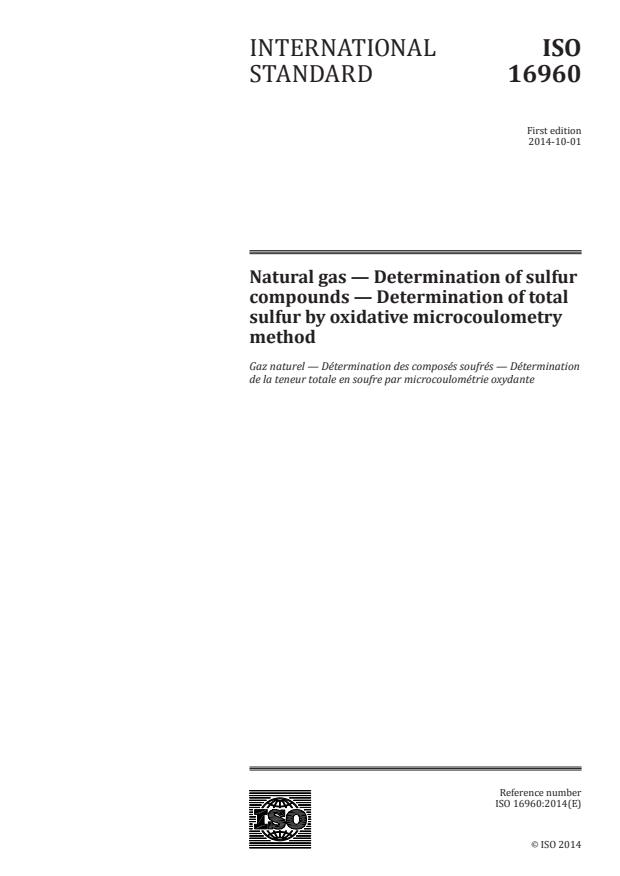
ISO 16960:2014 - Natural gas — Determination of sulfur compounds — Determination of total sulfur by oxidative microcoulometry method Released:9/30/2014
ISO 16960:2014 - Gaz naturel — Détermination des composés soufrés — Détermination de la teneur totale en soufre par microcoulométrie oxydante Released:9/30/2014
Overview - ISO 16960:2014 (Natural gas - Determination of total sulfur by oxidative microcoulometry)
ISO 16960:2014 specifies an analytical method to determine total sulfur in pipeline natural gas using oxidative microcoulometry. The method covers the range 1 mg/m3 to 200 mg/m3; samples with higher sulfur content can be analysed after dilution with a suitable sulfur‑free solvent. The standard describes the test principle, required reagents and apparatus, sampling and injection procedures, calculation and quality checks necessary for reliable sulfur quantification.
Key technical topics and requirements
- Test principle: Sulfur compounds in a gas sample are converted to SO2 by oxidative pyrolysis in a quartz furnace. SO2 is titrated in an electrolyte containing iodine; consumed iodine is replenished by electrolysis of potassium iodide and quantified by microcoulometry. Sulfur mass is calculated from the measured electric charge (Faraday’s law) and corrected using a conversion factor from a reference standard.
- Measurement range: 1–200 mg/m3 (dilution recommended for higher concentrations).
- Reagents and gases: Grade 3 water (ISO 3696), glacial acetic acid, potassium iodide, oxygen (≥99.99% purity) and carrier gas (argon, helium or nitrogen ≥99.99%).
- Apparatus: quartz furnace with three heating zones (preheat ~800 °C, combustion ~900 °C, exit ~800 °C), titration cell with electrolysis and indicator electrodes, microcoulometer, flow controller, electromagnetic stirrer, calibrated syringes and volumetric flask.
- Calibration and validation: Use calibration gas mixtures prepared per ISO 6142 / ISO 6144 / ISO 6145; recommended reference species include COS or H2S. Determine and monitor the sulfur conversion rate (average of five consecutive runs with RSD ≤ 2%). Conversion rates below 75% require investigation.
- Sampling: Pipeline sampling follows ISO 10715; cylinder handling and syringe injection protocols are specified (injection speeds/volumes and syringe flushing).
Practical applications and users
- Industrial and laboratory analysis of pipeline natural gas quality for regulatory compliance, custody transfer, environmental reporting and process control.
- Users: gas analysis laboratories, pipeline operators, gas processors, QA/QC teams, environmental compliance officers, and instrument manufacturers supplying microcoulometric analyzers.
- Benefits: direct measurement of total sulfur (sum of sulfur species) without separate speciation, suitable for routine monitoring within the specified range.
Related standards
- ISO 6326-3 (potentiometry for H2S/mercaptans/COS), ISO 6326-5 (combustion), ISO 19739 (GC methods); ISO 3696, ISO 6142, ISO 6144, ISO 6145 and ISO 10715 are normative references for reagents, calibration gas preparation and sampling.
Keywords: ISO 16960:2014, natural gas, total sulfur, oxidative microcoulometry, microcoulometer, sulfur determination, pipeline natural gas, sulfur conversion rate, calibration gas.
Relations
- Effective Date
- 12-Feb-2026
- Consolidates
ISO 5834-1:2005 - Implants for surgery — Ultra-high-molecular-weight polyethylene — Part 1: Powder form - Effective Date
- 06-Jun-2022
Buy Documents
ISO 16960:2014 - Natural gas — Determination of sulfur compounds — Determination of total sulfur by oxidative microcoulometry method Released:9/30/2014
ISO 16960:2014 - Gaz naturel — Détermination des composés soufrés — Détermination de la teneur totale en soufre par microcoulométrie oxydante Released:9/30/2014
Get Certified
Connect with accredited certification bodies for this standard

Element Materials Technology
Materials testing and product certification.

ABS Group Brazil
ABS Group certification services in Brazil.

ABS Quality Evaluations Inc.
American Bureau of Shipping quality certification.
Sponsored listings
Frequently Asked Questions
ISO 16960:2014 is a standard published by the International Organization for Standardization (ISO). Its full title is "Natural gas — Determination of sulfur compounds — Determination of total sulfur by oxidative microcoulometry method". This standard covers: ISO 16960:2014 specifies a method for the determination of total sulfur in the range from 1 mg/m3 to 200 mg/m3 in pipeline natural gas by oxidative microcoulometry. Natural gas with sulfur contents above 200 mg/m3 can be analysed after dilution with a suitable sulfur-free solvent.
ISO 16960:2014 specifies a method for the determination of total sulfur in the range from 1 mg/m3 to 200 mg/m3 in pipeline natural gas by oxidative microcoulometry. Natural gas with sulfur contents above 200 mg/m3 can be analysed after dilution with a suitable sulfur-free solvent.
ISO 16960:2014 is classified under the following ICS (International Classification for Standards) categories: 75.060 - Natural gas. The ICS classification helps identify the subject area and facilitates finding related standards.
ISO 16960:2014 has the following relationships with other standards: It is inter standard links to EN ISO 16960:2014, ISO 5834-1:2005. Understanding these relationships helps ensure you are using the most current and applicable version of the standard.
ISO 16960:2014 is available in PDF format for immediate download after purchase. The document can be added to your cart and obtained through the secure checkout process. Digital delivery ensures instant access to the complete standard document.
Standards Content (Sample)
INTERNATIONAL ISO
STANDARD 16960
First edition
2014-10-01
Natural gas — Determination of sulfur
compounds — Determination of total
sulfur by oxidative microcoulometry
method
Gaz naturel — Détermination des composés soufrés — Détermination
de la teneur totale en soufre par microcoulométrie oxydante
Reference number
©
ISO 2014
© ISO 2014
All rights reserved. Unless otherwise specified, no part of this publication may be reproduced or utilized otherwise in any form
or by any means, electronic or mechanical, including photocopying, or posting on the internet or an intranet, without prior
written permission. Permission can be requested from either ISO at the address below or ISO’s member body in the country of
the requester.
ISO copyright office
Case postale 56 • CH-1211 Geneva 20
Tel. + 41 22 749 01 11
Fax + 41 22 749 09 47
E-mail copyright@iso.org
Web www.iso.org
Published in Switzerland
ii © ISO 2014 – All rights reserved
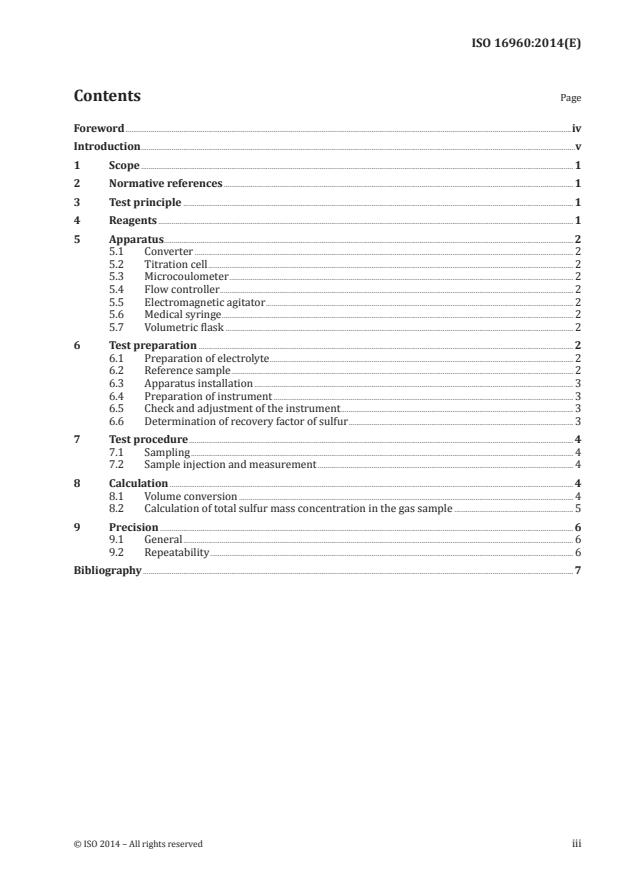
Contents Page
Foreword .iv
Introduction .v
1 Scope . 1
2 Normative references . 1
3 Test principle . 1
4 Reagents . 1
5 Apparatus . 2
5.1 Converter . 2
5.2 Titration cell . 2
5.3 Microcoulometer . 2
5.4 Flow controller. 2
5.5 Electromagnetic agitator . 2
5.6 Medical syringe . 2
5.7 Volumetric flask . 2
6 Test preparation . 2
6.1 Preparation of electrolyte . 2
6.2 Reference sample . 2
6.3 Apparatus installation . 3
6.4 Preparation of instrument . 3
6.5 Check and adjustment of the instrument . 3
6.6 Determination of recovery factor of sulfur . 3
7 Test procedure . 4
7.1 Sampling . 4
7.2 Sample injection and measurement . 4
8 Calculation . 4
8.1 Volume conversion . 4
8.2 Calculation of total sulfur mass concentration in the gas sample . 5
9 Precision . 6
9.1 General . 6
9.2 Repeatability . 6
Bibliography . 7
Foreword
ISO (the International Organization for Standardization) is a worldwide federation of national standards
bodies (ISO member bodies). The work of preparing International Standards is normally carried out
through ISO technical committees. Each member body interested in a subject for which a technical
committee has been established has the right to be represented on that committee. International
organizations, governmental and non-governmental, in liaison with ISO, also take part in the work.
ISO collaborates closely with the International Electrotechnical Commission (IEC) on all matters of
electrotechnical standardization.
The procedures used to develop this document and those intended for its further maintenance are
described in the ISO/IEC Directives, Part 1. In particular the different approval criteria needed for the
different types of ISO documents should be noted. This document was drafted in accordance with the
editorial rules of the ISO/IEC Directives, Part 2 (see www.iso.org/directives).
Attention is drawn to the possibility that some of the elements of this document may be the subject of
patent rights. ISO shall not be held responsible for identifying any or all such patent rights. Details of
any patent rights identified during the development of the document will be in the Introduction and/or
on the ISO list of patent declarations received (see www.iso.org/patents).
Any trade name used in this document is information given for the convenience of users and does not
constitute an endorsement.
For an explanation on the meaning of ISO specific terms and expressions related to conformity
assessment, as well as information about ISO’s adherence to the WTO principles in the Technical Barriers
to Trade (TBT) see the following URL: Foreword - Supplementary information
The committee responsible for this document is ISO/TC 193, Natural gas, Subcommittee SC 1, Analysis
of natural gas.
iv © ISO 2014 – All rights reserved
Introduction
Three methods for determination of sulfur compounds in natural gas already exist as International
Standards:
— ISO 6326-3, Natural gas — Determination of sulfur compounds — Part 3: Determination of hydrogen
sulfide, mercaptan sulfur and carbonyl sulfide sulfur by potentiometry;
— ISO 6326-5, Natural gas — Determination of sulfur compounds — Part 5: Lingener combustion
method;
— ISO 19739, Natural gas — Determination of sulfur compounds using gas chromatography.
INTERNATIONAL STANDARD ISO 16960:2014(E)
Natural gas — Determination of sulfur compounds —
Determination of total sulfur by oxidative microcoulometry
method
WARNING — The use of this International Standard can involve hazardous material, operations,
and equipment. This International Standard does not purport to address all of the safety
problems associated with its use. It is the responsibility of the user of this Inter
...
NORME ISO
INTERNATIONALE 16960
Première édition
2014-10-01
Gaz naturel — Détermination des
composés soufrés — Détermination
de la teneur totale en soufre par
microcoulométrie oxydante
Natural gas — Determination of sulfur compounds — Determination
of total sulfur by oxidative microcoulometry method
Numéro de référence
©
ISO 2014
DOCUMENT PROTÉGÉ PAR COPYRIGHT
© ISO 2014
Droits de reproduction réservés. Sauf indication contraire, aucune partie de cette publication ne peut être reproduite ni utilisée
sous quelque forme que ce soit et par aucun procédé, électronique ou mécanique, y compris la photocopie, l’affichage sur
l’internet ou sur un Intranet, sans autorisation écrite préalable. Les demandes d’autorisation peuvent être adressées à l’ISO à
l’adresse ci-après ou au comité membre de l’ISO dans le pays du demandeur.
ISO copyright office
Case postale 56 • CH-1211 Geneva 20
Tel. + 41 22 749 01 11
Fax + 41 22 749 09 47
E-mail copyright@iso.org
Web www.iso.org
Publié en Suisse
ii © ISO 2014 – Tous droits réservés
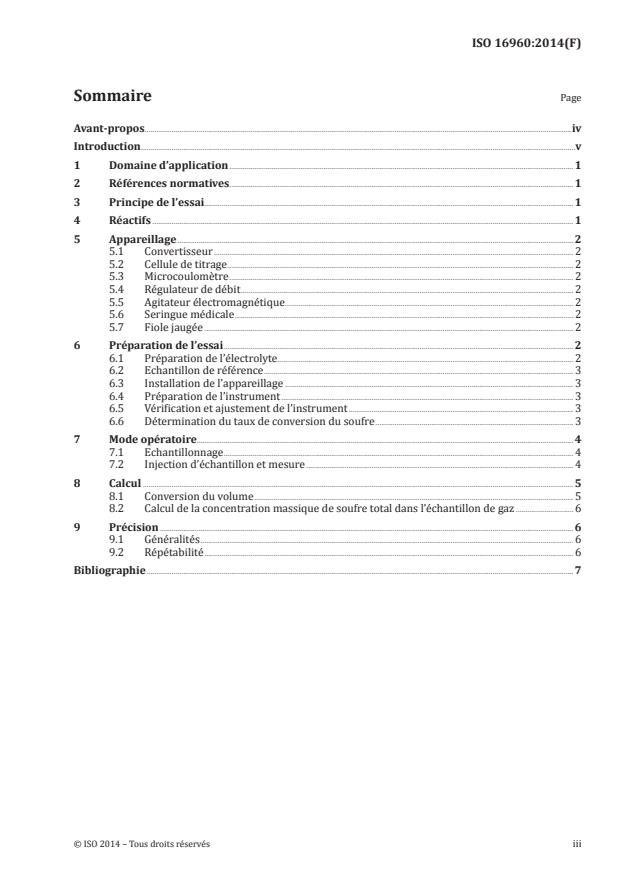
Sommaire Page
Avant-propos .iv
Introduction .v
1 Domaine d’application . 1
2 Références normatives . 1
3 Principe de l’essai . 1
4 Réactifs . 1
5 Appareillage . 2
5.1 Convertisseur . 2
5.2 Cellule de titrage . 2
5.3 Microcoulomètre . 2
5.4 Régulateur de débit . 2
5.5 Agitateur électromagnétique . 2
5.6 Seringue médicale . 2
5.7 Fiole jaugée . 2
6 Préparation de l’essai . 2
6.1 Préparation de l’électrolyte . 2
6.2 Echantillon de référence . 3
6.3 Installation de l’appareillage . 3
6.4 Préparation de l’instrument . 3
6.5 Vérification et ajustement de l’instrument . 3
6.6 Détermination du taux de conversion du soufre . 3
7 Mode opératoire. 4
7.1 Echantillonnage . 4
7.2 Injection d’échantillon et mesure . 4
8 Calcul . 5
8.1 Conversion du volume . 5
8.2 Calcul de la concentration massique de soufre total dans l’échantillon de gaz . 6
9 Précision . 6
9.1 Généralités . 6
9.2 Répétabilité . 6
Bibliographie . 7
Avant-propos
L’ISO (Organisation internationale de normalisation) est une fédération mondiale d’organismes
nationaux de normalisation (comités membres de l’ISO). L’élaboration des Normes internationales est
en général confiée aux comités techniques de l’ISO. Chaque comité membre intéressé par une étude
a le droit de faire partie du comité technique créé à cet effet. Les organisations internationales,
gouvernementales et non gouvernementales, en liaison avec l’ISO participent également aux travaux.
L’ISO collabore étroitement avec la Commission électrotechnique internationale (IEC) en ce qui concerne
la normalisation électrotechnique.
Les procédures utilisées pour élaborer le présent document et celles destinées à sa mise à jour sont
décrites dans les Directives ISO/IEC, Partie 1. Il convient, en particulier de prendre note des différents
critères d’approbation requis pour les différents types de documents ISO. Le présent document a été
rédigé conformément aux règles de rédaction données dans les Directives ISO/IEC, Partie 2, www.iso.
org/directives.
L’attention est appelée sur le fait que certains des éléments du présent document peuvent faire l’objet de
droits de propriété intellectuelle ou de droits analogues. L’ISO ne saurait être tenue pour responsable
de ne pas avoir identifié de tels droits de propriété et averti de leur existence. Les détails concernant les
références aux droits de propriété intellectuelle ou autres droits analogues identifiés lors de l’élaboration
du document sont indiqués dans l’Introduction et/ou sur la liste ISO des déclarations de brevets reçues,
www.iso.org/brevets.
Les éventuelles appellations commerciales utilisées dans le présent document sont données pour
information à l’intention des utilisateurs et ne constituent pas une approbation ou une recommandation.
Pour une explication de la signification des termes et expressions spécifiques de l’ISO liés à l’évaluation de
la conformité, aussi bien que pour des informations au-sujet de l’adhésion de l’ISO aux principes de l’OMC
concernant les obstacles techniques au commerce (OTC) voir le lien suivant: Foreword - Supplementary
information.
L’ISO 16960 a été élaborée par le comité technique ISO/TC 193, Gaz naturel, sous-comité SC 1, Analyse du
gaz naturel.
iv © ISO 2014 – Tous droits réservés
Introduction
Trois méthodes existent déjà comme Normes internationales pour la détermination de la teneur totale
en soufre dans le gaz naturel:
— ISO 6326-3, Gaz naturel — Détermination des composés soufrés — Partie 3: Détermination du
sulfure d’hydrogène, des thiols et du sulfure de carbonyle par potentiométrie;
— ISO 6326-5, Gaz naturel — Détermination des composés soufrés — Partie 5: Méthode de combustion
Lingener;
— ISO 19739, Gaz naturel — Détermination des composés soufrés par chromatographie en phase
gazeuse.
NORME INTERNATIONALE ISO 16960:2014(F)
Gaz naturel — Détermination des composés soufrés
— Détermination de la teneur totale en soufre par
microcoulométrie oxydante
AVERTISSEMENT — L’utilisation de cette Norme internationale peut impliquer des matières,
opérations et équipements dangereux. Cette Norme internationale ne prétend pas traiter
de toutes les questions de sécurité associées à son utilisation. Il est de la responsabilité de
l’utilisateur de cette Norme internationale d’établir des pratiques appropriées pour la sécurité
et la santé et de déterminer l’applicabilité des restrictions réglementaires avant son application.
1 Domaine d’application
La présente Norme internationale spécifie une méthode de détermination de la teneur totale en soufre
3 3
dans la plage de 1 mg/m à 200 mg/m dans les canalisations de gaz naturel par microcoulométrie
oxydante. Le gaz naturel avec des teneu
...