

ISO 18185-4:2007
(Main)Freight containers — Electronic seals — Part 4: Data protection
General Information
- Abstract
ISO 18185-4:2007 specifies requirements for the data protection, device authentication and conformance capabilities of electronic seals for communication to and from a seal and its associated reader. These capabilities include the accessibility, confidentiality, data integrity, authentication and non-repudiation of stored data.
- Status
- Published
- Publication Date
- 23-Apr-2007
- Technical Committee
- ISO/TC 104/SC 4 - Identification and communication
- Current Stage
- 9093 - International Standard confirmed
- Start Date
- 28-Mar-2022
- Completion Date
- 29-Aug-2026
Overview
ISO 18185-4:2007 - "Freight containers - Electronic seals - Part 4: Data protection" defines requirements for the protection, authentication and conformance capabilities of electronic seals used on freight containers. The standard focuses on ensuring the accessibility, integrity and non‑repudiation of data stored in or communicated by electronic seals (RFID-based seal tags), and on methods for verifying device authenticity and meeting mechanical conformance expectations.
Key topics and technical requirements
- Data protection scope: Addresses confidentiality, integrity and accessibility of seal data. In this first‑generation specification, all seal communications are deemed public information and transmitted in clear text; the emphasis is on protecting data integrity rather than encrypting transmissions.
- Fixed data vs. variable data:
- Fixed data (e.g., manufacturer ID, tag serial number, model, protocol/version) must be protected against erasure or alteration after manufacture.
- Variable data (e.g., time of seal closure/opening, battery status, event log) must be appended to the seal’s memory as permanent records and protected against modification or deletion during the seal’s lifetime.
- Device authentication:
- Requires capability for physical (forensic) authentication so manufacturers can validate mechanical and electronic components and unique manufacturing characteristics.
- No electronic authentication (via transmitted cryptographic credentials) is required in this first edition.
- Conformance:
- Electronic seals claiming compliance must meet the high security mechanical properties specified in ISO/PAS 17712 and follow the manufacturer security practices outlined in Annex A.
- Normative references: ISO/IEC 17025, ISO/PAS 17712, ISO 18185‑3 (environmental characteristics).
Applications and who uses the standard
ISO 18185-4 is intended for stakeholders in container security, logistics and supply chain operations:
- Electronic seal manufacturers - to design seals with immutable fixed data and tamper-evident event logs and to follow security-related manufacturing practices.
- System integrators and RFID solution providers - to implement compliant seal-reader systems and event logging.
- Shipping lines, freight forwarders, ports and terminal operators - to use seals for tamper evidence, container identification and chain-of-custody records.
- Customs, regulators and auditors - for forensic validation and verification of seal authenticity and event histories.
Practical uses include tamper detection, seal inventory control, event logging (open/close timestamps and battery status), and forensic validation after suspected intrusion.
Related standards
- ISO 18185 (series) - Parts 1–5 (communication protocol, application requirements, environmental characteristics, data protection, physical layer)
- ISO/PAS 17712 - Mechanical seals (high security seal physical properties)
- ISO/IEC 17025 - Testing and calibration laboratory competence
Note: ISO 18185-4:2007 defines first‑generation requirements; future revisions may introduce electronic authentication and additional confidentiality mechanisms.
Get Certified
Connect with accredited certification bodies for this standard

BRCGS (Brand Reputation Compliance Global Standards)
Global food safety and quality standards owner.
Sponsored listings
Frequently Asked Questions
ISO 18185-4:2007 is a standard published by the International Organization for Standardization (ISO). Its full title is "Freight containers — Electronic seals — Part 4: Data protection". This standard covers: ISO 18185-4:2007 specifies requirements for the data protection, device authentication and conformance capabilities of electronic seals for communication to and from a seal and its associated reader. These capabilities include the accessibility, confidentiality, data integrity, authentication and non-repudiation of stored data.
ISO 18185-4:2007 specifies requirements for the data protection, device authentication and conformance capabilities of electronic seals for communication to and from a seal and its associated reader. These capabilities include the accessibility, confidentiality, data integrity, authentication and non-repudiation of stored data.
ISO 18185-4:2007 is classified under the following ICS (International Classification for Standards) categories: 55.180.10 - General purpose containers. The ICS classification helps identify the subject area and facilitates finding related standards.
ISO 18185-4:2007 is available in PDF format for immediate download after purchase. The document can be added to your cart and obtained through the secure checkout process. Digital delivery ensures instant access to the complete standard document.
Standards Content (Sample)
INTERNATIONAL ISO
STANDARD 18185-4
First edition
2007-05-01
Freight containers — Electronic seals —
Part 4:
Data protection
Conteneurs pour le transport de marchandises — Scellés
électroniques —
Partie 4: Protection des données
Reference number
©
ISO 2007
PDF disclaimer
This PDF file may contain embedded typefaces. In accordance with Adobe's licensing policy, this file may be printed or viewed but
shall not be edited unless the typefaces which are embedded are licensed to and installed on the computer performing the editing. In
downloading this file, parties accept therein the responsibility of not infringing Adobe's licensing policy. The ISO Central Secretariat
accepts no liability in this area.
Adobe is a trademark of Adobe Systems Incorporated.
Details of the software products used to create this PDF file can be found in the General Info relative to the file; the PDF-creation
parameters were optimized for printing. Every care has been taken to ensure that the file is suitable for use by ISO member bodies. In
the unlikely event that a problem relating to it is found, please inform the Central Secretariat at the address given below.
© ISO 2007
All rights reserved. Unless otherwise specified, no part of this publication may be reproduced or utilized in any form or by any means,
electronic or mechanical, including photocopying and microfilm, without permission in writing from either ISO at the address below or
ISO's member body in the country of the requester.
ISO copyright office
Case postale 56 • CH-1211 Geneva 20
Tel. + 41 22 749 01 11
Fax + 41 22 749 09 47
E-mail copyright@iso.org
Web www.iso.org
Published in Switzerland
ii © ISO 2007 – All rights reserved
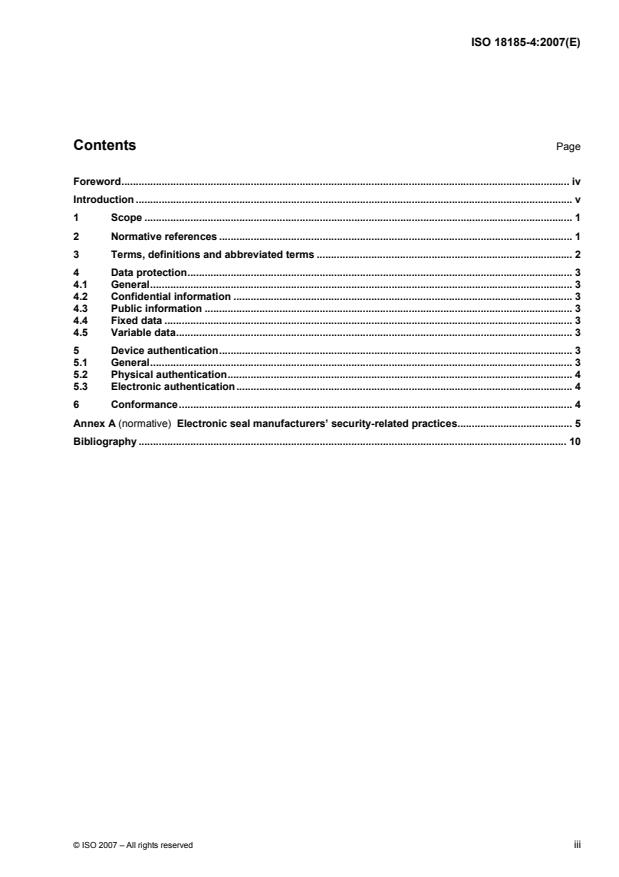
Contents Page
Foreword. iv
Introduction . v
1 Scope . 1
2 Normative references . 1
3 Terms, definitions and abbreviated terms . 2
4 Data protection. 3
4.1 General. 3
4.2 Confidential information . 3
4.3 Public information . 3
4.4 Fixed data . 3
4.5 Variable data. 3
5 Device authentication. 3
5.1 General. 3
5.2 Physical authentication. 4
5.3 Electronic authentication. 4
6 Conformance. 4
Annex A (normative) Electronic seal manufacturers’ security-related practices. 5
Bibliography . 10
Foreword
ISO (the International Organization for Standardization) is a worldwide federation of national standards bodies
(ISO member bodies). The work of preparing International Standards is normally carried out through ISO
technical committees. Each member body interested in a subject for which a technical committee has been
established has the right to be represented on that committee. International organizations, governmental and
non-governmental, in liaison with ISO, also take part in the work. ISO collaborates closely with the
International Electrotechnical Commission (IEC) on all matters of electrotechnical standardization.
International Standards are drafted in accordance with the rules given in the ISO/IEC Directives, Part 2.
The main task of technical committees is to prepare International Standards. Draft International Standards
adopted by the technical committees are circulated to the member bodies for voting. Publication as an
International Standard requires approval by at least 75 % of the member bodies casting a vote.
Attention is drawn to the possibility that some of the elements of this document may be the subject of patent
rights. ISO shall not be held responsible for identifying any or all such patent rights.
ISO 18185-4 was prepared by Technical Committee ISO/TC 104, Freight containers, Subcommittee SC 4,
Identification and communication.
ISO 18185 consists of the following parts, under the general title Freight containers — Electronic seals:
⎯ Part 1: Communication protocol
⎯ Part 2: Application requirements
⎯ Part 3: Environmental characteristics
⎯ Part 4: Data protection
⎯ Part 5: Physical layer
iv © ISO 2007 – All rights reserved
Introduction
This part of ISO 18185 was prepared by ISO Technical Committee 104/Subcommittee 4/Working Group 2,
using the drafting conventions of ISO/IEC Directives, Part 2.
In early 2005, an extensive Vulnerability Assessment took place to analyse the use cases and potential data
integrity threats posed to devices based on the ISO/IEC 18185 series as written. Based on learnings from that
assessment, spoofing and cloning were identified as potential data integrity risks to electronic seals. Device
authentication became the highest priority solution to mitigate those identified risks, and the scope of the
electronic seal standard-setting work was expanded to meet that objective.
Three aspects are discussed in this part of ISO 18185: data protection, device authentication and
conformance.
Data protection addresses the confidentiality and integrity of transmitted data. ISO TC 104/SC 4/WG 2
decided that for this part of ISO 18185, all seal information has been deemed to be public information, and as
such, can be transmitted in clear text. Data confidentiality and integrity requirements are presented in this part
of ISO 18185 for both fixed data (e.g. data items created during the seal manufacturing process) and variable
data (e.g. event information generated by and stored within the seal during use).
Device authenticity addresses the capability to identify the seal as a valid device. This first-generation
specification outlines methods for physical authentication.
Conformance addresses the requirement for electronic seals claiming compliance with ISO 18185 to also
contain the physical properties of high security mechanical seals in ISO/PAS 17712, and identifies best
practices for electronic seal manufacturers.
This part of ISO 18185 defines the first-generation specifications for device authentication and data protection.
Further generations of this part of ISO 18185 may be created upon further review of the potential benefits for
these electronic seal devices using additional device authentication and data protection methods.
INTERNATIONAL STANDARD ISO 18185-4:2007(E)
Freight containers — Electronic seals —
Part 4:
Data protection
1 Scope
This part of ISO 18185 specifies requirements for the data protection, device authentication and conformance
capabilities of electronic seals for communication to and from a seal and its associated reader. These
capabilities include the accessibility, confidentiality, data integrity, authentication and non-repudiation of stored
data.
The protection of this information is provided through a radio-communications interface providing seal
identification and a method to determine whether a freight container’s seal has been opened.
This part of ISO 18185 specifies a freight container seal identification system, with an associated system for
verifying the accuracy of use, having:
⎯ a seal status identification system;
⎯ a battery status indicator;
⎯ a unique Seal Identifier including the identification of the manufacturer;
⎯ a seal (tag) type.
This part of ISO 18185 is intended for use in conjunction with the other parts of ISO 18185.
This part of ISO 18185 is designed to facilitate electronic device authentication. For mechanical seals, the seal
manufacturer is able to determine the authenticity of the device if and when necessary, e.g. to determine the
unauthorized opening of the seal. There are electronic authentication methods which can provide similar
validation without visual inspection. This part of ISO 18185 provides only the guidelines for those methods.
This part of ISO 18185 applies to all electronic seals used on freight containers covered by International
Standards ISO 668, ISO 1496-1 to ISO 1496-5 and ISO 8323 and should, wherever appropriate and
practicable, also be applied to freight containers other than those covered by these International Standards.
2 Normative references
The following referenced documents are indispensable for the application of this document. For dated
references, only the edition cited applies. For undated references, the latest edition of the referenced
document (including any amendments) applies.
ISO/IEC 17025, General requirements for the competence of testing and calibration laboratories
ISO/PAS 17712, Freight containers — Mechanical seals
ISO 18185-3, Freight containers — Electronic seals — Part 3: Environmental characteristics
3 Terms and definitions
For the purposes of this document, the following terms and definitions apply:
3.1
AEI
Automatic Equipment Identification
3.2
authentication
method to verify the validity of a transmitted message and its originator
3.3
asset
anything an individual or a company owns which has value
NOTE In the container environment, an asset could be a container, the container’s contents, or information pertaining
to the container.
3.4
electronic seal
read-only, non-reusable freight container seal conforming to the high security seal defined in ISO/PAS 17712
and conforming to this part of ISO 18185 that electronically evidences tampering or intrusion though the
container doors
3.5
reader
wireless RFID communication device which interacts with RFID tags and electronic seals
3.6
Radio Frequency Identification
RFID
electrical transponder which stores information that can then be used to identify an item to which the
transponder is attached, similar to the way in which a bar code on a label stores information that can be used
to identify the item to which the label is attached
3.7
system
complete end-to-end RFID tracking solution of seal-to-reader-to-network-to-application-to-user
3.8
threat
potential abuse of an asset created by exploiting a vulnerability in order to impair the value of an asset
3.9
validation
process by which the integrity and correctness of data are established
3.10
vulnerability
potential flaw or weakness in system security procedures, design, or implementation that could be exercised
(accidentally triggered or intentionally exploited) and result in harm done to a system
2 © ISO 2007 – All rights reserved
4 Data protection
4.1 General
Data protection addresses the concern about the confidentiality and integrity of the data presented by the
electronic seal.
4.2 Confidential information
Under the terms of this first-generation part of ISO 18185, the current communication with the electronic seal
is performed in clear text and does not include any confidential information. Consequently, there are no
requirements regarding confidential information at this time.
4.3 Public information
All current information communicated by the electronic seal has been determined to be public information, and
as such, shall be communicated in clear text format. While it is not necessary to transmit public information
using confidentiality methods, there is a need to prevent the accidental or fraudulent alteration of the data
contained within the electronic seal.
4.3.1 Fixed data
Fixed data is defined as all seal information which will not change after the time of manufacture. This includes
the manufacturer ID, the tag ID (serial number), the protocol ID, the model number, the product version, the
seal tag type and the protocol version.
Fixed data shall be protected against erasure or alteration during the manufacturing process such that it
cannot be modified or deleted by an outside entity. The technical details of how fixed data protection is
performed are beyond the scope of this part of ISO 18185 and are left to the individual electronic seal
manufacturer.
4.3.2 Variable data
Variable data is defined as all seal event information which, after the time of manufacture, can and most
probably will change throughout the life of the seal. This includes the time of seal closure, the time of seal
opening and the battery status.
Event information shall be added to the seal’s memory upon each status change. Once written into the event
log, this information shall become a permanent record within the seal and shall not be modified or erased by
either the seal or an outside entity.
Variable data shall be protected against erasure or alteration within the device throughout the lifetime of the
seal. The technical details of how variable data protection is performed are beyond the scope of this part of
ISO 18185 and are left to the individual electronic seal manufacturer.
5 Device authentication
5.1 General
In addition to the integrity of the data communicated, this part of ISO 18185 requires the capability to verify the
authenticity of the electronic seal.
5.2 Physical authentication
The ability for forensic authentication is necessary for both the mechanical and the electronic components of a
seal. The seal manufacturer shall be able to identify and authenticate the seal as a valid seal based on
proprietary information, its unique manufacturing characteristics, and the fixed data defined in 4.3.1.
Presented with the physical device, the seal manufacturer shall be able to validate the authenticity of the
mechanical and electronic components of the seal. The technical details of how physical device authentication
is performed are beyond the scope of this part of ISO 18185 and are left to the individual electronic seal
manufacturer.
5.3 Electronic authentication
Under the terms of this first-generation part of ISO 18185, there are no requirements for the ability to
electronically authenticate a seal through data transmissions.
6 Conformance
Electronic seals claiming compliance with this part of ISO 18185 shall have the high security mechanical seal
physical properties defined in ISO/PAS 17712. They shall further comply with the electronic seal
manufacturers’ security-related practices identified in Annex A.
4 © ISO 2007 – All rights reserved
Annex A
(normative)
Electronic seal manufacturers’ security-related practices
A.1 Introduction
This annex addresses security-related practices relevant to the manufacture and distribution of electronic
security seals (electronic seals) and related equipment that conform to all parts of ISO 18185.
Since electronic seals require interrogators (reader/writers) for communication, this annex also addresses
security-related practices related to the manufacture and dis
...