

ISO 18185-3:2015
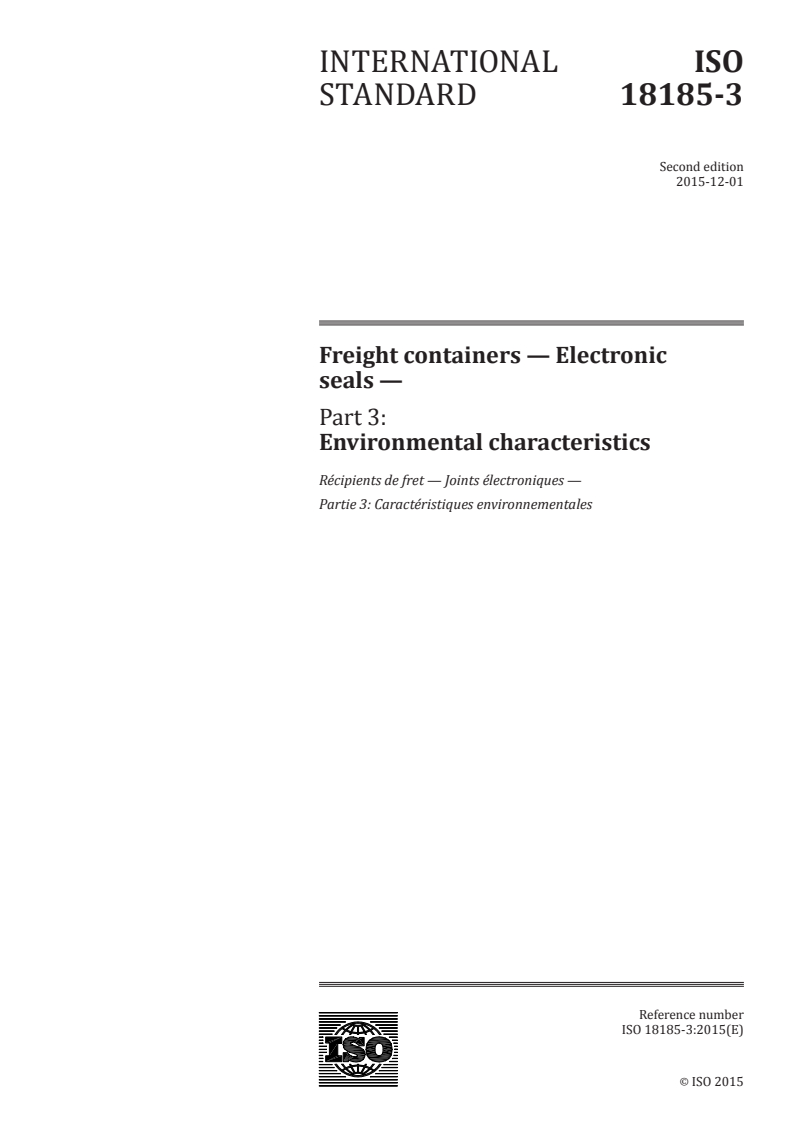
(Main)Freight containers — Electronic seals — Part 3: Environmental characteristics
General Information
- Abstract
ISO 18185-3:2015 specifies test methods and conditions for environmental characteristics of electronic seals. ISO 18185-3:2015 describes the environmental requirements for the ISO 18185 series, for ISO 10374 and for ISO 17363 and for ISO 10891 since it is expected that the implementation of these International Standards will face the same international conditions. However, each of these International Standards has its own unique requirements other than environmental conditions.
- Status
- Published
- Publication Date
- 17-Nov-2015
- Technical Committee
- ISO/TC 104/SC 4 - Identification and communication
- Current Stage
- 9060 - Close of review
- Completion Date
- 02-Dec-2031
Buy Documents
ISO 18185-3:2015 - Freight containers -- Electronic seals
ISO 18185-3:2015 - Freight containers — Electronic seals — Part 3: Environmental characteristics/18/2015
Overview
ISO 18185-3:2015 - Freight containers - Electronic seals - Part 3: Environmental characteristics defines the environmental test methods and conditions that electronic seals (e-seals) for freight containers must withstand. The standard establishes environmental requirements common to the ISO 18185 series and aligns those requirements with anticipated international transport conditions. It is focused on read-only, non-reusable high-security electronic seals that provide tamper/evidence data for container doors.
Key topics and technical requirements
ISO 18185-3:2015 specifies test methods and environmental conditions rather than prescriptive design details. Major technical topics covered include:
- Temperature extremes - procedures for low- and high-temperature storage and operating tests, and thermal shock considerations.
- Mechanical stresses - mechanical shock, drop shock and vibration test methods to verify ruggedness in transport.
- Moisture and precipitation - humidity cycling, rain and snow exposure, and water (high-pressure) ingress tests.
- Corrosion and contamination - salt-fog testing and sand/dust exposure procedures to assess durability in marine and dusty environments.
- Environmental surface effects - solar radiation and ice/frost resilience to ensure functional integrity over exposure.
- Electromagnetic environment - EMC immunity testing referenced to IEC 61000-4-2 and IEC 61000-4-3 to validate resistance to electrostatic discharge and radiated RF fields.
- Lightning and electrical transient resilience - tests for lightning strike effects and electrical transients where applicable.
- Operational verification - operation tests before and after environmental exposures to confirm data integrity and functional survival.
Note: ISO 18185-3 defines test purposes, requirements and methods but does not replace the unique requirements found in other parts of the ISO 18185 series.
Applications and who uses this standard
ISO 18185-3:2015 is essential for stakeholders involved in the specification, manufacture, testing and deployment of electronic container seals:
- Seal manufacturers and product engineers designing rugged e-seals for international shipping
- Third‑party test laboratories performing environmental qualification and type testing
- Shipping lines, container operators, ports and terminal operators requiring validated e-seal performance
- Customs, logistics service providers and security integrators implementing tamper-evident solutions
- Certification bodies and compliance officers referencing environmental test criteria for acceptance
Using ISO 18185-3 helps ensure e-seals provide reliable tamper evidence and maintain data integrity under the varied environmental stresses encountered in global freight logistics.
Related standards
- ISO 18185 series (Parts 1, 2, 4, 5) - communication, application, data protection, physical layer
- ISO 17712 - Mechanical seals (high-security seal definition)
- ISO 10374, ISO 17363, ISO 10891 - related container security/handling standards referenced for consistent environmental expectations
- IEC 61000-4-2 and IEC 61000-4-3 - EMC test methods referenced by ISO 18185-3
Keywords: ISO 18185-3:2015, electronic seals, e-seal, freight containers, environmental characteristics, environmental testing, container security seals, EMC testing.
Relations
- Revises
ISO 18185-3:2006 - Freight containers — Electronic seals — Part 3: Environmental characteristics - Effective Date
- 16-Jun-2012
Buy Documents
ISO 18185-3:2015 - Freight containers -- Electronic seals
ISO 18185-3:2015 - Freight containers — Electronic seals — Part 3: Environmental characteristics/18/2015
Get Certified
Connect with accredited certification bodies for this standard

BRCGS (Brand Reputation Compliance Global Standards)
Global food safety and quality standards owner.
Sponsored listings
Frequently Asked Questions
ISO 18185-3:2015 is a standard published by the International Organization for Standardization (ISO). Its full title is "Freight containers — Electronic seals — Part 3: Environmental characteristics". This standard covers: ISO 18185-3:2015 specifies test methods and conditions for environmental characteristics of electronic seals. ISO 18185-3:2015 describes the environmental requirements for the ISO 18185 series, for ISO 10374 and for ISO 17363 and for ISO 10891 since it is expected that the implementation of these International Standards will face the same international conditions. However, each of these International Standards has its own unique requirements other than environmental conditions.
ISO 18185-3:2015 specifies test methods and conditions for environmental characteristics of electronic seals. ISO 18185-3:2015 describes the environmental requirements for the ISO 18185 series, for ISO 10374 and for ISO 17363 and for ISO 10891 since it is expected that the implementation of these International Standards will face the same international conditions. However, each of these International Standards has its own unique requirements other than environmental conditions.
ISO 18185-3:2015 is classified under the following ICS (International Classification for Standards) categories: 55.180.10 - General purpose containers. The ICS classification helps identify the subject area and facilitates finding related standards.
ISO 18185-3:2015 has the following relationships with other standards: It is inter standard links to ISO 18185-3:2006. Understanding these relationships helps ensure you are using the most current and applicable version of the standard.
ISO 18185-3:2015 is available in PDF format for immediate download after purchase. The document can be added to your cart and obtained through the secure checkout process. Digital delivery ensures instant access to the complete standard document.
Standards Content (Sample)
INTERNATIONAL ISO
STANDARD 18185-3
Second edition
2015-12-01
Freight containers — Electronic
seals —
Part 3:
Environmental characteristics
Récipients de fret — Joints électroniques —
Partie 3: Caractéristiques environnementales
Reference number
©
ISO 2015
© ISO 2015, Published in Switzerland
All rights reserved. Unless otherwise specified, no part of this publication may be reproduced or utilized otherwise in any form
or by any means, electronic or mechanical, including photocopying, or posting on the internet or an intranet, without prior
written permission. Permission can be requested from either ISO at the address below or ISO’s member body in the country of
the requester.
ISO copyright office
Ch. de Blandonnet 8 • CP 401
CH-1214 Vernier, Geneva, Switzerland
Tel. +41 22 749 01 11
Fax +41 22 749 09 47
copyright@iso.org
www.iso.org
ii © ISO 2015 – All rights reserved
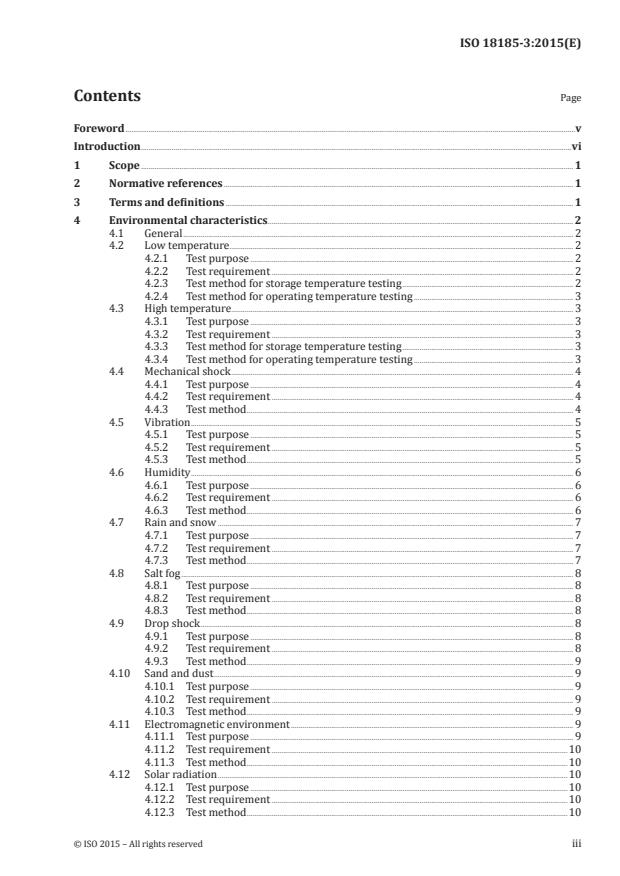
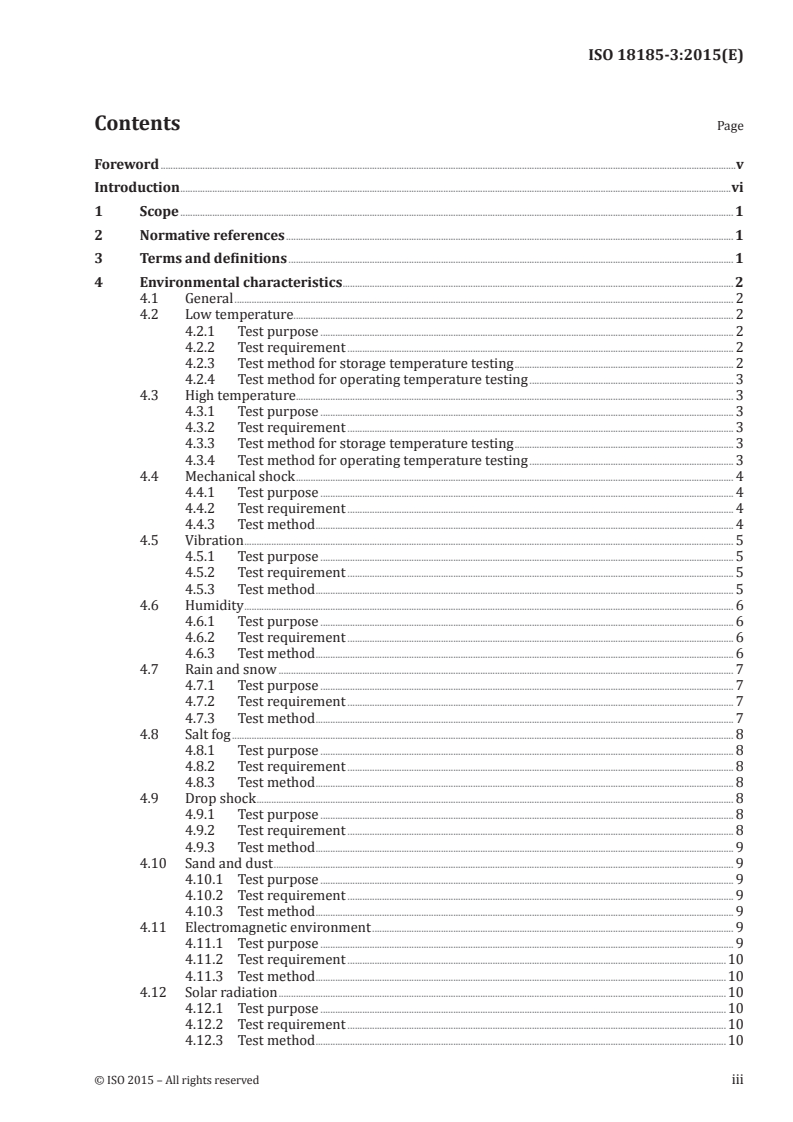
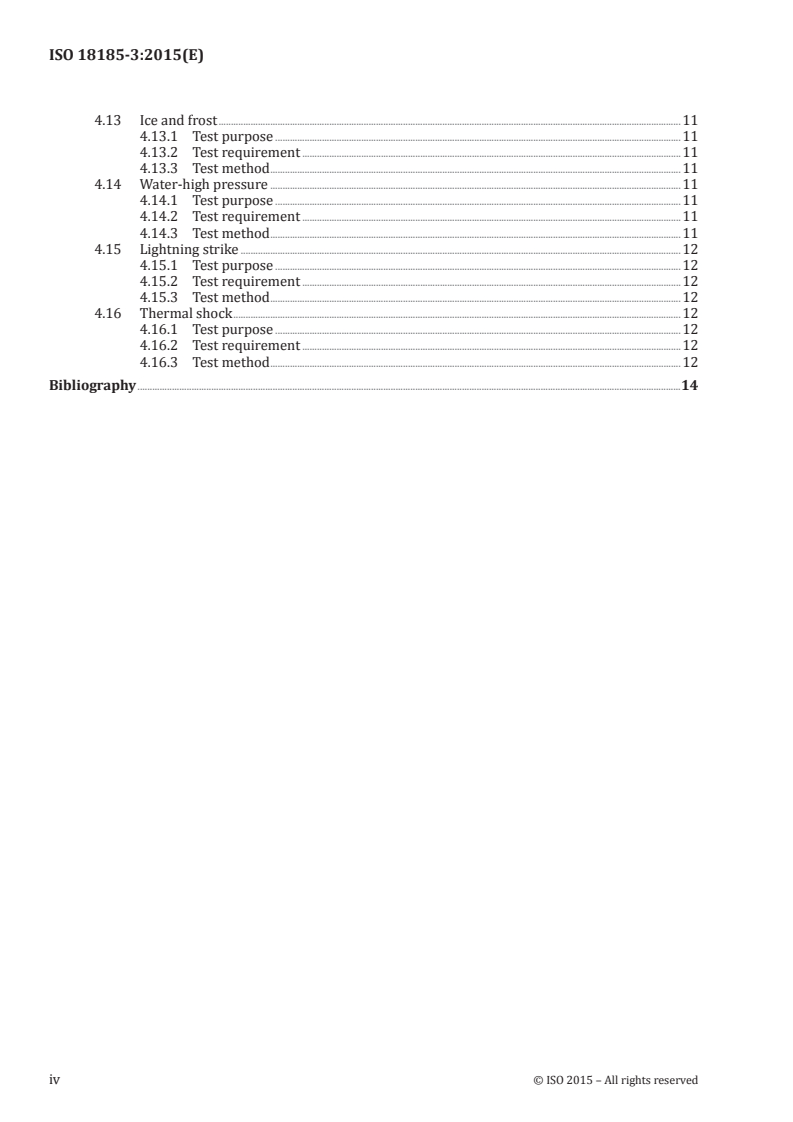
Contents Page
Foreword .v
Introduction .vi
1 Scope . 1
2 Normative references . 1
3 Terms and definitions . 1
4 Environmental characteristics . 2
4.1 General . 2
4.2 Low temperature. 2
4.2.1 Test purpose . 2
4.2.2 Test requirement . 2
4.2.3 Test method for storage temperature testing . 2
4.2.4 Test method for operating temperature testing . 3
4.3 High temperature. 3
4.3.1 Test purpose . 3
4.3.2 Test requirement . 3
4.3.3 Test method for storage temperature testing . 3
4.3.4 Test method for operating temperature testing . 3
4.4 Mechanical shock . 4
4.4.1 Test purpose . 4
4.4.2 Test requirement . 4
4.4.3 Test method . 4
4.5 Vibration . 5
4.5.1 Test purpose . 5
4.5.2 Test requirement . 5
4.5.3 Test method . 5
4.6 Humidity . 6
4.6.1 Test purpose . 6
4.6.2 Test requirement . 6
4.6.3 Test method . 6
4.7 Rain and snow . 7
4.7.1 Test purpose . 7
4.7.2 Test requirement . 7
4.7.3 Test method . 7
4.8 Salt fog . 8
4.8.1 Test purpose . 8
4.8.2 Test requirement . 8
4.8.3 Test method . 8
4.9 Drop shock . 8
4.9.1 Test purpose . 8
4.9.2 Test requirement . 8
4.9.3 Test method . 9
4.10 Sand and dust . 9
4.10.1 Test purpose . 9
4.10.2 Test requirement . 9
4.10.3 Test method . 9
4.11 Electromagnetic environment . 9
4.11.1 Test purpose . 9
4.11.2 Test requirement .10
4.11.3 Test method .10
4.12 Solar radiation .10
4.12.1 Test purpose .10
4.12.2 Test requirement .10
4.12.3 Test method .10
4.13 Ice and frost .11
4.13.1 Test purpose .11
4.13.2 Test requirement .11
4.13.3 Test method .11
4.14 Water-high pressure .11
4.14.1 Test purpose .11
4.14.2 Test requirement .11
4.14.3 Test method .11
4.15 Lightning strike .12
4.15.1 Test purpose .12
4.15.2 Test requirement .12
4.15.3 Test method .12
4.16 Thermal shock .12
4.16.1 Test purpose .12
4.16.2 Test requirement .12
4.16.3 Test method .12
Bibliography .14
iv © ISO 2015 – All rights reserved
Foreword
ISO (the International Organization for Standardization) is a worldwide federation of national standards
bodies (ISO member bodies). The work of preparing International Standards is normally carried out
through ISO technical committees. Each member body interested in a subject for which a technical
committee has been established has the right to be represented on that committee. International
organizations, governmental and non-governmental, in liaison with ISO, also take part in the work.
ISO collaborates closely with the International Electrotechnical Commission (IEC) on all matters of
electrotechnical standardization.
The procedures used to develop this document and those intended for its further maintenance are
described in the ISO/IEC Directives, Part 1. In particular the different approval criteria needed for the
different types of ISO documents should be noted. This document was drafted in accordance with the
editorial rules of the ISO/IEC Directives, Part 2 (see www.iso.org/directives).
Attention is drawn to the possibility that some of the elements of this document may be the subject of
patent rights. ISO shall not be held responsible for identifying any or all such patent rights. Details of
any patent rights identified during the development of the document will be in the Introduction and/or
on the ISO list of patent declarations received (see www.iso.org/patents).
Any trade name used in this document is information given for the convenience of users and does not
constitute an endorsement.
For an explanation on the meaning of ISO specific terms and expressions related to conformity
assessment, as well as information about ISO’s adherence to the WTO principles in the Technical
Barriers to Trade (TBT) see the following URL: Foreword - Supplementary information
The committee responsible for this document is ISO/TC 104, Freight containers, Subcommittee SC 4,
Identification and communication.
This second edition cancels and replaces the first edition (ISO 18185-3:2006), which has been
technically revised.
ISO 18185 consists of the following parts, under the general title Freight containers — Electronic seals:
— Par 1: Communication protocol
— Part 2: Application requirements
— Part 3: Environmental characteristics
— Part 4: Data protection
— Part 5: Physical layer
Introduction
This part of ISO 18185 defines the environmental characteristics for compliant electronic seals.
vi © ISO 2015 – All rights reserved
INTERNATIONAL STANDARD ISO 18185-3:2015(E)
Freight containers — Electronic seals —
Part 3:
Environmental characteristics
1 Scope
This part of ISO 18185 specifies test methods and conditions for environmental characteristics of
electronic seals.
This part of ISO 18185 describes the environmental requirements for the ISO 18185 series, for ISO 10374
and for ISO 17363 and for ISO 10891 since it is expected that the implementation of these International
Standards will face the same international conditions. However, each of these International Standards
has its own unique requirements other than environmental conditions.
2 Normative references
The following documents, in whole or in part, are normatively referenced in this document and are
indispensable for its application. For dated references, only the edition cited applies. For undated
references, the latest edition of the referenced document (including any amendments) applies.
ISO 17712, Freight containers — Mechanical seals
IEC 61000-4-2, Electromagnetic compatibility (EMC) — Part 4-2: Testing and measurement techniques —
Electrostatic discharge immunity test
IEC 61000-4-3, Electromagnetic compatibility (EMC) — Part 4-3: Testing and measurement techniques —
Radiated, radio-frequency, electromagnetic field immunity test
3 Terms and definitions
For the purposes of this document, the following terms and definitions apply.
3.1
electronic seal
e-seal
read-only, non-reusable freight container seal conforming to the high-security seal defined in ISO 17712
and to this International Standard that electronically provides evidence of tampering or intrusion
through the container doors
3.2
equipment under testing
EUT
any type of device that will undergo the tests described in this part of ISO 18185
3.3
interrogator identification
interrogator ID
code used to identify the source address during every communication session originated by the
interrogator
3.4
operation test
short functional test by a suitably qualified person to confirm that the electronic seal (3.1) complies with
the operational requirements including a check of survives and maintains the integrity of stored data
3.5
seal identification
seal ID
unique code used to identify each manufactured seal incorporating a combination of the serial number
(i.e. tag ID) and the manufacturer ID
4 Environmental characteristics
4.1 General
This part of ISO 18185 shall be used in conjunction with other parts of ISO 18185.
This part of ISO 18185 applies to all electronic seals used on freight containers covered by the following
International Standards: ISO 668, ISO 1496-1, ISO 1496-2, ISO 1496-3, ISO 1496-4, ISO 1496-5, and
ISO 830. This part of ISO 18185 should also, wherever appropriate and practicable, be applied to freight
containers other than those covered by the aforementioned International Standards.
This part of ISO 18185 establishes minimum operating parameters for environmental characteristics
and the test used to measure those characteristics.
This part of ISO 18185 is designed to test container seal resistance to electrical and mechanical
deterioration due to exposure to the shipboard environment or to the rigors of mishandling such as
dropping, where appropriate, or transportation and installation. Container seals are typically subjected
to the harsh environments of the marine, rail, and road transportation industries. Sand and dust, salt
spray, grease, snow, ice, and grime can be expected to coat the tag and sensing equipment. Physical
shock and vibration are commonly encountered as a result of handling and transport operations.
Normal ambient conditions are defined as any combination of the following:
— temperature: (15 to 35) °C;
— relative humidity: (20 to 75) %;
— air pressure: (86 to 106) kPa.
4.2 Low temperature
4.2.1 Test purpose
The purpose of this test is to verify that no damage is caused to the EUT and no permanent or
temporary malfunction occurs after being stored and during storage at cold temperatures for the low
temperature testing.
4.2.2 Test requirement
EUT shall fully operate after having been stored at a minimum low temperature.
4.2.3 Test method for storage temperature testing
— Preconditioning: normal ambient conditions.
— The EUT shall be placed in the test chamber and the temperature cycle is started at normal ambient
conditions. The EUT shall be kept at the test temperature for the test period (see Table 1).
2 © ISO 2015 – All rights reserved
Table 1 — Conditions of low storage temperature
...
INTERNATIONAL ISO
STANDARD 18185-3
Second edition
2015-12-01
Freight containers — Electronic
seals —
Part 3:
Environmental characteristics
Récipients de fret — Joints électroniques —
Partie 3: Caractéristiques environnementales
Reference number
©
ISO 2015
© ISO 2015, Published in Switzerland
All rights reserved. Unless otherwise specified, no part of this publication may be reproduced or utilized otherwise in any form
or by any means, electronic or mechanical, including photocopying, or posting on the internet or an intranet, without prior
written permission. Permission can be requested from either ISO at the address below or ISO’s member body in the country of
the requester.
ISO copyright office
Ch. de Blandonnet 8 • CP 401
CH-1214 Vernier, Geneva, Switzerland
Tel. +41 22 749 01 11
Fax +41 22 749 09 47
copyright@iso.org
www.iso.org
ii © ISO 2015 – All rights reserved
Contents Page
Foreword .v
Introduction .vi
1 Scope . 1
2 Normative references . 1
3 Terms and definitions . 1
4 Environmental characteristics . 2
4.1 General . 2
4.2 Low temperature. 2
4.2.1 Test purpose . 2
4.2.2 Test requirement . 2
4.2.3 Test method for storage temperature testing . 2
4.2.4 Test method for operating temperature testing . 3
4.3 High temperature. 3
4.3.1 Test purpose . 3
4.3.2 Test requirement . 3
4.3.3 Test method for storage temperature testing . 3
4.3.4 Test method for operating temperature testing . 3
4.4 Mechanical shock . 4
4.4.1 Test purpose . 4
4.4.2 Test requirement . 4
4.4.3 Test method . 4
4.5 Vibration . 5
4.5.1 Test purpose . 5
4.5.2 Test requirement . 5
4.5.3 Test method . 5
4.6 Humidity . 6
4.6.1 Test purpose . 6
4.6.2 Test requirement . 6
4.6.3 Test method . 6
4.7 Rain and snow . 7
4.7.1 Test purpose . 7
4.7.2 Test requirement . 7
4.7.3 Test method . 7
4.8 Salt fog . 8
4.8.1 Test purpose . 8
4.8.2 Test requirement . 8
4.8.3 Test method . 8
4.9 Drop shock . 8
4.9.1 Test purpose . 8
4.9.2 Test requirement . 8
4.9.3 Test method . 9
4.10 Sand and dust . 9
4.10.1 Test purpose . 9
4.10.2 Test requirement . 9
4.10.3 Test method . 9
4.11 Electromagnetic environment . 9
4.11.1 Test purpose . 9
4.11.2 Test requirement .10
4.11.3 Test method .10
4.12 Solar radiation .10
4.12.1 Test purpose .10
4.12.2 Test requirement .10
4.12.3 Test method .10
4.13 Ice and frost .11
4.13.1 Test purpose .11
4.13.2 Test requirement .11
4.13.3 Test method .11
4.14 Water-high pressure .11
4.14.1 Test purpose .11
4.14.2 Test requirement .11
4.14.3 Test method .11
4.15 Lightning strike .12
4.15.1 Test purpose .12
4.15.2 Test requirement .12
4.15.3 Test method .12
4.16 Thermal shock .12
4.16.1 Test purpose .12
4.16.2 Test requirement .12
4.16.3 Test method .12
Bibliography .14
iv © ISO 2015 – All rights reserved
Foreword
ISO (the International Organization for Standardization) is a worldwide federation of national standards
bodies (ISO member bodies). The work of preparing International Standards is normally carried out
through ISO technical committees. Each member body interested in a subject for which a technical
committee has been established has the right to be represented on that committee. International
organizations, governmental and non-governmental, in liaison with ISO, also take part in the work.
ISO collaborates closely with the International Electrotechnical Commission (IEC) on all matters of
electrotechnical standardization.
The procedures used to develop this document and those intended for its further maintenance are
described in the ISO/IEC Directives, Part 1. In particular the different approval criteria needed for the
different types of ISO documents should be noted. This document was drafted in accordance with the
editorial rules of the ISO/IEC Directives, Part 2 (see www.iso.org/directives).
Attention is drawn to the possibility that some of the elements of this document may be the subject of
patent rights. ISO shall not be held responsible for identifying any or all such patent rights. Details of
any patent rights identified during the development of the document will be in the Introduction and/or
on the ISO list of patent declarations received (see www.iso.org/patents).
Any trade name used in this document is information given for the convenience of users and does not
constitute an endorsement.
For an explanation on the meaning of ISO specific terms and expressions related to conformity
assessment, as well as information about ISO’s adherence to the WTO principles in the Technical
Barriers to Trade (TBT) see the following URL: Foreword - Supplementary information
The committee responsible for this document is ISO/TC 104, Freight containers, Subcommittee SC 4,
Identification and communication.
This second edition cancels and replaces the first edition (ISO 18185-3:2006), which has been
technically revised.
ISO 18185 consists of the following parts, under the general title Freight containers — Electronic seals:
— Par 1: Communication protocol
— Part 2: Application requirements
— Part 3: Environmental characteristics
— Part 4: Data protection
— Part 5: Physical layer
Introduction
This part of ISO 18185 defines the environmental characteristics for compliant electronic seals.
vi © ISO 2015 – All rights reserved
INTERNATIONAL STANDARD ISO 18185-3:2015(E)
Freight containers — Electronic seals —
Part 3:
Environmental characteristics
1 Scope
This part of ISO 18185 specifies test methods and conditions for environmental characteristics of
electronic seals.
This part of ISO 18185 describes the environmental requirements for the ISO 18185 series, for ISO 10374
and for ISO 17363 and for ISO 10891 since it is expected that the implementation of these International
Standards will face the same international conditions. However, each of these International Standards
has its own unique requirements other than environmental conditions.
2 Normative references
The following documents, in whole or in part, are normatively referenced in this document and are
indispensable for its application. For dated references, only the edition cited applies. For undated
references, the latest edition of the referenced document (including any amendments) applies.
ISO 17712, Freight containers — Mechanical seals
IEC 61000-4-2, Electromagnetic compatibility (EMC) — Part 4-2: Testing and measurement techniques —
Electrostatic discharge immunity test
IEC 61000-4-3, Electromagnetic compatibility (EMC) — Part 4-3: Testing and measurement techniques —
Radiated, radio-frequency, electromagnetic field immunity test
3 Terms and definitions
For the purposes of this document, the following terms and definitions apply.
3.1
electronic seal
e-seal
read-only, non-reusable freight container seal conforming to the high-security seal defined in ISO 17712
and to this International Standard that electronically provides evidence of tampering or intrusion
through the container doors
3.2
equipment under testing
EUT
any type of device that will undergo the tests described in this part of ISO 18185
3.3
interrogator identification
interrogator ID
code used to identify the source address during every communication session originated by the
interrogator
3.4
operation test
short functional test by a suitably qualified person to confirm that the electronic seal (3.1) complies with
the operational requirements including a check of survives and maintains the integrity of stored data
3.5
seal identification
seal ID
unique code used to identify each manufactured seal incorporating a combination of the serial number
(i.e. tag ID) and the manufacturer ID
4 Environmental characteristics
4.1 General
This part of ISO 18185 shall be used in conjunction with other parts of ISO 18185.
This part of ISO 18185 applies to all electronic seals used on freight containers covered by the following
International Standards: ISO 668, ISO 1496-1, ISO 1496-2, ISO 1496-3, ISO 1496-4, ISO 1496-5, and
ISO 830. This part of ISO 18185 should also, wherever appropriate and practicable, be applied to freight
containers other than those covered by the aforementioned International Standards.
This part of ISO 18185 establishes minimum operating parameters for environmental characteristics
and the test used to measure those characteristics.
This part of ISO 18185 is designed to test container seal resistance to electrical and mechanical
deterioration due to exposure to the shipboard environment or to the rigors of mishandling such as
dropping, where appropriate, or transportation and installation. Container seals are typically subjected
to the harsh environments of the marine, rail, and road transportation industries. Sand and dust, salt
spray, grease, snow, ice, and grime can be expected to coat the tag and sensing equipment. Physical
shock and vibration are commonly encountered as a result of handling and transport operations.
Normal ambient conditions are defined as any combination of the following:
— temperature: (15 to 35) °C;
— relative humidity: (20 to 75) %;
— air pressure: (86 to 106) kPa.
4.2 Low temperature
4.2.1 Test purpose
The purpose of this test is to verify that no damage is caused to the EUT and no permanent or
temporary malfunction occurs after being stored and during storage at cold temperatures for the low
temperature testing.
4.2.2 Test requirement
EUT shall fully operate after having been stored at a minimum low temperature.
4.2.3 Test method for storage temperature testing
— Preconditioning: normal ambient conditions.
— The EUT shall be placed in the test chamber and the temperature cycle is started at normal ambient
conditions. The EUT shall be kept at the test temperature for the test period (see Table 1).
2 © ISO 2015 – All rights reserved
Table 1 — Conditions of low storage temperature
...