

ISO 22379:2022
(Main)Security and resilience — Guidelines for hosting and organizing citywide or regional events
General Information
- Abstract
This document gives guidance on hosting and organizing citywide or regional events. It provides principles applicable to any host and organizer of citywide or regional events. This document will help hosts and organizers to plan and execute a safe, secure and sustainable event by: — introducing a process for cooperation between the host and organizer; — identifying and involving relevant interested parties; — identifying the economic, environmental and societal impact caused by the event; — establishing necessary measures to manage risks introduced by or affecting the event; — establishing necessary measures to deliver the event; — providing critical services to the public and to the event; — providing interested parties and the public with information; — providing future hosts and organizers of similar events with lessons identified; — introducing an event legacy plan consistent with the long-term objectives for the city or region. This document is general and strategic and does not include detailed descriptions or how to plan and execute specific tasks.
- Status
- Published
- Publication Date
- 01-Sep-2022
- Technical Committee
- ISO/TC 292 - Security and resilience
- Drafting Committee
- ISO/TC 292 - Security and resilience
- Current Stage
- 6060 - International Standard published
- Start Date
- 02-Sep-2022
- Due Date
- 30-Aug-2022
- Completion Date
- 02-Sep-2022

Overview - ISO 22379:2022 for citywide and regional events
ISO 22379:2022 provides high‑level guidance for hosting and organizing citywide or regional events with a focus on security and resilience. It outlines a strategic, process‑based framework to help hosts and organizers plan and deliver safe, secure and sustainable events while minimizing negative economic, environmental and societal impacts. The standard is intentionally general and strategic - it does not prescribe detailed task‑level procedures but establishes principles for cooperation, risk management and legacy planning.
Key topics and requirements
ISO 22379 addresses core areas that affect large public events, including:
- Cooperation framework between event hosts (e.g., city/region) and event organizers to align responsibilities and decision criteria.
- Stakeholder engagement: identification and involvement of relevant interested parties and partners.
- Impact assessment: evaluation of economic, environmental and societal effects of the event.
- Risk management: establishing measures to manage hazards, threats and dependencies between event and host city/regional risk profiles.
- Critical services and infrastructure: considerations for transport, utilities, communication and essential public services.
- Information, communication and privacy: guidance on public information, stakeholder communications and information security considerations.
- Event delivery and continuity: planning to ensure critical services and business continuity during the event.
- Evaluation and lessons identified: mechanisms for post‑event assessment and documenting lessons for future hosts.
- Event legacy planning: integrating tangible and intangible legacy objectives consistent with long‑term city or regional goals.
Practical applications - who uses ISO 22379
ISO 22379 is intended for any organization involved in large, citywide or regional events:
- Municipal and regional governments and event host agencies
- Professional event organizers and promoters
- Emergency management and public safety authorities
- Transport and infrastructure operators
- Tourism boards and economic development agencies
- Venue and facilities managers, utilities and communications providers
- Consultants, insurers and risk managers
Use cases include bidding and pre‑study assessments, cross‑agency planning, stakeholder coordination, strategic risk and impact assessments, pre‑event decision making, and post‑event evaluation and legacy development.
Related standards (if applicable)
- ISO 22301 - Business continuity management (complements continuity planning)
- ISO 20121 - Sustainable events management (aligns with environmental and social sustainability goals)
ISO 22379:2022 is a strategic tool for ensuring that large public events are planned and executed with resilience, public safety and sustainable legacy outcomes in mind. Keywords: ISO 22379, security and resilience, hosting citywide events, event management, risk management, event legacy.
Get Certified
Connect with accredited certification bodies for this standard

BSI Group
BSI (British Standards Institution) is the business standards company that helps organizations make excellence a habit.

Bureau Veritas
Bureau Veritas is a world leader in laboratory testing, inspection and certification services.

DNV
DNV is an independent assurance and risk management provider.
Sponsored listings
Frequently Asked Questions
ISO 22379:2022 is a standard published by the International Organization for Standardization (ISO). Its full title is "Security and resilience — Guidelines for hosting and organizing citywide or regional events". This standard covers: This document gives guidance on hosting and organizing citywide or regional events. It provides principles applicable to any host and organizer of citywide or regional events. This document will help hosts and organizers to plan and execute a safe, secure and sustainable event by: — introducing a process for cooperation between the host and organizer; — identifying and involving relevant interested parties; — identifying the economic, environmental and societal impact caused by the event; — establishing necessary measures to manage risks introduced by or affecting the event; — establishing necessary measures to deliver the event; — providing critical services to the public and to the event; — providing interested parties and the public with information; — providing future hosts and organizers of similar events with lessons identified; — introducing an event legacy plan consistent with the long-term objectives for the city or region. This document is general and strategic and does not include detailed descriptions or how to plan and execute specific tasks.
This document gives guidance on hosting and organizing citywide or regional events. It provides principles applicable to any host and organizer of citywide or regional events. This document will help hosts and organizers to plan and execute a safe, secure and sustainable event by: — introducing a process for cooperation between the host and organizer; — identifying and involving relevant interested parties; — identifying the economic, environmental and societal impact caused by the event; — establishing necessary measures to manage risks introduced by or affecting the event; — establishing necessary measures to deliver the event; — providing critical services to the public and to the event; — providing interested parties and the public with information; — providing future hosts and organizers of similar events with lessons identified; — introducing an event legacy plan consistent with the long-term objectives for the city or region. This document is general and strategic and does not include detailed descriptions or how to plan and execute specific tasks.
ISO 22379:2022 is classified under the following ICS (International Classification for Standards) categories: 03.100.01 - Company organization and management in general. The ICS classification helps identify the subject area and facilitates finding related standards.
ISO 22379:2022 is available in PDF format for immediate download after purchase. The document can be added to your cart and obtained through the secure checkout process. Digital delivery ensures instant access to the complete standard document.
Standards Content (Sample)
INTERNATIONAL ISO
STANDARD 22379
First edition
2022-09
Security and resilience — Guidelines
for hosting and organizing citywide or
regional events
Reference number
© ISO 2022
All rights reserved. Unless otherwise specified, or required in the context of its implementation, no part of this publication may
be reproduced or utilized otherwise in any form or by any means, electronic or mechanical, including photocopying, or posting on
the internet or an intranet, without prior written permission. Permission can be requested from either ISO at the address below
or ISO’s member body in the country of the requester.
ISO copyright office
CP 401 • Ch. de Blandonnet 8
CH-1214 Vernier, Geneva
Phone: +41 22 749 01 11
Email: copyright@iso.org
Website: www.iso.org
Published in Switzerland
ii
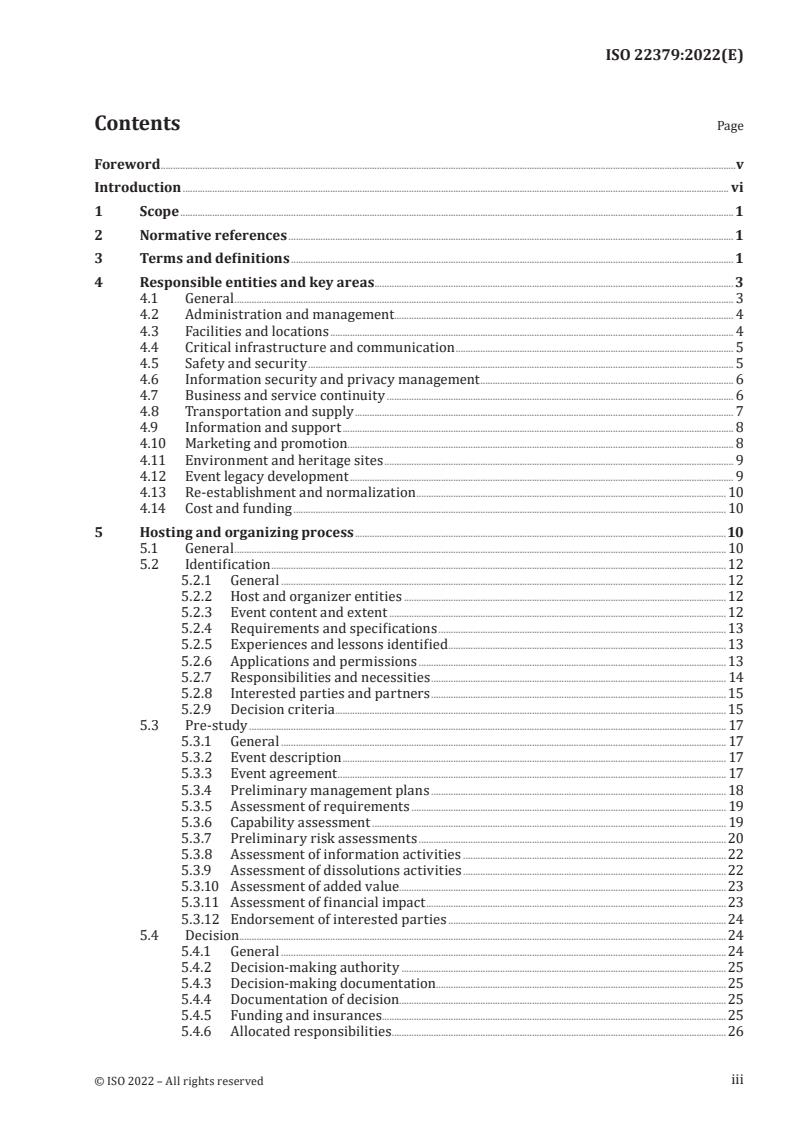
Contents Page
Foreword .v
Introduction . vi
1 Scope . 1
2 Normative references . 1
3 Terms and definitions . 1
4 Responsible entities and key areas . 3
4.1 General . 3
4.2 Administration and management. 4
4.3 Facilities and locations . 4
4.4 Critical infrastructure and communication . 5
4.5 Safety and security . 5
4.6 Information security and privacy management . 6
4.7 Business and service continuity . 6
4.8 Transportation and supply . 7
4.9 Information and support . 8
4.10 Marketing and promotion. 8
4.11 Environment and heritage sites . 9
4.12 Event legacy development . 9
4.13 Re-establishment and normalization . 10
4.14 Cost and funding . 10
5 Hosting and organizing process .10
5.1 General . 10
5.2 Identification .12
5.2.1 General .12
5.2.2 Host and organizer entities .12
5.2.3 Event content and extent .12
5.2.4 Requirements and specifications . 13
5.2.5 Experiences and lessons identified . 13
5.2.6 Applications and permissions . 13
5.2.7 Responsibilities and necessities . 14
5.2.8 Interested parties and partners . 15
5.2.9 Decision criteria . 15
5.3 Pre-study . 17
5.3.1 General . 17
5.3.2 Event description . 17
5.3.3 Event agreement . 17
5.3.4 Preliminary management plans . 18
5.3.5 Assessment of requirements . 19
5.3.6 Capability assessment . 19
5.3.7 Preliminary risk assessments . 20
5.3.8 Assessment of information activities . 22
5.3.9 Assessment of dissolutions activities . 22
5.3.10 Assessment of added value. 23
5.3.11 Assessment of financial impact . 23
5.3.12 Endorsement of interested parties . 24
5.4 Decision . 24
5.4.1 General . 24
5.4.2 Decision-making authority . 25
5.4.3 Decision-making documentation . 25
5.4.4 Documentation of decision . 25
5.4.5 Funding and insurances. 25
5.4.6 Allocated responsibilities . 26
iii
5.4.7 Applications and permissions . 26
5.4.8 Information and requests. 26
5.5 Planning . 26
5.5.1 General . 26
5.5.2 Management plans .26
5.5.3 Detailed assessments .28
5.5.4 Detailed plans .28
5.5.5 Interdisciplinary cooperation .29
5.5.6 Training . 29
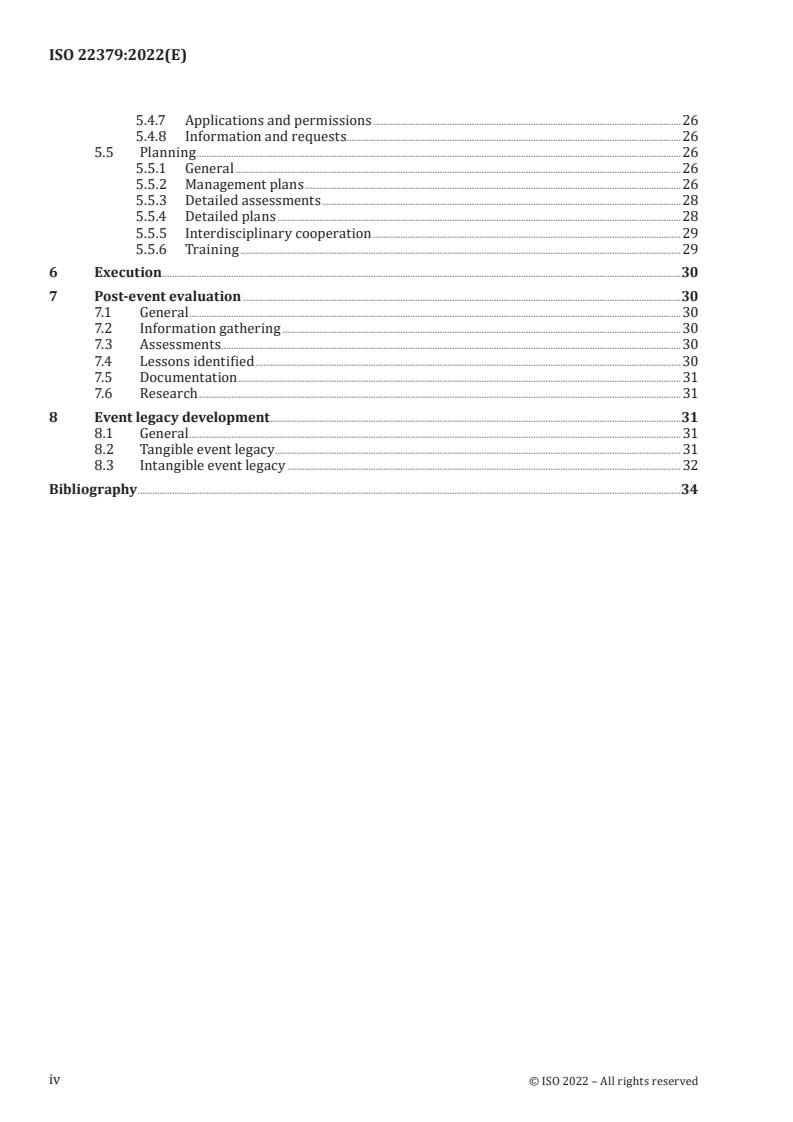
6 Execution .30
7 Post-event evaluation .30
7.1 General .30
7.2 Information gathering .30
7.3 Assessments . .30
7.4 Lessons identified . 30
7.5 Documentation . 31
7.6 Research . 31
8 Event legacy development .31
8.1 General . 31
8.2 Tangible event legacy . 31
8.3 Intangible event legacy . 32
Bibliography .34
iv
Foreword
ISO (the International Organization for Standardization) is a worldwide federation of national standards
bodies (ISO member bodies). The work of preparing International Standards is normally carried out
through ISO technical committees. Each member body interested in a subject for which a technical
committee has been established has the right to be represented on that committee. International
organizations, governmental and non-governmental, in liaison with ISO, also take part in the work.
ISO collaborates closely with the International Electrotechnical Commission (IEC) on all matters of
electrotechnical standardization.
The procedures used to develop this document and those intended for its further maintenance are
described in the ISO/IEC Directives, Part 1. In particular, the different approval criteria needed for the
different types of ISO documents should be noted. This document was drafted in accordance with the
editorial rules of the ISO/IEC Directives, Part 2 (see www.iso.org/directives).
Attention is drawn to the possibility that some of the elements of this document may be the subject of
patent rights. ISO shall not be held responsible for identifying any or all such patent rights. Details of
any patent rights identified during the development of the document will be in the Introduction and/or
on the ISO list of patent declarations received (see www.iso.org/patents).
Any trade name used in this document is information given for the convenience of users and does not
constitute an endorsement.
For an explanation of the voluntary nature of standards, the meaning of ISO specific terms and
expressions related to conformity assessment, as well as information about ISO's adherence to
the World Trade Organization (WTO) principles in the Technical Barriers to Trade (TBT), see
www.iso.org/iso/foreword.html.
This document was prepared by Technical Committee ISO/TC 292, Security and resilience.
Any feedback or questions on this document should be directed to the user’s national standards body. A
complete listing of these bodies can be found at www.iso.org/members.html.
v
Introduction
Cities, regions and countries support the hosting of high-profile public events as a means of attracting
national and international attention to opportunities for business, citywide or regional development,
population growth and tourism.
Large events, such as national or international sporting championships, cultural or societal
arrangements, conferences and exhibitions, or entertainment concerts, deliver significant direct and
indirect economic benefits to the host city, region or country, when effectively arranged.
Commensurate with the opportunities for development and growth, the demands of hosting extensive
events are accompanied by a range of financial, commercial and operational risks to the city, region or
country, which need to be responsibly managed.
The nature of extensive and complex events is such that the overall level of risk of the city or region will
be influenced prior to the event, during the event and post event. The level of risk to the city or region
from existing hazards and threats can be affected by the event, conversely, the city or regions current
level of risk can influence, either positively or negatively, the level of risk of the event activities.
Both the level of risk of the event and the level of risk of the host city, region or country, and their
interdependency, will need assessments to determine that the most effective risk management
strategies are implemented to execute a successful event.
This document has been developed as guidance for cities, regions and countries to manage large events
and minimize the impact on public finance, support infrastructure and community services in hosting
extensive events.
This document provides guidance to event hosts and organizers to identify, assess and evaluate
identified hazards and threats that can impact upon an event, and taken into consideration prior to
decisions being taken to host or organize an event, and how risks can be treated.
This document contains best practice initiatives for the delivery of safe, secure and sustainable events,
and provide a systematic process and framework for collaboration between an event host and an event
organizer in the preparation and realization of high-profile public events.
This document provides guidelines for any organization, public or private, responsible for hosting or
organizing a citywide or regional event and can be used by any organization engaged in the preparation
and realization of high-profile public events.
vi
INTERNATIONAL STANDARD ISO 22379:2022(E)
Security and resilience — Guidelines for hosting and
organizing citywide or regional events
1 Scope
This document gives guidance on hosting and organizing citywide or regional events.
It provides principles applicable to any host and organizer of citywide or regional events.
This document will help hosts and organizers to plan and execute a safe, secure and sustainable event
by:
— introducing a process for cooperation between the host and organizer;
— identifying and involving relevant interested parties;
— identifying the economic, environmental and societal impact caused by the event;
— establishing necessary measures to manage risks introduced by or affecting the event;
— establishing necessary measures to deliver the event;
— providing critical services to the public and to the event;
— providing interested parties and the public with information;
— providing future hosts and organizers of similar events with lessons identified;
— introducing an event legacy plan consistent with the long-term objectives for the city or region.
This document is general and strategic and does not include detailed descriptions or how to plan and
execute specific tasks.
2 Normative references
The following documents are referred to in the text in such a way that some or all of their content
constitutes requirements of this document. For dated references, only the edition cited applies. For
undated references, the latest edition of the referenced document (including any amendments) applies.
ISO 22300, Security and resilience — Vocabulary
ISO 31000, Risk management
3 Terms and definitions
For the purposes of this document, the terms and definitions given in ISO 22300, ISO 31000 and the
following apply.
ISO and IEC maintain terminology databases for use in standardization at the following addresses:
— ISO Online browsing platform: available at https:// www .iso .org/ obp
— IEC Electropedia: available at https:// www .electropedia .org/
3.1
host
public entity or organization responsible to ensure that the event (3.5) is executed in surroundings
sufficiently prepared for the event as planned and in compliance with current legislations, guidelines
and agreements
3.2
hosting
official activities related to the event (3.5) performed by the host (3.1)
3.3
organizer
private or public entity or organization responsible to ensure that the event (3.5) is executed as planned
and in compliance with current legislations, guidelines and agreements
3.4
organizing
activities related to the event (3.5) performed by the organizer (3.3)
3.5
event
planned gathering with respect to time and a place where an experience is created and/or a message is
communicated
[SOURCE: ISO 20121:2012, 3.8]
3.6
citywide event
event (3.5) in one or several locations within a single jurisdiction which impacts (3.8) city infrastructure
and citizens
3.7
regional event
event (3.5) in one or several locations throughout multiple jurisdictions which impacts (3.8)
infrastructures and citizens
3.8
impact
positive or negative change to society, economy or the environment, wholly or partially resulting from
past and present decisions and activities
Note 1 to entry: For the purpose of this document, the term “impact” refers to negative change and positive
change is referred to as added value.
[SOURCE: ISO 20121:2012, 3.44, modified — Note 1 to entry has been added.]
3.9
event rights holder
legal entity either holding or authorized to use one or more intellectual property rights
[SOURCE: ISO 22300:2021, 3.214, modified — “event” has been added to the term.]
3.10
contingency
preparation for and handling of unwanted situations
Note 1 to entry: Unwanted situations in this context are situations where remedial actions are considered
implemented or implemented
Note 2 to entry: Remedial actions relate to extraordinary response and do not include activities and actions
which are part of a daily operational follow-up, e.g. daily non-conformance handling.
4 Responsible entities and key areas
4.1 General
There are two responsible entities in the preparation and realization of an event:
— the host;
— the organizer.
The host and the organizer should be mutually responsible to ensure the planning and execution of the
event is in alignment with:
— human rights as determined by the United Nations;
— the United Nations Sustainable Development Goals;
— applicable working regulations;
— applicable anti-corruption regulations.
Both the host and the organizer should plan, document and communicate to the public how they ensure
alignment with these fundamental regulations in all parts of the preparation to and realization of the
event.
Only one public entity should be the responsible host.
When an event is hosted by several cities or regions, each city or region should appoint a responsible
host.
The host should be responsible for all other public or private entities involved in the hosting of the
event, and responsible towards any superior authorities who have interests involved in the event.
Only one entity should be the responsible organizer.
If the host city or region acts as both the host and the organizer, these roles should be separated and
handled by two different entities in alignment with this document.
When an event is organized in several cities or regions, each city or region should have an official
responsible organizer.
The organizer should be responsible for all its subcontractors and other entities involved in the
organizing of the event, and responsible towards any superior private or public entity who has interests
involved in the event.
EXAMPLE Superior or public entities who have interests in the event can be event rights holders or national
and/or international committees/federations/associations, etc.
The host and the organizer should be the responsible entities for all official mutual agreements
regarding the event.
Any agreements with an event rights holder which identifies rights or responsibilities should be
included in the official agreement between the host and the organizer.
Both the host and the organizer should consider the following key areas in accordance with this
document, to ensure the preparation and realization of a safe, secure and sustainable event:
— administration and management (see 4.2);
— facilities and locations (see 4.3);
— critical infrastructure and communication (see 4.4);
— safety and security (see 4.5);
— information security and privacy management (see 4.6);
— business and service continuity (see 4.7);
— transportation and supply (see 4.8);
— information and support (see 4.9);
— marketing and promotion (see 4.10);
— environment and heritage sites (see 4.11);
— event legacy development (see 4.12);
— re-establishment and normalization (see 4.13);
— cost and funding (see 4.14).
The host and the organizer should within their responsibilities assess and manage all risks related to
the key areas.
Both the host and the organizer should consider the key areas separately, to manage the influence on
their own responsibilities, and together, to identify, coordinate and manage how they influence and
depend on their mutual responsibilities.
4.2 Administration and management
The host and organizer should consider the key area “administration and management” in the
preparation and realization phase of the event, see Table 1 for requirements.
Table 1 — Requirements for administration and management
Host Organizer
For the host, administration and management, prior to, For the organizer, administration and management,
during and after the event, include: prior to, during and after the event, include:
a) establishing a robust and competent organization a) establishing a robust and competent organization
suitable to manage the host’s responsibilities; suitable to manage the organizer’s responsibilities;
b) ensuring necessary host interested parties b) ensuring necessary organizer interested parties
involvement; involvement;
c) activities to facilitate for the event; c) activities to facilitate for the event;
d) activities to perform in compliance with the host’s d) activities to perform in compliance with the
responsibilities; organizer’s responsibilities;
e) host hospitality activities. e) organizer hospitality activities.
4.3 Facilities and locations
The host and organizer should consider the key area “facilities and locations” in the preparation and
realization phase of the event, see Table 2 for requirements.
Table 2 — Requirements for facilities and locations
Host Organizer
For the host, facilities and locations, to be used prior to For the organizer, facilities and locations, to be used
and during the event, include: prior to and during the event, include:
a) existing or new facilities and locations; a) existing or new venues and installations;
b) accommodation for human host resources; b) existing or new public arenas;
c) administrative facilities for the host organization. c) accommodation for participants, delegations,
visitors, media officials and human event
resources;
d) administrative facilities for the organizer
organization.
4.4 Critical infrastructure and communication
The host and organizer should consider the key area “critical infrastructure and communication” in the
preparation and realization phase of the event, see Table 3 for requirements.
Table 3 — Requirements for critical infrastructure and communication
Host Organizer
For the host, critical infrastructure and communica- For the organizer, critical infrastructure and com-
tion, prior to and during the event, include the impact munication, to be used prior to and during the event,
on and use of: include:
a) power and electricity; a) power and electricity;
b) water and sanitation; b) water and sanitation;
c) roads and transport systems; c) roads and transport systems;
d) communication networks and internet access; d) communication networks and internet access;
e) broadcasting and social media. e) broadcasting and social media.
4.5 Safety and security
The host and organizer should consider the key area “safety and security” in the preparation and
realization phase of the event, see Table 4 for requirements.
Table 4 — Requirements for safety and security
Host Organizer
For the host, safety and security, to be present during For the organizer, safety and security, to be present
the event, include: prior to and during the event, include:
a) police services; a) crowd management services;
b) ambulance services; b) first aid services;
c) fire and rescue services; c) fire safety services;
d) interdisciplinary cooperation; d) security services;
e) emergency and crisis management. e) emergency and crisis management.
4.6 Information security and privacy management
The host and organizer should consider the key area “information security and privacy management”
in the preparation and realization phase of the event, see Table 5 for requirements.
Table 5 — Requirements for information security and privacy management
Host Organizer
a) For the host, information security, prior to, during a) For the organizer, information security, prior to,
and after the event, includes the protection of during and after the event, includes the protection
confidentiality, integrity and availability of: of confidentiality, integrity and availability of:
— communication with the organizer and — communication with the host and authorities
authorities involved; involved;
— internal communication regarding the event; — internal communication;
— external communication regarding the event; — external communication;
— extra public services regarding the event; — event administration;
— technical and facility services used for the — finances;
event.
— ticket and admission services;
b) For the host, privacy management, prior to, during
— payment and monetary services;
and after the event, includes the protection of
personal data and acting compliant to taking into
— technical and facility services.
consideration legal and regulatory obligations
regarding the privacy of:
b) For the organizer, privacy management, prior to,
during and after the event, includes the protection
— host staff;
of personal data and acting compliant to taking
into consideration legal and regulatory obligations
— host’s subcontractors’ staff;
regarding the privacy of:
— participants;
— staff;
— visitors to the event;
— subcontractors’ staff;
— press;
— participants;
— social media.
— visitors to the event;
— press;
— social media.
4.7 Business and service continuity
The host and organizer should consider the key area “business and service continuity” in the preparation
and realization phase of the event, see Table 6 for requirements.
Table 6 — Requirements for business and service continuity
Host Organizer
For the host, business and service continuity, prior to For the organizer, business and service continuity,
and during the event, include the impact on and use of: prior to and during the event, include:
a) commerce and financial services: a) administrative and hospitality services;
— retail and banking; b) technical and facility services;
— construction and industry; c) ticket and admission services;
b) law and order services: d) payment and monetary services.
— crime prevention and investigation;
— prosecution and detention;
c) health services:
— hospitals and emergency wards;
— infectious diseases and hazardous substances;
d) complementary public services:
— schools and kindergartens;
— elderly and home care services;
— social and special needs services;
— public transport services;
— other public services.
4.8 Transportation and supply
The host and organizer should consider the key area “transportation and supply” in the preparation
and realization phase of the event, see Table 7 for requirements.
Table 7 — Requirements for transportation and supply
Host Organizer
For the host, transport and supply, prior to and during For the organizer, transportation and supply, prior to
the event include the impact on and use of: and during the event, include:
a) arranged transport of: a) arranged transport of:
— citizens and visitors; — participants and delegations;
— host’s human resources; — spectators and media officials;
b) arranged hospitality and supply of food and drinks — organizer’s human resources;
to:
b) arranged hospitality and supply of food and drinks
— host’s human resources to:
c) public hygiene and waste management; — participants and delegations;
d) logistics. — spectators and media officials;
— organizer’s human resources;
c) hygiene and waste management;
d) logistics.
4.9 Information and support
The host and organizer should consider the key area “information and support” in the preparation and
realization phase of the event, see Table 8 for requirements.
Table 8 — Requirements for information and support
Host Organizer
For the host, information and support, to be provided For the organizer, information and support, to be provided
prior to and during the event, include: prior to and during the event, include:
a) official information to: a) official information to:
— citizens and visitors; — participants and delegations;
— host’s human resources; — spectators and media officials;
b) official support solutions to: — organizer’s human resources;
— citizens and visitors; b) official support solutions to:
— host’s human resources. — participants and delegations;
— spectators and media officials;
— organizer’s human resources.
4.10 Marketing and promotion
The host and organizer should consider the key area “marketing and promotion” in the preparation and
realization phase of the event, see Table 9 for requirements.
Table 9 — Requirements for marketing and promotion
Host Organizer
For the host, marketing and promotion, prior to and For the organizer, marketing and promotion, prior to and
during the event, include: during the event, include:
a) city or region marketing and promotion plans; a) estimates on the expected visitors and spectators
attendance;
b) the broad communication strategy to promote the
event and attract local and foreign visitors and b) reliable estimates on the potential revenues from
spectators; sponsorship, ticketing and merchandising;
c) target audiences to activate for the success of the c) the broad communication strategy to promote
event. the event maximising visitors and spectators
attendance;
d) target audiences to activate for the success of the
event.
4.11 Environment and heritage sites
The host and organizer should consider the key area “environment and heritage sites” in the preparation
and realization phase of the event, see Table 10 for requirements.
Table 10 — Requirements for environment and heritage sites
Host Organizer
For the host, environment and heritage sites, prior to For the organizer environment and heritage sites,
and during the event, include the impact on: prior to and during the event, include the use of:
a) nature and environment; a) environmentally friendly solutions;
b) heritage sites; b) heritage sites friendly solutions;
c) the overall host carbon footprint. c) the overall organizer carbon footprint.
4.12 Event legacy development
The host and organizer should consider the key area “event legacy development” in the preparation and
realization phase of the event, see Table 11 for requirements.
Table 11 — Requirements for event legacy development
Host Organizer
For the host, event legacy development, prior to, dur- For the organizer, event legacy development, prior to
ing and after the event, include: and during the event, include:
a) tangible event legacy plans for the post-event re- a) plans to incorporate event legacy requirements in
use of the hosting venues and facilities; the design and organization of the event;
b) intangible event legacy plans (economic, social, b) post-event reconversion plan for the venues and
environmental, others); facilities.
c) event legacy governance;
d) event legacy costs for the host city or region and
funding strategies;
e) alignment with the city or region long-term
development plans.
4.13 Re-establishment and normalization
The host and organizer should consider the key area “re-establishment and normalization” in the
preparation and realization phase of the event, see Table 12 for requirements.
Table 12 — Requirements for re-establishment and normalization
Host Organizer
For the host, re-establishment and normalization, after For the organizer, re-establishment and normalization,
the event, include: after the event, include:
a) disassembly of temporary host measures and a) disassembly of temporary organizer measures
installations; and installations;
b) re-establishing ordinary solutions; b) re-establishing ordinary solutions;
c) preservation and use of permanent facilities and c) demobilisation of the temporary organizer
installations; organization;
d) demobilisation of temporary host resources; d) evaluation, reporting and knowledge sharing.
e) evaluation, reporting and knowledge sharing.
4.14 Cost and funding
The host and organizer should consider the key area “cost and funding” in the preparation and
realization phase of the event, see Table 13 for requirements.
Table 13 — Requirements for control of cost and funding
Host Organizer
For the host, cost and funding, prior to and post the For the organizer, cost and funding, prior to and post
decision to host the event, include: the decision to arrange the event, include:
a) reliable cost estimates related to the event; a) reliable cost estimates related to the event;
b) reliable income and added value estimates related b) reliable income and added value estimates related
to the event; to the event;
c) accountable budgets for the event; c) accountable budgets for the event;
d) necessary funding for the event; d) necessary funding for the event;
e) necessary insurances for the event. e) necessary insurances for the event.
5 Hosting and organizing process
5.1 General
Cities and regions are advised to establish procedures to ensure early identification and systematic
processing of event initiatives.
The procedures should ensure:
— a transparent and appropriate official involvement and endorsement of any private or public
initiative to host and/or organize a citywide or regional event;
— that the city or region implements a structured and systematic process when considering hosting
an identified event initiative.
The hosting and organizing process, hereafter referred to as the “process”, consists of the following
stages:
— identification (see 5.2);
— pre-study (see 5.3);
— decision (see 5.4);
— planning (see 5.5);
— execution (see Clause 6);
— evaluation (see Clause 7).
The transition from one stage to the next should be agreed as a formal documented acceptance by both
the host and the organizer.
The documented acceptance should specify:
— the host entity and the organizer entity for the next stage;
— the responsibilities for the host and the organizer within the key areas;
— a stage-specific progress-plan with expected deliverables.
Both the host and the organizer should separately consider all key areas as described in this document
in all the stages of the process.
The exclusion of further consideration of one or several key areas, partially or totally, in any stage of the
process, should be a documented decision.
The host and the organizer should in all stages of the process:
— coordinate their efforts to ensure coherence in their measures and solutions;
— perform regular coordinating meetings to share relevant information and documentation;
— cooperate to ensure coherent and necessary information to the public and encourage any public
debate regarding the event;
— document lessons identified for future events;
— develop a desired post-event legacy.
Figure 1 — Event hosting and organizing process
The stages prior to the decision stage should be referred to as the “preparation phase” and the stages
after the decision stage should be referred to as the “realization phase”.
The decision stage is when the city or region officially applies for and/or agrees to be the host of the
event.
Both the preparation phase and the realization phase are equally important and are dependent on each
other in order to ensure a safe, secure and sustainable event.
5.2 Identification
5.2.1 General
The identification stage starts when the city or region has identified a citywide or regional event
initiative which the city or region considers endorsing.
In the identification stage, the city or region should identify and document necessary information as
basis for further initiative endorsement.
If the city or region identifies an event initiative which the city or region will not endorse, the city or
region should ensure that the initiative is not pursued any further by officially declining further public
endorsement of the event initiative.
The identification stage should identify and document the following information regarding the event:
— host and organizer entities;
— content and extent;
— requirements and specifications;
— experiences and lessons identified;
— applications and permissions;
— responsibilities and necessities;
— interested parties and partners;
— decision criteria.
5.2.2 Host and organizer entities
The city or region should appoint the official hosting responsibility for the event, temporary or
permanently, to a public function and/or entity acting as the host.
The host should appoint the official organizing responsibility for the event, temporary or permanently,
to a public or private function and/or entity acting as the organizer, if one is not already established by
the event initiators.
The host and the organizer should document
...