

ISO 4954-1:2024
(Main)Steels for cold heading and cold extruding — Technical delivery conditions — Part 1: Non-alloy and alloy steels
General Information
- Abstract
This document specifies requirements for non-alloy and alloy steels that are intended for cold heading or cold extruding and are delivered as wire rods, wire or bars. It also lists the specific requirements for: — steels not intended for heat treatment, with diameters from 2 mm to 100 mm (see Annex A); — case-hardening steels with diameters from 2 mm to 100 mm (see Annex B); — steels for quenching and tempering, including boron-alloyed steels, with diameters from 2 mm to 100 mm (see Annex C). This document (except Annex A) also applies to the properties of cold-headed or cold-extruded parts which have been subjected to a subsequent heat treatment. NOTE Stainless steels for cold heading and cold extruding are covered by ISO 4954-2.
- Status
- Published
- Publication Date
- 18-Jun-2024
- Technical Committee
- ISO/TC 17/SC 4 - Heat treatable and alloy steels
- Drafting Committee
- ISO/TC 17/SC 4 - Heat treatable and alloy steels
- Current Stage
- 6060 - International Standard published
- Start Date
- 19-Jun-2024
- Due Date
- 20-Mar-2026
- Completion Date
- 19-Jun-2024

Overview - ISO 4954-1:2024 (Steels for cold heading and cold extruding)
ISO 4954-1:2024 defines technical delivery conditions for non‑alloy and alloy steels intended specifically for cold heading and cold extruding. It covers steels delivered as wire rod, wire or bars and sets the requirements for steels with diameters from 2 mm to 100 mm. The standard includes normative annexes with tailored requirements for:
- steels not intended for heat treatment (Annex A),
- case‑hardening steels (Annex B),
- steels for quenching and tempering, including boron‑alloyed grades (Annex C).
Note: stainless steels for cold heading/extruding are covered separately in ISO 4954-2.
Key topics and technical requirements
ISO 4954-1 addresses the full set of delivery and acceptance criteria required for reliable cold forming:
- Classification and designation of steel grades for cold heading/cold extruding.
- Information to be supplied by the purchaser, including mandatory and optional data for orders.
- Manufacturing process attributes such as deoxidation, heat‑treatment condition, surface condition and traceability.
- Chemical composition and mechanical properties (tensile/impact where applicable) and hardenability (for case‑hardening and quench/tempered steels).
- Microstructure controls: grain size and carbide spheroidization.
- Non‑metallic inclusions and internal soundness requirements.
- Aptitude to cold forming (upsetting tests) and surface quality standards for wire rod, bars and bright products.
- Decarburization, shape, dimensions and tolerances.
- Inspection, sampling and testing procedures (chemical, mechanical, hardenability, non‑destructive testing) plus marking, packaging and traceability.
Practical applications
This standard is practical for organizations that specify, manufacture or inspect steels and components intended for cold forming:
- Fastener and bolt manufacturers producing high‑volume cold‑headed parts.
- Automotive and aerospace suppliers where cold‑formed components require controlled properties and post‑forming heat treatment.
- Wire‑rod and bar producers delivering material for cold extrusion operations.
- Quality, purchasing and metallurgical engineers who must specify material acceptance criteria, testing frequencies and traceability.
Using ISO 4954-1 helps ensure consistent material performance in cold forming operations, reduces scrap and rework, and provides a harmonized basis for procurement and conformity assessment.
Related standards
- ISO 4954-2 (stainless steels for cold heading/extruding)
- Relevant normative references cited in ISO 4954-1: ISO 377, ISO 404, ISO 642 (Jominy), ISO 643 (grain size), ISO 683 series (heat‑treatable steels)
Keywords: ISO 4954-1, cold heading, cold extruding, non‑alloy steels, alloy steels, technical delivery conditions, wire rod, case‑hardening, quenching and tempering, material specification.
Relations
- Effective Date
- 24-Dec-2022
Get Certified
Connect with accredited certification bodies for this standard

Element Materials Technology
Materials testing and product certification.

Inštitut za kovinske materiale in tehnologije
Institute of Metals and Technology. Materials testing, metallurgical analysis, NDT.
Sponsored listings
Frequently Asked Questions
ISO 4954-1:2024 is a standard published by the International Organization for Standardization (ISO). Its full title is "Steels for cold heading and cold extruding — Technical delivery conditions — Part 1: Non-alloy and alloy steels". This standard covers: This document specifies requirements for non-alloy and alloy steels that are intended for cold heading or cold extruding and are delivered as wire rods, wire or bars. It also lists the specific requirements for: — steels not intended for heat treatment, with diameters from 2 mm to 100 mm (see Annex A); — case-hardening steels with diameters from 2 mm to 100 mm (see Annex B); — steels for quenching and tempering, including boron-alloyed steels, with diameters from 2 mm to 100 mm (see Annex C). This document (except Annex A) also applies to the properties of cold-headed or cold-extruded parts which have been subjected to a subsequent heat treatment. NOTE Stainless steels for cold heading and cold extruding are covered by ISO 4954-2.
This document specifies requirements for non-alloy and alloy steels that are intended for cold heading or cold extruding and are delivered as wire rods, wire or bars. It also lists the specific requirements for: — steels not intended for heat treatment, with diameters from 2 mm to 100 mm (see Annex A); — case-hardening steels with diameters from 2 mm to 100 mm (see Annex B); — steels for quenching and tempering, including boron-alloyed steels, with diameters from 2 mm to 100 mm (see Annex C). This document (except Annex A) also applies to the properties of cold-headed or cold-extruded parts which have been subjected to a subsequent heat treatment. NOTE Stainless steels for cold heading and cold extruding are covered by ISO 4954-2.
ISO 4954-1:2024 is classified under the following ICS (International Classification for Standards) categories: 77.140.10 - Heat-treatable steels; 77.140.20 - Stainless steels; 77.140.45 - Non-alloyed steels. The ICS classification helps identify the subject area and facilitates finding related standards.
ISO 4954-1:2024 has the following relationships with other standards: It is inter standard links to ISO 4954:2022. Understanding these relationships helps ensure you are using the most current and applicable version of the standard.
ISO 4954-1:2024 is available in PDF format for immediate download after purchase. The document can be added to your cart and obtained through the secure checkout process. Digital delivery ensures instant access to the complete standard document.
Standards Content (Sample)
International
Standard
ISO 4954-1
First edition
Steels for cold heading and cold
2024-06
extruding — Technical delivery
conditions —
Part 1:
Non-alloy and alloy steels
Aciers pour transformation à froid et extrusion à froid —
Conditions techniques de livraison —
Partie 1: Aciers non alliés et faiblement alliés
Reference number
© ISO 2024
All rights reserved. Unless otherwise specified, or required in the context of its implementation, no part of this publication may
be reproduced or utilized otherwise in any form or by any means, electronic or mechanical, including photocopying, or posting on
the internet or an intranet, without prior written permission. Permission can be requested from either ISO at the address below
or ISO’s member body in the country of the requester.
ISO copyright office
CP 401 • Ch. de Blandonnet 8
CH-1214 Vernier, Geneva
Phone: +41 22 749 01 11
Email: copyright@iso.org
Website: www.iso.org
Published in Switzerland
ii
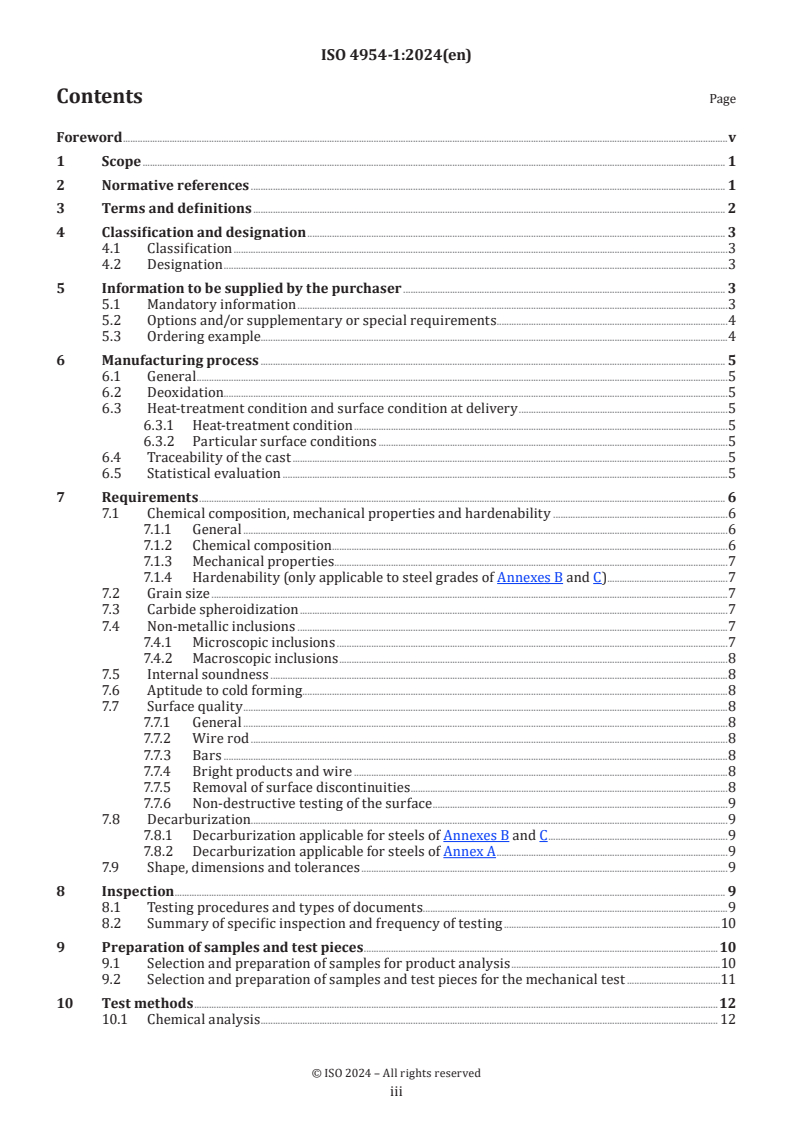
Contents Page
Foreword .v
1 Scope . 1
2 Normative references . 1
3 Terms and definitions . 2
4 Classification and designation . 3
4.1 Classification .3
4.2 Designation .3
5 Information to be supplied by the purchaser . 3
5.1 Mandatory information .3
5.2 Options and/or supplementary or special requirements .4
5.3 Ordering example.4
6 Manufacturing process . 5
6.1 General .5
6.2 Deoxidation.5
6.3 Heat-treatment condition and surface condition at delivery .5
6.3.1 Heat-treatment condition .5
6.3.2 Particular surface conditions .5
6.4 Traceability of the cast .5
6.5 Statistical evaluation .5
7 Requirements . 6
7.1 Chemical composition, mechanical properties and hardenability .6
7.1.1 General .6
7.1.2 Chemical composition . .6
7.1.3 Mechanical properties . .7
7.1.4 Hardenability (only applicable to steel grades of Annexes B and C).7
7.2 Grain size .7
7.3 Carbide spheroidization .7
7.4 Non-metallic inclusions .7
7.4.1 Microscopic inclusions .7
7.4.2 Macroscopic inclusions .8
7.5 Internal soundness .8
7.6 Aptitude to cold forming .8
7.7 Surface quality .8
7.7.1 General .8
7.7.2 Wire rod .8
7.7.3 Bars .8
7.7.4 Bright products and wire .8
7.7.5 Removal of surface discontinuities .8
7.7.6 Non-destructive testing of the surface .9
7.8 Decarburization . .9
7.8.1 Decarburization applicable for steels of Annexes B and C .9
7.8.2 Decarburization applicable for steels of Annex A .9
7.9 Shape, dimensions and tolerances .9
8 Inspection . 9
8.1 Testing procedures and types of documents.9
8.2 Summary of specific inspection and frequency of testing .10
9 Preparation of samples and test pieces .10
9.1 Selection and preparation of samples for product analysis .10
9.2 Selection and preparation of samples and test pieces for the mechanical test .11
10 Test methods .12
10.1 Chemical analysis . 12
iii
10.2 Mechanical tests . 12
10.3 Hardenability and core hardness tests . 13
10.3.1 Verification of hardenability . 13
10.3.2 Verification of core hardness . 13
10.4 Non-destructive testing . 13
10.5 Aptitude to cold forming — Upsetting test . 13
10.6 Visual and dimensional tests .14
10.7 Retests .14
11 Surface treatment, marking and packaging . 14
11.1 Surface treatment and temporary corrosion protection .14
11.2 Marking .14
11.3 Packaging .14
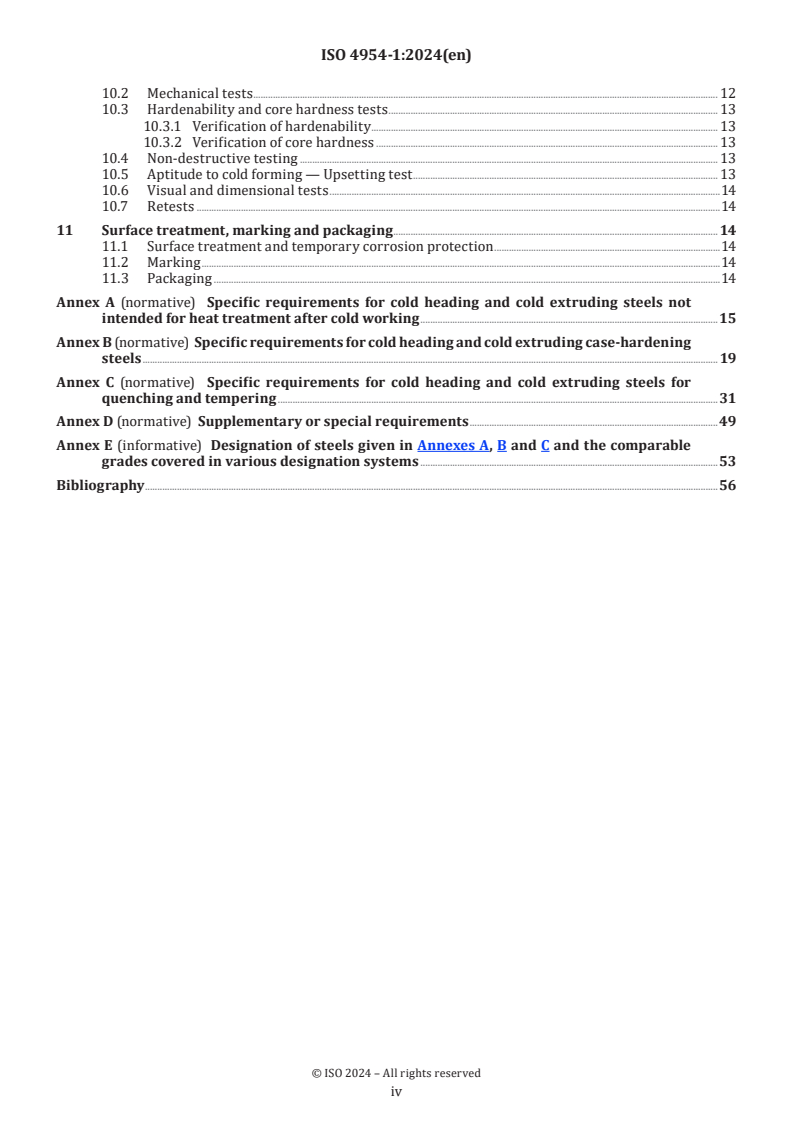
Annex A (normative) Specific requirements for cold heading and cold extruding steels not
intended for heat treatment after cold working .15
Annex B (normative) Specific requirements for cold heading and cold extruding case-hardening
steels . 19
Annex C (normative) Specific requirements for cold heading and cold extruding steels for
quenching and tempering .31
Annex D (normative) Supplementary or special requirements .49
Annex E (informative) Designation of steels given in Annexes A, B and C and the comparable
grades covered in various designation systems .53
Bibliography .56
iv
Foreword
ISO (the International Organization for Standardization) is a worldwide federation of national standards
bodies (ISO member bodies). The work of preparing International Standards is normally carried out through
ISO technical committees. Each member body interested in a subject for which a technical committee
has been established has the right to be represented on that committee. International organizations,
governmental and non-governmental, in liaison with ISO, also take part in the work. ISO collaborates closely
with the International Electrotechnical Commission (IEC) on all matters of electrotechnical standardization.
The procedures used to develop this document and those intended for its further maintenance are described
in the ISO/IEC Directives, Part 1. In particular, the different approval criteria needed for the different types
of ISO document should be noted. This document was drafted in accordance with the editorial rules of the
ISO/IEC Directives, Part 2 (see www.iso.org/directives).
ISO draws attention to the possibility that the implementation of this document may involve the use of (a)
patent(s). ISO takes no position concerning the evidence, validity or applicability of any claimed patent
rights in respect thereof. As of the date of publication of this document, ISO had not received notice of (a)
patent(s) which may be required to implement this document. However, implementers are cautioned that
this may not represent the latest information, which may be obtained from the patent database available at
www.iso.org/patents. ISO shall not be held responsible for identifying any or all such patent rights.
Any trade name used in this document is information given for the convenience of users and does not
constitute an endorsement.
For an explanation of the voluntary nature of standards, the meaning of ISO specific terms and expressions
related to conformity assessment, as well as information about ISO's adherence to the World Trade
Organization (WTO) principles in the Technical Barriers to Trade (TBT), see www.iso.org/iso/foreword.html.
This document was prepared by Technical Committee ISO/TC 17, Steel, Subcommittee SC 4, Heat treatable
and alloy steels.
This first edition of ISO 4954-1, together with ISO 4954-2, cancels and replaces ISO 4954:2022, which has
been technically revised.
The main changes are as follows:
— the following steel grades were added: 15B2, 20MnCr5, 42Mn6, 40MnB6
— Annex D.4 was extended to method K of SEP 1571-2.
A list of all parts in the ISO 4954 series can be found on the ISO website.
Any feedback or questions on this document should be directed to the user’s national standards body. A
complete listing of these bodies can be found at www.iso.org/members.html.
v
International Standard ISO 4954-1:2024(en)
Steels for cold heading and cold extruding — Technical
delivery conditions —
Part 1:
Non-alloy and alloy steels
1 Scope
This document specifies requirements for non-alloy and alloy steels that are intended for cold heading or
cold extruding and are delivered as wire rods, wire or bars. It also lists the specific requirements for:
— steels not intended for heat treatment, with diameters from 2 mm to 100 mm (see Annex A);
— case-hardening steels with diameters from 2 mm to 100 mm (see Annex B);
— steels for quenching and tempering, including boron-alloyed steels, with diameters from 2 mm to 100 mm
(see Annex C).
This document (except Annex A) also applies to the properties of cold-headed or cold-extruded parts which
have been subjected to a subsequent heat treatment.
NOTE Stainless steels for cold heading and cold extruding are covered by ISO 4954-2.
2 Normative references
The following documents are referred to in the text in such a way that some or all of their content constitutes
requirements of this document. For dated references, only the edition cited applies. For undated references,
the latest edition of the referenced document (including any amendments) applies.
ISO 377, Steel and steel products — Location and preparation of samples and test pieces for mechanical testing
ISO 404, Steel and steel products — General technical delivery requirements
ISO 642, Steel — Hardenability test by end quenching (Jominy test)
ISO 643, Steels — Micrographic determination of the apparent grain size
ISO 683-1, Heat-treatable steels, alloy steels and free-cutting steels — Part 1: Non-alloy steels for quenching and
tempering
ISO 683-2, Heat-treatable steels, alloy steels and free-cutting steels — Part 2: Alloy steels for quenching and
tempering
ISO 683-3, Heat-treatable steels, alloy steels and free-cutting steels — Part 3: Case-hardening steels
ISO 683-7, Heat-treatable steels, alloy steels and free-cutting steels — Part 7: Bright products of non-alloy and
alloy steels
ISO 1035-1, Hot-rolled steel bars — Part 1: Dimensions of round bars
ISO 1035-2, Hot-rolled steel bars — Part 2: Dimensions of square bars
ISO 1035-3, Hot-rolled steel bars — Part 3: Dimensions of flat bars
ISO 1035-4, Hot-rolled steel bars — Part 4: Tolerances
ISO 3887, Steels — Determination of the depth of decarburization
ISO 4885, Ferrous materials — Heat treatments — Vocabulary
ISO 4948-1, Steels — Classification — Part 1: Classification of steels into unalloyed and alloy steels based on
chemical composition
ISO 4948-2, Steels — Classification — Part 2: Classification of unalloyed and alloy steels according to main
quality classes and main property or application characteristics
ISO/TS 4949, Steel names based on letter symbols
ISO 4967:2013, Steel — Determination of content of non-metallic inclusions — Micrographic method using
standard diagrams
ISO 6508-1, Metallic materials — Rockwell hardness test — Part 1: Test method
ISO 6892-1, Metallic materials — Tensile testing — Part 1: Method of test at room temperature
ISO 6929, Steel products — Vocabulary
ISO 9443, Surface quality classes for hot-rolled bars and wire rod
ISO 9934-1, Non-destructive testing — Magnetic particle testing — Part 1: General principles
ISO 10474, Steel and steel products — Inspection documents
ISO 14284, Steel and iron — Sampling and preparation of samples for the determination of chemical composition
ISO 15549, Non-destructive testing — Eddy current testing — General principles
ISO 16124, Steel wire rod — Dimensions and tolerances
ISO 22034-2, Steel wire and wire products — Part 2: Tolerances on wire dimensions
JIS G 0555:2015, Microscopic testing method for the non-metallic inclusions in steel
SEP 1571-1, Evaluation of inclusions in special steels based on their surface areas – Part 1: Basics
SEP 1571-2, Evaluation of inclusions in special steels based on their surface areas – Part 2: Methods K and M
3 Terms and definitions
For the purposes of this document, the terms and definitions given in ISO 377, ISO 683-1, ISO 683-2,
ISO 683-3, ISO 683-7, ISO 4885, ISO 4948-1, ISO 4948-2, ISO 6929, ISO 14284 and the following apply.
ISO and IEC maintain terminology databases for use in standardization at the following addresses:
— ISO Online browsing platform: available at https:// www .iso .org/ obp
— IEC Electropedia: available at https:// www .electropedia .org/
3.1
bright steel product
drawn or peeled/turned bar with smoother surface quality and better dimensional accuracy in comparison
with a hot-rolled bar
3.2
drawn product
product of various cross-sectional shapes obtained, after descaling, by cold drawing of hot-rolled bars or
wire rod, on a drawing bench (cold deformation without removing material)
Note 1 to entry: This operation gives the product special features with respect to shape, dimensional accuracy and surface
finish. Products in lengths are delivered straightened, products of small cross-section may also be supplied in coils.
3.3
peeled/turned bar
steel bar of circular cross-section having the same features as drawn products (3.2) concerning shape,
dimensional accuracy and bright surface finish but without work hardening
Note 1 to entry: They are produced by peeling on a peeling machine usually followed by straightening and by polishing.
The removal of metal by peeling is carried out in such a way that the bright product is generally free from surface
defects and decarburization coming from the hot-rolling process.
4 Classification and designation
4.1 Classification
The classification of the relevant steel grades shall be in accordance with ISO 4948-1 and ISO 4948-2.
All steel grades mentioned in this document are special steels in accordance with ISO 4948-2.
The steels not intended for heat treatment after cold forming (see Annex A) are non-alloy steels.
The case-hardening steel grades (see Annex B) are alloy steels, except steel grades C10E2C to C20E2C.
The steels for quenching and tempering (see Annex C) are alloy steels, except steel grades C30EC to C45RC
and 42Mn6.
4.2 Designation
For the steel grades covered by this document, the steel names as given in the relevant tables shall be
allocated in accordance with ISO/TS 4949.
Annex E provides a list of steels given in Annexes A, B and C and the comparable grades covered in various
designation systems.
5 Information to be supplied by the purchaser
5.1 Mandatory information
The manufacturer shall obtain the following information from the purchaser at the time of enquiry and order:
a) the quantity to be delivered (mass, length);
b) the product form (e.g.: round bars, wire rod, wire);
c) the nominal diameter and the tolerances on dimensions and shape of the product with reference to the
relevant International Standard;
d) for bars, the length; and for wire rod and wire, the dimensions, e.g. inner diameter etc., and mass of the coils;
e) a reference to this document, i.e. ISO 4954-1;
f) the designation of the steel grade given in Tables A.2, B.2, C.2 and C.3;
g) if applicable, the symbol for the required heat-treatment condition, see Tables A.3, B.3 to B.7 and C.4 to C.10;
h) standard designation for a test report 2.2 or, if required, any other type of inspection document in
accordance with ISO 10474 or another comparable national standard.
5.2 Options and/or supplementary or special requirements
A number of options are specified in this document and listed below. If the purchaser does not indicate a
wish to implement any of these options, the products shall at least be supplied in accordance with the basic
specifications of this document (see 5.1):
a) any requirement for the hardenability (+H, +HH, +HL) of case-hardening steels of Annex B and of steels
for quenching and tempering of Annex C and for the core hardening (+CH) of steels for quenching and
tempering of Annex C, see 7.1.4;
b) verification of hardenability and, if agreed, information about the calculation of the hardenability for
case-hardening steels of Annex B and for steels for quenching and tempering of Annex C, see 10.3.1;
c) verification of core hardness for steels for quenching and tempering of Annex C, see 10.3.2;
d) if another surface condition than hot-rolled or a special surface quality is required, for the surface
condition, see Table 1, and for the surface quality E for wire rod and bars, see 7.7.2 and 7.7.3;
e) any requirement for the verification of the surface quality, see 7.7.5;
f) any requirement relating to the removal of surface defects, see 7.7.6;
g) any requirement for a product analysis, see 7.1.2.2;
h) any requirement for the verification of the fine grain structure, see D.2, of case-hardening steels of
Annex B and of steels for quenching and tempering of Annex C;
i) carbide spheroidization, see 7.3, and any requirement for the verification of the carbide spheroidization,
see D.3;
j) any requirement for the verification of the non-metallic inclusions of case-hardening steels of Annex B
and of steels for quenching and tempering of Annex C, see 7.4 and D.4;
k) internal soundness and any requirements for non-destructive testing, see 7.5 and 10.4;
l) verification of aptitude to cold forming, see 7.6 and 10.5;
m) any requirement concerning non-destructive testing of the surface, see 7.7.6 and 10.4;
n) depth of decarburization, see 7.8, and any requirements for testing the depth of decarburization, see D.5;
o) any requirement concerning surface treatment and temporary corrosion protection, see 11.1;
p) any special requirements concerning special or additional marking, see 11.2;
q) any special requirements concerning packaging, see 11.3;
r) statistical evaluation, see 6.5.
5.3 Ordering example
EXAMPLE 50 t round bars with a nominal diameter of 40 mm and a nominal length of 6 000 mm with diameter
tolerance according to class S and with length tolerance according to class L2 of ISO 1035-4 made of steel grade
ISO 4954-1, 42CrMo4 in the heat-treatment condition +AC+PE (see Table C.5), with hardenability requirement +H (see
Table C.7) and product analysis with an inspection certificate 3.1 in accordance with ISO 10474.
50 t round bars ISO 1035-4 – 40,0S × 6 000L2
ISO 4954-1, 42CrMo4+AC+PE+H – product analysis
ISO 10474 – 3.1
6 Manufacturing process
6.1 General
The manufacturing process of the steel and of the products is, with the restrictions given by the requirements
in 6.2 to 6.4, left to the discretion of the manufacturer.
6.2 Deoxidation
All steels shall be fully deoxidized.
Besides silicon and aluminium other suitable elements having a similar effect may also be used.
The deoxidation practice should be agreed at the time of enquiry and order.
NOTE Concerning the effect of aluminium on the fine grain structure, see 7.2 and D.2.
6.3 Heat-treatment condition and surface condition at delivery
6.3.1 Heat-treatment condition
Treatment and heat-treatment condition shall conform to one of the conditions indicated in Tables A.1, B.1
and C.1.
Bright steel products in cold drawn or peeled/turned condition are coated with a light film of grease from
processing. For bright steel products in a finally heat-treated condition, the manufacturer chooses the rust
protection after heat treatment.
The usual light application of ordinary grease or oil does not afford positive protection against rusting,
particularly in the presence of condensation water. Any surface treatment that can facilitate subsequent
cold heading and cold extrusion or partially delay any formation of rust shall, if required, be agreed at the
time of enquiry and order, see 11.1.
6.3.2 Particular surface conditions
If so agreed at the time of enquiry and order, the products shall be delivered in one of the particular surface
conditions given in Table 1.
Table 1 — Surface condition at delivery
Surface condition at delivery Symbol Bar Wire rod Wire
Unless otherwise agreed as-rolled none or +AR x x —
cold drawn +C x — x
Particular surface conditions
skin passed +LC x — x
supplied by agreement
peeled +PE x x x
6.4 Traceability of the cast
Each product shall be traceable to the cast, see 11.2.
6.5 Statistical evaluation
Suppliers are responsible, using the means they think fit, for inspecting their product in accordance with
various quality criteria specified. In view of the practical difficulties in inspecting a coil of wire rod along its
entire length, it cannot be proved that no value greater than the specified limits occur in the coil as a whole.
Statistical evaluation of performances applicable to all coils may be agreed between the purchaser and the
manufacturer at the time of ordering.
7 Requirements
7.1 Chemical composition, mechanical properties and hardenability
7.1.1 General
Wire rod, bars and wire shall be supplied in one of the delivery conditions as indicated in Tables A.1, B.1, and
C.1 as agreed at the time of enquiry and order. These tables show the combinations of usual heat-treatment
conditions at delivery, product forms and applicable requirements.
In addition to this document, the general technical delivery requirements of ISO 404 shall apply.
7.1.2 Chemical composition
7.1.2.1 The chemical composition determined by cast analysis shall conform to the values in Tables A.2,
B.2, C.2 and C.3.
In cases where steels for case hardening or for quenching and tempering are ordered with hardenability
requirements in accordance with Tables B.6, B.7, C.7, C.8 and C.9, a deviation of the cast analysis with respect
to the values indicated in Tables B.2, C.2 and C.3 is admissible, taking into account the prescriptions given
in footnote b) of those tables. In any case, however, the deviations in the product analysis in relation to the
specified limits of cast analysis shall not exceed the values indicated in Table 2.
7.1.2.2 Permissible deviations between the limiting values for cast analysis and the values for product
analysis are given in Tables 2. The product analysis shall be carried out when specified at the time of the
enquiry and order.
Table 2 — Permissible deviations between product analysis and the limiting values of the cast
analysis specified in Tables A.2, B.2, C.2 and C.3
Elements Limiting values of the cast (heat) Permissible deviation for the
analysis product analysis
a
% mass fraction % mass fraction
C ≤0,50 ±0,02
Si ≤0,30 ±0,03
≤1,00 ±0,04
Mn
>1,00 ≤ 1,65 ±0,06
P ≤0,025 +0,005
b
S ≤0,040 +0,005
Cr ≤1,70 ±0,05
≤1,00 ±0,03
Ni
>1,00 ≤ 2,00 ±0,05
≤0,30 ±0,03
Mo
>0,30 ≤ 0,50 ±0,04
Al ≤0,060 ±0,005
B ≤0,005 0 ±0,000 3
Cu ≤0,25 +0,03
a
± means that in one heat the deviation of the product analysis for a given element may occur over the upper
value or under the lower value of the specified range of the cast analysis, but not both at the same time.
b
For steels with a specified sulfur range (0,020 % to 0,035 % or 0,040 %) according to cast analysis, the
permissible deviation is ±0,005 %.
7.1.3 Mechanical properties
The mechanical properties of the products, to be determined by the tensile test (and, as an option, either by
end quench test hardenability requirements or by core hardening requirements for steels of Annexes B and
C) and by consideration of the delivery conditions of Tables A.1, B.1 and C.1 and of the surface condition of
Table 1, shall conform to Tables A.3, B.3, B.4, B.5, C.4, C.5 and C.6.
As the properties of the parts in the cold-headed or cold-extruded, and subsequently not-heat-treated
condition, are largely dependent on the applied cold-heading or cold-extruding conditions, these are, if
necessary, subject to agreement between the purchaser and the manufacturer of the parts.
7.1.4 Hardenability (only applicable to steel grades of Annexes B and C)
7.1.4.1 Where the steel is not ordered with hardenability or core hardening requirements, the
requirements for mechanical properties apply as given in Tables B.3, B.4, B.5, C.4, C.5 and C.6. In this case,
the hardenability values given in Tables B.6, B.7, C.7, C.8 and C.9 and the core hardness values in Table C.10
are for guidance purposes only.
7.1.4.2 In the case of products ordered with standard requirements regarding hardenability, that is, when
the steel names or numbers are supplemented by the symbol “+H”, the hardness values obtained in the end
quench test (Jominy test) shall conform to the values given in Tables B.6, C.7 and C.8.
In the case of products ordered with restricted requirements regarding the scatter bands of the hardness
values obtained by the Jominy test, that is, when the steel name or number is supplemented by the symbols
“+HH” or “+HL”, the above hardness values shall conform to the values given in Tables B.7 and C.9.
NOTE 1 The symbol “+HH” denotes that the upper limit of the scatter band coincides with the upper limit for the
corresponding steel “+H”.
NOTE 2 The symbol “+HL” denotes that the lower limit of the scatter band coincides with the lower limit for the
corresponding steel “+H”.
NOTE 3 For hardenability by calculation and for verification of hardenability, see 10.3.
The austenizing temperatures for the Jominy test are given in Tables B.6, B.7, C.7, C.8 and C.9.
7.1.4.3 In the case of steels for quenching and tempering (see Annex C) ordered with core hardening
requirements, that is, when the steel names or numbers are supplemented by the symbol “+CH”, the
minimum core hardness shall conform to the values given in Table C.10.
At least 90 % of the structure shall be martensite, even in the core.
7.2 Grain size
Steels of Annexes B and C shall have a fine grain structure with an austenite grain size number of 5 or finer.
For verification, see D.2.
For steels of Annex A, the austenitic grain size is left to the manufacturer’s discretion unless otherwise agreed.
7.3 Carbide spheroidization
If carbide spheroidization is requested, reference shall be made to D.3.
7.4 Non-metallic inclusions
7.4.1 Microscopic inclusions
The special steels of Annexes B and C shall have a certain degree of cleanness. However, verification of the
non-metallic inclusion content requires a special agreement. For such an agreement, see D.4.
For steels of Annex A, the cleanness is left to the manufacturer’s discretion unless otherwise agreed at the
time of enquiry and order.
7.4.2 Macroscopic inclusions
This requirement is applicable to the verification of the macroscopic inclusions in special steels. If verification
is agreed, the method and acceptance limits shall be agreed at the time of enquiry and order.
7.5 Internal soundness
Wire rod, bars and wire shall be free from internal defects, which can cause an adverse effect on products
during cold heading or cold extrusion or during heat treatment.
Where appropriate, non-destructive testing relating to the internal soundness of the products shall be
agreed at the time of enquiry and order, see 10.4.
7.6 Aptitude to cold forming
A test for verification of the aptitude of products to cold forming shall be carried out if agreed at the time of
enquiry and order with reference to 10.5
7.7 Surface quality
7.7.1 General
All products shall have a smooth surface finish appropriate to the manufacturing process applied. For hot-
rolled products, minor surface imperfections, which can occur also under normal manufacturing conditions,
such as prints originating from rolled-in scale, shall not be regarded as defects. It is more difficult to detect
and eliminate surface discontinuities from coiled products than from cut lengths. This should be taken into
account when agreements on surface quality are made.
7.7.2 Wire rod
Wire rod shall meet surface quality requirements in accordance with ISO 9443 quality class D. For certain
higher applications, quality class E in accordance with ISO 9443 is appropriate and may be agreed at the
time of enquiry and order.
7.7.3 Bars
Bars shall meet surface quality requirements in accordance with ISO 9443 quality class D. Conformity to
surface quality in accordance with ISO 9443 quality class E may be agreed at the time of enquiry and order.
When the diameter of the product is greater than the maximum diameter specified in ISO 9443 for the
surface quality class concerned, the maximum permissible depth of surface defects on the product shall not
be greater than that specified for this maximum diameter.
7.7.4 Bright products and wire
For wire, the permissible depth of surface discontinuities shall be in proportion to the reduction of the
diameter during cold drawing. Depending on the starting material for cold drawn products, the same
requirements apply as specified in 7.7.2.
Cold drawn bars shall be delivered with the surface quality class 1 and peeled/turned bars shall be delivered
with surface quality class 3 in accordance with ISO 683-7.
7.7.5 Removal of surface discontinuities
Removal of surface defects and imperfections shall only be done after approval from the purchaser.
7.7.6 Non-destructive testing of the surface
The surface shall be non-destructive inspected with magnetic particles if agreed at the time of enquiry and
order, see 10.4.
7.8 Decarburization
7.8.1 Decarburization applicable for steels of Annexes B and C
Bars and wire rod with as-rolled surface of steels specified in Tables B.2, C.2 and C.3 and wire, independent
of the heat-treatment condition, shall be free from complete decarburization.
For bars and wire rod with as-rolled surface and wire partial decarburization (ferrite-pearlite) E is
permitted, provided that it does not exceed the following limits. For diameters d ≤ 10 mm, the maximum
permissible depth of decarburization is E = 0,07 mm. For diameters greater than 10 mm, the maximum
permissible depth of decarburization is E = 0,007 d.
For cold drawn products with diameters greater than 5 mm, the limits of partial decarburization shall
be the same as those for hot-rolled products. For cold drawn products with diameter less than 5 mm, the
permissible depth of partial decarburization shall be reduced in function of the reduction of the diameter
during the cold drawing.
Peeled/turned bars, wire rod and wire shall be free of decarburization.
If, in special cases, the purchaser requests other values (e.g. bars annealed in an atmosphere that is not
controlled the depth of decarburization) for partial decarburization, those values shall be agreed at the time
of enquiry and order in accordance with D.5. Testing for decarburization should also be done according to D.5.
7.8.2 Decarburization applicable for steels of Annex A
For steels of Annex A, requirements for decarburization only apply if agreed at the time of enquiry and order.
7.9 Shape, dimensions and tolerances
The shape, dimensions and tolerances of the products shall conform to the requirements agreed at the time
of enquiry and order. The agreements shall be based on corresponding International Standards: ISO 683-7,
ISO 1035-1, ISO 1035-2, ISO 1035-3, ISO 1035-4, ISO 16124 and ISO 22034-2, or on other suitable regional
standards.
8 Inspection
8.1 Testing procedures and types of documents
8.1.1 Products conforming to this document shall be ordered and delivered with one of the inspection
documents as specified in ISO 10474 or another comparable national standard. The type of document shall
be agreed upon at the time of enquiry and order. If the order does not contain any specification of this type,
a test report 2.2 shall be issued.
NOTE Other comparable national standards, such as EN 10204, JIS G0415 or GB/T 18253, can be used.
8.1.2 If, in accordance with the agreements made at the time of enquiry and order, a test report 2.2 shall
be provided, this shall cover the following information:
a) confirmation that the material conforms to the requirements of the order;
b) results of the cast analysis for all elements specified in Tables A.2, B.2, C.2 and C.3 for the steel grade
concerned.
8.1.3 If, in accordance with the agreements in the order, an inspection certificate 3.1 or 3.2, must be
provided, the specific inspections and tests described in 8.2 and Clause 10 shall be carried out and the
results shall be confirmed in the inspection certificate.
In addition, the inspection certificate shall cover:
a) confirmation that the material conforms to the requirements of the order;
b) results of the cast analysis for all elements specified in Tables A.2, B.2, C.2 and C.3 for the steel grade
concerned;
c) results of all mandatory and optional inspections and tests (see Table 3);
d) the symbol, letters or numbers relating the inspection certificate, test pieces and products to each other.
8.2 Summary of specific inspection and frequency of testing
The requirements for specific inspection and frequency of testing for steels for cold heading and cold
extrusion shall be as given in Table 3.
9 Preparation of samples and test pieces
9.1 Selection and preparation of samples for product analysis
Samples for product analysis shall be taken from the test pieces or samples for mechanical testing or from
the same location as the mechanical test samples in accordance with ISO 14284.
Table 3 — Specific inspection and frequency of inspection of steels for cold heading and cold
extrusion
Inspection requirements Frequency of testing Applicable for
steels in accord-
d
ance with Annex
Type of test Clause/ Test Number of Number of A B C
a
subclause unit samples per test pieces per
reference test unit sample
1 Cast analysis 7.1.2 and 10.1 C the cast analysis is given by the m m m
manufacturer
Mandatory 2 Tensile test 7.1.3 and 10.2 1 for each 15 t with 1 m m m
C + D + T
tests a maximum of 3
3 Surface condition Clause 7
...