


ISO/FDIS 6346
(Main)Freight containers — Coding, identification and marking
General Information
- Abstract
This document provides a system for the identification and presentation of information about freight containers. The identification system is intended for general application, for example in documentation, control and communications (including automatic data processing systems), as well as for display on the containers themselves. The methods of displaying identification and certain other data (including operational data) on containers by means of permanent marks are included. This document specifies: a) a container identification system, with an associated system for verifying the accuracy of its use, having: — mandatory marks for the presentation of the identification system for visual interpretation, and — features to be used in optional Automatic Equipment Identification (AEI) and electronic data interchange (EDI); b) a coding system for data on container size and type, with corresponding marks for their display; c) operational marks, both mandatory and optional; d) physical presentation of marks on the container. The terms “mandatory” and “optional” in this document are used to differentiate those ISO marking provisions which shall necessarily be fulfilled by all containers from those which are not required of all containers. The optional marks are included to further comprehension and promote uniform application of the optional mark. If a choice has been made to display an optional mark, the provisions laid down in this document relating to the mark shall be applied. The terms “mandatory” and “optional” do not refer to requirements of any regulatory body. This document applies to all freight containers covered by International Standards ISO 668, parts 1 to 5 of ISO 1496, ISO 8323 and should, wherever appropriate and practicable, be applied: — to containers other than those covered by the International Standards mentioned in Clause 2; — to container-related and/or detachable equipment. NOTE 1 Containers marked according to previous editions of ISO 6346 need not be re-marked. This document does not cover temporary operational marks of any kind, permanent marks, data plates, etc. which may be required by intergovernmental agreements, national legislation or nongovernmental organizations. NOTE 2 Some of the major international conventions whose container-marking requirements are not covered in this document are as follows: — International Convention for Safe Containers (1972, as amended) (CSC), International Maritime Organization (IMO); — Customs Convention on Containers 1956 and 1972, related to temporary admission and transport under customs seal. — Convention on Temporary Admission (Istanbul, 26 June 1990), related to temporary admission. It should not be assumed that this list is exhaustive. This document does not cover the display of technical data on tank containers (see ISO 1496-3), nor does it, in any way, include identification marks or safety signs for items of cargo which may be carried in freight containers.
- Status
- Not Published
- Technical Committee
- ISO/TC 104/SC 4 - Identification and communication
- Current Stage
- 5020 - FDIS ballot initiated: 2 months. Proof sent to secretariat
- Start Date
- 16-Jun-2026
- Completion Date
- 16-Jun-2026
Buy Documents
ISO/FDIS 6346 - Freight containers — Coding, identification and marking
REDLINE ISO/FDIS 6346 - Freight containers — Coding, identification and marking
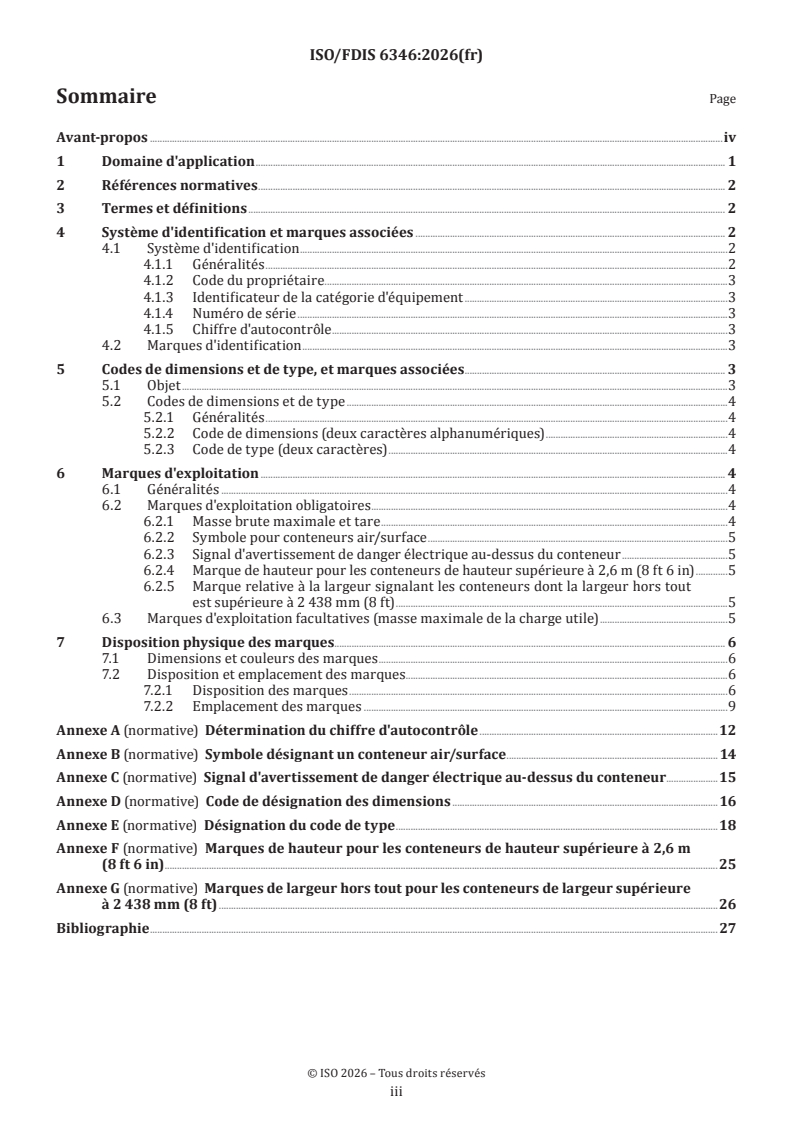
ISO/FDIS 6346 - Conteneurs pour le transport de marchandises — Codage, identification et marquage
Overview
ISO/FDIS 6346: Freight containers - Coding, identification and marking is an international standard developed by ISO for the uniform marking and identification of freight containers. This document establishes a globally recognized system for the coding, identification, and physical marking of containers, streamlining not only container tracking and handling but also supporting efficient logistics, documentation, and automatic data processing systems. The standard applies to all freight containers as referenced by related ISO standards and aims to promote clarity, safety, and interoperability throughout the global supply chain.
Key Topics
- Identification System: Defines the standard container identification system made up of an owner code, equipment category identifier, serial number, and check digit. This system guarantees each container's unique identity, verified for accuracy, aiding in seamless tracking and control.
- Container Marking: Specifies formats and locations for mandatory and optional container marks, ensuring they are permanently affixed and easily interpreted visually or by automated equipment such as AEI (Automatic Equipment Identification) tags used in electronic data interchange (EDI) systems.
- Container Size and Type Codes: Introduces a coding structure using alphanumeric size and type codes, facilitating instant recognition of a container’s key dimensions and primary features.
- Operational Marks: Outlines requirements for indicating a container’s maximum gross mass, tare mass, height warnings, width marks, and safety advisories (such as electrical hazard warnings), enhancing the safe operation of containers.
- Mandatory vs Optional Marks: Clarifies which marks are required for all containers and which are optional, promoting greater transparency and uniformity while allowing flexibility where appropriate.
Applications
ISO/FDIS 6346 is extensively used in international trade, shipping, and intermodal transport. Its practical applications include:
- Global Logistics and Supply Chain Management: Supports efficient container movement across ships, trucks, and trains by providing universally recognized identification, enabling tracking from origin to destination.
- Automated Data Processing: Ensures compatibility with electronic data interchange (EDI) and automatic identification technologies, boosting the accuracy and speed of information exchanges between carriers, ports, and customs authorities.
- Operational Safety and Compliance: Mandates the clear marking of operational data-such as mass limits and caution signs-to enhance safe handling, stacking, and transportation, and to comply with industry safety regulations.
- Infrastructure and Fleet Management: Allows shipping lines, railways, and ports to manage container inventories more effectively through standardized and visible marking systems.
- Customs and Regulatory Documentation: Provides clear marking standards that facilitate customs processing, inspections, and cross-border movement of goods.
Related Standards
ISO/FDIS 6346 is part of a suite of intermodal container standards supporting the global freight industry. Related standards include:
- ISO 668: Series 1 freight containers - Classification, dimensions, and ratings
- ISO 1496 (all parts): Series 1 freight containers - Specification and testing
- ISO 8323: Freight containers - Air/surface (intermodal) general purpose containers - Specification and tests
- ISO 10374: Freight containers - Automatic identification
- International conventions (not covered by this standard):
- International Convention for Safe Containers (CSC), International Maritime Organization
- Customs Convention on Containers
- Convention on Temporary Admission (Istanbul Convention)
Practical Value
By adhering to ISO/FDIS 6346, organizations achieve improved traceability, operational safety, and data accuracy throughout the container lifecycle. The standard’s consistent marking and identification rules lower the risk of misidentification, reduce logistical errors, and support seamless interoperability across ports, carriers, and digital information systems worldwide. For businesses involved in freight container manufacturing, leasing, operation, or logistics, compliance with ISO/FDIS 6346 is essential for global trade efficiency and regulatory alignment.
Relations
- Consolidates
FprEN ISO 6346 - Freight containers - Coding, identification and marking (ISO/FDIS 6346:2026) - Effective Date
- 12-Feb-2026
- Effective Date
- 07-Jan-2025
- Effective Date
- 07-Jan-2025
Buy Documents
ISO/FDIS 6346 - Freight containers — Coding, identification and marking
REDLINE ISO/FDIS 6346 - Freight containers — Coding, identification and marking
ISO/FDIS 6346 - Conteneurs pour le transport de marchandises — Codage, identification et marquage
Get Certified
Connect with accredited certification bodies for this standard

BRCGS (Brand Reputation Compliance Global Standards)
Global food safety and quality standards owner.
Sponsored listings
Frequently Asked Questions
ISO/FDIS 6346 is a draft published by the International Organization for Standardization (ISO). Its full title is "Freight containers — Coding, identification and marking". This standard covers: This document provides a system for the identification and presentation of information about freight containers. The identification system is intended for general application, for example in documentation, control and communications (including automatic data processing systems), as well as for display on the containers themselves. The methods of displaying identification and certain other data (including operational data) on containers by means of permanent marks are included. This document specifies: a) a container identification system, with an associated system for verifying the accuracy of its use, having: — mandatory marks for the presentation of the identification system for visual interpretation, and — features to be used in optional Automatic Equipment Identification (AEI) and electronic data interchange (EDI); b) a coding system for data on container size and type, with corresponding marks for their display; c) operational marks, both mandatory and optional; d) physical presentation of marks on the container. The terms “mandatory” and “optional” in this document are used to differentiate those ISO marking provisions which shall necessarily be fulfilled by all containers from those which are not required of all containers. The optional marks are included to further comprehension and promote uniform application of the optional mark. If a choice has been made to display an optional mark, the provisions laid down in this document relating to the mark shall be applied. The terms “mandatory” and “optional” do not refer to requirements of any regulatory body. This document applies to all freight containers covered by International Standards ISO 668, parts 1 to 5 of ISO 1496, ISO 8323 and should, wherever appropriate and practicable, be applied: — to containers other than those covered by the International Standards mentioned in Clause 2; — to container-related and/or detachable equipment. NOTE 1 Containers marked according to previous editions of ISO 6346 need not be re-marked. This document does not cover temporary operational marks of any kind, permanent marks, data plates, etc. which may be required by intergovernmental agreements, national legislation or nongovernmental organizations. NOTE 2 Some of the major international conventions whose container-marking requirements are not covered in this document are as follows: — International Convention for Safe Containers (1972, as amended) (CSC), International Maritime Organization (IMO); — Customs Convention on Containers 1956 and 1972, related to temporary admission and transport under customs seal. — Convention on Temporary Admission (Istanbul, 26 June 1990), related to temporary admission. It should not be assumed that this list is exhaustive. This document does not cover the display of technical data on tank containers (see ISO 1496-3), nor does it, in any way, include identification marks or safety signs for items of cargo which may be carried in freight containers.
This document provides a system for the identification and presentation of information about freight containers. The identification system is intended for general application, for example in documentation, control and communications (including automatic data processing systems), as well as for display on the containers themselves. The methods of displaying identification and certain other data (including operational data) on containers by means of permanent marks are included. This document specifies: a) a container identification system, with an associated system for verifying the accuracy of its use, having: — mandatory marks for the presentation of the identification system for visual interpretation, and — features to be used in optional Automatic Equipment Identification (AEI) and electronic data interchange (EDI); b) a coding system for data on container size and type, with corresponding marks for their display; c) operational marks, both mandatory and optional; d) physical presentation of marks on the container. The terms “mandatory” and “optional” in this document are used to differentiate those ISO marking provisions which shall necessarily be fulfilled by all containers from those which are not required of all containers. The optional marks are included to further comprehension and promote uniform application of the optional mark. If a choice has been made to display an optional mark, the provisions laid down in this document relating to the mark shall be applied. The terms “mandatory” and “optional” do not refer to requirements of any regulatory body. This document applies to all freight containers covered by International Standards ISO 668, parts 1 to 5 of ISO 1496, ISO 8323 and should, wherever appropriate and practicable, be applied: — to containers other than those covered by the International Standards mentioned in Clause 2; — to container-related and/or detachable equipment. NOTE 1 Containers marked according to previous editions of ISO 6346 need not be re-marked. This document does not cover temporary operational marks of any kind, permanent marks, data plates, etc. which may be required by intergovernmental agreements, national legislation or nongovernmental organizations. NOTE 2 Some of the major international conventions whose container-marking requirements are not covered in this document are as follows: — International Convention for Safe Containers (1972, as amended) (CSC), International Maritime Organization (IMO); — Customs Convention on Containers 1956 and 1972, related to temporary admission and transport under customs seal. — Convention on Temporary Admission (Istanbul, 26 June 1990), related to temporary admission. It should not be assumed that this list is exhaustive. This document does not cover the display of technical data on tank containers (see ISO 1496-3), nor does it, in any way, include identification marks or safety signs for items of cargo which may be carried in freight containers.
ISO/FDIS 6346 is classified under the following ICS (International Classification for Standards) categories: 55.180.10 - General purpose containers. The ICS classification helps identify the subject area and facilitates finding related standards.
ISO/FDIS 6346 has the following relationships with other standards: It is inter standard links to FprEN ISO 6346, ISO 5146:2023, ISO 6346:2022. Understanding these relationships helps ensure you are using the most current and applicable version of the standard.
ISO/FDIS 6346 is available in PDF format for immediate download after purchase. The document can be added to your cart and obtained through the secure checkout process. Digital delivery ensures instant access to the complete standard document.
Standards Content (Sample)
FINAL DRAFT
International
Standard
ISO/TC 104/SC 4
Freight containers — Coding,
Secretariat: AFNOR
identification and marking
Voting begins on:
Conteneurs pour le transport de marchandises — Codage, 2026-06-16
identification et marquage
Voting terminates on:
2026-08-11
RECIPIENTS OF THIS DRAFT ARE INVITED TO SUBMIT,
WITH THEIR COMMENTS, NOTIFICATION OF ANY
RELEVANT PATENT RIGHTS OF WHICH THEY ARE AWARE
AND TO PROVIDE SUPPOR TING DOCUMENTATION.
IN ADDITION TO THEIR EVALUATION AS
BEING ACCEPTABLE FOR INDUSTRIAL, TECHNO
ISO/CEN PARALLEL PROCESSING LOGICAL, COMMERCIAL AND USER PURPOSES, DRAFT
INTERNATIONAL STANDARDS MAY ON OCCASION HAVE
TO BE CONSIDERED IN THE LIGHT OF THEIR POTENTIAL
TO BECOME STAN DARDS TO WHICH REFERENCE MAY BE
MADE IN NATIONAL REGULATIONS.
Reference number
FINAL DRAFT
International
Standard
ISO/TC 104/SC 4
Freight containers — Coding,
Secretariat: AFNOR
identification and marking
Voting begins on:
Conteneurs pour le transport de marchandises — Codage,
identification et marquage
Voting terminates on:
RECIPIENTS OF THIS DRAFT ARE INVITED TO SUBMIT,
WITH THEIR COMMENTS, NOTIFICATION OF ANY
RELEVANT PATENT RIGHTS OF WHICH THEY ARE AWARE
AND TO PROVIDE SUPPOR TING DOCUMENTATION.
© ISO 2026
IN ADDITION TO THEIR EVALUATION AS
All rights reserved. Unless otherwise specified, or required in the context of its implementation, no part of this publication may
BEING ACCEPTABLE FOR INDUSTRIAL, TECHNO
ISO/CEN PARALLEL PROCESSING
LOGICAL, COMMERCIAL AND USER PURPOSES, DRAFT
be reproduced or utilized otherwise in any form or by any means, electronic or mechanical, including photocopying, or posting on
INTERNATIONAL STANDARDS MAY ON OCCASION HAVE
the internet or an intranet, without prior written permission. Permission can be requested from either ISO at the address below
TO BE CONSIDERED IN THE LIGHT OF THEIR POTENTIAL
or ISO’s member body in the country of the requester.
TO BECOME STAN DARDS TO WHICH REFERENCE MAY BE
MADE IN NATIONAL REGULATIONS.
ISO copyright office
CP 401 • Ch. de Blandonnet 8
CH-1214 Vernier, Geneva
Phone: +41 22 749 01 11
Email: copyright@iso.org
Website: www.iso.org
Published in Switzerland Reference number
ii
Contents Page
Foreword .iv
1 Scope . 1
2 Normative references . 2
3 Terms and definitions . 2
4 Identification system and its associated marks . 2
4.1 Identification system .2
4.1.1 General .2
4.1.2 Owner code .2
4.1.3 Equipment category identifier .3
4.1.4 Serial number .3
4.1.5 Check digit .3
4.2 Identification marks .3
5 Size and type codes and their associated marks . 3
5.1 Purpose .3
5.2 Size and type codes .3
5.2.1 General .3
5.2.2 Size: two alphanumeric characters . .3
5.2.3 Type: two characters .4
6 Operational marks . 4
6.1 General .4
6.2 Mandatory operational marks.4
6.2.1 Maximum gross and tare masses .4
6.2.2 Air/surface container symbol .5
6.2.3 Warning sign of overhead electrical danger .5
6.2.4 Height mark for containers higher than 2,6 m (8 ft 6 in) .5
6.2.5 Width mark for containers with an overall width greater than 2 438 mm (8 ft). .5
6.3 Optional operational mark (maximum mass of payload) .5
7 Physical display of marks . 5
7.1 Size and colour of marks .5
7.2 Layout and location of marks .6
7.2.1 Layout of marks .6
7.2.2 Location of marks .9
Annex A (normative) Determination of check digit .12
Annex B (normative) Symbol to denote air/surface container . 14
Annex C (normative) Sign warning of overhead electrical danger .15
Annex D (normative) Size code designation . .16
Annex E (normative) Type Code designation .18
Annex F (normative) Height marks for containers higher than 2,6 m (8 ft 6 in) .24
Annex G (normative) Overall width marks for containers wider than 2 438 mm (8 ft) .25
Bibliography .26
iii
Foreword
ISO (the International Organization for Standardization) is a worldwide federation of national standards
bodies (ISO member bodies). The work of preparing International Standards is normally carried out through
ISO technical committees. Each member body interested in a subject for which a technical committee
has been established has the right to be represented on that committee. International organizations,
governmental and non-governmental, in liaison with ISO, also take part in the work. ISO collaborates closely
with the International Electrotechnical Commission (IEC) on all matters of electrotechnical standardization.
The procedures used to develop this document and those intended for its further maintenance are described
in the ISO/IEC Directives, Part 1. In particular, the different approval criteria needed for the different types
of ISO document should be noted. This document was drafted in accordance with the editorial rules of the
ISO/IEC Directives, Part 2 (see www.iso.org/directives).
ISO draws attention to the possibility that the implementation of this document may involve the use of (a)
patent(s). ISO takes no position concerning the evidence, validity or applicability of any claimed patent
rights in respect thereof. As of the date of publication of this document, ISO had not received notice of (a)
patent(s) which may be required to implement this document. However, implementers are cautioned that
this may not represent the latest information, which may be obtained from the patent database available at
www.iso.org/patents. ISO shall not be held responsible for identifying any or all such patent rights.
Any trade name used in this document is information given for the convenience of users and does not
constitute an endorsement.
For an explanation of the voluntary nature of standards, the meaning of ISO specific terms and expressions
related to conformity assessment, as well as information about ISO's adherence to the World Trade
Organization (WTO) principles in the Technical Barriers to Trade (TBT), see www.iso.org/iso/foreword.html.
This document was prepared by Technical Committee ISO/TC 104, Freight containers, Subcommittee SC 4,
Identification and communication, in collaboration with the European Committee for Standardization (CEN)
Technical Committee CEN/TC 119, Intermodal loading units and cargo securing (ILUCS), in accordance with
the Agreement on technical cooperation between ISO and CEN (Vienna Agreement).
This fifth edition cancels and replaces the fourth edition (ISO 6346:2022), which has been technically
revised.
The main changes are as follows:
— improvements made to readability of tables related to code characters (Table D.1, Table D.2);
— modification to Table E.1 for new detailed type codes and description of existing codes;
— removal of the limitation for marking only containers built in conformance with the ISO 1496 series,
which can be marked with ISO Size Type Codes.
Any feedback or questions on this document should be directed to the user’s national standards body. A
complete listing of these bodies can be found at www.iso.org/members.html.
iv
FINAL DRAFT International Standard ISO/FDIS 6346:2026(en)
Freight containers — Coding, identification and marking
1 Scope
1.1 This document specifies a system for the identification and presentation of information about freight
containers. The identification system gives guidelines for general application, for example in documentation,
control and communications (including automatic data processing systems), as well as for display on the
containers themselves.
It defines the methods of displaying identification and certain other data (including operational data) on
containers by means of permanent marks.
1.2 This document specifies:
a) a container identification system, with an associated system for verifying the accuracy of its use of
marks;
b) a coding system for data on container size and type, with corresponding marks for their display;
c) operational marks, both mandatory and optional;
d) physical presentation of marks on the container.
1.3 This document defines the terms “mandatory” and “optional” and provides guidelines for the use of the
designated marks. The terms “mandatory” and “optional” do not refer to the requirements of any regulatory
body.
1.4 This document is applicable to all freight containers covered by ISO 668, the ISO 1496 series, ISO 8323
and is applicable to:
— containers other than those covered by the International Standards listed in Clause 2;
— container-related or detachable equipment, or both.
NOTE 1 Containers marked according to previous editions of this document need not be re-marked.
1.5 This document does not apply to temporary operational marks of any kind, permanent marks, data
plates, etc. which can be required by intergovernmental agreements, national legislation or nongovernmental
organizations.
NOTE 2 Some of the major international conventions whose container-marking requirements are not covered in
this document are as follows:
— International Convention for Safe Containers (1972, as amended) (CSC), International Maritime Organization
(IMO);
— Customs Convention on Containers 1956 and 1972, related to temporary admission and transport under customs
seal.
— Convention on Temporary Admission (Istanbul, 26 June 1990), related to temporary admission.
This document does not cover the display of technical data on tank containers (see ISO 1496-3), nor does
it, in any way, include identification marks or safety signs for items of cargo which can be carried in freight
containers.
2 Normative references
The following documents are referred to in the text in such a way that some or all of their content constitutes
requirements of this document. For dated references, only the edition cited applies. For undated references,
the latest edition of the referenced document (including any amendments) applies.
ISO 1496 (all parts), Series 1 freight containers — Specification and testing
ISO 8323:1985, Freight containers — Air/surface (intermodal) general purpose containers — Specification and
tests
ISO 10374, Freight containers — Automatic identification
3 Terms and definitions
For the purposes of this document, the following terms and definitions apply.
ISO and IEC maintain terminology databases for use in standardization at the following addresses:
— ISO Online browsing platform: available at https:// www .iso .org/ obp
— IEC Electropedia: available at https:// www .electropedia .org/
3.1
mandatory mark
mark applied to the container that is essential to identify the owner, the specification of the container and
the safe operation of the container
3.2
optional mark
marks applied to the container that provides additional information for a greater comprehension of the
operation of the container and its use
4 Identification system and its associated marks
4.1 Identification system
4.1.1 General
The identification system shall consist only of the following elements, all of which shall be included:
— owner code: three letters (see 4.1.2);
— equipment category identifier: one letter (see 4.1.3);
— serial number: six numerals (see 4.1.4);
— check digit: one numeral (see 4.1.5).
4.1.2 Owner code
See Key reference (1) in Figures 1 to 4
The container owner code shall consist of three capital letters, shall be unique and shall be registered with
the registration authority.
The name and contact information of the registration authority for this document can be found at www .iso
.org/ maintenance _agencies.
4.1.3 Equipment category identifier
See Key reference (2) in Figures 1 to 4
The equipment category identifier consists of one capital letter of the Latin alphabet as follows:
— U for all freight containers;
— J for detachable freight container-related equipment;
— Z for trailers and chassis.
4.1.4 Serial number
See Key reference (3) in Figures 1 to 4
The container serial number shall consist of six Arabic numerals. If the series of significant numerals does
not total six, they shall be preceded by sufficient zeroes to make up six numerals (for example, if the series of
significant numerals is 1234, the serial number is 001234).
4.1.5 Check digit
See Key reference (4) in Figures 1 to 4
The check digit provides a means of validating the transmission accuracy of the owner code and serial
number and shall be determined in accordance with Annex A. The check digit shall validate the owner code,
equipment category identifier and serial number of the container.
4.2 Identification marks
The use of marks in accordance with the identification system specified in 4.1, i.e. owner code, equipment
category identifier, serial number and check digit, is mandatory for freight containers and recommended for
all equipment as stated in 4.1.3. The characteristics (size, shape, layout, etc.) detailed in 7.1 and 7.2.1 shall be
displayed as nearly as practicable in accordance with Clause 7, i.e., legible to the human eye.
5 Size and type codes and their associated marks
5.1 Purpose
The type and main external dimensions of the container shall be identified with codes marked on the
container.
5.2 Size and type codes
5.2.1 General
This information is mandatory for the marking of containers covered by the International Standards listed
in Clause 2 and shall be coded as in 5.2.2 and 5.2.3.
The size and type codes, when displayed on the container, shall be used as a whole, i.e., the information must
not be broken into its component parts.
The size and type codes shall be displayed in accordance with Clause 7.
5.2.2 Size: two alphanumeric characters
See Key reference (5) in Figures 1 to 4
The container size (i.e. external dimensions) shall be indicated by two characters as follows:
— First character: numeric or alphabetic character representing the length.
— Second character: numeric or alphabetic character representing the width and the height.
These two characters shall be determined in accordance with Annex D.
5.2.3 Type: two characters
See Key reference (6) in Figures 1 to 4
The container type and main characteristics shall be indicated by two characters as follows:
— First character: alphabetic character representing the container type.
— Second character: numeric or alphabetic character representing main characteristics related to the
container type.
These two characters shall be selected in accordance with Annex E.
NOTE For the purpose of exchanging data when indication of the main characteristics is not essential, the “type
group code designation” as shown in Annex E can be used.
6 Operational marks
6.1 General
The marks in this section are not intended to correspond to any particular code (e.g., for use in data
transmission or any other purpose). They are solely intended as markings for use on freight containers to
convey certain information or give visual warnings.
6.2 Mandatory operational marks
6.2.1 Maximum gross and tare masses
The maximum gross and tare masses shall be marked on a container as:
MAX GROSS 00 000 kg
00 000 lb
TARE 00 000 kg
00 000 lb
For safety reasons, containers tested in conformance with the approved methods specified in the ISO 1496
series applicable to the type of container in question shall be uniformly marked with the maximum gross
mass.
Furthermore, the “maximum gross mass” marked on the container in accordance with this document shall
[3]
be identical to that shown on the International Convention for Safe Containers (CSC) Safety Approval
Plate.
As indicated above, the masses shall be expressed in both kilograms (kg) and pounds (lb).
NOTE 1 kg = 2,204 lb.
6.2.2 Air/surface container symbol
All air/surface containers shall display the symbol specified in Annex B.
6.2.3 Warning sign of overhead electrical danger
All containers equipped with ladders shall display a warning sign in accordance with the details given in
Annex C.
6.2.4 Height mark for containers higher than 2,6 m (8 ft 6 in)
All containers higher than 2,6 m (8 ft 6 in) shall bear the following mandatory marks:
a) on both sides, a height mark similar to that described in Annex F;
b) an area of alternating black and yellow stripes on the top members of each end frame and side wall at
each corner adjacent to the corner fitting, of 300 mm (12 in) minimum length, that can be seen from the
ground or from the top. See Figure 5.
In addition, any other optional marks, such as a mirror image of the mark described in Annex F, may be
displayed at any convenient location (e.g. front wall).
6.2.5 Width mark for containers with an overall width greater than 2 438 mm (8 ft).
All containers with an overall width greater than 2 438 mm (8 ft) shall bear a mark similar to that described
in Annex G on the ends and the roof at both ends.
Where there is insufficient space to fit the marking on the ends or the roof, for example on tank containers,
the marking shall be as wide as is practicable on the ends and may be omitted on the roof.
6.3 Optional operational mark (maximum mass of payload)
It is common industry practice to mark containers with maximum payload in addition to the maximum
gross and tare masses.
If used, the maximum mass of payload should be marked on a container in accordance with the requirements
of 6.2.1, positioned after the maximum gross and tare masses as follows:
7 Physical display of marks
7.1 Size and colour of marks
The letters and numerals of the owner code, equipment category identifier, serial number and check digit
shall be not less than 100 mm (4 in) high.
The letters and numerals for MAX GROSS, TARE and, when used, PAYLOAD shall be not less than 50 mm (2
in) high.
All characters shall be of proportionate width and thickness, they shall be durable and in a colour contrasting
with that of the container.
7.2 Layout and location of marks
The requirements of this clause are particularly applicable to containers of the “closed box” type. For
containers of other types, all possible practicable steps should be taken to follow the marking layout and
location given for the “closed box” type of container.
7.2.1 Layout of marks
7.2.1.1 General
The layout of the owner code, equipment category identifier, serial number and check digit on containers
shall preferably be in one single horizontal line (see Figure 1). Where constructional features of the container
dictate otherwise, the layout may be vertical (see Figure 2).
The layout of size and type codes should, as far as practicable, be in a single horizontal line underneath
the horizontal line giving the owner code, equipment category identifier, serial number and check digit (see
Figure 1).
When the owner code, equipment category identifier, serial number and check digit are displayed vertically,
the size and type codes should be placed adjacent to the other mandatory marks (see Figure 2 and Figure 3).
If, on some special-purpose containers, a fully horizontal or fully vertical layout is not possible, the layout
of the other mandatory identification marks shall be maintained in the horizontal or vertical groupings as
specified below (see Figure 3 and Figure 4).
On those special-purpose containers where a fully horizontal or fully vertical layout is not possible, and the
layout of the other mandatory identification marks is horizontal, the size and type codes should be placed
beneath the other mandatory marks (see Figure 4).
NOTE The boxes around the markings in the figures represent the approximate shape of the side walls and the
markings are positioned relative to the side wall.
The size and type codes should be used as a whole (see 5.2).
The owner code and equipment category identifier shall be joined and shall be separat
...
ISO/DISFDIS 6346:2026(en)
Date: 2026-01-132025-11-18
ISO/TC 104/SC 04/WG 1 4
Secretariat: AFNOR
Date: 2026-05-29
Freight containers — Coding, identification and marking
Conteneurs pour le transport de marchandises — Codage, identification et marquage
FDIS stage
TThhiiss d drraftaft i iss s suubbmmiitttteded t too a pa pararallel vallel vootte e iinn I ISSOO,, C CEENN.
All rights reserved. Unless otherwise specified, or required in the context of its implementation, no part of this publication
may be reproduced or utilized otherwise in any form or by any means, electronic or mechanical, including photocopying,
or posting on the internet or an intranet, without prior written permission. Permission can be requested from either ISO
at the address below or ISO’s member body in the country of the requester.
ISO copyright office
CP 401 • Ch. de Blandonnet 8
CH-1214 Vernier, Geneva
Phone: + 41 22 749 01 11
EmailE-mail: copyright@iso.org
Website: www.iso.org
Published in Switzerland
ii
Contents
Foreword . iv
1 Scope . 1
2 Normative references . 2
3 Terms and definitions . 2
4 Identification system and its associated marks . 2
4.1 Identification system . 2
4.2 Identification marks . 3
5 Size and type codes and their associated marks . 3
5.1 Purpose . 3
5.2 Size and type codes . 4
6 Operational marks . 4
6.1 General. 4
6.2 Mandatory operational marks . 4
6.3 Optional operational mark (maximum mass of payload) . 5
7 Physical display of marks . 6
7.1 Size and colour of marks . 6
7.2 Layout and location of marks . 6
Annex A (normative) Determination of check digit . 15
Annex B (normative) Symbol to denote air/surface container . 18
Annex C (normative) Sign warning of overhead electrical danger . 20
Annex D (normative) Size code designation . 22
Annex E (normative) Type Code designation. 25
Annex F (normative) Height marks for containers higher than 2,6 m (8 ft 6 in) . 32
Annex G (normative) Overall width marks for containers wider than 2 438 mm (8 ft) . 34
Bibliography . 35
iii
Foreword
ISO (the International Organization for Standardization) is a worldwide federation of national standards
bodies (ISO member bodies). The work of preparing International Standards is normally carried out through
ISO technical committees. Each member body interested in a subject for which a technical committee has been
established has the right to be represented on that committee. International organizations, governmental and
non-governmental, in liaison with ISO, also take part in the work. ISO collaborates closely with the
International Electrotechnical Commission (IEC) on all matters of electrotechnical standardization.
The procedures used to develop this document and those intended for its further maintenance are described
in the ISO/IEC Directives, Part 1. In particular, the different approval criteria needed for the different types of
ISO document should be noted. This document was drafted in accordance with the editorial rules of the
ISO/IEC Directives, Part 2 (see www.iso.org/directives).
ISO draws attention to the possibility that the implementation of this document may involve the use of (a)
patent(s). ISO takes no position concerning the evidence, validity or applicability of any claimed patent rights
in respect thereof. As of the date of publication of this document, ISO [had/had not] received notice of (a)
patent(s) which may be required to implement this document. However, implementers are cautioned that this
may not represent the latest information, which may be obtained from the patent database available at
www.iso.org/patents. ISO shall not be held responsible for identifying any or all such patent rights.
Any trade name used in this document is information given for the convenience of users and does not
constitute an endorsement.
For an explanation of the voluntary nature of standards, the meaning of ISO specific terms and expressions
related to conformity assessment, as well as information about ISO's adherence to the World Trade
Organization (WTO) principles in the Technical Barriers to Trade (TBT), see www.iso.org/iso/foreword.html.
This document was prepared by Technical Committee ISO/TC 104, Freight containers, Subcommittee SC 4,
Identification and communication, in collaboration with the European Committee for Standardization (CEN)
Technical Committee CEN/TC 119, Intermodal loading units and cargo securing (ILUCS), in accordance with
the Agreement on technical cooperation between ISO and CEN (Vienna Agreement).
, or both.This fifth edition cancels and replaces the fourthfourthfourth edition (ISO 6346:2022), which has
been technically revised.
The main changes are as follows:
— — Amendmentsimprovements made to improve the readability of the various tables related to code
characters (Table D.1, Table D.2, (Table D.1, Table D 2);
— — Amendmentsmodification to Table E.1Table E.1 to add for new detailed type codes and to improve
descriptionsdescription of existing codes.;
— removal of the limitation for marking only containers built in conformance with the ISO 1496 series, which
can be marked with ISO Size Type Codes.
Any feedback or questions on this document should be directed to the user’s national standards body. A
complete listing of these bodies can be found at www.iso.org/members.html.
- 2026 Editorial improvements to improve the readability of the document and ensure that ISO house
styles are adhered to.
- detailed type codes and to improve descriptions of existing codes
iv
- Editorial changes to figures to ensure greater clarity
— — Removal of the limitation for marking only containers built in compliance with the ISO 1496
series can be marked with ISO Size Type Codes.
v
Freight containers — Coding, identification and marking
1 Scope
1.1 1.1 This document specifies a system for the identification and presentation of information about
freight containers. The identification system gives guidelines for general application, for example in
documentation, control and communications (including automatic data processing systems), as well as for
display on the containers themselves.
It defines the methods of displaying identification and certain other data (including operational data) on
containers by means of permanent marks.
1.2 1.2 This document specifies:
a) a) a container identification system, with an associated system for verifying the accuracy of its
use; of marks;
b) b) a coding system for data on container size and type, with corresponding marks for their
display;
c) c) operational marks, both mandatory and optional;
d) d) physical presentation of marks on the container.
1.3 1.3 This document defines the terms “mandatory” and “optional” and provides guidelines for the
use of the designated marks. The terms “mandatory” and “optional” do not refer to the requirements of any
regulatory body.
1.4 1.4 This document is applicable to all freight containers covered by ISO 668, the ISO 1496, and
series, ISO 8323 and establishes where marks, areisis applicable to:
— — to containers other than those covered by the standardsInternational Standards listed in
Clause 2Clause 2;;
— — to container-related or detachable equipment, or both.
NOTE 1 Containers marked according to previous editions of ISO 6346this document need not be re-marked.
1.5 1.5 This document does not apply to temporary operational marks of any kind, permanent marks,
data plates, etc. which can be required by intergovernmental agreements, national legislation or
nongovernmental organizations.
NOTE 2 Some of the major international conventions whose container-marking requirements are not covered in this
document are as follows:
— — International Convention for Safe Containers (1972, as amended) (CSC), International Maritime Organization
(IMO);
— — Customs Convention on Containers 1956 and 1972, related to temporary admission and transport under
customs seal.
— — Convention on Temporary Admission (Istanbul, 26 June 1990), related to temporary admission.
This list is not exhaustive.
This document does not cover the display of technical data on tank containers (see ISO 1496-3), nor does it,
in any way, include identification marks or safety signs for items of cargo which maycan be carried in freight
containers.
2 Normative references
The following documents are referred to in the text in such a way that some or all of their content constitutes
requirements of this document. For dated references, only the edition cited applies. For undated references,
the latest edition of the referenced document (including any amendments) applies.
ISO 1496 (all parts), Series 1 freight containers — Specification and testing
ISO 8323:1985, Freight containers — Air/surface (intermodal) general purpose containers — Specification and
tests
ISO 10374, Freight containers — Automatic identification
3 Terms and definitions
For the purposes of this document, the following terms and definitions apply.
ISO and IEC maintain terminology databases for use in standardization at the following addresses:
— — ISO Online browsing platform: available at https://www.iso.org/obp
— — IEC Electropedia: available at https://www.electropedia.org/
3.1
3.1 Mandatory
mandatory mark
Marksmark applied to the container that areis essential to identify the owner, the specification of the container
and the safe operation of the container.
3.2
3.2 Optional
optional mark
Marksmarks applied to the container that provideprovides additional information to providefor a greater
comprehension of the operation of the container and its use.
4 Identification system and its associated marks
4.1 Identification system
4.1.1 General
The identification system shall consist only of the following elements, all of which shall be included:
— owner code: three letters (see 4.1.2);
— equipment category identifier: one letter (see 4.1.3);
— serial number: six numerals (see 4.1.4);
— check digit: one numeral (see 4.1.5).
4.1.2 Owner code
See Key reference (1) in Figures 1Figures 1 to 44
The container owner code shall consist of three capital letters, shall be unique and shall be registered with the
registration authority.
The name and contact information of the registration authority for this document can be found at
www.iso.org/maintenance_agencies.
4.1.3 Equipment category identifier
See Key reference (2) in Figures 1Figures 1 to 44
The equipment category identifier consists of one capital letter of the Latin alphabet as follows:
— U for all freight containers;
— J for detachable freight container-related equipment;
— Z for trailers and chassis.
4.1.4 Serial number
See Key reference (3) in Figures 1Figures 1 to 44
The container serial number shall consist of six Arabic numerals. If the series of significant numerals does not
total six, they shall be preceded by sufficient zeroes to make up six numerals (for example, if the series of
significant numerals is 1234, the serial number is 001234).
4.1.5 Check digit
See Key reference (4) in Figures 1Figures 1 to 44
The check digit provides a means of validating the transmission accuracy of the owner code and serial number
and shall be determined in accordance with Annex AAnnex A. The check digit shall validate the owner code,
equipment category identifier and serial number of the container.
4.2 Identification marks
The use of marks in accordance with the identification system specified in 4.14.1,, i.e. owner code, equipment
category identifier, serial number and check digit, is mandatory for freight containers and recommended for
all equipment as stated in 4.1.34.1.3. The characteristics (size, shape, layout, etc.) detailed in 7.17.1 and
7.2.17.2.1 shall be displayed as nearly as practicable in accordance with Clause 7Clause 7,, i.e., legible to the
human eye.
5 Size and type codes and their associated marks
5.1 Purpose
The type and main external dimensions of the container shall be identified with codes marked on the
container.
5.2 Size and type codes
5.2.1 General
This information is mandatory for the marking of containers covered by the international
standardsInternational Standards listed in Clause 2Clause 2 and shall be coded as in 5.2.25.2.2 and 5.2.35.2.3.
The size and type codes, when displayed on the container, shall be used as a whole, i.e., the information must
not be broken into its component parts.
The size and type codes shall be displayed in accordance with Clause 7Clause 7.
5.2.2 Size: two alphanumeric characters
See Key reference (5) in Figures 1Figures 1 to 44
The container size (i.e. external dimensions) shall be indicated by two characters as follows:
— — First character: numeric or alphabetic character representing the length.
— — Second character: numeric or alphabetic character representing the width and the height.
These two characters shall be determined in accordance with Annex DAnnex D.
5.2.3 Type: two characters
See Key reference (6) in Figures 1Figures 1 to 44
The container type and main characteristics shall be indicated by two characters as follows:
— — First character: alphabetic character representing the container type.
— — Second character: numeric or alphabetic character representing main characteristics related to the
container type.
These two characters shall be selected in accordance with Annex EAnnex E.
NOTE For the purpose of exchanging data when indication of the main characteristics is not essential, the “type
group code designation” as shown in Annex EAnnex E can be used.
6 Operational marks
6.1 General
The marks in this section are not intended to correspond to any particular code (e.g., for use in data
transmission or any other purpose). They are solely intended as markings for use on freight containers to
convey certain information or give visual warnings.
6.2 Mandatory operational marks
6.2.1 Maximum gross and tare masses
The maximum gross and tare masses shall be marked on a container as:
MAX GROSS 00 000 kg
00 000 lb
TARE 00 000 kg
00 000 lb
For safety reasons, containers tested in conformance with the approved methods specified in the ISO 1496
series applicable to the type of container in question shall be uniformly marked with the maximum gross mass.
Furthermore, the “maximum gross mass” marked on the container in accordance with this document shall be
[3][10]
identical to that shown on the International Convention for Safe Containers (CSC) Safety Approval Plate.
As indicated above, the masses shall be expressed in both kilograms (kg) and pounds (lb).
NOTE 1 kg = 2,204 lb.
6.2.2 Air/surface container symbol
All air/surface containers shall display the symbol specified in Annex BAnnex B.
6.2.3 Warning sign of overhead electrical danger
All containers equipped with ladders shall display a warning sign in accordance with the details given in
Annex CAnnex C.
6.2.4 Height mark for containers higher than 2,6 m (8 ft 6 in)
All containers higher than 2,6 m (8 ft 6 in) shall bear the following mandatory marks:
a) a) on both sides, a height mark similar to that described in Annex FAnnex F;;
b) b) an area of alternating black and yellow stripes on the top members of each end frame and side
wall at each corner adjacent to the corner fitting, of 300 mm (12 in) minimum length, that can be seen
from the ground or from the top. See Figure 5Figure 5.
In addition, any other optional marks, such as a mirror image of the mark described in Annex FAnnex F,, may
be displayed at any convenient location (e.g.,. front wall).
6.2.5 Width mark for containers with an overall width greater than 2 438 mm (8 ft).
All containers with an overall width greater than 2 438 mm (8 ft) shall bear a mark similar to that described
in Annex GAnnex G on the ends and the roof at both ends.
Where there is insufficient space to fit the marking on the ends or the roof, for example on tank containers,
the marking shall be as wide as is practicable on the ends and may be omitted on the roof.
6.3 Optional operational mark (maximum mass of payload)
It is common industry practice to mark containers with maximum payload in addition to the maximum gross
and tare masses.
If used, the maximum mass of payload should be marked on a container in accordance with the requirements
of 6.2.16.2.1,, positioned after the maximum gross and tare masses as follows:
7 Physical display of marks
7.1 Size and colour of marks
The letters and numerals of the owner code, equipment category identifier, serial number and check digit shall
be not less than 100 mm (4 in) high.
The letters and numerals for MAX GROSS, TARE and, when used, PAYLOAD shall be not less than 50 mm (2 in)
high.
All characters shall be of proportionate width and thickness, they shall be durable and in a colour contrasting
with that of the container.
7.2 Layout and location of marks
The requirements of this clause are particularly applicable to containers of the “closed box” type. For
containers of other types, all possible practicable steps should be taken to follow the marking layout and
location given for the “closed box” type of container.
7.2.1 Layout of marks
7.2.1.1 General
The layout of the owner code, equipment category identifier, serial number and check digit on containers shall
preferably be in one single horizontal line (see Figure 1Figure 1).). Where constructional features of the
container dictate otherwise, the layout may be vertical (see Figure 2Figure 2).).
The layout of size and type codes should, as far as practicable, be in a single horizontal line underneath the
horizontal line giving the owner code, equipment category identifier, serial number and check digit (see
Figure 1Figure 1).).
When the owner code, equipment category identifier, serial number and check digit are displayed vertically,
the size and type codes should be placed adjacent to the other mandatory marks (see Figure 2Figure 2 and
Figure 3Figure 3).).
If, on some special-purpose containers, a fully horizontal or fully vertical layout is not possible, the layout of
the other mandatory identification marks shall be maintained in the horizontal or vertical groupings as
specified below (see Figure 3Figure 3 and Figure 4Figure 4).).
On those special-purpose containers where a fully horizontal or fully vertical layout is not possible, and the
layout of the other mandatory identification marks is horizontal, the size and type codes should be placed
beneath the other mandatory marks (see Figure 4Figure 4).).
NOTE The boxes around the markings in the figures represent the approximate shape of the side walls and the
markings are positioned relative to the side wall.
The size and type codes should be used as a whole (see 5.25.2).).
The owner code and equipment category identifier shall be joined and shall be separated from the serial
number by at least one character space. The serial number shall be separated from the check digit by one
character space and the check digit shall be displayed in a box.
EXAMPLE
A general purpose container in accordance with ISO 1496, having passive vents at the upper part of the cargo space, a
length of 6 058 mm, a width of 2 438 mm, a height of 2 591 mm, having a unique registered owner code of ABZ, an
equipment category identifier of U and a serial number of 001234 will have the layout as shown in Figure 1Figure 1 to
Figure 4Figure 4.
Key
1 owner code
2 equipment category identifier
3 serial number
4 check digit
5 size code
6 type code
Figure 1 — Mandatory identification marks -— preferred horizontal layout
Key
1 owner code
2 equipment category identifier
3 serial number
4 check digit
5 size code
6 type code
Figure 2 — Mandatory identification marks -— preferred vertical layout
Key
1 owner code
2 equipment category identifier
3 serial number
4 check digit
5 size code
6 type code
Figure 3 — Mandatory identification marks -— Alternative (multiple column) vertical layout
Key
1 owner code
2 equipment category identifier
3 serial number
4 check digit
5 size code
6 type code
Figure 4 — Mandatory identification marks -— Alternative horizontal grouping layout
7.2.1.2 Mandatory operational marks
The layout of maximum gross and tare masses shall be as stated in 6.2.16.2.1.
The layout of the air/surface container symbol shall be as shown in Annex BAnnex B.
The layout of the sign warning of overhead electrical danger shall be
...
PROJET FINAL
Norme
internationale
ISO/TC 104/SC 4
Conteneurs pour le transport
Secrétariat: AFNOR
de marchandises — Codage,
Début de vote:
identification et marquage
2026-06-16
Freight containers — Coding, identification and marking
Vote clos le:
2026-08-11
LES DESTINATAIRES DU PRÉSENT PROJET SONT
INVITÉS À PRÉSENTER, AVEC LEURS OBSERVATIONS,
NOTIFICATION DES DROITS DE PROPRIÉTÉ DONT ILS
AURAIENT ÉVENTUELLEMENT CONNAISSANCE ET À
FOURNIR UNE DOCUMENTATION EXPLICATIVE.
OUTRE LE FAIT D’ÊTRE EXAMINÉS POUR
ÉTABLIR S’ILS SONT ACCEPTABLES À DES FINS
INDUSTRIELLES, TECHNOLOGIQUES ET COM-MERCIALES,
AINSI QUE DU POINT DE VUE DES UTILISATEURS, LES
PROJETS DE NORMES
TRAITEMENT PARALLÈLE ISO/CEN
INTERNATIONALES DOIVENT PARFOIS ÊTRE CONSIDÉRÉS
DU POINT DE VUE DE LEUR POSSI BILITÉ DE DEVENIR DES
NORMES POUVANT
SERVIR DE RÉFÉRENCE DANS LA RÉGLEMENTATION
NATIONALE.
Numéro de référence
PROJET FINAL
Norme
internationale
ISO/TC 104/SC 4
Conteneurs pour le transport
Secrétariat: AFNOR
de marchandises — Codage,
Début de vote:
identification et marquage
2026-06-16
Freight containers — Coding, identification and marking
Vote clos le:
2026-08-11
LES DESTINATAIRES DU PRÉSENT PROJET SONT
INVITÉS À PRÉSENTER, AVEC LEURS OBSERVATIONS,
NOTIFICATION DES DROITS DE PROPRIÉTÉ DONT ILS
AURAIENT ÉVENTUELLEMENT CONNAISSANCE ET À
FOURNIR UNE DOCUMENTATION EXPLICATIVE.
DOCUMENT PROTÉGÉ PAR COPYRIGHT
OUTRE LE FAIT D’ÊTRE EXAMINÉS POUR
ÉTABLIR S’ILS SONT ACCEPTABLES À DES FINS
© ISO 2026 INDUSTRIELLES, TECHNOLOGIQUES ET COM-MERCIALES,
AINSI QUE DU POINT DE VUE DES UTILISATEURS, LES
Tous droits réservés. Sauf prescription différente ou nécessité dans le contexte de sa mise en œuvre, aucune partie de cette
PROJETS DE NORMES
TRAITEMENT PARALLÈLE ISO/CEN
INTERNATIONALES DOIVENT PARFOIS ÊTRE CONSIDÉRÉS
publication ne peut être reproduite ni utilisée sous quelque forme que ce soit et par aucun procédé, électronique ou mécanique,
DU POINT DE VUE DE LEUR POSSI BILITÉ DE DEVENIR DES
y compris la photocopie, ou la diffusion sur l’internet ou sur un intranet, sans autorisation écrite préalable. Une autorisation peut
NORMES POUVANT
être demandée à l’ISO à l’adresse ci-après ou au comité membre de l’ISO dans le pays du demandeur.
SERVIR DE RÉFÉRENCE DANS LA RÉGLEMENTATION
NATIONALE.
ISO copyright office
Case postale 401 • Ch. de Blandonnet 8
CH-1214 Vernier, Genève
Tél.: +41 22 749 01 11
E-mail: copyright@iso.org
Web: www.iso.org
Publié en Suisse Numéro de référence
ii
Sommaire Page
Avant-propos .iv
1 Domaine d'application . 1
2 Références normatives . 2
3 Termes et définitions . 2
4 Système d'identification et marques associées . 2
4.1 Système d'identification .2
4.1.1 Généralités .2
4.1.2 Code du propriétaire . .3
4.1.3 Identificateur de la catégorie d'équipement .3
4.1.4 Numéro de série .3
4.1.5 Chiffre d'autocontrôle .3
4.2 Marques d'identification .3
5 Codes de dimensions et de type, et marques associées . 3
5.1 Objet .3
5.2 Codes de dimensions et de type .4
5.2.1 Généralités .4
5.2.2 Code de dimensions (deux caractères alphanumériques) .4
5.2.3 Code de type (deux caractères) .4
6 Marques d'exploitation . 4
6.1 Généralités .4
6.2 Marques d'exploitation obligatoires . .4
6.2.1 Masse brute maximale et tare .4
6.2.2 Symbole pour conteneurs air/surface .5
6.2.3 Signal d'avertissement de danger électrique au-dessus du conteneur .5
6.2.4 Marque de hauteur pour les conteneurs de hauteur supérieure à 2,6 m (8 ft 6 in) .5
6.2.5 Marque relative à la largeur signalant les conteneurs dont la largeur hors tout
est supérieure à 2 438 mm (8 ft) .5
6.3 Marques d'exploitation facultatives (masse maximale de la charge utile) .5
7 Disposition physique des marques. 6
7.1 Dimensions et couleurs des marques .6
7.2 Disposition et emplacement des marques.6
7.2.1 Disposition des marques .6
7.2.2 Emplacement des marques .9
Annexe A (normative) Détermination du chiffre d'autocontrôle .12
Annexe B (normative) Symbole désignant un conteneur air/surface . 14
Annexe C (normative) Signal d'avertissement de danger électrique au-dessus du conteneur .15
Annexe D (normative) Code de désignation des dimensions .16
Annexe E (normative) Désignation du code de type .18
Annexe F (normative) Marques de hauteur pour les conteneurs de hauteur supérieure à 2,6 m
(8 ft 6 in) .25
Annexe G (normative) Marques de largeur hors tout pour les conteneurs de largeur supérieure
à 2 438 mm (8 ft) .26
Bibliographie .27
iii
Avant-propos
L'ISO (Organisation internationale de normalisation) est une fédération mondiale d'organismes nationaux
de normalisation (comités membres de l'ISO). L'élaboration des Normes internationales est en général
confiée aux comités techniques de l'ISO. Chaque comité membre intéressé par une étude a le droit de faire
partie du comité technique créé à cet effet. Les organisations internationales, gouvernementales et non
gouvernementales, en liaison avec l'ISO participent également aux travaux. L'ISO collabore étroitement avec
la Commission électrotechnique internationale (IEC) en ce qui concerne la normalisation électrotechnique.
Les procédures utilisées pour élaborer le présent document et celles destinées à sa mise à jour sont
décrites dans les Directives ISO/IEC, Partie 1. Il convient, en particulier, de prendre note des différents
critères d'approbation requis pour les différents types de documents ISO. Le présent document
a été rédigé conformément aux règles de rédaction données dans les Directives ISO/IEC, Partie 2
(voir www.iso.org/directives).
L'ISO attire l'attention sur le fait que la mise en application du présent document peut entraîner l'utilisation
d'un ou de plusieurs brevets. L'ISO ne prend pas position quant à la preuve, à la validité et à l'applicabilité de
tout droit de propriété revendiqué à cet égard. À la date de publication du présent document, l'ISO n'avait pas
reçu notification qu'un ou plusieurs brevets pouvaient être nécessaires à sa mise en application. Toutefois,
il y a lieu d'avertir les responsables de la mise en application du présent document que des informations
plus récentes sont susceptibles de figurer dans la base de données de brevets, disponible à l'adresse
www.iso.org/brevets. L'ISO ne saurait être tenue pour responsable de ne pas avoir identifié tout ou partie de
tels droits de brevet.
Les appellations commerciales éventuellement mentionnées dans le présent document sont données pour
information, par souci de commodité, à l'intention des utilisateurs et ne sauraient constituer un engagement.
Pour une explication de la nature volontaire des normes, la signification des termes et expressions
spécifiques de l'ISO liés à l'évaluation de la conformité, ou pour toute information au sujet de l'adhésion de
l'ISO aux principes de l'Organisation mondiale du commerce (OMC) concernant les obstacles techniques au
commerce (OTC), voir le lien suivant: www.iso.org/avant-propos.
Le présent document a été élaboré par le comité technique ISO/TC 104, Conteneurs pour le transport de
marchandises, sous-comité SC 4, Identification and communication, en collaboration avec le comité technique
CEN/TC 119, Intermodal Loading Units and Cargo Securing (ILUCS), du Comité européen de normalisation
(CEN), conformément à l'Accord de coopération technique entre l'ISO et le CEN (Accord de Vienne).
Cette cinquième édition annule et remplace la quatrième édition (ISO 6346:2022), qui a fait l'objet d'une
révision technique.
Les principales modifications sont les suivantes:
— améliorations apportées à la lisibilité des tableaux relatifs aux caractères du code (Tableau D.1,
Tableau D.2);
— modification du Tableau E.1 pour de nouveaux codes de type détaillés et description des codes existants;
— suppression de la limitation relative uniquement au marquage des conteneurs construits conformément
à la série ISO 1496, qui peuvent être marqués à l'aide de codes ISO de dimensions et de type.
Il convient que l'utilisateur adresse tout retour d'information ou toute question concernant le présent
document à l'organisme national de normalisation de son pays. Une liste exhaustive desdits organismes se
trouve à l'adresse www.iso.org/members.html.
iv
PROJET FINAL Norme internationale ISO/FDIS 6346:2026(fr)
Conteneurs pour le transport de marchandises — Codage,
identification et marquage
1 Domaine d'application
1.1 Le présent document spécifie un système pour l'identification et la présentation d'informations
relatives aux conteneurs pour le transport de marchandises. Le système d'identification fournit des lignes
directrices d'application générale (par exemple, pour la documentation, le contrôle et les communications,
y compris les systèmes de traitement automatique des données) ainsi qu'en matière d'inscription sur les
conteneurs eux-mêmes.
Il définit les méthodes d'inscription de l'identification et de certaines autres informations (y compris les
données opérationnelles) sur les conteneurs au moyen de marques permanentes.
1.2 Le présent document spécifie:
a) un système d'identification des conteneurs incluant un dispositif pour vérifier l'exactitude de son
utilisation des marques;
b) un système de codage des données relatives aux dimensions et au type de conteneur, et les marques
correspondantes à inscrire;
c) des marques, obligatoires et facultatives, relatives à l'exploitation;
d) une présentation physique des marques sur le conteneur.
1.3 Le présent document définit les termes “obligatoire” et “facultatif” et fournit des lignes directrices
pour l'utilisation des marques désignées. Les termes “obligatoire” et “facultatif” ne font pas référence aux
exigences d'organismes de réglementation.
1.4 Le présent document s'applique à tous les conteneurs pour le transport de marchandises couverts par
l'ISO 668, par la série ISO 1496 et par l'ISO 8323, et est applicable:
— aux conteneurs autres que ceux couverts par les Normes internationales énumérées à l'Article 2;
— à tout équipement associé aux conteneurs ou amovible, ou les deux.
NOTE 1 Il n'est pas nécessaire d'effectuer un nouveau marquage sur les conteneurs déjà marqués conformément
aux éditions précédentes du présent document.
1.5 Le présent document ne s'applique pas aux marques d'exploitation temporaires (quel que soit leur
type), aux marques permanentes, aux plaques d'identification, etc., qui peuvent être requises par des accords
intergouvernementaux, par la législation nationale ou par des organisations non gouvernementales.
NOTE 2 Certaines des principales conventions internationales dont les exigences de marquage des conteneurs ne
sont pas couvertes par le présent document sont indiquées ci-après:
— Convention internationale sur la sécurité des conteneurs (1972, telle qu'amendée) (CSC), Organisation maritime
internationale (OMI);
— Convention douanière relative aux conteneurs (1956 et 1972), relative aux admissions temporaires et au transport
sous scellement douanier;
— Convention relative à l'admission temporaire (Istanbul, 26 juin 1990), relative aux admissions temporaires.
Le présent document ne couvre pas l'inscription de données techniques sur les conteneurs-citernes
(voir l'ISO 1496-3). Il ne comprend en aucune façon des marques d'identification ou des signaux de sécurité
pour les unités de marchandises qui peuvent être transportées dans des conteneurs pour le transport de
marchandises.
2 Références normatives
Les documents suivants sont cités dans le texte de sorte qu'ils constituent, pour tout ou partie de leur
contenu, des exigences du présent document. Pour les références datées, seule l'édition citée s'applique. Pour
les références non datées, la dernière édition du document de référence s'applique (y compris les éventuels
amendements).
ISO 1496 (toutes les parties), Conteneurs de la série 1 — Spécifications et essais
ISO 8323:1985, Conteneurs pour le transport de marchandises — Conteneurs air/surface (intermodaux) pour
usage général — Spécifications et essais
ISO 10374, Conteneurs pour le transport de marchandises — Identification automatique
3 Termes et définitions
Pour les besoins du présent document, les termes et définitions suivants s'appliquent.
L'ISO et l'IEC tiennent à jour des bases de données terminologiques destinées à être utilisées en normalisation,
consultables aux adresses suivantes:
— ISO Online browsing platform: disponible à l'adresse https:// www .iso .org/ obp
— IEC Electropedia: disponible à l'adresse https:// www .electropedia .org/
3.1
marque obligatoire
marque apposée sur un conteneur qui est essentielle à l'identification de son propriétaire, à la spécification
du conteneur et à son exploitation en toute sécurité
3.2
marque facultative
marque apposée sur un conteneur qui fournit des informations supplémentaires pour une meilleure
compréhension de l'exploitation et de l'utilisation du conteneur
4 Système d'identification et marques associées
4.1 Système d'identification
4.1.1 Généralités
Le système d'identification doit comprendre à la fois tous les éléments suivants et uniquement les éléments
suivants:
— code du propriétaire: trois lettres (voir 4.1.2);
— identificateur de la une lettre (voir 4.1.3);
catégorie d'équipement:
— numéro de série: six chiffres (voir 4.1.4);
— chiffre d'autocontrôle: un chiffre (voir 4.1.5).
4.1.2 Code du propriétaire
Voir la référence de légende (1) dans les Figures 1 à 4
Le code du propriétaire du conteneur doit comporter trois lettres majuscules. Il doit être unique et enregistré
auprès de l'organisme d'enregistrement.
Le nom et les coordonnées de l'organisme d'enregistrement relatif au présent document peuvent être
consultés à l'adresse suivante: www .iso .org/ fr/ maintenance _agencies .html.
4.1.3 Identificateur de la catégorie d'équipement
Voir la référence de légende (2) dans les Figures 1 à 4
L'identificateur de la catégorie d'équipement se compose d'une lettre majuscule de l'alphabet latin, à savoir:
— U pour tous les conteneurs de transport de marchandises;
— J pour les équipements amovibles associés aux conteneurs pour le transport de marchandises;
— Z pour les remorques et châssis.
4.1.4 Numéro de série
Voir la référence de légende (3) dans les Figures 1 à 4
Le numéro de série du conteneur doit comporter six chiffres arabes. Si la série des chiffres significatifs ne
comporte pas six chiffres, les chiffres doivent être précédés d'un ou de plusieurs zéros afin d'obtenir un total
de six chiffres (par exemple, si la série de chiffres significatifs est 1234, le numéro de série est 001234).
4.1.5 Chiffre d'autocontrôle
Voir la référence de légende (4) dans les Figures 1à 4
Le chiffre d'autocontrôle est un moyen de vérifier l'exactitude de la transmission du code du propriétaire et
du numéro de série, et doit être déterminé conformément à l'Annexe A. Le chiffre d'autocontrôle doit valider
le code du propriétaire, l’identificateur de la catégorie d’équipement et le numéro de série du conteneur.
4.2 Marques d'identification
L'utilisation de marques conformes au système d'identification spécifié en 4.1 (c'est-à-dire le code du
propriétaire, l'identificateur de la catégorie d'équipement, le numéro de série et le chiffre d'autocontrôle)
est obligatoire pour les conteneurs pour le transport de marchandises et est recommandée pour tous les
équipements spécifiés en 4.1.3. Les caractéristiques (dimensions, forme, disposition, etc.) décrites en 7.1
et 7.2.1 doivent être inscrites, autant que possible, conformément à l'Article 7, c'est-à-dire de manière visible
à l'œil nu.
5 Codes de dimensions et de type, et marques associées
5.1 Objet
Le type et les principales dimensions extérieures du conteneur doivent être identifiés par des codes marqués
sur le conteneur.
5.2 Codes de dimensions et de type
5.2.1 Généralités
Cette information est obligatoire pour le marquage des conteneurs couverts par les Normes internationales
indiquées à l'Article 2 et doit être codée comme décrit en 5.2.2 et 5.2.3.
Lorsqu'ils sont inscrits sur le conteneur, les codes de dimensions et de type doivent former un tout, c'est-à-
dire que ces informations ne doivent pas être décomposées en plusieurs parties.
Les codes de dimensions et de type doivent être inscrits conformément à l'Article 7.
5.2.2 Code de dimensions (deux caractères alphanumériques)
Voir la référence de légende (5) dans les Figures 1 à 4
Les dimensions (extérieures) du conteneur doivent être indiquées au moyen des deux caractères suivants:
— premier caractère: caractère numérique ou alphabétique représentant la longueur;
— second caractère: caractère numérique ou alphabétique représentant la largeur et la hauteur.
Ces deux caractères doivent être déterminés conformément à l'Annexe D.
5.2.3 Code de type (deux caractères)
Voir la référence de légende (6) dans les Figures 1 à 4
Le type du conteneur et ses caractéristiques principales doivent être indiqués au moyen des deux caractères
suivants:
— premier caractère: caractère alphabétique représentant le type du conteneur;
— second caractère: caractère numérique ou alphabétique représentant les caractéristiques principales
liées au type du conteneur.
Ces deux caractères doivent être choisis conformément aux dispositions de l'Annexe E.
NOTE Pour échanger des données, lorsqu'il n'est pas essentiel d'indiquer les caractéristiques principales, il est
possible d'utiliser le “code de type regroupé” indiqué à l'Annexe E.
6 Marques d'exploitation
6.1 Généralités
Les marques indiquées dans le présent article ne prétendent pas correspondre à un code particulier
(par exemple, pour la transmission de données ou tout autre usage). Elles sont seulement prévues pour être
utilisées comme marques sur les conteneurs pour le transport de marchandises afin de donner certaines
informations ou des avertissements visuels.
6.2 Marques d'exploitation obligatoires
6.2.1 Masse brute maximale et tare
La masse brute maximale et la tare doivent être inscrites sur un conteneur de la façon suivante:
MASSE BRUTE 00 000 kg
MAXIMALE
00 000 lb
TARE 00 000 kg
00 000 lb
Pour des raisons de sécurité, les conteneurs soumis à essai selon les méthodes approuvées spécifiées dans la
série ISO 1496 applicable au type de conteneur en question doivent être marqués uniformément de la masse
brute maximale.
De plus, la “masse brute maximale” inscrite sur le conteneur conformément au présent document doit
être identique à celle figurant sur la plaque d'agrément aux fins de la sécurité relevant de la Convention
[3]
internationale sur la sécurité des conteneurs (CSC).
Comme indiqué ci-dessus, les masses doivent être exprimées en kilogrammes (kg) et en livres (lb).
NOTE 1 kg = 2,204 lb.
6.2.2 Symbole pour conteneurs air/surface
Tous les conteneurs air/surface doivent porter le symbole indiqué à l'Annexe B.
6.2.3 Signal d'avertissement de danger électrique au-dessus du conteneur
Un signal d'avertissement conforme aux dispositions indiquées à l'Annexe C doit être apposé sur tous les
conteneurs équipés d'échelles.
6.2.4 Marque de hauteur pour les conteneurs de hauteur supérieure à 2,6 m (8 ft 6 in)
Tous les conteneurs de hauteur supérieure à 2,6 m (8 ft 6 in) doivent porter les marques obligatoires
suivantes:
a) sur les deux parois latérales: une marque de hauteur similaire à celle décrite dans l'Annexe F;
b) sur les traverses d'extrémité supérieures de chaque cadre d'extrémité et de chaque paroi de côté dans
les angles adjacents à chaque pièce de coin: une zone de 300 mm (12 in) minimum de longueur, rayée de
noir et de jaune, visible du sol ou du dessus. Voir la Figure 5.
En outre, toute autre marque facultative, comme une marque symétrique à celle décrite à l'Annexe F,
peut être inscrite en tout endroit approprié (par exemple, la paroi avant).
6.2.5 Marque relative à la largeur signalant les conteneurs dont la largeur hors tout est supérieure
à 2 438 mm (8 ft)
Tous les conteneurs dont la largeur hors tout est supérieure à 2 438 mm (8 ft) doivent porter, à leurs
extrémités et aux extrémités sur le toit, une marque similaire à celle décrite dans l'Annexe G.
Lorsque les extrémités ou le toit n'offrent pas un espace suffisant pour les marques (par exemple, dans le cas
des conteneurs-citernes), ces dernières doivent être aussi larges que possible sur les extrémités et peuvent
être omises sur le toit.
6.3 Marques d'exploitation facultatives (masse maximale de la charge utile)
Il s'agit d'une pratique courante dans l'industrie de marquer les conteneurs avec leur charge utile maximale,
en plus de la masse brute maximale et de la tare.
Dans ce cas, il convient de marquer la masse maximale de la charge utile sur le conteneur conformément aux
exigences en 6.2.1, après l'indication de la masse brute maximale et de la tare, comme suit:
7 Disposition physique des marques
7.1 Dimensions et couleurs des marques
Les lettres et les chiffres du code du propriétaire, de l'identificateur de la catégorie d'équipement, du numéro
de série et du chiffre d'autocontrôle ne doivent pas avoir une hauteur inférieure à 100 mm (4 in).
Les lettres et les chiffres de la MASSE BRUTE MAXIMALE, de la TARE et de la CHARGE UTILE (si utilisée) ne
doivent pas avoir une hauteur inférieure à 50 mm (2 in).
Tous les caractères doivent avoir une largeur et une épaisseur proportionnées. Ils doivent être durables et
d'une couleur contrastant avec celle du conteneur.
7.2 Disposition et emplacement des marques
Les exigences du présent paragraphe sont applicables en particulier aux conteneurs de type “fermé”. Pour
les conteneurs d'autres types, il convient que la disposition et l'emplacement des marques suivent, autant
que possible, les dispositions données pour les conteneurs de type “fermé”.
7.2.1 Disposition des marques
7.2.1.1 Généralités
Le code du propriétaire, l'identificateur de la catégorie d'équipement, le numéro de série et le
chiffre d'autocontrôle doivent être disposés sur les conteneurs de préférence sur une seule ligne
horizontale·(voir la Figure 1). Lorsque des particularités de construction du conteneur obligent à une autre
disposition, celle-ci peut être verticale (voir la Figure 2).
Si possible, il convient de disposer les codes de dimensions et de type sur une seule ligne horizontale,
en dessous de la ligne horizontale indiquant le code du propriétaire, l'identificateur de la catégorie
d'équipement, le numéro de série et le chiffre d'autocontrôle (voir la Figure 1).
Lorsque le code du propriétaire, l'identificateur de la catégorie d'équipement, le numéro de série et le chiffre
d'autocontrôle sont disposés verticalement, il convient de placer les codes de dimensions et de type à côté
des autres marques obligatoires (voir la Figure 2 et la Figure 3).
Si, pour certains conteneurs d'usage spécifique, il n'est pas possible d'avoir une disposition entièrement
horizontale ou entièrement verticale, la disposition des autres marques d'identification obligatoires doit
être réalisée par regroupements horizontaux ou verticaux, comme spécifié ci-après (voir la Figure 3 et la
Figure 4).
Lorsque les conteneurs d'usage spécifique ne permettent pas une disposition entièrement verticale ou
entièrement horizontale et lorsque les autres marques d'identification obligatoires sont regroupées
horizontalement, il convient de placer les codes de dimensions et de type en dessous des autres marques
obligatoires (voir la Figure 4).
NOTE Les encadrés autour des marquages sur les figures représentent la forme approximative des parois
latérales. Les marquages sont positionnés par rapport aux parois latérales.
Il convient que les codes de dimensions et de type soient utilisés comme un tout (voir 5.2).
Le code du propriétaire et l'identificateur de la catégorie d'équipement doivent être joints et séparés
du numéro de série par un espace équivalent à au moins un caractère. Le numéro de série et le chiffre
d'autocontrôle doivent être séparés par un espace équivalent à un caractère, et le chiffre d'autocontrôle doit
être encadré.
EXEMPLE
Un conteneur pour usage général (identificateur de catégorie U) conforme à l'ISO 1496, muni d'ouvertures d'aération
passives sur la partie supérieure de l'espace de chargement, de 6 058 mm de longueur, 2 438 mm de largeur, 2
...