


ISO 14117:2019
(Main)Active implantable medical devices — Electromagnetic compatibility — EMC test protocols for implantable cardiac pacemakers, implantable cardioverter defibrillators and cardiac resynchronization devices
Active implantable medical devices — Electromagnetic compatibility — EMC test protocols for implantable cardiac pacemakers, implantable cardioverter defibrillators and cardiac resynchronization devices
This document specifies test methodologies for the evaluation of the electromagnetic compatibility (EMC) of active implantable cardiovascular devices that provide one or more therapies for bradycardia, tachycardia and cardiac resynchronization in conjunction with transvenous lead systems. NOTE This document was designed for pulse generators used with endocardial leads or epicardial leads. At the time of this edition, the authors recognized the emergence of technologies that do not use endocardial leads or epicardial leads for which adaptations of this part will be required. Such adaptations are left to the discretion of manufacturers incorporating these technologies. It specifies performance limits of these devices, which are subject to interactions with EM emitters operating across the EM spectrum in the two following ranges: — 0 Hz ≤ ? — 385 MHz ≤ ? ≤ 3 000 MHz This document also specifies requirements for the protection of these devices from EM fields encountered in a therapeutic environment and defines their required accompanying documentation, providing manufacturers of EM emitters with information about their expected level of immunity.
Dispositifs médicaux implantables actifs — Compatibilité électromagnétique — Protocoles d'essai EMC pour pacemakers cardiaques implantables, défibrillateurs implantables et dispositifs de resynchronisation cardiaque
General Information
Relations
Standards Content (Sample)
INTERNATIONAL ISO
STANDARD 14117
Second edition
2019-09
Active implantable medical devices —
Electromagnetic compatibility —
EMC test protocols for implantable
cardiac pacemakers, implantable
cardioverter defibrillators and cardiac
resynchronization devices
Dispositifs médicaux implantables actifs — Compatibilité
électromagnétique — Protocoles d'essai EMC pour pacemakers
cardiaques implantables, défibrillateurs implantables et dispositifs de
resynchronisation cardiaque
Reference number
©
ISO 2019
© ISO 2019
All rights reserved. Unless otherwise specified, or required in the context of its implementation, no part of this publication may
be reproduced or utilized otherwise in any form or by any means, electronic or mechanical, including photocopying, or posting
on the internet or an intranet, without prior written permission. Permission can be requested from either ISO at the address
below or ISO’s member body in the country of the requester.
ISO copyright office
CP 401 • Ch. de Blandonnet 8
CH-1214 Vernier, Geneva
Phone: +41 22 749 01 11
Fax: +41 22 749 09 47
Email: copyright@iso.org
Website: www.iso.org
Published in Switzerland
ii © ISO 2019 – All rights reserved
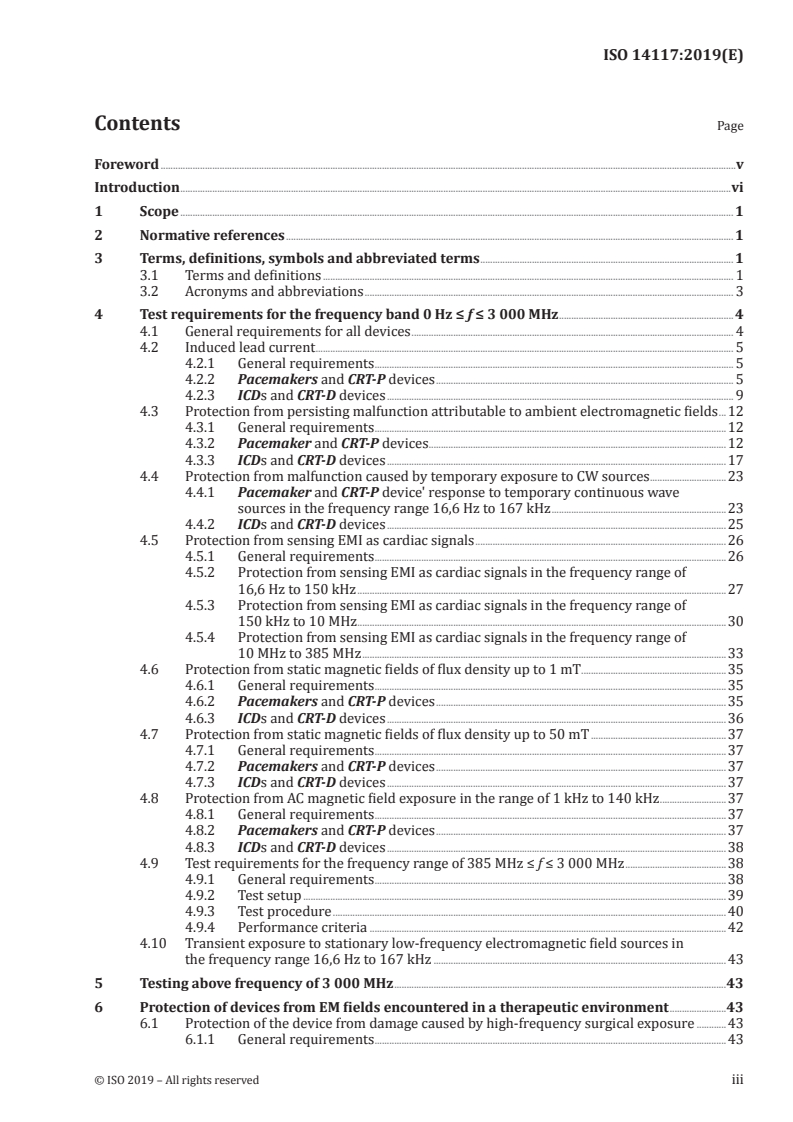
Contents Page
Foreword .v
Introduction .vi
1 Scope . 1
2 Normative references . 1
3 Terms, definitions, symbols and abbreviated terms . 1
3.1 Terms and definitions . 1
3.2 Acronyms and abbreviations . 3
4 Test requirements for the frequency band 0 Hz ≤ ƒ ≤ 3 000 MHz . 4
4.1 General requirements for all devices . 4
4.2 Induced lead current . 5
4.2.1 General requirements . 5
4.2.2 Pacemakers and CRT-P devices . 5
4.2.3 ICDs and CRT-D devices . 9
4.3 Protection from persisting malfunction attributable to ambient electromagnetic fields .12
4.3.1 General requirements .12
4.3.2 Pacemaker and CRT-P devices .12
4.3.3 ICDs and CRT-D devices .17
4.4 Protection from malfunction caused by temporary exposure to CW sources .23
4.4.1 Pacemaker and CRT-P device' response to temporary continuous wave
sources in the frequency range 16,6 Hz to 167 kHz .23
4.4.2 ICDs and CRT-D devices .25
4.5 Protection from sensing EMI as cardiac signals .26
4.5.1 General requirements .26
4.5.2 Protection from sensing EMI as cardiac signals in the frequency range of
16,6 Hz to 150 kHz .27
4.5.3 Protection from sensing EMI as cardiac signals in the frequency range of
150 kHz to 10 MHz .30
4.5.4 Protection from sensing EMI as cardiac signals in the frequency range of
10 MHz to 385 MHz .33
4.6 Protection from static magnetic fields of flux density up to 1 mT.35
4.6.1 General requirements .35
4.6.2 Pacemakers and CRT-P devices .35
4.6.3 ICDs and CRT-D devices .36
4.7 Protection from static magnetic fields of flux density up to 50 mT .37
4.7.1 General requirements .37
4.7.2 Pacemakers and CRT-P devices .37
4.7.3 ICDs and CRT-D devices .37
4.8 Protection from AC magnetic field exposure in the range of 1 kHz to 140 kHz .37
4.8.1 General requirements .37
4.8.2 Pacemakers and CRT-P devices .37
4.8.3 ICDs and CRT-D devices .38
4.9 Test requirements for the frequency range of 385 MHz ≤ ƒ ≤ 3 000 MHz .38
4.9.1 General requirements .38
4.9.2 Test setup .39
4.9.3 Test procedure .40
4.9.4 Performance criteria .42
4.10 Transient exposure to stationary low-frequency electromagnetic field sources in
the frequency range 16,6 Hz to 167 kHz .43
5 Testing above frequency of 3 000 MHz .43
6 Protection of devices from EM fields encountered in a therapeutic environment .43
6.1 Protection of the device from damage caused by high-frequency surgical exposure .43
6.1.1 General requirements .43
6.1.2 Pacemakers and CRT-P devices .44
6.1.3 ICDs and CRT-D devices .44
6.2 Protection of the device from damage caused by external defibrillators .45
6.2.1 General requirements .45
6.2.2 Pacemakers and CRT-P devices .45
6.2.3 ICDs and CRT-D devices .48
7 Additional accompanying documentation .49
7.1 Disclosure of permanently programmable sensitivity settings .49
7.2 Descriptions of reversion modes.49
7.3 Known potential hazardous behaviour .49
7.4 Minimum separation distance from hand-held transmitters .49
Annex A (informative) Rationale .50
Annex B (informative) Rationale for test frequency ranges .63
Annex C (informative) Code for describing modes of implantable generators .64
Annex D (normative) Interface circuits .66
Annex E (informative) Selection of capacitor C .71
x
Annex F (normative) Calibration of the injection network (Figure D.5) .74
Annex G (normative) Torso simulator .76
Annex H (normative) Dipole antennas .80
Annex I (normative) Pacemaker/ICD programming settings .82
Annex J (normative) Simulated cardiac signal .84
Annex K (normative) Calculation of net power into dipole antenna .85
Annex L (informative) Loop area calculations.90
Annex M (informative) Correlation between levels of test voltages used in this document
and strengths of radiated fields .96
Annex N (informative) Connections to DUTs having ports with more than two electrode
connections .104
Annex O (informative) Example method for evaluation of transient and permanent
malfunction of a CIED due to temporary exposure to low frequency (<167 kHz)
electromagnetic fields .127
Bibliography .132
iv © ISO 2019 – All rights reserved
Foreword
ISO (the International Organization for Standardization) is a worldwide federation of national standards
bodies (ISO member bodies). The work of preparing International Standards is normally carried out
through ISO technical committees. Each member body interested in a subject for which a technical
committee has been established has the right to be represented on that committee. International
organizations, governmental and non-governmental, in liaison with ISO, also take part in the work.
ISO collaborates closely with the International Electrotechnical Commission (IEC) on all matters of
electrotechnical standardization.
The procedures used to develop this document and those intended for its further maintenance are
described in the ISO/IEC Directives, Part 1. In particular, the different approval criteria needed for the
different types of ISO documents should be noted. This document was drafted in accordance with the
editorial rules of the ISO/IEC Directives, Part 2 (see www .iso .org/directives).
Attention is drawn to the possibility that some of the elements of this document may be the subject of
patent rights. ISO shall not be held responsible for identifying any or all such patent rights. Details of
any patent rights identified during the development of the document will be in the Introduction and/or
on the ISO list of patent declarations received (see www .iso .org/patents).
Any trade name used in this document is information given for the convenience of users and does not
constitute an endorsement.
For an explanation of the voluntary nature of standards, the meaning of ISO specific terms and
expressions related to conformity assessment, as well as information about ISO's adherence to the
World Trade Organization (WTO) principles in the Technical Barriers to Trade (TBT) see www .iso
.org/iso/foreword .html.
This document was prepared by Technical Committee ISO/TC 150, Implants for surgery, Subcommittee
SC 6, Active Implants.
This second edition cancels and replaces the first edition (ISO 14117:2012), which has been technically
revised.
The main changes compared to the previous edition are as follows:
— new definitions added for interference mode and transient exposure;
— the breakpoint between injected voltage testing and radiated testing reduced from 450 MHz to
385 MHz to account for new wireless services;
— modification and clarification of 4.4, temporary exposure to CW sources;
— new 4.10 concerning transient exposure to low-frequency magnetic field sources;
— recognition of multiple electrode leads such as those with IS-4 and DF-4 connectors;
— new 7.4 explicitly requiring separation distance warning when applicable;
— elimination of the table of emitters and frequencies from Annex B;
— addition of new informative Annex N describing generic nomenclature for multi-port, multi-
electrode systems;
— addition of new informative Annex O to provide a sample test method for evaluation of transient
exposure;
— overall language clarifications, corrections to minor use issues from edition 1, and updated
rationale.
Any feedback or questions on this document should be directed to the user’s national standards body. A
complete listing of these bodies can be found at www .iso .org/members .html.
Introduction
The number and the types of electromagnetic (EM) emitters to which patients with active implantable
cardiovascular devices are exposed in their day-to-day activities have proliferated over the past
two decades. This trend is expected to continue. The interaction between these emitters and active
implantable cardiovascular devices (pacemakers and implantable cardioverter defibrillators, or ICDs)
is an ongoing concern of patients, industry and regulators, given the potential life-sustaining nature
of these devices. The risks associated with such interactions include device inhibition or delivery of
inappropriate therapy that, in the worst case, could result in serious injury or patient death.
In recent years, other active implantable cardiovascular devices have emerged, most notably devices
that perform the function of improving cardiac output by optimizing ventricular synchrony, in addition
to performing pacemaker or ICD functions.
Although these devices can deliver an additional therapy with respect to pacemakers and ICD devices,
most of their requirements concerning EM compatibility are similar so that, in most cases, the concepts
that apply to pacemakers also apply to CRT-P devices, and the appropriate way to test a CRT-P device is
similar to the way pacemakers are tested. Similarly, the concepts that apply to ICD devices mostly apply
to CRT-D devices as well, so the appropriate way to test a CRT-D device is similar to the way ICD devices
are tested.
Standard test methodologies allow manufacturers to evaluate the EM compatibility performance
of a product and demonstrate that the product achieves an appropriate level of EM compatibility in
uncontrolled EM environments that patients might encounter.
It is important that manufacturers of transmitters and any other equipment that produces EM fields
(intentional or unintentional) understand that such equipment can interfere with the proper operation
of active implantable cardiovascular devices.
It is important to understand that these interactions can occur despite the conformance of the device
to this document and the conformance of emitters to the relevant human exposure safety standards
and pertinent regulatory emission requirements, e.g. those of the U.S. Federal Communications
Commission (FCC).
Compliance with biological safety guidelines does not necessarily guarantee EM compatibility with
active implantable cardiovascular devices. In some cases, the reasonably achievable EM immunity
performance for these devices falls below these biological safety limits.
See Annex M for rationale concerning the use of ICNIRP 1998 levels. See Annex M for rationale applicable
to emitters above 10 MHz.
The potential for emitter equipment to interfere with active implantable cardiovascular devices is
complex and depends on the following factors:
— frequency content of the emitter,
— modulation format,
— power of the signal,
— proximity to the patient,
— coupling factors, and
— duration of exposure.
An emitter with a fundamental carrier frequency up to 1 kHz has the potential to be sensed directly
by the pacemaker or ICD. Also, higher-frequency carriers that have baseband modulation rates below
500 Hz and that have sufficient proximity and power might be sensed by the pacemaker or ICD.
Additional details regarding this issue can be found in Annex M.
vi © ISO 2019 – All rights reserved
This document addresses the EM compatibility of pacemakers and ICDs up to 3 000 MHz and is divided
in several subclauses.
a) 0 Hz ≤ ƒ < 385 MHz
In the lower-frequency bands (<385 MHz), there are many EM emitters, such as broadcast radio
and television, and a number of new technologies or novel applications of established technologies
that can increase the likelihood of interaction between the emitters and patients’ pacemakers and
ICDs. A few examples:
— electronic article surveillance (EAS) systems;
— access control systems (radio-frequency identification, or RFID);
— new wireless services in the ultra-high-frequency and very-high-frequency bands;
— magnetic levitation rail systems;
— radio-frequency (RF) medical procedures, such as high-frequency surgery and ablation therapy;
— metal detectors;
— magnetic resonance imaging;
— experimental use of transponders for traffic control;
— wireless charging systems for electric or hybrid vehicles.
b) 385 MHz ≤ ƒ < 3 000 MHz
These are the frequencies, ƒ, that are typically associated with personal hand-held communication
devices (e.g. wireless telephones and two-way radios).
Two decades ago, relatively few pacemaker patients used hand-held transmitters or were
exposed to EM fields from portable transmitters. Hand-held, frequency-modulated transceivers
for business, public safety, and amateur radio communications represented the predominant
applications. However, the environment has changed rapidly during the past 15 years, with
wireless phone systems becoming increasingly common as this technology matured and received
widespread public acceptance. Thus, it is becoming increasingly likely that a large portion of the
pacemaker and ICD patient population will be exposed to EM fields from portable wireless phone
transmitters operated either by themselves or by others. Also, it should be expected that the
wireless technology revolution will continue to evolve new applications using increasingly higher
microwave frequencies.
Most electronic equipment, including external medical devices, has been designed for compatibility
with relatively low-amplitude EM conditions. Recognizing the wide range of EM environments
that patients could encounter, implantable devices have been designed to tolerate much higher-
amplitude EM conditions than most other electronic products. However, in some instances,
even this enhanced immunity is not sufficient to achieve compatibility with the complex electric
and magnetic fields generated by low-power emitters located within a few centimetres of the
implantable device. Studies in the mid-1990s demonstrated that some models of pacemakers and
ICDs had insufficient immunity to allow unrestricted use when in close proximity to some hand-
held emitters (e.g. wireless telephones and two-way radios). Although operating restrictions can
help prevent EM interaction with implantable devices, this approach is not viewed as an optimum
long-term solution. Rather, improved EM compatibility is the preferred method for meeting patient
expectations for using wireless services with minimal operating restrictions.
Some technological factors are contributing to the expanding variety of emitters to which patients
might now be exposed:
— smaller wireless phones;
— the introduction of digital technology;
— peak transmitter power.
Wireless phone size has now been reduced sufficiently so that it is possible for patients to carry
a phone that is communicating or in standby mode in a breast pocket immediately adjacent to a
pectorally implanted device.
The various wireless phone standards allow for a range of power levels and modulation schemes.
Most digital wireless phones are capable of producing greater peak transmitted power than analog
phones are capable of producing. Those factors contribute to greater potential interactions with
pacemakers and ICDs.
For frequencies of 385 MHz ≤ ƒ ≤ 3 000 MHz, this document specifies testing at 120 mW net power
into a dipole antenna to simulate a hand-held wireless transmitter 15 cm from the implant. An
optional characterization test is described that uses higher power levels to simulate a hand-held
wireless transmitter placed much closer to the implant.
c) ƒ ≥ 3 000 MHz
This document does not require testing of devices above 3 GHz. The upper-frequency limit chosen
for this document reflects consideration of the following factors:
— the types of radiators of frequencies above 3 GHz;
— the increased device protection afforded by the attenuation of the enclosure and body tissue at
microwave frequencies;
— the expected performance of EMI control features that typically are implemented to meet the
lower-frequency requirements of this document ; and
— the reduced sensitivity of circuits at microwave frequencies.
Additional details can be found in Clause 5.
In conclusion, it is reasonable to expect that patients with pacemakers and ICDs will be exposed
to increasingly complex EM environments. Also, the rapid evolution of new technologies and their
acceptance by patients will lead to growing expectations for unrestricted use. In view of the changing
EM environment and customer expectations, manufacturers will need to evaluate their product designs
to assess compatibility with the complex fields, broad range of frequencies, and variety of modulation
schemes associated with existing and future applications.
Annex A provides the rationale for certain provisions of this document in order to provide useful
background information for reviewing, applying, and revising this document. This rationale is directed
toward individuals who are familiar with the subject of this document but have not participated in its
drafting. Remarks made in this annex apply to the relevant clause, subclause, or annex in this document;
the numbering therefore, might not be consecutive.
viii © ISO 2019 – All rights reserved
INTERNATIONAL STANDARD ISO 14117:2019(E)
Active implantable medical devices — Electromagnetic
compatibility — EMC test protocols for implantable cardiac
pacemakers, implantable cardioverter defibrillators and
cardiac resynchronization devices
1 Scope
This document specifies test methodologies for the evaluation of the electromagnetic compatibility
(EMC) of active implantable cardiovascular devices that provide one or more therapies for bradycardia,
tachycardia and cardiac resynchronization in conjunction with transvenous lead systems.
NOTE This document was designed for pulse generators used with endocardial leads or epicardial leads. At
the time of this edition, the authors recognized the emergence of technologies that do not use endocardial leads
or epicardial leads for which adaptations of this part will be required. Such adaptations are left to the discretion
of manufacturers incorporating these technologies.
It specifies performance limits of these devices, which are subject to interactions with EM emitters
operating across the EM spectrum in the two following ranges:
— 0 Hz ≤ ƒ < 385 MHz;
— 385 MHz ≤ ƒ ≤ 3 000 MHz
This document also specifies requirements for the protection of these devices from EM fields
encountered in a therapeutic environment and defines their required accompanying documentation,
providing manufacturers of EM emitters with information about their expected level of immunity.
2 Normative references
The following documents are referred to in the text in such a way that some or all of their content
constitutes requirements of this document. For dated references, only the edition cited applies. For
undated references, the latest edition of the referenced document (including any amendments) applies.
ISO 14708-1:2014, Implants for surgery — Active implantable medical devices — Part 1: General
requirements for safety, marking and for information to be provided by the manufacturer
ISO 14708-2:2019, Implants for surgery — Active implantable medical devices — Part 2: Cardiac
pacemakers
ISO 14708-6:2019, Implants for surgery — Active implantable medical devices — Part 6: Particular
requirements for active implantable medical devices intended to treat tachyarrhythmia (including
implantable defibrillators)
3 Terms, definitions, symbols and abbreviated terms
3.1 Terms and definitions
For the purposes of this document, the terms and definitions given in ISO 14708-1:2014,
ISO 14708-2:2019, ISO 14708-6:2019 and the following apply.
ISO and IEC maintain terminological databases for use in standardization at the following addresses:
— ISO Online browsing platform: available at https: //www .iso .org/obp
— IEC Electropedia: available at http: //www .electropedia .org/
3.1.1
pacemaker
implantable pacemaker
active implantable medical device intended to treat bradyarrhythmias, comprising an implantable DUT
and leads
[SOURCE: ISO 14708-2:2019, 3.3, modified — “DUT” substituted for “pulse generator”, and the admitted
term" implantable pacemaker" added.]
3.1.2
ICD
implantable cardioverter defibrillator
active implantable medical device comprising an implantable DUT and lead(s) that is intended to
detect and correct tachycardias and fibrillation by application of cardioversion/defibrillation pulse(s)
to the heart
[SOURCE: ISO 14708-6:2019, 3.2, modified — “DUT” substituted for “pulse generator”.]
3.1.3
CRT-P
implantable cardiac resynchronization therapy pacing device
active implantable medical device intended to provide improved ventricular activation to optimize
cardiac output, comprising an implantable DUT and leads
[SOURCE: ISO 14708-2:2019, 3.7, modified — “DUT” substituted for “pulse generator”.]
3.1.4
CRT-D
implantable cardiac resynchronization therapy/defibrillator device
active implantable medical device intended to detect and correct tachycardias and fibrillation by
application of cardioversion/defibrillation pulses to the heart, and to provide improved ventricular
activation to optimize cardiac output, comprising an implantable DUT and leads
[SOURCE: ISO 14708-6:2019, 3.34, modified — “DUT" substituted for "pulse generator".]
3.1.5
inhibition generator
equipment that generates a simulated heart signal for devices within the scope of this document
3.1.6
maximum permanently programmable sensitivity
condition where the sensing channels of an ICD or pacemaker are set, either automatically by the device
or programmed by a clinician, to detect the lowest amplitude signals
Note 1 to entry: These settings are intended for use without direct medical supervision.
Note 2 to entry: Sensitivity settings are usually expressed in terms of the minimum voltage that can be sensed.
Therefore, a sensitivity of 1 mV is actually more sensitive than a setting of 2 mV.
Note 3 to entry: An AIMD can have settings, including those for sensitivity, that by design of the device or its
software, are only temporarily available for use during diagnostic testing (such as during manufacture) or for
testing at the time of implantation. Such settings are therefore unavailable for use by patients when not under
immediate medical care and are not intended to be encompassed by the testing herein.
3.1.7
interference mode
where asynchronous pacing is delivered in response to detected interference
2 © ISO 2019 – All rights reserved
3.1.8
transient exposure
exposure of the implanted DUT and leads for a period of less than 15 seconds
Note 1 to entry: 15 seconds is considered to be a reasonably foreseeable maximum exposure duration for persons
walking past a stationary emitter.
3.2 Acronyms and abbreviations
Table 1 shows acronyms and abbreviations used in this document.
Table 1 — List of acronyms and abbreviations
Acronym or abbreviation Description
A atrial
AAMI Association for the Advancement of Medical Instrumentation
ACA antenna cable attenuation (+dB)
AdBm power meter “A” reading (dBm)
ASIC Application Specific Integration Circuit
ATP antitachycardia pacing
BdBm power meter “B” reading (dBm)
BPEG British Pacing and Electrophysiology Group
bpm beats per minute
CENELEC European Committee for Electrotechnical Standardization
CIED Cardiac Implantable Electronic Device
CRT cardiac resynchronization therapy
CRT-P implantable cardiac resynchronization therapy pacing device
CRT-D implantable cardiac resynchronization therapy/defibrillator device
CW continuous wave
dB decibel
dBm decibels above a milliwatt
DCF directional coupler forward port coupling factor (+dB)
DCR directional coupler reflected port coupling factor (+dB)
DUT device under test
EAS electronic article surveillance
ECG electrocardiogram
EGM electrogram
EM electromagnetic
EMC electromagnetic compatibility
EMI electromagnetic interference
EN European Norm
ESMR enhanced specialized mobile radio
ƒ frequency
FCC Federal Communications Commission
FP forward dipole power (mW)
FPdBm forward dipole power (dBm)
ICD implantable cardioverter defibrillator
NOTE Throughout this document, DUT has been used to designate all devices within the scope of this document. When a
certain test or requirement applies only to a specific type of device, that designation is used.
Table 1 (continued)
Acronym or abbreviation Description
ICNIRP International Commission on Non-Ionizing Radiation Protection
IEC International Electrotechnical Commission
IEEE Institute of Electrical and Electronics Engineers
λ wavelength
NASPE North American Society of Pacing and Electrophysiology
NP net dipole power (mW)
o.d. outside diameter
Ωcm measure of resistivity (Ohm-cm)
PCS personal communication services
PVARP post ventricular atrial refractory period
RF radio frequency
RFID radio-frequency identification
rms root mean square
RP reflected dipole power (mW)
RPdBm reflected dipole power (dBm)
SMA subminiature “A”
T simulated heart signal interval
shs
V ventricular
VF ventricular fibrillation
VSWR voltage standing wave ratio
VT ventricular tachycardia
NOTE Throughout this document, DUT has been used to designate all devices within the scope of this document. When a
certain test or requirement applies only to a specific type of device, that designation is used.
4 Test requirements for the frequency band 0 Hz ≤ ƒ ≤ 3 000 MHz
4.1 General requirements for all devices
Implantable pacemakers, ICDs and CRT devices shall not create an unacceptable risk for patients because
of susceptibility to electrical influences due to external EM fields, whether through malfunction of the
device, damage to the device, heating of the device, or by causing local increase of induced electrical
current density within the patient.
In 4.2 through 4.9, connections between the DUT and a tissue-equivalent interface circuit are
illustrated using generic DUT symbols with a layered stacking of connection points on the DUT to
indicated additional lead ports. These drawings were initially created for simple unipolar or bipolar
ports intended to connect to leads with either a single or, at most, two electrodes. With the advent
of leads having more than two electrodes (e.g. IS-4 or DF-4), these interconnection drawings become
considerably more complex. In addition, the number and combination of port types for a given DUT
can vary widely between manufacturers. Therefore, the connection drawings, even as given, should be
treated as guidance, and engineering judgement should be applied to determine the set of connections
necessary for a given DUT and type of test. To assist users of this document, Annex N has been prepared
which illustrates a generic DUT with a reasonable worst case number of ports and electrodes. Annex N
further discusses how such a complex DUT should be treated with respect to interconnection to an
appropriate tissue-equivalent interface.
In 4.2 through 4.5, the test procedures specify the optional use of a coupling capacitor C . If this
x
capacitor is used to demonstrate compliance with the requirements of the related subclause, then the
value of C can be determined according to the method described in Annex E.
x
4 © ISO 2019 – All rights reserved
The following tests are generally intended to address the compatibility of the intracardiac signal
sensing. Any additional physiological sensors may be turned off during testing. Physiologic sensors
should be considered as part of the risk assessment required by 5.5 of ISO 14708-1:2014.
The tests outlined in this document are to be seen as type tests and shall be performed on a sample of
one device as being representative of the devices leaving volume production.
Compliance shall be confirmed if, after performance of the appropriate procedures described in 4.2 to
4.9, the values of the characteristics when measured are as stated by the manufacturer specification of
the DUT.
All requirements shall be met for all settings of the DUT, except as follows:
— For pacemakers and CRT-P devices: those sensitivity settings that the manufacturer specifies in the
accompanying documentation as not meeting the requirements of 4.4 and 4.5.2.1.
— For ICDs and CRT-D devices: those sensitivity settings that the manufacturer specifies in the
accompanying documentation as not meeting the requirements of 4.5.2.2.
This does not mean that all combinations of settings are tested, but at least the setting to which the
device is preset by the manufacturer should be tested completely.
If the case of the DUT is covered with an insulating material, the DUT (or part of it) should be immersed
in a 9 g/l saline bath held in a metal container; the metal container should be connected directly to the
test circuit as applicable in each test set up.
Manufacturers that use an automatic gain control function (or similar feature) for sensing purposes
should include a detailed test method.
4.2 Induced lead current
4.2.1 General requirements
The DUT shall be constructed so that ambient EM fields are unlikely to cause hazardous local increases
of induced electrical current density within the patient.
4.2.2 Pacemakers and CRT-P devices
Test equipment: Use the test setup specified in Figure 2; the tissue-equivalent interface circuit
specified in Figure D.1 and Table D.1a); the low-pass filter specified in Figure D.4; two oscilloscopes,
input impedance nominal 1 MΩ; and test signal generators, output impedance 50 Ω.
Test signal: Two forms of test signal shall be used.
Test signal 1 shall be a sinusoidal signal of 1 V peak-to-peak amplitude. The frequency shall be either
swept over the range 16,6 Hz to 20 kHz at a rate of 1 decade per minute or applied at a minimum of four
distinct, well-spaced frequencies per decade between 16,6 Hz and 20 kHz, with an evenly distributed
dwell time of at least 60 s per decade.
Test signal 2 shall be a sinusoidal carrier signal, frequency 500 kHz, with continuous amplitude
modulation at 130 Hz (double sideband with carrier) (see Figure 1).
Figure 1 — Test signal 2
The maximum peak-to-peak voltage of the modulated signal shall be 2 V. The modulation index, M, shall
be 95 %, where
Vv−
pp
M= ×100
Vv+
pp
Test procedure: The test signal generator shall be connected through input C of the interface circuit
as shown in Figure 2. The test signal shall be measured on the oscilloscope connected to monitoring
point D.
Key
1 oscilloscope
2 test signal generator
3 tissue equivalent interface
4 filter
Figure 2 — Test setup for measurement of induced current
The induced electrical current is measured by the oscilloscope connected to test point K through the
low-pass filter (as specified in Figure D.4), as shown in Figure 2. When test signal 1 is being used, the
low-pass filter shall be switched to bypass mode.
The capacitor C of the interface circuit (see Figure D.1) shall be bypassed unless required to eliminate
x
spurious low-frequency signals produced by the interference signal generator (see Annex E).
NOTE 1 It is not mandatory that a current measurement be made in the period from 10 milliseconds (ms)
preceding a stimulation pulse to 150 ms after the stimulation pulse.
The pacemaker or CRT-P shall be categorized into one or more of four groups as appropriate:
— single-channel unipolar devices shall be Group a);
— multichannel unipolar devices shall be Group b);
— single-channel bipolar devices shall be Group c);
— multichannel bipolar devices shall be Group d).
The bipolar channel should be tested in unipolar or bipolar mode, or both, according to the
programmability of the device and should be changed where applicable.
6 © ISO 2019 – All rights reserved
Any terminal of the DUT not being tested shall be connected to the channel under test through a resistor
of value R ≥ 10 kΩ, as specified by the manufacturer.
Group a): the DUT shall be connected to the coupled outputs F and G of the tissue-equivalent interface
(as shown in Figure 3), with output J connected to the case.
Figure 3 — Connection to a single-channel unipolar device
Group b): every input/output of the DUT shall be connected, in turn, to the coupled outputs F and G of
the tissue-equivalent interface (as shown in Figure 4), with output J connected to the case.
Figure 4 — Connection to a multichannel unipolar device
Group c): common mode performance shall be tested with the DUT connected to the outputs F and G of
the tissue-equivalent interface (as shown in Figure 5), with output J connected to the case.
Figure 5 — Common mode connection to single-channel bipolar device
Differential mode performance shall be tested using the test signals reduced to one-tenth amplitude.
The pacemaker shall be connected between the coupled outputs F and G and the output J of the tissue-
equivalent interface (as shown in Figure 6).
Figure 6 — Differential mode connection to single-channel bipolar device
Group d): common mode performance shall be tested by every input and output of the pacemaker being
connected, in turn, to outputs F and G of the tissue-equivalent interface (as shown in Figure 7), with
output J connected to the case.
Figure 7 — Common mode connection to multichannel bipolar device
Differential mode performance shall be tested using the test signals reduced to one-tenth amplitude.
Every input and output of the pacemaker shall be connected, in turn, between the coupled outputs F and
G and the output J of the tissue-equivalent interface (as shown in Figure 8).
Figure 8 — Differential mode connection to multichannel bipolar device
The current (root mean square, or rms) shall be determined by dividing the peak-to-peak voltage
reading on the oscilloscope, connected to test point K by 232 Ω for test signal 1.
...
Questions, Comments and Discussion
Ask us and Technical Secretary will try to provide an answer. You can facilitate discussion about the standard in here.
Loading comments...