


IEC 80601-2-35:2009
(Main)Medical electrical equipment — Part 2-35: Particular requirements for the basic safety and essential performance of heating devices using blankets, pads or mattresses and intended for heating in medical use
Medical electrical equipment — Part 2-35: Particular requirements for the basic safety and essential performance of heating devices using blankets, pads or mattresses and intended for heating in medical use
IEC 80601-2-35:2009 establishes particular basic safety and essential performance requirements, which minimize hazards to patients, and operators for heating devices using blankets, pads or mattresses and intended for heating in medical use and specifies tests for demonstrating compliance with these requirements. This second edition cancels and replaces the first edition published in 1996. This edition constitutes a technical revision. This new edition provides consistency with the third edition of IEC 60601-1, as well as with the four other particular standards related to paediatric equipment for which the committee is responsible.
Appareils électromédicaux — Partie 2-35: Exigences particulières pour la sécurité de base et les performances essentielles des dispositifs de réchauffage utilisant des couvertures, des coussins ou des matelas chauffants et destinés au réchauffage des patients en usage médical
La CEI 80601-2-35:2009 établit des exigences particulières pour la sécurité de base et les performances essentielles, afin de réduire les dangers pour les patients et les opérateurs, pour les dispositifs de réchauffage utilisant des couvertures, des coussins ou des matelas chauffants et destinés au réchauffage des patients en usage médical, et spécifie des essais pour démontrer la conformité à ces exigences. Cette deuxième édition annule et remplace la première édition publiée en 1996, dont elle constitue une révision technique. Cette nouvelle édition assure la cohérence avec la troisième édition de la CEI 60601-1, ainsi qu'avec les quatre autres normes particulières relatives aux appareils pédiatriques dont le comité est responsable.
General Information
- Status
- Withdrawn
- Publication Date
- 21-Oct-2009
- Withdrawal Date
- 21-Oct-2009
- Technical Committee
- ISO/TC 121/SC 1 - Breathing attachments and anaesthetic machines
- Drafting Committee
- ISO/TC 121/SC 1 - Breathing attachments and anaesthetic machines
- Current Stage
- 9599 - Withdrawal of International Standard
- Start Date
- 21-Sep-2020
- Completion Date
- 31-Oct-2020
Relations
- Effective Date
- 09-May-2020
Get Certified
Connect with accredited certification bodies for this standard

BSI Group
BSI (British Standards Institution) is the business standards company that helps organizations make excellence a habit.

TÜV Rheinland
TÜV Rheinland is a leading international provider of technical services.

TÜV SÜD
TÜV SÜD is a trusted partner of choice for safety, security and sustainability solutions.
Sponsored listings
Frequently Asked Questions
IEC 80601-2-35:2009 is a standard published by the International Organization for Standardization (ISO). Its full title is "Medical electrical equipment — Part 2-35: Particular requirements for the basic safety and essential performance of heating devices using blankets, pads or mattresses and intended for heating in medical use". This standard covers: IEC 80601-2-35:2009 establishes particular basic safety and essential performance requirements, which minimize hazards to patients, and operators for heating devices using blankets, pads or mattresses and intended for heating in medical use and specifies tests for demonstrating compliance with these requirements. This second edition cancels and replaces the first edition published in 1996. This edition constitutes a technical revision. This new edition provides consistency with the third edition of IEC 60601-1, as well as with the four other particular standards related to paediatric equipment for which the committee is responsible.
IEC 80601-2-35:2009 establishes particular basic safety and essential performance requirements, which minimize hazards to patients, and operators for heating devices using blankets, pads or mattresses and intended for heating in medical use and specifies tests for demonstrating compliance with these requirements. This second edition cancels and replaces the first edition published in 1996. This edition constitutes a technical revision. This new edition provides consistency with the third edition of IEC 60601-1, as well as with the four other particular standards related to paediatric equipment for which the committee is responsible.
IEC 80601-2-35:2009 is classified under the following ICS (International Classification for Standards) categories: 11.140 - Hospital equipment. The ICS classification helps identify the subject area and facilitates finding related standards.
IEC 80601-2-35:2009 has the following relationships with other standards: It is inter standard links to IEC 80601-2-35:2009/Amd 1:2016. Understanding these relationships helps ensure you are using the most current and applicable version of the standard.
IEC 80601-2-35:2009 is available in PDF format for immediate download after purchase. The document can be added to your cart and obtained through the secure checkout process. Digital delivery ensures instant access to the complete standard document.
Standards Content (Sample)
IEC 80601-2-35
Edition 2.0 2009-10
INTERNATIONAL
STANDARD
NORME
INTERNATIONALE
colour
inside
Medical electrical equipment –
Part 2-35: Particular requirements for the basic safety and essential performance
of heating devices using blankets, pads or mattresses and intended for heating
in medical use
Appareils électromédicaux –
Partie 2-35: Exigences particulières pour la sécurité de base et les performances
essentielles des dispositifs de réchauffage utilisant des couvertures, des
coussins ou des matelas chauffants et destinés au réchauffage des patients en
usage médical
All rights reserved. Unless otherwise specified, no part of this publication may be reproduced or utilized in any form or by
any means, electronic or mechanical, including photocopying and microfilm, without permission in writing from either IEC or
IEC's member National Committee in the country of the requester.
If you have any questions about IEC copyright or have an enquiry about obtaining additional rights to this publication,
please contact the address below or your local IEC member National Committee for further information.
Droits de reproduction réservés. Sauf indication contraire, aucune partie de cette publication ne peut être reproduite
ni utilisée sous quelque forme que ce soit et par aucun procédé, électronique ou mécanique, y compris la photocopie
et les microfilms, sans l'accord écrit de la CEI ou du Comité national de la CEI du pays du demandeur.
Si vous avez des questions sur le copyright de la CEI ou si vous désirez obtenir des droits supplémentaires sur cette
publication, utilisez les coordonnées ci-après ou contactez le Comité national de la CEI de votre pays de résidence.
IEC Central Office
3, rue de Varembé
CH-1211 Geneva 20
Switzerland
Email: inmail@iec.ch
Web: www.iec.ch
About the IEC
The International Electrotechnical Commission (IEC) is the leading global organization that prepares and publishes
International Standards for all electrical, electronic and related technologies.
About IEC publications
The technical content of IEC publications is kept under constant review by the IEC. Please make sure that you have the
latest edition, a corrigenda or an amendment might have been published.
ƒ Catalogue of IEC publications: www.iec.ch/searchpub
The IEC on-line Catalogue enables you to search by a variety of criteria (reference number, text, technical committee,…).
It also gives information on projects, withdrawn and replaced publications.
ƒ IEC Just Published: www.iec.ch/online_news/justpub
Stay up to date on all new IEC publications. Just Published details twice a month all new publications released. Available
on-line and also by email.
ƒ Electropedia: www.electropedia.org
The world's leading online dictionary of electronic and electrical terms containing more than 20 000 terms and definitions
in English and French, with equivalent terms in additional languages. Also known as the International Electrotechnical
Vocabulary online.
ƒ Customer Service Centre: www.iec.ch/webstore/custserv
If you wish to give us your feedback on this publication or need further assistance, please visit the Customer Service
Centre FAQ or contact us:
Email: csc@iec.ch
Tel.: +41 22 919 02 11
Fax: +41 22 919 03 00
A propos de la CEI
La Commission Electrotechnique Internationale (CEI) est la première organisation mondiale qui élabore et publie des
normes internationales pour tout ce qui a trait à l'électricité, à l'électronique et aux technologies apparentées.
A propos des publications CEI
Le contenu technique des publications de la CEI est constamment revu. Veuillez vous assurer que vous possédez
l’édition la plus récente, un corrigendum ou amendement peut avoir été publié.
ƒ Catalogue des publications de la CEI: www.iec.ch/searchpub/cur_fut-f.htm
Le Catalogue en-ligne de la CEI vous permet d’effectuer des recherches en utilisant différents critères (numéro de référence,
texte, comité d’études,…). Il donne aussi des informations sur les projets et les publications retirées ou remplacées.
ƒ Just Published CEI: www.iec.ch/online_news/justpub
Restez informé sur les nouvelles publications de la CEI. Just Published détaille deux fois par mois les nouvelles
publications parues. Disponible en-ligne et aussi par email.
ƒ Electropedia: www.electropedia.org
Le premier dictionnaire en ligne au monde de termes électroniques et électriques. Il contient plus de 20 000 termes et
définitions en anglais et en français, ainsi que les termes équivalents dans les langues additionnelles. Egalement appelé
Vocabulaire Electrotechnique International en ligne.
ƒ Service Clients: www.iec.ch/webstore/custserv/custserv_entry-f.htm
Si vous désirez nous donner des commentaires sur cette publication ou si vous avez des questions, visitez le FAQ du
Service clients ou contactez-nous:
Email: csc@iec.ch
Tél.: +41 22 919 02 11
Fax: +41 22 919 03 00
IEC 80601-2-35
Edition 2.0 2009-10
INTERNATIONAL
STANDARD
NORME
INTERNATIONALE
colour
inside
Medical electrical equipment –
Part 2-35: Particular requirements for the basic safety and essential performance
of heating devices using blankets, pads or mattresses and intended for heating
in medical use
Appareils électromédicaux –
Partie 2-35: Exigences particulières pour la sécurité de base et les performances
essentielles des dispositifs de réchauffage utilisant des couvertures, des
coussins ou des matelas chauffants et destinés au réchauffage des patients en
usage médical
INTERNATIONAL
ELECTROTECHNICAL
COMMISSION
COMMISSION
ELECTROTECHNIQUE
PRICE CODE
INTERNATIONALE
XB
CODE PRIX
ICS 11.140 ISBN 2-8318-1065-7
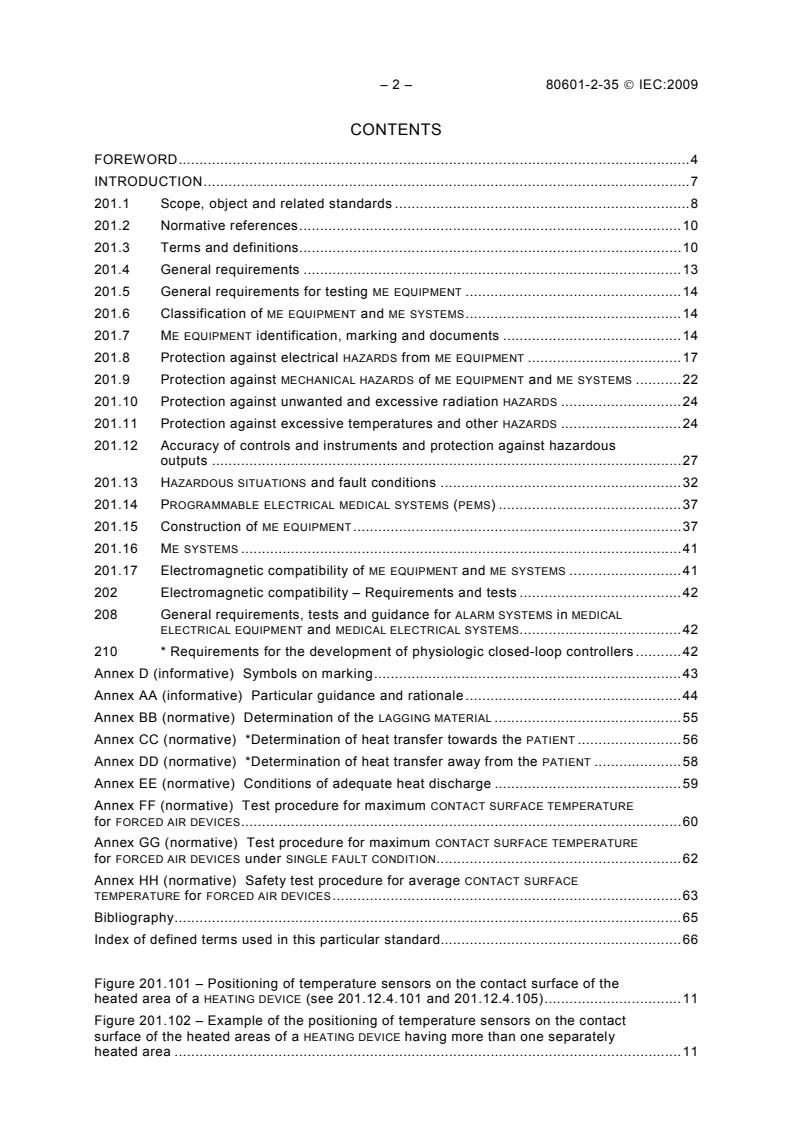
– 2 – 80601-2-35 © IEC:2009
CONTENTS
FOREWORD.4
INTRODUCTION.7
201.1 Scope, object and related standards .8
201.2 Normative references.10
201.3 Terms and definitions.10
201.4 General requirements .13
201.5 General requirements for testing ME EQUIPMENT .14
201.6 Classification of ME EQUIPMENT and ME SYSTEMS.14
201.7 ME EQUIPMENT identification, marking and documents .14
201.8 Protection against electrical HAZARDS from ME EQUIPMENT .17
201.9 Protection against MECHANICAL HAZARDS of ME EQUIPMENT and ME SYSTEMS .22
201.10 Protection against unwanted and excessive radiation HAZARDS .24
201.11 Protection against excessive temperatures and other HAZARDS .24
201.12 Accuracy of controls and instruments and protection against hazardous
outputs .27
201.13 HAZARDOUS SITUATIONS and fault conditions .32
201.14 PROGRAMMABLE ELECTRICAL MEDICAL SYSTEMS (PEMS) .37
201.15 Construction of ME EQUIPMENT .37
201.16 ME SYSTEMS .41
201.17 Electromagnetic compatibility of ME EQUIPMENT and ME SYSTEMS .41
202 Electromagnetic compatibility – Requirements and tests .42
208 General requirements, tests and guidance for ALARM SYSTEMS in MEDICAL
ELECTRICAL EQUIPMENT and MEDICAL ELECTRICAL SYSTEMS.42
210 * Requirements for the development of physiologic closed-loop controllers .42
Annex D (informative) Symbols on marking.43
Annex AA (informative) Particular guidance and rationale.44
Annex BB (normative) Determination of the LAGGING MATERIAL .55
Annex CC (normative) *Determination of heat transfer towards the PATIENT .56
Annex DD (normative) *Determination of heat transfer away from the PATIENT .58
Annex EE (normative) Conditions of adequate heat discharge .59
Annex FF (normative) Test procedure for maximum CONTACT SURFACE TEMPERATURE
for FORCED AIR DEVICES.60
Annex GG (normative) Test procedure for maximum CONTACT SURFACE TEMPERATURE
for FORCED AIR DEVICES under SINGLE FAULT CONDITION.62
Annex HH (normative) Safety test procedure for average CONTACT SURFACE
TEMPERATURE for FORCED AIR DEVICES.63
Bibliography.65
Index of defined terms used in this particular standard.66
Figure 201.101 – Positioning of temperature sensors on the contact surface of the
HEATING DEVICE (see 201.12.4.101 and 201.12.4.105).11
heated area of a
Figure 201.102 – Example of the positioning of temperature sensors on the contact
surface of the heated areas of a HEATING DEVICE having more than one separately
heated area .11
80601-2-35 © IEC:2009 – 3 –
Figure 201.103 a) – Apparatus for the spark ignition test – Detail A: The apparatus
(see 201.8.8.4.101).19
Figure 201.103 b) – Apparatus for the spark ignition test – Detail B: Lower member of
mask.20
Figure 201.103 c) – Apparatus for the spark ignition test – Detail C: Upper member of
mask.20
Figure 201.103 – Apparatus for the spark ignition test .20
Figure 201.104 – Ramp for the impact test on PADS .23
Figure 201.105 – Partial covering conditions.25
Figure 201.106 – Method of folding BLANKETS .34
Figure 201.107 – Examples of folds .36
Figure 201.108 – Positions of a BLANKET for the RUCK-RESISTANCE test.41
Figure HH.1 – Sensor locations – Average CONTACT SURFACE TEMPERATURE.64
Table 201.101 – *Additional ESSENTIAL PERFORMANCE requirements .13
Table 201.102 – Temperature limits in dependency to time.38
– 4 – 80601-2-35 © IEC:2009
INTERNATIONAL ELECTROTECHNICAL COMMISSION
____________
MEDICAL ELECTRICAL EQUIPMENT –
Part 2-35: Particular requirements for the basic safety
and essential performance of heating devices using blankets,
pads or mattresses and intended for heating in medical use
FOREWORD
1) The International Electrotechnical Commission (IEC) is a worldwide organization for standardization comprising
all national electrotechnical committees (IEC National Committees). The object of IEC is to promote
international co-operation on all questions concerning standardization in the electrical and electronic fields. To
this end and in addition to other activities, IEC publishes International Standards, Technical Specifications,
Technical Reports, Publicly Available Specifications (PAS) and Guides (hereafter referred to as “IEC
Publication(s)”). Their preparation is entrusted to technical committees; any IEC National Committee interested
in the subject dealt with may participate in this preparatory work. International, governmental and non-
governmental organizations liaising with the IEC also participate in this preparation. IEC collaborates closely
with the International Organization for Standardization (ISO) in accordance with conditions determined by
agreement between the two organizations.
2) The formal decisions or agreements of IEC on technical matters express, as nearly as possible, an international
consensus of opinion on the relevant subjects since each technical committee has representation from all
interested IEC National Committees.
3) IEC Publications have the form of recommendations for international use and are accepted by IEC National
Committees in that sense. While all reasonable efforts are made to ensure that the technical content of IEC
Publications is accurate, IEC cannot be held responsible for the way in which they are used or for any
misinterpretation by any end user.
4) In order to promote international uniformity, IEC National Committees undertake to apply IEC Publications
transparently to the maximum extent possible in their national and regional publications. Any divergence
between any IEC Publication and the corresponding national or regional publication shall be clearly indicated in
the latter.
5) IEC itself does not provide any attestation of conformity. Independent certification bodies provide conformity
assessment services and, in some areas, access to IEC marks of conformity. IEC is not responsible for any
services carried out by independent certification bodies.
6) All users should ensure that they have the latest edition of this publication.
7) No liability shall attach to IEC or its directors, employees, servants or agents including individual experts and
members of its technical committees and IEC National Committees for any personal injury, property damage or
other damage of any nature whatsoever, whether direct or indirect, or for costs (including legal fees) and
expenses arising out of the publication, use of, or reliance upon, this IEC Publication or any other IEC
Publications.
8) Attention is drawn to the normative references cited in this publication. Use of the referenced publications is
indispensable for the correct application of this publication.
9) Attention is drawn to the possibility that some of the elements of this IEC Publication may be the subject of
patent rights. IEC shall not be held responsible for identifying any or all such patent rights.
International Standard IEC 80601-2-35 has been prepared by IEC technical committee 62D:
Electromedical equipment, of IEC technical committee 62: Electrical equipment in medical
practice, and subcommittee 1: Breathing attachments and anaesthetic machines, of ISO
technical committee 121: Anaesthetic and respiratory equipment.
This second edition cancels and replaces the first edition published in 1996. This edition
constitutes a technical revision.
This new edition provides consistency with the third edition of IEC 60601-1, as well as with
the four other particular standards related to paediatric equipment for which the committee is
responsible.
80601-2-35 © IEC:2009 – 5 –
The text of this particular standard is based on the following documents:
FDIS Report on voting
62D/784A/FDIS 62D/804/RVD
Full information on the voting for the approval of this particular standard can be found in the
report on voting indicated in the above table. In ISO, the standard has been approved by
15 P-members out of 15 having cast a vote.
This publication has been drafted in accordance with the ISO/IEC Directives, Part 2.
In this standard, the following print types are used:
– Requirements and definitions: roman type.
– Test specifications: italic type.
– Informative material appearing outside of tables, such as notes, examples and references: in smaller type.
Normative text of tables is also in a smaller type.
– TERMS DEFINED IN CLAUSE 3 OF THE GENERAL STANDARD, IN THIS PARTICULAR STANDARD OR AS
NOTED: SMALL CAPITALS.
In referring to the structure of this standard, the term
– “clause” means one of the seventeen numbered divisions within the table of contents,
inclusive of all subdivisions (e.g. Clause 7 includes subclauses 7.1, 7.2, etc.);
– “subclause” means a numbered subdivision of a clause (e.g. 7.1, 7.2 and 7.2.1 are all
subclauses of Clause 7).
References to clauses within this standard are preceded by the term “Clause” followed by the
clause number. References to subclauses within this particular standard are by number only.
In this standard, the conjunctive “or” is used as an “inclusive or” so a statement is true if any
combination of the conditions is true.
The verbal forms used in this standard conform to usage described in Annex H of the ISO/IEC
Directives, Part 2. For the purposes of this standard, the auxiliary verb:
– “shall” means that compliance with a requirement or a test is mandatory for compliance
with this standard;
– “should” means that compliance with a requirement or a test is recommended but is not
mandatory for compliance with this standard;
– “may” is used to describe a permissible way to achieve compliance with a requirement or
test.
An asterisk (*) as the first character of a title or at the beginning of a paragraph or table title
indicates that there is guidance or rationale related to that item in Annex AA.
A list of all parts of the IEC 60601 series, published under the general title: Medical electrical
equipment can be found on the IEC website.
– 6 – 80601-2-35 © IEC:2009
The committee has decided that the contents of this particular standard will remain
unchanged until the maintenance result date indicated on the IEC web site under
"http://webstore.iec.ch" in the data related to the specific publication. At this date, the
publication will be
• reconfirmed;
• withdrawn;
• replaced by a revised edition, or
• amended.
IMPORTANT – The “colour inside” logo on the cover page of this publication indicates
that it contains colours which are considered to be useful for the correct understanding
of its contents. Users should therefore print this publication using a colour printer.
80601-2-35 © IEC:2009 – 7 –
INTRODUCTION
The minimum safety requirements specified in this particular standard are considered to
provide for a practical degree of safety in the operation for heating devices using BLANKETS,
PADS or MATTRESSES and intended for heating in medical use.
This particular standard amends and supplements IEC 60601-1 (third edition, 2005) Medical
electrical equipment – Part 1: General requirements for basic safety and essential
performance, hereinafter referred to as the general standard. The text of this particular
standard relating to forced air warmers is based on ASTM F2196-02, Standard specification
for circulating liquid and forced air patient temperature management devices.
The requirements are followed by specifications for the relevant tests.
A "general guidance and rationale" section giving some explanatory notes, where appropriate,
about the more important requirements is included in Annex AA.
While K (degree Kelvin) is the recognized unit and symbol for absolute temperature and
temperature difference, °C has been used throughout this particular standard because all
measurements are commonly made using equipment marked with the Celsius temperature
scale.
– 8 – 80601-2-35 © IEC:2009
MEDICAL ELECTRICAL EQUIPMENT –
Part 2-35: Particular requirements for the basic safety
and essential performance of heating devices using blankets,
pads or mattresses and intended for heating in medical use
201.1 Scope, object and related standards
1)
Clause 1 of the general standard applies, except as follows:
201.1.1 * Scope
Replacement:
BASIC SAFETY and ESSENTIAL PERFORMANCE of
This International Standard applies to the
HEATING DEVICES using BLANKETS, PADS or MATTRESSES in medical use, also referred to as
ME EQUIPMENT. HEATING DEVICES intended to prewarm a bed are included in the scope of this
International Standard.
If a clause or subclause is specifically intended to be applicable to ME EQUIPMENT only, or to
ME SYSTEMS only, the title and content of that clause or subclause will say so. If that is not the
case, the clause or subclause applies both to ME EQUIPMENT and to ME SYSTEMS, as relevant.
If a clause or subclause is specifically intended to apply to a specifically defined type of ME
EQUIPMENT, as is the case with FORCED AIR DEVICES, then the clause or subclause is entitled as
such. Clauses or subclauses that apply to all types of ME EQUIPMENT within the scope of this
standard are not specifically entitled.
HAZARDS inherent in the intended physiological function of ME EQUIPMENT or ME SYSTEMS
within the scope of this standard are not covered by specific requirements in this standard
except in 7.2.13 and 8.4.1 of the general standard.
NOTE See also 4.2 of the general standard.
This particular standard does not apply to:
– HEATING DEVICES intended for physiotherapy;
– radiant warmers; for information, see IEC 60601-2-21 [12] ;
– incubators; for information, see IEC 60601-2-19 [10];
– transport incubators, for information, see IEC 60601-2-20 [11];
– cooling devices.
201.1.2 Object
Replacement:
The object of this particular standard is to establish particular BASIC SAFETY and ESSENTIAL
PERFORMANCE requirements, which minimize HAZARDS to PATIENTS, and OPERATORS for heating
—————————
1)
The general standard is IEC 60601-1:2005, Medical electrical equipment – Part 1: General requirements for
basic safety and essential performance.
2)
Figures in square brackets refer to the Bibliography.
80601-2-35 © IEC:2009 – 9 –
devices using BLANKETS, PADS or MATTRESSES and intended for heating in medical use and to
specify tests for demonstrating compliance with these requirements.
201.1.3 Collateral standards
Addition:
This particular standard refers to those applicable collateral standards that are listed in
Clause 2 of the general standard and Clause 201.2 of this particular standard.
IEC 60601-1-2, IEC 60601-1-8 and IEC 60601-1-10 apply as modified in Articles 202, 208 and
210 respectively. IEC 60601-1-3 does not apply. All other published collateral standards in the
IEC 60601-1 series apply as published.
201.1.4 Particular standards
Replacement:
In the IEC 60601 series, particular standards may modify, replace or delete requirements
contained in the general standard and collateral standards as appropriate for the particular
ME EQUIPMENT under consideration, and may add other BASIC SAFETY and ESSENTIAL
PERFORMANCE requirements.
A requirement of a particular standard takes priority over the general standard.
For brevity, IEC 60601-1 is referred to in this particular standard as the general standard.
Collateral standards are referred to by their document number.
The numbering of clauses and subclauses of this particular standard corresponds to that of
the general standard with the prefix “201” (e.g. 201.1 in this standard addresses the content
of Clause 1 of the general standard) or applicable collateral standard with the prefix “20x”
where x is the final digit(s) of the collateral standard document number (e.g. 202.4 in this
particular standard addresses the content of Clause 4 of the 60601-1-2 collateral standard,
203.4 in this particular standard addresses the content of Clause 4 of the 60601-1-3 collateral
standard, etc.). The changes to the text of the general standard are specified by the use of
the following words:
"Replacement" means that the clause or subclause of the general standard or applicable
collateral standard is replaced completely by the text of this particular standard.
"Addition" means that the text of this particular standard is additional to the requirements of
the general standard or applicable collateral standard.
"Amendment" means that the clause or subclause of the general standard or applicable
collateral standard is amended as indicated by the text of this particular standard.
Subclauses or figures which are additional to those of the general standard are numbered
starting from 201.101. However due to the fact that definitions in the general standard are
numbered 3.1 through 3.139, additional definitions in this standard are numbered beginning
from 201.3.201. Additional annexes are lettered AA, BB, etc., and additional items aa), bb),
etc.
Subclauses or figures which are additional to those of a collateral standard are numbered
starting from 20x, where “x” is the number of the collateral standard, e.g. 202 for
IEC 60601-1-2, 203 for IEC 60601-1-3, etc.
The term "this standard" is used to make reference to the general standard, any applicable
collateral standards and this particular standard taken together.
– 10 – 80601-2-35 © IEC:2009
Where there is no corresponding clause or subclause in this particular standard, the clause or
subclause of the general standard or applicable collateral standard, although possibly not
relevant, applies without modification; where it is intended that any part of the general
standard or applicable collateral standard, although possibly relevant, is not to be applied, a
statement to that effect is given in this particular standard.
201.2 Normative references
NOTE Informative references are listed in the Bibliography.
Clause 2 of the general standard applies, except as follows:
Amendment:
IEC 60601-1-2:2007, Medical electrical equipment – Part 1-2: General requirements for basic
safety and essential performance – Collateral standard: Electromagnetic compatibility –
Requirements and tests
IEC 60601-1-8:2006, Medical electrical equipment – Part 1-8: General requirements for basic
safety and essential performance – Collateral standard: General requirements, tests and
guidance for alarm systems in medical electrical equipment and medical electrical systems
ISO 14971:2007, Medical devices – Application of risk management to medical devices
Addition:
IEC 60601-1-10:2007, Medical electrical equipment – Part 1-10: General requirements for
basic safety and essential performance – Collateral Standard: Requirements for the
development of physiologic closed-loop controllers
ISO 2439:2008, Flexible cellular polymeric materials – Determination of hardness (indentation
technique)
ISO 3743-1:1994, Acoustics – Determination of sound power levels of noise sources –
Engineering methods for small, movable sources in reverberant fields – Part 1: Comparison
method for hard-walled test rooms
201.3 Terms and definitions
NOTE An index of defined terms used in this document is found beginning on page 66.
For the purposes of this document, the terms and definitions given in IEC 60601-1:2005,
apply, except as follows:
Addition:
201.3.201
BLANKET
for FORCED AIR DEVICES, APPLIED PART of HEATING DEVICE intended to be used with a
CONTROLLER to transfer thermal energy to all or part of the body of a PATIENT; for other than
FORCED AIR DEVICES, APPLIED PART of HEATING DEVICE, which can be folded, for use under or
over a PATIENT
201.3.202
CONDITIONS OF ADEQUATE HEAT DISCHARGE
conditions achieved when a HEATING DEVICE is supported and covered as specified in
Annex EE
80601-2-35 © IEC:2009 – 11 –
201.3.203
CONTACT SURFACE TEMPERATURE
for FORCED AIR DEVICES, temperature resulting from the heat transferred to a target surface by
the APPLIED PART; for other than FORCED AIR DEVICES temperature T at the reference point of
R
the heated APPLIED PART (see Figures 201.101 and 201.102)
NOTE The CONTACT SURFACE TEMPERATURE for FORCED AIR DEVICES is measured by the test methods described in
Annexes FF, GG and HH.
T
T
T
R
T
T
IEC 1992/09
Key
T CONTACT SURFACE TEMPERATURE reference point on the contact surface
R
Some heating devices may have unheated areas shown in the following figures as:
Figure 201.101 – Positioning of temperature sensors on the contact surface
of the heated area of a HEATING DEVICE
(see 201.12.4.101 and 201.12.4.105)
1 7
IEC 1993/09
The temperature at the centre point of any one of the heated areas closest to the centre of the
HEATING DEVICE (in the example shown above 2, 3, 6, or 7) is treated as T .
R
Figure 201.102 – Example of the positioning of temperature sensors
on the contact surface of the heated areas of a HEATING DEVICE having
more than one separately heated area
– 12 – 80601-2-35 © IEC:2009
201.3.204
CONTROLLER
that part of a HEATING DEVICE intended to supply and control thermal energy to a BLANKET, PAD
or MATTRESS
NOTE This includes the HOSE, if present.
201.3.205
FORCED AIR DEVICE
HEATING DEVICE that uses air as the heat transfer medium to warm a PATIENT and is comprised
of a CONTROLLER and a BLANKET
201.3.206
FREE HOSING
hazardous practice or condition of using the CONTROLLER without a BLANKET
201.3.207
HEATING DEVICE
ME EQUIPMENT intended to supply heat to the whole or part of the body of a PATIENT by means
of heated BLANKETS, PADS, or MATTRESSES
201.3.208
HIGH HEAT TRANSFER
thermal characteristic of a HEATING DEVICE as determined according to Annex CC or Annex DD
201.3.209
HOSE
component of the CONTROLLER that is the conduit for the heat transfer medium to and/or from
the BLANKET, PAD or MATTRESS
201.3.210
INFANT
PATIENT up to the age of three months and with a weight less than 10 kg
201.3.211
LAGGING MATERIAL
open-cell polyurethane or polystyrene insulation material used in the test methods of this
specification to assist in the determination of temperature.
NOTE Specifications for LAGGING MATERIAL are given in Annexes BB and FF.
201.3.212
LOW HEAT TRANSFER
thermal characteristic of a HEATING DEVICE as determined according to Annex CC or Annex DD
201.3.213
MATTRESS
APPLIED PART of a HEATING DEVICE, which provides resilient support to the whole body of a
PATIENT
201.3.214
NOZZLE
end of the HOSE that connects to the BLANKET, PAD or MATTRESS
201.3.215
OVER-BLANKET
BLANKET designed to be used over a PATIENT
80601-2-35 © IEC:2009 – 13 –
201.3.216
PAD
APPLIED PART of HEATING DEVICE, which can be bent but not folded
201.3.217
RUCK
an unintended fold in a normally even surface
201.3.218
RUCK-RESISTANT BLANKET
BLANKET having a construction such that RUCKING of the flexible part is unlikely
201.3.219
UNDER-BLANKET
BLANKET designed to be used under a PATIENT
201.4 General requirements
Clause 4 of the general standard applies except as follows:
201.4.3 ESSENTIAL PERFORMANCE
Addition:
201.4.3.101 Additional requirements for ESSENTIAL PERFORMANCE
Additional ESSENTIAL PERFORMANCE requirements are found in the subclauses listed in
Table 201.101.
Table 201.101 – *Additional ESSENTIAL PERFORMANCE requirements
Requirement Subclause
ESSENTIAL PERFORMANCE requirement 1 201.12.4.104 or generation of a TECHNICAL
ALARM CONDITION in compliance with
201.12.3.103
201.4.5 Equivalent safety for ME EQUIPMENT or ME SYSTEMS
Addition:
This particular standard specifies safety requirements for HEATING DEVICES using BLANKETS,
PADS or MATTRESSES, but alternate methods of compliance with a specific clause or subclause
by demonstrating equivalent safety will not be judged non-compliant if the MANUFACTURER has
demonstrated in his RISK MANAGEMENT FILE that the RISKS presented by the HAZARDS are of an
acceptable level when weighed against the benefits of treatment using the device.
Additional subclause:
201.4.101 Combination of equipment
For equipment which combines several heat sources, the safety requirements of other
relevant particular standards shall be considered. Further, the safety requirements of this
particular standard shall be fulfilled with the combination of the other equipment, which is
approved by the MANUFACTURER as stated in the instructions for use according to Clause 16 of
the general standard (ME SYSTEMS).
– 14 – 80601-2-35 © IEC:2009
201.5 General requirements for testing ME EQUIPMENT
Clause 5 of the general standard applies.
201.6 Classification of ME EQUIPMENT and ME SYSTEMS
Clause 6 of the general standard applies, except as follows:
201.6.2 Protection against electric shock
Amendment:
Replace the last paragraph with the following:
HEATING DEVICES shall have TYPE BF APPLIED PARTS or TYPE CF APPLIED PARTS.
201.7 ME EQUIPMENT identification, marking and documents
Clause 7 of the general standard applies, except as follows:
201.7.2 Marking on the outside of ME EQUIPMENT or ME EQUIPMENT parts
201.7.2.1 Minimum requirements for marking on ME EQUIPMENT and on
interchangeable parts
Addition:
201.7.2.1.101 *Additional minimum requirements for marking on ME EQUIPMENT and on
interchangeable parts
201.7.2.1.101.1 HEATING DEVICES (other than for FORCED AIR DEVICES)
A HEATING DEVICE shall be marked as follows:
a) to indicate how it is intended to be positioned in NORMAL USE, whether:
– over the PATIENT;
– under the PATIENT;
– directly in contact with the PATIENT;
– separated from the PATIENT by an intermediate layer, or layers (for example by a water-
bed, other type of mattress, or bedclothes);
– it has to be used flat (that is without creases), or whether it can be wrapped around the
PATIENT;
b) to warn against possible HAZARDOUS SITUATIONS from penetration by sharp objects;
c) to warn against possible HAZARDOUS SITUATIONS from folding or methods of storage, other
than those specified by the MANUFACTURER;
d) to warn against the possibility of a HAZARDOUS SITUATION if a partial covering is caused by
pillows or other items having good thermal insulation being laid over part of the HEATING
DEVICE;
e) to specify, in the case of liquid-filled MATTRESSES intended to be used above a PAD, the
minimum amount of liquid to which the MATTRESS should be filled, and a warning that if this
minimum amount is not present a PATIENT could suffer a burn;
f) to specify, in the case of a HEATING DEVICE supplied or controlled by an external unit, that
the HEATING DEVICE shall only be used with the external unit specified by the
MANUFACTURER of the HEATING DEVICE.
80601-2-35 © IEC:2009 – 15 –
201.7.2.1.101.2 CONTROLLERS
A CONTROLLER for FORCED AIR DEVICES shall be marked as follows:
a) The HOSE shall be marked within 15 cm of NOZZLE to caution that the NOZZLE needs to be
connected to a BLANKET. The following statement shall accompany the “NO FREE
HOSING” safety sign (11), shown in Annex D of this particular standard:
“CAUTION! Hose nozzle MUST be connected to a compatible forced air blanket or thermal
injury may occur.”
b) A caution that allowing the HOSE to contact the PATIENT can lead to thermal injury, if
appropriate.
c) A warning against using the device distal to arterial cross clamping and that non-
observance can lead to thermal injury.
201.7.2.1.101.3 * Temperature sensors
A temperature sensor which is designed to be attached to or inserted into a PATIENT shall
have its intended use identified clearly and unambiguously on or adjacent to the sensor.
201.7.2.1.101.4 APPLIED PARTS (for other than FORCED AIR DEVICES) with a large
unheated border
For an APPLIED PART having an unheated border wider than 30 mm around the heated area,
and where the requirements of 201.12.4.101 are not satisfied, the outer boundary of the
heated area shall be marked on both sides of the APPLIED PART.
201.7.4.2 Control devices
Addition:
201.7.4.2.101 Additional requirements for control devices
(See also 201.12).
Where provided, on ME EQUIPMENT other than FORCED AIR DEVICES, a control for setting the
CONTACT SURFACE TEMPERATURE of a HEATING DEVICE shall indicate the temperature in intervals
not greater than 1 °C (see also 201.12.1.101).
For FORCED AIR DEVICES, each heated temperature control position shall be marked in degrees
C. Such marking shall be CLEARLY LEGIBLE.
201.7.9.2.2 Warning and safety notices
Addition:
201.7.9.2.2.101 Additional requirements for warning and safety notices
The instructions for use shall additionally contain the following:
a) a strong recommendation that the surface of the HEATING DEVICE should be checked for
freedom from mechanical damage prior to each application;
b) an indication for the use of parts of HEATING DEVICES which are intended to be used
together;
c) statements, details and warnings on the use of the HEATING DEVICE in combination with
other heat sources, if applicable;
d) a warning statement that the use of materials of good thermal conductivity, such as water,
gel and similar substances, with the HEATING DEVICE not switched on can decrease the
temperature of the body of a PATIENT;
– 16 – 80601-2-35 © IEC:2009
e) a warning statement regarding the RISK of electrical shock, burns or electromagnetic
interference with use of HF surgical instruments or endocardial catheters while a HEATING
DEVICE is in use, if applicable;
f) a statement that the OPERATOR should monitor the temperature of the PATIENT at regular
intervals;
g) a statement that means for drainage of liquid from a liquid-filled HEATING DEVICE is required
(see also 201.11.6.5.101);
h) a warning that a means for retaining a PATIENT either on or under a HEATING DEVICE may
need to be used and that the means for retaining a PATIENT should not block the fluid
pathways of the HEATING DEVICE;
i) a warning that warming transdermal medications (patches) can increase drug delivery,
resulting in possible HARM to the PATIENT;
j) a statement that the HEATING DEVICE contains an ALARM SYSTEM with an interruption of
power supply/SUPPLY MAINS ALARM CONDITION;
k) The instructions for use for CONTROLLERS for FORCED AIR DEVICES shall include the
following additional warning statements:
– a caution that the HOSE, if allowed to contact the PATIENT, can lead to thermal injury, if
appropriate;
– a description of system operating modes and PATIENT conditions where the HEATING
DEVICE can be safely used;
– a statement that the OPERATOR should monitor the temperature of the PATIENT at
regular intervals;
– *a statement that the HOSE NOZZLE needs to be connected to a BLANKET. The following
statement shall accompany the “NO FREE HOSING” safety sign (11) of IEC 60878
shown in Annex D:
“CAUTION! Hose nozzle must be connected to a compatible forced air BLANKET or
thermal injury may occur.”
201.7.9.2.9 Operating instructions
Addition:
201.7.9.2.9.101 Additional requirements for start-up PROCEDURE
The instructions for use shall include a method for testing the function of the ALARM SYSTEM for
each of the ALARM CONDITIONS specified in this standard, if not performed automatically during
start up.
201.7.9.2.9.102 Additional requirements for operating instructions
The following shall appear in the instructions for use:
a) the approximate time required for the CONTACT SURFACE TEMPERATURE to heat up from 23 ±
2°C to 37 °C, when operated under CONDITIONS OF ADEQUATE HEAT DISCHARGE as specified
in Annex EE;
ALARM SYSTEM.
b) a description of how and when to verify the functionality of the
201.7.9.2.9.103 Additional requirements for operating instructions for BLANKETS
The instructions for use for BLANKETS shall contain the following:
a) a description of system operating modes and PATIENT conditions where the system can be
safely used;
b) a statement that the OPERATOR should monitor the temperature of the PATIENT at regular
intervals;
c) an indication of how the BLANKET is to be positioned during NORMAL USE, e.g.:
80601-2-35 © IEC:2009 – 17 –
i) over the PATIENT,
ii) under the PATIENT,
iii) directly in contact with the PATIENT,
iv) separated from the PATIENT by an intermediate layer, or layers, of material,
v) whether it has to be used flat (without creases),
vi) whether it can be wrapped around the PATIENT.
d) *a statement identifying which CONTROLLER(S) can be used safely with the BLANKET. The
description shall include, as applicable, the CONTROLLER model number, revision level,
product version, options or any other element that could affect the safety of the
combination;
e) *a warning against using the device distal to arterial cross clamping;
NOTE BLANKETS can be used proximal to the clamped artery without any additional RISK.
f) a warning describing the possible HAZARD of using the device with ischemic limbs.
201.7.9.2.9.104 Additional requirements for operating instructions for temperature
sensors
The instructions for use for temperature sensors required for temperature control, which are
designed to be attached to, or inserted into, a PATIENT shall have their intended use identified.
201.7.9.2.13 Maintenance
Addition:
201.7.9.2.13.101 Additional requirements for maintenance
The following shall appear in the documentation:
– particulars of any necessary calibration procedure(s);
THERMAL CUT-OUT is operational.
– information as to how to confirm that the independent
201.8 Protection against electrical HAZARDS from ME EQUIPMENT
Clause 8 of the general standard applies, except as follows:
201.8.1 *Fundamental rule of protection against electric shock
b) SINGLE FAULT CONDITION includes:
Addition:
– contact between a PATIENT and the heat-transfer fluid caused by a leak from a fluid-
filled MATTRESS;
– *perforation of a liquid-filled MATTRESS heated by circulation of liquid from a remote
unit;
– perforation of the ENCLOSURE of a HEATING DEVICE separated from the SUPPLY MAINS by
a transformer (see 15.5 of the general standard).
201.8.5.1.2 MEANS OF PATIENT PROTECTION (MOPP)
Addition:
201.8.5.1.2.101 * Additional requirements for MEANS OF PATIENT PROTECTION (MOPP)
A HEATING DEVICE that has an electrical circuit within the APPLIED PART shall incorporate an
isolating transformer according to 15.5, excluding 15.5.3 and complying with the following:
– 18 – 80601-2-35 © IEC:2009
A transformer with an output-winding which is electrically separated from earth and the body
of the transformer by at least BASIC INSULATION and which is electrically separated from the
input-winding by an insulation at least equivalent to DOUBLE INSULATION or REINFORCED
INSULATION.
Compliance is checked by inspection of the HEATING DEVICES and examination of the circuit
diagram.
201.8.7.4.7 Measurement of the PATIENT LEAKAGE CURRENT
Addition:
201.8.7.4.7.101 Additional requirements for measurement of the PATIENT LEAKAGE
CURRENT
An APPLIED PART consisting of a surface of insulating material is tested using metal foil as
mentioned in 8.7.4.7 of the general standard.
a) for an APPLIED PART large enough for a PATIENT not to be in contact with the whole surface
of the APPLIED PART
...
Questions, Comments and Discussion
Ask us and Technical Secretary will try to provide an answer. You can facilitate discussion about the standard in here.
Loading comments...