

IEC 80601-2-89:2025
(Main)Medical electrical equipment — Part 2-89: Particular requirements for the basic safety and essential performance of medical beds for children
General Information
- Abstract
This document applies to the BASIC SAFETY and ESSENTIAL PERFORMANCE of MEDICAL BEDS, hereafter referred to as MEDICAL BEDS as defined in 201.3.219, intended for CHILDREN as defined in 201.3.207, and ADULTS with atypical anatomy (ADULTS ranging outside the definition for ADULTS in 201.3.201). This document applies to both electrical and non-electrical(manual) MEDICAL BEDS with or without adjustable functions. This document applies to MEDICAL BEDS with an INTERNAL LENGTH of up to 180 cm suitable to a body length of 155 cm. If a MANUFACTURER wishes to make a bed that can be used by both a CHILD and an ADULT, e.g. INTERNAL LENGTH of 180 cm or more, then IEC 80601-2-52 and this document apply. This document does not apply to: • ADULT only beds covered by IEC 80601-2-52; • SPECIALITY MATTRESS covered by the ISO 20342 series; • incubators covered by IEC 60601-2-19; • devices for which the INTENDED USE is mainly for examination or transportation under medical supervision (e.g. stretcher, examination table). If a clause or subclause is specifically intended to be applicable to a MEDICAL BED only, or to ME SYSTEMS only, the title and content of that clause or subclause will say so. If that is not the case, the clause or subclause applies both to MEDICAL BEDS and to ME SYSTEMS, as relevant. HAZARDS inherent in the intended physiological function of MEDICAL BEDS or ME SYSTEMS within the scope of this document are not covered by specific requirements in this document except in IEC 60601-1:2005, IEC 60601-1:2005/AMD1:2012 and IEC 60601-1:2005/AMD2:2020, 7.2.13 and 8.4.1.
- Status
- Published
- Publication Date
- 08-Dec-2025
- Technical Committee
- ISO/TC 173 - Assistive products
- Drafting Committee
- ISO/TC 173 - Assistive products
- Current Stage
- 6060 - International Standard published
- Start Date
- 09-Dec-2025
- Due Date
- 23-Jun-2024
- Completion Date
- 09-Dec-2025
Buy Documents
IEC 80601-2-89:2025 - Medical electrical equipment — Part 2-89: Particular requirements for the basic safety and essential performance of medical beds for children Released:9. 12. 2025

IEC/FDIS 80601-2-89 - Medical electrical equipment — Part 2-89: Particular requirements for the basic safety and essential performance of medical beds for children Released:7. 07. 2025
Overview
IEC 80601-2-89:2025 (FDIS) - developed jointly with ISO - specifies particular requirements for the basic safety and essential performance of medical beds for children. The standard applies to electrical and non‑electrical (manual) medical beds intended for children and for adults with atypical anatomy, with an internal bed length up to 180 cm (suitable to a body length of 155 cm). It covers both standalone medical beds and medical electrical (ME) systems where relevant, and is focused on reducing mechanical, electrical, thermal and entrapment hazards while ensuring essential performance.
Key topics and technical requirements
- Scope & exclusions: Applies to pediatric medical beds; does not cover adult‑only beds (IEC 80601-2-52), specialty mattresses (ISO 20342 series), incubators (IEC 60601-2-19), or transport/examination devices (stretchers, tables).
- Protection against entrapment and mechanical hazards: Detailed tests, clearance measurements, tools and pass/fail criteria to prevent finger, limb and body entrapment (includes V‑shaped opening guidance and annexes with measurement tools).
- Side rails, protection panels and mattress support: Requirements for configuration, segmentation, minimum radii of edges/corners, retention, and barrier heights suited to pediatric risk profiles.
- Safe working load and marking: Definitions and graphic symbols for maximum patient weight, safe working load, mattress compatibility and user instructions.
- Electrical safety & EMC: Alignment with IEC 60601‑1 series for electrical protection, programmable systems (PEMS), and electromagnetic compatibility testing.
- Temperature, radiation and outputs: Limits on applied‑part temperatures, protections against excessive radiation and hazardous outputs from controls and instruments.
- Testing, documentation and labeling: Procedures for mechanical impact, stability, rough handling, machine‑washable claims, inspection guidance (Annex DD), and user documentation.
- Normative & informative annexes: Annex BB (design recommendations), Annex CC (V‑shaped opening risk), Annex DD (periodic inspection guidance), Annex AA (rationale and guidance).
Practical applications and who uses it
- Manufacturers and product designers: For designing compliant pediatric medical beds and integrated ME systems.
- Test laboratories & certification bodies: To perform entrapment, mechanical, electrical and EMC conformity testing.
- Hospitals and procurement teams: To evaluate safety, labeling, mattress compatibility and maintenance requirements.
- Regulators and standards committees: For referencing in national regulations and conformity assessment.
- Biomedical engineers and risk managers: For hazard analysis, labeling, and maintenance/inspection programs.
Related standards
- IEC 60601-1 (general medical electrical safety)
- IEC 80601-2-52 (medical beds for adults)
- IEC 60601-2-19 (incubators)
- ISO 20342 series (specialty mattresses)
Keywords: IEC 80601-2-89, medical beds for children, pediatric medical beds, entrapment prevention, medical bed safety, IEC/ISO standard, pediatric bed design, safe working load.
Buy Documents
IEC 80601-2-89:2025 - Medical electrical equipment — Part 2-89: Particular requirements for the basic safety and essential performance of medical beds for children Released:9. 12. 2025
IEC/FDIS 80601-2-89 - Medical electrical equipment — Part 2-89: Particular requirements for the basic safety and essential performance of medical beds for children Released:7. 07. 2025
Get Certified
Connect with accredited certification bodies for this standard

BSI Group
BSI (British Standards Institution) is the business standards company that helps organizations make excellence a habit.

TÜV Rheinland
TÜV Rheinland is a leading international provider of technical services.

TÜV SÜD
TÜV SÜD is a trusted partner of choice for safety, security and sustainability solutions.
Sponsored listings
Frequently Asked Questions
IEC 80601-2-89:2025 is a standard published by the International Organization for Standardization (ISO). Its full title is "Medical electrical equipment — Part 2-89: Particular requirements for the basic safety and essential performance of medical beds for children". This standard covers: This document applies to the BASIC SAFETY and ESSENTIAL PERFORMANCE of MEDICAL BEDS, hereafter referred to as MEDICAL BEDS as defined in 201.3.219, intended for CHILDREN as defined in 201.3.207, and ADULTS with atypical anatomy (ADULTS ranging outside the definition for ADULTS in 201.3.201). This document applies to both electrical and non-electrical(manual) MEDICAL BEDS with or without adjustable functions. This document applies to MEDICAL BEDS with an INTERNAL LENGTH of up to 180 cm suitable to a body length of 155 cm. If a MANUFACTURER wishes to make a bed that can be used by both a CHILD and an ADULT, e.g. INTERNAL LENGTH of 180 cm or more, then IEC 80601-2-52 and this document apply. This document does not apply to: • ADULT only beds covered by IEC 80601-2-52; • SPECIALITY MATTRESS covered by the ISO 20342 series; • incubators covered by IEC 60601-2-19; • devices for which the INTENDED USE is mainly for examination or transportation under medical supervision (e.g. stretcher, examination table). If a clause or subclause is specifically intended to be applicable to a MEDICAL BED only, or to ME SYSTEMS only, the title and content of that clause or subclause will say so. If that is not the case, the clause or subclause applies both to MEDICAL BEDS and to ME SYSTEMS, as relevant. HAZARDS inherent in the intended physiological function of MEDICAL BEDS or ME SYSTEMS within the scope of this document are not covered by specific requirements in this document except in IEC 60601-1:2005, IEC 60601-1:2005/AMD1:2012 and IEC 60601-1:2005/AMD2:2020, 7.2.13 and 8.4.1.
This document applies to the BASIC SAFETY and ESSENTIAL PERFORMANCE of MEDICAL BEDS, hereafter referred to as MEDICAL BEDS as defined in 201.3.219, intended for CHILDREN as defined in 201.3.207, and ADULTS with atypical anatomy (ADULTS ranging outside the definition for ADULTS in 201.3.201). This document applies to both electrical and non-electrical(manual) MEDICAL BEDS with or without adjustable functions. This document applies to MEDICAL BEDS with an INTERNAL LENGTH of up to 180 cm suitable to a body length of 155 cm. If a MANUFACTURER wishes to make a bed that can be used by both a CHILD and an ADULT, e.g. INTERNAL LENGTH of 180 cm or more, then IEC 80601-2-52 and this document apply. This document does not apply to: • ADULT only beds covered by IEC 80601-2-52; • SPECIALITY MATTRESS covered by the ISO 20342 series; • incubators covered by IEC 60601-2-19; • devices for which the INTENDED USE is mainly for examination or transportation under medical supervision (e.g. stretcher, examination table). If a clause or subclause is specifically intended to be applicable to a MEDICAL BED only, or to ME SYSTEMS only, the title and content of that clause or subclause will say so. If that is not the case, the clause or subclause applies both to MEDICAL BEDS and to ME SYSTEMS, as relevant. HAZARDS inherent in the intended physiological function of MEDICAL BEDS or ME SYSTEMS within the scope of this document are not covered by specific requirements in this document except in IEC 60601-1:2005, IEC 60601-1:2005/AMD1:2012 and IEC 60601-1:2005/AMD2:2020, 7.2.13 and 8.4.1.
IEC 80601-2-89:2025 is classified under the following ICS (International Classification for Standards) categories: 11.140 - Hospital equipment. The ICS classification helps identify the subject area and facilitates finding related standards.
IEC 80601-2-89:2025 is available in PDF format for immediate download after purchase. The document can be added to your cart and obtained through the secure checkout process. Digital delivery ensures instant access to the complete standard document.
Standards Content (Sample)
IEC 80601-2-89
Edition 1.0 2025-12
INTERNATIONAL
STANDARD
NORME
INTERNATIONALE
Medical electrical equipment -
Part 2-89: Particular requirements for the basic safety and essential performance
of medical beds for children
Appareils électromédicaux -
Partie 2-89: Exigences particulières pour la sécurité de base et les performances
essentielles des lits médicaux pour enfants
ICS 11.140 ISBN 978-2-8327-0886-6
All rights reserved. Unless otherwise specified, no part of this publication may be reproduced or utilized in any form or
by any means, electronic or mechanical, including photocopying and microfilm, without permission in writing from either
IEC or IEC's member National Committee in the country of the requester. If you have any questions about IEC copyright
or have an enquiry about obtaining additional rights to this publication, please contact the address below or your local
IEC member National Committee for further information.
Droits de reproduction réservés. Sauf indication contraire, aucune partie de cette publication ne peut être reproduite ni
utilisée sous quelque forme que ce soit et par aucun procédé, électronique ou mécanique, y compris la photocopie et
les microfilms, sans l'accord écrit de l'IEC ou du Comité national de l'IEC du pays du demandeur. Si vous avez des
questions sur le copyright de l'IEC ou si vous désirez obtenir des droits supplémentaires sur cette publication, utilisez
les coordonnées ci-après ou contactez le Comité national de l'IEC de votre pays de résidence.
IEC Secretariat Tel.: +41 22 919 02 11
3, rue de Varembé info@iec.ch
CH-1211 Geneva 20 www.iec.ch
Switzerland
About the IEC
The International Electrotechnical Commission (IEC) is the leading global organization that prepares and publishes
International Standards for all electrical, electronic and related technologies.
About IEC publications
The technical content of IEC publications is kept under constant review by the IEC. Please make sure that you have the
latest edition, a corrigendum or an amendment might have been published.
IEC publications search - IEC Products & Services Portal - products.iec.ch
webstore.iec.ch/advsearchform Discover our powerful search engine and read freely all the
The advanced search enables to find IEC publications by a publications previews, graphical symbols and the glossary.
variety of criteria (reference number, text, technical With a subscription you will always have access to up to date
committee, …). It also gives information on projects, content tailored to your needs.
replaced and withdrawn publications.
Electropedia - www.electropedia.org
IEC Just Published - webstore.iec.ch/justpublished The world's leading online dictionary on electrotechnology,
Stay up to date on all new IEC publications. Just Published containing more than 22 500 terminological entries in English
details all new publications released. Available online and and French, with equivalent terms in 25 additional languages.
once a month by email. Also known as the International Electrotechnical Vocabulary
(IEV) online.
IEC Customer Service Centre - webstore.iec.ch/csc
If you wish to give us your feedback on this publication or
need further assistance, please contact the Customer
Service Centre: sales@iec.ch.
A propos de l'IEC
La Commission Electrotechnique Internationale (IEC) est la première organisation mondiale qui élabore et publie des
Normes internationales pour tout ce qui a trait à l'électricité, à l'électronique et aux technologies apparentées.
A propos des publications IEC
Le contenu technique des publications IEC est constamment revu. Veuillez vous assurer que vous possédez l’édition la
plus récente, un corrigendum ou amendement peut avoir été publié.
Recherche de publications IEC - IEC Products & Services Portal - products.iec.ch
webstore.iec.ch/advsearchform Découvrez notre puissant moteur de recherche et consultez
La recherche avancée permet de trouver des publications gratuitement tous les aperçus des publications, symboles
IEC en utilisant différents critères (numéro de référence, graphiques et le glossaire. Avec un abonnement, vous aurez
texte, comité d’études, …). Elle donne aussi des toujours accès à un contenu à jour adapté à vos besoins.
informations sur les projets et les publications remplacées
ou retirées. Electropedia - www.electropedia.org
Le premier dictionnaire d'électrotechnologie en ligne au
IEC Just Published - webstore.iec.ch/justpublished monde, avec plus de 22 500 articles terminologiques en
Restez informé sur les nouvelles publications IEC. Just anglais et en français, ainsi que les termes équivalents
Published détaille les nouvelles publications parues. dans 25 langues additionnelles. Egalement appelé
Disponible en ligne et une fois par mois par email. Vocabulaire Electrotechnique International (IEV) en ligne.
Service Clients - webstore.iec.ch/csc
Si vous désirez nous donner des commentaires sur cette
publication ou si vous avez des questions contactez-
nous: sales@iec.ch.
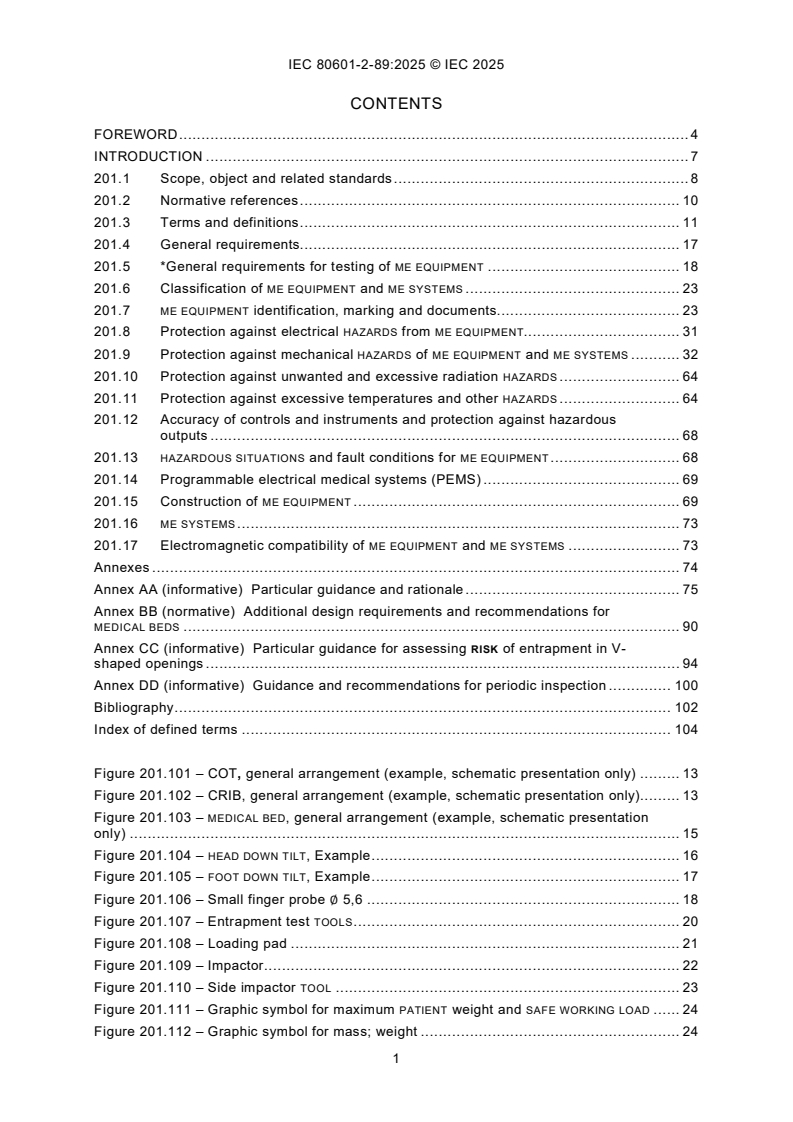
CONTENTS
FOREWORD . 4
INTRODUCTION . 7
201.1 Scope, object and related standards . 8
201.2 Normative references . 10
201.3 Terms and definitions . 11
201.4 General requirements. 17
201.5 *General requirements for testing of ME EQUIPMENT . 18
201.6 Classification of ME EQUIPMENT and ME SYSTEMS . 23
201.7 ME EQUIPMENT identification, marking and documents. 23
201.8 Protection against electrical HAZARDS from ME EQUIPMENT. 31
201.9 Protection against mechanical HAZARDS of ME EQUIPMENT and ME SYSTEMS . 32
201.10 Protection against unwanted and excessive radiation HAZARDS . 64
201.11 Protection against excessive temperatures and other HAZARDS . 64
201.12 Accuracy of controls and instruments and protection against hazardous
outputs . 68
201.13 HAZARDOUS SITUATIONS and fault conditions for ME EQUIPMENT . 68
201.14 Programmable electrical medical systems (PEMS) . 69
201.15 Construction of ME EQUIPMENT . 69
201.16 ME SYSTEMS . 73
201.17 Electromagnetic compatibility of ME EQUIPMENT and ME SYSTEMS . 73
Annexes . 74
Annex AA (informative) Particular guidance and rationale . 75
Annex BB (normative) Additional design requirements and recommendations for
MEDICAL BEDS . 90
Annex CC (informative) Particular guidance for assessing RISK of entrapment in V-
shaped openings . 94
Annex DD (informative) Guidance and recommendations for periodic inspection . 100
Bibliography . 102
Index of defined terms . 104
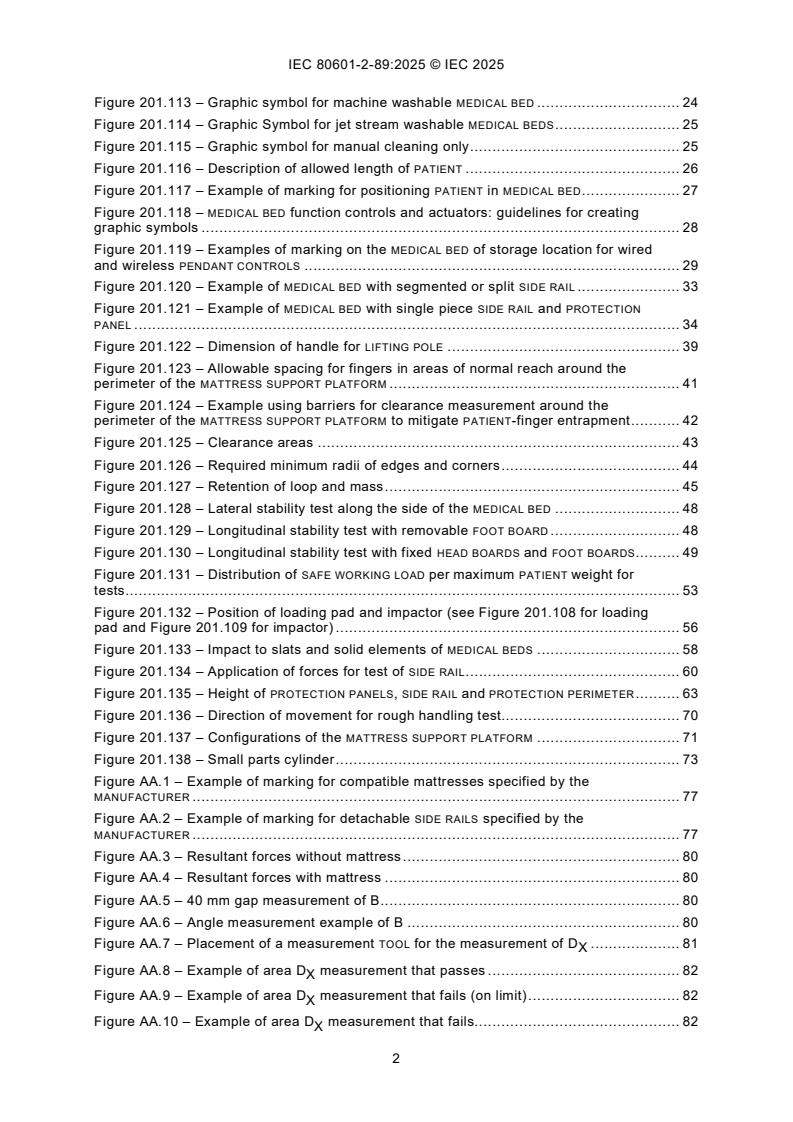
Figure 201.101 – COT, general arrangement (example, schematic presentation only) . 13
Figure 201.102 – CRIB, general arrangement (example, schematic presentation only). 13
Figure 201.103 – MEDICAL BED, general arrangement (example, schematic presentation
only) . 15
Figure 201.104 – HEAD DOWN TILT, Example . 16
Figure 201.105 – FOOT DOWN TILT, Example . 17
Figure 201.106 – Small finger probe ∅ 5,6 . 18
Figure 201.107 – Entrapment test TOOLS . 20
Figure 201.108 – Loading pad . 21
Figure 201.109 – Impactor . 22
Figure 201.110 – Side impactor TOOL . 23
Figure 201.111 – Graphic symbol for maximum PATIENT weight and SAFE WORKING LOAD . 24
Figure 201.112 – Graphic symbol for mass; weight . 24
Figure 201.113 – Graphic symbol for machine washable MEDICAL BED . 24
Figure 201.114 – Graphic Symbol for jet stream washable MEDICAL BEDS . 25
Figure 201.115 – Graphic symbol for manual cleaning only . 25
Figure 201.116 – Description of allowed length of PATIENT . 26
Figure 201.117 – Example of marking for positioning PATIENT in MEDICAL BED . 27
Figure 201.118 – MEDICAL BED function controls and actuators: guidelines for creating
graphic symbols . 28
Figure 201.119 – Examples of marking on the MEDICAL BED of storage location for wired
and wireless PENDANT CONTROLS . 29
Figure 201.120 – Example of MEDICAL BED with segmented or split SIDE RAIL . 33
Figure 201.121 – Example of MEDICAL BED with single piece SIDE RAIL and PROTECTION
PANEL . 34
Figure 201.122 – Dimension of handle for LIFTING POLE . 39
Figure 201.123 – Allowable spacing for fingers in areas of normal reach around the
perimeter of the MATTRESS SUPPORT PLATFORM . 41
Figure 201.124 – Example using barriers for clearance measurement around the
perimeter of the MATTRESS SUPPORT PLATFORM to mitigate PATIENT-finger entrapment . 42
Figure 201.125 – Clearance areas . 43
Figure 201.126 – Required minimum radii of edges and corners . 44
Figure 201.127 – Retention of loop and mass . 45
Figure 201.128 – Lateral stability test along the side of the MEDICAL BED . 48
Figure 201.129 – Longitudinal stability test with removable FOOT BOARD . 48
Figure 201.130 – Longitudinal stability test with fixed HEAD BOARDS and FOOT BOARDS . 49
Figure 201.131 – Distribution of SAFE WORKING LOAD per maximum PATIENT weight for
tests . 53
Figure 201.132 – Position of loading pad and impactor (see Figure 201.108 for loading
pad and Figure 201.109 for impactor) . 56
Figure 201.133 – Impact to slats and solid elements of MEDICAL BEDS . 58
Figure 201.134 – Application of forces for test of SIDE RAIL . 60
Figure 201.135 – Height of PROTECTION PANELS, SIDE RAIL and PROTECTION PERIMETER . 63
Figure 201.136 – Direction of movement for rough handling test. 70
Figure 201.137 – Configurations of the MATTRESS SUPPORT PLATFORM . 71
Figure 201.138 – Small parts cylinder . 73
Figure AA.1 – Example of marking for compatible mattresses specified by the
MANUFACTURER . 77
Figure AA.2 – Example of marking for detachable SIDE RAILS specified by the
MANUFACTURER . 77
Figure AA.3 – Resultant forces without mattress . 80
Figure AA.4 – Resultant forces with mattress . 80
Figure AA.5 – 40 mm gap measurement of B . 80
Figure AA.6 – Angle measurement example of B . 80
Figure AA.7 – Placement of a measurement TOOL for the measurement of D . 81
X
Figure AA.8 – Example of area D measurement that passes . 82
X
Figure AA.9 – Example of area D measurement that fails (on limit) . 82
X
Figure AA.10 – Example of area D measurement that fails. 82
X
Figure AA.11 – Example of potential PATIENT entrapment in area A within the SIDE RAIL. 83
Figure AA.12 – Example of potential PATIENT entrapment in area A below the SIDE RAIL . 83
Figure AA.13 – Example of potential PATIENT entrapment in area B . 83
Figure AA.14 – Example of potential PATIENT entrapment in area C between segmented
or split SIDE RAIL . 83
Figure AA.15 – Example of potential PATIENT entrapment in area C between SIDE RAIL
and HEAD BOARD . 83
Figure AA.16 – Example of potential PATIENT entrapment in area D . 83
Figure AA.17 – Example of potential PATIENT entrapment in area A below a single
piece SIDE RAIL . 84
Figure BB.1 – Schematic presentation of under MEDICAL BED clearance . 92
Figure BB.2 – Angles for different sections of the MATTRESS SUPPORT PLATFORM . 93
Figure CC.1 – Wedge TOOL. 95
Figure CC.2 – V-shaped opening in relation to B. 96
Figure CC.3 – Acceptance criteria in relation to area B . 96
Figure CC.4 – Positioning of wedge TOOL . 97
Figure CC.5 – Acceptance criteria in relation to area C between HEAD BOARD and FOOT
BOARD . 98
Figure CC.6 – Acceptance criteria in relation to area C between segmented or split
SIDE RAILS . 99
Table 201.101 – Protection against PATIENT entrapment . 35
Table 201.102 – Minimum SAFE WORKING LOADS . 52
Table 201.103 – Protection against inadvertent PATIENT falls and climbing out of
MEDICAL BED . 63
Table 201.104 – Allowable maximum temperatures for skin contact with MEDICAL BED
APPLIED PARTS . 64
Table 201.105 – Machine washable compliance PROCEDURE . 66
Table AA.1 – Protection against PATIENT entrapment in non-moving parts. 79
Table AA.2 – Height of protective barriers according to age . 88
INTERNATIONAL ELECTROTECHNICAL COMMISSION
____________
Medical electrical equipment -
Part 2-89: Particular requirements for the basic safety
and essential performance of medical beds for children
FOREWORD
1) The International Electrotechnical Commission (IEC) is a worldwide organization for standardization comprising
all national electrotechnical committees (IEC National Committees). The object of IEC is to promote international
co-operation on all questions concerning standardization in the electrical and electronic fields. To this end and
in addition to other activities, IEC publishes International Standards, Technical Specifications, Technical Reports,
Publicly Available Specifications (PAS) and Guides (hereafter referred to as "IEC Publication(s)"). Their
preparation is entrusted to technical committees; any IEC National Committee interested in the subject dealt with
may participate in this preparatory work. International, governmental and non-governmental organizations liaising
with the IEC also participate in this preparation. IEC collaborates closely with the International Organization for
Standardization (ISO) in accordance with conditions determined by agreement between the two organizations.
2) The formal decisions or agreements of IEC on technical matters express, as nearly as possible, an international
consensus of opinion on the relevant subjects since each technical committee has representation from all
interested IEC National Committees.
3) IEC Publications have the form of recommendations for international use and are accepted by IEC National
Committees in that sense. While all reasonable efforts are made to ensure that the technical content of IEC
Publications is accurate, IEC cannot be held responsible for the way in which they are used or for any
misinterpretation by any end user.
4) In order to promote international uniformity, IEC National Committees undertake to apply IEC Publications
transparently to the maximum extent possible in their national and regional publications. Any divergence between
any IEC Publication and the corresponding national or regional publication shall be clearly indicated in the latter.
5) IEC itself does not provide any attestation of conformity. Independent certification bodies provide conformity
assessment services and, in some areas, access to IEC marks of conformity. IEC is not responsible for any
services carried out by independent certification bodies.
6) All users should ensure that they have the latest edition of this publication.
7) No liability shall attach to IEC or its directors, employees, servants or agents including individual experts and
members of its technical committees and IEC National Committees for any personal injury, property damage or
other damage of any nature whatsoever, whether direct or indirect, or for costs (including legal fees) and
expenses arising out of the publication, use of, or reliance upon, this IEC Publication or any other IEC
Publications.
8) Attention is drawn to the Normative references cited in this publication. Use of the referenced publications is
indispensable for the correct application of this publication.
9) IEC draws attention to the possibility that the implementation of this document may involve the use of (a)
patent(s). IEC takes no position concerning the evidence, validity or applicability of any claimed patent rights in
respect thereof. As of the date of publication of this document, IEC had not received notice of (a) patent(s), which
may be required to implement this document. However, implementers are cautioned that this may not represent
the latest information, which may be obtained from the patent database available at https://patents.iec.ch. IEC
shall not be held responsible for identifying any or all such patent rights.
IEC 80601-2-89 has been prepared by a Joint Working Group of IEC subcommittee 62D:
Particular medical equipment, software, and systems, of IEC technical committee 62: Medical
equipment, software, and systems, and ISO technical committee 173: Assistive products. It is
an International Standard.
This publication is published as a double logo standard.
The text of this International Standard is based on the following documents of IEC:
Draft Report on voting
62D/2239/FDIS 62D/2272/RVD
Full information on the voting for its approval can be found in the report on voting indicated in
the above table. In ISO, the document was approved by XXX P members out of YYY having
cast a vote.
The language used for the development of this International Standard is English.
This document was drafted in accordance with ISO/IEC Directives, Part 2, and developed in
accordance with ISO/IEC Directives, Part 1 and ISO/IEC Directives, IEC Supplement, available
at www.iec.ch/members_experts/refdocs. The main document types developed by IEC are
described in greater detail at www.iec.ch/publications.
In this standard, the following print types are used:
– requirements and definitions: roman type;
– test specifications: italic type;
– informative material appearing outside of tables, such as notes, examples and references: in smaller type.
Normative text of tables is also in a smaller type;
– terms defined in clause 3 of IEC 60601-1:2005, IEC 60601-1:2005/AMD1:2012 AND
IEC 60601-1:2005/AMD2:2020, IN THIS DOCUMENT OR AS NOTED: SMALL CAPITALS.
In referring to the structure of this document, the term
– "clause" means one of the seventeen numbered divisions within the table of contents,
inclusive of all subdivisions (e.g. Clause 7 includes subclauses 7.1, 7.2, etc.);
– "subclause" means a numbered subdivision of a clause (e.g. 7.1, 7.2 and 7.2.1 are all
subclauses of Clause 7).
References to clauses within this document are preceded by the term "Clause" followed by the
clause number. References to subclauses within this document are by number only.
In this document, the conjunctive "or" is used as an "inclusive or" so a statement is true if any
combination of the conditions is true.
The verbal forms used in this document conform to usage described in Clause 7 of the ISO/IEC
Directives, Part 2. For the purposes of this document, the auxiliary verb:
– "shall" means that compliance with a requirement or a test is mandatory for compliance with
this document;
– "should" means that compliance with a requirement or a test is recommended but is not
mandatory for compliance with this document;
– "may" is used to describe a permissible way to achieve compliance with a requirement or
test.
An asterisk (*) as the first character of a title or at the beginning of a paragraph or table title
indicates that there is guidance or rationale related to that item in Annex AA.
A list of all parts of the IEC 80601 series, published under the general title Medical electrical
equipment, can be found on the IEC website.
The committee has decided that the contents of this document will remain unchanged until the
stability date indicated on the IEC website under webstore.iec.ch in the data related to the
specific document. At this date, the document will be
– reconfirmed,
– withdrawn, or
– revised.
INTRODUCTION
IEC 80601-2-52[1] applies to the BASIC SAFETY and ESSENTIAL PERFORMANCE of MEDICAL BEDS
for ADULTS, hence not covering requirement for beds for CHILDREN and ADULTS with atypical
anatomy. This particular standard is based on EN 50637[2], which was created pursuant to
Mandate M/467 Medical beds issued by the European Commission with the following
background information:
It appears, from a first analysis undertaken by EU Competent Authorities, that the current set
of standards is not adapted to the needs of CHILDREN or ADULTS with an atypical anatomy.
IEC 80601-2-52 does not foresee a maximum distance for the bars that is small enough to
prevent accidents.
According to the EU Competent Authorities' representatives, a part of the safety problem is due
to the fact that MEDICAL BEDS for ADULTS are not appropriately labelled as being designed only
for ADULTS with a normal anatomy. Users are therefore not always aware of the risk of MEDICAL
BEDS for young PATIENTS or for ADULTS with an atypical anatomy. Hospital administrations do
not always see a need to buy MEDICAL BEDS which are appropriate for CHILDREN or for ADULTS
with an atypical anatomy. Therefore, clear labelling of the targeted PATIENT groups for MEDICAL
BEDS complying with IEC 80601-2-52 could reduce the risk of inappropriate use of this kind of
MEDICAL BEDS for CHILDREN or for ADULTS with an atypical anatomy.
EU Competent Authorities' representatives also stated that there is a need for the development
of requirements for MEDICAL BEDS and COTS for CHILDREN and ADULTS with an atypical anatomy.
In order to prevent IEC 80601-2-52 from being extraordinarily complex to use, TC 62 decided
to develop this particular standard rather than further amending IEC 80601-2-52 in relation to
use for CHILDREN and ADULTS with an atypical anatomy.
This standard is based on EN 50637 and IEC 80601-2-52 with input from the following
standards and reports:
• EN 716-1, Furniture – V Children's cots and folding cots for domestic use – Part 1: Safety
requirements
• EN 716-2, Furniture – Children's cots and folding cots for domestic use – Part 2: Test
methods
• EN 1130, Furniture – Children's furniture – Cribs – Safety requirements and test methods
• EN 747-1, Furniture – Bunk beds and high beds – Part 1: Safety, strength and durability
requirements
• EN 747-2, Furniture – Bunk beds and high beds – Part 2: Test methods
• CEN/TR 13387 (all parts), Child use and care articles – General safety guidelines
• DIN 32623, Hospital children's cots made from metal and plastic – Safety requirements and
testing
• Nordic Requirements specification for Adjustable beds for disabled children
___________
Numbers in square brackets refer to the Bibliography.
201.1 Scope, object and related standards
IEC 60601-1:2005, IEC 60601-1:2005/AMD1:2012 and IEC 60601-1:2005/AMD2:2020,
Clause 1, applies, except as follows:
201.1.1 * Scope
Replacement:
This International Standard applies to the BASIC SAFETY and ESSENTIAL PERFORMANCE of MEDICAL
BEDS, hereafter referred to as MEDICAL BEDS as defined in 201.3.219, intended for CHILDREN as
defined in 201.3.207, and ADULTS with atypical anatomy (ADULTS ranging outside the definition
for ADULTS in 201.3.201).
This document applies to both electrical and non-electrical (manual) MEDICAL BEDS with or
without adjustable functions. This document applies to MEDICAL BEDS with an INTERNAL LENGTH
of up to 180 cm suitable to a body length of 155 cm.
NOTE 1 The limitation of 180 cm is in order to minimize the foreseeable misuse, of a parent sharing the bed with
the CHILD or that the bed will be used by an ADULT.
If a MANUFACTURER wishes to make a MEDICAL BED that can be used by both a CHILD and an
ADULT, e.g. INTERNAL LENGTH of 180 cm or more, then IEC 80601-2-52 and this document apply.
This document does not apply to:
• ADULT only MEDICAL BEDS covered by IEC 80601-2-52;
• SPECIALITY MATTRESS covered by the ISO 20342 series[5];
• incubators covered by IEC 60601-2-19;
• devices for which the INTENDED USE is mainly for examination or transportation under
medical supervision (e.g. stretcher, examination table).
If a clause or subclause is specifically intended to be applicable to a MEDICAL BED only, or to ME
SYSTEMS only, the title and content of that clause or subclause will say so. If that is not the case,
the clause or subclause applies both to MEDICAL BEDS and to ME SYSTEMS, as relevant.
HAZARDS inherent in the intended physiological function of MEDICAL BEDS or ME SYSTEMS within
the scope of this document are not covered by specific requirements in this document except
in IEC 60601-1:2005, IEC 60601-1:2005/AMD1:2012 and IEC 60601-1:2005/AMD2:2020,
7.2.13 and 8.4.1.
NOTE 2 See also IEC 60601-1:2005, IEC 60601-1:2005/AMD1:2012 and IEC 60601-1:2005/AMD2:2020, 4.2.
NOTE 3 Whenever the term MEDICAL ELECTRICAL EQUIPMENT (MEE, ME Equipment) is used within the series
of IEC 60601 standards, it refers to MEDICAL BEDS, both electrical and non-electrical.
201.1.2 Object
Replacement:
The object of this document is to establish particular BASIC SAFETY and ESSENTIAL PERFORMANCE
requirements and test methods for MEDICAL BEDS as defined in 201.3.219 intended for CHILDREN
as defined in 201.3.207 and ADULTS with atypical anatomy, i.e. ADULTS ranging outside the
definition for ADULTS in 202.3.201.
201.1.3 Collateral standards
Addition:
This document refers to those applicable collateral standards that are listed in Clause 2 of
IEC 60601-1:2005, IEC 60601-1:2005/AMD1:2012 and IEC 60601-1:2005/AMD2:2020 and
Clause 201.2 of this document.
IEC 60601-1-3 and IEC 60601-1-10 do not apply. All other published collateral standards in the
IEC 60601-1 series apply as published.
NOTE Some IEC 60601-1-8 requirements can be excluded if they do not affect PATIENT safety, could lead to user
confusion, or are inappropriate to MEDICAL BED usage.
201.1.4 Particular standards
Replacement:
In the IEC 60601 series, particular standards may modify, replace or delete requirements
contained in IEC 60601-1:2005, IEC 60601-1:2005/AMD1:2012 and
IEC 60601-1:2005/AMD2:2020, including the collateral standards as appropriate for the
particular ME EQUIPMENT under consideration, and may add other BASIC SAFETY and ESSENTIAL
PERFORMANCe requirements.
Requirements of this document takes priority over IEC 60601-1:2005,
IEC 60601-1:2005/AMD1:2012 and IEC 60601-1:2005/AMD2:2020.
The numbering of clauses and subclauses of this particular standard corresponds to that of
IEC 60601-1:2005, IEC 60601-1:2005/AMD1:2012 and IEC 60601-1:2005/AMD2:2020 with the
prefix "201" (e.g. 201.1 in this document addresses the content of Clause 1 of
IEC 60601-1:2005, IEC 60601-1:2005/AMD1:2012 and IEC 60601-1:2005/AMD2:2020) or
applicable collateral standard with the prefix "20x" where x is the final digit(s) of the collateral
standard document number (e.g. 202.4 in this document addresses the content of Clause 4 of
the IEC 60601-1-2:2015 collateral standard, 203.4 in this document addresses the content of
Clause 4 of the IEC 60601-1-3:2008 collateral standard, etc.). The changes to the text of
IEC 60601-1:2005, IEC 60601-1:2005/AMD1:2012 and IEC 60601-1:2005/AMD2:2020 are
specified by the use of the following words:
"Replacement" means that the clause or subclause of IEC 60601-1:2005,
IEC 60601-1:2005/AMD1:2012 and IEC 60601-1:2005/AMD2:2020 or applicable collateral
standard is replaced completely by the text of this document.
"Addition" means that the text of this document is additional to the requirements of
IEC 60601-1:2005, IEC 60601-1:2005/AMD1:2012 and IEC 60601-1:2005/AMD2:2020 or
applicable collateral standard.
"Amendment" means that the clause or subclause of IEC 60601-1:2005,
IEC 60601-1:2005/AMD1:2012 and IEC 60601-1:2005/AMD2:2020 or applicable collateral
standard is amended as indicated by the text of this document.
Subclauses, figures or tables which are additional to those of IEC 60601-1:2005,
IEC 60601-1:2005/AMD1:2012 and IEC 60601-1:2005/AMD2:2020 are numbered starting from
201.101. However, due to the fact that definitions in IEC 60601-1:2005,
IEC 60601-1:2005/AMD1:2012 and IEC 60601-1:2005/AMD2:2020 are numbered 3.1 through
3.154, additional definitions in this document are numbered beginning from 201.3.201.
Additional annexes are lettered AA, BB, etc., and additional items aa), bb), etc.
Subclauses, figures or tables which are additional to those of a collateral standard are
numbered starting from 20x, where "x" is the number of the collateral standard, e.g. 202 for
IEC 60601-1-2, 203 for IEC 60601-1-3, etc.
Where there is no corresponding clause or subclause in this particular standard, the clause or
subclause of IEC 60601-1:2005, IEC 60601-1:2005/AMD1:2012 and
IEC 60601-1:2005/AMD2:2020 or applicable collateral standard, although possibly not relevant,
applies without modification; where it is intended that any part of IEC 60601-1:2005,
IEC 60601-1:2005/AMD1:2012 and IEC 60601-1:2005/AMD2:2020 or applicable collateral
standard, although possibly relevant, is not to be applied, a statement to that effect is given in
this document.
201.2 Normative references
The following documents are referred to in the text in such a way that some or all of their content
constitutes requirements of this document. For dated references, only the edition cited applies.
For undated references, the latest edition of the referenced document (including any
amendments) applies.
NOTE Informative references are listed in the Bibliography.
IEC 60601-1:2005, IEC 60601-1:2005/AMD1:2012 and IEC 60601-1:2005/AMD2:2020,
Clause 2, applies except as follows:
Addition:
IEC 60529, Degrees of protection provided by enclosures (IP Code)
IEC 60601-1:2005, Medical electrical equipment - Part 1: General requirements for basic
safety and essential performance
IEC 60601-1:2005/AMD1:2012
IEC 60601-1:2005/AMD2:2020
ISO 48-5:2018, Rubber, vulcanized or thermoplastic - Determination of hardness - Part 5:
Indentation hardness by IRHD pocket meter method
ISO 3746, Acoustics - Determination of sound power levels of noise sources using sound
pressure - Survey method using an enveloping measurement surface over a reflecting plane
EN 71-3, Safety of toys - Part 3: Migration of certain elements
EN 597-1, Furniture - Assessment of the ignitability of mattresses and upholstered bed bases -
Part 1: Ignition source : Smouldering cigarette
EN 597-2, Furniture - Assessment of the ignitability of mattresses and upholstered bed bases -
Part 2: Ignition source: Match flame equivalent
EN 716-2, Furniture - Children's cots and folding cots for domestic use - Part 2: Test methods
201.3 Terms and definitions
For the purposes of this document, the terms and definitions given in IEC 60601-1:2005,
IEC 60601-1:2005/AMD1:2012 and IEC 60601-1:2005/AMD2:2020, and the following apply.
ISO and IEC maintain terminology databases for use in standardization at the following
addresses:
– IEC Electropedia: available at https://www.electropedia.org/
– ISO Online browsing platform: available at https://www.iso.org/obp
NOTE An index of defined terms is given after the Bibliography.
201.3.76
PATIENT
Replacement:
living person undergoing a medical PROCEDURE or PERSON WITH DISABILITY
Note 1 to entry: Whenever the term PATIENT is used, it comprises both ADULTS with an atypical anatomy and
CHILDREN.
201.3.109
SAFE WORKING LOAD
SWL
Replacement:
sum of:
1) the PATIENT;
2) the mattress;
3) the ACCESSORIES of the MEDICAL BED, only if they are supported by the support system of the
MEDICAL BED; and
4) the SAFE WORKING LOADS supported by those ACCESSORIES, excluding PATIENT weight
201.3.131
* TRAPPING ZONE
Replacement:
locations where the PATIENT or other persons can become entrapped, entangled, wedged, or
stuck in or between parts of the MEDICAL BED, such as the SIDE RAILS, HEAD/FOOT BOARD,
MATTRESS SUPPORT PLATFORM or mattress
Additional terms and definitions:
201.3.201
ADULT
PATIENT having a physical size equal to or more than 146 cm, a mass equal to or more than 40
kg and a body mass index (BMI) equal to or more than 17
201.3.202
APPLICATION ENVIRONMENT 1
*
intensive care or critical care provided in a hospital where 24 h medical supervision and
constant monitoring is required and provision of life support equipment used in medical
PROCEDURES is essential to maintain or improve the vital functions of the PATIENT
201.3.203
* APPLICATION ENVIRONMENT 2
acute care provided in a hospital or other medical facility where medical supervision and
monitoring is required and MEDICAL BED used in medical PROCEDURES is often provided to help
maintain or improve the condition of the PATIENT
201.3.204
* APPLICATION ENVIRONMENT 3
long-term care in a medical area where medical supervision is required and monitoring is
provided if necessary and MEDICAL BED used in medical PROCEDURES may be provided to help
maintain or improve the condition of the PATIENT
Note 1 to entry: This includes use in CHILDREN'S nursing homes and in rehabilitation facilities.
201.3.205
* APPLICATION ENVIRONMENT 4
care provided in a domestic area where MEDICAL BED is used to alleviate or compensate for an
injury, disability or disease
Note 1 to entry: This excludes use in all other application environments (e.g. CHILDREN'S nursing homes and
rehabilitation facilities) when a MEDICAL BED is purely designed for APPLICATION ENVIRONMENT 4.
201.3.206
* APPLICATION ENVIRONMENT 5
outpatient care or ambulatory care, which is provided in a hospital or other medical facility,
under medical supervision where MEDICAL BED, is provided for the need of persons with illness,
injury or disability for treatment, diagnosis or monitoring
201.3.207
CHILD
PATIENT having a body length equal to or less than 155 cm and a mass equal to or less than
70 kg and may display cognitive immaturity, exploratory behaviours, risk taking tendencies or
any combination.
Note 1 to entry: Body length is measured from crown to sole.
201.3.208
COT
MEDICAL BED with an INTERNAL LENGTH ≥90 cm and <140 cm provided with PROTECTION PANELS
also intended for CHILDREN able to stand up in bed
Note 1 to entry: See Figure 201.101.
Figure 201.101 – COT, general arrangement
(example, schematic presentation only)
201.3.209
CRIB
MEDICAL BED with an INTERNAL LENGTH <90 cm provided with PROTECTION PERIMETER, intended
for CHILDREN until they are able to sit, kneel or to pull themselves up
Note 1 to entry: See Figure 201.102.
Note 2 to entry: Excluded are MEDICAL BEDS with a swinging or rocking function.
Dimensions in millimetres
Figure 201.102 – CRIB, general arrangement
(example, schematic presentation only)
201.3.210
PERSON WITH DISABILITY
person with one or more impairments, one or more activity limitations, one or more participation
restrictions or a combination thereof
[SOURCE: ISO 9999:2022, 3.10]
201.3.211
HEAD OR FOOT BOARD
assembly mounted to MEDICAL BED, which identifies for the PATIENT the edge of the head or foot
end of the MEDICAL BED or MATTRESS SUPPORT PLATFORM
Note 1 to entry: It can be used as handles to push a MEDICAL BED intended to transport PATIENTS.
201.3.212
INTERNAL LENGTH
length of MATTRESS SUPPORT PLATFORM measured from inside bed HEAD BOARD to FOOT BOARD.
201.3.213
JUNIOR BED
MEDICAL BED with an INTERNAL LENGTH ≥140 cm and <180 cm
201.3.214
LIFTING POLE
ACCESSORY attached to a MEDICAL BED and intended to assist support of a PATIENT when
changing position by providing a gripping support above the PATIENT
201.3.215
LOCKING DEVICE
mechanism intended to maintain the MEDICAL BED or parts of it in its locked position
201.3.216
LOCKING SYSTEM
mechanism consisting of a LOCKING DEVICE and one or more operating devices, which can
deactivate the LOCKING DEVICE, e.g. by pushing a button, pressing a lever or turning a knob
201.3.217
MATTRESS OVERLAY
supplementary mattress, which is intended to be placed on an existing mattress, and generally
used for prophylactic or therapeutic effect
201.3.218
MATTRESS SUPPORT PLATFORM
structure which supports a PATIENT surface
EXAMPLE Mattress.
Note 1 to entry: The platform can articulate or change positions to facilitate various therapeutic, diagnostic and
convenience positions. See Figure 201.103, Subfigures a) to d) of Figure 201.137 and Figure BB.2.
Key
1 HEAD BOARD
2 Back section
3 Seat section
4 Upper leg section
5 Lower leg section
6 FOOT BOARD
Figure 201.103 – MEDICAL BED, general arrangement
(example, schematic presentation only)
201.3.219
* MEDICAL BED
device for which the INTENDED USE is sleeping, resting or both that contains a MATTRESS SUPPORT
PLATFORM and intended to assist in diagnosis, monitoring, prevention, treatment, alleviation of
disease or compensation for an injury or disability
Note 1 to entry: Whenever the term MEDICAL BED is used, it comprises CRIBS, COTS AND JUNIOR BEDS.
201.3.220
MOTION LOCKOUT CONTROL
auxiliary subsystem that deactivates motion controls
201.3.221
OVERSIZE COT
COT with an INTERNAL LENGTH ≥140 cm and <180 cm provided with PROTECTION PANELS also
intended for CHILDREN able to stand up in bed
201.3.222
PENDANT CONTROL
hand-held device, which has a FUNCTIONAL CONNECTION to the MEDICAL BED, controlling at least
MEDICAL BED articulations, movements or both
Note 1 to entry: PENDANT CONTROLS can be wired or wireless, and can integrate other functions such as
communications, radio, TV, etc.
201.3.223
PROTECTION PERIMETER
fully enclosed solid physical barrier e.g. bowl or basin, which is integral to the overall
construction of a MEDICAL BED, which will prevent the PATIENT from falling out of bed and which
can be movable, e.g. sliding sides, drop sides, folding sides
Note 1 to entry: Wherever a solid physical barrier is used, there can be a RISK of suffocation caused by lack of
oxygen.
201.3.224
PROTECTION PANEL
physical barrier, which shall be integral to the overall construction of a MEDICAL BED and is
positioned to the side(s) and ends of the MEDICAL BED to prevent the PATIENT from getting out of
bed unaided, and which can be movable, e.g. sliding sides, drop sides, folding sides
Note 1 to entry: Whenever the t
...
FINAL DRAFT
International
Standard
IEC/FDIS
80601-2-89
ISO/TC 173
Medical electrical equipment —
Secretariat: SIS
Part 2-89:
Voting begins on:
2025-07-07
Particular requirements for
the basic safety and essential
Voting terminates on:
2025-09-01
performance of medical beds for
children
RECIPIENTS OF THIS DRAFT ARE INVITED TO SUBMIT,
WITH THEIR COMMENTS, NOTIFICATION OF ANY
RELEVANT PATENT RIGHTS OF WHICH THEY ARE AWARE
AND TO PROVIDE SUPPOR TING DOCUMENTATION.
IN ADDITION TO THEIR EVALUATION AS
BEING ACCEPTABLE FOR INDUSTRIAL, TECHNO-
LOGICAL, COMMERCIAL AND USER PURPOSES, DRAFT
This draft is submitted to a parallel vote in ISO and in IEC.
INTERNATIONAL STANDARDS MAY ON OCCASION HAVE
TO BE CONSIDERED IN THE LIGHT OF THEIR POTENTIAL
TO BECOME STAN DARDS TO WHICH REFERENCE MAY BE
MADE IN NATIONAL REGULATIONS.
Reference number
IEC/FDIS 80601-2-89:2025(en) © IEC 2025
FINAL DRAFT
IEC/FDIS 80601-2-89:2025(en)
International
Standard
IEC/FDIS
80601-2-89
ISO/TC 173
Medical electrical equipment —
Secretariat: SIS
Part 2-89:
Voting begins on:
Particular requirements for 2025-07-07
the basic safety and essential
Voting terminates on:
2025-09-01
performance of medical beds for
children
RECIPIENTS OF THIS DRAFT ARE INVITED TO SUBMIT,
WITH THEIR COMMENTS, NOTIFICATION OF ANY
RELEVANT PATENT RIGHTS OF WHICH THEY ARE AWARE
AND TO PROVIDE SUPPOR TING DOCUMENTATION.
© ISO 2025
IN ADDITION TO THEIR EVALUATION AS
All rights reserved. Unless otherwise specified, or required in the context of its implementation, no part of this publication may
BEING ACCEPTABLE FOR INDUSTRIAL, TECHNO-
LOGICAL, COMMERCIAL AND USER PURPOSES, DRAFT
be reproduced or utilized otherwise in any form or by any means, electronic or mechanical, including photocopying, or posting on
This draft is submitted to a parallel vote in ISO and in IEC.
INTERNATIONAL STANDARDS MAY ON OCCASION HAVE
the internet or an intranet, without prior written permission. Permission can be requested from either ISO at the address below
TO BE CONSIDERED IN THE LIGHT OF THEIR POTENTIAL
or ISO’s member body in the country of the requester.
TO BECOME STAN DARDS TO WHICH REFERENCE MAY BE
MADE IN NATIONAL REGULATIONS.
ISO copyright office
CP 401 • Ch. de Blandonnet 8
CH-1214 Vernier, Geneva
Phone: +41 22 749 01 11
Email: copyright@iso.org
Website: www.iso.org
Published in Switzerland Reference number
IEC/FDIS 80601-2-89:2025(en) © IEC 2025
© IEC 2025 – All rights reserved
ii
IEC FDIS 80601-2-89 © IEC 2025
CONTENTS
FOREWORD . 4
INTRODUCTION . 6
201.1 Scope, object and related standards . 7
201.2 Normative references . 9
201.3 Terms and definitions. 10
201.4 General requirements . 16
201.5 *General requirements for testing of ME EQUIPMENT . 17
201.6 Classification of ME EQUIPMENT and ME SYSTEMS . 22
201.7 ME EQUIPMENT identification, marking and documents . 22
201.8 Protection against electrical HAZARDS from ME EQUIPMENT . 30
201.9 Protection against mechanical HAZARDS of ME EQUIPMENT and ME SYSTEMS . 31
201.10 Protection against unwanted and excessive radiation HAZARDS . 63
201.11 Protection against excessive temperatures and other HAZARDS . 63
201.12 Accuracy of controls and instruments and protection against hazardous
outputs . 66
201.13 HAZARDOUS SITUATIONS and fault conditions for ME EQUIPMENT . 67
201.14 Programmable electrical medical systems (PEMS) . 68
201.15 Construction of ME EQUIPMENT . 68
201.16 ME SYSTEMS . 72
201.17 Electromagnetic compatibility of ME EQUIPMENT and ME SYSTEMS . 72
Annexes . 73
Annex AA (informative) Particular guidance and rationale . 74
Annex BB (normative) Additional design requirements and recommendations for
MEDICAL BEDS . 89
Annex CC (informative) Particular guidance for assessing RISK of entrapment in V-
shaped openings . 93
Annex DD (informative) Guidance and recommendations for periodic inspection . 99
Bibliography . 101
Index of defined terms . 103
Figure 201.101 – COT, general arrangement (example, schematic presentation only) . 12
Figure 201.102 – CRIB, general arrangement (example, schematic presentation only) . 12
Figure 201.103 – MEDICAL BED, general arrangement (example, schematic presentation
only) . 14
Figure 201.104 – HEAD DOWN TILT, Example . 15
Figure 201.105 – FOOT DOWN TILT, Example . 16
Figure 201.106 – Small finger probe ∅ 5,6 . 17
Figure 201.107 – Entrapment test TOOLS . 19
Figure 201.108 – Loading pad . 20
Figure 201.109 – Impactor . 21
Figure 201.110 – Side impactor TOOL . 22
Figure 201.111 – Graphic symbol for maximum PATIENT weight and SAFE WORKING LOAD . 23
IEC FDIS 80601-2-89 © IEC 2025
Figure 201.112 – Graphic symbol for mass; weight . 23
Figure 201.113 – Graphic symbol for machine washable MEDICAL BED . 23
Figure 201.114 – Graphic Symbol for jet stream washable MEDICAL BEDS . 24
Figure 201.115 – Graphic symbol for manual cleaning only . 24
Figure 201.116 – Description of allowed length of PATIENT . 25
Figure 201.117 – Example of marking for positioning PATIENT in MEDICAL BED . 26
Figure 201.118 – MEDICAL BED function controls and actuators: guidelines for creating
graphic symbols . 27
Figure 201.119 – Examples of marking on the MEDICAL BED of storage location for wired
and wireless PENDANT CONTROLS . 28
Figure 201.120 – Example of MEDICAL BED with segmented or split SIDE RAIL . 32
Figure 201.121 – Example of MEDICAL BED with single piece SIDE RAIL and PROTECTION
PANEL . 33
Figure 201.122 – Dimension of handle for LIFTING POLE . 38
Figure 201.123 – Allowable spacing for fingers in areas of normal reach around the
perimeter of the MATTRESS SUPPORT PLATFORM . 40
Figure 201.124 – Example using barriers for clearance measurement around the
perimeter of the MATTRESS SUPPORT PLATFORM to mitigate PATIENT-finger entrapment . 41
Figure 201.125 – Clearance areas . 42
Figure 201.126 – Required minimum radii of edges and corners . 43
Figure 201.127 – Retention of loop and mass . 44
Figure 201.128 – Lateral stability test along the side of the MEDICAL BED . 47
Figure 201.129 – Longitudinal stability test with removable FOOT BOARD . 47
Figure 201.130 – Longitudinal stability test with fixed HEAD BOARDS and FOOT BOARDS . 48
Figure 201.131 – Distribution of SAFE WORKING LOAD per maximum PATIENT weight for
tests . 52
Figure 201.132 – Position of loading pad and impactor (see Figure 201.108 for loading
pad and Figure 201.109 for impactor) . 55
Figure 201.133 – Impact to slats and solid elements of MEDICAL BEDS . 57
Figure 201.134 – Application of forces for test of SIDE RAIL. 59
Figure 201.135 – Height of PROTECTION PANELS, SIDE RAIL and PROTECTION PERIMETER . 62
Figure 201.136 – Direction of movement for rough handling test . 69
Figure 201.137 – Configurations of the MATTRESS SUPPORT PLATFORM . 70
Figure 201.138 – Small parts cylinder . 72
Figure AA.1 – Example of marking for compatible mattresses specified by the
MANUFACTURER . 76
Figure AA.2 – Example of marking for detachable SIDE RAILS specified by the
MANUFACTURER . 76
Figure AA.3 – Resultant forces without mattress . 79
Figure AA.4 – Resultant forces with mattress . 79
Figure AA.5 – 40 mm gap measurement of B . 79
Figure AA.6 – Angle measurement example of B . 79
Figure AA.7 – Placement of a measurement TOOL for the measurement of D . 80
X
Figure AA.8 – Example of area D measurement that passes . 81
X
Figure AA.9 – Example of area D measurement that fails (on limit) . 81
X
IEC FDIS 80601-2-89 © IEC 2025
Figure AA.10 – Example of area D measurement that fails . 81
X
Figure AA.11 – Example of potential PATIENT entrapment in area A within the SIDE RAIL . 82
Figure AA.12 – Example of potential PATIENT entrapment in area A below the SIDE RAIL . 82
Figure AA.13 – Example of potential PATIENT entrapment in area B . 82
Figure AA.14 – Example of potential PATIENT entrapment in area C between split
SIDE RAIL . 82
Figure AA.15 – Example of potential PATIENT entrapment in area C between SIDE RAIL
and HEAD BOARD . 82
Figure AA.16 – Example of potential PATIENT entrapment in area D . 82
Figure AA.17 – Example of potential PATIENT entrapment in area A below a single
piece SIDE RAIL . 83
Figure BB.1 – Schematic presentation of under MEDICAL BED clearance. 91
Figure BB.2 – Recommendations and requirements regarding angles for different
sections of the mattress support platform . 92
Figure CC.1 – Wedge TOOL . 94
Figure CC.2 – V-shaped opening in relation to B. 95
Figure CC.3 – Acceptance criteria in relation to area B . 95
Figure CC.4 – Positioning of wedge TOOL. 96
Figure CC.5 – Acceptance criteria in relation to area C between HEAD BOARD and FOOT
BOARD . 97
Figure CC.6 – Acceptance criteria in relation to area C between split SIDE RAILS . 98
Table 201.101 – Protection against PATIENT entrapment . 34
Table 201.102 – Minimum SAFE WORKING LOADS . 51
Table 201.103 – Protection against inadvertent PATIENT falls and climbing out of
MEDICAL BED . 62
Table 201.104 – Allowable maximum temperatures for skin contact with MEDICAL BED
APPLIED PARTS . 63
Table 201.105 – Machine washable compliance PROCEDURE . 65
Table AA.1 – Protection against PATIENT entrapment in non-moving parts . 78
Table AA.2 – Height of protective barriers according to age . 87
IEC FDIS 80601-2-89 © IEC 2025
INTERNATIONAL ELECTROTECHNICAL COMMISSION
____________
Medical electrical equipment -
Part 2-89: Particular requirements for the basic safety
and essential performance of medical beds for children
FOREWORD
1) The International Electrotechnical Commission (IEC) is a worldwide organization for standardization comprising
all national electrotechnical committees (IEC National Committees). The object of IEC is to promote international
co-operation on all questions concerning standardization in the electrical and electronic fields. To this end and
in addition to other activities, IEC publishes International Standards, Technical Specifications, Technical Reports,
Publicly Available Specifications (PAS) and Guides (hereafter referred to as "IEC Publication(s)"). Their
preparation is entrusted to technical committees; any IEC National Committee interested in the subject dealt with
may participate in this preparatory work. International, governmental and non-governmental organizations liaising
with the IEC also participate in this preparation. IEC collaborates closely with the International Organization for
Standardization (ISO) in accordance with conditions determined by agreement between the two organizations.
2) The formal decisions or agreements of IEC on technical matters express, as nearly as possible, an international
consensus of opinion on the relevant subjects since each technical committee has representation from all
interested IEC National Committees.
3) IEC Publications have the form of recommendations for international use and are accepted by IEC National
Committees in that sense. While all reasonable efforts are made to ensure that the technical content of IEC
Publications is accurate, IEC cannot be held responsible for the way in which they are used or for any
misinterpretation by any end user.
4) In order to promote international uniformity, IEC National Committees undertake to apply IEC Publications
transparently to the maximum extent possible in their national and regional publications. Any divergence between
any IEC Publication and the corresponding national or regional publication shall be clearly indicated in the latter.
5) IEC itself does not provide any attestation of conformity. Independent certification bodies provide conformity
assessment services and, in some areas, access to IEC marks of conformity. IEC is not responsible for any
services carried out by independent certification bodies.
6) All users should ensure that they have the latest edition of this publication.
7) No liability shall attach to IEC or its directors, employees, servants or agents including individual experts and
members of its technical committees and IEC National Committees for any personal injury, property damage or
other damage of any nature whatsoever, whether direct or indirect, or for costs (including legal fees) and
expenses arising out of the publication, use of, or reliance upon, this IEC Publication or any other IEC
Publications.
8) Attention is drawn to the Normative references cited in this publication. Use of the referenced publications is
indispensable for the correct application of this publication.
9) IEC draws attention to the possibility that the implementation of this document may involve the use of (a)
patent(s). IEC takes no position concerning the evidence, validity or applicability of any claimed patent rights in
respect thereof. As of the date of publication of this document, IEC had not received notice of (a) patent(s), which
may be required to implement this document. However, implementers are cautioned that this may not represent
the latest information, which may be obtained from the patent database available at https://patents.iec.ch. IEC
shall not be held responsible for identifying any or all such patent rights.
IEC 80601-2-89 has been prepared by a Joint Working Group of IEC subcommittee 62D:
Particular medical equipment, software, and systems, of IEC technical committee 62: Medical
equipment, software, and systems, and ISO technical committee 173: Assistive products. It is
an International Standard.
This publication is published as a double logo standard.
The text of this International Standard is based on the following documents of IEC:
Draft Report on voting
62D/XX/FDIS 62D/XX/RVD
Full information on the voting for its approval can be found in the report on voting indicated in
the above table. In ISO, the document was approved by XXX P members out of YYY having
cast a vote.
IEC FDIS 80601-2-89 © IEC 2025
The language used for the development of this International Standard is English.
This document was drafted in accordance with ISO/IEC Directives, Part 2, and developed in
accordance with ISO/IEC Directives, Part 1 and ISO/IEC Directives, IEC Supplement, available
at www.iec.ch/members_experts/refdocs. The main document types developed by IEC are
described in greater detail at www.iec.ch/publications.
In this standard, the following print types are used:
– requirements and definitions: roman type;
– test specifications: italic type;
– informative material appearing outside of tables, such as notes, examples and references: in smaller type.
Normative text of tables is also in a smaller type;
– terms defined in clause 3 of IEC 60601-1:2005, IEC 60601-1:2005/AMD1:2012 AND
IEC 60601-1:2005/AMD2:2020, IN THIS DOCUMENT OR AS NOTED: SMALL CAPITALS.
In referring to the structure of this document, the term
– "clause" means one of the seventeen numbered divisions within the table of contents,
inclusive of all subdivisions (e.g. Clause 7 includes subclauses 7.1, 7.2, etc.);
– "subclause" means a numbered subdivision of a clause (e.g. 7.1, 7.2 and 7.2.1 are all
subclauses of Clause 7).
References to clauses within this document are preceded by the term "Clause" followed by the
clause number. References to subclauses within this document are by number only.
In this document, the conjunctive "or" is used as an "inclusive or" so a statement is true if any
combination of the conditions is true.
The verbal forms used in this document conform to usage described in Clause 7 of the ISO/IEC
Directives, Part 2. For the purposes of this document, the auxiliary verb:
– "shall" means that compliance with a requirement or a test is mandatory for compliance with
this document;
– "should" means that compliance with a requirement or a test is recommended but is not
mandatory for compliance with this document;
– "may" is used to describe a permissible way to achieve compliance with a requirement or
test.
An asterisk (*) as the first character of a title or at the beginning of a paragraph or table title
indicates that there is guidance or rationale related to that item in Annex AA.
A list of all parts of the IEC 80601 series, published under the general title Medical electrical
equipment, can be found on the IEC website.
The committee has decided that the contents of this document will remain unchanged until the
stability date indicated on the IEC website under webstore.iec.ch in the data related to the
specific document. At this date, the document will be
• reconfirmed,
• withdrawn, or
• revised.
IEC FDIS 80601-2-89 © IEC 2025
INTRODUCTION
IEC 80601-2-52[1] applies to the BASIC SAFETY and ESSENTIAL PERFORMANCE of MEDICAL BEDS
for ADULTS, hence not covering requirement for beds for CHILDREN and ADULTS with atypical
anatomy. This particular standard is based on EN 50637[2], which was created pursuant to
Mandate M/467 Medical beds issued by the European Commission with the following
background information:
It appears, from a first analysis undertaken by EU Competent Authorities, that the current set
of standards is not adapted to the needs of CHILDREN or ADULTS with an atypical anatomy.
IEC 80601-2-52 does not foresee a maximum distance for the bars that is small enough to
prevent accidents.
According to the EU Competent Authorities' representatives, a part of the safety problem is due
to the fact that MEDICAL BEDS for ADULTS are not appropriately labelled as being designed only
for ADULTS with a normal anatomy. Users are therefore not always aware of the risk of MEDICAL
BEDS for young PATIENTS or for ADULTS with an atypical anatomy. Hospital administrations do
not always see a need to buy MEDICAL BEDS which are appropriate for CHILDREN or for ADULTS
with an atypical anatomy. Therefore, clear labelling of the targeted PATIENT groups for MEDICAL
BEDS complying with IEC 80601-2-52 could reduce the risk of inappropriate use of this kind of
MEDICAL BEDS for CHILDREN or for ADULTS with an atypical anatomy.
EU Competent Authorities' representatives also stated that there is a need for the development
of requirements for MEDICAL BEDS and COTS for CHILDREN and ADULTS with an atypical anatomy.
In order to prevent IEC 80601-2-52 from being extraordinarily complex to use, TC 62 decided
to develop this particular standard rather than further amending IEC 80601-2-52 in relation to
use for CHILDREN and ADULTS with an atypical anatomy.
This standard is based on EN 50637 and IEC 80601-2-52 with input from the following
standards and reports:
• EN 716-1, Furniture – V Children's cots and folding cots for dom estic use – Part 1: Safety
requirements
• EN 716-2, Furniture – Children's cots and folding cots for domestic use – Part 2: Test
methods
• EN 1130, Furniture – Children's furniture – Cribs – Safety requirements and test methods
• EN 747-1, Furniture – Bunk beds and high beds – Part 1: Safety, strength and durability
requirements
• EN 747-2, Furniture – Bunk beds and high beds – Part 2: Test methods
• CEN/TR 13387 (all parts), Child use and care articles – General safety guidelines
• DIN 32623, Hospital children's cots made from metal and plastic – Safety requirements and
testing
• Nordic Requirements specification for Adjustable beds for disabled children
___________
Numbers in square brackets refer to the Bibliography.
IEC FDIS 80601-2-89 © IEC 2025
201.1 Scope, object and related standards
IEC 60601-1:2005, IEC 60601-1:2005/AMD1:2012 and IEC 60601-1:2005/AMD2:2020,
Clause 1, applies, except as follows:
201.1.1 * Scope
Replacement:
This International Standard applies to the BASIC SAFETY and ESSENTIAL PERFORMANCE of MEDICAL
BEDS, hereafter referred to as MEDICAL BEDS as defined in 201.3.219, intended for CHILDREN as
defined in 201.3.207, and ADULTS with atypical anatomy (ADULTS ranging outside the definition
for ADULTS in 201.3.201).
This document applies to both electrical and non-electrical(manual) MEDICAL BEDS with or
without adjustable functions. This document applies to MEDICAL BEDS with an INTERNAL LENGTH
of up to 180 cm suitable to a body length of 155 cm.
NOTE 1 The limitation of 180 cm is in order to minimize the foreseeable misuse, of a parent sharing the bed with
the CHILD or that the bed will be used by an ADULT.
If a MANUFACTURER wishes to make a bed that can be used by both a CHILD and an ADULT, e.g.
INTERNAL LENGTH of 180 cm or more, then IEC 80601-2-52 and this document apply.
This document does not apply to:
• ADULT only beds covered by IEC 80601-2-52;
• SPECIALITY MATTRESS covered by the ISO 20342 series[5];
• incubators covered by IEC 60601-2-19;
• devices for which the INTENDED USE is mainly for examination or transportation under
medical supervision (e.g. stretcher, examination table).
If a clause or subclause is specifically intended to be applicable to a MEDICAL BED only, or to ME
SYSTEMS only, the title and content of that clause or subclause will say so. If that is not the case,
the clause or subclause applies both to MEDICAL BEDS and to ME SYSTEMS, as relevant.
HAZARDS inherent in the intended physiological function of MEDICAL BEDS or ME SYSTEMS within
the scope of this document are not covered by specific requirements in this document except
in IEC 60601-1:2005, IEC 60601-1:2005/AMD1:2012 and IEC 60601-1:2005/AMD2:2020,
7.2.13 and 8.4.1.
NOTE 2 See also IEC 60601-1:2005, IEC 60601-1:2005/AMD1:2012 and IEC 60601-1:2005/AMD2:2020, 4.2.
NOTE 3 Whenever the term MEDICAL ELECTRICAL EQUIPMENT (MEE, ME Equipment) is used within the series
of IEC 60601 standards, it refers to MEDICAL BEDS, both electrical and non-electrical.
201.1.2 Object
Replacement:
The object of this document is to establish particular BASIC SAFETY and ESSENTIAL PERFORMANCE
requirements and test methods for MEDICAL BEDS as defined in 201.3.219 intended for CHILDREN
as defined in 201.3.207 and ADULTS with atypical anatomy, i.e. ADULTS ranging outside the
definition for ADULTS in 202.3.201.
IEC FDIS 80601-2-89 © IEC 2025
201.1.3 Collateral standards
Addition:
This document refers to those applicable collateral standards that are listed in Clause 2 of
IEC 60601-1:2005, IEC 60601-1:2005/AMD1:2012 and IEC 60601-1:2005/AMD2:2020 and
Clause 201.2 of this document.
IEC 60601-1-3 and IEC 60601-1-10 do not apply. All other published collateral standards in the
IEC 60601-1 series apply as published.
NOTE Some IEC 60601-1-8 requirements can be excluded if they do not affect PATIENT safety, could lead to user
confusion, or are inappropriate to MEDICAL BED usage.
201.1.4 Particular standards
Replacement:
In the IEC 60601 series, particular standards may modify, replace or delete requirements
contained in IEC 60601-1:2005, IEC 60601-1:2005/AMD1:2012 and
IEC 60601-1:2005/AMD2:2020, including the collateral standards as appropriate for the
particular ME EQUIPMENT under consideration, and may add other BASIC SAFETY and ESSENTIAL
PERFORMANCe requirements.
Requirements of this document takes priority over IEC 60601-1:2005,
IEC 60601-1:2005/AMD1:2012 and IEC 60601-1:2005/AMD2:2020.
The numbering of clauses and subclauses of this particular standard corresponds to that of
IEC 60601-1:2005, IEC 60601-1:2005/AMD1:2012 and IEC 60601-1:2005/AMD2:2020 with the
prefix "201" (e.g. 201.1 in this document addresses the content of Clause 1 of
IEC 60601-1:2005, IEC 60601-1:2005/AMD1:2012 and IEC 60601-1:2005/AMD2:2020) or
applicable collateral standard with the prefix "20x" where x is the final digit(s) of the collateral
standard document number (e.g. 202.4 in this document addresses the content of Clause 4 of
the IEC 60601-1-2:2015 collateral standard, 203.4 in this document addresses the content of
Clause 4 of the IEC 60601-1-3:2008 collateral standard, etc.). The changes to the text of
IEC 60601-1:2005, IEC 60601-1:2005/AMD1:2012 and IEC 60601-1:2005/AMD2:2020 are
specified by the use of the following words:
"Replacement" means that the clause or subclause of IEC 60601-1:2005,
IEC 60601-1:2005/AMD1:2012 and IEC 60601-1:2005/AMD2:2020 or applicable collateral
standard is replaced completely by the text of this document.
"Addition" means that the text of this document is additional to the requirements of
IEC 60601-1:2005, IEC 60601-1:2005/AMD1:2012 and IEC 60601-1:2005/AMD2:2020 or
applicable collateral standard.
"Amendment" means that the clause or subclause of IEC 60601-1:2005,
IEC 60601-1:2005/AMD1:2012 and IEC 60601-1:2005/AMD2:2020 or applicable collateral
standard is amended as indicated by the text of this document.
Subclauses, figures or tables which are additional to those of IEC 60601-1:2005,
IEC 60601-1:2005/AMD1:2012 and IEC 60601-1:2005/AMD2:2020 are numbered starting from
201.101. However, due to the fact that definitions in IEC 60601-1:2005,
IEC 60601-1:2005/AMD1:2012 and IEC 60601-1:2005/AMD2:2020 are numbered 3.1 through
3.154, additional definitions in this document are numbered beginning from 201.3.201.
Additional annexes are lettered AA, BB, etc., and additional items aa), bb), etc.
IEC FDIS 80601-2-89 © IEC 2025
Subclauses, figures or tables which are additional to those of a collateral standard are
numbered starting from 20x, where "x" is the number of the collateral standard, e.g. 202 for
IEC 60601-1-2, 203 for IEC 60601-1-3, etc.
Where there is no corresponding clause or subclause in this particular standard, the clause or
subclause of IEC 60601-1:2005, IEC 60601-1:2005/AMD1:2012 and
IEC 60601-1:2005/AMD2:2020 or applicable collateral standard, although possibly not relevant,
applies without modification; where it is intended that any part of IEC 60601-1:2005,
IEC 60601-1:2005/AMD1:2012 and IEC 60601-1:2005/AMD2:2020 or applicable collateral
standard, although possibly relevant, is not to be applied, a statement to that effect is given in
this document.
201.2 Normative references
The following documents are referred to in the text in such a way that some or all of their content
constitutes requirements of this document. For dated references, only the edition cited applies.
For undated references, the latest edition of the referenced document (including any
amendments) applies.
NOTE Informative references are listed in the Bibliography.
IEC 60601-1:2005, IEC 60601-1:2005/AMD1:2012 and IEC 60601-1:2005/AMD2:2020,
Clause 2, applies except as follows:
Addition:
IEC 60068-2-31, Environmental testing - Part 2-31: Tests - Test Ec: Rough handling shocks,
primarily for equipment-type specimens
IEC 60529, Degrees of protection provided by enclosures (IP Code)
IEC 60601-1:2005, Medical electrical equipment - Part 1: General requirements for basic
safety and essential performance
IEC 60601-1:2005/AMD1:2012
IEC 60601-1:2005/AMD2:2020
ISO 48-5:2018, Rubber, vulcanized or thermoplastic - Determination of hardness - Part 5:
Indentation hardness by IRHD pocket meter method
ISO 3746, Acoustics - Determination of sound power levels of noise sources using sound
pressure - Survey method using an enveloping measurement surface over a reflecting plane
EN 71-3, Safety of toys - Part 3: Migration of certain elements
EN 597-1, Furniture - Assessment of the ignitability of mattresses and upholstered bed bases -
Part 1: Ignition source : Smouldering cigarette
EN 597-2, Furniture - Assessment of the ignitability of mattresses and upholstered bed bases -
Part 2: Ignition source: Match flame equivalent
EN 716-2, Furniture - Children's cots and folding cots for domestic use - Part 2: Test methods
IEC FDIS 80601-2-89 © IEC 2025
201.3 Terms and definitions
For the purposes of this document, the terms and definitions given in IEC 60601-1:2005,
IEC 60601-1:2005/AMD1:2012 and IEC 60601-1:2005/AMD2:2020, and the following apply.
ISO and IEC maintain terminology databases for use in standardization at the following
addresses:
• IEC Electropedia: available at https://www.electropedia.org/
• ISO Online browsing platform: available at https://www.iso.org/obp
NOTE An index of defined terms is given after the Bibliography.
201.3.76
PATIENT
Replacement:
living person undergoing a medical PROCEDURE or PERSON WITH DISABILITY
Note 1 to entry: Whenever the term PATIENT is used, it comprises both ADULTS with an atypical anatomy and
CHILDREN.
201.3.109
SAFE WORKING LOAD
SWL
Replacement:
sum of:
1) the PATIENT;
2) the mattress;
3) the ACCESSORIES of the MEDICAL BED, only if they are supported by the support system of the
MEDICAL BED; and
4) the SAFE WORKING LOADS supported by those ACCESSORIES, excluding PATIENT weight
201.3.131
* TRAPPING ZONE
Replacement:
locations where the PATIENT or other persons can become entrapped, entangled, wedged, or
stuck in or between parts of the MEDICAL BED, such as the SIDE RAILS, HEAD/FOOT BOARD,
MATTRESS SUPPORT PLATFORM or mattress
Additional terms and definitions:
201.3.201
ADULT
PATIENT having a physical size equal to or more than 146 cm, a mass equal to or more than 40
kg and a body mass index (BMI) equal to or more than 17
[SOURCE: IEC 80601-2-52:20—, 201.3.222, modified – Deletion of “or having a physical size,
mass, and body index as defined by the MANUFACTURER'S RISK MANAGEMENT FILE”.]
201.3.202
* APPLICATION ENVIRONMENT 1
Intensive care or critical care provided in a hospital where 24 h medical supervision and
constant monitoring is required and provision of life support equipment used in medical
PROCEDURES is essential to maintain or improve the vital functions of the PATIENT
IEC FDIS 80601-2-89 © IEC 2025
201.3.203
* APPLICATION ENVIRONMENT 2
acute care provided in a hospital or other medical facility where medical supervision and
monitoring is required and MEDICAL BED used in medical PROCEDURES is often provided to help
maintain or improve the condition of the PATIENT
201.3.204
* APPLICATION ENVIRONMENT 3
long-term care in a medical area where medical supervision is required and monitoring is
provided if necessary and MEDICAL BED used in medical PROCEDURES may be provided to help
maintain or improve the condition of the PATIENT
Note 1 to entry: This includes use in CHILDREN'S nursing homes and in rehabilitation facilities.
201.3.205
* APPLICATION ENVIRONMENT 4
care provided in a domestic area where MEDICAL BED is used to alleviate or compensate for an
injury, disability or disease
Note 1 to entry: This excludes use in all other application environments (e.g. CHILDREN'S nursing homes and
rehabilitation facilities) when a MEDICAL BED is purely designed for APPLICATION ENVIRONMENT 4.
201.3.206
* APPLICATION ENVIRONMENT 5
outpatient care or ambulatory care, which is provided in a hospital or other medical facility,
under medical supervision where MEDICAL BED, is provided for the need of persons with illness,
injury or disability for treatment, diagnosis or monitoring
201.3.207
CHILD
PATIENT having a body length equal to or less than 155 cm and a mass equal to or less than
70 kg and may display cognitive immaturity, exploratory behaviours, risk taking tendencies or
any combination.
Note 1 to entry: Body length is measured from crown to sole.
201.3.208
COT
MEDICAL BED with an INTERNAL LENGTH ≥90 cm and <140 cm provided with PROTECTION PANELS
also intended for CHILDREN able to stand up in bed
Note 1 to entry: See Figure 201.101.
IEC FDIS 80601-2-89 © IEC 2025
Figure 201.101 – COT, general arrangement
(example, schematic presentation only)
201.3.209
CRIB
MEDICAL BED with an INTERNAL LENGTH <90 cm provided with PROTECTION PERIMETER, intended
for CHILDREN until they are able to sit, kneel or to pull themselves up
Note 1 to entry: See Figure 201.102.
Note 2 to entry: Excluded are MEDICAL BEDS with a swinging or rocking function.
Dimensions in millimetres
Figure 201.102 – CRIB, general arrangement
(example, schematic presentation only)
201.3.210
PERSON WITH DISABILITY
person with one or more impairments, one or more activity limitations, one or more participation
restrictions or a combination thereof
[SOURCE: ISO 9999:2022, 3.10]
IEC FDIS 80601-2-89 © IEC 2025
201.3.211
HEAD OR FOOT BOARD
assembly mounted to MEDICAL BED, which identifies for the PATIENT the edge of the head or foot
end of the MEDICAL BED or MATTRESS SUPPORT PLATFORM
Note 1 to entry: It can be used as handles to push a MEDICAL BED intended to transport PATIENTS.
201.3.212
INTERNAL LENGTH
length of MATTRESS SUPPORT PLATFORM measured from inside bed HEAD BOARD to FOOT BOARD.
201.3.213
JUNIOR BED
MEDICAL BED with an INTERNAL LENGTH ≥140 cm and <180 cm
201.3.214
LIFTING POLE
ACCESSORY attached to a MEDICAL BED and intended to assist support of a PATIENT when
changing position by providing a gripping support above the PATIENT
201.3.215
LOCKING DEVICE
mechanism intended to maintain the MEDICAL BED or parts of it in its locked position
201.3.216
LOCKING SYSTEM
mechanism consisting of a LOCKING DEVICE and one or more operating devices, which can
deactivate the LOCKING DEVICE, e.g. by pushing a button, pressing a lever or turning a knob
201.3.217
MATTRESS OVERLAY
supplementary mattress, which is intended to be placed on an existing mattress, and generally
used for prophylactic or therapeutic effect
201.3.218
MATTRESS SUPPORT PLATFORM
structure which supports a PATIENT surface
EXAMPLE Mattress.
Note 1 to entry: The platform can articulate or change positions to facilitate various therapeutic, diagnostic and
convenience positions. See Figure 201.103, Subfigures a) to d) of Figure 201.137 and Figure BB.2.
IEC FDIS 80601-2-89 © IEC 2025
Key
1 HEAD BOARD
2 Back section
3 Seat section
4 Upper leg section
5 Lower leg section
6 FOOT BOARD
Figure 201.103 – MEDICAL BED, general arrangement
(example, schematic presentation only)
201.3.219
* MEDICAL BED
device for which the INTENDED USE is sleeping, resting or both that contains a MATTRESS SUPPORT
PLATFORM and intended to assist in diagnosis, monitoring, prevention, treatment, alleviation of
disease or compensation for an injury or disability
Note 1 to entry: Whenever the term MEDICAL BED is used, it comprises CRIBS, COTS AND JUNIOR BEDS.
201.3.220
MOTION LOCKOUT CONTROL
auxiliary subsystem that deactivates motion controls
201.3.221
OVERSIZE COT
COT with an INTERNAL LENGTH ≥140 cm and <180 cm provided with PROTECTION PANELS also
intended for CHILDREN able to stand up in bed
201.3.222
PENDANT CONTROL
handheld device, which has a FUNCTIONAL CONNECTION to the MEDICAL BED, controlling at least
MEDICAL BED articulations, movements or both
Note 1 to entry: PENDANT CONTROLS can be wired or wireless, and can integrate other functions such as
communications, radio, TV, etc.
IEC FDIS 80601-2-89 © IEC 2025
201.3.223
PROTECTION PERIMETER
fully enclosed solid physical barrier e.g. bowl or basin, which is integral to the overall
construction of a MEDICAL BED, which will prevent the PATIENT from falling out of bed and which
can be movable, e.g. sliding sides, drop sides, folding sides
Note 1 to entry: Wherever a solid physical barrier is used, there can be a RISK of suffocation caused by lack of
oxygen.
201.3.224
PROTECTION PANEL
physical barrier, which shall be integral to the overall construction of a MEDICAL BED and is
positioned to the side(s) and ends of the MEDICAL BED to prevent the PATIENT from getting out of
bed unaided, and which can be movable, e.g. sliding sides, drop sides, folding sides
Note 1 to entry: Whenever the term SIDE RAIL is used, it comprises a PROTECTION PANEL. See COT and CRIB.
201.3.225
SIDE RAIL
physical barrier, which may be a detachable ACCESSORY or integral to the overall construction
of a MEDICAL BED and is mounted to the side(s) of the MEDICAL BED
Note 1 to entry: When a SIDE RAIL is located in the "up" position, it provides a physical barrier, which is intended to
reduce the RISK of the PATIENT accidentally slipping or rolling off the mattress.
201.3.226
SPECIALITY MATTRESS
mattress intended for prophylactic or therapeutic effect
201.3.227
UNDERCARRIAGE
all components of the MEDICAL BED below the MATTRESS SUPPORT PLATFORM
201.3.228
HEAD DOWN TILT
entire MATTRESS SUPPORT SURFACE positioned in a head down angle less than 12° with respect
to horizontal
Note 1 to entry: See Figure 201.104.
Key
1 HEAD BOARD
2 FOOT BOARD
3 MATTRESS SUPPORT PLATFORM
Figure 201.104 – HEAD DOWN TILT, Example
IEC FDIS 80601-2-89 © IEC 2025
201.3.229
FOOT DOWN TILT
entire MATTRESS SUPPORT SURFACE positioned in any foot down angle with respect to horizontal
Note 1 to entry: See Figure 201.105.
Key
1 HEAD BOARD
2 FOOT BOARD
3 MATTRESS SUPPORT PLATFORM
Figure 201.105 – FOOT DOWN TILT, Example
201.4 General requirements
IEC 60601-1:2005, IEC 60601-1:2005/AMD1:2012 and IEC 60601-1:2005/AMD2:2020,
Clause 4, applies, except as follows:
201.4.2 *RISK MANAGEMENT process for ME EQUIPMENT or ME SYSTEMS
Addition:
The MANUFACTURER shall include, in the RISK MANAGEMENT process for JUNIOR BEDS and
OVERSIZED COTS, HAZARDS related to PATIENTS taller than 155 cm and with a mass greater than
70 kg due to changes to the PATIENT while using the MEDICAL BED. The ACCOMPANYING DOCUMENT
shall document any HAZARDS associated with this use case.
NOTE E.g. greater reach of arms in relation to safe distances for not being able to open PROTECTION SIDE RAILS.
Compliance is checked by inspection of the RISK MANAGEMENT FILE and ACCOMPANYING
DOCUMENTS.
IEC FDIS 80601-2-89 © IEC 2025
201.5 *General requirements for testing of ME EQUIPMENT
IEC 60601-1:2005, IEC 60601-1:2005/AMD1:2012
...