


ISO 19115:2003
(Main)Geographic information — Metadata
Geographic information — Metadata
ISO 19115:2003 defines the schema required for describing geographic information and services. It provides information about the identification, the extent, the quality, the spatial and temporal schema, spatial reference, and distribution of digital geographic data. ISO 19115:2003 is applicable to: the cataloguing of datasets, clearinghouse activities, and the full description of datasets; geographic datasets, dataset series, and individual geographic features and feature properties. ISO 19115:2003 defines: mandatory and conditional metadata sections, metadata entities, and metadata elements; the minimum set of metadata required to serve the full range of metadata applications (data discovery, determining data fitness for use, data access, data transfer, and use of digital data); optional metadata elements - to allow for a more extensive standard description of geographic data, if required; a method for extending metadata to fit specialized needs. Though ISO 19115:2003 is applicable to digital data, its principles can be extended to many other forms of geographic data such as maps, charts, and textual documents as well as non-geographic data. NOTE Certain mandatory metadata elements may not apply to these other forms of data.
Information géographique — Métadonnées
Geografske informacije - Metapodatki
General Information
- Status
- Withdrawn
- Publication Date
- 07-May-2003
- Withdrawal Date
- 07-May-2003
- Technical Committee
- ISO/TC 211 - Geographic information/Geomatics
- Drafting Committee
- ISO/TC 211 - Geographic information/Geomatics
- Current Stage
- 9599 - Withdrawal of International Standard
- Start Date
- 19-Mar-2014
- Completion Date
- 12-Feb-2026
Relations
- Effective Date
- 28-Feb-2009

Get Certified
Connect with accredited certification bodies for this standard

BSI Group
BSI (British Standards Institution) is the business standards company that helps organizations make excellence a habit.

NYCE
Mexican standards and certification body.
Sponsored listings
Frequently Asked Questions
ISO 19115:2003 is a standard published by the International Organization for Standardization (ISO). Its full title is "Geographic information — Metadata". This standard covers: ISO 19115:2003 defines the schema required for describing geographic information and services. It provides information about the identification, the extent, the quality, the spatial and temporal schema, spatial reference, and distribution of digital geographic data. ISO 19115:2003 is applicable to: the cataloguing of datasets, clearinghouse activities, and the full description of datasets; geographic datasets, dataset series, and individual geographic features and feature properties. ISO 19115:2003 defines: mandatory and conditional metadata sections, metadata entities, and metadata elements; the minimum set of metadata required to serve the full range of metadata applications (data discovery, determining data fitness for use, data access, data transfer, and use of digital data); optional metadata elements - to allow for a more extensive standard description of geographic data, if required; a method for extending metadata to fit specialized needs. Though ISO 19115:2003 is applicable to digital data, its principles can be extended to many other forms of geographic data such as maps, charts, and textual documents as well as non-geographic data. NOTE Certain mandatory metadata elements may not apply to these other forms of data.
ISO 19115:2003 defines the schema required for describing geographic information and services. It provides information about the identification, the extent, the quality, the spatial and temporal schema, spatial reference, and distribution of digital geographic data. ISO 19115:2003 is applicable to: the cataloguing of datasets, clearinghouse activities, and the full description of datasets; geographic datasets, dataset series, and individual geographic features and feature properties. ISO 19115:2003 defines: mandatory and conditional metadata sections, metadata entities, and metadata elements; the minimum set of metadata required to serve the full range of metadata applications (data discovery, determining data fitness for use, data access, data transfer, and use of digital data); optional metadata elements - to allow for a more extensive standard description of geographic data, if required; a method for extending metadata to fit specialized needs. Though ISO 19115:2003 is applicable to digital data, its principles can be extended to many other forms of geographic data such as maps, charts, and textual documents as well as non-geographic data. NOTE Certain mandatory metadata elements may not apply to these other forms of data.
ISO 19115:2003 is classified under the following ICS (International Classification for Standards) categories: 35.240.70 - IT applications in science. The ICS classification helps identify the subject area and facilitates finding related standards.
ISO 19115:2003 has the following relationships with other standards: It is inter standard links to ISO 19115-1:2014. Understanding these relationships helps ensure you are using the most current and applicable version of the standard.
ISO 19115:2003 is available in PDF format for immediate download after purchase. The document can be added to your cart and obtained through the secure checkout process. Digital delivery ensures instant access to the complete standard document.
Standards Content (Sample)
INTERNATIONAL ISO
STANDARD 19115
First edition
2003-05-01
Geographic information — Metadata
Information géographique — Métadonnées
Reference number
©
ISO 2003
PDF disclaimer
This PDF file may contain embedded typefaces. In accordance with Adobe's licensing policy, this file may be printed or viewed but
shall not be edited unless the typefaces which are embedded are licensed to and installed on the computer performing the editing. In
downloading this file, parties accept therein the responsibility of not infringing Adobe's licensing policy. The ISO Central Secretariat
accepts no liability in this area.
Adobe is a trademark of Adobe Systems Incorporated.
Details of the software products used to create this PDF file can be found in the General Info relative to the file; the PDF-creation
parameters were optimized for printing. Every care has been taken to ensure that the file is suitable for use by ISO member bodies. In
the unlikely event that a problem relating to it is found, please inform the Central Secretariat at the address given below.
© ISO 2003
All rights reserved. Unless otherwise specified, no part of this publication may be reproduced or utilized in any form or by any means,
electronic or mechanical, including photocopying and microfilm, without permission in writing from either ISO at the address below or
ISO's member body in the country of the requester.
ISO copyright office
Case postale 56 • CH-1211 Geneva 20
Tel. + 41 22 749 01 11
Fax + 41 22 749 09 47
E-mail copyright@iso.org
Web www.iso.org
Published in Switzerland
ii © ISO 2003 — All rights reserved
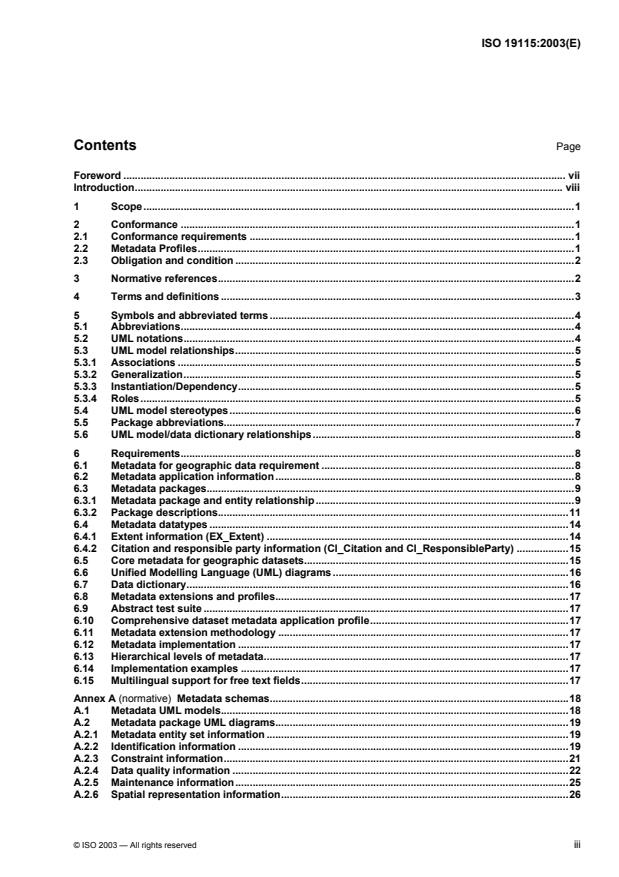
Contents Page
Foreword . vii
Introduction. viii
1 Scope.1
2 Conformance .1
2.1 Conformance requirements .1
2.2 Metadata Profiles.1
2.3 Obligation and condition .2
3 Normative references.2
4 Terms and definitions .3
5 Symbols and abbreviated terms .4
5.1 Abbreviations.4
5.2 UML notations.4
5.3 UML model relationships.5
5.3.1 Associations .5
5.3.2 Generalization.5
5.3.3 Instantiation/Dependency.5
5.3.4 Roles.5
5.4 UML model stereotypes.6
5.5 Package abbreviations.7
5.6 UML model/data dictionary relationships.8
6 Requirements.8
6.1 Metadata for geographic data requirement .8
6.2 Metadata application information.8
6.3 Metadata packages.9
6.3.1 Metadata package and entity relationship.9
6.3.2 Package descriptions.11
6.4 Metadata datatypes .14
6.4.1 Extent information (EX_Extent) .14
6.4.2 Citation and responsible party information (CI_Citation and CI_ResponsibleParty) .15
6.5 Core metadata for geographic datasets.15
6.6 Unified Modelling Language (UML) diagrams .16
6.7 Data dictionary.16
6.8 Metadata extensions and profiles.17
6.9 Abstract test suite .17
6.10 Comprehensive dataset metadata application profile.17
6.11 Metadata extension methodology .17
6.12 Metadata implementation .17
6.13 Hierarchical levels of metadata.17
6.14 Implementation examples .17
6.15 Multilingual support for free text fields.17
Annex A (normative) Metadata schemas.18
A.1 Metadata UML models.18
A.2 Metadata package UML diagrams.19
A.2.1 Metadata entity set information .19
A.2.2 Identification information .19
A.2.3 Constraint information.21
A.2.4 Data quality information .22
A.2.5 Maintenance information.25
A.2.6 Spatial representation information.26
A.2.7 Reference system information . 27
A.2.8 Content information. 28
A.2.9 Portrayal catalogue information. 29
A.2.10 Distribution information. 30
A.2.11 Metadata extension information. 31
A.2.12 Application schema information. 32
A.3 Metadata data types . 33
A.3.1 Extent information . 33
A.3.2 Citation and responsible party information . 34
Annex B (normative) Data dictionary for geographic metadata. 35
B.1 Data dictionary overview . 35
B.1.1 Introduction. 35
B.1.2 Name/role name . 35
B.1.3 Short name and domain code . 35
B.1.4 Definition . 35
B.1.5 Obligation/Condition . 36
B.1.6 Maximum occurrence. 36
B.1.7 Data type. 36
B.1.8 Domain. 36
B.2 Metadata package data dictionaries . 38
B.2.1 Metadata entity set information. 38
B.2.2 Identification information (includes data and service identification). 40
B.2.3 Constraint information (includes legal and security) . 46
B.2.4 Data quality information. 48
B.2.5 Maintenance information . 57
B.2.6 Spatial representation information (includes grid and vector representation). 59
B.2.7 Reference system information (includes temporal, coordinate and geographic identifiers). 63
B.2.8 Content information (includes Feature catalogue and Coverage descriptions). 68
B.2.9 Portrayal catalogue information. 73
B.2.10 Distribution information. 73
B.2.11 Metadata extension information. 78
B.2.12 Application schema information. 80
B.3 Data type information. 81
B.3.1 Extent information . 81
B.3.2 Citation and responsible party information . 85
B.4 Externally referenced entities. 91
B.4.1 Introduction. 91
B.4.2 Date and DateTime information. 91
B.4.3 Distance, angle, measure, number, record, recordType, scale and UomLength information. 91
B.4.4 Feature type, property type, and attribute type information . 91
B.4.5 PeriodDuration and temporal primitive information . 91
B.4.6 Point and Object information . 92
B.4.7 Set and Sequence information. 92
B.4.8 Type name information . 92
B.4.9 Vertical datum information . 92
B.5 CodeLists and enumerations . 92
B.5.1 Introduction. 92
B.5.2 CI_DateTypeCode <> . 92
B.5.3 CI_OnLineFunctionCode <>. 93
B.5.4 CI_PresentationFormCode <> . 93
B.5.5 CI_RoleCode <>. 93
B.5.6 DQ_EvaluationMethodTypeCode <>. 94
B.5.7 DS_AssociationTypeCode <> . 94
B.5.8 DS_InitiativeTypeCode <>.94
B.5.9 MD_CellGeometryCode <>. 95
B.5.10 MD_CharacterSetCode <>. 95
B.5.11 MD_ClassificationCode <>. 96
B.5.12 MD_CoverageContentTypeCode <>. 96
B.5.13 MD_DatatypeCode <> . 97
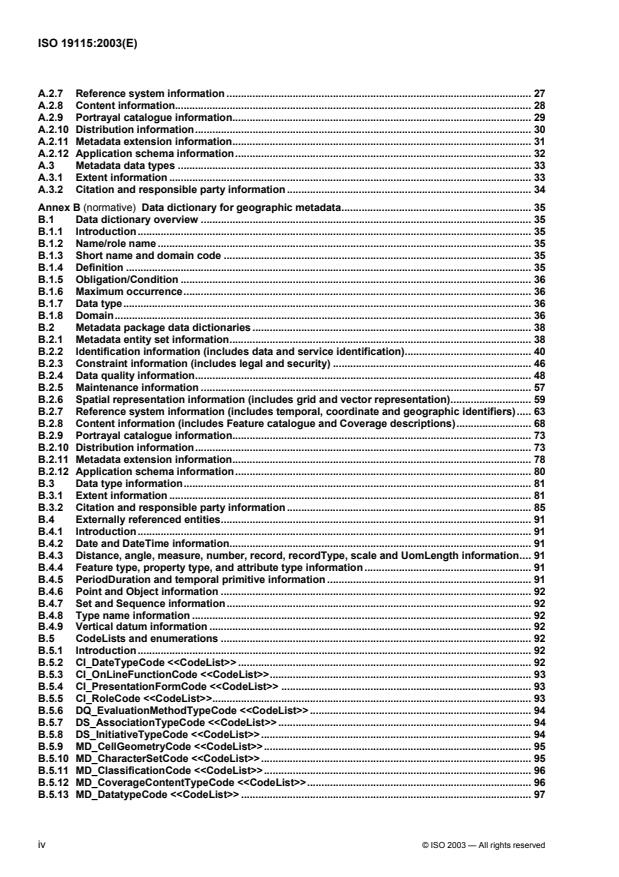
iv © ISO 2003 — All rights reserved
B.5.14 MD_DimensionNameTypeCode <> .97
B.5.15 MD_GeometricObjectTypeCode <> .97
B.5.16 MD_ImagingConditionCode <> .98
B.5.17 MD_KeywordTypeCode <> .98
B.5.18 MD_MaintenanceFrequencyCode <>.99
B.5.19 MD_MediumFormatCode <> .99
B.5.20 MD_MediumNameCode <>.99
B.5.21 MD_ObligationCode <>.100
B.5.22 MD_PixelOrientationCode <>.100
B.5.23 MD_ProgressCode <> .100
B.5.24 MD_RestrictionCode <> .101
B.5.25 MD_ScopeCode <> .101
B.5.26 MD_SpatialRepresentationTypeCode <> .102
B.5.27 MD_TopicCategoryCode << Enumeration>> .102
B.5.28 MD_TopologyLevelCode <>.104
Annex C (normative) Metadata extensions and profiles.105
C.1 Background.105
C.2 Types of extensions.105
C.3 Creating an extension.105
C.4 Rules for creating an extension.105
C.5 Community profile.106
C.6 Rules for creating a profile.107
Annex D (normative) Abstract test suite .108
D.1 Abstract test suite .108
D.2 Metadata test suite .108
D.2.1 Test case identifier: Completeness test.108
D.2.2 Test case identifier: Maximum occurrence test .108
D.2.3 Test case identifier: Short name test .108
D.2.4 Test case identifier: Data type test.109
D.2.5 Test case identifier: Domain test.109
D.2.6 Test case identifier: Schema test .109
D.3 User-defined extension metadata test suite.109
D.3.1 Test case identifier: Exclusiveness test .109
D.3.2 Test case identifier: Definition test.110
D.3.3 Test case identifier: Standard metadata test.110
D.4 Metadata profiles.110
D.4.1 Test case identifier: Metadata profiles.110
Annex E (normative) Comprehensive dataset metadata application profile .111
E.1 Comprehensive dataset metadata application schema .111
E.2 Comprehensive dataset metadata profile – UML model .112
Annex F (informative) Metadata extension methodology.113
F.1 Metadata extensions methodology .113
F.2 Review of existing metadata elements (Stage 1) .113
F.3 Definition of a new metadata section (Stage 2).114
F.4 Definition of a new metadata codelist (Stage 3).114
F.5 Definition of a new metadata codelist element (Stage 4).114
F.6 Definition of a new metadata element (Stage 5).115
F.7 Definition of a new metadata entity (Stage 6).115
F.8 Definition of a more stringent metadata obligation (Stage 7).116
F.9 Definition of more restrictive metadata codelist (Stage 8).116
F.10 Documentation of metadata extensions (Stage 9).117
Annex G (informative) Metadata implementation .119
G.1 Background.119
G.1.1 Problem statement .119
G.1.2 Scope and objectives.119
G.1.3 Granularity of spatial data supported .119
G.2 Metadata hierarchy levels.120
G.2.1 Dataset series metadata (optional) . 120
G.2.2 Dataset metadata . 120
G.2.3 Feature type metadata (optional) . 121
G.2.4 Feature instance metadata (optional). 121
G.2.5 Attribute type metadata (optional) . 121
G.2.6 Attribute instance metadata (optional). 121
Annex H (informative) Hierarchical levels of metadata . 122
H.1 Levels of metadata . 122
H.2 Example . 122
Annex I (informative) Implementation examples. 126
I.1 Metadata examples. 126
I.2 Example 1 – Exploration Licences for Minerals . 126
I.3 Example 2 – Example of extended metadata. 129
I.4 Data dictionary for the extended elements . 130
I.5 MD_KeywordType (Modified) . 136
Annex J (informative) Multilingual support for free text metadata element. 137
J.1 Free text metadata elements . 137
J.2 Data structure for handling multi-languages support in free text metadata elements . 138
J.3 Example of multi-languages free text in a metadata element . 139
Bibliography. 140
vi © ISO 2003 — All rights reserved
Foreword
ISO (the International Organization for Standardization) is a worldwide federation of national standards bodies
(ISO member bodies). The work of preparing International Standards is normally carried out through ISO
technical committees. Each member body interested in a subject for which a technical committee has been
established has the right to be represented on that committee. International organizations, governmental and
non-governmental, in liaison with ISO, also take part in the work. ISO collaborates closely with the
International Electrotechnical Commission (IEC) on all matters of electrotechnical standardization.
International Standards are drafted in accordance with the rules given in the ISO/IEC Directives, Part 2.
The main task of technical committees is to prepare International Standards. Draft International Standards
adopted by the technical committees are circulated to the member bodies for voting. Publication as an
International Standard requires approval by at least 75 % of the member bodies casting a vote.
Attention is drawn to the possibility that some of the elements of this document may be the subject of patent
rights. ISO shall not be held responsible for identifying any or all such patent rights.
ISO 19115 was prepared by Technical Committee ISO/TC 211, Geographic information/Geomatics.
Introduction
A revival in the awareness of the importance of geography and how things relate spatially, combined with the
advancement of electronic technology, have caused an expansion in the use of digital geographic information
and geographic information systems worldwide. Increasingly, individuals from a wide range of disciplines
outside of the geographic sciences and information technologies are capable of producing, enhancing, and
modifying digital geographic information. As the number, complexity, and diversity of geographic datasets
grow, a method for providing an understanding of all aspects of this data grows in importance.
Digital geographic data is an attempt to model and describe the real world for use in computer analysis and
graphic display of information. Any description of reality is always an abstraction, always partial, and always
just one of many possible "views". This "view" or model of the real world is not an exact duplication; some
things are approximated, others are simplified, and some things are ignored. There is seldom perfect,
complete, and correct data. To ensure that data is not misused, the assumptions and limitations affecting the
creation of data must be fully documented. Metadata allows a producer to describe a dataset fully so that
users can understand the assumptions and limitations and evaluate the dataset's applicability for their
intended use.
Typically, geographic data is used by many people other than the producer. It is often produced by one
individual or organization and used by another. Proper documentation will provide those unfamiliar with the
data with a better understanding, and enable them to use it properly. As geographic data producers and users
handle more and more data, proper documentation will provide them with a keener knowledge of their
holdings and will allow them to better manage data production, storage, updating, and reuse.
The objective of this International Standard is to provide a structure for describing digital geographic data.
This International Standard is intended to be used by information system analysts, program planners, and
developers of geographic information systems, as well as others in order to understand the basic principles
and the overall requirements for standardization of geographic information. This International Standard
defines metadata elements, provides a schema and establishes a common set of metadata terminology,
definitions, and extension procedures. When implemented by a data producer, this International Standard will:
1) Provide data producers with appropriate information to characterize their geographic data properly.
2) Facilitate the organization and management of metadata for geographic data.
3) Enable users to apply geographic data in the most efficient way by knowing its basic characteristics.
4) Facilitate data discovery, retrieval and reuse. Users will be better able to locate, access, evaluate,
purchase and utilize geographic data.
5) Enable users to determine whether geographic data in a holding will be of use to them.
This International Standard defines general-purpose metadata, in the field of geographic information. More
detailed metadata for geographic datatypes and geographic services are defined in other ISO 19100 series
standards and user extensions.
viii © ISO 2003 — All rights reserved
INTERNATIONAL STANDARD ISO 19115:2003(E)
Geographic information — Metadata
1 Scope
This International Standard defines the schema required for describing geographic information and services. It
provides information about the identification, the extent, the quality, the spatial and temporal schema, spatial
reference, and distribution of digital geographic data.
This International Standard is applicable to:
the cataloguing of datasets, clearinghouse activities, and the full description of datasets;
geographic datasets, dataset series, and individual geographic features and feature properties.
This International Standard defines:
mandatory and conditional metadata sections, metadata entities, and metadata elements;
the minimum set of metadata required to serve the full range of metadata applications (data discovery,
determining data fitness for use, data access, data transfer, and use of digital data);
optional metadata elements – to allow for a more extensive standard description of geographic data, if
required;
a method for extending metadata to fit specialized needs.
Though this International Standard is applicable to digital data, its principles can be extended to many other
forms of geographic data such as maps, charts, and textual documents as well as non-geographic data.
NOTE Certain mandatory metadata elements may not apply to these other forms of data.
2 Conformance
2.1 Conformance requirements
Metadata shall be provided as specified in Clause 6 and Annexes A and B.
User-defined metadata shall be defined and provided as specified in Annex C.
Any metadata claiming conformance with this International Standard shall pass the requirements described in
the abstract test suite presented in Annex D.
2.2 Metadata Profiles
Any profile conforming to this International Standard shall conform to the rules in Annex C, Clause C.6.
2.3 Obligation and condition
For the purposes of conformance testing using the abstract test suite in Annex D, metadata entities and
elements shall be considered to be mandatory, conditional or optional as specified in the applicable profile.
3 Normative references
The following referenced documents are indispensable for the application of this document. For dated
references, only the edition cited applies. For undated references, the latest edition of the referenced
document (including any amendments) applies.
ISO 639 (all parts), Code for the representation of names of languages
ISO 3166 (all parts), Codes for the representation of names of countries and their subdivisions
ISO 4217:2001, Codes for the representation of currencies and funds
ISO 8859 (parts 1 to 16), Information technology ― 8-bit single-byte coded graphic character sets
ISO 8879, Information processing ― Text and office systems ― Standard Generalized Markup Language
(SGML)
ISO/IEC 10646-1, Information technology ― Universal Multiple-Octet Coded Character Set (UCS) ― Part 1:
Architecture and Basic Multilingual Plane
ISO/IEC 11179 (all parts), Information technology ― Specification and standardization of data elements
1)
ISO 19106:― , Geographic information ― Profiles
1)
ISO 19107:― , Geographic information ― Spatial schema
ISO 19108:2002, Geographic information ― Temporal schema
1)
ISO 19109:― , Geographic information ― Rules for application schema
1)
ISO 19110:― , Geographic information ― Methodology for feature cataloguing
ISO 19111:2003, Geographic information ― Spatial referencing by coordinates
1)
ISO 19112:― , Geographic information ― Spatial referencing by geographic identifiers
ISO 19113:2002, Geographic information ― Quality principles
1)
ISO 19114:― , Geographic information ― Quality evaluation procedures
1)
ISO 19117:― , Geographic information ― Portrayal
1)
ISO 19118:― , Geographic information ― Encoding
1) To be published.
2 © ISO 2003 — All rights reserved
4 Terms and definitions
For the purposes of this document, the following terms and definitions apply.
NOTE The terms and definitions used in conjunction with the UML models are addressed in Clause 5.
4.1
data type
specification of a value domain with operations allowed on values in this domain [ISO 19103]
EXAMPLE Integer, Real, Boolean, String, Date, and GM_Point.
NOTE A data type is identified by a term, e.g. Integer.
4.2
dataset
identifiable collection of data
NOTE A dataset may be a smaller grouping of data which, though limited by some constraint such as spatial extent
or feature type, is located physically within a larger dataset. Theoretically, a dataset may be as small as a single feature or
feature attribute contained within a larger dataset. A hardcopy map or chart may be considered a dataset.
4.3
dataset series
collection of datasets sharing the same product specification
4.4
grid
network composed of two or more sets of curves in which the member of each set intersect the members of
the other sets in an algorithmic way [ISO 19123]
4.5
metadata
data about data
4.6
metadata element
discrete unit of metadata
NOTE 1 Metadata elements are unique within a metadata entity.
NOTE 2 Equivalent to an attribute in UML terminology.
4.7
metadata entity
set of metadata elements describing the same aspect of data
NOTE 1 May contain one or more metadata entities.
NOTE 2 Equivalent to a class in UML terminology.
4.8
metadata section
subset of metadata which consists of a collection of related metadata entities and metadata elements
NOTE Equivalent to a package in UML terminology.
4.9
model
abstraction of some aspects of a universe of discourse [ISO 19109]
4.10
resource
asset or means that fulfils a requirement
EXAMPLE Dataset, service, document, person or organization.
4.11
temporal reference system
reference system against which time is measured [ISO 19108]
5 Symbols and abbreviated terms
5.1 Abbreviations
DTD Document Type Definition
IDL Interface Definition Language
OCL Object Constraint Language
SGML Standard Generalized Markup Language
UML Unified Modelling Language
XML Extensible Markup Language
5.2 UML notations
The diagrams that appear in this International Standard are presented using the Unified Modelling Language
(UML) static structure diagram with the ISO Interface Definition Language (IDL) basic type definitions and the
UML Object Constraint Language (OCL) as the conceptual schema language. The UML notations used in this
International Standard are described in the Figure 1.
Association
Aggregation
Composition
Generalization
Dependency
Figure 1 — UML notation
4 © ISO 2003 — All rights reserved
5.3 UML model relationships
5.3.1 Associations
An association is used to describe a relationship between two or more classes. UML defines three different
types of relationships, called association, aggregation and composition. The three types have different
semantics. An ordinary association shall be used to represent a general relationship between two classes.
The aggregation and composition associations shall be used to create part-whole relationships between two
classes. The direction of an association must be specified. If the direction is not specified, it is assumed to be
a two-way association. If one-way associations are intended, the direction of the association can be marked
by an arrow at the end of the line.
An aggregation association is a relationship between two classes in which one of the classes plays the role of
container and the other plays the role of a containee.
A composition association is a strong aggregation. In a composition association, if a container object is
deleted, then all of its containee objects are deleted as well. The composition association shall be used when
the objects representing the parts of a container object cannot exist without the container object.
5.3.2 Generalization
A generalization is a relationship between a superclass and the subclasses that may be substituted for it. The
superclass is the generalized class, while the subclasses are specified classes.
5.3.3 Instantiation/Dependency
A dependency relationship shows that the client class depends on the supplier class/interface to provide
certain services, such as:
Client class accesses a value (constant or variable) defined in the supplier class/interface;
Operations of the client class invoke operations of the supplier class/interface;
Operations of the client class have signatures whose return class or arguments are instances of the
supplier class/interface.
An instantiated relationship represents the act of substituting actual values for the parameters of a
parameterized class or parameterized class utility to create a specialized version of the more general item.
5.3.4 Roles
If an association is navigable in a particular direction, the model shall supply a “role name” that is appropriate
for the role of the target object in relation to the source object. Thus in a two-way association, two role names
will be supplied. Figure 2 represents how role names and cardinalities are expressed in UML diagrams.
Association between classes
Association name
Class #1 Class #2
role-1 role-2
Association cardinality
1.*
Class Exactly one Class One or more
n
0.*
Class Zero or more Class Specific number
0.1
Class Optional (zero or one)
Aggregation between classes Class Inheritance (subtyping of classes)
Aggregate
Superclass
class
Component Component Component
Subclass #1 Subclass #2 Subclass #n
class #1 class #2 class #n
…….
…….
Figure 2 — UML roles
5.4 UML model stereotypes
A UML stereotype is an extension mechanism for existing UML concepts. It is a model element that is used to
classify (or mark) other UML elements so that they in some respect behave as if they were instances of new
virtual or pseudo metamodel classes whose form is based on existing base metamodel classes. Stereotypes
augment the classification mechanisms on the basis of the built-in UML metamodel class hierarchy. Below are
brief descriptions of the stereotypes used in this International Standard, for more detailed descriptions consult
ISO/TS 19103.
In this International Standard the following stereotypes are used:
a) <> class used for specification of a domain of instances (objects), together with the operations
applicable to the objects. A type may have attributes and associations.
b) <> data type whose instances form a list of named literal values. Both the enumeration
name and its literal values are declared. Enumeration means a short list of well-understood potential
values within a class.
c) <> a descriptor of a set of values that lack identity and whose operations do not have side
effects. Datatypes include primitive pre-defined types and user-definable types. Pre-defined types include
numbers, string,
...
SLOVENSKI STANDARD
01-november-2003
Geografske informacije - Metapodatki
Geographic information -- Metadata
Information géographique -- Métadonnées
Ta slovenski standard je istoveten z: ISO 19115:2003
ICS:
07.040 Astronomija. Geodezija. Astronomy. Geodesy.
Geografija Geography
35.240.70 Uporabniške rešitve IT v IT applications in science
znanosti
2003-01.Slovenski inštitut za standardizacijo. Razmnoževanje celote ali delov tega standarda ni dovoljeno.
INTERNATIONAL ISO
STANDARD 19115
First edition
2003-05-01
Geographic information — Metadata
Information géographique — Métadonnées
Reference number
©
ISO 2003
PDF disclaimer
This PDF file may contain embedded typefaces. In accordance with Adobe's licensing policy, this file may be printed or viewed but
shall not be edited unless the typefaces which are embedded are licensed to and installed on the computer performing the editing. In
downloading this file, parties accept therein the responsibility of not infringing Adobe's licensing policy. The ISO Central Secretariat
accepts no liability in this area.
Adobe is a trademark of Adobe Systems Incorporated.
Details of the software products used to create this PDF file can be found in the General Info relative to the file; the PDF-creation
parameters were optimized for printing. Every care has been taken to ensure that the file is suitable for use by ISO member bodies. In
the unlikely event that a problem relating to it is found, please inform the Central Secretariat at the address given below.
© ISO 2003
All rights reserved. Unless otherwise specified, no part of this publication may be reproduced or utilized in any form or by any means,
electronic or mechanical, including photocopying and microfilm, without permission in writing from either ISO at the address below or
ISO's member body in the country of the requester.
ISO copyright office
Case postale 56 • CH-1211 Geneva 20
Tel. + 41 22 749 01 11
Fax + 41 22 749 09 47
E-mail copyright@iso.org
Web www.iso.org
Published in Switzerland
ii © ISO 2003 — All rights reserved
Contents Page
Foreword . vii
Introduction. viii
1 Scope.1
2 Conformance .1
2.1 Conformance requirements .1
2.2 Metadata Profiles.1
2.3 Obligation and condition .2
3 Normative references.2
4 Terms and definitions .3
5 Symbols and abbreviated terms .4
5.1 Abbreviations.4
5.2 UML notations.4
5.3 UML model relationships.5
5.3.1 Associations .5
5.3.2 Generalization.5
5.3.3 Instantiation/Dependency.5
5.3.4 Roles.5
5.4 UML model stereotypes.6
5.5 Package abbreviations.7
5.6 UML model/data dictionary relationships.8
6 Requirements.8
6.1 Metadata for geographic data requirement .8
6.2 Metadata application information.8
6.3 Metadata packages.9
6.3.1 Metadata package and entity relationship.9
6.3.2 Package descriptions.11
6.4 Metadata datatypes .14
6.4.1 Extent information (EX_Extent) .14
6.4.2 Citation and responsible party information (CI_Citation and CI_ResponsibleParty) .15
6.5 Core metadata for geographic datasets.15
6.6 Unified Modelling Language (UML) diagrams .16
6.7 Data dictionary.16
6.8 Metadata extensions and profiles.17
6.9 Abstract test suite .17
6.10 Comprehensive dataset metadata application profile.17
6.11 Metadata extension methodology .17
6.12 Metadata implementation .17
6.13 Hierarchical levels of metadata.17
6.14 Implementation examples .17
6.15 Multilingual support for free text fields.17
Annex A (normative) Metadata schemas.18
A.1 Metadata UML models.18
A.2 Metadata package UML diagrams.19
A.2.1 Metadata entity set information .19
A.2.2 Identification information .19
A.2.3 Constraint information.21
A.2.4 Data quality information .22
A.2.5 Maintenance information.25
A.2.6 Spatial representation information.26
A.2.7 Reference system information . 27
A.2.8 Content information. 28
A.2.9 Portrayal catalogue information. 29
A.2.10 Distribution information. 30
A.2.11 Metadata extension information. 31
A.2.12 Application schema information. 32
A.3 Metadata data types . 33
A.3.1 Extent information . 33
A.3.2 Citation and responsible party information . 34
Annex B (normative) Data dictionary for geographic metadata. 35
B.1 Data dictionary overview . 35
B.1.1 Introduction. 35
B.1.2 Name/role name . 35
B.1.3 Short name and domain code . 35
B.1.4 Definition . 35
B.1.5 Obligation/Condition . 36
B.1.6 Maximum occurrence. 36
B.1.7 Data type. 36
B.1.8 Domain. 36
B.2 Metadata package data dictionaries . 38
B.2.1 Metadata entity set information. 38
B.2.2 Identification information (includes data and service identification). 40
B.2.3 Constraint information (includes legal and security) . 46
B.2.4 Data quality information. 48
B.2.5 Maintenance information . 57
B.2.6 Spatial representation information (includes grid and vector representation). 59
B.2.7 Reference system information (includes temporal, coordinate and geographic identifiers). 63
B.2.8 Content information (includes Feature catalogue and Coverage descriptions). 68
B.2.9 Portrayal catalogue information. 73
B.2.10 Distribution information. 73
B.2.11 Metadata extension information. 78
B.2.12 Application schema information. 80
B.3 Data type information. 81
B.3.1 Extent information . 81
B.3.2 Citation and responsible party information . 85
B.4 Externally referenced entities. 91
B.4.1 Introduction. 91
B.4.2 Date and DateTime information. 91
B.4.3 Distance, angle, measure, number, record, recordType, scale and UomLength information. 91
B.4.4 Feature type, property type, and attribute type information . 91
B.4.5 PeriodDuration and temporal primitive information . 91
B.4.6 Point and Object information . 92
B.4.7 Set and Sequence information. 92
B.4.8 Type name information . 92
B.4.9 Vertical datum information . 92
B.5 CodeLists and enumerations . 92
B.5.1 Introduction. 92
B.5.2 CI_DateTypeCode <> . 92
B.5.3 CI_OnLineFunctionCode <>. 93
B.5.4 CI_PresentationFormCode <> . 93
B.5.5 CI_RoleCode <>. 93
B.5.6 DQ_EvaluationMethodTypeCode <>. 94
B.5.7 DS_AssociationTypeCode <> . 94
B.5.8 DS_InitiativeTypeCode <>.94
B.5.9 MD_CellGeometryCode <>. 95
B.5.10 MD_CharacterSetCode <>. 95
B.5.11 MD_ClassificationCode <>. 96
B.5.12 MD_CoverageContentTypeCode <>. 96
B.5.13 MD_DatatypeCode <> . 97
iv © ISO 2003 — All rights reserved
B.5.14 MD_DimensionNameTypeCode <> .97
B.5.15 MD_GeometricObjectTypeCode <> .97
B.5.16 MD_ImagingConditionCode <> .98
B.5.17 MD_KeywordTypeCode <> .98
B.5.18 MD_MaintenanceFrequencyCode <>.99
B.5.19 MD_MediumFormatCode <> .99
B.5.20 MD_MediumNameCode <>.99
B.5.21 MD_ObligationCode <>.100
B.5.22 MD_PixelOrientationCode <>.100
B.5.23 MD_ProgressCode <> .100
B.5.24 MD_RestrictionCode <> .101
B.5.25 MD_ScopeCode <> .101
B.5.26 MD_SpatialRepresentationTypeCode <> .102
B.5.27 MD_TopicCategoryCode << Enumeration>> .102
B.5.28 MD_TopologyLevelCode <>.104
Annex C (normative) Metadata extensions and profiles.105
C.1 Background.105
C.2 Types of extensions.105
C.3 Creating an extension.105
C.4 Rules for creating an extension.105
C.5 Community profile.106
C.6 Rules for creating a profile.107
Annex D (normative) Abstract test suite .108
D.1 Abstract test suite .108
D.2 Metadata test suite .108
D.2.1 Test case identifier: Completeness test.108
D.2.2 Test case identifier: Maximum occurrence test .108
D.2.3 Test case identifier: Short name test .108
D.2.4 Test case identifier: Data type test.109
D.2.5 Test case identifier: Domain test.109
D.2.6 Test case identifier: Schema test .109
D.3 User-defined extension metadata test suite.109
D.3.1 Test case identifier: Exclusiveness test .109
D.3.2 Test case identifier: Definition test.110
D.3.3 Test case identifier: Standard metadata test.110
D.4 Metadata profiles.110
D.4.1 Test case identifier: Metadata profiles.110
Annex E (normative) Comprehensive dataset metadata application profile .111
E.1 Comprehensive dataset metadata application schema .111
E.2 Comprehensive dataset metadata profile – UML model .112
Annex F (informative) Metadata extension methodology.113
F.1 Metadata extensions methodology .113
F.2 Review of existing metadata elements (Stage 1) .113
F.3 Definition of a new metadata section (Stage 2).114
F.4 Definition of a new metadata codelist (Stage 3).114
F.5 Definition of a new metadata codelist element (Stage 4).114
F.6 Definition of a new metadata element (Stage 5).115
F.7 Definition of a new metadata entity (Stage 6).115
F.8 Definition of a more stringent metadata obligation (Stage 7).116
F.9 Definition of more restrictive metadata codelist (Stage 8).116
F.10 Documentation of metadata extensions (Stage 9).117
Annex G (informative) Metadata implementation .119
G.1 Background.119
G.1.1 Problem statement .119
G.1.2 Scope and objectives.119
G.1.3 Granularity of spatial data supported .119
G.2 Metadata hierarchy levels.120
G.2.1 Dataset series metadata (optional) . 120
G.2.2 Dataset metadata . 120
G.2.3 Feature type metadata (optional) . 121
G.2.4 Feature instance metadata (optional). 121
G.2.5 Attribute type metadata (optional) . 121
G.2.6 Attribute instance metadata (optional). 121
Annex H (informative) Hierarchical levels of metadata . 122
H.1 Levels of metadata . 122
H.2 Example . 122
Annex I (informative) Implementation examples. 126
I.1 Metadata examples. 126
I.2 Example 1 – Exploration Licences for Minerals . 126
I.3 Example 2 – Example of extended metadata. 129
I.4 Data dictionary for the extended elements . 130
I.5 MD_KeywordType (Modified) . 136
Annex J (informative) Multilingual support for free text metadata element. 137
J.1 Free text metadata elements . 137
J.2 Data structure for handling multi-languages support in free text metadata elements . 138
J.3 Example of multi-languages free text in a metadata element . 139
Bibliography. 140
vi © ISO 2003 — All rights reserved
Foreword
ISO (the International Organization for Standardization) is a worldwide federation of national standards bodies
(ISO member bodies). The work of preparing International Standards is normally carried out through ISO
technical committees. Each member body interested in a subject for which a technical committee has been
established has the right to be represented on that committee. International organizations, governmental and
non-governmental, in liaison with ISO, also take part in the work. ISO collaborates closely with the
International Electrotechnical Commission (IEC) on all matters of electrotechnical standardization.
International Standards are drafted in accordance with the rules given in the ISO/IEC Directives, Part 2.
The main task of technical committees is to prepare International Standards. Draft International Standards
adopted by the technical committees are circulated to the member bodies for voting. Publication as an
International Standard requires approval by at least 75 % of the member bodies casting a vote.
Attention is drawn to the possibility that some of the elements of this document may be the subject of patent
rights. ISO shall not be held responsible for identifying any or all such patent rights.
ISO 19115 was prepared by Technical Committee ISO/TC 211, Geographic information/Geomatics.
Introduction
A revival in the awareness of the importance of geography and how things relate spatially, combined with the
advancement of electronic technology, have caused an expansion in the use of digital geographic information
and geographic information systems worldwide. Increasingly, individuals from a wide range of disciplines
outside of the geographic sciences and information technologies are capable of producing, enhancing, and
modifying digital geographic information. As the number, complexity, and diversity of geographic datasets
grow, a method for providing an understanding of all aspects of this data grows in importance.
Digital geographic data is an attempt to model and describe the real world for use in computer analysis and
graphic display of information. Any description of reality is always an abstraction, always partial, and always
just one of many possible "views". This "view" or model of the real world is not an exact duplication; some
things are approximated, others are simplified, and some things are ignored. There is seldom perfect,
complete, and correct data. To ensure that data is not misused, the assumptions and limitations affecting the
creation of data must be fully documented. Metadata allows a producer to describe a dataset fully so that
users can understand the assumptions and limitations and evaluate the dataset's applicability for their
intended use.
Typically, geographic data is used by many people other than the producer. It is often produced by one
individual or organization and used by another. Proper documentation will provide those unfamiliar with the
data with a better understanding, and enable them to use it properly. As geographic data producers and users
handle more and more data, proper documentation will provide them with a keener knowledge of their
holdings and will allow them to better manage data production, storage, updating, and reuse.
The objective of this International Standard is to provide a structure for describing digital geographic data.
This International Standard is intended to be used by information system analysts, program planners, and
developers of geographic information systems, as well as others in order to understand the basic principles
and the overall requirements for standardization of geographic information. This International Standard
defines metadata elements, provides a schema and establishes a common set of metadata terminology,
definitions, and extension procedures. When implemented by a data producer, this International Standard will:
1) Provide data producers with appropriate information to characterize their geographic data properly.
2) Facilitate the organization and management of metadata for geographic data.
3) Enable users to apply geographic data in the most efficient way by knowing its basic characteristics.
4) Facilitate data discovery, retrieval and reuse. Users will be better able to locate, access, evaluate,
purchase and utilize geographic data.
5) Enable users to determine whether geographic data in a holding will be of use to them.
This International Standard defines general-purpose metadata, in the field of geographic information. More
detailed metadata for geographic datatypes and geographic services are defined in other ISO 19100 series
standards and user extensions.
viii © ISO 2003 — All rights reserved
INTERNATIONAL STANDARD ISO 19115:2003(E)
Geographic information — Metadata
1 Scope
This International Standard defines the schema required for describing geographic information and services. It
provides information about the identification, the extent, the quality, the spatial and temporal schema, spatial
reference, and distribution of digital geographic data.
This International Standard is applicable to:
the cataloguing of datasets, clearinghouse activities, and the full description of datasets;
geographic datasets, dataset series, and individual geographic features and feature properties.
This International Standard defines:
mandatory and conditional metadata sections, metadata entities, and metadata elements;
the minimum set of metadata required to serve the full range of metadata applications (data discovery,
determining data fitness for use, data access, data transfer, and use of digital data);
optional metadata elements – to allow for a more extensive standard description of geographic data, if
required;
a method for extending metadata to fit specialized needs.
Though this International Standard is applicable to digital data, its principles can be extended to many other
forms of geographic data such as maps, charts, and textual documents as well as non-geographic data.
NOTE Certain mandatory metadata elements may not apply to these other forms of data.
2 Conformance
2.1 Conformance requirements
Metadata shall be provided as specified in Clause 6 and Annexes A and B.
User-defined metadata shall be defined and provided as specified in Annex C.
Any metadata claiming conformance with this International Standard shall pass the requirements described in
the abstract test suite presented in Annex D.
2.2 Metadata Profiles
Any profile conforming to this International Standard shall conform to the rules in Annex C, Clause C.6.
2.3 Obligation and condition
For the purposes of conformance testing using the abstract test suite in Annex D, metadata entities and
elements shall be considered to be mandatory, conditional or optional as specified in the applicable profile.
3 Normative references
The following referenced documents are indispensable for the application of this document. For dated
references, only the edition cited applies. For undated references, the latest edition of the referenced
document (including any amendments) applies.
ISO 639 (all parts), Code for the representation of names of languages
ISO 3166 (all parts), Codes for the representation of names of countries and their subdivisions
ISO 4217:2001, Codes for the representation of currencies and funds
ISO 8859 (parts 1 to 16), Information technology ― 8-bit single-byte coded graphic character sets
ISO 8879, Information processing ― Text and office systems ― Standard Generalized Markup Language
(SGML)
ISO/IEC 10646-1, Information technology ― Universal Multiple-Octet Coded Character Set (UCS) ― Part 1:
Architecture and Basic Multilingual Plane
ISO/IEC 11179 (all parts), Information technology ― Specification and standardization of data elements
1)
ISO 19106:― , Geographic information ― Profiles
1)
ISO 19107:― , Geographic information ― Spatial schema
ISO 19108:2002, Geographic information ― Temporal schema
1)
ISO 19109:― , Geographic information ― Rules for application schema
1)
ISO 19110:― , Geographic information ― Methodology for feature cataloguing
ISO 19111:2003, Geographic information ― Spatial referencing by coordinates
1)
ISO 19112:― , Geographic information ― Spatial referencing by geographic identifiers
ISO 19113:2002, Geographic information ― Quality principles
1)
ISO 19114:― , Geographic information ― Quality evaluation procedures
1)
ISO 19117:― , Geographic information ― Portrayal
1)
ISO 19118:― , Geographic information ― Encoding
1) To be published.
2 © ISO 2003 — All rights reserved
4 Terms and definitions
For the purposes of this document, the following terms and definitions apply.
NOTE The terms and definitions used in conjunction with the UML models are addressed in Clause 5.
4.1
data type
specification of a value domain with operations allowed on values in this domain [ISO 19103]
EXAMPLE Integer, Real, Boolean, String, Date, and GM_Point.
NOTE A data type is identified by a term, e.g. Integer.
4.2
dataset
identifiable collection of data
NOTE A dataset may be a smaller grouping of data which, though limited by some constraint such as spatial extent
or feature type, is located physically within a larger dataset. Theoretically, a dataset may be as small as a single feature or
feature attribute contained within a larger dataset. A hardcopy map or chart may be considered a dataset.
4.3
dataset series
collection of datasets sharing the same product specification
4.4
grid
network composed of two or more sets of curves in which the member of each set intersect the members of
the other sets in an algorithmic way [ISO 19123]
4.5
metadata
data about data
4.6
metadata element
discrete unit of metadata
NOTE 1 Metadata elements are unique within a metadata entity.
NOTE 2 Equivalent to an attribute in UML terminology.
4.7
metadata entity
set of metadata elements describing the same aspect of data
NOTE 1 May contain one or more metadata entities.
NOTE 2 Equivalent to a class in UML terminology.
4.8
metadata section
subset of metadata which consists of a collection of related metadata entities and metadata elements
NOTE Equivalent to a package in UML terminology.
4.9
model
abstraction of some aspects of a universe of discourse [ISO 19109]
4.10
resource
asset or means that fulfils a requirement
EXAMPLE Dataset, service, document, person or organization.
4.11
temporal reference system
reference system against which time is measured [ISO 19108]
5 Symbols and abbreviated terms
5.1 Abbreviations
DTD Document Type Definition
IDL Interface Definition Language
OCL Object Constraint Language
SGML Standard Generalized Markup Language
UML Unified Modelling Language
XML Extensible Markup Language
5.2 UML notations
The diagrams that appear in this International Standard are presented using the Unified Modelling Language
(UML) static structure diagram with the ISO Interface Definition Language (IDL) basic type definitions and the
UML Object Constraint Language (OCL) as the conceptual schema language. The UML notations used in this
International Standard are described in the Figure 1.
Association
Aggregation
Composition
Generalization
Dependency
Figure 1 — UML notation
4 © ISO 2003 — All rights reserved
5.3 UML model relationships
5.3.1 Associations
An association is used to describe a relationship between two or more classes. UML defines three different
types of relationships, called association, aggregation and composition. The three types have different
semantics. An ordinary association shall be used to represent a general relationship between two classes.
The aggregation and composition associations shall be used to create part-whole relationships between two
classes. The direction of an association must be specified. If the direction is not specified, it is assumed to be
a two-way association. If one-way associations are intended, the direction of the association can be marked
by an arrow at the end of the line.
An aggregation association is a relationship between two classes in which one of the classes plays the role of
container and the other plays the role of a containee.
A composition association is a strong aggregation. In a composition association, if a container object is
deleted, then all of its containee objects are deleted as well. The composition association shall be used when
the objects representing the parts of a container object cannot exist without the container object.
5.3.2 Generalization
A generalization is a relationship between a superclass and the subclasses that may be substituted for it. The
superclass is the generalized class, while the subclasses are specified classes.
5.3.3 Instantiation/Dependency
A dependency relationship shows that the client class depends on the supplier class/interface to provide
certain services, such as:
Client class accesses a value (constant or variable) defined in the supplier class/interface;
Operations of the client class invoke operations of the supplier class/interface;
Operations of the client class have signatures whose return class or arguments are instances of the
supplier class/interface.
An instantiated relationship represents the act of substituting actual values for the parameters of a
parameterized class or parameterized class utility to create a specialized version of the more general item.
5.3.4 Roles
If an association is navigable in a particular direction, the model shall supply a “role name” that is appropriate
for the role of the target object in relation to the source object. Thus in a two-way association, two role names
will be supplied. Figure 2 represents how role names and cardinalities are expressed in UML diagrams.
Association between classes
Association name
Class #1 Class #2
role-1 role-2
Association cardinality
1.*
Class Exactly one Class One or more
n
0.*
Class Zero or more Class Specific number
0.1
Class Optional (zero or one)
Aggregation between classes Class Inheritance (subtyping of classes)
Aggregate
Superclass
class
Component Component Component
Subclass #1 Subclass #2 Subclass #n
class #1 class #2 class #n
…….
…….
Figure 2 — UML roles
5.4 UML model stereotypes
A UML stereotype is an extension mechanism for existing UML concepts. It is a model element that is used to
classify (or mark) other UML elements so that they in some respect behave as if they were instances of new
virtual or pseudo metamodel classes whose form is based on existing base metamodel classes. Stereotyp
...
Questions, Comments and Discussion
Ask us and Technical Secretary will try to provide an answer. You can facilitate discussion about the standard in here.
Loading comments...