


ISO 10079-2:2014
(Main)Medical suction equipment — Part 2: Manually powered suction equipment
Medical suction equipment — Part 2: Manually powered suction equipment
ISO 10079-2:2014 specifies safety and performance requirements for medical, manually powered suction equipment intended for oro-pharyngeal suction. It covers equipment operated by foot or by hand or both. Annex C illustrates the three parts of ISO 10079 by providing a schematic for typical systems. ISO 10079-2:2014 has additional requirements for suction equipment intended for field use or transport use.
Appareils d'aspiration médicale — Partie 2: Appareils d'aspiration manuelle
L'ISO 10079-2:2013 spécifie les exigences de sécurité et de performance relatives aux appareils d'aspiration médicale manuelle servant à l'aspiration oro-pharyngée. Elle traite des appareils actionnés avec le pied ou avec la main ou avec les deux. L'Annexe C illustre les trois parties de l'ISO 10079 en fournissant une représentation schématique des systèmes types. L'ISO 10079-2:2013 comporte des exigences supplémentaires pour les appareils d'aspiration prévus pour un emploi sur le terrain ou en transport.
General Information
- Status
- Withdrawn
- Publication Date
- 27-Apr-2014
- Technical Committee
- ISO/TC 121/SC 8 - Suction devices
- Drafting Committee
- ISO/TC 121/SC 8 - Suction devices
- Current Stage
- 9599 - Withdrawal of International Standard
- Start Date
- 16-Mar-2022
- Completion Date
- 12-Feb-2026
Relations
- Effective Date
- 12-Feb-2026
- Effective Date
- 17-Jul-2021
- Effective Date
- 17-Dec-2011


Get Certified
Connect with accredited certification bodies for this standard

BSI Group
BSI (British Standards Institution) is the business standards company that helps organizations make excellence a habit.

TÜV Rheinland
TÜV Rheinland is a leading international provider of technical services.

TÜV SÜD
TÜV SÜD is a trusted partner of choice for safety, security and sustainability solutions.
Sponsored listings
Frequently Asked Questions
ISO 10079-2:2014 is a standard published by the International Organization for Standardization (ISO). Its full title is "Medical suction equipment — Part 2: Manually powered suction equipment". This standard covers: ISO 10079-2:2014 specifies safety and performance requirements for medical, manually powered suction equipment intended for oro-pharyngeal suction. It covers equipment operated by foot or by hand or both. Annex C illustrates the three parts of ISO 10079 by providing a schematic for typical systems. ISO 10079-2:2014 has additional requirements for suction equipment intended for field use or transport use.
ISO 10079-2:2014 specifies safety and performance requirements for medical, manually powered suction equipment intended for oro-pharyngeal suction. It covers equipment operated by foot or by hand or both. Annex C illustrates the three parts of ISO 10079 by providing a schematic for typical systems. ISO 10079-2:2014 has additional requirements for suction equipment intended for field use or transport use.
ISO 10079-2:2014 is classified under the following ICS (International Classification for Standards) categories: 11.040.10 - Anaesthetic, respiratory and reanimation equipment. The ICS classification helps identify the subject area and facilitates finding related standards.
ISO 10079-2:2014 has the following relationships with other standards: It is inter standard links to EN ISO 10079-2:2014, ISO 10079-2:2022, ISO 10079-2:1999. Understanding these relationships helps ensure you are using the most current and applicable version of the standard.
ISO 10079-2:2014 is available in PDF format for immediate download after purchase. The document can be added to your cart and obtained through the secure checkout process. Digital delivery ensures instant access to the complete standard document.
Standards Content (Sample)
INTERNATIONAL ISO
STANDARD 10079-2
Third edition
2014-05-01
Medical suction equipment —
Part 2:
Manually powered suction equipment
Appareils d’aspiration médicale —
Partie 2: Appareils d’aspiration manuelle
Reference number
©
ISO 2014
© ISO 2014
All rights reserved. Unless otherwise specified, no part of this publication may be reproduced or utilized otherwise in any form
or by any means, electronic or mechanical, including photocopying, or posting on the internet or an intranet, without prior
written permission. Permission can be requested from either ISO at the address below or ISO’s member body in the country of
the requester.
ISO copyright office
Case postale 56 • CH-1211 Geneva 20
Tel. + 41 22 749 01 11
Fax + 41 22 749 09 47
E-mail copyright@iso.org
Web www.iso.org
Published in Switzerland
ii © ISO 2014 – All rights reserved
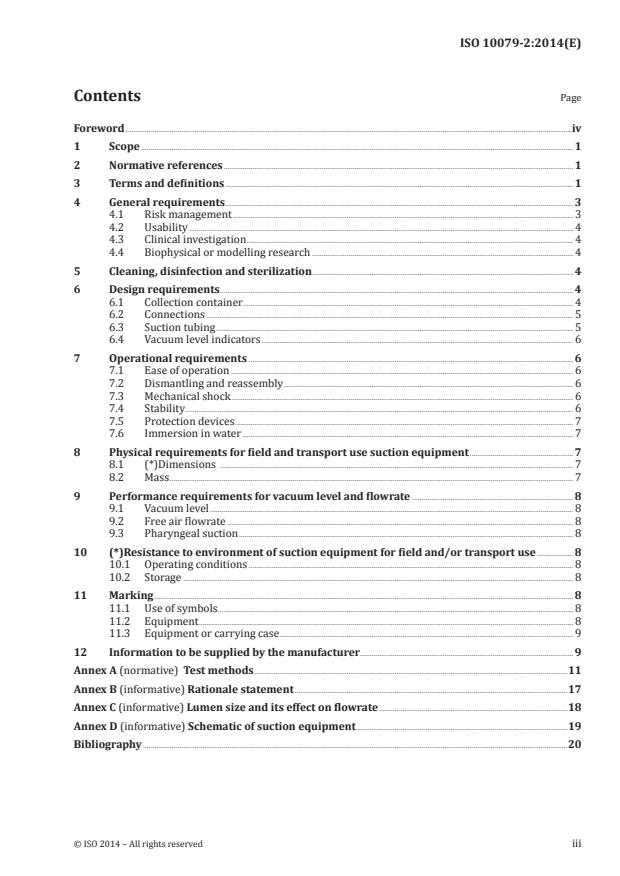
Contents Page
Foreword .iv
1 Scope . 1
2 Normative references . 1
3 Terms and definitions . 1
4 General requirements . 3
4.1 Risk management . 3
4.2 Usability . 4
4.3 Clinical investigation . 4
4.4 Biophysical or modelling research . 4
5 Cleaning, disinfection and sterilization . 4
6 Design requirements . 4
6.1 Collection container. 4
6.2 Connections . 5
6.3 Suction tubing . 5
6.4 Vacuum level indicators . 6
7 Operational requirements . 6
7.1 Ease of operation . 6
7.2 Dismantling and reassembly . 6
7.3 Mechanical shock . 6
7.4 Stability . 6
7.5 Protection devices . 7
7.6 Immersion in water . 7
8 Physical requirements for field and transport use suction equipment .7
8.1 (*)Dimensions . 7
8.2 Mass . 7
9 Performance requirements for vacuum level and flowrate . 8
9.1 Vacuum level . 8
9.2 Free air flowrate . 8
9.3 Pharyngeal suction . 8
10 (*)Resistance to environment of suction equipment for field and/or transport use .8
10.1 Operating conditions . 8
10.2 Storage . 8
11 Marking . 8
11.1 Use of symbols . 8
11.2 Equipment . 8
11.3 Equipment or carrying case . 9
12 Information to be supplied by the manufacturer . 9
Annex A (normative) Test methods .11
Annex B (informative) Rationale statement .17
Annex C (informative) Lumen size and its effect on flowrate .18
Annex D (informative) Schematic of suction equipment .19
Bibliography .20
Foreword
ISO (the International Organization for Standardization) is a worldwide federation of national standards
bodies (ISO member bodies). The work of preparing International Standards is normally carried out
through ISO technical committees. Each member body interested in a subject for which a technical
committee has been established has the right to be represented on that committee. International
organizations, governmental and non-governmental, in liaison with ISO, also take part in the work.
ISO collaborates closely with the International Electrotechnical Commission (IEC) on all matters of
electrotechnical standardization.
The procedures used to develop this document and those intended for its further maintenance are
described in the ISO/IEC Directives, Part 1. In particular the different approval criteria needed for the
different types of ISO documents should be noted. This document was drafted in accordance with the
editorial rules of the ISO/IEC Directives, Part 2 (see www.iso.org/directives).
Attention is drawn to the possibility that some of the elements of this document may be the subject of
patent rights. ISO shall not be held responsible for identifying any or all such patent rights. Details of
any patent rights identified during the development of the document will be in the Introduction and/or
on the ISO list of patent declarations received (see www.iso.org/patents).
Any trade name used in this document is information given for the convenience of users and does not
constitute an endorsement.
For an explanation on the meaning of ISO specific terms and expressions related to conformity
assessment, as well as information about ISO’s adherence to the WTO principles in the Technical Barriers
to Trade (TBT) see the following URL: Foreword - Supplementary information
The committee responsible for this document is ISO/TC 121, Anaesthetic and respiratory equipment,
Subcommittee SC 8, Suction devices for hospital and emergency care use.
This third edition cancels and replaces the second edition (ISO 10079-2:1999), which has been technically
revised.
ISO 10079 consists of the following parts, under the general title Medical suction equipment:
— Part 1: Electrically powered suction equipment
— Part 2: Manually powered suction equipment
— Part 3: Suction equipment powered from a vacuum or positive pressure gas source
Annex A forms a normative part of this part of ISO 10079 while Annexes B, C and D are for information
only.
Annex B contains rationale statements for some of the requirements of this part of ISO 10079. The clauses
and subclauses marked with an asterisk (*) after their number have corresponding rationale contained
in Annex B, included to provide additional insight into the reasoning that led to the requirements and
recommendations that have been incorporated in this part of ISO 10079. It is considered that knowledge
of the reasons for the requirements will not only facilitate the proper application of this part of ISO 10079,
but will expedite any subsequent revisions.
iv © ISO 2014 – All rights reserved
INTERNATIONAL STANDARD ISO 10079-2:2014(E)
Medical suction equipment —
Part 2:
Manually powered suction equipment
1 Scope
This part of ISO 10079 specifies safety and performance requirements for manually powered suction
equipment intended for oro-pharyngeal suction. It applies to equipment operated by foot or by hand or
both. Annex D illustrates the three parts of ISO 10079 by providing a schematic for typical systems.
The commonest use of manually powered suction is in situations outside of health care settings often
described as field use or transport use. Use in these situations may involve extreme conditions of
weather or terrain. Additional requirements for suction equipment intended for field and/or transport
use are included in this part of ISO 10079.
This part of ISO 10079 does not apply to the following:
a) end pieces such as suction catheters, Yankauer sucker and suction tips;
b) dental suction equipment;
c) mucus extractors, including neonatal mucus extractors.
2 Normative references
The following documents, in whole or in part, are normatively referenced in this document and are
indispensable for its application. For dated references, only the edition cited applies. For undated
references, the latest edition of the referenced document (including any amendments) applies.
ISO 5356-1, Anaesthetic and respiratory equipment — Conical connectors — Part 1: Cones and sockets
1)
ISO 7000 , Graphical symbols for use on equipment — Registered symbols
ISO 14155, Clinical investigation of medical devices for human subjects — Good clinical practice
ISO 14971, Medical devices — Application of risk management to medical devices
ISO 15223-1, Medical devices — Symbols to be used with medical device labels, labelling and information to
be supplied — Part 1: General requirements
ISO 80369 (all parts), Small-bore connectors for liquids and gases in healthcare applications
IEC 62366, Medical devices — Application of usability engineering to medical devices
EN 1041, Information supplied by the manufacturer of medical devices
3 Terms and definitions
For the purposes of this document, the following terms and definitions apply.
1) The graphical symbol collections of ISO 7000, ISO 7001 and ISO 7010 are also available on the Online Browsing
Platform http://www.iso.org/obp.
3.1
collection container
container in which liquids and solid particles are collected
3.2
end-piece
that part of the suction equipment applied to the patient which begins at the site where material is
drawn in and ends at the first detachable connection
Note 1 to entry: Examples of commonly used end-pieces are a Yankauer sucker and a suction catheter.
3.3
exhaust port
opening through which exhaust gas is discharged
3.4
field use
use of suction equipment in situations outside of the health care facility at the site of accidents or other
emergencies
3.5
filter
device for retention of particulate matter
3.6
free air flowrate
rate of unrestricted flow of air through a designated inlet
3.7
inlet port
opening through which liquid, solid particles or gas enter
3.8
intermediate tubing
tubing between the collection container and the vacuum source
3.9
manually powered suction
generation of vacuum by direct human effort
3.10
overfill protection device
device intended to prevent liquid or solid particles from entering the intermediate tubing
3.11
single fault condition
condition in which a single means for protection against a safety hazard in equipment is defective or a
single external abnormal condition is present
Note 1 to entry: Maintenance of equipment is considered a normal condition.
3.12
suction
application of vacuum to remove liquid, solid particles or gas
3.13
suction tubing
tubing for conduction of liquid, solid particles or gas between the end-piece and the collection container
3.14
transport use
use during patient transport outside of a health care facility (e.g. in an ambulance or aeroplane)
2 © ISO 2014 – All rights reserved
3.15
vacuum level
pressure less than atmospheric pressure
Note 1 to entry: In this part of ISO 10079, vacuum level is expressed as a difference from atmospheric pressure.
3.16
vacuum level indicator
device for displaying the vacuum level
3.17
vacuum source
component of device for generating vacuum
4 General requirements
4.1 Risk management
4.1.1 This part of ISO 10079 specifies requirements that are generally applicable to risks associated
with manually powered suction equipment. An established risk management process shall be applied to
the design of the device. The risk management process shall include the following elements:
— risk analysis;
— risk evaluation;
— risk control;
— production and post-production information.
EXAMPLE ISO 14971.
Check compliance by inspection of the risk management file.
4.1.2 Manually powered suction equipment shall, when transported, stored, installed, operated in
normal use and maintained according to the instructions of the manufacturer, present no risks that are
not reduced to an acceptable level using risk management procedures in accordance with ISO 14971 and
which are associated with their intended application, in normal and in single fault condition.
NOTE A situation in which a fault is not detected is considered a normal condition. Fault conditions/hazardous
situations might remain undetected over a period of time and, as a consequence, might lead to an unacceptable
risk. In that case, a subsequent detected fault condition needs to be considered as a single fault condition. Specific
risk control measures need to be determined within the risk management process to deal with such situations.
Check compliance by inspection of the risk management file.
4.1.3 Where requirements of this part of ISO 10079 refer to freedom from unacceptable risk, the
acceptability or unacceptability of this risk shall be determined by the manufacturer in accordance with
their policy for determining acceptable risk.
Check compliance by inspection of the risk management file.
4.1.4 The manufacturer may use type tests different from those detailed within this part of ISO 10079,
if an equivalent degree of safety is obtained. Alternative test methods shall be validated against the test
methods specified in Annex A of this part of ISO 10079.
Check compliance by inspection of the technical file.
4.2 Usability
The manufacturer shall address, in accordance with IEC 62366, the usability engineering process, and
the risk resulting from poor usability.
Check compliance by inspection of the usability engineering file.
4.3 Clinical investigation
Where appropriate, clinical investigation shall be performed under the conditions for which performance
is claimed, and documented in the risk management file. The clinical investigation shall comply with the
requirements of ISO 14155.
NOTE Clinical data may be sourced from:
— clinical investigation(s) of the device concerned, or
— clinical investigation(s) or other studies reported in the scientific literature, of a similar device for which
equivalence to the device in question can be demonstrated, or
— published and/or unpublished reports on other clinical experience of either the device in question or a similar
device for which equivalence to the device in question can be demonstrated.
Check compliance by inspection of the risk management file.
4.4 Biophysical or modelling research
Where appropriate, validated biophysical or modelling research shall be performed under the conditions
for which performance is claimed and documented in the risk management file.
Check compliance by inspection of the technical file.
5 Cleaning, disinfection and sterilization
Parts of the suction equipment which may be subject to contamination shall either be for single use
or capable of being cleaned and disinfected or sterilized as appropriate. This includes filters, suction
tubing and collection containers.
Parts intended for re-use shall meet the requirements of Clauses 7 and 9, as appropriate, after
those components have been submitted to 30 cycles of cleaning and disinfection or sterilization as
recommended by the manufacturer.
Check compliance by functional testing.
6 Design requirements
6.1 Collection container
6.1.1 General
The collection container shall clearly show the level of contents in normal use.
Check compliance by inspection.
6.1.2 Container capacity and usable volume
6.1.2.1(*)For suction equipment intended for field use with overfill protection, the usable volume of the
collection container shall be not less than 300 ml.
4 © ISO 2014 – All rights reserved
6.1.2.2(*)For suction equipment intended for field use and which is intended to continue operating
when the collection container is full, the volume of the collection container shall be not less than 200 ml.
Check compliance by functional testing and inspection.
6.1.2.3For all other suction equipment, including suction equipment intended for transport use, the
usable volume of the collection container shall be not less than 500 ml.
Check compliance by inspection and the tests given in A.2.
6.1.3 Container strength
The collection container shall not implode, crack or permanently deform and shall meet the requirements
of Clauses 7 and 9, as appropriate, after being subjected to a pressure of either 120 % of the manufacturer’s
recommended maximum vacuum level or 95 kPa below atmospheric, whichever is less, for 5 min.
Containers intended for re-use shall be tested after 30 cycles of cleaning and disinfection or sterilization
as recommended by the manufacturer.
Check compliance by the test given in A.3.
6.2 Connections
6.2.1 Tubing connectors for collection containers
The connectors for the suction tubing and the intermediate tubing shall be designed to facilitate correct
assembly or clearly marked to indicate correct assembly when all parts are mated.
Check compliance by functional testing and inspection.
NOTE Incorrect connections have frequently been a cause of spill over into the vacuum source and a loss of
suction.
6.2.2 Inlet port
The inside diameter of the suction tubing connector (inlet port of the collection container) shall be at
least 6 mm and the inside diameter of the suction tubing connection (inlet port) shall be equal to or
larger than the inside diameter of the largest tubing size as specified by the manufacturer.
The inlet shall not be compatible with any conical connector specified in ISO 5356-1 or small-bore
connectors specified in ISO 80369 (all parts).
Check compliance by functional testing and inspection.
NOTE Because of the risk of misconnection, the internal diameter of the inlet port of the collection container
should not be greater than 14 mm.
6.2.3 Exhaust port
It shall not be possible to connect suction tubing to the exhaust port.
Check compliance by functional testing.
6.3 Suction tubing
6.3.1Suction tubing shall have an inside diameter of not less than 6 mm.
The degree of collapse of the suction tubing shall be less than 0,5 throughout its entire length.
Check compliance by the tests given in A.4 using the tubing specified by the manufacturer of the suction
equipment.
6.3.2(*)Suction tubing supplied or recommended by the manufacturer shall have a minimum length of
1,3 m.
NOTE Suction performance may be markedly affected by the length and diameter of the tubing between the
collection container and end-piece. See Annex C.
6.4 Vacuum level indicators
Vacuum level indicators, if present, shall have the following specifications.
a) The full-scale of analog vacuum level indicators shall not be more than 200 % of the maximum
vacuum level below atmospheric pressure as specified by the manufacturer.
b) Analog displays shall have graduations not less than 2 mm apart, each graduation representing not
more than 5 % of the full-scale value.
c) Vacuum level indicators shall be accurate to within ± 5 % of the full-scale value.
Check compliance by insp
...
NORME ISO
INTERNATIONALE 10079-2
Troisième édition
2014-05-01
Appareils d’aspiration médicale —
Partie 2:
Appareils d’aspiration manuelle
Medical suction equipment —
Part 2: Manually powered suction equipment
Numéro de référence
©
ISO 2014
DOCUMENT PROTÉGÉ PAR COPYRIGHT
© ISO 2014
Droits de reproduction réservés. Sauf indication contraire, aucune partie de cette publication ne peut être reproduite ni utilisée
�������������������������������������������������������������������������������������������������������������������������
l’internet ou sur un Intranet, sans autorisation écrite préalable. Les demandes d’autorisation peuvent être adressées à l’ISO à
l’adresse ci-après ou au comité membre de l’ISO dans le pays du demandeur.
��������������������
���������������������1�11����������
Tel. + 41 22 749 01 11
Fax + 41 22 749 09 47
������������������������
���������������
Publié en Suisse
ii © ISO 2014 – Tous droits réservés
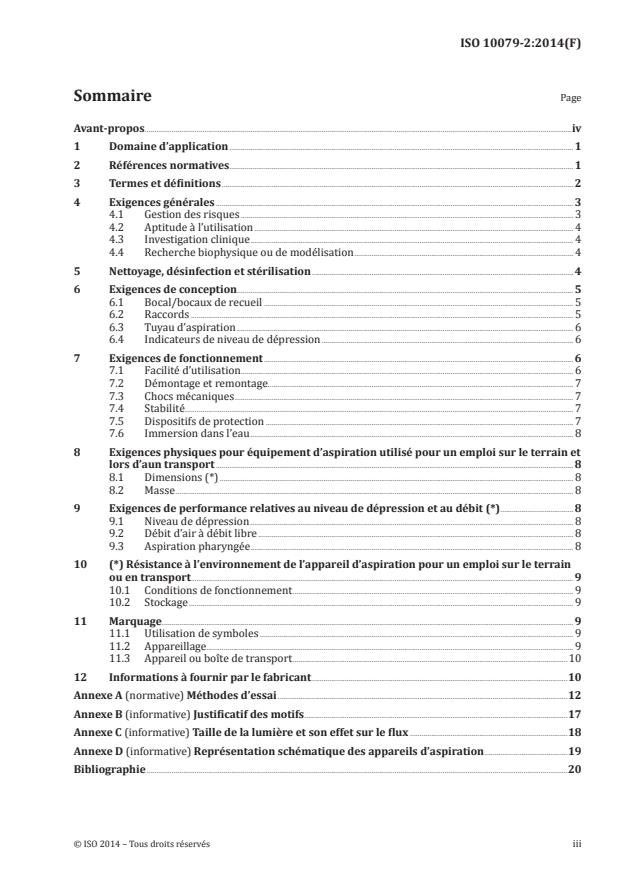
Sommaire ����
Avant-propos .iv
1 Domaine d’application . 1
2 Références normatives . 1
3 Termes et définitions . 2
4 Exigences générales . 3
��1� ������������������� . 3
4.2 Aptitude à l’utilisation . 4
���� ���������������������� . 4
4.4 Recherche biophysique ou de modélisation . 4
5 Nettoyage, désinfection et stérilisation . 4
6 Exigences de conception. 5
6.1 Bocal/bocaux de recueil . 5
6.2 Raccords . 5
6.3 Tuyau d’aspiration . 6
6.4 Indicateurs de niveau de dépression . 6
7 Exigences de fonctionnement . 6
7.1 Facilité d’utilisation . . 6
���� ���������������������� . . 7
7.3 Chocs mécaniques . 7
7.4 Stabilité . 7
7.5 Dispositifs de protection . 7
7.6 Immersion dans l’eau . 8
8 Exigences physiques pour équipement d’aspiration utilisé pour un emploi sur le terrain et
lors d’aun transport . 8
8.1 Dimensions (*) . 8
8.2 Masse . 8
9 Exigences de performance relatives au niveau de dépression et au débit (*) .8
9.1 Niveau de dépression . 8
9.2 Débit d’air à débit libre . 8
9��� �������������������� . 8
10 (*) Résistance à l’environnement de l’appareil d’aspiration pour un emploi sur le terrain
ou en transport . 9
10.1 Conditions de fonctionnement . 9
1���� ����� .���. 9
11 Marquage . 9
11.1 Utilisation de symboles . 9
11��� ������������. 9
11.3 Appareil ou boîte de transport .10
12 Informations à fournir par le fabricant .10
Annexe A (normative) Méthodes d’essai .12
Annexe B (informative) Justificatif des motifs .17
Annexe C (informative) Taille de la lumière et son effet sur le flux .18
Annexe D (informative) Représentation schématique des appareils d’aspiration .19
Bibliographie .20
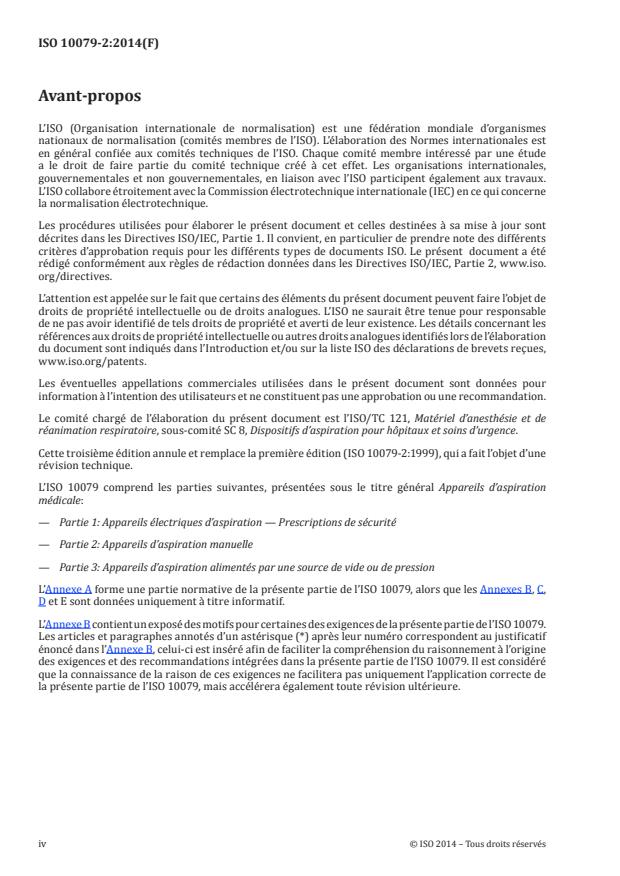
Avant-propos
������ �������������� ��������������� ��� ��������������� ���� ���� ����������� ��������� �������������
nationaux de normalisation (comités membres de l’ISO). L’élaboration des Normes internationales est
�������������������������������������������������������������������������������������������������
����������������������������������������������������������������������������������������������������
���������������������������������������������������������������������������������������������������
L’ISO collabore étroitement avec la Commission électrotechnique internationale (IEC) en ce qui concerne
la normalisation électrotechnique.
Les procédures utilisées pour élaborer le présent document et celles destinées à sa mise à jour sont
décrites dans les Directives ISO/IEC, Partie 1. Il convient, en particulier de prendre note des différents
critères d’approbation requis pour les différents types de documents ISO. Le présent document a été
���������������������������������������������������������������������������������������������������
���������������
L’attention est appelée sur le fait que certains des éléments du présent document peuvent faire l’objet de
��������������������������������������������������������������������������������������������������������
��������������������������������������������������������������������������������������������������������������
��������������������������������������������������������������������������������������������������������������
du document sont indiqués dans l’Introduction et/ou sur la liste ISO des déclarations de brevets reçues,
��������������������
Les éventuelles appellations commerciales utilisées dans le présent document sont données pour
information à l’intention des utilisateurs et ne constituent pas une approbation ou une recommandation.
�����������������������������������������������1����M��a�té�r��iel d�’a�ne��st�hé�s�ie� e�t� d�e�� 1
réanimation respiratoire, sous-comité SC 8, Dispositifs d’aspiration pour hôpitaux et soins d’urgence.
Cette troisième édition annule et remplace la première édition (ISO 10079-2:1999), qui a fait l’objet d’une
révision technique.
������1���9��������������������������������������������App�a�re�il��s d�’a��spir�at��ion� ����������
médicale:
— Partie 1: Appareils électriques d’aspiration — Prescriptions de sécurité
— Partie 2: Appareils d’aspiration manuelle
— Partie 3: Appareils d’aspiration alimentés par une source de vide ou de pression
L’Annexe A forme une partie normative de la présente partie de l’ISO 10079, alors que les Annexes B, C,
D et E sont données uniquement à titre informatif.
L’Annexe B����������������������������������������������������������������9��������������������������������1
��������������������������������������������������������������������������������������������������������
énoncé dans l’Annexe B�������������������������������������������������������������������������������������
��������������������������������������������������������������������������������1���9�������������������
���������������������������������������������������������������������������������������������������������
����������������������������1���9������������������������������������������������������
iv © ISO 2014 – Tous droits réservés
NORME INTERNATIONALE ISO 10079-2:2014(F)
Appareils d’aspiration médicale —
Partie 2:
Appareils d’aspiration manuelle
1 Domaine d’application
����������������������������1���9��������������������������������������������������������������������
����������������������������������������������������������������������������������������������������
actionnés avec le pied ou avec la main ou avec les deux. L’Annexe D illustre les trois parties de l’ISO 10079
en fournissant une représentation schématique des systèmes types.
Les appareils d’aspiration manuelle sont le plus souvent utilisés dans des situations en dehors des
établissements de soins souvent décrites comme des emplois sur le terrain ou en transport. L’utilisation
������������������������������������������������������������������������������������������������������
������������1������9�� ������������������������������������������������������������������������������
pour un emploi sur le terrain ou en transport.
La présente partie de l’ISO 10079 ne s’applique pas aux appareils suivants:
a) les pièces d’extrémité telles que les sondes d’aspiration, les canules d’aspiration de Yankauer et les
embouts d’aspiration;
b) les appareils dentaires d’aspiration;
c) les extracteurs de mucosités, y compris ceux pour nouveau-nés;
2 Références normatives
������������������������������������������������������������������������������������������������������
l’application du présent document. Pour les références datées, seule l’édition citée s’applique. Pour les
références non datées, la dernière édition du document de référence s’applique (y compris les éventuels
amendements).
ISO 5356-1, Matériel d’anesthésie et de réanimation respiratoire — Raccords coniques — Partie 1: Raccords
mâles et femelles
1)
ISO 7000, Symboles graphiques utilisables sur le matériel — Symboles enregistrés
ISO 14155, Investigation clinique des dispositifs médicaux pour sujets humains — Bonnes pratiques cliniques
ISO 14971, Dispositifs médicaux — Application de la gestion des risques aux dispositifs médicaux
ISO 15223-1, Dispositifs médicaux — Symboles à utiliser avec les étiquettes, l’étiquetage et les informations
à fournir relatifs aux dispositifs médicaux — Partie 1: Exigences générales
ISO 80369-1, Raccords de petite taille pour liquides et gaz utilisés dans le domaine de la santé -- Partie 1:
Exigences générales
EN 1041, Informations fournies par le fabricant de dispositifs médicaux
1)� � �����������������������������������������������������������1���������������1��������������������������������
�������������������������������������������������������
IEC 62366, Dispositifs médicaux — Application de l’ingénierie de l’aptitude à l’utilisation aux dispositifs
médicaux
ISO 80369 (toutes les parties), Raccords de petite taille pour liquides et gaz utilisés dans le domaine de la
santé
3 Termes et définitions
��������������������������������������������������������������������������������������
3.1
bocal de recueil
bocal dans lequel sont recueillis les liquides et les particules solides
3.2
pièce d’extrémité
partie de l’appareil d’aspiration appliquée sur le patient qui commence au niveau du site où de la matière
est aspirée et se termine au niveau du premier raccord amovible
Note 1 à l’article: Les canules d’aspiration de Yankauer et les sondes d’aspiration constituent des exemples de
pièces d’extrémité fréquemment utilisées.
3.3
orifice d’évacuation
������������������������������������������������������������
3.4
emploi sur le terrain
emploi d’un appareil d’aspiration à l’extérieur des établissements de soin, sur les lieux d’un accident ou
����������������������������������
3.5
filtre
dispositif destiné à retenir les particules
3.6
débit d’air à débit d’air libre
débit d’air non limité passant par une entrée déterminée
3.7
orifice d’entrée
��������������������������������������������������������������������������������������
3.8
tuyau intermédiaire
tuyau qui raccorde le bocal de recueil à la source de vide
3.9
aspiration manuelle
production d’une dépression (ou vide) par un effort humain direct
3.10
trop-plein
dispositif conçu pour empêcher la pénétration des liquides et des particules solides dans le tuyau
intermédiaire
3.11
condition de premier défaut
�����1�����������������������������������������������������������������������������������������������������
l’équipement fait défaut ou une seule condition externe anormale est présente
2 © ISO 2014 – Tous droits réservés
Note 2 à l’article: La maintenance de l’équipement est considérée une condition normale.
3.12
aspiration
������������������������������������������������������������������������������������������
3.13
tuyau d’aspiration
�����������������������������������������������������������������������������������������������������������
bocal de recueil
3.14
emploi en transport
emploi durant le transport du patient à l’extérieur des établissements de soin (par exemple une
ambulance, une automobile ou un avion
3.15
niveau de dépression
pression inférieure à la pression atmosphérique
Note 1 à l’article: Dans la présente partie de l’ISO 10079, le niveau de dépression est exprimé par une différence
par rapport à la pression atmosphérique.
3.16
indicateur de niveau de dépression
dispositif destiné à indiquer le niveau de dépression
3.17
source de vide
composant d’un dispositif destiné à produire une dépression
4 Exigences générales
4.1 Gestion des risques
4.1.1 ����������������������������1���9����������������������������������������������������������
������������������������������������������������������������������������������������������������������
�����������������������������������������������������������������������������������������������������������
suivants:
— analyse du risque;
— évaluation du risque;
— maîtrise du risque;
— informations de production et de post-production.
EXEMPLE ISO 14971
������������������������������������������������������������������������
4.1.2 �������������������������������������������������������������������������������������������������
et de l’entretien conformément aux instructions du fabricant, les appareils d’aspiration manuels ne
���������������������������������������������������������������������������������������������������������
des risques conformément à l’ISO 14971, en fonction de leur application prévue, dans des conditions
normales et de premier défaut.
NOTE Une situation dans laquelle un défaut n’est pas détecté est considérée comme une condition normale.
�����������������������������������������������������������������������������������������������������������
avoir pour conséquence un risque inacceptable. Dans ce cas, il faut considérer une condition de défaut détectée
��������������������������������������������������������������������������������������������������������������
��������������������������������������������������������������������������������������
������������������������������������������������������������������������
4.1.3 �����������������������������������������������������1���9�����������������������������������
inacceptable, l’acceptabilité ou la non-acceptabilité de ce risque doit être déterminée par le fabricant
conformément à la politique du fabricant relative à la détermination du risque acceptable.
������������������������������������������������������������������������
4.1.4 Le fabricant peut utiliser des essais types différents de ceux qui sont détaillés dans la présente
����������������1���9�����������������������������������������������������������������������������������
�������������������������������������������������������������������������Annexe A.
�����������������������������������������������������������
4.2 Aptitude à l’utilisation
������������������������������������������������������������������������������������������������������
l’utilisation et du risque résultant d’une mauvaise aptitude à l’utilisation.
��������������������������������������������������������������������������������������������
4.3 Investigation clinique
���������������������������������������������������������������������������������������������������������
����������������������������������������������������������������������������������������������������������
�����������������������������������������������������������������������1�1���
NOTE Les données cliniques peuvent provenir:
�� ���������������������������������������������������������
�� ���������������������������������������������������������������������������������������������������������������
similaire dont l’équivalence avec le dispositif en question peut être démontrée, ou
— de rapports publiés et/ou non publiés sur d’autres expériences cliniques avec le dispositif en question ou un
dispositif similaire pour lequel l’équivalence avec le dispositif en question peut être démontrée.
������������������������������������������������������������������������
4.4 Recherche biophysique ou de modélisation
Le cas échéant, des recherches biophysiques ou de modélisation validées doivent être effectuées dans
les conditions pour lesquelles la performance est déclarée et elles doivent être documentées dans le
�������������������������������
�����������������������������������������������������������
5 Nettoyage, désinfection et stérilisation
�����������������������������������������������������������������������������������������������������
������������������������������������������������������������������������������������������������������������
�������������������������������������������������������������������
4 © ISO 2014 – Tous droits réservés
��������������������������������������������������������������������������9������������������������������������
�����������������������������������������������������������������������������������������������������������
du fabricant.
�������������������������������������������������������
6 Exigences de conception
6.1 Bocal/bocaux de recueil
6.1.1 Généralités
Le bocal de recueil doit clairement laisser apparaître le niveau de son contenu en utilisation normale.
��������������������������������������
6.1.2 Capacité du bocal
6.1.2.1 (*) Pour un appareil d’aspiration conçus pour être utilisés sur le terrain comportant un trop-
plein, le volume utile du bocal de recueil ne doit pas être inférieur à 300 ml.
6.1.2.2 (*) Dans le cas d’un appareil d’aspiration destiné à être utilisé sur le terrain et conçu pour
continuer à fonctionner lorsque le bocal de recueil est plein, le volume du bocal de recueil ne doit pas être
inférieur à 200 ml.
6.1.2.3 Pour tous les autres appareils d’aspiration, y compris ceux prévus pour un emploi en transport,
le volume utile du bocal de recueil ne doit pas être inférieur à 500 ml.
��������������������������������������������������A.2.
6.1.3 Résistance du bocal de recueil
�����������������������������������������������������������������������������������������������������
������������������������������������������������������9������������������������������������������������������
de 120 % du niveau maximal de dépression recommandé par le fabricant, ou de 95 kPa en dessous de la
pression atmosphérique, en prenant la plus élevée de ces deux valeurs de dépression), pendant 5 min.
�����������������������������������������������������������������������������������������������������������
et désinfection, ou stérilisation comme recommandé par le fabricant.
���������������������������������.���������������A.3
6.2 Raccords
6.2.1 Raccords de tuyau pour les bocaux de recueil
Les raccords du tuyau d’aspiration et le tuyau intermédiaire doivent être conçus de manière à faciliter
�����������������������������������������������������������������������������������������������������
assemblées.
���������������������������������������������������������������������������
NOTE Des raccords incorrects ont fréquemment été des causes de fuite dans la source de vide et de perte
d’aspiration.
6.2.2 Orifice d’entrée
������������������������������������������������������������������������������������������������������
����������������������������������������������������������������������������������������������������������
���������������������������������������������������������������������������������������������������������
fabricant.
���������������������������������������������������������������������������������������������������������
�����������1����������������������������������������������������������9���������������������
���������������������������������������������������������������������������
����� ��������������������������������������������������������������������������������������������������������
recueil ne soit pas supérieur à 14 mm.
6.2.3 Orifice d’évacuation
������������������������������������������������������������������������������������
�������������������������������������������������������
6.3 Tuyau d’aspiration
6.3.1 le tuyau d’aspiration doit avoir un diamètre intérieur minimal de 6 mm.
��������������������������������������������������������������������������������������������
�������������������������������A�.4��������������������������������������������������������������������
l’appareil d’aspiration.
6.3.2 (*)� ������������������������������������������������������������������������������������
minimale de 1,3 m.
����� �����������������������������������������������������������������������������������������������������
du tuyau d’aspiration entre le bocal d’aspiration et la pièce d’extrémité. Voir Annexe C.
6.4 Indicateurs de niveau de dépression
����������������������������������������������������������������������������������������������������
��� ����������������������������������������������������������������������������������������������
����������������������������������������������������������������
��� ����������������������������������������������������������������������������������������������������
2 % de la pleine échelle.
��� ����������������������������������������������������������������������������������������������������
���������������������������������������������������������������������������
�������������������������������������������������������������������������
7 Exigences de fonctionnement
7.1 Facilité d’utilisation
Dans sa conception, l’appareil d’aspiration doit permettre son utilisation par une seule personne, sans
aide.
6 © ISO 2014 – Tous droits réservés
Il convient qu’un appareil d’aspiration actionné avec le pied nécessite une force inférieure à 350 N
������������������������������������������������������������������������������������������������������
���
...
Questions, Comments and Discussion
Ask us and Technical Secretary will try to provide an answer. You can facilitate discussion about the standard in here.
Loading comments...