

ISO 9211-7:2021
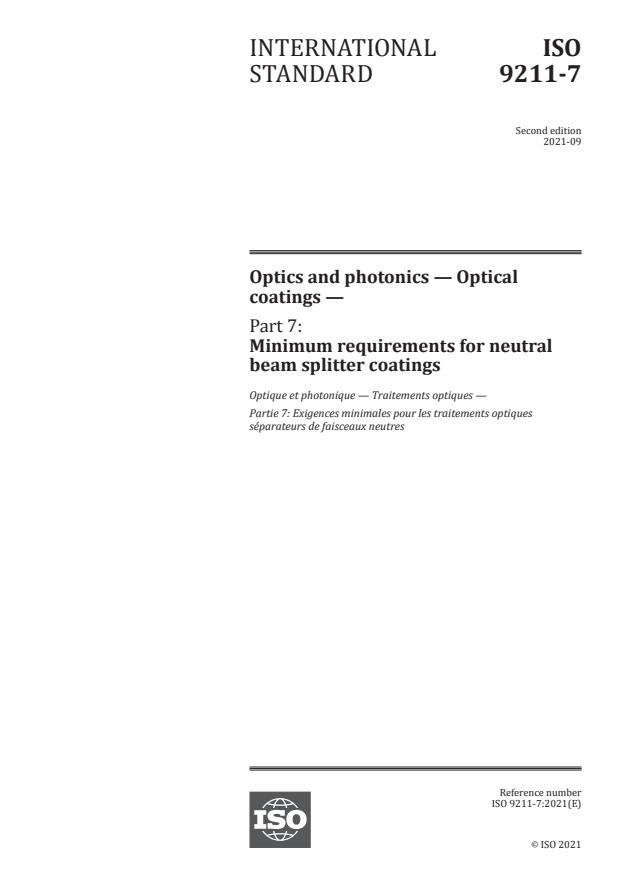
(Main)Optics and photonics — Optical coatings — Part 7: Minimum requirements for neutral beam splitter coatings
General Information
- Abstract
This document specifies minimum requirements on the optical effects and the mechanical, chemical and environmental properties of neutral beam splitter coatings. This document applies to neutral beam splitter coatings for optical applications. Thereby the user is able to rely on defined numerical data while the manufacturer of thin films has the choice for the materials and production method.
- Status
- Published
- Publication Date
- 15-Sep-2021
- Technical Committee
- ISO/TC 172/SC 3 - Optical materials and components
- Drafting Committee
- ISO/TC 172/SC 3/WG 2 - Coatings
- Current Stage
- 9060 - Close of review
- Completion Date
- 02-Dec-2031
Buy Documents
ISO 9211-7:2021 - Optics and photonics -- Optical coatings
ISO 9211-7:2021 - Optics and photonics — Optical coatings — Part 7: Minimum requirements for neutral beam splitter coatings/16/2021
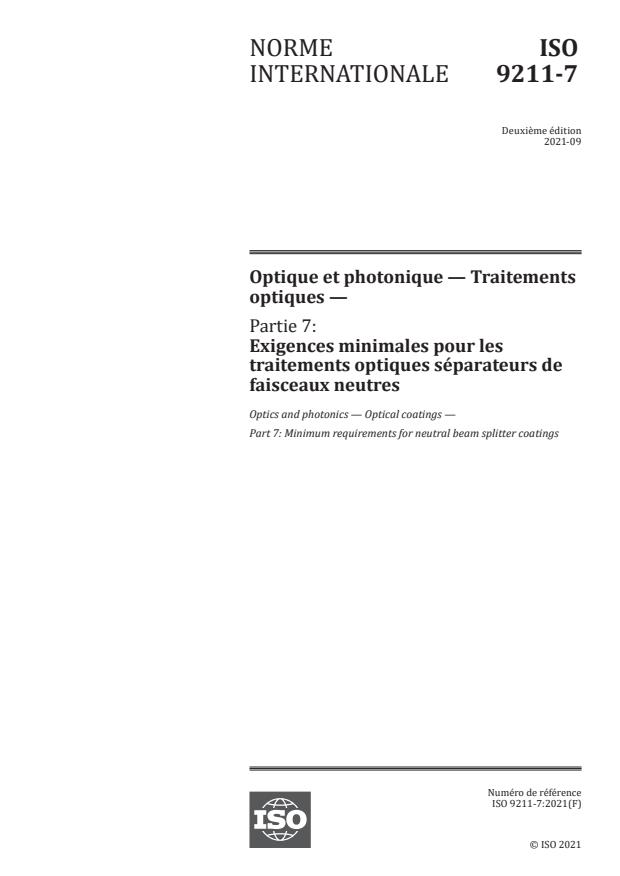
ISO 9211-7:2021 - Optique et photonique -- Traitements optiques
ISO 9211-7:2021 - Optique et photonique — Traitements optiques — Partie 7: Exigences minimales pour les traitements optiques séparateurs de faisceaux neutres/16/2021
Overview
ISO 9211-7:2021 sets minimum requirements for neutral beam splitter coatings used in optics and photonics. These coatings are critical components that divide incident light into reflected and transmitted beams with specific neutral (colorless) characteristics, ensuring reliable and consistent optical performance. The standard addresses the optical, mechanical, chemical, and environmental properties of neutral beam splitter coatings, offering manufacturers flexibility in materials and processes while providing users with clearly defined performance data.
Neutral beam splitters coated according to ISO 9211-7 are characterized by their ability to split light at a constant ratio within a given wavelength range and angle of incidence. This enables predictable optical behavior in applications such as imaging systems, laser systems, and scientific instrumentation.
Key Topics
- Scope: Applies to neutral beam splitter coatings for optical applications, guaranteeing minimum performance requirements.
- Optical Properties: Defines reflectance and transmittance ratios with tolerance levels for various types of neutral beam splitters across visible and near-visible wavelength ranges.
- Types of Coatings: Includes dielectric (D1 to D4) and absorbing (M1, M2) coatings, each with specific reflectance/transmittance ratios and spectral ranges, such as:
- D1: 50% reflectance / 50% transmittance at 450–650 nm
- D2: 70% reflectance / 30% transmittance at 450–650 nm
- M1: 30% reflectance / 30% transmittance at 380–780 nm
- Mechanical, Chemical, and Environmental Durability: Specifies adhesion, abrasion resistance, chemical durability, and resistance to solar radiation, cold, heat, humidity, and temperature changes.
- Testing and Measurement Methods: Aligns with ISO test methods such as ISO 9211-3 (environmental durability), ISO 9211-4 (specific test methods), ISO 13696 (scattered light measurement), and ISO 10110 series for indications in technical drawings.
- Designation and Documentation: Provides a system for standardized coding (e.g., BS ISO 9211-7 – M2) and requirements for indication in optical drawings to ensure consistent communication between manufacturers and users.
Applications
Neutral beam splitter coatings conforming to ISO 9211-7:2021 are widely applied in:
- Optical and Photonic Instruments: Beam splitters in microscopes, telescopes, and cameras rely on neutral, stable coatings to ensure accurate light division without altering color balance.
- Laser Systems: Precise beam splitting with minimal absorption and high durability is critical in scientific and industrial laser setups.
- Imaging Systems: Neutral coatings maintain color fidelity, which is essential in imaging devices used in medical diagnostics, machine vision, and quality control.
- Environmental Exposure Conditions: The coatings' resistance to environmental stressors makes them ideal for outdoor or industrial optical applications requiring long-term reliability.
- Custom Optical Coating Manufacturing: Manufacturers can select materials and methods freely while meeting the standardized minimum requirements, simplifying design and procurement decisions.
Related Standards
ISO 9211-7:2021 is part of the broader ISO 9211 series on optical coatings that covers vocabulary, test methods, and environmental durability:
- ISO 9211-1: Optical coatings vocabulary-defines terms critical for clear communication across optics industries.
- ISO 9211-3: Environmental durability-details conditioning and testing to ensure coatings withstand environmental challenges.
- ISO 9211-4: Specific test methods-provides procedures for adhesion, abrasion resistance, and other performance metrics.
- ISO 10110 Series: Preparation of drawings for optical elements and systems, including surface treatment and coatings (Parts 7, 8, and 9).
- ISO 13696: Test methods for scattered radiation measurement-important for evaluating beam splitter quality.
- ISO 9022-2: Environmental test methods for cold, heat, and humidity conditions, applicable to assessing coating durability.
By following ISO 9211-7:2021 in conjunction with these related standards, manufacturers and users achieve a comprehensive, internationally recognized framework for the design, testing, and application of neutral beam splitter coatings, enhancing performance consistency and reliability in optical systems across diverse industries.
Keywords: neutral beam splitter coatings, optical coatings, optics and photonics, beam splitter standard, ISO 9211-7, optical durability, reflectance, transmittance, optical components, environmental resistance, optical test methods
Relations
- Effective Date
- 23-Apr-2020
Buy Documents
ISO 9211-7:2021 - Optics and photonics -- Optical coatings
ISO 9211-7:2021 - Optics and photonics — Optical coatings — Part 7: Minimum requirements for neutral beam splitter coatings/16/2021
ISO 9211-7:2021 - Optique et photonique -- Traitements optiques
ISO 9211-7:2021 - Optique et photonique — Traitements optiques — Partie 7: Exigences minimales pour les traitements optiques séparateurs de faisceaux neutres/16/2021
Frequently Asked Questions
ISO 9211-7:2021 is a standard published by the International Organization for Standardization (ISO). Its full title is "Optics and photonics — Optical coatings — Part 7: Minimum requirements for neutral beam splitter coatings". This standard covers: This document specifies minimum requirements on the optical effects and the mechanical, chemical and environmental properties of neutral beam splitter coatings. This document applies to neutral beam splitter coatings for optical applications. Thereby the user is able to rely on defined numerical data while the manufacturer of thin films has the choice for the materials and production method.
This document specifies minimum requirements on the optical effects and the mechanical, chemical and environmental properties of neutral beam splitter coatings. This document applies to neutral beam splitter coatings for optical applications. Thereby the user is able to rely on defined numerical data while the manufacturer of thin films has the choice for the materials and production method.
ISO 9211-7:2021 is classified under the following ICS (International Classification for Standards) categories: 37.020 - Optical equipment. The ICS classification helps identify the subject area and facilitates finding related standards.
ISO 9211-7:2021 has the following relationships with other standards: It is inter standard links to ISO 9211-7:2018. Understanding these relationships helps ensure you are using the most current and applicable version of the standard.
ISO 9211-7:2021 is available in PDF format for immediate download after purchase. The document can be added to your cart and obtained through the secure checkout process. Digital delivery ensures instant access to the complete standard document.
Standards Content (Sample)
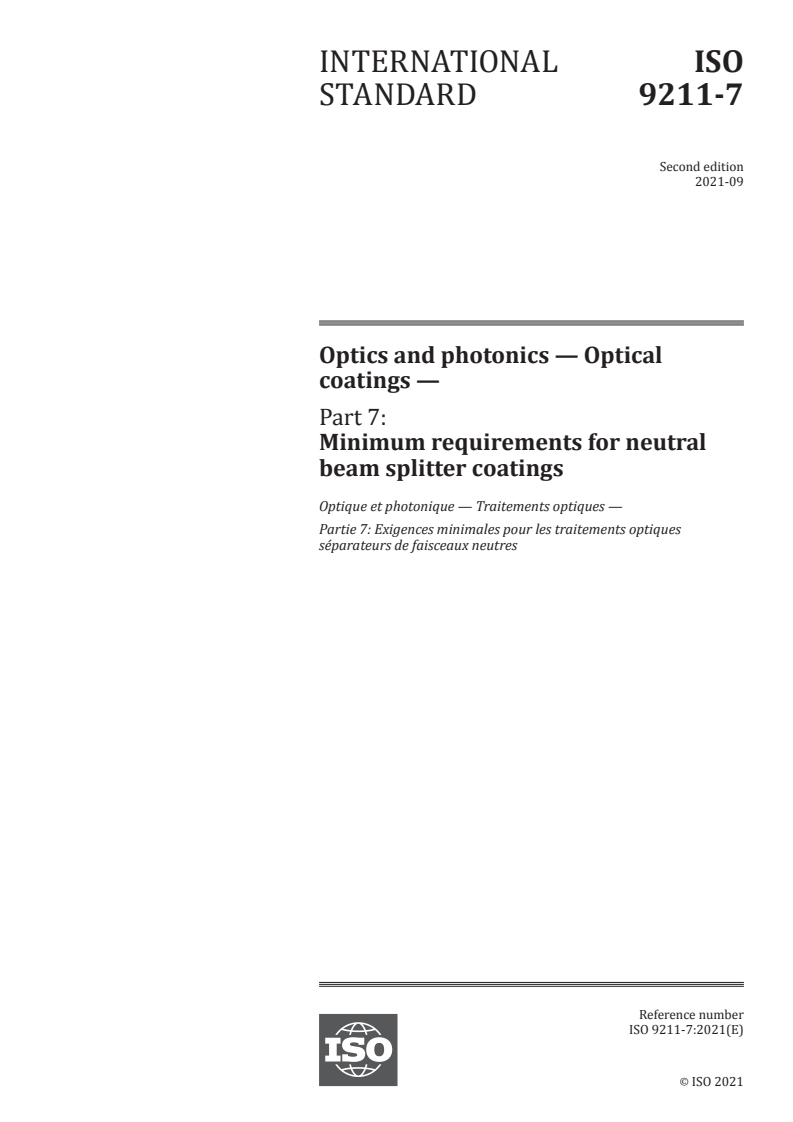
INTERNATIONAL ISO
STANDARD 9211-7
Second edition
2021-09
Optics and photonics — Optical
coatings —
Part 7:
Minimum requirements for neutral
beam splitter coatings
Optique et photonique — Traitements optiques —
Partie 7: Exigences minimales pour les traitements optiques
séparateurs de faisceaux neutres
Reference number
©
ISO 2021
© ISO 2021
All rights reserved. Unless otherwise specified, or required in the context of its implementation, no part of this publication may
be reproduced or utilized otherwise in any form or by any means, electronic or mechanical, including photocopying, or posting
on the internet or an intranet, without prior written permission. Permission can be requested from either ISO at the address
below or ISO’s member body in the country of the requester.
ISO copyright office
CP 401 • Ch. de Blandonnet 8
CH-1214 Vernier, Geneva
Phone: +41 22 749 01 11
Email: copyright@iso.org
Website: www.iso.org
Published in Switzerland
ii © ISO 2021 – All rights reserved
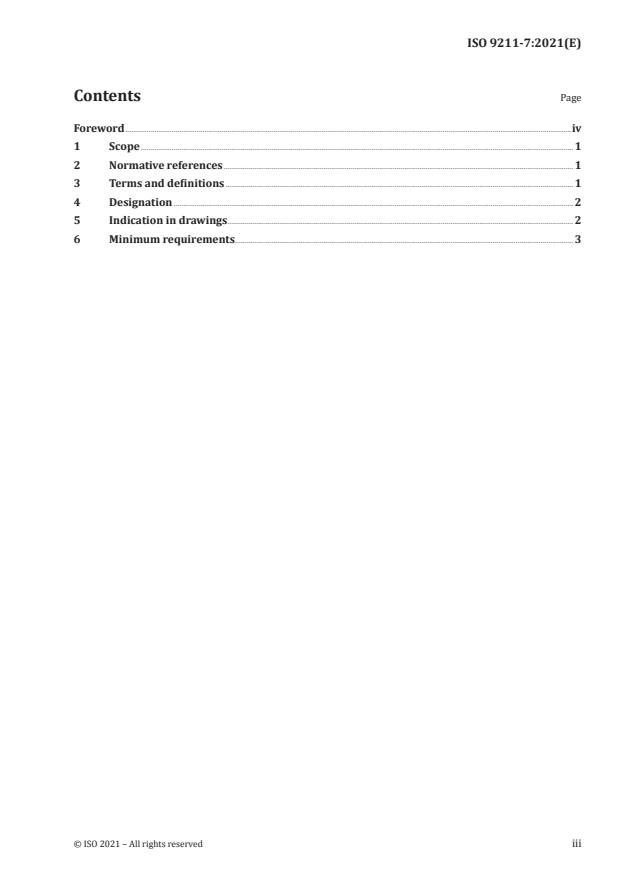
Contents Page
Foreword .iv
1 Scope . 1
2 Normative references . 1
3 Terms and definitions . 1
4 Designation . 2
5 Indication in drawings . 2
6 Minimum requirements . 3
Foreword
ISO (the International Organization for Standardization) is a worldwide federation of national standards
bodies (ISO member bodies). The work of preparing International Standards is normally carried out
through ISO technical committees. Each member body interested in a subject for which a technical
committee has been established has the right to be represented on that committee. International
organizations, governmental and non-governmental, in liaison with ISO, also take part in the work.
ISO collaborates closely with the International Electrotechnical Commission (IEC) on all matters of
electrotechnical standardization.
The procedures used to develop this document and those intended for its further maintenance are
described in the ISO/IEC Directives, Part 1. In particular, the different approval criteria needed for the
different types of ISO documents should be noted. This document was drafted in accordance with the
editorial rules of the ISO/IEC Directives, Part 2 (see www .iso .org/ directives).
Attention is drawn to the possibility that some of the elements of this document may be the subject of
patent rights. ISO shall not be held responsible for identifying any or all such patent rights. Details of
any patent rights identified during the development of the document will be in the Introduction and/or
on the ISO list of patent declarations received (see www .iso .org/ patents).
Any trade name used in this document is information given for the convenience of users and does not
constitute an endorsement.
For an explanation of the voluntary nature of standards, the meaning of ISO specific terms and
expressions related to conformity assessment, as well as information about ISO's adherence to the
World Trade Organization (WTO) principles in the Technical Barriers to Trade (TBT), see www .iso .org/
iso/ foreword .html.
This document was prepared by ISO/TC 172, Optics and photonics, Subcommittee SC 3, Optical materials
and components.
This second edition cancels and replaces the first edition (ISO 9211-7:2018), which has been technically
revised.
The main changes compared to the previous edition are as follows:
— correction of existing errors.
A list of all parts in the ISO 9211 series can be found on the ISO website.
Any feedback or questions on this document should be directed to the user’s national standards body. A
complete listing of these bodies can be found at www .iso .org/ members .html.
iv © ISO 2021 – All rights reserved
INTERNATIONAL STANDARD ISO 9211-7:2021(E)
Optics and photonics — Optical coatings —
Part 7:
Minimum requirements for neutral beam splitter coatings
1 Scope
This document specifies minimum requirements on the optical effects and the mechanical, chemical
and environmental properties of neutral beam splitter coatings. This document applies to neutral beam
splitter coatings for optical applications. Thereby the user is able to rely on defined numerical data
while the manufacturer of thin films has the choice for the materials and production method.
2 Normative references
The following documents are referred to in the text in such a way that some or all of their content
constitutes requirements of this document. For dated references, only the edition cited applies. For
undated references, the latest edition of the referenced document (including any amendments) applies.
ISO 9211-1, Optics and photonics — Optical coatings — Part 1: Vocabulary
ISO 9211-3, Optics and photonics — Optical coatings — Part 3: Environmental durability
ISO 9211-4, Optics and photonics — Optical coatings — Part 4: Specific test methods
ISO 9022-2, Optics and photonics — Environmental test methods — Part 2: Cold, heat and humidity
ISO 10110-7, Optics and photonics — Preparation of drawings for optical elements and systems — Part 7:
Surface imperfections
ISO 10110-8, Optics and photonics — Preparation of drawings for optical elements and systems — Part 8:
Surface texture
ISO 10110-9, Optics and photonics — Preparation of drawings for optical elements and systems — Part 9:
Surface treatment and coating
ISO 13696, Optics and optical instruments — Test methods for radiat
...
INTERNATIONAL ISO
STANDARD 9211-7
Second edition
2021-09
Optics and photonics — Optical
coatings —
Part 7:
Minimum requirements for neutral
beam splitter coatings
Optique et photonique — Traitements optiques —
Partie 7: Exigences minimales pour les traitements optiques
séparateurs de faisceaux neutres
Reference number
©
ISO 2021
© ISO 2021
All rights reserved. Unless otherwise specified, or required in the context of its implementation, no part of this publication may
be reproduced or utilized otherwise in any form or by any means, electronic or mechanical, including photocopying, or posting
on the internet or an intranet, without prior written permission. Permission can be requested from either ISO at the address
below or ISO’s member body in the country of the requester.
ISO copyright office
CP 401 • Ch. de Blandonnet 8
CH-1214 Vernier, Geneva
Phone: +41 22 749 01 11
Email: copyright@iso.org
Website: www.iso.org
Published in Switzerland
ii © ISO 2021 – All rights reserved
Contents Page
Foreword .iv
1 Scope . 1
2 Normative references . 1
3 Terms and definitions . 1
4 Designation . 2
5 Indication in drawings . 2
6 Minimum requirements . 3
Foreword
ISO (the International Organization for Standardization) is a worldwide federation of national standards
bodies (ISO member bodies). The work of preparing International Standards is normally carried out
through ISO technical committees. Each member body interested in a subject for which a technical
committee has been established has the right to be represented on that committee. International
organizations, governmental and non-governmental, in liaison with ISO, also take part in the work.
ISO collaborates closely with the International Electrotechnical Commission (IEC) on all matters of
electrotechnical standardization.
The procedures used to develop this document and those intended for its further maintenance are
described in the ISO/IEC Directives, Part 1. In particular, the different approval criteria needed for the
different types of ISO documents should be noted. This document was drafted in accordance with the
editorial rules of the ISO/IEC Directives, Part 2 (see www .iso .org/ directives).
Attention is drawn to the possibility that some of the elements of this document may be the subject of
patent rights. ISO shall not be held responsible for identifying any or all such patent rights. Details of
any patent rights identified during the development of the document will be in the Introduction and/or
on the ISO list of patent declarations received (see www .iso .org/ patents).
Any trade name used in this document is information given for the convenience of users and does not
constitute an endorsement.
For an explanation of the voluntary nature of standards, the meaning of ISO specific terms and
expressions related to conformity assessment, as well as information about ISO's adherence to the
World Trade Organization (WTO) principles in the Technical Barriers to Trade (TBT), see www .iso .org/
iso/ foreword .html.
This document was prepared by ISO/TC 172, Optics and photonics, Subcommittee SC 3, Optical materials
and components.
This second edition cancels and replaces the first edition (ISO 9211-7:2018), which has been technically
revised.
The main changes compared to the previous edition are as follows:
— correction of existing errors.
A list of all parts in the ISO 9211 series can be found on the ISO website.
Any feedback or questions on this document should be directed to the user’s national standards body. A
complete listing of these bodies can be found at www .iso .org/ members .html.
iv © ISO 2021 – All rights reserved
INTERNATIONAL STANDARD ISO 9211-7:2021(E)
Optics and photonics — Optical coatings —
Part 7:
Minimum requirements for neutral beam splitter coatings
1 Scope
This document specifies minimum requirements on the optical effects and the mechanical, chemical
and environmental properties of neutral beam splitter coatings. This document applies to neutral beam
splitter coatings for optical applications. Thereby the user is able to rely on defined numerical data
while the manufacturer of thin films has the choice for the materials and production method.
2 Normative references
The following documents are referred to in the text in such a way that some or all of their content
constitutes requirements of this document. For dated references, only the edition cited applies. For
undated references, the latest edition of the referenced document (including any amendments) applies.
ISO 9211-1, Optics and photonics — Optical coatings — Part 1: Vocabulary
ISO 9211-3, Optics and photonics — Optical coatings — Part 3: Environmental durability
ISO 9211-4, Optics and photonics — Optical coatings — Part 4: Specific test methods
ISO 9022-2, Optics and photonics — Environmental test methods — Part 2: Cold, heat and humidity
ISO 10110-7, Optics and photonics — Preparation of drawings for optical elements and systems — Part 7:
Surface imperfections
ISO 10110-8, Optics and photonics — Preparation of drawings for optical elements and systems — Part 8:
Surface texture
ISO 10110-9, Optics and photonics — Preparation of drawings for optical elements and systems — Part 9:
Surface treatment and coating
ISO 13696, Optics and optical instruments — Test methods for radiat
...
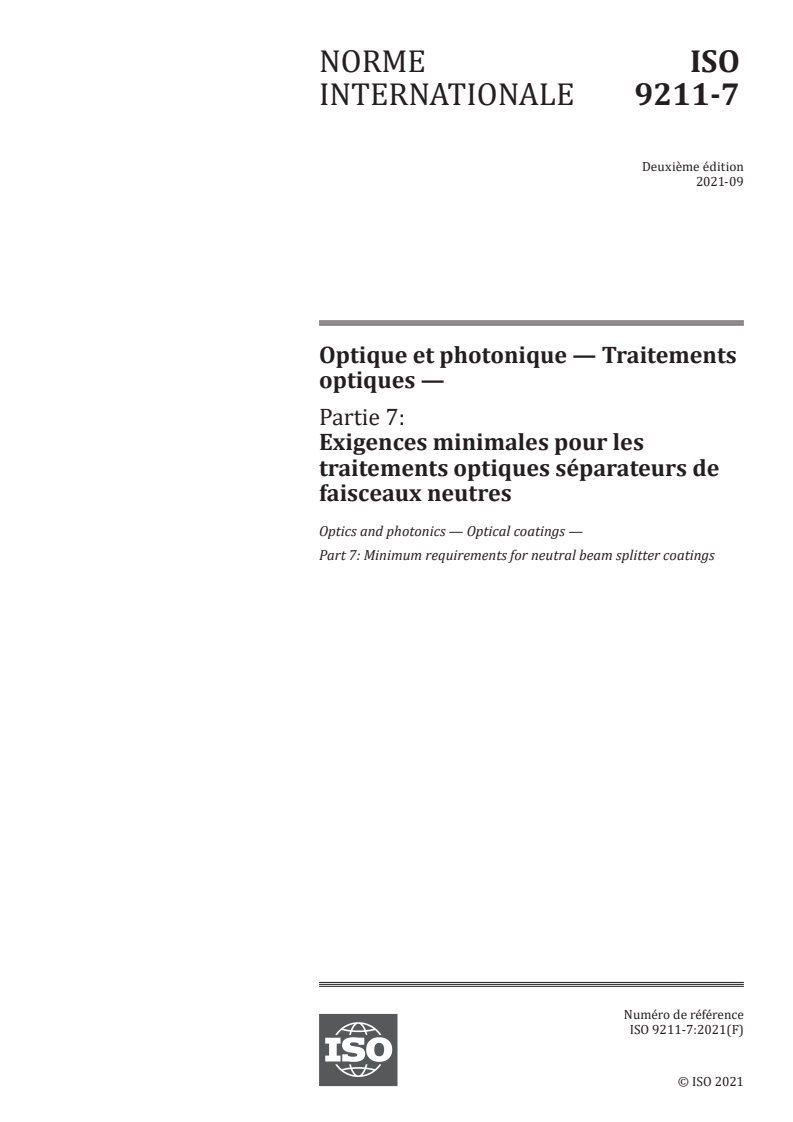
NORME ISO
INTERNATIONALE 9211-7
Deuxième édition
2021-09
Optique et photonique — Traitements
optiques —
Partie 7:
Exigences minimales pour les
traitements optiques séparateurs de
faisceaux neutres
Optics and photonics — Optical coatings —
Part 7: Minimum requirements for neutral beam splitter coatings
Numéro de référence
DOCUMENT PROTÉGÉ PAR COPYRIGHT
© ISO 2021
Droits de reproduction réservés. Sauf indication contraire, aucune partie de cette publication ne peut être reproduite ni utilisée
sous quelque forme que ce soit et par aucun procédé, électronique ou mécanique, y compris la photocopie, l’affichage sur l’internet
ou sur un Intranet, sans autorisation écrite préalable. Les demandes d’autorisation peuvent être adressées à l’ISO à l’adresse ci-
après ou au comité membre de l’ISO dans le pays du demandeur.
ISO copyright office
Case postale 401 • Ch. de Blandonnet 8
CH-1214 Vernier, Genève
Tél.: +41 22 749 01 11
E-mail: copyright@iso.org
Web: www.iso.org
Publié en Suisse
ii
Sommaire Page
Avant-propos .iv
1 Domaine d'application .1
2 Références normatives .1
3 Termes et définitions . 1
4 Désignation . 2
5 Indication sur les dessins .3
6 Exigences minimales .3
iii
Avant-propos
L'ISO (Organisation internationale de normalisation) est une fédération mondiale d'organismes
nationaux de normalisation (comités membres de l'ISO). L'élaboration des Normes internationales est
en général confiée aux comités techniques de l'ISO. Chaque comité membre intéressé par une étude
a le droit de faire partie du comité technique créé à cet effet. Les organisations internationales,
gouvernementales et non gouvernementales, en liaison avec l'ISO participent également aux travaux.
L'ISO collabore étroitement avec la Commission électrotechnique internationale (IEC) en ce qui
concerne la normalisation électrotechnique.
Les procédures utilisées pour élaborer le présent document et celles destinées à sa mise à jour sont
décrites dans les Directives ISO/IEC, Partie 1. Il convient, en particulier de prendre note des différents
critères d'approbation requis pour les différents types de documents ISO. Le présent document
a été rédigé conformément aux règles de rédaction données dans les Directives ISO/IEC, Partie 2
(voir www.iso.org/directives).
L'attention est attirée sur le fait que certains des éléments du présent document peuvent faire l'objet de
droits de propriété intellectuelle ou de droits analogues. L'ISO ne saurait être tenue pour responsable
de ne pas avoir identifié de tels droits de propriété et averti de leur existence. Les détails concernant
les références aux droits de propriété intellectuelle ou autres droits analogues identifiés lors de
l'élaboration du document sont indiqués dans l'Introduction et/ou dans la liste des déclarations de
brevets reçues par l'ISO (voir www.iso.org/brevets).
Les appellations commerciales éventuellement mentionnées dans le présent document sont données
pour information, par souci de commodité, à l’intention des utilisateurs et ne sauraient constituer un
engagement.
Pour une explication de la nature volontaire des normes, la signification des termes et expressions
spécifiques de l'ISO liés à l'évaluation de la conformité, ou pour toute information au sujet de l'adhésion
de l'ISO aux principes de l’Organisation mondiale du commerce (OMC) concernant les obstacles
techniques au commerce (OTC), voir www.iso.org/avant-propos.
Le présent document a été élaboré par le comité technique ISO/TC 172, Optique et photonique, sous-
comité SC 3, Matériaux et composants optiques.
Cette seconde édition annule et remplace la première édition (ISO 9211-7:2018), qui a fait l’objet d’une
révision technique.
Les principales modifications par rapport à l’édition précédente sont les suivantes:
— correction d'erreurs existantes.
Une liste de toutes les parties de la série ISO 9211 se trouve sur le site web de l’ISO.
Il convient que l’utilisateur adresse tout retour d’information ou toute question concernant le présent
document à l’organisme national de normalisation de son pays. Une liste exhaustive desdits organismes
se trouve à l’adresse www.iso.org/fr/members.html.
iv
NORME INTERNATIONALE ISO 9211-7:2021(F)
Optique et photonique — Traitements optiques —
Partie 7:
Exigences minimales pour les traitements optiques
séparateurs de faisceaux neutres
1 Domaine d'application
Le présent document spécifie des exigences minimales sur les effets optiques et les propriétés
mécaniques, chimiques et environnementales des traitements optiques séparateurs de faisceaux
neutres. Le présent document s’applique aux traitements optiques séparateurs de faisceaux neutres
pour des applications optiques. Ainsi, l'utilisateur peut s'appuyer sur des données numériques définies
alors que le fabricant de films minces a le choix entre les matériaux et la méthode de production.
2 Références normatives
Les documents suivants sont cités dans le texte de sorte qu’ils constituent, pour tout ou partie de leur
contenu, des exigences du présent document. Pour les références datées, seule l’édition citée s’applique.
Pour les références non datées, la dernière édition du document de référence s'applique (y compris les
éventuels amendements).
ISO 9211-1, Optique et photonique — Traitements optiques — Partie 1: Vocabulaire
ISO 9211-3, Optique et photonique — Traitements optiques — Partie 3: Durabilité environnementale
ISO 9211-4, Optique et photonique — Traitements optiques — Partie 4: Méthodes d’essai spécifiques
ISO 9022-2, Optique et photonique — Méthodes d'essais d'environnement — Partie 2: Froid, chaleur et
humidité
ISO 10110-7, Optique et photonique — Indications sur les dessins pour éléments et systèmes optiques —
Partie 7: Imperfections de surface
ISO 10110-8, Optique et photonique — Indications sur les dessins pour éléments et systèmes optiques —
Partie 8: État de surface
ISO 10110-9, Optique et photonique — Indications sur les dessins pour éléments et systèmes optiques —
Partie 9: Traitement de surface et revêtement
ISO 13696, Optique et instruments d’optique — Méthodes d’essai du rayonnement diffusé par les composants
optiques
3 Termes et définitions
Pour les besoins du présent document, les termes et définitions donnés dans l'ISO 9211-1 ainsi que les
suivants s'appliquent.
L’ISO et l’IEC tiennent à jour des bases de données terminologiques destinée
...
NORME ISO
INTERNATIONALE 9211-7
Deuxième édition
2021-09
Optique et photonique — Traitements
optiques —
Partie 7:
Exigences minimales pour les
traitements optiques séparateurs de
faisceaux neutres
Optics and photonics — Optical coatings —
Part 7: Minimum requirements for neutral beam splitter coatings
Numéro de référence
DOCUMENT PROTÉGÉ PAR COPYRIGHT
© ISO 2021
Droits de reproduction réservés. Sauf indication contraire, aucune partie de cette publication ne peut être reproduite ni utilisée
sous quelque forme que ce soit et par aucun procédé, électronique ou mécanique, y compris la photocopie, l’affichage sur l’internet
ou sur un Intranet, sans autorisation écrite préalable. Les demandes d’autorisation peuvent être adressées à l’ISO à l’adresse ci-
après ou au comité membre de l’ISO dans le pays du demandeur.
ISO copyright office
Case postale 401 • Ch. de Blandonnet 8
CH-1214 Vernier, Genève
Tél.: +41 22 749 01 11
E-mail: copyright@iso.org
Web: www.iso.org
Publié en Suisse
ii
Sommaire Page
Avant-propos .iv
1 Domaine d'application .1
2 Références normatives .1
3 Termes et définitions . 1
4 Désignation . 2
5 Indication sur les dessins .3
6 Exigences minimales .3
iii
Avant-propos
L'ISO (Organisation internationale de normalisation) est une fédération mondiale d'organismes
nationaux de normalisation (comités membres de l'ISO). L'élaboration des Normes internationales est
en général confiée aux comités techniques de l'ISO. Chaque comité membre intéressé par une étude
a le droit de faire partie du comité technique créé à cet effet. Les organisations internationales,
gouvernementales et non gouvernementales, en liaison avec l'ISO participent également aux travaux.
L'ISO collabore étroitement avec la Commission électrotechnique internationale (IEC) en ce qui
concerne la normalisation électrotechnique.
Les procédures utilisées pour élaborer le présent document et celles destinées à sa mise à jour sont
décrites dans les Directives ISO/IEC, Partie 1. Il convient, en particulier de prendre note des différents
critères d'approbation requis pour les différents types de documents ISO. Le présent document
a été rédigé conformément aux règles de rédaction données dans les Directives ISO/IEC, Partie 2
(voir www.iso.org/directives).
L'attention est attirée sur le fait que certains des éléments du présent document peuvent faire l'objet de
droits de propriété intellectuelle ou de droits analogues. L'ISO ne saurait être tenue pour responsable
de ne pas avoir identifié de tels droits de propriété et averti de leur existence. Les détails concernant
les références aux droits de propriété intellectuelle ou autres droits analogues identifiés lors de
l'élaboration du document sont indiqués dans l'Introduction et/ou dans la liste des déclarations de
brevets reçues par l'ISO (voir www.iso.org/brevets).
Les appellations commerciales éventuellement mentionnées dans le présent document sont données
pour information, par souci de commodité, à l’intention des utilisateurs et ne sauraient constituer un
engagement.
Pour une explication de la nature volontaire des normes, la signification des termes et expressions
spécifiques de l'ISO liés à l'évaluation de la conformité, ou pour toute information au sujet de l'adhésion
de l'ISO aux principes de l’Organisation mondiale du commerce (OMC) concernant les obstacles
techniques au commerce (OTC), voir www.iso.org/avant-propos.
Le présent document a été élaboré par le comité technique ISO/TC 172, Optique et photonique, sous-
comité SC 3, Matériaux et composants optiques.
Cette seconde édition annule et remplace la première édition (ISO 9211-7:2018), qui a fait l’objet d’une
révision technique.
Les principales modifications par rapport à l’édition précédente sont les suivantes:
— correction d'erreurs existantes.
Une liste de toutes les parties de la série ISO 9211 se trouve sur le site web de l’ISO.
Il convient que l’utilisateur adresse tout retour d’information ou toute question concernant le présent
document à l’organisme national de normalisation de son pays. Une liste exhaustive desdits organismes
se trouve à l’adresse www.iso.org/fr/members.html.
iv
NORME INTERNATIONALE ISO 9211-7:2021(F)
Optique et photonique — Traitements optiques —
Partie 7:
Exigences minimales pour les traitements optiques
séparateurs de faisceaux neutres
1 Domaine d'application
Le présent document spécifie des exigences minimales sur les effets optiques et les propriétés
mécaniques, chimiques et environnementales des traitements optiques séparateurs de faisceaux
neutres. Le présent document s’applique aux traitements optiques séparateurs de faisceaux neutres
pour des applications optiques. Ainsi, l'utilisateur peut s'appuyer sur des données numériques définies
alors que le fabricant de films minces a le choix entre les matériaux et la méthode de production.
2 Références normatives
Les documents suivants sont cités dans le texte de sorte qu’ils constituent, pour tout ou partie de leur
contenu, des exigences du présent document. Pour les références datées, seule l’édition citée s’applique.
Pour les références non datées, la dernière édition du document de référence s'applique (y compris les
éventuels amendements).
ISO 9211-1, Optique et photonique — Traitements optiques — Partie 1: Vocabulaire
ISO 9211-3, Optique et photonique — Traitements optiques — Partie 3: Durabilité environnementale
ISO 9211-4, Optique et photonique — Traitements optiques — Partie 4: Méthodes d’essai spécifiques
ISO 9022-2, Optique et photonique — Méthodes d'essais d'environnement — Partie 2: Froid, chaleur et
humidité
ISO 10110-7, Optique et photonique — Indications sur les dessins pour éléments et systèmes optiques —
Partie 7: Imperfections de surface
ISO 10110-8, Optique et photonique — Indications sur les dessins pour éléments et systèmes optiques —
Partie 8: État de surface
ISO 10110-9, Optique et photonique — Indications sur les dessins pour éléments et systèmes optiques —
Partie 9: Traitement de surface et revêtement
ISO 13696, Optique et instruments d’optique — Méthodes d’essai du rayonnement diffusé par les composants
optiques
3 Termes et définitions
Pour les besoins du présent document, les termes et définitions donnés dans l'ISO 9211-1 ainsi que les
suivants s'appliquent.
L’ISO et l’IEC tiennent à jour des bases de données terminologiques destinée
...