

ISO 18183-2:2024
(Main)Geometrical product specifications (GPS) — Partition — Part 2: Nominal model
General Information
- Abstract
This document specifies the methods used to partition a nominal model.
- Status
- Published
- Publication Date
- 04-Feb-2024
- Drafting Committee
- ISO/TC 213/AG 12 - Mathematical support group
- Current Stage
- 6060 - International Standard published
- Start Date
- 05-Feb-2024
- Due Date
- 27-Nov-2023
- Completion Date
- 05-Feb-2024
Buy Documents
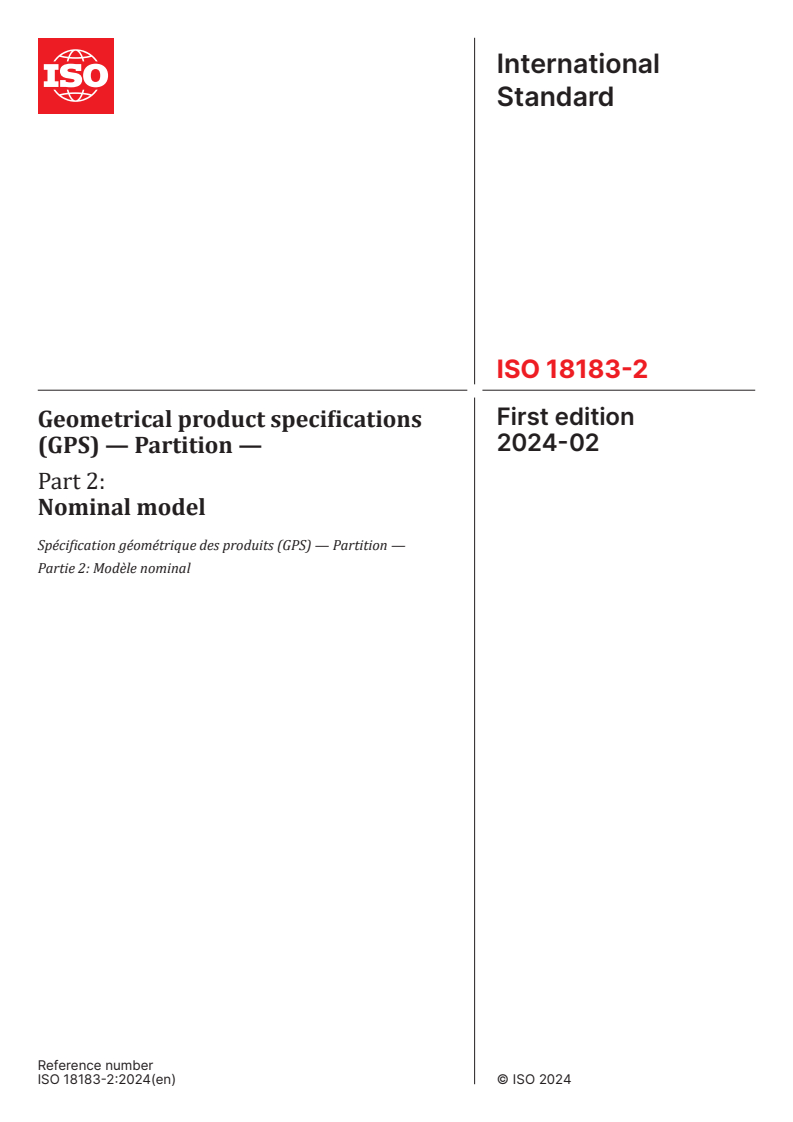
ISO 18183-2:2024 - Geometrical product specifications (GPS) — Partition — Part 2: Nominal model Released:5. 02. 2024
ISO 18183-2:2024 - Spécification géométrique des produits (GPS) — Partition — Partie 2: Modele nominal Released:5. 02. 2024
Overview
ISO 18183-2:2024 is an International Standard developed by the International Organization for Standardization (ISO) that specifies the methods used to partition a nominal model within the framework of Geometrical Product Specifications (GPS). As Part 2 of the ISO 18183 series on Partition, this document focuses on defining and formalizing operations such as selection, simplification, and subdivision applied to nominal models used in solid and geometrical modeling, including CAD systems.
This standard supports the efficient generation, interpretation, and verification of geometrical models by providing clear rules for partitioning a nominal model into features. It plays a crucial role in the digital manufacturing ecosystem, especially for autonomous production systems, by enabling smart identification and recording of nominal model features without the need for human intervention.
Key Topics
Nominal Model Partitioning
ISO 18183-2 defines procedures for dividing a nominal geometrical product model into distinct partitioned features. These features can be derived from surfaces, edges, vertices, and blend edges of 3D models.Operations: Selection, Simplification, Subdivision
The standard formalizes three main operations:- Selection: Choosing relevant features or areas of the model.
- Simplification: Combining multiple features into simplified, unified entities.
- Subdivision: Breaking down features into more detailed sub-features, such as datum targets or restricted areas.
Default Nominal Partition
Unless otherwise specified, the nominal model is partitioned by default into single surfaces as the initial set of partitioned features, following the geometrical element rules from ISO 8015.Relationship with ISO GPS Matrix Model
This standard is part of the general GPS standards influencing multiple chain links in the ISO GPS matrix, including feature specifications, conformity, and measurement. It supports consistent application alongside other GPS standards such as ISO 1101 (geometrical tolerancing), ISO 5459 (datums), and ISO 14253-1 (decision rules for conformity).Applications in CAD and Manufacturing
By defining systematic nominal partitioning methods, the standard enhances the interoperability of CAD data with verification and inspection processes while supporting smart manufacturing and automated quality control.
Applications
Geometrical Product Specification (GPS) Implementation
Enables precise and standardized partitioning of nominal models, essential for defining tolerances, datums, and measurement zones in product design and verification.Computer-Aided Design (CAD) Systems
Facilitates the automated generation and annotation of geometrical features, improving clarity and reducing errors in design documentation.Smart Manufacturing and Inspection
Supports automated interpretation of nominal models within autonomous production lines, permitting software systems to identify toleranced regions and verification features without manual input.Quality Assurance and Verification
Assists in creating clear, partitioned feature sets that can be directly used for inspection planning and conformity assessment according to established ISO GPS decision rules.Standardization Across Industries
Applies to sectors requiring precise geometrical specifications such as aerospace, automotive, machinery, and precision engineering, enabling consistent communication of product geometry.
Related Standards
ISO 18183-2:2024 works in conjunction with other key standards to ensure comprehensive geometrical product specification management:
ISO 18183-1: Vocabulary and Basic Concepts
Defines fundamental terminology and concepts related to partitioning models.ISO 18183-3: Methods for Specification and Verification
Details procedures on how to specify and verify partitioned features in the nominal model.ISO 1101:2017: Geometrical Tolerancing
Establishes tolerances of form, orientation, location, and run-out essential for GPS.ISO 5459:2011: Datums and Datum Systems
Specifies datum features and systems relevant for positioning within the nominal model.ISO 8015: Fundamentals of GPS
Provides fundamental principles and rules that underpin partitioning and geometrical element definitions.ISO 14253-1: Inspection and Decision Rules
Contains decision rules for verifying conformity of products against specifications.ISO 14638: GPS Matrix Model
Offers an overview and system framework for the ISO GPS standards ecosystem.
By aligning with these related standards, ISO 18183-2:2024 ensures integrated and consistent application of geometrical product specifications throughout design, manufacturing, and quality control processes.
ISO 18183-2:2024 streamlines nominal model partitioning to enhance clarity, automation, and precision in geometrical product specification. Its adoption supports modern manufacturing demands for interoperable and intelligent geometrical modeling, increasing efficiency and reducing ambiguity in product definition and verification.
Relations
- Effective Date
- 12-Feb-2026
- Effective Date
- 06-Jun-2022
Buy Documents
ISO 18183-2:2024 - Geometrical product specifications (GPS) — Partition — Part 2: Nominal model Released:5. 02. 2024
ISO 18183-2:2024 - Spécification géométrique des produits (GPS) — Partition — Partie 2: Modele nominal Released:5. 02. 2024
Get Certified
Connect with accredited certification bodies for this standard

BSMI (Bureau of Standards, Metrology and Inspection)
Taiwan's standards and inspection authority.
Sponsored listings
Frequently Asked Questions
ISO 18183-2:2024 is a standard published by the International Organization for Standardization (ISO). Its full title is "Geometrical product specifications (GPS) — Partition — Part 2: Nominal model". This standard covers: This document specifies the methods used to partition a nominal model.
This document specifies the methods used to partition a nominal model.
ISO 18183-2:2024 is classified under the following ICS (International Classification for Standards) categories: 17.040.40 - Geometrical Product Specification (GPS). The ICS classification helps identify the subject area and facilitates finding related standards.
ISO 18183-2:2024 has the following relationships with other standards: It is inter standard links to EN ISO 18183-2:2024, ISO 2812-1:2017. Understanding these relationships helps ensure you are using the most current and applicable version of the standard.
ISO 18183-2:2024 is available in PDF format for immediate download after purchase. The document can be added to your cart and obtained through the secure checkout process. Digital delivery ensures instant access to the complete standard document.
Standards Content (Sample)
International
Standard
ISO 18183-2
First edition
Geometrical product specifications
2024-02
(GPS) — Partition —
Part 2:
Nominal model
Spécification géométrique des produits (GPS) — Partition —
Partie 2: Modèle nominal
Reference number
© ISO 2024
All rights reserved. Unless otherwise specified, or required in the context of its implementation, no part of this publication may
be reproduced or utilized otherwise in any form or by any means, electronic or mechanical, including photocopying, or posting on
the internet or an intranet, without prior written permission. Permission can be requested from either ISO at the address below
or ISO’s member body in the country of the requester.
ISO copyright office
CP 401 • Ch. de Blandonnet 8
CH-1214 Vernier, Geneva
Phone: +41 22 749 01 11
Email: copyright@iso.org
Website: www.iso.org
Published in Switzerland
ii
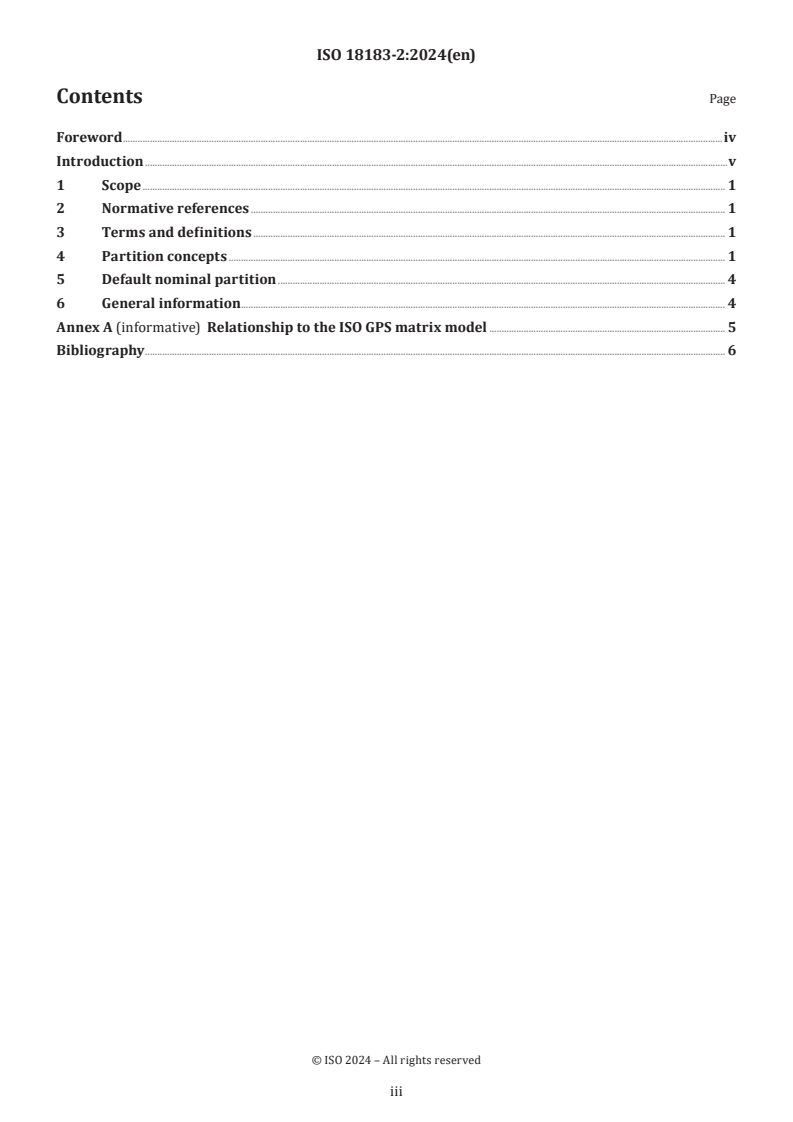
Contents Page
Foreword .iv
Introduction .v
1 Scope . 1
2 Normative references . 1
3 Terms and definitions . 1
4 Partition concepts . 1
5 Default nominal partition . 4
6 General information . 4
Annex A (informative) Relationship to the ISO GPS matrix model . 5
Bibliography . 6
iii
Foreword
ISO (the International Organization for Standardization) is a worldwide federation of national standards
bodies (ISO member bodies). The work of preparing International Standards is normally carried out through
ISO technical committees. Each member body interested in a subject for which a technical committee
has been established has the right to be represented on that committee. International organizations,
governmental and non-governmental, in liaison with ISO, also take part in the work. ISO collaborates closely
with the International Electrotechnical Commission (IEC) on all matters of electrotechnical standardization.
The procedures used to develop this document and those intended for its further maintenance are described
in the ISO/IEC Directives, Part 1. In particular, the different approval criteria needed for the different types
of ISO document should be noted. This document was drafted in accordance with the editorial rules of the
ISO/IEC Directives, Part 2 (see www.iso.org/directives).
ISO draws attention to the possibility that the implementation of this document may involve the use of (a)
patent(s). ISO takes no position concerning the evidence, validity or applicability of any claimed patent
rights in respect thereof. As of the date of publication of this document, ISO had not received notice of (a)
patent(s) which may be required to implement this document. However, implementers are cautioned that
this may not represent the latest information, which may be obtained from the patent database available at
www.iso.org/patents. ISO shall not be held responsible for identifying any or all such patent rights.
Any trade name used in this document is information given for the convenience of users and does not
constitute an endorsement.
For an explanation of the voluntary nature of standards, the meaning of ISO specific terms and expressions
related to conformity assessment, as well as information about ISO’s adherence to the World Trade
Organization (WTO) principles in the Technical Barriers to Trade (TBT), see www.iso.org/iso/foreword.html.
This document was prepared by Technical Committee ISO/TC 213, Dimensional and geometrical product
specifications and verification, in collaboration with the European Committee for Standardization (CEN)
Technical Committee CEN/TC 290, Dimensional and geometrical product specification and verification, in
accordance with the Agreement on technical cooperation between ISO and CEN (Vienna Agreement).
A list of all parts in the ISO 18183 series can be found on the ISO website.
Any feedback or questions on this document should be directed to the user’s national standards body. A
complete listing of these bodies can be found at www.iso.org/members.html.
iv
Introduction
This document is a geometrical product specification (GPS) standard and is to be regarded as a general GPS
standard (see ISO 14638). It influences chain links B, C and E of all the chains of standards in the ISO GPS
matrix model.
The ISO GPS matrix model given in ISO 14638 gives an overview of the ISO GPS system, of which this
document is a part. The fundamental rules of ISO GPS given in ISO 8015 apply to this document and the
default decision rules given in ISO 14253-1 apply to specifications made in accordance with this document,
unless otherwise indicated.
For more detailed information on the relation of this document to other standards and the ISO GPS matrix
model, see Annex A.
1)
This document applies the concepts from ISO 18183-1 in specifying the partition of the nominal model.
1) Under preparation. Stage at the time of publication: ISO/FDIS 18183-1:2023.
v
International Standard ISO 18183-2:2024(en)
Geometrical product specifications (GPS) — Partition —
Part 2:
Nominal model
1 Scope
This document specifies the methods used to partition a nominal model.
2 Normative references
The following documents are referred to in the text in such a way that some or all of their content constitutes
requirements of this document. For dated references, only the edition cited applies. For undated references,
the latest edition of the referenced document (includi
...
Norme
internationale
ISO 18183-2
Première édition
Spécification géométrique des
2024-02
produits (GPS) — Partition —
Partie 2:
Modèle nominal
Geometrical product specifications (GPS) — Partition —
Part 2: Nominal model
Numéro de référence
DOCUMENT PROTÉGÉ PAR COPYRIGHT
© ISO 2024
Tous droits réservés. Sauf prescription différente ou nécessité dans le contexte de sa mise en œuvre, aucune partie de cette
publication ne peut être reproduite ni utilisée sous quelque forme que ce soit et par aucun procédé, électronique ou mécanique,
y compris la photocopie, ou la diffusion sur l’internet ou sur un intranet, sans autorisation écrite préalable. Une autorisation peut
être demandée à l’ISO à l’adresse ci-après ou au comité membre de l’ISO dans le pays du demandeur.
ISO copyright office
Case postale 401 • Ch. de Blandonnet 8
CH-1214 Vernier, Genève
Tél.: +41 22 749 01 11
E-mail: copyright@iso.org
Web: www.iso.org
Publié en Suisse
ii
Sommaire Page
Avant-propos .iv
Introduction .v
1 Domaine d’application . 1
2 Références normatives . 1
3 Termes et définitions . 1
4 Concepts de la partition . 1
5 Partition nominale par défaut . . 4
6 Information générale . 4
Annexe A (informative) Relation avec le modèle de matrice ISO GPS .5
Bibliographie .6
iii
Avant-propos
L’ISO (Organisation internationale de normalisation) est une fédération mondiale d’organismes nationaux
de normalisation (comités membres de l’ISO). L’élaboration des Normes internationales est en général
confiée aux comités techniques de l’ISO. Chaque comité membre intéressé par une étude a le droit de faire
partie du comité technique créé à cet effet. Les organisations internationales, gouvernementales et non
gouvernementales, en liaison avec l’ISO participent également aux travaux. L’ISO collabore étroitement avec
la Commission électrotechnique internationale (IEC) en ce qui concerne la normalisation électrotechnique.
Les procédures utilisées pour élaborer le présent document et celles destinées à sa mise à jour sont
décrites dans les Directives ISO/IEC, Partie 1. Il convient, en particulier, de prendre note des différents
critères d’approbation requis pour les différents types de documents ISO. Le présent document a
été rédigé conformément aux règles de rédaction données dans les Directives ISO/IEC, Partie 2 (voir
www.iso.org/directives).
L’ISO attire l’attention sur le fait que la mise en application du présent document peut entraîner l’utilisation
d’un ou de plusieurs brevets. L’ISO ne prend pas position quant à la preuve, à la validité et à l’applicabilité de
tout droit de brevet revendiqué à cet égard. À la date de publication du présent document, l’ISO n’avait pas
reçu notification qu’un ou plusieurs brevets pouvaient être nécessaires à sa mise en application. Toutefois,
il y a lieu d’avertir les responsables de la mise en application du présent document que des informations
plus récentes sont susceptibles de figurer dans la base de données de brevets, disponible à l’adresse
www.iso.org/brevets. L’ISO ne saurait être tenue pour responsable de ne pas avoir identifié tout ou partie de
tels droits de propriété.
Les appellations commerciales éventuellement mentionnées dans le présent document sont données pour
information, par souci de commodité, à l’intention des utilisateurs et ne sauraient constituer un engagement.
Pour une explication de la nature volontaire des normes, la signification des termes et expressions
spécifiques de l’ISO liés à l’évaluation de la conformité, ou pour toute information au sujet de l’adhésion de
l’ISO aux principes de l’Organisation mondiale du commerce (OMC) concernant les obstacles techniques au
commerce (OTC), voir www.iso.org/avant-propos.
Le présent document a été élaboré par le comité technique ISO/TC 213, Spécifications et vérification
dimensionnelles et géométriques des produits, en collaboration avec le comité technique CEN/TC 290,
Spécification dimensionnelle et géométrique des produits, et vérification correspondante, du Comité européen
de normalisation (CEN) conformément à l’Accord de coopération technique entre l’ISO et le CEN (Accord de
Vienne).
Une liste de toutes les parties de la série ISO 18183 se trouve sur le site web de l’ISO.
Il convient que l’utilisateur adresse tout retour d’information ou toute question concernant le présent
document à l’organisme national de normalisation de son pays. Une liste exhaustive desdits organismes se
trouve à l’adresse www.iso.org/fr/members.html.
iv
Introduction
Le présent document est une norme de spécification géométrique des produits (GPS) et doit être considéré
comme une norme GPS générale (voir l’ISO 14638). Il influence les maillons B, C et E de toutes les chaînes de
normes dans le modèle de matrice ISO GPS.
Le modèle de matrice ISO GPS de l’ISO 14638 donne une vue d’ensemble du système ISO GPS dont le présent
document fait partie. Les principes fondamentaux de l’ISO GPS donnés dans l’ISO 8015 s’appliquent au présent
document et les règles de décision par défaut données dans l’ISO 14253-1 s’appliquent aux spécifications
faites conformément au présent document, sauf indication contraire.
Pour de plus amples informations sur la relation du présent document avec les autres normes, ainsi que le
modèle de matrice ISO GPS, voir l’Annexe A.
1)
Le présent document applique les concepts de l’ISO 18183-1 en spécifiant la partition du modèle nominal.
1) En préparation. Etape au moment de la publication: ISO/FDIS 18183-1:2023.
v
Norme internationale ISO 18183-2:2024(fr)
Spécification géométrique des produits (GPS) — Partition —
Partie 2:
Modèle nominal
1 Domaine d’application
Le présent document spécifie les méthodes utilisées pour obtenir la partition d’un modèle nominal.
2 Références normatives
Les documents suivants sont cités dans le texte de sorte qu’ils constituent, pour tout ou partie de leur
contenu, des exigences du présent document. Pour les références datées, seule l’édition citée s’applique. Pour
les références non datées, la dernière édition du document de référence s’applique (y compris les éventuels
amendements).
2)
ISO 18183-1 , Spécification géométrique des produits (GPS) — Partition — Partie 1: Vocabulaire et concepts de
base
...