

ISO 4948-1
(Main)Steels — Classification — Part 1: Classification of steels based on chemical composition
- Abstract
This document specifies the definition and classification of steels. It classifies the steel grades as main criteria by the chemical composition into non-alloy, low-alloy and high-alloy steels.
- Status
- Not Published
- Technical Committee
- ISO/TC 17 - Steel
- Drafting Committee
- ISO/TC 17/WG 30 - Revision of ISO 4948-1
- Current Stage
- 6000 - International Standard under publication - 60 Publication
- Start Date
- 22-Oct-2026
Buy Documents

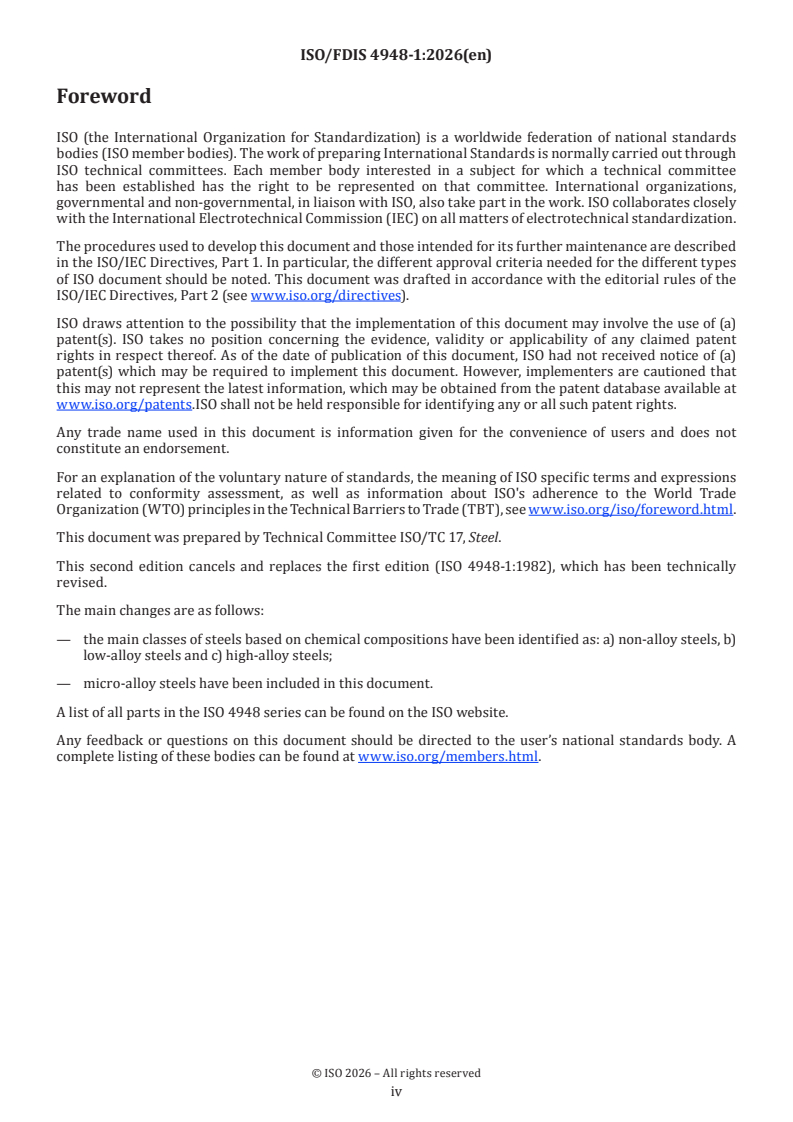
ISO/FDIS 4948-1 - Steels — Classification — Part 1: Classification of steels based on chemical composition
REDLINE ISO/FDIS 4948-1 - Steels — Classification — Part 1: Classification of steels based on chemical composition
ISO 4948-1, published by ISO, defines steel and classifies steels by chemical composition. It sets 2.0% carbon as the usual dividing line between steel and cast iron, and it groups steels into non-alloy, low-alloy and high-alloy grades for use by steel makers, specifiers, users and other technical readers.
What does ISO 4948-1 specify?
ISO 4948-1 specifies how to define steel and how to classify steel grades by chemical composition. The classification is based on the specified values for the ladle analyses, referred to here as cast analysis, of the elements listed in the document.
ISO 4948-1 is organized into scope, normative references, terms and definitions, and classification by chemical composition. Clause 4 covers the general method, non-alloy steel, low-alloy steel and high-alloy steel, with a bibliography at the end.
What are the key requirements of ISO 4948-1?
ISO 4948-1 classifies steels from their chemical composition, but the practical rule is not just “what is in the steel” - it is which analysis basis and which thresholds are used. For a buyer, specifier or quality manager, that matters because the same grade can fall into a different class depending on how the composition is stated and checked.
- Steel definition and carbon limit - Clause 3.1 defines steel as an iron-based material with generally less than 2% carbon, and says 2.0% is the usual dividing line between steel and cast iron. This is the basic identity check before classification starts.
- Use cast analysis for classification - Clause 4.1.1 says classification is based on the cast analysis specified in the product standard or specification, and all percentages are by mass. In practice, the grade is classified from the chemistry used for supply and designation, not from a loose general impression of composition.
- Use the minimum value rule - Clause 4.1.2 says classification is determined by the minimum specified value for each element. If only a maximum is given, 70% of that maximum is taken as the estimated minimum; this affects borderline grades.
- Handle product analysis correctly - Clause 4.1.4 says that if product analysis is used, an equivalent cast analysis is calculated with the permitted deviations given in the relevant product standard or specification. If there is no product standard, specification or exact composition, Clause 4.1.5 uses the manufacturer’s reported actual cast analysis.
- Non-alloy steel classification - Clause 4.2 says non-alloy steels are grades in which none of the limit values in Table 1 is reached. Residual elements are allowed within the Table 1 limits, and Table 1 is the boundary between non-alloy and low-alloy steels.
- Low-alloy steel classification - Clause 4.3 says low-alloy steels have at least one alloying element at or above the Table 1 threshold, while any alloying element stays below 5.0% and the total alloying elements stay below 8.0%. This is the main rule used to separate “alloyed” from “non-alloyed” steel in practice.
- Micro-alloy and heat-treatable subgroups - Clause 4.3.2 defines micro-alloy steel for construction purposes through Table 2, using elements such as B, La, Nb, Ti, V and Zr, with limits for Cr, Ni and Mo that must also be respected. Clause 4.3.3 covers low-alloy heat-treatable steels, which are mainly alloyed for heat treatability and may also use elements for machinability or other properties.
- High-alloy and stainless steels - Clause 4.4 defines high-alloy steels as steels above the Table 1 alloying limits, and includes stainless steels, other corrosion and heat resistant steels, and partly tool and bearing steels. Clause 3.5.1 and 4.4.2 define stainless steel as having at least 10.5% chromium and a maximum of 1.2% carbon.
What terms does ISO 4948-1 define?
- Steel - A material in which iron is the main element by mass, with generally less than 2% carbon and other elements present.
- Non-alloy steel - Steel where no alloying elements are intentionally added, although deoxidation or process-related additions are allowed.
- Alloy steel - Steel where alloying elements are intentionally added; this includes both low-alloy and high-alloy steels.
- Low-alloy steel - Alloy steel with any single alloying element below 5.0% and total alloying elements below 8.0%.
- Micro-alloy steel - A low-alloy steel subgroup using elements such as Nb, V, Ti, Zr, B and lanthanides at controlled levels to refine the structure or improve hardenability.
- High-alloy steel - Steel with any alloying element at or above 5.0%, or with total alloying elements at or above 8.0%.
- Stainless steel - A high-alloy steel with at least 10.5% chromium and no more than 1.2% carbon.
Who uses ISO 4948-1?
ISO 4948-1 is used by the steel industry, steel users, designers, students, researchers and authorities. It helps them classify grades consistently when writing specifications, comparing materials, checking supplier data or interpreting steel standards. In procurement and quality work, it gives a shared language for deciding whether a grade is non-alloy, low-alloy or high-alloy.
What changed in ISO 4948-1 from the previous edition?
ISO 4948-1:2026 cancels and replaces ISO 4948-1:1982, and it is technically revised. The main changes listed are that the main classes are identified as non-alloy steels, low-alloy steels and high-alloy steels, and that micro-alloy steels are included in the document.
Which standards are used with ISO 4948-1?
- ISO 4885 - Provides vocabulary for ferrous materials and heat treatments, and supports the terms used in clause 3.
- ISO 6306 - Sets the order of listing elements in steel standards, which clause 4.1.6 uses for expressing composition values.
- ISO 6929 - Supplies steel product vocabulary used alongside the definitions in clause 3.
- ISO 15510:2014 - Provides the stainless steel chemical composition definition used in the stainless steel term.
What does the ISO 4948-1 document contain?
ISO 4948-1 contains the classification method, the definitions that support it, and the boundary rules that separate the main steel groups. Figure 1 shows the overall classification of steels by chemical composition. Table 1 gives the boundary between non-alloy and low-alloy steels, and Table 2 gives the boundary between micro-alloy steels for construction purposes and other low-alloy steels.
Clause 4 also includes practical examples using common steel grades from other ISO standards. Those examples show how to read a product standard, apply the cast-analysis rules and decide whether a grade is non-alloy, low-alloy, micro-alloy or high-alloy.
Relations
- Effective Date
- 11-Jan-2025
Buy Documents
ISO/FDIS 4948-1 - Steels — Classification — Part 1: Classification of steels based on chemical composition
REDLINE ISO/FDIS 4948-1 - Steels — Classification — Part 1: Classification of steels based on chemical composition
Get Certified
Connect with accredited certification bodies for this standard

Element Materials Technology
Materials testing and product certification.

Inštitut za kovinske materiale in tehnologije
Institute of Metals and Technology. Materials testing, metallurgical analysis, NDT.
Sponsored listings
Frequently Asked Questions
ISO 4948-1 is a draft published by the International Organization for Standardization (ISO). Its full title is "Steels — Classification — Part 1: Classification of steels based on chemical composition". This standard covers: This document specifies the definition and classification of steels. It classifies the steel grades as main criteria by the chemical composition into non-alloy, low-alloy and high-alloy steels.
This document specifies the definition and classification of steels. It classifies the steel grades as main criteria by the chemical composition into non-alloy, low-alloy and high-alloy steels.
ISO 4948-1 is classified under the following ICS (International Classification for Standards) categories: 77.080.20 - Steels. The ICS classification helps identify the subject area and facilitates finding related standards.
ISO 4948-1 has the following relationships with other standards: It is inter standard links to ISO 4948-1:1982. Understanding these relationships helps ensure you are using the most current and applicable version of the standard.
ISO 4948-1 is available in PDF format for immediate download after purchase. The document can be added to your cart and obtained through the secure checkout process. Digital delivery ensures instant access to the complete standard document.
Standards Content (Sample)
Contents
- Introduction
- 1 Scope
- 2 Normative references
- 3 Terms and definitions
- 3.1 steel
- 3.2 non-alloy steel
- 3.3 alloy steel
- 3.4 low-alloy steel
- 3.4.1 micro-alloy steel
- 3.5 high-alloy steel
- 3.5.1 stainless steel
- 4 Classification by chemical composition
- 4.1 General
- 4.2 Non-alloy steel
- 4.3 Low-alloy steel
- 4.4 High-alloy steel
- Bibliography
Introduction
There are around 70,000 types of steel grades worldwide. Steel consumers deal with this diversity differently than steel manufacturers. Consumers may wonder how to select the right material for their purposes and what properties it must have. Manufacturers want to sell their products and be identifiable. The development of steel technology—from production to various applications—has made enormous progress over the past 50 years. Micro-alloy steels are now the largest group worldwide. Many groups, such as high-strength low-alloy steels, bake-hardening steels, maraging steels, and TRIP steels, have been developed. Better properties of steel products, such as strength, toughness, and formability, enable lighter and more sustainable solutions.
The classification of steel grades has a long history. First Europeans began doing so in the 1940s, and the International Standard ISO 4849 was published in 1982. The need for an updated classification standard is obvious especially due to the ambiguity of the word alloy steels. According to the definition of alloy steels in ISO 4948-1:1982, stainless steels are also alloy steels, however many standards instead use the term alloy steel in the meaning of alloy steel but not a stainless or high alloy steel. This document can be used not only by the steel industry, but also by a large group of steel users, designers, students, researchers and authorities.
FINAL DRAFT International Standard ISO/FDIS 4948-1:2026(en) Steels — Classification — Part 1:
Classification of steels based on chemical composition
1 Scope
This document specifies the definition and classification of steels. It classifies the steel grades as main criteria by the chemical composition into non-alloy, low-alloy and high-alloy steels.
2 Normative references
The following documents are referred to in the text in such a way that some or all of their content constitutes requirements of this document. For dated references, only the edition cited applies. For undated references, the latest edition of the referenced document (including any amendments) applies. ISO 4885, Ferrous materials — Heat treatments — Vocabulary ISO 6306, Chemical analysis of steel — Order of listing elements in steel standards ISO 6929, Steel products — Vocabulary ISO 15510, Stainless steels — Chemical composition
3 Terms and definitions
For the purposes of this document, the terms and definitions given in ISO 4885, ISO 6929, ISO 15510 as well as the following apply.
ISO and IEC maintain terminology databases for use in standardization at the following addresses:
- ISO Online browsing platform: available at https:// www .iso .org/ obp
- IEC Electropedia: available at https:// www .electropedia .org/
3.1 steel
material which contains by mass more iron than any other single element, having a carbon content generally less than 2 % and containing other elements Note 1 to entry: The presence of large quantities of carbide-forming elements can modify the upper limit of the carbon content, but 2 % is the usual dividing line between steel and cast iron, e.g. a limited number of chromium steels may contain more than 2% of carbon.
[1] Note 2 to entry: This definition is similar to the definition in ISO 4885 . Note 3 to entry: Other elements and substances may be existing or added into steel for different reasons: a) to improve the steel making process such as de-oxidation, castability and rolling; b) to remove detrimental elements resulting from raw materials such as phosphorus and sulphur; c) to improve the properties of steel products such as strength, toughness, hardenability, formability, weldability, corrosion and wear resistance. Note 4 to entry: If producing steel based on recycled raw materials, some residual elements are practically impossible to remove such as: Cu, Ni, Co.
ISO/FDIS 4948-1:2026(en) Note 5 to entry: If the amount of alloying elements exceeds the iron content, the material is defined as Ni-based alloy or Co-based alloy.
3.2 non-alloy steel
steels where no alloying elements are intentionally added Note 1 to entry: The use of additions aimed to deoxidation or to guarantee the castability or to guarantee other steel making processes and performances is allowed.
Note 2 to entry: Residual elements from raw material and/or process equipment can exist in non-alloy steels.
3.3 alloy steel
steels where alloying elements are intentionally added Note 1 to entry: Alloy steels are low-alloy and high-alloy steels. Note 2 to entry: In daily practice and in standards the term alloy steel is mostly used for low-alloy steels.
3.4 low-alloy steel
steels where alloying elements are intentionally added, but with a content of any alloying element less than 5,0 % and with a total content of alloying elements of less than 8,0 % Note 1 to entry: Additions for deoxidation, castability and/or for other steel making processes and performances shall not be considered for alloying.
3.4.1 micro-alloy steel
steels in which at least one of the following elements is specified niobium, vanadium, titanium, zirconium, boron and lanthanides and in which alloying elements are not exceeding certain levels Note 1 to entry: These elements are used to refine the grain microstructure and/or to facilitate precipitation and/or increase hardenability in quench hardening.
Note 2 to entry: Micro-alloying technology is used in a variety of applications and some applications are relatively new. Microalloying technology is not restricted to any class of steel. Note 3 to entry: Micro-alloy steel for construction purposes is introduced in this document as part and subgroup of low-alloy steel
3.5 high-alloy steel
steels with a content of any alloying element equal to or greater than 5,0 % or with a total content of alloying elements of equal to or greater 8,0 % and for the upper limit the amount of one alloying element shall not exceed the iron content, otherwise the material is defined according to the main element, i.e. nickel or cobalt base alloy Note 1 to entry: High-alloy steels include, for example, stainless steels, other corrosion and heat resistant steels and partly also tool and bearing steels.
3.5.1 stainless steel
high-alloy steels with at least 10,5 % (mass fraction) Cr and maximum 1,2 % (mass fraction) C [2] [SOURCE: ISO 15510:2014 , 3.1]
ISO/FDIS 4948-1:2026(en)
...
Contents
- Introduction
- 1 Scope
- 2 Normative references
- 3 Terms and definitions
- 3.1 steel
- 3.2 non-alloy steel
- 3.3 alloy steel
- 3.4 low-alloy steel
- 3.4.1 micro-alloy steel
- 3.5 high-alloy steel
- 3.5.1 stainless steel
- 4 Classification by chemical composition
- 4.1 General
- 4.2 Non-alloy steel
- 4.3 Low-alloy steel
- 4.4 High-alloy steel
- Bibliography
Introduction
There are around 70,000 types of steel grades worldwide. Steel consumers deal with this diversity differently than steel manufacturers. Consumers may wonder how to select the right material for their purposes and what properties it must have. Manufacturers want to sell their products and be identifiable. The development of steel technology—from production to various applications—has made enormous progress over the past 50 years. Micro-alloy steels are now the largest group worldwide. Many groups, such as high-strength low-alloy steels, bake-hardening steels, maraging steels, and TRIP steels, have been developed. Better properties of steel products, such as strength, toughness, and formability, enable lighter and more sustainable solutions.
The classification of steel grades has a long history. First Europeans began doing so in the 1940s, and the International Standard ISO 4849 was published in 1982. The need for an updated classification standard is obvious especially due to the ambiguity of the word alloy steels. According to the definition of alloy steels in ISO 4948-1:1982, stainless steels are also alloy steels, buthowever many standards instead use the term alloy steel in the meaning of alloy steel but not a stainless or high alloy steel. This standarddocument can be used not only by the steel industry, but also by a large group of steel users, designers, students, researchers, and authorities.
ISO/FDIS 4948-1:2026(en) Steels — Classification — Part 1:
Classification of steels based on chemical composition
1 Scope
This document specifies the definition and classification of steels. It classifies the steel grades as main criteria by the chemical composition into non-alloy, low-alloy and high-alloy steels.
2 Normative references
The following documents are referred to in the text in such a way that some or all of their content constitutes requirements of this document. For dated references, only the edition cited applies. For undated references, the latest edition of the referenced document (including any amendments) applies. ISO 4885, Ferrous materials — Heat treatments — Vocabulary ISO 6306, Chemical analysis of steel — Order of listing elements in steel standards ISO 6929, Steel products — Vocabulary ISO 15510:2014, Stainless steels — Chemical composition
3 Terms and definitions
For the purposes of this document, the terms and definitions given in ISO 4885, ISO 6929, ISO 15510:2014 as well as the following apply.
ISO and IEC maintain terminology databases for use in standardization at the following addresses:
- ISO Online browsing platform: available at https://www.iso.org/obp
- IEC Electropedia: available at https://www.electropedia.org/
3.1 steel
material which contains by mass more iron than any other single element, having a carbon content generally less than 2 % and containing other elements Note 1 to entry: The presence of large quantities of carbide-forming elements can modify the upper limit of the carbon content, but 2 % is the usual dividing line between steel and cast iron, e.g. a limited number of chromium steels may contain more than 2% of carbon.
[1] Note 2 to entry: This definition is similar to the definition in ISO 4885 . Note 3 to entry: Other elements and substances may be existing or added into steel for different reasons: a) to improve the steel making process such as de-oxidation, castability and rolling; b) to remove detrimental elements resulting from raw materials such as phosphorus and sulphur; c) to improve the properties of steel products such as strength, toughness, hardenability, formability, weldability, corrosion and wear resistance. Note 4 to entry: If producing steel based on recycled raw materials, some residual elements are practically impossible to remove such as: Cu, Ni, Co.
ISO/FDIS 4948-1:2026(en) Note 5 to entry: If the amount of alloying elements exceeds the iron content, the material is defined as Ni-based alloy or Co-based alloy.
3.2 non-alloy steel
steels where no alloying elements are intentionally added Note 1 to entry: The use of additions aimed to deoxidation or to guarantee the castability or to guarantee other steel making processes and performances is allowed.
Note 2 to entry: Residual elements from raw material and/or process equipment can exist in non-alloy steels.
3.3 alloy steel
steels where alloying elements are intentionally added Note 1 to entry: Alloy steels are low-alloy and high-alloy steels. Note 2 to entry: In daily practice and in standards the term alloy steel is mostly used for low-alloy steels.
3.4 low-alloy steel
steels where alloying elements are intentionally added, but with a content of any alloying element less than 5,0 % and with a total content of alloying elements of less than 8,0 % Note 1 to entry: Additions for deoxidation, castability and/or for other steel making processes and performances shall not be considered for alloying.
3.4.1 micro-alloy steel
steels in which at least one of the following elements is specified niobium, vanadium, titanium, zirconium, boron and lanthanides and in which alloying elements are not exceeding certain levels Note 1 to entry: These elements are used to refine the grain microstructure and/or to facilitate precipitation and/or increase hardenability in quench hardening.
Note 2 to entry: Micro-alloying technology is used in a variety of applications and some applications are relatively new. Microalloying technology is not restricted to any class of steel. Note 3 to entry: Micro-alloy steel for construction purposes is introduced in this document as part and subgroup of lowalloy steel
3.5 high-alloy steel
steels with a content of any alloying element equal to or greater than 5,0 % or with a total content of alloying elements of equal to or greater 8,0 % and for the upper limit the amount of one alloying element shall not exceed the iron content, otherwise the material is defined according to the main element, i.e. nickel or cobalt base alloy Note 1 to entry: High-alloy steels include, for example, stainless steels, other corrosion and heat resistant steels and partly also tool and bearing steels.
3.5.1 stainless steel
high-alloy steels with at least 10,5 % (mass fraction) Cr and maximum 1,2 % (mass fraction) C [2] [SOURCE: ISO 15510:2014 ISO 15510:2014,, 3.1]
ISO/FDIS 4948-1:2026(en)
4 Classification by chemical composition
4.1 General
4.1.1 Steels are divided into non-alloy, low-alloy and high-alloy steels, see Figure 1. Classification is based on the cast analysis specified in the product standard or specification. NOTE For this document, all the % values for the chemical composition are % by mass.
...