

ISO 14250:2026
(Main)Steel — Metallographic characterization of duplex grain size and distributions
- Abstract
This document specifies a micrographic method of determining the duplex grain size including the area fraction, of rolled or forged steel products. Additionally, this document provides detailed description methods for each specific type of duplex grain size.
- Status
- Published
- Publication Date
- 16-Nov-2026
- Current Stage
- 6060 - International Standard published - 60 Publication
- Start Date
- 17-Nov-2026
- Due Date
- 17-Nov-2026
- Completion Date
- 17-Nov-2026

ISO 14250:2026 is an International Standard from ISO for the metallographic characterization of duplex grain size and distributions in rolled or forged steel products. It specifies a micrographic method for determining duplex grain size, including area fraction, and gives detailed methods for the main duplex grain size types, for use by laboratories, producers, and others who need to examine steel microstructures.
What does ISO 14250:2026 specify?
ISO 14250:2026 specifies how to identify, classify, measure, and report duplex grain size in rolled or forged steel products. It covers both random and topological duplex grain size, and it ties the measurements to the grain size methods in ISO 643 and the point counting method in ISO 9042.
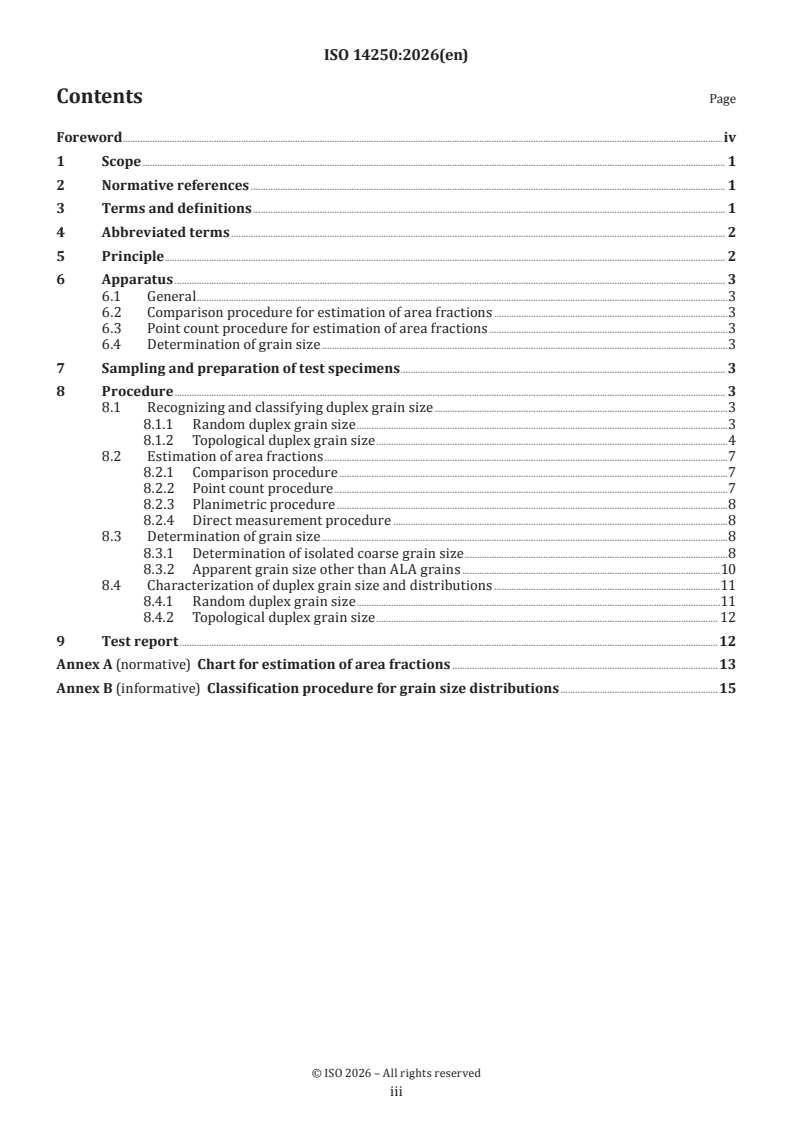
The document is organized into clauses on scope, references, terms, abbreviations, principle, apparatus, sampling and preparation, procedure, and test report. It also includes two annexes, one normative and one informative.
| Annex | What it covers |
|---|---|
| Annex A | Chart for estimation of area fractions |
| Annex B | Classification procedure for grain size distributions |
What are the key requirements of ISO 14250:2026?
ISO 14250:2026 requires the examiner to decide whether the specimen shows random duplex grain size or topological duplex grain size, then apply the matching measurement route. This matters because the reporting format and the area-fraction method depend on the grain-size pattern.
Classification of duplex grain size
Clause 5 divides duplex grain size into two main categories: random duplex grain size and topological duplex grain size. Random duplex grain size includes individual coarse grains, wide range grains, and bimodal grains; topological duplex grain size includes cross-section variations, necklace grains, and grains in bands.
The classification thresholds are based on differences in ISO grain size numbers and on how much of the specimen area each population occupies. In practice, this tells the reader whether the microstructure is a mixed random distribution or a patterned one, which changes how the report is written and how the measurements are taken.
Sampling, surface preparation, and field selection
Clause 7 requires evaluation of the entire specimen surface when the method is used to characterize deviations from a single log-normal distribution and patterns of grain-size variation. The examined surface is prepared by polishing and etching so that grain boundaries are visible.
The plane of examination depends on product form: it is parallel to the direction of maximum deformation, except for bars and tubes where the examined surface is perpendicular to that direction. This matters because the observed duplex pattern can change with orientation.
Estimating area fractions
Clause 8.2 provides four ways to estimate area fractions: comparison with charts in Annex A, point counting using ISO 9042, planimetric measurement, and a direct measurement procedure for topological specimens with surface layers of differing grain size. The comparison and point-count methods are used differently for random and topological cases, and the report must state which method and parameters were used.
Determining grain size
Clause 8.3 uses ISO 643 methods to rate grain size, and it gives special treatment to ALA grains. For ALA grain size, the standard focuses on the largest coarse grain and allows diameter, planimetric, test-grid, and image-analysis methods, with the test-grid method acting as the referee procedure in disputes.
For non-ALA duplex conditions, the document uses the apparent grain size (AGS) of the relevant populations. For necklace grains, the fine ring is treated as the grain boundary of the coarse grains, and the coarse grains are then rated accordingly.
Reporting
Clause 8.4 and Clause 9 require reports to identify the duplex type, specimen orientation, method used, AGS index, area fraction, and the most suitable report format for the observed condition. In practice, this gives a standard way to compare results between laboratories and to link microstructure findings to product acceptance or investigation records.
What terms does ISO 14250:2026 define?
- Duplex grain size - a condition where the distribution of grain intercept lengths, diameters, or areas departs from a single lognormal distribution.
- Equivalent diameter - the diameter of a circle with the same area as the grain.
- Random duplex grain size - two or more significantly different grain sizes that are randomly distributed.
- Topological duplex grain size - two or more significantly different grain sizes that vary in a non-random, definable pattern.
- AGS - Apparent grain size, the grain-size rating used for the relevant grain populations.
- ALA - A condition for isolated coarse grains, reported with an ALA grain size index.
- BD - Banding, the topological condition where distinct grain sizes appear in bands.
Who uses ISO 14250:2026?
ISO 14250:2026 is used in steel metallography, especially by laboratories and technical staff examining rolled or forged steel products. It is useful for producers, testing organizations, and quality teams that need to classify duplex grain patterns, measure area fractions, and report grain size in a consistent way. It also supports product-standard writers who need a defined method for micrographic evaluation.
What changed in ISO 14250:2026 from the previous edition?
ISO 14250:2026 is the second edition and it cancels and replaces ISO 14250:2000. The stated changes are:
- added terms and definitions, principles, and procedure, with later clauses renumbered;
- clarified the method for determining grain size using ISO 643;
- modified all figures;
- clarified the planimetric procedure for estimating area fractions;
- clarified the determination of isolated coarse grain size;
- clarified the determination of apparent grain size other than ALA grains;
- clarified the characterization of duplex grain size and distributions;
- modified the charts in Annex A;
- added the classification procedure for grain size distributions in Annex B.
Which standards are used with ISO 14250:2026?
- ISO 643, Steels - Micrographic determination of the apparent grain size - supplies the grain-size rating methods used throughout the document, including rating chart, planimetric, and intercept methods.
- ISO 9042, Steels - Point counting method for statistically estimating the volume fraction of a constituent with a point grid - supplies the point-counting procedure used to estimate area fractions.
- ISO 643:2024, Annex E - is also referenced for intercept length measurement and statistical determination of grain-size distribution where detailed discrimination is needed.
What does the ISO 14250:2026 document contain?
ISO 14250:2026 contains Table 1 for abbreviated terms, Table 2 for the relationship between ALA grain size, diameter, and area, and Formula (1) and Formula (2) for point counting and ALA area calculation. It also includes photomicrograph figures for ALA, WR, BM, CS, NL, and BD conditions, plus a mixed-condition figure and a schematic test-grid figure.
Annex A provides a chart for estimating area fractions. Annex B provides a classification procedure for grain-size distributions, which helps the reader decide whether the specimen belongs to a random or topological duplex class before reporting results.
Relations
- Revises
ISO 14250:2000 - Steel — Metallographic characterization of duplex grain size and distributions - Effective Date
- 23-Dec-2023
Get Certified
Connect with accredited certification bodies for this standard

Element Materials Technology
Materials testing and product certification.

Inštitut za kovinske materiale in tehnologije
Institute of Metals and Technology. Materials testing, metallurgical analysis, NDT.
Sponsored listings
Frequently Asked Questions
ISO 14250:2026 is a standard published by the International Organization for Standardization (ISO). Its full title is "Steel — Metallographic characterization of duplex grain size and distributions". This standard covers: This document specifies a micrographic method of determining the duplex grain size including the area fraction, of rolled or forged steel products. Additionally, this document provides detailed description methods for each specific type of duplex grain size.
This document specifies a micrographic method of determining the duplex grain size including the area fraction, of rolled or forged steel products. Additionally, this document provides detailed description methods for each specific type of duplex grain size.
ISO 14250:2026 is classified under the following ICS (International Classification for Standards) categories: 77.080.20 - Steels. The ICS classification helps identify the subject area and facilitates finding related standards.
ISO 14250:2026 has the following relationships with other standards: It is inter standard links to ISO 14250:2000. Understanding these relationships helps ensure you are using the most current and applicable version of the standard.
ISO 14250:2026 is available in PDF format for immediate download after purchase. The document can be added to your cart and obtained through the secure checkout process. Digital delivery ensures instant access to the complete standard document.
Standards Content (Sample)
Contents
- 1 Scope
- 2 Normative references
- 3 Terms and definitions
- 3.1 duplex grain size
- 3.2 equivalent diameter
- 3.3 random duplex grain size
- 3.4 topological duplex grain size
- 4 Abbreviated terms
- 5 Principle
- 6 Apparatus
- 6.1 General
- 6.2 Comparison procedure for estimation of area fractions
- 6.3 Point count procedure for estimation of area fractions
- 6.4 Determination of grain size
- 7 Sampling and preparation of test specimens
- 8 Procedure
- 8.1 Recognizing and classifying duplex grain size
- 8.2 Estimation of area fractions
- 8.3 Determination of grain size
- 8.4 Characterization of duplex grain size and distributions
- 9 Test report
- Annex A
- Annex B
1 Scope
This document specifies a micrographic method of determining the duplex grain size including the area fraction, of rolled or forged steel products.
Additionally, this document provides detailed description methods for each specific type of duplex grain size.
2 Normative references
The following documents are referred to in the text in such a way that some or all of their content constitutes requirements of this document. For dated references, only the edition cited applies. For undated references, the latest edition of the referenced document (including any amendments) applies. ISO 643, Steels — Micrographic determination of the apparent grain size ISO 9042, Steels — Point counting method for statistically estimating the volume fraction of a constituent with a point grid
3 Terms and definitions
For the purposes of this document, the following terms and definitions apply. ISO and IEC maintain terminology databases for use in standardization at the following addresses:
- ISO Online browsing platform: available at https:// www .iso .org/ obp
- IEC Electropedia: available at https:// www .electropedia .org/
3.1 duplex grain size
condition existent when the distribution of grain intercept lengths, diameters or areas deviates from a single lognormal distribution Note 1 to entry: Various types of duplex grain sizes are described in 8.1.
3.2 equivalent diameter
diameter of a circle with an area equivalent to that of the grain Note 1 to entry: The area is calculated as the geometric mean of the long axis (the maximum chord length) and the short axis (the maximum chord length perpendicular to the long axis), obtained by multiplying the two axes and taking the square root of the product.
3.3 random duplex grain size
grains of two or more significantly different sizes that are randomly distributed Note 1 to entry: See 5.1 for further explanations.
ISO 14250:2026(en)
3.4 topological duplex grain size
grains of two or more significantly different sizes that vary in a non-random, definable pattern Note 1 to entry: See 5.1 for further explanations.
4 Abbreviated terms
The abbreviated terms used are given in Table 1 Table 1 — Abbreviated terms Abbreviated Definition term ALA As large as AGS Apparent grain size BD Banding BM Bimodal CS Cross section DG Duplex grain L Longitudinal NL Necklace T Transverse WR Wide range G ALA grain size ALA G AGS grain size
5 Principle
5.1 Duplex grain size is classified into two main categories: random duplex grain size and topological duplex grain size, each with specified subcategories. Random duplex grain size includes: Individual coarse grains (ALA), Wide range grains (WR) and Bimodal grains (BM). Topological duplex grain size includes:
Cross-section variations of grains (CS), Necklace grains (NL) and Grains in bands (BD). This pattern may be related to the shape of the product being examined or the factors influencing grain formation. The document specifies methods for analysing the distribution type, rating the grain size, and estimating the area fractions occupied by each distinct grain size type. See Figure B.1 in Annex B for the classification procedure for grain size distribution.
5.2 This document outlines methods for identifying the presence of duplex grain size and characterizing the features of specific types of duplex grain sizes. It includes procedures for estimating the area fractions occupied by distinct grain sizes. The document establishes test methods for determining ALA grain size and provides guidelines for applying ISO 643 to determine grain size in specific designated areas. Additionally, it offers methods for reporting detailed and distinctive information for each type of duplex grain size. Furthermore, the test methods provide a statistical procedure for determining the actual distribution of all grain sizes present in a duplex grain size specimen.
5.3 The method may be applied to specimens or products containing grains of two or more significantly different sizes, but distributes at random or in topologically varying patterns. 5.4 The total specimen surface shall be evaluated when the test method describes deviations from a single, log-normal distribution of grain sizes and characterizes pattern of variations in grain size.
ISO 14250:2026(en)
6 Apparatus
6.1 General
The apparatus used shall depend on the nature of the test method as described in 6.2 to 6.4.
6.2 Comparison procedure for estimation of area fractions
This procedure shall require the use of comparison charts presented in Annex A, Figure A.1 to improve the accuracy of visual estimates of area fractions occupied by a distinct grain size. These comparison charts show different area percentages of light grains among dark grains.
6.3 Point count procedure for estimation of area fractions
This procedure shall require the use of a test grid on a transparent overlay, or on a reticle, as specified in ISO 9042.
6.4 Determination of grain size
The devices specified in ISO 643 shall be used. For specimens exhibiting different grain size distributions, the test methods outlined in ISO 643 — such as the rating chart method, planimetric method, or intercept method — shall be employed to rate the distinct grain sizes. Additionally, the intercept length method described in ISO 643:2024, Annex E, may also be utilized for this purpose. When rating individual ALA grains, the assessment shall be based on the equivalent diameter or the area of the maximum grain.
7 Sampling and preparation of test specimens
In order to characterize patterns of duplex grain size, the entire cross section of the specimen from the product shall be evaluated. The examined surface shall be along the longitudinal direction in a plane parallel to the direction of maximum product deformation except in the case of bars and tubes where the examined surface shall be perpendicular to the direction of the maximum deformation. The number of test specimens and their location shall be specified in the relevant product standard. When it is not the case, they are left at the producer's discretion.
A flat surface of the test specimen shall be polished for micrographic examination and shall be etched for an adequate period of time by means of the appropriate etching. The etch shall be such that all, or nearly all, of the grain boundaries are visible.
8 Procedure
8.1 Recognizing and classifying duplex grain size
8.1.1 Random duplex grain size
8.1.1.1 General
A random duplex grain size is defined as any of the following.
8.1.1.2 Random coarse grains (ALA)
This is the presence of randomly distributed individual coarse grains, differing in size by three or more ISO grain size numbers from the average size of the balance of the grains. These individual coarse grains shall comprise 5 % or less of the area of the specimens. If they comprise more than 5 % of that area, treat the specimen as described in 8.1.1.4.
ISO 14250:2026(en) An example of a photomicrograph of the ALA condition appears in Figure 1.
8.1.1.3 Wide range grains
This is the presence of an unusually wide range of grain sizes, randomly distributed, with the largest size differing from the smallest size by five or more ISO size numbers. An example of a photomicrograph of the wide-range condition appears in Figure 2.
8.1.1.4 Bimodal grains
This is the presence of two distinct grain sizes, randomly distributed such that the sizes differ by four or more ISO grain size numbers, and such that the two sizes together comprise 75 % or more of the total area of the specimen.
Two examples of photomicrographs of the bimodal condition appear in Figure 3.
8.1.2 Topological duplex grain size
8.1.2.1 General
A topological duplex grain size is defined as any of the following.
8.1.2.2 Cross-section variations of grains
This is the presence of a systematic variation in grain size across the section of the product, such that the average grain size differs from one area to another by three or more ISO grain size numbers; or the presence of different grain sizes in specific areas of a product cross-section (e.g. coarse grains resulting from germinative grain growth at areas of critical strains), such that the grain size in those specific areas differs from the grain size in the bulk of the cross-section by three or more ISO grain size numbers. An example of a photomicrograph of the cross-section condition appears in Figure 4.
...