

ISO 9441:2026
(Main)Steel — Determination of niobium content — 4-(2-Pyridylazo)-resorcinol (PAR) spectrophotometric method
- Abstract
This document specifies a spectrophotometric method by using 4-(2-pyridylazo)-resorcinol (PAR) for the determination of niobium in steel. The method is applicable to all types of steel with niobium contents between 0,005 % (mass fraction) and 1,3 % (mass fraction).
- Status
- Published
- Publication Date
- 02-Aug-2026
- Technical Committee
- ISO/TC 17/SC 1 - Methods of determination of chemical composition
- Drafting Committee
- ISO/TC 17/SC 1 - Methods of determination of chemical composition
- Current Stage
- 6060 - International Standard published - 60 Publication
- Start Date
- 03-Aug-2026
- Due Date
- 19-Oct-2026
- Completion Date
- 19-Oct-2026
ISO 9441:2026 is an International Standard from ISO for the spectrophotometric determination of niobium in steel using 4-(2-pyridylazo)-resorcinol (PAR). It applies to all types of steel with niobium content between 0,005 % and 1,3 % by mass fraction. The document sets out the reagents, separation steps, calibration approach and calculation needed to report niobium content from an absorbance measurement.
What does ISO 9441:2026 specify?
ISO 9441:2026 specifies a PAR spectrophotometric method for niobium in steel, together with the sampling, preparation, measurement and reporting steps needed to use it in the laboratory. The document is organized from Scope through Test report, followed by two informative annexes that support the precision data.
| Annex | What it covers |
|---|---|
| Annex A | Additional information on the international interlaboratory test, including sample composition and experimental results |
| Annex B | Graphical representation of precision data |
What are the key requirements of ISO 9441:2026?
ISO 9441:2026 is built around dissolution, separation of niobium, colour development with PAR, and absorbance measurement at about 550 nm. In practice, the method depends on controlled chemistry and matched calibration so the measured colour can be converted into a niobium content.
Sample handling and test setup
- Clause 7 requires sampling and preparation to follow ISO 14284 or appropriate national steel standards. This matters because the analytical result can only represent the steel sample if the sample itself is taken and prepared consistently.
- Clause 8.1 uses about 1,00 g of test sample for the test portion, and Clause 8.2 requires a blank test in parallel using pure iron. This gives a correction for reagent and handling effects.
Chemical separation and colour formation
- Clause 8.3.1 dissolves the sample in hydrochloric acid, oxidizes with hydrogen peroxide, and adds zirconium nitrate. Clause 8.3.2 then precipitates niobium and tantalum with phenylarsonic acid, with zirconium as carrier. In practice, this removes matrix effects before the final measurement.
- Clause 8.3.3 fuses the residue, dissolves it in tartaric acid, adjusts pH to about 6,0, and makes up the test solution. Clause 8.3.4 then adds EDTA·Na, PAR and sodium acetate buffer and waits for colour development. This creates the measured niobium complex under a controlled pH.
- Clause 8.3.5 measures absorbance at about 550 nm, using 40 mm cells for lower niobium content and 10 mm cells for higher content. This means the analyst must match path length to expected concentration to stay in the useful range.
Calibration and calculation
- Clause 8.4 prepares calibration solutions from iron plus niobium standard solution, then measures them at the same wavelength and cell path lengths. The calibration curve is plotted as absorbance against niobium concentration, so the test result can be read from the same response scale as the standards.
- Clause 9.1 converts the measured absorbance to concentration from the calibration curve and calculates niobium as a mass fraction using the stated formula. In practice, the reported result depends on the test portion mass, aliquot volume and final solution volumes.
- Clause 9.2 gives repeatability and reproducibility information based on an interlaboratory trial. This helps laboratories judge whether their results are consistent with the method’s expected precision.
What terms does ISO 9441:2026 use?
- PAR is 4-(2-pyridylazo)-resorcinol, the reagent that forms the coloured niobium complex measured by the method.
- EDTA·Na is disodium dihydrogen ethylenediamine tetraacetate, added to control interferences during colour development.
- Blank test is a parallel run with iron instead of test sample, used to correct for reagent and procedural background.
- Test portion is the weighed amount of steel taken for analysis, and it anchors the final calculation.
- Calibration curve links absorbance to niobium concentration so the sample response can be converted into a result.
- Repeatability limit (r) is the closeness expected for results under the same conditions.
- Reproducibility limits (R and R) describe how far results may spread between laboratories and under different intermediate conditions.
Who uses ISO 9441:2026?
ISO 9441:2026 is used by steel laboratories, metallurgical analysts, quality control teams and calibration staff who need to measure niobium in steel by a wet-chemical spectrophotometric method. It is also relevant to producers, purchasers and inspection laboratories that need documented test results for incoming material checks, process control or product release.
What changed in ISO 9441:2026 from the previous edition?
ISO 9441:2026 is the second edition and cancels and replaces ISO 9441:1988. The foreword states that the normative references were revised, the precision data were updated and the text was improved editorially.
Which standards are used with ISO 9441:2026?
- ISO 648 - specifies single-volume pipettes used for accurate liquid handling.
- ISO 1042 - specifies one-mark volumetric flasks used to make solutions to volume.
- ISO 3696 - specifies water quality for analytical laboratory use.
- ISO 14284 - gives the sampling and preparation approach for steel and iron chemical analysis.
- ISO 5725-1 - provides the general precision definitions used in the precision discussion.
- ISO 5725-2 and ISO 5725-3 - are used for the statistical treatment of the interlaboratory precision data.
What does the ISO 9441:2026 document contain?
ISO 9441:2026 contains the full laboratory method, including reagents, apparatus, sampling, dissolution, niobium separation, colour formation and spectrophotometric measurement. It also includes the calibration procedure, the calculation formula for niobium mass fraction and the precision statement based on interlaboratory data. Table 1 sets the aliquot volume, Table 2 sets the calibration-solution design, Table 3 summarizes precision, and Figure B.1 plots the precision relationships. Annex A adds the interlaboratory test details, and Annex B gives the graphical precision view used to interpret repeatability and reproducibility.
Relations
- Effective Date
- 21-Oct-2023
Get Certified
Connect with accredited certification bodies for this standard

Element Materials Technology
Materials testing and product certification.

Inštitut za kovinske materiale in tehnologije
Institute of Metals and Technology. Materials testing, metallurgical analysis, NDT.
Sponsored listings
Frequently Asked Questions
ISO 9441:2026 is a standard published by the International Organization for Standardization (ISO). Its full title is "Steel — Determination of niobium content — 4-(2-Pyridylazo)-resorcinol (PAR) spectrophotometric method". This standard covers: This document specifies a spectrophotometric method by using 4-(2-pyridylazo)-resorcinol (PAR) for the determination of niobium in steel. The method is applicable to all types of steel with niobium contents between 0,005 % (mass fraction) and 1,3 % (mass fraction).
This document specifies a spectrophotometric method by using 4-(2-pyridylazo)-resorcinol (PAR) for the determination of niobium in steel. The method is applicable to all types of steel with niobium contents between 0,005 % (mass fraction) and 1,3 % (mass fraction).
ISO 9441:2026 is classified under the following ICS (International Classification for Standards) categories: 77.080.20 - Steels. The ICS classification helps identify the subject area and facilitates finding related standards.
ISO 9441:2026 has the following relationships with other standards: It is inter standard links to ISO 9441:1988. Understanding these relationships helps ensure you are using the most current and applicable version of the standard.
ISO 9441:2026 is available in PDF format for immediate download after purchase. The document can be added to your cart and obtained through the secure checkout process. Digital delivery ensures instant access to the complete standard document.
Standards Content (Sample)
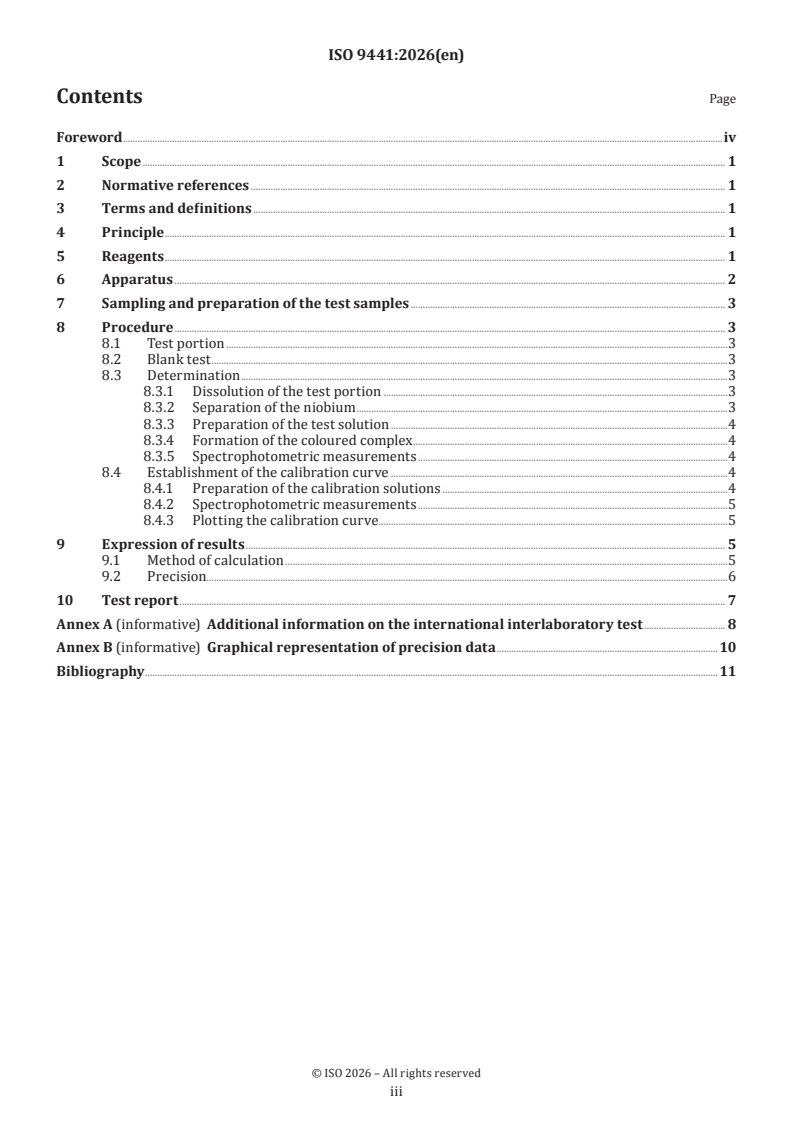
Contents
- 1 Scope
- 2 Normative references
- 3 Terms and definitions
- 4 Principle
- 5 Reagents
- 6 Apparatus
- 6.1 Spectrophotometer
- 7 Sampling and preparation of the test samples
- 8 Procedure
- 8.1 Test portion
- 8.2 Blank test
- 8.3 Determination
- 8.4 Establishment of the calibration curve
- 9 Expression of results
- 9.1 Method of calculation
- 9.2 Precision
- 10 Test report
- Annex A
- Annex B
- Bibliography
1 Scope
This document specifies a spectrophotometric method by using 4-(2-pyridylazo)-resorcinol (PAR) for the determination of niobium in steel. The method is applicable to all types of steel with niobium contents between 0,005 % (mass fraction) and 1,3 % (mass fraction).
2 Normative references
The following documents are referred to in the text in such a way that some or all of their content constitutes requirements of this document. For dated references, only the edition cited applies. For undated references, the latest edition of the referenced document (including any amendments) applies. ISO 648, Laboratory glassware — Single-volume pipettes ISO 1042, Laboratory glassware — One-mark volumetric flasks ISO 3696, Water for analytical laboratory use — Specification and test methods ISO 14284, Steel and iron — Sampling and preparation of samples for the determination of chemical composition
3 Terms and definitions
No terms and definitions are listed in this document.
ISO and IEC maintain terminology databases for use in standardization at the following addresses - ISO Online browsing platform: available at https:// www .iso .org/ obp - IEC Electropedia: available at https:// www .electropedia .org/
4 Principle
Dissolution of a test portion in hydrochloric acid followed by oxidation with hydrogen peroxide. Precipitation of niobium and tantalum with phenylarsonic acid, using zirconium as a carrier. Formation of a complex of niobium with 4-(2-pyridylazo)-resorcinol (PAR) in a sodium tartrate medium buffered by a sodium acetate solution adjusted to pH 6,3.
Spectrophotometric measurement of the coloured complex at a wavelength of about 550 nm.
5 Reagents
During the analysis, unless otherwise stated, use only reagents of recognized analytical grade and only distilled water or grade 2 water as specified in ISO 3696.
5.1 Pure iron, in flake or powder form, with a niobium content less than 0,000 5 % (mass fraction).
ISO 9441:2026(en) 5.2 Potassium hydrogen sulfate (KHSO ).
5.3 Hydrochloric acid, ρ approximately 1,19 g/ml.
5.4 Hydrochloric acid, ρ approximately 1,19 g/ml, diluted (1 + 9). 5.5 Sulfuric acid, ρ approximately 1,84 g/ml, diluted (1 + 1). 5.6 Sulfuric acid, ρ approximately 1,84 g/ml, diluted (1 + 4). 5.7 Hydrogen peroxide, 300 g/l.
5.8 Sodium hydroxide, 120 g/l.
Store in a polyethylene bottle.
5.9 Zirconium nitrate, 3 g/l solution in hydrochloric acid medium. Dissolve 0,3 g of zirconium nitrate in 50 ml of hydrochloric acid, ρ approximately 1,19 g/ml, diluted 1 + 4. Filter through a fine filter paper, dilute to 100 ml with water and mix. 5.10 Sodium acetate buffer, pH-value 6,3.
Dissolve 350 g of sodium acetate trihydrate in 700 ml of water, add 5,5 ml of glacial acetic acid, ρ approximately 1,05 g/ml, dilute to 1 000 ml with water and mix. Adjust the pH-value to 6,3 with small additions of acetic acid or sodium hydroxide (5.8), using a pH-meter for measurement. 5.11 Tartaric acid, 100 g/l.
5.12 Phenylarsonic acid [C H AsO(OH) ], 40 g/l.
6 5 2 5.13 Phenylarsonic acid [C H AsO(OH) ], 0,5 g/l.
6 5 2 5.14 Disodium dihydrogen ethylenediamine tetraacetic acid (EDTA·Na ), 15 g/l.
Dissolve 15 g of disodium dihydrogen ethylenediamine tetraacetate dihydrate (C H O N Na ·2H O) in 10 14 8 2 2 2 water, dilute to 1 000 ml with water and mix.
Store in a polyethylene bottle.
5.15 4-(2-pyridylazo)-resorcinol (PAR) (C H N O ), mono- or di-sodium salt, 0,6 g/l. 11 9 3 2 5.16 Niobium standard solution, 0,200 g/l.
Weigh, to the nearest 0,000 1 g, 0,143 1 g of niobium(V) oxide. (99,5 % minimum) and transfer into a platinum crucible. Fuse with 3,5 g of potassium hydrogen sulfate (5.2). Allow to cool and dissolve in 40 ml of tartaric acid (5.11). Add a further 160 ml of tartaric acid (5.11). Transfer into a 500 ml one-mark volumetric flask, dilute to the mark with water and mix.
1 ml of this standard solution contains 0,200 mg of niobium.
6 Apparatus
During the analysis, unless otherwise stated only ordinary laboratory apparatus and the following should be used.
ISO 9441:2026(en) All laboratory glassware shall be class A, in accordance with ISO 648 or ISO 1042 as appropriate.
6.1 Spectrophotometer
Suitable for measuring the absorbance of the solutions at a wavelength of 550 nm with cells (6.2). 6.2 Cells, with optical path lengths of 10 mm and 40 mm.
7 Sampling and preparation of the test samples
Sampling and preparation of the samples shall be carried out in accordance with ISO 14284 or appropriate national standards for steel.
8 Procedure
WARNING 1 Phenylarsonic acid contained in solutions 5.12 and 5.13, and in the main solution, filtrate or washings in 8.3.2, can be injurious to health when absorbed into the body. WARNING 2 Inhaling the vapour emitted when the precipitate in 8.3.2 is ignited can be injurious to health. WARNING 3 All solutions, filtrates and washings containing phenylarsonic acid shall be disposed of in a way which conforms with applicable regulations.
8.1 Test portion
Weigh, to the nearest 0,1 mg, about 1,00 g of the test sample (m).
8.2 Blank test
In parallel with the determination, and following the same procedure, carry out a blank test using the same quantities of all the reagents and the same cell as in the determination, but replacing the test portion with iron (5.1).
...