

ISO 16100-6:2018
(Main)Industrial automation systems and integration — Manufacturing software capability profiling for interoperability — Part 6: Interface services and protocols for matching profiles based on multiple capability class structures
General Information
- Abstract
This document defines the detailed interface services and protocols used in a matching method based on multiple capability class structures. This document also defines a CPTI (Capability Profile Template Interface) Service Group, an Extended CPI (Capability Profile Interface) Service Group and an Extended Matcher Interface Service Group, which is extensions of the Type 1, Type 2 and Type 3 services, respectively, specified in ISO 16100-3:2005,5.4. This document also defines the CCSI (Capability Class Structure Interface) Service Group, an additional service group used to create, register, access and modify a capability class structure for the reference manufacturing domain models specified in ISO 16100-5:2009, Clause 6. This document also specifies detailed contents of the specific part of a capability profile template defined in ISO 16100-5:2009, Clause 7.
- Status
- Published
- Publication Date
- 22-Aug-2018
- Technical Committee
- ISO/TC 184/SC 5 - Interoperability, integration, and architectures for enterprise systems and automation applications
- Drafting Committee
- ISO/TC 184/SC 5/WG 4 - Manufacturing software and its environment
- Current Stage
- 9060 - Close of review
- Completion Date
- 04-Mar-2029
Buy Documents



ISO 16100-6:2018 - Industrial automation systems and integration -- Manufacturing software capability profiling for interoperability

ISO 16100-6:2018 - Industrial automation systems and integration — Manufacturing software capability profiling for interoperability — Part 6: Interface services and protocols for matching profiles based on multiple capability class structures/23/2018
Overview
ISO 16100-6:2018 is part of the ISO 16100 series on manufacturing software capability profiling for interoperability. This part defines the detailed interface services and protocols required to match capability profiles when multiple capability class structures are used. It specifies service groups, protocol flows and the precise contents of the capability profile template elements needed to enable automated, vendor-neutral matching of manufacturing software capabilities.
Key topics and requirements
- Service groups and interfaces
- CPTI (Capability Profile Template Interface) Service Group - create/access/modify/validate/delete templates.
- Extended CPI (Capability Profile Interface) Service Group - extended services for creating and managing capability profiles.
- Extended Matcher Interface Service Group - extended matching services and conformance testing for matchers.
- CCSI (Capability Class Structure Interface) Service Group - create/register/access/modify capability class structures for reference manufacturing domain models.
- Detailed protocol specifications
- Formal ESI (Extended Service Interface) protocol descriptions for each service group, including message flows for creation, access, modification, validation and deletion.
- Protocols and service definitions intended for machine-to-machine implementations (warning on language translations).
- Supporting artefacts and mappings
- Definitions and procedures for dictionary import services, mapping Parts Library (PLIB) and other taxonomies (OTD) to Model Driven Definitions (MDDs).
- Informative annexes with the capability model, simplified matching examples, profile generation and matching procedures.
- Conformance and testing
- Procedures and service-level requirements to enable conformance testing of matcher implementations.
Practical applications
- Enables interoperability between manufacturing application software by providing a standardized method to represent and match software capabilities across vendors.
- Supports automated discovery and selection of software components based on capability profiles during system integration, procurement, or migration.
- Useful for building integration tools, capability registries, matchers, and repositories that require machine-readable templates, profiles and class structures.
- Helps reduce vendor lock-in by enabling modular system architectures and clearer capability descriptions across life-cycle phases.
Who should use this standard
- Manufacturing software vendors and integrators implementing capability profiling and matching.
- System architects, enterprise integrators and tool vendors developing registries, matchers or capability repositories.
- Standards developers and test labs creating conformance tests for capability-profile-based interoperability.
Related standards
- ISO 16100 series (other parts for capability model and profile definitions)
- ISO 16100-3:2005 (Type 1/2/3 service definitions referenced and extended here)
- ISO 16100-5:2009 (reference manufacturing domain models and MDDs)
Keywords: ISO 16100-6, capability profiling, manufacturing software, interoperability, CPTI, CPI, CCSI, matcher, protocol, capability profile template, PLIB, MDD.
Relations
- Effective Date
- 29-Apr-2017
Buy Documents
ISO 16100-6:2018 - Industrial automation systems and integration -- Manufacturing software capability profiling for interoperability
ISO 16100-6:2018 - Industrial automation systems and integration — Manufacturing software capability profiling for interoperability — Part 6: Interface services and protocols for matching profiles based on multiple capability class structures/23/2018
Get Certified
Connect with accredited certification bodies for this standard

DVS-ZERT GmbH
German welding certification society.
CARES (UK Certification Authority for Reinforcing Steels)
UK certification for reinforcing steels and construction.
EWF/IIW (European/International Welding Federation)
International welding personnel certification.
Sponsored listings
Frequently Asked Questions
ISO 16100-6:2018 is a standard published by the International Organization for Standardization (ISO). Its full title is "Industrial automation systems and integration — Manufacturing software capability profiling for interoperability — Part 6: Interface services and protocols for matching profiles based on multiple capability class structures". This standard covers: This document defines the detailed interface services and protocols used in a matching method based on multiple capability class structures. This document also defines a CPTI (Capability Profile Template Interface) Service Group, an Extended CPI (Capability Profile Interface) Service Group and an Extended Matcher Interface Service Group, which is extensions of the Type 1, Type 2 and Type 3 services, respectively, specified in ISO 16100-3:2005,5.4. This document also defines the CCSI (Capability Class Structure Interface) Service Group, an additional service group used to create, register, access and modify a capability class structure for the reference manufacturing domain models specified in ISO 16100-5:2009, Clause 6. This document also specifies detailed contents of the specific part of a capability profile template defined in ISO 16100-5:2009, Clause 7.
This document defines the detailed interface services and protocols used in a matching method based on multiple capability class structures. This document also defines a CPTI (Capability Profile Template Interface) Service Group, an Extended CPI (Capability Profile Interface) Service Group and an Extended Matcher Interface Service Group, which is extensions of the Type 1, Type 2 and Type 3 services, respectively, specified in ISO 16100-3:2005,5.4. This document also defines the CCSI (Capability Class Structure Interface) Service Group, an additional service group used to create, register, access and modify a capability class structure for the reference manufacturing domain models specified in ISO 16100-5:2009, Clause 6. This document also specifies detailed contents of the specific part of a capability profile template defined in ISO 16100-5:2009, Clause 7.
ISO 16100-6:2018 is classified under the following ICS (International Classification for Standards) categories: 25.040.01 - Industrial automation systems in general. The ICS classification helps identify the subject area and facilitates finding related standards.
ISO 16100-6:2018 has the following relationships with other standards: It is inter standard links to ISO 16100-6:2011. Understanding these relationships helps ensure you are using the most current and applicable version of the standard.
ISO 16100-6:2018 is available in PDF format for immediate download after purchase. The document can be added to your cart and obtained through the secure checkout process. Digital delivery ensures instant access to the complete standard document.
Standards Content (Sample)
INTERNATIONAL ISO
STANDARD 16100-6
Second edition
2018-09
Industrial automation systems
and integration — Manufacturing
software capability profiling for
interoperability —
Part 6:
Interface services and protocols for
matching profiles based on multiple
capability class structures
Systèmes d'automatisation industrielle et intégration — Profil
d'aptitude du logiciel de fabrication pour interopérabilité —
Partie 6: Services d'interface et protocoles pour la correspondance des
profils fondés sur les structures de classe d'aptitude multiple
Reference number
©
ISO 2018
© ISO 2018
All rights reserved. Unless otherwise specified, or required in the context of its implementation, no part of this publication may
be reproduced or utilized otherwise in any form or by any means, electronic or mechanical, including photocopying, or posting
on the internet or an intranet, without prior written permission. Permission can be requested from either ISO at the address
below or ISO’s member body in the country of the requester.
ISO copyright office
CP 401 • Ch. de Blandonnet 8
CH-1214 Vernier, Geneva
Phone: +41 22 749 01 11
Fax: +41 22 749 09 47
Email: copyright@iso.org
Website: www.iso.org
Published in Switzerland
ii © ISO 2018 – All rights reserved
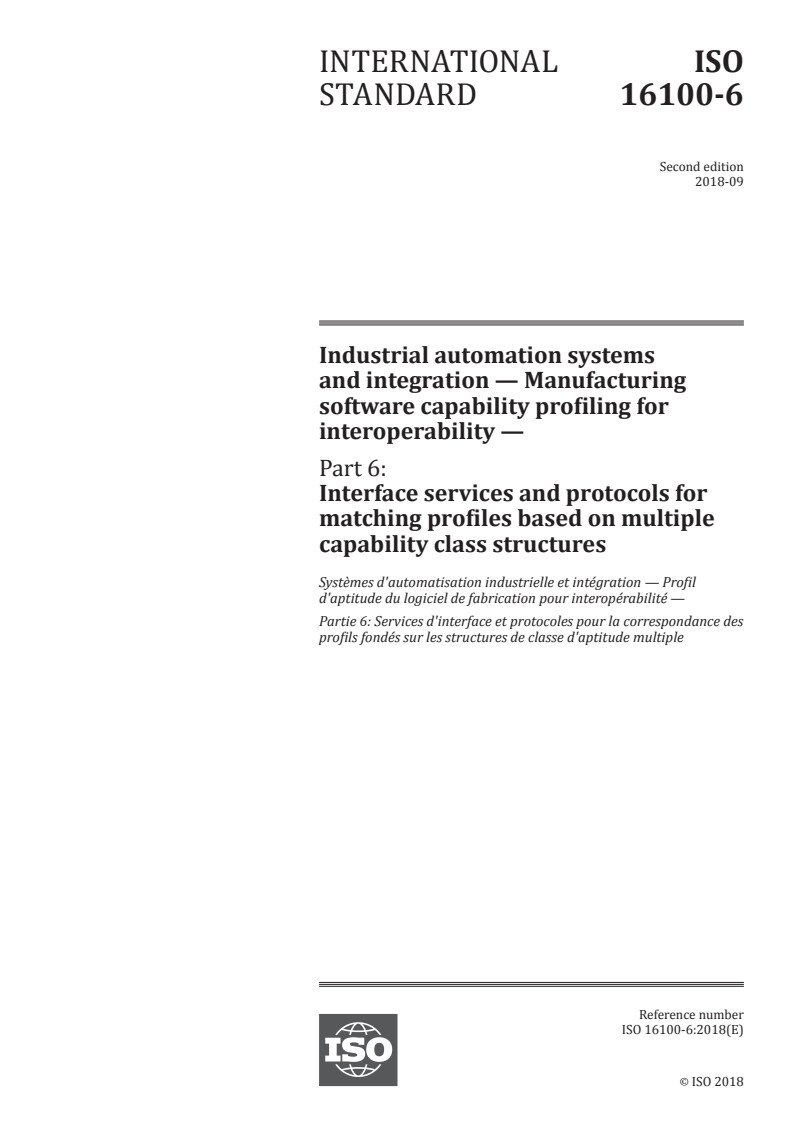
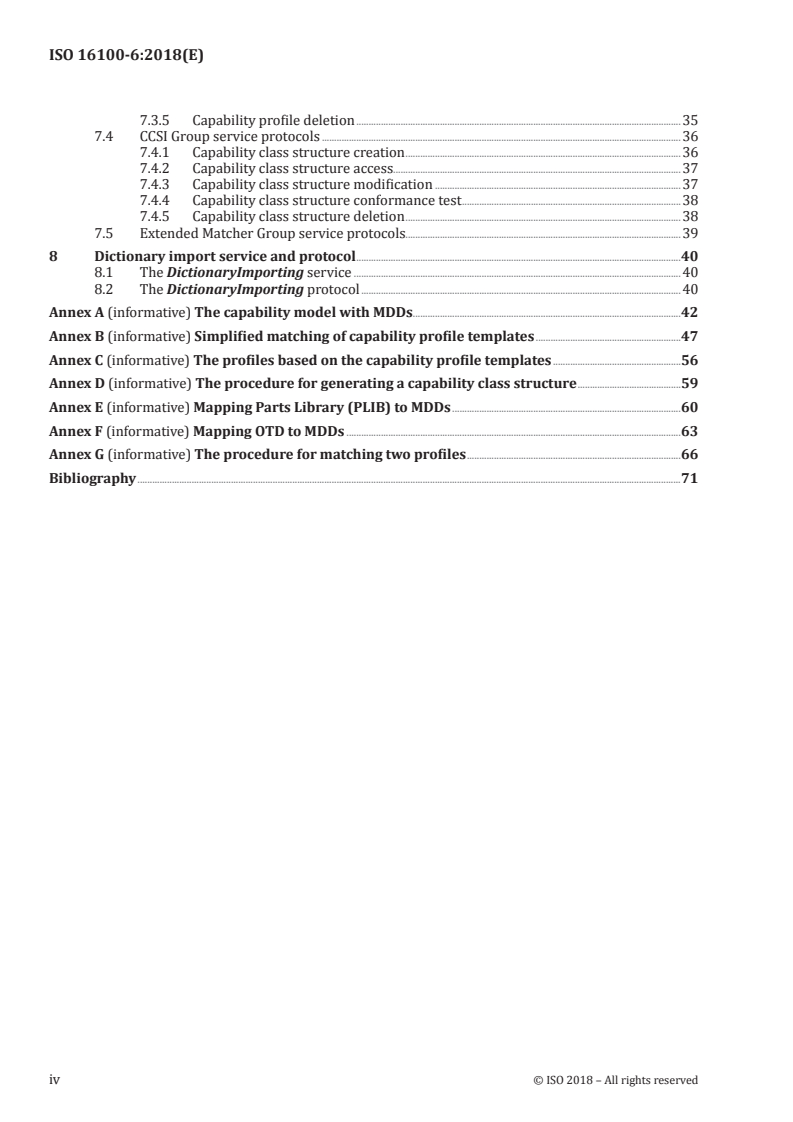
Contents Page
Foreword .v
Introduction .vi
1 Scope . 1
2 Normative references . 1
3 Terms and definitions . 2
4 Symbols and abbreviated terms . 3
5 Service provider interface services . 4
5.1 Service sets . 4
5.2 ESI service set . 5
5.3 Dictionary Import Service Interface . 6
5.3.1 Parts libraries imported to a repository . 6
5.3.2 Relationship between parts libraries and MDDs . 6
5.3.3 Mapping from a PLIB element to an MDD . . 7
6 Extended Service Interface . 7
6.1 CPTI Group services . 7
6.1.1 Scenarios handled by the CPTI Group . 7
6.1.2 Capability profile template creation . 7
6.1.3 The accessTemplate service .10
6.1.4 The modifyTemplate service .11
6.1.5 The validateTemplate service .12
6.1.6 The deleteTemplate service . .12
6.2 The Extended CPI Group.13
6.2.1 Scenarios handled by the Extended CPI Group .13
6.2.2 Capability profile creation .14
6.2.3 The accessProfile service .15
6.2.4 The modifyProfile service .16
6.2.5 The validateProfile service .17
6.2.6 The deleteProfile service .18
6.3 The CCSI Group .19
6.3.1 Scenarios handled by the CCSI Group .19
6.3.2 Capability class structure creation .19
6.3.3 The accessCCS service .21
6.3.4 The modifyCCS service .22
6.3.5 The validateCCS service .22
6.3.6 The deleteCCS service .23
6.4 The Extended Matcher Group .24
6.4.1 Scenarios handled by the Extended Matcher Group .24
6.4.2 The ExtendedMatcher service .24
6.4.3 Matcher conformance testing .25
7 Formal ESI protocol description .28
7.1 The Extended Matcher Group .28
7.2 CPTI Group service protocol .29
7.2.1 Capability profile template creation .29
7.2.2 Capability profile template access .30
7.2.3 Capability profile template modification .30
7.2.4 Capability profile template conformance test .31
7.2.5 Capability profile template deletion .32
7.3 Extended CPI Group service protocols .32
7.3.1 Capability profile creation .32
7.3.2 Capability profile access .33
7.3.3 Capability profile modification .34
7.3.4 Capability profile conformance test .35
7.3.5 Capability profile deletion .35
7.4 CCSI Group service protocols .36
7.4.1 Capability class structure creation .36
7.4.2 Capability class structure access.37
7.4.3 Capability class structure modification .37
7.4.4 Capability class structure conformance test .38
7.4.5 Capability class structure deletion .38
7.5 Extended Matcher Group service protocols.39
8 Dictionary import service and protocol .40
8.1 The DictionaryImporting service .40
8.2 The DictionaryImporting protocol .40
Annex A (informative) The capability model with MDDs .42
Annex B (informative) Simplified matching of capability profile templates .47
Annex C (informative) The profiles based on the capability profile templates .56
Annex D (informative) The procedure for generating a capability class structure .59
Annex E (informative) Mapping Parts Library (PLIB) to MDDs .60
Annex F (informative) Mapping OTD to MDDs .63
Annex G (informative) The procedure for matching two profiles .66
Bibliography .71
iv © ISO 2018 – All rights reserved
Foreword
ISO (the International Organization for Standardization) is a worldwide federation of national standards
bodies (ISO member bodies). The work of preparing International Standards is normally carried out
through ISO technical committees. Each member body interested in a subject for which a technical
committee has been established has the right to be represented on that committee. International
organizations, governmental and non-governmental, in liaison with ISO, also take part in the work.
ISO collaborates closely with the International Electrotechnical Commission (IEC) on all matters of
electrotechnical standardization.
The procedures used to develop this document and those intended for its further maintenance are
described in the ISO/IEC Directives, Part 1. In particular, the different approval criteria needed for the
different types of ISO documents should be noted. This document was drafted in accordance with the
editorial rules of the ISO/IEC Directives, Part 2 (see www .iso .org/directives).
Attention is drawn to the possibility that some of the elements of this document may be the subject of
patent rights. ISO shall not be held responsible for identifying any or all such patent rights. Details of
any patent rights identified during the development of the document will be in the Introduction and/or
on the ISO list of patent declarations received (see www .iso .org/patents).
Any trade name used in this document is information given for the convenience of users and does not
constitute an endorsement.
For an explanation of the voluntary nature of standards, the meaning of ISO specific terms and
expressions related to conformity assessment, as well as information about ISO's adherence to the
World Trade Organization (WTO) principles in the Technical Barriers to Trade (TBT) see www .iso
.org/iso/foreword .html.
This document was prepared by Technical Committee ISO/TC 184, Automation systems and integration,
Subcommittee SC 5, Interoperability, integration, and architectures for enterprise systems and automation
applications.
This second edition cancels and replaces the first edition (ISO 16100-6:2011), of which it constitutes a
minor revision. The changes compared to the previous edition are as follows:
— in 5.2 b) 5) and b) 6), changed “a requirement capability profile or a requirement capability profile”
to “an MSU capability profile or a requirement capability profile”;
— in 6.2.2.2.2, changed “createTemplate service” in the second sentence to “createProfile service”;
— in Figure 8, NOTE 2, changed “unique template identifiers” to “unique profile identifiers”;
— in 6.2.5, changed “returnTestingResult services” to “returnTestResult services”;
— in 7.3.5, changed “The deleteTemplate service deletes an existing template” to “The deleteProfile
service deletes an existing profile”;
— in 7.4.1.2, changed “generates a template” to “generates a CCS”;
— in 7.4.5, changed “deletes an existing template” to “deletes an existing CCS”;
— in Annex A, changed “the class capability model” to “the capability class model”;
— in Annex G, added double quotation marks for object names;
A list of all parts in the ISO 16100 series can be found on the ISO website.
Any feedback or questions on this document should be directed to the user’s national standards body. A
complete listing of these bodies can be found at www .iso .org/members .html.
Introduction
The motivation for ISO 16100 stems from the industrial and economic environment, in particular:
— a growing base of vendor-specific solutions;
— user difficulties in applying standards;
— need to move to modular sets of system integration tools;
— recognition that application software and the expertise to apply that software are assets of the
enterprise.
ISO 16100 is an International Standard for the computer-interpretable and human-readable
representation of a capability profile. Its goal is to provide a method to represent the capability of
manufacturing application software relative to its role throughout the life cycle of a manufacturing
application, independent of a particular system architecture or implementation platform. This can
lead to reduced production and information management costs to users and vendors/suppliers of
manufacturing applications.
Certain diagrams in this document are constructed following UML conventions. Because not all
concepts embodied in these diagrams are explained in the text, some familiarity with UML on the part
of the reader is assumed.
vi © ISO 2018 – All rights reserved
INTERNATIONAL STANDARD ISO 16100-6:2018(E)
Industrial automation systems and integration —
Manufacturing software capability profiling for
interoperability —
Part 6:
Interface services and protocols for matching profiles
based on multiple capability class structures
WARNING — This document provides a specification intended to be implemented in software.
Incompatibilities may result in machine-to-machine communication in the case of software
developed on the basis of translations of this document into languages other than the official
ISO languages. Accordingly, any implementations should be developed only on the basis of the
texts in the official ISO languages.
1 Scope
This document defines the detailed interface services and protocols used in a matching method based
on multiple capability class structures. This document also defines a CPTI (Capability Profile Template
Interface) Service Group, an Extended CPI (Capability Profile Interface) Service Group and an Extended
Matcher Interface Service Group, which is extensions of the Type 1, Type 2 and Type 3 services,
respectively, specified in ISO 16100-3:2005,5.4.
This document also defines the CCSI (Capability Class Structure Interface) Service Group, an additional
service group used to create, register, access and modify a capability class structure for the reference
manufacturing domain models specified in ISO 16100-5:2009, Clause 6.
This document also specifies detailed contents of the specific part of a capability profile template
defined in ISO 16100-5:2009, Clause 7.
2 Normative references
The following documents are referred to in the text in such a way that some or all of their content
constitutes requirements of this document. For dated references, only the edition cited applies. For
undated references, the latest edition of the referenced document (including any amendments) applies.
ISO 16100-1:2009, Industrial automation systems and integration — Manufacturing software capability
profiling for interoperability — Part 1: Framework
ISO 16100-2:2003, Industrial automation systems and integration — Manufacturing software capability
profiling for interoperability — Part 2: Profiling methodology
ISO 16100-3:2005, Industrial automation systems and integration — Manufacturing software capability
profiling for interoperability — Part 3: Interface services, protocols and capability templates
ISO 16100-4:2006, Industrial automation systems and integration — Manufacturing software capability
profiling for interoperability — Part 4: Conformance test methods, criteria and reports
ISO 16100-5:2009, Industrial automation systems and integration — Manufacturing software capability
profiling for interoperability — Part 5: Methodology for profile matching using multiple capability class
structures
3 Terms and definitions
For the purposes of this document, the terms and definitions given in ISO 16100-1, ISO 16100-2,
ISO 16100-3, ISO 16100-4, ISO 16100-5 and the following apply.
ISO and IEC maintain terminological databases for use in standardization at the following addresses:
— ISO Online browsing platform: available at https: //www .iso .org/obp
— IEC Electropedia: available at http: //www .electropedia .org/
3.1
capability class
element within the capability profiling method that represents
software unit functionality and behaviour with regard to the software unit's role in a manufacturing
activity
Note 1 to entry: The role of an MSU changes when used in different manufacturing activities; however, the MSU's
corresponding capability class is positioned uniquely in an inheritance structure, but it can assume different
positions in an aggregation structure.
Note 2 to entry: In this document, a capability class template is identical to a capability profile template (see
ISO 16100-2:2003, 6.3 for requirements for capability templates).
Note 3 to entry: In general, a capability class maps to an activity. The capability class is distinct within a capability
inheritance structure and can form a capability aggregation structure with other capability classes.
[SOURCE: ISO 16100-2:2003, 3.3, modified — The domain in angle brackets has been added; Note 1, 2 and
3 to entry have been added; the wording “software units role” has been changed to “software unit’s role”.]
3.2
capability class structure
hierarchy of capability classes
Note 1 to entry: This structure is intended for modeling capability aggregation hierarchies in the target domains
of ISO 16100-1:2009, Figure 2.
3.3
capability class structure template
XML schema representing a capability class structure
[SOURCE: ISO 16100-5:2009, 3.2, modified — The full form for “XML” has been deleted; the wording “a
hierarchy of capability classes” has been changed to “a capability class structure”.]
3.4
capability profile template
schema for a manufacturing software capability profile
3.5
extended service interface
set of service access points defined in this document that handle manufacturing domain data,
manufacturing domain models, capability class structures, capability profiles and capability profile
templates
Note 1 to entry: "Extended" refers to both the services specified in this document and the "basic" services
specified in ISO 16100-3.
2 © ISO 2018 – All rights reserved
3.6
manufacturing domain data
information, represented by a UML class, about manufacturing resources, manufacturing activities, or
items exchanged among manufacturing resources within a particular manufacturing domain
[SOURCE: ISO 16100-5:2009, 3.3, modified — The wording “unified modeling language (UML) class
representing information” has been changed to “informaiton, represented by a UML class”.]
3.7
manufacturing domain data template
XML schema representing a manufacturing domain data
[SOURCE: ISO 16100-5:2009, 3.4, modified — The full form for “XML” has been deleted.]
3.8
manufacturing domain model
particular view of a manufacturing domain, consisting of manufacturing domain data and relationships
among them, corresponding to the domain's applications
[SOURCE: ISO 16100-5:2009, 3.5]
3.9
parts library
collection of part descriptions or catalogue
Note 1 to entry: The term "parts library" also refers to a dictionary such as a PLIB dictionary in ISO 13584 or
OTD in ISO 22745.
4 Symbols and abbreviated terms
BSU Basic Semantic Unit
CCS Capability Class Structure
CCSI Capability Class Structure Interface
CPI Capability Profile Interface
CPTI Capability Profile Template Interface
CSI Conformance Statement for the Implementation
ESI Extended Service Interface
ESP Extended Service Provider
ICD International Code Designator
MDD Manufacturing Domain Data
MDM Manufacturing Domain Model
MSU Manufacturing Software Unit
OTD Open Technical Dictionary
PLIB Parts Library (as specified in ISO 13584)
UML Unified Modeling Language
URL Uniform Resource Locator
URN Uniform Resource Name
XML eXtensible Markup Language
5 Service provider interface services
5.1 Service sets
Figure 1 shows all the services and their relations to Extended Service Providers and Basic Service
Providers to handle capability profiles, capability profile templates, CCSs, MDMs, MDDs and MDD
objects. Basic Service Providers handle CPI group Type 1 services. Extended Service Providers handle
CPTI, CPI and CCSI services. In addition, Extended Service Providers support extended matcher services
and other service interfaces to handle MDMs and MDDs.
NOTE 1 This figure is not in accordance with UML conventions. The line between the Data Store Mechanism
and the Repository represents the rules for adding, removing and changing contents of the Repository. The line
between the Data Store Mechanism and the Extended Service Provider represents a mapping of the extended
services to the Data Store services. The mapping is typically implementation-specific and therefore not part of
the scope of this document.
NOTE 2 The boldfaced elements in this figure are specifically addressed in this document.
NOTE 3 The contents in the Repository are stored as XML files.
NOTE 4 The ESI access point is represented elsewhere in this document by the object ServiceAccessPoint.
NOTE 5 The Type 1 CPI service group, which is briefly described in ISO 16100-3:2005, 5.4, includes Type 1
matcher service.
NOTE 6 The Type 2 CPI service group, which is briefly described in ISO 16100-3:2005, 5.4, does not include
Type 2 matcher services, which are part of the Extended Matcher Group.
NOTE 7 The Type 3 CPI service group is briefly described in ISO 16100-3:2005, 5.4.
Figure 1 — Extended Service Provider service sets
All services have the following characteristics:
a) when a service is conducted, there is one service provider and one service user, and no other third
party is involved;
b) the service user initiates all service invocations, which are distinct from the lower communications
layer service invocations;
c) a service user invocation is always accompanied by a response from the service provider;
4 © ISO 2018 – All rights reserved
d) any service user invocation and the corresponding response(s) are conducted in a bounded time
frame, as determined by the service user or the service provider or both;
e) a service invocation at a service access point is processed when a response to a prior service
invocation is completed;
f) an invocation is made for a single service; there is no invocation for a service group;
g) a service to register additions and updates to the repository uses the data store mechanism in
Figure 1;
h) the state of an object in the repository is one of the following:
1) stored: an object is stored in the repository after a creation request;
2) registered: an object is registered into the repository after it is conformance tested;
3) deleted: an object is deleted from the repository after a deletion request.
5.2 ESI service set
The generic ESI services provided by an ESP can be organized in specific combinations into a CPI Group
Type 1 (see ISO 16100-3) and the following four service groups, which are described in more detail in
Clause 6. Other service groups can exist, e.g. MDM, MDDs and MDD objects, but are not defined in this
document.
a) CPTI Group, that includes CPI Group Type 3, allows the following services:
1) create a new capability profile template;
2) access a capability profile template;
3) modify a capability profile template;
4) conformance test a capability profile template;
5) register an MSU capability profile;
6) delete an MSU capability profile.
b) CPI Group Type 2 (see ISO 16100-3) allows the following services:
1) create a new MSU capability profile or a new requirement capability profile;
2) access an MSU capability profile or a requirement capability profile;
3) modify an MSU capability profile or a requirement capability profile;
4) conformance test a capability profile;
5) register an MSU capability profile or a requirement capability profile;
6) delete an MSU capability profile or a requirement capability profile.
c) CCSI Group allows the following services:
1) create a new capability class structure;
2) access a capability class structure;
3) modify a capability class structure;
4) conformance test a capability class structure;
5) register a capability class structure;
6) delete a capability class structure;
d) Extended Matcher Interface Group allows the following services:
1) access an MSU capability profile or a requirement capability profile;
2) match two capability profiles, each referencing a different capability class structure.
Annex A provides information on the capability model with MDDs.
5.3 Dictionary Import Service Interface
5.3.1 Parts libraries imported to a repository
The Dictionary Import Service Interface enables the importing of a library (e.g. PLIB dictionary or OTD)
to a repository.
5.3.2 Relationship between parts libraries and MDDs
A parts library imported to a repository can be used as part of MDDs in capability profiling. MDDs in
an MDM include the definition of manufacturing activities. Since a PLIB dictionary and an OTD includes
definitions of technical terms, it can be used in capability profiling in the same manner as MDDs are
used. All classes and attributes in a PLIB dictionary or OTD can be identified by an unambiguous
identifier in accordance with ISO/TS 29002-5 and ISO 22745-13. The unambiguous identifier is a form of
international registration data identifier (IRDI) as specified in ISO/IEC 11179-5. Classes and attributes
within a PLIB dictionary can also be specified by a combination of dictionary and a BSU, a code for
each PLIB class and attribute internal to the dictionary. A BSU for an attribute in a PLIB dictionary is
the combination of the attribute code and the BSU of the parent class. For an OTD, it is not necessary
to reference the BSU of the parent class, since ISO 22745 is classification-neutral, and properties are
defined independently of classes in an OTD. The relationship between a PLIB dictionary or OTD and an
MDD is determined by mapping the unambiguous identifier for each MDD and attribute of an MDD, as
shown in Figure 2.
NOTE 1 This figure is not in accordance with UML conventions.
NOTE 2 In ISO 13584 the term “property” is used instead of “attribute”.
Figure 2 — Relationship between parts libraries and MDDs
6 © ISO 2018 – All rights reserved
5.3.3 Mapping from a PLIB element to an MDD
The element "MDD_Name" in Figure 2 shall have the following extended attributes: “dictionary id”,
“parent”, “BSU”, “version” and “revision”. The attribute set of “dictionary id”, “parent” and “BSU” can be
used as an identifier of the MDD.
According to Figure 2, attributes in an MDD refer to attributes of items in a PLIB dictionary. An MDD
corresponds to an element in a PLIB dictionary. Attributes belonging to the same element would be
associated with one MDD.
Annex E provides information on mapping PLIB to MDDs.
6 Extended Service Interface
6.1 CPTI Group services
6.1.1 Scenarios handled by the CPTI Group
The CPTI Group handles the following capability profile template scenarios:
a) create a capability profile template for a specific class structure, either by partially filling the
generic formal structure of the capability profile template or by modifying an existing capability
profile template with a new capability profile template ID using the MDDs in the MDM, and then
receive a capability profile template from a service provider;
b) request a capability profile template from a repository based on a capability profile template ID
and then receive a capability profile template from a service provider;
c) modify a capability profile template according to either user requirements or the results from a
conformance test and receive a modified capability profile template from a service provider;
d) test a capability profile template against the capability profile template conformance criteria found
in ISO 16100-5:2009, Clause 8 and receive either a positive, negative or matching level response
from a service provider;
e) register a tested capability profile template into a repository and receive a “registered” status from
the service provider;
f) delete a capability profile template based on a capability profile template ID and receive a “deleted”
status from a service provider.
Annex B provides information on the simplified matching of capability profile templates.
6.1.2 Capability profile template creation
6.1.2.1 The creation process
The process for creating a capability profile template for a capability class of a particular capability class
structure consists of configuring a generic formal structure of a capability profile template by either
a) filling in specific values to certain attributes of certain elements in the generic formal structure of
the capability profile template as defined in ISO 16100-5:2009, 6.3, or
b) modifying previously filled-in values in an existing capability profile template.
6.1.2.2 Capability profile template configuration
A generic formal structure of the capability profile template may be either partially or completely filled
according to the application requirement.
For any capability profile template, the following attributes and elements shall be filled in or modified:
a) attributes “id” and “name” in element “Capability Profile Template”;
b) attribute "domain_Name" in element "Reference_MDM_Name";
c) attribute “format_name” in element “MDD_Description_Format” with one of the following four values:
1) “Set_Of_MDD_Objects”;
2) “List_Of_MDD_Objects”;
3) “Time_Ordered_MDD_Objects”;
4) “Event_Ordered_MDD_Objects”;
d) attributes “name” and “action” in element “MDD_Name”.
Each value filled in or modified for the attributes “id” in 6.1.2.2 a), “domain_Name” in 6.1.2.2 b) and
“name” in 6.1.2.2 d) shall be unique.
A capability profile template shall be used to create a capability profile associated with a capability class.
Annex B provides information on the simplified matching of capability profile templates.
6.1.2.3 The createTemplate service
6.1.2.3.1 Template based on a generic formal capability structure
The createTemplate service shall allow a template user to create a template based on a generic formal
capability structure. When creating a template based on a formal capability structure, the createTemplate
service uses at a minimum the requestBlankTemplate, returnBlankTemplate, processFilledTemplate and
returnProcessingResult services. The createTemplate service shall consist of the following steps:
a) the template user invokes the requestBlankTemplate service of the ServiceAccessPoint object, in
which there are no parameters associated with the requestBlankTemplate;
b) the service provider invokes the returnBlankTemplate service of the ServiceAccessPoint object, in
which the parameters of the returnBlankTemplate service are blank template and creation error;
c) the template user fills in the blank template using MDDs of the MDM and then invokes the
processFilledTemplate service of the ServiceAccessPoint object, in which the parameter of the
processFilledTemplate service is template ID;
d) the service provider checks the uniqueness of the template ID and then invokes the
returnProcessingResult service of the ServiceAccessPoint object, in which the parameters of the
returnProcessingResult service are ID check error and storage error.
Figure 3, above the dotted line, provides a UML sequence diagram of the mandatory steps for the
creation of a template from a formal template structure.
6.1.2.3.2 Template created by modifying an existing capability profile template
The createTemplate service shall allow a template user to create a template modified from an existing
template. When creating a template modified from an existing template, the createTemplate service
uses at a minimum the requestExistingTemplate, returnExistingTemplate, processModifiedTemplate and
returnProcessingResult services. The createTemplate service shall consist of the following steps:
a) the template user invokes the requestExistingTemplate service of the ServiceAccessPoint object, in
which the parameter of the requestExistingTemplate service is template ID;
8 © ISO 2018 – All rights reserved
b) the service provider invokes the returnExistingTemplate service of the ServiceAccessPoint
object, in which the parameters of the returnExistingTemplate service are existing template and
processing error;
c) the template user modifies the existing template and then invokes the processModifiedTemplate
service of the ServiceAccessPoint object, in which the parameter of the processModifiedTemplate
service is template ID;
d) the service provider checks the uniqueness of the template ID and then invokes the
returnProcessingResult service of the ServiceAccessPoint object, in which the parameters of the
returnProcessingResult service are ID check error and storage error.
Figure 3, below the dotted line, provides a UML sequence diagram of the mandatory steps for the
creation of a template from an existing template.
NOTE 1 The dotted line separates the two creation cases.
NOTE 2 Template creation is always preceded by the preliminary step of registering and verifying unique
template identifiers, which is outside the scope of ISO 16100.
Figure 3 — The createTemplate service
6.1.3 The accessTemplate service
The accessTemplate service, using the requestExistingTemplate and the returnExistingTemplate services,
shall allow a template user to access an existing template.
The accessTemplate service shall consist of the following steps:
a) the template user invokes the requestExistingTemplate service of the ServiceAccessPoint object, in
which the parameter of the requestExistingTemplate service is template ID;
b) the service provider invokes the returnExistingTemplate service of the ServiceAccessPoint
object, in which the parameters of the returnExistingTemplate service are existing template and
processing error.
Figure 4 provides a UML sequence diagram of the mandatory steps for accessing a template based on a
template ID.
10 © ISO 2018 – All rights reserved
Figure 4 — The accessTemplate service
6.1.4 The modifyTemplate service
The modifyTemplate service, using the requestExistingTemplate, returnExistingTemplate,
processModifiedTemplate and returnProcessingResult services, shall allow a template user to modify an
existing template.
The modifyTemplate service shall consist of the following steps:
a) the template user invokes the requestExistingTemplate service of the ServiceAccessPoint object, in
which the parameter of the requestExistingTemplate service is template ID;
b) the service provider invokes the returnExistingTemplate service of the ServiceAccessPoint
object, in which the parameters of the returnExistingTemplate service are existing template and
processing error;
c) the template user modifies the existing template and then invokes the processModifiedTemplate
service of the ServiceAccessPoint object, in which the parameter of the processModifiedTemplate
service is template ID;
d) the service provider checks the uniqueness of the template ID and then invokes the
returnProcessingResult service of the ServiceAccessPoint object, in which the parameters of the
returnProcessingResult service are ID check error and storage error.
Figure 5 provides a UML sequence diagram of the mandatory steps for the modification of an existing
template based on a template ID.
Figure 5 — The modifyTemplate service
6.1.5 The validateTemplate service
The validateTemplate service, using the requestExistingTemplate, returnExistingTemplate, testTemplate
and returnTestResult services, shall allow a template user to conformance test an existing unregistered
template.
The validateTemplate service shall consist of the following steps:
a) the template user invokes the requestUnregisteredTemplate service of the ServiceAccessPoint object,
in which the parameter of the requestUnregisteredTemplate service is template ID;
b) the service provider invokes the returnUnregisteredTemplate service of the ServiceAccessPoint
object, in which the parameters of the returnUnregisteredTemplate service are unregistered
template and processing error;
c) the template user invokes the testTemplate service of the ServiceAccessPoint object, in which there
are no parameters associated with the testTemplate service;
d) the service provider invokes the returnTestResult service of the ServiceAccessPoint object, in which
the parameters of the returnTestResult service are the test result and match status.
The value of the test result parameter of the returnTestResult service may be positive, negative or
the matching levels defined in ISO 16100-5:2009, 7.2. The value of the match status parameter of the
returnTestResult service shall be equivalent to the output messages shown in ISO 16100-4:2006, B.1.
The tested template shall be registered into the repository if the value of the test result parameter of
the returnTestResult is positive or a Complete Match (see ISO 16100-5:2009, 7.2). Depending on user
requirements, the tested template may be registered into the repository if the value of the test result
parameter is either All Mandatory Match or Some Mandatory Match (see ISO 16100-5:2009, 7.2). The
tested template may be modified again to meet the conformance criteria if the value of the test result
parameter is negative or No Mandatory Match (see ISO 16100-5:2009, 7.2).
Figure 6 provides a UML sequence diagram of the mandatory steps for the conformance testing of an
unregistered template based on a template ID.
Figure 6 — The validateTemplate service
6.1.6 The deleteTemplate service
The deleteTemplate service, using the requestExistingTemplate, returnExistingTemplate, removeTemplate
and returnRemoveResult services, shall allow a template user to delete an existing template.
The deleteTemplate service shall consist of the following steps:
a) the template user invokes the requestExistingTemplate service of the ServiceAccessPoint object, in
which the parameter of the requestExistingTemplate service is template ID;
12 © ISO 2018 – All rights reserved
b) the service provider invokes the returnExistingTemplate service of the ServiceAcce
...
INTERNATIONAL ISO
STANDARD 16100-6
Second edition
2018-09
Industrial automation systems
and integration — Manufacturing
software capability profiling for
interoperability —
Part 6:
Interface services and protocols for
matching profiles based on multiple
capability class structures
Systèmes d'automatisation industrielle et intégration — Profil
d'aptitude du logiciel de fabrication pour interopérabilité —
Partie 6: Services d'interface et protocoles pour la correspondance des
profils fondés sur les structures de classe d'aptitude multiple
Reference number
©
ISO 2018
© ISO 2018
All rights reserved. Unless otherwise specified, or required in the context of its implementation, no part of this publication may
be reproduced or utilized otherwise in any form or by any means, electronic or mechanical, including photocopying, or posting
on the internet or an intranet, without prior written permission. Permission can be requested from either ISO at the address
below or ISO’s member body in the country of the requester.
ISO copyright office
CP 401 • Ch. de Blandonnet 8
CH-1214 Vernier, Geneva
Phone: +41 22 749 01 11
Fax: +41 22 749 09 47
Email: copyright@iso.org
Website: www.iso.org
Published in Switzerland
ii © ISO 2018 – All rights reserved
Contents Page
Foreword .v
Introduction .vi
1 Scope . 1
2 Normative references . 1
3 Terms and definitions . 2
4 Symbols and abbreviated terms . 3
5 Service provider interface services . 4
5.1 Service sets . 4
5.2 ESI service set . 5
5.3 Dictionary Import Service Interface . 6
5.3.1 Parts libraries imported to a repository . 6
5.3.2 Relationship between parts libraries and MDDs . 6
5.3.3 Mapping from a PLIB element to an MDD . . 7
6 Extended Service Interface . 7
6.1 CPTI Group services . 7
6.1.1 Scenarios handled by the CPTI Group . 7
6.1.2 Capability profile template creation . 7
6.1.3 The accessTemplate service .10
6.1.4 The modifyTemplate service .11
6.1.5 The validateTemplate service .12
6.1.6 The deleteTemplate service . .12
6.2 The Extended CPI Group.13
6.2.1 Scenarios handled by the Extended CPI Group .13
6.2.2 Capability profile creation .14
6.2.3 The accessProfile service .15
6.2.4 The modifyProfile service .16
6.2.5 The validateProfile service .17
6.2.6 The deleteProfile service .18
6.3 The CCSI Group .19
6.3.1 Scenarios handled by the CCSI Group .19
6.3.2 Capability class structure creation .19
6.3.3 The accessCCS service .21
6.3.4 The modifyCCS service .22
6.3.5 The validateCCS service .22
6.3.6 The deleteCCS service .23
6.4 The Extended Matcher Group .24
6.4.1 Scenarios handled by the Extended Matcher Group .24
6.4.2 The ExtendedMatcher service .24
6.4.3 Matcher conformance testing .25
7 Formal ESI protocol description .28
7.1 The Extended Matcher Group .28
7.2 CPTI Group service protocol .29
7.2.1 Capability profile template creation .29
7.2.2 Capability profile template access .30
7.2.3 Capability profile template modification .30
7.2.4 Capability profile template conformance test .31
7.2.5 Capability profile template deletion .32
7.3 Extended CPI Group service protocols .32
7.3.1 Capability profile creation .32
7.3.2 Capability profile access .33
7.3.3 Capability profile modification .34
7.3.4 Capability profile conformance test .35
7.3.5 Capability profile deletion .35
7.4 CCSI Group service protocols .36
7.4.1 Capability class structure creation .36
7.4.2 Capability class structure access.37
7.4.3 Capability class structure modification .37
7.4.4 Capability class structure conformance test .38
7.4.5 Capability class structure deletion .38
7.5 Extended Matcher Group service protocols.39
8 Dictionary import service and protocol .40
8.1 The DictionaryImporting service .40
8.2 The DictionaryImporting protocol .40
Annex A (informative) The capability model with MDDs .42
Annex B (informative) Simplified matching of capability profile templates .47
Annex C (informative) The profiles based on the capability profile templates .56
Annex D (informative) The procedure for generating a capability class structure .59
Annex E (informative) Mapping Parts Library (PLIB) to MDDs .60
Annex F (informative) Mapping OTD to MDDs .63
Annex G (informative) The procedure for matching two profiles .66
Bibliography .71
iv © ISO 2018 – All rights reserved
Foreword
ISO (the International Organization for Standardization) is a worldwide federation of national standards
bodies (ISO member bodies). The work of preparing International Standards is normally carried out
through ISO technical committees. Each member body interested in a subject for which a technical
committee has been established has the right to be represented on that committee. International
organizations, governmental and non-governmental, in liaison with ISO, also take part in the work.
ISO collaborates closely with the International Electrotechnical Commission (IEC) on all matters of
electrotechnical standardization.
The procedures used to develop this document and those intended for its further maintenance are
described in the ISO/IEC Directives, Part 1. In particular, the different approval criteria needed for the
different types of ISO documents should be noted. This document was drafted in accordance with the
editorial rules of the ISO/IEC Directives, Part 2 (see www .iso .org/directives).
Attention is drawn to the possibility that some of the elements of this document may be the subject of
patent rights. ISO shall not be held responsible for identifying any or all such patent rights. Details of
any patent rights identified during the development of the document will be in the Introduction and/or
on the ISO list of patent declarations received (see www .iso .org/patents).
Any trade name used in this document is information given for the convenience of users and does not
constitute an endorsement.
For an explanation of the voluntary nature of standards, the meaning of ISO specific terms and
expressions related to conformity assessment, as well as information about ISO's adherence to the
World Trade Organization (WTO) principles in the Technical Barriers to Trade (TBT) see www .iso
.org/iso/foreword .html.
This document was prepared by Technical Committee ISO/TC 184, Automation systems and integration,
Subcommittee SC 5, Interoperability, integration, and architectures for enterprise systems and automation
applications.
This second edition cancels and replaces the first edition (ISO 16100-6:2011), of which it constitutes a
minor revision. The changes compared to the previous edition are as follows:
— in 5.2 b) 5) and b) 6), changed “a requirement capability profile or a requirement capability profile”
to “an MSU capability profile or a requirement capability profile”;
— in 6.2.2.2.2, changed “createTemplate service” in the second sentence to “createProfile service”;
— in Figure 8, NOTE 2, changed “unique template identifiers” to “unique profile identifiers”;
— in 6.2.5, changed “returnTestingResult services” to “returnTestResult services”;
— in 7.3.5, changed “The deleteTemplate service deletes an existing template” to “The deleteProfile
service deletes an existing profile”;
— in 7.4.1.2, changed “generates a template” to “generates a CCS”;
— in 7.4.5, changed “deletes an existing template” to “deletes an existing CCS”;
— in Annex A, changed “the class capability model” to “the capability class model”;
— in Annex G, added double quotation marks for object names;
A list of all parts in the ISO 16100 series can be found on the ISO website.
Any feedback or questions on this document should be directed to the user’s national standards body. A
complete listing of these bodies can be found at www .iso .org/members .html.
Introduction
The motivation for ISO 16100 stems from the industrial and economic environment, in particular:
— a growing base of vendor-specific solutions;
— user difficulties in applying standards;
— need to move to modular sets of system integration tools;
— recognition that application software and the expertise to apply that software are assets of the
enterprise.
ISO 16100 is an International Standard for the computer-interpretable and human-readable
representation of a capability profile. Its goal is to provide a method to represent the capability of
manufacturing application software relative to its role throughout the life cycle of a manufacturing
application, independent of a particular system architecture or implementation platform. This can
lead to reduced production and information management costs to users and vendors/suppliers of
manufacturing applications.
Certain diagrams in this document are constructed following UML conventions. Because not all
concepts embodied in these diagrams are explained in the text, some familiarity with UML on the part
of the reader is assumed.
vi © ISO 2018 – All rights reserved
INTERNATIONAL STANDARD ISO 16100-6:2018(E)
Industrial automation systems and integration —
Manufacturing software capability profiling for
interoperability —
Part 6:
Interface services and protocols for matching profiles
based on multiple capability class structures
WARNING — This document provides a specification intended to be implemented in software.
Incompatibilities may result in machine-to-machine communication in the case of software
developed on the basis of translations of this document into languages other than the official
ISO languages. Accordingly, any implementations should be developed only on the basis of the
texts in the official ISO languages.
1 Scope
This document defines the detailed interface services and protocols used in a matching method based
on multiple capability class structures. This document also defines a CPTI (Capability Profile Template
Interface) Service Group, an Extended CPI (Capability Profile Interface) Service Group and an Extended
Matcher Interface Service Group, which is extensions of the Type 1, Type 2 and Type 3 services,
respectively, specified in ISO 16100-3:2005,5.4.
This document also defines the CCSI (Capability Class Structure Interface) Service Group, an additional
service group used to create, register, access and modify a capability class structure for the reference
manufacturing domain models specified in ISO 16100-5:2009, Clause 6.
This document also specifies detailed contents of the specific part of a capability profile template
defined in ISO 16100-5:2009, Clause 7.
2 Normative references
The following documents are referred to in the text in such a way that some or all of their content
constitutes requirements of this document. For dated references, only the edition cited applies. For
undated references, the latest edition of the referenced document (including any amendments) applies.
ISO 16100-1:2009, Industrial automation systems and integration — Manufacturing software capability
profiling for interoperability — Part 1: Framework
ISO 16100-2:2003, Industrial automation systems and integration — Manufacturing software capability
profiling for interoperability — Part 2: Profiling methodology
ISO 16100-3:2005, Industrial automation systems and integration — Manufacturing software capability
profiling for interoperability — Part 3: Interface services, protocols and capability templates
ISO 16100-4:2006, Industrial automation systems and integration — Manufacturing software capability
profiling for interoperability — Part 4: Conformance test methods, criteria and reports
ISO 16100-5:2009, Industrial automation systems and integration — Manufacturing software capability
profiling for interoperability — Part 5: Methodology for profile matching using multiple capability class
structures
3 Terms and definitions
For the purposes of this document, the terms and definitions given in ISO 16100-1, ISO 16100-2,
ISO 16100-3, ISO 16100-4, ISO 16100-5 and the following apply.
ISO and IEC maintain terminological databases for use in standardization at the following addresses:
— ISO Online browsing platform: available at https: //www .iso .org/obp
— IEC Electropedia: available at http: //www .electropedia .org/
3.1
capability class
element within the capability profiling method that represents
software unit functionality and behaviour with regard to the software unit's role in a manufacturing
activity
Note 1 to entry: The role of an MSU changes when used in different manufacturing activities; however, the MSU's
corresponding capability class is positioned uniquely in an inheritance structure, but it can assume different
positions in an aggregation structure.
Note 2 to entry: In this document, a capability class template is identical to a capability profile template (see
ISO 16100-2:2003, 6.3 for requirements for capability templates).
Note 3 to entry: In general, a capability class maps to an activity. The capability class is distinct within a capability
inheritance structure and can form a capability aggregation structure with other capability classes.
[SOURCE: ISO 16100-2:2003, 3.3, modified — The domain in angle brackets has been added; Note 1, 2 and
3 to entry have been added; the wording “software units role” has been changed to “software unit’s role”.]
3.2
capability class structure
hierarchy of capability classes
Note 1 to entry: This structure is intended for modeling capability aggregation hierarchies in the target domains
of ISO 16100-1:2009, Figure 2.
3.3
capability class structure template
XML schema representing a capability class structure
[SOURCE: ISO 16100-5:2009, 3.2, modified — The full form for “XML” has been deleted; the wording “a
hierarchy of capability classes” has been changed to “a capability class structure”.]
3.4
capability profile template
schema for a manufacturing software capability profile
3.5
extended service interface
set of service access points defined in this document that handle manufacturing domain data,
manufacturing domain models, capability class structures, capability profiles and capability profile
templates
Note 1 to entry: "Extended" refers to both the services specified in this document and the "basic" services
specified in ISO 16100-3.
2 © ISO 2018 – All rights reserved
3.6
manufacturing domain data
information, represented by a UML class, about manufacturing resources, manufacturing activities, or
items exchanged among manufacturing resources within a particular manufacturing domain
[SOURCE: ISO 16100-5:2009, 3.3, modified — The wording “unified modeling language (UML) class
representing information” has been changed to “informaiton, represented by a UML class”.]
3.7
manufacturing domain data template
XML schema representing a manufacturing domain data
[SOURCE: ISO 16100-5:2009, 3.4, modified — The full form for “XML” has been deleted.]
3.8
manufacturing domain model
particular view of a manufacturing domain, consisting of manufacturing domain data and relationships
among them, corresponding to the domain's applications
[SOURCE: ISO 16100-5:2009, 3.5]
3.9
parts library
collection of part descriptions or catalogue
Note 1 to entry: The term "parts library" also refers to a dictionary such as a PLIB dictionary in ISO 13584 or
OTD in ISO 22745.
4 Symbols and abbreviated terms
BSU Basic Semantic Unit
CCS Capability Class Structure
CCSI Capability Class Structure Interface
CPI Capability Profile Interface
CPTI Capability Profile Template Interface
CSI Conformance Statement for the Implementation
ESI Extended Service Interface
ESP Extended Service Provider
ICD International Code Designator
MDD Manufacturing Domain Data
MDM Manufacturing Domain Model
MSU Manufacturing Software Unit
OTD Open Technical Dictionary
PLIB Parts Library (as specified in ISO 13584)
UML Unified Modeling Language
URL Uniform Resource Locator
URN Uniform Resource Name
XML eXtensible Markup Language
5 Service provider interface services
5.1 Service sets
Figure 1 shows all the services and their relations to Extended Service Providers and Basic Service
Providers to handle capability profiles, capability profile templates, CCSs, MDMs, MDDs and MDD
objects. Basic Service Providers handle CPI group Type 1 services. Extended Service Providers handle
CPTI, CPI and CCSI services. In addition, Extended Service Providers support extended matcher services
and other service interfaces to handle MDMs and MDDs.
NOTE 1 This figure is not in accordance with UML conventions. The line between the Data Store Mechanism
and the Repository represents the rules for adding, removing and changing contents of the Repository. The line
between the Data Store Mechanism and the Extended Service Provider represents a mapping of the extended
services to the Data Store services. The mapping is typically implementation-specific and therefore not part of
the scope of this document.
NOTE 2 The boldfaced elements in this figure are specifically addressed in this document.
NOTE 3 The contents in the Repository are stored as XML files.
NOTE 4 The ESI access point is represented elsewhere in this document by the object ServiceAccessPoint.
NOTE 5 The Type 1 CPI service group, which is briefly described in ISO 16100-3:2005, 5.4, includes Type 1
matcher service.
NOTE 6 The Type 2 CPI service group, which is briefly described in ISO 16100-3:2005, 5.4, does not include
Type 2 matcher services, which are part of the Extended Matcher Group.
NOTE 7 The Type 3 CPI service group is briefly described in ISO 16100-3:2005, 5.4.
Figure 1 — Extended Service Provider service sets
All services have the following characteristics:
a) when a service is conducted, there is one service provider and one service user, and no other third
party is involved;
b) the service user initiates all service invocations, which are distinct from the lower communications
layer service invocations;
c) a service user invocation is always accompanied by a response from the service provider;
4 © ISO 2018 – All rights reserved
d) any service user invocation and the corresponding response(s) are conducted in a bounded time
frame, as determined by the service user or the service provider or both;
e) a service invocation at a service access point is processed when a response to a prior service
invocation is completed;
f) an invocation is made for a single service; there is no invocation for a service group;
g) a service to register additions and updates to the repository uses the data store mechanism in
Figure 1;
h) the state of an object in the repository is one of the following:
1) stored: an object is stored in the repository after a creation request;
2) registered: an object is registered into the repository after it is conformance tested;
3) deleted: an object is deleted from the repository after a deletion request.
5.2 ESI service set
The generic ESI services provided by an ESP can be organized in specific combinations into a CPI Group
Type 1 (see ISO 16100-3) and the following four service groups, which are described in more detail in
Clause 6. Other service groups can exist, e.g. MDM, MDDs and MDD objects, but are not defined in this
document.
a) CPTI Group, that includes CPI Group Type 3, allows the following services:
1) create a new capability profile template;
2) access a capability profile template;
3) modify a capability profile template;
4) conformance test a capability profile template;
5) register an MSU capability profile;
6) delete an MSU capability profile.
b) CPI Group Type 2 (see ISO 16100-3) allows the following services:
1) create a new MSU capability profile or a new requirement capability profile;
2) access an MSU capability profile or a requirement capability profile;
3) modify an MSU capability profile or a requirement capability profile;
4) conformance test a capability profile;
5) register an MSU capability profile or a requirement capability profile;
6) delete an MSU capability profile or a requirement capability profile.
c) CCSI Group allows the following services:
1) create a new capability class structure;
2) access a capability class structure;
3) modify a capability class structure;
4) conformance test a capability class structure;
5) register a capability class structure;
6) delete a capability class structure;
d) Extended Matcher Interface Group allows the following services:
1) access an MSU capability profile or a requirement capability profile;
2) match two capability profiles, each referencing a different capability class structure.
Annex A provides information on the capability model with MDDs.
5.3 Dictionary Import Service Interface
5.3.1 Parts libraries imported to a repository
The Dictionary Import Service Interface enables the importing of a library (e.g. PLIB dictionary or OTD)
to a repository.
5.3.2 Relationship between parts libraries and MDDs
A parts library imported to a repository can be used as part of MDDs in capability profiling. MDDs in
an MDM include the definition of manufacturing activities. Since a PLIB dictionary and an OTD includes
definitions of technical terms, it can be used in capability profiling in the same manner as MDDs are
used. All classes and attributes in a PLIB dictionary or OTD can be identified by an unambiguous
identifier in accordance with ISO/TS 29002-5 and ISO 22745-13. The unambiguous identifier is a form of
international registration data identifier (IRDI) as specified in ISO/IEC 11179-5. Classes and attributes
within a PLIB dictionary can also be specified by a combination of dictionary and a BSU, a code for
each PLIB class and attribute internal to the dictionary. A BSU for an attribute in a PLIB dictionary is
the combination of the attribute code and the BSU of the parent class. For an OTD, it is not necessary
to reference the BSU of the parent class, since ISO 22745 is classification-neutral, and properties are
defined independently of classes in an OTD. The relationship between a PLIB dictionary or OTD and an
MDD is determined by mapping the unambiguous identifier for each MDD and attribute of an MDD, as
shown in Figure 2.
NOTE 1 This figure is not in accordance with UML conventions.
NOTE 2 In ISO 13584 the term “property” is used instead of “attribute”.
Figure 2 — Relationship between parts libraries and MDDs
6 © ISO 2018 – All rights reserved
5.3.3 Mapping from a PLIB element to an MDD
The element "MDD_Name" in Figure 2 shall have the following extended attributes: “dictionary id”,
“parent”, “BSU”, “version” and “revision”. The attribute set of “dictionary id”, “parent” and “BSU” can be
used as an identifier of the MDD.
According to Figure 2, attributes in an MDD refer to attributes of items in a PLIB dictionary. An MDD
corresponds to an element in a PLIB dictionary. Attributes belonging to the same element would be
associated with one MDD.
Annex E provides information on mapping PLIB to MDDs.
6 Extended Service Interface
6.1 CPTI Group services
6.1.1 Scenarios handled by the CPTI Group
The CPTI Group handles the following capability profile template scenarios:
a) create a capability profile template for a specific class structure, either by partially filling the
generic formal structure of the capability profile template or by modifying an existing capability
profile template with a new capability profile template ID using the MDDs in the MDM, and then
receive a capability profile template from a service provider;
b) request a capability profile template from a repository based on a capability profile template ID
and then receive a capability profile template from a service provider;
c) modify a capability profile template according to either user requirements or the results from a
conformance test and receive a modified capability profile template from a service provider;
d) test a capability profile template against the capability profile template conformance criteria found
in ISO 16100-5:2009, Clause 8 and receive either a positive, negative or matching level response
from a service provider;
e) register a tested capability profile template into a repository and receive a “registered” status from
the service provider;
f) delete a capability profile template based on a capability profile template ID and receive a “deleted”
status from a service provider.
Annex B provides information on the simplified matching of capability profile templates.
6.1.2 Capability profile template creation
6.1.2.1 The creation process
The process for creating a capability profile template for a capability class of a particular capability class
structure consists of configuring a generic formal structure of a capability profile template by either
a) filling in specific values to certain attributes of certain elements in the generic formal structure of
the capability profile template as defined in ISO 16100-5:2009, 6.3, or
b) modifying previously filled-in values in an existing capability profile template.
6.1.2.2 Capability profile template configuration
A generic formal structure of the capability profile template may be either partially or completely filled
according to the application requirement.
For any capability profile template, the following attributes and elements shall be filled in or modified:
a) attributes “id” and “name” in element “Capability Profile Template”;
b) attribute "domain_Name" in element "Reference_MDM_Name";
c) attribute “format_name” in element “MDD_Description_Format” with one of the following four values:
1) “Set_Of_MDD_Objects”;
2) “List_Of_MDD_Objects”;
3) “Time_Ordered_MDD_Objects”;
4) “Event_Ordered_MDD_Objects”;
d) attributes “name” and “action” in element “MDD_Name”.
Each value filled in or modified for the attributes “id” in 6.1.2.2 a), “domain_Name” in 6.1.2.2 b) and
“name” in 6.1.2.2 d) shall be unique.
A capability profile template shall be used to create a capability profile associated with a capability class.
Annex B provides information on the simplified matching of capability profile templates.
6.1.2.3 The createTemplate service
6.1.2.3.1 Template based on a generic formal capability structure
The createTemplate service shall allow a template user to create a template based on a generic formal
capability structure. When creating a template based on a formal capability structure, the createTemplate
service uses at a minimum the requestBlankTemplate, returnBlankTemplate, processFilledTemplate and
returnProcessingResult services. The createTemplate service shall consist of the following steps:
a) the template user invokes the requestBlankTemplate service of the ServiceAccessPoint object, in
which there are no parameters associated with the requestBlankTemplate;
b) the service provider invokes the returnBlankTemplate service of the ServiceAccessPoint object, in
which the parameters of the returnBlankTemplate service are blank template and creation error;
c) the template user fills in the blank template using MDDs of the MDM and then invokes the
processFilledTemplate service of the ServiceAccessPoint object, in which the parameter of the
processFilledTemplate service is template ID;
d) the service provider checks the uniqueness of the template ID and then invokes the
returnProcessingResult service of the ServiceAccessPoint object, in which the parameters of the
returnProcessingResult service are ID check error and storage error.
Figure 3, above the dotted line, provides a UML sequence diagram of the mandatory steps for the
creation of a template from a formal template structure.
6.1.2.3.2 Template created by modifying an existing capability profile template
The createTemplate service shall allow a template user to create a template modified from an existing
template. When creating a template modified from an existing template, the createTemplate service
uses at a minimum the requestExistingTemplate, returnExistingTemplate, processModifiedTemplate and
returnProcessingResult services. The createTemplate service shall consist of the following steps:
a) the template user invokes the requestExistingTemplate service of the ServiceAccessPoint object, in
which the parameter of the requestExistingTemplate service is template ID;
8 © ISO 2018 – All rights reserved
b) the service provider invokes the returnExistingTemplate service of the ServiceAccessPoint
object, in which the parameters of the returnExistingTemplate service are existing template and
processing error;
c) the template user modifies the existing template and then invokes the processModifiedTemplate
service of the ServiceAccessPoint object, in which the parameter of the processModifiedTemplate
service is template ID;
d) the service provider checks the uniqueness of the template ID and then invokes the
returnProcessingResult service of the ServiceAccessPoint object, in which the parameters of the
returnProcessingResult service are ID check error and storage error.
Figure 3, below the dotted line, provides a UML sequence diagram of the mandatory steps for the
creation of a template from an existing template.
NOTE 1 The dotted line separates the two creation cases.
NOTE 2 Template creation is always preceded by the preliminary step of registering and verifying unique
template identifiers, which is outside the scope of ISO 16100.
Figure 3 — The createTemplate service
6.1.3 The accessTemplate service
The accessTemplate service, using the requestExistingTemplate and the returnExistingTemplate services,
shall allow a template user to access an existing template.
The accessTemplate service shall consist of the following steps:
a) the template user invokes the requestExistingTemplate service of the ServiceAccessPoint object, in
which the parameter of the requestExistingTemplate service is template ID;
b) the service provider invokes the returnExistingTemplate service of the ServiceAccessPoint
object, in which the parameters of the returnExistingTemplate service are existing template and
processing error.
Figure 4 provides a UML sequence diagram of the mandatory steps for accessing a template based on a
template ID.
10 © ISO 2018 – All rights reserved
Figure 4 — The accessTemplate service
6.1.4 The modifyTemplate service
The modifyTemplate service, using the requestExistingTemplate, returnExistingTemplate,
processModifiedTemplate and returnProcessingResult services, shall allow a template user to modify an
existing template.
The modifyTemplate service shall consist of the following steps:
a) the template user invokes the requestExistingTemplate service of the ServiceAccessPoint object, in
which the parameter of the requestExistingTemplate service is template ID;
b) the service provider invokes the returnExistingTemplate service of the ServiceAccessPoint
object, in which the parameters of the returnExistingTemplate service are existing template and
processing error;
c) the template user modifies the existing template and then invokes the processModifiedTemplate
service of the ServiceAccessPoint object, in which the parameter of the processModifiedTemplate
service is template ID;
d) the service provider checks the uniqueness of the template ID and then invokes the
returnProcessingResult service of the ServiceAccessPoint object, in which the parameters of the
returnProcessingResult service are ID check error and storage error.
Figure 5 provides a UML sequence diagram of the mandatory steps for the modification of an existing
template based on a template ID.
Figure 5 — The modifyTemplate service
6.1.5 The validateTemplate service
The validateTemplate service, using the requestExistingTemplate, returnExistingTemplate, testTemplate
and returnTestResult services, shall allow a template user to conformance test an existing unregistered
template.
The validateTemplate service shall consist of the following steps:
a) the template user invokes the requestUnregisteredTemplate service of the ServiceAccessPoint object,
in which the parameter of the requestUnregisteredTemplate service is template ID;
b) the service provider invokes the returnUnregisteredTemplate service of the ServiceAccessPoint
object, in which the parameters of the returnUnregisteredTemplate service are unregistered
template and processing error;
c) the template user invokes the testTemplate service of the ServiceAccessPoint object, in which there
are no parameters associated with the testTemplate service;
d) the service provider invokes the returnTestResult service of the ServiceAccessPoint object, in which
the parameters of the returnTestResult service are the test result and match status.
The value of the test result parameter of the returnTestResult service may be positive, negative or
the matching levels defined in ISO 16100-5:2009, 7.2. The value of the match status parameter of the
returnTestResult service shall be equivalent to the output messages shown in ISO 16100-4:2006, B.1.
The tested template shall be registered into the repository if the value of the test result parameter of
the returnTestResult is positive or a Complete Match (see ISO 16100-5:2009, 7.2). Depending on user
requirements, the tested template may be registered into the repository if the value of the test result
parameter is either All Mandatory Match or Some Mandatory Match (see ISO 16100-5:2009, 7.2). The
tested template may be modified again to meet the conformance criteria if the value of the test result
parameter is negative or No Mandatory Match (see ISO 16100-5:2009, 7.2).
Figure 6 provides a UML sequence diagram of the mandatory steps for the conformance testing of an
unregistered template based on a template ID.
Figure 6 — The validateTemplate service
6.1.6 The deleteTemplate service
The deleteTemplate service, using the requestExistingTemplate, returnExistingTemplate, removeTemplate
and returnRemoveResult services, shall allow a template user to delete an existing template.
The deleteTemplate service shall consist of the following steps:
a) the template user invokes the requestExistingTemplate service of the ServiceAccessPoint object, in
which the parameter of the requestExistingTemplate service is template ID;
12 © ISO 2018 – All rights reserved
b) the service provider invokes the returnExistingTemplate service of the ServiceAcce
...