

ISO 10804:2018
(Main)Restrained joint systems for ductile iron pipelines — Design rules and type testing
General Information
- Abstract
ISO 10804:2018 specifies the design rules and type testing for restrained joint systems to be used on ductile iron pipelines complying with ISO 2531 and ISO 7186, in order to determine their mechanical properties and leaktightness.
- Status
- Published
- Publication Date
- 02-Jan-2018
- Technical Committee
- ISO/TC 5/SC 2 - Cast iron pipes, fittings and their joints
- Drafting Committee
- ISO/TC 5/SC 2 - Cast iron pipes, fittings and their joints
- Current Stage
- 9093 - International Standard confirmed
- Start Date
- 08-Jun-2023
- Completion Date
- 29-Aug-2026
Buy Documents
ISO 10804:2018 - Restrained joint systems for ductile iron pipelines -- Design rules and type testing
ISO 10804:2018 - Restrained joint systems for ductile iron pipelines — Design rules and type testing/3/2018
Overview
ISO 10804:2018 is an international standard that specifies design rules and type testing requirements for restrained joint systems used in ductile iron pipelines. These pipelines comply with ISO 2531 and ISO 7186 standards. The purpose of ISO 10804:2018 is to ensure that restrained joints exhibit reliable mechanical strength and leaktightness under various operating conditions, providing safety and durability for water and sewerage pipeline systems.
Restrained joints are assemblies designed to prevent the separation of ductile iron pipe sections, fittings, and other components, which is critical for maintaining pipeline integrity under internal pressure, negative pressure, and dynamic loading. This standard provides manufacturers and engineers with clear guidelines for joint design, validation through rigorous type testing, and documentation, promoting consistent quality and interoperability worldwide.
Key Topics
Design Rules
- Minimum spigot thickness must accommodate welding or attachment loads (e.g., gasket teeth).
- Safety factors require joints to withstand 1.5 times the allowable operating pressure plus 5 bar.
- Joints must be able to endure negative internal pressures and cyclic internal hydraulic pressures as part of type testing.
- Considerations for seismic zones are included, with recommendations to consult specialists for critical locations.
Type Testing Procedures
- Positive internal pressure tests to verify mechanical strength and leak tightness with specific gap configurations between spigot and socket.
- Negative internal pressure (vacuum) tests to simulate pressure below atmospheric conditions.
- Dynamic/cyclic internal pressure tests comprising 24,000 cycles between maximum allowable operating pressure (PMA) and PMA minus 5 bar to simulate real-world operational stresses.
- Tests under deflection and shear load conditions to represent actual pipeline installation scenarios.
- Required accuracy of pressure gauges and detailed measurement intervals during testing.
Test Reporting
- Comprehensive documentation including joint type, tested nominal diameter (DN), pipe thickness, pressure ratings, angular deflection allowed, and test results to ensure traceability and compliance.
Definitions
- Clear terminology such as “restrained joint,” “allowable operating pressure (PFA),” “maximum allowable operating pressure (PMA),” and “type test” are standardized to ensure consistency in communication.
Applications
ISO 10804:2018 is designed for use in the design, manufacturing, and quality assurance of restrained joints in ductile iron pipeline systems, commonly utilized in:
- Water supply networks
- Sewerage and wastewater systems
- Industrial fluid transport
- Infrastructure projects in seismic or high-pressure environments
- Environments involving aggressive soils, requiring protective coatings for joint components
By adhering to ISO 10804:2018, pipeline operators and contractors benefit from enhanced pipeline durability, reduced risk of joint failure, improved leak resistance, and compliance with international best practices, ensuring safe and sustainable pipeline operation.
Related Standards
- ISO 2531 – Ductile iron pipes, fittings, accessories, and joints for water applications
- ISO 7186 – Ductile iron products for sewerage applications
- ISO 6708 – Pipework components – Definition and selection of nominal size (DN)
- ISO 16631 – Ductile iron pipes, fittings, and joints compatible with plastic piping systems
These interconnected standards provide a comprehensive framework for ductile iron pipeline construction and testing, with ISO 10804:2018 focusing specifically on the design and verification of mechanical joint restraint systems.
Keywords: ISO 10804:2018, restrained joint systems, ductile iron pipelines, joint design rules, type testing, leaktightness, mechanical strength, ductile iron pipe joints, pipeline safety, internal pressure testing, pipeline standards, ISO 2531, ISO 7186, pipeline engineering, seismic pipeline design, pressure cycling test.
Relations
- Revises
ISO 10804:2010 - Restrained joint systems for ductile iron pipelines — Design rules and type testing - Effective Date
- 10-Dec-2016
Buy Documents
ISO 10804:2018 - Restrained joint systems for ductile iron pipelines -- Design rules and type testing
ISO 10804:2018 - Restrained joint systems for ductile iron pipelines — Design rules and type testing/3/2018
Get Certified
Connect with accredited certification bodies for this standard

Institut za varilstvo d.o.o. (Welding Institute)
Slovenia's leading welding institute since 1952. ISO 3834, EN 1090, pressure equipment certification, NDT personnel, welder qualification. Only IIW Au
Sponsored listings
Frequently Asked Questions
ISO 10804:2018 is a standard published by the International Organization for Standardization (ISO). Its full title is "Restrained joint systems for ductile iron pipelines — Design rules and type testing". This standard covers: ISO 10804:2018 specifies the design rules and type testing for restrained joint systems to be used on ductile iron pipelines complying with ISO 2531 and ISO 7186, in order to determine their mechanical properties and leaktightness.
ISO 10804:2018 specifies the design rules and type testing for restrained joint systems to be used on ductile iron pipelines complying with ISO 2531 and ISO 7186, in order to determine their mechanical properties and leaktightness.
ISO 10804:2018 is classified under the following ICS (International Classification for Standards) categories: 23.040.01 - Pipeline components and pipelines in general. The ICS classification helps identify the subject area and facilitates finding related standards.
ISO 10804:2018 has the following relationships with other standards: It is inter standard links to ISO 10804:2010. Understanding these relationships helps ensure you are using the most current and applicable version of the standard.
ISO 10804:2018 is available in PDF format for immediate download after purchase. The document can be added to your cart and obtained through the secure checkout process. Digital delivery ensures instant access to the complete standard document.
Standards Content (Sample)
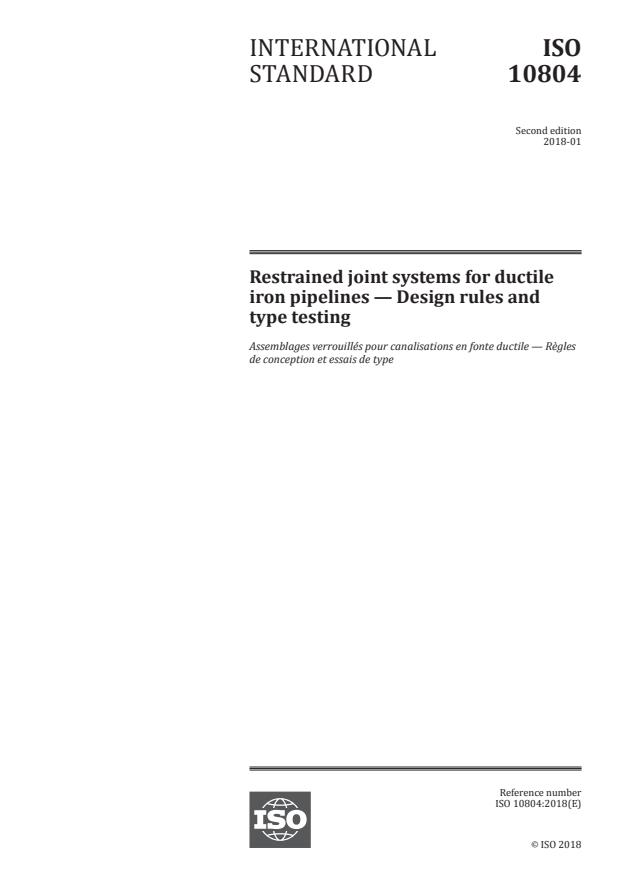
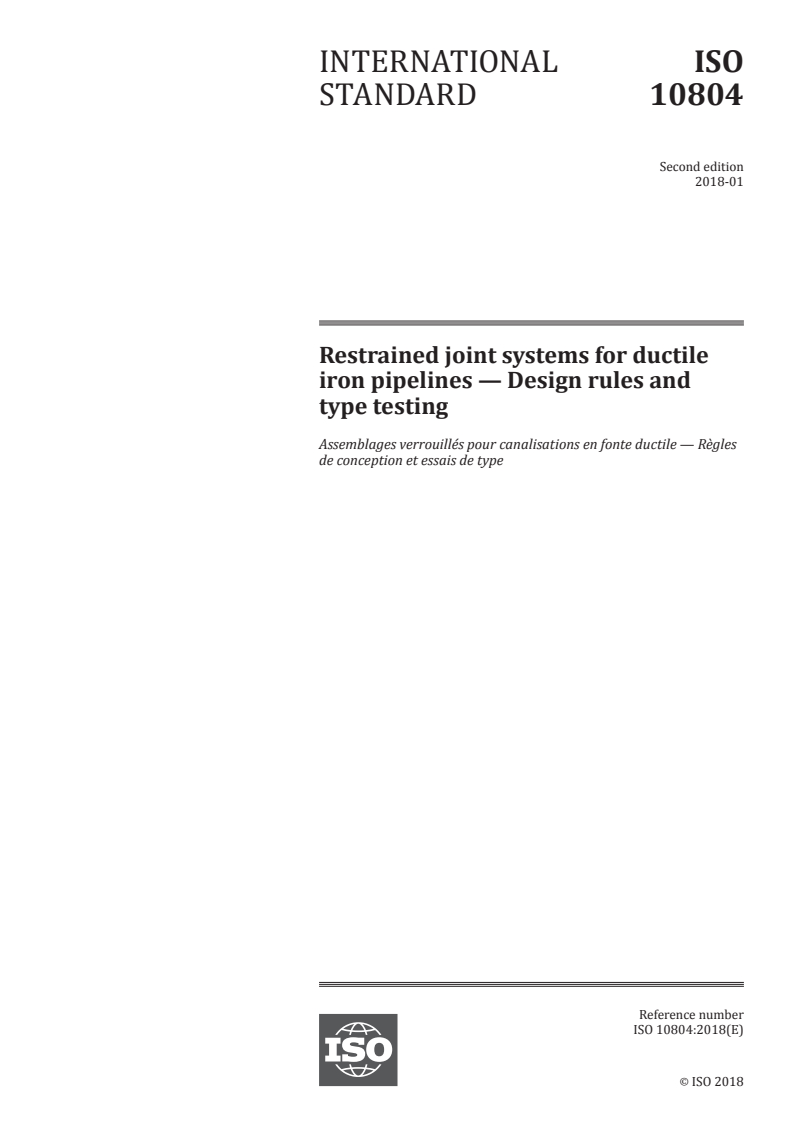
INTERNATIONAL ISO
STANDARD 10804
Second edition
2018-01
Restrained joint systems for ductile
iron pipelines — Design rules and
type testing
Assemblages verrouillés pour canalisations en fonte ductile — Règles
de conception et essais de type
Reference number
©
ISO 2018
© ISO 2018
All rights reserved. Unless otherwise specified, or required in the context of its implementation, no part of this publication may
be reproduced or utilized otherwise in any form or by any means, electronic or mechanical, including photocopying, or posting
on the internet or an intranet, without prior written permission. Permission can be requested from either ISO at the address
below or ISO’s member body in the country of the requester.
ISO copyright office
CP 401 • Ch. de Blandonnet 8
CH-1214 Vernier, Geneva, Switzerland
Tel. +41 22 749 01 11
Fax +41 22 749 09 47
copyright@iso.org
www.iso.org
Published in Switzerland
ii © ISO 2018 – All rights reserved
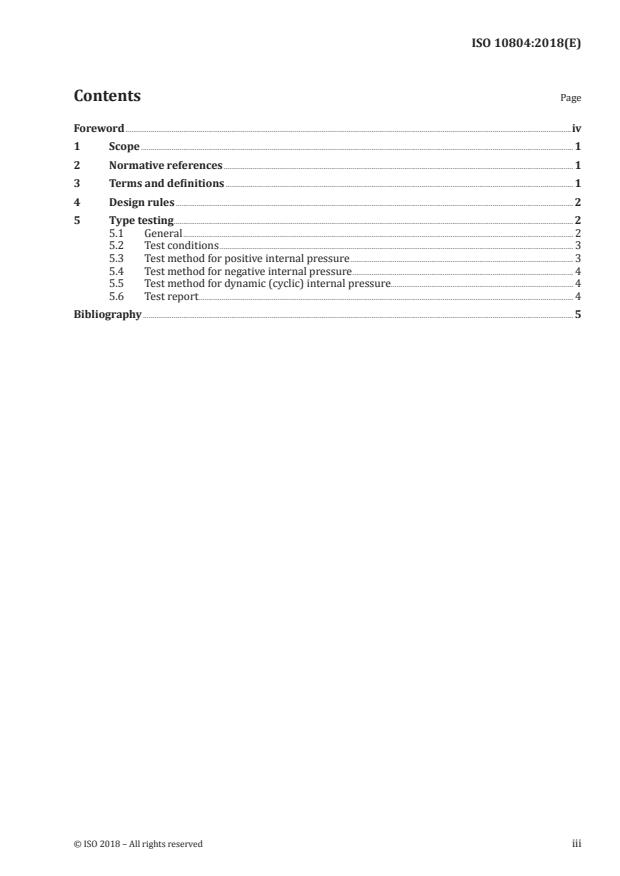
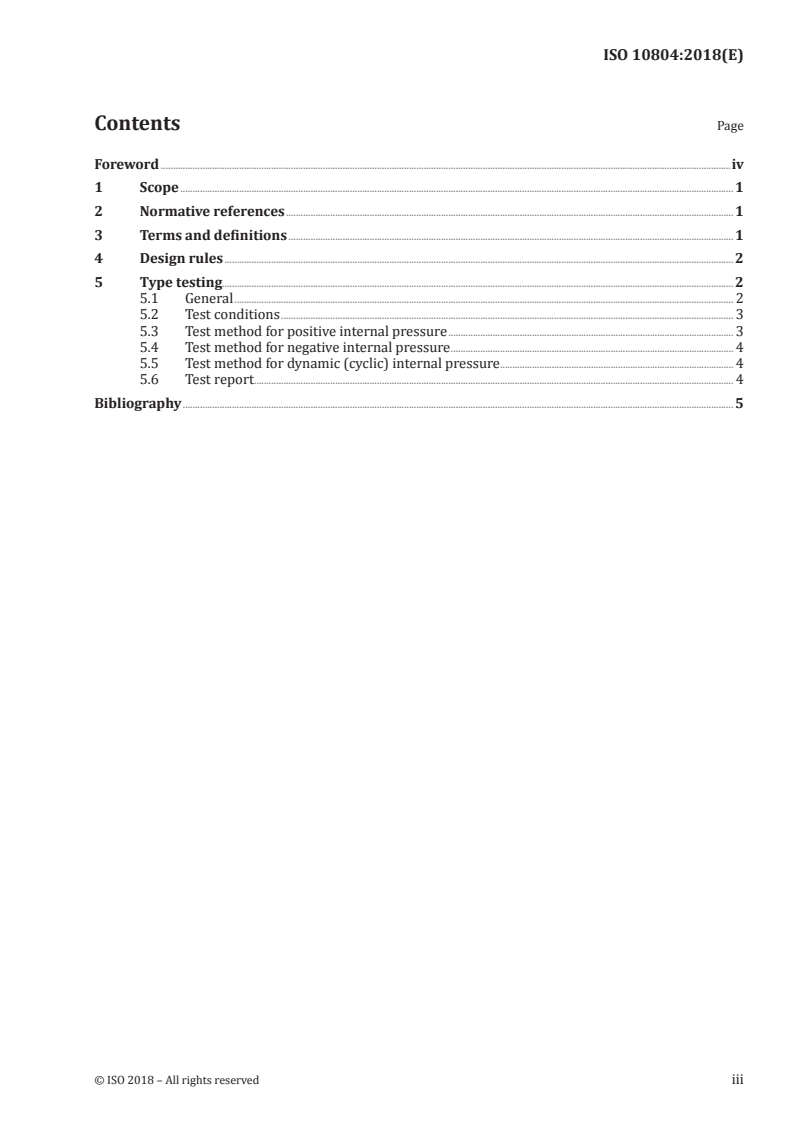
Contents Page
Foreword .iv
1 Scope . 1
2 Normative references . 1
3 Terms and definitions . 1
4 Design rules . 2
5 Type testing. 2
5.1 General . 2
5.2 Test conditions . 3
5.3 Test method for positive internal pressure . 3
5.4 Test method for negative internal pressure . 4
5.5 Test method for dynamic (cyclic) internal pressure. 4
5.6 Test report . 4
Bibliography . 5
Foreword
ISO (the International Organization for Standardization) is a worldwide federation of national standards
bodies (ISO member bodies). The work of preparing International Standards is normally carried out
through ISO technical committees. Each member body interested in a subject for which a technical
committee has been established has the right to be represented on that committee. International
organizations, governmental and non-governmental, in liaison with ISO, also take part in the work.
ISO collaborates closely with the International Electrotechnical Commission (IEC) on all matters of
electrotechnical standardization.
The procedures used to develop this document and those intended for its further maintenance are
described in the ISO/IEC Directives, Part 1. In particular the different approval criteria needed for the
different types of ISO documents should be noted. This document was drafted in accordance with the
editorial rules of the ISO/IEC Directives, Part 2 (see www.iso.org/directives).
Attention is drawn to the possibility that some of the elements of this document may be the subject of
patent rights. ISO shall not be held responsible for identifying any or all such patent rights. Details of
any patent rights identified during the development of the document will be in the Introduction and/or
on the ISO list of patent declarations received (see www.iso.org/patents).
Any trade name used in this document is information given for the convenience of users and does not
constitute an endorsement.
For an explanation on the voluntary nature of standards, the meaning of ISO specific terms and
expressions related to conformity assessment, as well as information about ISO's adherence to the
World Trade Organization (WTO) principles in the Technical Barriers to Trade (TBT) see the following
URL: www.iso.org/iso/foreword.html.
This document was prepared by Technical Committee ISO/TC 5, Ferrous metal pipes and metallic fittings,
Subcommittee SC 2, Cast iron pipes, fittings and their joints.
This second edition cancels and replaces the first edition (ISO 10804-1:2010), which has been technically
revised. The main changes compared to the previous edition are as follows:
— the positive internal pressure type test in the configuration of minimum design radial gap has been
introduced for joints restrained by gasket with hard anchor teeth;
— the references and presentation have been reviewed and improved.
iv © ISO 2018 – All rights reserved
INTERNATIONAL STANDARD ISO 10804:2018(E)
Restrained joint systems for ductile iron pipelines —
Design rules and type testing
1 Scope
This document specifies the design rules and type testing for restrained joint systems to be used on
ductile iron pipelines complying with ISO 2531 and ISO 7186, in order to determine their mechanical
properties and leaktightness.
2 Normative references
The following documents are referred to in the text in such a way that some or all of their content
constitutes requirements of this document. For dated references, only the edition cited applies. For
undated references, the latest edition of the referenced document (including any amendments) applies.
ISO 6708, Pipework components — Definition and selection of DN (nominal size)
3 Terms and definitions
For the purposes of this document, the terms and definitions given in ISO 6708 and the following apply.
ISO and IEC maintain terminological databases for use in standardization at the following addresses:
— ISO Online browsing platform: available at https://www.iso.org/obp
— IEC Electropedia: available at https://www.electropedia.org/
3.1
restrained joint
joint in which a means is provided to prevent separation of the assembled joint
3.2
allowable operating pressure
PFA
maximum internal pressure, excluding surge, which a component can safely withstand in permanent
service
3.3
allowable maximum operating pressure
PMA
maximum internal pressure, including surge, which a component can safely withstand in service
3.4
type test
proof-of-design test which is performed once and repeated only after change of design
3.5
allowable angular deflection
angular deflection that a joint between two components can safely withstand in service under the
allowable operating pressure (PFA) (3.2)
4 Design rules
4.1 All restrained joints for ductile iron pipes, fittings and other components shall be designed in
accordance with this clause. If the design of a restrained joint has been tested and successfully used for a
minimum of 10 years, a type test as described in Clause 5 is only required for a significant change in the
design
...
INTERNATIONAL ISO
STANDARD 10804
Second edition
2018-01
Restrained joint systems for ductile
iron pipelines — Design rules and
type testing
Assemblages verrouillés pour canalisations en fonte ductile — Règles
de conception et essais de type
Reference number
©
ISO 2018
© ISO 2018
All rights reserved. Unless otherwise specified, or required in the context of its implementation, no part of this publication may
be reproduced or utilized otherwise in any form or by any means, electronic or mechanical, including photocopying, or posting
on the internet or an intranet, without prior written permission. Permission can be requested from either ISO at the address
below or ISO’s member body in the country of the requester.
ISO copyright office
CP 401 • Ch. de Blandonnet 8
CH-1214 Vernier, Geneva, Switzerland
Tel. +41 22 749 01 11
Fax +41 22 749 09 47
copyright@iso.org
www.iso.org
Published in Switzerland
ii © ISO 2018 – All rights reserved
Contents Page
Foreword .iv
1 Scope . 1
2 Normative references . 1
3 Terms and definitions . 1
4 Design rules . 2
5 Type testing. 2
5.1 General . 2
5.2 Test conditions . 3
5.3 Test method for positive internal pressure . 3
5.4 Test method for negative internal pressure . 4
5.5 Test method for dynamic (cyclic) internal pressure. 4
5.6 Test report . 4
Bibliography . 5
Foreword
ISO (the International Organization for Standardization) is a worldwide federation of national standards
bodies (ISO member bodies). The work of preparing International Standards is normally carried out
through ISO technical committees. Each member body interested in a subject for which a technical
committee has been established has the right to be represented on that committee. International
organizations, governmental and non-governmental, in liaison with ISO, also take part in the work.
ISO collaborates closely with the International Electrotechnical Commission (IEC) on all matters of
electrotechnical standardization.
The procedures used to develop this document and those intended for its further maintenance are
described in the ISO/IEC Directives, Part 1. In particular the different approval criteria needed for the
different types of ISO documents should be noted. This document was drafted in accordance with the
editorial rules of the ISO/IEC Directives, Part 2 (see www.iso.org/directives).
Attention is drawn to the possibility that some of the elements of this document may be the subject of
patent rights. ISO shall not be held responsible for identifying any or all such patent rights. Details of
any patent rights identified during the development of the document will be in the Introduction and/or
on the ISO list of patent declarations received (see www.iso.org/patents).
Any trade name used in this document is information given for the convenience of users and does not
constitute an endorsement.
For an explanation on the voluntary nature of standards, the meaning of ISO specific terms and
expressions related to conformity assessment, as well as information about ISO's adherence to the
World Trade Organization (WTO) principles in the Technical Barriers to Trade (TBT) see the following
URL: www.iso.org/iso/foreword.html.
This document was prepared by Technical Committee ISO/TC 5, Ferrous metal pipes and metallic fittings,
Subcommittee SC 2, Cast iron pipes, fittings and their joints.
This second edition cancels and replaces the first edition (ISO 10804-1:2010), which has been technically
revised. The main changes compared to the previous edition are as follows:
— the positive internal pressure type test in the configuration of minimum design radial gap has been
introduced for joints restrained by gasket with hard anchor teeth;
— the references and presentation have been reviewed and improved.
iv © ISO 2018 – All rights reserved
INTERNATIONAL STANDARD ISO 10804:2018(E)
Restrained joint systems for ductile iron pipelines —
Design rules and type testing
1 Scope
This document specifies the design rules and type testing for restrained joint systems to be used on
ductile iron pipelines complying with ISO 2531 and ISO 7186, in order to determine their mechanical
properties and leaktightness.
2 Normative references
The following documents are referred to in the text in such a way that some or all of their content
constitutes requirements of this document. For dated references, only the edition cited applies. For
undated references, the latest edition of the referenced document (including any amendments) applies.
ISO 6708, Pipework components — Definition and selection of DN (nominal size)
3 Terms and definitions
For the purposes of this document, the terms and definitions given in ISO 6708 and the following apply.
ISO and IEC maintain terminological databases for use in standardization at the following addresses:
— ISO Online browsing platform: available at https://www.iso.org/obp
— IEC Electropedia: available at https://www.electropedia.org/
3.1
restrained joint
joint in which a means is provided to prevent separation of the assembled joint
3.2
allowable operating pressure
PFA
maximum internal pressure, excluding surge, which a component can safely withstand in permanent
service
3.3
allowable maximum operating pressure
PMA
maximum internal pressure, including surge, which a component can safely withstand in service
3.4
type test
proof-of-design test which is performed once and repeated only after change of design
3.5
allowable angular deflection
angular deflection that a joint between two components can safely withstand in service under the
allowable operating pressure (PFA) (3.2)
4 Design rules
4.1 All restrained joints for ductile iron pipes, fittings and other components shall be designed in
accordance with this clause. If the design of a restrained joint has been tested and successfully used for a
minimum of 10 years, a type test as described in Clause 5 is only required for a significant change in the
design
...