

ISO/PAS 22101-3:2024
(Main)Polyethylene reinforced with short glass fibres (PE-sGF) piping systems for industrial applications — Part 3: Fittings
General Information
- Abstract
This document specifies the fittings made from short glass fibre reinforced polyethylene (PE-sGF) manufactured by the spiral cross winding method used below ground for the conveyance of fluids in the following industrial and agricultural contexts: — chemical plants; — industrial sewerage engineering; — power engineering (cooling and general-purpose water supply); — agricultural production plants; — water treatment; — small hydraulic power plants (general-purpose water supply). This document also specifies the test parameters for the test methods it references. In conjunction with the other parts of the ISO 22101 series, this document is applicable to PE-sGF fittings, and to joints with components of PE-sGF or other materials, intended to be used under the following conditions: a) a maximum allowable operating pressure (PFA) up to and including 25 bar;1) b) an operating temperature of 20 °C as the reference temperature. NOTE 1 For other operating temperatures, guidance is given in ISO/PAS 22101-1:2022, Annex A. This document covers a range of maximum allowable operating pressures and gives requirements concerning colours and additives. NOTE 2 It is the responsibility of the purchaser or specifier to make the appropriate selections from these aspects, taking into account their particular requirements and any relevant national guidance or regulations and installation practices or codes. This document is applicable to fittings of the following types: — electrofusion socket fittings; — loose backing flanges and flange adapters; — fabricated fittings (see Annex A). 1) 1 bar = 0,1 MPa = 105 Pa; 1 MPa = 1 N/mm2.
- Status
- Published
- Publication Date
- 30-Jun-2024
- Technical Committee
- ISO/TC 138/SC 3 - Plastics pipes and fittings for industrial applications
- Current Stage
- 6060 - International Standard published
- Start Date
- 01-Jul-2024
- Due Date
- 12-Aug-2025
- Completion Date
- 01-Jul-2024


Overview
ISO/PAS 22101-3:2024 specifies requirements for fittings made from polyethylene reinforced with short glass fibres (PE‑sGF) manufactured by the spiral cross‑winding method for below‑ground industrial piping systems. The document covers electrofusion socket fittings, loose backing flanges and flange adapters, and fabricated fittings used to convey fluids in settings such as chemical plants, industrial sewerage, power engineering (cooling and water supply), agricultural production, water treatment and small hydraulic power plants. The standard is intended for systems with a maximum allowable operating pressure (PFA) up to 25 bar and uses 20 °C as the reference temperature.
Key topics and technical requirements
- Scope and application: PE‑sGF fittings and joints with PE‑sGF or other materials for below‑ground industrial use.
- Materials: PE compound and PE‑sGF compound requirements reference ISO/PAS 22101‑1; non‑polyethylene parts (e.g., metal components) must be resistant to service and storage environments.
- Manufacturing: Specifies fittings manufactured by the spiral cross‑winding method; includes requirements for fabricated fittings (Annex A).
- Pressure and temperature basis: PFA up to 25 bar at 20 °C reference (guidance for other temperatures in ISO/PAS 22101‑1).
- Geometrical and dimensional control: Measurement methods, dimensions for electrofusion sockets, fabricated fittings and flange components in line with ISO 3126 and related dimensional standards.
- Mechanical, physical and chemical performance: Conditioning, test parameters and acceptance criteria for mechanical strength, physical properties and chemical resistance are specified; short‑term pressure test method is included (Annex B).
- Electrofusion and jointing: Electrical characteristics for electrofusion fittings, appearance of factory‑made joints, and specific requirements for butt‑fused joints (Annex C).
- Marking & packaging: Minimum required marking, fusion system recognition, and packaging rules to support traceability and field installation.
- Colour and additives: Range of acceptable colours/additives provided; final selections are the purchaser/specifier’s responsibility taking local regulations into account.
Practical applications
- Designing and specifying industrial piping systems for chemical plants, cooling water, sewerage under pressure, water treatment and agricultural process plants.
- Manufacturing and quality control of PE‑sGF fittings (electrofusion sockets, flange adapters, fabricated fittings).
- Testing laboratories performing mechanical, pressure and chemical‑resistance tests to verify compliance.
- Procurement teams and specifiers selecting compatible fittings, materials and jointing systems for below‑ground installations.
Who should use this standard
- Pipe and fitting manufacturers, system designers, plant engineers, installation contractors, testing laboratories, procurement/specification teams, and regulatory bodies involved in industrial fluid conveyance.
Related standards
- ISO/PAS 22101‑1, 22101‑2, 22101‑5 (PE‑sGF series)
- ISO 1167 (internal pressure testing), ISO 3126 (dimensions), ISO 4433 (chemical resistance), ISO 13953/13954/13955 (fusion/joint tests)
Keywords: ISO/PAS 22101-3:2024, PE-sGF, short glass fibre reinforced polyethylene, fittings, electrofusion, fabricated fittings, industrial piping systems, below-ground piping, flange adapters, pressure testing.
Get Certified
Connect with accredited certification bodies for this standard

Institut za varilstvo d.o.o. (Welding Institute)
Slovenia's leading welding institute since 1952. ISO 3834, EN 1090, pressure equipment certification, NDT personnel, welder qualification. Only IIW Au
Sponsored listings
Frequently Asked Questions
ISO/PAS 22101-3:2024 is a technical specification published by the International Organization for Standardization (ISO). Its full title is "Polyethylene reinforced with short glass fibres (PE-sGF) piping systems for industrial applications — Part 3: Fittings". This standard covers: This document specifies the fittings made from short glass fibre reinforced polyethylene (PE-sGF) manufactured by the spiral cross winding method used below ground for the conveyance of fluids in the following industrial and agricultural contexts: — chemical plants; — industrial sewerage engineering; — power engineering (cooling and general-purpose water supply); — agricultural production plants; — water treatment; — small hydraulic power plants (general-purpose water supply). This document also specifies the test parameters for the test methods it references. In conjunction with the other parts of the ISO 22101 series, this document is applicable to PE-sGF fittings, and to joints with components of PE-sGF or other materials, intended to be used under the following conditions: a) a maximum allowable operating pressure (PFA) up to and including 25 bar;1) b) an operating temperature of 20 °C as the reference temperature. NOTE 1 For other operating temperatures, guidance is given in ISO/PAS 22101-1:2022, Annex A. This document covers a range of maximum allowable operating pressures and gives requirements concerning colours and additives. NOTE 2 It is the responsibility of the purchaser or specifier to make the appropriate selections from these aspects, taking into account their particular requirements and any relevant national guidance or regulations and installation practices or codes. This document is applicable to fittings of the following types: — electrofusion socket fittings; — loose backing flanges and flange adapters; — fabricated fittings (see Annex A). 1) 1 bar = 0,1 MPa = 105 Pa; 1 MPa = 1 N/mm2.
This document specifies the fittings made from short glass fibre reinforced polyethylene (PE-sGF) manufactured by the spiral cross winding method used below ground for the conveyance of fluids in the following industrial and agricultural contexts: — chemical plants; — industrial sewerage engineering; — power engineering (cooling and general-purpose water supply); — agricultural production plants; — water treatment; — small hydraulic power plants (general-purpose water supply). This document also specifies the test parameters for the test methods it references. In conjunction with the other parts of the ISO 22101 series, this document is applicable to PE-sGF fittings, and to joints with components of PE-sGF or other materials, intended to be used under the following conditions: a) a maximum allowable operating pressure (PFA) up to and including 25 bar;1) b) an operating temperature of 20 °C as the reference temperature. NOTE 1 For other operating temperatures, guidance is given in ISO/PAS 22101-1:2022, Annex A. This document covers a range of maximum allowable operating pressures and gives requirements concerning colours and additives. NOTE 2 It is the responsibility of the purchaser or specifier to make the appropriate selections from these aspects, taking into account their particular requirements and any relevant national guidance or regulations and installation practices or codes. This document is applicable to fittings of the following types: — electrofusion socket fittings; — loose backing flanges and flange adapters; — fabricated fittings (see Annex A). 1) 1 bar = 0,1 MPa = 105 Pa; 1 MPa = 1 N/mm2.
ISO/PAS 22101-3:2024 is classified under the following ICS (International Classification for Standards) categories: 23.040.01 - Pipeline components and pipelines in general. The ICS classification helps identify the subject area and facilitates finding related standards.
ISO/PAS 22101-3:2024 is available in PDF format for immediate download after purchase. The document can be added to your cart and obtained through the secure checkout process. Digital delivery ensures instant access to the complete standard document.
Standards Content (Sample)
Publicly
Available
Specification
ISO/PAS 22101-3
First edition
Polyethylene reinforced with short
2024-07
glass fibres (PE-sGF) piping systems
for industrial applications —
Part 3:
Fittings
Systèmes de canalisations en polyéthylène renforcé de fibres de
verre courtes (PE-sGF) pour les applications industrielles —
Partie 3: Raccords
Reference number
© ISO 2024
All rights reserved. Unless otherwise specified, or required in the context of its implementation, no part of this publication may
be reproduced or utilized otherwise in any form or by any means, electronic or mechanical, including photocopying, or posting on
the internet or an intranet, without prior written permission. Permission can be requested from either ISO at the address below
or ISO’s member body in the country of the requester.
ISO copyright office
CP 401 • Ch. de Blandonnet 8
CH-1214 Vernier, Geneva
Phone: +41 22 749 01 11
Email: copyright@iso.org
Website: www.iso.org
Published in Switzerland
ii
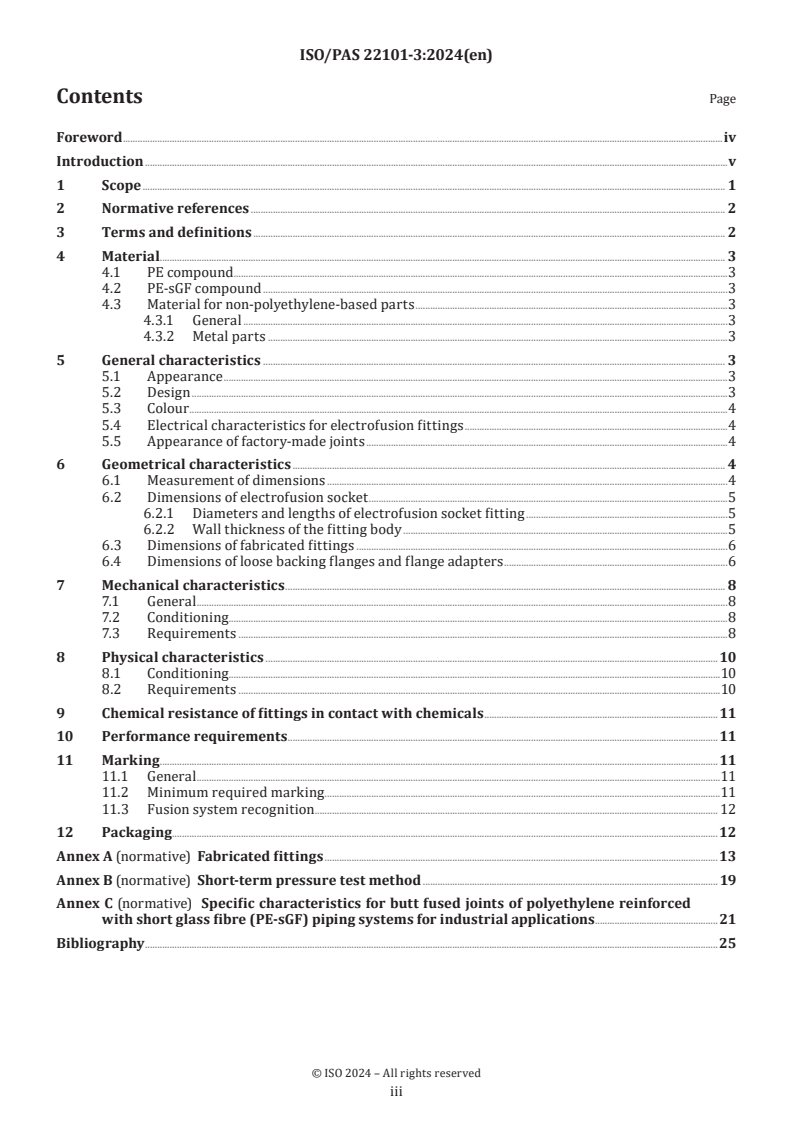
Contents Page
Foreword .iv
Introduction .v
1 Scope . 1
2 Normative references . 2
3 Terms and definitions . 2
4 Material. 3
4.1 PE compound.3
4.2 PE-sGF compound .3
4.3 Material for non-polyethylene-based parts .3
4.3.1 General .3
4.3.2 Metal parts .3
5 General characteristics . 3
5.1 Appearance .3
5.2 Design .3
5.3 Colour .4
5.4 Electrical characteristics for electrofusion fittings .4
5.5 Appearance of factory-made joints .4
6 Geometrical characteristics . 4
6.1 Measurement of dimensions .4
6.2 Dimensions of electrofusion socket .5
6.2.1 Diameters and lengths of electrofusion socket fitting .5
6.2.2 Wall thickness of the fitting body .5
6.3 Dimensions of fabricated fittings .6
6.4 Dimensions of loose backing flanges and flange adapters .6
7 Mechanical characteristics . 8
7.1 General .8
7.2 Conditioning.8
7.3 Requirements .8
8 Physical characteristics .10
8.1 Conditioning.10
8.2 Requirements .10
9 Chemical resistance of fittings in contact with chemicals .11
10 Performance requirements . .11
11 Marking . .11
11.1 General .11
11.2 Minimum required marking .11
11.3 Fusion system recognition . 12
12 Packaging.12
Annex A (normative) Fabricated fittings .13
Annex B (normative) Short-term pressure test method . 19
Annex C (normative) Specific characteristics for butt fused joints of polyethylene reinforced
with short glass fibre (PE-sGF) piping systems for industrial applications .21
Bibliography .25
iii
Foreword
ISO (the International Organization for Standardization) is a worldwide federation of national standards
bodies (ISO member bodies). The work of preparing International Standards is normally carried out through
ISO technical committees. Each member body interested in a subject for which a technical committee
has been established has the right to be represented on that committee. International organizations,
governmental and non-governmental, in liaison with ISO, also take part in the work. ISO collaborates closely
with the International Electrotechnical Commission (IEC) on all matters of electrotechnical standardization.
The procedures used to develop this document and those intended for its further maintenance are described
in the ISO/IEC Directives, Part 1. In particular, the different approval criteria needed for the different types
of ISO document should be noted. This document was drafted in accordance with the editorial rules of the
ISO/IEC Directives, Part 2 (see www.iso.org/directives).
ISO draws attention to the possibility that the implementation of this document may involve the use of (a)
patent(s). ISO takes no position concerning the evidence, validity or applicability of any claimed patent
rights in respect thereof. As of the date of publication of this document, ISO had not received notice of (a)
patent(s) which may be required to implement this document. However, implementers are cautioned that
this may not represent the latest information, which may be obtained from the patent database available at
www.iso.org/patents. ISO shall not be held responsible for identifying any or all such patent rights.
Any trade name used in this document is information given for the convenience of users and does not
constitute an endorsement.
For an explanation of the voluntary nature of standards, the meaning of ISO specific terms and expressions
related to conformity assessment, as well as information about ISO's adherence to the World Trade
Organization (WTO) principles in the Technical Barriers to Trade (TBT), see www.iso.org/iso/foreword.html.
This document was prepared by Technical Committee ISO/TC 138, Plastics pipes, fittings and valves for the
transport of fluids, Subcommittee SC 3, Plastics pipes and fittings for industrial applications.
A list of all parts in the ISO 22101 series can be found on the ISO website.
Any feedback or questions on this document should be directed to the user’s national standards body. A
complete listing of these bodies can be found at www.iso.org/members.html.
iv
Introduction
Polyethylene reinforced with short glass fibres (PE-sGF) piping systems are pipe systems which consist
of fittings produced by adding short glass fibres into high density polyethylene resins. Their physical and
mechanical properties are influenced by short glass fibre orientation.
For the material subject of this document, the mechanical performances are obtained on the basis of
standards dedicated to thermoplastics. The geometrical characteristics are defined for this material in line
with ISO 3 and ISO 4065.
v
Publicly Available Specification ISO/PAS 22101-3:2024(en)
Polyethylene reinforced with short glass fibres (PE-sGF)
piping systems for industrial applications —
Part 3:
Fittings
1 Scope
This document specifies the fittings made from short glass fibre reinforced polyethylene (PE-sGF)
manufactured by the spiral cross winding method used below ground for the conveyance of fluids in the
following industrial and agricultural contexts:
— chemical plants;
— industrial sewerage engineering;
— power engineering (cooling and general-purpose water supply);
— agricultural production plants;
— water treatment;
— small hydraulic power plants (general-purpose water supply).
This document also specifies the test parameters for the test methods it references.
In conjunction with the other parts of the ISO 22101 series, this document is applicable to PE-sGF fittings,
and to joints with components of PE-sGF or other materials, intended to be used under the following
conditions:
1)
a) a maximum allowable operating pressure (PFA) up to and including 25 bar;
b) an operating temperature of 20 °C as the reference temperature.
NOTE 1 For other operating temperatures, guidance is given in ISO/PAS 22101-1:2022, Annex A.
This document covers a range of maximum allowable operating pressures and gives requirements
concerning colours and additives.
NOTE 2 It is the responsibility of the purchaser or specifier to make the appropriate selections from these aspects,
taking into account their particular requirements and any relevant national guidance or regulations and installation
practices or codes.
This document is applicable to fittings of the following types:
— electrofusion socket fittings;
— loose backing flanges and flange adapters;
— fabricated fittings (see Annex A).
1) 1 bar = 0,1 MPa = 105 Pa; 1 MPa = 1 N/mm .
2 Normative references
The following documents are referred to in the text in such a way that some or all of their content constitutes
requirements of this document. For dated references, only the edition cited applies. For undated references,
the latest edition of the referenced document (including any amendments) applies.
ISO 527-1, Plastics — Determination of tensile properties — Part 1: General principles
ISO 1167-1, Thermoplastics pipes, fittings and assemblies for the conveyance of fluids — Determination of the
resistance to internal pressure — Part 1: General method
ISO 1167-2, Thermoplastics pipes, fittings and assemblies for the conveyance of fluids — Determination of the
resistance to internal pressure — Part 2: Preparation of pipe test pieces
ISO 2505, Thermoplastics pipes — Longitudinal reversion — Test method and parameters
ISO 3126, Plastics piping systems — Plastics components — Determination of dimensions
ISO 4427-2, Plastics piping systems for water supply, and for drainage and sewerage under pressure —
Polyethylene (PE) — Part 2: Pipes
ISO 4433-1, Thermoplastics pipes — Resistance to liquid chemicals — Classification — Part 1: Immersion test method
ISO 4433-2, Thermoplastics pipes — Resistance to liquid chemicals — Classification — Part 2: Polyolefin pipes
ISO 11357-6, Plastics — Differential scanning calorimetry (DSC) — Part 6: Determination of oxidation induction
time (isothermal OIT) and oxidation induction temperature (dynamic OIT)
ISO 13953, Polyethylene (PE) pipes and fittings — Determination of the tensile strength and failure mode of test
pieces from a butt-fused joint
ISO 13954, Plastics pipes and fittings — Peel decohesion test for polyethylene (PE) electrofusion assemblies of
nominal outside diameter greater than or equal to 90 mm
ISO 13955, Plastics pipes and fittings — Crushing decohesion test for polyethylene (PE) electrofusion assemblies
ISO/PAS 22101-1, Polyethylene reinforced with short glass fibres (PE-sGF) piping systems for industrial
applications — Part 1: General
ISO/PAS 22101-2, Polyethylene reinforced with short glass fibres (PE-sGF) piping systems for industrial
applications — Part 2: Pipes
ISO/PAS 22101-5, Polyethylene reinforced with short glass fibres (PE-sGF) piping systems for industrial
applications — Part 5: Fitness for purpose of the system
3 Terms and definitions
For the purposes of this document, the following terms and definitions apply.
ISO and IEC maintain terminology databases for use in standardization at the following addresses:
— ISO Online browsing platform: available at https:// www .iso .org/ obp
— IEC Electropedia: available at https:// www .electropedia .org/
3.1
electrofusion socket fitting
PE-sGF fitting which contains one or more integral heating elements that are capable of transforming
electrical energy into heat to realize a fusion joint with a spigot end or pipe
3.2
mechanical fitting
fitting that generally includes a compression part to provide pressure integrity, leak tightness and resistance
to end loads for assembling PE-sGF pipe to another PE-sGF pipe or any other element of the piping system
Note 1 to entry: The fitting can allow either a dismountable or permanently assembled joint.
Note 2 to entry: The fitting can be supplied for field assembly or pre-assembled by the manufacturer.
3.3
fabricated fitting
fitting produced from pipe conforming to ISO/PAS 22101-2 or the spiral cross winding process in accordance
with this document, or both
4 Material
4.1 PE compound
The PE compound from which the fitting is made shall conform to ISO/PAS 22101-1.
4.2 PE-sGF compound
The PE-sGF compound from which the fittings are made shall conform to ISO/PAS 22101-1.
4.3 Material for non-polyethylene-based parts
4.3.1 General
The materials and constituent elements used in making the fitting (including any metal parts) shall be as
resistant to the external and internal environments as the other elements of the piping system and shall
have a life expectancy under the following conditions at least equal to that of the PE-sGF pipe conforming to
ISO/PAS 22101-2 with which they are intended to be used:
a) during storage;
b) under the effect of the fluids being conveyed;
c) with respect to the service environment and operating conditions.
4.3.2 Metal parts
All parts susceptible to corrosion shall be adequately protected, provided this is necessary for durability
and function of the system. When dissimilar metallic parts are used which can potentially be in contact with
moisture, appropriate actions shall be taken to avoid galvanic corrosion.
5 General characteristics
5.1 Appearance
When viewed without magnification, the internal and external surfaces of the fitting shall be smooth, clean
and free from scoring, cavities and other surface defects which would prevent conformity of the fitting to
this document.
5.2 Design
The design of the fitting shall be such that, when assembling the fitting onto the pipe or other components in
accordance with the manufacturer’s recommendations, the electrical coils are not displaced.
The electrofusion fitting body shall be made with PE-sGF. Electrofusion fitting sockets shall have an internal
layer in PE. Heating wires shall be placed in the internal PE layer. The outer surface shall have a protective
PE layer.
Flange adapters shall be made from PE-sGF.
Loose backing flanges shall be made from metal.
Fabricated fittings shall be designed in accordance with Annex A.
5.3 Colour
The colour of the PE-sGF parts of the fitting shall be black.
5.4 Electrical characteristics for electrofusion fittings
The electrical protection that shall be provided by the fusion process depends on the voltage and the current
used, and on the characteristics of the electricity power source.
For voltages greater than 25 V, direct human contact with energized parts shall be not possible when the
fitting is in the fusion cycle during assembly, in accordance with the instructions of the manufacturers of the
fittings and the manufacturers of the assembly equipment, as applicable.
[7]
NOTE 1 The fitting during the fusion process is part of an electrical system as defined in EN 60335-1, HD 60364-
[8] [6]
1, and IEC 60449.
The specified electrical resistances of the fitting at 23 °C shall be stated by the manufacturer and its
tolerance shall be between nominal resistance (±5 % Ω).
NOTE 2 0,1 Ω is the assumed value of the contact resistance.
The surface finish of the terminal pins shall allow a minimum contact resistance in order to satisfy the
resistance tolerance requirements.
5.5 Appearance of factory-made joints
The internal and external surfaces of the pipe and fitting after fusion jointing, examined visually without
magnification, shall be free from melt exudation outside the confines of the fitting, apart from that which
may be declared acceptable by the fitting manufacturer or used as a fusion marker.
There shall be no wire movement leading to short circuiting when the electrofusion fitting is jointed
in accordance with the manufacturer’s instructions. There shall be no excessive creasing of the internal
surfaces of the adjoining pipes or spigots.
6 Geometrical characteristics
6.1 Measurement of dimensions
The dimensions of the fittings shall be measured in accordance with ISO 3126. In case of dispute, the
measurement of dimensions shall be made not less than 24 h after manufacture and after conditioning for at
least 4 h at (23 ± 2) °C.
Indirect measurement at the stage of production is permitted after shorter time periods, provided that
evidence is shown of correlation.
6.2 Dimensions of electrofusion socket
6.2.1 Diameters and lengths of electrofusion socket fitting
When measured in accordance with 7.1, the diameters and lengths of electrofusion sockets as shown in
Figure 1 shall conform to ISO/PAS 22101-2. L shall be at least 20 mm. The thickness of the non-glass filled
layer of inner polyethylene shall be at least 1,5 mm for electrofusion socket fittings.
Key
D mean inside diameter in the fusion zone, measured in a plane parallel to the plane of the mouth at a distance of L
1 3
+ 0,5 L
L socket depth corresponding to the maximum spigot insertion
L heated length within a coupler as declared by the manufacturer to be the nominal length of the fusion zone
L distance between the mouth of the fitting and the start of the fusion zone
1 glass-filled layer of electrofusion socket fitting
2 electrical oils
3 non-glass-filled layer of electrofusion socket fitting
4 non-glass-filled layer of electrofusion socket fitting
Figure 1 — Dimensions of electrofusion socket fitting
In the case of a fitting having sockets of different sizes, each one shall conform to the requirements for the
corresponding nominal diameter.
The connection of two pipes of different materials (e.g. PE to PE-sGF) and thicknesses is allowed by the
fitting.
6.2.2 Wall thickness of the fitting body
The wall thickness, E, of the fitting body measured at any point, shall be at least equal to the nominal wall
thickness, e , of the pipe.
n
Any changes in wall thickness inside the body of the fitting shall be gradual in order to prevent stress
concentrations.
6.3 Dimensions of fabricated fittings
When the description and dimensions of fittings of this type are required, Annex A applies.
6.4 Dimensions of loose backing flanges and flange adapters
Loose backing flanges shall be designed to the relevant PS, in accordance with Table 2 and Table 3 as
appropriate.
Flange adapters shall be designed in order to prevent stress concentration at any changes in cross-section.
The thickness of the flange adapter face and loose backing flange shall be dependent on the material used in
the manufacture of the adapter and on the nominal pressure, PS, of the piping system for which it is designed.
All dimensions shall be measured in accordance with Figure 2.
Key
D nominal (inside) diameter of connecting pipe
n
R radius of shoulder of flange adapter
f
D inside diameter of loose backing flange
D pitch circle diameter
D outside diameter of flange adapter head
D outside diameter of flange adapter shank
D bolt hole diameter
D outside diameter of loose backing flange
Figure 2 — Butt fusion systems
For butt fusion systems, the dimensions of the flange adapters shall conform to those given in Table 1.
Table 1 — Flange adapters — Dimensions for butt fusion systems
Dimensions in millimetres
Radius of shoulder of
Nominal inside diameter Outside diameter of Outside diameter of flange
flange adapter
a b c
of pipe and spigot flange adapter head adapter shank
R
f
d D D
n 4min 5min
(+0,5/-0,5)
200 231 235 10
300 335 343 10
400 440 449 10
500 589 560 10
600 797 682 15
700 905 788 15
800 1 005 894 15
900 1 107 1 010 20
1 000 1 217 1 121 20
a
The diameter of the spigot shall conform to the relevant product standard.
b
The actual value of D should be as high as possible to ensure fitness for purpose of the assembly.
c
D shall be measured in the middle of the radius, R .
5 f
The dimensions of PS 10 designated loose backing flanges shall conform to those given in Table 2.
Table 2 — PS 10 designated loose backing flange dimensions for butt fusion systems
Dimensions in millimetres
PS 10 designated loose backing flanges
Nominal
outside Bolts
DN/ID
Outside Inside diame- Pitch circle
diameter of
Bolt hole Screw thread
diameter ter diameter
Number
pipe
diameter
DN/OD D D D D n
7min 2 3 6
200 224 290 228 262 23 12 M20
300 333 400 337 368 25 16 M22
400 441 510 445 475 27 16 M24
500 554 675 558 620 27 20 M24
600 660 905 664 840 33 24 M30
700 768 1 020 772 950 33 28 M30
800 876 1 120 880 1 050 33 28 M30
900 982 1 235 986 1 160 39 28 M36
1 000 1 095 1 345 1 099 1 270 39 28 M36
The dimensions of PS 16 designated loose backing flanges shall conform to those given in Table 3.
...