

ISO 23464:2020
(Main)Nitrile cleanroom gloves — Specification
General Information
- Abstract
This document specifies the specification for ISO Class 4, ISO Class 5 and ISO Class 6 nitrile cleanroom gloves. It is applicable to cleanroom gloves made of acrylonitrile butadiene material.
- Status
- Published
- Publication Date
- 06-Jul-2020
- Technical Committee
- ISO/TC 45/SC 4 - Products (other than hoses)
- Drafting Committee
- ISO/TC 45/SC 4/WG 5 - Gloves and other latex products
- Current Stage
- 9093 - International Standard confirmed
- Start Date
- 09-Jun-2025
- Completion Date
- 29-Aug-2026
Buy Documents
ISO 23464:2020 - Nitrile cleanroom gloves -- Specification
ISO 23464:2020 - Nitrile cleanroom gloves — Specification/7/2020
Overview
ISO 23464:2020 is an international standard specifying requirements for nitrile cleanroom gloves used in controlled environments. Applicable to acrylonitrile butadiene-based gloves, this document covers ISO Class 4, Class 5, and Class 6 gloves-designed to minimize contamination risks in critical cleanrooms. Published by ISO in 2020, this standard supports industries requiring stringent contamination control such as electronics, semiconductors, nanotechnology, and biomedical fields.
Cleanroom gloves certified to ISO 23464:2020 ensure minimal transfer of sub-micron particles, ionic contaminants, and chemical residues onto sensitive products or components, preserving the integrity and quality within controlled operations.
Key Topics
Cleanroom Classification
Defines three glove classes based on cleanliness levels:- ISO Class 4 (highest cleanliness)
- ISO Class 5
- ISO Class 6 (standard protection)
Contaminant Limits
The standard sets quantitative limits for glove parameters, including:- Particle counts per cm² on glove surfaces
- Ionic chemical content (fluoride, chloride, bromide, nitrate, phosphate, sulfate, sodium, magnesium, potassium)
- Total non-volatile residue (TNVR)
- Absence of silicone, amide, and dioctyl phthalate (DOP)
Testing and Sampling Methods
Specifies sampling of 3 gloves per batch and defines test methods based on IEST-RP-CC005.4:2013 procedures for:- Particle counting across multiple size ranges (0.5 µm to >20 µm)
- Ionic and TNVR chemical analysis
- Detection of prohibited contaminants such as silicone and DOP
Glove Processing and Packaging
Requirements for cleanroom-compatible processing including laundering with high purity RO-DI water, extraction, drying under laminar airflow, and packaging in non-particulating materials to prevent contamination post-manufacture.
Applications
ISO 23464:2020 certified nitrile cleanroom gloves are critical in environments that demand ultra-clean conditions to avoid product contamination and process failures, including:
Semiconductor Manufacturing
Protects wafers and chips from particle and chemical contamination during fabrication stages.Electronic & Storage Media Industries
Ensures integrity of sensitive components such as disk drives and flat panel displays.Nanotechnology & TFT/LCD Production
Provides ultra-clean handling for nano-scale components and advanced display technologies.Biomedical and Pharmaceutical Processing
Maintains aseptic conditions by controlling glove particulates and chemical residues in critical healthcare and research labs.Cleanroom Laboratory Operations
Supports environments classified under ISO 14644 for air cleanliness, reducing airborne and surface contamination sources.
Related Standards
- ISO 14644-1: Classification of air cleanliness by particle concentration, relevant for cleanroom environment control.
- IEST-RP-CC005.4:2013: Recommended practices for cleanroom gloves and finger cots, referenced for testing methods.
- ISO 2859-1: Sampling procedures for inspection by attributes, guiding batch testing approaches.
- ISO 11193-1: Specification for single-use medical examination gloves, providing complementary guidelines for medical applications.
- ASTM D3577 & D3578: Specifications for synthetic surgical and examination gloves widely used in healthcare.
Adherence to ISO 23464:2020 ensures nitrile cleanroom gloves meet critical standards for contaminant control, fostering reliability and quality assurance in high-precision manufacturing and research sectors. This standard is essential for manufacturers and users aiming to maintain stringent contamination limits and optimize cleanroom safety protocols.
Buy Documents
ISO 23464:2020 - Nitrile cleanroom gloves -- Specification
ISO 23464:2020 - Nitrile cleanroom gloves — Specification/7/2020
Get Certified
Connect with accredited certification bodies for this standard

DIN CERTCO
DIN Group product certification.

Smithers Quality Assessments
US management systems and product certification.
Sponsored listings
Frequently Asked Questions
ISO 23464:2020 is a standard published by the International Organization for Standardization (ISO). Its full title is "Nitrile cleanroom gloves — Specification". This standard covers: This document specifies the specification for ISO Class 4, ISO Class 5 and ISO Class 6 nitrile cleanroom gloves. It is applicable to cleanroom gloves made of acrylonitrile butadiene material.
This document specifies the specification for ISO Class 4, ISO Class 5 and ISO Class 6 nitrile cleanroom gloves. It is applicable to cleanroom gloves made of acrylonitrile butadiene material.
ISO 23464:2020 is classified under the following ICS (International Classification for Standards) categories: 83.140.99 - Other rubber and plastics products. The ICS classification helps identify the subject area and facilitates finding related standards.
ISO 23464:2020 is available in PDF format for immediate download after purchase. The document can be added to your cart and obtained through the secure checkout process. Digital delivery ensures instant access to the complete standard document.
Standards Content (Sample)
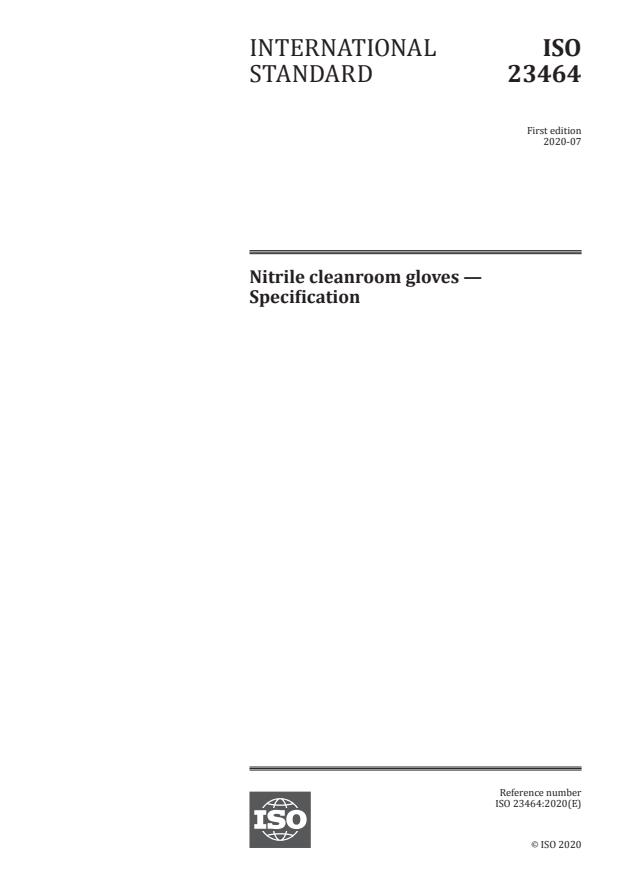
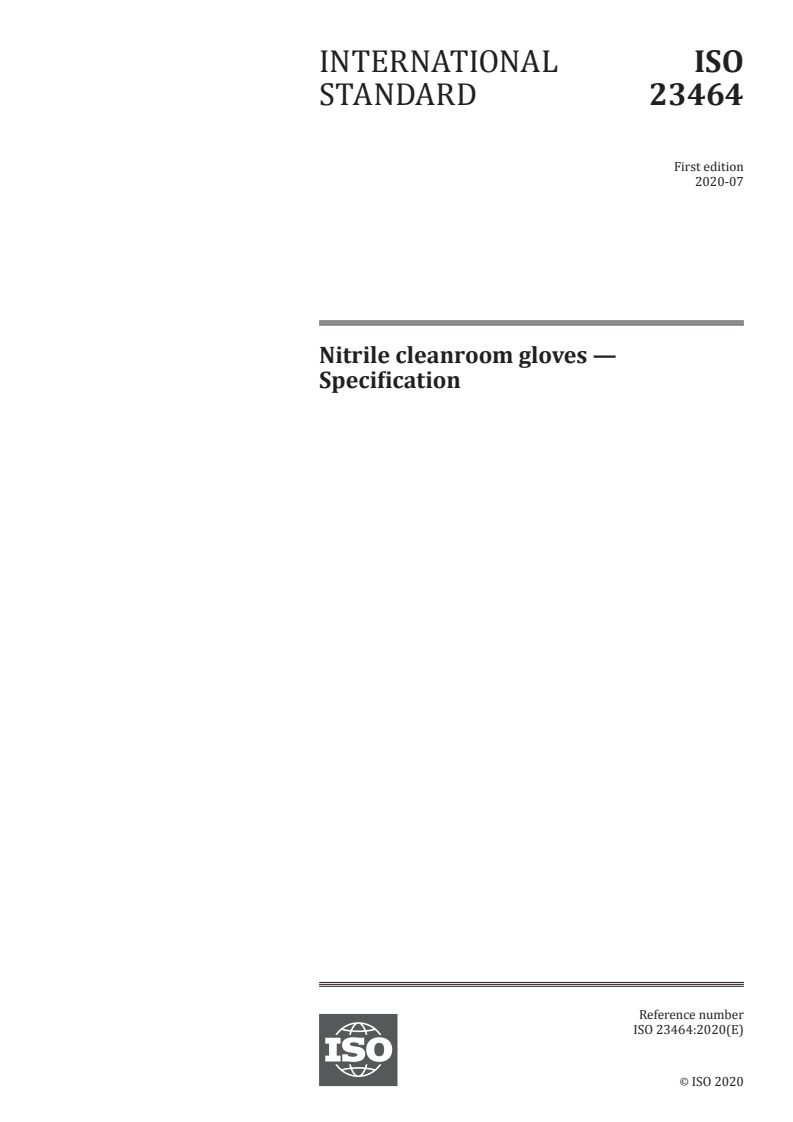
INTERNATIONAL ISO
STANDARD 23464
First edition
2020-07
Nitrile cleanroom gloves —
Specification
Reference number
©
ISO 2020
© ISO 2020
All rights reserved. Unless otherwise specified, or required in the context of its implementation, no part of this publication may
be reproduced or utilized otherwise in any form or by any means, electronic or mechanical, including photocopying, or posting
on the internet or an intranet, without prior written permission. Permission can be requested from either ISO at the address
below or ISO’s member body in the country of the requester.
ISO copyright office
CP 401 • Ch. de Blandonnet 8
CH-1214 Vernier, Geneva
Phone: +41 22 749 01 11
Email: copyright@iso.org
Website: www.iso.org
Published in Switzerland
ii © ISO 2020 – All rights reserved
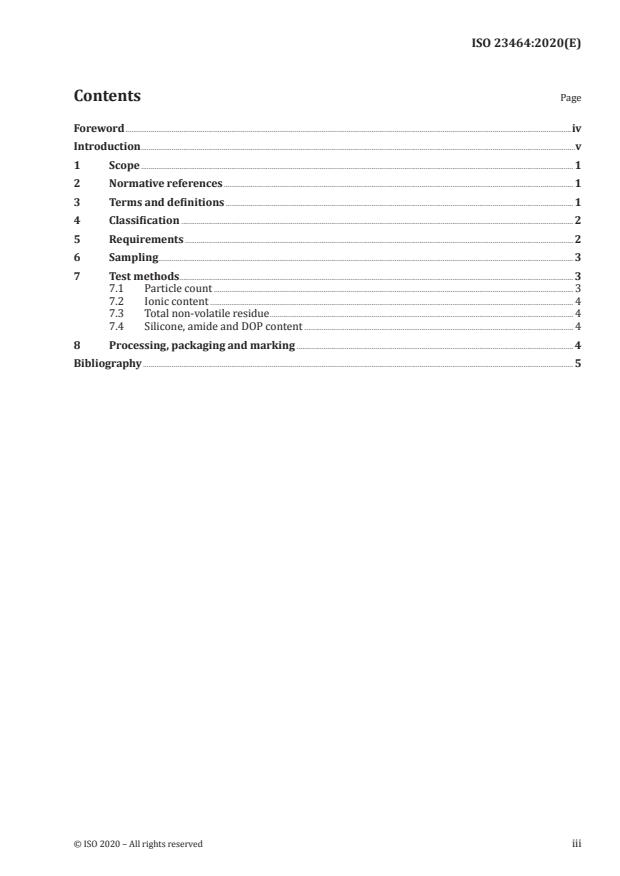
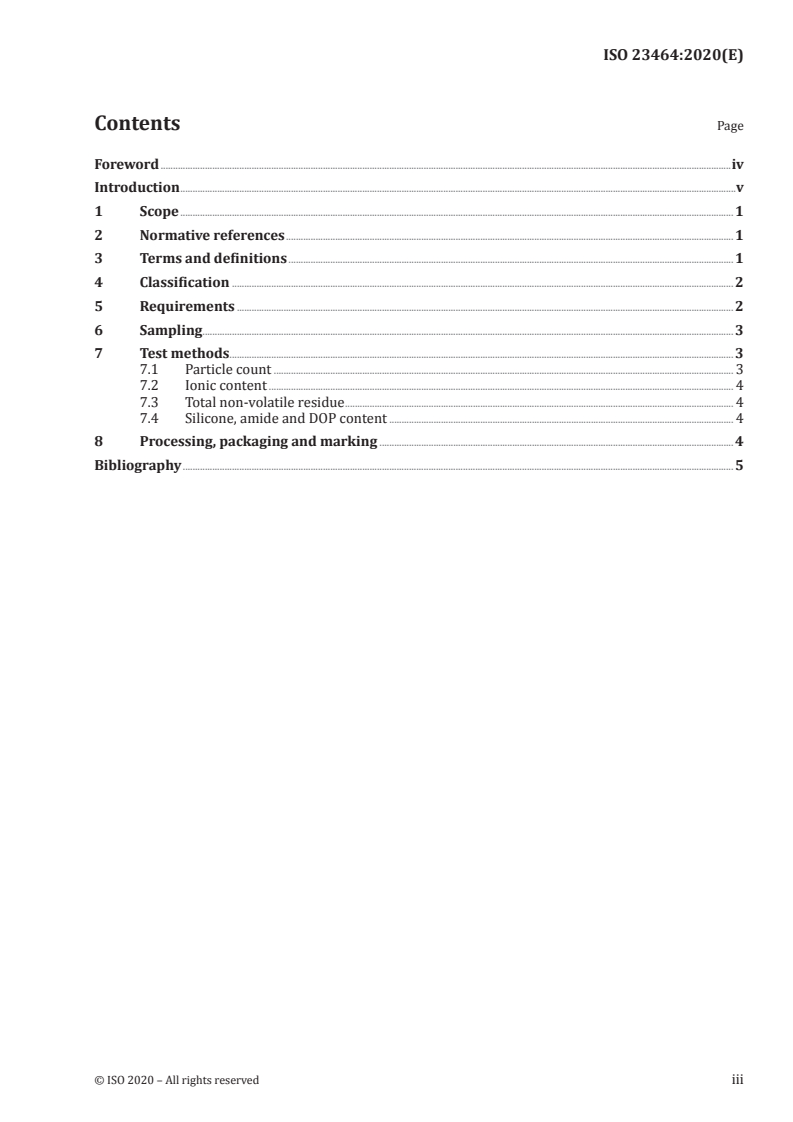
Contents Page
Foreword .iv
Introduction .v
1 Scope . 1
2 Normative references . 1
3 Terms and definitions . 1
4 Classification . 2
5 Requirements . 2
6 Sampling . 3
7 Test methods . 3
7.1 Particle count . 3
7.2 Ionic content . 4
7.3 Total non-volatile residue . 4
7.4 Silicone, amide and DOP content . 4
8 Processing, packaging and marking . 4
Bibliography . 5
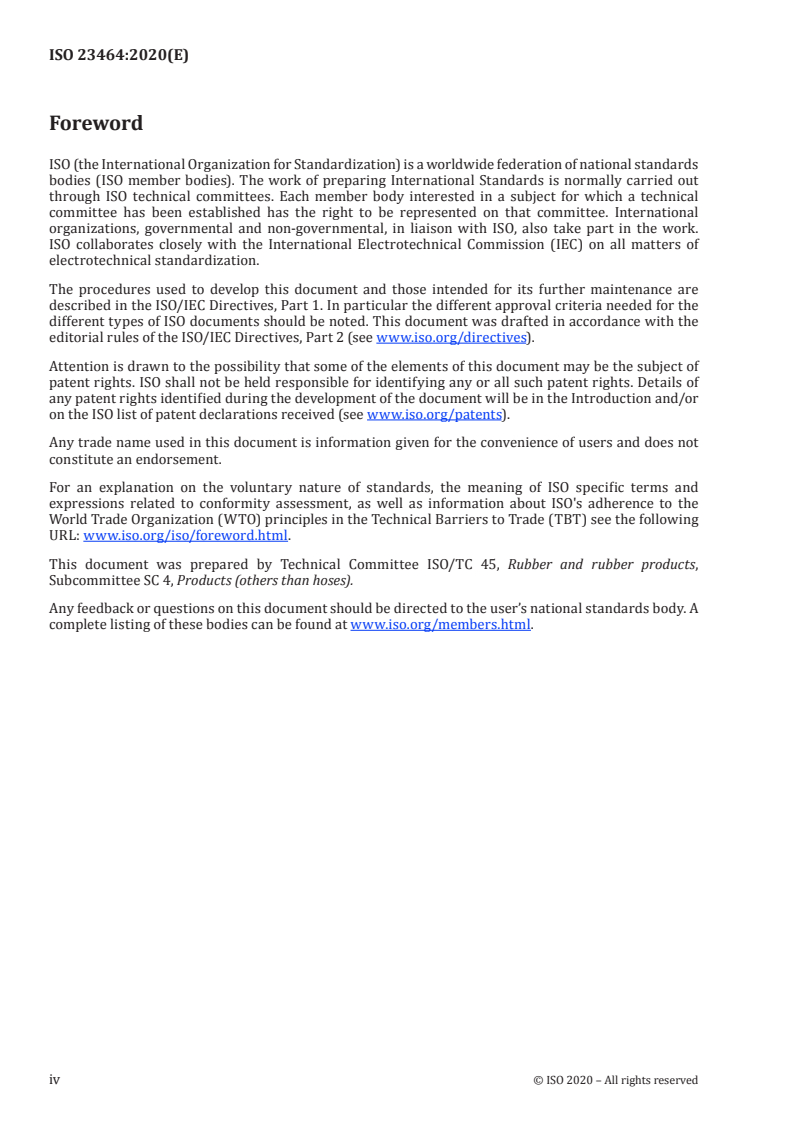
Foreword
ISO (the International Organization for Standardization) is a worldwide federation of national standards
bodies (ISO member bodies). The work of preparing International Standards is normally carried out
through ISO technical committees. Each member body interested in a subject for which a technical
committee has been established has the right to be represented on that committee. International
organizations, governmental and non-governmental, in liaison with ISO, also take part in the work.
ISO collaborates closely with the International Electrotechnical Commission (IEC) on all matters of
electrotechnical standardization.
The procedures used to develop this document and those intended for its further maintenance are
described in the ISO/IEC Directives, Part 1. In particular the different approval criteria needed for the
different types of ISO documents should be noted. This document was drafted in accordance with the
editorial rules of the ISO/IEC Directives, Part 2 (see www .iso .org/ directives).
Attention is drawn to the possibility that some of the elements of this document may be the subject of
patent rights. ISO shall not be held responsible for identifying any or all such patent rights. Details of
any patent rights identified during the development of the document will be in the Introduction and/or
on the ISO list of patent declarations received (see www .iso .org/ patents).
Any trade name used in this document is information given for the convenience of users and does not
constitute an endorsement.
For an explanation on the voluntary nature of standards, the meaning of ISO specific terms and
expressions related to conformity assessment, as well as information about ISO's adherence to the
World Trade Organization (WTO) principles in the Technical Barriers to Trade (TBT) see the following
URL: www .iso .org/ iso/ foreword .html.
This document was prepared by Technical Committee ISO/TC 45, Rubber and rubber products,
Subcommittee SC 4, Products (others than hoses).
Any feedback or questions on this document should be directed to the user’s national standards body. A
complete listing of these bodies can be found at www .iso .org/ members .html.
iv © ISO 2020 – All rights reserved
Introduction
Cleanroom synthetic gloves have been used in the critical environments of the electronic, disk drive,
semiconductor as well as storage media industries, for the past 15 years. The quest for a cleaner glove,
in new emerging industries of TFT, LCD, nanotechnology, bio medical applications, has ensured that
this is a growing market. The industry use of cleanroom gloves is currently dominated by synthetic
gloves, though, this wasn’t the case, right up to the year 2000, wherein, latex gloves was the principle
cleanroom available.
The basic function of cleanroom gloves is to ensure minimal transfer of contaminants onto the products
or components being processed or manufactured in a clean environment. Such contaminants will
always be present in the exposed hands of the personnel. It is for this purpose that the hands need to be
gloved. However, such gloves need to have minimal contaminants on its surface, thus the need for the
use of cleanroom gloves.
The principle contaminants that could compromise the quality or the integrity of the product or process
in a critical environment are sub-micron particles, ionic chemical contaminants, non-volatile chemical
components as well as silicone, amide or dioctyl phthalate (DOP). In the cleanroom industry, these
parameters a
...
INTERNATIONAL ISO
STANDARD 23464
First edition
2020-07
Nitrile cleanroom gloves —
Specification
Reference number
©
ISO 2020
© ISO 2020
All rights reserved. Unless otherwise specified, or required in the context of its implementation, no part of this publication may
be reproduced or utilized otherwise in any form or by any means, electronic or mechanical, including photocopying, or posting
on the internet or an intranet, without prior written permission. Permission can be requested from either ISO at the address
below or ISO’s member body in the country of the requester.
ISO copyright office
CP 401 • Ch. de Blandonnet 8
CH-1214 Vernier, Geneva
Phone: +41 22 749 01 11
Email: copyright@iso.org
Website: www.iso.org
Published in Switzerland
ii © ISO 2020 – All rights reserved
Contents Page
Foreword .iv
Introduction .v
1 Scope . 1
2 Normative references . 1
3 Terms and definitions . 1
4 Classification . 2
5 Requirements . 2
6 Sampling . 3
7 Test methods . 3
7.1 Particle count . 3
7.2 Ionic content . 4
7.3 Total non-volatile residue . 4
7.4 Silicone, amide and DOP content . 4
8 Processing, packaging and marking . 4
Bibliography . 5
Foreword
ISO (the International Organization for Standardization) is a worldwide federation of national standards
bodies (ISO member bodies). The work of preparing International Standards is normally carried out
through ISO technical committees. Each member body interested in a subject for which a technical
committee has been established has the right to be represented on that committee. International
organizations, governmental and non-governmental, in liaison with ISO, also take part in the work.
ISO collaborates closely with the International Electrotechnical Commission (IEC) on all matters of
electrotechnical standardization.
The procedures used to develop this document and those intended for its further maintenance are
described in the ISO/IEC Directives, Part 1. In particular the different approval criteria needed for the
different types of ISO documents should be noted. This document was drafted in accordance with the
editorial rules of the ISO/IEC Directives, Part 2 (see www .iso .org/ directives).
Attention is drawn to the possibility that some of the elements of this document may be the subject of
patent rights. ISO shall not be held responsible for identifying any or all such patent rights. Details of
any patent rights identified during the development of the document will be in the Introduction and/or
on the ISO list of patent declarations received (see www .iso .org/ patents).
Any trade name used in this document is information given for the convenience of users and does not
constitute an endorsement.
For an explanation on the voluntary nature of standards, the meaning of ISO specific terms and
expressions related to conformity assessment, as well as information about ISO's adherence to the
World Trade Organization (WTO) principles in the Technical Barriers to Trade (TBT) see the following
URL: www .iso .org/ iso/ foreword .html.
This document was prepared by Technical Committee ISO/TC 45, Rubber and rubber products,
Subcommittee SC 4, Products (others than hoses).
Any feedback or questions on this document should be directed to the user’s national standards body. A
complete listing of these bodies can be found at www .iso .org/ members .html.
iv © ISO 2020 – All rights reserved
Introduction
Cleanroom synthetic gloves have been used in the critical environments of the electronic, disk drive,
semiconductor as well as storage media industries, for the past 15 years. The quest for a cleaner glove,
in new emerging industries of TFT, LCD, nanotechnology, bio medical applications, has ensured that
this is a growing market. The industry use of cleanroom gloves is currently dominated by synthetic
gloves, though, this wasn’t the case, right up to the year 2000, wherein, latex gloves was the principle
cleanroom available.
The basic function of cleanroom gloves is to ensure minimal transfer of contaminants onto the products
or components being processed or manufactured in a clean environment. Such contaminants will
always be present in the exposed hands of the personnel. It is for this purpose that the hands need to be
gloved. However, such gloves need to have minimal contaminants on its surface, thus the need for the
use of cleanroom gloves.
The principle contaminants that could compromise the quality or the integrity of the product or process
in a critical environment are sub-micron particles, ionic chemical contaminants, non-volatile chemical
components as well as silicone, amide or dioctyl phthalate (DOP). In the cleanroom industry, these
parameters a
...