

ISO/TR 22762-7:2024
(Main)Elastomeric seismic-protection isolators — Part 7: Relationship of the ISO 22762 series to the design and testing of seismic isolation systems
General Information
- Abstract
This document explains the relationship of the ISO 22762 series to the design and testing of seismic isolation systems, including the relationship to national seismic codes.
- Status
- Published
- Publication Date
- 18-Jul-2024
- Technical Committee
- ISO/TC 45/SC 4 - Products (other than hoses)
- Drafting Committee
- ISO/TC 45/SC 4 - Products (other than hoses)
- Current Stage
- 6060 - International Standard published
- Start Date
- 19-Jul-2024
- Completion Date
- 19-Jul-2024


Overview
ISO/TR 22762-7:2024 - Elastomeric seismic-protection isolators - Part 7 explains how the ISO 22762 series relates to the design and testing of seismic isolation systems and to national seismic codes. The Technical Report clarifies terminology, maps ISO test categories to common code requirements (using ASCE/SEI 7-22 as an illustrative example), and provides guidance for structural engineers, manufacturers and testing laboratories on applying ISO requirements in practice.
Key topics and technical requirements
- Scope and purpose: Explains relationships between ISO 22762 parts and seismic-code design/testing requirements for elastomeric isolators (rubber bearings such as HDR, LRB and LNR).
- Terms and symbols: Defines critical terms and symbols used across ISO 22762 (e.g., shear stiffness K, equivalent damping heq, characteristic strength Qd, design compressive stress σ0, design shear strain γ0).
- Testing categories:
- Qualification tests / Type tests - manufacturer-conducted tests submitted for approval.
- Prototype tests / Type tests - project-specific verification of designed isolators.
- Production tests / Routine tests - factory quality control and pre-shipment verification.
- Correspondence with seismic codes: Matches seismic-code terminology and test requirements to ISO 22762 definitions and procedures; highlights minor differences in property definitions and test parameters.
- Property modification factors: Guidance on determining factors that account for temperature, rate-of-loading, manufacturing variations, ageing and environmental exposure.
- Informative annexes: Practical tables and examples - comparisons between ISO 22762-6 and EN 15129, sample test data for prototype testing, and examples for calculating property modification factors.
Practical applications and primary users
Who uses ISO/TR 22762-7:2024 and why:
- Structural engineers - interpret ISO isolator test results and map them to national seismic-code requirements when designing seismically isolated buildings.
- Manufacturers - understand which ISO tests satisfy code-specified qualification, prototype and production test demands.
- Testing laboratories - prepare test programs that align ISO methods with seismic-code expectations.
- Code authorities and procurement teams - evaluate manufacturer submissions and ensure isolator performance claims meet code-driven design demands.
Practical uses include preparing bid documents, specifying isolator performance for projects, approving manufacturer type-test data, and ensuring consistent translation of ISO test outcomes to code-required design parameters.
Related standards
- ISO 22762 series (multiple parts covering material, type, production and test methods) - ISO/TR 22762-7 explains how these parts relate to design and testing under national seismic codes.
- Informative comparison with EN 15129 and practical examples referencing ASCE/SEI 7-22 are included to aid international application.
Get Certified
Connect with accredited certification bodies for this standard

DIN CERTCO
DIN Group product certification.
DIBt (Deutsches Institut für Bautechnik)
German Institute for Building Technology.

Aboma Certification B.V.
Specialized in construction, metal, and transport sectors.
Sponsored listings
Frequently Asked Questions
ISO/TR 22762-7:2024 is a technical report published by the International Organization for Standardization (ISO). Its full title is "Elastomeric seismic-protection isolators — Part 7: Relationship of the ISO 22762 series to the design and testing of seismic isolation systems". This standard covers: This document explains the relationship of the ISO 22762 series to the design and testing of seismic isolation systems, including the relationship to national seismic codes.
This document explains the relationship of the ISO 22762 series to the design and testing of seismic isolation systems, including the relationship to national seismic codes.
ISO/TR 22762-7:2024 is classified under the following ICS (International Classification for Standards) categories: 83.140.99 - Other rubber and plastics products; 91.120.25 - Seismic and vibration protection. The ICS classification helps identify the subject area and facilitates finding related standards.
ISO/TR 22762-7:2024 is available in PDF format for immediate download after purchase. The document can be added to your cart and obtained through the secure checkout process. Digital delivery ensures instant access to the complete standard document.
Standards Content (Sample)
Technical
Report
ISO/TR 22762-7
First edition
Elastomeric seismic-protection
2024-07
isolators —
Part 7:
Relationship of the ISO 22762 series
to the design and testing of seismic
isolation systems
Isolateurs en élastomère pour la protection sismique —
Partie 7: Relation entre la série ISO 22762 et la conception et les
essais des systèmes de protection sismique
Reference number
© ISO 2024
All rights reserved. Unless otherwise specified, or required in the context of its implementation, no part of this publication may
be reproduced or utilized otherwise in any form or by any means, electronic or mechanical, including photocopying, or posting on
the internet or an intranet, without prior written permission. Permission can be requested from either ISO at the address below
or ISO’s member body in the country of the requester.
ISO copyright office
CP 401 • Ch. de Blandonnet 8
CH-1214 Vernier, Geneva
Phone: +41 22 749 01 11
Email: copyright@iso.org
Website: www.iso.org
Published in Switzerland
ii
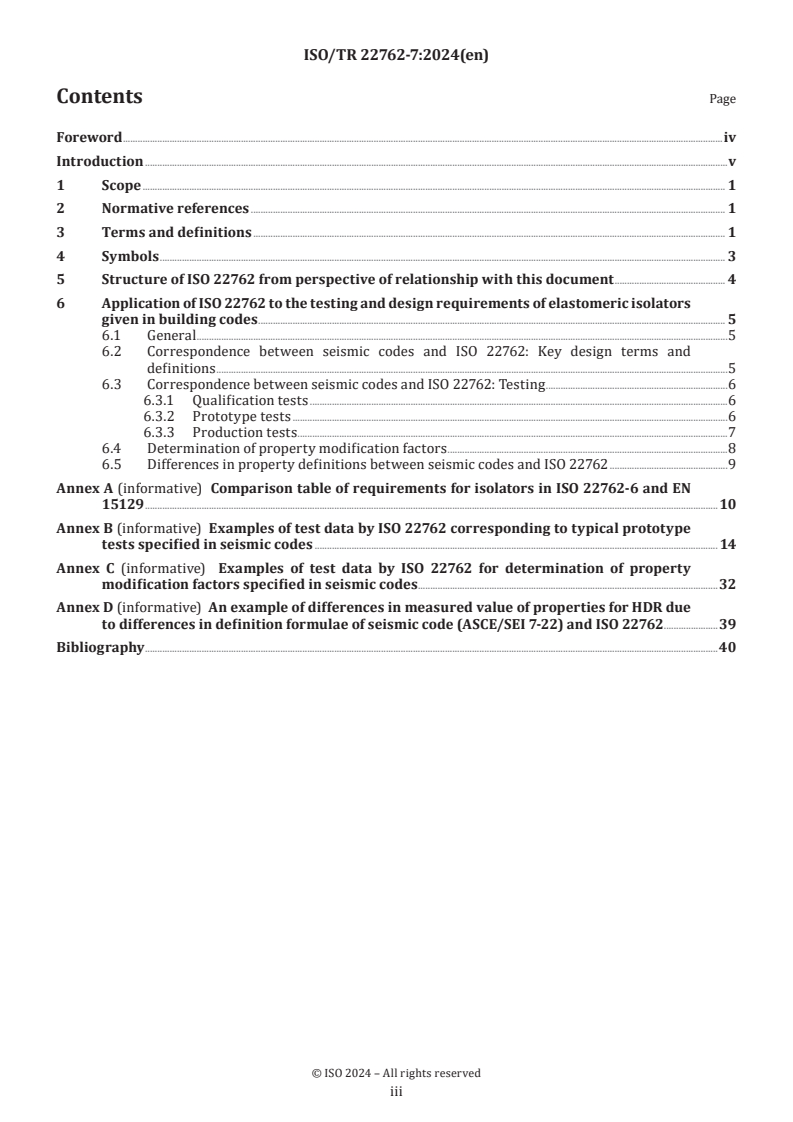
Contents Page
Foreword .iv
Introduction .v
1 Scope . 1
2 Normative references . 1
3 Terms and definitions . 1
4 Symbols . 3
5 Structure of ISO 22762 from perspective of relationship with this document . 4
6 Application of ISO 22762 to the testing and design requirements of elastomeric isolators
given in building codes . 5
6.1 General .5
6.2 Correspondence between seismic codes and ISO 22762: Key design terms and
definitions .5
6.3 Correspondence between seismic codes and ISO 22762: Testing .6
6.3.1 Qualification tests .6
6.3.2 Prototype tests .6
6.3.3 Production tests .7
6.4 Determination of property modification factors .8
6.5 Differences in property definitions between seismic codes and ISO 22762 .9
Annex A (informative) Comparison table of requirements for isolators in ISO 22762-6 and EN
15129 .10
Annex B (informative) Examples of test data by ISO 22762 corresponding to typical prototype
tests specified in seismic codes . 14
Annex C (informative) Examples of test data by ISO 22762 for determination of property
modification factors specified in seismic codes .32
Annex D (informative) An example of differences in measured value of properties for HDR due
to differences in definition formulae of seismic code (ASCE/SEI 7-22) and ISO 22762.39
Bibliography .40
iii
Foreword
ISO (the International Organization for Standardization) is a worldwide federation of national standards
bodies (ISO member bodies). The work of preparing International Standards is normally carried out through
ISO technical committees. Each member body interested in a subject for which a technical committee
has been established has the right to be represented on that committee. International organizations,
governmental and non-governmental, in liaison with ISO, also take part in the work. ISO collaborates closely
with the International Electrotechnical Commission (IEC) on all matters of electrotechnical standardization.
The procedures used to develop this document and those intended for its further maintenance are described
in the ISO/IEC Directives, Part 1. In particular, the different approval criteria needed for the different types
of ISO document should be noted. This document was drafted in accordance with the editorial rules of the
ISO/IEC Directives, Part 2 (see www.iso.org/directives).
ISO draws attention to the possibility that the implementation of this document may involve the use of (a)
patent(s). ISO takes no position concerning the evidence, validity or applicability of any claimed patent
rights in respect thereof. As of the date of publication of this document, ISO had not received notice of (a)
patent(s) which may be required to implement this document. However, implementers are cautioned that
this may not represent the latest information, which may be obtained from the patent database available at
www.iso.org/patents. ISO shall not be held responsible for identifying any or all such patent rights.
Any trade name used in this document is information given for the convenience of users and does not
constitute an endorsement.
For an explanation of the voluntary nature of standards, the meaning of ISO specific terms and expressions
related to conformity assessment, as well as information about ISO's adherence to the World Trade
Organization (WTO) principles in the Technical Barriers to Trade (TBT), see www.iso.org/iso/foreword.html.
This document was prepared by Technical Committee ISO/TC 45, Rubber and rubber products, Subcommittee
SC 4, Products (other than hoses).
A list of all parts in the ISO 22762 series can be found on the ISO website.
Any feedback or questions on this document should be directed to the user’s national standards body. A
complete listing of these bodies can be found at www.iso.org/members.html.
iv
Introduction
Elastomeric isolators are one of the most popular types of seismic isolation systems for buildings worldwide.
Structural engineers must comply with national building code requirements, or guidelines if detailed code
provisions for isolation do not exist, and generally that means designing in accordance with a standard, such
as ASCE/SEI 7-22. In these codes and guidelines, the requirements for isolators must satisfy design demands
determined by structural seismic response analysis. The ISO 22762 series provides detailed requirements for
testing and design of elastomeric isolators and gives different requirements (grades) according to the target
performance level for the isolation system. This document is intended to explain the relationship between
the requirements in national seismic codes with ASCE/SEI 7-22 used by way of example throughout, and
ISO 22762 series, with the goal of allowing structural engineers to more effectively, and more widely, make
use of ISO 22762 series when designing seismically-isolated buildings. ASCE/SEI 7-22 is used throughout
this document as an example building code for seismically-isolated buildings, and any reference to “seismic
code” may be understood to refer to that document. The concept of this document is given in Figure 1.
Figure 1 — Conceptual diagram showing the role of ISO/TR 22762-7
v
Technical Report ISO/TR 22762-7:2024(en)
Elastomeric seismic-protection isolators —
Part 7:
Relationship of the ISO 22762 series to the design and testing
of seismic isolation systems
1 Scope
This document explains the relationship of the ISO 22762 series to the design and testing of seismic isolation
systems, including the relationship to national seismic codes.
2 Normative references
There are no normative references in this document.
3 Terms and definitions
For the purposes of this document, the following terms and definitions apply.
ISO and IEC maintain terminological databases for use in standardization at the following addresses:
— ISO Online browsing platform: available at https:// www .iso .org/ obp/
— IEC Electropedia: available at http:// www .electropedia .org/
3.1
breaking
rupture of elastomeric isolator (3.6) due to compression- (or tension-) shear loading
3.2
buckling
state when elastomeric isolators (3.6) lose their stability under compression-shear loading
3.3
compressive properties of elastomeric isolator
K
v
compressive stiffness for all types of rubber bearings
3.4
design compressive stress
long-term compressive force on the elastomeric isolator (3.6) imposed by the structure
3.5
design shear strain
shear strain of elastomeric isolator (3.6) at design shear displacement
3.6
elastomeric isolator
rubber bearing, for seismic isolation of buildings, bridges and other structures, which consists of multi-
layered vulcanized rubber sheets and reinforcing steel plates
EXAMPLE High-damping rubber bearings, linear natural rubber bearings and lead rubber bearings.
3.7
first shape factor
ratio of effectively loaded area to free deformation area of one inner rubber layer between steel plates
3.8
high-damping rubber bearing
HDR
elastomeric isolator (3.6) with relatively high damping properties obtained by special compounding of the
rubber and the use of additives
3.9
inner rubber
rubber between multi-layered steel plates inside an elastomeric isolator (3.6)
3.10
lead rubber bearing
LRB
elastomeric isolator (3.6) whose inner rubber (3.9) has a lead plug or lead plugs press fitted into a hole or
holes of the isolator body to achieve damping properties
3.11
linear natural rubber bearing
LNR
elastomeric isolator (3.6) with linear shear force-deflection characteristics and relatively low damping
properties, fabricated using natural rubber
Note 1 to entry: Any bearing with relatively low damping can be treated as an LNR bearing for the purposes of isolator
testing.
3.12
maximum compressive stress
peak stress acting briefly on elastomeric isolators (3.6) in compressive direction during an earthquake
3.13
maximum shear strain
shear strain of elastomeric isolator (3.6) at maximum shear displacement
3.14
property modification factor
factor to account for a variation in physical property from a standard value, due to effects such as
temperature, rate of loading, manufacturing variations, ageing and environmental exposure
3.15
compressive stress
nominal compressive stress
long-term stress acting on elastomeric isolators (3.6) in compressive direction as recommended by the
manufacturer for the isolator, including the safety margin
3.16
production test
project specific test to verify that the isolator manufactured has the required performance prior to shipping
3.17
prototype test
project specific test to verify that the designed isolator has the required performance
3.18
qualification test
test to demonstrate the isolator performance in various test items, which is conducted by manufacturer and
whose data is submitted for approval of structural engineer as one of bidding documents
3.19
routine test
test for quality control of the production isolators during and after manufacturing
3.20
second shape factor
ratio of the diameter of the inner rubber (3.9) to the total thickness of the
inner rubber
3.21
second shape factor
ratio of the effective width of the inner rubber (3.9) to the total
thickness of the inner rubber
3.22
seismic code
building code that defines regulatory requirements for the earthquake design of buildings, and which may
include provisions for seismic isolation
3.23
shear properties
shear properties of elastomeric isolators
comprehensive term that covers characteristics determined from isolator tests:
— shear stiffness, K , for LNR
h
— shear stiffness, K , and equivalent damping ratio, h , for HDR and LRB
h eq
— post-yield stiffness, K , and characteristic strength, Q , for LRB
d d
3.24
standard value
value of isolator property defined by manufacturer based on the results of type test
3.25
structural engineer
engineer responsible for the design of the seismically-isolated building and for specifying the requirements
for elastomeric isolators (3.6)
3.26
type test
test for verification of either material properties and isolator performances during development of the
product or that project design parameters are achieved
3.27
ultimate property
property at either buckling, breaking, or roll-out of an isolator under compression-shear loading
4 Symbols
For the purposes of this document, the symbols given in Table 1 apply.
Table 1 — Symbols and descriptions
Symbol Description
D dead load of building-superstructure
L
a
D displacement at the centre of stiffness of the isolation system under the Design Earthquake (from seis-
D
mic code)
D maximum displacement at the center of stiffness of the isolation system under the Maximum Earth-
M
a
quake (from seismic code)
a
D maximum displacement of an element of the isolation system under the Maximum Earthquake , includ-
TM
ing torsional effects (from seismic code)
E load of building-superstructure in vertical direction generated during earthquake
L
h equivalent damping ratio
eq
K post-yield stiffness (tangential stiffness after yielding of lead plug) of lead rubber bearing
d
K effective stiffness of an isolator unit in the horizontal direction at either the Design Earthquake or the
eff
Maximum Earthquake level (from seismic code)
K shear stiffness
h
L live load of building-superstructure
L
P design compressive force in absence of seismic action effects
P maximum compressive force including seismic action effects
max
P minimum compressive force including seismic actions effects
min
Q (X ) shear force at maximum positive shear displacement
1 1
Q (X ) shear force at minimum negative shear displacement
2 2
Q characteristic strength
d
S first shape factor
S second shape factor
T total rubber thickness, given by T = n × t
r r r
X design shear displacement
X maximum positive shear displacement
X minimum negative shear displacement
β effective damping (equivalent viscous damping ratio) of an isolator unit in the horizontal direction at
eff
either the Design Earthquake or the Maximum Earthquake level (from seismic code)
γ design shear strain
γ maximum design shear strain during earthquake
max
γ ultimate shear strain under horizontal uniaxial loading
u
σ design compressive stress
σ maximum compressive stress
max
σ minimum compressive stress
min
a
The terms “Design Earthquake” and “Maximum Earthquake” are used for simplicity herein to facilitate explanation of
concepts and relationships for two earthquake hazard levels. It is recognized that these terms are not directly used by ASCE
7-22 or other building codes. The test parameters presented in subsequent tables (give table numbers) assume that the Design
Earthquake demand is 2/3 of the Maximum Earthquake Demand.
5 Structure of ISO 22762 from perspective of relationship with this document
The relationship between the different parts of ISO 22762 is shown schematically in Figure 2. ISO 22762-7
intends to help structural engineers whereas ISO 22762-4 to help manufacturers of elastomeric isolators for
buildings.
Figure 2 — Relationship of this document and other parts of the ISO 22762 series
6 Application of ISO 22762 to the testing and design requirements of elastomeric
isolators given in building codes
6.1 General
When applying the ISO 22762 series for the design of elastomeric seismic isolation bearings it is necessary
for the user to relate various design terms and symbols in the seismic code or guideline being followed with
the applicable terms and symbols in ISO 22762 series. It is expected that the main users of ISO 22762 series
will be structural engineers and that their primary interest will be the testing requirements for the seismic
isolators. The types of tests typically required are qualification tests, prototype tests and production tests.
6.2 Correspondence between seismic codes and ISO 22762: Key design terms and
definitions
The correspondence between key design terms and definitions commonly used in seismic codes and those
used in the ISO 22762 series is shown in Table 2.
Table 2 — Correspondence between seismic codes and ISO 22762: Key design terms and definitions
Seismic code term ISO 22762 term Remarks
All tests and requirements specified in ISO
Qualification test Type test
22762-3 or ISO 22762-6 are applicable.
There are minor differences in some
definitions of isolator properties between
Prototype test Type test
seismic codes and ISO 22762. In such case,
similar definition in ISO 22762 is applied.
Some minor differences exist in definition
Production test Routine test of the properties. In such case, similar
definition in ISO 22762 is applied.
1,0 D + 0,5 L Design compressive force Design compressive stress
L L
P σ =P /A
0 0 0
1,2 D +L + E Maximum compressive force Maximum compressive stress
L L L
Vertical load P σ =P / A
max max max
TTabablele 2 2 ((ccoonnttiinnueuedd))
Seismic code term ISO 22762 term Remarks
0,9 D - E Minimum compressive force Minimum compressive stress
L L
P σ =P / A
min min min
(if negative) Tensile force
P = P
t min
Horizontal D Design displacement Design shear strain
D
displacement
X γ =X /T
0 0 0 r
D , D Maximum displacement Maximum shear strain
M TM
X γ =X /T
max max max r
6.3 Correspondence between seismic codes and ISO 22762: Testing
6.3.1 Qualification tests
Although most seismic codes do not provide specific details for qualification tests, manufacturers generally
must provide structural engineers with various properties of isolators, including dependencies on effects
such as temperature and frequency, repeated loading, creep, and ageing. Tests for these properties are
specified as type tests of ISO 22762-3 and ISO 22762-6 using test methods defined in ISO 22762-1. These tests
and methods are directly applicable for manufacturers to provide qualification test data for elastomeric
isolators. ISO 22762 provisions that can be referred to for qualification test of elastomeric isolators are
shown in Table 3. Comparison of the test items and requirements in EN 15129 and ISO 22762-6 are given in
Annex A.
Table 3 — ISO 22762 provisions for qualification tests of elastomeric isolators
Properties Test item Test method
Compressive properties Compressive stiffness ISO 22762-1:2018, 6.2.1, meth-
od 2
Shear properties Shear stiffness
Equivalent damping ratio
ISO 22762-1:2018, 6.2.2
Post-yield stiffness (for LRB)
Characteristic strength (for LRB)
Tensile properties Tensile fracture strength
ISO 22762-1:2018, 6.5
Tensile yield strength
Dependencies of shear Shear strain dependency ISO 22762-1:2018, 6.3.1
properties Compressive stress dependency ISO 22762-1:2018, 6.3.2
Frequency dependency ISO 22762-1:2018, 6.3.3
Repeated loading dependency ISO 22762-1:2018, 6.3.4
Temperature dependency ISO 22762-1:2018, 6.3.5
Dependencies of compressive properties Shear strain dependency ISO 22762-1:2018, 6.3.6
Compressive stress dependency ISO 22762-1:2018, 6.3.7
Shear strain and displacement capacity Breaking strain, buckling strain
ISO 22762-1:2018, 6.4
Roll-out strain
Ultimate property diagram ISO 22762-3:2018, Annex B
Durability Shear property change ISO 22762-1:2018, 6.6.1
Creep ISO 22762-1:2018, 6.6.2
6.3.2 Prototype tests
The correspondence between isolator prototype tests typically defined by seismic codes and the
elastomeric isolator test methods of ISO 22762-1 is shown in Table 4. In the table, the seismic code prototype
test requirements are those of ASCE 7-22 and TBEC 2018. ISO 22762-3 does not give detailed, specific
requirements for each test item, whereas ISO 22762-6 does give specific test requirements, depending on
the grade of the isolator.
Table 4 — Correspondence between seismic codes and ISO 22762: Prototype tests
Seismic code ISO 22762
prototype test condition test method and requirements
Test Vertical load Horizontal dis- ISO 22762-6:2022
Test item Cycles Test method(s)
a
no. combination placement requirements
Compressive ISO 22762-1:2018,
1 1,4 D +1,6 L 0 - Table 6
L L
properties 6.2.1 method 2
Horizontal shear
creep test and re-
2 D + 0,5 L wind force 20 sidual displacement No requirement
L L
ISO 22762-6:2022,
8.5.2
0,25 D or 0,25 D 3
D M
D + 0,5 L
L L
Shear strain depend-
0,5 D or 0,5 D 3
1,2 D + D M
L
3 ency, ISO 22762- No requirement
0,5 L ± E
L L 0,67 D or 0,67 D 3
D M
1:2018, 6.3.1
0,9 D ± E
L L
1,0 D or 1,0 D 3
D M
Repeated loading
dependency
K : ≥-10 %, Q :
d d
4 D + 0,5 L 1,00 D 10
ISO 22762-1:2018,
L L TD
≥-30 %
Shear
6.3.4, ISO 22762-
properties 6:2022, 8.2.1
Buckling strain
≥2/3×100×S (%)
Breaking strain
Shear strain and dis-
≥400 %
placement capacity
or
5 1,2 D +L ± E 1,00 D 1
L L L TM
Shear displacement
ISO 22762-1:2018,
capacity:
6.4
Buckling and break-
ing displacement
≥ 1,5 X
max
Tensile capacity
ISO 22762-1:2018,
6 0,9 D ± E 1,00 D 1 ≧50 %
L L TM
6.5, ISO 22762-
6:2022, 8.4.4
a
In ISO 22762-6, detailed test requirements are defined according to the isolator performance grade. In this table, the
ISO 22762-6 test requirements for LRB Grade-II isolators are shown as an example. Examples of the results of the prototype tests
in this table are given in Annex B.
6.3.3 Production tests
Correspondence of test methods specified in ISO 22762-1 for production tests given in Table 4. Generally,
there is no specific method of compression test in seismic codes or guidelines. Therefore, compression test is
introduced in Table 5. In ISO 22762-6, the tolerance on compressive and shear properties is classified. As an
example, classification of LRB is introduced in Table 6. Grade I in ISO 22762-6 corresponds to the tolerance
specified in ISO 22762-3.
Table 5 — Correspondence between seismic codes and ISO 22762-6: Production tests
ISO 22762 test method and
Seismic code production test condition (ASCE/SEI 7-22)
requirements
ISO 22762-6 Require-
Test Vertical load Horizontal dis-
Test item Cycles Test method ments (specifications)
no. combination placement
a
Shear
ISO 22762-
1 D + 0,5 L D 3 Table 6
L L D
1:2018, 6.2.2
properties
ISO 22762-
Compressive
2 — — — 1:2018, 6.2.1 Table 6
properties
method 2
a
In ISO 22762-6, detailed test requirements are defined according to the islolator performance grade. Requirements for some
of the test items are specified according to the grade of isolator. In this table, the ISO 22762-6 test requirements for LRB Grade-II
isolators are shown as an example.
Table 6 — Classification by tolerance on compressive and shear properties of LRB in ISO 22762-6
Shear stiffness K ,
d
Grade Compressive stiffness K
v
characteristic strength Q
d
I ±30 % ±20 %
II ±20 % ±15 %
III ±15 % ±10 %
6.4 Determination of property modification factors
Property modification factors are used by seismic codes to account for variations in isolation devices
properties due to effects such as heating due to dynamic loading, rate of loading, manufacturing variability,
temperature, environmental exposure and ageing (for example, ASCE/SEI 7-22, 17.2.8.4). These factors
are incorporated in the building seismic response analyses, either by equivalent lateral force procedures
or by time history analysis. Property modification factors may be determined by test methods defined
in ISO 22762-1. Manufacturing tolerance corresponds to the tolerance on shear properties as specified in
ISO 22762-3:2018, 6.5.3.1, Table 6. The relationship between various property modification factors, but not
including cyclic effects, and ISO 22762 test methods is given in Table 7.
Table 7 — Use of ISO 22762 for determination of seismic code property modification factors
ISO 22762 properties and test methods
Seismic code property modification
Test methods and standard
factors (ASCE/SEI 7-22)
Property
values
ISO 22762-1:2018, 6.6.1
Ageing λ Property change
ISO 22762-6:2022, 6.5.1 Tables 4, 5,
a
and 6
ISO 22762-1:2018, 6.3.5 or 5.8
Temperature λ Temperature dependency
t
ISO 22762-6:2022, 6.5.1
ISO 22762-1:2018, 6.3.4
All cyclic effects λ Repeated loading dependency
ISO 22762-6:2022, 6.5.1 Tables 4, 5,
test
and 6
Shear stiffness ISO 22762-1:2018, 6.2.2
Equivalent damping ratio post-yield ISO 22762-3:2018, 5.3 Table 3
Manufacturing tolerance* λ
spec
stiffness (LRB)
ISO 22762-6:2022, 6.5.1 Tables 4, 5,
Characteristic strength (LRB) and 6
λ =λ ×(1+(0,75×(λ λ -1))) ×λ
total.max spec a t test
Total in ASCE 7-22 λ
total
λ =λ ×(1-(0,75×(λ λ -1)
...